How To Leave A Great
Last Impression

“Can’t say I’ve ever been too fond of beginnings, myself. Messy little things. Give me a good ending anytime. You know where you are with an ending.” ― Neil Gaiman

By PJ Parrish

I love it when I can draft along in someone’s wake. James had a good post Sunday on how to end scenes or chapters. He talked about how he studied how King, Koontz and Grisham artfully ended chapters. And then yesterday, I was a guess blogger over at Kay’s blog The Craft of Writing, where she complimented me on the ending of one of my books.

So what better time than to talk about the alchemy of a good ending? I wish I could remember who said this, but my memory is unreliable: The opposite of a happy ending is not a sad ending. The opposite of a happy ending is an unsatisfying ending.

I recently watched The Princess Bride for the first time. Great storytelling. The last scene is the four heroes – Westley, Buttercup, Fezzik and Inigo Montoya — riding off on white horses. No lousy epilogues, just a sweet satisfying ending reflecting the movie’s tone. But here’s what screenwriter William Goldman said about it in an interview:

Well, I’m an abridger, so I’m entitled to a few ideas of my own. Did they make it? Was the pirate ship there? You can answer it for yourself, but, for me, I say yes it was. And yes, they got away. And got their strength back and had lots of adventures and more than their share of laughs.
But that doesn’t mean I think they had a happy ending, either. Because, in my opinion, anyway, they squabbled a lot, and Buttercup lost her looks eventually, and one day Fezzik lost a fight and some hot-shot kid whipped Inigo with a sword and Westley was never able to really sleep sound because of Humperdinck maybe being on the trail.

I’m not trying to make this a downer, understand. I mean, I really do think that love is the best thing in the world, next to cough drops. But I also have to say, for the umpty-umpth time, that life isn’t fair. It’s just fairer than death, that’s all.

You probably don’t want to even think about your ending, because right now you’re spinning your wheels in chapter 7. But you should think about it. Because often it’s the ending that resonates strongest with a reader. Everything you write before it leads up to it. And if the ending is good, everything points back to it. Last impressions are important.

It’s all about structure and you being in control of your narrative and pacing. It’s also about mood and theme because a good ending emotionally connects. What you don’t want to do is write until you are exhausted and go out with a whimper. What you don’t want to do stay too long at your party and bore everyone to death. A good ending is, like everything you write, a definite choice. It is not a final groan. It is a goal.

Let’s start by defining some different types of endings. If you all think of any I’ve missed, please weigh in. SPOILER ALERTS.

Tied Up With a Bow. Common in stand alones because the story is resolved, no questions are left unanswered, the bad guys are vanquished and the hero has won. Boy gets girl. The child is rescued. The world is saved. The implication is that order has been restored and everyone lives, maybe not happily ever after, but at least existing above the dirt. Unless you’re H.G. Wells. Now my tastes run toward ambiguity in endings. But the bow route can be very satisfying for readers. Don’t apologize if it’s what your story needs.

Closing The Circle. In this structure, the story ends where it began, as events eventually lead back to the imagery, event, or scene that begins the story. Best example I can think of is Steinbeck’s Of Mice And Men. The tragic ending is inevitable because Steinbeck sets up in the beginning the idea that happiness is impossible for Lennie and George. George always protects Lennie, but the task becomes too difficult when Lennie accidentally kills Curley’s wife. Steinbeck begins and ends at the same place — the pond. It is symbolic in that despite all their efforts to better themselves, Lennie and George end up exactly where they began.

Open-Ended Ending. There is still some element of resolution, but nothing is neat. There may be lingering questions, doors might be left open. This is good for series in which you may want the character arc of your protagonist to change over the course of several books. You have put your protag through a challenge, but he still has more to tell. This is one reason readers love series — one story might compel them to the next book to see what is going to happen next to the hero.

The Ambiguous Ending. This is a little different than open-ended. Ambiguity may occur with a character, plot point, image, or situation that can be understood in two or more possible ways. An ending can be interpreted in different ways. Tana French’s In The Woods is a good example. The ending, wherein some events of the case prove unresolved, left some readers frustrated.

The Twist. You’ve led readers down a plot path that makes them expect a certain ending. The satisfaction for readers is thus seeing only how you pull things off. But, maybe you decided to add a last minute plot twist that no one sees coming. Best one I can think of is Dennis Lehane’s Shutter Island, also a heck of a good example of an unreliable narrator.

SPOILER ALERT: Where The Crawdads Sing. After standing trial for murdering Chase, it is revealed that an exonerated Kya did, in fact, off him. Sharp Objects by Gillian Flynn. Here’s how she explains her shocking and very abrupt ending: https://www.rollingstone.com/tv-movies/tv-movie-features/sharp-objects-finale-recap-gillian-flynn-hbo-713667/

The Ticking Clock. This is stock in thrillers. To end the story, you decide what should happen last. One example is Lee Child’s 61 Hours, wherein Jack Reacher is racing against the clock as he investigates a small-town murder in South Dakota. But Reacher doesn’t know he’s under a countdown, which creates a second layer of tension for the reader. Like Hitchcock’s bomb-under-the-table, readers know about the time “bomb” as they wait for Reacher to figure things out.

Spoiler alert: 61 Hours ends in a cliff-hanger, with the plot resolved but Reacher desperately running for his life. There’s an epilogue (see below for my take on that!) wherein Child suggests that nobody survived the explosion that ended the novel. What? Reacher’s dead? No answer in 61 Hours. But the next Reacher book Worth Dying For, opens with a bruised and battered Reacher talking to a doctor who wonders why he’s so beat up. Reacher never really explains how he walked away from the explosion. Some fans were miffed about this, but hey, he’s Jack Reacher, right? And maybe James Bond survived that missile attack in No Time To Die.

Epilogues. You all know how much I dislike prologues. (it’s mainly a taste thing). So it is with epilogues for me. This is a pin-the-vestigial-tail-on-the-donkey kind of thing. You’ve ended your story with a good resolution yet you keep yakking away. Usually to impart something like: After her would-be killer went to jail, Barbie went on to marry Ken, become a brain surgeon, and they remodeled their dream house in Hoboken. Yuck. You have to know when to leave the party, folks. After the tragedy/mystery is resolved, allow breathing room for your reader to envision what comes next. At this point, the reader’s imagination is much more powerful than yours.  “Epilogue” looks all artsy-fartsy on the page but it’s almost always an ego thing. Unless you’re Lee Child.

Example: The one good one I can remember is The Book Thief. The epilogue runs four “chapters” and it bookends the four “chapter” prologue. It worked within the complex structure of the story wherein the narrator is Death, who tells us about the girl Liesel’s journey, and laments humanity’s cruelty and hopefulness. I loved this book and its closing lines:

All I was able to do was turn to Liesel Meminger and tell her the only truth I truly know. I said to the book thief and I say it now to you.

*** A LAST NOTE FROM YOUR NARRATOR***

I am haunted by humans.

Tips For Good Endings

  1. Know how things end from the beginning. I know, I know…you don’t want to hear this. It’s hard enough, especially if you’re a pantser like me, to figure things out when you’re still mucking around in chapter 2. But I almost always have at least a vague idea of what that last chapter is going to say. Sometimes I know the ending before I know where to start and I almost write in reverse gear. What you should know is the central question of your story — who killed poor old Roger? (See Agatha Christie). Can the team come together to save the world? (Andromeda Strain by Michael Crichton) How far will a woman go to protect her murderous sister? (My Sister, the Serial Killer by Oyinkan Braithwaite.) If you can articulate the central question of your story, you have a good jump on knowing how it ends.
  2. Earn it! How you resolve your story has to come organically. What does that mean? You have to lay down clue trails logically. The end, regardless of its tone, must feel inevitable and true. Also, your antagonist must be a presence in the book early (even if you artfully conceal him or lead the reader away from him.) Don’t get lazy and resort to the Long Lost Uncle From Australia ploy where the bad guy suddenly turns up at the end.
  3. Know your tone going in. Happy or sad? Hopeful or uncertain? You want readers smiling or crying at the end? That is up to you, but whatever you chose, it must be supported by the plot foundation you lay. My own books are dark and sometimes ambiguous at end. But I like a grace note of hope.
  4. Stand Alone or Series. Of course this affects your ending. If you plan to write a series character, you must carefully consider each trait and event in that person’s life (and please, commit this to a record or dossier!). The endings of series books often provide transitions to the next. You must decide if that series character will age with each book. My own hero Louis ages one year to 18 month with every book, so I’m thankful we started book one with him age 24. Or your series character might be static. Sue Grafton’s Kinsey Millhone was born May 5, 1950 (according to Grafton’s website) but she is perennially “in her mid-30s.” A stand alone, of course, dictates a different structure. At THE END, there should be nothing left to say.
  5. Write more than one ending. So you get to act 3 and you’re in a fog. You know that finish line is out there but you can’t see it. Don’t choke. Write one ending, then write a different one or two or three. Think of it as your Director’s Cuts. Give them to a trusted friend for testing. Usually, the shortest one, the one with the emotional kick, is best. One of my favorite movies is Cinema Paradiso. An Italian boy Toto, obsessed with movies, grows into a teen who falls in love with the beautiful and obtainable Elena. He becomes a famous movie director but his bed, as his mother tells him, is always filled with strangers. In the ending, Toto returns to his tiny village and watches a montage of old movie clips of couples kissing. It is heart-crushing but so perfect. Yet the director unwisely issued a special cut in which the adult Toto tracked down Elena. It’s awful. Here’s the good ending, the most romantic two minutes ever put to film.

So, no director’s cut, okay? If you don’t believe me, go watch Apocalypse Now Redux.  

I’ll leave you with one final example from one of our own books, Island of Bones. I bring this up only because Kay told me she really liked it. I think it’s also an example of coming full circle and leaving a definite mood of hope. You can skip this part. I won’t be offended.

I wrote this last scene right after I wrote the first chapter. Chapter 1 is all action: a woman trying to escape from an island off Florida coast, so terrified that she risks taking out a small boat during a coming hurricane. The plot revolves around Louis and Mel tracking down missing women and, in the end, saving a boy and an newborn infant. The ending is back on the gulf, this time at sunset with Louis and Mel, who is slowly blind, reflecting on the case and the children they saved. Louis is compelled to tell Mel he is haunted by the fact he got a girl pregnant in college.

“What happened to her,” Mel asked.

“She left school and got an abortion.”

“You sure?”

Louis kept his eyes on the gulf. Sure? Hell, he had never thought about it before. There was no reason to think she hadn’t done what she told him she was going to do.

“Shit,” Louis said under his breath. “Like I really needed to be thinking about that possibility right now.”

Mel didn’t answer. His eyes were closed and he was leaning back on his elbows, his face upturned to catch the faint breeze. “What was her name?”

“Kyla. I screwed it up,” Louis said softly.

Mel was quiet for a long time. “You know, memory is a strange thing,” he said finally. “I mean you can’t always rely on it. I have a whole library of images in my memory, things I use to remember what something looks like, things I use to make me feel like I’m not groping around in the dark when things get bad.”

Louis was quiet, looking out at the gulf.

“I guess what I’m trying to say is that you might not be remembering that thing in college all that clearly. Memories can be…unreliable. You did the best you could at the time. I think that’s all any of us do. When you know better, you do better.”

The waves were a gentle hiss on the sand. A flock of pelicans were flying up the beach toward them, and Louis watched as they went by in a perfect V, gliding over the water. The birds were beautiful, no sound, no effort, moving through their world with not a single wasted motion. He watched them until they were gone.

“The boy will be all right,” Mel said. “And the baby is alive. You did the best you could.”

The breeze was kicking up. Louis closed his eyes and drew in a deep breath of the salty air. He listened to the breaking waves.

“Tell me what it looks like,” Mel said.

Louis opened his eyes. “What?”

“The sunset.”

“I’m not falling for that again. I know you can see it, some of it anyway.”

“All I see is a big blur of color.”

“Well, that’s all it is.”

Mel laughed. “Christ, you’re hopeless. Tell me what it looks like.”

Louis looked at the sky and shrugged. “I told you, it’s colorful.”

“Try again.”

Louis took a deep breath. “It’s red at the bottom and kind of yellow at the top.”

“You can do better than that.”

“Okay, it’s really red and really yellow. Damn it, Mel, you tell me.”

Mel lifted his face to the sky, eyes closed. “The clouds are wispy, and it’s like someone tossed a bunch of yellow and pink feathers against a freshly painted red wall. And the sun is laying itself down on the water, giving in, like you would if you were going to sleep and knew you had nothing but good dreams ahead.”

Louis looked at Mel then back out at the sky.

“I can’t do better than that,” he said.

The unreliability of our memories is a theme in the book. No cops fully trust witnesses. No person, as Mel knows, can fully trust their own memories. The mood I was going for is weary but hopeful. And with the mention of the pregnant girlfriend, we set up the plot for a future Louis book.

And on that note, I’m leaving the party.
How To Adopt a Writing Mindset

The word “success” has various meanings. Some writers stay laser-focused on the end result, but I propose that we step back, slow down, and view success as footprints in the sand. Each footprint represents one day.
Will you step into that print or let it wash away in the tide?

Success is about adopting a growth mindset. Every morning I watch the sunrise. Why? Because it grounds me with a positive mindset for the day. If you roll over and slap the snooze button, dreading the day ahead, you’ll start the day with a negative mindset. Things tend to roll downhill from there.

Have you ever heard a writer complain that they’re just not any good at writing? That’s called a fixed mindset. Their mind is made up. They will never be a good writer. Period. End.

A growth mindset is positivity based. The writer with a growth mindset says, “I may not be the best writer today, but I will be.”

See the difference?

The writer with the growth mindset is stepping into the footprint to see where it leads. The writer with the fixed mindset would rather complain about writing on social media and let the footprint melt away in the tide.

Success is not about how many books you’ve sold, the amount of traffic to your blog, or even an article going viral. Instead, success is about progress, growth, and moving forward. That type of success is sustainable and filled with joy. We often say writing is a marathon, not a sprint, and there’s a reason for that. By celebrating small successes along the way to that big dream, we give ourselves positive reinforcement, we cheer ourselves on, we maintain a positive and joyous mindset.

Embrace your potential.

Understand that good writing is not a natural talent. It’s earned through study and practice and showing up every day.

If you struggle with a negative mindset, flip the script.

  • Where the negative writer sees a problem, the positive writer seizes the opportunity to grow and learn.
  • When the negative writer doesn’t know an answer and gives up, the positive writer researches the problem.
  • Where the negative writer sees criticism, the positive writer appreciates the feedback.
  • Where the negative writer might feel jealously, the positive writer feels admiration.
  • Where the negative writer might find something too hard, the positive writer knows the hard work will be worthwhile in the end.

People in general who believe that their efforts and strategies can lead to success are likely to engage in learning activities and take on challenges with enthusiasm, so they learn more, which reinforces their belief that they can learn to write well. In fact, according to some psychologists, this confidence, or self-efficacy, is central to motivation and learning.

What is a writing mindset?

It’s how we think about writing. Because I start the day with a positive mindset, I can’t wait to get to my keyboard. I know I’m gonna have a great day. Why? Because a writing mindset supports creative work.

How we approach and frame our writing problems lead to positive or negative outcomes. Working on developing a growth mindset will support your writing process.

So, for example, if you believe you can only write on Monday mornings from 8-10 a.m., you’re already making decisions about your ability to write on a Tuesday or a Wednesday or a Saturday, so if you slip behind the keyboard on any other day but Monday, it’ll be harder to write. You’ve handicapped your creativity with a fixed (negative) mindset.

How do we develop a writing mindset?

It’s about thinking that supports creativity, productivity, and persistence within our written work. It’s about reframing negative thought patterns. For example, I am not a poet, but I would never say I couldn’t write a poem. I would never say I couldn’t write anything. That’s not a self-serving statement. It stems from the knowledge that I can learn to write anything I want. And so can you!

A writing mindset challenges negativity and forces us to examine where negative thoughts stem from. Fear? Anxiety? Low self-esteem?

Writers with a growth mindset rarely, if ever, experience writer’s block. Why? Because we’ve harnessed the power of self-belief and positivity.

Benefits of a Writing/Growth Mindset

  • You will feel more in control of your writing.
  • Writing won’t feel so elusive and magical (magical meaning, to the point where you can’t replicate it).
  • You’ll be able to decide when and where you write rather than waiting for motivation or inspiration.
  • You’ll learn to show up and put in the hours.
  • You’ll step into the next footprint to see where it leads.

Okie doke, my beloved TKZers. There’s your Monday morning pep-talk. Now, go seize the day!

Mr. Gene Hill’s Impact

As we’ve discussed before, I’ve been an avid reader since elementary school. Second grade, I believe. Cowboy Sam books.

After that, I absorbed a weekly string of novels, and through the years, they became old friends. I’d bet you have those old acquaintances, also.  Like many other dedicated readers, some of us wanted to become authors and I tried and I tried, but nothing.

My reading tastes went from one genre to another, depending on my age, and where I was in life. They ran the gamut from hardball crime, to travel books, to westerns, and spy novels. Matt Helm figured in there, as well as William Johnstone. After that came apocalyptic books (Johnstone again, along with an excellent title, Malevil), in the 1970s, and horror. One book of “terror” was titled Feral, about house cats that escaped, multiplied, and terrorized a new homeowner.

Good lord.

After that, it was books about the outdoors, hunting, fishing, and camping. I’d discovered a columnist for Field and Stream Magazine, Mr. Gene Hill, and absorbed everything he wrote. That was back in the days when I was a devoted upland bird hunter (and still would be if a horrific wasting disease hadn’t swept through the south, destroying almost our entire bobwhite population).

One day I read in the paper that Mr. Hill was coming to Dallas on a book tour.

I had no idea what a book tour was.

It was 1983, five years before my first outdoor column was published, when I put on a clean shirt and went to B. Dalton Booksellers to see this man who wrote so well and touched my soul with his words.

Expecting to find a crowd spilling out into the mall, I was surprised to find a gray-haired man in a rumpled shirt and wrinkled khakis sitting by himself behind a table full of books. He looked like any one of the old men who sat on the front porch up at the store and spun yarns all day long.

I suspect that’s what he was. The man many considered to be one the best outdoor writers of all time looked forlorn there all alone as shoppers passed and avoided eye contact on their way to pick up Stephen King’s new doorstop.

His eyes brightened as I stepped up. Uncertain what to say to that Harvard educated outdoorsman, I must have mumbled something that caught his attention, because we were soon engaged in conversation, and he was doing the majority of the talking.

When a lady stopped to pick up one of his books, he motioned to an empty folding chair beside him. “Sit down, son.”

I obeyed and still remember their brief exchange.

The lady read the back cover. “What’s this about?”

“My look at hunting and fishing.”

“I don’t believe I’ve ever heard of you.” We were in Dallas’ Northpark mall, I think, and I doubted she’d ever been out of the city. Hidden by a thick German Schmear of makeup and false eyelashes, she frowned. “I don’t believe in killing animals. I don’t read these kinds of books, either.”

“Good to hear.” He gently took it from her hand and turned to me. “So you’re a bird hunter…”

The lady disappeared, likely in a puff of smoke, but I can’t say for sure. Maybe she dissolved into the ground, screaming, “I’m melting!”

Never mind, because he and I were talking about things near and dear to us. Hunting, fishing, and writing. Ten minutes into the conversation, one of the store employees stopped by.

“Mr. Hill, would you like anything?”

“I sure would.” He pointed across the mall. “Could I get some of that vanilla ice cream from over there? In a cup, please.”

Now I wish I could remember the look on that young man’s face, but all of my attention was on the writer beside me who could ask for ice cream and get it. As we talked, Mr. Hill took a packet of loose-cut tobacco from his back pocket and tucked a chew into his left cheek. I recall that clearly, because five minutes later the employee returned and I watched in fascination as Mr. Hill shifted the chew to one side and ate the ice cream at the same timg.

I was in the presence of greatness!

He sold a few books while we talked, and I was afraid I’d worn out my welcome, so I stood and he reared back in his chair. “What’re you doing tonight?”

I shrugged. “Nothing.”

“Good. Come to Abercrombie and Fitch at seven as my guest. There’s a reception for me, and I fear you’re going to be one of the few people there who I can relate to. Use my name to get in.”

At that time, Abercrombie and Fitch was one of the premier hunting and fishing stores in the country, but at age 29 and on a teacher’s salary, I’d never been inside such a high end establishment.

His name worked, though, and I walked inside an outdoor sporting goods dream store. Before they sold out and shifted their focus on what I call soft core porn clothing advertisements aimed at young people, they sold items I’d only read about in books.

I found Mr. Hill beside a 17’ Grumman canoe full of ice and drinks, and he waved me over. Someone gave me a beer, and he introduced me to men I’d only heard or read about in Dallas society. All were Safari Club members, and I recalled one was part of the investigation into Kennedy Assassination. There was a well-known attorney, doctors, a popular newspaperman, and others who looked as if they were made of money, but Mr. Hill made them think we’d been friends for years.

One of the store managers announced they were going to open all the gun cases and we could examine any rifle or shotgun in stock. “Go over there and take a look at that little side by side .410.” Mr. Hill waved a finger in that direction. “You’ll love it.”

I walked over and the manager wearing cotton gloves handed me the gun. I took it with my calloused, grubby hands and admired the engraving on the side plate. The tag flipped and I read the $14,000 price.

Shocked and terrified that I was going to drop it, I held that beautiful gun so the manager could take it from my hands. I wandered down case after case, trying to find one that didn’t have at least five digits and several zeros, before returning to Mr. Hill’s side.

Their conversation had drifted to the most dangerous animals they’d ever hunted. One said lion, another cape buffalo, leopard, and they finally noticed that I was there. The corners of Mr. Hill’s eyes wrinkled in anticipation.

“What’s the most dangerous game you’ve ever hunted?”

“Quail.”

The silence was astounding. The lawyer tilted his head. “What do you mean?”

“One of these days, when I’m older, they’re gonna give me a heart attack when they flush from right under my feet.”

Laughter all around, and Mr. Hill put a hand on my shoulder. “Some day you’re going to make a fine writer, or an excellent liar.”

I’ve met a number of authors since then, and call many of them good friends, and a couple, family, but this is another column about kind words from those who’ve made it, and I’ll be forever beholden to Mr. Gene Hill and that night when I was in deep water and he offered encouragement.

Oh, and I still have that book he’d co-written with another excellent writer, Steve Smith. He signed Outdoor Yarns and Outright Lies, to me that day.

“For Reavis, Remember: There’s no future or challenge in honesty.”

I tilt one to that fine writer, and gentleman.

Reader Friday – 1001 Authorial Nights

King Solomon had 1000 wives and concubines. King Shahrayar had his 1001 Arabian nights. King Badassi the Barbarian is sparing 1001 authors.

Will you survive the cut?

Badassi the Barbarian

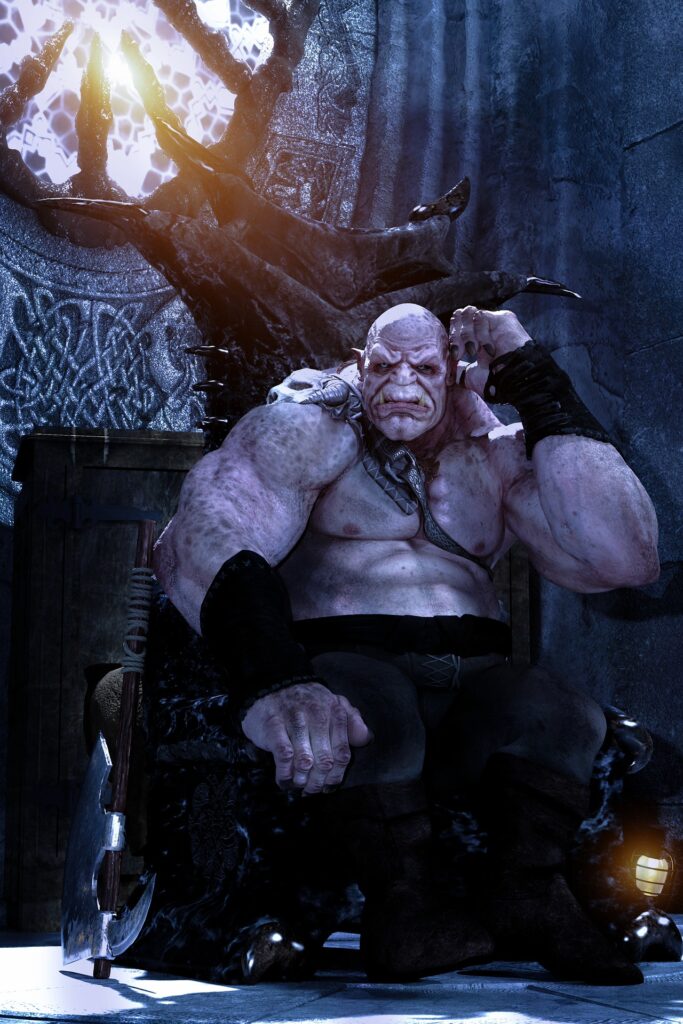
You stand outside the throne room, your best book clutched tightly in your sweaty hands, your mouth as dry as the desert, your heart pounding like a jackhammer.

Behind you lies a trail of destruction throughout the motherland, the mark of the New World Ruler, King Badassi. All of civilization has been leveled, the previous government incinerated, the thinkers and professors led to the chopping block, and the inventors herded like cattle to the Ruler’s pens where they will be put to his work.

Now, Badassi is starting on the writers. The nonfiction authors and journalists have disappeared. The writers of fiction are next. But…whispers have spread the rumor that 1001 writers will be spared…if they can hold the New World Ruler’s interest for one minute.

You are next to enter the throne room and face your judgement. You must entertain and captivate to avoid the thumbs-down and the escort to the door with the giant and his bloody executioner’s axe. You must muster the saliva and begin a tale so enticing it cannot be interrupted…for just one minute.

What will you say?

Use the first line or sentence or paragraph from one of your books, your favorite book, or create a new one.

 We’re rooting for you, holding our breath. We want to see you on the other side in the ranks of the 1001 authors – the 1001 Authorial Knights. You can do this!

Not Even More Rules

Not Even More Rules
Terry Odell

Photo from Wikimedia Commons

If there’s one “rule” of writing, especially in these days of indie publishing, it’s that there are no rules. Want to leave out quotation marks? Go for it. Want to replace them with dashes? Why not? Want to publish without any eyes but your own on the prose? Do your thing.

And, in these days of indie publishing, we can split these ‘rules’ into two basic categories. Rules of writing, which lean toward grammar conventions, and rules of publishing, which relate to what happens once the book is set loose into the world of readers.

Since there was a recent post about Heinlein’s rules, I’m following up with these from Kurt Vonnegut, which, as did Heinlein’s, relate more to the publishing side of things.

8 Rules for Writing

  1. Use the time of a total stranger in such a way that he or she will not feel the time was wasted.
  2. Give the reader at least one character he or she can root for.
  3. Every character should want something, even if it is only a glass of water.
  4. Every sentence must do one of two things—reveal character or advance the action.
  5. Start as close to the end as possible.
  6. Be a sadist. No matter how sweet and innocent your leading characters, make awful things happen to them-in order that the reader may see what they are made of.
  7. Write to please just one person. If you open a window and make love to the world, so to speak, your story will get pneumonia.
  8. Give your readers as much information as possible as soon as possible. To hell with suspense. Readers should have such complete understanding of what is going on, where and why, that they could finish the story themselves, should cockroaches eat the last few pages.

— Kurt Vonnegut: Bagombo Snuff Box: Uncollected Short Fiction (New York: G.P. Putnam’s Sons 1999), 9-10.

My personal thoughts and interpretations:

  1. The last thing I want is to hear someone saying, “well, there are XX hours I’ll never get back” after reading one of my books.
  2. Totally agree. It’s all about the characters for me, and I give readers more than one.
  3. We’ve heard this one a lot, both here at TKZ and at a myriad of other writing sites. Enough said.
  4. Need to remember this one. Wandering down Happy Lane in Happy Town doesn’t do much for book pacing.
  5. Yep, we’ve heard this one a lot, too. My self-measured progress as a writer was how much less I had to cut from the beginnings of my books.
  6. Another familiar one. Put your character up a tree and throw rocks at them. Or shoot at them.
  7. This one sits at the top of my list when I hit the editing phase. Don’t second guess yourself. Some readers will have issues with something in your book, be it a character who reminds them of their ex, or setting, or POV, or tense, or anything else. Let it go. Write your
  8. Not sure how to interpret this one. As writers focused on mysteries and suspense, we want that twist, that surprise.

Seems to me, we each make up our own rules, be it on the production side or the story side. We do what works for us, writing the best story we can by our personal standards.

Any of Vonnegut’s rules resonate with you? In either direction?

**Anyone going to Left Coast Crime in Tucson? Would love to meet!


Available for Pre-Order

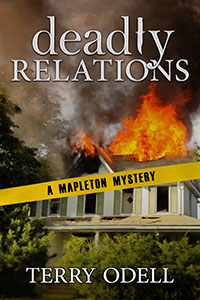
Deadly Relations.
Nothing Ever Happens in Mapleton … Until it Does
Gordon Hepler, Mapleton, Colorado’s Police Chief, is called away from a quiet Sunday with his wife to an emergency situation at the home he’s planning to sell. A man has chained himself to the front porch, threatening to set off an explosive.


Terry Odell is an award-winning author of Mystery and Romantic Suspense, although she prefers to think of them all as “Mysteries with Relationships.”

Plotting With Post-it Notes

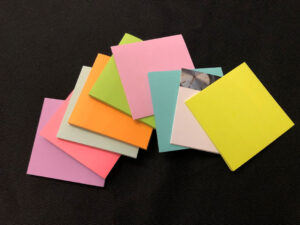
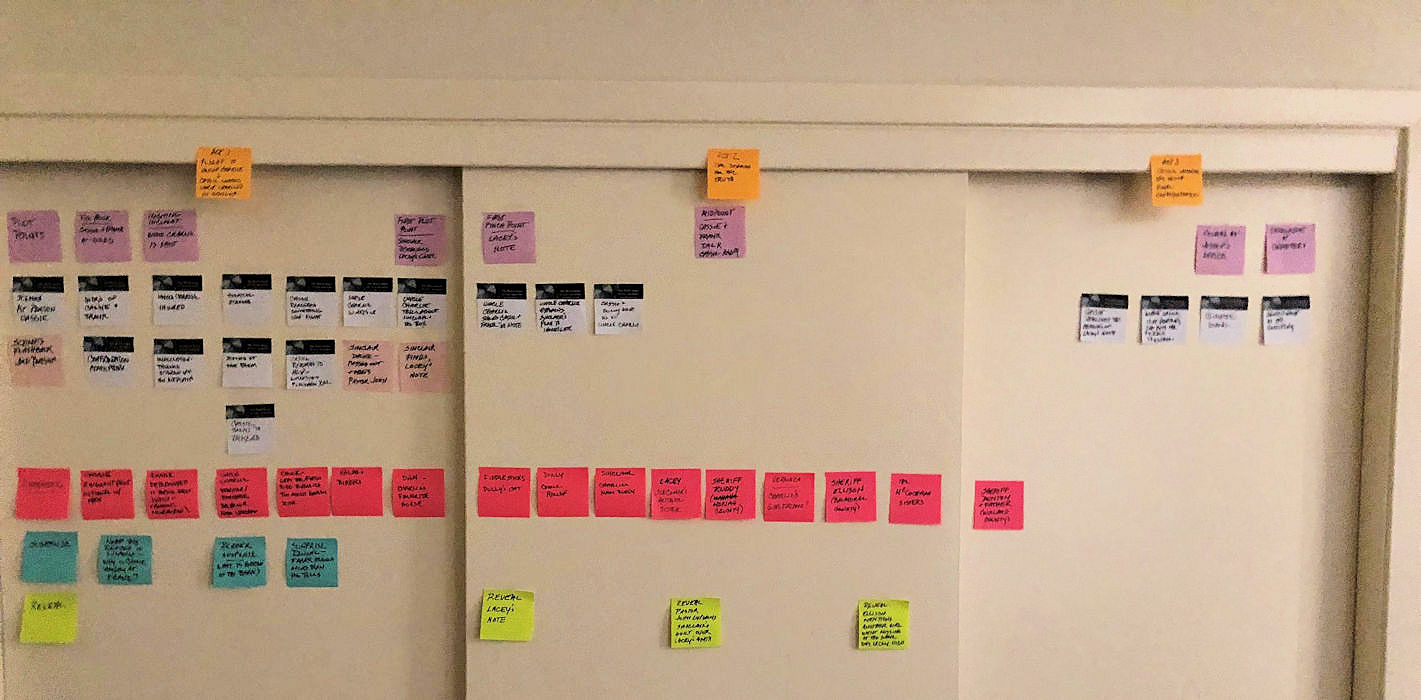
There’s a three-door closet in my office. At some point early in my writing career, it occurred to me that this closet would be particularly useful for creating a storyboard as I constructed my novels. Each door represented one act in the story.

I’m a hybrid plotter/pantser. I think of my method more as a process of iterative writing, and the storyboard works well for me. First, I come up with a general plot idea, post the first scenes on the storyboard, and start writing. Each day, I stand in front of the storyboard and think about how the story is developing. I decide on additional scenes, post them, write them, and repeat the process.

Here’s a brief summary of the post-it note storyboard I created for my fourth novel.

* * *

STARTING OUT

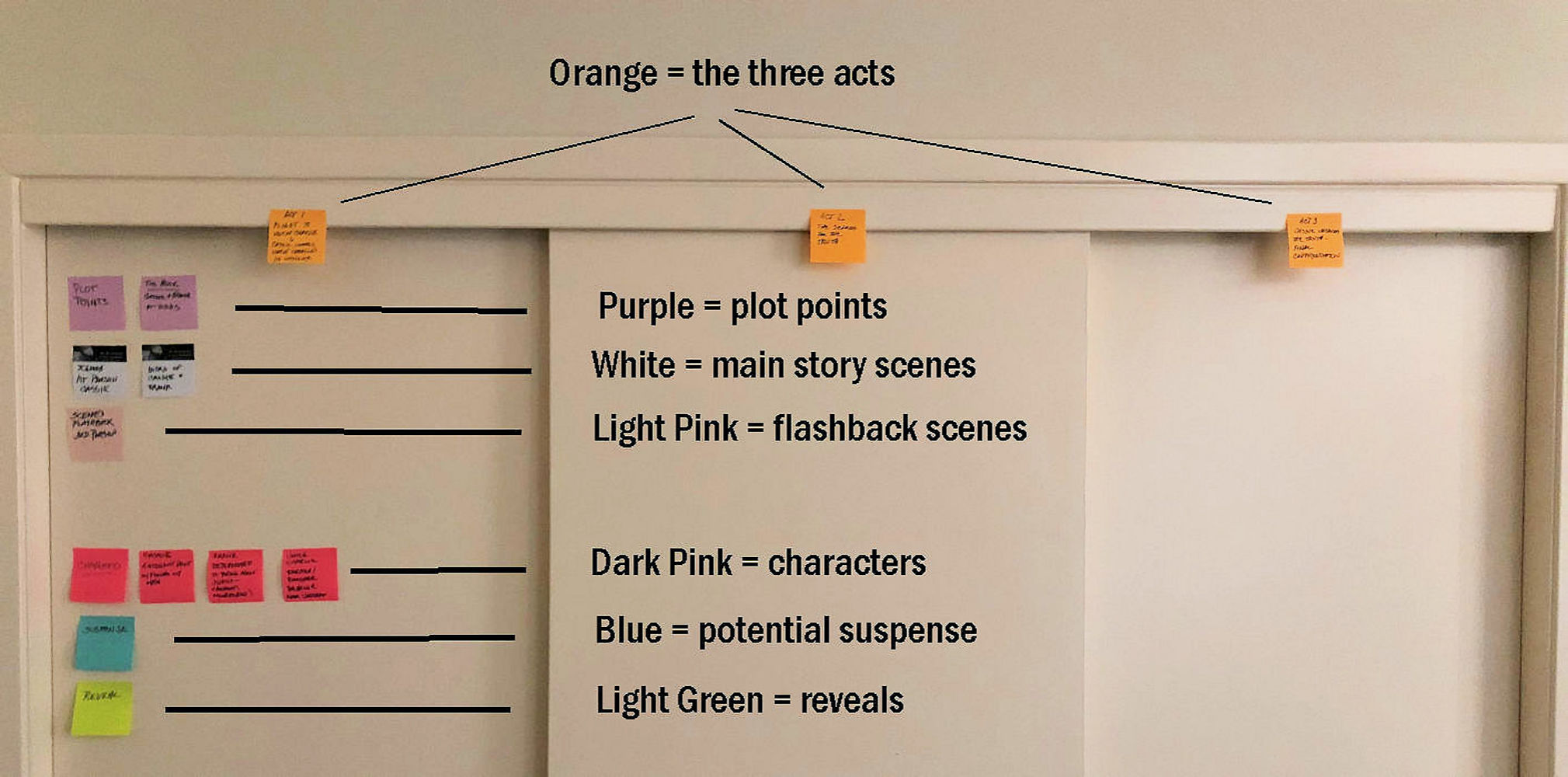
Once I decided on the first scene and a few characters, I set the storyboard up.. It was laid out horizontally, left to right. I use different colors to represent different elements of the story. Here’s a reconstruction of the initial setup for my WIP with definitions added for each color.

The three acts are in orange. The purple notes are plot points (e.g., hook, inciting incident.) The story is mainly written in first person, so the white notes are for those scenes. There are a few flashback scenes that are denoted by light pink. There has to be a fair amount of real estate for the white and light pink notes since scenes are the greatest part of the.storyboard.

Characters are in dark pink.

With this book, I had the idea to note particular places where I wanted the reader to wonder what’s going on (e.g., Why is she so mad? Why would thieves steal something of so little value?) I call those Suspense points, and they’re in blue.

I also wanted to mark where information is revealed to the reader. (e.g., Ah, that’s why he’s so distant.) Those Reveal notes are light green.

* * *

MAKING PROGRESS

I add or change the plot to satisfy something I’ve discovered, then I continue to write. Sometimes I decide on an ending before I’ve figured out all the details in Act 2. In the picture below, I’ve defined all the characters and have Act 1 pretty much under control. I’ve added scenes for Act 3, and I’ve begun work on the middle. Most of the purple plot points have been put in place.

This cycle continues until I think the story is completely fleshed out.

* * *

COMPLETING THE FIRST DRAFT


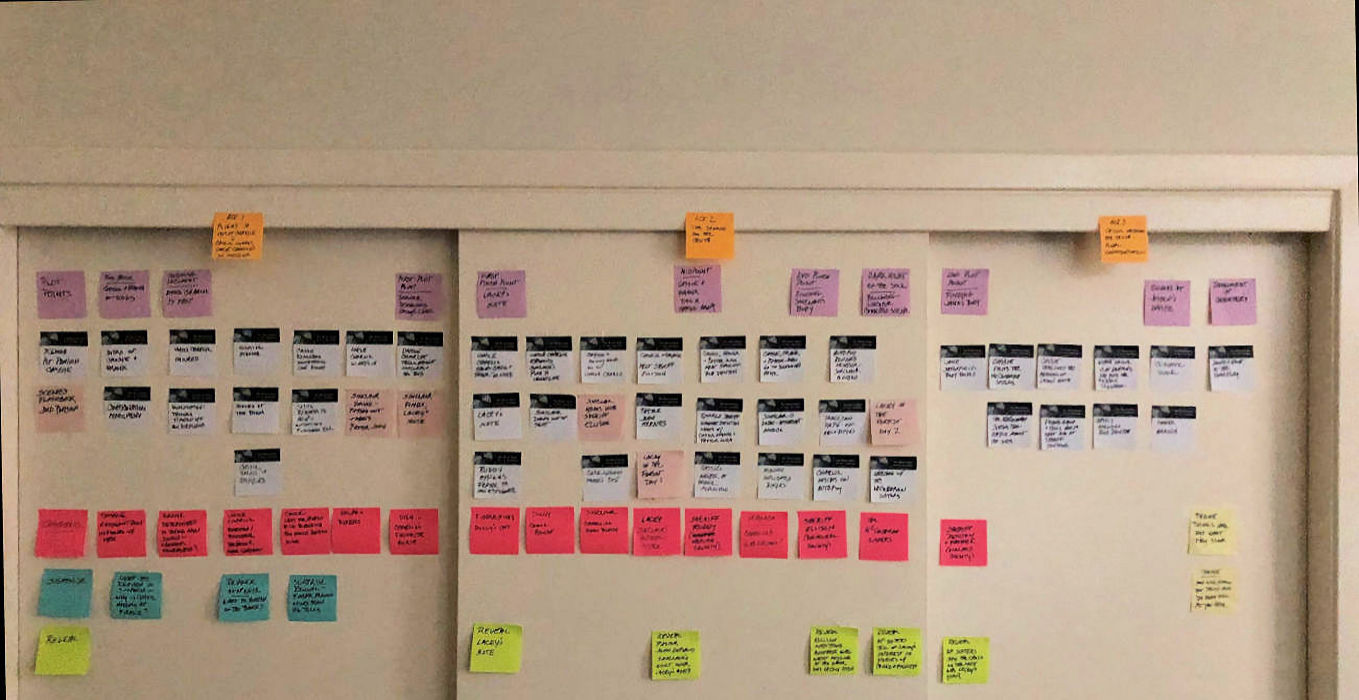
Here’s the storyboard as it appeared when I was close to completing the first draft.

You can see I added a couple of yellow post-it notes to the right-hand door. These are possible themes for the book.

At this point, the story is well-defined in my head, and I won’t bother changing the notes on the doors.

* * *

WHY DO I DO THIS?

There are several reasons I like the storyboard.

  1. I like seeing the entire story laid out in front of me as I’m building it. I can reacquaint myself with the sequence of events in just a few minutes.
  2. It helps me spot places where a new scene should be inserted or others should be rearranged.
  3. Moving things around is fast and easy.
  4. There’s something satisfying about the tactile nature of jotting down a note and adding it to the story or moving a note from one place to another.
  5. i can design my storyboard the way I want it without having to adapt it to an app.

There are ways to do this electronically. I work in Scrivener, and there’s a corkboard feature that displays scenes on an electronic corkboard. I suspect there are apps that let you lay out the entire story as I did here, but I can’t see the “big picture” without having a big space to lay it out on.


So TKZers: How do you plot your stories? Are you a plotter or pantser? Do you use an outline or some kind of index card layout to organize your thoughts?

Musical Words of Wisdom

I almost always write to music. Music helps me get into the writing zone and stay there, and also with creating a particular mood in myself while working. I have a wide variety of music playlists. When I am drafting, I can play songs, but when I am revising, it needs to be instrumental—movie scores, electronica, synth-wave, even classical music at times.

Sue’s post this past Tuesday about using ringtones for characterization and Kris’s on Wednesday discussing a story’s soundtrack inspired me to search the KZB archives for posts dealing with using music, to hopefully start a discussion and share insights.

The first excerpt is from a 2010 Joe Moore post about film scores. The full post provides a list of film scores he liked. The second excerpt is from author Robert Liparulo, and is a fine follow-up, discussing how he uses film scores to create his fiction. Our final excerpt today is from Kelli Stanley, talking about how a soundtrack can help you mentally recreate another era.

As always, the original posts are date-linked at the bottom of their respective excerpts.

Lets start by looking at the cinema. Arguably, a movie would lose its impact without music. Even in the days of silent movies, there was a live piano player in the theater whose job was to add drama to each scene. You can have the greatest photography, acting, direction, set design and script, but without music, the movie would probably fall flat. Not to be confused with what some call movie soundtracks–usually a collection contemporary tunes–movie scores are written and orchestrated pieces of original music specifically designed for a particular scene. They enhance and support the visual images. If you listen to a movie score isolated from the visuals, it can verge on being classical in nature. As a matter of fact, I consider names like Trevor Jones, Randy Edelman, Hans Zimmer, Ennio Morricone, James Horner, John Williams, Howard Shore, and many others to be our modern day classical composers.

I discovered many years ago that I could also use the element of music to help me write. Someone gave me the CD score to THE MISSION with Robert De Niro. It happened to be playing on my stereo as I started a new chapter, and I realized that the music set exactly the same mood as the scene on which I was working. So from then on, as I watched movies I would pay particular attention to the scores. If they evoked the type of mood I sought in my WIP, or just set a very cool, dramatic, romantic or spooky mood, I would order the CD and rip it to MP3.

I now have a huge collection of scores on my computer and rarely sit down to write without my MP3 player on “shuffle”. I don’t use any music with lyrics since I find that other people’s words distract me. That’s why scores work so well—in most cases they are instrumental.

So if you’d like to try writing dramatic scenes to music, here’s a short list of my favorite CDs that seem to have it all when it comes to creating a mood found in most mysteries and thrillers.

Joe Moore—December 9, 2009

For as long as I can remember, I’ve listened to music as I wrote—through years of writing magazine articles and intermittent screenplays. It started as a way of deadening the sounds of screaming kids, vacuum cleaners, and when I rented an outside office, the shouts coming from the divorce attorney’s office next door. Then I started writing novels, and the type of music I played suddenly mattered.

Faster tempos do help keep the pace up—if not within the story, then at least with how fast my fingers move over a keyboard; but then, volume helps with that as well. The louder, the better. More important than tempo is how a piece of music makes me feel. A cue that starts off slow and builds to a triumphant crescendo can carry me through a fast-paced action sequence as well as any nonstop, staccato rhythm. “Chevaliers de Sangreal” from The Da Vinci Code, for example: a hero’s theme if ever there was one.

Over time, I’ve built a library of music categorized by the mood it puts me in when I write. Take, for instance, Clint Mansell’s haunting music for Requiem for a Dream. Its cues seem to be teetering on the edge of something, without relief or execution. No wonder several of the titles have the word “Tense” in them. When I launch into a suspenseful scene, I’ll often queue up my Requiem playlist.

Here’s a specific example of a partial scene and the music I was listening to when I wrote it:

“With the speed and fluidity he had practiced a thousand times, Hutch drew back on the bowstring and released it, all in one, smooth two-second motion. He held still for another beat to make sure the arrow cleared the bow. Then he dropped his right arm to a second arrow rising from the ground beside him. His bow arm never moved. His head never moved. His eyes never came off of Bad. As the arrow sliced a groove through Bad’s skin at the temple, Hutch was already nocking the next arrow.”

Most likely, Quentin Tarantino would go with something fast and exotic, like NEU!’s “Super 16” from Kill Bill. Because the scene is a mix of suspense and action, I powered up “Betrayal” from Enemy at the Gates—from the scene in which they discover a young boy murdered and hanging from a crane. It’s emotive and heart-wrenching, and prior to the “discovery” almost painful in its anticipation.

My writing-music of choice is almost always film scores. It seems to me that movie moguls are the benefactors of today’s great composers, Hollywood the new Vienna. I also like that the structure of a good story—with its cycle of tension and relief, despair and triumph—forces a wide variation in music within one recording. I used to think the strong bond between a movie’s images and its music would cause me to think only of those images while listening to the score—Russell Crowe plucking his violin in Master and Commander. However, I’ve found that the spirit of the music takes over and I can claim it for my own. That’s why filmmakers often listen to other movies’ scores while on set. They’re not trying to imitate another movie’s scene; they’re letting the music help them get in the mood for their own scene. The director Ridley Scott is known for doing this.

Robert Liparulo—June 28, 2009


Y’ see, listening is particularly helpful when you’re trying to lose yourself in time. Because City of Dragons is set in 1940, I immersed myself in a lot of music from the era—and had to be very careful to not access something anachronistic. I wanted to hear what my characters did, and I was writing about a period in American culture when music was truly a mass medium of popular entertainment … and when our entertainment—thanks to radio drama—was more audio than visual.

The music was key to me feeling like I could capture the past. And then it became about character, too, about my protagonist reacting to that world, particularly the irony of achingly romantic big band swing juxtaposed to the atrocities of war.

So I found myself becoming immersed in the music, actually using it in the book. And I felt confident about being able to, since some writers I greatly admire—like George Pelecanos and Ken Bruen—reference music and lyrics in their works.

The rub, of course, is the permissions phase … something I didn’t know much about. But warning, all you Springsteen fans who want to include “The River” in your latest novel … the author is responsible for either acquiring permission or rewriting the scene.

In my case, I found out too late and had to rewrite certain scenes, retaining a line of lyric and hopefully the flow and rhythm and emotion of the original draft. But—like a DVD director’s cut—I was able to link up a City of Dragons playlist on my website, so that, whenever possible, you can listen to the music my characters do.

It’s a cool way of sharing not just what I like to listen to, but what became an intrinsic element of the book, and a kind of instant time machine back to February, 1940.

Kelli Stanley–January 28, 2010

***

Now it’s your turn to weigh on using music when creating fiction.

Do you listen to music when drafting? When revising?

If you do, is there a certain genre or style of music you prefer listening to?

If you don’t listen to music during your actual writing session, do you ever listen to it “get into the mood” before writing?

Reader Friday – Inkblots

WHAT DO YOU SEE?

In 1921 Swiss psychologist Hermann Rorschach developed the Rorschach Ink Blot Test to evaluate subjects’ psychological functioning. It is often used to explore personality characteristics and emotional functioning. The original test had 10 ink blots. The picture above is inkblot #10.

This past Monday, Sue used ring tones to define characters. Tuesday, Kris discussed sound tracks and their correlation with tone and emotion. Let’s continue our inspection of our characters with the Rorschach test.

The original test used 10 inkblots. Today we’ll use one. Here is the assignment:

  1. Pick the MC from one of your books or a favorite book.
  2. Have your MC inspect the inkblot above and tell us what he or she sees.
  3. Explain what that reveals about the personality of your MC.

 Please be as wildly creative as you wish. And realize this is an opportunity to plug your character and your book.

Naming the Baby


By Elaine Viets

I just turned in my latest Angela Richman, Death Investigator mystery. You know the hardest part of that novel? Coming up with a title.
Without a good title, the book can’t go forward – there’s no cover, no editing, nothing – without the title.
Here’s a brief teaser:
“Everyone in Chouteau Forest knows the legend of the Cursed Crypt. It’s claimed that the restless spirit of a professor nicknamed Mean Gene Cortini, buried in Chouteau Forest University’s crypt, has been causing death and destruction in the Forest for almost two centuries.”
My publisher’s contract calls this novel Untitled Angela Richman Mystery #8. Doesn’t sing, does it?
I gave the novel this working title, The Cursed Crypt.
But my editor didn’t like that name. Others dismissed it as “too Nancy Drew.”
So I spent the next couple of weeks trying to find a new title. This was serious work. I batted titles around with readers, friends and my agent. Finally, far I had:
A Cryptic End
Murder Most Cryptic
Murder at the Tomb
The Dead of Night
Death in the Night
Death Comes at Night
A Grave Ending
Money, Murder, and Madness
After much discussion, it was whittled down to one title. I checked Amazon and other online databases to make sure someone else wasn’t using that title. This was an important step. One New York publisher released two books with the same title. In the same year. I can’t imagine the confusion that caused both authors.
At last, the title was approved by the publisher’s editorial board.
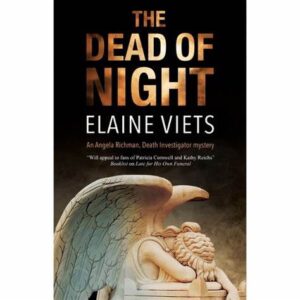
The new novel would be called The Dead of Night, and it has this gorgeous cover.

But there’s still one pitfall.
Choose the wrong title, and my book could wind up on the Goodreads list of “Worst titles: Some titles don’t go with the books.” About 227 books made the list. Here are two obvious examples:
Truth, Dare, or Handcuffs or Threeway.

Not as catchy as Fifty Shades of Grey, is it?

It addresses this dilemma: “When two men love the same woman, what are they to do?”
Then there’s this one: Such a Pretty Fat: One Narcissist’s Quest to Discover If Her Life Makes Her Ass Look Big, or Why Pie Is Not the Answer.

I expected to be hit by lightning just for reading this title: Jesus Potter Harry Christ: The astonishing relationship between two of the world’s most popular literary characters: a historical investigation into the mythology and literature of Jesus Christ and the religious symbolism in Rowling’s magical series.
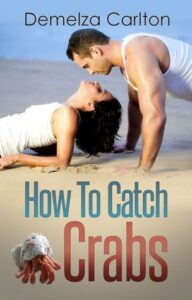
This next example is a truly terrible title for a romance novel: How To Catch Crabs.
It’s not about those crabs. It’s about a seagoing man who catches crustaceans: “A tale of crabs, cricket bats and catching your heart’s desire in Jazz Age Western Australia.”

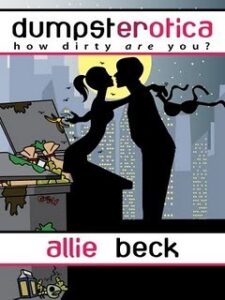
And here’s a really trashy novel: Dumpsterotica: How Dirty Are You? Described as an “erotic comedy series,” this short story “puts the ‘rot’ in erotica; after reading this you’ll never look at a Dumpster the same way again.”I’ve already changed my mind about Dumpsters.
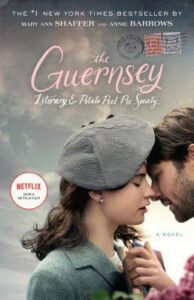
I was surprised to see big-time titles on this list, including all four books in the Twilight saga: Twilight, New Moon, Eclipse and Breaking Dawn.

The Guernsey Literary and Potato Peel Pie Society also made the list. I liked the book and the movie, but the cover has nothing to do with the title.
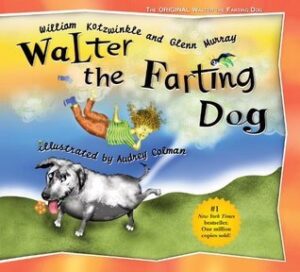
Some titles on the list are so disgusting I won’t print them. Others have one or more F-bombs. But I was sorry to see Walter the Farting Dog there. If you’re not familiar with William Kotzwinkle’s children’s book, here’s the story:
“Walter is a fine dog, except for one small problem: he has gas. He can’t help it; it’s just the way he is. Fortunately, the kids Billy and Betty love him regardless, but Father says he’s got to go! Poor Walter, he’s going to the dog pound tomorrow. And then, in the night, burglars strike. Walter has his chance to be a hero. A children’s beloved classic, this story will have kids rolling on the floor with laughter. Adults are permitted to laugh too.”
I have my own story about Walter. I was working behind the register at a Barnes & Noble, when a dignified woman in a Chanel-style suit (in Florida, yet!), came up to the counter holding the Kotzwinkle book by one corner, as if she couldn’t bear to touch it. She was livid. Her voice was cold, soft and deadly. “Someone. Gave. This. Book. To. My. Child.”
She didn’t have a receipt, but the store took it back. I felt sorry for the poor kid, but Kotzwinkle and his crepitant canine didn’t need my sympathy. There’s a new book in the saga: Walter The Farting Dog Farts Again.

****************************************************************

The Dead of Night will be published April 4. Preorder your copy now.
https://tinyurl.com/2c4qzlb6

The Soundtrack of Your Story

By PJ Parrish

Well, I didn’t purposefully piggyback on Sue’s post yesterday What Do Ringtones Say About Your Character.  We’re not that cleverly organized here at TKZ. But the beat goes on. Today I’d like to talk about our musical muses.

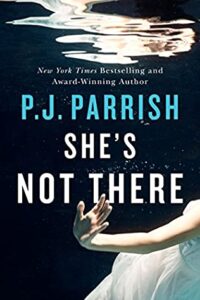
Several years ago, on the publication eve of our stand alone She’s Not There, Thomas & Mercer sent us a lengthy and provocative questionaire about ourselves and our book. The purpose was to pinpoint marketing campaigns and help with the book’s design design.

They asked what who we thought our audience was. (Answer: thriller readers who like character-driven stories) What we believed the “tone” of our book was (Medium dark but ultimately hopeful). They asked us what “color” our story was. (Midnight blue). They asked us for images that might inspire a cover design. (We sent them photos of women drowning like the one below left. The second one is the actual cover.)

They also asked us what music, if any, had inspired us during the writing. That last question hit the target with me. The idea for our book came as I was jogging and “She’s Not There” by the Zombies came on. I started really listening to the lyrics:

Well, no one told me about her, the way she lied
Well, no one told me about her, how many people cried
But it’s too late to say you’re sorry
How would I know, why should I care?
Please don’t bother tryin’ to find her
She’s not there
Well, let me tell you ’bout the way she looked
The way she’d act and the colour of her hair
Her voice was soft and cool
Her eyes were clear and bright
But she’s not there

The story is about Amelia, a woman who early in life lost her way on the path to living an authentic life and finds herself trying to be someone else for her rich ambitious husband. She’s living a lie. Until an accident makes her lose her memory, and she begins a journey to reclaim her life and maybe find a truer version of herself. All this while someone is hunting her down to kill her — maybe her husband.

I was struck by the woman in the Zombies song — outwardly beautiful but not there inside. The story almost wrote itself, one of the few times this has happened to me, mainly because I knew Amelia and the sotto voce song she was singing to me.

Music is often in the back of my brain when I write. I don’t mean literally because I can’t write while music is playing; it really distracts me. Writing habits is not what I am talking about here today. That’s another topic.

The point I’m trying to make is that I believe every good book has a soundtrack, a melodic mood, if you will. Now, I’m not talking here about a character’s musical taste (ie Harry Bosch famously loves jazz). Although, as Sue pointed out yesterday, knowing what music rocks your character’s soul is part of that dossier you need to be creating. I’m trying to articulate something about the mood-currents and rhythms that propel your story itself.

Only once do I remember having a hard time hearing anything as I wrote. Ironically, it was a book about music: The Killing Song, wherein a serial killer in Paris who is a professional cellist leaves behind musical clues with each victim. The clues were easy because they were all popular music (ie Elvis Costello’s “Crimes of Paris.”) But I couldn’t come up with anything that captured the black heart of the killer. I asked a cellist friend and she suggested a piece called Tout un Monde Lointain. Rough translation: All the world, distant. Which is exactly how my villain feels — alone, cut off, every question unanswered, every cry unheard.

As I listened to the piece, I began to understand him. The piece opens with a shiver of cymbals. Then the cello begins a slow meditative solo but it keeps shapeshifting from balanced to intense, almost chaotic plucking. It feels like two souls struggling. Here’s the opening minute.

As I’ve mentioned, I’m judging manuscripts for a writers conference right now. I am struck by how few of the writers seem to have given any thought to what “color” their stories are or what music is playing in the background. The few that do “sing” have a defined mood that really makes me want to read on. I can see — and hear — the worlds the writers are conjuring for me.

Also, I was thinking about this subject after I watched the film Tár, wherein Cate Blanchette plays a mentally tormented orchestra conductor. The soundtrack, heavy with Mahler and Elgar with doses of Count Basie and Cole Porter, was done by Hildur Guðnadóttir, who calls the movie “an ambient tone poem.”

The score gives the film its undertone of dread.  Guðnadóttir said in one interview: “There is a lot of music in the film that’s working on a very delicate, subconscious level, and if you took it out, it would be a completely different animal.”

That got me to thinking about other scores that amplified the tones of movies. Listen to this piece of music that was used behind the arrival of Eleanor (Katherine Hepburn) on parole from prison, in The Lion of Winter.

Regal, ethereal voices — but undercut with death-tolling bells, and discordant horns that signal a darkness beneath the pageantry.

Another score I think supports its story is in Master And Commander, much of it original, but also brilliant choices from classics. I love this piece for the way the background pulse mimics the rhythm of a sailing ship bouncing over waves as the human bustle goes on above board.

https://www.youtube.com/watch?v=l78VNe_dhAM

There are endless examples of scores that deepened a movie’s emotional impact. Hitchcock had his Bernard Herrmann. Sergio Leone had his Ennio Morricone. Coppola had his Nino Rota. John Williams played two tuba notes for Steven Spielberg and no one wanted to ever go into the water again.

So, what can we book people glean from this? Well, I’m often harping here on the need for tone. Every successful story has its own particular rhythm, mood, and ambience. You may not be always conscious of this, but the way you, as a writer, choose to put your words and sentences together creates a type of music. This soundtrack, be it butterfly-flit-light or chiaroscuro shadowy dark, must support your plot and characters. It must be true and unique to them. To your story. To you.

I can see you out there scratching your heads. Well, let’s try this experiment. Your book has just been bought by some bigly big director at Lionsgate. They have brought you on for extra money as a consultant (Stop that laughing!) They ask you what music is playing as the movie opens, and what music is playing as the credits roll. Do you sit there dumb as a stump? Or do you know, deep in your writer bones, what needs to be heard.

I daydream about this often. I have songs all ready to go when Hollywood calls. At the beginning of Dark of the Moon, as Louis Kincaid is tramping through the Mississippi swamps and sees a skeleton with a noose, “Strange Fruit” is playing but only in instrumental because I want it subtle.

At the end of the movie, Louis gets in his old Mustang and drives away from Blackpool Mississippi, heading home. Case is solved but Louis’s heart is not. Credits roll. There’s a long birds-eye pull-away shot of a small white car heading north through a huge close expanse of green trees. And this is what we hear:

Hey, it’s what’s playing in my head. Now, what’s in yours?