Shutting Down and Opening Up

By Elaine Viets


Open-MouthBy Elaine Viets 

Recently, I’ve seen a rash of news stories with headlines like these:

“Retired Air Force four-star general opens up about Wright-Patt, DDC.”

“Marine general opens up about battle with prostate cancer.”

“Wells Fargo CEO opens up about his childhood in poverty.”

Opens up? No, they didn’t.

“Opens up” implies that a person hesitates to talk about a subject, then relaxes and spills the information they didn’t intend to. “Opens up” paints a cozy word picture: We see the reluctant subject settling in over a beer or a cup of coffee, looking a bit nervous. After skillful questioning, the interviewer pries that pearl of information out of the oyster. The subject opens up and reveals a deep secret.

pearl-oyster-sea-farming-101

Wrong.

Retired generals and CEOs don’t open up. They didn’t get to the top by opening up anything, especially their mouths. Every word they say in public is carefully calculated.

Even clown prince Donald Trump knows what he’s doing when he shoots off his mouth. His outrageous remarks get him the attention he needs to rack up the poll numbers – he wants to be one of the top ten in the Republican presidential debate.

And while we’re talking about opening up, why doesn’t Trump’s barber open up and say the Donald’s hair looks lousy?

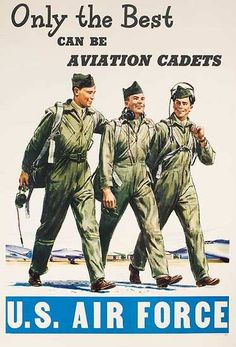
air force

Anyway, about that so-called opening up: The retired four-star general didn’t open up about the air force base.

He told a newspaper he didn’t like “the focus on a potential Base Realignment and Closure process — because he sees bigger dangers to Wright-Patterson Air Force Base — and warns of complacency because the base has fared well in recent years.”

That isn’t “opening up.” The general is sounding off, possibly to preserve a local pork barrel. He’s been put up to “open up,” and the headline writers fell for it.

Marine-Corps-Logo

And the Marine General who “opened up” about his prostate cancer?

More careful calculation. The story says, “In the midst of planning a complicated drawdown in forces, the Marine Corps’ three-star manpower chief received startling news: He had cancer.”

But he soldiered on, did his military duty and survived his battle with cancer.

That was one brave general. But the article stresses that many men, important men, get prostate cancer, get treated and survive.

I salute the general for discussing a sensitive issue. But he didn’t “open up” – as an ex-reporter I smell a carefully calculated public relations opportunity. He discussed prostate cancer and urged other men to get the exam they fear.

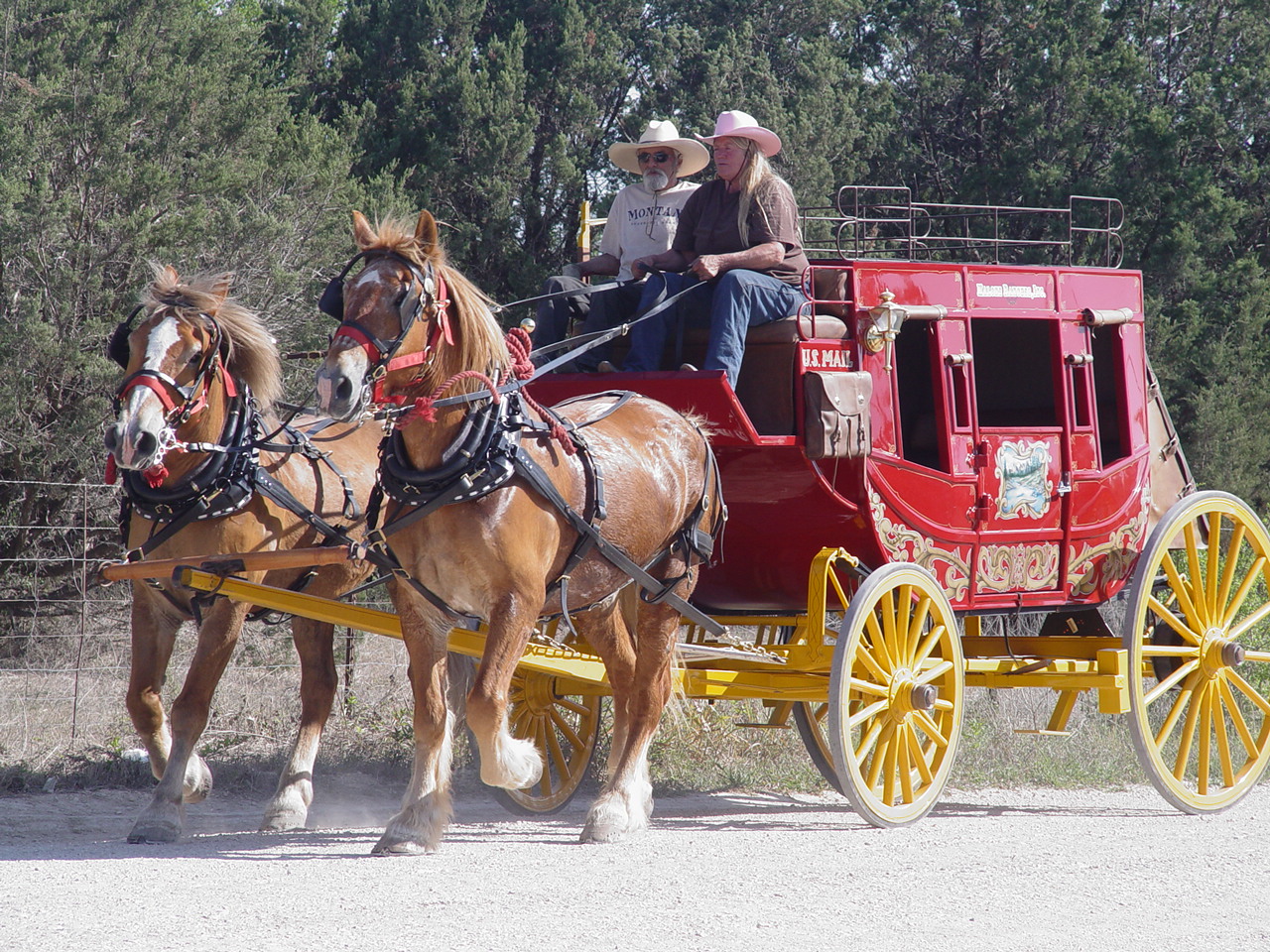
STAGECOACH3%20002

Then there’s that Wells Fargo CEO. Did he really “open up” about his poverty-stricken childhood? Absolutely. Right after he handed out free money to the first one thousand customers.

Hell, no. That “opening up” was another PR ploy. Wells Fargo has had a wagon load of bad publicity about its foreclosures. But here’s this CEO, “one of 11 children growing up on a farm in small-town Minnesota,” who “knows how much trouble we were in financially by the time I was 6 years old . . . We bounced between bankruptcy and foreclosure until I was 15 or 16, when we got a chicken farm, where we had 15,000 laying hens. All of a sudden we had regular income.”

Oh, and by the way, Well Fargo “will continue serving real customers in the real economy.”

Sniff! Sniff! What’s that smell? Is it coming from that team of Wells Fargo horses?

Watch where you step, writers. And be careful about “opening up.”

You can fall into a dangerous word trap.

                           *********************************

Win Elaine’s latest hardcover mystery, “Checked Out.”  Click on Contests at www.elaineviets.com


Indie Book Store Confidential

books

Editor’s note: Kris is up in the wilds of Northern Michigan helping her sister Kelly move into a new condo. She is busy painting the kitchen so Kelly is stepping in today. All these stories are true but the customers’ names have been withheld for obvious reasons.

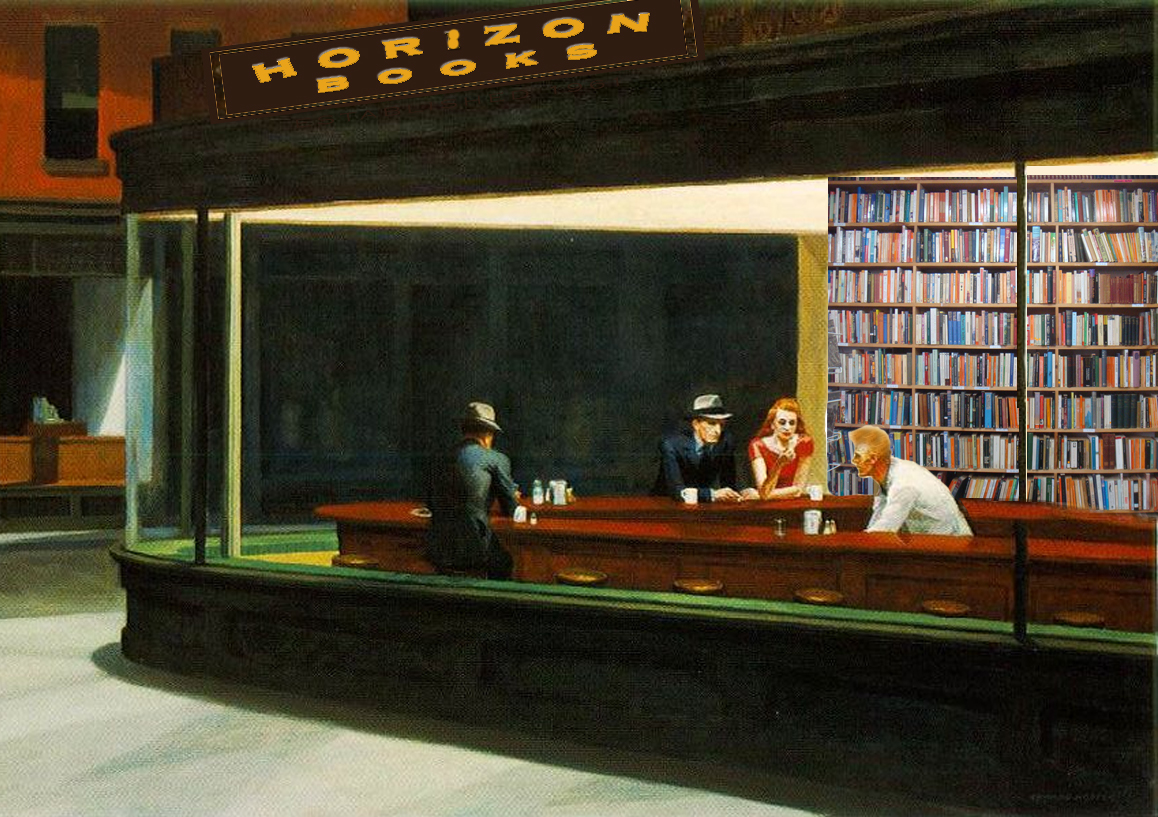
It was a dark and snowy night. I was working the late shift all alone at Horizon Books in Traverse City. The cavernous store was as empty and quiet as Al Capone’s vault. The windows dripped with sweaty heat. Across the street, the red neon sign of the Milk and Honey Ice Cream shop beat blood-red, like a broken heart.

I was leaning on the counter, reading a copy of Hilary Mantel’s Wolf Hall. I only cracked it open because it was my job to know what’s hot and I always did my job. But I was only twenty pages in and I was already tired of characters named Thomas.

Suddenly, the air turned cold, sashaying over me like a discarded mink stole. I saw a dame standing near the door. Red heels, silk stockings, red skirt and a high-collared leopard fur coat with a matching hat, cocked with sass. She wasn’t young but I could tell she had paid a lot of money to have folks think otherwise.

Her baby blues jumped left and right and her red lips pursed slightly as she approached the counter. I knew what she was going to ask for. I knew because not only is it my job to know what’s hot, I got a knack for knowing exactly what people want.

She was an easy read. Before she ever reached the counter, I discreetly reached into what we at the store called “The Case.” The Case is where we keep the VHS Porn Movie Guide, Cannabis Culture magazines, Naked Art Books, the Karma Sutra, and a handful of other titles low-lifes have a tendency to sticky-finger out the door.

I wrapped my hand around the slick spine of a trade pulp and laid it silently on the counter. The dame blushed and reached her for dough. It cost her sixteen Washingtons, all shades of green, but I had a feeling that she would’ve paid fifty, one dollar for each shade of Grey.
Then she was gone into the white confetti of the Michigan night, just one of a hundred happy Horizon readers, eager to experience literary new worlds.

I was just being introduced to yet another Thomas in Wolf Hall when the door opened again. This time, it wasn’t milk and honey but milk and cookies. Shirley Temple with red hair and Sock Monkey mittens. She could barely see over the counter.

“Do you have Mable Makes a Move by Anne Mazer?”

I love little kids who read. There are so few nowadays. I punched at a keyboard that was so old it looked brushed with fingerprint dust, and scrolled through our 1990s WordStock system for the title. Yeah, the computer’s as old as the Clinton-Lewinsky scandal, but hey, it works. And indie bookstores don’t have much cash flow. Nothing came up. Section 904 -– younger young adult — is not my area of expertise. I’m a hard-boiled kind of clerk.

“Is that part of a series?” I asked.

She gave me the How-dumb-are-you? eye roll. “It’s the Sister Magic series. Book Six. Anne Mazer. M-a-z-e-r.”

Feeling a hundred years old, I strolled to the 904 aisle to get the book for Miss Sassy Pants. But I found myself standing there in a maze of pink and purple books, all with glittery spines and little blonde girls and unicorns on the covers.

“There it is,” the girl said as she snatched the book from the shelf. She was back at the counter with the exact change before I could bag her up.

“You’ll enjoy that book,” I say to make conversation as she counted her pennies.

“It’s not for me,” she said. “It’s for my younger sister. I’m reading The Chronicles of Narnia by C.S. Lewis. It’s very old but holds up well. Thank you.”

I sighed in satisfaction as I watched her go, amazed and hopeful for the next generation. Finding the right book for the right reader is the best part of my job. But that’s only part of what goes on in an independent bookstore.

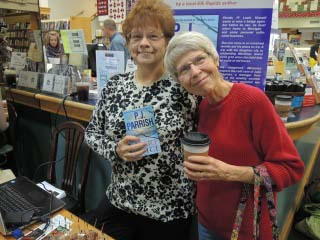
Kelly posing with our book HEART OF ICE and a very nice Horizon Books customer

Kelly posing with our book HEART OF ICE and a very nice Horizon Books customer

We all wear many fedoras here. We shelve new arrivals and ship out the flash-in-the pan hardcovers when they fall off the NYT list. We find impossible-to-find out of print titles for discerning readers. We babysit authors for signings, from the local geezer who wrote a fly-fishing guide to the likes of Steve Hamilton and Mardi Link. We tote books to business luncheons, library fund raisers and school carnivals. And yeah, we make coffee, too. Some of us even know latte art.

You learn a lot working behind the scenes. Some things you might not want to know, like what’s really in a Jimmy Dean sausage. But if you want the dope on how you, as an author, can get the “bulge” (advantage) when working with an indie store, well, maybe this hardboiled old bookseller can give you some hints:

1. Don’t piss off the Author Events Manager.
2. Do not bring in consignment books without being asked.
3. When you first approach the Events Manager, please arrive with sufficient materials in hand so the manager knows what the book is about. A copy of the book might be good.
4. Do not call every Sunday and ask how many books you sold this week.
5. Do not show up late for your event. Maybe, just maybe, people might be waiting.
6. Don’t be a stump. Most events will not require you speak to a group. Your first store events will be done at a table, behind a pile of books. STAND UP. Talk to people, and smile. Have postcards or flyers with a synopsis and let the customer walk away and read your stuff. Pretty good chance they will come back and buy. Flyers can be printed at home!
7. If your book is non-returnable, do not expect your bookstore to carry it on any basis but consignment. You bring it in and get paid only if you sell one.
8. If your book is consignment, do not be surprised if your local store refuses to carry it or do an event. It’s just the way it is. However, even if your book is from Createspace, if it has local interest, many stores are very likely to not only carry it, but actively promote it.
9. If you visit your bookstore as a reader, do not ask a salesperson to look up a book and when you find out the store does not have it but can order it for you, do not tell them you are going to go home and order it from Amazon, where you can get it cheaper. You might find yourself with a boot up your butt as you go out the door.
10. Remember that the folks who work in indie bookstores usually are there because they really love books. And writers. But remember that they are human and just might be having a bad day at the latte machine or just had to deal with a really dicey customer.

Which brings me back to that dark and snowy night. It was near closing and I had already done most my duties: run out the stragglers, reshelved the books people sat and read for eight hours, cleaned the coffee bar, took out the trash, and rolled the pennies for the day shift.

I was this close to a clean getaway when another cold blast of air made me look to the front door.

The kid was standing there wet and bedraggled. As he slurped over toward me, I saw the piercing in his nose and the desperation in his eyes.

“I need a book,” he whispered.

I had already locked up The Case and wasn’t about to open it for another would-be weed farmer.

“We got books,” I said.

“I need it for school,” the kid said. “It’s called One Flew Over the Cuckoo’s Nest.”

The kid looked like he didn’t have the strength to go get it himself, so I hopped over, came back and slid the slender paperback across the counter. He stared at it like it was a dead walleye.

“Is this hard stuff?” he asked.

“Not too bad.” I paused, feeling a moment of pity for this pathetic creature. “You seen the movie?” I asked.

His eyes brightened. “There’s a movie?”

“Yeah, it’s a little dated but it’s good and has a powerful message on the mental health system in America.”

The light left his eyes.

“Hey, you can’t go wrong with Jack Nicholson,” I said.

“Who’s he?”

I shook my head and picked up the wad of crumbled bills the kid had set on the counter. I bagged up his book and sent him back out into the night, locking the door behind him. I watched him until he disappeared into the swirling snow.

Life wore a man out, wore a man thin. Tomorrow would be a better day.

I pulled the string on the light and the neon – BOOKS! OPEN! – sign went silent.

Subjectivity of Art

So we all know how subjective an assessment of any novel can be – we see it  all the time in conflicting book reviews, Amazon and Goodreads ratings, or, as demonstrated in every book group I’ve ever attend, the amazing array of reader reactions possible to the exact same book… Instinctively, I think we all know that our work cannot please everyone all the time. How then does a new writer know if the work he or she is producing is going to be of a standard that will attract an agent or editor’s interest? How (at the most basic level) do you know if you’ve written something that’s actually ‘good enough’ for publication?

Most writers I know suffer from a fair measure of self-doubt as well as ambition, and many, by their own account, are never totally sure when they complete a new draft whether others are actually  going to like it. That’s where beta readers, critique groups and manuscript/first page critique sessions come in –  these all provide writers with some initial feedback on their work. This is also where the thorn in every writer’s side comes in – subjectivity. We’ve all heard stories of agents and editors who didn’t like the next book a writer they previously loved  produced, or books rejected dozens of times only to be picked up by that one elusive editor and nurtured to success. Remember how many times the first Harry Potter book was rejected only to then go on to be  bestseller…well, many writers cling to that hope – but how to know when that hope is possibly true or, sadly, unfounded? Art by its very nature is subjective…so how is a new writer to gauge the success of their current WIP without being driven crazy by the spectre of ‘subjectivity’ ?

I admit I am just as plagued by self-doubt as the next writer and even when I think something I’ve written is pretty good I’m never sure anyone else is going to think the same…so when working with my own beta readers/critique partners I adopt the following approach in order to keep my sanity:

  • I ask for both an overall assessment as well as specific feedback on elements in the story that are critical ( e.g. POV, narrative flow and character) or areas where I know I am weakest (hello, plot and structure!). This enables my readers to pinpoint some elements that may not work as well as others (and hopefully avoid the vague “I’m not sure why I didn’t like that bit…” kind of response).
  • I look for consistency of the same feedback. If everyone feels like the POV isn’t as strong as could be, then there’s probably merit in considering reworking it. If only one person doesn’t like a particular element, I may be less sure…and I may need to probe their response a little deeper.
  • I accept the likes and dislikes of my beta readers. All of mine love historical fiction but some have a preference for lighter or darker mysteries, while others aren’t really into speculative or fantasy elements…and so I tailor my feedback requests to take this into account.
  • I reach out to new beta readers/critique partners that represent the readers I am targeting in my current WIP. If it’s a children’s book for example, I think children should give their feedback, not just adults.
  • I realize the limitations of any feedback and try to critically reappraise my own work as well. Just after I’ve finished a draft I’m usually too close to the material to take a step back and process its overall merits. I need to give myself time and space so I can re-evaluate my work – because often your own gut feel is just as important.
  • I try to accept that failure is the only means to achieving ultimate success. No matter the blow to one’s ego, sometimes we have to admit it that something doesn’t work and move on. I strongly believe that each ‘failure’ is an important learning step on the path to success (even if it does suck sometimes!)

What about you? How do you deal with the thorny ‘subjectivity’ issue when it comes to feedback for your own work? What process do you use to gain the confidence that your work really is ready…in terms of being ‘good’,  ‘marketable’ or ‘publication ready’?


From Failure to Success in Writing

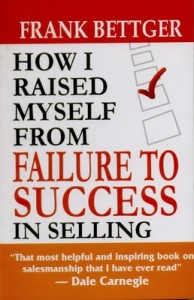
how-i-raised-myself-from-failure-to-success-400x400-imadpwd2t88rkgy8The rah-rah headline for today’s post is borrowed from a book I read as a young man, How I Raised Myself From Failure to Success in Selling by Frank Bettger. It’s considered a classic of sales-training lit. But lots of folks have given the book props for helping them get ahead in other professions, too.

The headline is also apt because I definitely thought myself a failure as a writer when I was in my twenties. The stuff I wrote didn’t work the way I wanted it to, and I was told that’s because you have be born a writer. You can’t learn how to do it.

For ten years or so I accepted that I would never make it in this business.

So I did some other things. I moved to New York to pursue an acting career. Started doing Off-Broadway, Shakespeare, avant-garde. But after awhile I wondered why I wasn’t being offered a starring role in a movie like Raiders of the Lost Ark (they gave it to some guy named Ford).

During a visit back to L.A. I met this gorgeous actress at a party. Knowing I’d be returning to New York soon, I only waited two-and-a-half weeks to ask her to marry me.

Shockingly, she said yes.

After we were married I decided it might be a good idea for us to have one steady paycheck. Since Cindy was the more talented of the two of us, she continued with her stage work while I applied to law school.

In my third year at USC Law I interviewed with a big firm with offices in Beverly Hills.

Shockingly, they hired me.

Later on I opened my own office. And found out I had to be a businessman, too. I had to learn entrepreneurial principles. So I started to read books on business, and one of these was Bettger’s.

A few years went by and the desire to write, with me since I was a kid reading Tarzan of the Apes, came back to me. Bettger’s principles helped me along that path, too.

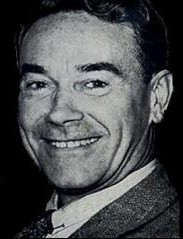
Frank_Bettger_(1888-1981)Frank Bettger was a former big-league ballplayer who went into the insurance game. After initial failures he started wondering if he really had what it took to be a good salesman. He decided to find out what others did. He began to apply a set of practices that helped get him to the top.

The first of these practices was enthusiasm. To sell successfully, you have to be enthusiastic about your product, your prospects, life itself. You need to exude joy, because the alternative is gloom, and gloom don’t sell.

Bettger noticed that if he didn’t feel enthusiastic, he could still act enthusiastic, and soon enough the feeling came tagging right along.

When I discovered you really can learn the craft, I got as excited as a man in the ocean who finds a plank to hang on to and then spots a lush island in the distance. It was enough to infuse joy and hope into my writing, and those two things alone started to improve it.

Another practice Bettger mentions is a system of organization. Make plans, record your results. When I got my first book contract I hadn’t thought through what I’d do for a follow-up. So I got organized. I began planning my career five years ahead, kept track of who I met with and pitched to, who I wanted to meet, and scheduled projects accordingly.

I’d already established the discipline of writing to a quota, but now I started keeping track of my output on a spreadsheet. Starting with the year 2000 I can tell you how many words I wrote on any given day, on what projects, and my weekly, monthly, and yearly totals.

Next, Bettger summarized the most important secret in sales: Find out what the other fellow wants, then help him find the best way to get it.

This got me thinking about pleasing readers. In college I was heavily influenced by the Beats (Kerouac, Ginsberg, et al.) Their writing was idiosyncratic and experimental. But I figured out early that what was idiosyncratic did not necessarily, or usually, connect with a large audience.

I knew I could write solely for myself, ignore genre, be hip (though a lot of the time it was artificial hip). But I wanted to make a living at this, so I backed up and looked for points where my own writing pleasure met with readers’ desire for a good story.

Still, I needed confidence this could be done. Bettger wrote that the best way to increase confidence is to keep learning about your business. Never stop.

The same holds true for writing, both the craft side and the business side.

If you are set on traditional publishing you need to know: What are publishing contracts like? What terms are you willing to accept … or, more importantly, walk away from? What are the characteristics of a good agent? What can you realistically expect in terms of editorial and marketing?

If you are going to self-publish, do you have a plan? Do you know what you need to know? Are you putting in a systematic effort to find out? Are you a risk taker?

In my business life I dedicated at least half an hour a day reading about business principles, thinking, and planning. I do the same thing in my writing life. I read every issue of Writer’s Digest. I enjoy books and blogs on the craft. My philosophy has always been that if I pick up one new technique, or see something familiar from another point of view, it’s worth the effort.

There’s a lot more packed into Bettger’s book, but I’ll close with the part that helped me most, both as a businessman and as an author. It’s his chapter on Ben Franklin’s plan for self-improvement.

In Franklin’s autobiography, he writes about his desire, as a young man, to acquire the habits of successful living. Franklin chose thirteen virtues, such as temperance, resolution, frugality, justice and so on. He made a chart and concentrated on one virtue for a week, ingraining the habit. That way, he could go through his list four times a year.

Bettger followed this plan by choosing thirteen practices that would help him as a salesman, such as sincerity, remembering names and faces, service and prospecting, and so on.

I did something similar with my writing. I formulated what I call the Seven Critical Success Factors of Fiction: plot, structure, character, scenes, dialogue, theme, and voice. By concentrating on these serially, I hoped to raise my overall game.

Bettger’s book helped me at two crucial points in my life––when I had to run a business, and when I made the decision to pursue the writing dream. In both pursuits there are challenges aplenty. Sources of inspiration are critical. I’m glad that ex-ballplayer was around to fire me up.

So what gets you enthusiastic about your writing? When you need an infusion of confidence, where do you turn?

My Rolling Edit Process

800px-Reader48

Jordan Dane
@JordanDane

I expect to get a few push backs on this post. Many writers use the “draft” process of editing their book after they get it written. They push to get a first draft done before they edit in several more drafts, but for me, I’ve never been able to do this. There’s a compulsive part of my nature that can’t let my own imperfections remain on the page until the end. If I know my book is riddled with my idiosyncrasies, it would haunt me too much, but that’s just me.

I do what I call “rolling edits” because I want to stay close to the action and character motivation at hand. I still get my daily word count in, but I read and reread my daily new material until I have nothing more to edit. In other words, if I write a chapter on one day, I edit it as I continue to move forward until I consider moving on.

Here’s my edit process:

1.) DELETE WITH A VENGEANCE – My first pass is always to delete and tighten each sentence. To help this process, I usually read aloud. Anything I stumble over gets a redo. I have a tendency to use compound sentences, so I make sure not to have dangling participles or long sentences that are hard to follow. I have a two comma rule. Any sentence that needs more than two commas, should probably be broken apart.

2.) LOOK FOR REPETITION (MORE DELETES) – I look for overused words, redundant wording, repeated phrases or “crutch” words that I fall back on too often. This can change from book to book and each author will have their own verbal handicaps.

3.) ADD EMOTIONAL LAYERING – Every scene has an emotional component to it. I push to add more emotion, even if it seems over the top. In fiction, this works because stories are about triggering emotions that the reader can relate to. If the scene is action packed, I’m looking for those delectable word choices to support the action or short viscerally descriptive sentences that will make the thrill palpable to the reader.

4.) REVISE THE DIALOGUE – I read the scene dialogue (without the narratives) to see if I can imagine the characters in my head and hear their voices. If there is humor in the scene, I work to punch it up or improve the timing (usually by deleting). If there is menace in the exchange, I ramp up the threat.

5.) EDIT THE BODY LANGUAGE – I often add body language in each scene as if I am watching a movie, but books aren’t that visual and I can sometimes overdo certain “crutch” reactions, like too many shrugs or nods. Again this is another opportunity to delete usually and it’s worth having a step to look for this.

6.) SPOT CHECK CHARACTER MOTIVATION – Do the characters’ reactions ring true? What if one of them reacted differently, how would that change my scene. I test my character motivation while I am “in” the scene to make sure it feels authentic. As I go through the book and stay close to each character’s story arc, I want the ability to “feel” a different outcome or twist as it is occurring, rather than waiting until the end to realize I like a different turn to happen and have to rewrite major sections.

7.) LAYER IN SETTING – I like to make sure my setting enhances each scene to infuse the action with a setting that is almost like another character. I love writing stories with a strong sense of world building, to make the reader feel as if they can walk the same streets that my characters do, with all their senses.

8.) REMEMBER THE INTIMACY – If my characters have a spark of attraction (that can have it’s own story arc), there is nothing more titillating than mounting intimacy. A glance, a first touch, can be drawn out so the reader feels everything. This can be construed as #3 (adding emotional layering), but for me, a growing romance should carry its own importance. If you can strip out the romance of a story, and the book no longer makes sense, then you have the right balance. This means that the romance is integral. The lovers are “punished” for wanting to be together and they get into more trouble because of it.

ROLLING PROCESS:
As I’ve mentioned, I keep writing my daily word goals, but continue to edit prior scenes (usually a chapter or two previously written) until I’m content to move on. Because I’m old school, I kill a lot of trees by printing out my edit pages and making notes in the margins. Every night I read what I’ve written before I go to bed. My reward is to get my own work done first before I treat myself to reading someone else’s book. The next morning, I make the changes.

By the time I get to the end, my novel is fully edited by me. I usually make one or two more passes through, to read it as a reader might. But most of the major edits are done. When I’m done, I’m done.

I set my daily word count, depending on the contractual due date. The usual range can be 2500-5000 words per day. My advice to other writers, on setting word count goals, is to take into account your priorities and set realistic goals. Even if you can only squeeze in a page a day, that is still progress and you will eventually get done.

DISCUSSION:
1.) How many of you do something similar? Anything you would add to my list?

2.) If you edit in drafts, what tips do you have to make this draft process more effective?

4 Techniques for Adding Depth to a Scene

shutterstock_187206578Have you ever wondered how to add emotional depth to a scene you’ve written? There are a number of techniques you can use to inject emotional depth and drama into a scene. Here are my top four techniques for scene deepening:

1. Ban the bland

Many writers create a bland main character surrounded by quirky, interesting secondary characters. Let your hero be the one who goes through emotional experiences in the scene. Secondary characters should play off/react to the main character’s emotions, not the other way around.

2. Heighten suspense through avoidance

Have your characters dance around an emotionally charged issue. By hinting at trouble to come rather than addressing it directly, you will avoid “on the nose” writing, plus you will create suspense for your readers.

3. One stimulus, two responses

You can inject some energy into a scene by giving your characters contrasting responses to the same situation in a scene. The following example is a bit of a cliche, but think of the veteran cop who doesn’t blink an eye at a gory murder scene, contrasted with his newbie partner who is quietly losing his lunch in the bushes.

4. The human touch

Seed your scenes with small, human moments. Think of the gruff cop who, after he throws his arrestee into the slammer, offers to buy him a bag of chips from the vending machine.

There are dozens of ways to deepen a story scene. Which techniques have you used, and can recommend?


Essential Answers the Mystery/Thriller Author Must Have

Put ten writers in a room, ask them about their creative process, and you’ll likely get ten different answers varying by approach and degree, and volume. The gamut includes planners, plotters, pantsers, hybrids, muse-followers and in some cases the prayerful, at least when you can get them to admit this as a last resort.

All of these methodologies work (okay, the last one is iffy), though with a diverse range of efficiency and the measure of Xanax consumed.

Some contend they are writing drafts.

And that this – their way – is the only way, it is what writing is at its core and at its best.

Others, while disagreeing, admit they are planning drafts, which is something other than – preliminary to – actually writing a draft.

A debate often ensues.

It is clarifying, as well as stupendously good news, to realize that all of us, in the early stages of story development, and no matter which process we sign up for, are doing exactly the same thing, at least when expressed as an objective. We are searching for our story, culling it from an original notion, trying out ideas, vetting others, seeing what fits, what works, and hopefully tossing what doesn’t.

Different approaches heading toward an identical destination, at least when – either way – it works.  Too often – also either way – it doesn’t.

Storytelling is not an exact science.

There is no math here. Opinion, imprecision, world view, comfort-level and a default do-whatever-Stephen-King-does ethos become the raw grist of the author’s choice.

The reason this is worth noting is that the criteria for – and the moment of – our rounding the corner toward actually writing the story, versus searching for it, is a milestone portending massive consequences.

Because if we haven’t actually completed the search for story – indeed, if we don’t possess the tools and story sensibilities to know when we’ve truly found the best possible story and its beats – then the search draft at hand cannot possibly be just that: the best possible story that awaits us down the storytelling road, the one where everything works.

Same goes for a story plan.  Story sensibility, rather than process, is the hallmark of creating a killer story.

The search for story is essentially a search for answers…

… good answers, compelling answers, answers that trump more obvious answers, that when viewed in sum actually become the core elements and essences of the story itself.

But answers to what, specifically?

Answers to questions that define what it is we must discover, what we must know about our story before it can work.  Answers that become the raw grist of effective exposition.

This is often – usually – where experience counts, and mightily.

Rare is the newer author who nails these questions with consistency, regardless of their creative process.

Indeed, it is a dearth of compelling answers that explains the percentage of rejection that defines our avocation. It is why so many breakout first novelists have a drawer full of incomplete and rejected manuscripts that are rarely spoken about. It is evidence that the rumored degree of difficulty has not been elevated casually.

Story planners and plotters seek to find these answers before they write a draft, using them as components of the draft, and thus – in theory – reducing the number of drafts required to reach the Valhalla of “Final” in its highest form.

Pantsers, and to a lesser degree hybrid planners who quietly do a little planning on the sly, use the drafting process as the primary means of story search, which quickly separates that particular sub-demographic into three categories:

– pantsers who, within a draft somewhere down the line, finally do find the best possible answers, thus enabling their next draft to become a contextually solid story that embraces foreshadowing, context and nuance;

– or, pantsers who either believe they’ve found those answers, but have actually lowered the bar because, after all, writing draft after draft can be exhausting and life is short;

– or, pantsers who really do hit on that best possible story in the middle of a draft, which then (tragically) turns out to be the draft they submit, half of which is randomly context-free and the last half context-driven, rather than writing one more (at a minimum) fully-informed draft that has the more likely shot.

The latter is like a college student who, after three years of study, still doesn’t know what their major will be, but during one random night in their senior year bolts upright with an Epiphany that envisions their future, prompting him/her to change their major the very next day.

We all know how that turns out. Usually it means one or more extra, unexpected and unplanned for years of school, because worthy majors have prerequisites that begin back at Square One of one’s Freshman year (pre-med students and science majors: remember Chemistry 101?).

A good novel, regardless of how it got good, depends on context, foreshadowing, nuance and optimal pacing to work, all of it beginning at Page 1, and all of which are impossible if you don’t truly understand – and nail – these questions and their answers, including how the story ends.

I can’t squeeze all 54 of those questions into the space parameters of The Kill Zone.

But I will offer the more foundational questions among them, which experienced pros will recognize immediately, and newer writers and some MFA grads, especially those who are “all about character and theme,” might find daunting.

Here they are:

What is the core DRAMATIC story spine the emerges from your premise, and the DRAMATIC QUESTION it poses?

The key word (fragment) here is drama, not character.

In other words, what is your hero’s primary story problem or opportunity – a.k.a. the plot – expressed as a hero’s quest or journey, motivated by stakes and opposed by an antagonist?

Without a good answer to this one and you haven’t finished your story search.  Try to write this manuscript without that answer and you are virtually assured a rejection and a rewrite.

What is CONCEPTUAL about your premise?

Newsflash: concept and premise are different things. Most new writers don’t know or understand this, and a high percentage of practicing writers and their agents are confused by it. But it’s true. A premise infused with the notion of something conceptual makes a story more intriguing, beginning with the pitch itself.

Does your thriller unfold within the walls of the CIA, or the Herman Miller partitions of an accounting office in Sacramento? Is the hero playing for world peace and survival, or the keys to a stolen Buick? Is the femme fatale seeking to steal nuclear detonation codes, or palming a few lottery tickets when her shift at the 7-11 concludes?

What blocks your hero’s path, and what is the agenda of the antagonist?

In thrillers and mysteries, the worst possible answer sounds like this: “The hero never felt approval from his/her father, and has always felt low self confidence and self-esteem.”

Heroes who are their own primary villains rarely work, especially in mysteries and thriller.

That’s about as dramatic as someone crying as they watch The Bachelor. The degree of external drama – conflict leading to tension – defines thrillers and mysteries, and is necessary to some degree in each and every other genre, as well.

How do you set up your hero’s quest, prior to launching it?

This implies you know what a setup is, and how and where the hero’s quest hits the page for the first time in a fully-informed way (hint: it’s called the First Plot Point, and it happens 50 to 90 pages in, after the setup).

Blow this one and a narrative domino effect of Voldemortesque consequences will follow.

What is your First Plot Point, and how does it change/interrupt the hero’s life and thrust them down a sudden, new and urgent path?

It may or may not be big (thought it often is), but more important is what it means, how it causes the hero to drop everything to react and respond emotionally (fear is often involved), literally thrusting them into the core story.

How does the hero respond to that first encounter with their new mission/quest?

If your answer is they begin kicking butt immediately, then a lesson in classic story structure is required. Rather, the hero has to find their own answers, seeking more information, grasping the magnitude of the situation, enlisting help, or simply fleeing or hiding until they can hatch an informed plan.

Meanwhile, the threat looms and evolves.

How does your story change at the Midpoint, thus empowering the hero toward a more proactive attack on the problem?

New information needs to enter the story here, and it needs to change the story while empowering the hero. The Midpoint twist has its own unique context, pulling the curtain back to reveal a clearer understanding of what’s true and in play for either the reader, the hero, or both.

What does your hero do – decisions and actions – that shifts the odds their way, perhaps after playing catch-up until this point?

Stories should escalate in terms of dramatic tension. When the hero ups his/her game, the villain does the same. So the hero has to really ramp it up after the Midpoint, and it’ll have nothing to do with luck, a fortunate deus ex machina or the troops arriving in the nick of time.

How does your hero become the primary catalyst that brings about the resolution of the story?

Simply put, if someone else saves the day, then make that guy the protagonist in your next draft. Or better, put the ball back in your hero’s hands and call a play with his/her name on it.

To make it work, the author must have full awareness and command of your ending. No saving the hero, no having the hero observe the denouement from the cheap seats. This is where the hero gets his/her hands dirty and earns the name tag.

It’s natural not to know all these answers early in the process.

That’s why we call it the search phase of story development, however you choose to go about it. At first these questions work as criteria for the search, and then, when all the blanks are filled in, as a qualitative standard.

The writer’s sense of that defies process, it is what separates the good from the great, the published from the unpublished.

Pantsers need to know what to pants. Planners need to understand what to plan. Either way, answers emerge and the story progresses, for better or worse. And if you aren’t sure, you’ll know soon enough when you submit the work.

With these questions and some stellar answers in your quiver, the story may exceed even your own highest expectations, especially if you don’t settle for the first idea that fits the moment in question. Rather, cultivate a better, fresher and more emotionally resonant answer that will make an agent, editor or reader leap from their chair and throw money at you.

That’s the real story, after all.

****

If you want to dive deeper into the middle of your novel, I have an ebook on this subject:
Middle cover

Also, TKZ’s James Scott Bell has a great ebook on this topic, as well.


First Page Critique: El Cuco

Purchased from Shutterstock by Kathryn Lilley

Photo via Shutterstock, purchased by Kathryn Lilley

Today we are doing a critique of an anonymous first-page submission. The title is EL CUCO (THE CUCKOO). After my comments, please add your thoughts and constructive criticism. (Note: Content contains strong language).

***

It was hot as hell.   Four-thirty in the morning and it was already a fucking nightmare in her apartment.  The ceiling fan pushed warm air around the room, and the feel of it against her skin reminded Silky of the hot, stale, breath of an ex-lover she almost killed back in ’72.

She slid into a light robe and slippers, tucked her big gun into the deep side pocket, and headed for her car, where she intended to blast the A/C and smoke a joint.

When Silky pushed through the broken screen door onto the porch, Steve was standing there smoking a cigarette, his painted toes tapping a private beat against the pealing gray floorboards.

“What the fuck are you doing up this early?” she said.  “You scared the shit out of me – I thought you were that lunatic running around.”

Steve blew a column of out of the side of his mouth.  “Christ,” he said.  “What are you doing up?”

“It’s hot as fish grease in my apartment.”

Steve’s manicured eyebrows climbed into his hairline.  “Wait – what are talking about, a lunatic?”

“Some nut,” she said, waving a dismissive hand. “He’s out there slashing throats.”

“Around here?”

Silky nodded.

Steve reflexively touched his throat.  “I haven’t heard anything about a throat-slasher.”

“He’s out there,” Silky said confidently.  “Believe me.”

“That’s awful.”

“There’s all kinds of fruitcakes out there.  That’s why you never see me without this.” Silky pulled the big gun from her robe and held it up.

“Jesus!”

“And I won’t hesitate to use this,” Silky said.  She discharged the clip and showed it to Steve.  “You see?  Loaded.  I don’t fuck around.”

Silky slowly lowered herself onto the top stoop, her knees cracking like microwave popcorn.  “And just think,” she said, “you almost got shot with this grizzly.”  She rested the gun beside her.   “Gimme a cigarette.”

Steve withdrew a cigarette from his pack and handed it to Silky.   He flicked the lighter for her.  “Me?” he said.

Silky held the cigarette against the flame until she got it going.  She leveled her gaze at Steve, raised a perfectly sharp eyebrow.

“Yeah, you ,” she said.

“I almost got shot?  When?”

“Are you high? Two minutes ago when I walked down here.  You think I was expecting to bump into someone this early in the morning?  Who else but the slasher is out this time of day?”

***

My comments:

This page has an engaging spirit to it. I think it could be much stronger after some issues are addressed. Let’s discuss the issues one at a time.

First, kill off all the adverbs

In general, it’s a good idea to be very sparing in the use of “ly” adverbs such as “Slowly,” and “confidently”. Adverbs are a weak way of conveying action.

Shorten sentence structure

Many of the sentences on this page are too long. The prose will be stronger and snappier once they are broken up. For example:

“The ceiling fan pushed warm air around the room, and the feel of it against her skin reminded Silky of the hot, stale, breath of an ex-lover she almost killed back in ’72.”

Break up as follows:

The ceiling fan pushed warm air around the room. The feel of it against her skin reminded Silky of the hot, stale, breath of an ex-lover she almost killed back in ’72.

And the following sentence:

“When Silky pushed through the broken screen door onto the porch, Steve was standing there smoking a cigarette, his painted toes tapping a private beat against the pealing gray floorboards.”

Can be broken up as follows:

“Silky pushed through the broken screen door onto the porch. She immediately felt a warm presence in the shadows. It was Steve. He stood in the shadows, smoking a cigarette, his painted toes tapping a private beat against the pealing peeling gray floorboards.”

Watch spelling

Spelling errors such as the one contained in the previous example are a death sentence for any first page submission. In addition to running spell check, the writer needs to make sure the spelling of the word is correct for its meaning in context. (“Pealing” is the sound of a bell. “Peeling” is how one removes the skin from an orange.)

Keep cause with effect

When Silky says, “I thought you were that lunatic running around,” Steve’s response to the statement should follow immediately. The way it’s currently written, he responds to the first part of her statement (regarding the hour of day) before he reacts to the important part of her speech (a lunatic running around).

Vary the language for impact

Silky says, “You scared the shit out of me – I thought you were that lunatic running around.”

Steve eventually responds by using identical language. ““Wait – what are talking about, a lunatic?”

Steve’s response should be revised to use wording that is different than hers.

Avoid repeating phrases

“Big gun” is repeated twice on the same page, which is one time too many.

Use specific language

“Big gun” is vague language. Indicate what type of gun is being used. Using specific language helps reveal character.

A note about similes

Similes and metaphors can be effective when used well. The simile in this page, “…her knees cracking like microwave popcorn” didn’t quite work for me. “Popping” might be a better gerund to use in this case, but I would still jettison the simile.

Strong language

I’m not a prude about the use of strong language in fiction, but in this instance, I don’t think the F-bomb and related terms add anything interesting to the characters or scene.

Monitor tics and jerks

For some reason, many writers, including professionals, love to use eyebrows and other tics to convey a character’s reaction. This page has a little too much eyebrow action going on.

“Steve’s manicured eyebrows climbed into his hairline.”

“She…raised a perfectly sharp eyebrow.”

Convey action before dialogue

In this scene, Silky tells Steve that she almost shot him, but I didn’t get a sense of that during the action that leads up to their dialogue. Before she says to Steve, “I almost shot you,” the reader needs to see her going onto the porch, feeling a presence in the shadows, raising the gun barrel, etc.

Title note

I had to look up the title, EL CUCO, on a translator to verify what it meant. That’s not good. The story title is the  first opportunity to engage a reader. If the reader doesn’t understand what the title means, that opportunity is lost.

Overall

Even though I’ve called out quite a few issues with this page, I still felt engaged by the story, and found myself liking the characters. That’s half the battle right there–everything else is fixable with careful editing.

Thank you to the writer for submitting this page for discussion.

What do you think of this first page, TKZ’ers? Any comments to add?

Everything I Ever Learned
I Learned From Potboilers

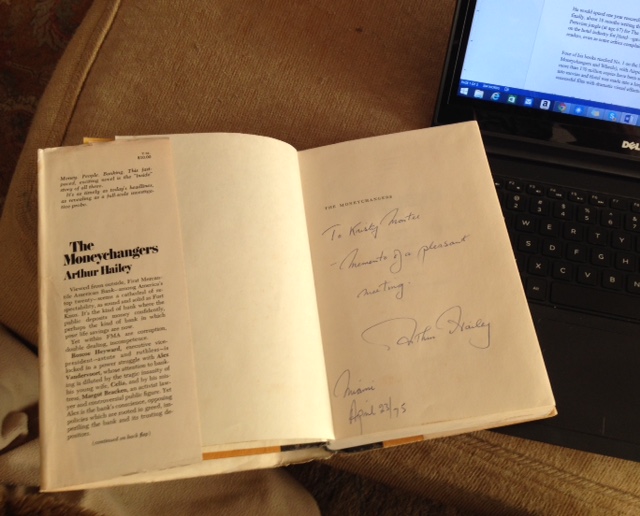
My signed first edition of Arthur Hailey's The Moneychangers.

My signed first edition of Arthur Hailey’s The Moneychangers.

“A great book should leave you with many experiences, and slightly exhausted at the end. You live several lives while reading.” — William Styron

By PJ Parrish
We moved around a lot when I was a kid, and like a plant with shallow roots, I was always sending out feelers toward solid ground. I found it in libraries. I couldn’t always count on having the same address every year, the same classroom or even the same friends for very long. But I always could count on finding old faces and familiar places in the local library.

Paradoxically, it was in libraries where my love of exotic places and travel was born. No matter what was going on in my little life, I could escape to somewhere else by opening a book. My library card was my first passport.

Novels took me around the world, but they also taught me things — about history, religion, politics, philosophy, human psychology, medicine, outer space – filling in the gaps left by my spotty education. Even after I went to college, made my own money and settled down, novels remained my autodidact keys.

I learned about the American Revolution through John Jake’s Kent Family Chronicles. I studied medieval Japan through James Clavell’s Shogun. I was able to wrap my brain around the complex politics of Israel and Ireland after reading Leon Uris. James Michener taught me about Hawaii and Edna Ferber took me to Texas. Susan Howatch’s Starbridge series sorted out the Church of England for me. Ayn Rand made me want to be an architect for a while, or maybe a lady reporter who wore good suits. (I skimmed over the political stuff.)

And Arthur Hailey taught me to never buy a car that was made on a Monday.

I got to thinking about Hailey and all the others this week for two reasons: First, was an article I read in the New York Times about the Common Core teaching controversy (more on that later). The second reason was that while pruning my bookshelves, I found an old copy of The Moneychangers. This was one of Hailey’s last books, written after he had become famous for Hotel, Wheels, and that quintessential airport book Airport. I interviewed Hailey in 1975 when he was touring for The Moneychangers. I remember him as sweet and patient with a cub reporter and he signed my book “To Kristy Montee, Memento of a Pleasant Meeting.”

I had read all his other books, especially devouring Wheels, which was set in the auto industry of my Detroit hometown. Hailey, like Michener, Clavell, Uris et al, wrote long, research-dense novels that moved huge, often multi-generation casts of characters across sprawling stages of exotic locales (Yes, Texas qualifies). Hawaii, which spans hundreds of years, starts with this primordial belch:

Millions upon millions of years ago, when the continents were already formed and the principle features of the earth had been decided, there existed, then as now, one aspect of the world that dwarfed all others.

How could you not read on after that? But the main reason I loved these books was for their bright promise of cracking open the door on something secret. Here’s some cover copy from Hailey’s The Moneychangers:

Money. People. Banking. This fast-paced, exciting novel is the “inside” story of all three. As timely as today’s headlines, as revealing as a full-scale investigation.

Shoot, that could be copy written for Joseph Finder now.

Many of these books were sniffed off as potboilers in their day. (Though Michener and Ferber both won Pulitzer Prizes). But the writers were, to a one, known for their meticulous research techniques. Hailey spent a full year researching his subject (he read 27 books about the hotel industry), then six months reviewing his notes and, finally, about 18 months writing the book. Michener lived in each of his locales, read and interviewed voraciously, and collected documents, music, photographs, maps, recipes, and notebooks filled with facts. He would paste pages from the small notebooks, along with clippings, photos and other things he had collected into larger notebooks. Sort of an early version of Scrivener.

51dyqvF1YqL._SY344_BO1,204,203,200_

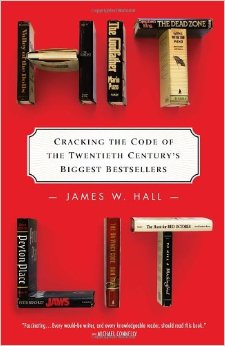
For my money, these books were a potent blend of entertainment and information, and they endure today as solid examples for novelists on how to marry research with storytelling. In his fascinating non-fiction book Hit Lit: Cracking the Code of the Twentieth Century’s Biggest Bestsellers, James W. Hall analyzes what commonalities can be found in mega-selling books. One of the criteria is large doses of information that make readers believe they are getting the inside scoop, especially of a “secret” society. The Firm peeks into the boardrooms of Harvard lawyers. The Da Vinci Code draws back the curtain on the Catholic Church. Those and all the books I cited delivered one thing in spades — the feeling we are learning something while being entertained.

Which brings me to Common Core.

This is an educational initiative, sponsored by the National Governors Association and the Council of Chief State School Officers that details what K–12 students should know in English language arts and mathematics at the end of each grade. I read this week that as part of the Common Core mandate, English teachers must balance each novel they teach with “fact” material –news articles, textbooks, documentaries, maps and such.

So ninth graders reading The Odyssey must also read the G.I. Bill of Rights. Eight graders reading Tom Sawyer also get an op-ed article on teen unemployment. The standards stipulate that in elementary and middle school, at least half of what English students read must be supplemental non-fiction, and by 12th grade, that goes up to 70 percent.

Now, I’m not going to dig into the politics of this. (You can read the Times article here.) And I applaud anything that gets kids reading at all. What concerns me is that in an effort to stuff as much information and facts into kids’ heads, we might not be leaving room for the imagination to roam free. As one mom (whose fifth-grade son came home in tears after having to read the Universal Declaration of Human Rights), put it, “If you look at the standards and what they say, nowhere in there does it say, ‘kill the love of reading.’”

One more thing, I then I’ll shut up:

There was a study done at Emory University last year that looked at what happens to the brain when you read a novel. At night, volunteers read 30-page segments of Robert Harris’s novel Pompeii then the next morning got MRIs. After 19 days of finishing the novel and morning MRIs, the results revealed that reading the novel heightened connectivity in the left temporal cortex, the area of the brain associated with receptivity for language. Reading the novel also heightened connectivity in “embodied semantics,” which means the readers thought about the action they were reading about. For example, thinking about swimming can trigger the some of the same neural connections as physical swimming.

“The neural changes that we found…suggest that reading a novel can transport you into the body of the protagonist,” said Gregory Berns, the lead author of the study. “We already knew that good stories can put you in someone else’s shoes in a figurative sense. Now we’re seeing that something may also be happening biologically.”

Maybe those poor eighth graders just need to crack open some Jean Auel, SE Hinton or Cassandra Clare.