Sneak Peek into Audiobook Narration

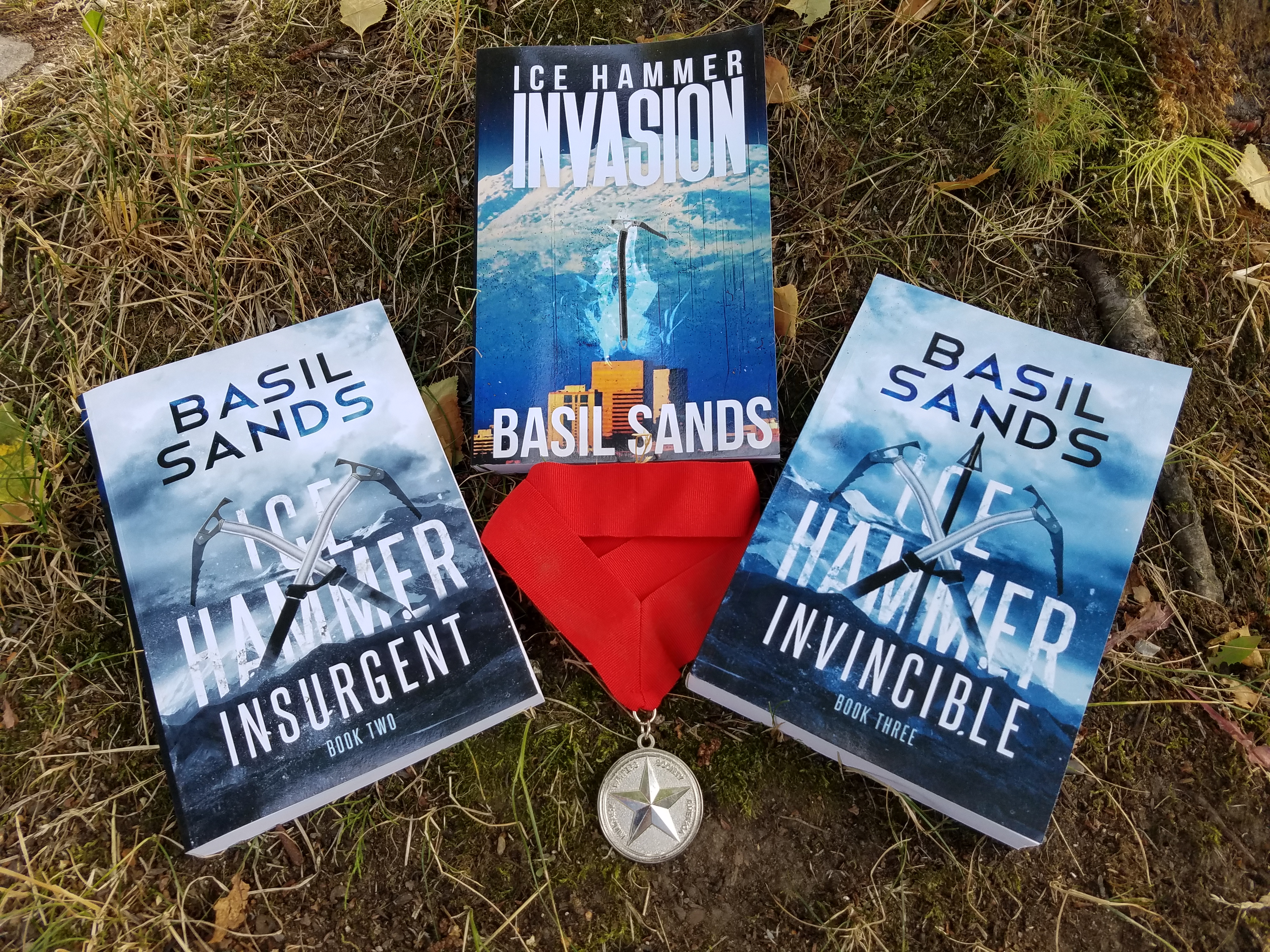
Photo courtesy of Basil Sands

by

Debbie Burke

@burke_writer

Jim Bell recently wrote an excellent post about doing his own narration for his audiobook. With training as an actor, attorney, and experienced public speaker, he’s a natural for his craft books.

For memoirs, the author is often the default choice as long as s/he has a good voice. (See recording artist Juni Fisher’s tips for DIY narration at the bottom of this post)

What narration styles do readers prefer for fiction?

In the 1990s, my husband and I browsed racks at truck stops for Books of the Road cassette tapes with great selections of mysteries, thrillers, and historicals. Listening to books made the hours and miles fly by. Several times I really hated to leave a compelling story, even for a dinner break!

Back then, most narrators were male. I recall being annoyed every time a man adopted a falsetto tone for a female character. It totally jerked me out of the story and had a ridiculously comic effect, not the best mood for a tense, life-or-death scene.

Conversely, the female narrator of an early Sue Grafton book sounded so silly when she attempted a phony deep voice for a male character, we ejected the tape.

Audiobooks have grown up a lot since the days of cassette tapes. With their increasing popularity, I went in search of the tastes of today’s listeners.

GoodReads featured a discussion on audiobooks prompted by a two-part question:

In general, would you say you read more books written by male or female authors?

Would you say you listen to, or prefer listening to, more male or female narrators?

Responses were evenly split on whether they read more female or male authors and not necessarily along gender lines.

Many reported they didn’t care which gender as long as the narrator knew what s/he was doing. Quality of performance made the strongest impression.

Several said a book written in first person point of view should be read by a narrator of the same gender.

A number cited irritation with a male narrator who made female characters sound like “bimbos” or a female narrator who sounded “dopey” trying to fake a baritone.

Some respondents had trouble hearing higher-pitched female voices and therefore generally preferred male narrators or females with lower-pitched voices.

A few mentioned preferring a male narrator for male characters and a female narrator for female characters. But a surprising number would rather listen to a single, skillful narrator throughout the whole book, regardless of gender.

Narrators develop their own fan bases. One fan said: “I can fall in love with narrators and try an audiobook simply because they narrated it, even if I’ve never even heard of the author.”

British accents entranced many fans.

Quite a few cited Davina Porter as a favorite. She narrated Diana Gabaldon’s Outlander series.

Others said they would listen to Kobna Holdbrook-Smith read the phone book.

~~~

To learn what happens inside the recording studio, I reached out to two well-respected audiobook narrators, one male, Basil Sands, and one female, Marguerite Gavin.

Photo courtesy of Basil Sands

Basil Sands has narrated numerous novels by TKZ’s own James Scott Bell and John Gilstrap. Basil is also the author of the Ice Hammer series. He has his own studio in his Anchorage, Alaska home where he narrates and does post-production editing.

DB: Basil, would you give us an overview of the process of creating an audiobook?

BS: Writing a novel has a great many complex parts and narrating a book into audio format is similar.

The rights holder (author/publisher) contacts the narrator community for auditions. Once the narrator is chosen, contract and script are sent. The narrator should read through the entire text at least once. There will likely NEVER be time to read a book twice, or enjoy a leisurely read ever again. Time crunches may mean cold reads so improv skills are a must.There is literally no time for rehearsing.

In order to make a decent living, a narrator has to do two to four books a month or more.

DB: Do you ever consult with the author?

BS: In most cases, [publishers arrange contracts and] authors are off-limits to narrators. If I can, I love talking to authors to get their take on their characters.

Years ago, I recorded back-catalog books for Piers Anthony (sci-fi/fantasy author with unusual names and spelling). I emailed Piers (now 85). He had no idea his old books were being recorded and was delighted. He gave me free rein to perform as I pleased. I had a lot of fun with his series.

DB: How do you handle female voices and dialogue?

BS: With a fairly deep, resonant voice, I never go falsetto. My tactic is to soften my voice, slide up an octave or two, and give a less masculine impression.

Basil’s summation: Narrating is far from the easiest of acting professions but is one of the best ways an actor can really sink their chops into their trade. Every book is a marathon, playing all the parts, knowing all the details, in full control of the entire show. Did I mention I love my job?

~~~

Audiobook narrator Marguerite Gavin

Marguerite Gavin has narrated 600+ books and won multiple awards. She lives on the Delaware shoreline with her 19-year-old daughter. She likes to say she and author Dana Stabenow grew up together since Marguerite narrated Dana’s first Kate Chugak thriller and they’ve worked together for 22 books. Marguerite also brings to life Liam Campbell, Dana’s male protagonist.

During our phone conversation, when asked how she handles male voices, Marguerite says she narrates many thrillers where, inevitably, “five male cops all from the same hometown with similar accents wind up in a car chase. How do you distinguish among them?” She then demonstrated several voices with slight but distinct differences in tone, diction, and speech patterns.

In addition to narration, Marguerite is an actor/director and jokes, “Audiobook narration supports my theatre habit.”  She also teaches and coaches students “to understand the actor’s instrument of voice and to understand their own range.”

If the character is a hulking male truck driver who smokes, “I throw air over my cords. It’s not always about pitch.”

She believes it’s easier for a woman to do male voices because women have more range. “I’m not afraid to sound like a man.” She suspects men have more trouble making the leap to sound feminine.

Marguerite loves to narrate series, watching characters evolve over time. She also enjoys collaborations with authors.

Her enthusiasm for her profession comes through with every word. “I’m fortunate to have the balance of financial stability with my passion. It’s important to keep your joy in your job.”

“The skill is to be inside the story as much as possible. You don’t want people listening to an actor act rather than getting lost in the story.” She always asks, “What makes a good reading experience? What is the feeling?”

Thank you, Basil and Marguerite, for giving us a peek inside audiobook narration! It’s always enlightening to talk with artists whose passion for their profession shines through.

~~~

Recording artist Juni Fisher’s tips for DIY narration, quoted with her permission:

  • Print script in 14-16 font, double-spaced, and make notes.
  • Recording can be done a few lines, a paragraph, a page at a time.
  • If you make a small error, clap your hands to make a “mark” so you know where to go back to re-record, and keep going.
  • Use your eyebrows when you read. Be more enthusiastic than you think. The engineer will have you back off if it’s too much.
  • Advice from the music recording industry: “Nice, but do it now so I BELIEVE you.”
  • Sip room-temperature water or warm water (never cold) every couple of pages or paragraphs.
  • No dairy and no sugar.
  • Use sugar-free throat lozenges (not numbing type).
  • Speak as you’d speak to someone you adore, sitting right next to you.

~~~

TKZers:

Do you have a preference for audiobook narrators of one gender over the other? If so, what are your reasons?

What audiobook quality is most important to you as a listener?
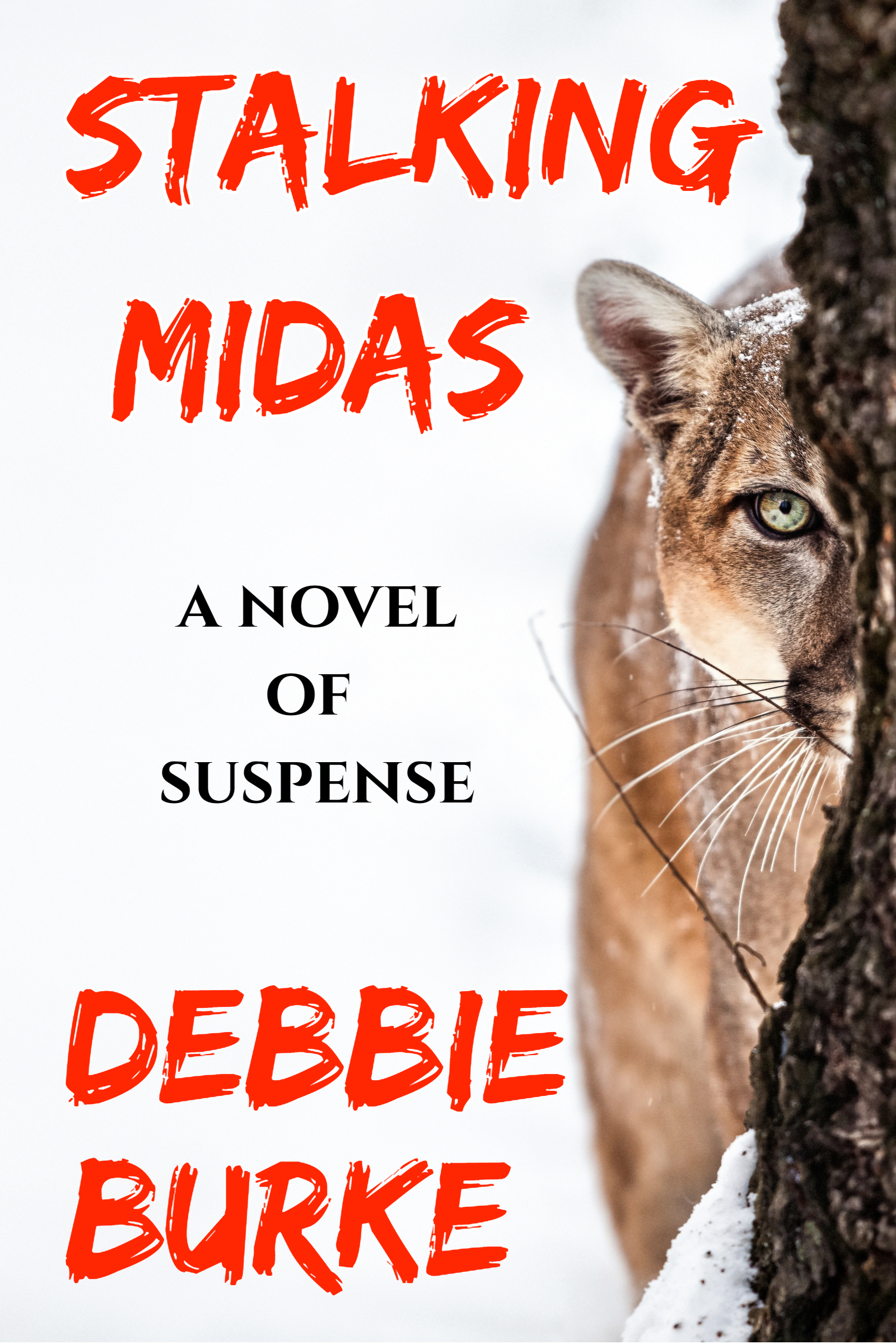


Debbie Burke’s new book, Stalking Midas, is FREE on Kindle today through November 2.  Here’s the link. 


An Amazing Story of Luck and Persistence

For today’s post I have something a bit different to my usual musings – this post concerns a real life story that impacted my family last week. Even though it truly is a remarkable story in and of itself (one providing a perfect antidote to today’s winter-comes-way-too-early weather in Colorado!), it also offers a heartwarming affirmation that sometimes luck and persistence pays off (a belief all of us writers should embrace, especially in our darkest moments…)

Last Monday, my mother-in-law was out walking her beloved border collie,Tess, in the Australian bush outside the Victorian era mining town she lives in, when the dog literally disappeared. One minute Tess was scampering through the undergrowth, the next minute she was gone. My mother-in-law called for her frantically for nearly an hour, but there was no answer – and no sign of Tess. By the time we received the news in Colorado, Tess had been missing the whole day – and by then the anxious waiting was already taking its toll. Had Tess run off after kangaroo or been bitten by a snake? In an area known for abandoned mine shafts (during Victorian times, this was a huge gold mining area), had she fallen down one and been injured? Another day passed and hope was fading – it’s almost summer in Australia and there hadn’t been any rain for almost a month. How could she survive when there was no water to be found? Three more days passed and we all feared the worst…

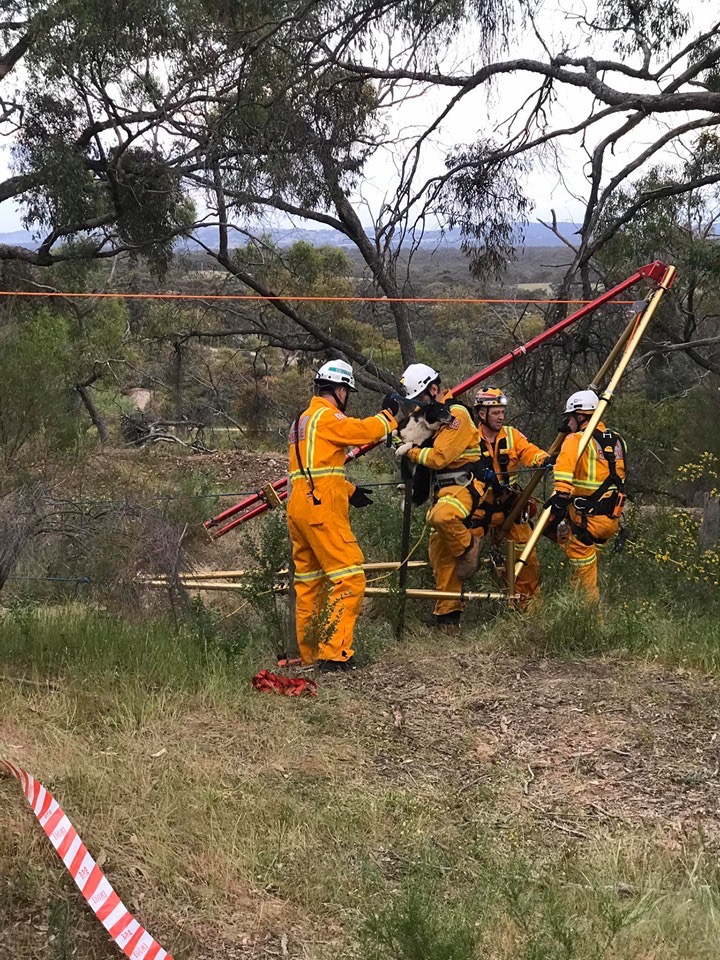
Then at midnight we  received the most remarkable call – Tess had been found alive and well after having fallen some 5-10 meters down an abandoned mine shaft. It was a movie-like moment and (as you will see from the photos) a truly remarkable ending that has captured the local imagination (and news!) in Australia. Even now, after a weekend to digest the news, I don’t think any of us can truly believe what just happened. For my mother-in-law it was the kindness of a friend who went back to an area that had been searched 2-3 times and who just happened to be at the right place and the right time to her Tess whimpering from the depths of this mine shaft:


Then they waited for the specialist mine-shaft rescue team (yes, they have one!) to drive over from nearby Bendigo and watched as they winched down a man who grabbed Tess and held her as they winched them both back up:

And here is the lucky dog, herself, looking none the worse for her experience. As far as the vet can tell she suffered nothing more than a scratch on the nose (and some dehydration of course).


This is such a lovely story of how luck and persistence came together to save a dog’s life, that I simply had to share it.

I think we can all take heart, that sometimes, miracles do happen!

For those interested in seeing the news story on Tess’ rescue – I’ve posted the link below:


16 Concrete Tips for Effectively Editing Your Own Fiction

by Jodie Renner, TKZ alumna, fiction editor and author of writing guides    

Are you relatively new at writing fiction? Perhaps you’ve shown your first (or latest) draft to beta readers and been told your premise, plot, and characterization are now pretty solid, but that your pacing is a bit slow and your writing style could use some amping up and polishing. Perhaps it’s overly wordy or just a bit pedestrian.

If so, take a break, then grab a coffee or some chocolate and start going through the whole story again, page by page, to search for any wordy, clunky, hackneyed, or lackluster phrasing and replace it with succinct, fresh, vibrant wording that will entice and delight your readers. The step-by-step list below will help you do a line-by-line self-edit to take your story up a notch or two.

If you want your popular fiction to captivate readers, sell well, and garner great reviews, ferret out and fix these 16 style weaknesses:

1. Meandering, wordy, or repetitive writing. Be on the constant lookout for anywhere you can cut down on wordiness. Don’t bore your readers by having characters going on and on. Avoid lengthy, neutral descriptions—today’s readers don’t have patience with them. And don’t say the same thing several times just to make sure readers got it. Look for areas you’re repeating yourself. Also, watch for “little word pileup.” Can you be more succinct and direct? For example, instead of “It would be a good thing for us to…,” just say “We should….” Here’s an example from my editing:

Before: The man was small and pudgy and he had a full dark beard that he nervously stroked with his hand.

After: The small, pudgy man nervously stroked his full dark beard.

2. Wishy-washy qualifiers that weaken your message. Do a search for words like quite, sort of, almost, kind of, a bit, pretty, somewhat, rather, usually, basically, generally, probably, mostly, etc., and delete almost all of them. Forget “He was quite brave,” or “She was pretty intelligent” or “It was almost scary.” These qualifiers dilute your message, reduce the impact, and make the imagery weaker. Even really and very are best avoided—it’s like you’re saying the word after it needs reinforcing. “She was beautiful” packs more punch than “She was very beautiful.”

3. Colorless, pedestrian verbs. Do a search for overused verbs like walked, ran, went, saw, talked, ate, did, got, put, took. Get out your thesaurus or use the MS Word one to find more expressive, powerful verbs instead, like crept, loped, stumbled, stomped, glimpsed, noticed, observed, witnessed, spied, grunted, whimpered, devoured, consumed, gobbled, wolfed, munched, or bolted. Do searches for walked and ran and replace many or most of them. See Ch. 21 of Fire up Your Fiction for plenty of more expressive alternatives.

4. Overuse of –ing verbs. Best to use -ed verbs instead—they’re stronger and more immediate. “He was racing” is weaker than “He raced.” “They searched the house” is more immediate than “They were searching the house.” Rewrite -ing verbs whenever you can, and you’ll strengthen your writing and increase its power.

5. Too many -ly adverbs. Instead of propping up a boring, anemic verb with an adverb, look for strong, descriptive, powerful verbs. Instead of “He walked slowly” go for “He plodded” or “He trudged” or “He dawdled.” Instead of “She ate hungrily” say “She devoured the bag of chips,” or “She wolfed down the pizza.” Instead of “They talked quickly,” say “They babbled.” Instead of “He walked deliberately,” say “He strode.”

6. Pile-up of adjectives. Use adjectives sparingly and consciously. Instead of stringing a bunch of descriptors in front of an ordinary, overused noun, find a more precise, expressive noun to show rather than tell. Instead of “a very tall, hefty man” say “a giant”; instead of “a beautiful, huge, historic house,” say “a stately mansion.”

Overuse of adjectives can also turn your writing into “purple prose”—melodramatic, overly “flowery” writing. For example, here’s an over-the-top description from a novel I edited many years ago, about a sports car in motion: “Every turn of the wheel, the veiled beauty of fortune shadowed him: serpentine and capricious in nature, bestowing pleasure or pain at whim, and enslaving mankind to her fancy.”

7. Telling instead of showing. Show us, don’t tell us how your characters are feeling. Avoid statements like, “He found that funny,” or “The little girl felt sad.” Show these emotions by their actions, words, tone, facial expressions, and body language: “Eyes downcast, shoulders slumped, head down, she pushed her food around the plate.” Do searches for was, looked, seemed, and felt and reassess and revise.

8. Distracting dialogue tags. Stick with the basic he said and she said­ (or asked) wherever possible, rather than “he emphasized” or “she reiterated” or “Mark uttered,” etc. These phrases stand out, so they take the reader out of the story, whereas “said” is almost invisible. However, I like dialogue tags that describe how something is said, as in he shouted, she murmured, he grumbled, she whispered.

Also, you can often eliminate the dialogue tag altogether and just use an action beat instead:  He picked up the phone. “That’s it. I’m calling the cops.”

9. Showing a reaction before the action that caused it. Make sure your sentence structure mimics the order of the actual actions. Describe the action first, then the reaction; the stimulus, then the response. State cause before effect. Instead of “He jumped when he heard a piercing scream,” write: “A piercing scream made him jump.”

10. Passive instead of active voice. Don’t say, “The ball was thrown by the boy.” Say “The boy threw the ball.” Start with the doer, then describe what he did, rather than the other way around. Use the more direct, personalized, active voice wherever possible. Instead of “The house was taped off by the police,” write “The police taped off the house.” Instead of: “Fire on them as soon as they’re spotted,” say “Fire on them as soon as you spot them.”

11. Negative constructions. Avoid double negatives as they can be confusing to the reader. Instead of “I didn’t disagree with him,” say “I agreed with him.”

12. Frequent repetition of the same word or forms of the same word. If you’ve already used a certain noun or verb in a paragraph or section, go to your thesaurus to find a different way to express that idea when you mention it again. “The assailant closed in on me, eyes blazing. Next thing I saw was his fist closing in, and then making contact.” or “Two big stacks of files were stacked on her desk.”

13. Pet words or imagery you use over and over. Is your character smiling or shrugging or squinting or swallowing or nodding or rolling her eyes or raising her eyebrows a lot? Vary the wording and imagery.

14. Formal sentences and pretentious language. To be avoided in fiction, unless it’s the dialogue of an arrogant or pretentious character. Rather than impressing your readers, ornate, fancy words can just end up distracting and alienating them. Simple words are more powerful and direct, as they evoke an instant image or feeling. Pompous or unfamiliar words feel like the author is trying too hard to impress us.

“Are you excavating a subterranean channel?” asked the scholar. “No sir,” replied the farmer. “I am only digging a ditch.” – Anon

15. Characters starting to do things. Don’t have your characters begin to do something or start to do something. Just show them performing the action. Instead of “She was beginning to feel nauseous,” say “She felt nauseous.” Instead of “His head started to pound” say “His head pounded.”

16. Monotonous sentence structure:

– Don’t start sentence after sentence with “He” or “She” or their name. Rearrange the ideas for a more sophisticated feel:

Before: His headlights found the driveway leading to the rear of the duplex. He parked in the darkness. He closed the car door carefully after him. He drew his gun. He was relieved to see no lights in the windows. He walked quietly up the path to the back door.

After: His headlights found the driveway leading to the rear of the duplex. He drove around, then parked in the darkness. Closing the car door carefully after him, he drew his gun and crept forward. As he walked quietly up the path to the back deck, he was relieved to see no lights in the windows.

– Don’t start sentence after sentence with a gerund:

Creeping to the office door, Eileen stood listening. Hearing nothing, she opened it and peeked out. Seeing no one in the hallway, she headed for the door near the entrance to the showroom. Entering the room, she turned on the light and closed the door behind her. Expecting to see a room filled with stolen artwork, Eileen was disappointed.

– Change up “and” sentences, which can seem clunky and amateurish.

Before: He was tall and thin with a long narrow face and looked exhausted.

After: Tall and thin with a long narrow face, he looked exhausted.

– Combine sentences and reword for better flow:

Before:  Ben Cross was a top-notch investigator. He was at a table drinking coffee and eating a donut when Shelley walked in.

After:  Ben Cross, a top-notch investigator, was at a table drinking coffee and eating a donut when Shelly walked in.

Or:  Shelly walked in the café and looked around. Ben Cross, a top-notch investigator, was at a table drinking coffee and eating a donut.

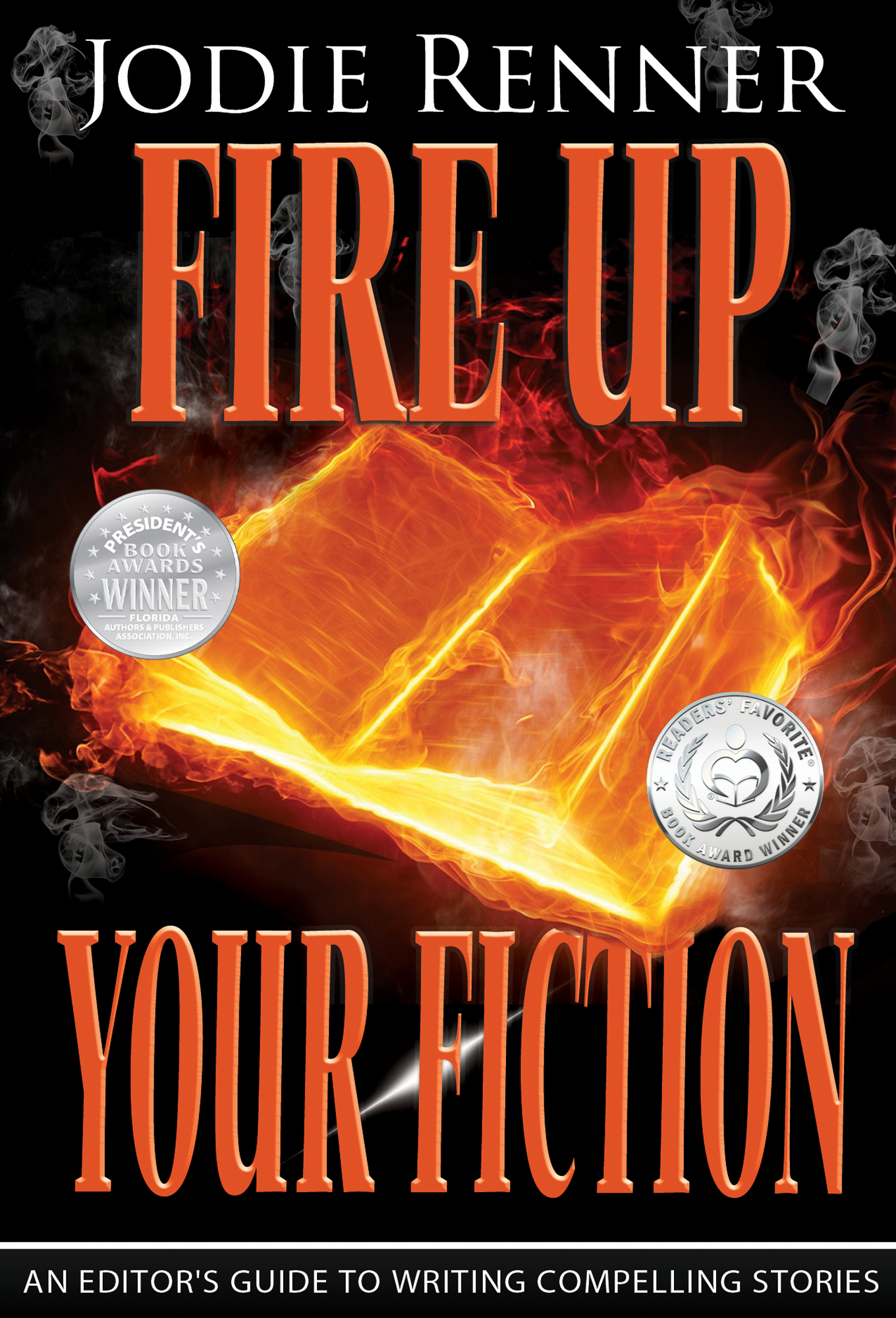
This list is by no means exhaustive, but working through these tips should definitely result in a more dynamic, engaging writing style and better pacing. For more many more tips with examples for sparking up your story and polishing your prose, check out Jodie Renner’s FIRE UP YOUR FICTION.

For lots more succinct, valuable advice for writing compelling fiction, see links to many of Jodie Renner’s top writing craft posts HERE.

Do you have any style tips to add? Please post them in the comments below. (Let’s leave advice on grammar and punctuation, and also plot, characterization, pacing, tension, intrigue, etc. for other blog posts.) Thanks.

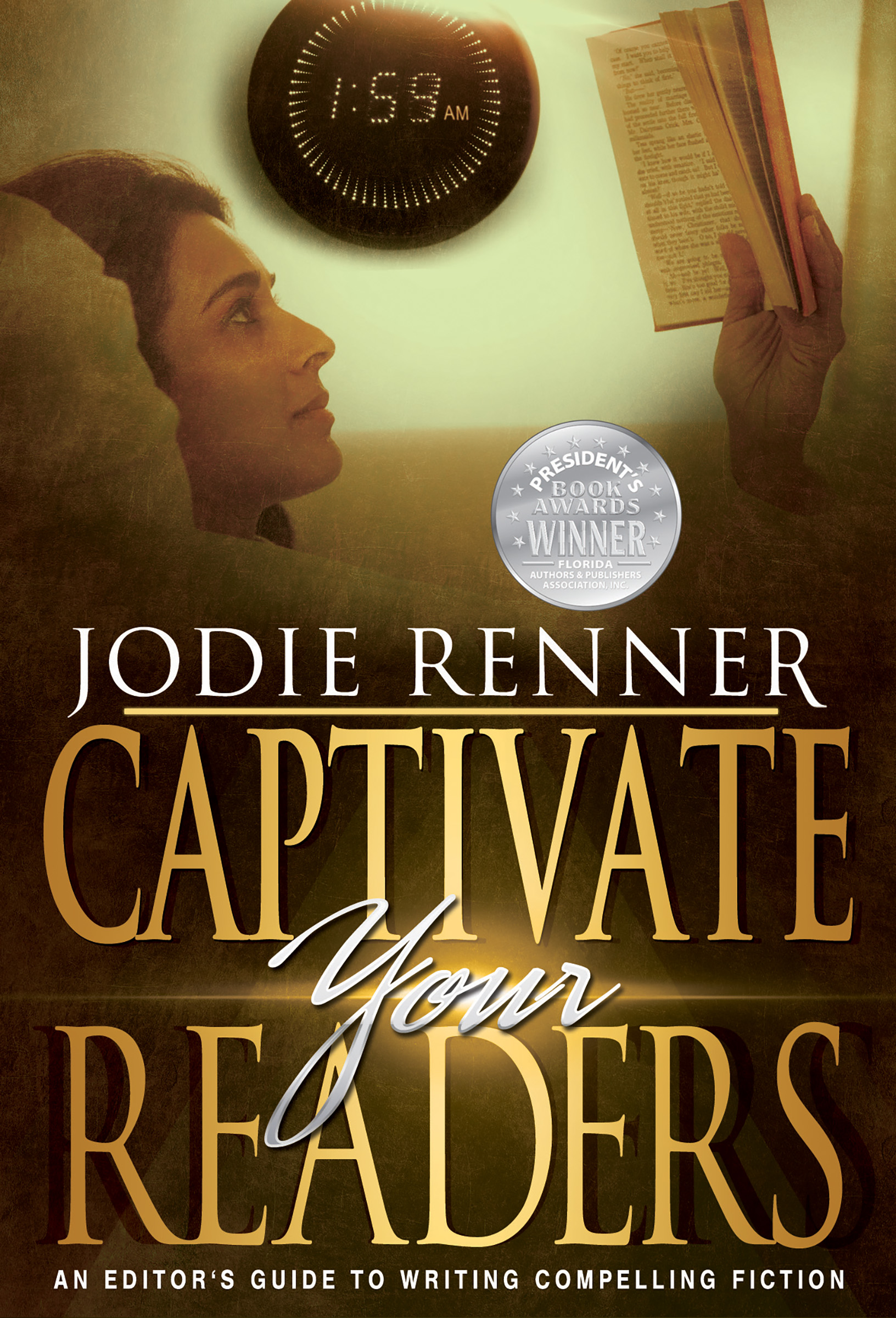
Jodie Renner is a freelance fiction editor and the award-winning author of three craft-of-writing guides in her series An Editor’s Guide to Writing Compelling Fiction: FIRE UP YOUR FICTION,CAPTIVATE YOUR READERS, and WRITING A KILLER THRILLER, as well as two handy, clickable, time-saving e-resources, QUICK CLICKS: Spelling List and QUICK CLICKS: Word Usage. Website: www.JodieRenner.com; Blog – Resources for Writers;  Facebook, Amazon Author Page.

Noir at the Bar

By John Gilstrap

A few weeks ago, I had the honor of attending a conference that is quickly becoming one of my favorites, and has earned a place on my very small must-attend list.  Creatures, Crimes & Creativity (C3 Con) is one of very few writer and fan confabs that is not genre-specific.  In fact, C3 is the only conference on my list that is not specific to the mystery/suspense/thriller genre.  It’s nice to hang out with romancers and science fictioneers.  Hey, writers are writers, and it’s hard to find a smarter, more entertaining group to hang around with.

A popular after-dinner feature of C3 is an event called Noir at the Bar, where writers sign up in advance to read a selection of their work to the assembled crowd, who then vote for the “best” story.  (By way of full disclosure and bragging rights, I won the contest in 2018, but was too crushed by deadline pressure to prepare anything for this year.)  There’s always a time limit to the presented pieces, usually somewhere between five and seven minutes, and at hard core Noirs at the Bar, they cut readers off at the sixtieth second of that final minute.

This year, as I sat in the audience listening and watching authors slash each other with gladiatorial prose, I realized that too many of the presenters didn’t understand the challenge they were facing.  To read a story aloud is to perform a story.  Pushing the competitive element aside, when a writer chooses to read to his audience, he is denying his audience the opportunity to read along.  Whatever the listener gleans from the story must pass through not just the writer’s fingers, but also his vocal chords and his eyes and his body language.

The whole point of taking the stage–any stage–is to entertain the audience.  Hard stop.  That requires eye contact and knowledge of how to use the microphone.  It means knowing your material.  The year I won, I confess I cheated a little bit by reading an epic poem instead of a short story.  (I was just a child, a boy of ten, when I went to the mountain where I’d never been/and I heard the old folks talk and say there’s a monster up here, still lives today/with glowing red eyes and a deathly look/I’m telling you, boy, ’bout Old Mack Cook . . .)

Our time limit was 7 minutes, and I edited the piece and rehearsed it and trimmed it some more until I had it down to 6:45.  I presented from a manuscript that I’d printed out in 20-point Arial, and using the timer on my phone, I tracked my progress through handwritten notes I’d placed during rehearsals that showed me what the time should be at the beginning of key stanzas.  By the time of the performance, I had the piece pretty much memorized, and the manuscript was there just as a reference.

Speaking of using a manuscript as a reference, I learned a valuable trick.  First of all, I never staple or bind the papers.  When I place the text of a presentation on the lectern, I begin with two piles, both face-up, with the bulk of the text on the right, and the current page I’m referencing on the left.  As I get to the bottom of the left-hand page, I slide the right-hand page over to cover it.  This way, if a brain fart happens, I know at a glance both where I’m supposed to be, and where I’m going.  When the presentation is completed, the entire manuscript is stacked on the left, face-up, with the last page on top.

My rationale here is that I want to appear to be as prepared for a presentation as I try to be.  To the degree that I can memorize the presentation, I do, but I think it looks terrible to break the flow of language for a page turn, and I hate the optics of a page flip.  It looks unprofessional to me.  And the flopping page turn necessitated by a staple in the corner is just flat-out awful.

When I’m on tour for a book, I avoid doing readings whenever I can because I find them boring.  But when pressed, I invoke a trick I learned from an author buddy of mine, and read a scene from the book that I’ve rewritten specifically for a bookstore audience.  Since my stories are largely inappropriate for children, yet children are often present at readings, I simplify the language and make it family-friendly.  I’ll make the violence less violent.

While we writers are not in show business, per se, we are in the entertainment business, and we’d all be wise to treat every public presentation as if we were addressing a television audience of millions of people.  Preparation is key.  Obsessive preparation is even better.  Every time you ask people to watch you and listen to your words, you owe them the courtesy of having something to say and being prepared to say it in the most engaging way you can.

Just as writing is about the reader, not the writer, presentations are about the audience, not the speaker.  However many or few are in the audience, every one of those people came for a show, and you owe them the best you can give.

There’s really no downside to writers putting themselves out there as public speakers.  For the most part, the public expectation is low because most writers hate being out in front of audiences–that’s why they sit alone in rooms making stuff up.  If the speaker is boring, he’ll have met expectations and will largely be forgotten.  If he nails it, though–if he makes people laugh a little or cry a little (preferably both)–he’ll be remembered for taking the audience on an unexpected journey.

What say you, TKZers?  Do you have any tips to share on presentation skills?

First Page Critique Redux:
What A little Rewriting Can Do

“Books aren’t written – they’re rewritten. It is one of the hardest things to accept, especially after the seventh rewrite hasn’t quite done it.” ~Michael Crichton

By PJ Parrish

Hi there, crime dogs. Today I’d like to revisit one of our First Page critiques.  Not because I think that the submitting writer needs to be raked over the coals once more.  This time, I’d like to show (rather than tell) what a little judicious rewriting can do.

Rewriting is dear to my heart. It reminds me, at times, of the despair I used to feel in my sculpture classes when I was a college art major. I was terrible at anything involving three-dimensional design. I aced portraiture, watercolor, acyrlic and oil. But when it came to creating something out of a piece of wood, clay or plaster, I was really bad.  Don’t know why…it’s just the way my brain is wired.  I had to work really really hard in 3D design. It didn’t come naturally to me.

So those of you out there struggling with the structure of your book, I feel your pain.  I know how hard it is to take a lumpy gray mass of hot mess and try to turn it into something with shape, definition and, yeah, even beauty.

Which brings me back to our topic of the day — rewriting.  You can’t fear it. You shouldn’t fight it. You must embrace it.  I read one writer who described rewriting as trying to scrub the basement floor with a toothbrush. But it needn’t be that gruesome. Writing may not come naturally to you, but you can be better at it if you try.  Rewriting is how you get all the bad stuff out of your system.

It’s okay in your first draft to use cliches, stale metaphors, boring chapter endings, bad transitions, unoriginal description.  It’s okay to have potholes in your plot, flaccid character development, turgid backstory.  Get it all out there, keep moving forward, finish the draft. Philip Roth once described a first draft as a floor that, once in place, he could walk upon.

So build your floor. Then go back over it and do the hard work. Don’t despair. Trust that you can do it.  Your pencils should always outlast your erasers. I think Nabokov said that.

Now, back to the First Pager. Last month, I critiqued a submission titled Scarlet Lies. It wasn’t bad, but it had some basic problems. The writer asked if I would read her second attempt. Because her attitude was so receptive, I agreed. I will let you see how things went. First, here’s the original:

SCARLET LIES

Scarlet crossed the multi-lane city street without checking for oncoming traffic. They would stop. And if they didn’t, what of it? A few horns blared and she clicked her heels across the road, the sun blaring in her eyes through the smog and haze. A man sat across the street, watching the foot traffic from a cafe table. He drank from a small, cream-colored mug.

Was that him?

Yes. It was. It was him. She couldn’t believe she saw him there, just on the other side of the street, drinking coffee, existing. How long had it been? Two years?

“Guy! Hey! Guy!” She hustled, her voice screeching and her gait reminiscent of a baby calf with awkward, tiny steps. Her skirt was tight, the shopping bags she carried were bulky, and her stilettos were sharp. The traffic did stop for her.

The man turned and watched her wobbling approach. She was grinning. He was not.

He said nothing, creasing his brow and sipping his coffee. He ended the call he was on. Slid his phone into his pocket. His olive complexion had deepened in the summer sun, and he had opted not to shave for a few days, giving him a rough, careless appearance.

She was radiant, elbowing people out of the way to get to him and straightening her walk.

“Guy! How are you? It’s been forever!” She was breathless. She stepped through the cafe gate and sat at the table with him. She raised her hand at a server, waving her over. A young woman approached and looked at the two of them, waiting. Scarlet looked at Guy, and blinked a couple of times.

“The lady will have an extra-hot Americano with a half-pump of hazelnut and a pitcher of cream on the side, please.” He looked up at the waiter apologetically.

“Oookay. One very special nearly hazelnut Americano and some creamer coming up.” She forced a smile, rolled her eyes and walked away. Scarlet beamed at Guy, biting her lip.

“You remember my coffee. You were always so thoughtful. How are you, though? Really?” She leaned towards him.

He looked at her for a moment, not returning the smile. “I’m good. I’m surprised to see you, Scarlet. Out in the wild.”

“Really? Why is that?”

He didn’t answer. He sipped his coffee and stared at her.

“I’ve missed you so much.”

“I doubt that.”

_______________________

Now here’s the second version she sent to me:

Scarlet crossed six lanes of traffic on East 57th street without looking. New York hadn’t claimed her life yet, but she felt it would be an easier fate than dealing with her mother’s charity gala tomorrow. How was she supposed to find a speaker when she’d only been released for two days? As usual, her mother’s demands were unreasonable.

Tires screeched as she strutted across the road, the sun blazing in her eyes through the smog. A Ferrari skidded to a halt and blared its multi-tone horn.

“Watch it, lady!” A man yelled out the window at her.

She held up her middle finger at him as she stepped onto the sidewalk.

Scarlet walked two more blocks towards her target. A coffee shop, apparently. She double checked the location on her phone as she approached.

Then, serenity. She saw Michael sitting at a cafe table, talking on his phone and flipping through a notebook. Scarlet smiled, knowing her luck at finding him here would probably be considered closer to criminal stalking, but he would benefit from her charming companionship, regardless of what he claimed to believe or what he had said to her the last time they parted. That was two long years ago, and he hadn’t been thinking clearly.

His olive complexion had deepened in the summer sun, and he had opted not to shave for a few days, giving him a rough, careless appearance. He was absorbed in his conversation. Next to him, steam curled from a small, cream-colored mug. Her heart pounding, she watched the image of him flicker in and out of view between the gray masses of people elbowing their way around her.

She hadn’t spoken to him since the fire. Since he “swore her off.” Well. Time to change that. She adjusted her skirt and walked through the cafe gate.

“Michael! Hi!”

The man froze in place for a moment and then looked up, his face stony. She was grinning. He was not.

She heard him bark a quick “call you later,” and he slid his phone into his pocket.

“How are you? It’s been forever!” She was breathless. She down sat at the table with him, dropping her shopping bags on the ground beside her.

He looked at her for a moment, dread and quiet disbelief on his face. “I’m honestly a bit surprised to see you, Scarlet. Out in the wild.” He gestured in the air around him.

Scarlet raised her voice an octave and flipped her hair behind her shoulder. “Well! Vacation’s over.”

“Vacation?” He pressed his lips together, eyebrows raised. “I don’t think so. Did you break out, or did your parents pay?”

She smiled again. “I’ve missed you.”

___________________

So, what is improved by the rewriting? Let’s try to break it down. Again, this is just my opinion:

  1. Scarlet is much more likable now. Some of you liked her better than I did, but I found her sort of ditzy and wondered if readers would want to follow her for an entire book. Now, I think she comes across as just high-spirited. Big difference. I don’t know what sort of sub-genre the writer is going for here, but the light tone makes me think this would be appropriate for romantic suspense, straight romance, or cozy. What’s better now is that the tone is more consistent, and that’s important. Some writers never quite grasp the idea that you have to have a tone for your story — light, dark, hard-boiled, historical, whatever — and every word and sentence you write has to support that tone.
  2.  We now know where we are geographically. Important to establish that right away.
  3. The dialogue is much better. Do you notice how just separating the dialogue from surrounding narrative makes it look cleaner? Easier to read for today’s writers. If you go back and read older fiction, you’ll notice this may not be true. But for today’s market seems to demand it. It’s a matter of taste and trends but it’s good to be aware of it.
  4. Point of view: This is where the writer really improved things. In the original, the POV wavered between Scarlet, the man, and wandered up into omniscient. Again, this is a modern trend, but being firmly in one character’s POV at a time is  important in today’s market.

One last thing I pointed out to the writer:  We don’t know what genre she’s working in here, but if it is suspense or mystery, it is crucial to pretty quickly establish some kind of disruption in Scarlet’s life. Something has to go wrong, or you have to drop hints that something ALREADY has gone wrong — and that THIS is what your story is really about. I advised her to not waste too much more time on chit-chat between Scarlet and Michael unless it supports this. His dialogue about the breaking out and her being out in the wild hints at it, but the writer still needs move the CONFLICT closer to the front of the stage. And you don’t want to wait too long to do this.

So, end of object lesson. Thank you — again! — dear writer for letting us learn as you do. And to remind us that in baseball, you only get three strikes. But in writing, you get as many as you need.  I think Neil Simon said that…or maybe it was Yogi Berra.

Welcome to Murder 101: PG Halloween Edition

With Halloween arriving next week, murder is in the air. It might be the only time of year when “normal” people can fully relate to crime writers and readers. So, ladies and gents, grab your favorite beverage and kick back for a little Murder 101, complete with visual aids.

Let’s say your male character is cheating on your protagonist.

During the confrontation — we can’t ignore that type of behavior, now can we? — take the homewrecker by surprise with one well-placed stab to the carotid artery. Don’t forget to withdraw the hunting knife! We wouldn’t want it to act as a plug.

Notice how the kitty is priming the carotid artery? The subject is nice and relaxed. More importantly, he doesn’t suspect a thing.

There are two carotid arteries in the neck, one on the left side and one on the right. Each carotid artery branches into two divisions:
• Internal carotid artery supplies blood to the brain
• External carotid artery supplies blood to the face and neck

If it were me, I’d aim for the internal carotid, but it’s a personal preference. If you’d rather watch the blood drain from the subject’s face and neck, then shoot for the external. Both will get the job done.

A quiet execution is an effective way to murder…

If you choose this murder method, be sure to use a fast-acting poison. No need to act psychopathic by dragging out your subject’s agony. Unless, of course, that’s what you’re into. No judgments!

May I make a suggestion? Try using Tetrodotoxin, which is a complex biochemical found in two marine creatures, the blue-ringed octopus and the puffer fish. It’s also in slugs, but on a much smaller scale. Garry Rodgers wrote a fantastic article about this deadly poison.

Whether Tetrodotoxin is injected via octopus bite — how might you explain a pet octopus? — or ingested by way of food or drink, the poison will kill the subject within a few minutes, depending on the character’s size vs. the amount of poison administered. Tetrodotoxin first blocks nerve responses and then paralyzes the victim, which prevents the victim from breathing. Finally, it stops the heart. As little as 1 milligram is all you need to accomplish your goal.

Some people prefer a good ol’ fashioned murder method, complete with sound effects.

Ladies, please don’t close your eyes while firing a weapon. I know murder isn’t easy, but if you’re determined to see this through, you may as well do it right. For information on the correct ammunition to use, John Gilstrap, wrote a post about what works best. Hint: hollow points are your friend.

Manual suffocation adds an up-close-and-personal touch.

This method is fairly straightforward. Notice how the sloth covers the kitty’s nose and mouth with one smooth motion? Perfect execution! Only use this murder method on humans please. We’re not savages, after all. ?

Sometimes, you just gotta let loose — and that’s okay.

Nothing screams you’re on the edge of sanity quite like an ax. Don’t you agree? You may want to act this one out at his place to avoid a lengthy crime scene clean up. Notice the plastic coveralls? Get yourself an identical suit but wear the hood. You wouldn’t want to leave hairs behind for the crime scene unit.

I swear, Your Honor, I had nothing to do with it. He tripped.

Do NOT harm the family dog. Please note how Miss White effortlessly pushes her lover down the stairs. So graceful, so ladylike, a little flick of the wrist and her problem is resolved.

Unless, of course, his neck doesn’t snap. Yeah, that could happen. Then what do you do? No problem. Finish him off with a quick slash to the neck like this …

Time is running out, folks. By November 1st some people may not “appreciate” a crime writer/reader’s passion to help others. Before then, it’s perfectly acceptable to say…

I’ll leave you with one final word of wisdom…

For those participating in NaNoWriMo this year, remember that. Happy hunting! I mean… writing. 😉


He Has Come to Solve Your Plot Problems

by James Scott Bell
@jamesscottbell

Click to enlarge. You’ll be glad you did.

Long, long ago, on the planet Plotto, there lived a king named Story and a queen named Structure. So deep was their love that they knew neither of them alone could rule the planet justly. They needed each other. So did the people.

Thus, together, King Story and Queen Structure ushered Plotto into its golden age.

Naturally, they were thrilled when a royal baby was born.

But alas, an evil villain, Vektor Formless, hatched a plan to blow up the planet. The plan was discovered, but not in time to stop the Formless Doomsday Machine countdown.

With tears in their eyes, King Story and Queen Structure lovingly placed their baby into a little rocket ship and sent him to a distant blue planet.

The rocket came to rest in a field in Kansas. An elderly couple, the Essbees, found the baby and decided to raise him as their own. They named him Jay.

As Jay Essbee grew, he began to understand that his mother was a frustrated writer. She had been working on a novel for years, and it was now being rejected by publishers in the east.

This made his mother sad, and Jay Essbee wanted her to be happy.

One day he went into the study and found his mother’s manuscript. He read it all the way through in an hour.

When his mother came in and saw Jay sitting in a chair with her pages on his lap, she was astonished.

“What are you doing with my book, Jay?” she asked.

“I read it, Mother,” Jay said.

“But you’re only eight years old!”

“And yet I read it and understood it.”

Mother Essbee trembled into a chair. “What … did you think?”

“I think there is a germ of a great plot, Mother. But the first act drags, and the main character is not forced through a doorway into a great conflict. Some of the scenes lack tension. The plot meanders in places. There is some definite sagging in the middle.”

For a long moment Mother Essbee sat frozen, staring at the boy. Then she cried out, “Father!”

Father Essbee came running into the room.

“Our son,” Mother Essbee said, “is a book critic!”

“Not a critic,” Jay said. “I can help you fix these things.”

“But how?” said Mother Essbee.

“It must be he has powers from his own planet,” Father Essbee said.

Over the next few weeks, Jay Essbee worked with his mother on her manuscript. When they were finished, Mother Essbee sent it to an agent in New York. The book sold at auction for a million dollars and then to the movies for another million.

After the movie premiere, Mother and Father Essbee took Jay out for ice cream. Mother Essbee said to her son, “We cannot keep your wonderful gift to ourselves. You must take it to the world. Henceforth, you shall be known as Plotman.”

She produced a little costume with a large P on the front, and a cape with the same P. No one seems to know how the costume grew right along with Jay and still fit him when he was an adult.

But we do know this: Plotman has sworn to uphold plot, story, and the bestselling way!

JSB: Thanks for indulging a little whimsy. All this is to introduce my new writing book, PLOTMAN TO THE RESCUE: A TROUBLESHOOTING GUIDE TO FIXING YOUR TOUGHEST PLOT PROBLEMS. The ebook is available here:

Kindle

Nook

Kobo

And just a note, if you’re doing NaNoWriMo next month, this book will be a perfect companion for the days when you sit down and go, “Now what?” or “What the heck is this?” Plotman, along with his faithful sidekick Subplot Boy, will appear to help you faster than a speeding bullet … or at least as fast as you can click to a chapter.

Happy writing!


What Writers Can Learn from the Housecat

(c) Copyright Fennec the Cat. Used by permission. All rights reserved.

It is October. Dark and light chase each other as they battle for supremacy,  a conflict which the dark is pre-ordained to win at this time of year. A potentially paralyzing ennui has a tendency to sit in and take its grip on some of us during this time of year. There are many ways to break this, such as turning on every light in the house, reading that backlist of your favorite author, blasting music, binge-watching a television series on your favorite streaming service, or all of the above, sometimes at the same time. Still, for writers, the flow of ideas with the transformation to sentences occasionally tends to ooze like syrup rather than flow like water. At such times we would be wise to consider the housecat. 

Yes. The housecat. It has so prestigious a title, yet so little to do. Its brain cannot conceive of us as anything other than giant cats (so we are told) which possess opposable thumbs, placed on earth to do their bidding on demand, even if we are doing something more important (such as listening to The Complete Prestige 10-Inch LP Collection by Miles Davis) or otherwise. Fennec, my own black-and-white cat, occasionally interrupts his eat/litterbox/sleep/repeat cycle to request entry to my attached garage. Herein lies the lesson. 

The garage for Fennec is what the mind is to writers. We search our minds for ideas. Fennec, particularly at this time of year, goes into the garage in search of mice. Rodents find the garage to be attractive at this time of year due to its (relative) warmth. It took me a while to figure out why Fennec, immediately after entering the garage, rolls around on the garage floor. I figured out that he is masking his scent. Once Fennec is sufficiently garage-odiferous he waits patiently for a mouse — the idea, if you will — to manifest itself. Sometimes Fennec waits on the floor. He at other times sits atop the car, like a vulture on a branch. A mouse eventually appears. Fennec pursues. Sometimes he comes up empty. When I open the door and he comes in empty mouthed he appears to be forlorn, the same way that we do if an idea fails to bear literary fruit. If Fennec catches something, however, he runs into the house triumphantly, with the mouse — his completed novel — in his mouth. He tosses it up in the air and catches as he runs from room to room without missing a beat as I — his most avid reader — chase after him, hoping that 1) the mouse is squeaking in the Choir Invisible or 2) the mouse is stunned enough that I can get it into a plastic bag and dispose of it before it scatters off into an inaccessible corner of the house where it will no doubt bear a litter. 

We’ve gone through this Mr. Punch routine several times in the past two weeks. To paraphrase Yogi Berra, I’ve learned a lot by watching. I’ve been taught that ideas will come and will be transformed into sentences. I just need to wait patiently. I also need to be ready to pounce when they manifest themselves. And yes, I am allowed to throw them in the air, juggle them, and catch them if the mood strikes me. As are you. 

Enjoy October and Halloween. I hope you catch what you seek. In the interim…what have you learned about writing, life, or anything, from your or someone else’s pet? Thank you for stopping by, as always.

Afflicted

When I think about the personal challenges that thriller/mystery series protagonists are saddled with–particularly cops, psychologists, private detectives, and medical examiners–they tend to be emotional and psychological. Or the protagonists are alcoholics or drug addicts. (Sherlock Holmes? Wallander? House? I know, but House solves medical mysteries.) Or they’re irascible jerks who get away with being jerks because they always solve the crime. (Morse, and often Lynley.) Poirot was a fastidious little man, yet not nearly as annoying on the page as on the screen (only in comparison–I’m a fan of both).  Lord, save us from the oft-divorced investigator who’s been damaged by the death of a sibling or (an abusive) parent or has abandonment issues, drinks too much, and can only be saved by a good woman–only he won’t be saved because he always screws up his best opportunities. Then again, never mind. These guys have become tropes because they make good reading.

I confess I’ve read a lot more male investigator stories than female, written by men and women, both. Kate Atkinson’s Jackson Brodie, and Val McDermid’s Tony Hill are among my favorites. But when it comes to damage, it’s hard to compete with the devastating pasts of female protagonists Lisbeth Salander (Stief Larsson) and Kick Lanigan (Chelsea Cain).

As usual, I digress.

Psychological and emotional challenges are always interesting. But in the past week I listened obsessively to four novels in Michael Robotham’s Joe O’Loughlin series. Yes, I started with book number five, of eight. (I often start mid-series and eventually return to the beginning.) Joe O’Loughlin is a psychologist drawn into the profiling game. In addition to having the infidelity, alcohol, and relationship issues common to so many other (fictional) investigators, Joe has early-onset Parkinson’s disease. I find that a fascinating choice on Robotham’s part.

Parkinson’s is a degenerative disease of the central nervous system that has a survival rate of between 7 and 15 years. It affects men more often than women, and is marked by uncontrollable movements, late-stage dementia, and a host of other troubling symptoms. It’s not a disease that the sufferer can hide for very long.

O’Loughlin’s battle with the disease begins in the very first book of the series, and never ends or gives him a break. He’s suffering, and it negatively affects his marriage, work, and other relationships. More than once, it nearly costs him his life. It’s become a super villain he refers to as Mr. Parkinson, and it’s a villain he can’t fight beyond taking medication and making some lifestyle changes. There is no cure.

Today, a woman who served me lunch at a restaurant had the use of only her right arm, as her left had been amputated at the elbow. She did her job with alacrity and care. However it happened, she just deals. It must be incredibly difficult, but she makes it look easy. She is not fiction.

O’Loughlin is a fictional character about whom Robotham made a significant and possibly unique choice. As a psychologist, O’Loughlin is a character who’s used to guiding other people’s lives, yet he can’t even control his own body. Frustration layered over sadness over tragedy. The deck is, as they say, stacked against him. But isn’t that what excellent thrillers are all about? Ordinary people facing extraordinary odds. Robotham pulls it off.

I’m stymied as to other thrillers in which the protagonist has a significant physical challenge. Of course, there was Jimmy Stewart with his broken leg in Hitchcock’s adaptation of Cornell Woolrich’s REAR WINDOW. The break definitely intensified the story.

Can you name other stories/characters in which the writer severely challenged their main character?

Have you created similar situations in your own work?


Reaching Out to New Writers

by

Debbie Burke

@burke_writer


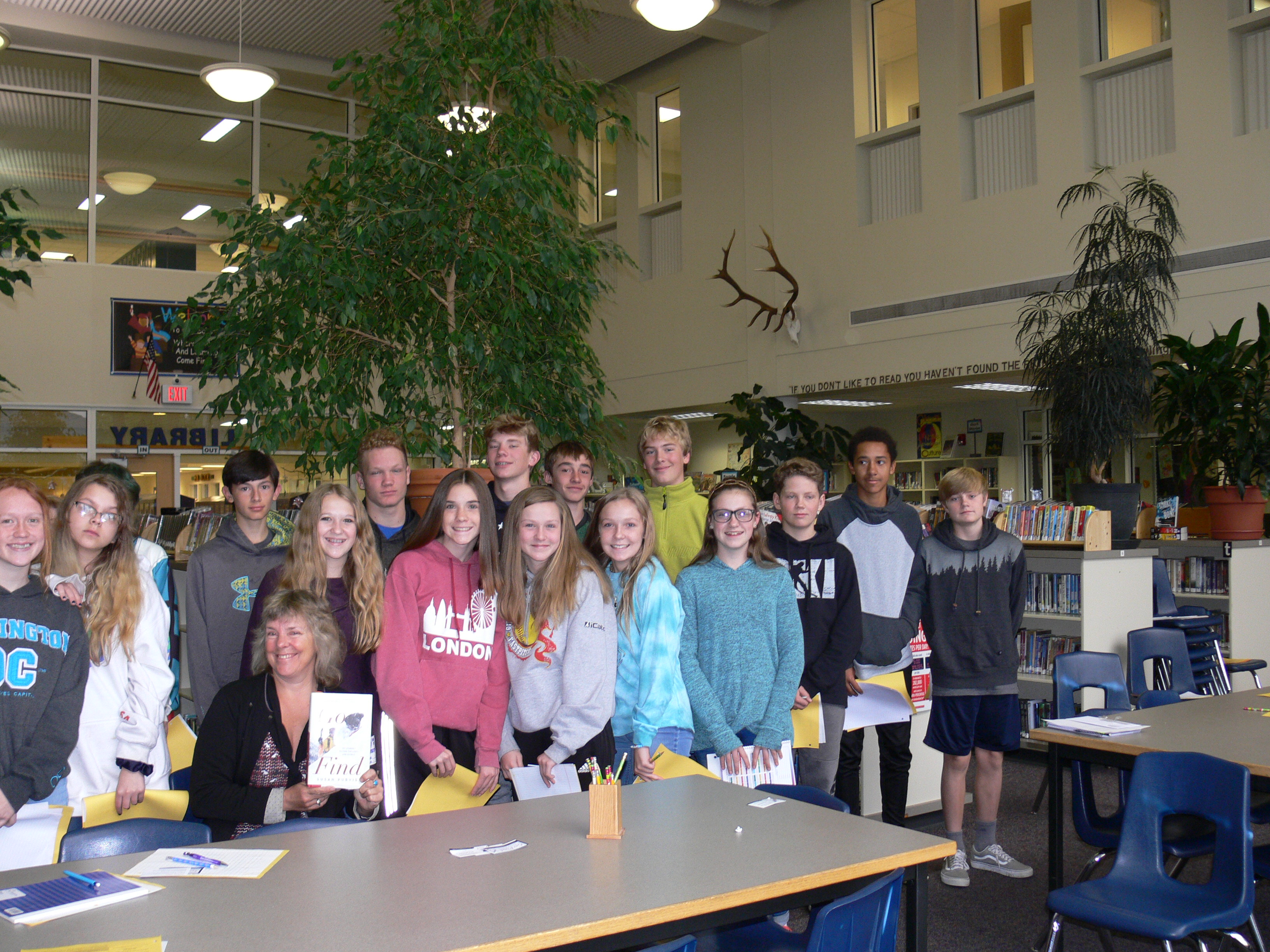
Columbia Falls Junior High NaNoWriMo students

It’s Tuesday morning at Columbia Falls Junior High School in northwest Montana. Approximately 75 eighth graders troop into the library where a massive glass wall faces Glacier National Park, shrouded in clouds that promise early snow. The students are gearing up for NaNoWriMo (National Novel Writing Month) led by English teachers Rubianna Masa and Cecilia Byrd-Rinck.

Since 2012, Rubianna has shepherded her students through the November writing marathon. “I will not lie,” she says. “Some of my students are excited to write while others think this is the craziest and worst thing a teacher has ever made them endeavor.”

Prior to the challenge this year, she invites two local authors to talk to the kids.

The lucky guest authors? Memoirist Susan Purvis (Go Find: The Journey to Find the Lost and Myself) and yours truly.

As students trail into the library, I chat briefly with Brookann who tells me she uses her dreams to inspire her writing. We discuss harnessing the power of the subconscious to find answers to story problems. I’m instantly impressed.

Sue kicks off the talk. “It all starts with a promise. I promised to train my Lab puppy to be a search dog that never leaves anyone behind. And I promised to write a book about it. That was my dream.” She draws parallels between her true-life story and fiction the kids will write, starting with an inciting incident, the roller coaster of setbacks, finally building to the climax, then the resolution.

Since Sue’s book is set in high mountains, she asks the kids, “What’s your Everest? What is your goal or dream?” followed by the question, “What’s standing in your way?”

Aspen answers: “Be an artist. But I have to do schoolwork instead of draw.”

Emma answers: “To love somebody. But society is in the way.”

Sue then describes the story problem in her memoir: “Why is it easier for me to jump out of helicopter with my search dog onto a 13,000-foot mountaintop to recover a dead body than to talk to my husband about our marriage?”

Tristan answers: “Because your dog doesn’t judge.”

Sue and I stare at each other, blown away by his insight.

When I ask the kids who are the antagonists in Sue’s story, they shoot off more great answers:

“Her dog that didn’t want to be trained.”

“The other search guys who didn’t want a woman around.”

“Her husband.” 

This is one smart crowd.

Next we focus on their stories and ask:

Who’s your main character? What do they want? Who opposes them? What’s at stake if they fail?

And the toughest question of all: How do you distill your entire novel into a 30-word elevator pitch?

They take a few minutes to write their answers. Then several read their summaries to the group.

Hailey: “My main character is a 14-year-old boy who wants his mom to stop using drugs. If he fails, she will get sicker and sicker.”

Sarah: “My story is about a girl and her best friend who want to change the world by getting rid of trash. Then the best friend is killed in a school shooting and my main character falls apart. Her new mission is to stop future attacks.”

Whoa. Serious writers with serious themes.

We invite them to meetings of our local group, the Authors of the Flathead, whose motto is writers helping writers.

I talk about how brainstorming with others can get you out of a corner; how it’s hard to judge your own work because you’re too close to it; how asking others read your story gives you honest assessments, even if they’re painful.

I encourage them to grasp unexpected opportunities that may divert from the original plan yet lead to greater rewards.

Sue and I arrive with the intention of helping young writers but we receive an unexpected gift in return. We are co-writing an adventure book for young readers and ask if they’ll give us feedback on our synopsis. They enthusiastically agree and proceed to shoot off penetrating questions like:

“Are you going to use alternating points of view?” That has not occurred to us until Jasmin brings it up! And we’ll certainly consider it.

Other comments: “Tell us more adventures in the mountains.”

“What happens to people in avalanches?”  

“I want to hear about the science of how dogs smell lost people.”

We’re on it, guys!

We ask if they’ll be our focus group to offer suggestions and opinions as we write the book. “Sure!”

Ninety minutes have flown by and the bell rings for their next classes. Off they go, hopefully with a few new tools to help them survive NaNoWriMo.

Novelist/screenwriter Dennis Foley mentored Sue, Rubianna, and me (see earlier post here). He always urges us to “pass it on.”

As so often happens in life, you set out to help others and instead wind up being the one who’s helped.

Sue and I leave Columbia Falls Junior High School with full hearts and two notes from students.

Brookann writes to me (with a follow-up email that afternoon, condensed here): “Goal is to be a writer of anime books. Elisbeth wants to save the human race and defeat the villains to make a better world…I am writing this story because I love anime and I am basing it off multiple scenes from different anime series, to make the perfect character for the perfect book. I hope this book will succeed in the way I want it to. I hope you can help me progress and succeed with this book. Thank you.”

This eighth grader understands more about researching her market and making her book stand out in the crowd than most adult authors! 


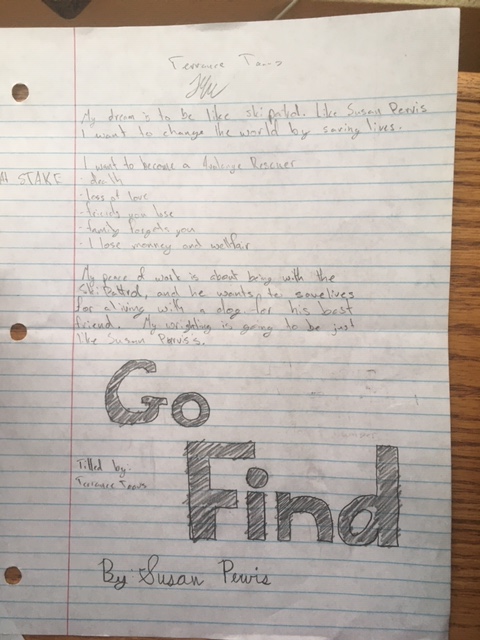
Terrance writes to Sue: “My dream is to be like ski patrol, like Susan Purvis. I want to change the world by saving lives. I want to become an Avalanche Rescuer. My writing is going to be like Susan Purvis.”


It’s a good day to be an author.


TKZers: What’s your favorite way to pass it on? 


You can find Debbie Burke’s new thriller Stalking Midas on Amazon.