Why You Should Never Give Up

hindsightEighty percent of success is showing up.” — Woody Allen

By PJ Parrish

I got my first rejection letter back in 1980. It was for a romance novel I had written. The letter came from Dell Publishing. It was short and sweet.

Dear Sir or Ms., Montee,

We thank you for the opportunity to consider your proposal or manuscript.  We are sorry to inform you that the book does not seem a likely prospect for the Dell Book list.

Because we receive many individual submissions every day, it is impossible for us to offer individual comment.

We thank you for thinking of Dell and we wish you the best of success in placing your book with another publisher.

Sincerely,

The Editors

Yes, they had crossed out (scribbled out really) “sir” and had sloppily inked in my last name. But dontcha love the elegance of the phrasing? “The opportunity to consider”  (the story I had sweated over for a year.) “Doesn’t seem a likely prospect…” (to ever see the inside of a bookstore). “We thank you for thinking of Dell…”  (like Dell is some real live person who actually wrote this?) “We wish you success in placing your book with another publisher…” (And don’t darken our doorstep again, you no-talent little twerp.)

I found this letter the other day when I was cleaning out my office.  Oddly, it was the same day I bought a new wallet and had to transfer all my stuff to the new wallet.  Tucked behind my old Social Security card, I found a tiny folded up, deeply creased yellowed piece of paper. On it was typed this:

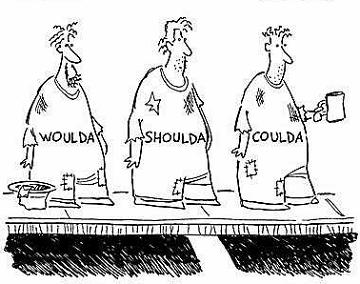
I’d rather be a could be
If I couldn’t be an are
for a could be is a maybe
with a chance of reaching par.
I’d rather be a has been
than a might of been, by far
for a might have been has never been
but a has was once an are.

I have no idea when I typed that or where it came from. I don’t even know how long I have had it, though I suspect I have worn out many wallets since. But I do know that I have it for as long as I have been using a wallet so that means most of my adult years. The sentiment in that little stanza has carried me through many a bad patch and through many jobs.

I remember I had it tacked up on the bulletin board above my desk in my dorm freshman year at Eastern Michigan University.  I was there at the state college by virtue of a 2.5 high school GPA, mediocre SATs and a promise from my dad that he had just enough money to get through one year. After that, he said, I was on my own.  I got a job flipping burgers at Big Boy’s and ended the year with a 3.5 GPA, which led to a modest scholarship. I made it through the next three years on waitress tips and student loans.

I’d rather be a could be
If I couldn’t be an are…

When I graduated in 1972 with a teaching degree, there wasn’t a job to be had. But I had been working on the college newspaper for extra money and the adviser suggested I might be able to get a job as a reporter. Twelve rejections later from the largest newspapers in the Detroit metro area, I got hired as the editor of the Suburban Woman section of the Southfield Eccentric weekly. I was off and running…at $125 a week.

for a could be is a maybe
with a chance of reaching par.

I won a national award from the University of Missouri school of journalism for my women’s section and got a call from a guy at the Fort Lauderdale News who was looking for someone to run his women’s section. (Yes, that’s what it was still called in those days, young-uns).  I got the job, packed up my cat in my rusty VW, and moved to Florida.  I was 24 years old and not ready to run a daily feature section, let alone supervise a staff of nine, three of whom were in their 60s. Six months later, I was demoted to assistant and an older woman was brought in as my replacement.  I wanted to quit. But I went for a walk in the parking lot, cried, and went back upstairs to work.  Six years later, I was promoted to assistant managing editor.

I’d rather be a has been
than a might of been, by far.

It was a nice paycheck but I was writing performance evaluations instead of articles. They wouldn’t let me go back to being a writer because my salary was too high and I was the only female in management. So I bought a small typewriter and at night in the dining room, I wrote a romance novel called The Dancer. I sent it out to agents and maybe 30 of them even bothered to write back and tell me no. So I sent it out to editors directly. (You could do that in those days…see rejection letter above).  Rejections…too many to remember.  Many rewrites and re-submissions later, I got a letter from a woman at Ballantine Books. Someone had given her my manuscript. My story was about a ballerina who had to give up her career after an injury. The woman who bought my first book was an ex-dancer.  I was off and running…with an advance of $2,500.

I had four books published with Ballantine/Fawcett. I found a good agent. Life was good. Then, one day, the agent told me the publisher was dropping me.  No reason given. I wasn’t smart enough about the industry in those days to understand the numbers game, the Barnes and Noble Death Spiral, and the fact that no, your book doesn’t get placed in the front of the store just because it’s good.

I gave up.  I was devastated and depressed. I walked around the mall alot. My fabulous husband, who had told me I could quit my day job to write fulltime and that we’d work it out financially, finally told me I had to try again — or get a job.  So I started over, writing a really bad but heart-felt historical family saga.  An agent told me she liked the suspense in my writing and that I should switch to mysteries.  I wrote 200 pages about a Miami homicide cop whose husband and kids are killed in a drug-raid-gone-bad.  I showed it to the agent. She suggested it was a good idea, in a mystery, if someone gets killed in the first 200 pages. She told me to go home and read some P.D. James and start over.

for a might have been has never been
but a has was once an are.

I called my sister Kelly, who I knew was working in her spare time on her own book and said, “I have a proposition for you.”  Six months later, we finished the first Louis Kincaid book. It was rejected by 10 New York publishers before it found a home at Kensington Books, a fine family-owned house in Manhattan.  It didn’t sell that well but it got some nice reviews and one really scathing one from Kirkus. But Kensington asked for two more.

The second Louis book, Dead of Winter, was nominated for an Edgar. We were off and…still trotting. Kelly and I are now working on Louis book No. 13.

You’ve probably heard different versions of my story a million times and the stories of others who have struggled. But let’s remind ourselves that…

J.K. Rowling was just-divorced, on government aid, and could barely afford to feed her baby in 1994, just three years before Harry Potter and The Philosopher’s Stone, was published. When she was shopping it out, she was so poor she couldn’t afford a computer or even the cost of photocopying the 90,000-word novel, so she manually typed out each version to send to publishers. It was rejected dozens of times until finally Bloomsbury, a small London publisher, gave it a second chance after the CEO’s eight year-old daughter fell in love with it.

Stephen King was broke and living in a trailer with his wife—also a writer—and they both worked multiple jobs to support their family while pursuing their craft. They were so poor they had to borrow clothes for their wedding and got rid of the telephone because it was too expensive. King received so many rejection letters that he developed a system for collecting them. From On Writing: “By the time I was 14…the nail in my wall would no longer support the weight of the rejection slips impaled upon it. I replaced the nail with a spike and kept on writing.” He received 60 rejections before selling his first short story, “The Glass Floor,” for $35.  After dozens of rejections, he finally sold Carrie for a meager advance to Doubleday Publishing, where the hardback sold only 13,000 copies—not great. Soon after, Signet Books signed on for the paperback rights for $400,000, $200,000 of which went to King.

Fifteen publishers rejected a manuscript by e. e. cummings. When he finally got it published by his mother, the dedication, printed in uppercase letters, read WITH NO THANKS TO . . . followed by the list of publishers who had rejected his prized offering.

Fred Smith, the founder of Federal Express, received a “C” on his college paper detailing his idea for a reliable overnight delivery service. His professor at Yale told him, “Well, Fred, the concept is interesting and well formed, but in order to earn better than a C grade, your ideas also have to be feasible.”

James Lee Burke’s novel The Lost Get-Back Boogie was rejected 111 times over a period of nine years and, upon its publication by Louisiana State University Press in 1986, was nominated for a Pulitzer Prize.

Michael Jordan famously said:  “I’ve missed more than 9000 shots in my career. I’ve lost almost 300 games. Twenty-six times I’ve been trusted to take the game winning shot … and missed. I’ve failed over and over and over again in my life. That is why I succeed.”

But maybe my favorite failure is Winston Churchhill. He had to repeat a grade during elementary school and, when he entered Harrow, was placed in the lowest division of the lowest class. Later, he twice failed the entrance exam to the Royal Military Academy at Sandhurst. He was defeated in his first effort to serve in Parliament. He became Prime Minister at the age of 62. He later wrote, “Never give in, never give in, never, never, never, never — in nothing, great or small, large or petty — never give in except to convictions of honor and good sense. Never, Never, Never, Never give up.” (his capitals, not mine.)

So, to all my fellow writers on these days after Thanksgiving, here’s my message. If you’re hitting that wall, if that wall is papered wall with rejections, if you’re filling your hard drive with tenth drafts — stop for a moment and give thanks for the power of failure.  It is what makes you strong, it what makes you better. It is what keeps you in the game.

Don’t give up. Tattoo this on your brain:

I’d rather be a could be
If I couldn’t be an are
for a could be is a maybe
with a chance of reaching par.
I’d rather be a has been
than a might of been, by far
for a might have been has never been
but a has was once an are.
 

Spinning Hope From Rejection


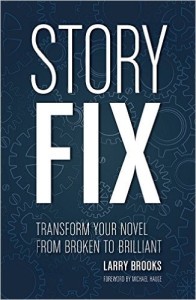
Today’s post is an excerpt from my new writing book, “Story Fix: Transform Your Novel From Broken to Brilliant.”

This is the eleventh chapter, out of 15 plus an Introduction, and thus it is written in context to what I believe to be the highest ambition of the book: to show you two things… the scary roster of stuff that can conspire to contribute to your novel being rejected (and how to reduce that risk)… and the inherent opportunity that awaits those who seek to understand the reasons why it was rejected.

Too often, upon hearing the dark news, writers simply find a new target and sent out another submission. As if the rejecting agent or editor has their head up their… sweater.

Maybe.

Just as often, the rejecting party – an agent or a publisher – doesn’t provide any real feedback from which the author might embark upon an upgrade, if not outright repair of the manuscript.

And thus (and herein commences the excerpt)…

Welcome to the Bermuda Triangle of Storytelling.

Your story is a vessel. It must float on a sea of possibility. If the weight of absurdity, familiarity, or underachievement is too heavy, the boat will sink. The relationship between an idea, a concept, and a premise defines the Bermuda Triangle of storytelling, where well-intentioned writers too often set sail without the right navigation, sensibility, or awareness to avoid being swallowed alive.

Surviving these deadly waters requires more than knowing how to swim (i.e., how to write nice sentences), or having an interesting idea alone. It’s knowing how to navigate the waters of a story, with a vessel that is strong and seaworthy.

After reading the chapters thus far, this is, of course, old news. But what remains floating is perhaps our willingness to embrace it all, to allow the principles to flow in as our limited beliefs are dumped overboard. That, like storytelling itself, is sometimes a hard thing to accomplish.

There’s a reason why revision is so freaking hard.

But if you think about it, it shouldn’t be. With all these principles and tools, it should at least be manageable. The damage is sitting in the rejected draft, staring back at you, mocking you, or it’s ringing in your ears from an outside source. The upside should position revision as more of a gift than a burden, but that’s sometimes hard to see, because you are either in denial, or you know it was you who did it that way in the first place, working with the best of intentions and without the slightest clue you were mismanaging the moment. So now, armed only with a new awareness, perhaps a need you don’t even understand, you’re supposed to suddenly bring something different to the process of fixing it?

This is craziness in its purest form.

If you’re a professional writer seeking representation from an agent, or to land a contract from a publisher, or even just to earn a little buzz in the crowded wilderness of self-published fiction, then one thing is beyond argument: Rejection hurts. It sucks on so many levels, even though the public writing conversation has assured you this was coming, because it always does. It still hurts.

And yet, despite the pain, and unlike so many other avocations that we embrace because they are fun and personally (versus professionally) rewarding, rejection matters. Hey, we believe we’re pretty good at the stuff we do personally: dancing, karaoke, golf, painting, poker, knitting, ping pong, bodybuilding, cooking. You can play crappy golf or tennis or bridge every weekend for the rest of your life, and it doesn’t change your experience or alter your future. You’re still having a good time. But this isn’t the case with writing. We thrive on hope, on the belief that our efforts are actually leading us toward something.

Pain exists not because it is an issue of winning or losing but rather because it is a measure of personal identity and ambition. Rejection threatens our dream. But that perception is exactly backwards. Rejection reminds us how hard this is, dashing hope in the process, and yet perhaps fueling us with an ambition that seeks to find an upside.

While you likely wouldn’t think to declare yourself a professional in your weekend recreational pursuits, as a writer, otherwise worldly and wise, you might consider yourself a professional even now. You go to writing conferences, read writing books, seek representation, and suddenly, because you absolutely do intend to sell your work, you bestow upon yourself the mantle of the professional. Which means—and here is a rarely spoken truth—you are competing with everyone else at the writing conference, if for nothing else than mindshare and respect from agents and editors. The respect and props you seek from them are defined by how your story compares to everyone else’s.

But you opted in as a professional, not a weekend warrior. Which means you don’t get to take it personally. For the enlightened professional, the call for revision becomes an opportunity rather than a reminder of your limitations.

And yet, it seems so … daunting.

What you hear at the writing conference, particularly when it comes to the revision process, may not take you where you want to go. Not because the advice you pick up is wrong, per se, but because it can be imprecise. It comes at you in pieces, little chunks of conventional wisdom floating alone and unconnected—as from a workshop on how to write better dialogue, for example—on a sea of assumed yet less-than-clear relevance to a bigger picture.

So you’re saying better dialogue will make my novel better? The answer is: Sure it will. Always. But then there’s this slightly different question: So you’re saying that writing better dialogue will get me published?

This is why many writers drink.

And why writing teachers exist at the very edge of madness.

The bigger picture will save you. 

When your story requires revision, chances are something you’ve done doesn’t fully align with the principles that show us how a story works, and it can be found at the story level rather than the craft level.

The sow’s ear, chicken-droppings level.

Listen closely … that sound in your head may be your inner author trying to tell you something. And chances are you really need to hear it.

The more you know about the craft of storytelling, the louder that voice becomes. The more you know about storytelling—both at the story level and the craft level—the clearer the message itself will be. Our profession is full of writers who hear the call. They acknowledge doubt in the form of that inner voice telling them something is off the mark, but they don’t really know how to respond. Usually they respond by submitting it somewhere else to see what happens, hoping to confirm their suspicion that the first agent or editor was having a bad day.

And then it comes back to you with the same outcome. And the voice telling you to revise becomes louder and more impatient.

The enlightened writer listens. 

You’ve been introduced to the tools, criteria, and benchmarks of a strong story that can be applied to the revision process, as well as to a first draft. Maybe you haven’t yet internalized them. Maybe you zoned out when they were being presented at the writing conference. Maybe you opted for the session on how to land an agent instead. Maybe you prefer the indulgent musings of keynote speakers who wax eloquent about the mystery of it all, the muse that channels through them, the characters that speak to them, the immersion in their process with the trust that somehow, some way, someday, their story will finally make sense.

Here’s a newsflash for those writers who like to tell their friends that there is something mystical in what we do: There are no actual muses (there are inspirations, which are different animals), and your characters don’t talk to you. When stories are broken—they are very much like friends and relatives and politicians in this regard—they’re not going to confess to their sins and give you a strategy for healing. No, the voices you ascribe to muses and talking characters are you, speaking to yourself from a place of story sensibility, which for better or worse is the sum and nuance of all that you’ve read and studied and learned and concluded on your writing journey.

You’ll finally hear it—it’ll sound a lot like an improved sense of story when you do—because it makes sense to you. Because you’ve had your fill of pain and frustration, and you’re finally opening up to higher thinking.

Seeking the Sweet Spot

I offer this next point from my experience presenting writing workshops for the last twenty-five years. Writers arrive in the room with certain belief systems about writing that defines what is and isn’t true in their minds. This causes them to be resistant to anything that challenges those beliefs and leads to a rather strong sense of confidence that what they’ve written, or intend to write, is rock solid and infused with genius. When something challenges that assumption—like someone saying that your characters don’t talk to you, or that there may be a better path for your story—they shut down to some extent. They are processing the contradictions, the perception of falsehood hanging in the air, and thus don’t completely perceive the meaning and inherent opportunity in what’s being presented.

Some readers of this book will, at this point, not clearly comprehend a critical nuance: that the process of story fixing isn’t just for rejected books, it’s for any story that seeks to become a better story. And complicating this is the cold, hard truth that some rejected books aren’t necessarily broken at all; they simply may not have landed in the sweet spot, at the right time, of their publishing journey. In this sense, revision is merely a form of starting over, building your best story from the inside out, from the ground up, from the truth of the principles that will never steer you wrong.

To Revise Or Not To Revise

Then again, every rejection slip does not necessarily signal the need for a major revision. Your story may be perfectly fine as is. The rejection may come from a source you do not understand, and therefore do not value. More often, though, harsh criticism and rejection may actually be the wake-up call the writer needs. And thus, it’s on the shoulders of the writer to know the difference—timing rather than a lack of sufficient craft—and to use feedback in all its forms to accurately assess the story’s strengths and weaknesses and apply that feedback to move forward accordingly. The tools and processes apply to any origin of the need for story repair, however it is conveyed—be it a rejection or simply a depressing hunch that won’t leave you alone.

Worthy stories, some of which go on to success, certainly do get rejected all the time, both by agents and publishers. These are the stuff of urban legend. Do a quick Google search and you’ll find them everywhere. I’ll mention again the quote from esteemed author William Goldman: “Nobody knows anything.”

It’s too true. But it’s also a risky way to place your bet. Because you could rationalize the rejection of your story as simply a case of timing or another agent who doesn’t get it rather than a legitimate red flag that should get your attention. We can be sure that Kathryn Stockett didn’t revise her manuscript forty-six times, one for each instance of rejection. But because she hasn’t talked about it, we can’t say for sure how those rejections colored her subsequent sequence of drafts, if at all.

Right here is where a paradox kicks in: If you don’t possess the knowledge to nail it the first time out, and are now stuck with the need to revise, how can you leverage feedback and rejection in the writing of a subsequent draft to solve those problems? You’re the same writer who wrote that flawed story. How can you suddenly, without elevating your skill set, attempt to hoist good toward greatness? That’s like asking a toddler who has just fallen off his bicycle to simply get back up and try it again, without showing him what went wrong. A lot of fathers have tried just that method over the years—“It builds character,” they say—and it’s always a recipe for further frustration and tears, as well as a few Band-Aids.

You can’t expect to take your story higher with the same skill set as before, at least to the extent that you don’t understand the feedback itself. But you’re here, you’re learning the unique tools and principles that drive successful revision, and that just might change everything about your next swing at the story.

As professional writers we are beyond the need to use our work as a means of personal character building. We require knowledge applied toward the growth of something much more amorphous and elusive: a heightened storytelling sense.

for Kill zone

 “Writing the novel is half the battle. The other half is fixing it. In this book, master craftsman Larry Brooks gives you his set of tools for the fix-it stage. So strap on your belt, and get to work!” — James Scott Bell, author of Write Great Fiction: Plot & Structure


How to Bring Characters in From the Cold


Cold CharacterVirtually all books on character creation contain a list of questions, a “dossier” to fill out which starts with how a character looks, where he was born, and so on through his family circumstances, education, likes and dislikes, etc.

I have not found such forms helpful. It may just be a personal quirk, but I’m never excited about filling out answers to questions.

First of all, too many answers too soon might hinder the development of a character. A book is a living, breathing entity. If I have a long list of facts for a character before I begin writing, it hamstrings me. I may want the character to do one thing or another, but the dossier is set and works against me.

Characters I create using the dossier method seem cold and distant. I want characters who are hot and close.

Consequently, I’ve come up with my own way of bringing story people to the page. It starts with my protagonist and finding a visual (a head shot) that resonates with me, that says to me, This is her! I copy that image and paste it on a character card in Scrivener (this way, I can look at a corkboard of all my characters at once).

Next, I want a unique voice, and that comes from a Voice Journal, a free-form document of the character talking to me. I let the character go on and on until I hear a distinct and surprising voice. It always happens, bubbling up from my basement without me being overtly conscious of it.

From here I usually go to my “mirror moment.” I brainstorm it by making a list of possibilities, until one clicks. Then I let the character talk to me in the Voice Journal. When I nail that moment, I know my pre-story psychology (and can brainstorm that, again with the journal) and the transformation at the end (I try to visualize a scene to prove the transformation. All this is explained in my book, Write Your Novel From the Middle).

I’ll spend almost as much time with my antagonist, but relatively little with the other characters I’ve cast in the story. Why? Because I want to be able to manipulate them as needed. God complex, don’t you know?

As I write to my “signpost scenes” I’ll be creating characters along the way. Instead of stopping for each and filling out a form, I just ask the character to tell me what I need to know!

For example, let’s say I’m writing a scene about a lawyer interviewing a witness. The lawyer is the main character, a female public defender. The witness is an old man who used to be a … I’m thinking about it … I want him to be blue collar … how about a machinist?

I know my Lead pretty well. Now I’ve come to this old man. He’s going to be an important player, so I start by giving him some basics—age, looks, vocation. I’ll find a head shot to match.

Now to the scene. My lawyer is questioning him in his home, and he doesn’t want to talk to her at all. Why not? So I can have conflict, of course. But the question now is why? Why would he refuse?

I asked him.

You wanna know why I don’t want to talk to a lousy lawyer? Well I’ll tell you. The minute you start flapping your gums is the minute you’re going down, because the whole system is rigged against you. I was going good there when the aerospace boom was on in L.A., out there in the San Fernando Valley, and I was good at what I did, I could operate anything, and I had a friend, Buck Franklin, that was the scum sucker’s name, he took me to a couple of meetings where a guy wanted to know if I could use some more scratch, and of course I could’ve, we all could’ve, and before I know it I’ve got a couple of Gs in cash but this guy wants me to give him some information about what’s going on inside Rocketdyne, and I say sure, but instead what I do is go to the FBI, right to ‘em, and tell ‘em what’s going on. But before I can say Jack Robinson, they turn around and arrest me because of some evidence that got planted, because the agent on the case was dirty, but I was never able to prove it, not even to the L.A. Times who wouldn’t touch my story. And I end up out of a job and out of a pension, and can’t get hired, and Buck Franklin ends up farting through silk. So yeah, I’m not talking, I’m clamming, I don’t care if I see the Queen of England walk up to a drug dealer and blow his brains out and take his money. You’ll get nothing from me.

This all just came out as I wrote. I kind of like it. I can tweak it as I will. But the big thing is this: I now feel this character. When I render him on the page he will alive for me––and thus, I hope, for the reader.

So there’s my tip for today: Don’t fill out forms. Let the characters tell you about themselves. And if what they say is Dullsville, dig deeper. Make them reveal a secret to you. Ask them what the one thing is they don’t want anyone to ever know about them.

That’s how you bring your characters in from the cold.

So what about you? What is your process for character creation? Do you like the dossier method? Or are you more of a “character pantser” who creates on the fly?

Reader Friday: The Best Little Golden Book of all Time?

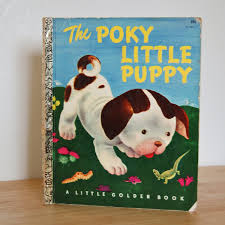
1pokyindexDay before yesterday I stopped into a Barnes & Noble in Maui (where they have an excellent B&N) and discovered that they were running a local holiday fundraiser to support literacy and early readers. At this particular store they were asking customers to choose a Little Golden Book, which would be given away to a young reader. After considerable thought, I chose THE POKY LITTLE PUPPY. But it was a tough call. 1old-mother-gooseMy second choice would have been THE LITTLE RED HEN; but Little Red struck me as a bit of a Huffy Henny when she refused to  share her baked bread with the other farm animals (although she certainly had just cause).

Turns out my fave, THE POKY LITTLE PUPPY, is one of the all-time bestsellers. Here’s a link to a list of some titles of the classic favorites in this series. (By the way, I loved wandering around the children’s books section of that book store. Everywhere I looked, there were  parents and small children engaged in intense, earnest discussions about books and stories.

1shykitten01450_p0_v2_s192x300Let’s all resolve to patronize physical bookstores as much as possible in 2016. They are so incredibly  valuable as venues for introducing children to the magical world of reading!)

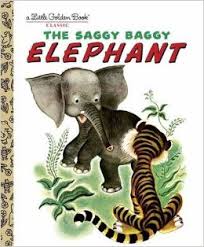
Which Little Golden Book would you choose to give to a tiny reader, to best introduce them to the magical world of books and reading?1fourpuppiesIMSaL._SX258_BO1,204,203,200_1giraffesBO1,204,203,200_1redhenimages

1saggyindex


Free Advice for Writers

by Joe Moore
@JoeMoore_writer

By the time you read this I’ll be in the air and won’t be able to respond to any comments. So instead, I have gathered together quotes from notable authors filled with free advice to anyone crazy enough to get into this writing business. Enjoy, and Happy Thanksgiving!

“Writing a book is a horrible, exhausting struggle, like a long bout with some painful illness. One would never undertake such a thing if one were not driven on by some demon whom one can neither resist nor understand.” — George Orwell

“Never use jargon words like reconceptualize, demassification, attitudinally, judgmentally. They are hallmarks of a pretentious ass.” — David Ogilvy

“There are three rules for writing a novel. Unfortunately, no one knows what they are.” ― W. Somerset Maugham

“If you have any young friends who aspire to become writers, the second greatest favor you can do them is to present them with copies of The Elements of Style. The first greatest, of course, is to shoot them now, while they’re happy.” – Dorothy Parker

“If you don’t have time to read, you don’t have the time — or the tools — to write. Simple as that.” – Stephen King

“Notice how many of the Olympic athletes effusively thanked their mothers for their success? “She drove me to my practice at four in the morning,” etc. Writing is not figure skating or skiing. Your mother will not make you a writer. My advice to any young person who wants to write is: leave home.” — Paul Theroux

“Substitute ‘damn’ every time you’re inclined to write ‘very;’ your editor will delete it and the writing will be just as it should be.” — Mark Twain

“The first draft of everything is shit.” — Ernest Hemingway

“I would advise anyone who aspires to a writing career that before developing his talent he would be wise to develop a thick hide.” — Harper Lee

“You can’t wait for inspiration. You have to go after it with a club.” ― Jack London

“If writing seems hard, it’s because it is hard. It’s one of the hardest things people do.” — William Zinsser

“Remember: when people tell you something’s wrong or it doesn’t work for them, they are almost always right. When they tell you exactly what they think is wrong and how to fix it, they are almost always wrong.” — Neil Gaiman

“You must stay drunk on writing so reality cannot destroy you.” ― Ray Bradbury

“Imagine that you are dying. If you had a terminal disease would you finish this book? Why not? The thing that annoys this 10-weeks-to-live self is the thing that is wrong with the book. So change it. Stop arguing with yourself. Change it. See? Easy. And no one had to die.” — Anne Enright

“If writing seems hard, it’s because it is hard. It’s one of the hardest things people do. – William Zinsser19. Consistency is the last refuge of the unimaginative.” – Oscar Wilde

“Here is a lesson in creative writing. First rule: Do not use semicolons. They are transvestite hermaphrodites representing absolutely nothing. All they do is show you’ve been to college.” — Kurt Vonnegut

“Prose is architecture, not interior decoration.” — Ernest Hemingway

“Write drunk, edit sober.” — Ernest Hemingway

“Start telling the stories that only you can tell, because there’ll always be better writers than you and there’ll always be smarter writers than you. There will always be people who are much better at doing this or doing that — but you are the only you.” ― Neil Gaiman

“Consistency is the last refuge of the unimaginative.” – Oscar Wilde

“Don’t take anyone’s writing advice too seriously.” – Lev Grossman

Have I missed any of your favorite free advice?

Girl on the Wrong Train?

BN-LH180_GIRLTR_J_20151116151400My husband alerted to me to this article in the Wall Street Journal ( ‘loved-the-novel-about-a-girl-on-a-train-you-may-have-read-the-wrong-book’) about the unexpected plot twist associated with the best selling book by Paula Hawkins, The Girl on the Train, and readers confusing it with another thriller written by Alison Waines, Girl on a Train. Since my book group just did Hawkins’ book (and we all actually read the right book!) it made me chuckle – as it would seem that many book groups, book reviews and reader purchases have fallen prey to the confusion that comes from two, very similarly titled books.

I don’t believe I’ve ever actually bought the wrong book based on the title alone, but according to this article this is becoming a more common issue especially with the plethora of e-books now available. The article pointed to the novel ‘Joyland’ by Emily Schultz who saw her e-book sales jump after Stephen King’s ‘Joyland’ was released (I’m suspecting some readers would have been a little upset getting the former when they thought they were getting the latter – but Schultz said the confusion did open up a new audience for her!).

When I’m choosing the initial title for a work-in-progress I always search on Amazon to make sure that the proposed title I’m thinking of hasn’t already been taken. Likewise I usually do a quick Google search just to make sure the title isn’t  some well-known book/blog/other entity that I’m totally ignorant of…Now I know publishers often change book titles anyway so it’s not something I get too hung up over but still, I try not to knowingly call my latest book something really similar to one already available (especially when it’s the same genre). Likewise I avoid choosing titles that are likely to confuse readers or deliberately mimic a current bestselling series  (the WSJ pointed to a good example – ‘The Girl with the Cat Tatoo’). Still I’m sure it was a happy coincidence for Waines when her sales numbers took off because readers were buying her book, mistaking it for Hawkins’ bestseller!

So, have you ever bought the wrong book based on a confusing or similar sounding title? Have you perhaps benefitted as an author from a confusion like this? When choosing the title for your book how much research do you do to ensure yours will stand out (or do you simply not worry?)

Happy Thanksgiving this week to you all. May you, like Alison Waines, be the recipient of some happy coincidences in the holiday period ahead!


The Writer and The Market Should Be Friends


FriendsTo market to market to buy a fat pig,
Home again, home again jiggity-jig.
To market to market to buy a fat book,
Or download that sucker on Kindle or Nook.

– (apologies to Mother Goose)

Today we ask one of those perennial questions anxious authors pose to agents and editors at conferences or online, viz., How much attention should I pay to the market when deciding what to write?

A couple of blogs recently addressed the issue. Dean Wesley Smith seems to fall on the side of writing what you want without too much consideration of the market. If you don’t watch it, he warns, you might develop an “addiction” to sales numbers, which is “deadly to your writing and your career for the long term.”

When you are sitting at your computer, your creative voice really, really wants to write a certain story or a new book in a certain series, and you hear yourself think, “What’s the point? It won’t sell.”

Oh, oh…

Trust me, folks, I am not immune from this in the slightest. When I realize that one of my books or series is selling better than others, and yet I am firing up a book that is in the poor-selling series, I hear myself ask that question.

How I get around it is tell that tiny part of my critical voice that is trying to stop me that maybe this book in this lower-selling series will be the one that explodes. That answers the question, “What’s the point.”

And makes the critical voice crawl away whimpering.

But over at Writer Unboxed, Dave King recognizes that there is a reason to consider what is selling in the market:

Of course, in some ways you can’t help writing to market. The point of writing is to give readers something they’ll want to read. This is especially true if you’re writing in a particular genre. Readers of romance, science fiction, horror, fantasy all expect their novels to deliver certain tropes, and it’s up to you to provide them. If you give your readers a mystery without a crime, detective, or denouement, then you really aren’t giving them a mystery.

Yet King rightly notes that mere formula is not enough. Otherwise a story can become what he terms “hack” work. To avoid that:

When you bring something original to the mix – an approach to your characters that stretches the boundaries of the genre, a plot that doesn’t simply string together the usual twists – then you are more likely to reach across genre lines to a larger market.

However, some market consideration is essential:

Completely ignoring the market can be as dangerous as pandering to it. If you deliberately turn away from your readers to follow your own, eccentric vision, you might wind up with something no one else will understand — or think is worth the bother.

King’s conclusion:

I understand the temptation to focus on the market. If you’re having a hard time breaking into print, the siren song of the hack – boil down readers’ expectations to a formula, then never color outside the lines – can be hard to resist. But bending your story to the market’s will is a shortcut that won’t get you where you want to go. The best way to reach the market is to throw everything you’ve got into telling the story you want to tell.

My conclusion is as follows:

First, the pro writer always considers the market, because it’s just another way to refer to people who buy books. If you don’t want to reach people who buy books you can certainly write for fun or therapy or to keep your fingers limber. But I’m going to assume you do want readers to buy your stuff. If so, it’s essential to find out what’s being bought.

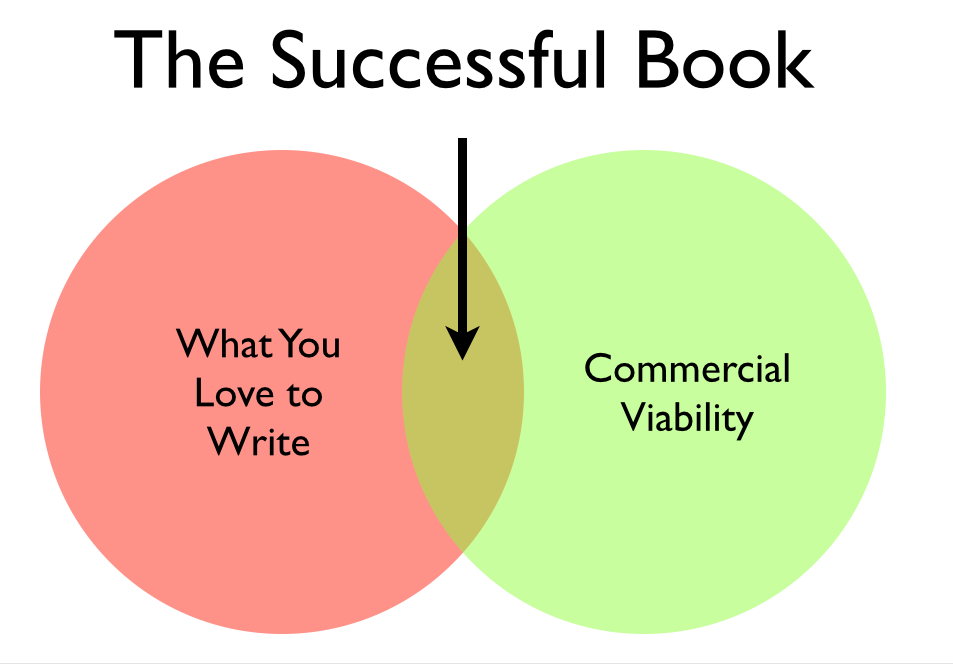
But then! Marry those considerations to what you love to write. Figure out that area where love and commerce come together.

It’s like this Venn diagram. The sweet spot for you is right in that middle.

Venn diagram for books

Definitely “tell the story you want to tell” but tell it with VOICE. As I argue in my book VOICE: The Secret Power of Great Writing, voice is what elevates and distinguishes one novel from another, and turns readers into fans.

So it’s not a matter of what you love versus what will sell. It’s a matter of finding that exquisite intersection where you’re happy to park yourself and hammer out stories readers are actually going to buy.

Of course, selling (or selling a lot) may not be your goal. Maybe you’re more interested in absolute, insular creativity, and damn the torpedoes, full speed ahead.

Great! You can write despite the market. You can decide to take that risk. You might even hope that big publishing, which is suddenly placing some risky bets, has a look at your novel. Once in a great while such a book goes huge. Most don’t. But if you don’t mind those odds, go for it.

(One nice thing about self-publishing is that you can experiment a bit, with short-form work, and see what takes wing.)

But there are many writers, as in the old pulp days, who are doing this to put food on the table and kids through college. They write for a market and they figure out how to love what they write.

Since I began this post with a ditty, it seems fitting to finish with another (with profound apologies to Rodgers and Hammerstein):

The writer and the market should be friends,`
Oh, the writer and the market should be friends.
The writer likes to spin a plot,
The market likes to sell a lot,
And that’s the reason why they should be friends.

Now it’s your turn. How do you go about deciding what to write? How much do you study your genre and the market? How do you propose to do more than what’s been done before?

Getting to Jack Reacher, or Someone Like Him

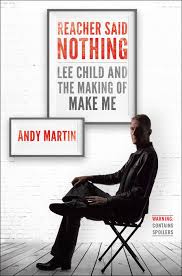
reacher said nothing

I am reading an extremely interesting book which will see the light of day next week — Tuesday, November 24, 2015, to be exact — everywhere books are sold. It is titled REACHER SAID NOTHING: Lee Child and the Making of Make Me. It is written by Andy Martin, who teaches at Cambridge but is nonetheless capable of writing a fun book, and more so, a fun book about the writing process. What occurred is that Martin approached Child via email in August 2014 about writing a book that would take the reader from the very beginning of the process by which Child does what he does so well to the very end. Martin’s timing was perfect, given that Child was about to start writing what ultimately became MAKE ME, his latest Jack Reacher novel.


I’m not going to present my review of REACHER SAID NOTHING now — you’ll have to go here next week over the Thanksgiving weekend to see that — but I can tell you that if you have ever thought of writing a novel you need to get a copy of REACHER SAID NOTHING and sit down and read it. You’ll feel better about the process, for sure. I can assure you that, whatever problem you may have had with completing your work, Child has had it as well, and yes, still has it and works to overcome it year in and year out. You will find within the pages of REACHER SAID NOTHING how he does it, as well as the very first thing that Child did when he started writing the very first Reacher book, lo those many years ago. Child utilizes many tools — copious amounts of coffee and cigarettes among them — but you don’t have to have move into Starbucks or have access to a secret stash of Chesterfield Kings to have similar results, with “similar results” being finishing your book, and then writing another, and another. And no, I’m not going to give away the specifics. Martin gave up a year of his life following Child around with  proximity and access that would make a proctologist jealous, and then compiled it all into something readable, so it would be neither fair nor right. I will tell you in one general word, however, how Child does what he does: discipline. That’s it. He sits down (among other things) and gets it done. The process of doing that is a part of Martin’s book, and so far, that book is an entertaining hodgepodge of an account consisting of emails, diary entries, and transcripts of conversations.


Will reading REACHER SAID NOTHING help you to write a bestseller or a critically acclaimed work? No. No. No. Life is not fair. Equity is not equal. If you want justice go to theology school and cross your fingers; maybe you’ll get it. But, if you model your work ethic after Child, you’ll finish your book, The rest is a combination of luck and ability and timing. As far as writing goes, remember that just because you like sausage doesn’t mean you want to make it. Have at it, by all means, but know what you are getting into. And if you still want to by the time you finish REACHER SAID NOTHING, by all means: start, and never stop until the job is done.


From my house to yours: Happy Thanksgiving! I’m old and grumpy and experiencing a health issue that is more an inconvenience than a herald of mortality but it’s a reminder that the sand is running, ever running, through the hourglass. Still, I have much to be thankful for, and you would be very high on that list, for stopping by The Kill Zone and spending a few minutes with us. Thank you.


Reader Friday: The Best “Bond Girl”?

Last week, we polled TKZers about which actor best portrayed Ian Fleming’s James Bond character. In the interest of equal gender-time, today let’s say who we think played the best Bond Girl. (Although I choke on the word “girl.” But it is what it is, as they say.) This was a tough assignment–turns out there have been about a bazillion Bond Girls–the Good, the Bad, and the Very Good When They’re Very Bad. I’ve only skimmed the surface of some of the better known Bond Girls in this post. Add your nominations for any I missed in the Comments.

Have at it!

Dr. No

Dr. No had almost too many Bond gals to keep track of. Here are some of the top Bondesses.

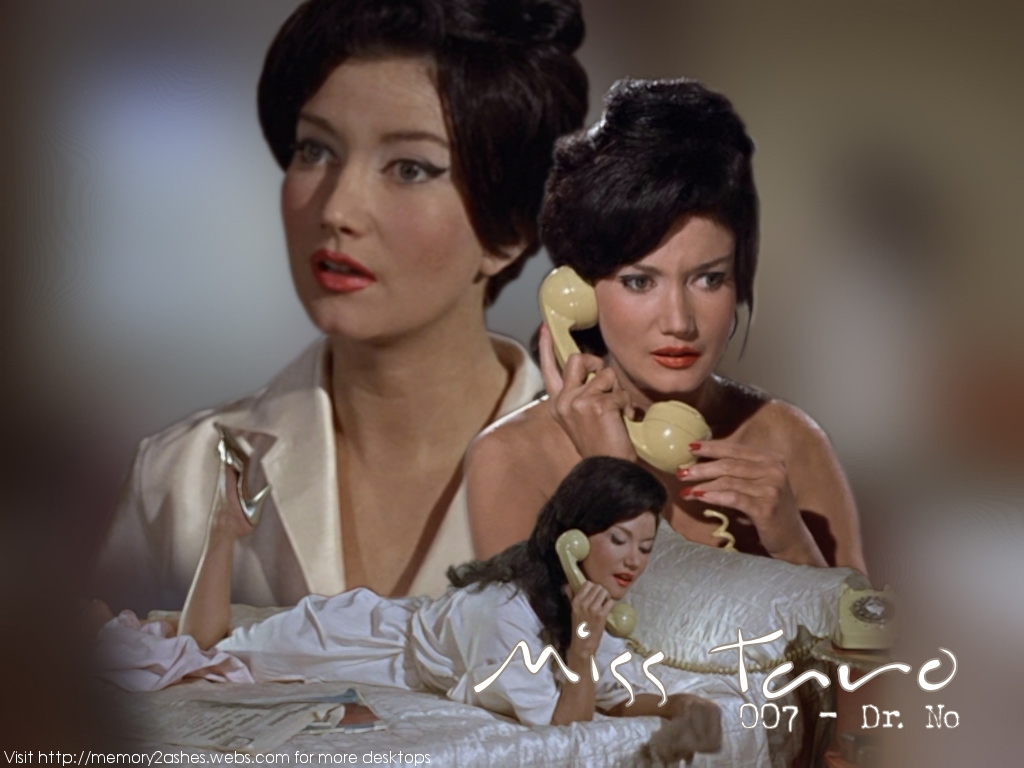
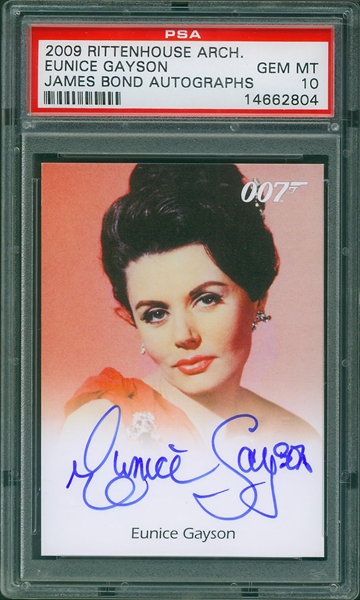
I mean, come on. Can anything beat Ursula Andress emerging from the waves as Honey Ryder in Dr. No? (Well, maybe Bo Derek topped that Venus rising moment in Ten, but as a non-Bondess, Bo doesn’t count.) Eunice Gayson (as Sylva Trench) also appeared in Dr. No and several other Bond films. She is famous for introducing herself to Bond as “Trench. Sylvia Trench.” Bond picked up that intro line and made it his mocking trademark way of introducing himself. Zena Marshall also appeared in that film as Miss Taro, Evil Spy Extraordinaire.

1Ursula-Andress-dr-no

1miss_taro__zena_marshall__from__dr__no__by_memory2ashes-d6i1ry71zjbeg

From Russia With Love

Daniela Bianchi, hot Russian chick turned reluctant spy “Tatiana Romanova”, who winds up falling for Bond. What could be more fun?

1d41MtI0GrbZL._SX300_

Goldfinger

Pussy Galore, Goldfinger, you get the idea. Played by Honor Blackman. “Jill Masterson”, played by Shirley Eaton, also played a doomed Bondess in the film. She died Midas-like, covered in gold paint.

1honor024.bond.honor.mh.100212

141Us2xC9XDL._SX300_


Thunderball

Claudine Auger played Domino Derval, mistress of an evil SPECTRE agent.

!thunder5d4b1e2c63ebf17467e60111cf16d55a

You Only Live Twice

Mie Hama played Kissy Suzuki, who had a mock wedding with Bond during the film.

1kissy-suzuki

On Her Majesty’s Secret Service

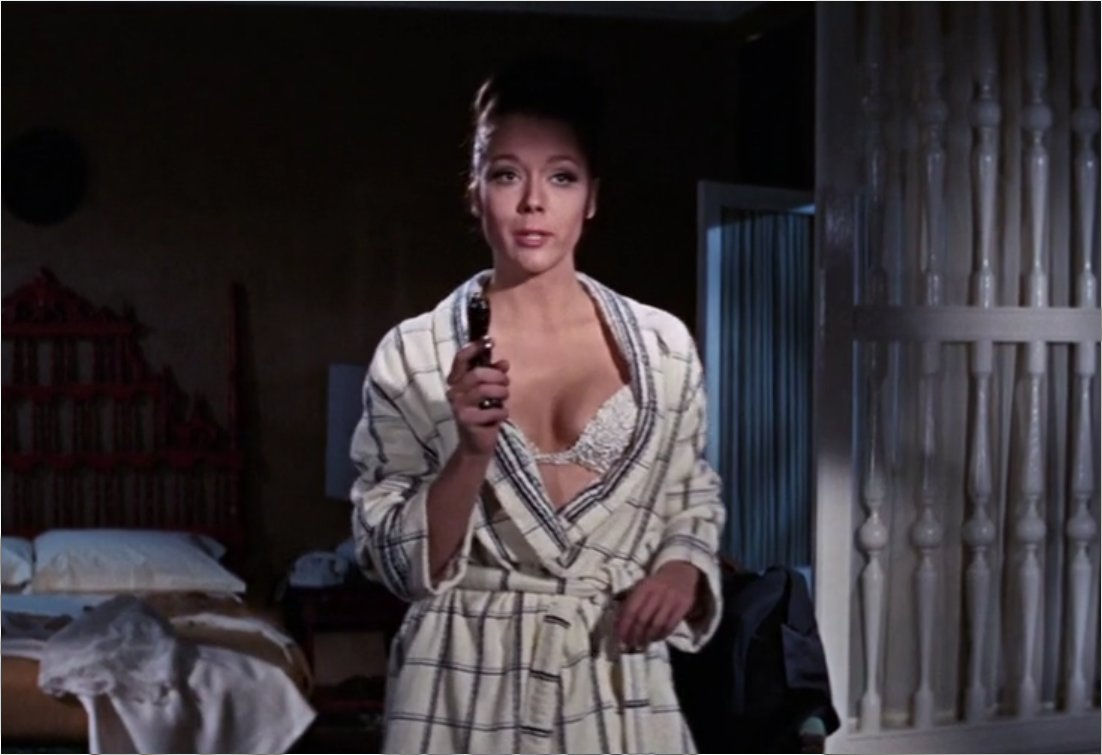
James Bond fell in love with Teresa di Vicenso, played by Diana Rigg in this film. Can you blame him?1dianatracy-di-vicenzo


Diamonds Are Forever

Jill St. John played Tiffany Case, a diamond smuggler. And Trina Parks played judo Bondess Thumper. Wowzer.

1Jill-St-John

1thumper-trina-parks


Seriously, there are so many Bond Girls, I can’t profile all of them in one shot. Here are some other notable Bond Girls:

Britt Ekland as Mary Goodnight in The Man With The Golden Gun.

Barbara Bach as Anya Amasova in The Spy Who Loved Me.

Lois Chiles as Holly Goodhead (!) in Moonraker.

Maud Adams as Octopussy in Octopussy.

Grace Jones as May Day in A View To A Kill.

Izabella Scorupco as Natalya Simonova in Goldeneye.

Teri Hatcher as Paris Carver in Tomorrow Never Dies.

Halle Berry as Jinx in Die Another Day.1halleGiacinta-Jinx-Johnson1


Last but not least, we have a character who didn’t get a name; she was simply called “Bond’s lover” in Skyfall, played by Tonia Sotiropoulou. I guess people were too busy freaking out about James Bond as a blond to give her character an actual name. Bond Girls nowadays need to “lean in” and get some better stature in Hollywood, I’m thinking.1bondgirlimages

Phew! There are many, many more Bond Girls in films that aren’t mentioned here. Are any of these your favorite, or is it one that I missed? Now let’s all go over to Netflix and binge out watching Bond flicks. Happy Friday!