That’s All, she wrote

Frank Sinatra via Wikimedia Commons

It’s time for my final curtain, dear friends. This is my last official post for TKZ. It’s with a heavy heart that I write this, because I’ve had a blast with you the past several years.

TKZ was the first and only group blog for which I’ve written regularly, and I couldn’t have chosen a better one. I can’t think of a more experienced group of writers writing about writing on the Internet. While many other group blogs have become weighed down with self-promotion and infighting and prima donna grandstanding, TKZ has only gotten better with time.

You, dear readers, are our better halves. You’re talented and curious and smart. You make it a pleasure to show up–whether it’s to post or join in the comments. Please give yourselves a big round of applause.

It’s often a challenge for me to come up with blog topics about writing that I think will interest you. My interior life is chaotic, and writing fiction is still a mystery to me after three decades of writing. When I finish writing a book or story, the memory of how I did it dissolves with time like Kool Aid mix in water–and nearly as quickly. It’s tough to delineate a process that I can’t precisely recall. While I am a person of a certain age, it’s not that I’m going dotty. It’s just the way my ADHD brain works. I can hyperfocus on something so that it becomes a delicious experience that engages my senses so fully that I find it difficult to return to reality. It’s a dreamlike state, and, like a real dream, it dissipates and disappears. When things are going well, a dozen pages of writing is left behind. The challenge is dodging all the shiny objects that seem to throw themselves at me when I’m trying to get back to the dream again.

If it sounds like I’m telling you that writing is magic that can’t be taught, I promise I’m not. I attended writing classes and workshops during the first six or seven years I was writing. (And I have to tell you that if you pay attention to the craft and critique pages here, and you write regularly, and read, you will get a solid writing education without paying a dime. Just sayin’…) Writing is not magic. It’s a combination of art and craft.

So, I hope you’ll forgive me for all the posts I didn’t write about how to plot, or create a character, or remind you to number those pages. (Seriously, Manuscript Rule 1 is number your pages!) We all have different strengths, and different gifts.

You know I love a list. Here’s a list of a few thoughts about writing and the writing life I’d like to leave with you.

— Read indiscriminately. Read the stories that you know will please you, and read stories and writers that will challenge you. Read out of your preferred genre and your culture and your comfort zone. Good writing is everywhere. Learn from it.

— Write bravely. I won’t lie. Brave is hard. The more of yourself–your feelings, your experiences, your ideas, your imagination–you put in your work, the better it will be. It may seem that both publishers and our contemporary society are currently offering writers very narrow lanes in which to write. It’s tough to be brave when you’re feeling pressured and walled in. Be brave anyway. That’s where your best work lies: beyond the walls.

–Let yourself be envious, then let it go. Too much envy is poisonous, but it’s a totally normal feeling. If you feel it, that’s okay. Let it motivate you to write better, be better. But use it and let it go before it turns on you. The phrase love and light sounds like the stuff of an SNL skit, but it’s kind of useful. Pile coals of kindness on the heads of those who make you itch with irritation. Their journey is not your journey, so keep your eyes on your own paper and do your own work. (Did I get enough platitudes in that paragraph?)

–Don’t be a dick. If you achieve any kind of success–from being the first in your writing group to sell a story, to being the only one at a table full of established writers to have made the bestseller lists–don’t be arrogant. Retain (or cultivate) some humility, if only because you never know when you’ll get surpassed or taken down, or by whom. Otherwise, it’s just a good idea to be nice. Cheer others’ successes. It’s true that someone might forget that you offered them congratulations on their Facebook page, but they won’t ever forget if you only ever talk about yourself.

–Don’t bore your reader. If you’re writing and you find you’re getting bored, stop what you’re doing immediately and try something different. If you’re feeling bored, chances are your reader would already have wandered off.

–Publishing is a crapshoot, and there’s an element of luck involved. Raise your odds by submitting (to an agent or publisher or beta reader) your best writing, packaged as a clean manuscript, and ask for help, advice, or representation in the most polite and charming way possible. Keep in mind that there are a huge number of not-very-well-written books alongside terrific books released every week. Just because you get a rejection doesn’t mean your writing is bad.

–Write what brings you joy. Or scares your pants off. Or makes you cry in a good way. That way lies authenticity (always good) and personal fulfillment (even better).

That’s it. I’m done. In Frank’s immortal words: I did it my way. Thank you, thank you, thank you for your kind attention. Stay in touch. Write like the wind!  xx Laura

Kat Martin and Larry Martin – Marriage Between Authors

By Debbie Burke

@burke_writer

Photos courtesy of Kat and Larry Martin


Today I’m delighted to chat with bestselling authors Kat Martin and L.J. (Larry) Martin, who’ve been together for 34 years. Between them, they have written well over a hundred novels.

Kat has written more than 75 historical and romantic suspense novels that have sold many millions of copies all over the globe. Larry crosses multiple genres, with bestselling westerns, thrillers, and nonfiction. He is also a founder and former owner of Wolfpack Publishing.


Here’s the inside scoop from Kat and Larry on their successful, long-lasting relationship.

DB: For most households, one author is quirky enough. How do two authors married to each other make it work?

Kat Martin

Kat: Actually, it has some advantages. We have the same friends, travel to the same conferences, are interested in a lot of the same subjects. We also understand the frustrations of being a writer, which are difficult for a non-writer to understand.

Larry: Ditto to Kat’s answers, plus we can read each other’s work and comment. For instance one time she was reading some female dialog I’d written and then drew a little mustache in the margin…I got it, my lady sounded like a dude.

DB: You met each other while working in the real estate industry. How did you each make the huge career change from real estate to writing?

Kat: Larry had already written a historical novel when we met.  He continued to work while I wrote my first book and we ended up selling both novels within six weeks of each other.

L.J. Martin

Larry: I had a giant year in the R.E. biz and never wanted to work that hard again. We had a little financial cushion, and needed it, and Kat was enthralled with my writing and said, “Hell, I can do that.” And did, far better. We’d always been avid readers, which is the basis of great writers.

DB: You are both exceptionally prolific authors. Do you have systems or routines for keeping up high production?

Kat: I don’t have kids, which gives me a lot of free time. Larry’s boys are grown. So that gives us a real time advantage. Also, we like what we are doing so mostly we would rather be writing than anything else. Well, I do enjoy traveling, staying in nice hotels and eating in gourmet restaurants. But we manage to work that in.

Larry: It’s productive to have “in-house” competition and an example to follow. Kat’s a voracious worker. I’m distracted by yard work, garden, photography, hunting…but her dedication always pulls me back. And both of us love to write.

DB: Do you brainstorm with each other on story ideas? Can you describe the process?

Kat: Larry writes his own books, his own way. No input from me. I appreciate his help with plotting and he also reads my action scenes and gives me input. Other than that, we pretty much work separately.

Larry: Neither of us slows down enough to get much input from the other. I help her occasionally with the male aspect: fistfights, firearms, survival, but that’s about it. I’m also preoccupied with publishing nonfiction, and enjoy that part of the biz.

DB: You often combine travel with research. This may be a chicken and egg question but do you visit locations with a plot already in mind, or do story ideas spring out of new places?

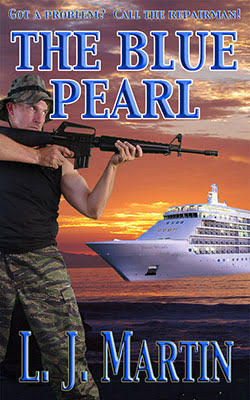
Kat: A little of both, I think. Sometimes we go places because one of us is working on a story.  Sometimes when we are traveling a new idea comes from the experience we are having at the time. Larry just finished a novel called The Blue Pearl, a high action thriller set around a cruise ship being taken over by terrorists. Our cruise was already planned. The story came to him before we left and the cruise helped with his research.

Larry: Most action books are a quest of some kind so the cruise was ideal with the addition of some really bad guys in exotic locations. I was able to interview the captain and security people and go everywhere on board other than the engine room. My prior thriller, The K Factor, was set primarily in North Korea and trust me, I didn’t go, and the cruise and great sights and wonderful restaurants in France, Spain and Portugal was more fun than researching lots of North Korean trials and tribulations…as much as I enjoy research.

DB: Describe a typical work day for Kat.

Kat: My day starts around 7 a.m. I enjoy my morning till around nine o’clock, when we either head to the gym for an hour, or I start going through email and doing some promotion. I like to be writing by 11:00, no later than noon, then write till the end of the day. After that I do some Facebook and a little more promo, then pour myself a glass of wine and relax for the evening.

DB: Describe a typical work day for Larry.

Larry: I hit the machine early, usually by six at least. When I smell the blood sometimes by four as I can’t sleep as my mind is plotting. Cup of coffee, sweatsuit, and I write until it’s time to shower and three days a week hit the gym to keep the brain blood flowing, then back to the word processor. Often in the P.M. I’m in the garage or outdoors, but I’ve already got my eight or ten in.

DB: How do you balance your individual creative idiosyncrasies in a long-term relationship?

Kat: Mostly he does his thing; I do mine. We overlap at the end of the day. He has a lot more diversified interests than I do. I’m fairly well consumed by my writing. Though currently, I’m on a remodel project for our new winter home, which has been agonizing and exhilarating.

Larry: It’s more than merely nice to have a beautiful, intelligent, woman with like interests seldom more than one story away. Most of the idiosyncrasies are left in characters in our books. We both love to cook, love a good glass of wine, love good dramas on TV or the theater, and each other’s company. What could be better?

DB: Is there anything else you’d like to share with readers of The Kill Zone?

Kat: I’ve got more Maximum Security novels coming out, including a new novella called Come Daybreak, which is one of my personal favorites. I’m hoping readers will be on the lookout for the books and that they enjoy them.

Larry: And I’m supporting Wolfpack Publishing, a company I co-founded and sold to my former partner, who still publishes my Westerns, and now that my non-compete has expired I’m into another aspect of publishing. No one does a better job with Westerns, and other fiction, than Mike Bray. Buttonwillow Books, my new effort, publishes my nonfiction and some for others. I’m currently enjoying publishing educational books by T. Michael Traser, an internationally recognized educator and a friend. If you’re a teacher, particularly one with English challenged students, check out the series ESL – Fun Games for the Classroom. Immigrant children who don’t master English are destined to be trapped in barrios and enclaves, and that’s not a good thing. And while you’re at it grab a copy of Rugged Trails, my latest western, suitable for young adults. Thanks for taking the time to chat with us.

~~~

Thank you, Kat and Larry, for opening up about your writing lives to TKZ readers.

Check out Kat’s books at katmartin.com and Larry’s books at ljmartin.com

~~~

3 Books for 3 Bucks – Special sale February 7-14, 2020. Debbie Burke’s thriller series is only $.99 each.  Click on title for “buy” link. 

Instrument of the Devil

Stalking Midas

Eyes in the Sky


First Page Critique – The Wildfire Pathogen

Jordan Dane
@JordanDane

I am posting my first page critique to assist Clare who is in Australia with personal family business. My first critique in 2020, I hope you’ll enjoy THE WILDFIRE PATHOGEN. Very timely with the Coronavirus out of China. Let’s sanitize our hands and read on. My comments will be on the flip side.

The Wildfire Pathogen

Even through six inches of solid acrylic, Conrad Jurek could see the monsters moving inside the box.

They were no more than grainy mists inside individual test tubes. Those mists swirled with each jolt of the plane as it powered through pockets of turbulence. Almost as if the bumpy ride irked them.

Jurek reached into his sage-colored flight suit, pulled out a pen, and began to jot notes on his clipboard. The acrylic box was a four-by-six foot transparent crate mounted on a hardwood dolly. A locking mechanism the size and weight of a manhole cover sat on top. He’d seen the same tamper-proof device protecting the innards of nuclear warheads.

The monsters inside could do far worse than mere firecrackers.

Six tubes hung suspended below the locking device like bullets chambered in a revolver. Each finger-length container held twenty grams of orthohantavirus, a solid mass of viral matter dried into particles as white and delicate as baby powder.

Yet each cylinder of glittering borosilicate glass held enough pathogenic material to kill several million men, women, and children.

A beefy hand came down on Jurek’s shoulder. He suppressed his instincts and allowed the hand to turn him around. A man wearing a black uniform with the word SECURITY stenciled across the front scowled at him before growling two words.

“Back off.”

Jurek held up the clipboard. “I’m supposed to do a load check mid-flight.”

“No one’s supposed to come close to the package.” The guard’s eyes flicked to the name tag at the chest pocket. “If I were you, Corporal Witkowski, I’d leave. Now.”

Two more security men stepped into view on the opposite side of the box. Jurek considered them for a moment. Under his flight jacket, a 9mm Beretta Nano hung snugly in a holster. The weapon was still warm from when he’d shot Witkowski and taken the airman’s uniform off the hanger.

No, he thought to himself. Stick to the plan.

Jurek turned away and went up to the cockpit. He locked the door and took the empty co-pilot’s chair. The pilot glanced over with a raised eyebrow. His uniform’s tag also bore the name of a man murdered in the last two hours.

“I’m familiar with the outer locking mechanism,” Jurek confirmed. “We go forward as planned, Doctor Isenhoff.”

“Good,” came the reply. “Get your oxygen mask ready.”

With that, Isenhoff reached out and flicked a single switch on the flight panel.

FEEDBACK

SUMMARY – Great place to start. This time it’s not SNAKES ON A PLANE. It’s monsters in a vial. We are already in the middle of the action with plenty of mystery and intrigue to keep turning the pages. The author sticks with the action without slowing the pace with backstory. There’s time for explanation once the reader is pulled in. At the end of the 3rd paragraph, the author draws the reader in tighter in describing the tamper proof canister and compares it to the protection on a nuclear warhead. Nicely done. And it got my attention when the author described a nuke to “firecrackers” compared to the monsters on the plane.

I also liked that the author had patience to let the reader discover that Jurek committed murder to get on the plane, wearing a dead man’s uniform. At this point, we aren’t sure if Jurek is trying to stop a deadly pathogen attack by hijacking the material from villains or if he plans to steal the deadly virus to commit his own attack. Great set up with plenty of mystery to unravel.

I especially like how the author had Jurek accosted by security and he had to restrain his instincts to fight the man off. He’s got more up his sleeve (a plan) and that’s when we find out that Jurek killed to board the plane. Nice touch, author.

Then a stroke of genius to have Jurek working with the pilot – a doctor presumably familiar with the pathogen – who is also a pilot. Jurek and Dr Isenhoff are in it together. And there’s a hint that there’s a reason Jurek went to check out the dangerous cargo, to determine if he knew how to break into the canister. Something bad is about to happen that involves oxygen masks. At this point, we don’t know who the protagonist is, but we have a great start.

TITLE – I like the reference to “wildfire.” We all know what that could mean in terms of spreading fast and the word “pathogen” is timely and medical. Only the author knows if there are other titles that could establish the critical danger in a better way, but I would be happy taking this title to a publisher. It’s more than a working title, in my opinion.

NIT PICKY – At the start of paragraph 3, I spotted a pet peeve of mine. I like a strong sentence with tight wording. The words “began to” are unnecessary. It would be better to say “…and pulled out a pen to jot notes on his clipboard.”

Jurek reached into his sage-colored flight suit, pulled out a pen, and began to jot notes on his clipboard. 

Great job, anonymous author. There’s action and I’m intrigued. I would definitely keep reading. Okay TKZers, please leave your comments and provide feedback to this brave author. (Safe travels, Clare. We missed you.)

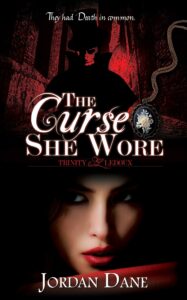
The Curse She Wore – Coming Feb 10, 2010. On presale now.

Trespassing on Fate’s turf comes with a price for two broken people–one they will never see coming.

The Curse of Expository Dialogue

by James Scott Bell
@jamesscottbell

There are times when I need ten minutes of The Three Stooges. You know what I’m talking about. You’ve spent a long day writing some tough pages. Or you were bottled up in your cubicle at work, untangling your boss’s mess. Or maybe you were caught up in the latest news cycle, and you find yourself neck deep in the blues.

That’s what the Stooges are for. You don’t have to think. In fact thinking is precisely the wrong thing to do when watching the boys.

Now, I know the Stooges are not everyone’s comedic cup o’ noodles. Moe is often hard to take. Anything could set him off and get you a slap in the face or, worse, two fingers in the eyes. I had my run-ins with bullies as a kid, so Moe always made me uncomfortable (in real life, Moe Howard was a delightful man—who I met—and a great storyteller about the film business and the history of the Stooges).

But there is always Curly to save the day by giving us a nice, hearty belly laugh. (When Curly suffered a stroke in 1947, he was replaced by his and Moe’s real brother, Shemp. Most of my kid contemporaries didn’t like Shemp, but I did. While no one could ever replace Curly, Shemp is funny in his own way.)

Anyway, the other day I was in need of a respite from brain work and went to a Stooges short I’d recorded on the telly. It was We Want Our Mummy (1939). As you might guess, it’s about the boys, playing detectives, going to Egypt to try and find a mummy on behalf of a museum.

Well, the opening made me laugh, but for another reason. It was a full-on example of expository dialogue. Of course, these were short comedies that were produced like pancakes, and had absolutely no pretensions about being anything else. Still, it provides me with an illustration for teaching purposes.

The short begins in a museum of ancient history. Two professors in stuffy garb speak to each other in the Egyptian Room.

Prof 1: Bad news. The police aren’t able to find any trace of Professor Tuttle. His disappearance has them completely baffled.

Prof. 2: That ruins our hopes of ever finding the tomb of King Rutentuten. Professor Tuttle is the only man alive who knows its exact location.

Prof 1: First Professor Dalton dies mysteriously, and then Tuttle disappears. Something terrible happens to anyone who tries to explore that tomb. I’m telling you, it is the curse of Rutentuten!

Prof 2: But unless we secure the mummy of King Rutentuten, our entire collection is worthless. We must find Tuttle!

Prof 1: Well, I’m doing the best I can. I sent for the three best investigators in the city. And they are our last hope!

Okay, King Rutentuten is funny. But the dialogue, as you can see, is there merely as set-up material. It’s blatantly obvious, and I’m sure the writers, Elwood Ullman and Searle Kramer, snorted as they wrote the lines.

But in our fiction, such dialogue is a drag. It always sounds phony, which turns the reader against you. They are investing their time (and perhaps some discretionary income) on your book. You want them into the story, not catching you in a cheat.

The primary way to avoid this is: Do not have characters reveal information that both characters already know. Here’s a ham-fisted example of what I mean:

“Sally! I didn’t expect to find you here at Central Market.”

“I often come here at lunchtime, Molly. Doing research for the senior partners at Dewey, Cheatham & Howe really creates an appetite.”

“Does your husband know his petite, thirty-year old wife enjoys greasy hamburgers?”

“Bill? What he doesn’t know won’t hurt him. Being a cop on the street, he has enough to worry about.”

Ouch. Most of the time you’ll find such dialogue on the opening pages of beginner’s manuscripts. They think they have to get a bunch of exposition out there so the reader will understand what’s going on. Not so. Act first, explain later.

On the other hand, dialogue can be used to reveal information when the info is hidden within a tense exchange.

Let’s say the key bit you want to reveal is that Sally is married to a cop. The scene might go this way:

“Sally! What are you doing here?”

“What does it look like?”

“I’m just surprised. A hamburger?”

“So?”

“You’re usually so careful.”

“What do you want?”

“Are you meeting Bill?

“No.”

“Is he on duty?”

“Is that your business?”

“Got to be hard.”

“What?”

“Being a cop’s wife. Nervous time. I can understand—”

“Thanks for your concern. Can I finish my meal in peace now?”

So relax about exposition, and get your characters into more arguments. Readability will go up, and reader trust in you as an author will not be compromised. And you will be able to sit back and utter a satisfying nyuck nyuck nyuck. (Further dialogue techniques may be found here.)

For giggles, you can watch the opening dialogue below…and the rest of the short if you so desire. Excelsior!

We Want Our Mummy (1939) from Patrick J Mele on Vimeo.

True Crime Thursday – 911 Pizza Emergency

Photo credit: In memorium: Mr. Ducke, Visual Hunt

By Debbie Burke

@burke_writer

On a dreary winter night when hunger pangs strike, the craving for a thick-crust pepperoni pizza with double cheese might FEEL like an emergency.

But in this True Crime Thursday case, a 911 dispatcher in Oregon, Ohio answered a call from a woman ordering a pizza that turned out to be a bona fide emergency.

Tim Teneyck, a 14-year veteran at the 911 center, at first thought the call was a prank. But the woman was insistent and repeated her address, tipping Tim off to a problem at that location. He asked if someone was threatening her. She answered yes. He asked more questions and determined she was in danger even though she couldn’t say so directly.

He dispatched officers to the address. Inside the residence, they found a drunk man menacing the caller’s 57-year-old mother. The man was the mother’s live-in boyfriend who had a history of domestic abuse. He was arrested, averting a possible tragedy.

From time to time, social media spreads the word that there is a “secret code” for domestic abuse victims. Supposedly, if they call 911 and order a pepperoni pizza, that indicates they are in danger but cannot talk. According to law enforcement, this code is neither standard nor official.

But quick-thinking 911 dispatchers recognize signs of stress in a caller’s voice and will prolong the conversation, as Tim did, until help arrives.

Thank you to the unsung heroes who answer frantic calls to 911.

~~~~

TKZers, do you have an unusual or interesting 911 story to share in the comments? Some regular TKZ readers are dispatchers or connected to law enforcement. Please chime in with your anecdotes.

~~~~


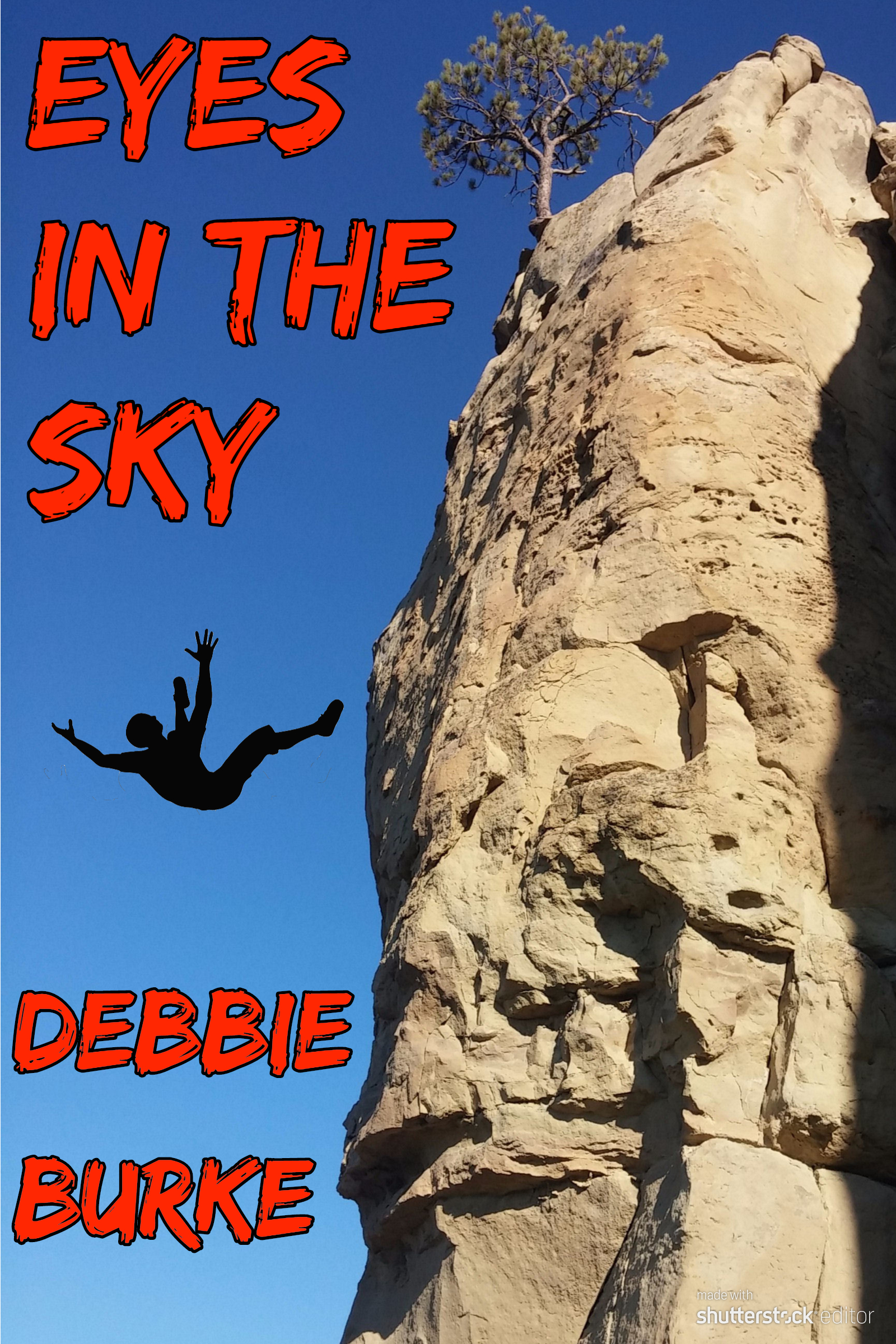
Please check out Debbie Burke’s new release, Eyes in the Sky, book 3 in her Thrillers with a Heart Series. You can read a sample here.


First Page Critique ‘The False Curtain’:
Alone Again…Unnaturally

By PJ Parrish

Why is January feeling like it’s lasting forever? And I don’t even have to deal with snow.  I just wanted to get that off my chest. Now, let’s have some fun and read a First Pager.  Thank you, dear submitting writer, for giving me some diversion this week as I fill out the scary questionaire in preparation for possible grand jury duty next week. If you don’t see me for a couple months, send out the search party to the Tallahassee courthouse.

THE FALSE CURTAIN

A suspense novel

The small, windowless room felt more like a place for an interrogation than a meeting.

Although two plastic chairs sat side-by-side in the middle, I stood. Actually, I paced. It’s what I do whenever I’m uneasy. Mimi had said there was nothing to be nervous about. My appointment with Mr. Smith, the man she owed money to, should be simple and quick.

Finally I heard the doorknob turn. I watched as the door opened. It took a moment for me to realize who stood in the doorway.

I had no idea Mimi’s Mr. Smith was Davey Smith. I never would have put the two together.

I recognized Davey only because I saw him at our 25th high school reunion last year. Back in the day he’d been the quiet, studious kid who tutored math dummies, like me. Someone said he’d done well for himself and he looked it. Seeing him again—now—totally surprised me. He showed no indication of feeling the same.

He took a couple steps forward, stopping just inches away. He cupped my face with both hands and tilted it upward. I watched his face come close. His kiss was soft and persuasive.

After releasing me, he said, “Good to see you again, Lindsey. Sorry we didn’t get to talk at the reunion.”

“Davey, I—”

“I prefer my friends call me David.”

“David. I—.”

“…and my business associates call me Mr. Smith. I haven’t decided which category you’ll be in.” He smiled, just a little, then abruptly turned and walked to the door. “About that kiss. Don’t take it too seriously. You still have to do everything I say. If you don’t, you won’t like what happens to your cousin. You also won’t like what will happen to you.” With that, he left.

I stared at the closed door, stunned.

Davey was no longer the sweet boy I knew in high school.

His attitude….

His threats….

I wanted to start pacing again, but I was too scared to move.

***

After a while, I sat. I don’t know how much time passed because I didn’t have my purse or phone. A man had taken them before I was shown into the room. That was my first clue the meeting wasn’t going to be simple or quick.

My meeting with Mr. Smith was supposed to be a discussion of how I could pay back Mimi’s debt—

________________________

I’m back. Well, what do we think? I think there’s some good stuff here that, with a little tweaking, could be the beginnings of what the writer subtitles “A suspense novel.” (Which I think is superfluous, by the way. Your back copy can carry that load for a potential reader. But that’s a nit.)

What’s good here: We’re picking up the story in a good active moment — a somewhat mysterious meeting that has the protag on edge. There is just enough backstory hints to ground us but no info dumps. I like the way the writer told us who Mimi is — not through a narrative tag (“My cousin Mimi had told me…”) but letting the relationship emerge through dialogue a couple beats later. Smoothly done.  I think the dialogue itself is handled cleanly and reads as believable. David’s kiss is a big creepy surprise, especially when he backs it up with a threat. (More on that in a sec). So, all in all, not a bad opening at all. I would read on.

But…

And this is a caveat I often give. When the writing is solid, I want it to be better. Because good isn’t good enough in today’s market. When you’re as close as this submission is, you need to push yourself even harder to make your story stand out  from the madding crowd.

I try not to rethink a writer’s approach or question their style. But here’s a few suggestions, just one reader’s perspective.

The opening line isn’t bad. But it’s a good example of telling instead of showing. I think you could use a few more choice details to SHOW us this room rather than TELL us it “felt more like a place for an interrogation than a meeting.”

Windowless, small, plastic chairs is not enough, imo. Use description to enhance the MOOD, the apprehension she feels. You won’t lose your momentum by slowing down just a little. How big is this room, exactly? (Calling a room small is like calling a man handsome — It has no currency in our imaginations). What’s the lighting — glaring fluorescent with maybe one bulb giving off that annoying buzzing just before it dies? Industrial carpeting with an odd stain? What color are the walls? Does it smell? It also might not be a bad idea to hint somewhere where we are exactly. Your description is so spare we could be in anything from downtown Houston skyscraper to an anteroom in a airplane hangar meth lab. Make your description make us FEEL something.

Ditto when you get to Davey/David. I like this line: “Someone said he’d done well for himself and he looked it.” But again, that’s telling instead of showing. Does this mean he has money? Is he wearing a Brioni suit and silk tie? Again, you’re missing an opportunity to not only ground your reader in detail but to reveal something about your protagonist by filtering description through her PERCEPTIONS and BACKGROUND. You can tell us a lot about your protag (and help us bond with her) at the same time you tell us something about David. Don’t let these opportunities go by.

Because…right now Lindsey is sort of a cipher. Granted, it is hard for you the writer to give us a sense of her physically when you’re in the first person. But a simple line like “I watched his face come close” gives you a chance to add detail — a small shaving nick on his chin? The smell of clove after-shave? Are his hands, cupping her face, rough or smooth?

One thing that kind of doesn’t make sense. She seems to be surprised by his appearance (ie, the line, someone had said he had made good for himself…). But she saw him herself just a year ago at a reunion. So she would already know he was successful and/or handsome? People at reunions talk about who made it, who failed, who died, etc. You say they didn’t talk at the reunion but did she see him from afar? You say he is NOT surprised to see her. You need to reconcile this.

The kiss is interesting. But the fact she has no reaction or thought (other than saying it was “soft and persuasive”) struck me as odd. Unless these two have a romantic past, it comes across as somewhat unrealistic and weirdly submissive on her part. What is “persuasive” about it? It made me flash back to the dynamic between Christian Grey and Anastasia Steele in Fifty Shades of Ickiness. Lindsey is, given the 25th reunion time line, about 43 years old and there on some kind of financial mission (ex math dummie or not). Do you really want to paint her as so passive?

That passivity is echoed, too, in these lines after David leaves:

Davey was no longer the sweet boy I knew in high school.

His attitude….

His threats….

I wanted to start pacing again, but I was too scared to move.

The guy just planted a predatory kiss on her, threatened her and her cousin, and left the room with nothing resolved. And this is all she feels and thinks? Now, maybe this is a calculated character arc for Lindsey on your part. Mousy CPA encounters a mystery man from her past and she eventually grows and rises to some challenge? (You titled this a suspense novel, not a romance).  But Lindsey, in this opening at least, doesn’t strike me as a woman who will take her destiny into her own hands. She recalls all the tropes of a bad 1950s bodice ripper).

Which leads me to the last paragraph. (By the way, you don’t need the * * * designation. It is used only when you have a legitimate scene break, not when you don’t know how to transition from one moment in your story to another)

After a while, I sat. I don’t know how much time passed because I didn’t have my purse or phone. A man had taken them before I was shown into the room. That was my first clue the meeting wasn’t going to be simple or quick.

Why did she just sit there? Again, this is passive and not very interesting. And the fact that someone took her phone and purse when she came in should have been in the first graph — it ups the stakes immediately. But unless you set this up better, it isn’t believable. Maybe if you had described this place better in her thoughts — that when she entered the building, she went through a metal detector or given us details about the circumstances of surrendering her purse and phone, I might buy it. But again, she does this without question or even a thought — which makes her passive and almost juvenile.

So, there we are, alone in a windowless room, with a faceless protagonist. Where does Lindsey — and this story — go from here? As I said, I think this set-up has potential and the writer has a decent grasp of craft.  But it doesn’t read real and it feels unnatural, like the weird kiss and threat came out of nowhere, not organically from the situation. Also, we need some flesh on these bones. Create a mood. Give us some details to fire up our imaginations. And most important, give us good reason to want to follow Lindsey for 300 suspenseful pages.

Thank you, dear writer, for letting us see your work. I hope you find this one person’s opinion this helpful. And others here, as always, might have different takes. What say you all?

Lessons Learned from Writing True Crime

By SUE COLETTA

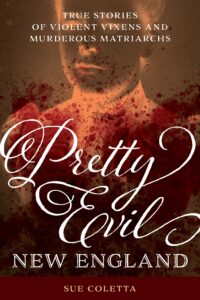
Have you ever considered writing true crime? With five days left of my deadline, I’ve finished the manuscript of Pretty Evil New England and am now just tightening the writing and gathering my photographs for the book. The hard part is behind me.

via GIPHY

While on this journey into true crime I learned a few lessons that might interest you.

Would I recommend true crime to new writers? The only honest answer I can give is, it depends.

The truth is, this work isn’t for everyone. Writing true crime is a huge undertaking that requires months of intense research and deep concentration. Some days I swear my brain had caught fire from overuse. Seriously, it can be physically draining to live inside a real killer’s head for months on end, never mind five killers’ heads, or the victims and their families. At the same time, my passion and excitement for the project kept me racing to work every single day, and the day after that, and the day after that.

Please indulge me for a moment. I do have a point, but you’ll need context to understand what I’m talking about. When the publisher approached me about writing Pretty Evil New England, they asked me to include 10 +/- female serial killer stories.

But I didn’t want to write 10 short stories. What fun is that? If I was to veer out of my comfort zone (psychological thrillers and mysteries), then I needed to write a story that mattered, a story that readers could sink into, spend time in the story world, and experience a visceral thrill ride. What I failed to realize at the time was that the publisher’s idea would’ve been a cakewalk compared to my over-eager proposition. But hey, I was never one to shy away from a challenge. Why start now?

In my book proposal, I outlined the book in four Parts. Part I – III focused on one female serial killer at a time, with each Part dedicated to the subject’s case, all four Parts the length of a novella. In Part IV, I zeroed in on two female serial killers — one poor, one “lady of influence” — who committed almost identical crimes. They both claimed to experience visions and prophetic dreams, both murdered the people they loved most, and both stunned the public with their heartless crimes. Yet, after they were exposed as killers, the two women’s lives ran in opposite directions. Even more shocking were the outcomes at trial. So, Part IV became not only two intriguing storylines that intertwined but it shined a (subtle) light on fairness and equality.

Not conforming to the publisher’s original vision for the book was a risk, but I backed up my argument with facts from various sources that proved true crime readers prefer quality over quantity.

Lesson #1: When pushing for your own concept, you need to provide proof that your idea will be more profitable and enjoyable than the one posed by the publisher.

Once I found my five cases, I delved into research. Now, I had no idea what to look for, so I researched everything… life in nineteenth century New England, nursing requirements back then, forensics of yesteryear, how trials worked back then, the gallows… you name it, I researched the topic to death (no pun intended). I had no direction, except for my five ladies, two of which had practically no online footprint and one who had too many articles written about her, and many with conflicting accounts that didn’t align with my early research. Which is worse, actually. It’s much more time-consuming to wade through conflicting information than to research a bare bones case.

Lesson #2: Have a plan of attack. Meaning, before you start to research plan what you’ll need for the story, like dialogue and a sense of place.

Being a fiction writer helped a lot, because I viewed the cases from a storyteller’s point of view. The worse thing we can do is to just report facts. Boring! Instead, we need to find that perfect balance between journalism and engaging storytelling. But, and this is key, we cannot change or embellish to enhance the story.

What I discovered is, there are numerous ways to write true crime. Each of my four Parts are written differently. Why? Because no true story is the same. Thus, it’s our job to be able to adapt according to the case. For example, in Part I, I used the killer’s confession and dialogue to write scenes from her perspective, the victims’ perspectives, and the dogged investigators who caught her. Using a backdrop of the historical Eastern Heatwave of 1901 enhanced the atmosphere in a creepy way. Which brings me to…

Lesson #3: Look outside the case for a sense of place. What else is happening at that time, in that area?

Lesson #4: No amount of online research can replace real-world experience.

Even if we’re writing historical true crime, we still need to visit the crime scenes, grave sites, walk where the killer walked, visit the town, or the murder house, if you’re really lucky. In my research I stumbled across a third floor that was perfectly preserved from 1881. I walked where the killer walked (in Part III of Pretty Evil), I sat where the victims sat, I laid my finger on the ivory keys of their piano and perused their bookshelves. What an incredible find! It’s an experience I will never forget. If you’d like to see the photos, I blogged about it.

The most important lesson I learned was this. Before choosing a subject to write about, ask yourself, why does this story interest me? What is it about this crime that makes it unique?

We, as writers, need to be passionate about all our projects. For true crime writers, we need to be doubly sure, because we can’t change real life. The true crime writer lives with the case for a long time… many months, sometimes years. If the writer isn’t passionate about the story, chances are readers won’t care, either. Same goes for fiction. Hence why TKZ members have written umpteen posts on concept, premise, when to keep a story idea and when to trash it.

By the time I wrote the final sentence of Part IV of Pretty Evil, I couldn’t wait to go back to page one. I missed my “characters” from Part I-III. And now that I’m just tidying up the manuscript, I feel like I’m visiting old friends, even if they are psychopaths. 😉 Their stories are part of me now, and hopefully, will become part of my readers’ lives as well.

Have you ever considered writing true crime? If you already do, please share your tips.


PRETTY EVIL NEW ENGLAND: True Stories of Violent Vixens and Murderous Matriarchs hits bookstores Sept. 1, 2020. Can’t wait!


Further Reflections on the Mirror Moment

by James Scott Bell
@jamesscottbell

I enjoy getting emails and tweets from writers regarding the “mirror moment,” which is the subject of my book, Write Your Novel From the Middle. Recently I received two that I thought would make good fodder for a post (we at TKZ are always looking for good fodder).

The first email was a great question from someone who asked about the mirror moment in a long series. She used Sue Grafton’s alphabet series as an example. Should each book have a mirror moment? How can a series character go through so many changes?

I wrote back reminding her that there are two kinds of mirror moments. The first kind is about identity. It asks questions like, “Who am I? Why am I this way? What must I become?” It’s Rick in Casablanca.

The second kind is about death. It is the realization, “I’m probably going to die. The opposition is too great. How can I possibly survive?” That’s Dr. Richard Kimble in The Fugitive.

So I suggested that in any Kinsey Millhone mystery (and in mystery series in general), there could always be a realization in the middle that this case, this puzzle, this villain is the most perplexing or dangerous of their career. It looks like they could “die” (professionally) this time.

But that is not to say the character in any given book in a series cannot have a personal crisis of identity, too. Exhibit A would be the Harry Bosch books by Michael Connelly.

C is for confession: I have not read all of the alphabet books by Sue Grafton. I think I may have stopped around F. But the question intrigued me, so I went to the library and picked one of the later books at random—Q is For Quarry. I sat down and, as is my practice when mirror hunting, turned to the physical center of the book and just started looking around. Was there anything relating to identity? Or anything indicating this was the biggest challenge of her career?

Lo and behold, I found that it was about identity. Kinsey, who lost both her parents in a car accident when she was very young, has had a hole in her identity ever since. In this scene from the middle of the book, she is looking at a photograph of her mother. You don’t even have to know the details of the plot to know that this is the language of an identity-type of mirror moment:

I placed the frame on my desk, sitting back in my swivel chair with my feet propped up. Several things occurred to me that I hadn’t thought of before. I was now twice my mother’s age the day the photograph was taken. Within four months of that date, my parents would be married, and by the time she was my age, she’d have a daughter three years old. By then my parents would have had only another two years to live. It occurred to me that if my mother had survived, she’d be seventy. I tried to imagine what it would be like to have a mother in my life—the phone calls, the visits and shopping trips, holiday rituals so alien to me. I’d been resistant to the Kinseys, feeling not only adamant but hostile to the idea of continued contact. Now I wondered why the offer of simple comfort felt like such a threat. Wasn’t it possible that I could establish a connection with my mother through her two surviving sisters? Surely, Maura and Susanna shared many of her traits—gestures and phrases, values and attitudes ingrained in them since birth. While my mother was gone, couldn’t I experience some small fragment of her love through my cousins and aunts? It didn’t seem too much to ask, although I still wasn’t clear what price I might be expected to pay.

I locked the office early, leaving the photo of my mother in the center of my desk. Driving home, I couldn’t resist touching on the issue, much in the same way the tongue seeks the socket from which a tooth has just been pulled. The compulsion resulted in the same shudder-producing blend of satisfaction and repugnance.

Thus, any book in a long-running series can include subplot elements that relate to the hero’s identity and transformation.

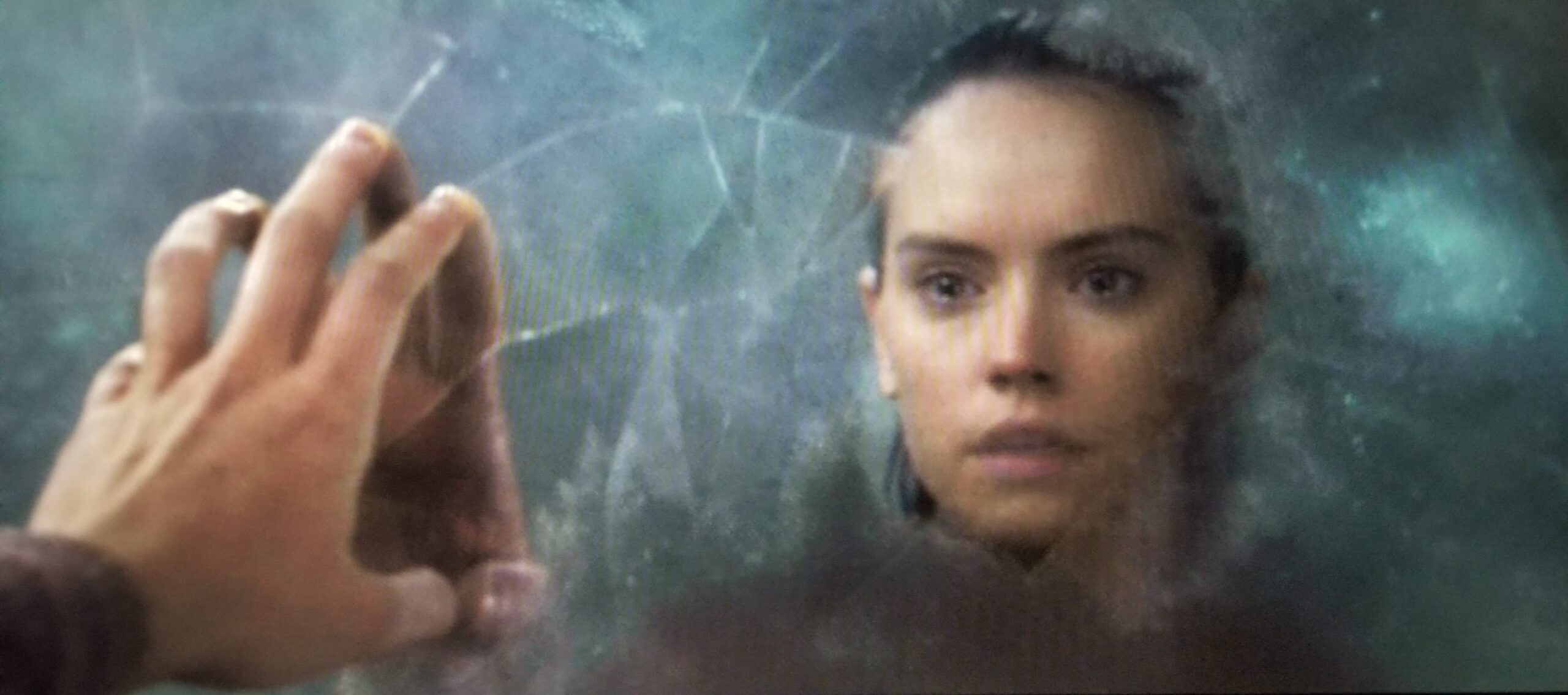
Shortly after this I got an email from my friend, writer Rich Bullock. He told me he’d been watching Star Wars: The Last Jedi, and in the chapter titled “The Mirror Cave” Rey is being tempted by the dark side (what a shock) and challenged by Kylo Ren on her true identity. Rich told me it was smack dab in the middle.

So I checked out the DVD from the library, chucked in the player, and went to the scene. Rey has fallen into this mirror cave, and is hoping it will give her a clue about who she truly is. Kylo Ren is somewhere else, but able to communicate with her:

KYLO REN: Let the past die. Kill it if you have to. That’s the only way to become what you were meant to be.

REY: No! No!

REY (VOICE OVER): I should have felt trapped or panicked. But I didn’t. This didn’t go on forever, I knew it was leading somewhere. And that, at the end, it would show me what I came to see.

REY: Let me see them. My parents … please.

She touches the mirror. Two shadowy figures approach from the other side of the glass. But when the frost clears, Rey is looking at … herself!

I took a look at the DVD timeline:

Hmm, we’re 1:16 into a 2:32 movie. I’m no math whiz, but I believe you can’t get any more middle than that!

The mirror moment works every time.

(For more on this, see my post “Revisiting the Mirror Moment”.)

That’s it for today, kids. I’m on the road most of the day, but will try to check in later. Talk amongst yourselves, esp. those of you writing series characters. How do you handle any inner transformation?

Setting Yourself Up for Success

It is happenstance that I follow the excellent question posed by James Scott Bell yesterday in this space about the concept for writers of “Failing Up” with some thoughts on success and how to achieve it. The collection of individuals known as “writers” and “authors” have any number of motives for writing. One of the ones at the top of this list hopefully would be that each and all of them want to do so. Those of us who show up every week or two at this space with a post that we have written do so because we want to do it. We seek to help others, hope to entertain, and/or wish to sound off, among other things. The big one, however, is that we want to write. 

Some authors have reached the enviable point in their careers where they are under contract and must write in order to fulfill a contractual obligation, but wanting to do it is hopefully still their primary motivation. Sitting in front of a screen trying to fill a space beats looking forward to a day where a shovel and a ditch constitute the primary scenery and the scenery never changes. Others are trying to get to the point where someone is willing to pay them to write. They are honing their work in hope of piercing the hardened heart and mind of an editor. Again, however, they have to want to. And so it goes. In each case, a writer assembles the tools, skills, and ideas at hand and gets to work. 

It sometimes helps, however, to sit back for a moment (as opposed to a week, or a month, or longer) to discern what is one’s prime motivator, regardless of what they are trying to accomplish. I was reminded of this last week as I listened to a lecture titled “Counseling Your Client to Reduce Stress & Succeed in Litigation” given by Alan S. Fanger, Esq., as part of the lawline.com legal education series. Mr. Fanger, the president of EmpowerLegal, Inc. touched upon many subjects dealing with how to prepare a client for trial.  My major takeaway from his presentation, however, was a discussion concerning how to successfully accomplish a task. Mr. Fanger put forth the proposition that it is more important to focus upon what needs to be done to perform the task successfully than upon the consequences of the failure to do so. He concluded that focusing on consequences rather than how to do the job will guarantee failure.  

Mr. Fanger used an example from the world of professional football to illustrate his point. You don’t have to be a football fan to appreciate it.  There was a cringe-inducing moment during the 2016 NFC Wild Card playoff between the Minnesota Vikings and Seattle Seahawks. A Vikings player named Blair Walsh was tasked near the end of the game with kicking a field goal which would have, all other factors being equal, won the game for Minnesota. It was a short kick (for a professional football player) of twenty-seven yards. Walsh missed it, in front of God and everybody. It wasn’t as if Walsh was pulled out of the stands to make the effort, either. The game in question was a low scoring one. Walsh had actually scored all nine of Minnesota’s points during that game by kicking field goals from longer distances. He missed that last one, however. It was indeed a bitter pill to swallow, one that some football fans remember to this day. While none of us can accurately predict what goes through anyone’s mind in the moments before making an attempt at a task, Mr. Fanger submitted that perhaps Blair Walsh was more focused on the enormity of what would happen if he failed — losing the game and thus failing to advance to the Super Bowl that year — than upon what he needed to do to succeed. 

That conclusion may or may not be true. It makes sense, however. You may have heard of something which is currently called “analysis paralysis.” It’s a term applied to overthinking, which is easy to do because in a very subtle way it delays the need to make a decision as to what to do. Let’s look at a very famous incident that required immediate decision and focused implementation. I am sure that the name Chesley “Sully” Sullenberger is familiar to all of you. Captain Sullenberger was piloting a commercial airliner when a bird strike shortly after takeoff from LaGuardia Airport disabled his aircraft’s engines. Captain Sullenberger, a veteran Air Force and commercial pilot, made some calculations and concluded that landing at an airport wasn’t an option. He made a decision and told his control tower, “We’ll be in the Hudson.” That is where he landed his plane. The conclusion of that particular incident would have been quite different if Captain Sullenberger had focused upon and overwhelmed by the consequences of failure — job loss, destruction of property, and, oh yeah, loss of life — instead of upon the best method (under the circumstances ) of landing the plane and the passengers with which he had been entrusted. He made a decision and acted on it, focusing on what he needed to do to succeed. “We’ll be in the Hudson,” Just so. 

Think about Captain Sullenberger the next time you sit down to write and find that the old bugaboo — “I gotta finish this” — gets in the way. You probably have near at hand everything you need to succeed, including writing instruments, a command of language, imagination, the will to start, and your own mind.  I had all of those within reach when I began writing today’s post. I didn’t consider what would happen if I didn’t. It was more constructive and more fun, actually, to start writing and see, to paraphrase Dorothy Sayers, where my whimsy would take me. The finished product is just a bit different than what I had envisioned it would be, but that’s okay, too. I’m happy with it. I don’t know if I kicked it between the goalposts, but I think I landed in the Hudson, and I hope I didn’t lose anyone.  

Thank you for stopping by. Enjoy your weekend.