Narrative Drive – Do You Have It?

Jordan Dane
@JordanDane

Another author who blurbed one of my books told me, “You have great narrative drive.” I thanked her with a smile and quickly went to look it up. Being a self-taught author, I had never heard the term. Narrative drive is that quality that keeps readers turning the pages, riveted to your work. It’s your innate story telling ability. It’s not complicated when you break it down, but how do you teach it? Can it be taught?

What sets apart highly successful best selling authors from others? Best selling authors can build worlds that readers want to be in and they create memorable characters and plots that are compelling with good pace, but do they have something unique to them and their ability that sets them apart?

Each author strives to create a compelling narrative drive (whether they understand what the term means or not) because they want readers eager to turn the page. That means the author MUST manipulate the world and the characters into the optimal story that involves mystery, suspense and intriguing relationships. This covers all genres of writing.

The author controls what is revealed to the reader and parses it out in the most optimal way by their judgement. They make choices on when to reveal things and how they are to be doled out. Natural born story tellers know how to do this instinctively.

The author is in control of EVERYTHING. He or she manipulates the reader with a titillating story and how that story is shared and how it affects the character relationships. Nothing should come as a surprise to the author.

To create MYSTERY elements, the author is guarded about what to share with the reader and when to share it. There’s misdirection with red herrings or through unreliable narrators, for example.

To create SUSPENSE, the author can have the reader follow along and reveal what they want the reader to know as the main characters discover things. This builds on suspense elements.

To give the reader an INSIDER VIEW, the author may reveal things to the reader that the characters don’t know. Let the readers play God from afar and watch the play that is told in the story.

KEEP A READER CURIOUS and/or WORRIED – Readers are naturally curious folks. Give them something to uncover. A wise author will let a reader’s minds be piqued by carefully placed clues. Or an author might make readers worry for the characters they’ve grown fond of. Make readers care and escalate the danger for the characters. Again, this post might sound geared for crime fiction, but it can apply to any genre. The threat does not have to involve life or death. It can involve the heart or the emotional survival of a family enduring a tragedy or a stigma.

WHAT KILLS NARRATIVE DRIVE
1.) Backstory dumps and long boring expositions can kill a strong page turner.
2.) When one scene doesn’t lead to a cause and effect, the plot may drift without cohesion. The reader gets lost in the amble. Actions must have consequences for the reader to want to come along for the ride.
3.) Cheating at mystery elements, where the author creates intrigue, but the outcome is a let down or a head fake for the reader. That’s when a reader will throw a book against a wall and may never buy an author again.
4.) Cheap surprises without build up is the same type of disappointment. Don’t pull a killer or a bad actor or a story element from thin air to end the book.
5.) No coincidences. An author might get away with a coincidence in the first few pages of a story, but a coincidence should never end the book. Major No-No.

HOW TO FIX A FAULTY NARRATIVE DRIVE:
I believe that each scene in a book should be like a mini-story. It should have a compelling beginning, a journey through the scene with purpose, and an ending that foreshadows what’s to come to create a page turner. Each scene should move the plot forward by 1-3 plot points, making that scene impossible to delete without toppling your story (like the wood block-building game of Jenga.)

I endeavor to build as many of these scenes as possible, even with scenes that build on a relationship as a subplot. The subplot should have a journey through the book as well.

If an author is in control of everything in a book, the fixes come from the author too. Be critical of each scene during the edit phase. I first strip out the unnecessary words to tighten the writing. I layer in the emotional content. Whatever the scene is meant to do–like action or romance or mystery–I layer in MORE of those elements. I read the book aloud to make sure it has cadence and the dialogue sounds real and well-motivated.

1.) Give a character GOALS to every scene. Otherwise what is the purpose for that scene?

2.) Are the motives clear? Are the characters well-motivated? Do their actions make sense and does the scene contribute to building on the plot? If not, how can the scene be revised to make motives stronger or more compelling?

3.) What is the internal and external conflict in the scene? How is conflict layered in? Revise to show the parallels between what a character is confronted with and how it affects them emotionally. Heighten the intensity of a character’s journey.

4.) What’s at stake and is it compelling enough? Are the stakes clear to the reader? What does the character stand to lose? Make the reader care more.

5.) Give the character choices. Good guys or bad, do they face dire consequences for their actions? Do the consequences matter? Make the reader care what happens.

6.) Do the character(s) change in the scene? Is there a journey of growth or development? No throw away scenes. Make each one count.

7.) Be critical of the scenes meant for backstory or too much world building. Do these elements drag on and slow the pace? How much is essential to the story? How much should be reserved as a mystery element? Remember, even the smallest of mysteries can create curiosity in the reader. Make it count. Be judicious.

8.) What is the point of each scene? What makes it impossible to delete? If a scene can be deleted in total without consequence to the overall plot, it should stay gone or parts of it could be stripped and used in other scenes.

9.) Word choices can affect Narrative Drive – Strip out unnecessary words within each sentence to give more impact. Too many adjectives or flowery descriptions can slow pace and confuse the reader on the direction of each scene.

10.) Do your scene and chapter endings fizzle to a dead stop or do they foreshadow what’s coming? Anticipation can build on fear or feelings from readers. Compelling imagery can be an effective way to end a scene that’s based on a relationship. Cliffhangers don’t have to be major to intrigue a reader, but don’t waste a scene or chapter ending without something that makes the reader want to turn the page. That’s a wasted opportunity.

11.) Look for too much described body language in each scene. Too much head movements or blinking eyes or interruption with movement can be a distraction to slow narrative drive. Make sure any character movement means something or adds to the irony or character banter.

DISCUSSION:

1.) Can storytelling be taught? What distinguishes authors from the competition?

2.) What tips do you have on Narrative Drive that you use in your own writing?

3.) What challenges have you experienced in improving your Narrative Drive?
Things to Rescue From the Water

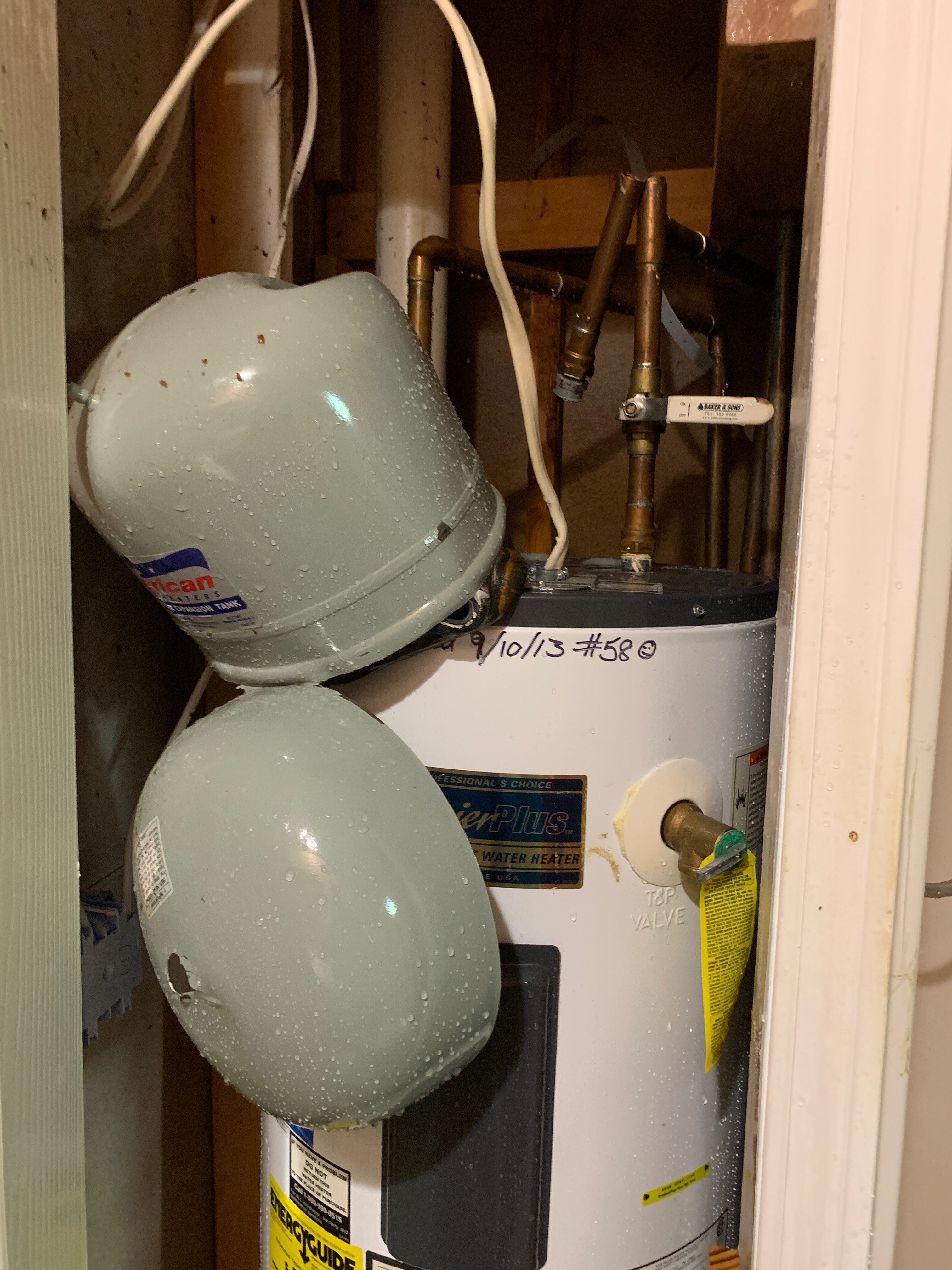
Possibly the homeliest post pic ever. The busted gray thing was an expansion tank that exploded when our house water pressure regulator suddenly failed.


Forgive my brevity, dear TKZers. The above photo may give you a hint as to what my week has been like. Last Wednesday night, I was practically walking on rarified air after I’d (successfully) interviewed writer Jodi Picoult in front of 900 readers at St. Louis County Headquarters. (Successful being defined as no one laughing me offstage, and I didn’t faint. Others’ definitions may differ!) I was just tucking up in bed when I noticed I had two missed calls from our alarm company. I’d missed them because my phone had gone into sleep mode. Husband was home, alone, with the animals. Talk about alarming.

After the responding police (!) left him (he’s a deep sleeper and didn’t hear the blaring horn sounds coming from the alarm unit), he texted me as he  looked around the inside of the house. Nothing appeared to be amiss–except for an inch of water in the back half of the house. Yes, four bedrooms, a mudroom, and a long hallway were all wet.

I felt helpless being two hours away, unable to do anything besides offer advice. Hero Husband managed to shut off the water to the house, and swept and vacced for several hours. If not for those missed calls and the pounding of the police on the door, the entire house would’ve been a loss. As it was, our biggest loss was flooring.

What did I ask him to rescue? A big box containing…books. Of course. Not that surely soggy box full of professional photos of a previous marriage (mine), and various high school and college certificates and yearbooks. Not the exercise equipment bits and bobs. Not whatever mysterious debris lay sodden on the floor of my son’s room. Only the books felt important.

Once home late Thursday morning, I rescued other damp things. But I made sure my books were safe and dry, first. (Really should’ve gotten rid of those wedding photos 28 years ago anyway, right?)

They weren’t particularly precious books, or rare. Ebay probably has other copies. But they weren’t the same copies. Then, as a good friend and I emptied those four bedrooms of belongings and more books, it occurred to me that life would’ve been a lot easier if all of my books were digital instead of paper. It was a brief thought, which I then banished to the  Outer Dark. I must have been very tired or something to have even had that thought at all.

So, gentle readers, what objects would you save first if your house flooded itself?


.

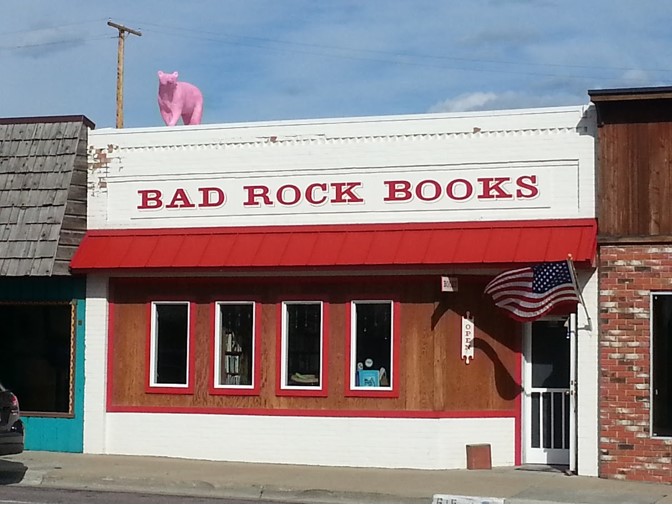
Bookstore Spotlight: Bad Rock Books

by

Debbie Burke

@burke_twitter

Bad Rock Books
Columbia Falls, MT

Montana fun facts: Montana is the fourth largest state but only has a population of one million.

Cattle outnumber humans.

The entire state has only one area code—406.

The little town of Livingston, Montana (pop. 7500+) claims more writers per capita than any other city in the U.S.

My favorite fun fact: Montana has more bookstores per capita than any other state.

Maybe it’s the long winters. Or the proud tradition of authors like Norman MacLean, A.B. Guthrie, James Lee Burke, Nevada Barr, James Crumley, Ivan Doig, Jim Harrison, etc.

Whatever the reason, Montanans love to read.

One of my favorite bookstores is Bad Rock Books in Columbia Falls, a small town on the way to Glacier National Park.

The name “Bad Rock” derives from nearby Bad Rock Canyon, a narrow mountain pass that’s bordered on one side by the Flathead River and sheer rock cliffs on the other. In ancient times, the Blackfeet, who lived on the plains east of the Swan Range, and Flathead tribe, on the west side, engaged in frequent territorial conflicts. The Flathead crossed the mountains to hunt buffalo on the plains and the Blackfeet traveled to the west side to steal the excellent horses raised there.

According to legend and lore, one tribe strategically positioned itself atop the sheer cliff and rolled boulders down on their opponents trapped in the narrow canyon, winning that battle.

The name is still appropriate. With every spring thaw, rock slides crash down on the two-lane highway or on the train tracks on the opposite side of the river.

Back to Bad Rock Books, which is not only a charming shop but also has a great backstory.

From 1997-2016, Carol Rocks ran Bad Rock Books as a one-woman show. Every morning, she ate breakfast at the Whistle Stop Café across Nucleus Avenue from the shop and struck up a friendship with Cindy Ritter, her favorite server. When health problems hit Carol, with true small-town community spirit, Cindy began helping out at the bookstore. As Carol’s health worsened, soon Cindy was running the business full-time.

When Carol passed, Cindy was stunned to learn Carol had left the store to her.

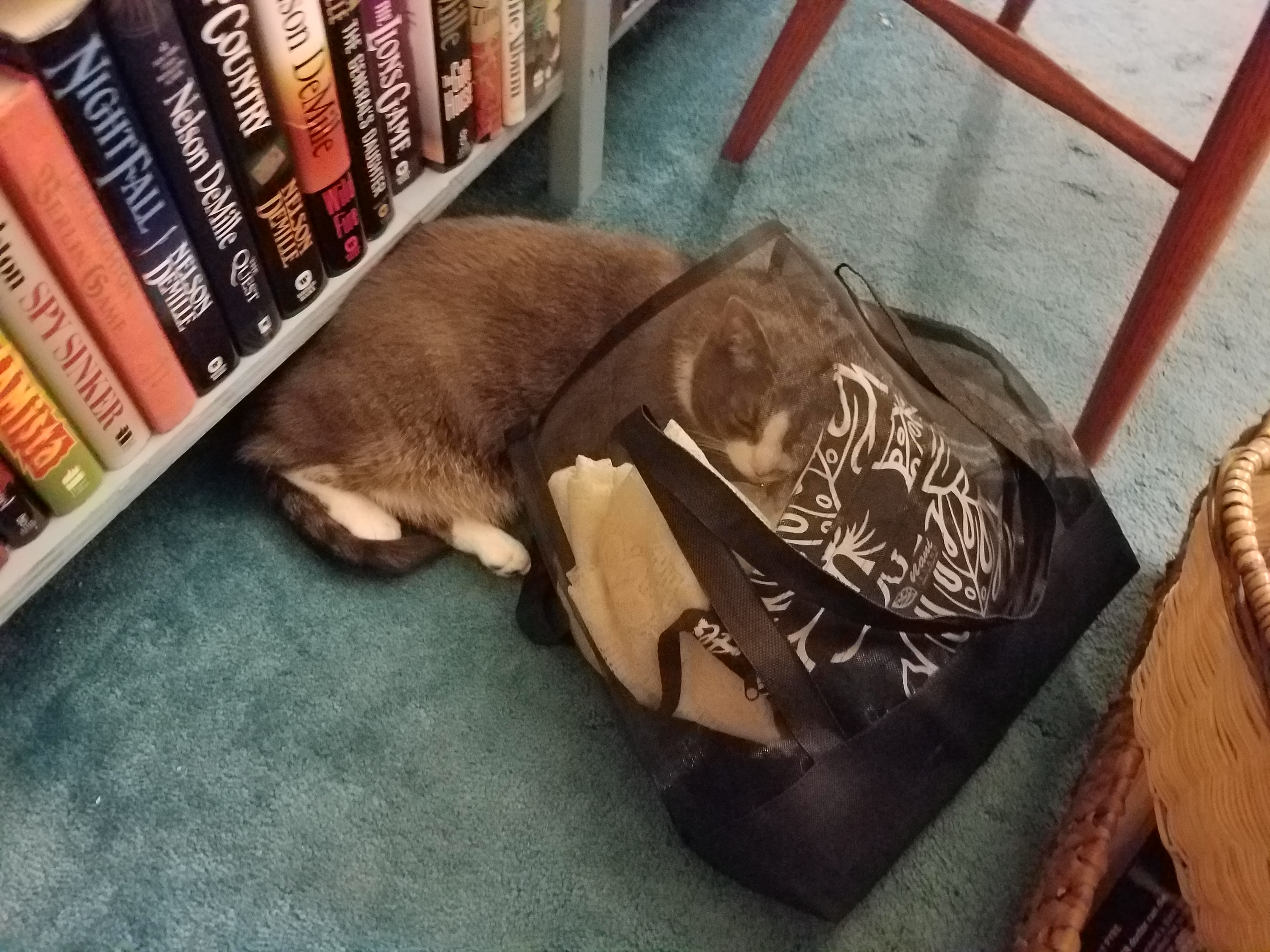
The neighbor-helping-neighbor spirit doesn’t end there. One cat, Bailey, came with the shop. When Cindy took Bailey to Dr. Lawson, the veterinarian down the street, he told her about a sweet cat that had been abandoned and asked if Cindy would adopt her. To close the deal, he threw in free vet care. The new cat was dubbed: “Miss Poe”.

Manager Bailey pauses for a nap while inspecting a new bag of books

Miss Poe now co-manages the bookstore with Bailey.

A recent addition is Sweet Pete, another rescue from Dr. Lawson’s clinic. Bailey makes sure that Sweet Pete knows he has to work his way up to a management position.


Locals and tourists alike browse the shelves for new and used books from every possible genre. One corner is filled with boxes of children’s books on the floor. Cindy explains she initially thought those books should be shelved. Then she discovered, “Kids prefer to sit on the floor and dig through boxes like a treasure hunt.”

Cindy says one of her favorite perks is to see readers discover a special book. “Whether it’s fiction, local history, or plant identification, I like to watch how people light up and expand when they find a book that opens doors to a new interest for them.”

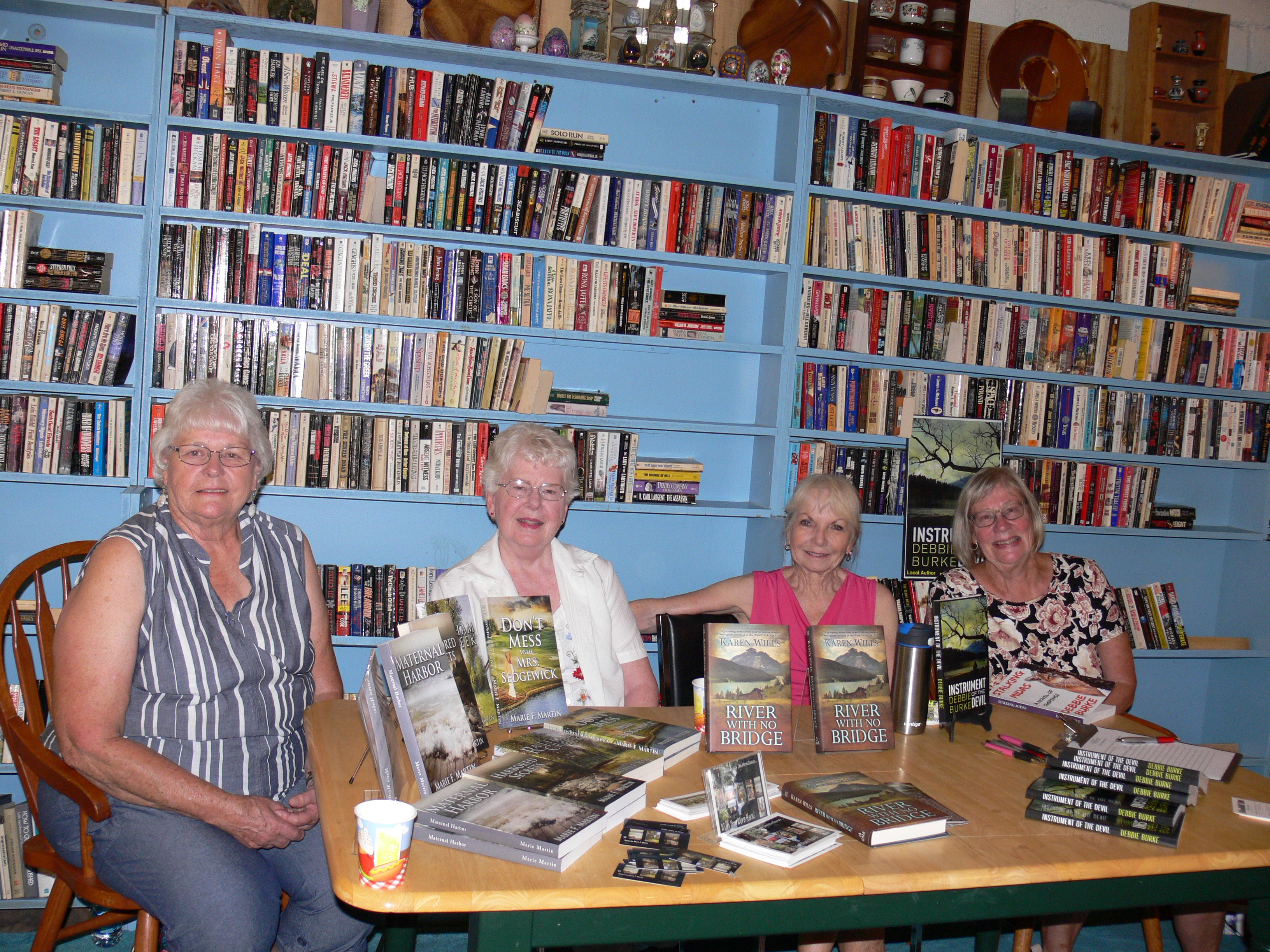
The inventory of 20,000 books is attractively displayed and well-organized. Cindy is also an enthusiastic booster of local authors. She prominently features their books and graciously hosts gatherings and signings.

MT authors Marie Martin, Karen Wills, Dr. Betty Kuffel, Debbie Burke


Cindy says: “It’s a blessing to be a part of this place. The community benefits the bookstore and the bookstore benefits the community.”

Her great attitude is the reason Bad Rock Books is one of my favorite bookstores.


TKZers: What are the best qualities of your favorite local bookstore?


Bad Rock Books carries the paperback edition of Debbie Burke’s new thriller, Stalking MidasAlso available on Kindle here.

Toxic Romance?

My mother-in-law forwarded me an interesting article on the toxicity of many of the romances depicted in YA novels and it got me thinking about how writers tackle the whole romance thing, especially in an age where many protagonists (in mysteries, thrillers as well as YA) are often ‘bad boy’ (or ‘bad girl’)  heroes/anti-heroes.

The article in the Melbourne newspaper The Age (link here), is an interview with Kasey Edwards, an Australian writer, about the often abusive, stalkerish, and horrible relationships depicted in some YA novels (most notably, the Twilight series) where girls fall for the ‘bad boy’ who thinks ‘no’ just means ‘try harder’ when it comes to winning their affection. And it’s not just YA – you have books like the Fifty Shades of Grey series which translate this behavior in a decidedly adult way where girls/women fall in love with someone who is more powerful, controlling and possibly abusive (I confess I haven’t read the Fifty Shades of Grey books so I can’t really comment!).

I do think there is a broader issue at play in terms of the way relationships and romances are depicted, irrespective of gender or genre. I know I’ve certainly fallen into the trap of creating emotionally distant male characters who don’t treat their female counterparts with the respect that I certainly would demand in real life. But then fiction isn’t real life and nice, kind, pleasant people don’t necessarily make the most compelling characters!

In YA I think the issue of depicting abusive, controlling relationships and toxic romance as ‘normal’ is a definite concern, because girls (and boys) reading them may start to believe that these are the sort of relationships they should seek in real life. In adult fiction the lines are more blurred and, though I wouldn’t want to write a book that would in any way condone or encourage abusive relationships, mysteries and thrillers by their very nature deal with the darker aspects of human nature as well as society. So how do we, as writers, reconcile the two? How do we create compelling relationships without falling into the trap of writing ‘toxic’ romance?

I don’t have any answers, except to say that I support a writer’s right to choose to depict whatever characters, relationships, or romances they want – even though somewhere along the line those choices must come with some level of responsibility (again, I think in YA, this is much greater). Beyond that, I’m not really sure – although I do think it’s a valuable topic to debate. After reading this article, I’ll certainly think a little more carefully about the type of romance and relationships I portray in my books.

So TKZers how do you approach the issue of potentially ‘toxic romance’ in your writing? Do you step back and consider the nature of the relationships and romance between your characters – especially if they might be seen as condoning abusive or dysfunctional behavior or perpetuating damaging stereotypes?


Rookie Mistakes Indie Writers Make

by James Scott Bell
@jamesscottbell

Sometimes it’s hard to believe that the Kindle made its appearance nearly twelve years ago. It ushered in the greatest boon to writers since Gutenberg—independent publishing. Not only did this sea change give new writers a way to get their work out to the world instantly; it also saved the careers of many midlist writers who were let go by their publishers due to lack of sales.

In those heady, early years a veritable Sargasso of sloppy mistakes were made by over-anxious newbies. Everything from lousy formatting to horrific covers (“But my daughter designed the cover for me, and by golly, I’m going to use it!”)

As the years rolled on, and blogs and books on indie publishing proliferated, quality issues slowly improved. That still did not guarantee huge sales numbers. You still had to write a good book! But we’ve now reached a point in indie publishing that I would call the “mature phase.”

Still, however, rookie mistakes are made by new writers. I’d like to point out three, and then turn the conversation over to you.

Cover Chaos

The other day I was browsing in the Kindle store when a cover popped out at me. Popped, but didn’t grab. I don’t want to embarrass the author, so I’ll just describe in general terms what it looked like.

The colors were fine, the fonts were good, the image — a small, shadowy figure — communicated thriller.

But the title did nothing for me. At least, what I thought was the title. For it turned out the title was a name. At first, I thought the name was that of the lead character, since it had a “title-like” font.

I should mention that the book cover was displayed in thumbnail form, which is significant because I then noticed, almost too small to read, something below the name.

It was the actual title.

And then, on the bottom of the cover: A ____ _____ Thriller.

Which meant, of course, that the font dominating the cover was the author’s name.

One little problem: this is the author’s first book. We’re not talking Lee Child here. We’re talking a rookie whom no one outside his immediate circle has ever heard of.

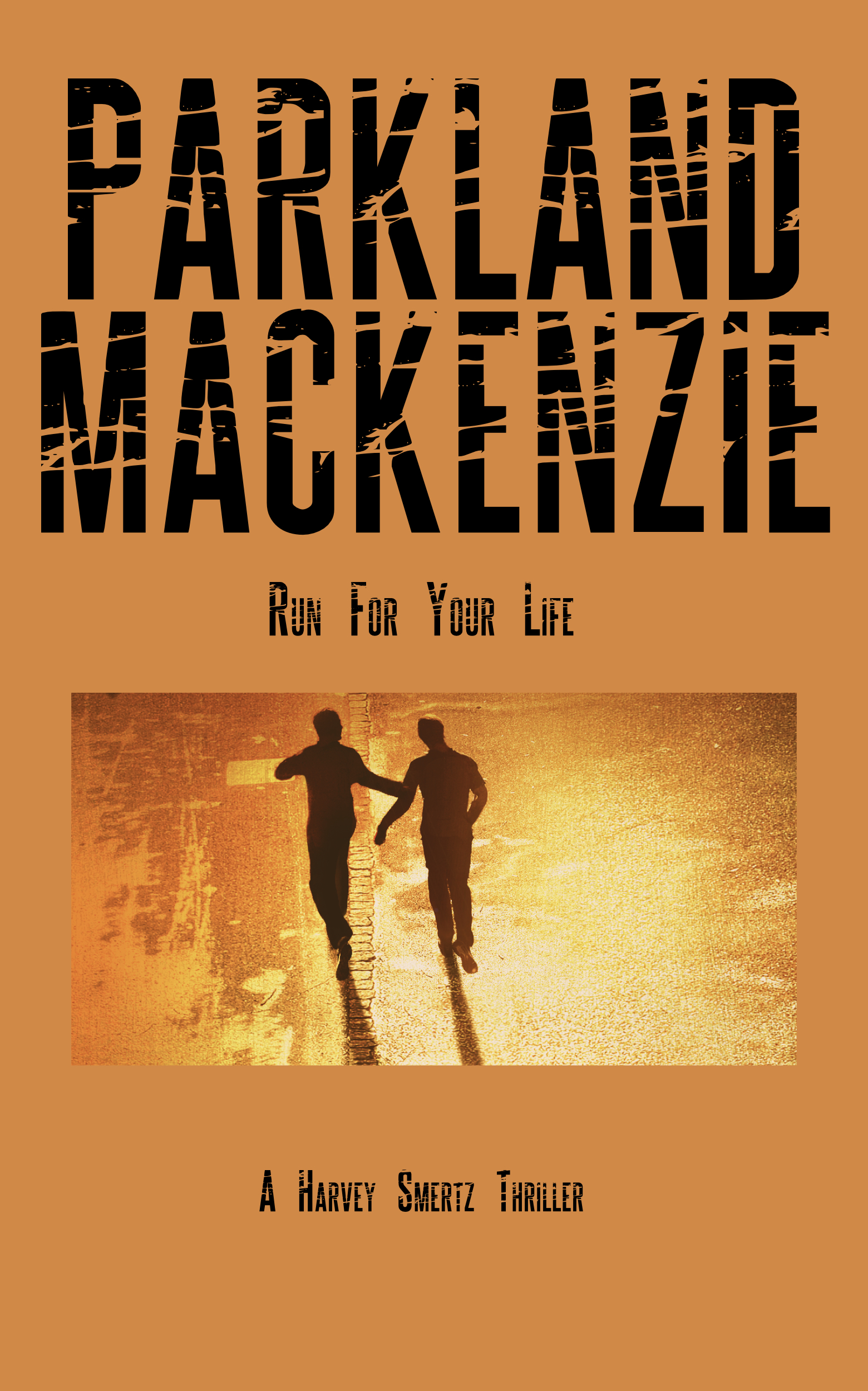
To give you an idea, I did a quickie mockup to show you the proportions. The names have been changed, of course.

As much of an ego boost as it is to see your name above the title, your first book is not the time to do it. Your task is to sell books and make repeat readers.

When might you put your name above the title?

a) When you hit a major bestseller list

b) When you win a major award

c) When your book sells a million copies

d) When you have established solid sales over four or five books.

Then you can move from this:

To this:

Not Paying for a Good Proofreader

I was teaching at a conference in Oklahoma recently, and took Lyft to the airport for the flight back to L.A. As I usually do, I engaged the driver in conversation. He was a local, a gray-haired ponytail fellow who goes around to fairs with a trio of guys reenacting Old West gunfights. He asked what I did and I told him and he said, “Hey, my buddy writes crime novels. He’s really into it. He’s written two of ’em.” Pause. “He needs an editor, though. A lot of mistakes and typos.”

“Uh-huh,” I said. “You can’t do that. At least if you want people to buy another one of your books.”

“I bought his second one,” my driver said, then added: “But only because he’s my buddy.”

You know all those potential readers out there? Not your buddies. So don’t annoy them with a typo infested book.

Typos are the special bane of the indie existence. I’ve often said they are like sand fleas. You get back from the beach, you shower, you think you’re good. Then around midnight, what’s that itch?

Yeah, ick, I know. But that’s how I feel about a typo that slips through.

So find a good proof reader and pay that person. It’s a rookie mistake not to invest in quality control.

And if there’s still a sand flea or two? Don’t worry. A reader will alert you. (Kindle Direct Publishing does, too.) Then you can fix and re-up your book in about ten minutes. I use Vellum for my formatting, so I make the change and then output for both ebook and print. I log into KDP and click a few times and I’m done.

Marketing Mayhem

As a rook, you’ll be tempted to try every dang thing under the sun to get the word out on your book. I’ve already written the wisest guide to marketing out there, one that will save you a lot of stress.

For now I’ll point out the two biggest blunders:

  1. Overlarding your social media with variations on: “I’ve got a book out there you should buy!” Follow the 90/10 rule. Ninety percent of your content should be positive and of some value to the reader. Ten percent you can hawk your books or alert to a deal.
  2. Letting social media overwhelm your actual writing. Remember, the best marketing by far is word-of-mouth, which comes only when you produce a great reading experience, time after time. So use most of your energy to study your craft and write your next book!

Have at it, folks. What other rookie mistakes have you seen? I’m at a conference today so my interaction may be sketchy. Talk amongst yourselves! 


True Crime Thursday – Calder Road Killings

Photo courtesy of FBI

In the mid-1980s to 1993, a remote area between Houston and Galveston became a dumping ground for the bodies of four murdered women. The desolate fields off Calder Road near League City, TX became known as “The Killing Fields.”

Police detectives and the FBI believe one person is responsible, likely someone who lived in the area and was familiar with the location. But they have no suspects and no discernible link between the four victims.

Dental records identified two women soon after they were found but two more remained “Jane Doe” and “Janet Doe” for decades until they were at last IDed a few months ago.

Here is a link to the FBI report, which includes a five-minute video. Particularly poignant is the interview with Tim Miller, the grieving father of 16-year-old Laura Miller.

Starting at the two-minute marker, he describes how he would go to the fields off Calder Road to visit her memorial. He would place his hand on her cross and say, “Laura, please don’t hate your daddy but I can’t come out here anymore. I have to say goodbye and I have to put my life back together. And I’d literally be walking away and I’d hear this little voice say, ‘Dad, don’t quit, please, don’t quit.’”

He didn’t.

Instead, Tim Miller focused on finding answers for families of missing persons. He runs Texas EquuSearch, a nonprofit organization that has located 250 missing people.

We can only hope someday he finds justice for his own child.

~~~

 TKZers: Are there unsolved cases that haunt you?

You Never Feel Secure

By John Gilstrap

One of the questions that every published writer faces from time to time goes something like this: “Does it ever get easier after you’ve published your first book?”

The whole-truth form of the answer is yes, it does get easier, but not in the ways that people might expect.  The pressure never eases to produce a compelling story with interesting characters doing important things in interesting ways.  There’s no quarter for bad writing, flat storytelling or indulgent rants.  The mechanics all need to be there, and, I would argue, the bar for excellence only increases from book to book.

The confidence factor is where things get easier, I think.  I now realize that somewhere around page 200 in a book, I’m going to feel totally lost and I’m going to conclude that the only way to successfully end the misery is to give the book a ride in the shredder.  Having walked the walk 20 times now, however, I also know that somehow, I’ll figure it out.  The panic evaporates and the story resolves itself.

Yeah, but what if I can’t?  When creativity meets cockiness, a lot of bad things can happen.

September 15 has been my submission deadline every year since 2009.  Every year.  I’ve posted before about how much August sucks for me as I binge-write for 10-hours a day trying to bring the story in under the wire.  It’s total madness in the Gilstrap household during the month of August and the first half of September.

Beginning five or six years ago, my lovely bride, Joy, landed on an antidote for the madness: An exotic vacation that begins on September 16.  Two years ago, it was two weeks in Scotland, last year it was two weeks in Nova Scotia and Newfoundland, and this year, as I write this post, we’re beginning our second week in Portugal.  The upshot of this, of course, is that with tickets bought and deposits put down, blowing my deadline is not an option.

Next year’s Jonathan Grave book is called Hellfire.  I clicked Send to launch the manuscript five hours before our plane left Dulles Airport.  I wrote it, read it and liked it, but was that because it was good or because I needed to like it?

This is where the insecurity always lives on.  My agent and my editor had copies, and all I had to do was wait for the results.

After a week, I had hear nothing from either.  If it was terrific, they’d tell me right away, right?  But they knew I was on vacation.  If they hated the story, they would say nothing, right?  They’d let me enjoy the trip before ruining my day.  Right?

whole week passed without any word.  What the hell?

As of yesterday, I couldn’t take it anymore.  I sent an email to my agent telling her that the silence was killing me.  She wrote back almost instantly with the news that she loved the book, but was terrified that Joy would kill her if she interrupted our vacation with a work email.  Then I heard from my big honkin’ New York editor, who told the same story.  Loved the book, scared of my five-foot-three bride.  Now, that’s respect!

The takeaway, though, is that I can now have a nice vacation.

And next year, I have every confidence that the paranoids will come hunting for me once again.

What say you, TKZers?  Can you keep your paranoids in the closet where they belong?

First Page Critique: Where Are We
And Whose Head Are We In?

By PJ Parrish

Morning, crime dogs. We have another First Page submission to chew on today.  It has things to teach us about picking a point of view.  And a big hat tip to our writer who has pushed her/his baby out there for our scrutiny.  Remember…that takes guts.

SCARLET LIES

Scarlet crossed the multi-lane city street without checking for oncoming traffic. They would stop. And if they didn’t, what of it? A few horns blared and she clicked her heels across the road, the sun blaring in her eyes through the smog and haze. A man sat across the street, watching the foot traffic from a cafe table. He drank from a small, cream-colored mug.

Was that him?

Yes. It was. It was him. She couldn’t believe she saw him there, just on the other side of the street, drinking coffee, existing. How long had it been? Two years?

“Guy! Hey! Guy!” She hustled, her voice screeching and her gait reminiscent of a baby calf with awkward, tiny steps. Her skirt was tight, the shopping bags she carried were bulky, and her stilettos were sharp. The traffic did stop for her.

The man turned and watched her wobbling approach. She was grinning. He was not.

He said nothing, creasing his brow and sipping his coffee. He ended the call he was on. Slid his phone into his pocket. His olive complexion had deepened in the summer sun, and he had opted not to shave for a few days, giving him a rough, careless appearance.

She was radiant, elbowing people out of the way to get to him and straightening her walk.

“Guy! How are you? It’s been forever!” She was breathless. She stepped through the cafe gate and sat at the table with him. She raised her hand at a server, waving her over. A young woman approached and looked at the two of them, waiting. Scarlet looked at Guy, and blinked a couple of times.

“The lady will have an extra-hot Americano with a half-pump of hazelnut and a pitcher of cream on the side, please.” He looked up at the waiter apologetically.

“Oookay. One very special nearly hazelnut Americano and some creamer coming up.” She forced a smile, rolled her eyes and walked away. Scarlet beamed at Guy, biting her lip.

“You remember my coffee. You were always so thoughtful. How are you, though? Really?” She leaned towards him.

He looked at her for a moment, not returning the smile. “I’m good. I’m surprised to see you, Scarlet. Out in the wild.”

“Really? Why is that?”

He didn’t answer. He sipped his coffee and stared at her.

“I’ve missed you so much.”

“I doubt that.”

__________________________

Well, right off the bat my first question is: What kind of book am I reading here? Given the description of the woman and the interplay with the mystery man, it feels a little on the romantic suspense side or maybe we’re in cozy territory. Which is fine, if that is where the writer is going.  If this is straight mystery or suspense, then this opening, with its emphasis on the woman’s clothing, shopping bags, shoes etc., is off in tone. It’s hard to tell.  So we are left to judge it as it is, absent the helpful context of cover art or back copy.  The title SCARLET LIES could be anything, but it suggests to me a lighter tone.

Now about point of  view.  We are firmly in Scarlet’s POV at the start because we get her thoughts about the cars not stopping and her wondering if the man is the cafe is “him.”  But as we get deeper into the scene, the POV wavers a tad, floating up into semi-omniscient or even into the man’s POV when the writer starts describing her stilettos and her screeching voice and awkward gait. Who is making these observations?  She cannot, so it is either the man in cafe (which is a head-jumping POV shift) or it is the writer herself (which is a shift to omniscient).  It’s good that the writer is coming up with specifics in the descriptions but they must be grounded in a single POV to be effective.

Now, what is happening in this scene? Not too much really. A woman, apparently just finishing shopping, spots a man in a cafe, someone from her past, and initiates an encounter. The man seems blase, almost irritated.  Oddly, though, he doesn’t seem at all surprised to see her even though it has been “forever.”  Is this enough to make us want to read on? I don’t think so. There’s not enough meat here in the encounter and the woman, to be frank, is ditzy to the point of being annoying. Guy, on the other hand, by his simple  indifference, seems more interesting.  I can’t tell who the protagonist is here.  I hope it’s not the woman because, as I said, I think she comes across as silly.  If Scarlet IS the protagonist, then I think there’s a problem in asking readers to attach themselves to such a flimsy character.

If Guy is the protag, then I suggest the writer switch this scene to his point of view only. It could be much more interesting.  Let me demonstrate:

Guy Talbot ended his call and laid the phone face down on the cafe table. He was tempted to turn the damn thing off because he was tired of being on call and just wanted to be alone. Just for one afternoon. That’s why he had picked the Tiffany Cafe on Rodeo Drive. No one he knew would ever show up here. 

He was about to pick up his coffee cup when a flash of red across the street caught his eye. A trailing blazing of red hair, and a glimpse of tight red skirt visible through the bounce of Prada and Hermes shopping bags. 

Jesus, what that her? Of course it was. No woman on earth had hair that color. He hadn’t seen her in five years. What the hell was she doing here in Los Angeles? 

He picked up his sunglasses to hide behind. Too late. She spotted him.

“Guy! Guy!” she yelled.

She started across Rodeo Drive without looking. No matter. The cars would stop for her. They always did. Sure enough, a guy in a Ferrari stopped, the screech of his tires matching her voice.

I did this not to rewrite your work but to demonstrate what a difference a secure point of view can make. All description needs to be filtered through a solid POV. So pick one and stay in it.  Now I’d like to do some line editing to specifically show where the point of view has issues.

Scarlet crossed the multi-lane city street without checking for oncoming traffic. Is this a compelling enough sentence to open a book? I think you could do better. They would stop. And if they didn’t, what of it? Ditzy thought…if they don’t stop, she’d get hit. A few horns blared and she clicked her heels She didn’t click her heels; her heels made click-clacking sounds…big difference and it goes to POV across the road, the sun blaring in her eyes through the smog and haze. A man sat across the street, watching the foot traffic from a cafe table. He drank from a small, cream-colored mug. This observation must come from her POV.  She spotted or saw a man sitting in a sidewalk cafe WHERE? You need to tell us where we are. 

Was that him?

Yes. It was. It was him. She couldn’t believe she saw him there, just on the other side of the street, drinking coffee, existing. I don’t understand this. How long had it been? Two years?

“Guy! Hey! Guy!” Set your dialogue off on its own line before you go into movement.

She hustled, odd and unflattering word. She hurried? her voice screeching and her gait reminiscent of a baby calf with awkward, tiny steps. Here is where you really lose your POV. She would not describe her own voice as a screech nor would she compare herself to a calf. Her skirt was tight, the shopping bags she carried were bulky, and her stilettos were sharp. The traffic did stop for her.

The man turned and watched her wobbling approach. This feels like you are now in Guy’s POV. She was grinning. He was not.

He said nothing, creasing his brow and sipping his coffee. Again, you are now in his POV. She hasn’t arrived at his table yet. He ended the call he was on. Slid his phone into his pocket. His olive complexion had deepened in the summer sun, and he had opted not to shave for a few days, giving him a rough, careless appearance. Now we seem to be in omniscient POV. This is you observing, not Scarlet. It’s good to describe him this way but it MUST come from her not you. 

She was radiant, Another POV lapse. She cannot see herself as “radiant” which is in itself an odd description. elbowing people out of the way to get to him On the sidewalk? and straightening her walk.

“Guy! How are you? It’s been forever!” Again, separate dialogue from movement. It’s cleaner. 

She was breathless. She stepped through the cafe gate and sat at the table with him. What happened to all the shopping bags? She raised her hand at a server, waving her over. A young woman approached and looked at the two of them, waiting. Scarlet looked at Guy, and blinked a couple of times.This is one of her gestures that strikes me as ditsy

“The lady will have an extra-hot Americano with a half-pump of hazelnut and a pitcher of cream on the side, please.” He looked up at the waiter she’s a woman apologetically.

“Oookay. One very special nearly hazelnut Americano and some creamer coming up.” She forced a smile, rolled her eyes and walked away.  Giving the waitress this line adds nothing. It wastes space in your precious opening moments. Have her just leave.

Scarlet beamed at Guy, biting her lip. More ditziness. “You remember my coffee. You were always so thoughtful. How are you, though? Really?” Here’s an example where your dialogue isn’t working hard enough. We are in the first page or two of your story. Make every word count! She leaned towards him.

He looked at her for a moment, not returning the smile. “I’m good. I’m surprised to see you, Scarlet. Out in the wild.” I really like this line.  It is the first punch of suspense as it implies she has some kind of weird past.  It also makes Guy interesting. 

“Really? Why is that?”

He didn’t answer. You really need to amp up the tension in this scene so having him answer nothing after he laid out that great “out in wild” line feels limp. I think you missed a big opportunity to layer in some badly needed background between these two or give him more thoughts about her past or his own. MAKE YOUR DIALOGUE WORK HARDER. He sipped his coffee and stared at her.

“I’ve missed you so much.”  Who is talking? Makes a big difference! I’m guessing it’s her given her fawning tone. 

“I doubt that.”  As I said, Guy’s recalcitrance makes him more appealing as someone I would be interested in following for a couple hundred pages. 

Okay, so to sum up, I think you need to brush up on point of view, especially as it applies to description. You also need to make your dialogue more muscular. What do I mean by that? You need to make every line mean something. Every word and line has to contribute to your dramatic point.

Most important, you need to find a way to inject more interest and tension into this scene. A chance meeting between two characters who had a past together isn’t meaty enough unless you layer in some intriguing undercurrents. Ask yourself: What is the POINT of this scene? What am I trying to accomplish? An effective opening has to introduce your main character, tell us where we are (you need to add that) and most importantly, begin to establish some kind of disturbance.

Thanks writer, for letting us get a peek at your work. Don’t get discouraged. As Hemingway said, “The first draft of anything is always junk.” Although trust me, he used a much stronger word. 🙂 Hope you find this helpful.


First Page Critique: Singularity Syndrome

By Sue Coletta

Another brave writer has submitted their first page for critique. I’ll see you on the flipside. Enjoy!

Title:  Singularity Syndrome

It was just the kind of case I like. Someone was sipping data from Hurgle’s supposedly leakproof data cloud. Hurgle wasn’t an especially evil corporation—just average evil. So, I didn’t mind taking their coins to send sniffers loose in the data streams. I found the leak and plugged it for good with a worm that trashed the sneak thieves’ servers. They never knew what hit them, and my client and I never knew who they were. But that didn’t matter. They’d be back, or someone else would. The universe holds an infinite number of crackers.

It was 13:06 hours of work by my intelligent agents while me, the Parrot and Altima sat around the warehouse snacking on Chapul bars and fresh water.

Then she called. And reminded me what kind of case I really like.

The call came in on my public comms screen with full voice and video. A woman with long scarlet hair, glossy in the style of years ago. She was beautiful, with lines around her eyes that showed she liked to smile. But not smiling now. Of course not. She wouldn’t be calling me if she had anything to smile about.

“How can I help you?” I’m the Finder, that’s what I do, so it’s obvious. But it helps them to start from the beginning.

“I’m worried about my husband.”

“He’s missing?”

“No.”

“Then what?”

A small crease furrowed her lovely forehead. “His behavior has changed.”

“How so?”

“He’s lost focus.”

“Is he dangerous? Accident prone? I’m not clear why you’ve called me. Why not a psychiatrist?”

“We run a business together. A significant company. He’s got some strange ideas, and they’re impacting our business.”

“If this is some corporate drama, I’m not interested.”

“I know about you.”

“Then you know I don’t care about the corps.”

“Unless it interests you.”

“And why would it?”

“I think his brain has been hacked.”

Okay, she was right. That was interesting. “His brain has been hacked or you just don’t like the way he thinks?”

“I don’t like the way he thinks, but it’s more than that. He’s not thinking the way he used to.”

“People change.”

“Yes, they do.” She let the silence draw out and so did I. I could be silent much longer than most people.

* * *

Excellent first page, Anon! The writing is crisp, exciting, and has an engaging voice. The dialogue is punchy and quick, sounds natural and believable. The MC’s personality shines through. There’s a solid goal and conflict, and you’ve dropped us into the story at an ideal place and time. I liked this opener so much, I wanted to keep reading.

Even without you having to tell the reader, we can assume the MC is male. We also get a good sense of who he is—a highly skilled white hat who works for a government agency in a specialized field (my guess is a cyber-tracker). That’s a lot of information that you subtly infused into this first page without clobbering us over the head with backstory. Well done! His name would be nice, but I’m willing to wait. See what good writing does? It tells the reader we’re in capable hands. If I didn’t learn his name for another ten pages, I’d still be content to go for the ride. Try to slip it in earlier than that, though. 🙂

Let’s see if we can improve this first page even more.

It was just the kind of case I like[d] add the “d” to stay in past tense here. Someone was sipping data from Hurgle’s supposedly leakproof data cloud. Hurgle wasn’t an especially evil corporation—just [an] average evil. So, I didn’t mind taking their coins to send sniffers loose in the data streams. I found the leak and plugged it for good with a worm that trashed the sneak[y] thieves’ servers. They never knew what hit them, and my client and I never knew who they were. But that didn’t matter. They’d be back, or someone else would.

The universe holds an infinite number of crackers. I brought this line down for greater impact; also, because you’ve switched to present tense, which isn’t wrong, btw. In this context, the statement still holds true. 

It was 13:06 hours of work by my intelligent agents while me, the Parrot and Altima [the Parrot, Altima, and I] sat around the warehouse snacking on Chapul bars and fresh water. Use the pronoun “I” when the person speaking is doing the action, either alone or with someone else. Use the pronoun “Me” when the person is receiving the action, either directly or indirectly. — courtesy of Webster’s Ask the Editor

Then she called. And reminded me what kind of case I really like. This line is redundant. Instead, I’d rather see you tease the reader here. I don’t know where you’re going with the story, but perhaps you could add something like: The woman that rocked my world, and not necessarily in a good way.

The call came in on my public comms screen with full voice and video. A woman (if you decide to use something similar to my example above, then change this to [There she sat,] with long scarlet hair, glossy in the style of years ago. She was beautiful, with lines around her eyes that showed she liked to smile (how ‘bout using “laugh” instead of “smile” here to avoid repetition, since you use “smile” at the end of this paragraph?) But not smiling now. Of course not. Not now, of course. (one sentence is tighter than two 🙂 ) She wouldn’t be calling me if she had anything to smile about.

“How can I help you?” I’m the Finder, that’s what I do, so it’s obvious (last part is unnecessary). But it helps them to start from the beginning.

“I’m worried about my husband.”

“He’s missing?”

“No.”

“Then what?” (This seems out-of-character. He’s nice enough to let her “start from the beginning,” yet here he seems agitated. How ‘bout: “Then… I’m not sure why—”)

A small crease furrowed her lovely forehead (normally I’d ding you for “lovely” because it’s a non-visual word, but here, it works to show he’s enamored with the caller). “His behavior has changed.”

“How so?”

“He’s lost focus.”

“Is he dangerous? (why would losing focus automatically make him think “dangerous”? Don’t tell us; you’ll ruin the intrigue. Just give us a hint in the right direction.) Accident prone? I’m not clear why you’ve called me. Why not a psychiatrist?” (I would delete this last question. There’s nothing particularly wrong with it. It just feels… misplaced. *shrug*) 

“We run a business together. A significant company. He’s got some strange ideas, and they’re impacting our business.”

“If this is some corporate drama, I’m not interested.”

I’d love to see her stumble over her words. “It’s not. It’s just that— What I mean is, I know about you.” “I know about you.”

“Then you know I don’t care about the corps.”

“Unless it interests you.”

“Exactly. So, lay it on me. ’Cause as it stands now, I gotta tell ya, so far this sounds like a waste of valuable time and resources.” (I added to the dialogue to increase tension. Your MC is about to hang up when the caller drops a bomb i.e. brain hack) And why would it?”

“I think his brain has been hacked.”

Okay, she was right. That was interesting. (Is a brain hack something that happens every day in your story world? If not, he needs a bigger reaction. Even if it’s as simple as confusion: Whoa. Wait. Huh?) “His brain has been hacked or you just don’t like the way he thinks?”

Both I don’t like the way he thinks, but it’s more than that. He’s not thinking the way he used to.”

(Add a lame half-shrug or another body cue that shows indifference). “People change.”

“Yes, they do.” She let the silence draw out and so did I. I could be silent much longer than most people. (Delete the last line. It adds nothing. How ‘bout something snarky instead? “If she thought she could out-silence me, she obviously didn’t have the first clue about me.”)

All in all, you did a terrific job with this opener, Anon. I really enjoyed it. Be sure to let us know how things progress with your story. So far, I’m intrigued!

Over to you, my beloved TKZers. Would you keep reading? Please add your suggestions/comments of how you might improve this first page. Do you like the title? Why/why not?