 By Elaine Viets
I’d rather write an entire mystery than come up with a title for it. So much depends on choosing the right name for your baby: Will your title grab the reader? Describe your book? Boost your sales?
If you’re writing for a traditional publisher, your contract will probably call your mystery Untitled Work. It’s your job to give it a snappier name. You’ve lived with this book for months, even years. Maybe you’re too close to think of a good title. It’s time to step back and take a look at tips for mystery titles.
Ask your family and friends. I originally wanted to call my Angela Richman mystery about the murder of an aging Hollywood diva, Death Star. My editor said the title sounded too much like science-fiction. My husband Don came up with a play on a classic movie title. The new book was christened A Star Is Dead.
Keep Your Title Short. Yes, I know The Girl With the Dragon Tattoo wasn’t hurt by its long name. But short, snappy titles sell well. Consider Michael Connelly’s mysteries, starting with Black Echo. His titles are short and to the point. Stephen Cannell was another master of titles. My favorite is The Vertical Coffin, which he said was a cop term. When the first law enforcement officer rushes the door in a takedown, that doorway can quickly become a vertical coffin. Especially if firearms are used.
Early in my career, I wrote a collection of humor columns called The Viets Guide to Sex, Travel and Anything Else that Will Sell This Book. Lots of laughing readers didn’t line up for that title. Instead, drooling old men infested my signings, saying, “I want that book on sex travel.” Apparently the old boys missed that comma between Sex and Travel in the title. My mystery novels with titles like Killer Cuts attracted a better reader.

Search Shakespeare. Some authors, including Marcia Talley, find titles in the Bard’s work. My favorite Talley title is Unbreathed Memories, a phrase from “Midsummer Night’s Dream.” You can hunt for titles in OpenSourceShakespeare.org
Hymns and the Bible. Julia Spencer-Fleming has found a number of titles in hymns, beginning with In the Bleak Midwinter. They are perfect for her Rev. Clare Fergusson series.
 Want to go trendy? For a while every third book had “Girl” in the title. That trend started with novels like Gillian Flynn’s Gone Girl and Paula Hawkins’ The Girl on the Train, not to mention The Girls With the Dragon Tattoo by Stieg Larsson. None of these women were the girl next door, but their books sold. By the way, The Girl Next Door was used by a wide range of writers, from Brad Parks to Ruth Rendall. It’s even a horror story.
There were also a raft of “Daughters,” as in Leslie Welsh’s The Serial Killer’s Daughter. Now I’m seeing lots of “Wives,” including Daisy Wood’s debut novel, The Clockmaker’s Wife, and Alice Hunter’s The Serial Killer’s Wife.
One word titles can sum up the book. This works well for thrillers, such as Jeff Abbott’s Panic and Aaron Elkins’ Loot. I had a one-word title for a Dead-End Job mystery. I wanted to call the book Catnapped, but there was another mystery with the same name that year.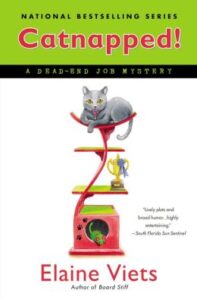
My editor added an exclamation point to the title and made it Catnapped!, leaving me with a punctuation nightmare. How would you end this sentence: “I hope you like Catnapped!”
Should I add a period at the end of this sentence: “I hope you like Catnapped!.”
Or keep the exclamation point and look like a hyper-excited ditz?
Some words have a mystery mystique. Currently on the Pub Alley Fiction Mystery Bestsellers list are titles with words that seem to grab readers:
Paris. Gets them every time. At the top of the list is The Paris Detective: Three Detective Luc Moncrief Thrillers by James Patterson and Richard Dilallo.
Curse. Another intriguing word. Curse of Salem by Kay Hooper made the list.
Midnight. Two titles with “Midnight” are on the list: The Midnight Lock by Jeffrey Deaver and The Midnight Hour by Elly Griffiths.
Book Title Generators are another tool for clueless mystery writers. You can find several of them here: https://kindlepreneur.com/free-book-title-generator-tools/
I sampled the Mystery Book Title Generator, which claims to be the “Ultimate Bank of 10,000 Titles” that will “generate a random story title that’s relevant to your genre. You can pick between fantasy, crime, mystery, romance, or sci-fi.” http://blog.reedsy.com/book-title-generator/mystery
I clicked on “I’m just starting to write” and got this title: “The Mystery of the Three-Inch Stranger,” which struck me as a bit personal. It’s not the size of the stranger, it’s what you do with him.
 Series titles: Sue Grafton has her alphabet series, beginning with A Is for Alibi and ending with Y Is for Yesterday. Mary Higgins Clark and her partner-in-crime Alafair Burke have a song title series, starting with You Don’t Own Me. Stephanie Plum uses numbers. Her latest is Game on: Tempting Twenty-eight.
I’d wanted to call my first novel for Penguin The Dead-End Job. My editor thought that would make a good series title, so that book became Shop Till You Drop.
When you write for a publisher, potential titles are batted back and forth. My fourth mystery in that series featured the murder of an overbearing mother of the bride. I wanted to call it One Dead Mother.
My publisher nixed that title as “too urban.” The novel was named Just Murdered.
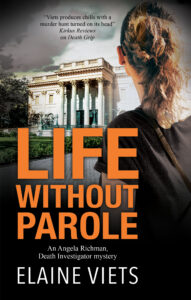 Enter to win a free copy of Life Without Parole, my latest Angela Richman, death investigator mystery. Stop by Kings River Life magazine: https://www.krlnews.com/2022/01/life-without-parole-angela-richman.html
 Those dang pesky buggers that sneak into first drafts and weaken the writing are called filler words and phrases—also known as fluff.
 So here we are on a toboggan hurtling down the snowy mountain called 2022. Seems like a good time to take a look at the current state of book publishing, the better to avoid the rocks, tree stumps, and cliffs scattered all over the slope.
 Ah, yes, the old plot-driven vs. character-driven debate. I’m not going there with this post, as it’s probably been done to death on The Kill Zone and by far more qualified fiction writers than me. But I will share with you a list of
  Harry was born into policing royalty. Her great-grandfather was a constable in the Northwest Mounted Police that morphed into the Royal Canadian Mounted Police which Harry’s grandfather joined. Harry’s dad, Hendrik (Hank) Henderson followed suit, and Hank was a high-ranking RCMP commissioned officer when Harry became a recruit.
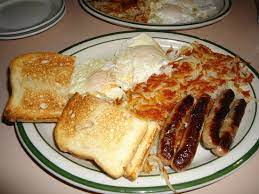 Harry was left-handed but ate with her right. On dayshift, we always went to lunch at the same diner and Harry always ordered breakfast. Always the same—she hated substitutes. Pork sausages, eggs lightly steamed, shredded hash browns, dry white toast, and black coffee that she loaded with curdles of cream and sacks of sugar. Once served, Harry held her fork in her right, her knife in her left, and chopped everything into one large mangled mess which she mawed down while constantly talking.
 She completely and hostilely rejected my concern so, confidentially, I had the boss request a hearing test at her annual physical. After that, Harry reluctantly had hearing aids hidden by her large hair. (We, the other detectives, used to mess with Harry by raising and lowering our voices.)
 Garry Rodgers is a retired homicide detective with a second investigative stint as a coroner. Now, Garry is a writer with