
In his book “On Writing,” Stephen King states he doesn’t read in order to “study the craft” but believes there is “a learning process going on” when he reads. Do you read books differently as a writer? Are you conscious of “the craft” as you read?

 I returned from an amazing trip to India all the more excited about possible future projects not just because my ‘on the ground’ research was more fruitful than I expected, but because I’d been able to experience that critical connection to history that will (I hope) provide the window I need to reimagine the past. I’d felt this connection once before, in Venezuela, and it provided me the impetus for writing my first Ursula Marlow mystery, Consequences of Sin.
For a historical mystery writer, I need to feel a connection to the history I’m writing about. I want to convey the sensory experience of what it would have been like to live in another era and for that I need some means of accessing the past on a personal level to enable the true ‘reimagining’ process to begin. This is easy for me in a place like England where family ties already establish that connection, but much harder when I consider other places and eras to which I have little in the way of understanding or connection.
I wasn’t sure what I’d find on my trip to India (apart from obviously some very beautiful places – see the photo of the Taj Mahal above – which is awe-inspiring – and the sharp contrast between poverty and luxury – also evident in Agra just streets away from the Taj Mahal). I certainly wasn’t sure what my reaction would be to the place or its history.
As it turned out, I was surprised how easily I felt an affinity to those Europeans who arrived in India during the late 18th and early 19th centuries (the period that I had, not surprisingly, been researching with a future novel in mind). Although many historical places were difficult to isolate against the noise, traffic and bustle of modern life in India, I had no trouble reimagining what it must have once been like. I also found that I was beginning to inhabit the mind and imagination of some of the characters I had begun to sketch out in my head before my trip, and so much of what I saw, smelled, and heard could be accessed through the prism of their thoughts and background, not just my own.
 One of the most surprisingly things to come out of my research was that the place I had originally believed would be the initial setting for my story (Hyderabad) was totally displaced by my experiences in another city (Udaipur – photo to the right) and I saw quite clearly my characters inhabiting this landscape and not the one I had previously envisaged (only downside, a whole new set of history books to read!).
One of the best things about travel is that it rarely provides the experience you expect – and it’s in the unexpected that I find the greatest inspiration.
So now I’m back, I just need to get down to the business of actually writing. In the meantime, I’d love to hear some TKZers’ unexpected travel and research experiences – how have they inspired your writing?
 10. Characters are how readers connect to story
I’ve read books about the history of eras, and while interesting, they are nothing compared to a good biography (I’m currently reading H. W. Brands’ biography of Andrew Jackson). Why? Because we are more fascinated with people than epochs. (I once heard history described as “biography on a timeline.”)
We all love twisty turny plots, chases, love, hate, fights, freefalls––all of that. But unless readers connect to character first, none of that matters.
9. On the other hand, character without plot is a blob of glup
Contrary to what some believe, a novel is not “all about character.” To prove the point, let’s think about Scarlett O’Hara. Do you want 400 pages of Scarlett sitting on her front porch, flirting? Going to parties and throwing hissy fits? I didn’t think so. What is it that makes us keep watching Scarlett? A little thing called the Civil War.
A novel is not a story until a character is forced to show strength of will against the complications of plot. Plot brings out true character, rips off the mask, and that’s what readers really want to see.
“Blob of glup,” by the way, is a term I remember from my mom reading me The Thirteen Clocks by James Thurber. I always thought it quite descriptive.
8. Lead characters don’t have to be morally good, just good at something
Two of the most popular books in our language are about negative characters. I define a negative character as one who is doing things that the community (theirs, and ours) do not approve of, that harm other people. A Christmas Carol has Scrooge, and Gone With the Wind has Scarlett. Why would a reader want to follow them?
Two reasons: They want to see them redeemed, or they want to see them get their “just desserts.”
The trick to rendering a negative Lead is to show, early, a capacity for change. When Scrooge is taken back to his boyhood, we see in him, for the first time, some compassionate emotion. Maybe he’s not a lost cause after all!
Or show that the negative character has strength, which could be an asset if put to good use. Scarlett has grit and determination (fueled by her selfishness) and just dang well gets things done. We admire that, and hope by the end of the book she’ll turn it to something that actually helps those in her world. She does, but by then it’s too late. Rhett just doesn’t give a damn.
7. Characters need backstory before readers do
Yes, you have to know your character’s biography, at least the high points. One question I like to ask is what happened to the character at sixteen? That’s a pivotal, shaping year (unless your character actually is sixteen, in which case I’d go to age eight).
But you don’t have to reveal all the key information to readers up front. In fact, it’s good to withhold it, especially a secret or a wound. Show the character behaving in a way that hints at something from the past, currents below the surface. Why does Rick in Casablanca stick his neck out for nobody? Why does he play chess alone? Why doesn’t he protect Ugarte? Why doesn’t he love Paris? We see him act in accord with these mysteries, and don’t get answers until well into the film.
6. But readers want to know a little something about the character they’re following
Against the advice that you should have absolutely zero backstory in the first fifty pages, I say do what Stephen King, Dean Koontz, Michael Connelly and most every bestselling novelist does: sprinkle in bits of backstory in the opening pages. But only what is necessary to help readers bond to character.
A rule of thumb I give in my workshops is this: In the first ten pages, you can have three sentences of backstory, used all together or spread out. In the next ten pages, you can have three paragraphs of backstory, used all together or spaced out. This will force you to examine closely what you include, saving the rest for later, and letting the story get cracking.
5. Memorable characters create cross-currents of emotion in the reader
We all know about inner conflict. A character is unsure about what he’s about to do, and there’s an argument in his heart and soul, giving him reasons both for and against the action. That’s good stuff, and one way to get there is to identify the fear a character feels in each scene.
But to create even greater cross-currents of emotion in the reader, consider having the character do something the absolute reverse of what the reader expects. Brainstorm ideas for this, and you’ll often find a great one down the list, beyond your predictability meter. Put that action in. Write it. Have other characters react to it.
Only then find a way to justify the behavior, and work that into your material.
It was E. M. Forster, in Aspects of the Novel, who defined “round” (as opposed to “flat”) characters as those who are “capable of surprising us in a convincing way.”
4. Great villains are justified, at least to themselves
The antagonist (or as I like to put it, the Opponent) is someone who is dedicated to stopping the Lead. It does not have to be a villain, or “bad guy.” It just has to be someone on the other side of one definition of plot: two dogs and one bone.
When you do have a bad guy opponent, don’t fall into the trap of painting him with only one color. The pure-evil villain is boring and manipulative, and readers won’t fall for it. You’re also robbing them of a deeper reading experience (for which they’ll thank you by looking for your next book).
One exercise I give in workshops is the opponent’s closing argument. Pretend they have to address a jury and justify their actions. They are not going to argue, “Because I’m just a bad guy. I’m a psycho. I was born this way!” No bad guy thinks he’s bad. He thinks he’s right.
Make that argument. Weave the results into your book.
3. Don’t waste your minor characters
One of the biggest mistakes I see new writers make is putting stock characters into minor roles: The burly bartender, wiping glasses behind the bar; the boot-wearing, cowboy-hat-sporting, redneck truck driver; the saucy, wise-cracking waitress.
Instead, give each minor character something to set him or her apart from the stereotype. Think of:
• Going against type (a female truck driver, for example)
• An odd tick or quirk
• A distinct speaking style
Use minor characters as allies or irritants. Even those who have only one scene. A doorman, for example. Instead of his opening the door for your Lead, have him give the Lead a hard time. Or have your Lead in a hurry but the cab driver is lethargic and chatty.
A little time spent on spicing up minor characters will add mounds of reading pleasure to your readers.
2. Great characters delight us
When I ask people to name their favorite books or movies, and then ask why, it’s invariably because of one great character. As good as Harrison Ford is in The Fugitive, people always mention Tommy Lee Jones, and even his famous line, “I don’t care!”
The Silence of the Lambs? Two great characters. The absolutely unforgettable Hannibal Lecter, and the insecure but dogged trainee, Clarice Starling. Lecter delights us (because we are all a little twisted) with his wit, deviousness, and dietary habits. Clarice delights us because she’s the classic underdog who fights both professional and personal demons.
1. Great characters elevate us
Truly enduring characters end up teaching us something about humanity and, therefore, about ourselves. They elevate us. And that is true even if the character is tragic. As Aristotle pointed out long ago, the tragic character creates catharsis, a purging of the tragic flaw, thus making us better by subtraction.
On the positive side, I think of Harry Bosch and Atticus Finch, both on a seemingly impossible quest for justice. I’m the better for reading about them, and those are the kinds of books I always read more than once.
On the negative side, I think of the aforementioned Scarlett O’Hara. We are pulling for her to do the right thing, to get with it, to join the community of the good. Then she goes off an marries some other guy she doesn’t love and uses him mercilessly. When she finally suffers the consequences of her actions we, too, are duly warned.
So, TKZers, when you think of an unforgettable character, who comes to mind? What is it about this character that moves you? Elevates you? Makes you want more of the same?
By Elaine Viets

Some bookstores are mad as hell at writers, and for good reason.
We writers still need bookstores. Even self-published writers like to see their work displayed on store shelves – at least the ones I know.
And bookstores need to fill those shelves with our pretty books.

So why is it so hard to make this work?
I used to be a bookseller, and a couple of members of the tribe told me why writers’ books may not make it onto their shelves. I’m not using their names because they spoke bluntly about the issues.
Here’s what booksellers want you to do:
(1) Give me a real new release.
An independent bookstore owner said, “I’m not interested in mysteries that authors have been trying to sell on their own for six weeks, but are still calling new releases. When your book is first out, bring it to me.”
(2) Give me time to display your new release.
Make sure your books are at the store in plenty of time. Either hound your publisher or personally deliver the books to the store. “For an April 1 release, I’ll need to have a copy of the book in my store by March 25,” an indie bookseller said.
(3) It costs money to stock your books.
“Many traditional publishers are charging restocking fees now,” the indie bookseller said. “So if your books don’t sell, my store loses money. Self-published books require paperwork and have storage, pickup and delivery problems. I don’t have to the space to keep them.”
(4) A fact of book selling life: Some local authors don’t sell in my store.
The authors are charming. Their covers are good-looking. “But their books don’t sell. I’ve had some authors’ books for a year and no one bought them,” he said. The big box stores would have returned those books months ago.
“I can display your books as a new release for two or three weeks, but if they don’t sell, I can’t afford to give those books shelf space.” If this bookstore isn’t the right fit for your work, look for one that can sell your books.
(5) A bookstore is a place to buy books – not a showroom.
“I’ve had people buy the books on Amazon – Amazon!” he said. “Then these same people come to hear the author at my store, eat my snacks and drink my bottled water and soda. Can they do that on Amazon? No!
“I’ve watched people in the audience take out their e-readers or their iPhones during the talk and order from Amazon. That’s why booksellers are starting to charge for signings.
“Authors, if you have a signing at my store, please ask your friends and fans to buy the book here.”
(6) Avoid the A-word.
That’s Amazon. A Barnes & Noble community relations manager told me this story:
“A customer wanted a local author to speak and sign books for her group. I gave her the names of several people I thought would be a good fit for her organization. We spent half an hour discussing various authors, and then I gave her their contact information.
“ ‘Now,’ I said, ‘when you get the author, how many copies would you like to order for your event?’
“ ‘Oh, I’ll get the books from Amazon,’ she said. ‘They’re cheaper.’ ”
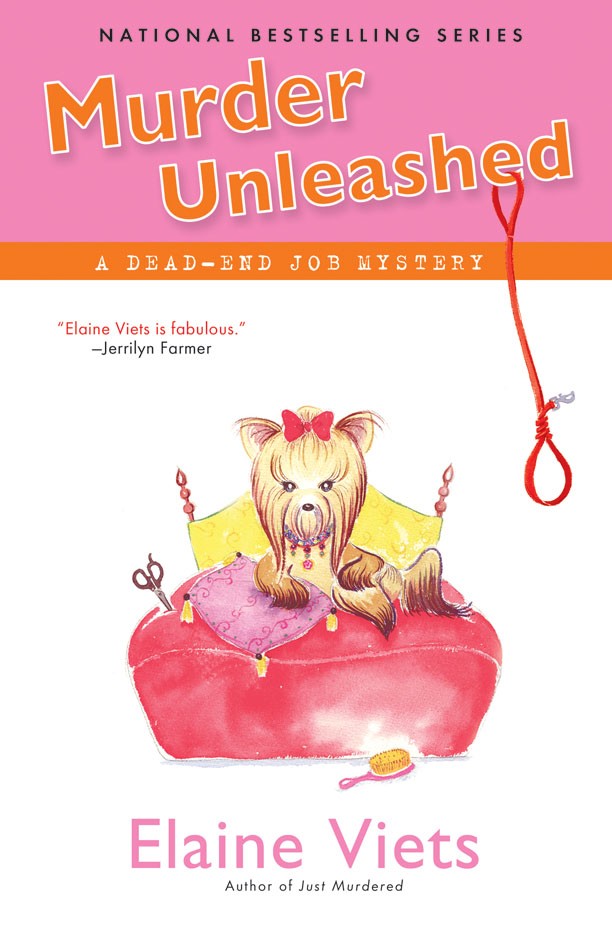
Win a free hardcover. I’m giving away my first Dead-End Job Mystery that was in hardcover, “Murder Unleashed.” Enter to win by clicking Contests at www.elaineviets.com

“It is easier to tone down a wild idea than to think up a new one.” — Alex Osborn
I don’t know how you guys do it. Those of you who write alone, I mean.
I am blessed in that I work with a co-author, my sister Kelly. Our collaboration began more than 20 years ago and has lasted through 20-some books (counting the ones that didn’t get published). And while we have had our disagreements over the years, we have always understood the power behind the notion that two brains are better than one.
I want to talk today about brainstorming.
This came about because I was cleaning out my computer folders the other day. I have one folder I labeled BRAIN LINT. This is just a depository for all the stuff I can’t find a good place for but am too gutless to throw out. In this folder are still-born story ideas, pictures cadged from iStock that were meant to inspire, old newspaper articles about bizarre crimes and weirdos, and one completed manuscript that is so bad I keep it just to remind myself of how far I have come and how far I could fall.
When I was cleaning out the lint, I found one gem. It is a transcript of a story conference in 1978 between Steven Spielberg, George Lucas and Lawrence Kasdan. They were brainstorming about a possible movie. It didn’t have a title then, but it would eventually be made under the title Raiders of the Lost Ark. You might have heard of it.
Here’s just one exchange:
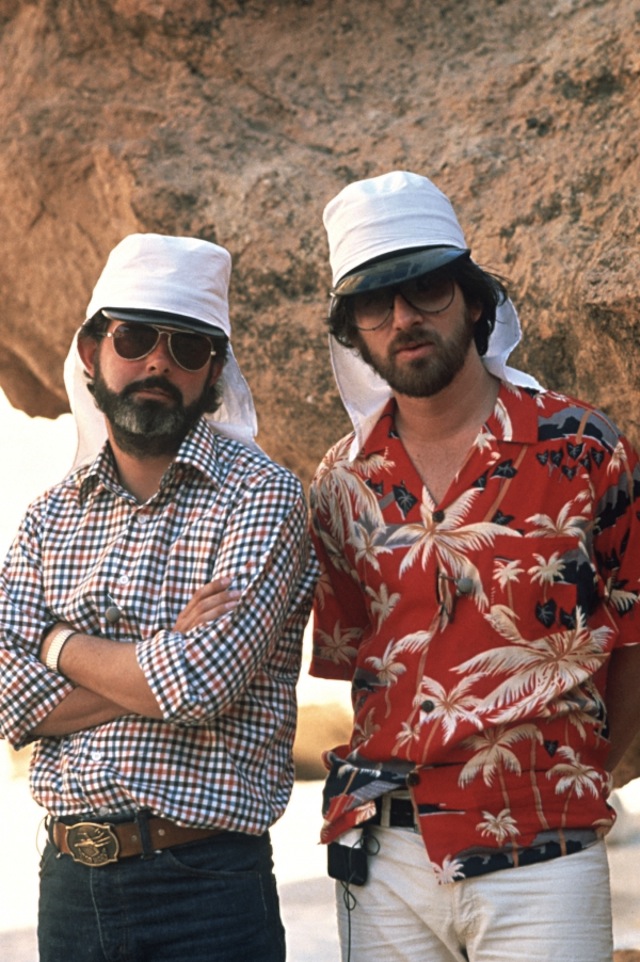 Lucas: We want to make a very believable character. We want him to be extremely good at what he does, as is the Clint Eastwood character or the James Bond character. James Bond and the man with no name were very good at what they did. They were very fast with a gun, they were very slick, they were very professional. They were Supermen.
Kasdan: How do you see this guy?
Lucas: Someone like Harrison Ford, Paul LeMatt. A young Steve McQueen. It would be ideal if we could find some stunt man who could act.
Spielberg: Burt Reynolds. Baryshnikov.
Kasdan: Do you have a name for this person?
Lucas: I do for our leader.
Spielberg: I hate this, but go ahead.
Lucas: Indiana Smith. It has to be unique. It’s a character. Very Americana square. He was born in Indiana.
Kasdan: What does she call him, Indy?
I still can’t get the image of Baryshnikov in a fedora out of a mind. But that was how Indiana Jones was born, out of a brainstorming session between three creative guys. What a strange word – brainstorming. Ever wonder where it came from?
 Well, in 1919, Alex Osborn, an ex-newspaper man from Buffalo, joined with Bruce Fairchild Barton and Roy Sarles Durstine to form the hugely successful BDO advertising agency. Osborn went on to write many books on creativity but he’s the one who coined the term “brainstorming.”
Nowadays, “brainstorming” is a catch-all for any type of creative group grope. But I thought it might be interesting to go back and see what Osborn had to say about it back in 1953 and find out if it could help writers today. Well, guess what? It’s still good advice, whether you are collaborating, working in a critique group — or even flying solo.
Here’s my main take-aways from Osborn’s ideas on brainstorming.
1. Think up as many ideas as possible regardless of how ridiculous they may seem. It’s unlikely you’ll get the perfect solution right off the bat, so he recommends getting every idea out of your head and then go back to examine them afterwards. An idea that may sound crazy may actually turn out to work with a little modification.
Doesn’t this make sense when you’re plotting? I know when Kelly and I talk, we throw everything on the wall. You need to take the same approach with yourself. Write down every idea and let them bake for a while. Sometimes, the most outrageous thing leads to something useful.
2. Don’t be judgmental. All ideas are considered legitimate and often the most far-fetched are the most fertile. Ideas can be evaluated after the brainstorming session but judgments during the process should be withheld.
Are you sometimes too hard on yourself? Do you think, “Oh, that’s so stupid, no editor will ever buy it.” Or maybe you are a self-doubter, telling yourself, “I don’t have the chops to try this technique.” Or: “This is a great idea but it’s so complex so I won’t even try.”
3. Go for quantity not quality. Don’t get hung up (like I often do) on coming up with the most clever solution to your writing problem. Let your brain waves flow so the bad stuff bobs up to the surface along with the good. Osborn said: “Creativity is so delicate a flower that praise tends to make it bloom while discouragement often nips it in the bud. Forget quality; aim to get a quantity of answers. When you’re through, your sheet of paper may be so full of ridiculous nonsense that you’ll be disgusted. Never mind. You’re loosening up your unfettered imagination—making your mind deliver.”
Osborn’s books were geared more toward corporate types trying to get their teams to think more creatively on things like how to get traffic flowing better in big cities. But take a look at his suggestions for improving creativity and see if there’s not something here for us mere writers:
1. Break up the problem into smaller pieces. For writers, this can mean tackling each plot or character problem as manageable bites, not getting overwhelmed by the idea that you’ve got 400 pages to fill. Get that first draft written then go back and fix your plot holes or layer your characters better.
2. Search for alternatives. If you’ve painted yourself into a plot corner, look for a different way out than the old ways.
3. What can be borrowed or adapted? Read other writers and learn from them.
4. Modify with new twists. There aren’t many new plots in crime fiction but there is always a way to put your own fresh imprint on them.
5. Is there something that can be magnified or minified? Maybe the stakes in your thriller aren’t high enough. Maybe you need to play down a secondary character who is overshadowing your hero. Are you larding in too much research?
6. What can be substituted? Maybe if you changed your location the story would suddenly come alive. Would your mystery work better in a small town where you could exploit the English village dynamic? Is your setting banal and underwritten? Are you hitting all the wrong clichés if your book is set in Paris or some other iconic place?
7. What can be re-arranged? Maybe you’re writing in the wrong point of view? Try switching from first to third. Or maybe the guy you think is your hero is really the bad guy?
8. Consider the vice versa. I love this one. Do just the opposite of what you are now doing. Is your protag male? Switch gender! Are you relying on tired character tropes (lonely alchoholic PI, sweet antique store owner who solves crime). Make your brain do a 180 and examine what is on the flip side. I did this with my latest book. The woman I thought was my protag turned out to be one of two in a dual-protag parallel theme story.
Okay, enough lessons. Let’s end by going back and eavesdropping some more on the Indiana Jones brainstorm session. CLICK HERE to read the whole thing.
 Lucas and Spielberg started with the idea that they wanted to make a movie that was like old Republic serials of the Thirties (Zorro, Dick Tracy, Red Ryder). Something had to always kept happening, every ten minutes or so another cliff-hanger situation. From there, the guys dreamed up Indiana Smith and other elements. In the beginning, even the ark was just a MacGuffin.
Lucas: The thing is, if there is an object of antiquity, that a museum knows about that may be missing, or they know it’s somewhere. He can go like an archeologist, but it’s like rather than doing research, he goes in to get the gold.
Spielberg: His main adversaries will be the Germans?
Lucas: Yeah, I think they should be. I’ve been trying to move him around the world a little bit to see if we can’t get a little Oriental influence into it just for the fun of it. I may have fit it in. The fun thing is, he’s a soldier of fortune, so we can move him into any sort of exotic thirties environment we want to.
Spielberg: Keep him out of the States. We don’t want to do one shot in this country.
Lucas: The film starts in the jungle. South America, someplace. We get one of these great scenes with the pack animals going up the mist-covered hills. Very exotic mist-filled jungles and mountains.
Spielberg: Where he goes into the cave?
Lucas: This is where he goes into the cave. We had it where there’s a couple native bearers, whatever, and sort of a couple of Mexican, well not Mexican…
Spielberg: They’re like Mayan.
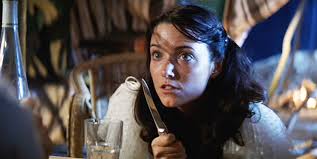 Lucas: They’re the third world local sleazes…[LATER] He goes into this very sleazy Casablanca type club and makes contact with this agent. The agent is a girl. She’s sort of a Marlene Dietrich tavern singer spy. A German lady singer. She’s really a double agent.
Spielberg: I like the idea that she’s a heavy drinker and our hero doesn’t drink at all. She gets drunk a lot. She’s beautiful and she gets really sexy when she’s drunk, and silly. And he doesn’t touch the stuff.
Lucas: I don’t want to soften her. I like the fact that it’s greed. I like all the hard stuff, but you’re going to love her.
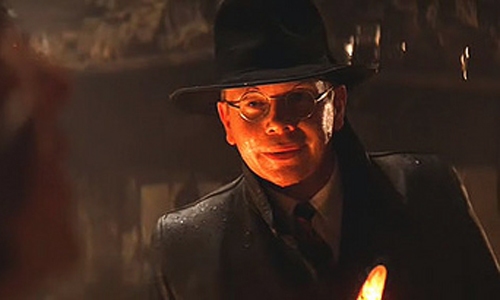 Spielberg: There should be a real slimy German character. He’s the only gestapo involved there. Every time you see him, you know it’s going to be the worst pain, death by torture. This guy looks like a ferret. He’s got that slick black hair. His name is Himmler or something like that. He’s a stocky short guy, a master torturer.
Lucas: What can he chase them with? What if he jumps on a camel?
Spielberg: I love it. It’s a great idea. There’s never been a camel chase before.
Lucas: Is this camel going to chase a car?
Spielberg: You know how fast a camel can run? Not only that, he can jump over vegetable carts and things. We still have the big fight in the moving truck to do. And now we have a camel chase.
Lucas: We’ve added another million dollars.
Spielberg: Not really. How much trouble can a camel be?
And then they talk about the big scene toward the end where Indy and Marion are tossed into that deep tomb and the bad guys cover it up with a rock. They’re trying to figure out what is in the tomb that’s dangerous and how Indy gets out. They decide there is a huge artesian well that opens up and he and Marion are in danger of drowning. Then somebody suggests there are also wild animals in the tomb, like tigers.
Spielberg: It would have to be a neighborhood tiger.
Lucas: There aren’t any tigers out there.
Spielberg: I’m not in love with the idea.
Lucas: You could have bats and stuff, make it slightly spooky.
Spielberg: What about snakes? All these snakes come out.
Lucas: People hate snakes. Asps? They’re too small.
Spielberg: It’s like hundreds of thousands of snakes.
Lucas: When he first jumps down in the hole, it’s a giant snake pit. Then when he says they’re afraid of light, they throw down torches. You have a whole bunch of torches that keep the snakes back. So he only has one more torch, and the snakes start coming in. He sits there with one torch, knowing that when the torch goes out… It’s the idea of being in a room, in a black room with a lot of snakes. That will really be scary.
Spielberg: The snakes are waiting, looking at him. Thousands. And the torches are burning down. He’s trying to keep it going. The torch goes out. The whole screen goes black. The sound of the snakes gets more intense. You hear him backing up. The camera pans and suddenly you see, it’s black, but there’s light coming from several cracks. It’s not completely black. That leads him to an opening. To a rock that isn’t so flush against the other rocks. He knows there’s access. He keeps pushing on it, he gets a little more room.
Lucas: We shouldn’t have any snakes in the opening sequence, just tarantulas. Save the snakes for now.
Spielberg: It would be funny if, somewhere early in the movie he somehow implied that he was not afraid of snakes. Later you realize that that is one of his big fears.
Lucas: It should be slightly amusing that he hates snakes, and then he opens this up, “I can’t go down in there. Why did there have to be snakes? Anything but snakes.”
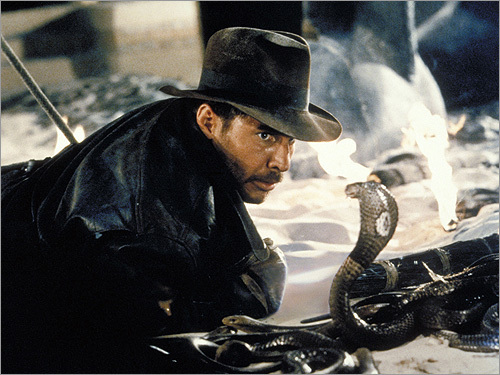
Now, aren’t you glad they didn’t go with the tigers?
 Authors who’ve been around awhile, and have more than a few books out there, are often asked two questions.
The first is, “Where do you get your ideas?”
I like how Harlan Ellison used to answer that: “There’s a swell idea service in Schenectady. Every week I send them twenty-five bucks, and every week they send me a fresh six-pack of ideas.”
Every now and then someone would ask him for the address of the service, and Harlan would do to that person what Harlan always used to do all such folks, i.e., not suffer them.
The other question we’re asked is, “Which book is your favorite?”
The answer is complicated. There are books we love because we worked so hard on them. Others because they were so much fun to write. And still others because they helped pay the mortgage.
But when I am asked about a series, I pause a moment, then name my legal thrillers featuring Ty Buchanan. They originally came out in beautiful hardcover editions, then trade paper.
As Seinfeld would say, yadda yadda yadda, I am pleased to report that I’m now releasing all three books in new digital editions. And to celebrate, I’m pricing each one at $2.99 for this kickoff period.

Allow me to tell you how I got the idea for the series, and indeed for each book. It started with my regularly scheduled “creativity time.”
Back when newspapers existed, I would read either the L.A. Times or the L.A. Daily News, and one legal newspaper, the L.A. Daily Journal. I’d scan for interesting stories or legal issues, and clip them and throw them into a box. Every now and then I’d go through that box, seeing if the ideas still interested me.
One item kept vying for my attention. It was a tragic story about an L.A. man who shot his young wife to death, then drove to a freeway overpass, got out, shot himself, and fell 100 feet to the freeway below. He crushed a Toyota, killing the driver. How bizarre is that?
So one day I wrote this up as an opening scene. When I got to the part about the woman being killed, I made up a character: Jacqueline Dwyer, a twenty-seven-year old elementary school teacher.
And then I paused, switched to a First Person POV voice, and wrote:
This would have been simply another dark and strange coincidence, the sort of thing that shows up for a two-minute report on the local news—with live remote from the scene—and maybe gets a follow-up the next day. Eventually the story would go away, fading from the city’s collective memory.
But the story did not go away. Not for me. Because Jacqueline Dwyer was the woman I was going to marry.
Who was narrating? That’s how Tyler Buchanan was born. I made him an up-and-coming, hotshot lawyer with everything going his way, until this. And especially after a shady guy finds him and tells him Jacqueline was still alive after the crash … and someone murdered her.
That book became Try Dying.
Book #2, Try Darkness, was based on a story I clipped from the legal paper. It was about illegal evictions from downtown transient hotels. There was a trick landlords were using to get around the law, so I made one of fhs evicted a mother with a six-year-old daughter, who comes to Ty for help. And then she turns up dead, and the plot, as they say, thickens.
The last book in the trilogy is Try Fear. Again, this came out of a real story I clipped. One Christmas season the LAPD stopped a very large man on suspicion of driving under the influence. He was about 6’5”, 280 pounds. He was also wearing nothing but a Santa hat and a G-string.
I found myself thinking, This has to be Ty’s next client. So that’s how Try Fear begins.
The reviews were kind. Please allow me to toot two small horns:
“Engaging whodunit series … Readers will enjoy Bell’s talent for description and character development.” –– Publishers Weekly
“The tale equally balances action and drama, motion and emotion. Readers who pride themselves on figuring out the answers before an author reveals them are in for a surprise, too. Bell is very good at keeping secrets. Fans of thrillers with lawyers as their central characters—John Lescroart and Phillip Margolin, especially—will welcome this new addition to their must-read lists.” — Booklist
I’ve been asked many times if I might add another book to this series. I’ve considered it, but I also think the series ends in exactly the right spot, with exactly the right scene, and indeed, even the right line. I am hesitant to mess with that. But if you do decide to read all three books, I would love to hear what you think I should do!
The books are on Kindle and Nook, and soon will be on Kobo and in print. If you want to know when, you can subscribe to my email alerts and I’ll be sure to let you know.
KINDLE:
Try Dying – Ty Buchanan Legal Thriller #1
Try Darkness – Ty Buchanan Legal Thriller #2
Try Fear – Ty Buchanan Legal Thriller #3
NOOK:
Try Dying – Ty Buchanan Legal Thriller #1
Try Darkness – Ty Buchanan Legal Thriller #2
Try Fear – Ty Buchanan Legal Thriller #3
Now we turn to you, TKZers. What is your favorite way to get ideas? And have you ever been to Schenectady?

Editor: Mary-Theresa Hussey
My guest today is my favorite editor (for my Young Adult books at Harlequin Teen), Mary-Theresa Hussey. Her passion for books shows in everything she does. I love collaborating with her. She has a meticulous eye for detail, but her true strength lies in her realistic understanding of character motivation and the emotion of a story. I’m proud to have her as my guest today at TKZ. Welcome, Matrice!
***
So you’ve written your book shared it with a critique partner, revised it, set it aside for a bit, revised it once more and are ready for the next step. Your mother, friend and sister love it and think it’s perfect.
What’s next? Well, it does depend on your goals for that novel. Do you want to find an agent? A publisher? Self-publish it? Go Indy? Do you want to share it with a few people or the wider world?
If you’re aiming at an agent or publisher, you might feel it’s in solid shape and you’ll wait for those professionals to give feedback and direction. That can be the right route if your project fits in with their goals as well.
However, if you haven’t gotten many bites, or you want to go indy, then you might want to investigate working with a freelance editor. The editor might help pinpoint some areas that will capture that agent/publisher or else give you the confidence to self-publish yourself. Freelancing can be hard for anyone who decides they are interested in going down that path. But knowing that various aspects like the finances can be handled with a simple invoice template, this means one less aspect to think about. You’ll have more time to focus on what you love to do, which is writing.
Luckily there are some places where you might be able to get the resources you need to help you along with your freelance career, for example, using an invoice template could be a good way of keeping on top of your clients.
An editor—freelancer or not—will wear many hats, but there are some things she probably won’t do.
By Joe Moore
@JoeMoore_writer
You’re writing a novel. Maybe you’ve even finished it. Congratulations. The hard part is over, right?
Wrong.
First, you need to define your audience. It’s important that you know what type of person or group will go out of their way to find and pay to read your book. What are the characteristics of your target reader such as their age, gender, education, ethnicity, etc. Is there a common theme, topic or category that ties them together? And even more important, what is the size of your target audience?
For instance, if your book is a paranormal romance set in the future in which the main characters are all teenagers, is there a group that buys lots of your type of book? If not, you might need to adjust the content to appeal to a broader audience. Change the age of the characters or shift the story to present day or another time period. If your research proves that a large number of readers buy books that fall into that category, making the adjustment now could save you a great deal of frustration later.
Next, you need to define your competition. Who are you going up against? If your book falls into a specialized sub-genre dominated by a few other writers, you might have a hard time convincing a publisher that the world needs one more writer in that niche.
The opposite problem may occur if your genre is a really broad one such as cozy mysteries or romance. You’re going to have to put a unique, special spin on your book to break it out of the pack. Or accept the fact that the genre and your competition is a wide river of writers, and you only hope to jump in and go with the current. Either way, make the decision now, not later.
The next issue to consider is what makes your book different from all the others in your genre. Do your homework to determine what the characteristics are of books that your potential audience loves. This can be done online in the dozens of Internet writer and reader forums. And you can also do the research by discussing the question with librarians and books sellers. Once you know the answers, improve on what your target audience loves and avoid what they don’t.
Just keep in mind that you can’t time the market, meaning that what’s really hot right now might have cooled off by the time your book hits the shelves. The moment you sign a publishing contract, you’re still as much as 12-18 months behind what’s on the new release table right now. This timetable can be greatly improved with indie publishing, but you still have to take the time to analyze your audience in either case.
Another detail to consider in advance is deciding how you’ll market and promote your book. Sadly, this burden has fallen almost totally on the shoulders of the author and has virtually disappeared from the responsibilities of the publisher. Start forming an action plan including setting up a presence on the Internet in the form of a website and/or blog. Also, is there a way to tie in your theme to a particular industry? How can you promote directly to your audience? For instance, if your romance novel revolves around a sleuth who solves crimes while on tour as a golf pro, would it be advantageous to have a book promotion booth at golf industry tradeshows? If your protagonist is a computer nerd, should you be doing signings at electronics shows? How about setting up a signing at a Best Buy or CompUSA? Follow the obvious tie-ins to find your target audience.
Writing is hard work. So is determining your target audience and then promoting and marketing to them. Like any other manufacturing company, you are manufacturing a product. Doing your homework first will help avoid needless detours on the way to publication.
 I have to fly across the country frequently these days on family business. Because I’m a nervous flyer, I normally don’t think too much about the customer service during a flight–I’m too worried about the plane crashing. But last night’s experience gave me a new perspective on the topic of customer service. I’ve started to think there are some best practices in customer service which should apply to a writing career.
I should add that in addition to being afraid of flying, I’m prone to superstition, plus I resist changes to routine. On my recent cross-country trips, therefore, I have flown on the same airline, in the same seat on the same row, every time. Each of these flights turned out to be a pleasant experience (aside from my epic battles with white knuckle syndrome, which isn’t the airline’s fault).
Last night I took a different airline for the first time for my usual trip. It was the same airplane model, same seat and row. Only the customer service was different.
And how. Here’s the way it went down: the exact same trip, on two different airlines.
Airline A
Upon entering the cabin, I was greeted by a flight who asked me if she could hang up my coat for me. Another crew member distributed beverages before takeoff, and told us what types of food were available. The crew patrolled the aisle regularly, making eye contact with passengers and making sure needs were being met. They smiled at us a lot. They made us feel like they wanted us on their plane!
Airline B
Upon entering the cabin, I was ignored by the flight attendant, who was engaged in an animated personal discussion with a colleague. She looked startled when I asked where I could hang up my coat, and checked my ticket to make sure I was actually entitled to coat hanging privileges. The animated personal discussion continued during the preparation for takeoff, with brief, obligatory pauses to make announcements required by the FAA. The flight magazine was a month out of date, so we couldn’t discover what food choices would be available. When the flight attendant finally took our orders, I asked if the entree (it turned out to be pasta, hooray!) contained meat. She wasn’t sure, and didn’t find out. (The pasta did have meat, this vegetarian discovered later for herself).
The flight crew evidently enjoyed each other’s company a lot, because they spent the entire journey talking among themselves. At one point an attendant from another section came forward, looking distressed. This new conversation was punctuated by dramatic hand gestures. The distressed newcomer was even shielding her mouth from view of the passengers as she continued talking.
Having taped and watched every episode of AIR DISASTERS, I immediately suspected that the flight attendants were talking about some kind of problem with the plane.
“Is everything okay?” I asked one of them, when I finally caught her attention.
“Yes. Why?” She paused, and then it seemed to dawn on her why I’d asked the question. “Oh, we’re just talking about life. You know, girl stuff.”
“As long as you aren’t talking about broken-airplane stuff,” I said.
She retreated with a doubtful look on her face. The chat fest resumed.
When we eventually landed in Washington, three hours late, I discovered that I’d forgotten to pack my laptop, on which I’d written my post for today. So I’m writing this rant on my iPad, which hates interacting with WordPress. (Okay, that one’s not the flight crew’s fault.)
Customer Service and Writing
The flight episode gave me a new appreciation for the importance of customer service. I think writers would benefit by developing some best practices of our own in that regard. Here are some suggestions:
When using social media, don’t talk “at” people in a one-sided conversation. Engage in actual conversations.
Always maintain a friendly, polite tone in public forums.
Answer emails promptly.
In short, make your readers and public feel like you’re glad they made the decision to board your flight. They’ll reward you with return visits.
Can you add any customer service best practices that writers should follow? Or better still, anything we should avoid doing?
