Reader Friday – Turn Back the Clock

Reader Friday - Santa's BagTake a trip back through time. You’re a little kid–maybe in the 4-6 year-old range. Santa (or Hanukkah Harry, or St. Nick, or whoever is in charge of delivering presents for special occasions) has arrived with his bag, and he’s brought you the one gift you explicitly asked for. The one you’ve been dreaming of. That you’ve tried so hard to be good for.

This is “The World Revolves Around Me” time. Pure selfish, unadulterated greed. What did you ask for?

And whatever you celebrate, I hope you get what you want this year!


Reader Friday – Holiday Media

Holiday Media

Image by Jill Wellington from Pixabay

Do your reading/viewing/listening habits change with the holidays? I’m going out on a limb and saying for most here (I’m an exception), the “holiday” is Christmas. December is filled with Christmas releases in books and television. Radios play nonstop Christmas music.

Are you a fan?

What are your favorites? New ones? Classics? Night Before Christmas? A Christmas Carol? Die Hard? Charlie Brown? Hallmark? Lifetime?

Do you tune in “All-Christmas Music” stations? When do  you start?

Here’s my favorite holiday song, one I think is appropriate this season, regardless of what holiday you observe.


Dreams, Goals, and a Gift

Dreams, Goals, and a Gift
Terry Odell

This is my last official post of 2020, but the official TKZ Winter Hiatus doesn’t start until December 21st, so don’t stop visiting.

Is it too early to think about the New Year? Are you already thinking about the tradition of making resolutions? With a new year come new beginnings. Fresh starts. We all enter a new year filled with hope and promises to make it better than the last one.

And, usually, by the end of January, all those good intentions have gone by the wayside. I gave up making resolutions long ago (although I occasionally make them for the Hubster—less chance of me breaking them that way). What I’ve learned, is that if you want to see success, you have to narrow your focus.

These resolutions don’t work:

  • I resolve to be a best-selling author.
  • I resolve to write three novels this year.
  • I resolve to make $100,000 selling my e-books.

Why don’t they work? They’re dreams.

Dreams are wonderful. Dreams are things you’d love to have, but they’re also things over which you have no control, because they depend on other people. You need goals.
Goals have to be measurable. I learned that way back in college when I was getting my teacher certification. The course was “Behavioral Objectives” and we learned to set ways to measure whether we were getting through to our students. We could set a goal that at least 90% of our students would score at least 80% or better on an exam. This was a measurable outcome. If they didn’t, we’d have to go back and figure out why. And, frankly, the usual answer would be “because I didn’t teach the material effectively”, NOT “the students were lazy slackers.”

Another thing I learned in that course was that you had to take small steps. You had to figure out what skills were required for a student to answer a question on that exam correctly, and then work on practicing those skills. (Not teaching to the test—teaching skills.)

How do you turn those dreams into goals? Break them down into things you can do in small increments, and that you can measure. Being a best-selling author isn’t measurable. (Can I call myself a best-selling author if I pay for an ad and my books hit the number 1 slot on a very small niche at Amazon for a week? Some authors do, but that’s not something I’m comfortable with.)

Those who say, “I’m going to write three books this year” are likely to fail if that’s as far as they go. What does it take to finish the book? You take that lofty goal, break it into small pieces, and then figure out what you can do to achieve each piece.

Write X words/pages a day/week until you’re done. That’s something you can track. You can see your success. You have a specific goal each day/week.

And, most importantly, you can reassess and adjust these goals over the course of the year. Are you making your word count goal by 10 AM? Maybe it’s too low. Are you staying up until 3 AM and still failing? Don’t be afraid to lower it. Of course, you’ll want to take a hard look at why you’re not meeting your word count goals. If it’s because you’re spending 8 hours a day on Facebook, you might want to cut back on your social media time!

As for making $100,000? That’s a dream that depends on others. You have no control over who buys your books. You can develop a marketing plan, a budget, hire a publicist, but the sales are out of your hands. The one thing you can do, however, is to use the best marketing tool out there. Write the next book!

Whatever you’re looking for in the new year, I wish you the best in attaining it.

(Did you forget about the word “Gift” in the title? If you’ve read this far, I’ve got one for you.)

TP MenorahTomorrow is the first night of Hanukkah, which is the winter holiday my family celebrates, although there’s likely to be a different slant on the retelling of the “miracle” this year.

Because I consider everyone at TKZ, on both sides of the site, my family, I thought I’d offer you a gift as my last TKZ offering of 2020.

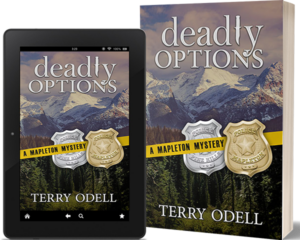
Deadly Production by Terry OdellMy gift to you: Enjoy a free download of Deadly Production, Book 4 in my Mapleton Mystery series. You can find your gift at Book Funnel. You can download an epub, mobi, or PDF file. If you have trouble, the wonderful folks at BookFunnel will be happy to help. (Download deadline is December 18th.)

Have a wonderful and safe holiday season.


Heather's ChaseMy new Mystery Romance, Heather’s Chase, is available at most e-book channels. and and in print from Amazon.

Terry Odell is an award-winning author of Mystery and Romantic Suspense, although she prefers to think of them all as “Mysteries with Relationships.” Follow her on Facebook and Twitter.


Reader Friday – Comfort Zones

Reader Friday – Comfort Zones

Comfort ZonesMost of us will admit that 2020 has had plenty of added stress. We all have different ways of coping. Hiking, reading, meditating. I discovered my stress reliever turned out to be watching the Great British Baking Show. Even though I can’t understand half of what they’re saying, there was something about the show that pulled me away from my real world, which is surprising, since baking is a whole different game at 9100 feet!

What’s your comfort activity? Did it change in 2020?

That’s That

That’s That
Terry Odell

First, for those of you who celebrate Thanksgiving, this year presents special challenges. I wish all of you a safe and sensible holiday.

That's ThatAh, those overused words. Little ones. Almost invisible ones. Ones we take for granted. One of my critique partners pays her editors by the word, so getting rid of unnecessary words is high on her priority list.

One word that creeps into our prose is “that.” An obvious reason is that there are different ways it can be used (you’ll notice I used it in this sentence). That can be a pronoun, an adjective, an adverb, or a conjunction. It’s the pronoun usage that can cause problems (and there’s another that!). When I finished the first draft of one of my Mapleton novels, I found 902 instance of that. And yes, I did look at each one to see how it was used, and if it was needed. Here’s one example of a before and after:

The mayor interrupted. “I’ve assured Marianna that you will provide traffic and crowd control for any of her shooting. In return, she’s assured me that there will be as little disruption as possible to the normal, everyday routines of the citizens of our city.”

The way McKenna said city belied that Mapleton was hardly more than a small town. But one thing Gordon had learned was that regardless of the political head of the city, it was all about revenue. He imagined that some heavy-duty discussion of financial arrangements had already taken place, and that his life was about to become much more complicated.

Here’s the version after I went through zapping that:

The mayor interrupted. “I’ve assured Marianna you will provide traffic and crowd control for any of her shooting. In return, she’s assured me there will be as little disruption as possible to the normal, everyday routines of the citizens of our city.”

The way McKenna said city belied that Mapleton was hardly more than a small town. But one thing Gordon had learned was that regardless of the political head of the city, it was all about revenue. He imagined heavy-duty discussions of financial arrangements had already taken place, and his life was about to become much more complicated.

In my editing pass, I eliminated 4 of the 6 usages in those two paragraphs. Rule of thumb is to read the sentence with and without the that. Is the meaning as clear without it? Could I have deleted the remaining two? Maybe. My editor hasn’t seen this yet, and she might decide they can go as well. Or, maybe she’ll put some back. The rules here aren’t cut and dried.

Here’s another sentence where I kept the that.

We’ve found that locals are generally receptive to appearing as background characters, and property owners are well-compensated for any disruptions to their lives or livelihoods.”

When reading it without that, it’s easy to read it as finding locals, as if they were lost. When you read the rest of the sentence, you have to readjust your thinking, and you don’t want to slow a reader down.

Here’s another place where that helps clarify:

Gordon didn’t have the heart to tell Angie that Cassidy Clarke had little, if any, authority in deciding where scenes would be shot and who would be in them.

Without the that, it would read Gordon didn’t have the heart to tell Angie Cassidy, and with the names Angie and Cassidy Clark right next to each other, a reader might be confused and have to read the sentence twice.

The goal of an author is to keep the reader engaged in the story. Anything that pulls the reader away while they figure out what that sentence really means should be avoided.

But there’s another use of that I’ve seen lately that goes against everything I was taught in school, and I’ve been seeing it in books published by major publishing houses, and written by best-selling authors.

I was taught that for things and who for people. Now, admittedly, it can get tricky with nouns that don’t refer to specific people, but in my head, if that noun is made up of people, then you use who, not that. Examples: doctors, police officers, teachers, etc.

Here are a few examples from recent reads:

  • But maybe you’ve seen strange people around. You know, shady characters that might be involved.
  • I thought it was the girl’s father that was the real worry.
  • Older guys that we know.
  • Are you an author that has more than one book in a series?

And, what about this one?

I know rules can change, so I sent my editor a couple examples and asked her whether I was somehow behind the times.

Here’s what she said:

I’m not surprised that the books were published with “that” in the sentence. It’s becoming more and more common. A lot of authors don’t use “who” when they should. I think it may be partly because of today’s current English language and the way we talk today, and how authors write their stories. “That” is familiar. It’s a passive word and is overly used in most writing, so it’s a comfortable word. “Who” on the other hand is becoming a more formal choice, so it’s not used as often.

In 90% of the manuscripts I work on, “that” is used in similar examples in the original unedited version of the manuscripts. Is it the right thing to do? No, “who” is the correct choice. Unfortunately, or fortunately, depending on your perspective, I don’t think many readers notice the “that” versus “who” issues, so what happens is “that” becomes transparent within the manuscript in these types of examples whereas “who” sometimes stands out more in the sentence, making it less transparent and possibly “stopping” the reader in their read.

What’s your take? Does something like “John was a man that loved to fish” bother you? Do you even notice? Is this another gray area of grammar?


Heather's ChaseMy new Mystery Romance, Heather’s Chase, is available at most e-book channels. and and in print from Amazon.

Terry Odell is an award-winning author of Mystery and Romantic Suspense, although she prefers to think of them all as “Mysteries with Relationships.” Follow her on Facebook and Twitter.
What Winnie the Pooh Taught Me About Writing

What Winnie the Pooh Taught Me About Writing
Terry Odell

First, on this Veterans Day, a thank you to all who have served.

Winnie the Pooh and WritingWhen I was a child, my dad would read Winnie the Pooh (the REAL one, not the Disney version) to me and my brother. I loved his voices (Years later, when an old movie was playing on the television, I heard Eeyore’s voice. I ran out to look and it was a W.C. Fields movie. I didn’t know my dad had been doing “real” voices when he read—but I digress.)

Another thing I remember from my dad’s reading was the way he began each chapter in a Very Important Voice. And the way each chapter was titled, “In Which…” followed by a few words telling us what the chapter was about.

Winnie the Pooh and Writing

(Kind of like “circles and arrows and a paragraph on the back of each one…” but I digress again.)

Although I certainly don’t title my chapters, the “In Which” approach helps make sure I’m putting something on the page that belongs there.

Too often, it’s easy to get carried away with description, or dumping in some back story, or including that “wonderful” scene that came to you when you overheard a conversation at the coffee shop, or salon, or when you were people watching and saw someone who just had to be in the book. So you write it, and it’s wonderful, and you’ve captured the moments perfectly. But is it moving the story. Is it something worthy of including in your “in which” summary of the scene.

Because you should be summarizing the scenes, either before or after you write them. And there need to be plot points (which is the official writerly term for “in which”). You’ll notice I used the plural. A scene had better be carrying more than one. While there’s no rule, and no exact number, I’d recommend shooting for three. Scene length, of course, can cause variations, but whatever happens in that scene needs to relate to the story.

Which brings me to kinds of scenes. Here’s a quick summary, gleaned from a RWA workshop, although most will carry over to any genre.

  • Prologue – not required. In fact, unless there’s a huge time gap between this and the opening, it should probably be Chapter One. There’s also a difference of opinion as to whether agents want to see prologues when you’re submitting.
  • Opening – should draw the reader in.
  • Set-up  — foreshadows something to come
  • Validation – shows the character at work
  • Conflict
  • Push – moves characters apart
  • Pull – moves characters closer together
  • Reaction – also referred to as “sequel” (or shower scene, where the character would reflect on what just happened). These can slow the pace, so they’re falling out of favor. If you need one, make sure it’s important, and don’t linger too long.
  • Flashback – use sparingly – they’re often found in reaction scenes
  • Flash forward—rarely used in romance; author intrusion. Tends to be omniscient POV, which can intrude as well.
  • Reversal/Black moment – everything goes wrong
  • Climax – characters must make choices
  • Conclusions – wrap up those dangling threads
  • Epilogue – not required. Common in romance (although I’m not fond of them, personally)

Do you ever find scenes in books you’re reading, even very well-written scenes, that leave you wondering what they’re doing there? Have you found them while writing your own books?


Heather's ChaseMy new Mystery Romance, Heather’s Chase, is available at most e-book channels. and and in print from Amazon.

Terry Odell is an award-winning author of Mystery and Romantic Suspense, although she prefers to think of them all as “Mysteries with Relationships.” Follow her on Facebook and Twitter.

Tips for Distant Settings

Things I’ve learned about setting a book in real places, especially distant ones.

Distant SettingsWhen the Hubster and I decided to celebrate our 50th anniversary with a trip to the British Isles, of course I had “book” in the back of my mind. However, an international setting wouldn’t have worked with any of my existing series, and since I never plot in advance, I decided to enjoy our tour, taking pictures and notes of what we were seeing and doing and just wait and see what might bubble to the surface.

Distant SettingsOur trip began in Northern Ireland with a visit to our daughter, who had pointed out that she moved there 12 years ago and we’d never visited. From there, we had a couple days in London where I got to meet one of my critique partners face to face for the first time. Given we’d been in our little group for about 15 years, that was another “it’s about time” moment.

From there, we visited Scotland, and then Ireland. When we got home, I decided I’d write a short and sweet romance. Write it quickly, understanding that it’s not my true “brand” but that I had to publish something to justify writing off at least part of the trip.

Well, I soon discovered I’m not a short and sweet romance author, and mystery elements insisted on working their way into the story. What I ended up with is Heather’s Chase: an International Mystery Romance which is closer to my brand, although it’s a stand alone and still a bit of a one off. Nevertheless, it was an educational experience.

My Tips

Distant SettingsLess is more. My first drafts went into phenomenal detail about absolutely everything. Airports. Train stations. Hotels. Food. All the places we stopped, what we saw on the drives. Given we were traveling for well over two weeks, that would have been a LONG book. A sense of place is good. Overwhelming readers is not. I had to keep reminding myself to make sure everything related to the plot and characters. I wasn’t writing a travelogue.

Stay true to time. Readers familiar with the area will know that you can’t get from A to B in two hours, or that when you’ve had your characters on their bus for five hours, it’s really a twenty-minute drive.

Distant SettingsYou’ll always miss something. Unless you’ve got your plot mapped out before your trip, once  you start writing, you’ll have a scene to write and—lo and behold—you missed taking a picture, or didn’t take the right notes. I spent a LOT of time on the internet rechecking facts, looking at maps, and refamiliarizing myself with some of the attractions we visited. If I couldn’t find exactly what I needed, I reminded myself I was writing fiction—another reason not to name real places. On the occasions where my characters were eating in real, named places, I made sure I had pictures and menus. Same for attractions.

Distant SettingsDon’t make up real stuff. One of the reasons I made this book a stand alone was because our trip didn’t include visits to police departments (although I snapped a picture of a vehicle in Ireland, “just in case”). Also, it would be unrealistic for my American characters to have any access to law enforcement in several different countries.

Be nice. I also opted not to name the specific hotels or restaurants (mostly). For one thing, it gave me the freedom to change the décor, layout, amenities, or the restaurant menus. And, if something “bad” happened, I wasn’t going to incur the wrath of those establishments.

It’s about flavor. Although my characters didn’t visit Northern Ireland, I did include a character from the same town we’d visited when we stayed with my daughter. I made sure she vetted all his dialogue. For example, people in Northern Ireland use the word “wee” as a meaningless adjective. I was asked for my wee credit card, given a wee receipt, offered a wee bag for my purchases. My British critique partner was very helpful with vocabulary as well.

All in all, I had a great time ‘revisiting’ my trip to the British Isles while I was writing the book, and being able to incorporate my experiences into Heather’s Chase.

Want to see more pictures? Click on the book cover below, then scroll down to “Special Features.”


Heather's ChaseMy  Mystery Romance, Heather’s Chase, is  available at most e-book channels. and in print from Amazon.

Terry Odell is an award-winning author of Mystery and Romantic Suspense, although she prefers to think of them all as “Mysteries with Relationships.” Follow her on Facebook and Twitter.

Using Apostrophes

Using Apostrophes
Terry Odell

apostrophesA pet peeve of mine is incorrect apostrophe usage, something I see all the time while driving around, or scrolling the internet. I’m sure everyone here at TKZ is well aware of the rules, but just in case someone needs a refresher course, I thought I’d mention it. If you’re starting out, or get confused, I hope this helps.

Use 1. It shows possession. Something belongs to someone or something.

The man’s hat. The dog’s leash. My biggest trouble-spot with this is dealing with plurals. There’s a difference (as my crit partner loves to point out) between the Detective’s office and the Detectives’ office. But then, I can never remember if I’ve given each of my detectives his own office.

I also have to stop and think about housing. You know, like when you go to the house that belongs to Mr. and Mrs. Smith. Since it belongs to both of them, it’s the Smiths’ house, not the Smith’s house. Our neighbors across the street have a lovely carved sign that says “The Cochran’s.” I cringe every time I walk by.

Words that already end in “s” can be a problem. I go out of my way to avoid naming characters with names ending in “s” to bypass the head-scratching. And here, I’ve seen it both ways. In my first book, my editor, whom I fear was overworked, didn’t catch that I’d written both Doris’ and Doris’s throughout the manuscript. Luckily, I noticed it in edits. She really didn’t care which one I used as long as they were all the same. My inclination is to leave off the final ‘s’ after the apostrophe simply because it looks cumbersome and when I read it “aloud in my head” I keep added “s” sounds.

Okay, that’s one use of the apostrophe. The other:

Use 2. Replaces other stuff.
apostrophes

Apostrophes are used in contractions to show you’ve combined two words and taken away some of the letters.

Examples: Don’t. I’ve. Shouldn’t. He’d. We’ll.

I taught apostrophes when I was tutoring in adult literacy. It was very common for students to see the word don’t and read it aloud as do not. They knew what the apostrophe meant even if they couldn’t use one when writing.

Use 3. THERE IS NO USE THREE

You CANNOT use an apostrophe to create a plural.

One last point:

apostrophesA major hangup for people seems to be with its and it’s. I know it’s very easy to have the fingers outpace the brain, and first-draft typos are common, but if you remember it’s = it is, you’ll be fine. The apostrophe stands for a missing letter.

Which means its is possessive, which is the exception to Rule 1.  The tree lost its leaves. The leaves belonged to the tree.

The only other ‘exception’ I can think of is one I discussed with my editor (not the one who missed my Doris inconsistencies). My characters can mind their Ps and Qs. But when it comes to dotting I’s , she prefers the apostrophe because it avoids the confusion with the word Is. And, for consistency, she included the apostrophe with crossing T’s. So, it’s dotting I’s and crossing T’s. The caps, I think, are a matter of preference.

But PLEASE. Don’t kill any more puppies!

One more hint, related to formatting:

There’s a difference between an apostrophe and a single quotation mark. Trust me.

If you’re using Word, when you want to start a word with an apostrophe because it’s a contraction, abbreviation, as when you’re using dialect, Word assumes that you want a single quote there, because that’s how the program works.

Thus, if your character uses em for them you’re going to get ‘em. What you want is ’em. There are codes, or keystrokes for getting that apostrophe instead of the single quote, but I’m lazy and forgetful, so I just copy an apostrophe from another word and paste it where it needs to be.

To find them, you can search on a space before a single quote/apostrophe, and that should bring them up.

I’m sure you have some apostrophe observations to share. The floor is yours.

Heather's ChaseMy new Mystery Romance, Heather’s Chase, is now available at most e-book channels. and in print from Amazon.

Terry Odell is an award-winning author of Mystery and Romantic Suspense, although she prefers to think of them all as “Mysteries with Relationships.” Follow her on Facebook and Twitter.

Mixed Up Words

Mixed Up Words
Terry Odell

Judging from some recent posts, it’s looking like we all need a break from what’s happening around us. I thought I’d follow in the footsteps of Debbie’s mondegreens, Elaine’s eggcorns, and and JSB’s bloopers with a little more fun with words—although I’m sure they weren’t fun for the authors who made the mistakes.

These errors are from the spectrum of publishing—from indie to major publishing house authors. Whether or not some of these were typos on the part of the author and missed in editing, or whether the author didn’t know the correct word doesn’t really matter. However, given editorial passes these days are often far fewer than in the past, it behooves the author to get as much right as possible, and not hope an editor will find and fix errors. Sometimes it’s the little things that get overlooked, such as a NYT best-selling author having “That to” instead of “That, too.” (and there are different house style for the comma, but that’s not the error.)

Below are examples. Spellcheck wouldn’t have flagged any of them. Do you recognize these vocabulary errors? I’m sure you do. Why didn’t the editors?

  1. Rowdy little hoard
  2. His jacket was pealed back
  3. The car pealed away from the curb
  4. He’s cooling his heals in the lockup
  5. A single star shown brighter than any other
  6. The plain of his abdomen
  7. Ran her fingers down his chest toward his naval
  8. The bullet had come to rest against the seventh vertebrae
  9. Emerged like a breach birth
  10. “You saved his life today. He’ll probably give you an accommodation or something.”
  11. “The state trooper gave the children law enforcement’s universal anecdote: orange juice and candy bars.”
  12. He was injured trying to diffuse the bomb.
  13. She poured over the pages of the book.
  14. She peddled her bike down the sidewalk
  15. He waited with baited breath.
  16. He knocked on the door jam before entering the room.

And, one I didn’t learn until a reader (not my editor) pointed it out: discrete vs discreet.

What errors have you found in recent reading? The floor is yours.


Heather's ChaseMy new Mystery Romance, Heather’s Chase, is now available at most e-book channels. and in print from Amazon.

Terry Odell is an award-winning author of Mystery and Romantic Suspense, although she prefers to think of them all as “Mysteries with Relationships.” Follow her on Facebook and Twitter.