
Come what may, all bad fortune is to be conquered by endurance. –Virgil
* * *
Writing a novel is often compared to running a marathon, and my experience dealing with the unexpected in the London Marathon in April 2010 was a good rehearsal for my later efforts in writing.
I’ve never been a good marathon runner. I’m better suited for the half-marathon. But in 2009, having completed three marathons (San Antonio, Vancouver, and Toronto), I decided I’d go for just one more. And I wanted to run one of the big marathons for that once-in-a-lifetime experience.
I told my husband I’d like to celebrate our anniversary in 2010 with a trip to the UK where I would run the London Marathon in honor of our marriage. Then we could spend a week or so vacationing. Frank was supportive, and for some unknown reason, I was convinced everything would go my way.
Hmm.
The major marathons are so popular that they can’t admit everyone who wants to enter. If you’re a very good runner and can meet the qualifying time for your age group, you’ll be entered. But if you’re like most runners (me, for instance) and can’t meet the qualifying time, they’ll put your name into a lottery and it’s just a matter of chance.
So when they opened the online registration in April 2009, I jumped in and registered along with 150,000 other runners. Although only about a quarter of those would get places, I was ridiculously confident. Around October, I received an email from the London Marathon notifying me that I wasn’t chosen. Rats.
But they held out another possibility. I could run for a charity. “That’s even better,” I thought. I could do a good deed as well as run the marathon. So I applied to several of the charities that I thought I’d like to support, and a few weeks later, one of them called. With about four months to go, I had cleared the first hurdle. I was in the race.
I was sure that from then on everything would be smooth sailing. (You can smile now.)
My running buddies at work were all excited that I was going to run the London, and that made me even more determined to do well. When they asked what kind of time I was planning on, I spouted off a near-impossible-for-me number. But if everything went perfectly, maybe I could make it.
Everything did not go perfectly.
- Our treadmill, on which I was doing almost half of my training, broke. We needed a new one anyway, so we bought a bigger, better model. A few days of training lost.
- I injured my knee in a tempo run. A couple of weeks of training lost.
I had stumbled over those first hurdles, but my excitement continued to ramp up as the days ticked closer to the race. Since I suffer from jetlag on international trips, we planned to fly to London six days prior to the marathon to allow my body to adjust to the time change before the race. But then…disaster.

- A few days before our scheduled departure, I woke up to the news that a volcano in Iceland had erupted, volcanic ash was drifting over western Europe, and airports were closing. Heathrow was one of them. Our flight was cancelled.
You can overcome a lot of obstacles. But a volcano? Time to throw in the towel.
But then the winds shifted, and airports reopened. We managed to get on a flight that put us in London in the early morning hours of Friday before Sunday’s race day. Okay, so my jetlag would be a problem, but the excitement of the race would probably overcome that. (Are you laughing yet?)
I dragged myself out of bed on race day after just a few hours of sleep to discover there were more obstacles: the weather was warm (not good) and it was drizzling rain (super not good). Frank and I agreed on where we’d meet after the race, and he walked me to the starting area to join the other thirty-seven thousand people who had paid perfectly good money to punish their bodies for 26.2 miles.
But at least I had made it to the starting line. Now all I had to do was finish.
The London Marathon is unique. It’s a big party, and many of the marathoners wear costumes. One guy was dressed in a full suit of armor and someone else was carrying a huge replica of the Angel of the North sculpture on his back.
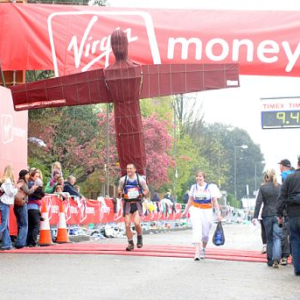
As time ticked down to the start, you could feel the buzz in the air. After an entire year of waiting, hoping, training, and planning, the starter’s pistol fired, and we were off.
I wish I could say everything went well.
- For the first time ever, my GPS watch malfunctioned. Bad omen.
- Another first: I got a side stitch. At least now I can describe in a book what it feels like to be stabbed just below the ribs.
- As the miles went on, fatigue set in, and I realized I was getting a blister on one of my heels.
- By the time I got to the eighteen-mile mark, I was starving. I guess the time change had messed up my body clock. Honestly, if I had seen a child holding a sandwich by the side of the course, I probably would have snatched it out of the kid’s hand and run away before anyone could catch me. But there were no sandwiches, my back and foot hurt, and I was run-walking so slow that I knew I was going to turn in a terrible time.
* * *
That’s when I had THE THOUGHT. I could quit. I could just step off the course, find a volunteer to give me a cart-ride to the finish, and it would be over. I wouldn’t suffer the embarrassment of a poor showing. I’d just tell everybody I was injured and couldn’t finish. I could bandage my foot and take an Advil and eat a steak dinner and forget this stupid marathon. The whole thing was wrong from the start. Why hadn’t I seen that? Why did I have to be so stubborn when there were just too many problems to overcome?
That little exercise in self-pity and frustration got me through the next mile or two. Then I had the SECOND THOUGHT. I would cross the finish line even if I had to crawl. Even if I was the last person across. Even if they had taken down the banners and all the volunteers had gone home and I didn’t get a medal or a T-shirt. Even if my feet were bleeding so profusely that I was leaving a trail of blood behind me on the course. (Self-martyrdom can be useful in certain situations.)
And I knew no matter how long it took, Frank would be waiting for me, and I knew exactly what he’d say when he saw me. After all, this was the race to honor our marriage, not to show off my great (ha!) running talent.
Those reflections got me through another mile or two, and then I was within just a few miles of the finish, so it didn’t make sense to quit.

I crossed the finish line. I didn’t crawl, and I wasn’t the last person in the race. There were still a couple of thousand people behind me, including angel sculpture man and the guy in the suit of armor. A volunteer hung a medal around my neck and someone else handed me a T-shirt that said “LonDONE 25.04.10.” Then I walked into the meeting area and saw Frank waving. As I limped toward him with my hair frizzy from the rain and my clothes damp with sweat, he jogged over and put his arm around me. “Great race, honey.”
* * *
So yeah. Writing a novel, especially a first one, is a lot like running a marathon. You start out with all this enthusiasm and confidence, but then things get hard, much harder than you thought. There are unexpected challenges, and it’s discouraging when agents and publishers don’t immediately see your genius and rush to sign you to a life-long contract.
That’s when many people give up. They hit the wall and decide it’s not worth all the pain and disappointment. According to selfpublishingus.com, only about 3% of people who start writing a book actually finish it. And of those, even fewer have their book published. But for those of us who stay in the race, there’s a satisfaction of accomplishment few have known.
I learned some lessons from the London Marathon that I believe apply to my writing.
- Life (and running and writing) is more about what you put into it than what you get out.
- It’s more about fighting the good fight than winning.
- It’s more about the journey than the destination.
- You value what you earn more than what someone gives you.
And in the long run (pun intended), whether it’s running or writing or living, endurance is more important than talent.
* * *

This has been a very long TKZ blog post, and if you made it to the end, you deserve a medal. Maybe you should consider running a marathon.
* * *
So TKZers: Have you ever run a marathon?
Have you faced obstacles when writing your books?
How do you deal with the setbacks?
* * *

Kathryn Frasier is training for her first marathon, but murderers keep getting in her way.
Run with Kathryn in The Watch Mysteries. The ebook boxset is on sale at Amazon, Barnes & Noble, Kobo, Google Play, or Apple Books.

 The title of this post is not a play on words. As I might’ve mentioned a time or two, we can learn a lot from animals.





 Becca Puglisi is an international speaker, writing coach, and bestselling author of The Emotion Thesaurus and other resources for writers. Her books have sold over 1 million copies and are available in multiple languages, are sourced by US universities, and are used by novelists, screenwriters, editors, and psychologists around the world.


 Villains are always useful in helping protagonists overcome their shortcomings and face down danger. An example of this was the film “Die Hard” where the protagonist John McClane (Bruce Willis) matches wits with the villainous deuteragonist Hans Gruber (Alan Rickman.)