 If you could relive your writing life from day one, would you change anything?
What might you do differently?
What might you do the same?
And why?

 Picture this. You’re in the zone rockin’ the WIP, the words flowing from your fingertips faster than you can type. And then . . . splat. You’ve hit a brick wall. That special character or symbol isn’t on your keyboard.
Sound familiar?
So now, you need to stop, go to Insert, then to Advanced Symbols and scroll through the list to find that pain-in-the-butt character. You could leave yourself a note in the manuscript to deal with it later and continue on, but wouldn’t a keyboard shortcut make life easier?
With that in mind, I offer the following . . .
SYMBOLS & SPECIAL CHARACTERS
Please note: these shortcuts can be used on the web or in Word by using the numbers on the top row of your keyboard. If you use your numbers keypad, you may get different results.
ALT + 1 = ¡
ALT + 2 = ™
ALT + 3 = £
ALT + 4 = ¢
ALT + 5 = ∞
ALT + 6 = §
ALT + 7 = ¶
ALT + 8 = •
ALT + 9 = ª
ALT + q = œ
ALT + SHFT + Q = Œ
ALT + w = ∑
ALT + SHFT + W = „
ALT + e = ´
ALT + r = ®
ALT + SHFT + R = ‰
ALT + t = †
ALT + SHFT + T = ˇ
ALT + y = ¥
ALT + SHFT + Y = Á
ALT + u = ¨
ALT + i = ˆ
ALT + o = ø
ALT + SHFT + O = Ø
ALT + p = π
ALT + SHFT + P = ∏
ALT + a = å
ALT + SHFT + A = Å
ALT + s = ß
ALT + SHFT + S = Í
ALT + d = ∂
ALT + SHFT + D = Î
ALT + f = ƒ
ALT + SHFT + F = Ï
ALT + g = ©
ALT + SHFT + G = ˝
ALT + h = ˙
ALT + SHFT + H = Ó
ALT + j = ∆
ALT + SHFT + J = Ô
ALT + k = ˚ (degree)
ALT + SHFT + K = Ó
ALT + l = ¬
ALT + SHFT + L = Ò
ALT + ; = … (to create ellipsis you can also press CTRL + ALT + .)
ALT + SHFT + : = Ú
ALT + “ = Æ
ALT + ‘ = æ
ALT + z = Ω
ALT + SHFT + Z = ¸
ALT + x = ≈
ALT + SHFT + X = ˛
ALT + c = ç
ALT + SHFT + C = Ç
ALT + v = √ (square root)
ALT + SHFT + V = ◊
ALT + b = ∫
ALT + SHFT + B = ı
ALT + n = ˜
ALT + m = µ
ALT + SHFT + M = Â
ALT + , = ≤
ALT + SHFT + < = ¯
ALT + . = ≥
ALT + SHFT + > = ˘
ALT + / = ÷
ALT + SHFT + ? = ¿
COMMON SHORTCUTS
On my keyboard “Command” equals the “WIN” key—I use a Windows keyboard on a Mac—but yours might be CTRL or COMMAND (Mac users) depending on the keyboard type.
<Command> + C = Copy
<Command> + X = Cut
<Command> + V = Paste
<Command> + Q = Quit
<Command> + W = Close File or Window
<Command> + N = Open New file
<Command> + O = Open Existing file
<Command> + S = Save
<Command> + P = Print
<Command> + F = Find a word or phrase on web pages or in Word. If the word or phrase appears more than once, press ENTER to move to the next instance.
<Command> + Z = Undo Action (To redo the action, press <Command> + Y)
<Command> + A = Select All
<Command> + B = Bold (To stop bold, repeat command)
<Command> + I = Italics (To stop italics, repeat command)
<Command> + U = Underline (To stop underline, repeat command)
<Command> + T = Open New Browser
<Command> + D = Bookmark Page
<Command> + B = View Bookmarks
WORDPRESS SHORTCUTS
Most of the above commands also work on WordPress. Here’s a few extras exclusive to WordPress …
<Command> + 1 = Heading 1
<Command> + 2 = Heading 2
<Command> + 3 = Heading 3
<Command> + 4 = Heading 4
<Command> + 5 = Heading 5
<Command> + 6 = Heading 6
<Command> + 9 = Address
ALT + SHFT + n = Check Spelling
ALT + SHFT + j = Justify Text
ALT + SHFT + d = Strikethrough
ALT + SHFT + u = Bullet List
ALT + SHFT + o = Numbered List
ALT + SHFT + q = Quote
ALT + SHFT + w = Distraction Free Writing Mode
ALT + SHFT + p = Insert Page Break Tag
ALT + SHFT + l = Align Left
ALT + SHFT + c = Align Center
ALT + SHFT + r = Align Right
ALT + SHFT + a = Insert Link
ALT + SHFT + s = Remove Link
ALT + SHFT + m = Insert Image
ALT + SHFT + t = Insert More Tag
ALT + SHFT + h = Help
Most social media sites offer their own shortcuts in the help menu. YouTube, however, offers several cool hacks to save time.
YOUTUBE SHORTCUTS
Press 1 = jump ahead 10% through the video.
Press 3 = jump ahead 30%
Press 4 = jump ahead 40%
Press 5 = jump ahead 50%
And so on.
Press 0 = restarts the video
Spacebar = pause/un-pause video
← Go back 5 seconds
→ Go forward 5 seconds
↑ Raise volume
↓ Decrease volume
F = Fullscreen
ESC = Exit Fullscreen
MISC.
CTRL+ALT+DEL = Quit Frozen Application. This command opens the Task Manager. Select the application that stopped working and press END TASK.
Do you have a favorite shortcut that you use regularly? Please share!
Want to have a little fun? Include a special character in your comment. ♠♣♥♦ If it’s not listed above, be sure to tell us how you created it.
I invited my buddy, Garry Rodgers, back to TKZ for a fascinating behind-the-scenes trip to the morgue. He’ll hang around for questions/comments, so don’t be shy. Now’s your chance to ask an expert something you might need for your WIP. Enjoy!
Most living people never visit the morgue.
Most never think of the morgue except when watching TV shows like CSI or some new Netflix forensic special. The screen may show in hi-def and tell in surround sound, but it can’t broadcast smell. That’s a good thing because no one would tune in and the actors would be looking for real-life morgue jobs like homicide cops, coroners and forensic pathologists.
I did two of those real-life morgue jobs for a long time. I’m a retired murder cop and field coroner who spent a lot of hours in that windowless place. Now, I’m a crime writer and thought I’d share a bit of what really goes on in the morgue with my crime-writing colleagues.
The morgue is strictly off-limits for anyone not having a specific reason to be there. That’s for a few reasons. One is the place can hold sensitive court evidence. Two is that it’s a somewhat disagreeable place due to the odor, temperature and the continual chance of contracting a contagious disease. The third reason is dignity. Even though the majority of the morgue occupants are no longer alive, they’re still human entities and not some sort of a morbid exhibit.
The morgue is a place of business. It’s a medical environment where the deceased are stored, processed and released to their final disposition. The morgue operates 24/7/365 as death pays no attention to the clock or the calendar. But, the morgue is busiest between 8:00 am and 4:30 pm Monday to Friday—holidays exempted. Morgue workers need time off like anyone else.
A city morgue, like I worked at in Vancouver, British Columbia, is an active environment. It has a dedicated shipping and receiving area with a loading dock much like a typical warehouse. Bodies arrive by black-paneled coroner vans or on sheet-covered gurneys brought down from the wards. They’re booked into a ledger, assigned a crypt and, yes, marked with a personalized toe tag.
Vancouver General Hospital’s morgue is like Costco for the dead. Stainless steel refrigeration crypts, stacked three-high in two rows of nine, have shelving for fifty-four. The freezer unit stores eight and isolation, for the stinkers, can take six sealed aluminum caskets or “tanks” as we called them. These tanks are also used for homicide cases, locked to preserve forensic evidence.
A grindy overhead hoist shifts cadavers from wheeled gurneys that squeak about fluorescent-lit rooms, touring them to and from roll-out metal drawers. Refrigeration temperatures are ideally set at 38-degrees Fahrenheit (4-degrees Celsius) while the ambient range in the autopsy suites is held at a comfortable 65 / 18. The storage rooms, laboratory and administration areas are normal office temperature, and they’re set apart from the main morgue region. Support staff, for the most part, have no sense of being so near to the dead.
Operational personnel in the morgue are highly-trained professionals. The workhorse of the morgue is the autopsy technician or attendant called the “Diener”. It’s a term originating from German that translates to “Servant of the Necromancer”. Dieners have the primary corpse handling and general dissection responsibility. They do most of the cutting.
Hospital pathologists are primarily disease specialists. They spend the majority of their day in the laboratory peering into microscopes and dictating reports. It’s a rare general pathologist who stays with an autopsy procedure from incision to sew-up. Usually, hospital pathologists come down to the morgue once the diener has removed the organs and has them ready for cross-section.
A hospital pathologist takes a good look for what might be the anatomical cause of a sudden or unexplained death. The main culprits are usually myocardial infarctions, or “jammers” as they called in the heart attack word. Aneurisms are another leading cause of dropping dead, and they’re often found in the brain.
Hospital pathologists sometimes do partial autopsies when they want to confirm an antemortem diagnosis. That might be a certain tumor or the extended effects of a runaway respiratory disease like Covid19. Sometimes, there’s no clear cause of death such as in a heart arrhythmia or a case of toxic shock.
Forensic pathologists are an entirely different animal. These are meticulous medical examiners with a tedious touch. It takes years of specialized training and understudy to become a board-certified forensic pathologist qualified to give expert evidence in criminal cases.
Forensic autopsies are peak-of-the-apex procedures inside the morgue. In a setting like Vancouver General Hospital (VGH), there are six autopsy stations in one open room. At any given time, the slabs are occupied and there more in the pipe. Not so with a forensic procedure.
There are two segregated and dedicated suites for forensic autopsies at VGH. Protection of the corpse, which is the best evidence in homicide cases, is paramount. So is maintaining continuity of possession, or the chain of evidence, that ends up in court. In a forensic autopsy, there’s utmost care to ensure the body is not compromised by contaminating it with foreign matter like DNA or losing critical components like bullets or blades.
In a homicide case, the body is taken from the crime scene in a sterilized shroud and locked in a tank. There’s an officer or coroner appointed to maintain continuity from the time the cadaver is bagged until the corpse is laid out on the slab. This is a critical element in forensic cases and one that is treated as gospel.
A forensic pathologist stays with the autopsy from the time the body is unlocked from its tank till the time the pathologist feels there is no more evidentiary value to glean. This is usually a full-day event but sometimes the body is put back in the tank, held overnight, and the process goes on the next day. This completely depends on the case nature such as multiple gunshot or knife wounds.
There are police officers at every forensic autopsy. Those are the crime scene examiners who photograph the procedure and pertinent physical properties. Detectives receive evidentiary exhibits like foreign objects such as fired bullets or organic particulates. There might be semen samples or other questionable biological matter. Then, there are usual suspects for toxicology examination like blood, urine, bile, stomach contents and vitreous fluid.
Radiography is done in almost all forensic autopsy cases. A portable X-ray machine scans the body as it lies on the table. In some situations, MRI / CT technology is helpful.
But, nothing beats the eye and experience of a seasoned forensic pathologist. They observe the slightest details that even a general pathologist would miss. However, don’t dismiss what a good diener can spot. It’s a treat to watch a forensic pathologist and a diener work when they’re in synch.
At day’s end, folks in the morgue are much like anyone else. They have a market to serve and they do it well. They’re also prone to talk shop in a social setting. There’s nothing like having drinks with a diener who’s into black humor.
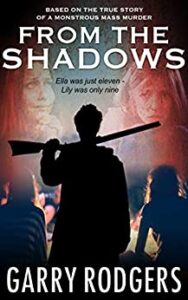
What if six members—three generations—of your family were slain in a monstrous mass murder?
FROM THE SHADOWS is part of Garry’s “Based on True Crime” series. Available on Amazon and Kobo.
I couldn’t write a piece about what really goes on in the morgue without a few war stories. In my time as a cop and a coroner, I’ve been around hundreds of cadaver clients. Maybe more like thousands, but I never kept track. There were a few, though, that I’ll never forget.
One was “Mister Red Pepper Paste Man”. My friend Elvira Esikanian, a seasoned forensic pathologist of Bosnian descent who cut her teeth by exhuming mass graves, is a gem. She also has a wicked eye for detail.
I brought this old guy into the morgue after finding him dead in his apartment. Neighbors reported him screaming like someone was skinning a live cat. They rushed in and found him collapsed on the floor. No idea what killed him, but no sign of foul play.
Elvira opened his stomach and it was positively crawling. She knew what it was—botulism. Elvira told me to go back to the scene and look to see what he’d been eating. I found it. It was a jar of red pepper paste that was years past its expiry date, and the inside was a mass of organic activity.
Then, there was Kenny Fenton. He was found dead after being dumped beside a rural road and left to rot for a week in hot weather. I brought him into the morgue as intact as possible but it wasn’t easy. Kenny went into a stinker tank before Dr. Charlesworth could take him on.
As a routine, Kenny had a radiography session before his dissection. It showed a bullet in his gut. Not a run-of-the-mill bullet, of course. It was a .22 short with no rifling engraved on its sides.
Turns out, Kenny was accidentally shot in the neck by a Derringer dueling pistol. The bullet cut his carotid, hit his spinal cord, bounced back to his esophagus and he swallowed the dammed thing before bleeding out and dying fast. The crew he was with thought it was better to dump Kenny than report it.
And I can’t wrap up without a bit of spring foolishness that went on in the morgue. It involved my buddy—Dave the Diener.
Dave had about thirty years in the crypt before he met me. In fact, Dave had something to do with me getting hired by the coroner’s office because he thought I might be a good fit. Dave may, or may not, have been right.
It was the First of April and a Friday morning. Dave liked Fridays because he usually left early once his cutting was done. I don’t think there’s anything wrong with that, and I’ve done it myself.
But this Friday was different—probably had something to do with the date. I snuck into the morgue real early and prepared Dave’s first case. I needed some weight so he wouldn’t suspect anything off the bat. I put a bunch of concrete patio blocks on the crypt’s drawer base. Then, I placed my cadaver inside a shroud and laid it on top. I even attached a toe tag and made the right entries in the ledger.
I wasn’t there but sure heard from the other staff who were in on it. Dave rolled-out his first subject-for-the-day and unzipped the shroud. Smiling at Dave was the puckering face of a blow-up sex doll.
That’s the kind of stuff that really goes on in the morgue.
 Garry Rodgers has lived the life he writes about. Garry is a retired homicide detective and forensic coroner who also served as a sniper on British SAS-trained Emergency Response Teams. Today, he’s an investigative crime writer and successful author with a popular blog at DyingWords.net as well as the HuffPost.
Garry Rodgers lives on Vancouver Island in British Columbia at Canada’s west coast where he spends his off-time around the Pacific saltwater. Connect with Garry on Twitter and Facebook and sign up for his bi-monthly blog.
By SUE COLETTA
 It’s fun to see how words change over time. Their meanings transform, expand, and even metamorphose into a whole new meaning. These changes occur gradually over time. I find it fascinating how one word used by our ancestors means something totally different today.
While researching my historical “ladies” (female serial killers) for Pretty Evil New England, I ran across numerous differences in spelling and definitions.
The process of words changing over time is called semantic narrowing, which is a type of semantic change by which the meaning of a word becomes less general or inclusive than its earlier meaning. In other words, any change in meaning(s) of a word over time — also called semantic shift, lexical change, and semantic progression.
Common types of semantic change include bleaching (where the semantics of a word reduces while the grammatical content increases), broadening (when the semantics of a word becomes broader or more inclusive than its earlier meaning), metaphor, and metonymy (a figure of speech or trope in which one word or phrase is substituted for its closely related cousin, such as “crown” for “royalty”).
Semantic change may also occur when foreign speakers adopt English expressions for use in their own social and cultural environment.
“We say that narrowing takes place when a word comes to refer to only part of the original meaning. The history of the word hound in English neatly illustrates this process. The word was originally pronounced hund in English, and it was the generic word for any kind of dog at all. This original meaning is retained, for example, in German, where the word Hund simply means ‘dog.’ Over the centuries, however, the meaning of hund in English has become restricted to just those dogs used to chase game in the hunt, such as beagles…”
“Words may come to be associated with particular contexts, which is another type of narrowing. One example of this is the word indigenous, which when applied to people means especially the inhabitants of a country which has been colonized, not ‘original inhabitants’ more generally.”
— Terry Crowley & Claire Bowen, An Introduction to Historical Linguistics, 4th ed. Oxford University Press, 2010
Etymologically, a hound dog translates to dog dog. 🙂
Another prime example of semantic narrowing is mouse and bookmark. Rather than an animal and a device used in place of a dog-earing a page, these words also refer to a computer mouse and online bookmark.
Where’s the Beef? (A nod to JSB’s post, Storytelling Lessons in 60 Seconds or Less 😉 )
If you were a vegetarian in Anglo-Saxon times, you still ate meat. In Old English the word mete referred to food in general. It wasn’t until the 1300s that the meaning of meat began to narrow to mean animal flesh. Even though meat still refers to the contents of a nut (i.e. almond meat) that’s not the first image that springs to mind.
The original sense of meat survived in sweetmeats, an old term for a type of candied treat.
Girl Power
The word girl (historically written as gurle, grile, and gerle) meant “a child” or “young person” of either sex. Today, of course, girl refers to a young female, though women of all ages use the word to refer to close friends. “Girl, you’re not gonna believe what he did this time.”
Along those same lines, woman comes from the Old English word wīfman, which literally means “wife-man.” I know, ladies. Just let the sexist definition roll off your shoulders. After all, I’m referencing a time when man meant any human.
Strangely enough, wife stems from the Old English word wīf, meaning any “woman, female” instead of today’s meaning: a married woman.
Doe a Deer, a Female Deer
When we think of the word deer, we imagine graceful animals, with or without antlers, who frolic in the woods. The word, however, stems from the Old English word dēor, meaning “beast,” especially a four-legged animal unlike a bird or fish. By the 1400s, deer morphed into its current Bambi-like designation.
Should we strive to be an awful writer?
Don’t answer too quickly. In the 1200s, awful meant “full of awe.” It also meant “inspiring awe” or “reverential.” Later, awful referred to “causing fear and dread,” which contributed to the current meaning of “bad, unpleasant.”
Awesome evolved in the opposite direction, from “inspiring awe” to “great, excellent.” Though in some cases, its original meaning still holds true.
My, What an Egregious Gentleman
Sounds incorrect, doesn’t it? But back in the early 1500s, egregious meant “distinguished” or “eminent.” It comes from the Latin word egregius, meaning “preeminent” with a literal sense of “[standing] out from the flock.”
Naughty Villain
First recorded around 1340-1400, naughty meant “wicked, evil.” It also meant “poor, needy.” Naughty is formed from the Old English naught, meaning “nothing” or “wickedness.” It wasn’t until centuries later that the word transformed to refer to a misbehaving child or an adult engaged in risqué behavior.
Reserved Seating for Vulgar Only
Sometimes semantic narrowing can lead to a negative connotation, a process called pejoration. If I said the word vulgar, you’d immediately think I was referring to someone (or something, as in a painting, photo, song, or language) who acted in an inappropriate manner. But vulgar stems from the Latin word vulgaris or vulgas, meaning “common people” or “ordinary.”
Over to you, my beloveds. Write a sentence that includes two or more of these words with their original definitions. Bonus points if you include more than five!
By SUE COLETTA
 I read an article recently that gave writers permission to stop writing during these trying times, and it really resonated with me. Not because I long to stop creating—perish the thought—but being granted the permission not to write lifted some of the pressure from the “new normal,” which isn’t easy, as Clare mentioned last Monday.
Perhaps you can relate.
Do you feel guilty about not hitting the keyboard as often as you normally do? If you do, consider this your permission to stop writing. Just don’t stray away for too long. As we like to remind you from time to time, it’s important to keep our creative juices flowing. 🙂
As a self-professed research junkie, I wondered if creatives might feel the pinch more than non-creatives. Turns out, back in 2015, researchers conducted a study on stress and creativity.
The main reason for the connection between anxiety and creativity is imagination. The dichotomy lies in the fact that the same brain that conjures up inventive paintings, poetry, and music can also get trapped in repetitive thoughts and dreadful worries.
According to an expert at Evergray Digital Media, these individuals use their imagination to visualize something before it happens, whether it’s a piece of art or an issue (whether real or made up) that frightens them to cause feelings of great concern and panic. People with both traits also tend to overthink and over-analyze everything, which can make them more anxious and even neurotic at times. Interestingly, dwelling on one’s fears might be the very root of creativity and problem solving.
It’s difficult to recreate creativity in a lab setting. So, my theory runs a bit deeper into what might be causing creatives to lose focus. I say, many creative types are empaths, at least on a certain level. We need to be, don’t you think? How else could we slip inside a character’s skin?
Being an empath is different from being empathetic. Being empathetic is when your heart goes out to someone else. Being an empath means you can actually feel another person’s happiness or sadness in your own body.
In empaths, the brain’s mirror neuron system — a specialized group of cells that are responsible for compassion — is thought to be hyperactive. As a result, empaths can absorb other people’s energies (both positive and negative) into their own bodies.
Empaths are the medicine the world needs and they can have a profound impact on humanity with their compassion and understanding… The key skill is to learn how to take charge of your sensitivities and learn specific strategies to prevent empathy overload. — Dr. Judith Orloff
Let’s conduct an experiment.
Are you really intuitive when it comes to friends and family?
Can you sense conflict before it hits?
Do you pick up on the emotions of others, even those you’ve just met? How about those you’ve never met in person (aka online friendships)?
Can you sense when someone isn’t telling you the whole truth?
Do you feel drained after being around certain people?
If you answered yes to these questions, you could be an empath.
Empaths are highly sensitive individuals, who have a keen ability to sense what people around them are thinking and feeling. Psychologists may use the term empath to describe a person that experiences a great deal of empathy, often to the point of taking on the pain of others at their own expense. However, the term empath can also be used as a spiritual term, describing an individual with special, psychic abilities to sense the emotions and energies of others. — PsychAlive.com
When I say creatives are empaths, I’m referring to the psychological definition. Other signs may include an overpowering sense of intuition. It drives my family crazy when I know something’s bothering one of them, even if we’re only communicating via text. I’m not psychic, as some would like to believe. I’m simply in tune with my intuition.
Without attaching labels, I think we can all agree that creatives need a healthy dose of empathy to view the world through a writer’s lens. If you missed Jordan’s post last week, read it. I’ll add one tip to her list: give yourself permission not to write. If you’re feeling distracted or overwhelmed, take the time you need to process your new normal.
During these turbulent times, an overabundance of empathy can suck the life right out of you. Thus, it’s important to develop self-protection mechanisms, like deep breathing exercises and communing with nature. Ridding one’s psyche of negativity promotes balance and good mental health.

There’s a lot of beauty in this world. If we take a moment to find it—the chipmunk who grins at a shelled peanut, the goofy antics of a squirrel, dog, or cat, the magnificent agility of crows and ravens, or the gentle whisper of silence—we can lessen the heavy burden of our new reality.
The world needs creatives more than ever before. So, let’s rise to the challenge.
As writers, what can we do to help folks stuck at home? One idea is to ask your subscribers if they’d like to read a free novel to help pass the time. I did, and the response was overwhelming. I’m still receiving emails from readers in my community. It feels wonderful to give back!
This seems to be a growing trend among creatives.
Many of our favorite recording artists are performing free home concerts under the hashtag #TogetherAtHome (link includes 80 concerts). On StorylineOnline celebrities read books to children (16 books and climbing).

Have you come across something beautiful that’s touched your heart? Share it with us in the comments. C’mon, creatives! Let’s lavish the world with our gift. What are other ways writers can help the community adjust to the new normal?
By SUE COLETTA
Have you ever considered writing true crime? With five days left of my deadline, I’ve finished the manuscript of Pretty Evil New England and am now just tightening the writing and gathering my photographs for the book. The hard part is behind me.
While on this journey into true crime I learned a few lessons that might interest you.
Would I recommend true crime to new writers? The only honest answer I can give is, it depends.
The truth is, this work isn’t for everyone. Writing true crime is a huge undertaking that requires months of intense research and deep concentration. Some days I swear my brain had caught fire from overuse. Seriously, it can be physically draining to live inside a real killer’s head for months on end, never mind five killers’ heads, or the victims and their families. At the same time, my passion and excitement for the project kept me racing to work every single day, and the day after that, and the day after that.
Please indulge me for a moment. I do have a point, but you’ll need context to understand what I’m talking about. When the publisher approached me about writing Pretty Evil New England, they asked me to include 10 +/- female serial killer stories.
But I didn’t want to write 10 short stories. What fun is that? If I was to veer out of my comfort zone (psychological thrillers and mysteries), then I needed to write a story that mattered, a story that readers could sink into, spend time in the story world, and experience a visceral thrill ride. What I failed to realize at the time was that the publisher’s idea would’ve been a cakewalk compared to my over-eager proposition. But hey, I was never one to shy away from a challenge. Why start now?
In my book proposal, I outlined the book in four Parts. Part I – III focused on one female serial killer at a time, with each Part dedicated to the subject’s case, all four Parts the length of a novella. In Part IV, I zeroed in on two female serial killers — one poor, one “lady of influence” — who committed almost identical crimes. They both claimed to experience visions and prophetic dreams, both murdered the people they loved most, and both stunned the public with their heartless crimes. Yet, after they were exposed as killers, the two women’s lives ran in opposite directions. Even more shocking were the outcomes at trial. So, Part IV became not only two intriguing storylines that intertwined but it shined a (subtle) light on fairness and equality.
Not conforming to the publisher’s original vision for the book was a risk, but I backed up my argument with facts from various sources that proved true crime readers prefer quality over quantity.
Lesson #1: When pushing for your own concept, you need to provide proof that your idea will be more profitable and enjoyable than the one posed by the publisher.
Once I found my five cases, I delved into research. Now, I had no idea what to look for, so I researched everything… life in nineteenth century New England, nursing requirements back then, forensics of yesteryear, how trials worked back then, the gallows… you name it, I researched the topic to death (no pun intended). I had no direction, except for my five ladies, two of which had practically no online footprint and one who had too many articles written about her, and many with conflicting accounts that didn’t align with my early research. Which is worse, actually. It’s much more time-consuming to wade through conflicting information than to research a bare bones case.
Lesson #2: Have a plan of attack. Meaning, before you start to research plan what you’ll need for the story, like dialogue and a sense of place.
Being a fiction writer helped a lot, because I viewed the cases from a storyteller’s point of view. The worse thing we can do is to just report facts. Boring! Instead, we need to find that perfect balance between journalism and engaging storytelling. But, and this is key, we cannot change or embellish to enhance the story.
What I discovered is, there are numerous ways to write true crime. Each of my four Parts are written differently. Why? Because no true story is the same. Thus, it’s our job to be able to adapt according to the case. For example, in Part I, I used the killer’s confession and dialogue to write scenes from her perspective, the victims’ perspectives, and the dogged investigators who caught her. Using a backdrop of the historical Eastern Heatwave of 1901 enhanced the atmosphere in a creepy way. Which brings me to…
Lesson #3: Look outside the case for a sense of place. What else is happening at that time, in that area?
Lesson #4: No amount of online research can replace real-world experience.
Even if we’re writing historical true crime, we still need to visit the crime scenes, grave sites, walk where the killer walked, visit the town, or the murder house, if you’re really lucky. In my research I stumbled across a third floor that was perfectly preserved from 1881. I walked where the killer walked (in Part III of Pretty Evil), I sat where the victims sat, I laid my finger on the ivory keys of their piano and perused their bookshelves. What an incredible find! It’s an experience I will never forget. If you’d like to see the photos, I blogged about it.
The most important lesson I learned was this. Before choosing a subject to write about, ask yourself, why does this story interest me? What is it about this crime that makes it unique?
We, as writers, need to be passionate about all our projects. For true crime writers, we need to be doubly sure, because we can’t change real life. The true crime writer lives with the case for a long time… many months, sometimes years. If the writer isn’t passionate about the story, chances are readers won’t care, either. Same goes for fiction. Hence why TKZ members have written umpteen posts on concept, premise, when to keep a story idea and when to trash it.
By the time I wrote the final sentence of Part IV of Pretty Evil, I couldn’t wait to go back to page one. I missed my “characters” from Part I-III. And now that I’m just tidying up the manuscript, I feel like I’m visiting old friends, even if they are psychopaths. 😉 Their stories are part of me now, and hopefully, will become part of my readers’ lives as well.
Have you ever considered writing true crime? If you already do, please share your tips.
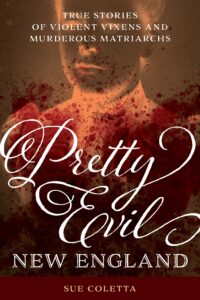
PRETTY EVIL NEW ENGLAND: True Stories of Violent Vixens and Murderous Matriarchs hits bookstores Sept. 1, 2020. Can’t wait!
With Halloween arriving next week, murder is in the air. It might be the only time of year when “normal” people can fully relate to crime writers and readers. So, ladies and gents, grab your favorite beverage and kick back for a little Murder 101, complete with visual aids.
Let’s say your male character is cheating on your protagonist.
During the confrontation — we can’t ignore that type of behavior, now can we? — take the homewrecker by surprise with one well-placed stab to the carotid artery. Don’t forget to withdraw the hunting knife! We wouldn’t want it to act as a plug.
Notice how the kitty is priming the carotid artery? The subject is nice and relaxed. More importantly, he doesn’t suspect a thing.
There are two carotid arteries in the neck, one on the left side and one on the right. Each carotid artery branches into two divisions:
• Internal carotid artery supplies blood to the brain
• External carotid artery supplies blood to the face and neck
If it were me, I’d aim for the internal carotid, but it’s a personal preference. If you’d rather watch the blood drain from the subject’s face and neck, then shoot for the external. Both will get the job done.
A quiet execution is an effective way to murder…
If you choose this murder method, be sure to use a fast-acting poison. No need to act psychopathic by dragging out your subject’s agony. Unless, of course, that’s what you’re into. No judgments!
May I make a suggestion? Try using Tetrodotoxin, which is a complex biochemical found in two marine creatures, the blue-ringed octopus and the puffer fish. It’s also in slugs, but on a much smaller scale. Garry Rodgers wrote a fantastic article about this deadly poison.
Whether Tetrodotoxin is injected via octopus bite — how might you explain a pet octopus? — or ingested by way of food or drink, the poison will kill the subject within a few minutes, depending on the character’s size vs. the amount of poison administered. Tetrodotoxin first blocks nerve responses and then paralyzes the victim, which prevents the victim from breathing. Finally, it stops the heart. As little as 1 milligram is all you need to accomplish your goal.
Some people prefer a good ol’ fashioned murder method, complete with sound effects.
Ladies, please don’t close your eyes while firing a weapon. I know murder isn’t easy, but if you’re determined to see this through, you may as well do it right. For information on the correct ammunition to use, John Gilstrap, wrote a post about what works best. Hint: hollow points are your friend.
Manual suffocation adds an up-close-and-personal touch.
This method is fairly straightforward. Notice how the sloth covers the kitty’s nose and mouth with one smooth motion? Perfect execution! Only use this murder method on humans please. We’re not savages, after all. ?
Sometimes, you just gotta let loose — and that’s okay.
Nothing screams you’re on the edge of sanity quite like an ax. Don’t you agree? You may want to act this one out at his place to avoid a lengthy crime scene clean up. Notice the plastic coveralls? Get yourself an identical suit but wear the hood. You wouldn’t want to leave hairs behind for the crime scene unit.
I swear, Your Honor, I had nothing to do with it. He tripped.
Do NOT harm the family dog. Please note how Miss White effortlessly pushes her lover down the stairs. So graceful, so ladylike, a little flick of the wrist and her problem is resolved.
Unless, of course, his neck doesn’t snap. Yeah, that could happen. Then what do you do? No problem. Finish him off with a quick slash to the neck like this …
Time is running out, folks. By November 1st some people may not “appreciate” a crime writer/reader’s passion to help others. Before then, it’s perfectly acceptable to say…
I’ll leave you with one final word of wisdom…
For those participating in NaNoWriMo this year, remember that. Happy hunting! I mean… writing. 😉
By Sue Coletta
 In a recent chat with Jordan, she mentioned that when she went for her TSA pre-check ID for her upcoming trip, they couldn’t detect her digital fingerprints.
They said since she spent so much time at a computer keyboard as a writer, she’s deteriorated her ridge detail.
Could this be true of all professional writers?
As you might have guessed, this question sent me down a rabbit hole of research, because I’ve had trouble with my iPhone’s digital fingerprint scan. It only recognizes my thumbprint, not any other finger. Which I figured was just a glitch with the phone. Now, I’m not so sure.
Before we can prove or disprove TSA’s conclusion, we first need to know the basics.
What is a fingerprint?
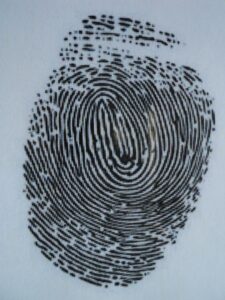
A fingerprint is a pattern of friction ridge details, comprised of ridges and valleys. A ridge is a high point, a valley is a depression or low point. Friction ridges are also found on our palms, feet, and toes. “Pattern” equals the unique characteristics of the ridges and valleys that make up the print, defined by the spatial relationship of multiple lines, their beginning and terminating points, and the unique pattern they create.
Each ridge contains tiny pores connected to sweat glands beneath the skin. When we touch an object, sweat and oils release from these pores and leave behind a print, latent or visible. The genes from our parents determine the general characteristics of the pattern.
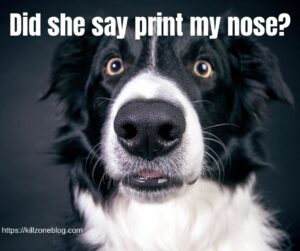
Fun fact: Like human fingerprints, a dog’s nose has a unique identifiable pattern. In fact, many dog clubs now keep nose prints on file.
If you’d like to learn how to print your dog’s nose, see this post. 🙂
Sir Francis Galton was the first person to classify fingerprints into different types based on the three basic features: loops, arches, and whorls. Learn more about points, types, and classifications HERE.
Fingerprints form before birth and remain unchanged until the body decomposes after death.
There are two exceptions to “remain unchanged”…
 If, say, someone sliced the tip of their finger with a knife, it may leave behind a scar. But then, their fingerprint would be even more distinguishable because of that scar.
Along similar lines, severe burns can also damage the deep layers of skin and obliterate the ridge detail. However, much like the knife injury, the scars that form would become the injured party’s unique identifiers.
The other exception has to do with the elderly. As we age, we lose skin elasticity, which may affect ridge detail. The fingerprints become wider; the spaces between the ridges narrower. Even though the fingerprint still exists, fingerprint technology may find it more difficult to detect.
Can someone be born without fingerprints?
In a few rare cases, yes. One condition called adermatoglyphia — also known as “immigration delay disease” — can result in a child being born without fingerprints. In some cases, these infants have almost no other health issues. In other cases, this condition could cause skin abnormalities, including tiny white bumps on the face, blistering of the skin, and/or a lack of sweat glands. Adermatoglyphia has only been documented in four families worldwide.
Naegeli Syndrome is another rare condition that halts the production of fingerprints in utero. Said syndrome is characterized by reticular skin pigmentation (meaning, mottled, purplish, and lace-like splotches), diminished function of the sweat glands, and the absence of teeth. Individuals with Naegeli Syndrome have sweat gland abnormalities. Not only do they lack fingerprints but they also suffer from heat intolerance due to a decrease or total inability to sweat.
Do Twins Have the Same Fingerprints?
 No. Twins do not have identical fingerprints. Our prints are as unique as snowflakes. Actually, we have a 1 in 64 billion chance of having the same fingerprints as someone else.
Sci-fi writers could potentially take advantage of these odds, but it’s such a longshot that it’d be tricky to pull off.
Who’s most at risk for losing their fingerprints?
Patients undergoing chemotherapy — such as capecitabine (Xeloda), for example — are most at risk. With prolonged use of this medication, the finger-pad skin can become inflamed, swollen, and damaged to the point of erasing the ridge detail, according to DP Lyle, MD, author of Forensics for Dummies. Chemotherapy may also cause severe peeling of the palms and soles of the feet. The medical term for this condition is called Hand-Foot Syndrome.
Skin diseases like scleroderma, psoriasis, and eczema also have the potential to obliterate the ridge pattern.
Which professions cause the most damage to fingerprints?
Bricklayers and other heavy manual laborers can wear down their fingerprint ridges to the point where no pattern is visible. Secretaries and file clerks who handle paper all day can have a similar thing occur. Typists (Writers!) and piano players can suffer the same alterations. Hairstylists, dry cleaning workers, and those who work with lime (calcium oxide) are often exposed to chemicals that dissolve the upper layers of the skin, thereby flattening the ridge detail.
So, to answer our initial question, was TSA correct?
Yes! Pounding on the keyboard can wear away a writer’s fingerprints.
How might the lack of fingerprints cause problems?
 Losing one’s prints can cause issues with crossing international borders and even logging on to certain computer systems.
Fortunately, fingerprint technology is always evolving and improving.
As more and more careers require hours of keyboard time, someday retinal scanners, facial recognition, and voice prints will replace the current technology.
Have you ever been told you have no digital fingerprints? Have you experienced any problems with fingerprint technology?
By SUE COLETTA
 Last Friday I was editing what I wrote the day before in my WIP when a word stopped me cold: casket. Should that be coffin?
The specific year in question is 1901, so I needed to figure out exactly when “coffin” first became “casket”?
The words are often used interchangeably, but they shouldn’t be.
Coffins and caskets give two distinct mental images. I could ruin my scene if I used the wrong word.
Coffin
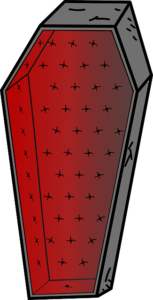 The word coffin comes from the Old French word cofin and the Latin word cophinus, which translates to basket. First used in the English language in 1380, a coffin is a box or chest for the display and/or burial of a corpse. When used to transport the deceased, a coffin may also be referred to as a pall.
The shape of a coffin resembles the shape of a body, with either six or eight sides, wider at the top to allow for the shoulders, then tapered toward the bottom—the foot, if you will. 😉
Think: Dracula movies.
Coffins date back to ancient Egypt when bodies were placed in a sarcophagus after the mummification process but before being buried in pyramids. Around 700 AD, the Celts in Europe began fashioning ornamental flat stones to coffins.
Casket
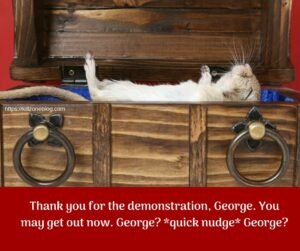
 Interestingly enough, the word casket was originally used to describe a jewelry box, similar to the one George modeled in the above photo. 😀
In the mid-nineteenth century, casket took on an additional meaning synonymous with coffin.
Once morticians and undertakers started operating funeral parlors instead of mortuaries, the word coffin changed to casket because polite society considered it less offensive. The exact date still escaped me, though. I also had to consider the location of my story. What if Maine townsfolk used casket while Massachusetts residents still used coffin?
I kept digging…
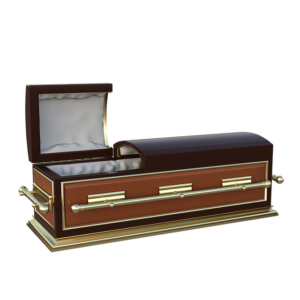
A casket is rectangular in shape and often has a split-lid for viewing the deceased.
Caskets and coffins have been made of wood, cast iron, steel, fiberglass, real glass, bamboo, wicker, wool, and even gold. Wicker and wool threw me. How ’bout you? Carved whalebone, ivory, or precious metals adorned the ornamental trim, if the family coughed up the extra dough.
Both possess side handles for easy carrying. The main difference is the shape. Which, for writers as well as readers, is a pretty big deal. How would it look if pallbearers carried a triangular coffin? See what I’m sayin’? Details matter.
In 1784, a disturbing new law went into effect for a brief period. Holy Roman Emperor Joseph II declared coffins should be reused to save on wood. So, coffin-makers installed trap doors on coffin floors that would drop open as soon the wood hit the grave. After the funeral service, the undertaker would hoist the coffin out of the hole, rinse and repeat. Public outcry abolished the law six months later.
That’s all well and good — fascinating, even; I love learning new tidbits for the ol’ memory bank — but I still hadn’t answered my original question. Should I use coffin or casket in my WIP? Some might not understand a writer’s obsession over one tiny word, but TKZers know every word counts. More importantly, they must be the right words.
Next, I read about the different materials used in coffins…
From 1848 through the 1870’s Almond Fisk made some coffins out of cast-iron. Shaped like a sarcophagus, they weighed over 300 pounds. Total cost: $100. How many pallbearers would it take to carry 400, 500, 600 pounds of dead weight?
Wooden coffins sold for $1.00 to $3.00 during that time. Imagine? Today some “burial boxes” can cost a whopping $50,000., depending on material and style.
In 1950, Fisk died penniless after mortgaging his patent rights to John G. Forbes, who resurrected the company and continued the cast-iron coffin business till it folded in 1888. The affluent members of society, however, preferred cast-iron coffins to wood; they helped to deter grave robbers. In fact, some say General Ulysses S. Grant is buried in a steel casket for this very reason.
Edgar Allan Poe’s The Premature Burial added to the chaos of the 1700’s and 1800’s, when folks feared being buried alive. Which is when coffin-makers introduced the safety coffin, complete with cord and bell. We’ve all heard those stories, right? Countless novels, short stories, novellas, film adaptations, and even plays hopped on that particular bandwagon.
Poe’s The Premature Burial exacerbated many people’s worst fear.
The lady was deposited in her family vault, which, for three subsequent years, was undisturbed. At the expiration of this term it was opened for the reception of a sarcophagus; — but, alas! how fearful a shock awaited the husband, who, personally, threw open the door! As its portals swung outwardly back, some white-appareled object fell rattling within his arms. It was the skeleton of his wife in her yet unmolded shroud.
A careful investigation rendered it evident that she had revived within two days after her entombment; that her struggles within the coffin had caused it to fall from a ledge, or shelf to the floor, where it was so broken as to permit her escape. A lamp which had been accidentally left, full of oil, within the tomb, was found empty; it might have been exhausted, however, by evaporation.
On the uttermost of the steps which led down into the dread chamber was a large fragment of the coffin, with which, it seemed, that she had endeavored to arrest attention by striking the iron door. While thus occupied, she probably swooned, or possibly died, through sheer terror; and, in failing, her shroud became entangled in some iron — work which projected interiorly. Thus she remained, and thus she rotted, erect.
As you can probably guess, I got sucked right into the master of darkness’ story instead of searching for the answer to my research question! It wasn’t easy — Edgar Allan Poe’s mind intrigues me — but I finally managed to refocus on the task at hand.
Turns out, I had the answer all along in my printed research paperwork, hidden in a news article. The story told of a victim’s father who argued over the price of his daughter’s coffin, believing he should be charged the wholesale price rather than retail. *facepalm*
Ah, well, I figured, maybe I can use this casket/coffin research for my Monday post on the Kill Zone. 🙂 There must be a lesson or two in here somewhere. Or maybe, just maybe, this information might save one of you research time in the future.
What say you, my beloveds? Have you ever gotten hung up on one word? Did it lead you to uncover a fascinating tidbit or two? Tell us about it.
International Thriller Writers wrote a feature article about RACKED, which I’m still *happy dancing* about. If you’re interested, you can read the full article HERE.
The ebook of RACKED is on sale for 99c on Amazon for another day or two.
*All books in the series can stand alone.
By SUE COLETTA
Joe’s Saturday post inspired me to share a strange encounter I had with a reader last week. I loaded up the SUV for my annual trip north to appear at a 5-star library in New Hampshire (rated by Library Journal). I’ve all but given up on libraries for book signings, but this library has the coolest librarian/director I’ve ever met. She’s a walking contradiction! Inside the library, she’s quiet, polite, and super helpful. When she locks the library doors, however, she really lets her hair down, hops into her supped-up Mustang convertible and races down the streets—a quick streak of blue and white whizzing by. I adore this woman! Every signing, successful or not, ends with a hug. Which keeps me coming back year after year.
Sometimes my timing is perfect. Other times, not so much.
Last week, the local priest decided to hold his retirement party across the street from the library on the same night as my book event. Needless to say, it wasn’t my most successful signing ever. Didn’t matter. Whether we’re speaking to a packed room or only three or four readers trickle in, we still need to put on the same show. Sometimes a more intimate setting is really nice, as it gives us the opportunity to chitchat with the folks who read our books.
Unless you get an angry-looking woman in the front row who does nothing but glare at you.
All she wanted was for me to keep reading excerpts, one after another. It was strangest thing. Every time I stopped she’d point to another book and ask me to read the opening chapter. No one else objected, so I gave her what she wanted. After I read about four, I was beginning to feel like a puppet on a string. So, I asked her why she’d rather hear me read than chat with me.
Her response? “I don’t even think about the writer when I read. I don’t care about the research. I don’t care about the story behind the story. All I want is the next book.”
“Wow,” was all I managed before the librarian jolted to her feet.
“I care,” she said, “I care very deeply for writers.”
The others in the room agreed.
Still, I couldn’t help thinking, how sad. Here this woman sat surrounded by books lining every wall, every partition. Decades, if not centuries, of writers who’d worked endless hours, alone, pecking the keyboard or typewriter or writing longhand by candlelight, their joys, their sorrows, their laughter and pain spilled across the pages, and this poor woman was incapable of seeing any of it. Didn’t care to, either, apparently. But even if she continued to disrespect writers, I wasn’t about to stoop to her level and spout an equally snarky comeback. I’m a big believer in karma. So, I gave her a free signed paperback and thanked her for coming to the event.
If you haven’t done book signings yet, let me put your mind at ease. For every one clueless reader, there are thousands of others who cherish every word. Readers who sit our books on a shelf of honor because they loved it so much. Our characters become their best friends, sometimes their only friends. When these devoted readers finally get the chance to meet the writer who brought their beloved characters to life, they shower us with love. Some might even mistake the writer for one of their characters. You know what? That’s okay, too… unless she’s a Delores Claiborne type. 😉 It means our words, our stories, touched their lives in some way.
Isn’t that why we write?
Please excuse me while I share my love for those who read my books. I’ve been blessed with an amazing, generous, thoughtful, kind, funny, loving, and downright nutty audience. It’s no secret that I adore crows, right? I’m so enamored with these birds that I’ve set out to change the public perception that crows are pests. Nothing could be farther from the truth. Spotting one in the yard does NOT equate to a bad omen. These amazing creatures—the smartest of the bird world, by the way, along with their cousin, the raven—do NOT bring death and destruction. They’ve been saddled with an unjustified bad reputation for no apparent reason. It’s time to stop judging birds by the color of their plumage.
Ahem. Excuse me. I get a little carried away when it comes to breed profiling. 🙂
Anyway, since I share my love for Poe (my crow who lives free, yet comes when called) along with Edgar, Allan, Thoreau, Shakespeare, and the rest of my black beauties (some of which I’ve turned into characters for my Mayhem Series) readers are now decorating my office with crows. Here are a few I received this summer…
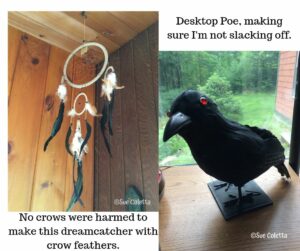
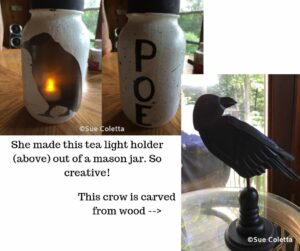
Over to you, TKZ family. Have you ever heard a similar remark as the woman in the library? If so, how’d you handle it? Tell us about your strangest — or best! — encounter with a reader?
*I’m on the road today, researching, so I may be late responding to comments.