
By Elaine Viets
Writing a novel is like making soup: We add chunks of our own experience, bits of research, boil it down, season it with imagination. We transform those ingredients into something that we hope is tasty, even nourishing, for our readers.
In “Fixing to Die,” my new Josie Marcus mystery shopper mystery, I used an old encounter with a bully. Josie has a tween daughter, Amelia. Three mean girls at Barrington School create a Facebook page called the Bitches of Barrington, and put photos of Amelia and three of her friends in doghouse frames. Twelve-year-old Amelia is hurt and humiliated when her classmates see the BOB page. Worse, the other students bark and howl as Amelia and her friends run for their parents’ cars. 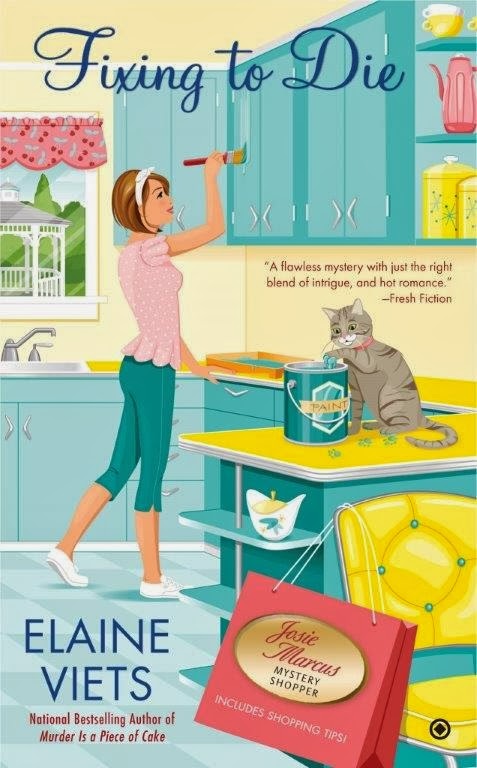
It’s hard to escape stories about bullying these days. The facts are dreadful. Dosomething.org says some “43 percent of kids have been bullied online and girls are about twice as likely as boys to be victims and perpetrators of cyber bullying. Worse, bullying victims are two to nine times more likely to consider committing suicide.”
I grew up before kids used computers – and before mean girls had their own movies. Back then, we knew about boy bullies, but nobody thought girls could be, too.
When I was twelve, I was bullied by a mean girl named Bonnie. She went to public school and I went to St. Sabina Catholic school. Bonnie beat me up on my way home from school. I started taking the long way home to avoid her.
Now that I’m grown up, Bonnie’s bullying seems ridiculous. But my terror at twelve was real.
Here’s how I used it in “Fixing to Die.” In this scene, Josie, her new husband, Ted, and Amelia, discuss bullying:
“Technology has changed the bully business,” Josie said.
“What’s technology got to do with bullies?” Ted asked.
“When I was Amelia’s age,” she said, “I was bullied by Bonnie. Skinny girl with straggly hair. Bonnie was a year older and a whole lot bigger than me. She didn’t like that I used what she called ‘big words.’ Bonnie would wait for me about two blocks from school, and punch me in the gut. I started taking the long way home to avoid her.”
“Did you tell Grandma?” Amelia asked.
“No. Bonnie said her father was in the Mafia and he’d kill her.”
Amelia giggled. “You believed that?”
“Yeah, I was stupid,” Josie said. “Bonnie had a German last name. I don’t even know if she knew any Italians, but she had me shaking in my shoes.
“Here’s the difference between me and Amelia. Once I was home, I was safe. Bonnie wouldn’t come to my house and nobody else knew about it. Online bullying is there twenty four/seven.”
Bonnie quit tormenting me when I went to high school. I’ve lost track of her. But the memory of her jabs to the gut stayed with me.
Here’s the good thing about being a writer: No experience is ever wasted, no matter how painful.
Writing with Two Heads
Recently, Mark Alpert posted a blog about The Writing Buddy and how writing can be a lonely occupation. There are few methods of getting around that situation. If you want to write fiction, it’s usually a one-man show. Fortunately for me, I have a solution—a cowriter.
One of the most frequently asked questions Lynn Sholes and I get is “How is it possible for two people to write fiction together?” The answer is, it ain’t easy. At least it  wasn’t at first. Collaboration on non-fiction is somewhat easier to understand. In general, with non-fiction, the “facts” usually already exist and the collaborators’ job is to organize them into a readable document that has a beginning, middle and end. A good outline and knowledge of the subject matter along with professional writing skills may be all the authors need.
But with fiction, nothing exists. It’s all smoke and mirrors. Fiction is a product of an individual’s imagination. It might be inspired by actual facts or events, but only the individual has a specific vision of those events in their head. So how can two people have a similar enough vision to be able to write a novel together?
I can’t speak for the handful of other writing teams out there (including TKZ’s own PJ Parrish), but Lynn and I have managed to complete 6 thrillers together because of a number of reasons.
First, we love the same kind of books—the ones we read are like the ones we write.
Second, we have an unquestioning respect for each other’s writing skills and a deep belief that whatever one of us writes, the other can improve.
Third, we believe that there’s always a better way to write something.
Fourth, we never let our egos get in the way of a good story. This comes from spending over 10 years in a weekly writers critique group.
Fifth, we know each other’s strengths and weaknesses, and are willing to admit them.
Sixth, we agree on the same message/theme in each book.
Seventh, we believe that we are on the same level of expertise.
And last, we believe that the whole is greater than the sum of the parts.
Those points cover the mental portion. Now, how do we handle the mechanics of the job? We talk, and talk, and talk. Once a day we conference call, brainstorm, tell and retell each other the story. Our two favorite words are: What if? Whether it’s global plot points or an individual scene or character motivation, we keep telling each other the story until that little imaginary movie in our minds becomes as in-sync as possible. Then one of us will declare they have a “handle” on the scene or character or chapter, enough of which to create the first draft.
We write very slowly because each chapter must go back and forth many times for revision. Years ago, when we first started, everyone could tell who wrote what as we tried to write our first book. It took three years of hard work before we melted our voices together. Now, because the process goes through so many revisions, even I can’t always remember what I wrote and what she wrote. I rely on my co-writer so much that I’ve come to wonder how individuals can possibly write a book on their own.
There are a number of advantages and disadvantages to collaborating. A disadvantage is that you split any money you make. So you’ll always make half of what you could as a single author. And like any relationship, there is always a chance of a falling out. And something could happen where an ego can become inflated and affect the process.
One of the pluses is that we never experience writer’s block. One of us will always have an idea on how to get out of a jam or move the story forward. And unlike our spouses, family, friends, trusted beta readers, and everyone else, a co-writer has an intimate, vested interest in the success of the story that no one else could have.
Lynn and I are approaching the mid-point of our seventh thriller together (THE SHIELD, the follow-up to THE BLADE). I’ve found that creating the first draft of a chapter is just as exciting as getting a new chapter from her and seeing where the story has gone. I guess the whole thing boils down to trust. Trust in each other and in the goals we both want to achieve with the story and with our careers.
One last note: I haven’t seen Lynn in person in over 5 years since we live hundreds of miles apart. That seems to be something that mystifies everyone.
So, now that you know how we write together, do you think you could ever collaborate on a novel? Or is writing fiction too private an experience. Do you believe two heads are better than one or would you rather not have anyone sticking their nose in your work?
————–
“THE BLADE is full-throttle thriller writing.” David Morrell
What we can learn from pulp fiction
By P.J. Parrish
Now pay attention, kittens and bo’s, there’s a quiz at the end of this one.
I was an art major in college. This was before I figured out I couldn’t make a living at this. Unless I planned to teach, but I was scared of kids. (Not a good character trait in teachers). I was doing okay in art until I hit a class called Three Dimensional Design. I could draw and paint but I was terrible at this. Evidence of my ineptitude was my “final exam” sculpture, which I called Nude With A Paper Cup Head. So titled because I couldn’t get my figure’s face right so I just filled a Dixie cup with wet plaster and stuck it on top. I got a D.
I just didn’t get it. I couldn’t think outside the two-dimensional box. Finally, my instructor told me I had to stop seeing the world in POSITIVES and start seeing it in NEGATIVES. In other words, I was so hung up on adding things, I was missing the beauty of subtracting. “Learn how to leave things out,” he told me.
I ended up abandoning art for writing. But I think that little piece of advice must have lodged deep in my brain cells because it is something subconsciously I have always tried to apply to my fiction writing. Subconsciously I say because until recently, I hadn’t even thought about my art instructor and his advice. Maybe I am thinking about it now because of the book I am reading — “The Black Lizard Big Book of Pulps.” I got it for Christmas but I keep it handy by the bedside, digesting it in small doses.
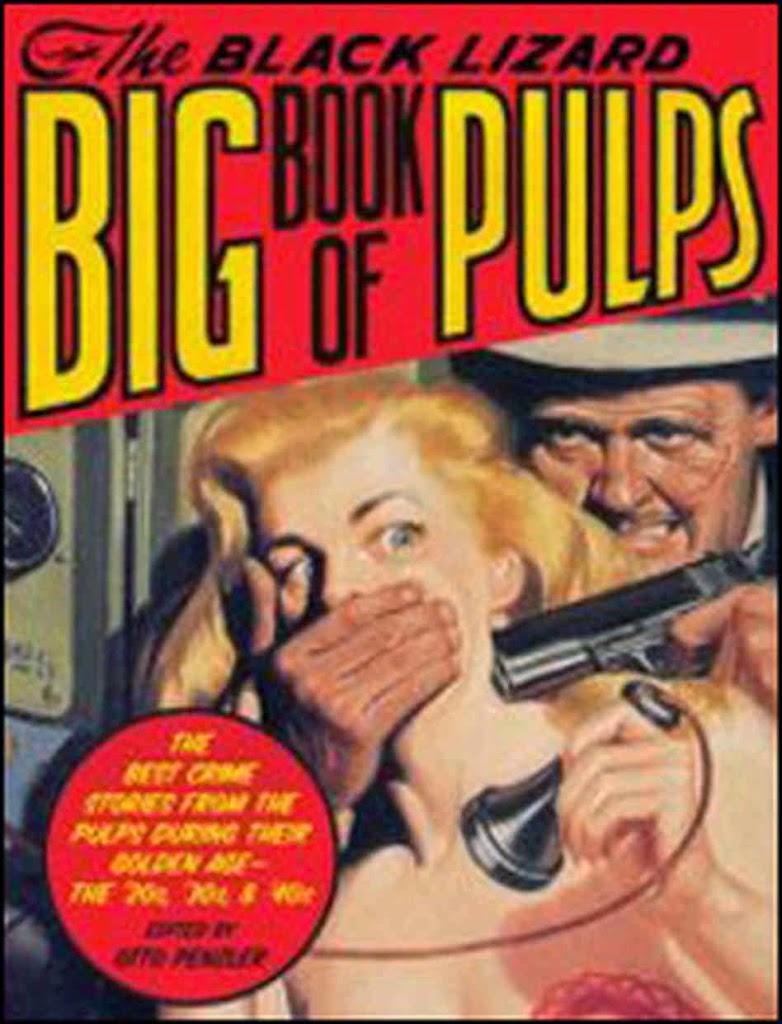
It’s a handsome book…a compiliation of the best crime stories from the “golden age” of pulp crime fiction — the 20s through the 40s. It’s about the size of the Manhattan phone book. And to be really honest, parts of it read about as well.
Many of these guys were dismissed as the hacks of their day, churning out their stories for cheaply printed magazines like “Black Mask” and “Dime Detective.” Yeah, they were lurid, the syntax cringe-worthy, the plots thin or nonsensical. But they tapped into a popular need for a new kind of human hero. The most memorable of the heroes became the prototypes for much of what we are seeing in our crime fiction today — lone wolves fighting for justice against all odds but always on their own different-drummer terms. Would we have Harry Bosch without the Continental Op? Jack Reacher without Simon Templar? Doubtful…
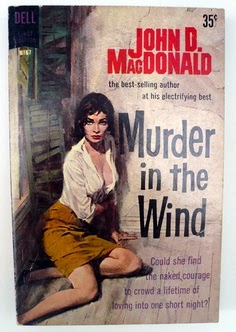
Some of my favorite “classic” crime writers wrote pulp. Like John D. MacDonald who churned out stories for “Black Mask” and “Dime Detective,” and Donald Westlake writing as Richard Stark. Even my seminal hero Georges Simenon (creator of inspector Maigret who was a partial inspiration for my own protag Louis Kincaid) couldn’t resist the lure of the lurid and wrote two nasty little noirs call “Dirty Snow” and “Tropic Moon.”
To be sure, not all the stories in “Lizard” have aged well. The slang sounds vaguely silly now, the sexism and racism we can explain away as anachronistic attitudes. But the armature these writers created is still sturdy.
Especially in pure writing style. That is the biggest thing I am getting out of these stories, an appreciation for that streamlined locomotive style that propels these stories along their tracks. I read these stories now — discovering most of these writers for the first time — with a smile on my face and a Highlighter in hand. There are lessons to be learned for us all, and you can almost hear James M. Cain whispering: “I’m not going to dazzle you with my writing. I’m going to tell you a helluva story.”
These guys sure knew what to leave out. Let me give you one little passage from Paul Cain’s “One Two Three”:
I said: “Sure — we’ll both go.”
Gard didn’t go for that very big, but I told him that my having been such a pal of Healy’s made it all right.
We went.
Not: And then we left the apartment and got in my roadster and set out. We took Mulholland Drive out of the canyon and arrived just before dusk.
Just: We went.
How can you read that and not smile?
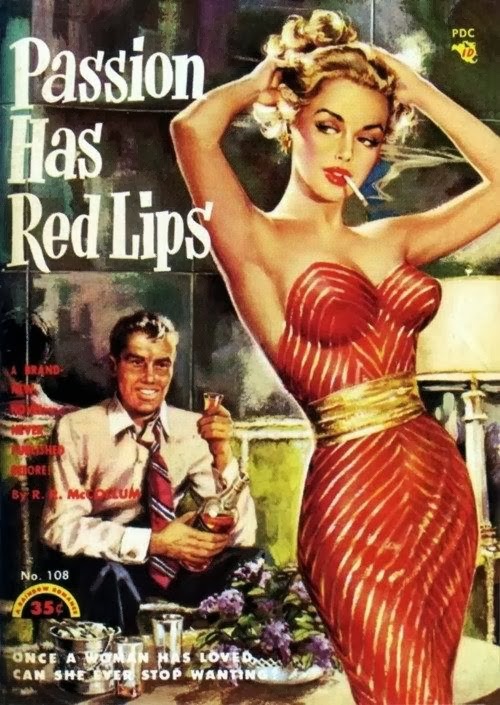
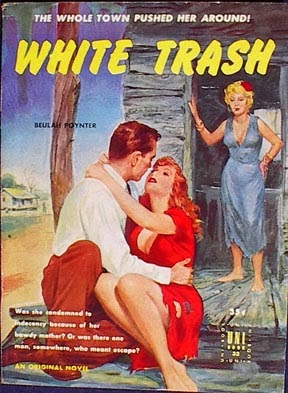
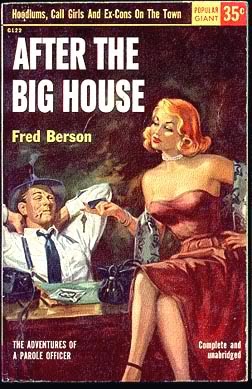
I heartily recommend the “Big Book of Pulps.” And speaking of art, check out some of the best pulp cover artists of the day at Rex Parker’s terrific vintage paperback blog Pop Sensation.
And now, in honor of our pulp forefathers, I am offering up this little quiz of pulp slang for your amusement. Answers at the end. And don’t chance the chisel for a cheap bulge, bo. We Jake?
DEFINITIONS.
1. Ameche
2. Kicking the gong around
3. Wooden kimono
4. cheaters
5. Gasper
6. Hammer and saws
7. Orphan papers
8. Wikiup
9. Bangtails
10. Can-opener
TRANSLATIONS
11. I had been ranking the Loogan for an hour and could see he was a right gee. It was all silk so far.
12. I stared down at the stiff. The bim hadn’t been chilled off. Definitely a pro skirt who had pulled the Dutch act.
13. I got a croaker ribbed up to get the wire.
14. By the time we got to the drum the droppers had lammed off. Another trip for biscuits…
1. telephone
2. taking opium
3. coffin
4. sunglasses
5. cigarette
6. Police
7. Bad checks
8. Home
9. Horses
10. Safecracker
11. I had been watching the man with the gun for an hour and could tell he was an okay guy. Everything was cool so far.
12. I stared at the body. The woman hadn’t been murdered. She was definitely a prostitute who had committed suicide.
13. I have arranged for a doctor to get the information.
14. By the time we got to the speakeasy, the hired killers had left. Just another trip for nothing…
Remodeling
As you could tell from my last (MIA) post I am currently in the throes of a house remodel and thus ‘enjoying’ life without a kitchen or living area (having decamped into the basement), trying to keep everything on schedule, taking the opportunity to buy a new memory foam mattress and deciding whether tile or carpet would be better. I know that a lot of people struggle when it comes to deciding what they want doing to their house when they are thinking about having it remodeled. Some people might just struggle with figuring out where they want a knock out wall to add, whilst others only worry about the color scheme. When we bought our house we knew we would have to undertake some sizable renovations to bring the 1957 ranch house back to its former glory. Although, we are quickly blasting through our budget so I might have to find some cheap, discount furniture in the sales!
Oddly enough, our house remodel coincides with a significant ‘remodel’ I’m undertaking of a story a wrote a couple of years ago. This particular story had a great premise but, for some reason, turned into a way-too-convoluted novel (it took me about a year to realize the novel was actually three stories in one – a YA novel, an adult novel and one novel that was only good for the garbage!).
Once I realized this, I faced a dilemma, should I try to go beyond mere edits and totally ‘remodel’ it, or was the book really only fit to be burned. As it was, I knew my agent loved the main idea (so the foundations were solid) but felt I needed to streamline some of the multiple plot and mythological elements. When I started to pull apart the three different stories, I felt I could see my way clear to writing the YA novel trapped inside. The question was, would I be able to pull off this kind of major renovation?
Gutting most of a novel and starting again creates a number of challenges – not the least of which is ensuring that the new story structure holds together and doesn’t teeter on the edges of the old one. For me, the decisive moment came when I realized that changing the time period provided the ideal opportunity to refashion the story whilst keeping the critical elements in place. After doing further historical research I came to realize that the new time-frame provided a much better grounding for the story and (thankfully) it looked as if the remodelled story would be much stronger and clearer than the original.
Now I feel like, despite the chaos of the physical renovations occurring at my house (estimated to take about 10 weeks…), I’m ready to face this new challenge – especially as the story has been gnawing away at me (which is a good indication it wants to get written) and I have time now that my previous WIP is out on submission. Still – it’s a daunting task.
So, my fellowTKZers, have you ever managed to successfully remodel an old story. If you have, how did you approach the process? How did you gauge whether the story was salvageable? What about if the remodel was a failure – any lessons learned?(Be kind now – for I’m facing not just the cutting block but an HGTV worthy scrape and rebuild…)
How to Procrastinate
There are three steps to successful procrastination:
1.
***
Let me put it another way. I am currently in the throes of NaNoWriMo, so it seems a bit odd to pause for a meditation on procrastination. But I spend a good deal of online time chatting with fellow writers, and in one loop a discussion broke out on, of all things, the proper use of the singular possessive apostrophe (talk about having too much time on your hands!)
This is what I mean. Should you write Dickens’ books or Dickens’s books? The former sounds better, but the latter is the accepted form. I pulled out my Strunk & White and found the rule to be that for ancient proper names, like Jesus and Moses, the form is: Jesus’and Moses’. Which seems to me a little unfair to Dickens, as it’s merely his accident of birth date that gets him the extra s at the end.
One of the other writers cited the “Bible” – The Chicago Manual of Style, 16th edition. She said CMOS “goes for ‘s for singular nouns ending in s––even Jesus’s name.”
Unwilling to leave it at that, and feeling a bit anti-authoritarian that day, I took five minutes and wrote a drinking song, to be sung around a table with other writers, steins of beer in hand, and sung directly to CMOS:
Your singular possessive
Is singularly regressive
And your S’s just make messes!
Halaloo halalay!
[Pause for drinking, and pounding steins on table]
When it comes to guys like Dickens
Your injunction is for chickens.
Here is what I say:
I will do it Jesus’ way!
Halaloo halalay!
[Finish with more drinking]
And that’s how you procrastinate.
What about you? What are your favorite ways to keep from working on your books? What do you find yourself doing when you know you should be writing?
Purging the Editor
I believe it is a given that those of us who aspire to write are also vociferous readers. A reader is a wonderful thing to be; however, I have come to the conclusion that sometimes this state of mind and being can be an impediment to an author aborning. Reading a novel by James Lee Burke or Karin Slaughter or John Connolly or Chelsea Cain can inspire a reader to think, “I want to do that.” Yet it can also be discouraging; one reads BLACK CHERRY BLUES by Burke and thinks, “I can never be that good; why bother?” The fleeting dream is set aside, sometimes permanently. Part of the reason for this state of affairs is that in the case of a book (or a film, or a painting, or a music project) we rarely see what came before, the early stages that led to the final result.
Such does not hold true with respect to a construction project, to name but one example. We recently had the opportunity to watch an all but vacant shopping center in our area be transformed over a period of several months into a wholly done, over, remodeled, commercially successful unit. It was fun to watch. Readers generally do not get to watch the process by which their favorite author transforms a few hundred blank pages into a cohesive, occasionally unforgettable, experience. So it is that the novel, upon publication, seems to have sprung from whole cloth, seemingly effortlessly. We know better, of course. But it is difficult sometimes to fully appreciate it without seeing the ultrasound ourselves.
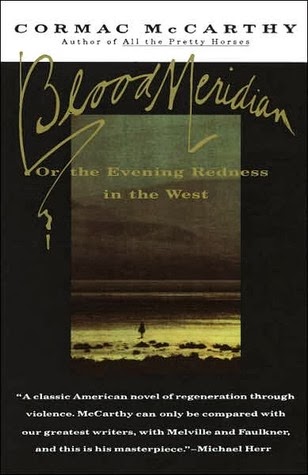
I hit an emotional low point this past week for a number or reasons that aren’t really important to this discussion; what is important is what brought me out of it, at least so far as creativity is concerned. I happened across an article in Slate entitled “Cormac McCarthy Cuts to the Bone.” You can find the article here. It is an extremely interesting piece which, among other things, reveals that McCarthy’s classic novel BLOOD MERIDIAN was a far different book at publication than it was at conception. What really attracted me to the article, however, was the reproduction of two pages from McCarthy’s original draft. They are instructive, even if you have never read a word that Mr. McCarthy has written or alternatively would not reflexively grab your copy of BLOOD MERIDIAN or THE ORCHARD KEEPER if confronted with a fire and the resultant dilemma of what to save. BLOOD MERIDIAN did not flow out of McCarthy’s mind without deep and dark consideration. If you’re having trouble getting your words out of you and onto the page, don’t let it be because you in your own mind aren’t “good enough” or “as good” as your favorite author. When your favorite author started writing, they weren’t good enough either. It takes several drafts, several cement pourings, if you will, before things solidify and become right. Don’t put your handprints and your initials into your work and ruin it before it is dry. Purge yourself of what playwright John Guare so brilliantly called “tiny obnoxious editor living in your head,” the one who tells you that you will never be as good as Stephen King or Elmore Leonard or whoever. Then let the construction begin.
Reader Friday: Bad Opening Line Contest
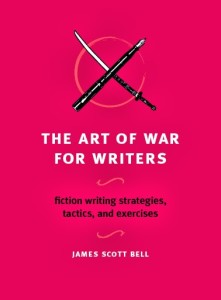 As you probably know, the Bulwer-Lytton Fiction Contest is an annual event to see who can write the worst opening line for a novel. Let’s do our own here at TKZ. Write a bad opening line in 50 words or less. The winner (as judged by the TKZ bloggers) will receive a signed copy of The Art of War for Writers. Entries must be posted before 12:00 a.m. Eastern Time.
 Check back on this post on Monday at noon (Eastern) to find out who the winner is.
Good luck!
UPDATE: We have a winner. The voting was extremely close, but the victory belongs to Jeannie Leighton. Congrats! Please email me at JSB [at] jamesscottbell [dot] com for details on the book. We were going to do second place and honorable mention, but frankly it was too difficult to choose after all the judges weighed in. You were all so good…I mean, bad. Thanks to everyone who played!
UPDATE: We have a winner. The voting was extremely close, but the victory belongs to Jeannie Leighton. Congrats! Please email me at JSB [at] jamesscottbell [dot] com for details on the book. We were going to do second place and honorable mention, but frankly it was too difficult to choose after all the judges weighed in. You were all so good…I mean, bad. Thanks to everyone who played!
What Makes a Critique Group Work?
Yesterday I attended the first meeting of my new critique group, the first group I’ve been in since 2004. I’ve never had much luck with such groups, probably because I was so new to writing that I didn’t know what to even want from a group. I had even started one and had to drop out, but this time should be different.
There are four of us. Very experienced authors. We have a mix of genres, which could make things interesting. I wasn’t sure how well I would fit in. I’m the only crime fiction and YA writer, but after our meeting and the fun we had brainstorming plots, it became apparent very quickly that genres won’t matter. Storytellers know how to kick start a plot.
 |
| Texas Hill Country Bluebonnets |
We met in the beautiful hill country of Texas, outside Boerne. Gorgeous drive up to a member’s beautiful home. The scenic drive is enough to start the creative juices flowing. Our hostess had lunch prepared, something easy and way too yummy. She knew the other two authors and had gotten us together after I whined about not finding what I needed in a few of my local (larger) writers’ groups.
We chatted via email on what we’d like to get from our group. At first I wasn’t sure my goals would match up. Initially we had planned on meeting once a month to talk about the business of writing and maybe brainstorm on plot or scene issues, but after the meeting yesterday, we are getting together once a week and it will be much more on craft and pushing each other to be the best we can be.
Yes, we talked promotion and I learned some new things there and we shared contact info for promo things that worked for each of us. We chatted about plotting methods and storyboarding, but when we got to brainstorming a plot, that’s where my mind was blown.
One of our members had purchased three covers from a designer, images that spoke to her. None of us realized what her intentions were until we got into it, but she bought the covers BEFORE even knowing what any of the books would be about. Basically our session turned into a major Flash Fiction exercise of brainstorming what a new series would be about using the cover designs for books that didn’t exist. HA! When you get the right people together, the ideas flow and we had a blast doing it. We set the stage for a world she’d be building from those three covers that would be bigger than three books, something she could grow into. I’d never done that before and I can’t say I would recommend it as a method of plotting, but with the right people, you never know where things will go.
So we set up our basic crit group intentions as follows:
1.) We will endeavor to get together weekly and bring new material from our current projects. The author will read (& hand out copies of the material), but advance copies will be made available to the other members prior to our meeting for “track changes” feedback. This will allow us to focus on the reading.
2.) None of us are very interested in line edits (unless something is glaring), but we want to get feedback on character, plot, scene choice, motivations, etc. (Craft issues)
3.) We will help each other through plot glitches and even do a “getaway retreat” for serious plotting sessions on future books.
4.) We chatted about limiting our reads to a number of pages and/or a time limit per member, but none of us liked the rigidity. So as we get into this, we will be considerate of not overstepping each other’s time and bring what we need to read to keep us on any publisher’s deadline. We will stay until everyone gets what they need.
5.) We’ll rotate the meetings between member’s houses, as long as the commute isn’t too much on any one person. (Two authors are located more conveniently for all of us.)
6.) We are at four members and like that headcount. Whatever we say in the group will be confidential.
So that is a summary of my new crit group. I’m sure we will define things as we go, to suit the needs of the group, but I’d love to hear from you, TKZers.
For discussion purposes, my questions to all of you (who have way more experience than I do with critique groups) are:
1.) What works in your groups? What do you look for in a crit group?
2.) What doesn’t work?
3.) What do you wish you could add to your groups?
Jordan Dane’s Crystal Fire (The Hunted Series with HarlequinTeen) now available for pre-order. Release November 26, 2013.
“The Hunted – Strong characters and a wild and intense story.”
4.5 Stars – Romantic Times Magazine
Getting Back on Track
How do you get back on track after being away from home? When I go on vacation, attend a conference, or even do a one-day speaking engagement, I lose about two days of work for every day gone. It’s hard to jump back into your Work in Progress when you have bills to pay, receipts to file, emails that need response, phone calls to return, and household chores like laundry and food shopping to complete. With that being said, the idea of being able to use a shift swapping app when people are away could make getting back into work a lot easier. Plus, people can switch shifts if certain people can’t make it.
Photos from our visit to Epcot’s Food & Wine Festival:



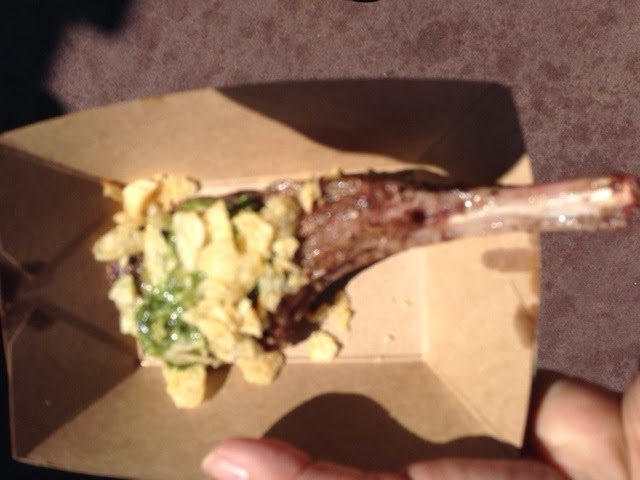
Easing into a work schedule is impossible for me when all these things are on my mind. Thus I allow a few days to get caught up, maybe not in everything but at least in the essentials, before turning to the work left waiting for me.
There’s no easy way to get back to the grind. You can reread your material and do some edits to put the story into your head again. Or you can set a writing/editing schedule beginning with a certain date.
I’m expecting line edits on Warrior Lord, #3 in my Drift Lords paranormal series. Before these arrive, I want to move ahead with Peril by Ponytail, my next Bad Hair Day mystery. This story is based on my recent Arizona trip, and I’d like to write it while those details are still fresh in my mind. And yet I have travel arrangements to make for a New York trip in January, bank statements to reconcile, a wedding invitation that needs a response, family visits to plan, and more. Plus the laundry and food shopping must be done today, not to mention paying the property tax bill, etc.
In a week or so, I’ll be caught up. And this is only from going away for four days. So how do you ease into your work schedule after a vacation? Do you jump right into it, or do you allow yourself time to get caught up?
<><><>
Fall into Reading Contest, Oct. 28 – Nov. 15 Enter to win an ebook copy of Dead Roots, my haunted hotel mystery, and a $10 Starbucks gift card or one of three runner-up prizes: http://nancyjcohen.com/fun-stuff/contest/
Booklover’s Bench Contest Nov. 4 – Nov. 18 Enter to win a $25 Amazon or BN gift card or one of six runner-up ebook prizes: http://bookloversbench.com/contest/
Got Theme?
Recently in my role as TKZ admin and self-appointed den mother, I noticed that we were getting a lot of traffic related to the topic of “developing a theme in fiction writing.” Since searches for that topic take people to an article I wrote back in 2009, I think it makes sense to revisit the subject of theme.
A story’s theme is the fundamental and universal idea behind its plot. If a plot could be compared to the body of a race car, the theme would be the engine turning its wheels. In King Lear, for example, one of its main themes is authority versus chaos.
Theme vs. Subject
We should not confuse a story’s subject with its theme. The subject of a story would be a one-word descriptor of its main idea. “War”, for example, would be the subject of many stories. A theme would be an opinion related to that subject, such as “In War, everyone loses.” Joe Moore wrote an excellent post a while back about how to distinguish between a story’s subject and its theme.
Some writers approach theme almost as an afterthought. But having a well-crafted theme adds dimension and depth to our stories.
Using a character-driven approach to develop a theme

I like to use minor characters to explore a story’s underlying theme. I call this method the “360-degree” approach to developing theme. In this approach, the secondary characters represent various aspects of the main theme, and they act as foils to the main character’s experiences. For example, the theme of A KILLER WORKOUT was “Mean Girls Suffer Last”. That theme was explored through the story arcs of several characters. One woman had been victimized by bullies in her youth; another was a bully. Another character was a protector of abused women. Each of these characters explored different facets of the subject of bullying and emotional abuse.
What’s your theme?
How do you explore theme? What’s the theme of your WIP? How are you working that theme into your narrative?