Guest Post: Harking Back To The Golden Age Of Journalism

Today we welcome back to TKZ our friend and fellow ITW member, author Lisa Black. Enjoy!

By Lisa Black

Who hasn’t wanted to be a newspaper reporter at some point in their life? Chasing a big story, elbowing your way up to shady corporations, reluctant witnesses, crusading leaders? Living on coffee and take-out, your only uniform a pair of jeans and a worn leather jacket, with the ever-present notebook and pen in hand? Comforting the afflicted and afflicting the comfortable?
At least that used to sound glamorous to me. Now it just sounds exhausting.
But I still love newspapers. Reading the day’s edition, delivered to a box at the end of my driveway, over a cup of tea is my favorite part of the day. So when I decided to set the second Gardiner and Renner book around a large city newspaper, I knew it was the right decision.
I did a ton of research, but one book that was more fun than work is titled Gimme Rewrite, Sweetheart…. It is a compilation of memories of reporters for the two major Cleveland, Ohio newspapers from when Cleveland still had two papers. Like most cities it now has one and that one only provides home print delivery four days per week.
Reporters in a bygone era could be assigned to the police beat, and their schedule became dictated by the police radio which sat on a shelf for constant monitoring. Fires, traffic accidents, helpful dispatchers warning officers that they might need noseplugs for a week-old welfare check gave the reporters a quick summary of what the story might be. But of course they couldn’t really know until they got there.
Some other tidbits of information from this book:
You may wonder why stories are ‘buried’ near the obituaries. Editors have no way to know how many people will die on any particular day so they leave a little room open near the obituaries. Late-breaking stories are placed there because there is space, not because of any editorial decision.
A reporter got on the good side of some mobsters at their trial by stealing 20-30 year old photos of them from the newspaper’s archives. Giving each a photo and saying, “Look, this is you when you were, like, 22,” made him their new buddy and got them chatting.
Back in the heady days of large staffs, each paper had specialized writers. There were religion writers, aviation writers, medicine writers. At one point both papers had dog writers.
Game-changing stories don’t always have to be herculean, dramatic efforts. One reporter, with help from the hospital’s employees, simply wandered around a hellish psychiatric ward for a day. When the state governor read the story, he strengthened state regulations to improve conditions. Another reporter wrote a story on Savings & Loans soaking home buyer on fees (one of the practices which would cause the entire economy to crash in 2008) and wound up taking on the inimical Freddie Mac. But the local Congresswoman happened to be on the House Banking Committee and Freddie Mac happened to be asking the Committee to do an IPO. Freddie Mac wound up having to make information public and belatedly enforce its own rules.
Or smaller stories—a car dealership beloved in the area for its corny TV commercials ran a contest where they awarded a car to a worthy person. The college girl winner had a father recently disabled from a heart attack, but the car she won got two flats on the way home and the exhaust system fell off. A reporter wrote the truth. Luckily for the reporter the dealership didn’t advertise in the paper, so the paper ran the story anyway—the dealership sued, but the reporter won the lawsuit. The truth, it seemed, was still a valid defense.
Some things don’t change.

****

It begins with the kind of bizarre death that makes headlines—literally. A copy editor at the Cleveland Herald is found hanging above the grinding wheels of the newspaper assembly line. Forensic investigator Maggie Gardiner has her suspicions about this apparent suicide inside the tsunami of tensions that is the news industry today—and when the evidence suggests murder, Maggie has no choice but to place her trust in the one person she doesn’t trust at all….
Jack Renner is a killer with a conscience, a vigilante with his own code of honor. He has only one problem: Maggie knows his secret. She insists he enforce the law, not subvert it. But when more newspaper employees are slain, Jack may be the only person who can help Maggie unmask the killer–even if Jack is still checking names off his own private list.

UNPUNISHED available January 31 wherever books are sold!
www.lisa-black.com
Twitter: @LisaBlackAuthor

Lisa Black has spent over 20 years in forensic science, first at the coroner’s office in Cleveland Ohio and now as a certified latent print examiner and CSI at a Florida police dept. Her books have been translated into 6 languages, one reached the NYT Bestseller’s List and one has been optioned for film and a possible TV series.

www.lisa-black.com
@LisaBlackAuthor

To Count or Not to Count (Words, that is)

Because* I’m a writer who is thisclose to completing the draft of her next novel, I was telling someone today about how many words I wrote when I went off on a writing retreat this past weekend. (I know, I know. Another writer talking about her book. You’re yawning already. But do try to stay awake, because I promise I do have a point. And a question for you.) It’s the second January in a row I ran away from home for a weekend to write, and while I can’t yet call it a tradition or habit, I think I shall make it both.

The person I was telling isn’t a writer, and so the numbers–2K words late Friday night, 9K on Saturday, and 2K Sunday morning for a total of 13K—meant nothing to him. But he did ask me a question that surprised me: “Why in the world do you keep track of the number of words you write? Are you in some kind of competition?”

I definitely did not see that coming.

One of my best friends, an enormously successful writer, has kept track of her words on spreadsheets for well over a decade. But I also know a writer who has been writing for a half-century and couldn’t tell you precisely how many stories she’s published, let alone the number of words.

The subject of word counts comes up frequently when you’re an emerging writer. Agents only want to see a certain number of pages, and competitions, magazines, and writing workshops all set limits. When you sell that novel, there will be a word count mentioned in the contract, and when it comes time for delivery, it better be close: if there aren’t enough, it won’t meet the contract; if there are too many, it could negatively impact the production schedule and projected costs. Word counts are relevant.

But should word counts have a place in your creative life? What do word counts mean to you?

This might sound a little crazy, but keeping track of my words satisfies the voice in my head that says, “use your time well.” Word counts are by nature quantifications. Proof that I’ve written. It doesn’t matter if I’ve written badly. It doesn’t matter if I throw them out later. It doesn’t matter if I don’t even like them. I’ve written. I’ve worked. It sounds a little cold, but sometimes you have to feed the voice. (Now, these are only my thoughts. If you don’t have that scary neurosis voice in your head telling you she’s watching how you use your time, good for you.)

The softer, more right-brained view is that the more words you write, the more practiced you become. A friend of mine is fond of saying, “Writing begets writing.” This is so true. When I write, I work things out on the page. The more words I get down on paper, the more room there is in my brain for birthing new ideas. My brain feels larger, happier when it’s planning new words.

At the end of December, I started tracking my word counts in my daily blog. The person who asked me why I tracked words wondered if I was in some kind of competition. The answer is yes. I am in competition with myself. I like to know how much I’ve written, and it keeps me motivated—not just to improve the numbers as I go along, but to have some markers along the way.

What about you?

(Oh, and I wanted to share a bit of news with you all: I’m excited to have a story, A Paler Shade of Death, nominated in the Best Short Story category for 2017 Edgar Awards. I’m thrilled and honored and a little freaked out to be nominated alongside four of my writing heroes!)

*Yes, I opened this blog with the forbidden word, “because.” Please don’t try this at home.

(Photo by George Hodan, PublicDomainPictures.net)

Laura Benedict’s latest dark suspense novel is The Abandoned HeartVisit her at laurabenedict.com and get a free ebook when you sign up for her newsletter.

When The Muse Needs A Kick In The Pants


Do you ever have one of those days when it feels like the “boys in the back room” have gone on strike? It’s those times when inspiration fades, and fresh, original  ideas seem to have taken a permanent vacay from your brain? To help kickstart the inner Muse, consider trying out these nifty little writing exercise programs, which include everything from a Random Plot Generator, What If? Scenarios, a Character Trait Generator, and a Random First Line Generator.  Happy Writing!

Speaking of Happy: We’re excited and pleased to announce that The Kill Zone has been recognized by Positive Writer in its “Best Writing Blogs for Writers Awards 2017″.

Thanks to our bloggers and TKZ readers and community contributors for making this another great year for writing and learning!

Story Critique: When Concept Doesn’t Play Nice With Premise

By Larry Brooks

(I’m sharing this from my website, because it has received some interesting feedback, much of it sent to me directly (via the Feedburner email distribution) rather than appearing in the online Comment thread. It’s a variation on the First Page Critique format we use here on KZ… more a Concept/Premise critique, which is bigger-picture than just a first page critique, which by definition is more scene, voice and style focused than it is a story-level focus. Both are useful. Feel free to chime in with feedback of your own.)

The traps that would compromise or even sabotage our best story intentions are everywhere.

Even when it all begins with a strong conceptual proposition… which is what’s up with today’s case study.

Notice how the premise really states a situation, without ever really defining a hero’s challenge and path and goal, which in a good story becomes the core dramatic question explored along a core dramatic arc.

Notice how the weight of the themes tend to overwhelm (this often happens when theme is the initial inspiration), isolating the circumstance (which contributes to the setup) from expository conflict arising from dramatic tension, which in a solid story is what elicits an empathetic response and emotional resonance from the reader.

Rather, in this story the reader ends up observing, rather than rooting, because there is little to root for.

Notice, in the final answers, how the whole thing changes lanes and becomes about something else entirely (a killer of stories), or at least seems as clear in the setup of a narrative as it is completely void of a third act (parts 3 and 4 of the four-part structure model), thus leaving us without an actionable story plan.

As an organic/pantsing, free-writing exercise… maybe this would work itself out. That’s the upside of organic writing, it is primarily a story discovery-centric process, but without the ability to sense when it isn’t working and vet what you believe is working, it can become portraiture via fingerpainting.

As a story plan, though, as it sits now… it is only half there, and even then, is problematic.

After reading the author’s statement of concept, take a moment and ask yourself what story you might cull from that proposition, and where that inspiration might take you.

This is a study in story sense that is unfocused and unsure, without ever reaching a cohesive destination.

All of it fixable, but only with a clear hero’s quest—one with a more empathetic and rootable vision—in mind.  What do you think?

Initial feedback shows in red.

*****

Genre: YA, after an initial draft as Middle Grade

What is the CONCEPT of your story?

What if a kid looked white, grew up thinking he was white, and later found out he was black?” What would happen? How would he feel? How would his ideas of identity change? His view of race in general?”

Nice, especially in terms of one of the criteria for a strong concept: the notion that several stories—even many different stories—could be written from this singular conceptual idea or proposition.

There are other criteria (for concept) that apply as well, and this one works particularly well relative to the potential for dramatic tension, and the creation of an “arena” (racial tensions, in this case).

Of course, we still need a premise that works, but this is a good start.

Restate your concept using a “WHAT IF…?” proposition:

What if a blue-eyed, blonde-haired boy discovers he is black in 1960s Alabama?

Even  stronger, now that you added this placement in time (which is fraught with drama and tension, and – especially – emotional resonance). This thematic arena is what made “The Help” work as well as it did, and is a good example of concept in play. Because time/place/setting/arena can indeed be conceptual.

What is the PREMISE of your story?

Before I read your answer and comment, allow me share what I’m looking for in this answer.

I mention this because sometimes a strong thematic and setting-oriented concept (which is what you have) can lead the writer into a trap… they end up writing ABOUT this condition and circumstance and setting, but do so as a “series of things that happen, this is what it was like”… instead of what we need to see, which is a linear dramatic story.  A plot.  A hero with something specific he/she needs to do, or solve, or accomplish, or avoid/survive, driven by stakes, leading to an opportunity to become heroic… and with an opposing force (a villain, an antagonist; racism is NOT sufficient antagonism, it needs to have a face, be a character, be a villain… like Miss Hilly in The Help), all of it driven by emotionally-resonant stakes.

Concept doesn’t do all of that. This becomes the job of premise.

I see this so often, I feel the need to forewarn. Hopefully, I didn’t need to mention it, because you’re already there.  Let’s see.

I started with the premise of a 12-year-old boy (Mark) on a baseball team in Montgomery – a team that was beginning to integrate. Not by choice but by law. He and his teammates are not in favor of this and give the ‘colored’ kids a hard time. One colored kid (Bo) is a great pitcher and Mark tries to befriend him in secret. They get to know each other and then Mark gets a letter from school telling him he is expelled due to the discovery that he is colored (Mark’s dead father was mulatto).

Already an emotional button-pusher.

By the way, this could be (probably is) your First Plot Point moment (occurring from 20 to 25 percent into the narrative). Or – and this is why structure is not formulaic, because the writer needs to (gets to) make a call on this issue – it could be an inciting incident withing the first setup block of narrative (about 20 percent in, or so), leading toward and even more story-defining first plot point turn.

Mark refuses to believe he is colored and immediately assumes this is payback for befriending Bo (at this point, he does not listen to anything his mother tries to explain). She kept the secret, hoping he could ‘pass’. Now Mark wants nothing to do with Bo. Why? Because Mark’s goal is to get an afterschool job to help his single mother pay the bills, and most of the errand boy type jobs are with businesses owned by the Justice family, who are racists (in the book, I show that not all whites in AL were racist at that time).

So Mark has a problem, and a choice: “un-friend” Bo so he can help his mother… or, not bow to social pressure, even when there are consequences.

Good… and so far, a continuing setup. Now, you need to give Mark SOMETHING TO DO, rather than a situation merely to ponder, to exist within, however emotionally resonant. It’s a good/strong setup, too… but until you put Mark in motion (because is NOT a documentary about “what it was like to be him,” but rather, a DRAMA about him setting out to accomplish something specific, with stakes and opposition), it is not yet a strong novel. Add that hero’s quest for Mark, and it will be.

“The Help,” a story with similar historic and thematic raw grist, didn’t just depend on the situation of the maids working Jackson, Mississippi in 1962. The author created a hero with something that she must do and accomplish: Skeeter needs to convince the maids to help her write her book, which is her vehicle to launch her journalism career. Notice that originally Skeeter’s goal was not – at least not primarily – to solve the racism problem of that time and place. Rather, her goal was self-focused. But her character arc was the discovery of what it all meant, and what would come it within a bigger picture beyond herself. In doing that, the author turned the story from a documentary into a drama, and did so brilliantly.

Mark has been trying to get in good with his teammate Billy Justice in order to get the job (not really an admirable thing, to “use” the guise of friendship to advance one’s self; you shouldn’t place your bet on the reader rooting for this as his core quest). So the story follows Mark as he tries to overcome the obstacle of prejudice in order to reach his goal.  (That’s a bit of a rationalizing over-generalization which really doesn’t describe Mark’s problem. He’s facing some tough choices, created in the context of racism, but he still must be called to do the “right thing.”)

This is a yellow flag. What does this mean – “follows Mark?”  Can you see how this promises a bunch of stuff, an episodic series of moments and circumstances that show Mark in this frustrating, angry, unfair place?  But it isn’t moving forward toward something, along a dramatic spine (versus the episodic narrative this promises)… until you state what he does about it.

The story doesn’t work as a documentary, simply allowing us to observe a hero in a situation.  Rather, as readers we need to root for him to take action that leads to a satisfying outcome. Which is a different thing than simply watching, even if we marvel at it all.

The novel, as described here, is just that: about showing us this circumstance.  But it should be more about showing us what he DOES about it… how those efforts are opposed (antagonism from an external source; i.e., a villain), creating tension and conflict… how he ups his game to get to the goal (which must be much more succinct that “get the job” – because simply getting the job is NOT particularly heroic, even with these motives), and ultimately, within the context of this racial culture, courageously accepts the consequences of acting heroically, versus acting selfishly.

It’s not heroic, as his story is written thus far, because of the moral cost of his choices. Our stories need heroes, not people who buckle to weakness. At first… sure. But ultimately, Mark needs to triumph over this situation and do the right thing.

What are you asking your reader to root for? It can’t be to just “get the job.” It can’t be for him to escape his true color and that situation, through deception or cowardice. Rather, we need to root for Mark to CHANGE things, to create fairness and opportunity, not just for himself, but for Bo, as well. To step into the risk of doing the right thing. To show these people what is right, to show them how things must change.

That, the reader will root for. Because it is so much more emotionally-resonant that him just “getting the job.”

In the interim, he rejects the colored school he must attend, tries to get back in Billy’s good graces, and refuses to fix his friendship with Bo.  (This is him buckling to social and peer pressure, without realizing or having the courage to do the right thing by Bo.  But the reader will root for NONE of this. These can’t be his goals – at least past the story’s mid-point – because this isn’t the story arc… the arc needs to be the exact opposite of this.)

(Reader note: this is example of the author’s story sense not serving the opportunity here. A good idea, rendered impotent because of the stated direction of the context of the hero’s arc, as described. It won’t work like this, unless there is some contrary resolution at the end, which hasn’t been hinted at yet.)

A better story requires rethinking:

The story should ultimately show Mark embracing his true race, fitting in at the new “colored” school (because that’s one inequity he can’t fix realistically), while STILL winning over Billy, and becoming friends with Bo because it’s WRONG and weak if he doesn’t. If he can show Billy a higher road in the process, all the better.

As told, Mark becomes part of the problem. A better story would show us Mark becoming part of the solution, a beacon of hope and courage. In other words, a hero.

If you head in that direction (perhaps in the next paragraph), then you’ll have a nice story arc. But if you don’t… you’ve sabotaged your own story. More clearly put, it’s not good enough yet, it’s off the mark (no pun), and needs further thought and development, toward what I’ve described here.

The ‘ah ha’ moment for him is when he is betrayed after trusting, and finds that his friendships were based on color and not on who he is as a person.  (Sounds like the midpoint context shift turn, to me; it also sounds like you might turn this around…)

In the end, he embraces both worlds in order to survive and make peace with himself.

That’s it? It’s a good statement of intention, but without any “plan” or description on what or how, specifically, he does to embrace both worlds. What happens that becomes a catalyst for him to “embace both worlds?” How does he do the right thing by Bo (better put: what does he do to create that pivot?)?

And there’s this: “making peace with himself” is an outcome, not the journey itself, or the plot or the story goal.  

You’ve SKIPPED the entire meat of the novel: what Mark DOES about this situation, to fix things, to make things right. He doesn’t have to earn the Nobel Prize by solving the race problem in that day and age (indeed, in “The Help” that problem isn’t even dented by the characters; rather, the characters we have come to know achieve resolution for themselves using courage and cleverness, and it changes them going forward).

You’re not done. You have a strong concept, but an incomplete premise.

You describe a story about a boy who is on the wrong path, who rejects and fears doing the right thing, who gives into fear and peer pressure. All of this is bad… all of this is what he must OVERCOME, not embrace.

Then you very briefly – too briefly – mention an “ah-ha” moment without coming anywhere near telling what it is, how it changes him, and what he does about it…

… which IS (or should be) the entire second half of the story. And it’s not here.

What are you asking the reader to root for and care about in this story?

Mark’s struggle both internal and external.

This is incomplete. We don’t root for the internal struggle, we simply observe it, note it, and see how it impacts his journey. Rather, we recognize it as a factor—an obstacle—conflicting the external struggle that we do root for.

As we watch the hero move through the arc of the story, we need to root for him/her in the moment… and we also root for an OUTCOME to it, which is rewarded by the author showing us how, courageously and cleverly, Mark embraces that higher road and gets it done.  In this case, for Mark to get it, to do the right thing, to step into risk with new courage… to do the right thing for the right reasons (not self-serving reasons).

It seems you want to write about the struggle as a primary focus. But is he really struggling, or just choosing?  Ultimately, the story should be about his victory within that inner struggle, manifesting as choices and actions in confronting his exterior antagonist. Which in this case is vague. There is virtually nothing at all hindering him along the path, he simply gets to choose. And when the consequence of his choice move him toward morally ambiguous and self-serving outcomes, that’s not heroic, nor is it something we are rewarded for watching.

The story you are describing reads as inherently episodic. The better story wouldn’t be.

You have some work to do on that front… because none of that “take the high road” context is described here, and for the most part, not even alluded to.

What do you believe will distinguish your story in a crowded marketplace, setting it apart from and above the competition to attract the attention of agents, editors and readers?

I put this concept out last year in a pitch party where six agents and four editors requested to see the manuscript.

My guess is, they asked to see it because the concept, at a glance, is compelling. It is rich conceptual fodder. They assumed the story would turn the corner and become about Mark’s fight to do the right thing, as an empathetic hero’s quest. That is what they were hoping for when they requested more pages, because that’s where the emotional resonance and payoff come from.

So the concept attracted attention, yet the premise (maybe even the writing) was off. A few agents asked that I re-engineer the book and re-submit.

Precisely what I’m recommending, as well, per these notes, for reasons herein explained.

You don’t have the best story yet, or even the right story, IMO. Or at least, the more complete and compelling story. Because ultimately you don’t have a story that brings us a hero to root for (versus what you do have, which is a kid in a tough spot that we observe, and within that observation, must endure a series of his bad choices). You have the setup for one, but you imply this is the whole narrative… and it doesn’t work because it’s incomplete. If this is all it is, then it isn’t working that way.

And to the extent you don’t imply it, you don’t actually describe a story path in the second half of the novel that brings out his heroism through courage and empathy.

Second, this is not a book about racism in the normal sense. This is more a story about how one wraps their head around a life-altering situation at a time when being ‘the wrong color’ in the wrong state, at the wrong time, had enormous consequences.

Which isn’t enough. You are saying here—this is a story about a situation. Which really only works for the setup portion of a story (the initial pre-FFP quartile).

What you’ve given us is a story about Mark’s attempt to avoid doing the right thing, to get what he wants by doing a work-around of some kind that serves him…. without the payoff of going with him (emotionally) as he pivots onto a higher path.

In its current state (as an MG in first person) I do not feel I can do it justice, mainly because I came to the realization that I cannot write the MG voice; it’s just not in me.

Voice isn’t the problem here. The context of the story as a hero’s journey and quest… that is the problem.

In the new version I am writing the boy as 14, he is off to baseball camp in Alabama where he was born but has not been since he was four. His mother has relocated him to Bridgeport, Illinois and has remarried. It is 1970. (Montgomery did not integrate schools until that year so prejudice was still very much alive in the attitudes of residents). His mother has not told Mark or his stepfather that he is black. She does not want him to go to Alabama and checks out the camp instructors thoroughly but never says why. So, the first line of chapter one is: When Mark told his mother that this year’s baseball camp was in Alabama, her rosy cheeks went pale.

Nice line. But… where is it taking the narrative from there? I sense a massive lane change here… but would need to know more about this new plan to comment on it.

What you’ve described here is the opening. But where’s Bo? Where’s Billy? Where is the prospect of the new job?  What you have is another flavor of a  situational opening setup. But if you dwell there, you risk setting up the wrong story entirely, rather than the one you describe earlier.

At the camp, one of the white instructors gets hurt and is replaced with a very fair-skinned black man who is an ex minor leaguer. This is significant to Mark’s goal because he has spent most of his young life trying to please the man he thought was his father – who does not like sports and gives his attention/affection to the younger brother who is his real son.

I already don’t recognize this from the previous answers. Lane change… a red flag. 

Therefore, the book unravels the reason for his mother’s deception/secret, the real father’s reaction/rejection to learning he has a son, the treatment by the kids on the team, and Mark’s discovery that his real father is dying of prostate cancer.

But the book isn’t about THAT. That’s an issue, yes, but as context for the story you promise in these answers. You seem less than clear what the dramatic spine of this story is, and needs to be.

So I’m wondering… it appears you have moved on to another story altogether. But if that’s true, what are we to make of those initial answers? Why are you submitted a trashed story for analysis, when you’ve already moved on to something else in terms of the core dramatic thread, the stakes and the hero’s quest within the story?

Is it a story about a boy and his father? Or his mother? Or his friend, Bo, and the racial issues that separate them? Can it be all of these? Perhaps, but only in context to a core dramatic thread that is clearly dominating the forward motion of the narrative… which isn’t clearly established here.

You need to rethink and expand on the concept as it informs a revised premise, to bring it around to the solutions-orientation I explain here.

Hope this helps you rethink this, beginning with a clearer understanding of why it isn’t working.

******

As part of what’s next, I recommended that this author study my new video, “The Beautiful Collision Between Concept and Premise” (91 minutes), which you can download HERE and HERE, as part of my new Storyfix Virtual Classroom series of hardcore craft training modules (there are five training modules posted thus far).  Killzoners can use this code –  Killzone25off – to get 25 percent off any/all of those titles).

Strengthening Your Fiction The Ben Franklin Way

by James Scott Bell
@jamesscottbell

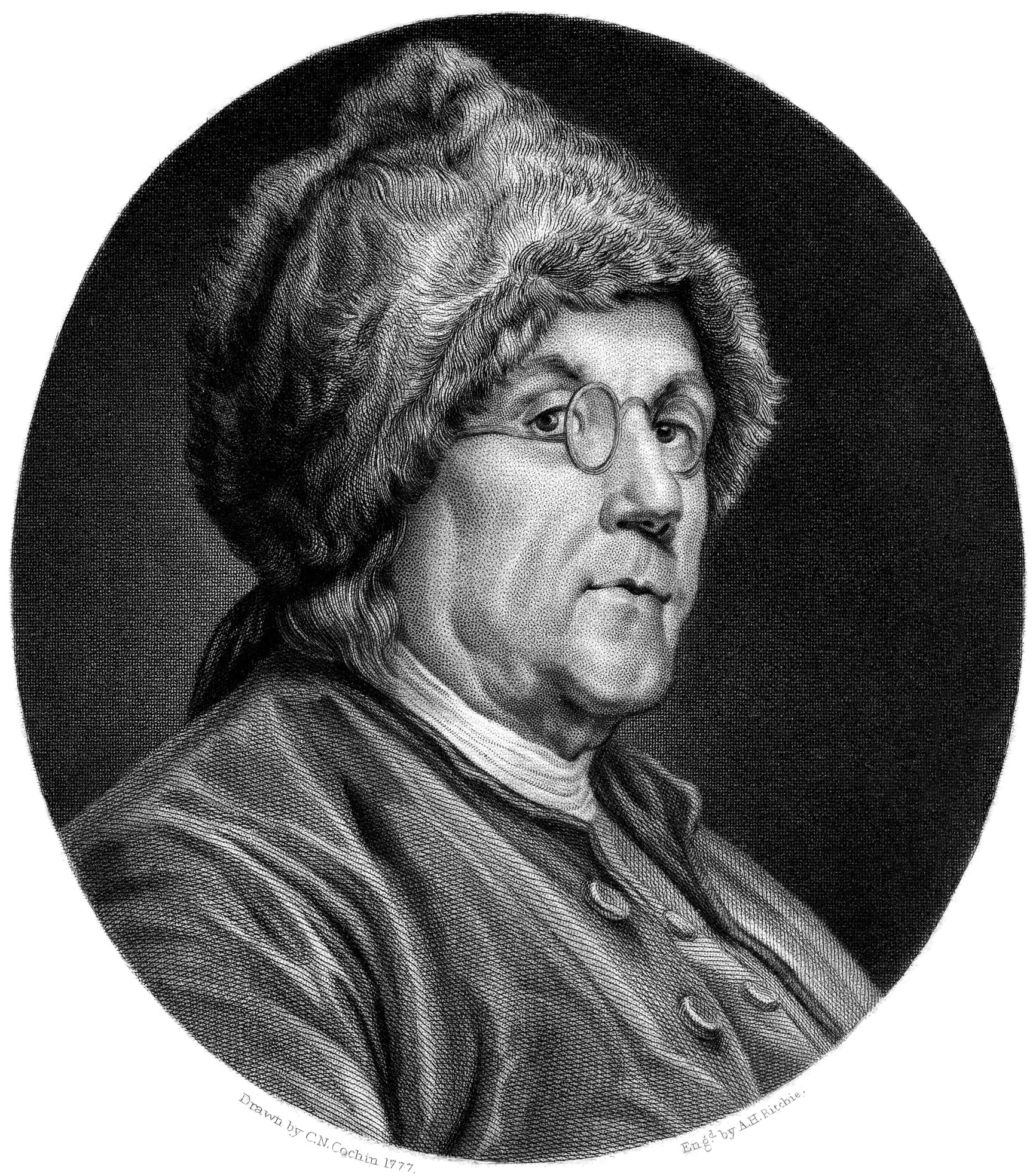
For those who advocate the free-form, no-study school of fiction writing, let me call from the grave an expert witness for the other side, one Benjamin Franklin. No slouch as a writer himself, Franklin was also a lifelong student of the art of living well.

In a letter to Lord Kames, dated May 3, 1760, Franklin wrote:

Most people have naturally some virtues, but none have naturally all the virtues. To acquire those that are wanting, and secure what we acquire, as well as those we have naturally, is the subject of an art. It is as properly an art as painting, navigation, or architecture. If a man would become a painter, navigator, or architect, it is not enough that he is advised to be one, that he is convinced by the arguments of his adviser, that it would be for his advantage to be one, and that he resolves to be one, but he must also be taught the principles of the art, be shewn all the methods of working, and how to acquire the habits of using properly all the instruments; and thus regularly and gradually he arrives, by practice, at some perfection in the art.

In Franklin’s autobiography, he sets out his method of moral improvement. He settled on thirteen virtues he wanted in his life: Temperance, Silence, Order, Resolution, Frugality, Industry, Sincerity, Justice, Moderation, Cleanliness, Tranquility, Chastity and Humility.

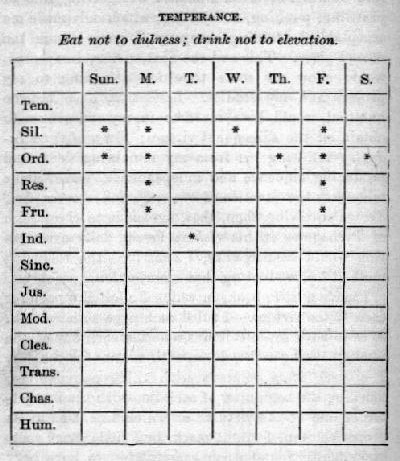
Next, Franklin printed up grids with the virtues in the left column, and rows of seven boxes, representing a week. He determined to concentrate on one virtue per week, and leave the other virtues to their “ordinary chance.” In the evening, he would look at the day’s page and assess how he did in the main virtue, while making a mark in those areas where he sensed he needed improvement. Here is what a page on Temperance looked like:

In this fashion, Franklin could go through all thirteen virtues four times a year. Business and sales folk have been using Franklin’s system for decades to improve their own performance. Not via Franklin’s virtues, but by determining their own areas of competence. These are called critical success factors (CSFs).

For fiction writers, I identify seven CSFs: Plot, Structure, Characters, Scenes, Dialogue, Voice and Meaning (Theme).

If you were to set up a self-study program, concentrating on one CSF for seven weeks, in one year you will have covered them all––with three weeks to spare!

Improving just one of the CSFs is going to kick your fiction up a notch. But what if you improved on all seven?

What if your goal was to get 10% better in each? (I know there’s no way to measure that, but you will be able to feel it. So will your readers). If you did that, your writing would improve not just a notch, but exponentially.

If this concept is new to you, let me suggest that you start by regularly investing in craft books.

For plot and structure, modesty prevents me from recommending certain books, like Plot & Structure and Write Your Novel From the Middle. Collegiality, however, would have me alert you to Story Engineering by TKZ’s own Larry Brooks.

My favorite book on characters is Dynamic Characters by Nancy Kress.

The best book on dialogue is How to Write Dazzling Dialogue. Modesty prevents me from naming the author.

Scenes? Make a Scene by Jordan E. Rosenfeld.

Voice? Voice (I’m over the modesty thing).

Meaning or Theme: Writing a Book That Makes a Difference by Philip Gerard.

There are, of course, many other texts you can add to the list. I love books on writing. I still read them. And Writer’s Digest. My philosophy is if I learn just one new thing (or a slightly different take on something I already know) that makes my writing better, it’s worth it.

We also have a stunningly good archive on the craft here at TKZ, too.

And if you feel like making in-depth investment in instruction on all of the above, I can sheepishly recommend the video course Writing a Novel They Can’t Put Down.  

Now, add to all that some of your favorite novels and authors who do these CSFs well. For example, when I want a refresher on dialogue, I might turn to Elmore Leonard or Robert B. Parker. For an action scene, I can whip out any of the Jonathan Grave thrillers by a fellow named Gilstrap. For voice, give me some Raymond Chandler or Ray Bradbury. Theme? To Kill a Mockingbird or The Catcher in the Rye. Scenes that end so you have to turn the page? Early Stephen King.

Make your own list. Read those books again, or for the first time, taking notes on what the author does well. In my bookshelf in the garage (moved there so I could have more room for books in my house) is a big collection of paperbacks I devoured in the early 90s as I was learning the craft. They are filled with my pencil underlines and marginal notes:

Character sympathy!

Read-on prompt.

Mystery dropped in.

You still have pencils, don’t you? Use them!

And don’t forget movies. I use film a lot when I teach because some of the most important CSFs are complementary twixt film and literature.

Want to see a perfectly structured movie? You can’t go wrong with The Fugitive. how about a big theme wrapped up in compelling characters? Casablanca. Dialogue? Double Indemnity. All About Eve. Sunset Boulevard. A lesson in tension? Eye in the Sky (a recent favorite). The whole history of movies awaits you.

Finally, do some writing exercises that incorporate what you’re learning. Write practice scenes, experiment with voice, do several pages of nothing but dialogue.

And yes, right alongside your study, be writing your novels. When you write, write. Be loose. Don’t think too much. Be very careful about the demon perfectionism. Write your first drafts as fast as you comfortably can, leaving the CSFs, as Franklin did with the virtues, to their “ordinary chance.”

Then, when you edit, think about and apply what you’ve learned.

Repeat over and over the rest of your life.

Do that, and Ben Franklin, flying his kite somewhere near Alpha Centauri, will look down and smile.

Publishing Trends to Watch in 2017

Jordan Dane

@JordanDane

Jordan Dane purchased image from Shutterstock

I’ve been involved in many “experiments” lately, like Amazon Marketing Services and Amazon Kindle Worlds. I plan to get more familiar with Kindle Unlimited with my upcoming release in Feb – Mr. January. Retaining my copyrights and self-publishing this book, I can explore more marketing tools to see how effective I can be. So I thought I would list some of these things to watch in 2017 as I see them. As always, I would love to hear your thoughts on trends you see as important in 2017 or marketing efforts you have had success with. Join in the discussion in your comments.

Publishing Trends to Watch in 2017

Marketing Power of Digital – Print books are expected to continue a comeback in 2017, but for anyone publishing fiction, e-books drive sales and are easier to promote since social media and reader websites offer more economical ways to promote. Digital is the gift that keeps giving in that each book is on a forever shelf. Any author can recreate interest in a back list novel by repackaging the work with a new cover or new content or bundling as part of a box set. (See more on this below in “Over-crowded Digital Book Shelves.”) It’s easier for an author or publisher to focus marketing efforts in the digital arena since it’s cost effective and the exposure can be much greater, but with all the e-book competition, marketing strategies will be more important in 2017.

Small Presses & Savvy Self-Publishers are Growing – The larger traditional publishers market shares are dropping each year. Over 50% of the market share is comprised of self-publishing authors, small boutique publishers, and Amazon imprints. The challenge comes when trying to navigate this new sea of 50-percenters. Simply discounting an ebook or offering it for free won’t cut it. That makes marketing and visibility more strategic in 2017. Amazon is offering their Amazon Marketing Services (AMS) to smaller houses and indie authors. With sales stats to track the effectiveness of this AMS marketing tool, it is an easy way for authors to try it and see how it results in sales vs cost to promote.

Amazon Imprints Are Dominating – In 2016, 7 out of 10 Kindle bestsellers were from Amazon Imprints. Is there an advantage to selling a book to Amazon in 2017 when it comes to their sales ranking algorithms? I don’t know, but if anyone knows how to maximize visibility and preferential marketing spots on Amazon, it would be their own imprints, don’t you think? When traditional houses offer bare minimum of support to most mid-list authors, selling to Amazon feels like an author has a leg up on marketing and promotion when the buyer is an Amazon imprint. An Amazon imprint could give any author an edge in marketing strategy in 2017.

Kindle Unlimited Expanding – More readers in 2017 will be finding benefits to the Kindle Unlimited program and Amazon markets their program effectively. This growth trend will undoubtedly affect e-book sales and I’m sure Amazon will find more incentives for authors to try their program. I see this program expanding in 2017 to keep Amazon dominating.

Kindle KDP Select Enhancements Provide Better Outreach – If you are part of the Kindle KDP Select Program, where you publish only through Amazon for a given period of time, you are automatically enrolled in Kindle Unlimited AND the Kindle Owners Lending Library (KOLL) and will earn different enhanced royalties as incentive. The KDP Select program also provides for better royalties globally (70%) in countries like Japan, India, Brazil and Mexico. Plus authors can expand their outreach through Kindle Unlimited in the US, UK, Germany, Italy, Spain, France, Brazil, Mexico, Canada, India, Japan, and Australia. (My reader fans have complained that Kindle Worlds books aren’t available for distribution yet into their countries, but until that happens, any books I have through KDP Select is available to many of my readers.)

Over-crowded Digital Book Shelves – New e-books have to compete with the over-crowded digital shelves of digital books in 2017 that never go out of inventory. The good news is that there is endless space for digital books forever. The bad news is that authors must compete with a growing mass of books competing for readership. Don’t forget your back list, authors. Redesign your covers, obtain new praise blurbs or write new book jacket copy, get new reviews, and spend marketing dollars toward generating new interest in your tried-and-true back list. The bigger your inventory for a reader to “discover,” the more visibility you can achieve and your promo dollars can go a longer way.

Audiobook Market Is Growing – I haven’t focused on this enough, but with indie authors able to use ACX to create an indie audio book, it’s worth a shot to make your own audio book in 2017 (if you haven’t sold your audio sub-rights). It’s always a good thing to make your book available in as many formats as you can – plus you get to retain your sub-rights in audio.

Marketing Strategy Will Be More Important Than Ever – This is a tough one for me and my biggest challenge. I try new things all the time to stay effective. I’ve seen good and track-able success in Amazon Marketing Services, but there are other marketing tools, such as BookBub, Freebooksy, and Bargain Booksy. In 2017, continue to expand your marketing strategies and evaluate what is working and drop what isn’t.

Facebook Ads Declining – I’ve never been a fan of Facebook. Their ads might not seem too costly, but unless you have a good metric to establish whether these ads are truly effective and result in actual sales, it doesn’t matter how much they cost. Some authors have used FB ads to increase their mailing lists, but for actual book sales, I haven’t seen anyone who can analyze this. With Amazon Marketing Services being a better option, with sales data tied to the promo, it is a much better option.

Try Expanding Your Foreign Sales in 2017 – Part of anyone’s sub-rights are foreign sales. If you have an agent, they could be marketing this for you “a la carte” or your publisher might have gotten your foreign rights when you sold to them. These foreign sub-rights have value and a potential for growth. And if you’re lucky enough to get your back list rights returned to you, try marketing to international markets. Many international buyers love American authors. If you’re an indie author on Amazon, you would notice the foreign markets they list when you set up your book, but there are other international markets. An agent or broker might be able to enhance your sales by tapping into this resource. Some may take English language “as is” or they may require language translation, but they pay an advance for the rights. It could be worth exploring in 2017 to expand beyond US and UK readers.

Authors Find Safety in Numbers – In 2017, expect to see more authors banding together in projects where marketing and promo can be shared. Co-writing books and creating box sets can generate buzz. Authors have always been generous with other authors and it warms my heart to see this, but it also makes good sense. The best part of the Amazon Kindle Worlds books comes from the cross promotion of all the launch authors banding their efforts together. We share our readerships with all the other authors, but get a lot in return. The concept of the Kindle Worlds launches and cross-promotions is a real benefit for all authors involved.

Discussion:
1.) What trends have you noticed that you’d like to share with your TKZ family?

2.) What marketing tools have you tried and had success with? Please share.

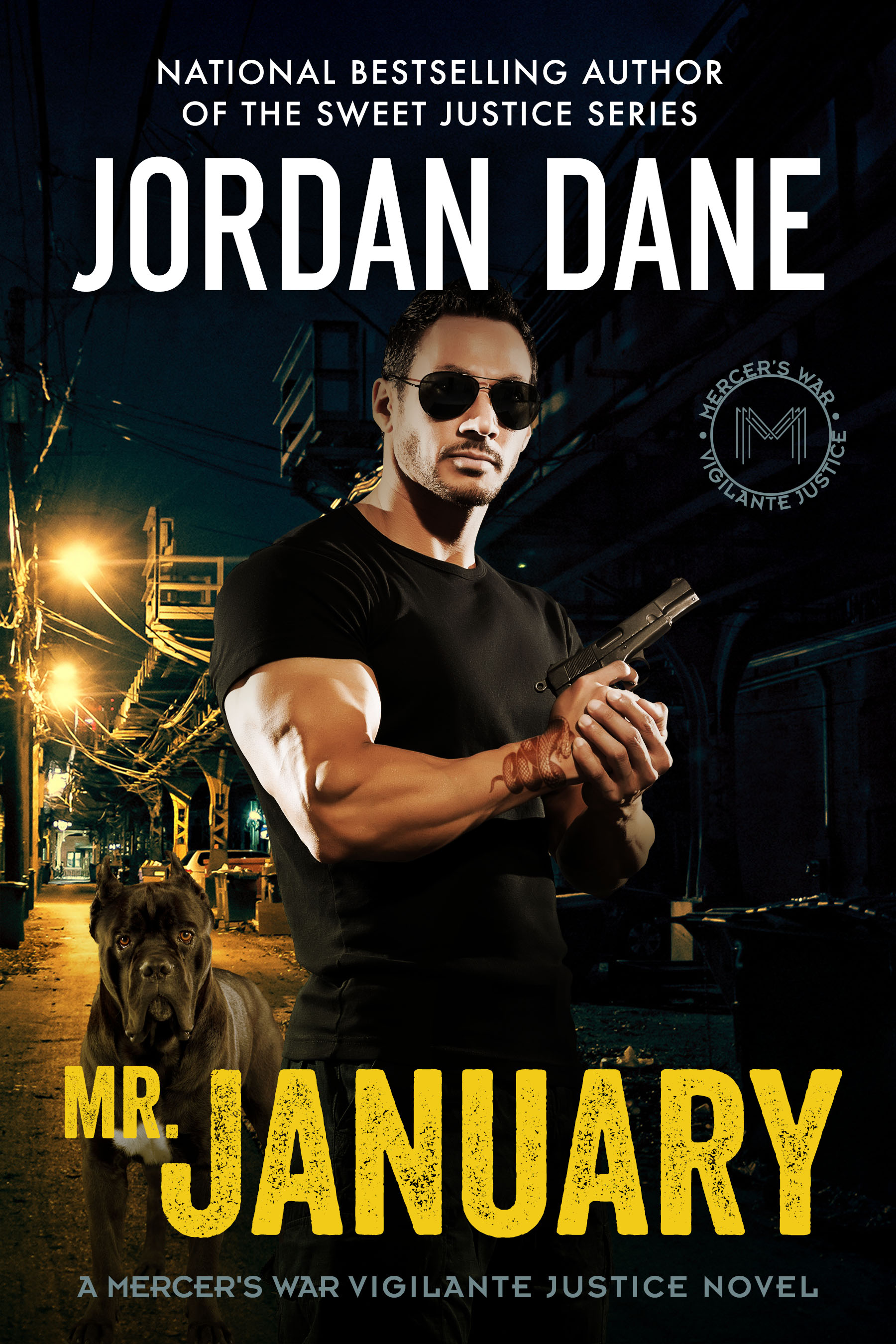
Mr. JanuaryMercer’s War Book 1 coming Feb 2017 in print and ebook

Zoey Meager risks her life to search for her best friend Kaity in a burning warehouse, only to cross paths in the inferno with Mr. January, a mysterious man with a large black dog, completely devoted to its shadowy master.


The So-What

by John Gilstrap

If you’re around this writing biz long enough, and attend enough seminars or classes, sooner or later you’re going to hear about the three-act structure.  I’m of the belief that there are no hard and fast rules in the world of fiction-writing—that if it works, it works—but it’s pretty hard to tell any story without a beginning, a middle and an end.

Now, the Syd Fieldses of the world embrace a form of the three-act structure that is far more draconian and, frankly, intimidating than mine.  Truth be told, looking back on 17 published novels, I would be hard pressed to identify precise act-to-act transitions in any of them.  I think more in terms of setup, development and climax.  Or, as I wrote above, a beginning, a middle and an end.

A few weeks ago, as I was teaching a two-hour writing seminar in Alexandria, Virginia, I was smitten with the notion that, structurally, there’s another critical element of successful storytelling: the so-what.  It’s a little hard to define, but it goes to the heart of what makes an otherwise well-told story fall flat, and what makes some mundane storytelling very successful.  In my view, it’s the missing element that renders a lot of so-called literary fiction to be under-performers at the cash register.

A successful so-what leaves readers satisfied that the time they invested in the reading was well-spent.  After investing a few hours (or a lot of hours) into reading a story, I need to feel that the characters I’ve bonded with have changed somehow, and that their journey has left their slice of the world somehow changed.  Brilliantly-painted word pictures and navel-gazing angst all have their places, but the absence of a good so-what leaves me, as a reader, a little angry at the author.  Would it have killed the writer to include an identifiable story along with the beautiful words?

Every year at ThrillerFest in New York City, International Thriller Writers Association sponsors an event called Pitch Fest, where attendees can carve out face time with NY literary agents to pitch their book ideas.  Last year, I agreed to participate in Practice Pitch Fest, in which I would sit where an agent would later sit and help writers hone their pitches.  It was a real eye-opener for me, not least because, never having had to pitch, I don’t know that I could do it.

After sitting across from fifteen, maybe eighteen authors, the most common weakness among the pitches I heard was the lack of a solid so-what.  Consider:

My book is based on my mother’s brave effort to conquer cancer. The so-what questions here are, how was your mother’s fight more brave or essentially different than every other mother’s fight to conquer cancer?  Why are you and you alone the right person to write this book?  What will the reader take away that is different from other books about parents’ brave struggles with illness?  Actually, this is the problem with most memoirs.

An emotionally scarred New Orleans detective stalks a serial killer who preys on tourists in the Big Easy.  Emotionally scarred detectives have been done to death.  The New Orleans beat is covered by countless gumshoes already, and serial killers are ubiquitous in crime fiction.  The so-what in a story like this could be the evolution of the detective over the course of the book from good to bad, or bad to good.  Or that the serial killer is of a nature that we’ve never seen before.  But without the so-what, the idea is just another serial killer book.  Been there.  Ho-hum.

Sometimes, the so-what has little to do with plot and everything to do with character.  For some mysteries—but no thrillers I can think of—the so-what is as simple as letting readers spend a fun few hours with characters they have come to love over the years.  But that’s a tough hill to climb for Book One.

So, does this make sense or am I all wet here?  Can you think of a book you disliked yet you thought you were going to love?  No need to name names, but when a book leaves you flat, what is the most likely missing element?

Fair warning: When this post appears, I will be in Las Vegas at the SHOT Show, researching what new toys Jonathan Grave needs to add to his arsenal.  I will accordingly be slow to respond to comments.

The Dénouement: Tying Up
the Yarn Strands of Your Story

It is the loose ends with which men hang themselves. — Zelda Fitzgerald.

By PJ Parrish

Another sleepless night. But – hazzah! – another idea for a Kill Zone post. Two nights ago, unable to stop the hamster wheel in my head, I took my pillow out to the sofa, hit the remote, and trolled for a good movie. Nothing except…

The last half hour of Spike Lee’s Do the Right Thing. Now I hadn’t seen the movie since it came out in 1989 and while I didn’t remember all the characters and plot points, I did remember that climax. And that is where I came in the other night, right when the tensions and heat in the Brooklyn neighborhood boiled over, leading Mookie to throw a trash can through the window of Sal’s pizza joint. All hell then breaks loose.

Spike Lee choreographs this climax with chilling precision. But what interested me was what came after. The next day, Mookie and Sal, standing in front of the smoldering ruins of the pizza joint, argue then reach a tepid reprochement. But Lee adds a coda of the local DJ (Samuel Jackson) greeting his listeners with the admonishment “Wake up! Up you wake, up you wake, up you wake! It’s gonna be another hot day.” Then before the credits roll, Lee gives us two quotes — from Martin Luther King Jr. on peaceful protest and Malcolm X on violence as self-defense.

That’s when I got up and jotted some notes for this blog. Because I think the ending of Do the Right Thing is a great departure point for a talk here about the dénouement.

De-noue-what?

You’ve probably heard this term bouncing about in craft books or maybe on conference panels. But I’m not sure we really know what it is or how we should use it in our books.
First, let’s learn how to say the sucker: It’s day-new-moh.

http://www.youtube.com/watch?v=dXbsK7eHirk

It comes from the Old French word desnouer, “to untie” and the Latin word nodus for “knot”. It’s the part of the story that comes after you’ve built up your conflicts in a rising arc of tension and blown up your plot in a giant fireball of gun fights, car chases, lovers’ quarrels, dying zombies or melting Nazis (I also watched Raiders of the Lost Ark this week). The dénouement is what comes after the climax, wherein you the writer have to tie up those loose plot ends, slap on some salve, leach out the suspense and resolve things into a nice satisfying conclusion.

Or maybe not. But we’ll get back to Spike Lee in a second. For now, let’s stick with conventional dénouements.

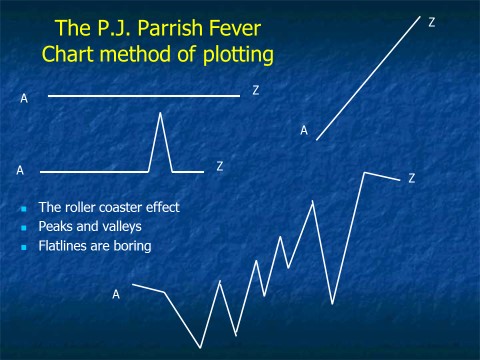
Above is a slide from one of our workshops. We’re making the point here that a good plot is never a flat line or even a comet-shot straight upward. It is like that fever chart at the bottom — a series of triumphs and setbacks for your hero but its main thrust is always upward toward the climax. And that little downward line out to Z is just the denouement.

Think of the dénouement as a coda to the big movements that precede it. It is a tail on the plot beast, but still important because it is where things are explained (if necessary) and secrets revealed (sometimes). Shakespeare was big on dénouements: In Romeo and Juliet, after the lovers are dead, the Montagues and Capulets gather and Escalus lays a big guilt trip on them all telling them their feud is to blame. At the end of Hamlet, with the stage strewn with bodies, Horatio shows up to remind us that the voices of angels will carry Hamlet to his heavenly rest, meaning his story – and thus he – will live forever.

To use a metaphor: Your climax is well, like a climax. The dénouement is smoking the cigarettes afterward.

Maybe it’s useful to stop here and think about the THREE-ACT STRUCTURE. James and others here at TKZ talk about this a lot, so if you aren’t familiar with it, pick up James’s books on plot structure or go troll through our archives. Here’s the skinny over-simplified: The first act is your set-up wherein you introduce characters and their world, set up your plot, and define the main conflict that is the hero’s call to action. The second act is “rising action,” a series of events and setbacks that build up to the climax. The third act is the turning point and climax that requires the hero to draw on strengths, confront the antagonist and solve the problem at hand. Then we move into “resolution” where conflicts may be fixed, normalcy restored, and anxiety (for the reader) released.

The dénouement is a big deal in traditional detective stories. You will often get at the end of the story Holmes or Poiret laying out the clues and explaining how they figured things out.
One of my favorite detective dénouements is from Psycho. The climax has Norman, dressed up as Mother, trying to stab Lila in the creepy cellar. But what comes next is the scene in the courthouse where the psychiatrist explains what happened to Norman.

https://www.youtube.com/watch?v=abAsTTC9puk

It’s hokey, yeah, but we need to understand how Norman got so twisted. Likewise, you might need such a useful scene to help untangle the yarns of your plot at the end.

My sister Kelly and I are struggling with this notion right now with our WIP.  We’re at the climax wherein our hero confronts the bad guy and triumphs, of course. The bad guy has to die. But we realized that while we knew why our antagonist had rotted from within (and you need to know this!) we had no one in our cast of characters to explain it to the reader.  Yes, the hero can surmise things about the bad guy, and you need to sow the clues of personality throughout the story. But sometimes, in the end, someone — like the shrink in Psycho — has to give it context and history.  So we went back and inserted a new character early in the book — hidden in plain sight — who will, in a denouement, give testimony.

There’s a great example of dénouement in Arthur Miller’s Death of a Salesman. After the climatic fight between Biff and Willy and Willy’s suicide (to get insurance money) there is a final scene called “Requiem” where the family gathers at Willy’s funeral. Sadly, no one has come to pay their respects. Biff laments that Willy had “the wrong dreams.”  And Willy’s wife, who has been able to cry, breaks down, sobbing that the house is now paid for, repeating “We’re free…we’re free.”

Both Terminator movies have nice dénouements. In the first one, Sara Conner in her Jeep, guns and dog in tow, pulls into a last-stop desert gas station where a young boy points to the darkening sky and says “a storm is coming.” Sara’s last line before she heads off toward the apocalypse — “I know. I know.”  In the sequel, the dénouement is the “good” Terminator lowering himself into the fire pit to destroy his microchip and thus save the world.

Another of my favorites is from The Shawshank Redemption. After Andy Dufresne escapes from prison and disappears, the story is essential over and all is resolved. But no…we are treated to his friend Morgan Freeman’s touching narration about going free: “I hope the Pacific Ocean is as blue as it is in my dreams.”

We can debate this, but I think a denouement is different than an epilogue.  An epilogue is an animal unto its own world, a specific literary device that has a special purpose, often yoked with a prologue.  The denouement usually takes places immediately following the climax and resolution; an epilogue is usually separated by time — week, months or years later. Sometimes it hints at a sequel to come, or it serves as a commentary of sorts on what has happened. It might sum up what happened much later to the characters. Think of way George Lucas used this device in American Graffiti — as the credits rolled, he shows graduation pictures of each character and listed what happened to each i.e. “Curt Henderson is a writer living in Canada.”

A good denouement is subtle. What you don’t want to do is end up with an extended “Now I have to explain why I have to kill you” speech. This is not a true denouement; this is just a bad climax.  The skeins that you weave as you move through your story should come together in a logical and satisfying pattern.  And if you have some little loose threads that might poke out after that — well, that’s what the denouement is for.

But then there’s the big question: Do you have to untie every knot? Do you have to snip off every loose thread? No, of course not. I love ambiguity in endings. I don’t like anal books that clean up everything. And truth be told, I don’t really enjoy those classics mysteries where the detective gathers everyone in the dining car and lays it out there.  I want to figure some things out for myself. And I crave some messiness in my fiction.  Not all stories are neat; not all storytellers color within the lines.

Which brings me back to Spike Lee and his denouement for Do the Right Thing. It doesn’t tie up anything in a pretty bow.  In fact, Lee rejects the whole idea of traditional closure. Mookie and Sal are left in a wary face-off that personifies the unease of race relations in general in this country.  The mayor (Ossie Davis) tells Mookie to “do the right thing” but no one in this story really knows what that is, which is the only thing that is clear at the end.  So what can Spike Lee leave us with except the denouement he offers — two powerful and deeply conflicting quotes from King and Malcolm X.  And a final picture of them shaking hands?

Some knots just defy untying.


The Fear Factor

“Do one thing every day that scares you” – Eleanor Roosevelt

I’m writing this blog post on Thursday in anticipation of a long weekend in which I am (finally!) going to learn how to ski (cue drum roll…) I’m sincerely hoping that come Monday when this blog post will be posted, I will have survived the experience in one piece (no broken bones, smushed body parts, or too many bruises at least). The hardest thing for me will not be the physical aspect (although, to be fair, I am immensely uncoordinated) but the mental ‘fear factor’. I’ve been cross country skiing before and loved it – basically you get to hike with skis on and you don’t have any shrieking speed issues unless you take a wrong turn. Actual downhill skiing, however,  is quite another thing –  something that involves overcoming my fear of speed (or, more precisely, careening out of control).

My husband snowboards and my boys have been taking skiing lessons since we moved to Denver so I’m the last hold out (if you don’t count our collie Hamish, who, to be sure, would love it if he could have skis on his paws).  It seems strange to me that I think nothing of moving continents or taking risks with my writing, but skiing (like bicycle riding) remains a definite ‘fear factor’ to overcome. I managed to combat my fear when it came to bicycle riding (although I’m still a slow poke!) so I’m sure I’ll survive skiing – the question is whether I can overcome fear to actually enjoy it!

I’ll keep you all posted, but, hopefully, by the time this posts on Monday and I can respond to comments, I will have mastered the basics of downhill skiing!

So TKZers, what is your ‘fear factor’ and are you planning on overcoming it in 2017?…If so, how?