What Writers Can Learn from “Pork and Beans” – Guest Writer Steven Ramirez

Jordan Dane

@JordanDane

Photo Courtesy of Eli Duke

My guest today is Steven Ramirez, the horror thriller author of the series TELL ME WHEN I’M DEAD. Catchy. We met on Twitter, like normal people. Steven lives in Los Angeles and has also published short stories as well as a children’s book (this scares me), and he wrote the screenplay for the horror thriller film ‘Killers.’ Welcome to TKZ, Steven.

Steven Ramirez

I first heard Weezer’s “Pork and Beans” when my younger daughter was teaching herself the bass. She would blast it every day, following along on her instrument. Eventually, I found myself listening to the lyrics. I came to love that song and now have it on my phone. Yeah, I know. Talk about late to the party. Well, in my defense, I mostly listen to straight-ahead jazz, so.

But enough about Weezer…

Trying Not to Be a Pompous Ass
As a writer, I can really identify with those lyrics. I won’t quote them here, but you can use this LINK if you want to refresh your memory. The point is, the books I choose to write are a product of my, shall we call it, pork-and-beans attitude. I really don’t give a crap about researching popular genres and writing the kinds of books I think people might like. I notice a lot of “experts” like to give that kind of advice to non-fiction authors. To me, that’s right up there with “write what you know.” Spare me. Now, on the surface, I might sound a little pompous. But stick with me for a sec. I am simply trying to stay true to myself. You know, like Lady Gaga.

I watched a lot of movies and television as a kid. My favorites were horror, sci-fi, and comedy. As I grew older, I came to appreciate thrillers. And in the last few years, I fell in love with Westerns. I guess I can thank Sergio Leone and Clint Eastwood for that. I also love foreign films—especially those from Japan and Korea. As you can see, my tastes tend to run the gamut. I do lean toward horror, though. In fact, my first four books revolve around zombies and demons.

Some Really Cheesy Math
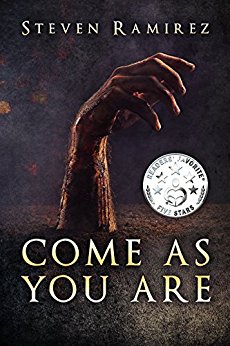
Recently, I read a Wikipedia article which stated that, as of April 2017, Amazon’s Kindle Store had nearly seven million titles available in the US. Seven million! I have no idea if that number is accurate. As of this writing, my latest horror novella is at around 41,000 in Amazon’s best sellers rank for paid eBooks. Take a look.

Now, that’s a long way from the top 100, but here’s how I look at it. Keep in mind, I am terrible at math, but I think you’ll get my point. Let’s say, conservatively, that out of the 7,000,000 titles offered at Amazon, half are fiction. I’m guessing it’s more than half, but this is just for the sake of argument. So, that’s 3,500,000 fiction titles—all genres. Now, let’s say that of those, half are free due to a promotion or whatever. That brings the number down to 1,750,000 paid titles. Still with me? Okay. Out of this number—which is shaky at best—my book is at 41,510. This is the only true number based on the screenshot above. So, that means Come As You Are is in the top two percent of paid books. Now, as I said, this whole thing is pure speculation. But at least it’s the kind of voodoo economics that lets me sleep at night. Know what I mean?

Style as Brand
What I am saying is, despite me writing what I want instead of chasing some fad because some expert told me to, I managed to get my book pretty far up the chart. Okay, I’m no Stephen King, but who is? And another thing, let’s forget about the stupid ranking for a minute. What’s really interesting about this exercise is that there are real readers out there who seem to like my work. And that’s what it’s all about, isn’t it? Getting people to read your book. It’s about creating a brand through your personal, one-of-a-kind writing style and doing your best to let those folks who enjoy that sort of thing find out about you. It’s what I strive to do every time I sit at the computer and type out another sentence.

The truth is, I currently have more ideas for novels that I could ever possibly write in this lifetime. But I promise you, the books I do manage to write will be always good. Otherwise, I won’t publish. And you may not always like the genre. For example, I’ve been toying with a time travel story—not because time travel is popular, but because I have what I think is an interesting idea and want to see it come to life. What I’m hoping is, there are readers out there who will fall in love with it. You never know.

If I had to leave you with one piece of advice, it would be this. Don’t write what you know. Instead, write what keeps you up at night—something that’s burning a hole in your gut and giving you nightmares until you commit it to the page. In other words, write the thing that comes out when there’s a gun at your head.

For Discussion:

1.) For writers: Have you built your brand on a single genre, or are you comfortable pursuing interests outside the genre?

2.) For readers: Do you prefer authors who stick with a single genre, or are you more interested in the author, no matter the genre?

Come as You Are: A Short Novel & Nine Stories

Links for Steven:

Newsletter

Twitter

Website

Facebook

First Page Critique: “Kimberley Creed”


Happy Wednesday!

It’s time to present another First Page critique of a Brave Writer’s work. (Updated to reflect title)

________

Kimberley Creed

“Are you listening to me?” his dad asked him. He nodded, but he hadn’t been. He had been watching in wonder at the group of chanting demonstrators marching down the main street and the half a dozen or so cops standing by. He’d never seen such a commotion.

His father glared at him, his fearsome black eyes striking terror into David. He knew his father could tell when he lied and cringed as the expected hand struck him hard. Whack! on the cheek, his head jolting, ear ringing as the side of his face throbbed. His eyes opened wide in pain as his throat tightened, stopping him from breathing.

“Don’t miss,” Tracker said. “If you do, you owe me fifty bucks. You got it?”

David nodded, still facing the ground. Finally his throat loosened and he was able to suck in a breath, keeping his mouth open to avoid whimpering.

“Focus! I’ll meet you back in the park soon,” Tracker said, and walked away.

David composed himself, wiped his face and looked up. His father lurked at the back of the crowd, looking for a suitable victim. But most of the people around him were locals, David could tell by the way they were dressed. Locals were too much trouble. Tracker wanted a tourist and wandered off the path onto the long stretch of lawn that separated the street from the beach. Dozens of people lingered there, watching the demonstration. Many wore fashionable beachwear, definitely tourists, and David looked over them, trying to guess which unlucky mug Tracker was going to choose.

An attractive couple was canoodling on a bench, oblivious to their surroundings. Easy, but too young. Not cashed up. Then there was the group of young surfers. Too fit; probably fast runners. There was a young father and two young kids seated around a table having lunch. Perfect, the father won’t leave his kids. But he doesn’t look like the kind of fella to have a thick wallet. Then there was the grey-haired couple enjoying a glass of wine and packed lunch at a portable picnic table. Probably retired. Grey nomads. They’ll be loaded for sure.

David looked at Tracker, who was looking back at him and had been waiting for eye contact. Tracker gave a furtive look to the grey nomads, having already picked them out. David nodded and headed towards them.

Tracker walked behind the couple, reached down to the grass and appeared to pick up a fifty-dollar bill.

“Excuse me,” he said. The couple turned and saw him holding up the note. “I think you dropped this,” Tracker said.

“Oh, goodness,” the woman said. The man pulled his wallet from his pocket.

David took a deep breath.

“Thank you, that’s very kind of you,” the man said and took the fifty. That was David’s cue, and he bolted. The old guy stuffed the fifty inside his wallet, and before he could slide it back into his pocket, it was gone – snatched out of his hand, as David shot through.

——-

Brave Author, you’ve got an interesting story here, and a very strong facility for clear, declarative prose. Let’s talk a few housekeeping details:

Don’t make your reader work too hard, especially at the beginning of your story. It’s okay and necessary to identify your characters by name.

So it could open: “Are you listening to me, son?” David’s father asked him.

Or: “Are you listening to me, son?” David’s father clamped a rough hand on his shoulder, jerking him away from the window.

(I had the sense David was looking out a window, but then I wasn’t sure when the father simply walked away. If they were in public, surely his father wouldn’t have whacked him on the head. Perhaps they were in an alley? Or in a copse in the park? Do establish the scene in a quick line or two.)

Though many writers discourage opening a story with dialogue, it’s a rule I break all the time, particularly at the beginning of a chapter. But you might consider another, non-dialogue opening for the beginning of a novel or story.

The sudden mention of the name, Tracker, jarred me out of the moment, and I had to read the beginning again to make sure there weren’t three people in the scene. You can correct that in the second paragraph with something like:

“His father–who was given the nickname Tracker by the uncle who’d started him in the pickpocketing game–glared at him, his black eyes filling David with terror.”

Since you’re telling this story from David’s close 3rd POV, “Tracker” should probably read as “his father” throughout the piece because he wouldn’t think about his father’s first name. It’s the safer approach. Others may disagree. But if you stick with Tracker, establish it quickly.

While “he said” and “she said” can disappear into the background, their overuse can be grating. The same with starting a long series of sentences with “He…” As you read (and you should be reading lots!) pay careful attention to the way writers use bits of action or description of the characters who are speaking to indicate that they are connected to the dialogue. (As above, with David’s father putting a hand on his shoulder, which connects the character and dialogue and also clues us in to his unpleasantness.)

I don’t understand how David could hear what his father and the old couple were saying. Surely he wasn’t standing just a few feet away. You can have him imagining the conversation or reading their lips or simply have him guess at it since he’s seen it happen before.

What are David’s feelings about what he’s seeing? Does it bother him that he’s ripping off old people?

Paragraphs 6 and 7 are outstanding. They beautifully illustrate the process the con men go through to choose their marks. Well done! The cool objectivity of the paragraphs does make David seem cynical and very involved in the game–and that’s not the impression I get from both the opening of the piece, and Tracker’s worry that David might screw up. David seems more sensitive and sheltered, i.e. he’s never seen a demonstration before and doesn’t think murderous thoughts about his father.

Keep at it Brave Writer. You are doing great!

TKZers, what’s your advice for our Brave Writer?

First Page Critique: The Wickedest Girl

Photo purchased from Shutterstock

Today we are critiquing the first page of a story called “The Wickedest Girl”. I’ll add my comments at the end, and then please give your feedback in the Comments.

The Wickedest Girl

When my brother Nico gave me a Wicked CD for my eleventh birthday, we all knew what he wanted as a graduation present. He had done the same thing four years ago with Matilda, and then we went to the show in July. Now it’s the week before school, and no one had mentioned anything.

I stretch out on my bed and run my hand over my side table until I find the stack of CDs. I have five in all: Wicked, Matilda, Legally Blonde, and two Broadway Christmas albums. I pick up the top CD and read the braille on the cover: Wicked: the Musical. On the back it says: to Olivia who is always defying gravity.

I can’t help smiling. The messages are from Nico, brailled on to a thin sheet of paper that can peel like a sticker. How he managed to get it done—while at college no less—I’ll never ask.

I lean over and press play on my CD player—a machine I only ever use to listen to Wicked since the songs aren’t yet copied on to my iPod. I press the skip button until I reach song eleven, and then flop on my back to listen.

“Something has changed within me/ Something is not the same/ I’m through with playing by the rules/ Of someone else’s game”

I don’t know why I keep listening to this song. It tells me to break rules. It tells me to not listen to grownups. It tells me to defy gravity. And that has never worked for me before.
“With you and I/ Defying gravity / They’ll never bring us down.”

Back in second grade, I had a horrible teacher. Well, she wasn’t exactly horrible, just dry and sour, a person who despised fun and creativity. Back then I was obsessed with Matilda, and had followed her orders to be naughty. My friend Rosa and I had done it together—smeared Mrs. Walsh’s blackboard with glue and dirt and written the worst messages we could think of—but since I was the one under a magnifying lens for being blind, I was the one who took the heat. The general group of teachers that governed my life back then had labeled me mentally delayed and behaviorally unstable. Mamma had managed to clear all of that up before Christmas, but I will never forget it.

Matilda led me astray once, I won’t letting Elphaba do it again. Yet here I am, listening to the song that will influence me the most.

My comments 

I’m intrigued by the narrator in this story—her physical handicap gives her an immediate obstacle to overcome, and makes me want to learn more about her. I loved the anecdote about the chalkboard, and the way this writer establishes her close relationship with her brother at the top.

I got tripped up by a few issues. I stumbled over change of tenses in the transition between the first and second paragraphs. The switch to the present made it feel as if I’d entered a completely different story. (Disclosure: I’m not a fan of stories written in the present tense, although I understand it is used by many YA authors. I find it a tedious to read a story written in the present tense. I once had a lengthy debate with an aspiring YA author in my critique group about the perils of using the present tense. She decided not to use it).

In the last paragraph, I stumbled over a missing word (be?) in “I won’t letting Elphaba do it again.” I also think it would help bring the reader back to the present if the writer would add a “had” to “Matilda led me astray” in the first sentence of the last paragraph. (I was puzzled by the reference to “Elphaba” in the next line, but I suspect it’s a musical reference that I’m too old and tone deaf to recognize ?.)

Those nits aside, I do love the character and relationships that are being introduced in this story. The voice is engaging, which is a huge accomplishment by the writer—creating a compelling voice is one of the biggest challenges in writing. I hope to read more of this story at some point in the future. Thanks to today’s courageous writer for submitting this page!

TKZers, please add your feedback about “The Wickedest Girl “ in the Comments. Thanks!

With Help from Jeffery Deaver, Let’s Rock This First Page Critique!

Posted by Sue Coletta

Greetings, TKZers! Another brave writer has submitted a first page for critique. Rather than nitpick, I’ve approached this one a little differently. My comments are below. Hope you’ll weigh in too.

1st Page Critique


“Coming Home”

“Did I tell you I knew your father?”

John put on his best fake smile and nodded. “Yeah, you mentioned it when I first came in. You played football together?”

Ralph continued, “Yeah. Hank was one hell of a lineman. In our senior year against Haynesworth, he knocked their quarterback six feet into the air and…”

John couldn’t help but tune out. He’d heard the stories of his dad’s glory days retold hundreds of times with varying degrees of exaggeration. It happens when you live in a small town where everyone knows everyone else. It’s even more common when your father died becoming a local hero. It was bad enough when he was a kid, but ever since John returned home after flunking out of college last month he ran into people every day who felt the need to explain their connection to his father. He knew the story of every guy his dad had ever met or arrested and every woman he dated in high school. He just didn’t expect it during a job interview.

“…the refs decided we would get the point, the crowd went crazy. That victory carried us through the rest of the school year, but I don’t think that quarterback ever walked right again.”

John struggled to picture the large man sitting across the desk playing football. He couldn’t imagine this guy lifting anything heavier than a bowl of gravy since his beet-red face was sweating from the exertion required just to have this conversation. The man had to have had help squeezing his butt between the arms of that old wooden office chair which creaked horribly every time he moved.

John pushed to get the conversation back on track. “Pops, ur…sorry, Poplawski said you were looking for someone to start immediately.”

“The sooner, the better. Jim just walked out on us. No notice or nothin’. He came back from his shift one day last week and took his uniform off right here in this office. Said ‘this job doesn’t pay enough for this kind of shit,’ threw his clothes on the floor and drove home in his skivvies. Can you believe that? Left me in a pinch. I had to go out on his calls for the rest of the week.”

* * *

Overall, I liked this piece. Loved the voice too. With a few tweaks, I think this could be a strong first page. Brave Writer has given us a peek into the main character’s background without resorting to a huge info. dump. Paragraph four dances on the edge, but not so much that it pulled me out of the story. We have a sense of who John is and some of the difficulties he’s had growing up in his deceased father’s shadow. Life in a small town isn’t easy, and that’s clear.

I’m a sucker for snarky characters, so I loved this line:

He couldn’t imagine this guy lifting anything heavier than a bowl of gravy since his beet-red face was sweating from the exertion required just to have this conversation. 

It may read better if you broke it into two sentences, but I’d rather concentrate on the bigger picture.

What this first page is missing is a solid goal, something the MC needs to achieve more than anything. Sure, he’s applying for a job, but it doesn’t seem like he cares if he gets it. Why, then, should the reader care? Our main character must be in a motivated situation with an intriguing goal or problem to overcome.

The writer may want to save this piece for later in the story, even if it’s used on page two or three, and instead draw us in with a more compelling goal. Or, show us why this job interview is so important to John. Without the job, will he lose his house? Not have food? Is he trying to escape this small town for some reason?

Also, I’m not a fan of opening with dialogue unless it’s used for a purpose. For example, to raise a story question or to intrigue the reader. Dialogue, especially when used as an opening line, needs to sparkle (I’ll show you what I mean in a second). Without context and grounding, we risk disorienting the reader.

Let’s look at an example of dialogue that works as a first line and adds conflict to the entire first page. Maybe it’ll help spark some ideas for you.

The following is from The Burial Hour by Jeffery Deaver. For clarity, my comments are in bold, the excerpt italicized.

“Mommy.”

“In a minute.” 

Bam! Right off, we feel the tension mounting. 

They trooped doggedly along the quiet street on the Upper East Side, the sun low this cool autumn morning. Red leaves, yellow leaves spiraled from sparse branches.

Mother and daughter, burdened with the baggage that children now carted to school.

In five sentences the author has grounded us in the scene. We’re right there with the characters, envisioning the scene in our mind’s eye. Without even reading the next line we can sense the urgency of the situation. Plus, we can already empathize with the characters.

Let’s read on …

Clare was texting furiously. Her housekeeper had—wouldn’t you know it?—gotten sick, no, possibly gotten sick, on the day of the dinner party! The party. And Alan had to work late. Possibly had to work late.

As if I could ever count on him anyway.

Ding.

The response from her friend:

Sorry, Carmellas busy tnight.

Jesus. A tearful emoji accompanied the missive. Why not type the god-damn “o” in tonight? Did it save you a precious millisecond? And remember apostrophes?

“But, Mommy.” A nine-year-old’s singsongy tone.

“A minute, Morgan. You heard me.” Clare’s voice was a benign monotone. Not the least angry, not the least peeved or piqued.

first page critique

Can you see why this 1st page works? The goal is clearly defined and the main character needs to achieve it. The snappy dialogue between mother and daughter creates conflict. The voice rocks, and the scene hooks the reader. We need to read on in order to find out what happens next. More importantly, we’re compelled to turn the page. Questions are raised, questions that need answers. And that’s exactly what a first page should do. Don’t let us decide whether or not we want to turn the page. Grab us in a stranglehold and force us.

Over to you, TKZers. What advice would you give to improve this brave writer’s first page?

Get Some Rejection

by James Scott Bell
@jamesscottbell

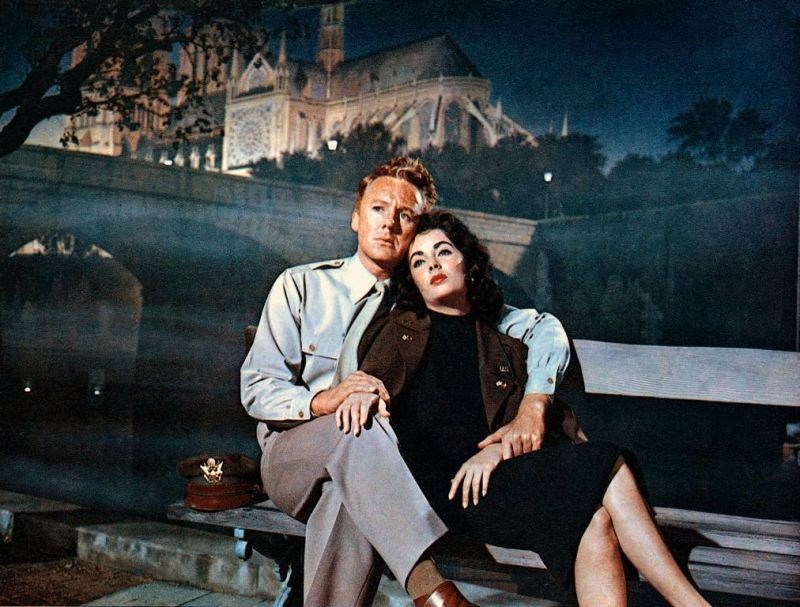
Van Johnson and Elizabeth Taylor in The Last Time I Saw Paris

The other day I watched an old MGM movie, The Last Time I Saw Paris (1954). It stars Elizabeth Taylor at her most gorgeous and Van Johnson at his most likable. Van plays a GI in Paris on VE Day. He gets kissed in the crowd by Liz, which is not something a GI would ever forget. When he sees her later at a party, he makes a beeline for her. Soon they are in love. Then married.

Van had been a wartime correspondent for Stars and Stripes, and lands a job in the Paris office of a wire service. But what he really wants to be is a novelist. He works diligently on his first novel, and finally sends it out.

It’s rejected at several houses. Van is naturally disappointed, but Liz talks him up, tells him to keep trying.

So Van spends the next couple of years writing his heart out. When he finishes the new manuscript he has Liz read it. As he looks on anxiously, Liz puts down the final page and gazes into Van’s eyes. “It’s even more beautiful than the last one,” she says.

Huzzah! He sends it out.

Rejected and rejected and rejected!

Marital strife ensues. Van spends another two years writing what is left of his heart out. But when he gets more rejections he nosedives into depression. He gets drunk, throws things around the apartment, and screams at Liz, “Let’s face it! I just don’t have what it takes!”

If you want to know about the rest of the movie, you can look it up on Wikipedia.

I mention it here because it captures what real writerly rejection felt like in the “old days” of publishing. Most writers born after 1990 haven’t experienced such a rebuke. They’re part of the participation-trophy, instant-gratification generation, and know all about self-publishing, be it on Wattpad or Amazon or blog or vlog or pod.

Well let me tell you kids something. Back in the pre-Kindle days—and especially in the 1950s and 60s—the walls of the Forbidden City were huge and ominous. “Serious” hardcover fiction (as opposed to pulp-style paperbacks and book-club mysteries) was the shelf “real” writers wanted to crack. Some—like Norman Mailer, Leon Uris, Herman Wouk, Sloan Wilson, Carson McCullers—made it, garnering critical or popular acclaim, or both. Most unpublished writers longed for same. And never got it.

Dreams died hard.

They still do outside the gates of the Forbidden City. Because of the great digital disruption and ensuing retrenchment in traditional publishing, there are even fewer slots for new writers. The City must depend even more on A-list blockbusters or celebrity debuts to sustain its Manhattan overhead.

In a private conversation with an agent friend, I was told that the market for new fiction writers is all but gone. From a business standpoint, that makes sense. The industry is understandably risk-averse. Yes, new deals are being made. But not nearly so many as ten and twenty years ago.

Which brings us to self-publishing, the greatest boon to writers since Gutenberg. No longer does rejection by the Forbidden City mean it’s all over, that you’ll never make it, that your dream of writing and finding readers is dead in the water.

Van Johnson would have been amazed by this.

So it may come as a bit of a shock when I tell you what I sometimes advise a new writer anxious to self-publish. Especially if it’s their first book. I say, “Get some rejection.”

Stay with me.

Before self-publishing became viable, when you got rejected it truly tested your mettle. First novels almost never got picked up by an agent or publisher. And most of the time they never told you why. Just something like, “Does not fit our needs at this time.”

This would sting for a few days. Maybe you’d throw things around and think, “I just don’t have what it takes!” But if you were a real writer you’d get back to work. You’d figure out (with help from others) what was wrong with your writing. You’d study the marketplace. If you were wise, you’d study the craft, too. Maybe join a critique group, go to a conference or two or three. Invest in yourself.

Most important of all, you would continue to write. And then maybe two or three or five years later an agent would take a chance on you. And another year or two later, you might land that first contract. And then eighteen months later, your book would hit the stores.

And you would discover the truth behind Martin Myers’ keen observation: “First you’re an unknown, then you write one book and you move up to obscurity.”

Yet all that rejection and heartache and sticktoitiveness made you a better writer. Which, in turn, increased your chances of having an actual career.

So if you’re a brand new writer with a brand new novel (and a lot of you will be at the end of this NaNoWriMo month), go out and get some rejection. Use the beta reader grinder system. Seek open and honest opinion. Take the chip off your shoulder. Consider hiring a freelance editor. Start thinking like a business. Set up quality controls.

Heck, spend a month studying our library of first-page critiques. Talk about a concentrated course on storytelling!

Sure, you can skip all that and toss your novel up on Amazon, where it will get rejected by the people you most need—readers.

Or you can be a little patient, work hard, listen and learn and improve, and greatly increase your chances of success.

So go get some rejection. Just don’t get drunk and throw things around your apartment. Especially your keyboard.

So what about you? What has been your experience with the R word?

***


Oh, and for those of you who saw last week’s post and wanted to know when the print version would be available, well, it’s here.

Reader Friday: Aloha! (And Mea Culpa)

Note: Reader Friday is kicking back in Maui today, and forgot to post in time for early morning. Reader Friday blames an excess of parasailing and Mai Tais by the beach. Aloha!

Speaking of zen, Iif you could pick one tropical paradise or idyllic location to live on as your personal writing retreat, where would that be?

First Page Critique: Excellent Imagery, Intriguing Find

By Elaine Viets


This first page critique takes us back in time and back to the Old Country – Ireland. Let’s take a look at this offering. After the critique, I’ve made some comments. What do you think?
——–
No Title
Ireland 1240 AD

Eoin kicked the fallen oak’s trunk in disgust. He raised his face to the sky and loosed a stream of curses at the dark clouds. The reply came in a torrent of heavy rain drops that slapped his face like a thousand tiny fists, forcing him to turn his eyes back to the massive tree that that’d crushed the stone wall and let his sheep escape into the next farm. His father, Aengus O’Dowd, would have demanded his neighbor Finn return the lost sheep. But Finn hated Eoin, sole survivor of the fever sickness that had recently claimed both parents and his sister. According to tradition, if Eoin died Finn would have first right to claim the O’Dowd lands as his own. Therefore Finn counted Eoin’s recovery as theft, prevented him from becoming the wealthiest farmer in the county.

Lightning cracked in the sky, illuminating the twisted limbs like demon fingers reaching from the bowels of the earth to suck the remaining flicker of life from his Eoin’s weary soul. He tossed a scoop of mud over his shoulder and stabbed the blade back into the ground. The shovel jerked wildly as it glanced off a flexible tendril of root, slipped from his hand, and fell into the hole beneath the tree. It landed with a hollow wooden thump.
“What is this?” Eoin muttered as he stared down.

He jumped into the hole, mud splashing as he landed. He picked up the shovel and poked the metal blade into the soil probing for whatever it had hit. On the third jab he got the same hollow knock. He scraped soil away to reveal a smooth black surface, then dug until he found the edges of what appeared to be a large wooden box. Eoin soon freed it from its earthly tomb and heaved the chest up to the surface, climbing out after it. As wide as the length of his forearm and about two thirds that in both height and depth, sealed completely in pitch.
|
Night was falling. He carried the box into his house.
“Get away,” he hissed at the cat, who’d immediately gotten under his feet, “or I’ll step on you.”

Too exhausted to light a lamp he, he shrugged off his wet clothes, exchanging them for dry, dropped a peat log onto the embers in the fireplace and passed out on his mat nearby.

=================================================================

Elaine Viets: The author has a mystery here: Eoin has found a mysterious box under an uprooted tree. But there may be too much mystery in this first page.

Who is Eoin? How old is he? What does he look like? Is he a big man? Bearded? Muscular? Scrawny and overworked?

Eoin’s soul is described as “weary,” and Eoin recently survived a “devastating” fever. Has the fever left him weakened? Give us some hints.

Eoin’s sheep escaped. How many? If he’s a farmer, he knows exactly how many sheep he lost: two, five, six. Part of his wealth is gone.

Do we really need Eoin’s father’s name in this sentence?

“His father, Aengus O’Dowd, would have demanded his neighbor Finn return the lost sheep. “We have several names thrown at us in one paragraph: Eoin, his father and Finn.

What if you tried something like this?

            Eoin’s father would have demanded his neighbor Finn return the lost sheep.
The paragraph raises more questions:
Why doesn’t Eoin demand Finn return the sheep? Is he afraid of Finn? Is he too weak? Is Finn politically connected? We should know.

Instead we’re told, “But Finn hated Eoin, sole survivor of the fever sickness that had recently claimed both parents and his sister. According to tradition, if Eoin died, Finn would have first right to claim the O’Dowd lands as his own. Therefore Finn counted Eoin’s recovery as theft, prevented him from becoming the wealthiest farmer in the county.”

Finn’s hatred shouldn’t keep Eoin from claiming what is rightfully his. Give us a good reason.

There’s too much writing about the weather. First, the rain beats down on Eoin’s face:
“He raised his face to the sky and loosed a stream of curses at the dark clouds. The reply came in a torrent of heavy rain drops that slapped his face like a thousand tiny fists . . .”

Then, “Lightning cracked in the sky, illuminating the twisted limbs like demon fingers reaching from the bowels of the earth to suck the remaining flicker of life from his Eoin’s weary soul.”

That’s a little overdone. Think about stopping the sentence after “demon fingers.”
There is excellent imagery here. I especially liked the discovery of the box. Well done! But how does Eoin feel about this discovery? Does he think it might have a treasure to make him rich? Will it bring more trouble? Has he heard rumors that something – or the bones of someone – were buried in this area? Show us his feelings.

When Eoin gets home, he bullies the cat. Is that deliberate? Do you want to make him less sympathetic? The page ends with a cliff hanger: Eoin is “too exhausted” to open the box. I’m not sure that works. Maybe you could have him faint from exhaustion.
Be careful of the typos.

You have an intriguing situation here, Author, and good imagery. Solve some of these mysteries and you’ll have a first-rate beginning.

Get the complete Angela Richman, Death Investigator series: Brain Storm and Fire and Ashes, on sale now. http://tinyurl.com/yczfeeak

First Page Critique: Indianner

By John Gilstrap

Let’s go right to the piece submitted by our brave writer, and I’ll see you on the other side.

INDIANNER

CHAPTER ONE

Megan’s long nails played across the keyboard. Click. Click. Click. Acrylic on plastic keys. She paused, staring at the poster hanging above her computer. Grabbing a black marker, she leaned over her monitor and circled the faces of the three Native Americans dressed in traditional regalia. Circled their faces until she wore a hole in the paper. Around her bedroom, posters of gothic metal bands fought for the remaining wall space. Their dark lyrics appealed to her. She smiled as she glanced around the room at the black-circled faces staring back at her from every corner. A few more words and she was done. Click.

She refocused on the poster with the Native Americans: two women and one man, appearing in a musical performance that night in Frankfurt, Germany, a short walk from Megan’s hometown of Bad Homburg. This was her second time seeing the Navajo singer/songwriter Doli Yazzie in concert. Last time was disappointing; this time Megan was better prepared. She had post-concert passes in her purse, won through a contest held by Doli via her Facebook Fan Page. Megan was fascinated with all things Native American. “Dances with Wolves” and books by German author, Karl Friedrich May, were  cult favorites of Germans and other Europeans who followed their own version of the pow wow trail. As popular as the Renaissance Faires in the United States, the teepee camps and Indian pow wows arranged by and for Non-Natives were scheduled throughout the year in Germany and other countries. Megan was an active participant.

Shawnee/Creek flute player, Ella Longhat, and Ella’s husband, Caddo/Shawnee Charlie Longhat, a noted Native film producer and pow wow dancer, were something of an afterthought for her. Took up too much space on the poster, she thought. She was only interested in Doli.

“Megan, come on. We’re waiting on you. Momma says hurry. We’re going to be late.” Her little sister banged on Megan’s locked bedroom door.

“Go away, brat. Leave me alone. I’ll be there in a minute.”

Megan stood up, repositioned her chair, and rearranged her desk, squaring off a stack of paper, realigning pen and pencil. She glanced back and forth from Doli’s poster to her full-length mirror as she dressed in black pants and black t-shirt, the same way Doli dressed for concerts. Megan imagined herself looking like Doli, but Megan was a large girl, nearer to woman than child, a recent high school graduate working at a local American fast-food franchise. She brushed her dyed black hair, muttering as she covered a lighter section with a green parrot feather, and applied blush and lipstick to her pale face. Glancing one more time at her reflection, the poster, and a final time at her reflection, she joined her mother and two younger sisters. They walked in silence to the concert hall.

=

It’s Gilstrap again.

What a ride, huh?  A gripping tale of . . .

Wait.  Nothing happened.  No, seriously.  Nothing.  Happened.  In 474 words, Megan made circles on posters, thought a lot about music that is entirely unfamiliar to me, and she got dressed.  The purpose of this exercise is to learn how to grab readers’ attention with exciting prose that is worthy of the single most valuable patch of real estate any book can have.

Whether writing a thriller, a mystery, a romance or a literary novel, something needs to happen that will engage the reader.  The first paragraph needs to make us hungry for the second paragraph.  Ditto the first page for the second page.  This piece disappoints at every level.

Now, let’s talk about the writing itself, which feels young to me, and is not without promise.  Here’s the first paragraph again, but annotated:

Megan’s long nails played across the keyboard. Click. Click. Click.  As written, the nails are acting independently.  I would prefer that Megan drives the action: Megan played her fingers across the keyboard, acrylic nails against plastic keys. The “click <period>” construction plays as very slow typing.  If that is the writer’s intent, then fine.  But I sense that it is not the intent.

She paused, staring at the poster hanging above her computer. Grabbing a black marker, she leaned over her monitor and circled the faces of the three Native Americans dressed in traditional regalia.  There’s nothing wrong with this writing, but the -ing construction of the simultaneous action bothers me.  I would write this as separate sentences, restructured to have Megan drive the action: When she paused, she looked up at the poster she’d hung on the wall above her computer screen.  It showed three Native Americans in traditional regalia—two women and a man—who’d performed last night just a few miles down the road from Megan’s apartment in Bad Hamburg, a suburb of Frankfurt.  Grabbing a black marker, she leaned over her monitor and circled their faces.  Then she circled them some more.  And more.  Until her marker wore a hole in the paper.  Until those faces looked like all the other faces on all the other posters on her walls.

I don’t mean to presume to rewrite your piece, but I just combined two paragraphs into a few sentences, and while there’s still no action, there’s a sense of weirdness that I think is kind of cool.

All of the esoterica about the music and what she likes and what she doesn’t needs to be deleted, or at the very least moved elsewhere in the story.  Too many names come flying at the reader too quickly, and it’s confusing.  They call that stuff backstory for a reason—because it belongs in the back of the piece.  Certainly not the first page.

Finally, avoid the urge to be coy with your reader.  Specifics bring us into the story.  Her little sister has a name, so use it.  If you mean McDonald’s, don’t say, “American fast-food franchise.”

What say you, TKZ?


Cutting Open the Sausage:
A Hard Look at Rewriting

“I have rewritten — often several times — every word I have ever published. My pencils outlast their erasers.” –Vladimir Nabokov.

By PJ Parrish

This is it. This is the third draft. This is the last best chance to get it right.

I’m in rewrite hell this week. Actually, it’s not hell. To me, at least. I love this phase of the process because the really hard work is done — the laying of the foundation, the erecting of the beams, the finishing of the roof.  Now I just have to go back in and make sure the structure is sturdy, the flow from room to room logical, and the style true to my own. Oh, and it would be great if someone gets so emotionally caught up that they maybe want to buy it.

Rewriting is where the book is truly made. No one will ever convince me otherwise. Yeah, my sister and I can turn out a pretty decent first draft, but who wants pretty decent these days? What reader would settle for it? What writer would? So I’m digging back into the coffee-stained third draft this week to up the ante as far as I can.

Now maybe you’re one of those rare birds who can produce a perfect book in a single swoop. (Like Lee Child who told one interviewer: “I don’t want to improve it. When I’ve written something, that is the way it has to stay.”). But most of us need to go back and reassess and rearrange. I always tell my workshop folks that the first draft is written with the heart, but the second, third…tenth, well, that’s written with the head.

Two quick tips: Wait as long as you can stand after you finish your first draft to start rewrites. You need a break from the beast that has consumed your life for eight months or eight years. Also, I always print out a manuscript for rewriting because the eye, so attuned to the screen, becomes inured to error and excess.  Seeing your work in a physical state also gives it a gravitas that the computer can’t imitate. Here’s my big baby in three messy piles:

Now what I’d like to do is show you my draft’s innards. But before I drag out my sausage machine, let’s do a quick review of rewrite basics:

Structural Problems

This is a big issue, so be prepared to spend a lot of time and brain-power on it. You’re going to find plot holes to plug, characters to amplify, a muddy middle to amp up, conflicts to bring into higher relief. Oh yeah….and you might uncover that elusive theme.  Ask yourself all the basic questions that our bloggers here post about: Is your three-act structure sound? Do your characters want something and is it important enough to drive their arcs? Is your central conflict tantalizing enough to support a whole novel? What, at its heart, is your book about? (not plot, but theme.).

Logic Lapses

Does your plot make sense and it is believable? (Those are two different things). Do you resort to a deus ex machina or the Long Lost Uncle From Australia villain reveal? Do your characters act in accordance with their natures or do you have them doing stupid illogical things? Are your police and forensics procedures sound or did you try to fake it? (ie clip and magazine are not the same). Does your research hold up? Is your fantasy, horror or alien world well-rendered and credible?

Confusion and Clarity Issues

Can the reader easily figure out what’s going on? This does not mean artful misdirection or red herrings. This means you choreograph movement and events carefully, everything from small stuff like moving people across a room or a country to big things like why did they did a certain thing (motivation).  Do you make it clear where we are and what time period we’re in? Can the reader discern a mood or tone in your book (dark? hardboiled? humorous? sardonic?)

Flabby Writing

Have you ferreted out all the junk-writing? This includes overwrought and repetitious description, dumb physical moves (“He bent his left arm and brought the beer up to his lips.”…no, he took a drink.)  Do you rely on adverbs instead of muscular dialogue? Have you pruned away all the unnecessary words you can, especially as you near the last third of the story when the reader wants to move faster?

Proof Reading

Spelling, grammar, punctuation…know them or hire an editor who does. Watch out for dumb inconsistencies like changing a character’s eye color or name spelling. Double check for errors (use Google maps to verify that it is, indeed, a four-hour drive from Moose Butt to Manitou).  Did you get rid of all your brain farts? I once read a novel that described the crime as as grizzly murder. Shoot, in one of my first drafts, I had a distraught character balling like a girl…thank God for editors.

Okay, now let’s look at some of my mistakes and I’ll show you how I hope to run ’em back through the sausage-making machine:

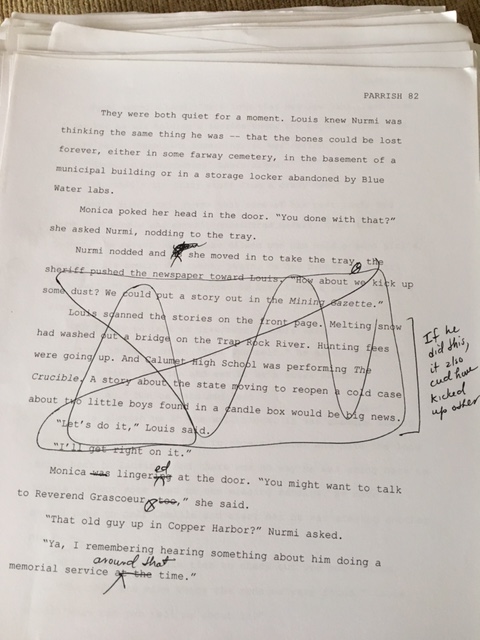
Here we are on page 1 and already I have a problem. In my first chapter (indeed, the whole book) I neglected to tell the reader what year we’re in. My series started in year 1981 and has progressed now to 1991.  I have to make sure my readers know this early because the forensics, cell phones, computers are all going to be different. But notice that I DID find a way to tell readers we are in Lansing Michigan.  I have a logic/plot problem here. In the deleted part, the sheriff offers to plant a story about Louis’s case in the local paper, hoping to stir up leads. But if he does this, it will tip off a suspect who I have come forward fifteen chapters later — and it blows up the plot! This sounded good when I wrote it on pg 82 but it doesn’t hold up on page 345.
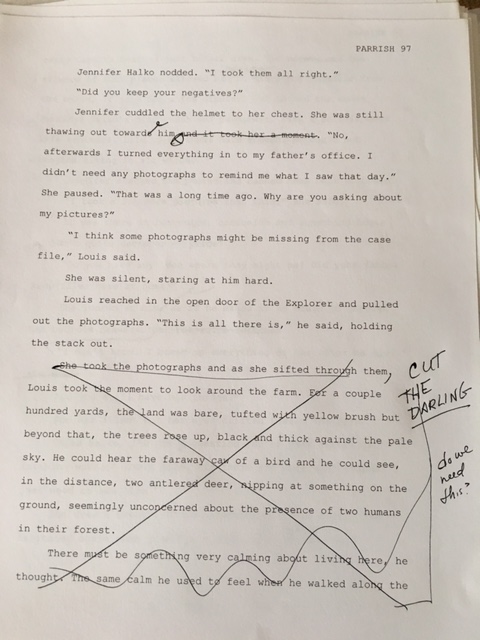
This one falls under Elmore Leonard’s Kill Your Darlings.  Louis is about to uncover a major gruesome clue and plot point on next page. (Yay! Momentum!) Why in the world do I need him looking around this farm at deer or listening to crows? (Boo! Screeching halt!) It was a pretty image when I wrote it but adds nothing, especially since I had already described the lonely isolation of the place in vivid detail two pages ago.

Nice clean page, right? Except for one bone-headed mistake. One of my main characters is a teetotaler. It’s a big point in his make-up, which my hero Louis knows. So why does Louis set a beer at the man’s side? Always watch for dumb mistakes and inconsistencies. In film, a script supervisor oversees the continuity of a movie including wardrobe, props, set dressing, hair, makeup and the actions of the actors during a scene. You don’t have one of these backing you up. So be careful.

I call this one the Jacqueline Susann problem. The copy after the double space is the beginning of a seven-page scene where Louis goes to a state forensics lab to log in his evidence. It’s interesting in so much as it shows nerdy police procedure. But my book is running long so I have to MAKE DECISIONS about what to put “on camera” and what to recount in narrative. Now some scenes must be on camera (decisive action, great clue reveals) but some stuff can be dealt with efficiently in a character’s thoughts after the fact.  I am going to cut this scene and in the following chapter just say “Louis went to the lab in Marquette and logged in the evidence.”  Back to Jackie Susann: When she turned in one of her potboilers, she devoted an entire chapter to a Democratic National Convention (she had gone to one and was going to show off her research, damn it!). Her wise editor Michael Korda told her to cut it.  She fought him but in the end the book said: “The convention was held.”
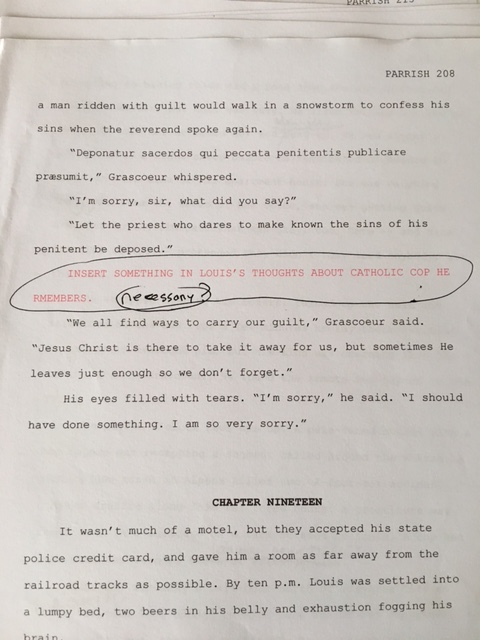
See the part in red? During first draft, I was trying to hone the theme (forgiving those who hurt you as a child) so I was acutely aware of all religious references I used. In this scene, Louis has interviewed an ex-priest who took confession from a murderer decades ago. The priest talks about the sanctity of the confessional but how his guilt eventually drove him from the Church. Catholic cops grapple hard with this issue. But after a powerful scene with the priest, do I really need Louis thinking about this? No, it was one theme-bridge too far.  Lesson: Have a theme but don’t preach.
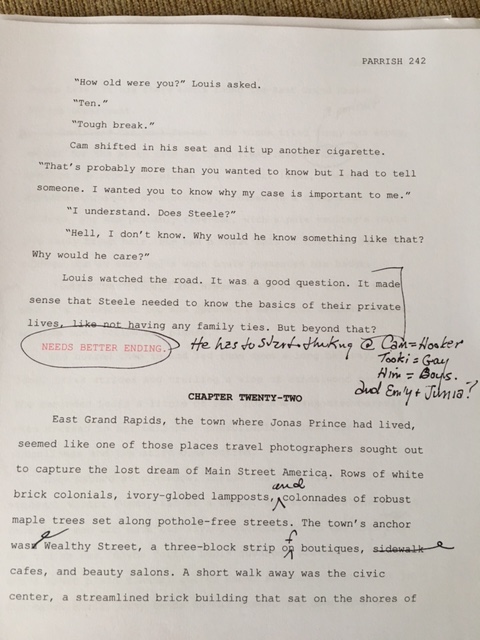
I am a perfectionist. It is hard for me to move on until I get a paragraph, a scene, a chapter right. I am trying hard to change this flaw. My sister flogs me constantly: JUST WRITE! So now I put notes to myself in red to fix it later. This is called faith. {{sigh}} Read the ending of this scene. It sucks, right? I know that. I will fix it. Lesson: Don’t get paralyzed by perfection. Move forward. Chances are excellent that by the time you finish the first draft you will know exactly how to make an early chapter end — or begin — with more punch and precision.
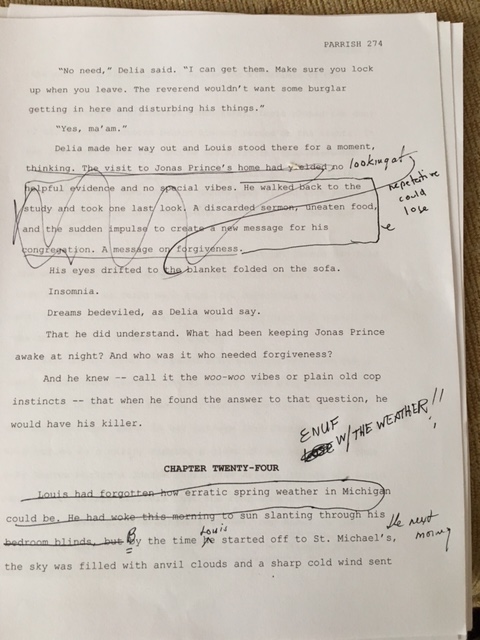
Look at the beginning of chapter 24.  Argh! I opened it with weather. Now, that is okay except that it is April in Michigan and it is raining almost every day in my book. By page 274, the reader GETS that because I have told them at least four times. Lesson: Go easy on weather and don’t repeat the obvious.
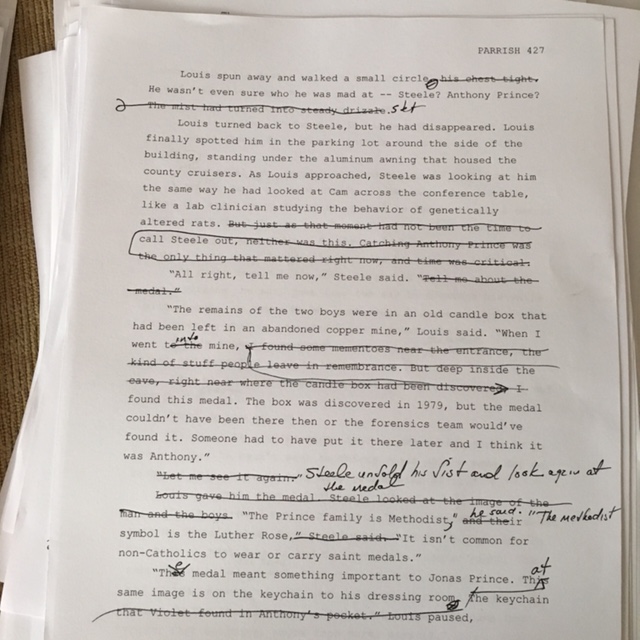
I included this page just to make the point about flabby writing. All the stuff I crossed out is fat. Always aim for economy, which is not the same as underwriting (a sin in its own right). When you are just moving characters around in time and space, do it with as few and unflashy words as possible.  Almost half the pages in my manuscript are marked up like this.
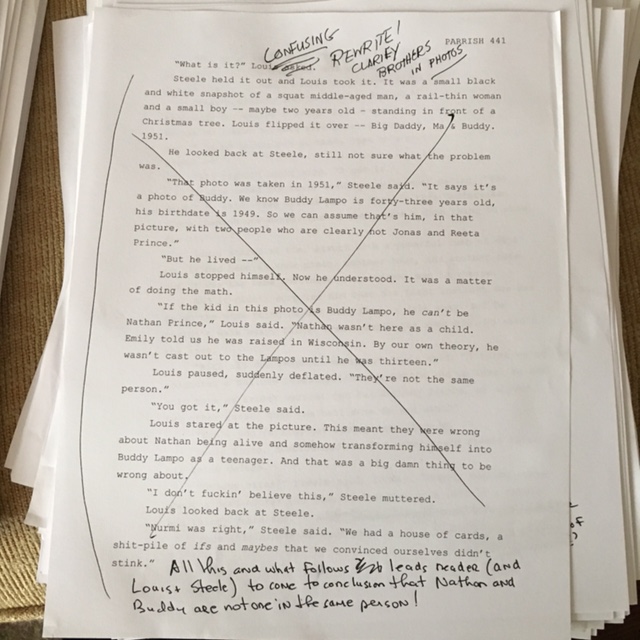
I saved the most important one for last. The sin isn’t apparent to you but boy, did it jump off the page when I read it in rewrites. We laid down a very complicated bread-crumb trail of clues in this book about mistaken identities, time-lines, family trees. So it was critical that as the book neared its climax, we explained this so the reader would understand how the puzzle finally fit together.  Well, we didn’t do a good job of ‘splainin. As a major clue, we had two photographs of boys that we thought was a peachy misdirection but it only confused the reader in the end. It came on page 441 and was a major plot mistake that we had to acknowledge and correct. It was major surgery but without it, the book would have died. Lesson 1: Don’t avoid the hardest work. Lesson 2: Don’t confuse the reader. Especially at the end, after they have invested so much time and heart into your story.  Make the ending clear, satisfying and logical.  Your plot twists must be well-earned.

That’s it, crime dogs. Now if you’ll excuse me, I have work to do.


First Page Critique: Historical Thriller

Today we have a historical legal thriller to examine as part of our regular first page critiques. Sometimes historical fiction can be intimidating – especially when (as is the case in this first page) we are unfamiliar with the period or location in question. My goal as a historical fiction writer is to provide a story which helps overcome that initial uncertainty through: 1) a well established sense of place and time; 2) an authentic, period appropriate voice; and 3) a sensory evocation of the period that helps immerse a reader in that place and time. In addition to these three goals, I also hope to provide a rich layer of drama and intrigue, characterization and plot (…pretty much what we hope for in most novels!). Luckily, I think today’s first page manages to establish a pretty good foundation to achieve all these goals. Kudos to our brave submitter and read on. My specific comments follow.

Title: In the Matter of Lucy

Genre: Historical Legal Thriller (1840s)

Chapter One

Narrative of Orlando B. Ficklin, Esq.

A law office is a dull, dry place.

Leastways, that’s what “Mr. H” told me on my first day as an apprentice.

God, but I could use some dull and dry right now. You wouldn’t believe what the people of a backwoods Illinois county can get up to in the way of shenanigans in the year of our Lord, one thousand eight hundred and forty-seven. Lying, cheating, stealing, screwing, welching, divorcing – there seems no end to the vices of this hamlet. And the half of the them – and not always the better half – find their way to me.

This week has been a busy one for laying bare offenses, large and small. The circuit court is in town for the spring session. It’s a regular curia regis: Judge Hopkins and an itinerant band of attorneys traveling through the “realm,” arguing and dispensing justice, when they aren’t eating, smoking, drinking, whoring, and swearing. Our courthouse, such as it is, is a backroom of Deskin’s Tavern. It’s no unusual occurrence to find judge, lawyers, litigants, witnesses, and jurors at the same dining table.

Yesterday, I defended the Meisenhalter brothers.  David Adkins had sued them for slander. Once, for Levi calling Adkins a “damned pig thief,” and again for Robert calling him a “damned infamous pig thief.” Fortunately, the truth was our best defense: Adkins had, in fact, stolen five hogs a few years back in another county. The jury found for my clients and I got my own hog – rightfully earned – as compensation.

Today, I’m watching – and learning – from the master: Mr. Lincoln.  He’s representing Eliza Cabot in a slander case, one more titillating than my own with the Meisenhalter boys. Eliza is suing Frances Regnier for saying that Elijah Taylor was “after skin” and had got it with Eliza, that Taylor “rogered” Eliza, and that Elijah “has got some skin there as much as he wanted.”

Lincoln has just asked Taylor if he knows the difference between adultery and fornication. After some thought, Taylor answered: “Well, I’ve tried both…there’s no difference.”

The galley roars with laughter.

Despite the performance, I’m distracted.  My mind wanders to this morning’s “mail”: a rock, thrown through my office window, with the following note:

“Take on that damned ni – – er’s case, and I’ll see you in Hell.”

Specific Comments

My comments focus on the goals I identified above:

1) A well established sense of place and time

What I enjoyed about this first page is that I felt we immediately had a well established time (1847) and place (some small backwoods town in Illinois) without the need for any unnecessary data-dumps or overly long descriptions. I could easily envisage the setting without being given much in the way of description as the key elements were all there (the back room of Deskin’s Tavern for example and the two law cases that were highlighted with humorous specificity). This first page demonstrates that historical novels don’t need a huge amount of period description at the start – just enough to evoke the time and place and allow the reader to step into the scene quickly and easily.

2) An authentic, period appropriate voice

Overall I think the voice in this first page is strong and authentic. I had some minor quibbles with word choices (like ‘leastways’) but those were just personal preferences. The first person narrative is strong and humorous and the voice of Orlando Ficklin Esq. seems to be one that has enough interest to sustain the story. Given it is his narrative, I did wonder whether we needed the quotation marks around the words realm and mail – they seem to distract as other quotation marks are around other character’s actual speech/dialogue. I also wondered why the ‘n-word’ in the final line of the page was censored, as I assume the threatening note on the rock thrown through the window would not have been. I was also briefly taken out of the narrative by the term ‘rogering’ as I associate that more with British slang – I have no idea if this was used in the USA in the 1840s – but would just advise the author to double check all the words used to make sure they would have been in common usage at that time/place.

3) A sensory evocation of the period

Most often we associate ‘sensory evocation’ with descriptions involving sights, sounds and smells to evoke a historical scene. In this first page we don’t really get any description of what people are wearing or sensory based period details but I think we get enough in terms of scene setting with the snippets of conversations provided and the first person narrator’s view on the circuit court proceedings. I expect as the novel progresses more period details will be provided that will fill out the historical scene for the reader.

So far, at least for me, we have a solid basis for a story that I would be more than happy to continue reading. The last line also provides a great set up for the drama and intrigue that is to come. What do you think, TKZers?