
 Every September 15, I owe a book to my publisher, and somehow, every September 12, it’s not quite done. It’s close. I’ve written all the scenes, and the story has a complete structure, but I’m in the throes of making right that which is close. It’s a tedious, arduous task, and alas, it takes away from activities such as blogging. Feel free to gossip about my awesome new cover, but for now, I must go back to making stuff up. I’ll see you here again in a couple of weeks. Sorry about this.
First Page Critique: Can Your
Language Be Too Blue?
By PJ Parrish
We have a new contribution from a writer today. For me, it hit home, because it made me think about something I had been dealing with in my own books. I’ll explain after you take a moment to read today’s submission. Thanks writer!
Darkness
His cell phone buzzed and rattled on the bedside table, forcing Jake Barnes to fight his way up through the haze of a deep sleep. He slapped blindly in the dark, searching for the offending device. Wiping the sleep from his eyes, he looked at the screen. Shit, three thirty in the morning, and of course its work calling. When he had taken the supervisor’s position at the Energy Control Center in St. Paul, Minnesota, he hadn’t expected the phone to ring quite so often. And its always something they could handle on their own if they tried.
He answered the call with a quiet “Wait.” Sliding out of bed, he stepped into the bathroom and closed the door. “This is Jake, go ahead.”
“Holy shit, man, I’m glad you answered. We are having some serious problems right now.”
Jake winced and moved the phone an inch away from his ear. “Not so damn loud, Glen,” he said, leaning back against the sink. “Take a few deep breaths and start from the top, OK?” Glen Reynolds was another of the supervisors at the ECC, running the night shift this week.
“Sorry. It’s been a rough night. We were running the Sunday night system scans when the backup went down. As soon as IT hit go, the damn thing went black. We called in Ron to help, but he couldn’t get it running either. So we are down to one SCADA, and we have no idea why we lost the backup.”
The line was silent as Jake thought about the situation. The SCADA were computers used to control complex systems, made by Siemens in Germany.
“Jake, you still there?”
“Sorry, I was thinking. Look, I know things fail, but when is the last time you saw one of the SCADA go down?” He paused, waiting for an answer. When Glen didn’t respond, he continued. “Exactly. Is the primary server still working?”
________________
Okay, let’s start with general observations. First, it’s cleanly written (except for some typos and such). It’s easy to figure out what is going on — guy (protag maybe?) getting roused from sleep with a “situation.” But here’s the rub: Do we care?
I can’t count the number of times I have read this opening. The person’s job may change (usually, it’s a cop getting called out to a murder scene) but the action-catalyst is always the same — the call that comes to wake someone up and spur them to action. It’s been done to death. The fact that Jake isn’t a cop doesn’t really make it feel any fresher. It’s a tired trope of crime fiction and maybe it’s time to retire it forever.
We talk often here about how an effective, grabber opening conveys a sense of disturbance, how we need to show that something has gone awry in the normal world. The disturbance can seem small (but as the plot plays out, we learn it was important). Or it can be earth-shattering, like a killer comet is heading our way and someone has to save the world.
It can be personal. In fact, I’d say the best disturbance/openings are usually human in scale. I pulled Miami Blues off the shelve to show you this opening from one of my favorite writers Charles Willeford:
As Roy Dillon stumbled out of the shop his face was a sickish green, and each breath he drew was an incredible agony. A hard blow in the guts can do that to a man, and Dillon had gotten a hard one. Not with a fist, which would have been bad enough, but from the butt-end of a heavy club.
Or maybe the disturbance is something that the protag observes. Here’s a dandy from John D. MacDonald:
We were about to give up and call it a night when someone dropped the girl off the bridge.
Maybe the disturbance starts out personal but morphs into something big, like Stephen King gives us in It.
The terror, which would not end for another twenty-eight years – if it ever did end – began, so far as I know or can tell, with a boat made from a sheet of newspaper floating down a gutter swollen with rain.
This opening gives us a boy who tries to retrieve a paper boat from a drain and gets lured in by a killer clown who cuts the kid’s arm off.
But what an opening disturbance shouldn’t be is trite or tired. It has to be a catalyst for the conflict to come. And it has to feel like you alone among all writers could have put it on paper. So, if you’re going to start your book out with a phone call, you better make it good, like this:
When the phone rang, Parker was in the garage killing a woman.
That’s Richard Stark aka Don Westlake. He knows his way around a juicy opening.
Back to our submission: There’s nothing wrong about it on the surface, as I said. Jake Barnes quite literally takes the proverbial “three a.m. call” challenge. The caller literally says, “We have some serious problems.” I wonder, dear writer, if there isn’t a more original way to begin your story? Just because it’s about computer geeks instead of cops doesn’t make it less hoary. If this big computer failure is your dramatic catalyst, why not start with Jake right on the scene? You can say he had been roused from sleep by a cohort, but why not START with him in action instead of in bed?
Now, let’s talk about the language — specifically the profanity. I’m going to throw this one out for discussion because there are arguments on both sides on this subject. Side 1: People swear. It helps make the dialogue feel more realistic. Side 2: Profanity is a big turn-off for a lot of readers, so why do it?
I come down on this somewhere in between. I write about cops and PIs, so my books have their share of blue language. I even drop the f-bomb when I really feel it’s needed. But over fourteen books now, and yes, after getting feedback from readers, I have really toned it down. In the first draft, I cuss like a sailor. But these days, on rewrites, I almost always take most of it out. Profanity can get old really quick. And not because it is offensive. Because it is can feel forced, almost desperate. If my characters swear, well, hell, they have to be well-rendered, right?
Now, I question every curse word I use. Here’s the original opening of our new book The Damage Done:
Something was wrong. This wasn’t where he was supposed to be.
Louis Kincaid leaned forward and peered out the windshield. The gray stone building in front of him went in and out of focus with each sweep of the wipers, appearing and disappearing in the rain like a medieval castle on some lost Scottish moor.
But it was just an abandoned church, sitting in a weedy lot in a rundown neighborhood in Lansing, Michigan. Louis picked up the piece of paper on which he had scribbled the directions. It was the right address, but this couldn’t be the place where he had come to start his life over again.
He rested his hands on the steering wheel and stared at the church. A car went by slowly and pulled up to the curb, parking in front of him, maybe fifteen feet away. Louis sat up, alert. It was a black Crown Vic with tinted windows and a small antenna mounted on the trunk. But it was plate that gave it away -– three letters and three numbers, just like all Michigan plates, but this one had an X in the middle.
An unmarked cop car. The driver didn’t get out. But he didn’t have to. Louis knew who it was.
The devil. It was the f–king devil himself.
Now, Louis is looking at the man who once took away his badge. He hates the guy. But on rewrites, I took the f-bomb out. I didn’t need it. Because Louis isn’t an f-bomber by nature. And it works better simply as “It was the devil himself.” I have other f-bombs in the book, mainly uttered by another character because it feels true to his rough nature. But on the first page? I thought it was too in-your-face.
In this submission, we get two “shits” and two “damns.” Is that too much? I dunno. I’m just throwing this issue out for discussion here. Please weigh in with how you handle profanity as a writer — and as a reader.
Now let’s do some line editing:
His cell phone buzzed and rattled on the bedside table, forcing Jake Barnes are you sure you want to use the name of Hemingway’s most famous heroes? to fight his way up through the haze of a deep sleep. He slapped blindly in the dark, searching for the offending device. Wiping the sleep from his eyes, he looked at the screen. and finally grabbed the phone. Shit, three thirty in the morning, and of course its work calling. Is this a thought? Then you should set it off in italics on its own line. When he had taken the supervisor’s position at the Energy Control Center in St. Paul, Minnesota, This is a mini-info dump. You can convey this info more gracefully through dialogue. he hadn’t expected the phone to ring quite so often. And its always something they could handle on their own if they tried. Tense lapse here. Should be: It was always something they could handle on their own if they tried.
He answered the call with a quiet “Wait.” Sliding out of bed, he stepped into the bathroom and closed the door. Little confused here. He’s in his own home? He’s alone? Why the need to hide out in the bath? If he had a bed-mate, mention her. “This is Jake, go ahead.”
“Holy shit, man, I’m glad you answered. We are having some serious problems right now.” Is there some way to up the stakes here? “Serious problems” isn’t very interesting.
Jake winced and moved the phone an inch away from his ear. “Not so damn loud, Glen,” he said, leaning back against the sink. “Take a few deep breaths and start from the top, OK?” Glen Reynolds was another of the supervisors at the ECC, running the night shift this week. This might be where you could drop in the backstory: Glen Reynolds was another supervisor at Energy Control Center. (This way you get it OUT of your crucial first graph)
“Sorry. It’s been a rough night. We were running the Sunday night system scans when the backup went down. As soon as IT hit go, the damn thing went black. We called in Ron to help, but he couldn’t get it running either. So we are down to one SCADA, and we have no idea why we lost the backup.”
The line was silent as Jake thought about the situation. The SCADA were computers used to control complex systems, made by Siemens in Germany. Good way to slip in what this is.
“Jake, you still there?”
“Sorry, I was thinking. Look, I know things fail, but when is the last time you saw one of the SCADA go down?” He paused, waiting for an answer. When Glen didn’t respond, he continued. “Exactly. Is the primary server still working?”
Me again. So, as I said, it’s not a bad opening. But is a computer going down big enough stakes to make us want to read on? When I get a computer glitch, all I feel is frustration and annoyance. I don’t know if I want to read about one, even on a big scale (as this seems to be) UNLESS you find a way early on to make me care. Like can we get a hint about WHY this thing going down is important? Does it supply the artificial atmosphere for the desecrated planet? (sci-fi). Does it contain the world data base of moles for the CIA (political thriller). Is it a matchmaking super-computer? (Don’t laugh. Lincoln Child wrote a terrific thriller on this subject called Death Match.)
Any old computer dying isn’t interesting. If you can find a way to at least hint at what the stakes are here, we might be lured into caring…and reading on.
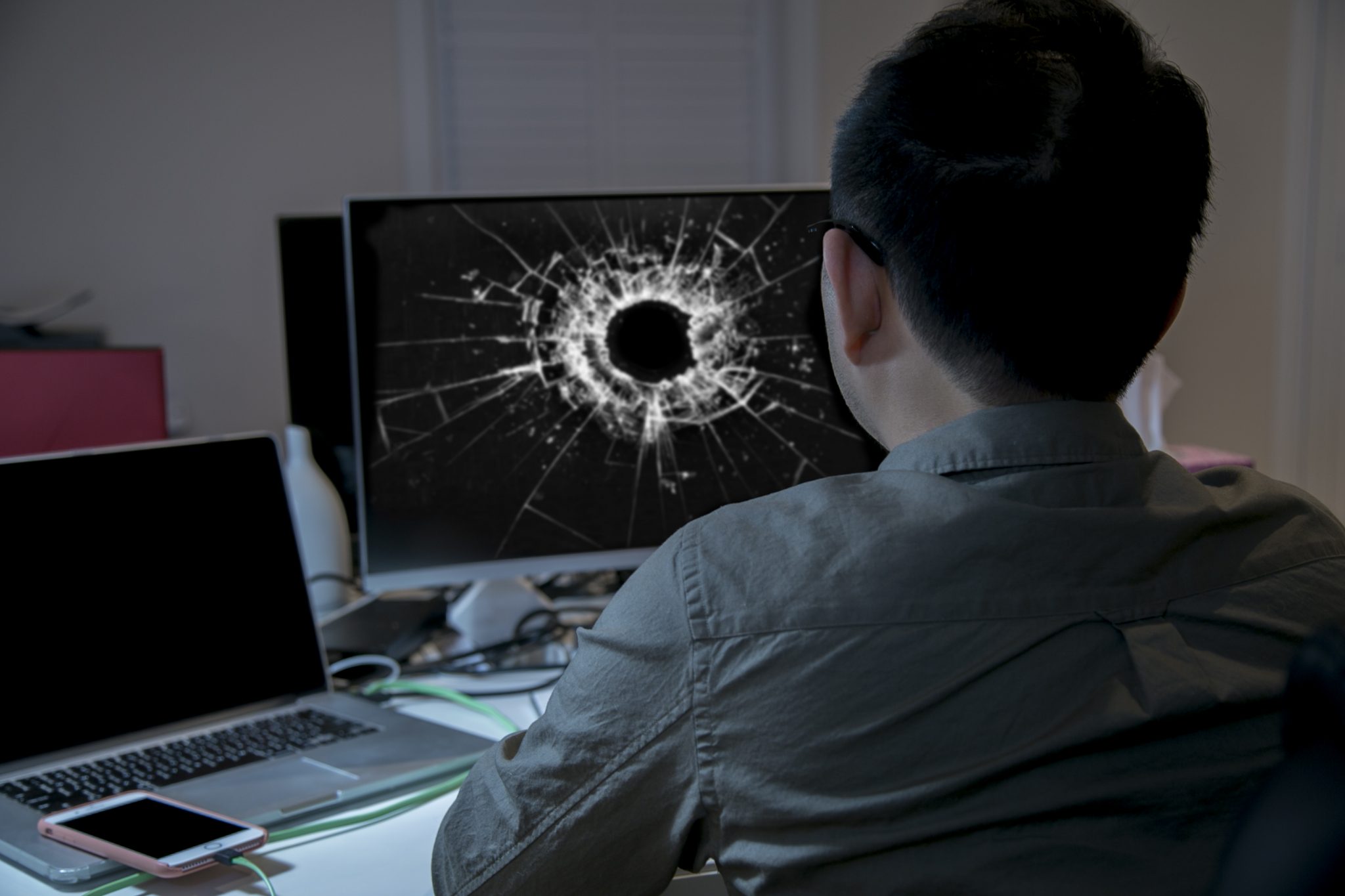
One last thing. About that title. “Darkness” is much too generic. If you are writing a thriller or mystery set in the computer sphere, why not go with something that tells readers what they’re getting? My computer geek Gary told me about a great slang term called “In the black mirror.” It is what you see when your screen goes suddenly dark — your own mug reflected back to you in creepy blackness. I always wanted to use it as a title but I have no interest in writing a novel about computers, so hey, it’s up for grabs. You need to stand out from the pack while you shed some light on what your story is about. Simple Darkness won’t do it for you.
Thank, writer, for participating. The line is open for discussion!
Writers and Dreaming
By SUE COLETTA
 Most of us are able to recall one or two of our dreams, but what if there were ways to increase that number?
We’ve all heard the stories of hugely popular novels which stemmed from the author’s dreams. For example, Stephanie Meyer and Twilight. Dreams serve health benefits, too. Researchers believe dreams help with memory consolidation, mood regulation, and/or conflict resolution.
Nightmares aren’t fun. Night terrors are even worse. It’s important we pay attention, though, because they can signal a disruption in our lives and sometimes, provide the answer.
Sigmund Freud believed dreams were a window into our subconscious, that they paved the way to satisfy urges and secret desires that might be unacceptable to society. I agree with the first part of his theory, but I think the latter depends on the dreamer. When it comes to dream interpretation there’s no cookie-cutter, one-size-fits-all definition.
Case in point: crime writers dream about murder. If an average Joe plotted revenge in his dreams, it might be cause for alarm. When writers delve into the dark recesses of the subconscious mind, it’s research. 🙂
While some sleep experts believe dreams are an anomaly of sleep, others think they may help us save memories, problem-solve, and manage emotions.
Dreams and the Brain
During REM — rapid-eye movement, when brain activity piques — and non-REM sleep, we have the potential to dream.
Dreams are connected to the creativity part of the brain, called the Superior temporal gyrus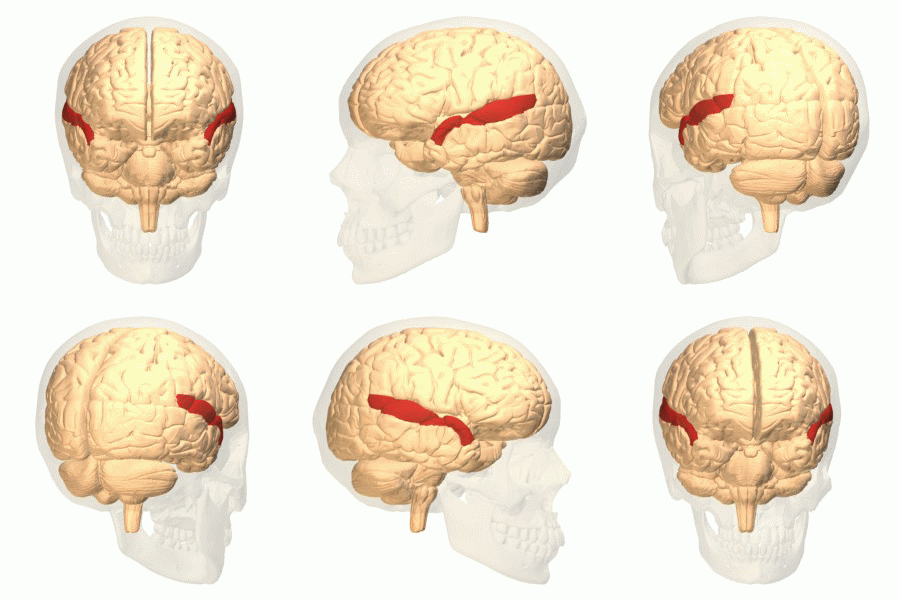 .
.
We have three creativity sections of the temporal lobe…
- Superior temporal gyrus — mainly auditory, this gyrus is responsible for processing sounds, sound level and frequency, as well as interpreting language and social cognition.
- Middle temporal gyrus — connected to recognizing familiar faces, contemplating distance, and interpreting word meanings while reading.
- Inferior temporal gyrus — visual stimuli processing and recognition, memory and memory recall, particularly with objects. This gyrus stores the color and shape of objects so they’re easily recognized when we see that object again.
This could explain why serial killers, who often have temporal lobe damage or malformations, experience different phases before, during, and after they kill. And why, during the Aura Phase colors become vibrant.
Did you notice in the 3D image the temporal gyri aren’t limited to the right-side?
Right Hemisphere vs. Left Hemisphere
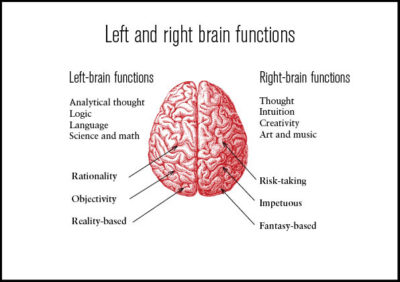 Brain cells in the left hemisphere have short dendroids which pull in information.
The right hemisphere branches out wider to absorb distant unrelated ideas, connections between concepts, and is responsible for insight and Ah-ha! moments. It’s here where our creativity comes alive.
Part of the Brain Responsible for Dreaming
The cerebral cortex is responsible for our dreams. During REM sleep, signals are sent from an area of the brain called “the pons” and then relayed through the thalamus to the cerebral cortex, which attempts to make sense of these signals. The end result is dreaming.
The pons also send signals to neurons in the spinal cord, shutting them down, causing temporary paralysis of the limbs. This safety switch prevents the dreamer from physically acting out dreams and harming themselves. However, there are exceptions. A condition called REM sleep behavior disorder exists. Can you guess what this causes? If you said, the pons fail to paralyze the limbs during REM sleep, you’re correct.
Why Dreams Are Difficult to Recall
Some researchers believe we’re not designed to remember our dreams. If we had perfect recall, dreams might get confused with real-life memories. During REM, maybe our brain shuts off the Inferior temporal gyrus, responsible for memory recall. And why, we may only recall our last dream before waking, because that part of the brain is now switched back on.
Studies show people actually have more brain activity and more vivid dreams during REM. Others say our brains store dreams, which is why the tiniest detail later in the day can trigger the memory of what we’d dreamed the night before.
8 Tips to Recall Dreams
Sound sleepers are less likely to recall dreams. If you fall into this category, consider yourself lucky; the rest of us don’t sleep as well. Even so, maybe these tips will help:
- Don’t use an alarm clock. We’re better off waking naturally. When that annoying buzz startles us awake, we’re concentrating on slapping the snooze button rather than dream recall.
- Once you get in bed tell yourself to remember your dreams. This may sound silly, but sometimes making the conscious choice to do something works wonders.
- Upon waking, don’t move. Studies show if we remain in the same position as when we had the dream, we’re more likely to remember the details when we wake. Keep your eyes closed and concentrate on the emotions you felt while dreaming. Were you frightened? Exhilarated? Blissful? By first tapping into our emotions, we’re more likely to recall the circumstance. In this case, the dream.
- When you wake, concentrate on recalling your dream rather than reviewing your to-do list for the day. Easing into your day promotes healthy living and helps with dream recall.
- Regular routine. Going to bed and waking at the same time each day aids in dream recall.
- Keep a dream journal next to your bed. When that perfect plot idea jolts you awake, scribble the scene in a notebook before you forget, the more detailed the better. Or sketch pictures of what you envisioned. Don’t worry if it doesn’t make sense yet. Author Ruth Harris suggests several pads, pens, and notebooks that would make perfect dream journals.
- Tell your significant other, roommate, or writer friend your dreams. By bringing dreams into your reality, it helps to recall the next one. Maybe skip the intimate dreams if they do not include your partner. I can hear it now, “Don’t blame me. Sue told me to tell you my dreams.” An angry mob of jilted lovers storms my home, with pitchforks and murder on their mind! Seriously, though, the above link is fascinating and might also help explain why you’re having sexy dreams about Mr. or Mrs. X.
- Studies show pleasant aromas cause happy dreams. Whereas unpleasant odors cause bad dreams and/or nightmares.
- Don’t get discouraged. Mastering dream recall takes time. The more you practice, the better you’ll get.
So, my beloved TKZ family, are you able to recall dreams? Have you ever used dreams in your writing?
How to Give Your Readers Unforgettable Moments
by James Scott Bell
@jamesscottbell
The legendary movie director John Huston once remarked that a great movie is comprised of “three great scenes, and no weak ones.” Not bad advice that. We don’t want any weak scenes in our fiction. But we also want those moments that reach deep into the reader’s heart.
 I thought about this recently while watching an early episode of the old cop drama Hill Street Blues.
I didn’t watch the show religiously when it first aired, as it began the same year I started law school. I was kind of busy. What I do remember is how much I liked the central character, Francis Xavier “Frank” Furillo, played by Daniel J. Travanti. He was the right mix of tough and compassionate, and Travanti was perfect in the role.
A few weeks ago I ran across a channel specializing in vintage cop shows and started watching an episode of HSB. It was a two-parter titled “Jungle Madness.” The show had several plot lines, one involving John “J.D.” LaRue (Kiel Martin) as a cop going down the drain due to alcoholism. In Part 1, LaRue’s drinking causes an incident that might have gotten him killed. Furillo takes him aside and gets in his face. “You’re a drunk!” he says, and tells him he either admits this to a police doctor or he’ll be drummed off the force.
In Part 2, LaRue hits bottom. No money. Kicked out of bars. Alone.
At episode’s end he nervously walks into an AA meeting. The leader asks if there are any newcomers. Slowly, LaRue raises his hand. The leader asks him to please stand and tell everyone his first name.
“I’m John,” he says, “and I guess I’m an alcoholic.”
“Hi, John,” the group responds
As he’s about to sit down he hears, “How you doing, J.D.?”
Astonished, LaRue looks over and sees … Captain Furillo. And the twist of this tough captain being there, an alcoholic himself, was a totally unexpected heart punch. The expression on Travanti’s face was acting perfection. I’m going to admit it—the waterworks turned on.
We love moments like that, don’t we? So how can we create them for our readers?
Brainstorm. Before I write, even before I outline extensively, I do an exercise I call “killer scenes.” I take a bunch of 3 x 5 cards to a coffee house, tank up, and start jotting random scene ideas for my plot-to-be. I don’t think about how they connect or if I’ll even use them. But when I’m done I’ve got a stack of scene ideas, some of which I hope will become stunningly memorable.
Use music. On iTunes I have a library of mood music, mostly drawn from movie soundtracks. There is music to inspire action, suspense, heart tugs and so on. Music brings out emotions in us, which vibrate the imagination. My most perfect ending—to both book and trilogy—is probably in Try Fear. And it came to mind as I was listening to the Beatles song “I Will.” To find out why it worked, you’ll have to read the books (heh heh).
Listen to a character. We’ve all had the experience of a character doing something unanticipated in a scene (or at least wanting to, which starts an argument with the author). Well, give the character a fair hearing and if you get persuaded, put it in. I once had a wife who was supposed to get out of town because her husband was in jeopardy. I had her trip all planned. But she refused to leave. And it was the right move.
Re-work scenes in subsequent drafts. Your first draft will have some scenes that work and others that need to be cut or revised. Any scene that has potential can be improved. Up the emotion in the characters. Improve the dialogue.
I will never forget that scene at the AA meeting in Hill Street Blues. If you’d like to see the episode, it’s on YouTube (the AA meeting starts at the 37:40 mark).
What’s a memorable moment you recall from a movie or book?
Do What You Gotta Do

Photo: “Highway Landscape” courtesy George Bohunicky from unsplash.com
It’s kind of difficult to be an unpublished author these days. You have to start, finish, and get published, and each step is heavier than the last. Even worse, it seems like everyone else who tries it succeeds. Look at all of the books that are published every month. It seems like everyone has a book out but you.
That isn’t true, of course. What you see in bookstores, on websites, and other outlets for book sales comprises the tip of the literary spear. The point, or tip, as it were, consists of people with varying level of talent who absolutely, positively refused to take “no” for an answer, and who particularly didn’t take it from the familiar face they confront in the mirror every morning. You can’t control every step of the process, but you can control part of it, the part that is in front of you. It is like driving. You can’t control other drivers, road hazards, or unexpected engine failure, but you can control something, at least, as long as you keep your hands on the wheel and your foot within reach of the gas and brake pedals. Don’t surrender control to chance. Otherwise, you’ll never get where you are going. I, of course, have a real-world story about this, one that has nothing directly to do with writing but everything to do with what is possible in the face of adversity.
I had a part-time job working in a supermarket during my high school days in the late 1960s. I was on my break during a particularly busy Saturday afternoon when someone hesitantly came up to the table where I was sitting. He appeared as if he wanted to talk to me but didn’t quite know how.
I didn’t know him, but I did know of him. “Steve” had been a couple of years behind me in grade school where he resided at the nadir of the Mariana Trench of the social order. I had heard stories about Steve’s family and home life. The sad punchline to all of those tales was that he and his siblings didn’t have squat, either materially or parentally. His situation was so bad that no one picked on him, probably for fear that whatever bad luck microbacteria clung to him would rub off. He was also incredibly shy in the manner of an individual who has the words “kick me” indelibly inked on his forehead.
I hadn’t seen Steve in over four years and had never in my life spoken a word to him. I accordingly was somewhat surprised when he approached me. I nodded and said, “Hey,” the way one would when he sees someone he recognizes but doesn’t really know. Steve, without any further social dancing, sat down next to me and said, “My girlfriend’s moving.”
My initial and unstated reaction was So? I realized that such a retort would be kind of harsh at the least, so I bit it back and instead asked him, “Well, uh, who’s your girlfriend?” He said, “Tabitha.” I asked, as if I were in the middle of a knock-knock joke, “Tabitha who?” “Tabitha Stanley,” he said.
Whoa. I had a year or so before briefly “dated” “Tabitha Stanley,” who had been in one of my classes. We kind of slowly and carefully drifted together and then painlessly drifted apart without any apparent damage to anyone all within the space of a few weeks. We remained casual friends, speaking in the halls, but that was the extent of our contact. I hadn’t exactly kept tabs on her so I had no idea at all as to how she and Steve had connected. Since Steve didn’t attend our high school and would not have had the opportunity to observe us I could only guess that at some point in their relationship they had gone through the boring begats of their romantic histories so that 1) my name had come up as a footnote and 2) my reflection in her rearview mirror was more favorable than otherwise, given that Steve felt he could approach me, however uncomfortably, and tell me that she was moving.
I at first couldn’t understand why he was telling me. I quickly figured it out from his demeanor. He was asking me for advice. He looked as sad without crying as anyone I had encountered up to that point. I also, from knowing his backstory, figured that Tabitha was probably the best thing — maybe the only good thing — that had ever happened to him. Stalling for time, I asked him where Tabitha was moving. He named a city two states away. That was a much larger distance and potentially insurmountable distance then than it is now.
He just sat there then, waiting for me to offer him some wisdom. I don’t know where my advice to him was conceived but from somewhere inside my totally clueless, hormonally driven, eighteenish self, I told him to stay in contact with her. Remember that this was in the late 1960s. They couldn’t text or skype or tweet or, um, send each other selfies or emails over cell phones or computers. There were snail mail letters and landline phone calls. That was pretty much it. I told him to write to her as often as he could and to call her once a week. He told me that his house didn’t have a phone. I told him to save up his quarters and use a payphone, but to call her, to get a job and scrape up enough money to send her flowers on her birthday, and to send her a card once in a while. I also advised him that, when he got the chance and the ability to drive to where she lived, which was that city two states and a world away, he needed to do that, or, failing that, to take a bus. It’ll either work out, I told him, or it won’t. “If it does, you’ll know it. If it doesn’t, you’ll know that, too, and you can find someone else,” I said. “Either way, do what you gotta do.”
My break was over. I wished Steve good luck and went back to work. I never saw him again. I actually never even thought of him, or Tabitha, or the entire conversation until earlier this week, a half-century on. I ran into a high school friend, an encounter which resulted in an hour of “do you remember” and “whatever happened to what’s-her-name.” Later that evening I started looking folks up on Facebook. I happened to think of Tabitha for some reason and checked to see if she had a page. She did. It features a picture of her with Steve. They’re married, living in that city two states away, and have at least one son, a man in his forties who seems to be an upstanding guy with kids of his own. Steve still looks shy, but he also has the demeanor of someone who won the Powerball at least once. So does Tabitha. I’m reasonably certain that neither one of them ever split the atom, wrote a bestseller, recorded a Top 40 hit, or amassed a fortune, but they look like they’ve done just fine, even if they had to overcome geography, background, poverty, and undoubtedly a bunch of other seemingly insurmountable obstacles to get to that photo on Facebook, some five decades on.
So. Tell yourself anything you want, but don’t look in the mirror in the morning (or any part of the day) and say that you can’t do something because you there are too many too manys in your life. There aren’t too many books, or too many obligations, or too many expenses, or too many obstacles in your life to keep you from doing what you want to do. There are just enough barriers in front of you so that once you overcome them you can appreciate what you have and get what you want. If you don’t believe me, think of Steve and Tabitha. Every word I’ve told you (except for their names) is true. If they can reach their dream, so can you.
READER FRIDAY: How Are You Supported as a Writer?

We’ve all experienced the naysayers who put up roadblocks for our writing passion, but what about those wonderful people who helped you nurture your gift? Please share some inspirational stories for those generous people in your life who have helped you write and sparked your passion.
Bonus points for sharing a story of how you paid the kindness forward to another writer. I know it’s hard to brag, but sometimes hearing a good story of support can inspire more of the same gestures.
A Writer’s Imagination is a Nurtured Gift
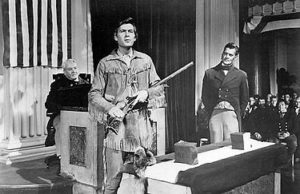
One of our TKZ regulars reached out and sent me a photo of his Davy Crockett attire when he was a lad after he read my post – “Nostalgia time: What TV show from your childhood Influenced you?”Nice raccoon hat, Dave. Don’t shoot your eye out.
Remember when we were kids and a TV show could inspire adventure in your life where you imagined YOU were Davy Crockett. We didn’t need much to entertain ourselves. An empty cardboard box became a fortress or a robotic monster. Things that people discarded became whatever we imagined them to be. Entertainment was cheap.
Dave’s photo reminded me of all the things my family did as kids. I came from a big family of 5 siblings and 2 parents. We were all about the same age as kids, around a year or two apart, so we hung out together in “the hood.”

TKZs Dave Williams as Davy Crockett
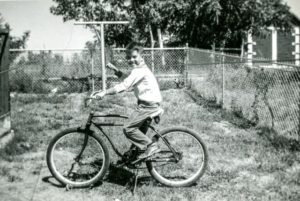
Nice bike, Dave. You and I have clothes lines in common.
When I was Dave’s age in this photo, I loved my westerns and read every horse book I could find. As kids during our summers out of school, my sibs (2 brothers and 2 sisters) would leave our home after breakfast and we stayed out all day. We built forts from fallen tree limbs and old boards, searched for arrowheads, rescued wounded baby animals, or launched rotten fruit fights with our rivals. We lived in a rural setting outside San Antonio and didn’t have many neighbors, especially girls. We had to make due with boys as friends.
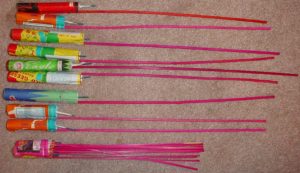
Photographer: Sarachit
When fireworks were in season, we changed our weapons of choice to include bottle rockets shot from empty Coke bottles and staged a major offensive with the neighbor kids. A turned over picnic table was our command bunker. My older brother (our General) thought he’d be invincible if he wore a heavily padded and hooded jacket so the bottle rockets would bounce off him. That worked…for awhile.
I stood at his side when he took aim at a neighbor boy standing in his yard two houses down. My big bro held his Coke bottle and I lit the fuse. When the rocket took off, it switched course and zeroed back on him – got caught in his hood – and his head turned into spiraling, scorching roman candle with the pungent stench of burning hair. Yes, he could’ve lost an eye, but a scorched head is funny to a kid and gave him bragging rights that he survived. My older brother later served a career in the US Air Force and even became a base commander. Needless to say, stories from our “hood,” stayed in the “hood.”
During long summers, we had time on our hands and plenty of imagination. Even then I had a passion for writing and I would write parody scripts based on some of our favorite TV shows, complete with mock commercials. The Tremenderosa was born, replete with sound effects and recorded on audio cassette. My siblings would act out the parts, we’d experiment with sound effects and had a blast making our own audio recorded productions. Later, when I had access to my high school video equipment, we would do class projects with better equipment and my sisters and I did our own production of JABBERWOCKY, a nonsensical poem of made up words by Lewis Carroll that inspired us. My sisters and I still know the words.
My dad wasn’t allowed to have pets as a kid. His mother didn’t approve, but he made up for what he didn’t have by seeing his kids had a menagerie of odd animals in our backyard. We charged admission to the kids in our neighborhood, just to see our ZOO. We nursed wild animals back to health for release into the wild and we raised goats, dogs, horses, fish, exotic birds (a Toucan and various parrots), an iguana and baby crocodile, rabbits, raccoons, lizards and snakes, and various breeds of exotic chickens and guinea fowl (nasty buggers).

Wikimedia Commons
We never wanted for anything. We didn’t have a lot of money, but my parents made sure we attended private Catholic schools, had food on the table and nice clothes. At Christmas, we had all the excesses – including a weird metal roller coaster set up in our front yard and a zip line from a tall tree that dropped us at the mailbox at the street. We had toys, but we still preferred roaming the acres around us with our neighborhood “gangs.”
When we got a Ouija Board, all of us got into it and conjured ghosts we thought would scare the others. Halloween was a great time to scare the neighbor kids and we set up our house with sounds and things that rustled through the brush as kids would make the long trek up our driveway for candy. They would rarely make it to the front door. My young bro would rig wires to make things move across the porch and zip out from nowhere to attack them by air. Once they started to run, the rest of us would chase them in the dark, screaming. We got to keep the candy they didn’t stick around for.
My dad fancied himself a gourmet cook, even though my mom always made better homemade food. But that meant dad was always trying new stuff, like pig roasting or goat over a fire pit. We were always trying weird foods. Again, it helped us become adventuresome and willing to try new things.
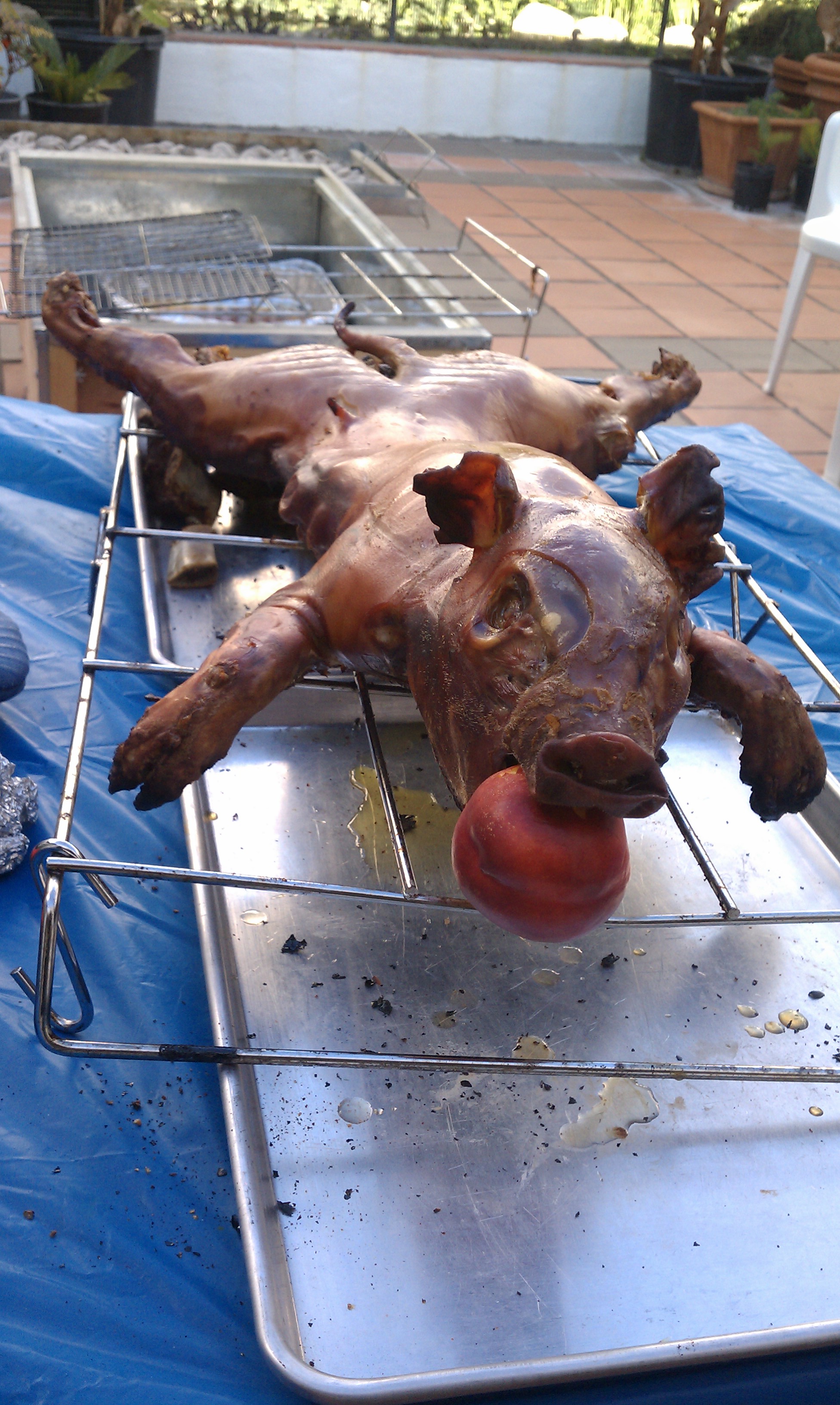
All of these memories inspired my imagination when I became a writer. I didn’t have to rely on scary movies to get the adrenaline pumping. I created my own horror show on the front lawn with neighbor kids as guinea pigs. We learned stealth and war time strategy from our firework assaults and as girls, my sisters and I learned about boys and how they thought and acted.
My childhood became a treasure trove of inspirations for me as a writer that I still draw upon. One of my greatest joys is to relive those years with my siblings since we are blessed to still have our parents with us. When we go on our annual family retreats, we still play jokes on each other and play games and tell stories around a campfire. I’ve been blessed with life experiences that fuel my passion to write. How about you?
For Discussion:
1.) Share some of the childhood stories that still inspire you as a writer.
2.) When you write a particularly scary or dramatic scene, what experiences do you draw from to make those scenes real?
First Page Critique: A Thing of Beauty

Gentle Readers, today another Brave Soul has brought their work to the critique altar.
Chapter 1. A Thing of Beauty
I’m forgetting things.
That’s not good when someone’s been murdered.
Not when I’m holding a gun in my hand.
My memories are all mixed-up. I watch myself… this memory thing… always watching for lapses. The war, my mom’s illness…
Or maybe the lump on the back of my head has something to do with it?
Or maybe I’m seeing ghosts.
Lemme try get things straight.
I remember how it started… She came to my office—or did it begin before then?
Fog and anger and my finger pulling the trigger…
No, I have to get this straight.
Let’s start with the meeting…
* * *
I was in my office—up two flights, turn right and I’m at the far end. It must’ve been late. It was getting dark. A Wednesday. I never understood Wednesdays. Too far away from both weekends. Not that I did much at the weekend. Especially when I couldn’t afford to play poker with the boys.
I was closing up. The usual things: scowling at the in-tray full of bills, checking my phone was still working, closing the inner office door, switching off the lights in the outer office… Someday I’ll be able to afford a receptionist to look after these things for me.
Someday.
In the darkness the harsh splash of neon lights from the street below splattered across the office ceiling like weapon flash. Movie-town was still making magic and bringing dreams to life with flickering lights. Spinning money out of dreams. Little changed while I was busy in Europe saving the world. Was it really five years since that Liberty ship offloaded me back onto American soil, to find my mother crippled and confused by a blood clot in her brain?
I don’t know how long the blonde was standing in the doorway while my mind wandered. Maybe she made a sound, I don’t know, but I snapped out of it and took a look.
She was a sweet shape silhouetted by the strip lighting in the hallway and topped by tumbling platinum hair. I took in the sheath of her pencil skirt and snug, fitted jacket. I wanted to see more.
Maybe she was just asking directions for another of the petty outfits in this rat-run of a decrepit building.
I flipped on the lights in the reception area.
_______________
Kudos to Anonymous Writer for excellent clarity of sentences and scene visualization. The prose is sharp and moves at a good clip. But, oh my, I’m not sure how to approach this piece. Is it meant to be an homage to noir detective films and stories? It feels less like homage than clever duplication.
The image that immediately popped into my head was of Fred MacMurray in the classic noir film Double Indemnity (novel by James M. Cain). It begins with his character making a recording in his office–a confession about his involvement in evil Barbara Stanwyk’s murderous insurance scheme that results in the death of her husband.
But a more direct parallel is to the opening of both the novel and film of Hammett’s The Maltese Falcon. Sam Spade does have a receptionist, and it’s not the end of the day. Still there’s a beautiful woman in distress who shows up at a less-than-profitable private detective’s office, and not too long after, something goes badly wrong. (I can only assume our first-person character is a detective.)
The third comparison is to J. K, Rowlings’s more modern character, Cormorant Strike, also a struggling detective.
The examples could go on and on because this is a classic, even clichéd scene.
First section:
“I’m forgetting things.” Then we’re presented with a litany of things they might have forgotten–or barely remember. I’m visualizing a cloudy collage above their head. Mom’s illness, bombs going off, a gun… It’s a voiceover, a setup. People don’t actually talk to themselves this way. If this is indeed an opening to a novel, it deserves better treatment. Here’s a person who believes they might have committed a murder. That’s a very scary prospect. Where’s the shock? The drama? They’re HOLDING A GUN. They can’t be just standing there about to drift off into a long reverie about how they got where they are. How much better to give us an entire scene.
Second:
The prose here is very good. I particularly like this line: “In the darkness the harsh splash of neon lights from the street below splattered across the office ceiling like weapon flash.” Again, a bit too familiar, but far more substantial as the first lines of a novel than the original.
I still have to ask, what end does the scene serve? It’s dour and sad and a little lusty: classic noir is classic noir. As it is, it doesn’t offer the reader anything new. My only advice can be to either change it to make it more surprising, or possibly drop the intro and start here. I’m frustrated.
So, TKZers. I’m handing this over to you. What do you make of it? Am I missing some vital point?
“When I Grow Up”: Things I Never Planned To Become
Photo purchased from Shutterstock
We spent Labor Day weekend in New York City, which meant I had to reacquaint myself with the sights and textures of Manhattan’s gritty streets in the sweltering heat of late summer.
Our activities revolved mostly around watching the US Open and Yankees baseball. As someone who had zero interest in spectator sports for most of her life, I’m a bit surprised by having acquired a sudden, rabid interest in baseball. Because my newfound enthusiasm for baseball far outstrips my knowledge of the game, I have a newbie’s tendency to vocalize (loudly) ill informed skepticism about Aaron Boone management decisions. This obnoxious trait leads to the occasional humiliation when his decisions turn out to be correct, leading to a Yankees win.
We spent the entire day on Saturday enjoying a close-up tour of Yankees Stadium. They let us wander around the dugout and take a quick peek at the bullpen. Later that day during the game we listened as the famed Bleacher Creatures bellowed outfielder Andrew McCutchen’s name as he made his debut in pinstripes. Per my usual, I questioned Boone’s decision to use him as the leadoff hitter in his very first game (I mean, Cutch had just traveled 3,000 miles on short notice—ever hear of jet lag, Aaron?)
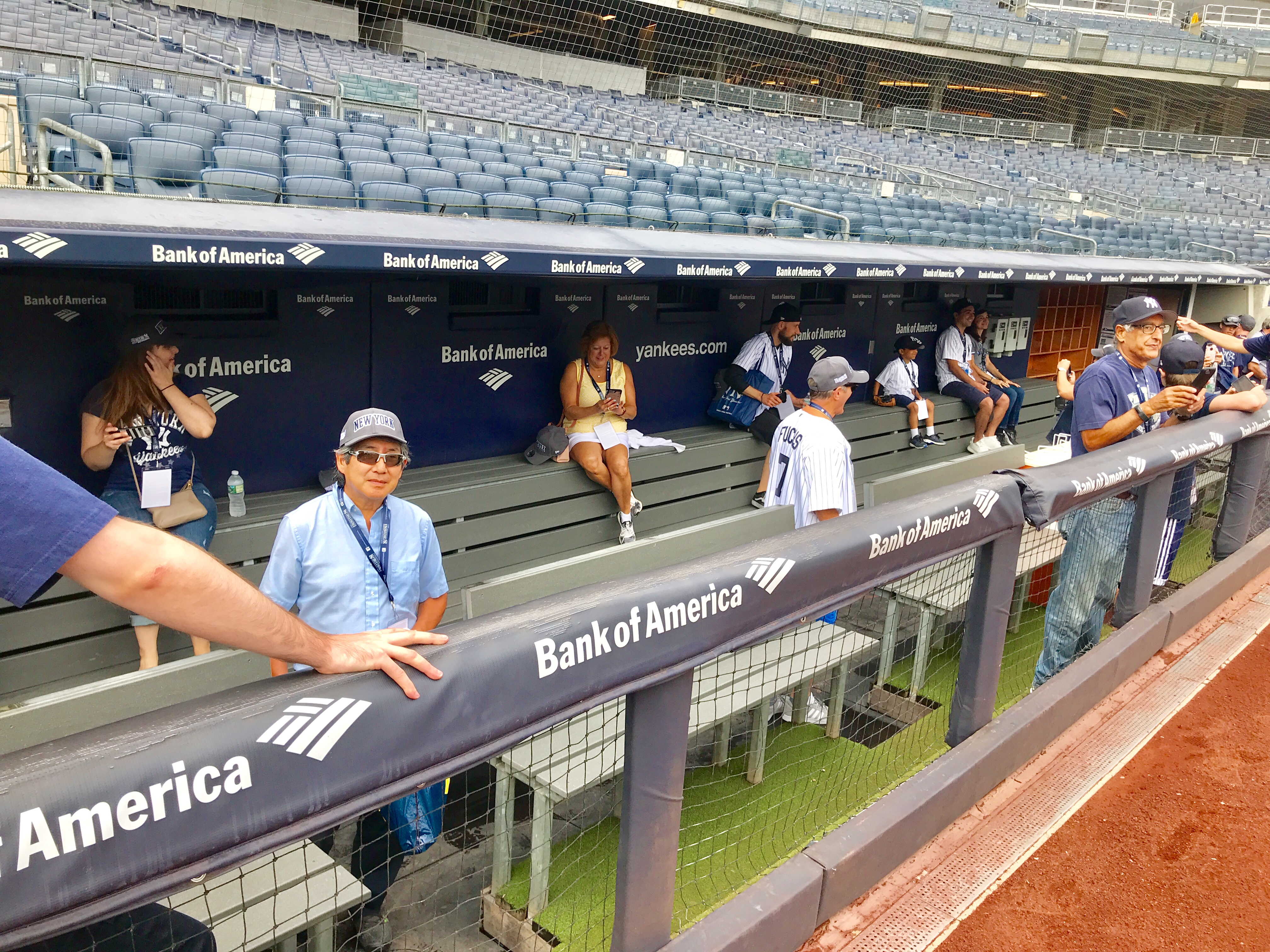
Checking out the Yankees dugout
But to his credit, Boone thrilled many hearts in Yankees fan world (a notoriously fickle lot) by getting thrown out of a game recently. Boone, who has been criticized in social media for being a bit too mellow, too nice, got suspended after storming the field to conduct a brim-to-brim confrontation with an umpire. The manager’s ejection seemed to galvanize his players, who rallied quickly to take the win.
So now I’m in the mood to read some great books about sports. The subject doesn’t have to be baseball; I’m looking for anything that captures the drama, personalities, or history of a sport. Any suggestions?
My Crossword Obsession
Happy Labor Day!
In honor of our official workers’ holiday, I thought I’d share/confess my favorite form of relaxation/obsession – my daily crossword fix. It began as a hobby over a decade ago (I was never a huge puzzle fan as a child or teenager) and has now morphed into a bit of an obsession…one primarily focused on the NYT crossword, but which has spread so that I can no longer resist the temptation to try each and every crossword I come across – whether it be in an airline magazine or the local newspaper at a coffee shop. Nowadays, my handbag invariably has a folded, squished, half-completed crossword stuffed inside.
When I first started doing the NYT crossword, I could barely make it through Monday and Tuesday. Now, even though I might be tearing my hair out by Saturday, I’m determined to do it every day (as the NYT crossword gets harder as the week progresses, my success is measured by which day I can complete without any ‘cheating’:))
My boys have tried to encourage me to extend my crossword mania to other puzzles – and, although I enjoy doing word problems and puzzles (in Australia I loved doing the daily word Target puzzle), I simply can’t come at any of the mathematical ones like Sudoku or KenKen. I think my mind just doesn’t work that way, and the amount of frustration experienced always outweighs any satisfaction I might feel when completing these kinds of puzzles. One day I hope to challenge myself and face the dreaded cryptic crossword…but so far the ability to process any of those clues has eluded me…
As I’ve progressed over time, I’ve discovered that I’ve developed a few crossword tics. The first of these is that I have to do it on paper and always in pen, never in pencil. Although I’ve tried doing the crossword online, it just doesn’t feel the same. Ditto when it comes to trying to complete it in pencil – I just can’t do it. I have to complete a crossword in ballpoint pen, even though I hate writing with these kinds of pens as a general rule (go figure..). So my crossword on a difficult day looks like a mess of pen marks, cross-outs and (more often than not) smears of vegemite toast fingers and coffee drips…exactly how I like it:)
I’ll probably be catching up on Sunday’s NYT crossword as well as tackling Monday’s crossword this holiday weekend. What about you, TKZers, what’s your favorite puzzle? Are you similarly crossword or puzzle obsessed?