Inspired Every Morning

by James Scott Bell
@jamesscottbell

“I only write when I’m inspired, and I see to it that I’m inspired at nine o’clock every morning.” – Peter De Vries

Anyone who’s written for any length of time knows there are times when the writing flows like the Colorado rapids. You whoop it up and enjoy the ride.
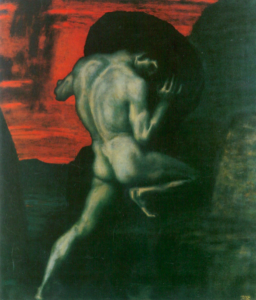
Sisyphus, Franz Stuck (1920)

Then there are times when it feels like you’re Sisyphus halfway up the mountain. You grunt and groan. But you keep pushing that boulder, because you know that writing as a vocation or career requires the consistent production of words.

What’s helped me in the Sisyphus times are writing quotes I’ve gathered over the years. I go to my file and read a few until I’m ready, as it were, to roll.

I’ve even contributed a couple of quotes that have found some purchase in cyberspace. The one that seems most widespread is this:

“Write like you’re in love. Edit like you’re in charge.”

There are, however, some writing quotes that are oft shared but were never said…or are misattributed. Two of them have been hung on Ernest Hemingway.

“Write drunk. Edit sober.” Nope, he never said that. Indeed, it would have horrified him. Hemingway was one of the most careful stylists who ever lived. He did his drinking after hours (and too much of it, as it turned out).

The other one is, “There is nothing to writing. All you do is sit down at a typewriter and bleed.”

It’s a great quote, but should be attributed to the legendary sports writer, Red Smith. Smith probably got the idea from the novelist Paul Gallico (author most famously of The Poseidon Adventure). This is from Gallico’s 1946 book Confessions of a Story Writer:

It is only when you open your veins and bleed onto the page a little that you establish contact with your reader.

(If you want to deep dive on the various attributions of the quote, go here.)

So how did this blood quote get attributed to Hemingway? I know the answer, for I am a skilled detective!

Actually, I am a Hemingway fan, so one day I decided to watch a TV movie about Hemingway and his third wife, Martha Gellhorn. The film, imaginatively titled Hemingway & Gellhorn, starred Clive Owen as Hemingway and Nicole Kidman as Gellhorn. As I recall, the movie is okay. But I do remember Owen delivering this line: “There’s nothing to writing, Gellhorn. All you do is sit at your typewriter and bleed.”

And there you have it. The script writers thought this quote, which they got from Red Smith, would be a perfect line for their rendition of Papa. And really, it might have been a line for him to utter, but for the fact that Hemingway did virtually all of his drafts in longhand.

Speaking of renditions of Hemingway on film, my favorite is Corey Stoll’s performance in Woody Allen’s Midnight in Paris. Allen and Stoll managed to capture Hemingway’s bluster without turning him into a cartoon. I especially love this exchange with Owen Wilson, who is a laid-back writer from our time transported back to the Paris of the 1920s, where Hemingway, Scott and Zelda Fitzgerald, Gertrude Stein and others were all tossed together.

Now, back to business. Here are five of my favorite writing quotes:

Remember, almost no writer had it easy when starting out. If they did, everyone would be a bestselling author. The ones who make it are the stubborn, persistent people who develop a thick skin, defy the rejection, and keep the material out there. – Barnaby Conrad

You must stay drunk on writing so reality cannot destroy you. – Ray Bradbury

In a world that encompasses so much pain and fear and cruelty, it is noble to provide a few hours of escape, moments of delight and forgetfulness. – Dean Koontz

Keep working. Keep trying. Keep believing. You still might not make it, but at least you gave it your best shot. If you don’t have calluses on your soul, this isn’t for you. Take up knitting instead. – David Eddings

The first page of a book sells that book. The last page sells your next book. – Mickey Spillane

Your turn! Let’s get inspired. Share a favorite writing quote and why it speaks to you.

I Did It My Way

My sixty-seven-year-old memory is somewhat fuzzy on distant particulars, but I recall sitting beside the open windows in my un-airconditioned freshman high school English class, listening to Miss Linda Adams talk about writing. Had I been sitting on the inside row with the other reluctant students against the wall that first day of class, we would’ve enjoyed the dubious luxury of hot air pushed by a large fan.

Instead, I got to look out the window, at the same time keeping an eye on my fresh-faced, just-out-of-college teacher. Miss Adams was…splendid…in a short skirt, white top, and loose blond hair enhanced with what back then was called a “fall” that came down past her shoulders.

I also recall white go-go boots, but that’s probably from an adolescent dream, long forgotten and dried. Teachers couldn’t dress that way back then, and even the girls in my class couldn’t wear jeans. The school district reluctantly allowed pant suits instead, as long as the top came down below their…um…buttocks.

Anyway, pardon my digression that sets the scene for My Awakening. I fell in love with when she leaned back against her desk and crossed her arms that distant day, finished with outlining what we’d do that semester. “We’re going to have some fun, too. Y’all know the rules of writing, and we’ll practice them in this class.”

Moans filled the room.

Her lips were red, as were her fingernails. I’m afraid my concentration was mostly on her appearance until the sweetest words I ever heard fell from those lips at the same time a bright beam of light illuminated her person, followed by an angelic chorus of beautiful voices.

“But when we get into creative writing, I want you to break all those rules you’ve learned in the past and explore the creative process as much as you can.”

That statement sizzled through my brain, yanking me back from a particularly enthusiastic fantasy and into class.

What’d she say!!!???

Since I’m a Gemini, I answered myself.

She said there were no rules in creative writing.

That means I can do what I want!

Apparently.

She’d freed me! I could break those dusty old shackles of formal writing and be myself.

Huzzah!

I rose and did the Happy Dance, a unique blend of gyrations taken from Snoopy, American Bandstand, and Elvis movies.

Not really, but I wanted to.

“Break the rules.” Her statement came to mind years afterward when I finally discovered my writing Voice in 1988 and published an inaugural humor column that was nothing like I’d ever read in a newspaper.

I was successful in getting published that first time because I broke the rules and created something no one else was doing in newspapers. I took a new and different trail again when I embarked on my first novel a dozen years later.

The opening chapter was in first person, from the viewpoint of ten-year-old Top Parker, and I learned pretty quick that writing the entire novel from Top’s POV was limiting, but I needed to see rural 1964 through a kids’ eyes. First person speaks to me, and the words flow with startling ease when I’m in those chapters.

But the next chapter switched to third person, the change was intentional, because I wanted readers to see the story from the boy’s granddad’s more experienced point of view. Both a farmer and the local constable in their rural community of Center Springs, Ned Parker’d already lived a lifetime before the youngster showed up.

The alternating POV worked well in my mind, and it never occurred to me at that time that I was breaking some sort of rule. I was simply describing what I saw as the first two chapters developed, because I think differently than many authors. When writing a novel, I see the story from different lenses, sometimes involving POVs for more than one character

I did the same thing in Burrows (a suspenseful and claustrophobic novel that people either love or hate, with no in between, but the critics loved it, so there) and I was on my way, blissfully ignorant of the fact that many editors, agents, and critically acclaimed and bestselling authors said it was wrong.

That little revelation came along as I was sitting in an audience between two well-known and very successful authors listening to a panel discussion at Bouchercon, the country’s largest conference devoted to mysteries and detective fiction. When it was his time to speak, one of my favorite and influential writers on the stage pulled microphone closer to his lips and stated with absolute authority, “You cannot switch back and forth between points of view. It’s a sin, and if you do it, Jesus won’t love you no more, and you’re going to Hell with your pockets full of dandruff and adverbs.”

He sat back to let that sink in.

Well, he didn’t say it that exact way, but the gist was the same. My friends on either side turned their heads to gauge my reaction, but I had nothing and refused to make eye contact. I was a sinner for sure and no amount of water was ever going to wash me clean.

But I didn’t care and I kept writing the way I wanted, because I had a Voice, and a style (which is dramatically different than these blog posts for some reason), and I wasn’t going to change. With twelve novels in print, one scheduled for release in February, 2022, and two others under contract for the next two years after that, I’ve continued this particular style of storytelling and have no intention of changing.

Because Miss Adams said it was okay.


True Crime Thursday – You Got the Wrong Guy

By Debbie Burke

@burke_writer

Photo credit: Alex Galloso, Unsplash

We’re all aware of the staggering rise of identity theft that can screw up our credit. According to the Insurance Information Institute, in 2020, the FTC received 4.8 million reports of identity theft and fraud, a 45% increase from 2019.

But if a criminal claims to be you, does that mean you could be locked up for an outstanding warrant?

In the case of Jonah Scott Miller, yes.

When Zin Mali McDade, a transient, was arrested in Brevard County, Florida, he claimed his name was Jonah Scott Miller, who had been a childhood acquaintance. Both were born in December, 1985, six days apart. However, Jonah is 6’2” and Zin is 5’7”.

The real Jonah, who works security for a hospital, was arrested during Bike Week in Daytona Beach in 2019 on a failure to appear warrant for shoplifting, a warrant actually meant for Zin.

When Jonah told police they had the wrong man and he had never been to Brevard County, the arresting officer accused him of lying. According to the Daytona Beach News-Journal, she said:

“I suggest you get a lawyer because somebody’s lying. If it’s not you lying to me, it’s somebody you know because they know way too much about you. They knew your date of birth, your social, where you were born, your address and they have your tattoos.”

Jonah protested his tattoos couldn’t match anyone else’s because they were the names of his kids.

Apparently, no one at the scene brought up the mugshot from Zin’s arrest.

Jonah was booked into Volusia County Jail. There, officers discovered the mugshot on file didn’t match the real Jonah. The fingerprints on record also didn’t match the real Jonah. Yet, despite the obvious mistake, the innocent victim of identity theft spent the night in jail.

Attorney Steve Weisman of Scamicide.com recommends being proactive if someone impersonates you. Contact a lawyer, law enforcement, and the prosecutor/district attorney to file a report that you are the victim of identity theft. Show your driver’s license, passport, or other photo ID to prove who you are. Request a letter from the district attorney explaining the situation. In some states, you can request an Identity Theft Passport that may help if you are detained because a criminal steals your identity.

Booking photo of Zin Mali McDade


Whatever happened to Zin Mali McDade (alias Jonah Scott Miller)? He currently resides at the Brevard County Jail in Cocoa, FL.

~~~

TKZers: Have you ever been the victim of mistaken or stolen identity? Would you obtain an Identity Theft Passport?

Don’t Play Coy With Your Readers

Don’t Play Coy With Your Readers
Terry Odell

Don't Play Coy With Readers

Image by Tayeb MEZAHDIA from Pixabay

One of my first writing lessons was Point of View. I learned it was a good idea to stick to one character at a time (and ‘time’ means more than a paragraph or two).

As a reader, I discovered I connected more with characters if I was privy to their thoughts. There are no hard and fast rules about Point of View beyond it’s important that readers can keep track of whose head they’re in.

My preference is to use Deep Point of View, which is sometimes called Close or Intimate, and that’s the focus of today’s post. What you call it isn’t as important as making sure that your readers can’t know anything your POV character doesn’t know. Or see. Or feel. Or smell. Or hear. It’s very close to writing in first person.

POV is a powerful tool, because by controlling the POV character, you control what you reveal to the reader. As I said above, the reader is only privy to what the character knows. On the flip side of that coin, if the POV character sees, smells, feels, or hears something, the reader should, too.

In my current WIP, my female lead knows why she quit her job, and is aware of some less-than-ethical behaviors of her boss. I’m eight chapters in, and she doesn’t want the male lead to know the details yet. But she can feed him bits and pieces as circumstances arise. The way I see it, it’s the author’s responsibility to find legitimate ways to withhold information from readers until it’s time to reveal it.

Which brings me to a couple of recent reads which had my hackles up. Both were written in first person POV. That puts the reader right into that character’s head, the same way Deep POV does.

In one book, the character read a letter; in the second she looked at a photograph. In both instances, the characters had strong emotional reactions to what they’d just seen. These books were both mysteries, and this “secret” information provided important clues.

But—and this is where I would have screamed out loud, had it not been late at night with someone sleeping nearby—both authors opted to hide this information from the reader. They simply avoided the reveal. The characters mulled it over, worried about it, wondered if they should tell another character, weighed the pros and cons. On and on. But never did they mention the name of the person in the photograph or the contents of the letter. The characters knew what they’d seen, so there was no reason the reader shouldn’t other than the author was doing what one of my first critique group leaders called “Playing Coy With the Reader.”

And for me, it’s not fair, not if you’re writing in first person or deep POV. It’s like when a television show character gets a letter, opens it, reads it, and then … cut to commercial without letting the viewer know what it said. If, when the commercial is over, the action picks up where it left off before the break and either shows the letter or the characters talking about it, I’ll accept it as being a way to make sure viewers “stay tuned.”

Now, if the author breaks to a different POV character, I might forgive them if, when we get back to the first character’s POV, we get the reveal. But to put a reader in a character’s head and then yank them out when something important happens is likely to aggravate them rather than heighten the suspense (which is what the author is going for.) To me, it’s a cheat.

In one of the books, the author never put the information out there. In the other, it took a while, but the reveal did come, so I grumbled and gave the author another chance.

And that’s what might happen. Play coy with the reader and you might lose them, not just for this book, but for future books they’ll never read.

In a more distant point of view, where the author is telling the story more than the character, it might not be such an issue, but then—I don’t like distancing points of view. Your mileage may vary.

All right, TKZers. What are your thoughts about authors withholding information a reader should have? Does it add a layer to the read for you, or frustrate you?

(I’m away from cyberspace this morning, but will be back later this afternoon to respond to comments.)


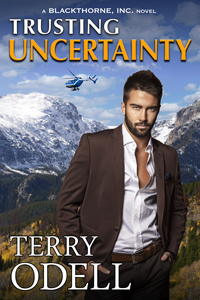
Trusting Uncertainty by Terry OdellNow available for Preorder. Trusting Uncertainty, Book 10 in the Blackthorne, Inc. series.
You can’t go back and fix the past. Moving on means moving forward.

Terry Odell is an award-winning author of Mystery and Romantic Suspense, although she prefers to think of them all as “Mysteries with Relationships.” Follow her on Facebook and Twitter.

POP QUIZ ON ADJECTIVES

By Debbie Burke

@burke_writer

When we first learned to talk, most likely we never gave a second thought to the order of words. We just mimicked our parents until the sentences that came out of our mouths made sense and were understandable.

If a five-year-old said, I kicked over the fence the ball, most likely Mom, Dad, or a kindergarten teacher would tell the child it sounded better to say: I kicked the ball over the fence.

We instinctively knew how to place the words in the right order, even though we didn’t realize exactly what it was we knew or how we knew it. 

[Side note: English is a particularly difficult language for non-native speakers to learn because it’s full of inconsistencies and contradictory rules. If you didn’t learn English as a first language, please accept my condolences for the misery you’re going through.]
 

At some point in our language development, we learned that adjectives make sentences more descriptive. For those of us destined to become writers, adjectives became fun new toys.

Consider the three examples below:

The Jack Russell tan frisky terrier chased a mouse.

Hey, wait a sec. That sounds awkward. What’s wrong?

Instead, how about:

The frisky tan Jack Russell terrier chased a mouse.

Sounds natural.

A hot-air red massive balloon floated above farm land.

Awkward.

A massive red hot-air balloon floated above farm land.

Natural.

A new silver shiny Cadillac was parked in the murky dark shadows of the concrete parking high-rise garage.

Awkward.

A shiny new silver Cadillac was parked in the dark murky shadows of the high-rise concrete parking garage.

Natural.

In these examples, one flows easily off the tongue while, in the other, words come out in halts and jerks.

What is the difference?

The order of the adjectives.

Huh? Who even thinks about that?

Writers, that’s who.

Turns out there are actual rules about the correct order of adjectives.

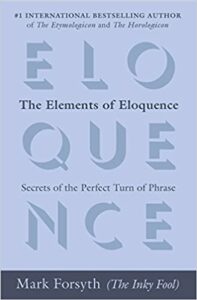
Recently I learned that new lesson when TKZ regular Chuck sent me an interesting article that quotes The Elements of Eloquence: Secrets of the Perfect Turn of Phrase by Mark Forsyth. In his book, Forsyth separates adjectives into eight different types of descriptors and their proper order:
  1. Opinion
  2. Size
  3. Age
  4. Shape
  5. Color
  6. Origin
  7. Material
  8. Purpose

There is even a handy little acronym to remind you of the correct order, using the first letter of each type: OSASCOMP.

Cambridge Dictionary doesn’t want the rules to be that simple so they offer an alternate option that divides adjectives into 10 classifications in slightly different order.

  1. Opinion
  2. Size
  3. Physical quality
  4. Shape
  5. Age
  6. Color
  7. Origin
  8. Material
  9. Type
  10. Purpose

Translated to an acronym: OSPSACOMTP.

Hmm, I think I’ll stick with Forsyth’s version.

In Elements of Eloquence, Forsyth illustrates the correct order with this complicated yet coherent phrase:

A lovely little old rectangular green French silver whittling knife.

Take a moment to experiment. Can you rearrange the adjectives in a different order that makes sense and sounds better?

Me neither.

Of course, no author would dare string that many adjectives together without a stern reprimand from the editor.

Photo credit: Isaak Alexandre Karslain, Unsplash

Let’s have some fun with a quiz. Read the following jumbled descriptions and put them in the correct order. Your choice of either Forsyth’s or Cambridge Dictionary’s rules.

  1. The wicked old shriveled witch cast a permanent vengeful curse on the young innocent maiden.
  2. The black-and-tan huge guard German Shepherd dog growled when the child grabbed her puppy.
  3. The parchment ancient yellowed fragile scroll crumbled when touched.
  4. Margie couldn’t resist buying the silk designer black sexy strapless dress.

Below are my answers. If you disagree, please share in the comment section.

  1. The wicked (opinion) shriveled (physical quality) old (age) witch cast a vengeful (opinion) permanent (type) curse on the innocent (opinion) young (age) maiden.
  2. The huge (size) black-and-tan (color) German Shepherd (origin) guard (purpose) dog growled when the child grabbed her puppy.
  3. The fragile (physical quality) ancient (age) yellowed (color) parchment (material) scroll crumbled when touched.
  4. Margie couldn’t resist buying the sexy (opinion) strapless (shape) black (color) designer (origin) silk (material) dress.

Here’s a shortcut for when you’re writing a sentence with several adjectives but can’t remember the rules:

Read the sentence out loud.

If it sounds awkward, rearrange the order of the adjectives until the sentence flows smoothly and naturally.

If you’re still not sure, read the sentence out loud to someone else. Ask how the adjective order sounds best to their ears.

If you can’t remember the rules or would rather ignore them, here’s the easiest option of all: don’t string more than two adjectives together.

Your editor will appreciate it and so will your readers.

~~~

TKZers: Did you know there were rules for the order of adjectives?

As a writer, do you love adjectives? Or would you rather discard them in the same wastebasket with adverbs?

~~~

Debbie Burke is an absentminded (opinion) aging (age) blond (color) Montana (origin) thriller (purpose) writer who never uses more than two adjectives in a row. You can verify that if you read Debbie’s six-book series at this link.

To Adverb or Not to Adverb?

I’m in the midst of revisions – which is why today’s blog post is rather short – and (as always) wrestling with some of the the writerly tics that seem to invade every new manuscript. Today I faced the perennially thorny issue of adverb use, particularly when it comes to dialogue tags. I have a wonderful writing group partner who is particularly good at pointing out sloppy adverb use, highlighting all the ‘quietly/desperately/softly/angrily’ kind of dialogue slips that I have a tendency to make. She’s also very good at pointing out all the times I ‘tell’ rather than ‘show’ so I’m definitely feeling rather humble at the moment:)

As with any revision process, I make a judgment call on whether to keep the dreaded adverbs and when to curtail the amount of ‘showing’ versus ‘telling’ (sometimes not using an adverb actually makes the prose sound more awkward). My writing partner uses (and highly recommends) a program called ProWriting Aid, which apparently helps highlight problematic and sloppy writing but I am reluctant to go down that path for fear it will wreck my prose (or maybe I’m just afraid of all the writing errors it will illuminate!). Another writing partner ran some of her latest novel through ‘Grammarly’ with nightmarish results…which only confirmed my fears!

So my question to you all, is do you use any of these online writing aids? Have you run your prose through any of these kinds of grammar/writing checks and if so, was it helpful? How do you approach this type of stylistic revision when it comes to fiction  (up till now I’ve tended to prefer to go with my gut…) and finally – to adverb, or not to adverb, that is the question…

PS: Congratulations Jim on completing your draft of the new Mike Romeo thriller! – I’d be interested to hear if you’ve considered adding any of thee online tools to your revision process!

You Finished Your First Draft. Now What?

by James Scott Bell
@jamesscottbell

Done!

Finito!

Sis boom bah!

The first draft of my next Mike Romeo thriller is finished!

Completing a novel is such a great feeling, don’t you agree?

Be ye plotter or pantser, plodder or pounder—whether you write like the Santa Ana winds or like the groundskeeper at the La Brea Tar Pits—typing that last page is always a lovely moment.

How could it not be? You’ve done something only a few people on earth ever do: You’ve transposed a fictive dream in your head to the pages of a completed manuscript so it can be shared with others.

Sure, your novel may be dreck, but by gum it’s your dreck! You labored over it and brought it forth into the world. The good news is dreck can be improved. As Nora Roberts once said, “I can fix a bad page. I can’t fix a blank page.”

So the first thing you should do when you finish a draft is this:

Luxuriate in the moment. Enjoy it. You earned it. Take the rest of the day off.

On the other hand, you could be like Anthony Trollope, the legendary quota man. If he wrote “The End” and saw that he needed another five hundred words for his quota, he’d sigh, take out a fresh sheet of paper, and write “Chapter One.”

Me, I like to take a full, one-day break and do something fun. Like drive to the ocean with Mrs. B after picking up a couple of world-famous fish tacos at Spencer Mackenzie’s. We have a favorite spot on PCH (Pacific Coast Highway for you out-of-towners) where we can park and listen to the waves as we munch.

Or pop some champagne at home and watch a classic movie.

Or anything else that springs to mind. The main thing is to do something to celebrate. Writers need rituals, too.

Then it’s time to get back to work, which means two things: revising your draft and working on your next project.

I’ve always counseled getting some distance (4-6 weeks) from a first draft, then sitting down and reading it through in hard copy, taking minimal notes. You’re trying to come at it like a reader, not the author. You want to analyze the big picture: plot, characters, scenes. Are they working? Are there holes that need patching? Are you sufficiently bonded to the characters? Is it page-turning?

I then fix—or strengthen—those elements.

Then I give the manuscript to a trusted editor for the first pass—Mrs. B. She has been the first reader on every one of my manuscripts and always improves them. She’s especially adept at picking up plot inconsistencies or confusions.

And she puts up with me. When she’s reading quietly in her nook I’ll sometimes walk by, casting her a glance, wondering what she thinks.

“Reading!” she’ll say.

“Oh, sorry. I was just on my way to get a glass of water.”

Cindy’s cop voice: “Move along now. Nothing to see.”

After I incorporate her notes and fixes, I submit to my beta readers.

Then final fixes.

Then a polish. I primarily look at dialogue and scene endings. I find that cutting is an almost foolproof technique. Cutting flab words in dialogue gives it extra verisimilitude. Cutting the last line or two of a scene almost instantly creates more forward momentum.

Then I get a proofread.

Then I’m ready to publish.

Launch day for me is more sedate, but still a time to enjoy the moment.

So let me ask you: Do you have a “ritual” for when you’ve typed that last page? Do you celebrate?

Do you have system (a series of steps) that you follow after your first draft?

What if You Were the Main Character

What if…?

What if you decided you wanted to write a novel that would join the “50 most influential books ever written?” You wanted your book to be studied in literature classes 100 years from now. You had a concept and premise that would address a problem and make this world a better place. And you felt you had it within you to pull off such a feat.

And what if you wanted that novel to address social injustice or something just as controversial. I included the Literature and Society sections from the “50 most” list for examples of such books.

Literature

From creating characters and stories that have become foundational elements in cultures around the world to upsetting undesirable standards and inspiring the imagination of many, these works of literature have touched the world in significant ways. These are the most influential books in literature.

  1. The Canterbury Talesby Geoffrey Chaucer.
  2. Divine Comedyby Dante Alighieri.
  3. The Complete Works of William Shakespeare.
  4. Moby Dickby Herman Melville.
  5. 1984by George Orwell.
  6. Brave New Worldby Aldous Huxley.
  7. The Iliad and The Odysseyby Homer.
  8. Don Quixoteby Miguel de Cervantes.
  9. In Search of Lost Timeby Marcel Proust.
  10. Madame Bovaryby Gustave Flaubert.
  11. Arabian Nightstranslated by Andrew Lang.
  12. One Hundred Years of Solitudeby Gabriel García Márquez.
  13. War and Peaceby Leo Tolstoy.
  14. The Tale of Genjiby Murasaki Shikibu.
  15. Uncle Tom’s Cabinby Harriett Beecher Stowe.
  16. Crime and Punishmentby Fyodor Dostoyevsky.
  17. Things Fall Apartby Chinua Achebe.
  18. Faustby Johann Wolfgang von Goethe.
  19. Belovedby Toni Morrison.
  20. The Lord of the Ringsby J.R.R. Tolkien.

Society

These are the most influential books in terms of impacting society, texts that helped changed people’s views on racism, feminism, consumption, and language.

  1. The Diary of a Young Girlby Anne Frank
  2. The Vindication of the Rights of Womenby Mary Wollstonecraft
  3. The Second Sexby Simone de Beauvoir
  4. A Room of One’s Ownby Virginia Woolf
  5. Waldenby Henry David Thoreau.
  6. A Dictionary of the English Languageby Samuel Johnson
  7. Critique of Pure Reasonby Immanuel Kant.
  8. The Jungleby Upton Sinclair.
  1. What other titles would you add to this list?

And what if there would be consequences for writing such a controversial novel? Stakes (JSB, Plot and Structure): such as harm – physical, professional, psychological – even death. Do you still want to write that book? Have you thought carefully about the possible consequences?

So, what if you decided to protect yourself by inserting a buffer or a decoy – a main character who was on a quest to write such an influential novel, thus adding another layer to the story, and taking some of the heat off yourself?

What if, even though that main character was really you, you knew you must put your MC through the ringer.

  1. How far would you take your MC (you), or how close to physical death would you put yourself? Could you handle torturing and nearly killing yourself?

Commando squads showing up during the night to haul you off, never to be seen again? Or being ruined professionally where you could never find a publisher? Or being driven mad with the whole quest where you would finish the book as a deranged writer?

And, before you write your answer, we are talking “social disasters” outside your own country, not your own country’s political battles. No politics, please!

Okay, so how close to death would you take your MC (yourself)?

  1. Upping the ante

Now, finally, let’s up the ante. Or as Donald Maass says (in his books and classes), pick the worst possible scenario, now make it three times as bad. Let’s take that writer, the MC, you, out of the equation. You no longer have the MC to hide behind. You are writing that great influential, transformational novel yourself, without a decoy or a safety net; you face the stakes of death, in reality, not in the story. Do you still want to write it?

So, now, how badly do you want to write that story? What stakes would you be willing to face? What sacrifices would you be willing to make? Do you have it within you to make the ultimate sacrifice?

  1. Gaming the game

And knowing that some of you are already figuring out a way to publish without pain, what tricks have you devised to deceive? I’ll steal the easy ones: publish posthumously, hide behind a pen name, ghost write for someone else who is willing to take the heat. What others?

  1. Do you still want to be the Main Character?