Do you have a muse?

“There is a muse, but he’s not going to come fluttering down into your writing room and scatter creative fairy-dust all over your typewriter or computer.”

Stephen King, On Writing.

The Ancient Greeks believed there were goddesses or muses who were the sources of knowledge and inspiration for the creative arts. From Calliope and Errato in poetry to Melpomene (tragedy) and Thalia (comedy), they personified the force of creative inspiration. Even today, many people describe creativity as a capricious power to be harnessed – some even speak of it as a kind of ethereal being, who (when the mood is right) flutters down to bestow inspiration (and possibly genius) on the lucky artist or writer. I don’t hold a great deal of stock in the ides of muses, simply because as a writer I don’t have the luxury of waiting for the muse to appear. For me, inspiration comes with the active practice of writing – a ‘bum in your seat’ kind of inspiration rather than a sprinkling of fairy-dust. Although this week I found, in the midst of some dreadful first draft writing, there was a moment of inspiration – generating a single line that opened up a character and a relationship in a way I hadn’t expected. In that moment, it truly was as if I had a muse on my shoulder but she certainly wouldn’t have been able to visit had I not been typing away in the first place.

As Stephen King describes it, the muse is ‘a basement kind of guy’ and my fellow blogger, James Scott Bell often likes to refer to the ‘basement guys’ when he describes his writing process. I like the analogy, particularly because, as King says, writers still have to do the grunt work regardless – because only in burning the midnight oil can you find the bag of magic in the end. Although sometimes, especially when stuck in the middle of a chapter, I really wish there was some other-worldly goddess who could visit and endow me with talent and inspiration:)

Apart from the concept of the muse as an ethereal visitor, there’s also the real life people  that many called their muses. From Dante’s childhood sweetheart Beatrice to F. Scott Fitzgerald’s wife – these so-called muses inspired and motivated the creation of great works of art. Often times, these muses were lovers, mistresses or wives – I couldn’t find any great example of a husband muse but maybe I didn’t search widely enough! I like Anais Nin’s perspective when she wrote: “For too many centuries women have been being muses to artists. I wanted to be the muse, I wanted to be the wife of the artist, but I was really trying to avoid the final issue — that I had to do the job myself.”

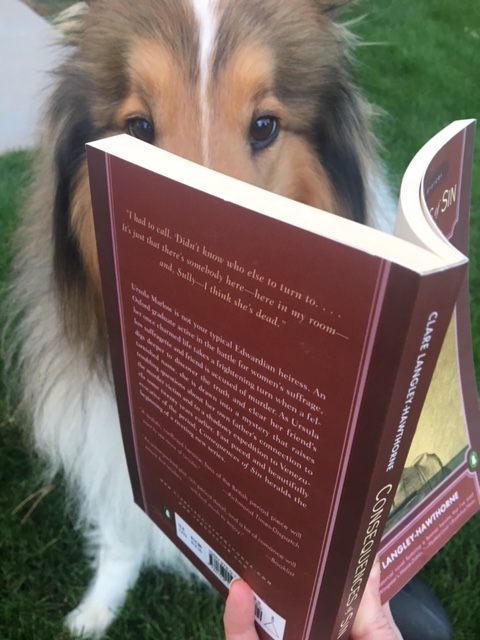
I guess my only real muse is my collie Hamish – he’s my constant companion, lying on the floor by my chair while I’m writing. He’s always willing to listen as I complain or tear my hair out in frustration, and is always happy to misinterpret my triumphs (a completed chapter!) as a request to play tug with a chew toy. He willingly goes for multiple walks a day when I need to clear my head and is always content to lie next to the couch when I resort to watching Masterpiece Theatre as ‘research’.  In honor of him (and my previous collies) I always try to include at least one collie in each novel I write:) As you can see from this photo, he really is the perfect writer’s muse.


As much as I would love to embrace the whole concept of the muse, I think my attitude can be best summed up by a quote from a fellow Australian writer, Kerry Greenwood (of Phryne Fisher fame), when she said. “If I ever saw my muse she would be an old woman with a tight bun and spectacles poking me in the middle of the back and growling, ‘Wake up and write the book!'”.

So TKZers do you have a muse? If so, in what form does your muse visit (real or imagined)? Do you ever feel like you could use one to sprinkle some fairy-dust of inspiration?

Cops at Your Door & a Mystery Unfolds – First Page Critique: Healing Wounds

Jordan Dane
@JordanDane

For your reading enjoyment, we have the first 400-word submission from a work-in-progress introduction from an anonymous author. When I got this submission, the first few lines were broken apart, so I had to reunite them. I don’t know if this weighty first paragraph was the author’s intention, so forgive me if it doesn’t look right. I’ll have my feedback on the flip side. Please share your thoughts in the comments.

***

She had the dream again last night. It lingered as awareness of morning pulled her up and her thoughts coalesced into memory. Audrey Grey saw Jacob’s imprint on the pillow beside her. The light through the curtains told her it was time to get up, too. She stood under the water, transitioning to the day ahead. Thoughts of her dream receded as the day took hold. She dressed and finished a buttered bagel. He should be back anytime. The knocking surprised her. Not tentative and apologetic like you might expect so early in the morning. It sounded . . . commanding. She tiptoed to the window and eased apart a slit between the blinds. A man in a gray and black uniform waited. She let the slats fall shut and took inventory of her appearance. Wet hair, worn skinny jeans, baggy knit top. He knocked again.

You don’t just ignore the police at your door. It’s dishonest and she couldn’t lie to a cop about not being home. Her clumsy fingers fumbled with the lock and slid the chain off. The door always stuck a little, but with an extra tug it gave way. She leaned into the door frame, face to face with the visitor. She could see the gold shield, the belt fully rigged with gear and the black gun at his side.

“Good morning, Ma’am. My name is Officer Mike Welden, Wake County Sheriff’s Department.” He consulted a black notebook flipped open in his hand. His questioning eyes moved from the page to her wary ones.

“There’s been an accident and the identification on the injured party gave this address. Do you know Jacob R.

Grey?” She caught her breath. “Yes, he’s my husband.”

“May I come in?”

She stepped back allowing him to enter. His trained eyes scanned beyond the entry and he spoke her line.

“Would you like to sit down?” Obediently, she took a seat on the edge of the sofa, swiping at shower damp tendrils of hair falling onto her face. “You saw my husband? Is he okay?”

“I found him, yes, ma’am. It appears he was hit while on his bicycle this morning. He’s been taken to Duke Hospital.”

No. He would be here soon. They had to buy a grill for the cookout. “I’m sorry, what do you mean, ‘appears’?”

“We have no witnesses, so it’s not clear exactly what happened.

FEEDBACK

OVERVIEW – This intro is a classic opener with police knocking on the door of a wife to share bad news about the husband or a family member. Here at TKZ, we preach to start with a disturbance and cops at your door would qualify, but I would’ve liked to see the dialogue with more tension and intrigue. With this being a bicycle accident, the lines are bland. If you isolate only the dialogue and take everything else away, nothing much happens.

Would it have been better to open with the bicycle accident?

We also have an opener with someone in their own head and thinking about a dream, but with the dream not explained any more than a vague 2-line notion, it’s not interesting either. I’ve opened with internal thoughts of a character, but the writing has to intrigue and create elements of mystery to keep the reader (or an editor and agent) turning pages.

It’s my opinion that the author might try to find a better place or a better way to start. Let’s drill down into the details.

OPENING LINE: ‘had the dream again last night.’
The dream is only brought up twice in this weighty opening paragraph. With the first line and this one in the middle of the first paragraph – ‘Thoughts of her dream receded as the day took hold.’ There is so little known about the dream, it’s almost not worth bringing up. It’s a cheap tease that doesn’t work for me.

To intrigue a reader, there needs to be elements of mystery that would force them to want to know more about the dream. In these two lines, even the author dismisses the importance by saying ‘her dream receded as the day took hold.’ If this dream is significant, more of it needs to be layered in and it must reflect or foreshadow what is about to happen–or create the start of a mystery to be solved–otherwise it’s not worth the focus.

If this is a dream where Audrey symbolically loses her husband Grey or can’t find him, that might provide an answer as if she is telepathic or deeply connected to him. If the dream is of something else that will carry through the story, like a distinct thread that evolves, then more needs to be hinted from the start.

Maybe the dream is something buried in Audrey’s subconscious that has put Grey in danger. The author must show patience at dangling this kind of story element into the story, but there needs to be more in order for it to gain traction.

To play with this opener, the author could have the cops get Audrey out of bed from a dead sleep. I liked the imagery of her waking to see Jacob’s imprint on his pillow. She could be more traumatized and her mind muddled if they wake her from an exhausting night of bad dreams, only to wake into her own nightmare.

But I’m more of a fan of action in the opening. Hard to say what I might’ve done in these 400 words, but the bicycle accident would appeal to me more. The reader could be drawn into Grey’s world of normalcy as he rides his bicycle, only to be suddenly struck down by a mystery assailant who races from the scene. BOOM! Opener. Then build on the foreboding dream of Audrey’s that comes to fruition with a knock on her door with police standing there. Solid start.

DISTRACTING LINE – ‘You don’t just ignore the police at your door. It’s dishonest and she couldn’t lie to a cop about not being home.’

This line should be deleted. It’s a strange thought for her to even think about not opening the door to police. A lie about not being home is odd. Most people would be intrigued as hell about why cops were at the door. Why isn’t she? It makes her sound flaky and doesn’t read as solid motivation. In the following line, there’s a focus on action where ‘her clumsy fingers fumbled with the lock.’ That shows her mental state, as if she’s nervous (and rightly so) which is contrary to her strange thought about not opening her door as a dishonest gesture.

VISUAL IMAGERY – In the second paragraph, Audrey comes face to face with the policeman. This struck me as odd, given the next imagery of her staring at his duty belt and gun. I would imagine a cop would be taller than Audrey, unless she’s tall. If she’s shorter, her eyesight might see his duty belt better. I can see her distraction with it. Many people aren’t familiar with guns and she might be intimidated by it, but the police are there for a reason and she doesn’t seem curious enough about why they are there. If this image is important, then clean it up and make the cop more intimidating, if that’s the intention, but in the whole intro, Audrey doesn’t act like a normal wife getting bad news about her husband. I’ll explain below in the section on CHARACTER MOTIVATION.

HOUSEKEEPING – There’s plenty to clean up, line by line. I’m sure other TKZers will help with that, but something that stood out was the cop’s mention of Jacob R, about halfway down. Who is Jacob R? Didn’t the police have his last name? Why would the cop only call him by his first name and an initial? When Audrey says, “Grey?” I had to reread to get the leap she made. (Maybe she jumps in to add it and interrupts him, but there’s punctuation of em dash that would help make that clearer. The author should explain why the police only referred to Jacob R or use his full name. Presumably they would have it since Jacob is at the hospital and survived the accident. He would have ID on him.

In the sentence that starts with ‘His trained eyes scanned beyond the entry and he spoke her line.’ If this is in Audrey’s POV, the author leaps into the head of the cop when referring to ‘his trained eye.’ The author should delete the word ‘trained.’ I also had to reread the last part of that line – ‘he spoke her line.’ This is out of order from real action. How would Audrey know he was about to speak her line -‘Would you like to sit down?’ In that one short paragraph, two characters are speaking and it’s confusing. Separate the lines with space to make things more clear and I would write the cop’s line more distinctly to show he’s speaking.

“It’s best we sit down. After you.” The big man took charge and Audrey lead him into the parlor.

“You saw my husband. Is he okay?”

CHARACTER MOTIVATION – Officer Welden tells her that he found her husband, saying ‘it appears he was hit…’ Instead of Audrey focusing on what a real wife might want to know – “If he’s okay, why isn’t he home?” “Was he injured? Where is he?”

Instead, Audrey focuses on the word ‘appears’ and acts like a sleuth, at the expense of the well being of her poor husband. If she comes across as jarred by the news, physically and mentally, she would be more sympathetic and the tension and emotion would be escalated. But with this cold reaction, it only adds to the bland nature of this opener. The reader will care more if they can relate to the character and Audrey’s understandable emotion.

After Audrey asks if her husband is okay, Officer Welden only says, ‘I found him, yes, ma’am’ before he jumps to more of what happened. This is a police notification to a family. They would be more concerned with sharing news about the husband’s condition and where he’s been taken. Audrey can push for details on the case and who caused the accident once she knows her husband is okay and sees for herself, but there is no sense of urgency on Audrey’s part and the cop should explain more about Jacob’s condition.

“Your husband sustained a broken arm and a few cracked ribs. Doctors at Duke Hospital are examining him now.”

Audrey mentions an internal thought of ‘No, He would be here soon. They had to buy a grill for the cookout,’ (a line that I would italicize to show an internal thought for the reader). The emotion or her confusion isn’t in sync with her cold reaction and focus on the word ‘appears.’ Put more emotion into this section and have her react like a more normal wife and the reader will care more too.

DISCUSSION:
1.) What is your feedback, TKZers?

It takes guts to submit your work for critique. Any comments are solely for the purposes of providing help to a fellow author. We’ve all been here. Thanks for your submission, brave author. The beginning of every story is my greatest challenge, always. Tweak this and perhaps re-imagine a different beginning for Audrey and Jacob and you’ll have a solid start.

Cozy Book Promotion: A Soft Sell in a Hard Business


By Elaine Viets

TKZ regular Eric asked us to define “a true cozy,” as opposed to what he called a “cutesie,” and how to market true cozies. Eric’s definition of a “cutesie” was “novels that start with a silly pun in the title, usually having to do with food or animals or Amish, that have a cartoonish cover, and that go downhill from there into worse silliness.”
Eric’s novel is “somewhat like James Scott Bell’s Glimpses of Paradise, with more crime and mystery and more realistic language.”
Since I’m a former cozy writer who now writes forensic mysteries, Jim asked me to address your question.
Last time, I defined a cozy as “a mystery with no graphic sex, cuss words or violence. Generally, the murder takes place offstage. Dame Agatha is the queen of cozies, but Miss Marple is no pushover. ‘I am Nemesis,’ the fluffy old lady announces, and relentlessly pursues killers.
“Conan Doyle’s Sherlock Holmes mysteries are not cozies, though they have many of the same elements. Sherlock has a hard edge to him, and some of his stories, like ‘The Man With the Twisted Lip,’ border on noir. Doyle, like Grafton and Sayers, writes traditional mysteries, but they aren’t considered cozies. You’ve lumped a lot of traditional novels together under the cozy umbrella. Traditional mysteries play fair – they give readers all the clues, though they may be cleverly disguised. You may be writing a traditional mystery.
“The ‘cutesies’ that you object to are simply one branch of the cozy sub-genre.”
Now, on to the promo part. These tips are for traditionally published authors. Self-published promo is a different world.

(1) Know the men writing cozies. Read their work. Here are a few: Jeff Cohen, aka EJ Copperman, who writes several series, including the Asperger’s Mysteries and the Haunted Guesthouse series. http://www.ejcopperman.com/
There’s also Dean James, aka Miranda James and his Cat in the Stacks series, http://catinthestacks.com/
And James Ziskin, https://jameswziskin.com/ whose Ellie Stone series has been nominated for the Edgar, and Lefty Awards and won the Anthony and the Macvacity Awards.
(2) Know the women writing cozies. Put aside your prejudices and read some really good cozies. I’ve mentioned Charlaine (Sookie Stackhouse) Harris’s Aurora Teagarden series. Marcia Talley’s Hannah Ives series, and Margaret Maron’s Judge Deborah Knott series. Keep on reading and you’ll find lots of cozies that have real social commentary.
(3) Meet your readers. Bouchercon, Thrillerfest, Left Coast Crime are some of the good mystery conferences, but if you really want to meet cozy readers, I recommend the Malice Domestic Mystery Conference in Bethesda, Md. (malicedomestic.org). Malice is devoted to the traditional mystery, but it has the highest concentration of cozy readers. Only a few men attend – lucky you. Also, think about a giveaway of your books for the Malice book bags. If your publisher won’t do it, buy a case of your books for the bags.
(4) Facebook. There are dozens of cozy sites. Get to know them. A few include Save Our Cozies, Cozy Mystery Giveaways, the Cozy Mystery Once a Month Book Club, Cozy-Mysteries.com. “Friend” the cozy writers you admire.


(5) Bloggers you should know. Dru Ann Love and Dru’s Book Musings. Dru calls herself a “book advocate” and she is definitely a friend to writers. Dru Ann won the Raven Award for her work. Another book lover you should know is BOLO Books reviewer Kristopher Zgorski, who’s also won a Raven.


(6) Join writers groups. Stay in touch with your peers. Join the Mystery Writers of America, the International Thriller Writers, and don’t forget Sisters in Crime. They accept Misters. Each one of these groups can help you.


(7) Bookstores. Mysteries, especially cozies, are sold by word of mouth. Get to know your local bookstore. Stop by and say hello. Buy something, even if it’s only a card or a bookmark. And ask the owner or manager if they’d like to read a copy of your book. They may ask you to do a signing. Booksellers have done amazing acts of kindness for me through the years. When I was first starting out – and returns could have hurt my career – one bookseller kept a case of my books in her office for a year until she sold them all.
(8) Avoid cutesy giveaways. Pens, tea bags, emery boards, even lipstick, are often given as gifts by cozy writers to promote their books. Unless your publisher is paying for this paraphernalia, don’t bother. I used to work at a bookstore, and we had a box in the break room with all the cozy goodies. If we needed a nail file or a pen, we’d root around in the box. To my knowledge these gifts never sold a single book.
(9) Do get bookmarks. Those are worth your money. They sell books. Most bookstores like to keep them by the cash register, and so do many libraries – and libraries are big book buyers. They buy more hardcovers than the big box stores.
Can’t afford bookmarks? Get business cards with your book cover on the front and your information on the back – including the ISBN and a Website where your book can be bought.

*************************************************************************************************

Like forensic mysteries? Win my new Angela Richman, Death Investigator novella. Click Contests at www.elaineviets.com.

First Page Critique: Tenor Trouble

Today’s first page critique is entitled Tenor Trouble, and raises many of the issues we’ve addressed here at the TKZ such as the appropriate entry scene for a novel, the use of description/backstory, and clarity in POV. Kudos to our brave author for submitting this page. My comments follow.

Tenor Trouble

“Oh no, my dear. No. You simply should not even think about auditioning for this role.”

Melissa stared at her teacher, all joy flooding from her. “I shouldn’t?”

“No, no.”

Helena Montague tapped her lacquered fingernails on the shiny surface of the vocal score for Othello, which had arrived from Amazon that morning.

Melissa had been delighted that she had caught the postman before she had to leave the flat for her ten-thirty seminar on Media Adaptations of Dickens, because she went straight from work to get to Glasgow in time for her singing lesson. It was possible, of course – even probable – that the Grande dame of British opera already had the score somewhere on the shelves that lined the music room in her elegant West End townhouse, but some instinct had made Melissa hold back on mentioning her plans until she had her own copy in her own hands.

It made it real, somehow. Melissa had been so keen to get her score that she hadn’t waited for the bulk order for the company to come through from Harmony Music, but had summoned one overnight from Amazon as soon as the choice of show was officially confirmed. Not that there had ever been a great deal of doubt about whether Agnes Farquhar’s choice of Verdi’s Otellofor Doric Opera’s next production would be voted through by the Committee.

And when she had ripped off the cardboard packaging in her kitchen that morning, and gazed reverentially at the glossy cover – identical to last year’s score, with the exception of the name of the show, framed in red – she marveled at how lightweight and relatively slender the book was. It was astonishing to think that this insubstantial volume held within it the whole of such a great work.

Now she looked at the same score on the lid of the baby grand piano, tingling with dismay. “Um – why?”

My Comments

Overall Feedback

First off, I thought the first three lines of dialogue worked really well at capturing my attention and interest. Unfortunately, after that, there is far too much narrative about Melissa’s purchase of the score for Othello and her traveling to her singing lesson, which stalls the action and drains the first page of the initial dramatic tension established.

The key to this first page is, I think, establishing emotional resonance. We want to feel (and care about) Melissa’s anticipation about auditioning as well as her dismay when her teacher immediately dismisses the prospect. To do this, the author could easily reduce the various paragraphs to one or two sentences. For example, something like “Melissa clutched the glossy score to Othello that she’d eagerly had shipped overnight and stared at Helena Montague, once the Grande Dame of British opera, in dismay.” Then the scene could immediately move to providing us with more action to give the reader a tantalizing glimpse of the novel to come.

I’m assuming the novel isn’t just about Melissa’s dashed hopes so I’d like to see some kind of foreshadowing of the drama (or mystery) to come. If this is a murder mystery, the reader should start to feel a sense of anticipation that a crime is about to occur.

More Specific Comments

Dialogue

I thought the dialogue was effective – from the initial first line I already had a good sense of Helena’s arrogance as well as Melissa’s insecurity. The teacher-student relationship was obvious. I think more dialogue rather than narrative would have strengthened this first page. That being said, we also need more action in order to become committed to following (and caring about) Melissa as a character. The dialogue so far makes her seem insecure and submissive (although that is possibly understandable when faced with the Grande Dame!).

POV

I confess I got a little confused at the start when the POV seemed to shift from Melissa to Helena Montague tapping her lacquered fingers (an image I liked BTW) on the vocal score that had arrived from Amazon that morning. It made me think (incorrectly) that it was Helena who ordered it. I think this page would work better if the author stuck close to Melissa’s POV and we knew quite clearly that we were observing Helena through her eyes.

Extraneous Information

As I already noted in my overall comments, there is far too much background detail in this first page that weighs down the scene. Do we really need to know that Melissa has a ten-thirty seminar on Media Adaptations of Dickens? Likewise, do we need details such as it was Agnes Farquhar’s choice of Verdi’s Otello for Doric Opera’s next production or that a committee voted on it? Probably not. Even though Melissa’s delight and reverence for the score packs some emotional punch, this could be portrayed more succinctly. We don’t need all the details regarding her ordering it on Amazon, intercepting the postman, or how she felt opening the package.

A first page is the reader’s initial entry point to the story and so every line, every word counts. My advice to our brave submitter would be to get straight to the heart of the matter and the initial incident which (I assume) sets up the conflict for the rest of the novel.

First Scene

One question I would ask our submitter is whether he or she thinks this is the best place to start the novel – could this confrontation occur perhaps later in the first chapter or even in chapter 2? Since I’m not sure where the story is heading, I can’t answer this myself but I do wonder if this chapter contains sufficient dramatic weight to start a novel. Although Melissa’s disappointment is evident, we probably need more intrigue/drama to become fully invested in her as a character. Sometimes it helps for a writer to take a step back and re-evaluate the best place to start the story so that it grabs the reader’s attention and doesn’t let go. Maybe (and I don’t have any idea about the actual plot for this book so I’m just throwing it out there) this novel starts with the discovery of Helena’s body and then moves to this scene as Melissa grapples with her mixed feelings over her singing teacher’s demise…

All in all though, well done to our brave submitter.

So TKZers what feedback would you provide or add?


Pixar Storytelling – 20 Points Writers Can Learn From Animated Stories

JordanDane
@JordanDane

I ran across this great video posted on Youtube that features the 20-pt advice of Emma Coats, a master storyboard artist with Pixar. The narrator of this video is writing coach Mike Consol. It runs through tips on storytelling. Whether you are a novice writer or a seasoned pro, you can learn a lot from these amazing gems.

For your convenience, I posted Pixar’s 20 points in summary and my paraphrasing, but it’s worth it to watch the video for more. Jot down the tips that speak to you and try some if you haven’t.

1.) Create characters that people admire for more than their successes.

2.) Write what is interesting for your readers, not just you as a writer.

3.) Create a character story arc using these basic lines:

Once upon a time there was _____
Every day _____
One day _____
Because of that _____
Until finally _____

4.) Simplification & focus is important. Simplifying the flow to the essence of the story is freedom for the writer. (This is like the ELLE method of sharp fast-paced writing used in the scenes of Law & Order TV series – Enter Late, Leave Early.)

5.) What is your character’s comfort zone, then throw them a major curve ball. Challenge them and give them a twist of fate.

6.) Create an ending BEFORE you write the middle. Endings are tough. Know them upfront.

7.) Finish your story by letting go of it. Nothing is perfect. Move on. You can do better the next time.

8.) Deconstruct a story that you like. What do you like best about it? Break it down. Recognize the elements.

9.) Put your story on paper and not just keep it in your head.

10.) Discount the first few plot/story ideas that come to you. Get the obvious stuff out of the way and clear your mind for new story ideas that will surprise you.

11.) Give your characters opinions. Passive characters are boring.

12.) Ask yourself – why must I tell THIS story? This will be the heart of your story and the essence of storytelling.

13.) Ask yourself – If I were my character, how would I feel? Emotional honesty brings authenticity and credibility to your writing. If the story puts the character in over-the-top circumstances, the emotional honesty can help the reader relate to the character and draw them in.

14.) What are the stakes? Give your readers a reason to root for your character. Stack the odds against your character and make them worthy of their starring role.

15.) No work is ever wasted. If it’s not working, let it go and move on. The idea or writing might be used at another time when it’s more suitable.

16.) Know the difference between doing your best and fussing.

17.) A coincidence that gets your character INTO trouble is a beautiful thing, but a coincidence that gets your character OUT OF trouble is cheating. Don’t cheat.

18.) Take the building blocks of a movie or story that you do NOT like and rearrange them into a story that is better.

19.) A writer should identify with a situation or a character. Figure out what would make YOU act that way to make it read as authentic.

20.) What is the essence of your story and then figure out what is the most economical way to tell that story.

FOR DISCUSSION:
1.) What tips did you find most helpful?
2.) Are there tips listed that you are eager to try?

By The Book

One of my favorite parts of reading the NYT Book Review is reading the interview in the ‘By the Book’ section (you may also recall some controversy when an author poo-poo’d genre fiction in one such interview). I love seeing that other writers have far too many unread books on their nightstands and that, quite often, are as disappointed by some of the so-called ‘great books’ as we all are – it’s also a great way to get insight into the workings of a writer’s mind, their literary loves and hates, their passions as well as their favorite authors.

One of this week’s questions prompted this particular blog post – after all it’s Memorial Day weekend so most of us are enjoying a long weekend, hopefully spending at least some time thinking about those who gave the ultimate sacrifice for their country (and saying a thank you to all that have and who continue to serve) as well as setting some time aside for reading and/or writing.

The question this week was: What’s your ‘go to’ classic? And your favorite book no one else has heard of…

For me, my ‘go to’ classic is Joseph Conrad’s Heart of Darkness. I studied it in my final year of high school and fell in love with it (so much so that my husband even bought me one of those prints that recreates the entire book in the shape of the continent of Africa). There’s something about the journey itself (both physical and metaphysical) as well as the lush, powerful prose that lured me in and wouldn’t let go. If I was asked to take one book to a desert island, Heart of Darkness would be it (despite the fact that it’s hardly the most uplifting tale to have with you!).

The second question is equally easy for me to answer and stems back to another book I studied in my final year of high school. It’s a book by an Australian author, David Malouf, entitled An Imaginary Life and, although it’s about the Roman poet Ovid in exile who encounters a feral child, it really deals with the whole concept of knowledge, language, imagination, civilization, man’s relationship with nature…you get the picture. Again, the lush, poetic prose is what really drew me in, as well as the amazing ability of David Malouf to describe the most complex, deep rooted concepts in the most simple yet magical terms.

I was recommended this book by my English teacher after I couldn’t get into the assigned text, Fly Away Peter (also by David Malouf). This novel is set in Australia during the First World War and, after being obsessed with British First World War poets and books like Testament of Youth, it seemed too simplistic and understated to appeal to my more dramatic tastes. My teacher, however, wisely told me to read An Imaginary Life first and then re-read Fly Away Peter…and I fell in love not only with An Imaginary Life but also David Malouf (I’ve bought and read every novel of his since). Reading that book was an almost mystical experience and yet (sadly) it’s not a novel I think many people have heard of…

So TKZers in the spirit of ‘By the Book,’ what is your ‘go to’ classic and what is your favorite book that no one else has probably heard of?