Seven Decisions That Can Crash Your Story Onto The Rocks

red hearrings

By PJ Parrish

Decisions, decisions…

We make thousands of them every day, and they run the gamut from the semi-conscious to the life-altering. Get up or hit the snooze button? Walk the dog now or hope he makes it until I get home? Buy or rent? Call up the ex-wife and tell her the truth? Send my son to rehab? Confront mom about giving up her car keys?

Since this process is part of our everyday life, you’d think making decisions would be rote when it comes to our writing. But it’s not. Just ask any poor slob who has painted himself into the plot corner and said, “Oh crap, now what?”

Was thinking about this a lot because I am critiquing a manuscript. I am doing this for a friend who is stuck, about a third of the way through, and asked me to take a look. Normally, I don’t do this for friends because I don’t have enough of them and didn’t want to lose this one. But he had some sucess with traditional publishing years ago, lost his contract, and was now going the self-pubbing route. And without an editor, he had wandered off his path.

Well, I read his stuff. It wasn’t bad. He’s got a solid grip on craft. But for the life of me, and despite doing countless First Page Critiques here, I couldn’t figure out what was wrong. Like him, I was stuck. So I asked him to be patient and set his manuscript aside. I came back to it with a fresh eye two weeks later, and it hit me immediately — he had not made enough decisions.

Here’s a quote from an essay about decision making from the writer Amos Oz. I had to run down some internet rabbit holes to find it because it is THIRTY years old! But when I re-read it, it feels as fresh as the first day I read it. (Click here if you want to read the whole essay in Paris Review). Money quote:

[Writing] is like reconstructing the whole of Paris from Lego bricks. It’s about three-quarters-of-a-million small decisions. It’s not about who will live and who will die and who will go to bed with whom. Those are the easy ones. It’s about choosing adjectives and adverbs and punctuation. These are molecular decisions that you have to take and nobody will appreciate, for the same reason that nobody ever pays attention to a single note in a symphony in a concert hall, except when the note is false. So you have to work every hard in order for your readers not to note a single false note. That is the business of three-quarters-of-a-million decisions.

Isn’t that great? A good novel is made by careful and calculated decision-making. Not that there isn’t room for serendipity, flights of fancy, and raw passion. Yes, characters take on a life of their own, but we still hold their reins. Yes, we can’t anticipate every detour, but we can keep the car under fifty as we career down the road less written about.

Back to my lost friend. Like I said, there was some good stuff happening in his story. But he wasn’t in control of his decisions. He was like a guy thrown into a swift-moving river and had left his fate to the rapids and rocks instead of making an effort to steer toward a goal.

Years ago, I went on a white-water rafting trip on the Nantahala River (where part of Deliverance was filmed. That’s me middle right in the picture above). It was white-knuckle stuff, but I always had faith that our guide could get us through. He knew where the rocks and whirlpools were, when we needed to pull right, or when we needed to ford a bad stretch. He made decisions.

Okay, enough with the metaphors. I’ll give you some rocks to grab onto. Here are some of the biggest decisions you have to make:

1. Where do I start?
We crime dogs get drilled into us that a fast break from the gate is vital to mystery and thrillers. I believe you can risk a slow opening if it is well done, but I also believe that your POINT OF ENTRY is the single most important decision you make. Yes, the opening must be compelling and hint at what’s to come. But enter too early and you risk throat-clearing. (Detective awakened by phone call in night summoning him to crime scene.). Too late and you risk confusion. (What the heck is going on here? Who are these people? Where am I in time and place?).

Let’s take a look at one opening. It’s a little long but worth dissecting:

Dawn broke over Peachtree Street. The sun razored open the downtown corridor, slicing past the construction cranes waiting to dip into the earth and pull up skyscrapers, hotels, convention centers. Frost spiderwebbed across the parks. Fog drifted through the streets. Trees slowly straightened their spines. The wet, ripe meat of the city lurched toward the November light.

The only sound was footsteps. Heavy slaps echoed between the buildings as Jimmy Lawson’s police-issue boots pounded the pavement. Sweat poured from his skin. His left knee wanted to give. His body was a symphony of pain. Every muscle was a plucked piano wire. His teeth gritted like a sand block. His heart was a snare drum. The black granite Equitable Building cast a square shadow as he crossed Pryor Street. How many blocks had Jimmy gone? How many more did he have to go?

Don Wesley was thrown over his shoulder like a sack of flour. Fire-man’s carry. Harder than it looked. Jimmy’s shoulder was ablaze. His spine drilled into his tailbone. His arm trembled from the effort of keeping Don’s legs clamped to his chest. The man could already be dead. He wasn’t moving. His head tapped into the small of Jimmy’s back as he barreled down Edgewood faster than he’d ever carried the ball down the field. He didn’t know if it was Don’s blood or his own sweat that was rolling down the back of his legs, pooling into his boots.

He wouldn’t survive this. There was no way a man could survive this.

This is from Karin Slaughter’s Cop Town. Why do I like this opening? Because even though she uses a lot of description, the effect is visceral and immediate. She could have started with the shooting incident itself, but haven’t we all read that a million times? No, she dives into the bleeding heart of the scene by showing a cop carrying his dying partner. What is left UNSAID is compelling and makes us want to read on: What happened? Why didn’t he just get in his squad car and drive? Where is he going? Are both men shot? Turns out, Jimmy carries his partner to the hospital but does he survive?

2. Whose story is this?

Every story needs a protagonist. Duh. But sometimes, in the hurly-burly of writing, we can lose sight of who owns the story. The result can be that seductive secondary characters take over, or the villain becomes hyper-vivid. The protag-hero is, to my mind, the hardest character to create because you must invest so much of the story’s logic and impact in them that they can mutate from calm center to sidelined cipher.
Sometimes, you might start out telling the story from one character’s POV, believing he is your hero, but then a second character elbows into the spotlight. This happened to our book She’s Not There. I opened with a woman waking up in a hospital with concussion-induced amnesia and she has a gut-punch fear that her husband tried to kill her. So she bolts from the hospital and goes on the run. She’s my unreliable narrator protag, I thought. Until her husband hires a skip tracer to bring her home. It took fifty-some pages before I realized I had a full-scale dual-protag story on my hands. And I had to do a lot of rewriting to make it work.

Now this is not to say you can’t have a teeming cast in your story. Take Ken Follett’s The Pillars of the Earth. I was captivated by the protag Tom Builder, but whenever Follett moved away from Tom, I got impatient. Later in this massive book, the protag spotlight shifts to his step-son Jack. I missed Tom badly.

And be careful about setting up a false or “decoy” protag. This is a character that dominates so much of a book in its early going, that the reader begins to identify with her and invest in her journey. But then this character is marginalized (usually killed). Think of Marion Crane in Psycho, who dominated the movie for 47 minutes until Norman Bates became the putative protag. Stieg Larsson’s Mikael Blomkvist is a decoy protag, I think, because while most the plot’s machinery is built around him, Lizabeth Salander is the true action hero and embodiment of the story’s themes. At the very least, I’d consider them dual protags.

3. What am I trying to say?

I’m going out on limb here and say all good books have themes. Yes, your goal might be modest — you just want to entertain readers. But beneath the grinding gears of plot, even light books can have something to say about the human condition. A romance might be “about” how love is doomed without trust. A courtroom drama might be “about” the morality of the death penalty. Good fiction, Stephen King says, “always begins with story and progresses to theme.” And often, you don’t even grasp the theme until later in the book or even during rewrites.

What are your major and minor conflicts? What is the book’s theme(s)? What are the recurring visual motifs or symbols? What is the book’s tone and mood? Which leads me to…

4. What mood am I in?

When She’s Not There was in the Thomas & Mercer pipeline, my editor sent me a questionnaire listed some “mood” words — haunting, witty, intense, sweet, hopeful, psychological, somber, epic, tragic, foreboding, romantic. They were asking us this because they wanted the design and promotion to enhance our chances of marketing success. You, too, have to think about this as you write your book, whether you self-pub or go traditional. What kind of world are you asking your reader to enter? How do you want them to feel? Once you can answer this question, you then must use all your powers and craft to create what Edgar Allan Poe called “Unity of Effect.” Every word and image, Poe believed, had to be carefully chosen to illicit an emotion.

5. Where am I?

I’m often surprised at how paltry setting is rendered in crime fiction. We need to know where we are very early in the story, preferably inserted gracefully into the narrative flow via sharp description. Yeah, you can slap one of those tags at the beginning of chapter one — Somewhere in the Gobi Desert, Sept, 1904. I concede that you need sign-posts at times; I’ve used them myself. But they can be a crutch. As a reader, I prefer to be parachuted into a place and use my senses rather than have the writer stick a sign in my face.

6. Am I doing this for me or for the story?

The story always has to come first. You can’t kill someone off just because you’ve stalled in the middle and you’re desperate. You can’t let a character hog the story just because you’ve fallen in love with her or she’s easier to write than your protag. You can’t add a twist just because you think it will make you look clever. All twists must be organic, emerging from the plot, not from your “hey-watch-this!” writer-ego. Go back to question 2: Whose story it is? Well, it’s not yours; it’s your character’s. It’s not about you using fancy words or filigreed metaphors. It’s not about you trying to transcend the genre, win some award, or anything else. It’s about the people in your book.
As Elmore Leonard said, “Always write from a character’s point of view. Write in their language to keep the sense that it’s their story. They’re the most important thing.”

7. Does this make sense?

This is just a plea for simple clarity in three things: your writing style, plot structure, and character motivation. Let’s break them down:

Writing style: Don’t confuse your readers. Chose the simplest but most evocative words you can find. As Stephen King says, “One of the really bad things you can do to your writing is dressing up the vocabulary, looking for long words because maybe you’re a little ashamed of your short ones.” In other words, most the time a lawn is just a lawn, not a verdant sward. Be clear in your choreography when you move your characters through time and space. If someone enters a room, tell us. If you jump ahead three days in time, tell us. This is the “busy work” of fiction writing but it’s no less important. If your reader can’t follow the simple physical movements in your story, they will give up on you and your book.

Plot structure: Your story must have a durable thread of logic that runs from beginning to end. Events on your plot arc must emerge organically and not from coincidence. (no deus ex machina or long-lost Uncle Dickie from Australia showing up in chapter 40 to announce he is the killer) Your details of police, legal and medical procedure must ring true. Your twists and turns must be well-planned and hard-earned. Does the plot, as a whole, make sense? And if you write sci-fi, dystopian fiction, fantasy or horror, does the artificial world you create obey the rules of its own logic and does it FEEL believable?

Character motivation: Man, is this one important. I can’t believe I left it for last. Characters are your lifeblood and if you want the reader to believe in them, to care about them, to root against them or cheer for them, they must be multi-dimensional and “real.” They must conform to their own internal logic. They must be true to their personalities. We’ve all read books where we say, “Shoot, that guy would have never done that!” The writer has not done her job in this case, has not asked herself: “Does this make sense for this person to do this?”

Decisions, decisions…

So what about my friend’s book? First, he had allowed a secondary character (A sidekick) to steal the spotlight. I advised him to go read some Robert B. Parker books to see how Parker kept the titanic yet taciturn sidekick Hawk under control. My friend also didn’t quite know what he was trying to SAY with his book. He is trying to transition from police procedurals to softer suspense (actually trying to catch the cozy-fantasy trend that’s hot right now). I suggested to him that he was relying too much on his darker neo-noir habits. The mood was inconsistent, even a tad tone-deaf.

As Amos Oz said nobody ever pays attention to a single note in a symphony, except when the note is false..
Inappropriate Character Flaw or Nervous Habit

True confession time. I have a horrible nervous habit — reaction? — when someone falls. I’ve struggled with it my entire life, but try as I might, I can’t change my behavior. Believe me, I’ve tried.
What is this awful flaw?

Let me preface this by saying, I feel all the correct emotions, hoping the person who fell is not seriously hurt, didn’t break a bone, or worse. I’m deeply concerned about their wellbeing — I really am — but the uncontrollable laughter that wells from deep inside me counteracts any genuine feelings I try to convey. It’s terrible for the person who fell. It’s even worse for me, because it’s not an accurate portrayal for how I feel in the moment. But I can’t stop laughing.

How would you handle a character with a flaw like mine?

Readers would hate an MC who laughs when someone falls. It’s so inappropriate, many wouldn’t care how the character felt inside. Even my mother had a difficult time dealing with my nervous habit, especially since I’m a very even, calm, happy-go-lucky person. Not an overly serious one, though. Which may be part of the problem. If we don’t laugh, we cry, right? Perhaps it’s a survival instinct.

Hmm…

Or maybe, it’s because of my lighthearted nature that when something shocks me like a fall, it throws me into a mental tailspin. Uncontrollable belly-laughter is the result. The worst part? The more I love the person, the harder I laugh. For a long time, I thought there was something seriously wrong with me. Only a sadist would laugh at a time like this.

Since this happened again recently — thankfully, the loved one who fell has the same flaw — it drove me to find answers.

On Quora, someone asked the question, “Why can’t I control my laughter when someone falls?”

A psychology student responded:

“Laughter is a parasympathetic response which calms the nervous system down and often occurs in situations of relief (people engage in nervous laughter to try to calm themself down). The laughter can force you to engage in rapid diaphramatic breathing (belly laughing), which stimulates other parts of the parasympathic nervous system, creating a calming effect.”

Ah-ha! It’s an empathetic response. I felt somewhat better, but I needed more. So, I dug deeper and found an article in Scientific American entitled, Why Do We Laugh When Someone Falls?

William F. Fry, a psychiatrist and laughter researcher at Stanford University, explained:

EVERY HUMAN develops a sense of humor, and everyone’s taste is slightly different. But certain fundamental aspects of humor help explain why a misstep may elicit laughter.

The first requirement is the “play frame,” which puts a real-life event in a nonserious context and allows for an atypical psychological reaction. Play frames explain why most people will not find it comical if someone falls from a 10-story building and dies: in this instance, the falling person’s distress hinders the establishment of the nonserious context. But if a woman casually walking down the street trips and flails hopelessly as she stumbles to the ground, the play frame may be established, and an observer may find the event amusing.

Exactly! I would never laugh if someone fell from a 10-story building and died. Strangely, I also don’t laugh if animals or the elderly fall. My brain must deem that more serious. Everyone else is fair game. Including me, by the way. All it takes is one little smirk from an onlooker and I die laughing.

Another crucial characteristic is incongruity, which can be seen in the improbable or inconsistent relation between the “punch line” and the “body” of a joke or experience. Falls are incongruent in the normal course of life in that they are unexpected. So despite our innate empathetic reaction—you poor fellow!—our incongruity instinct may be more powerful. Provided that the fall event establishes a play frame, mirth will likely ensue.

And you thought I was a terrible person. Shame on you. 😉

Play frames and incongruity are psychological concepts; only recently has neurobiology caught up with them. In the early 1990s the discovery of mirror neurons led to a new way to understand the incongruity aspect of humor.

When we fall down, we thrash about as we reach out to catch ourselves. Neu­rons in our brain control these movements. But when we observe another person stumbling, some of our own neurons fire as if we were the person doing the flailing—these mirror neurons are duplicating the patterns of activity in the falling person’s brain.

My hypothesis regarding the relevance of this mechanism for humor behavior is that the observer’s brain is “tickled” by that neurological “ghost.” The observer experiences an unconscious stimulation from that ghost, reinforcing the incongruity perception.

Thank you, Doctor! Still, it’d be a tough flaw to give a character. The only way to handle it would be to show how awful the character felt about laughing. Even then, I don’t know if it’s enough.

What do you think? Is all inappropriate behavior a tough sell, or does it make the character more relatable?

For the brave souls among us, do you have a similar flaw? What is one thing you’d change about yourself if you could?

There’s Something Bigger Than Amazon

by James Scott Bell
@jamesscottbell

Mel Brooks and Carl Reiner had a routine called The 2000-Year-Old Man. Reiner played a reporter interviewing the world’s oldest man, who would tell him all sorts of things that happened in the distant past. One time the subject was religion:

REINER: Did you believe in anything?

BROOKS: Yes, a guy, Phil. Philip was the leader of our tribe.

REINER: What made him the leader?

BROOKS: Very big, very strong, big beard, big arms, he could just kill you. He could walk on you and you would die.

REINER: You revered him?

BROOKS: We prayed to him. Would you like to hear one of our prayers? “Oh Philip. Please don’t take our eyes out and don’t pinch us and don’t hurt us. Amen.”

REINER: How long was his reign?

BROOKS: Not too long. Because one day, Philip was hit by lightning. And we looked up and said, “There’s something bigger than Phil.”

I’ll return to this later.

I was too busy to give a thoughtful reply to Terry’s post about Amazon and their new “Ask This Book” feature. Enough has been said about it there—and everywhere—that the issues are clear.

Most pressing for authors and publishers are copyright and permission. Does this feature, which provides plot summaries and character analyses, violate copyright? Or is it more like a flexible version of CliffsNotes?

Or is ATB different in kind? The Authors Guild thinks so. It argues that what Amazon is doing is creating an interactive book from the original material, i.e., another iteration of an author’s intellectual property, for which the author should receive compensation. I suspect there is a lot more to come on this matter.

It should be noted that someone can go straight to AI now and ask for a summary and analysis of a book. I went to Grok and asked for a summary of a thriller by one of my favorite authors. I got it. Accurately, too. Without spoilers. When I asked specifically for the spoiler answer to the ultimate mystery, I got that, too. I then asked for an analysis of the main characters. Check. (In deference to the author, from whom I did not seek permission, I will not post the answers.) Is ATB merely a more convenient way for a reader to get the same information?

And speaking of permission, this feature is being rolled out by Amazon without giving the author or publisher the choice to opt in or out, as with DRM. This has raised the temperature in many a discussion. Given that, what should an author do? I don’t think many will pull their ebooks off Amazon in protest, because Amazon is their biggest revenue stream. It’s irrelevant whether one is wide or exclusive.

Which brings me back to Phil. Because there’s something bigger than Amazon in all this. And that is Artificial Intelligence itself. We all know it’s here, it’s growing, and it’s here to stay. There have been innumerable discussions, debates, and jeremiads on how writers use this borg. For me, the firm no-go zone is having it generate text that is cut-pasted into a book, even though AI can now replicate a writer’s particular style (see Joe Konrath’s recent post and the examples therein).

What I’m most concerned about is the larger issue of melting brains. Using AI as a substitute for hard thinking atrophies the gray matter. “Use it or lose it” is real. In the past, a reader who wanted to know what’s happened in a book had to “flip back” actual pages to find out. That was work, and therefore good for the noggin. AI bypasses that neural network.

This brain rot is bad for the species, especially among the young. It tears my heart out to see a man or woman walking down the street, looking at their phone, while pushing a stroller with a toddler in it, who is likewise staring at a device full of dancing monkeys or pink rabbits. That child’s brain is being robbed of essential foundations built only by looking around at the real world in wonder.

The school years used to be a daily session of ever more complex thinking. Learning to write a persuasive essay—with a topic paragraph and supporting arguments—was once a major goal of education. Now AI can do that for you in seconds, so you can go back to playing Candy Crush.

We all know this. But what can we do about it? Take responsibility for our own actions. Don’t let AI do all the work for us, or for our kids and grandkids.

And if you’re upset with Amazon’s ATB, cool your jets and register a polite response to KDP customer service. There’s enough vitriol out there. We’re awash in so much Ghostbusters II mood slime now that we don’t need to add to it.

Because as bad as brain rot is, soul rot is worse. And a hate-laced, click-bait habit will inevitably turn your soul into the picture of Dorian Gray. Don’t go there.

And those are my myriad thoughts. Help me sort them out in the comments.

This Ain’t Your Grandaddy’s Western

Good morning to you all!

Today’s post is a little different than usual. The link below will take you to Saddlebag Dispatches Magazine and an article I co-wrote with Roan and Weatherford publisher, Casey Cowan. He called me one day several months ago and asked if I’d work with him on an article about westerns and their survival as viable genre. Of course I jumped at the chance.

We reached out to other authors such as Marc Cameron, Craig Johnson, and the creator of Rambo, David Morrell who are writing modern westerns today, bringing in different viewpoints about these books that once entertained, and eventually brought many authors into the writing world.

This is the result.

Enjoy!

https://issuu.com/oghmacreative/docs/saddlebag_dispatches-january_2026/s/152135644

P.S.

Here’s the link to the entire January issue of this fine magazine, where you can find an in-depth interview with David Morrell, fascinating articles on the new and old west, and my ongoing column, along and much, much more.

https://issuu.com/…/docs/saddlebag_dispatches-january_2026

Reader Friday: What’s in a Name?

Here’s an oldie from TKZ emerita Jordan Dane:

JSB’s favorite short story collection

Answer any one or all:

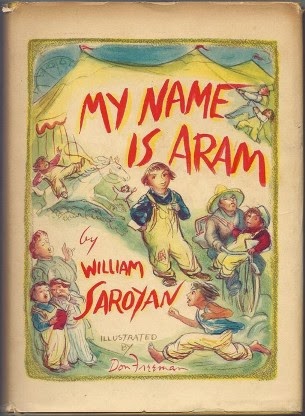
1.) What’s your favorite way to select a character’s name? (Do you have any favorite GO TO resource links?)

2.) Do you care about name origins or meanings?

3.) How do you select names for a character with different ethnic backgrounds?

Show Up: The Discipline of Writing

When I first started writing way back in the dark ages, even before the internet was dial-up…What’s dial-up, you ask? For readers who aren’t familiar with the term, back in the late nineties when you connected to the internet, first you heard a dial tone, then a series of screeching, beeps, and static as the modem connected to the ISP that might go on forever while the user sat there waiting and waiting for everything to connect…

Oh, and this was before Word, so everything was DOS…and even before that, it was an electric typewriter, and before that, a manual one (that’s what I started on), and the only critique groups were—gasp—in person. Only in my corner of the world, there were no critique groups. I wrote and wrote and kept getting rejections because I made the same mistakes over and over because there was no one to tell me what I was doing wrong.

Writing was hard. It took a lot of discipline to show up and keep going.

Let me tell you a little secret. Writing is still hard, even with all the shortcuts and conveniences we have. Need to research gunrunning? Instead of getting in the car and driving to the library and looking through the card catalogue for books or articles on the subject, just put your research question in Giggle, I mean Google, and instantly there are hundreds of articles on gun running at your fingertips. Off you go on a rabbit trail. Not only that, there are a gazillion books on writing.

When I started, I had a handful of books from my local library, and probably the best thing I could’ve had—the Writers Digest Magazine featuring a monthly column by Lawrence Block. Each installment felt like a masterclass in creative writing. Here’s a link to one of his columns—columns he wrote every month for fourteen years–talk about discipline! Later came Nancy Kress and then our own James Scott Bell.

However, books and articles don’t teach discipline, and in MHO, discipline is the difference between wanting to write and actually writing. Here’s my definition of discipline: Showing up and doing the hard work when you don’t feel like it.

I’ve known writers who love to talk about writing and who love to have written, but when it comes to actually sitting behind a computer and actually putting something on paper, they are MIA. Unfortunately, no one can give you the discipline to write. Only you can do that, and if you don’t have a deadline, either from a publisher or a self-imposed one, it’s hard to make yourself sit at the computer and run (or plod) toward the finish line unless you have that drive to create a story and put what’s in your head on paper.

So TKZers, what advice do you have on developing discipline? And if I don’t show up to answer comments, then you’ll know the ice storm brought down the power lines in my area…

Amazon’s Latest Rollout – And Controversy

Amazon’s Latest Rollout – And Controversy
Terry Odell

Amazon is rolling out a new feature, “Ask this Book,” a new feature that allows readers (of Kindle books) to interact with the book. It’s currently available for thousands of English-language books on the Kindle iOS app in the U.S. The feature will be enabled on Kindle devices and Android OS next year.

Forget a character’s name? Can’t remember where a scene took place? Instead of searching, which can be a tedious process, you can now ask the AI genie inside the book and it will answer you, also inside the book. No scrolling, no losing your place.

That seems harmless enough. Helpful, even. But you can also ask more general questions, and AI will answer in a paragraph, and that’s where the controversy begins.

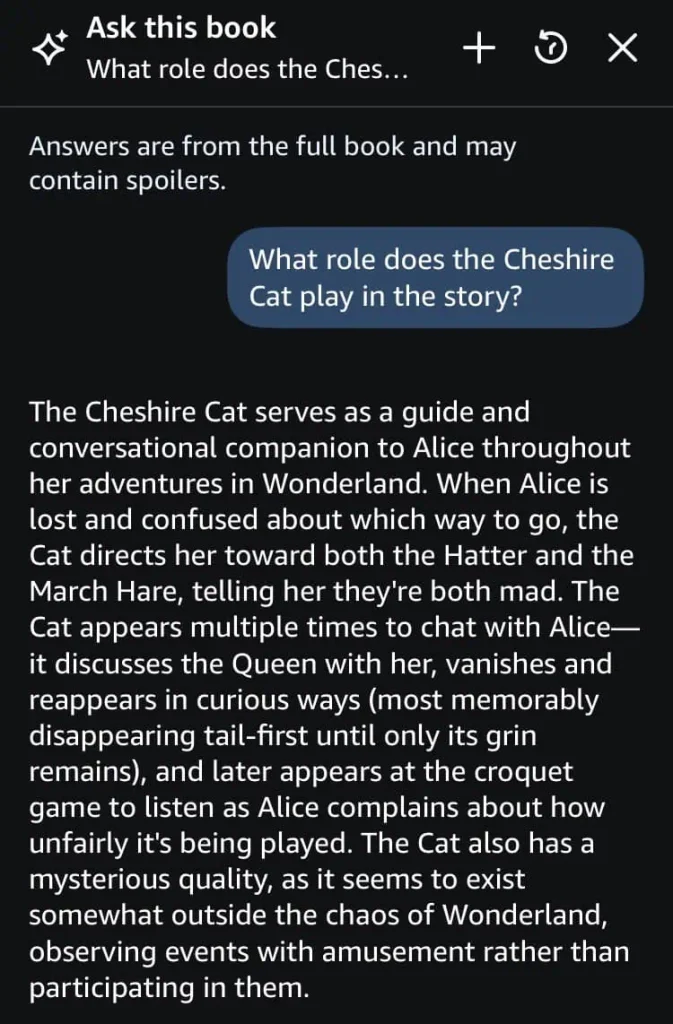
This example is from a Kindlepreneur article written by Kevin J. Duncan, Head of Content. Using the book “Alice in Wonderland,” he asked what was the role of the Cheshire Cat.

The response:

The argument continues that these sorts of answers are the “opinions” of AI. To quote Duncan, “the system is giving you its version of what that thing means. It decides what matters, what doesn’t, what’s central, and what can be glossed over.”

My own test. I don’t own a Kindle, and I buy almost all my books from Barnes & Noble, but I do have a few books from Amazon, admittedly. Most of them are the freebies that come with my Prime membership, with occasional purchases from authors I’m familiar with. I didn’t have access to the Ask This Book feature when I opened a book from my Kindle library to read on my PC, but I did get the feature on my phone.

(Personal note. Reading on my phone is a last resort. I have a Nook tablet and an iPad mini, both of which are much more eye-friendly, but sometimes I’m stuck waiting unexpectedly and don’t have one of those devices with me.)

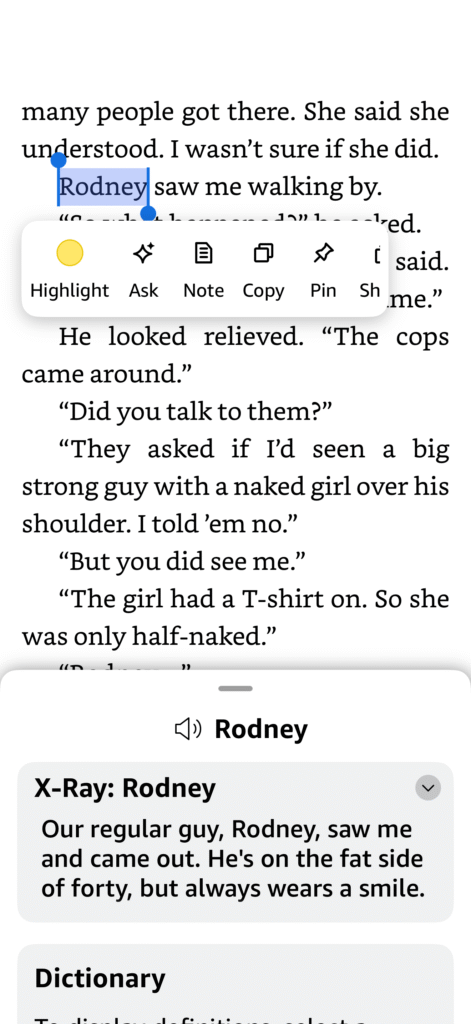
The Ask This Book feature is activated by tapping the page and getting a menu of icons at top of the screen. Ask This Book is the diamond shape with the little +.

Or, you can highlight a word or portion of text, which should give you the option to ask your question.

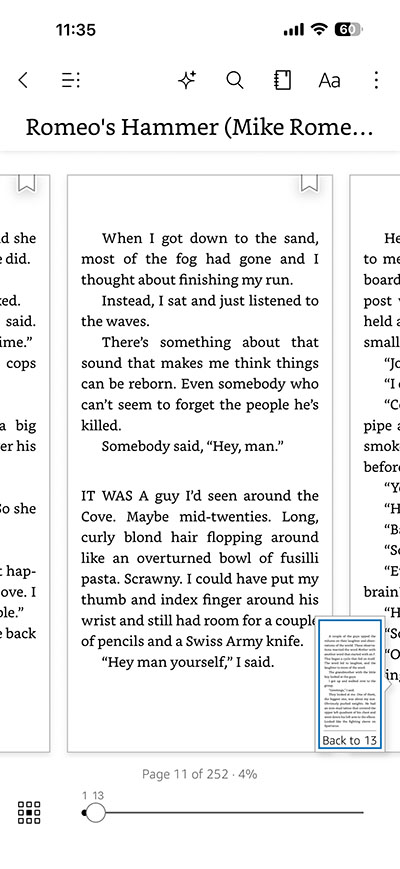
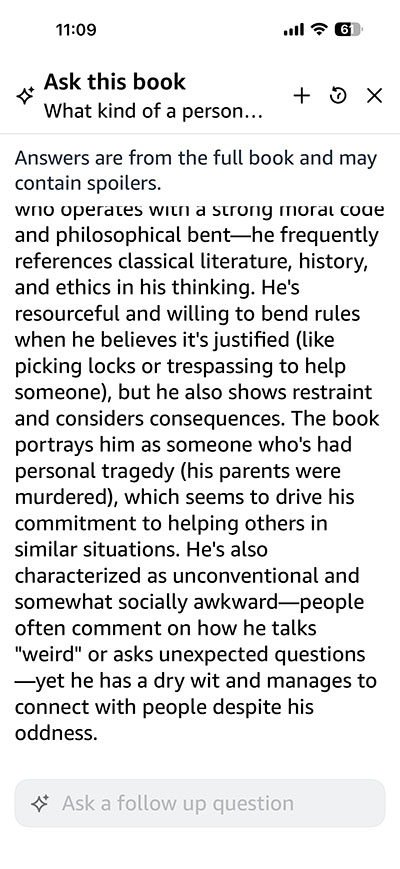
You can also choose between having AI look at the whole book, or only up to as far as you’ve read, which is supposed to avoid spoilers. I used the whole book option and asked the question, “What kind of person is Mike Romeo.”

This is the response I got. (Sorry, but my phone wouldn’t let me shrink the text to get the entire answer on the screen, but you can probably figure out the first sentence.)

**If you’re reading this, JSB, what do you think about this characterization summary?

The Author’s Guild is pushing back. This is what they had to say:

“The Guild is looking into whether the feature, which was added without permission from publishers or authors, might infringe authors’ and publishers’ rights.

“Ask this Book, which is slated for a wider rollout in 2026, allows readers to query an AI chatbot about books they have purchased or borrowed. So far there is no way for publishers or authors to opt their books out of the feature, though as of this writing the feature is not available for all ebooks. It allows a reader to highlight text and click on an “Ask” icon to ask the AI to “explain” the selected text or enter their own question in the chatbot. All responses are generated from the book itself.

“The Guild is concerned that Ask this Book turns books into searchable, interactive products akin to enhanced ebooks or annotated editions—a new format for which rights should be specifically negotiated—and, given Amazon’s stronghold on ebook retail, it could usurp the burgeoning licensing market for interactive AI-enabled ebooks and audiobooks.”

Writer Beware isn’t too happy about the feature, either. They say, “Agents and publishers broadly regard anything to do with generative AI as a separate right reserved solely to the author, and publishing contracts are increasingly addressing this issue. The primary focus has been on preventing unpermissioned AI training, but with the technology embedding itself at warp speed in all aspects of the book business, the rights implications are expanding just as fast…especially where, as here, they sneak in under the radar.”

Should this be considered yet another format of a book? If so, what are the author’s rights?

As of now, there is no opt-out choice. Ask This Book is included automatically. It operates independently of the author, so they don’t get to review answers, suggest changes, or flag problems.

Your thoughts, TKZers? Are authors and publishers getting shortchanged?

**Note: if you’re upset with Amazon, my books are available wide.


New! Find me at Substack with Writings and Wanderings

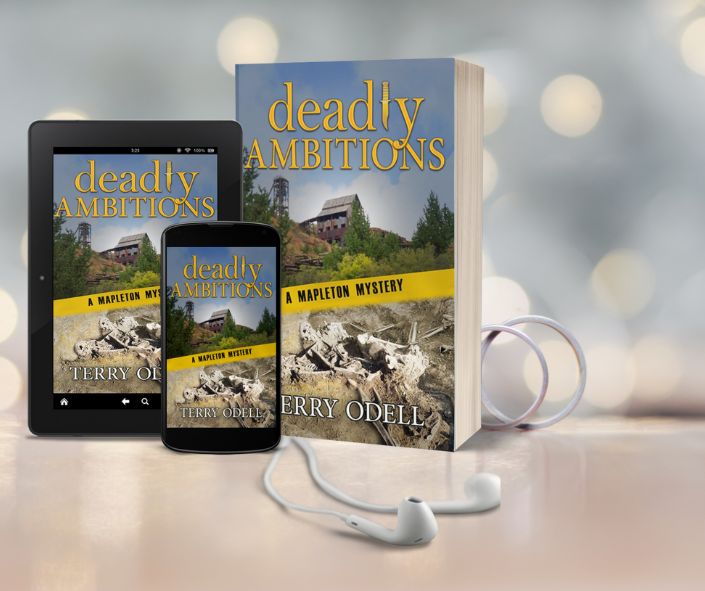
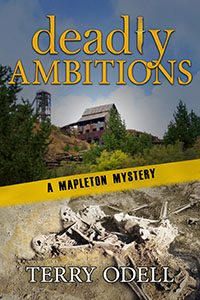
Deadly Ambitions
Peace in Mapleton doesn’t last. Police Chief Gordon Hepler is already juggling a bitter ex-mayoral candidate who refuses to accept election results and a new council member determined to cut police department’s funding.
Meanwhile, Angie’s long-delayed diner remodel uncovers an old journal, sparking her curiosity about the girl who wrote it. But as she digs for answers, is she uncovering more than she bargained for?
Now, Gordon must untangle political maneuvering, personal grudges, and hidden agendas before danger closes in on the people he loves most.
Deadly Ambitions delivers small-town intrigue, political tension, and page-turning suspense rooted in both history and today’s ambitions.


Terry Odell is an award-winning author of Mystery and Romantic Suspense, although she prefers to think of them all as “Mysteries with Relationships.”

Celebrating Public Domain Day – Part 2

Montage of 1929 Works

by Debbie Burke

Y’know what they say about great minds?

Well, Kay DiBianca and I independently had the same idea this week: Public Domain Day 2026.

When I went to schedule my post, I noticed Kay had already scheduled hers. So we put our great minds together and decided that1930 was such an exceptional year for books, films, and music, there was enough to cover without duplicating each other.

So here is Part 2 featuring music and recordings.

George and Ira Gershwin published four great tunes:  I Got RhythmI’ve Got a Crush on YouBut Not for Me, and Embraceable You.

More hummable earworm songs: Georgia on My Mind, Dream a Little Dream of Me, Body and Soul, Just a Gigolo.

Music and lyrics have their own copyright dates as sheet music but recordings of those songs by particular musicians may fall under different later dates. For 2026, these specific performances entered the public domain:

In an interesting side note, the soundtracks for a number of cartoons were built on musical compositions that had earlier gone into public domain. For boomers, our first introduction of these tunes often came from cartoons, singing along to: “A Hunting We Will Go”, “The Farmer in the Dell”, and “Pop Goes the Weasel”. I have clear memories of several  cartoon heroes playing a flute to coax a cobra from a basket with the “Snake Charmer Song”.

How many of us boomers were called to the TV by the siren song of the “William Tell Overture,” the theme for The Lone Ranger?

Want to stroll farther down memory? Check out Duke University’s annual public domain summaries.

~~~

TKZers: Did any of these characters, books, films, cartoons, or music inspire your writing? Which ones and why?

Would any of these songs play well for the soundtrack of a movie based on your book? Which ones?

~~~

Tawny Lindholm Thrillers will probably enter public domain around the beginning of the 22nd century. Meanwhile, you can read them at this sales link.

Debbie Burke website.

What’s New in the Public Domain in 2026

Only one thing is impossible for God: To find any sense in any copyright law on the planet. —Mark Twain

* * *

Article I, Section 8, Clause 8 of the United States Constitution grants the U.S. Congress the power “To promote the Progress of Science and useful Arts, by securing for limited Times to Authors and Inventors the exclusive Right to their respective Writings and Discoveries”

Congress has used that power to define the “limited time” for authors’ works to be placed in the public domain. According to Google AI

Current U.S. law generally puts works into the public domain 95 years after their publication (for pre-1978 works) or 70 years after the author’s death (for post-1978 works, or 95/120 years for corporate works), with new works entering each January 1st, so as of January 1, 2026, works published in 1930 entered the public domain. This means works from 1930, like early Mickey Mouse cartoons, are now freely usable, while works created today will remain protected until 70 years after the creator’s death. 

* * *

The Center for the Study of the Public Domain on the website of Duke University Law School has a good explanation of the notion of the public domain. Here are a couple of quotes:

When works go into the public domain, they can legally be shared, without permission or fee.

The public domain is also a wellspring for creativity. You could think of it as the yin to copyright’s yang. Copyright law gives authors important rights that encourage creativity and distribution—this is a very good thing. But the United States Constitution requires that those rights last only for a “limited time,” so that when they expire, works go into the public domain, where future authors can legally build on the past—reimagining the books, making them into films, adapting the songs and movies. That’s a good thing too! It is part of copyright’s ecosystem. The point of copyright is to promote creativity, and the public domain plays a central role in doing so.

* * *

Fortunately for us, as of January 1, 2026, thousands of copyrighted works from 1930 entered the public domain in the U.S. Sound recordings from 1925 are also included.

Here are a few that entered the PD this year (with some interesting trivia):

  •  The Maltese Falcon  by Dashiell Hammett – Even though the gold- and jewel-laden Maltese Falcon wasn’t found in the story, the statuettes used as props in the movie turned out to be very valuable indeed. In 2013 a buyer paid $4.1 million for one of them.
  • The Murder at the Vicarage by Agatha Christie – Although Miss Marple had appeared in short stories before, The Murder at the Vicarage was her first role as the detective in a novel.
  • As I Lay Dying by William Faulkner – Faulkner claimed to have written the book in six weeks (!) while working at a Mississippi power plant. The book has 15 narrators over 59 chapters. (The title comes from a quote in Homer’s Odyssey where Odysseus has traveled to Hades and meets his old pal Agamemnon who complains about his wife’s behavior as he lay dying.)
  • The first four Nancy Drew books by Carolyn Keene – As most of us know, Carolyn Keene was the pseudonym for the group of writers in the Stratemeyer Syndicate who produced the Nancy Drew novels. The first books were penned by Mildred Benson, a woman whose adventurous life as a journalist and pilot (I hope Patricia Bradley is reading this) contributed to Nancy Drew’s persona.
  • The Little Engine That Could by Watty Piper (pseudonym of Arnold Munk) – The tale’s basic idea appeared in a Swedish journal in 1902. Early versions were published in American newspapers around 1906 as sermons or moral tales. The themes of optimism, perseverance, and service over status have captured children’s (and adults’) imaginations for decades. (I wonder if I could write a good book with those themes. I think I can. I think I can.)

A few more books on the 2026 list:

  • Cakes and Ale by W. Somerset Maugham
  • Strong Poison by Dorothy L. Sayers
  • Private Lives by Noël Coward
  • Ash Wednesday by T.S. Eliot
  • The Conquest of Happiness by Bertrand Russell

And several movies:

  • All Quiet on the Western Front, winner of the Academy Award for Best Picture
  • Cimarron, winner of the Academy Award for Best Picture
  • Animal Crackers, starring the Marx Brothers
  • Soup to Nuts, featuring later members of The Three Stooges
  • Hell’s Angels, Jean Harlow’s film debut, directed by Howard Hughes
  • Murder!, directed by Alfred Hitchcock

A more comprehensive list can be found on the Center for the Study of the Public Domain site.

* * *

So TKZers: Have you read or watched any of the new public domain additions? What other artistic works that have recently come into the public domain do you recommend?

* * *


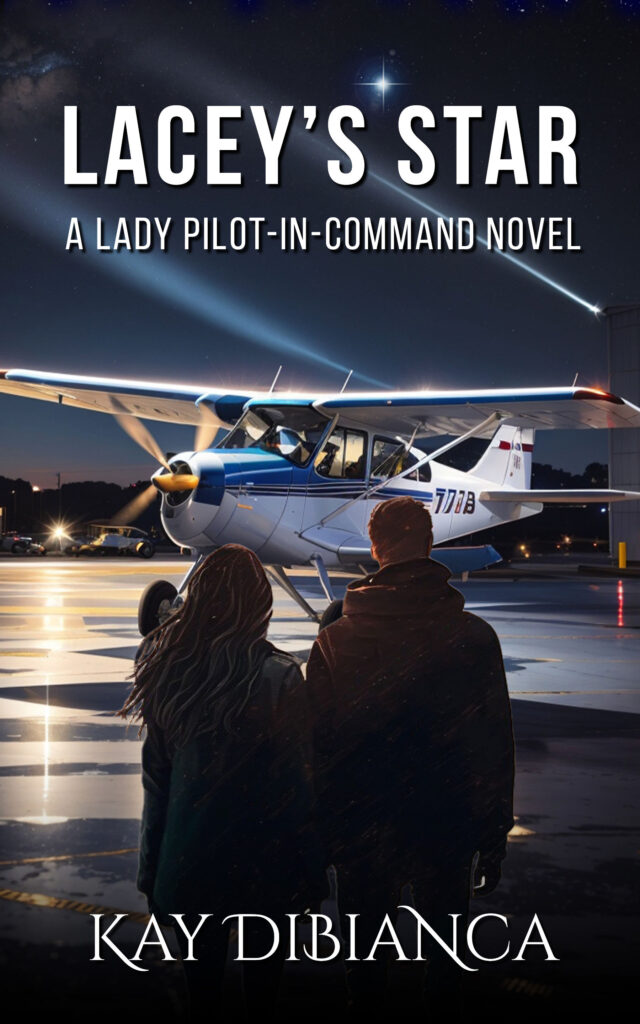
Forty years ago, Lacey Alderson died—and the truth was buried with her. In Lacey’s Star, private pilot Cassie Deakin lands in the middle of the mystery and discovers old secrets that refuse to stay hidden any longer.

Click the image to fly with Cassie.

This Book Brought to You By

by James Scott Bell
@jamesscottbell

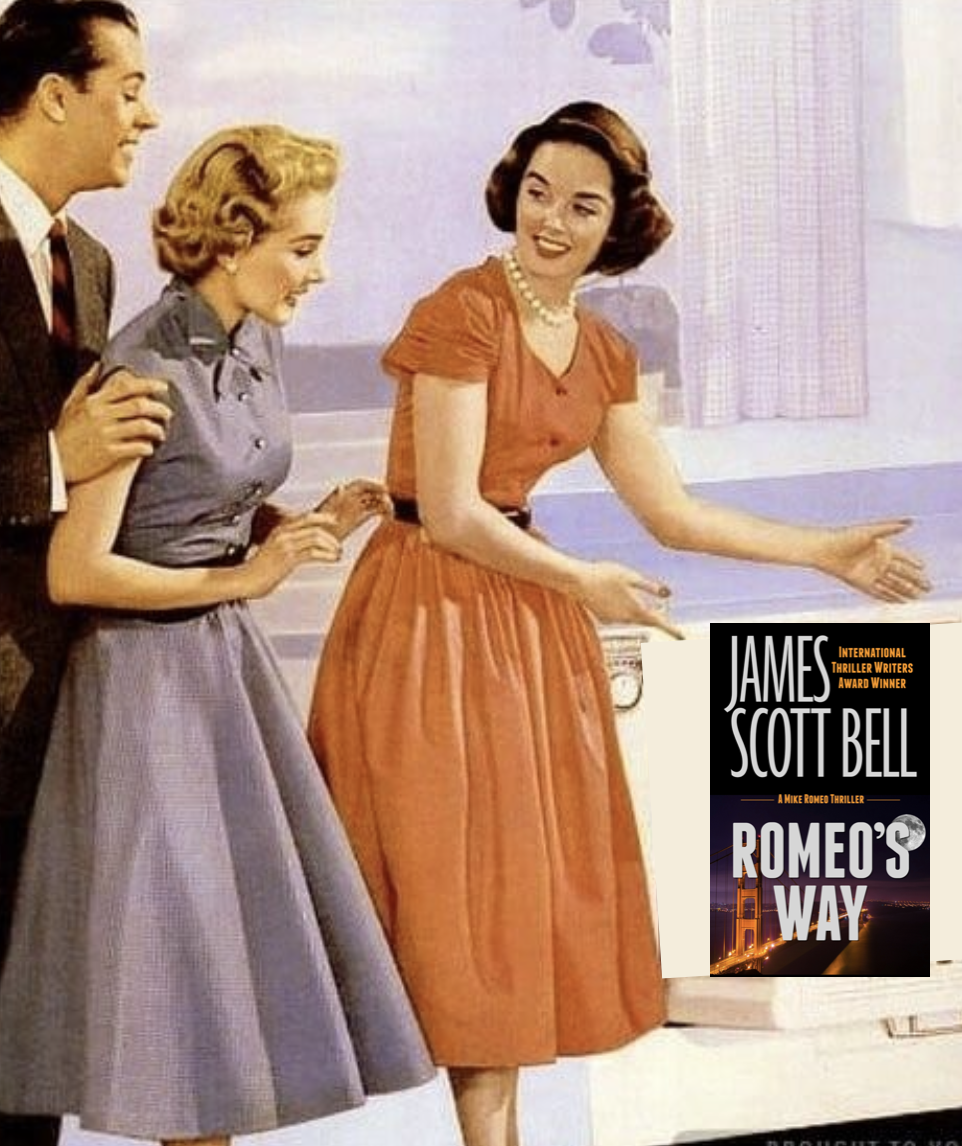
Today’s post is brought to you by Romeo’s Way. Yes, with Romeo’s Way you’ll be the envy of every reader on the block. And for a limited time only, Romeo’s Way can be yours for the low, low price of 99¢.

No on to our blog and your host, JSB!

In the early years of television, most shows had a single sponsor paying the bills, e.g., Colgate Comedy Hour, Texaco Star Theatre, Goodyear TV Playhouse, Kraft Television Theatre. The shows that were “brought to you by” often featured the stars in a commercial.

Father Knows Best, brought to you by Maxwell House Coffee. Good to the last drop.”

Leave it to Beaver has been brought to you by Ralston Purina, makers of the eager eater dog food.”

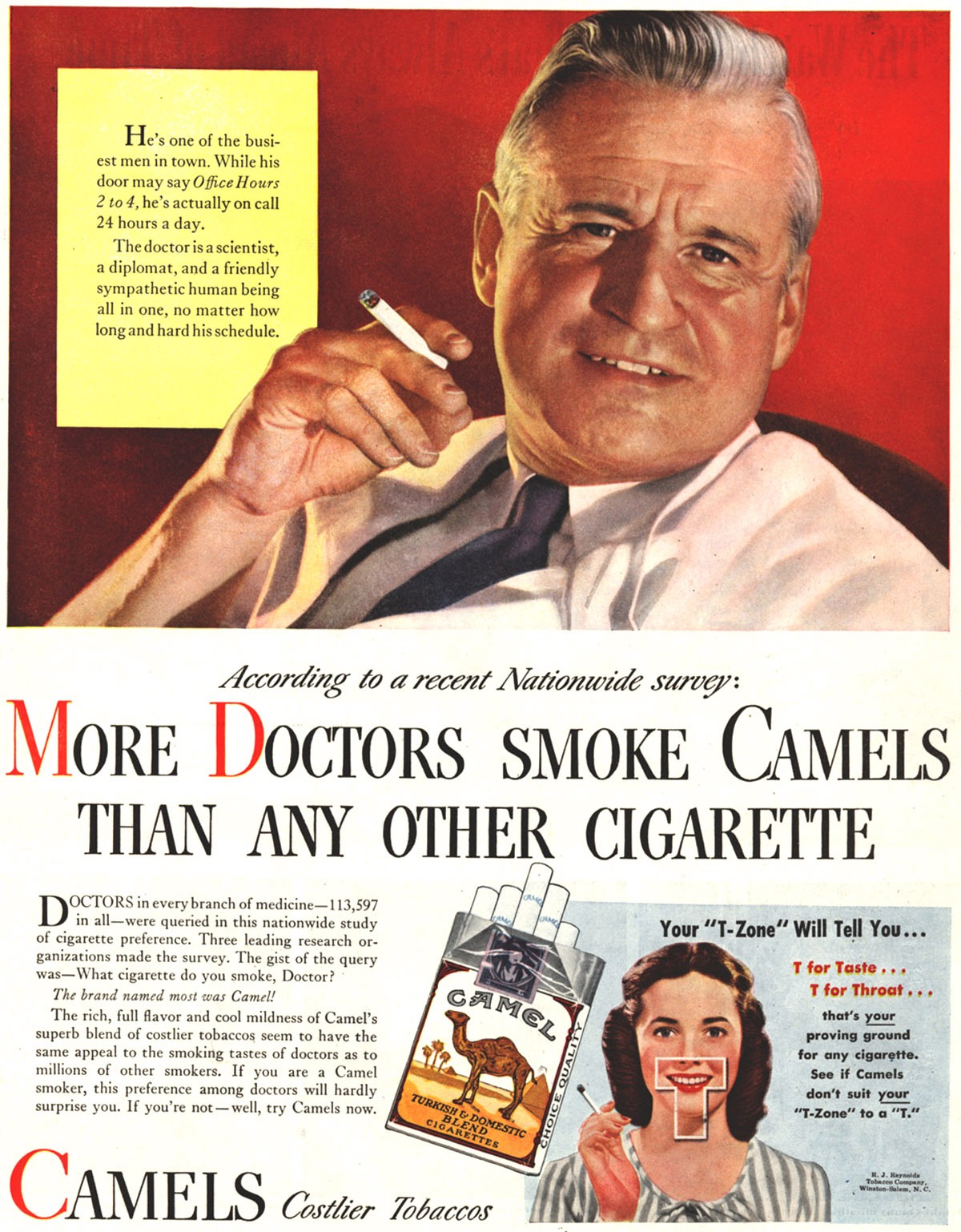
The Fugitive has been brought to you by Viceroy cigarettes. Viceroy’s got the taste that’s right.”

Speaking of that ubiquitous weed, a plethora of shows were sponsored by tobacco companies.

The sponsors hoped the brand would be associated with a quality show and its stars, week after week. Not just quality, but consistent quality, directed to a target audience.

The most popular show of 1953 was I Love Lucy. It worked because Lucille Ball was a brilliant comedic actress, Desi Arnaz a perfect foil and also an astute producer.

The second most popular show that year was Dragnet, the very opposite of Lucy. A police drama, it had a consistent style developed by its star, Jack Webb. That style featured staccato dialogue and underplayed acting. It became famous and easily parodied. (Fortunately, Jack Webb had a sense of humor about it.)

There have been innumerable articles for writers about developing their “brand.” What that is is not really complicated. It’s an expectation in readers’ minds about what you, the author, can deliver to them. It’s a mash up of the type of books you write, your voice, your visuals (book covers, website, etc.) and your online presence. What you want to communicate is that you are capable of producing work of consistent quality. You want to be seen as a “trusted brand.” This is why traditional publishing invests in promising new writers. They hope to create a long-term, profitable “product line.”

Now, what if a writer wants to write something “off brand”? In the traditional publishing world, this is problematic, for obvious commercial reasons. The brand helps bookstores know where to shelve your books. It is protection for the publisher’s investment.

This is what hamstrung early John Grisham, whose massively popular legal thrillers made big bucks for all. But Grisham wanted to write literary fiction, too. It was only when he had sufficient leverage that he was “allowed” to write A Painted House.

Indie writers have more flexibility, though they want to build a brand, too. But if they hanker to try something a little different, why not? The world’s largest bookstore will “shelve” your book in the right places (categories). So JSB can offer thrillers, historical fiction, even crime fighting nun stories, and not miss a meal.

The most important part of a brand is delivering the goods. That’s what you want your name to be associated with. All of the razzle dazzle of covers and marketing and ads might get you a look from an interested buyer. What you want is to entice them to come back for more.

When Lay’s Potato Chips were introduced in the 1960s, they ran an ad campaign featuring Bert Lahr (of Cowardly Lion fame). He’s reading the paper when his little boy comes in with an open bag of Lay’s. He asks the boy what that is. The boy says, “Lay’s Potato Chips. I bet you can’t eat one.” Burt takes a chip, eats, tells his son to go do his homework…but then the taste kicks in and he says, “I’ll have another.” The boy says, “Uh-uh, I said one.” At which point Bert grabs the bag and starts munching chip after chip. The boy turns to the camera. “I knew he couldn’t do it.”

The Lay’s tagline: “No one can eat just one.”

This is the hope of all series writers, too!

Thank you for reading today’s post, brought to you by Romeo’s Way, the thriller that builds strong bodies twelve ways. Nine out of ten doctors who read thrillers prefer Mike Romeo.

Do you have an author brand? How would you describe it?