The Five Modes of A Writer’s Life

by James Scott Bell
@jamesscottbell

So I was sitting around the other day with a bout of procrastination when I had a thought (I writertry to have at least one thought per day). I find, as a writer, I am usually in one of five modes: Flow, Go, Slow, No and Pro. I thought of adding another one for residents of New York and New Jersey – Yo! – but decided five was enough

Flow

Flow is a state of hyper focus, of total immersion in one’s creative work. In this mode you experience a mix of forgetfulness, play, joy, and “time quickening.” An hour feels like five minutes. Difficult tasks seem to melt before you. You are “in the zone.”

Jack London wrote a lot about flow, in all parts of life, but especially in the life of the writer. In The Call of the Wild he compares it to the elemental ecstasy of the animal in full beast mode:

There is an ecstasy that marks the summit of life, and beyond which life cannot rise. And such is the paradox of living, this ecstasy comes when one is most alive, and it comes as a complete forgetfulness that one is alive. This ecstasy, this forgetfulness of living, comes to the artist, caught up and out of himself in a sheet of flame; it comes to the soldier, war-mad on a stricken field and refusing quarter; and it came to Buck, leading the pack, sounding the old wolf-cry, straining after the food that was alive and that fled swiftly before him through the moonlight.

There you go, writer. Hunt that book!

So how do you get into the zone when you write? I’ve found it more or less sneaks up on you, that you can’t force it. But there is a way to make it more recurrent: Know your craft!

Mihály Csíkszentmihályi (I’ll help you out. It’s pronounced MEE-high Chick-SENT-mee-high), in his seminal work Flow: The Psychology of Optimal Experience, stressed that flow most often occurs when the challenge of a task is met with an equal or greater skill level. When you know what you’re doing, and how to pull something off, you are more likely to experience flow. I love the speech in The Hustler with Paul Newman, where he describes to his girl what it’s like to play great pool:

EDDIE: Like, you know, anything can be great. Brick laying can be great, if a guy knows. If he knows what he’s doing and why and if he can make it come off.

When I’m goin’, I mean when I’m really goin’, I feel like a jockey must feel. He’s sitting on his horse, he’s got all that speed and that power underneath him, he’s coming into the stretch, the pressure’s on him, and he knows. He just feels when to let it go and how much. ‘Cause he’s got everything working for him – timing, touch. It’s a great feeling, boy, it’s a really great feeling when you’re right and you know you’re right.

It’s like all of a sudden I got oil in my arm. The pool cue’s part of me … You feel the roll of those balls and you don’t have to look, you just know. You make shots nobody’s ever made before. I can play that game the way nobody’s ever played it before.

SARAH: You’re not a loser, Eddie, you’re a winner. Some men never get to feel that way about anything.

Study your craft and write with abandon and you will experience those times when you just know. It’s the greatest mode of the writing life.

Go

The next best thing to being lost in flow is being able to write at a good pace anyway. Get the words down. Turn off the inner editor and just go.

One way to do that is the writing sprint. You set yourself a goal of, say, 250 words. You make a little plan for what you’re going to write. It might be some action, some description, some dialogue, whatever. You think about it, then write without stopping.

You can set a timer for this, or use something like Dr. Wicked’s Write or Die.

When you get to the end of your sprint you might very well find that you’re in flow. So keep going.

Otherwise, take a short break and then do another sprint.

Slow

We all know there are times when writing is a slog. There are many reasons this may be. It could be physical—you’re just tired. Or it could be a part of your manuscript you’re unclear or unexcited about.

If it’s physical, take a power nap. I recommend them! Every day, sometime between one and three o’clock, I try to nod off for fifteen or twenty minutes. You can train your body to do that. I can put my feet up on my desk and lean back in my chair, or hit the sofa, and I’m off to dreamland in a minute or two.

Another idea when it’s slow going is to take a brisk walk in the sunshine. If you live in Buffalo and it’s December, do some jumping jacks in the living room … and then don’t live in Buffalo in December anymore.

If slowness is caused by being unclear or unexcited about your WIP, try this:

Skip ahead from wherever you are and write a fresh new scene. Before you start, let the scene play in your mind and tell your imagination to come up with one surprising thing. Out of the blue. Wild. Your character could do something you never thought he would. Or another character might pop in (Chandler’s famous “guy with a gun” perhaps?). Or create some crazy lines of dialogue.

At the very least, this exercise will produce new plot possibilities and more layers of character life. And it’s fun.

No

And then there are some days when you simply do not want to write, when it almost feels like you can’t type. Your fingers rest on the keys but refuse to move.

There may be several reasons for this.

It could be that familiarity has bred contempt. You just can’t stand looking at your project anymore. Perhaps you’ve hit a wall in your story and don’t know whether to jump over, tunnel under, blow it up, or go back the way you came.

Or it could be completely unrelated to your writing, such as a life crisis that saps your mental energy.

So the first thing to do is figure out why your brain is saying No. Journaling about it helps. Write to yourself in a free-form way, asking questions, letting your thoughts pour out on the page.

But don’t beat yourself up if you have to take a break. I am all for busting through barriers, but there have been times when I’ve given myself permission to just say No. I even build a day into my week for a “writing Sabbath.” I try not to write anything on Sunday. This lets my mind rest and usually results in new ideas and fresh energy on Monday.

Pro

The pro writer writes to a quota.

Now, I know some writers think a quota stifles creativity by putting “pressure” on delicate artist sensibilities. I say hooey. It’s the exact opposite. Having a quota actually pulls you forward so flow and ideas and productivity can happen.

My standard advice: find the number of words you can comfortably produce in a normal week. Then up that by10%. Make that your weekly goal and divide it up among your days and according to your schedule. Keep track of how you do each day.

A pro also keeps up on what’s happening in the publishing world – both traditional and indie – in order to make wise career choices. Keep abreast of what’s being offered in publishing contracts (Kris Rusch is currently running a great series on this subject. Start here.) Subscribe to industry blogs like Jane Friedman and follow observers like @Porter_Anderson. Put together your own list of go-to resources … and then go to them.

And then there’s marketing, which these days falls mainly on the author’s shoulders, even in traditional publishing. So we all have to give it attention, but here’s my thing: follow the 80/20 rule. Eighty percent of your writing life should be devoted to the writing itself, the craft, the production. Twenty percent to the business and marketing side. Why? Because I’ve seen some fabulous marketers zigging and zagging all over the place, but with stinky books. That doesn’t build repeat business.

And repeat business is the name of this game for a pro. You get that when you write great books. So make that your primary focus.

For if you can deftly handle Flow, Go, Slow, No and Pro, you will greatly increase your chances of making something else – Dough.

Y’know?

So …

…what mode have you been in lately?

 

Write It On Spec — Guest Post by David Levien

:The-Boyz0004.jpgDavid Levien on set of Showtime’s “Billions.” Photo credit: Jeff Neumann

Today we offer a heartfelt tip of the fedora to our guest blogger David Levien. David, in addition to writing one of my favorite detective series  — the Frank Behr books — is also the creative genius behind BILLIONS, the brilliant and addicting Showtime series which has just wrapped up its first season and has been renewed for a second. David graciously took time out of an impossibly busy schedule to offer some important suggestions and advice to writers new and seasoned, and will be intermittently available to answer questions and comments throughout the day. David, thank you! — Joe Hartlaub

You sit bolt upright in the middle of the night and scrabble around the bedside table for pen and paper before the spark of a brand new idea forming in your mind blows away on the wind. Or you’re jogging, driving, taking a shower when it comes. You scratch out the initial thoughts in a desperate rush before they vanish—maybe it’s the beginning or maybe the end that has come to you first. You probably don’t even tell anyone about it for a while, because you don’t want to chase away this fragile dragonfly of a thought that’s landed on your desk, and when you do talk, it’s likely only to a trusted friend, colleague, editor or agent. Then you set about writing it, for yourself, on spec. You build it out because you have to, it’s what you do, with no guaranteed reward.

Only when it’s done, standing sturdy and complete, bearing all that you could bring to it, do you share the piece, be it novel or screenplay or teleplay or whatever the métier, with the marketplace, with the world. That’s the way it’s supposed to go anyway. But sometimes, if you’ve been fortunate enough to build a career, a name, daresay a brand, opportunities come along. A money offer is made for you to write someone else’s idea, or a project based on other source material. Sometimes you take that fledgling idea of your own out, as a proposal or a pitch, and the meetings go well and a buyer comes aboard early. What a glorious state of affairs! They’ve bought in before you’ve even done the bulk of the work. There won’t be any sweat equity on this one, there won’t be any risk that you’ve wasted your time. No, you’re on their dime, they have a vested interest…but.

But along with that money, with that deal, with that contract comes outside input. Hey, they’re your partners, they’re invested, so why shouldn’t they have some say? They dug it enough to buy in the first place. You’re reasonable. You’re collaborative. You’re living for a time on their largesse. You listen. A few of those ideas may creep in. But your piece is still weak, vulnerable, its structure and tone yet to be fully formed. The doctors advise not to take a baby outside into the world for at least the first month, until the immune system gets up and running, because the risk of contamination is too great. The same goes for your project.

Sometimes, when the work doesn’t turn out as well as it was supposed to, you go back and do a post-mortem, and with dismay you see that it was one of those seemingly benign outside creative suggestions that turned virulent and blighted the whole enterprise. You try to find your way back to the original intention, but the helix of creation is too complex to reverse engineer. Your idea was a gift in the first place and because you wanted to or had to, you sold it to the highest bidder, and it’s not pure anymore. And neither are you. For that moment you’ve been bought and paid for. You tell yourself: that’s not going to happen next time.

If you’ve managed to build a career of any length you may look back and realize the ones that really work, the ones that made you, were the ones you wrote on spec, just for yourself, the way they were meant to be. I can certainly look back and see it that way. There have been some successes that were commissioned. “Runaway Jury” and “Ocean’s 13,” were work-for-hires and turned out well. But the ones that live closest to my heart, my private investigator character Frank Behr—he was created and the first book written on spec although later books in the series were written under multi-book deals, including my latest, Signature Kill, out now in paperback—my first movie “Rounders,” and even my television show “Billions,” (both written with filmmaking partner Brian Koppelman) were created with no outside interference. The eventual buyers who came to the table wanted them as they were. Writing it on spec is the most elemental way for a writer to work, and even though it can sometimes become a luxury or a hardship to work for free, the reward outweighs the risk by plenty. You know best, so be unreasonable, and treat yourself, force yourself, trick yourself, spoil yourself but do yourself the favor and write it on spec.

Making a Case for Novellas: Short is the New Black

Jordan Dane
@JordanDane

books-768426_1280

How many books do you write a year? – To keep your work in front of readers, it’s advantageous to have a new offering every 90 days. Gone are the days when 1 to 2 books a year keeps an author in the public eye, not with all the competition issuing teasers, serials, advance chapters, etc. That’s a lot of writing between bouts of promotion.

But don’t let the competition overwhelm you. New offerings could be boxed sets of your previously released material, or a remake of a previously released novel where you have received your rights back, or it could be a shorter length work like a novella that you can write between projects. Allow me to make a case for writing novellas and see if some of these ideas fit your annual goals.

The Versatile Novella:

1.) GEN BUZZ – You can create buzz about an upcoming novel by utilizing a short back story for the main character featured in your new series. A discounted or free teaser is a great way to entice new readers to try your books. (Word of Caution – If you plan on submitting your new series for traditional publication, a shorter serialization of your idea may be objectionable to a publisher. They could feel the material has already been exposed to readers.)

2.) ENHANCE CASH FLOW – Novellas can generate cash flow between longer projects.

3.) CHARACTER FOCUS – Novellas can be used to feature the main character in unique clever scenarios or if your readership finds your secondary characters interesting, you could feature them in shorter offerings. For example, I have always wanted to know how Elvis Cole and Joe Pike met in Robert Crais’s PI series. Crais has fielded this question many times from readers. A short story could be a huge revenue generator and a gift to his legions of fans.

4.) ADVANCE TEASERS – Have you noticed how many big named authors release the first 10 chapters or so for a new novel coming out shortly? This lure can also serve as promotion of the series or novel and be a part of the new material offering every 90 days.

5.) WRITING TIME FILLER – A novella can be a writing time filler (between contracts) if you are traditionally published. I dislike sitting around while my agent pitches my proposals. I can keep working while I wait and it’s a good distraction. Any novella I write could be new material for something to explore as a new series. (Word of caution – If you plan on using characters from a series under a published contract where you don’t have the copyrights back yet, be sure to read your terms to determine if you’re allowed to write a shorter length story with your original characters. Your sub-rights clause and other provisions may not allow you to do that.)

6.) DISCOUNTED PRICES – Some readers today have less time for reading (so shorter is better) and/or they may have budget concerns with all the books they read in a year.  A shorter story line, priced at a discount, might be what they are looking for. Amazon Kindle Worlds were created to be along the lines of fan fiction, but with more polish and better covers. Amazon sets the pricing, depending on length, but most of their novellas are 25,000 words priced at $1.99. An avid reader can buy a whole series easily.

Challenges of Writing a Shorter Story:

I have always been a novel writer. I never started out on shorter material, thinking it would be easier to write, as some people might believe. In my mind, a shorter story is more challenging. It’s only been this year that I’ve written shorter stories for Amazon Kindle Worlds. (See my OMEGA TEAM series at this LINK priced at $1.99 ebook) My novellas have been 25,000-30,000 words, at my option. That length forced me to change how I write, but I didn’t want my readers to feel that I’ve short-changed their reading experience because my voice or style has been stripped down.

Personal Challenges:

1.) Plots must be simpler – This has taken some new thinking and conceiving of plots in advance while I’m planning my story. More intense story lines with complex layers have to be shed in order to peel back to the essence of a story.

2.) Minimize subplots – Subplots can still be done, but they are more of a challenge, so I try to limit the way I think out a story.The subplot must be integral to the overall story and enhance the pace or suspense.

3.) Setting descriptions and prose must be simplified – Getting straight to the bare emotional elements of a scene or a story will stick with readers and provide them with a solid reading experience, without making them feel that the writing is too sparse. I must be truly selective on what images I choose and the wording I use to create the most impact.

4.) Novellas are like screenplays – My shorter stories are more like screenplays with a focus on dialogue and major plots movements, less on back story and lengthy internal monologue.

5.) Novellas are like the visuals of film – I like this aspect. Give the reader a visual experience as if they are watching a movie. The scenes must have memorable images to tap into their minds quicker, using fewer words to do it.

FOR DISCUSSION:

1.) What do you see as personal challenges to writing a shorter story? Is it easier for you to write a novel?

2.) How many books or projects do you write a year? How do you manage your between projects time?


Kim Haynes Photography

Kim Haynes Photography

Bestselling, critically-acclaimed author Jordan Dane’s gritty thrillers are ripped from the headlines with vivid settings, intrigue, and dark humor. Publishers Weekly compared her intense novels to Lisa Jackson, Lisa Gardner, and Tami Hoag, naming her debut novel NO ONE HEARD HER SCREAM as Best Books of 2008. She also pens young-adult novels for Harlequin Teen. Formerly an energy sales manager, she now writes full time. Jordan shares her Texas residence with two lucky rescue dogs.

Faster Than a Speeding Bullet

I have a confession to make. Since about 2009, I’ve been leading a secret life.

As a woman.

Yes, it’s true. Several years back I was working a day job and writing my novels for St. Martins at night and was so exhausted all the time I could barely form a response to anyone who asked me what time it was. And if I managed, it was usually “Bedtime.”

Life as a midlist author for one of the Big Five is not all champagne and roses. My advances were decent, but not fantastic. And spread out over a couple of years, the royalties they were doling out were not enough to sustain my hedonistic lifestyle. I mean, Ferraris are expensive to maintain.

So I knew I had to do something to make the leap from day job zombie caffeine addict to full-time writer zombie caffeine addict and the only way to do that would be a) drink more coffee; and b) find more writing work.

And since we’re supposed to be talking about writing here, I’ll spare you my opinion on Jamaica Blue Mountain beans and tell you about the finding more work part.

Oh, and the woman part, too. I’m sure you haven’t forgotten about that.

You see, many of my writer friends are women. And many of those woman work in the world of romance, specifically the world of Harlequin romance. Some of them work for a line called Harlequin Intrigue, which is all about romantic suspense, and the emphasis on suspense over romance is completely up to the author.

When I asked my buddy Debra Webb (the Queen of Intrigue) if any men ever write for the line, she told me they did indeed and “Oh, my God, you should write for them! I’ll introduce you to my editor!”

The next thing I knew I was writing an outline and sample chapters and within a month I was working for Intrigue under a female pen name that I will happily reveal to anyone willing to pay me a hundred bucks, so long as you promise not to reveal the secret (hey, I’ve gotta make money SOMEHOW).

Anyway, I was attracted to Intrigue because the books are only about 50,000 words long, fairly linear, and I figured I’d be able to bang them out pretty quickly and earn enough extra money to dump the day job.

And I was right. Thanks to Harlequin and a very nice deal with Penguin, I was able to do just that.

But I had one very small problem…

I’ve never been what you’d call a fast writer. So now I was in a situation where I had to not only write a big 150,000 word apocalyptic novel for Penguin, I also had to do a couple of those 50,000 word romancers.

Had I just shot myself in the foot? Painted myself into a corner? Taken a long walk off a short—you get the point. Choose your own cliché.

Ever since I started writing, I’ve been a pantser. I come up with an idea, kinda sorta figure out who the main character is, then sit down and start writing. I had tried outlining many, many times (just like all the writing books say we should) and I just couldn’t stand to do them. My eyes would glaze over after three paragraphs.

Isn’t writing supposed to be fun?

But for the Harlequin Intrigue audition I had no choice but to write that outline and three sample chapters. It was full proposal or don’t bother auditioning. They weren’t going to hire me simply because they liked my Facebook page. (Or maybe in was MySpace in those days.)

When it came time to actually write the book, however, I discovered something quite wonderful. Because I had worked everything out in that outline, all I really had to do was, as they say, “word it in,” and I managed to bang that thing out in record time.

From there on out, I was a convert. At least when it came to Harlequin romances. I still wrote (and continue to write) my Robert Gregory Browne books by the seat of my pants (except for one exception I won’t get into here), but the Intrigues were all outlined first. Even after my editor said all she needed was a paragraph from me. I would write a ten to twenty page outline for myself, because I had to write those suckers fast.

I think the fastest I ever went from outline to finished book was about two and a half weeks. I’m no John Creasey, but I think 50K words in that amount of time is pretty damn fast.

So if you’re concerned about your snail’s pace as a writer, just know that as much as you might hate them, outlines can certainly be your friend.

Now that I’ve said goodbye to Intrigue, I still loath outlines and avoid them completely.

But that doesn’t mean you have to.


First Page Critique: Characters, Connection, and Flow

image

By Kathryn Lilley

Today, we’re critiquing the first page of a story called AMERICAN LIONS, submitted anonymously by a TKZ reader. I’ll kick off the discussion with my feedback, and then I invite you to add your notes and constructive criticism in the Comments.

American Lions

“You remember Spag, don’t you?” Aunt Julie asked Nora for about the hundreth time that morning. She asked it when she got Nora and Myra out of bed, when she rushed them out of their house, when she drove them across town, and now as they walked into the Filler Up truck stop. She nodded her head as she asked, “Don’t you remember him?”

I don’t know, Aunt Julie.” What kind of a name is Spag, anyway? “Why are we here? My mom needs me. And Myra can’t miss any more school. They’ll send a truancy officer to our house. He’ll ask questions.”

Stop worrying, Nora. Let the adults handle this.”

Nora had never been to a truck stop before. Aunt Julie said they were going to have breakfast there. Nora scanned the room. It was crowded with rowdy men seated at round tables in the center of the room, men stuffed into booths along both sides. At the far end, Nora could see a kitchen through a cut out in the wall. A row of men sat at a counter facing the kitchen. From the back, the men looked pretty much the same. The had short hair and and were hunched over their plates, or reading newspapers and drinking coffee. But there was one man who sat facing away from the kitchen, toward the entrance. His hair was shoulder length and layered in the current style. Nora studied his features for something familiar. Then she saw him looking back at her and she moved behind Aunt Julie.

“There he is.” Aunt Julie said and the man and he hurried over to her.

“He looks like Rick Springfield,” Myra said.

“Myra, Nora, this is the friend I was telling you about. Remember him now?”

He said to Aunt Julie, “What are they doing here?”

Nora moved close to Aunt Julie and said, “But this place, is it safe?”

“They’re truckers, Nora. You’ll be with Spag.”

“Now wait a minute, Julie. You asked me to meet you here and you put me on baby sitting duty? I thought you were in trouble, I thought you needed my help.”

“I do. I need you to stay with the girls. I didn’t know what else to do.”

“But I can help, Aunt Julie. Don’t leave me here.” She’s my mother. She needs me. This morning was the worse I have ever seen her.

~~~~

My comments

Some distracting technical issues made it difficult at times for me to follow what was happening in this scene.

Setting the stage in the first paragraph: crowd control

The first paragraph introduces (or makes reference to) a total of four characters–Aunt Julie, Nora, Myra, and Spag. I had trouble visualizing who was actually visible in this scene as it opened–there is not enough information provided to orient the reader in the scene. I had to backtrack and reread the first paragraph in order to sort out who was doing what. (Tip: As a general rule, try to lImit the focus of action in each paragraph to a maximum of two characters.)

Cue the reader when the dialogue or focus shifts to a different character

Whenever a new character begins speaking or the scene’s focus shifts to that character, the writer needs to cue the reader that a shift is taking place. For example, in the second paragraph, a new character is speaking, so the dialogue should open with an opening quotation mark.

“I don’t know, Aunt Julie.”

Focus on action/reaction

It would strengthen the scene to include more reaction and characterization for the character named Spag. Show him reacting to the children and sizing up the situation as he realizes he’s being thrust into babysitting duty.

Avoid distracting POV wobbles

I got slightly disoriented by some of the point of view transitions.  Sometimes Nora’s point of view is presented in third-person, as follows.

Nora moved closer to Aunt Julie…

Sometimes the POV shifted to first person, focusing on Nora’s internal thoughts as in the following.

This morning was the worst I have ever seen her. 

(Yes, it’s possible to shift the point of view within a story, but the way it’s done here added to my overall feeling of disorientation within this scene.)

Keep track of characters

The character Myra was briefly mentioned in the first paragraph, but not in a way that established her physically within the scene. I was a bit startled  therefore when Myra popped up later on in the scene to contribute the Rick Springfield observation, (I also had to look up Rick Springfield to identify him. Would a young child know who RIck Springfield is, btw?)

If you are going to re-introduce a character who has been silent or missing for several sentences or paragraphs, you need to re-establish that character in the reader’s mind. Something like,

Myra, who’d remained silent during our discussion, jumped in to deliver the final verdict.

“He looks like Rick Springfield,” she said.

Edit out repetitive language and extraneous words

We all have a tendency to repeat certain words and phrases. The fifth paragraph contains an extraneous phrase “and the man”, and the repeated phrase “Nora moved behind Aunt Julia” are examples here.

Overall

The nice thing about technical difficulties is that they’re easily fixed with editing. An editing pass will eliminate most of the issues I’ve mentioned.

After reading this scene, I’m not sure what type of story this will turn out to be. Once the technical issues are fixed, the writer can concentrate on bringing the characters and story into stronger focus.

Please add your constructive feedback in the Comments, and thanks to our brave writer for submitting today’s first page for critique!

The Little Dialogue Ditty That Always Makes You Look Bad

Being a new writer is a good thing. We all wore that name tag when we began our writing journey.

The goal, however, is to hide that fact as we write stories we intend to submit and publish. Anything that exposes inexperience is a bad thing, sometimes leading to rejection, or if not that, to harsh judgment from readers and reviewers. If your story is on the bubble, this can be the thing that pushes it over the edge… in the wrong direction.

There are lots of ways to screw up a novel, not all of them unique to rookies and well-intentioned sophomore authors. But perhaps the most fertile ground to find evidence of one’s newbie status is within how we write and present dialogue.

Let’s be clear, dialogue is easy to write. But it’s extremely hard to write it really well

When that happens, careers can explode. Dialogue is a place to shine, to stylize narrative in a way that would put non-dialogue sentences over the top into a universe shaded with hues of purple and riddled with bleeding adjectives and screaming adverbs.

Okay, that sentence came close to just that. Not an accident. I wanted you to notice before you winced.

On the other hand, bad dialogue, the kind that sounds like it came from a bad elementary school play, the kind punctuated by someone who never met a comma, can tank your story altogether.

Within the vast minefield of dialogue there are a handful of common mistakes that scream “rookie writer… run!”  Over the past few years there have been more than a few terrific Kill Zone posts on the subject, my favorite being coverage of the tricky task of attribution. I won’t rehash all the ways this can make you look bad – use the Search function for some good stuff on this topic – but there is another pesky tendency that is most commonly evidenced by newer writers especially.

Which is why this is a case of principle trumping evidence to the contrary, in the form of this mistake occasionally appearing within traditionally-published novels, which employ professionals editors who are paid to – but not always successful at catching – eradicated before warming up the printing presses.

This, too, involves the use of character names.

Not as attribution, but rather, within dialogue itself in the form on one character addressing and acknowledging the other. It is best defined with an example. See if this is like any conversation you’ve ever heard in real life, and then ask yourself if you’ve ever written something just like it.

“Hey Dave, good to see you, man!”

“Steve, you old dog, you look terrific.”

“You know Dave, I’m feeling okay. Especially after… well, you know how it goes, right Dave?”

“I sure do, Steve. Been there, survived that.”

“Just shoot me if you ever hear about me having to do that again, okay Dave?”

“Will do, Steve. Count on it.”

“Thanks Dave. You’re a prince.”

“No problems, Steve. You’d do the same for me.”

Okay, I know, that was painful to read. And not just because of this demonstration of how all those names within the exchange create a totally false, less-than-authentic cadence while lending a corny, fifties-television vibe to it all.

But this happens all the time in manuscripts written by newer writers. And occasionally in novels written by authors and edited by editors who should know better.

In every workshop there is one guy who throws up a hand right about here in this discussion, so allow me to address that one next.

Certainly, there are instances in real life when the use of the name of the recipient of your words is called for. Like passing someone on the street who doesn’t see you, so you call out their name to get their attention. Or if you’re a supervisor chewing out a rascal employee (even then, only once is enough).

That said, listen closely to the real world in which you live. Chances are you can go months without hearing this. Which should reinforce the fact that you should go decades without having one your characters talk this way to another one of your characters.


Writing Lessons From The Masters

by James Scott Bell
@jamesscottbell

Okay, the headline is sneaky wordplay, as I am not referring to writing experts, but The Masters golf tournament recently concluded. Something shocking happened there and I think we can all learn from it, as writers and as normal folk making our way through a life that tosses out plenty of lemons.

jordan-spieth

Jordan Spieth

There is a young golfer named Jordan Spieth. He is twenty-two years old and a huge talent. He’s already won two majors (the hardest thing to do for a pro golfer), and one of those was last year’s Masters. He’s also a classy, well-spoken gentleman. And boy, do we need more of those these days.

Which is why what happened is so sad.

Jordan Spieth was set to go absolute legend. Only three players have ever won back-to-back Masters. You may have heard of these guys–Jack Nicklaus, Nick Faldo and Tiger Woods.

Spieth was playing lights out, leading the tournament all the way into the final round. He was up by five strokes with only seven holes left to play. All he had to do was avoid a major mistake and a second green jacket (the Masters’ cloak of honor) would be his. And then they’d begin measuring the space for Jordan Spieth on golf’s Mount Rushmore.

So as Spieth stepped up to the notorious par-3 12th, he could feel it, the victory. The crowd was with him. As were the millions watching at home.

But then the unthinkable, the shocking, the disastrous happened. Spieth hit two consecutive balls into the water. The first from 150 yards, the second from just 80. These were shots Jordan Spieth can make in his sleep, left handed. Not this time. The infamous Masters pressure caught up with him and … plop, plop.

His next shot went over the green and into a bunker. When it was all over, Jordan Spieth, one of the best players of his generation, carded a quadruple bogey.

And lost the tournament.

That, my friends, will mess with your head. To his credit, Jordan took it like a man, stood up to reporters’ questions, and made his obligatory appearance in Butler Cabin to slip the green jacket on the surprise winner, Danny Willet. Poor Jordan went through the motions, but he was clearly not there. He looked like an actor auditioning for a part in The Walking Dead.

This loss will be with Jordan forever. The only question now is, how will he handle it?

I know for sure he will hurt for a long time. But I suspect Jordan Spieth will muster his competitive spirit and play great golf again. I believe he will add several more majors to his resume before he’s done.

Which leads me to three lessons for writers:

  1. When you get knocked down, let it hurt for an hour. Then write something

Rejection. Rotten reviews. Dismal sales. They hurt. Don’t deny it. You can’t.

But after an hour (set a timer!) get yourself back to your keyboard.

If you’re on a project, write a new scene. If you’re not, write a journal entry.

Or use a writing prompt to get your creative juices flowing. (There’s a wonderful “writer igniter” over at the DIYMFA site. Check it out).

When you write, the pain of the setback begins to fade a little. It will try to reassert itself, but then you write some more. Eventually, the pain ceases to hold any power over you.

  1. Be the kind of writer that readers pull for

People like Jordan Spieth. He’s humble and positive and polite. Golf fans want to see him do well, especially now.

So show in your craft and your social media presence that you are a positive writer, someone who seeks to add value to other people’s lives. Readers who know you that way are much more likely to give you another chance should something you write fail to catch on.

  1. Don’t expect the easy road

Let me engage in a golf analogy for writers who are contemplating self-publishing. Imagine that suddenly anyone could play in The Masters. Just show up and tee off. Would being able to play mean you’d finish in the money? Of course not. The best golfers in the world would still win the prizes, with a few exceptions. Some really good amateurs would get in and maybe a handful of these would play out of their minds and make some tournament dough.

But the vast majority wouldn’t. Why not? Not because there’s a “tsunami of golfers,” but because their game is not good enough yet.

What they would need to do is go practice, get some coaching, and expect that it will take years to develop a great game. Even then, there are going to always be better golfers than you.

But if you grind and drive your beat-up Saturn from tournament to tournament, maybe you can earn enough to make it worth your while. Plus, you are playing a game you love.

Well, publishing is like that now. You don’t have to wait for an invitation from the Forbidden City. You can publish anytime you like.

But please don’t think that “getting to play” is an automatic win. You need to work on your craft, every day, just the way a pro golfer does. Think in terms of many years and many books, not just next month and your one completed novel.

Jordan Spieth will be back. And so will you, writer, because the only way to stop you is if you quit.

And you’re not going to.

So what about you? What major setback did you have to overcome, as a writer or in any other arena of life? How did you handle it?

READER FRIDAY: Would You?

Ah, April 15. Why does this date create images in my mind like, oh, a pie with a slice cut out of it? Dunno.

Dollar SignAnyway, I’m also reminded of a TV show years ago called The Millionaire. A guy would show up at some person’s door and hand them a check for a million dollars, taxes “already paid.” The rich man behind this scheme wanted to see what an ordinary person would do with sudden wealth.

So if someone were to offer you a million bucks tax free, but with the condition that you never write fiction again … would you take it?

And what’s the first thing you’d do with a mil?

Using Your Disadvantages

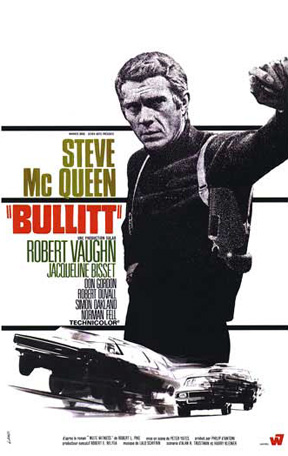
Bullitt_posterBy Elaine Viets

I love movie car chases. Nothing beats “Bullitt,” with Steve McQueen’s Mustang hurtling down the San Francisco hills. Michael Caine’s crafty Mini Cooper mixup in “The Italian Job” is another classic.

italian-jobBut traditional mysteries can have car chases, too. I wanted a car chase in The Art of Murder, my new Dead-End Job mystery. My private eye, Helen Hawthorne, doesn’t drive a muscle car. Good detectives have to blend in. In South Florida, that often means a white car. Helen has a white four-cylinder PT Cruiser.

iglooSteve McQueen would weep.
But I got my car chase, thanks to an equalizer – speed bumps. The extra-wide ones, a.k.a. traffic calmers or “speed humps.” (Cue the risque jokes.)These speed bumps are in a lush Fort Lauderdale neighborhood known as The Landings, where residents dock their yachts out their back doors.

I can’t reveal the killer’s name, gender, or vehicle model, but here’s The Art of Murder car chase in The Landings. Watch that yacht. It will be in the car chase, too.

landings-sign-yacht

The Art of Murder Car Chase
The killer roared out of the driveway toward The Landings, blasting across Commercial Boulevard as the light turned yellow. Helen followed, accompanied by a chorus of car horns and upraised middle digits.

This wasn’t a fair race. Helen knew her trusty Igloo was seriously underpowered. The killer’s car had twice as many horses as the PT Cruiser. The killer floored the car and it flew over the north bridge into The Landings. Helen’s Igloo tried its best to keep up, but its workhorse engine was no match for the powerful car. Still, Helen floored her Cruiser.
And saw the speeding car slam on its brakes.

The speed bumps! Suddenly this pursuit was almost fair. The sports car raced forward again, then slammed on its brakes for a bump. Race and brake. Race and brake.
The odd stop and sprint chase continued for four speed bumps, with Helen’s intrepid Igloo managing to keep pace.

Helen struggled to push her car on the straightaway and spot the speed bumps in time to brake. The two cars lurched through The Landings.

After the fourth speed bump, the killer powered through a four-way stop to the angry blare of honking horns. Helen made a full stop.

She waited her turn for two cars, then crossed the intersection and floored the Igloo again. Her finger pressed SEND for 911. I should have called the police sooner, she thought. I can’t let the killer escape.

The killer was turning left at the next block. There were no speed bumps on that street. It bordered a canal. Helen was going to lose the killer.

She could hear the 911 operator saying, “Nine one one, what’s your emergency. Nine one one . . . ”

“Help!” Helen shouted into her. “I’m pursuing a killer in The Landings. I’m almost at Fifty-sixth. Get the police here. I can’t talk.”

Helen slammed the brakes again, and the Igloo jounced over the speed bump. Her cell phone clattered to the floor. Helen could hear the 911 operator and hoped the woman believed her plea for help.

Up ahead, she saw the killer make a screeching turn on two wheels, heading straight for a yellow moving van with its ramp down, parked in the street. The killer swerved to avoid it, and nearly hit a pony-tailed woman walking her fluffy white shih-tzu.

The killer swerved again, narrowly missing the woman and her little dog.

And the accident seemed to happen in slow motion.

The killer lost control of the car on the small humped canal bridge. It sailed over the bridge railing and crashed into the white yacht tied up at a backyard dock. The front end of the car smashed through the yacht’s pristine white hull. The car’s back end was on the dock, sliding toward the water.

A screeching, cracking sound split the air as several million dollars collided.

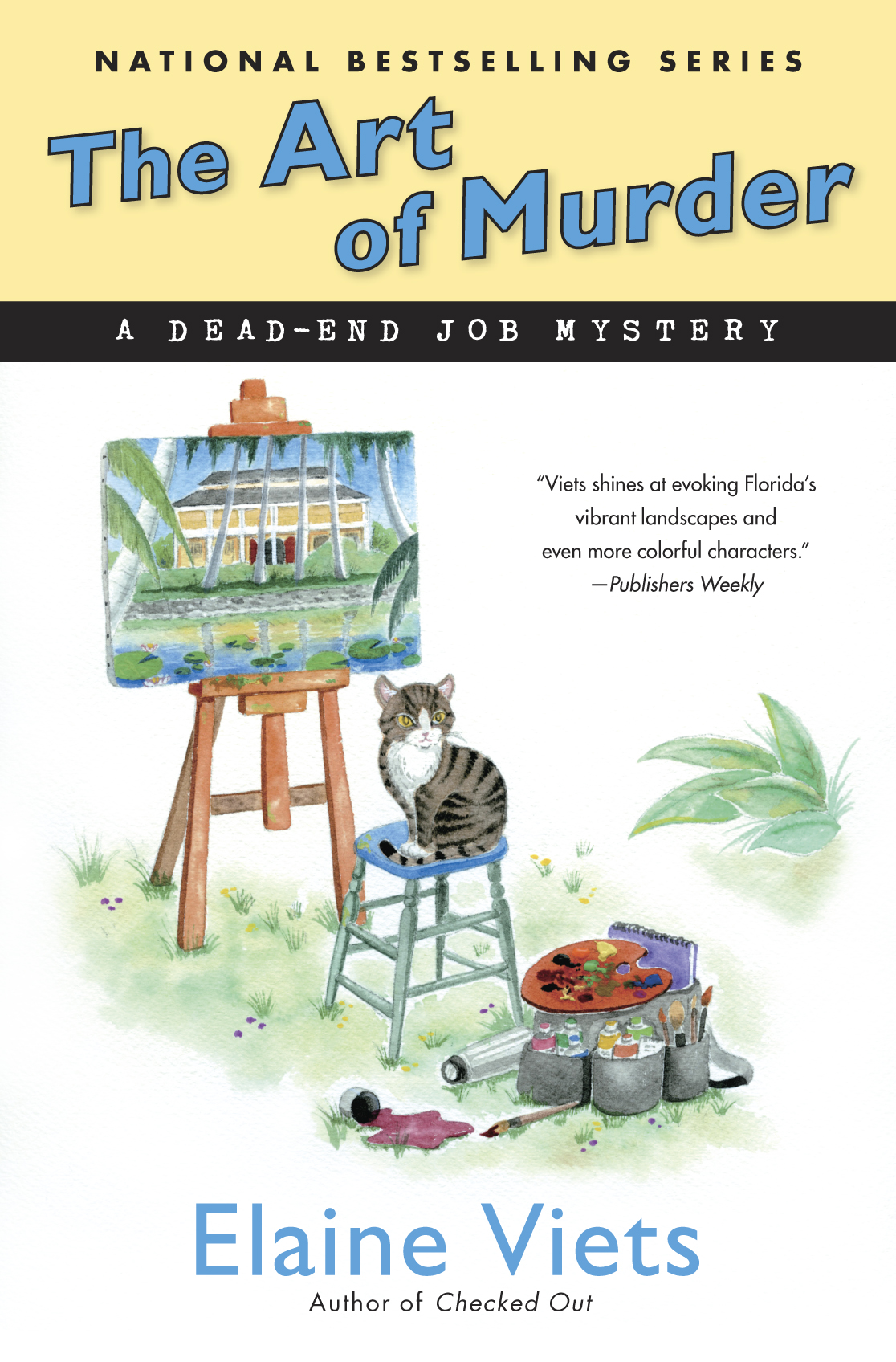
ArtofMurder_revised(2)

The Art of Murder is my fifteenth Dead-End Job mystery. Helen Hawthorne and her landlady, Margery Flax, tour Bonnet House, the whimsical mansion-turned-museum in Fort Lauderdale and admire an up-and-coming artist at a museum painting class. When the talented artist is murdered, Helen is hired to find her killer. She discovers the artist’s sketchy past. Was the promising painter killed by her jealous husband? A rival using her artful wiles? All that and a car chase-boat crash, too.

Pre-order The Art of Murder