
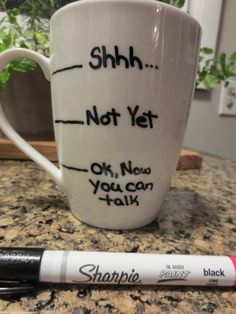
 If you were to design the perfect mug for that first cup of coffee before you start writing each day, what would it say?
A New Day, A New Genre
My guest today is Theo Gangi, the Director of the writing program at St Francis College. His stories have been anthologized in First Thrills, edited by Lee Child, The Greensboro Review, The Columbia Spectator and the Kratz Sampler. His articles and reviews have appeared in Buzzfeed.com, The San Francisco Chronicle, Mystery Scene Magazine, Inked Magazine and Crimespree Magazine. Theo and I first met in NYC when our books debuted in 2008 at ITW’s Thrillerfest. I’ve enjoyed his gritty writing ever since. Please welcome Theo, TKZers.
A New Day, A New Genre
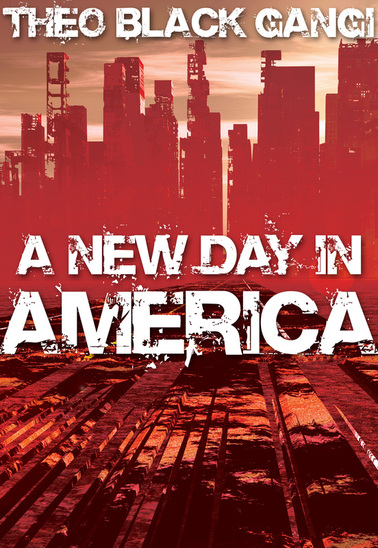
I admit it– the inspiration for my new novel A New Day in America was not mine initially. The somewhat notorious writer James Frey approached me with the idea for the tale of Nostradamus Greene and his daughter Naomi: a post-apocalyptic father-daughter survival story.
If I’d had a project I was in love with at the time, I’m not sure how I would have reacted. Screenwriters are accustomed to inheriting ideas and collaborating, but the mythology of the Novelist is the lone, solitary storyteller. However, once I found an inspiration to draw on, the work became mine as much as anything I’ve written.
The post-apocalyptic world—the desolate lands, the loss of the structure of civilization, the father who braves survival, and the daughter who has seen too much—recalled a story from my formative years.
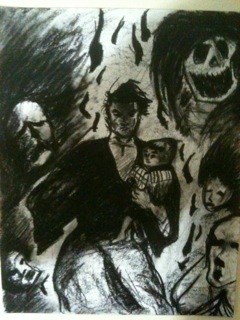
Apocalypse stories, while set in the future, are actually a return to the past. The time after modern civilization would resemble the time before it. The landscape of feudal Japan felt just right. Samurai assassin Itto Ogami and his son Daigoro serve as a great model for Nostradamus Greene and Naomi. Doing some sketches, I even found some visual symmetry. The paradox of the killer-father character has a brutal simplicity. A man with a gun is a killer. A man with a gun and a child at his back is a hero.
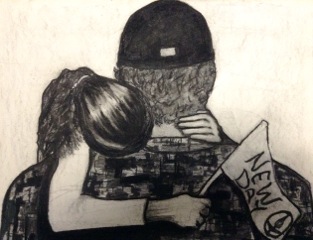
The idea was freeing for a couple of reasons. For one, I had some much-needed simplicity, and in the past I’ve had a tendency to over-complicate my work. Second, I got to play with reality itself.
My first book, Bang Bang, is a hardboiled, botched-robbery sort of urban crime thriller. While the hero’s ability to rack up a body count of a dozen or so in a single night might stretch the realm of reality, the book is firmly set in the real world. For A New Day in America, writing in a post-apocalyptic world meant I could create the whole thing. I had to invent setting, history, events, and the all-important rules.
As a writer I always saw craft as a kind of minimalist-vs-maximalist approach. My biggest influence was Elmore Leonard, who famously didn’t write the parts the reader ‘skips anyway’, and once said he read Hemingway every morning before writing, to get the feel of reduction in his writing process. I love Dashiell Hammett, whose minimal approach to books like Red Harvest and The Maltese Falcon would’ve made Hemmingway proud (‘The stuff that dreams are made of’ is an invention of filmmaker John Houston, and far too sentimental for Hammett). The idea being, don’t waste the reader’s time and attention on an eloquent description of a back alley, because the reader know what a alley looks like, and wants to know what your characters will do and say, not that there’s a garbage can that’s tipped over, or a couple of chicken bones in the gutter. The empty spaces of great noir are poetic in and of themselves.
When writing in a world that has suffered a recent apocalypse, you can’t get away with that approach. If you allow the reader the space to fill in your apocalyptic world, they will likely visualize some stock imagery from this movie or that. Mel Gibson will poke his head out of a tricked out Mad Max vehicle in the background. A zombie might appear in the reader’s imagination even though there are no zombies in your book. To write in a speculative world is to build one. Visuals such as a New York City skyline that looks like a king’s crown—skyscrapers line the outer rim, but nothing stands within.
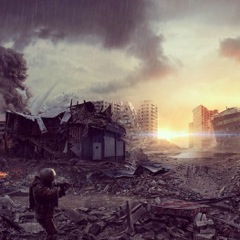
The process required quite a bit of overwriting and then cutting, so the sense of the world was greater than the word count. World building aside, the fundamentals are the same as any kick-ass thriller: Danger, conflict, bravery, human connectivity and impossible choices. The America that’s reduced to rubble offers a vehicle for the same challenges that the best thriller heroes endure—back to the wall, knife to the throat, what do you do? How do you find a way to assert yourself on a world that’s gone to hell? Is your next move moral or practical? Can you save them all? Can you save the ones that matter most?
The apocalyptic scenario creates a series of Sophie’s Choice sorts of situations. I’ll relate it this way– say there’s a train bearing down the tracks full of ten innocent people. The track forks: one way is a brick wall. The other way is your child tied to the rails. You stand at the switch. Which do you chose?
I imagine most people would chose to save their child, as I would. But what if there’s 100 people on that train? 1,000? A New Day in America is about a father who makes the decision to save his child over and over again.

Question 1: TKZ Question for Discussion: If you could take a few non-essential luxuries in your survivalist bunker, what would they be?
Question 2: Have you ever written a book that wasn’t your original idea?

https://www.facebook.com/NEWDAY.TBG
https://twitter.com/tprgangi
http://theogangi.com/
Tips for researching your story
My co-author, Lynn Sholes, and I write globe-hopping thrillers that always deal with some form of futuristic technology—human cloning, quantum computing and mechanics, string theory, human cell regeneration, faster-than-light propulsion, and many other yet-to-be-developed science. We spend a great deal of time before and during the drafting of our manuscript researching or story. Often, we call upon experts to help us formulate our fictionalized theories. For instance, we contacted a famous geneticist and asked: “We know you can’t regenerate an entire human body from just a sample of DNA, but if you could, how would it be done.” The result was the science in THE PHOENIX APOSTLES.
I find researching for our novels to be as much fun as writing them. It’s the excitement of uncovering those tidbits and morsels of fact that add seasoning and spice to the story. I believe that research adds layers to a story. It keeps the story from becoming thin and two-dimensional. With the right amount of research, we can round out character’s lives, locations, settings, and atmosphere. Each layer helps transport our readers into a more fascinating and realistic story-world. Some genres demand more research than others—science fiction, medical, legal, criminal, and historical to name a few. But all books can benefit from in-depth research.
The general rule in researching for a manuscript is: more is better during the collecting stage but less is better during the writing stage. Here are some tips to help find the right balance.
When we research, we collect a great deal of material, almost always more than we need. We come across a lengthy article on a topic and highlight a dozen of those tasty info tidbits. The skill to researching is to choose one or two that will enhance the reader’s experience without bogging down the tale or turning our writing into a dry college lecture or travel guide. If you have a number of research items available for a particular scene, pick the one that helps put a little bit more icing on the story cake. Ask yourself which one helps develop the character or move the story forward the best. That’s the one to use. Keep the others in mind in case they’re needed later. Also remember that choosing the right research data will help lend authenticity to our writer’s voice.
Another tip is to never talk down to the reader by using information from our research that they might not understand. Never confuse the reader or push them out of the story by making them feel they’re not as smart as the writer. It’s really easy to put a book down and move to another out of frustration. Keep it simple—but not too simple. There are a number of ways to talk down to the reader. Avoid them all by not talking over their heads or dumbing down the information as if you were explaining it to a child. Even if the readers may not totally understand a fact or word, use it in such a way that they can mostly grasp the meaning from the context of the scene.
Avoid throwing in facts from your research just to prove you know how to look stuff up. Again, use your research only if it helps build your characters or advances your plot. Showing off your knowledge is not why the reader enjoys reading.
Lastly, avoid the dreaded info dump. Spread out your research information in just the right amounts to keep the reader from skimming over pages or skipping ahead. Your novel can educate readers and take them to places they’ve never been, but don’t forget that first and foremost, the reader wants to be entertained, not go back to school. Sprinkle in your research like spices and seasoning in a gourmet dish. Too little creates a bland taste, too much creates heartburn.
Zoners, any other researching tips and experiences to share?
—————————-
 “Vengeance can be earth-shattering.”
Max is back! Coming in July, Maxine Decker returns in THE TOMB, book #3 in the Decker series. This time around, the former OSI agent risks her life to stop the elimination of an entire branch of the U.S. Government.
First Page Critique: BIRTHRIGHT
 Today we are pleased to present another first-page submission. This story is called BIRTHRIGHT. First, the page. Then my notes.
BIRTHRIGHT
She knew if she walked through the door, things would never be the same. It would be an admission of humanity. A bow to the ordinary.
She had been sent to inform and invigorate the people of Liberty so they could stand up to the coming onslaught. Even as she arrived the enemy grew as it traveled, dragging able-bodied men from villages as they passed and forcing them into servitude. To bring an entire village together and equip its people to do battle was a monumental task, one no mere mortal could hope to accomplish. That’s why the Council saw fit to send her to this place. It wasn’t a question of her ability, nor of her knowledge. It was a question of birthright. Her father was Leader of the Council. It was an incontrovertible fact that his heirs would step into his role when he relinquished it. It had always been that way. It would always be. Such was the way of her kind.
She stepped into the heart of Liberty, the center of the village, and slowly turned. The courthouse sat vacant—the laws of the land, as well as much of the building, long ago turned to dust. A tattered flag sagged on a pole in front of a tall brick garage. Then she saw it. The old gray-stoned library, heavily pasted with vines rooted to the mortar, bundling the building itself into a green-wrapped package. She stared up at the roof, at least thirty tridents high. The crane of her neck made her wobble. She had never looked up before; only down. She hurried to the doorway, slashed at the vines until the way was clear. What was inside stole her breath. She had never seen a book before. Now she was in an entire building of them. So many, she thought they might count as high as the stars. She breathed deeply. The scent of books was new to her and she paused to relish it. This was where it would all begin. After all, this was where it once ended.
KL’s Notes:
On the plus side, I should say that I like the opening line.
“She knew if she walked through the door, things would never be the same.”
It’s hard to write a first line that immediately grabs a reader. Well done!
I also enjoy the way the writer describes the moment the narrator first sees the library.
“Then she saw it. The old gray-stoned library, heavily pasted with vines rooted to the mortar, bundling the building itself into a green-wrapped package.”
That’s a good visual image.
But in other ways, this narrative runs into some craft-related headwinds. Here are some areas that could be improved.
A Case of Backstory Blues
The writer grabs my attention at Line One. But from there, things go awry. The story falls into a notorious swamp known as Backstory. The entire second paragraph gives nothing but character background. That information should be woven in later, after we are immersed in the main character’s situation. We preach this lesson all the time here at TKZ: Stay in the moment with your character and scene! Let us see her in action in the moment, and then tell us how she arrived at that juncture.
Character Challenge
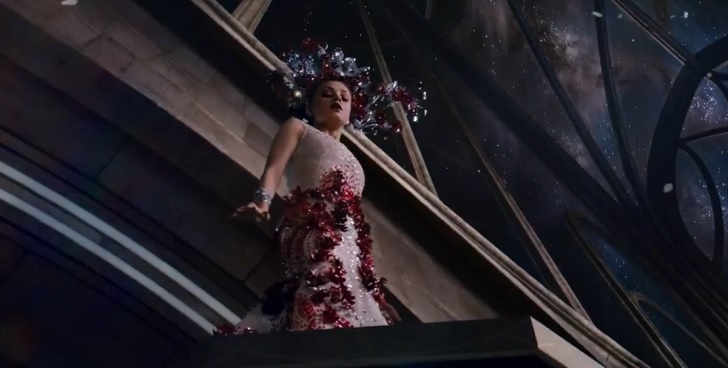
As I read this page I was reminded of a film I saw last weekend, “Jupiter Ascending.” (A completely dreadful film, btw, but that’s for another review). In that story, there’s a claque of one-percenter aliens known as The Entitled. The Entitled get to hog all the good stuff in The Universe because, well, they were born to rule.
As the title of this first page, BIRTHRIGHT, makes clear, the main character has arrived in Liberty village simply because she was born into the right family. I’m assuming the story will present at least two challenges: 1) Can she save the Lost World? 2) Does she have anything going for her other than her birthright?
Action Needed
Theodore Roosevelt famously coined the phrase, “Get Action!” I think this page could use some action. Or should I say, interaction. On my first reading, I assumed that the village of Liberty was totally abandoned. Then I realized that the character’s challenge is to mobilize the demoralized inhabitants. Shouldn’t we get some sense of someone else in this scene, or at least a reminder of that they exist? A secondary character would be an excellent way to introduce some of the backstory information that is dumped at the reader in the second paragraph. (For example: an enslaved villager suddenly sees the Council’s Heir materialize in town. How does he react?)
Wording Notes
There were a few awkward or confusing phrases here and there. (Redundant use of “heart of” followed by “village center”; “The crane of her neck made her wobble.”)
Final Notes
Overall, I think eliminating the early introduction of backstory, plus using action to show the character’s situation, would improve things immensely. Thank you to this intrepid writer for the submission!
TKZers, your thoughts about this page?
Mob Rules?
Two recent articles in the New York Times caught my attention – not just because they highlight the frenzy of vitriol that so often explodes on social media but also because they point to a disturbing ‘faceless mob’ mentality permeating our digital lives. As a writer, an active presence online (to both market and publicize my work as well as create connections with my readers) is, however, a necessity but one which, especially after reading these articles, I increasingly view with trepidation.
The first article “Feed Frenzy‘ details the misery of online ‘shaming’ victims – people like Lindsey Stone and Justine Sacco who, because of inappropriate and ill-advised jokes/tweets, were subject to relentless (and I mean relentless) Twitter attacks that all but ruined their lives. I have always been cautious about what I tweet but after reading this article I’m not sure I want to tweet anything ever again!
The second article entitled ‘The Epidemic of Facelessness‘ points to the dissonance between the world of faces (the real world of interpersonal communication) and the world without faces (our increasingly ‘anonymous’ digital lives). Apart from the disturbing number of ‘troll’ incidents reported with varying degrees of threats of person violence against actual people, there is also the basic lack of humanity and compassion that we now see spreading across the digital world. The article highlights a few key rules we need to adopt when ‘conversing’ through Twitter, Facebook and other social media. One is ‘Never say anything online you wouldn’t say to someone’s face’ (something you’d think would be pretty obvious) and the other is ‘Don’t listen to what people wouldn’t say to your face’ (a much harder proposition I think for most of us).
Now I’m pretty sure I’ve never said anything on social media that I wouldn’t say to someone in person. Likewise, however, there are many things I won’t say on social media that I would say to someone’s face – and that self-censorship is starting to make me feel disheartened. It’s hard to be a writer in this digital age and not engage online with readers across a range of social platforms and media – but often I feel that I cannot really present myself authentically on social media because of the risk of trolls, flame-wars and all the other horrible reactions seemingly innocuous posts or tweets can inflame (as anyone who’s ever been on any social media has witnessed). I find myself refusing to comment not just on political or social issues that I would otherwise freely discuss, but also hesitating to post or comment on a range of issues that in my ‘real world’ I wouldn’t even think twice about talking about. It’s become an issue not just about professionalism versus personal disclosure but about censoring my online ‘appearances’ to the extent that I fear I must be very boring indeed!
So what do you TKZers think about the current state of our ‘faceless’ digital world? How do you navigate the treacherous digital waters?
Have you ever been the subject to the kinds of ‘faceless’ attacks these articles discuss? Do you, like me, censor how you appear online (not just out of professionalism, but also out of fear?). Does the current ‘faceless mob’ mentality affect how you market and publicize your work online? What about what you actually write? Are you even hesitant to deal with controversial political or social issues in the work itself?
Top Ten Things You Need to Know About the Writing Life
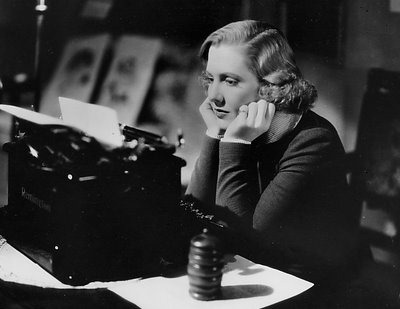
10. You have to love it
If you don’t love to write, if it’s not something you are virtually compelled to do, you’re not truly living a writing life. You could be a business person who wants to use writing as a vehicle for making some extra cash. You could be someone who journals as a form of therapy. That’s all legit. It’s just not a love for telling stories.
But if you have some inner compulsion to write, embrace it, because that will show in the writing itself. And you’re also going to need some love when you get hit with disappointment. Thus:
9. You have to learn to handle discouragement
If you’re going to do this, write for your life, you have to become a bit of a Sherman tank (as opposed to buying a fifth and getting tanked). You need a tough hide and forward drive. Because there are plenty of things to get you down.
Like the sound of crickets when your book launches. Or the screech of a hater leaving an unfair review. Or you looking at your work and thinking, This stinks. Who am I kidding?
Just know that all writers have gone through similar discouragement, it’s part of the life, it’s even part of the training. Those scars on the soul make you human, and humanity is what you need in your fiction.
8. It’s hard work
If your writing is going to be any good, that is. The best writers sweat over their labors, always trying to get better. They produce the words on a scheduled basis. This is called a quota.
By the way, I don’t want to hear any whining about a quota. There were times I didn’t want to go to court to defend a man so guilty his dog left him. But that was my job. I went and did it.
Show up. Write. Do your best. Take a break now and then—I take Sundays off completely—and then get back to the keyboard.
7. It’s a craft
The writing life is also about skills. Painters have paint, musicians have notes, surgeons have scalpels and forceps and malpractice insurance. And they all have mentors and journals and long periods of study.
 Who would tell a young golfer just to grab a club and start hacking balls around? All that produces is a menace to gophers. Sure, every now and then one might succeed, like a Bubba Watson. But you can count those guys on one foot with a toe missing.
Write and learn. Learn and practice.
(This seems an apt place to tell you that my new book, Super Structure: The Key to Unleashing the Power of Story is now available in print as well as E.)
6. It’s about steady growth
Forget the million-dollar advance on your debut novel. Or the viral downloading of your first e-novella. Not going to happen.
If you want to lead a writer’s life and even make some money at it, be prepared for an apprenticeship of years. I’ve been at this business for over two decades. The first five years brought me nothing, but all that time I was studying the craft like a madman and writing and writing.
I eventually landed a five-book contract, but did not quit my day job. I still had to get better, and that was my goal. It was only after ten years of steady production that I felt I could call myself a professional writer.
Even if you self-publish fast, it’s going to take time to grow a readership, and that’s only if you’ve followed all the above steps consistently.
5. It’s a fellowship
No, we don’t have a ring. Or even a secret sign. But writers do have each other, and we are, in large part, supportive. Every now and then a sour apple slips in––some egomaniacal writing brat, a sock puppet who tears down his rivals under a false name, or (worst of all) an odious plagiarizer.
But at conferences and local gatherings, online or in person, wherever authors congregate you’ll find fellow travelers willing to give you a tip or some encouragement. It’s good to remember that while we write alone, we are also “social people who can greatly benefit from balancing solitude and community.”
4. Don’t get hooked on the ups
It’s fun to land on a bestseller list, or making it to #1 in an Amazon category, or getting an email from a true fan who loved your book, or finding your bank account unexpectedly and substantially expanded one month. All these are nice, and to be enjoyed for what they are.
Just remember one thing: Don’t let them go to your head. Don’t expect that they will be easily repeated. Don’t let them inflate your ego. And especially don’t let them keep you from continuing to work and grow. The literary landscape is littered with the dry husks of careers that flowered briefly but were not sustained because of hubris, ego, fear, booze, or simple neglect.
Enjoy a victory for a day or two, then concentrate on your current project.
3. Now is the best time to live the writing life
We’re in year number eight of the digital era in publishing. Since the introduction of the Kindle at the end of 2007 more writers are making more money than at any time in history. Some are killing it, many are making a living, scores more are realizing a nice side income, and almost anyone who is serious is making enough to support at least a Starbucks habit.
This was never possible before. Ever since old Gutenberg set movable type, the power to publish belonged to those who owned the presses and dealt with bookstores selling paper copies. Writers were at the mercy of commercial interests. If those interests ever felt your value had diminished, they could end your participation––and maybe your career––by not offering you another contract (or, worse, canceling the current one).
The landscape has changed forever. There are new challenges to face, of course (*cough* discoverability *cough*). But writers have always had challenges. What’s new and life-altering is that they now have options.
2. It’s a business life, too
A writing life, as opposed to a writing hobby, must include plans based upon sound business principles. I’ve written a whole book about those principles, but suffice to say here that you only grow a business in two ways: First, by finding new customers. Second, by selling more products to your existing customers.
Learn how to do both and keep on doing it, and you’ll be living the writer’s dream.
1. It’s a great way to live, period
A life that nurtures your creative side is a great life, an expanded life. As long as you don’t forget the other things that matter—your loved ones, friendship, community—being a working writer is about the best thing there is to be.
Why? Because you see things deeply. You vibrate with emotion. You are not a mushroom stuck in the bog of existence. You have feeling, will, verve, and even joy if you’ll allow it to happen. As a writer who cares, works, trusts, produces, and keeps on trying you will be living proof of the credo of one of my favorite writers of all time, Jack London:
I would rather be ashes than dust!
I would rather that my spark should burn out
in a brilliant blaze than it should be stifled by dry-rot.
I would rather be a superb meteor, every atom
of me in magnificent glow, than a sleepy and permanent planet.
The function of man is to live, not to exist.
I shall not waste my days trying to prolong them.
I shall use my time.
So what about you, writing friends? Anything you’d like to add to the list?
Happy Valentine’s Day!

It is February 14th already. I thought I would keep things short and sweet (just like me) for my inaugural post at TKZ’s new home by sending out three group valentines with literary connections. Accordingly, in no particular order, Happy Valentine’s Day to:
1) The authors of books for children and young adults, particularly in genre fiction. Yes, I started reading Richard Prather at much too early an age, but I cut my mystery teeth on Helen Fuller Orton (if you read MYSTERY IN THE OLD RED BARN, give me an “Amen!”) and The Hardy Boys. I keep saying this, but only because it’s true: today’s children aren’t going to suddenly start reading as adults if they aren’t reading now. The authors of books aimed at children do yeoman’s work and need to be recognized for same. Herein, a start.
2) Translators. I am a huge fan of Nordic and Japanese noir and wouldn’t know a girl with a dragon tattoo from a boy in the suitcase without the folks who translate those books which are written in languages other than English into English. Bless you. And let’s not forget the legion of folks who translate the English language novels into hundreds of other languages, so that the talent which we take so much for granted may be shared with the world. At long last I’m beginning to see translators receiving proper credit on title pages and in some cases on covers. It’s late in coming, but they deserve the recognition.
3) Parents. I’m talking about the ones who read to their children and take them to the library whenever they are asked. You’re the best.
I could go on, but I’ll stop here. As for you…please consider today’s post to be one of those shoe box Valentine’s Day card boxes and submit your own offering. And Happy Valentine’s Day to you!
Reader Friday: You’re In An Elevator, And…

Stormy Seas for Little Free Libraries
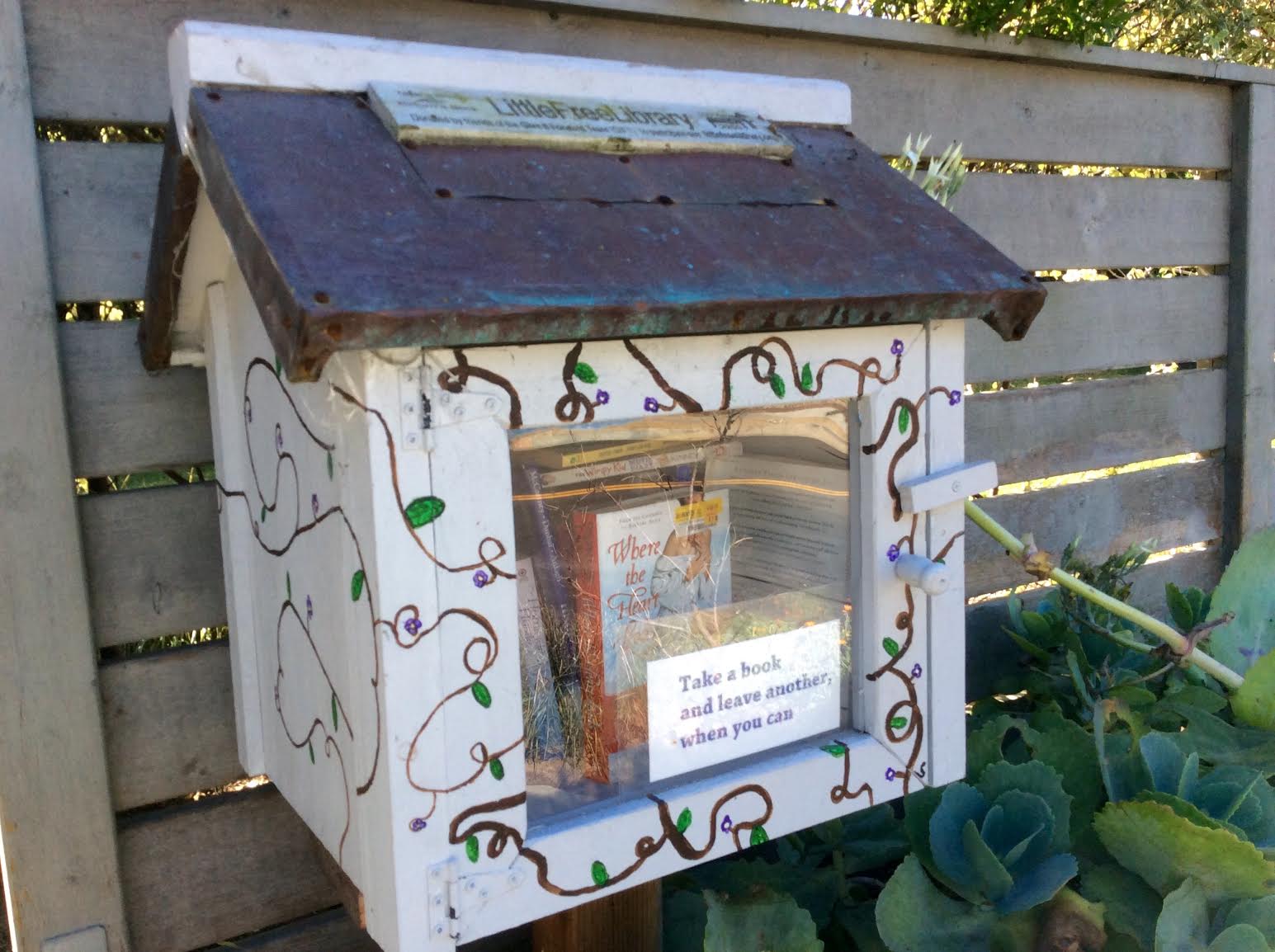 I spotted the Little Free Library in our new neighborhood long before I started using it. Now I’m wondering why I waited so long. The first time I opened the door to peruse the book selections, I was pleasantly surprised to see titles by some of my favorite authors, such as Crichton and Clancy. The Little Free Library has also introduced me to books I probably wouldn’t otherwise have read. I’m always eager to see which new reads my neighbors have dropped off.
But not everyone is a fan of the miniature libraries, apparently. According to a recent article in the LA Times, “Little Free Libraries on the wrong side of the law“, the city threatened to remove one LFL after receiving an anonymous letter of complaint. The city of Shreveport, Louisiana is also cracking down on the curbside book exchanges for violating zoning laws. (Although one enlightened city councilman has proposed an exemption specifically for LFLs).
Other than the Crabby Appleton who penned the complaint letter, I think most people would agree that a Little Free Library is a positive addition to any neighborhood. But the LFLs may need a little help from the rest of us. For example, we can use social media to let city officials know that voters won’t think kindly of anyone who harasses, fines, or otherwise threatens the continued existence of the little libraries.
Little Free Libraries are worth saving, don’t you think? Do you have one in your neighborhood, and have you used it?
The One-Page Synopsis
My mystery publisher requires a one-page double-spaced synopsis along with a manuscript submission. That’s probably harder for me to write than the book. My normal synopsis runs about fifteen pages on average. I write this guideline before starting the story, and later I attach it to my art department’s request for a full synopsis. In the meantime, how does one condense this bulk of material into a single page? Here’s my method for a traditional mystery.

First I’ll give the book title, my name, and the series title a few lines down from the top and centered. Then I’ll offer a tag line that sums up the plot. We’ll use Shear Murder as an example.
A wedding turns deadly when hairstylist Marla Shore discovers a dead body under the cake table.
The Setup
This initial paragraph presents the setup for the story.
Hairstylist Marla Shore is playing bridesmaid at her friend Jill’s wedding when she discovers the bride’s sister stabbed to death under the cake table. Torrie had plenty of people who might have wanted her dead, including her own sister who threatened her just before the ceremony.
The Personal Motive
Why does your sleuth get involved?
At Jill’s request, Marla agrees to help solve the case. With her own wedding four weeks away, her salon expanding into day spa services, and her relatives bickering over nuptial details, she has enough to do. When Jill is arrested for Torrie’s murder, though, Marla has no choice but to unmask the killer.
The Suspects
Here’s where I give a brief profile and possible motive for each of the main suspects.
Jill and Torrie owned a piece of commercial property. Their cousin Kevin, a Realtor, was trying to find them a new tenant. Meanwhile, Jill’s uncle Eddy, a shady attorney, has been urging them to sell. Now Torrie’s husband Scott has inherited his wife’s share. Scott has another motive besides greed. Torrie had announced her plan to leave him for another man, Griff Beasley. Griff was a photographer at Jill’s wedding and Torrie’s colleague. Griff implicates Hally, another coworker. Hally and Torrie were competing for a promotion. [Somebody else ends up dead here, but that’s a spoiler.]
 The Big Reveal
The final paragraph, which I won’t share with you in the hopes you’ll read the book, is where the clues lead to the killer, and the protagonist has her insight about what she’s learned. This last is important for emotional resonance, not only with your readers but also with your editor.
Further Tips: Leave out character names except for your main players, and don’t include subplots. If you’re writing romance, the mid-section would include major plot twists along with the resultant emotional turning points. So now share your tips. What else would you include or not include in your one page synopsis?
Contests
Booklover’s Bench Giveaway, Feb. 4-18
Win an iPad Mini or free books from Booklover’s Bench authors, including a signed paperback of Shear Murder, http://bookloversbench.com/contest/
Winter Contest, Jan. 27-Feb. 14
Win a signed hardcover of Shear Murder & a $10 Starbucks gift card. Two prizes to be awarded. http://nancyjcohen.com/fun-stuff/contest/