TKZ Spotlight: Author Terri Lynn Coop

Today I’m delighted to welcome author Terri Lynn Coop for a Q and A.

TVavatarTerri is a lawyer by day, writer by night, and an unapologetic geek the rest of the time. Her work appears in the “Battlespace” military fiction anthology and the spooky “No Rest for the Wicked” collection. She is a long-time member of the TKZ community.

Please describe your journey as a writer, including any challenges and obstacles you’ve had to overcome.

I didn’t write anything except exams in pursuit of my engineering degree, back then it was all about the math. By the time I hit law school, I was taking every writing class I could to avoid exams. One class, Law and Literature, stuck with me. The professor stressed how the body of American law develops like an epic novel, new chapters constantly building on the old. I developed an appreciation for some of the great legal writers and even forgave the professor for making me read Kafka. 

And it was a good thing. My nascent writing career was short-circuited in 2005 when the family antique business became embroiled in an intellectual property lawsuit. Over the next five years I probably wrote 500,000 words in briefs and motions in four courts across three states. Despite the myth that lawyers are wordy, I had to learn, and learn fast, how to persuasively tell my story, complete with all the backstory, research, and reasoning in 25-page chunks. I had a very specialized audience of one, the judge. I won the case, but it was brutal. 

During this time I also wrote the two “trunkers,” novels of such horrifying proportion that I will do everyone a favor and leave them in the darkest recesses of my hard drive. 

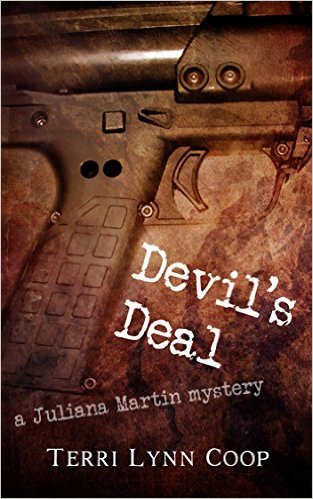
Everything changed in 2009 when my husband was seriously and critically injured in an accident. I was thrown into the role of full-time caregiver and primary wage-earner for two years. Even though he eventually had professional health care aides, I still worked three jobs to keep the household running. Writing was my escape then, and out of that cauldron came the first novel I would let anyone read: “Devil’s Deal”. It went on to win the 2013 Claymore Award at Killer Nashville for best unpublished novel.

Where do you live, and how does that setting inform your writing?

I live on the Kansas prairie in Fort Scott, about 100 miles south of Kansas City, but I’ve lived coast to coast and traveled widely. My settings come from my road trips. For example, in my novel, I’ve camped at that trailer park in south Texas, had breakfast in that truck stop diner, and I spent six months working in downtown Dallas. 

Here in Fort Scott, I love to sit in the local diner and listen to the locals talk. 

How does your background influence your writing?

After my Claymore win, I was interviewed by The Library Police. They asked me why so many lawyers end up as writers. I told them that as a group we are bright, literate, and bored. The practice of law is interesting and can be fulfilling, but if done correctly, is extremely routine and administrative. As a public defender, I practiced what I called “law by the pound.” It was about volume and number of cases resolved. A lot of interesting tidbits came my way, but most of it was very mundane. However, it was so immersive that it couldn’t help but influence my writing in both content and style. 

How old were you when you first felt the urge to write, and what inspired you to get serious about honing the craft?

Ignoring my high school emoting, real inspiration hit in 2003 when I joined an online writing group. I got serious about learning the craft when I wandered into venues that were considerably less impressed with me than I was. 

What are some main themes you return to when writing?

The series that kicked off with Devil’s Deal will have an underlying current of trust, betrayal, loss, and loyalty. In the first book Juliana can’t abandon her father to his fate, even though he may well deserve it. Law enforcement knew exactly how to manipulate her into risking everything to save him. She called it a “familial bomb vest strapped around her heart.” 

Which authors have most influenced your writing?

I have a spare style, terse to the point of being brusque. Most edit notes I get are to “put more in,” rather than “cut more out.” In books, I like plots that move fast and sure with well-defined reluctant heroes like Lee Child’s Jack Reacher, Steve Ulfelder’s Conway Sax, and John Gilstrap’s Jonathan Graves. But, I’m also intrigued by rich characters and settings like Larry’s McMurtry’s Texasville saga. So, I try to keep it moving, but also have character quirks and a lot of repartee in dialogue. 

For POV, a short work called “Lawyers, Guns, and Money,” by J.D. Rhoades completely sold me on the effectiveness of using first person for tight fast plots where the action swirls around the main character. I liked keeping the villains slightly off-stage. The bad guys drove Juliana and Ethan like puppet-masters. 

Do you have a “day job”? Tell us about that. Does it inform your writing in any way?

I’m semi-retired from practicing law. I’ll never give up my license, but I really burned out on courtroom work after some tragic cases. So these days I run the antique business I inherited from my late husband, hustle freelance writing work (including a gig writing catalog descriptions for Halloween costumes,) and hack away at my novels. I’m always on the lookout and absorbing settings, overheard snips of conversation, legal news, and other writers to incorporate into my writing. 

What are you working on now?

I am working on the second installment of the Juliana Martin series, titled “Ride the Lightning.” After the debacle in Texas that ended the first book, Juliana is burned out, salving her wounds as the cynical manager of a Biloxi roadhouse and dance club. Everything is going fine until Ethan Price shows up on undercover with an outlaw motorcycle club. 

When did you first connect with the TKZ community, and have the discussions here had any impact on you as a writer?

 I came to TKZ in about 2007. I was going to a writers conference where John Gilstrap was a presenter and would be critiquing my writing sample. I researched him and landed here. Best decisions I ever made. First the critique, including the now famous “this sucks,” and becoming part of this community have all contributed to my writer’s life. The lessons, discussions, fellowship, and critiques have all left positive impressions on me and my work. Even when I go quiet on the comments because of some kerfuffle in real life, I’m always around. 

Many thanks to Kathryn Lilley for this chance to ramble. I’ll see you all around TKZ. I’ve also been known to blog at Readin’, Ritin’, and Rhetoric. [http://readinrittinrhetoric.blogspot.com/]

1devil51ZAGcl6jpL._SX311_BO1,204,203,200_

Devil’s Deal is available through Amazon. [http://www.amazon.com/Devils-Deal-Juliana-Martin-Mystery-ebook/dp/B00N9OL3FK/ref=sr_1_1?ie=UTF8&qid=1415893921&sr=8-1&keywords=terri+coop] Ride the Lightning will be out by late summer.

The Secret Compartment in the Writers Tool Box

I love the analogous notion of a writer’s tool box, chuck full of principles and proven practices and empowered narrative options. But the dark, rarely uttered truth of the matter is that we can get it all absolutely right, we can produce a by-the-book specimen of a mystery or thriller novel, and still not reach the goal of being published, pleasing reviewers or finding readers.

This, unfortunately, is why some writers drink to excess.

Sometimes this dark outcome can be explained by the idea itself not being robust enough, or competitive enough in a market full of stronger and fresher ideas. You can cook the hell out of a killer hamburger, but it may not make you the next Ray Kroc.

Brilliant execution of a too familiar or too vanilla premise – the bane of mysteries and thrillers and romances – may not be enough.

Or, the explanation may be the more obvious one: sub-standard execution chops. The tools were ignored, or at least not plugged into the right socket.

To get on the other side of this, to access the secret sauce that bestselling authors seem to deliver as if by second nature, we need to go deeper to discover and apply a set of more nuanced and powerful tools. Tools that aren’t taught at the 101 workshop but are definitely available once you crack the code on how to access that secret compartment of the author’s tool box, where opportunity awaits.

There a bunch of them, actually.

This weekend one of those principles assaulted me from a side door, which is usually the case. As a writing teacher/blogger it wasn’t new news – I would hope not – but its application within an unexpected venue knocked me over.

Secret weapon, indeed.  Here’s what happened.

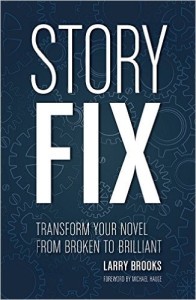
I am three months away from my new writing book’s release (Story Fix: Transform Your Novel From Broken to Brilliant, out in October from Writers Digest Books), and the author of the Foreword delivered his draft for my review before sending it on to the publisher.

Tricky, nervous stuff, that. Send your book out to an author who is significantly more accomplished and famous than you and see what it feels like, waiting for their Foreword to arrive. It’s like asking Phil Michelson to play a round with you so he can recommend you to the PGA tour school.

In my case, the author of my Foreword is Michael Hauge, a legend in the craft world right up there with Robert McKee and our own James Scott Bell. He presented the very first writing workshop I ever attended, some three decades ago (the poetry of which was one of the reasons I recommended him for the Foreword), and had already blurbed one of my prior writing books (Story Engineering).

But a blurb is not a Foreword, so the jury was out. His endorsement could be a make-or-break proposition.

To my great relief he got it, and his Foreword exceeded my highest expectation. But that’s not my point today, at least here, or my agenda.

In a fit of glee I showed it to my wife, an avid reader not easily pleased, and instead of jumping on the celebratory bandwagon, all she could talk about was how well written it was. Not my book… the Foreword. How brilliant Michael Hauge is as a writer, walking the walk in a book about how to do just that.

Her first response struck me as Kill Zone-worthy. 

Here’s what she said: “I love how he writes, he’s got the fluidity of Stephen King, it just goes down easy. There’s not a wasted word in there, and yet he sucks you in, you’re with him all the way. He tells you a story, makes you relate, makes you care. You are in synch with him from the beginning, and by the end you’ve felt every word he says. He makes you believe.”

I had to think about that. This was a Foreword in a writing book, not a novel. And yet, my wife was captivated by those 1200 words. Who does that?

Michael Hauge did it, by telling a story that evoked reader empathy through vicarious experience.

Michael Hauge told the story of how challenging it is to write an effective and authentic Foreword. About the context of it, the expectations and the agenda of it. How it made him wonder, made him think, even made him nervous. Emotions we could all relate to. What if he didn’t like the book? What if he had nothing much to say about it? What if he could not deliver what was hoped for, and indeed, expected?

And there is was, the secret weapon that works in any writing venue, even our fiction.

We take the reader with us, we plug them into our own experience and the fear and thrill and confusion and hope that comes with it. That’s what King does so well, that’s what Jonathan Sparks and Dean Koontz and Michael Connelly, and a long list of other names that are still writing their own titles, do so well. That’s what my wife saw as common ground between them.

Vicarious experience was the secret weapon he employed. There’s a payoff to it, too. When got to the part where he said the book itself rescued him, that he could indeed write a Foreword that endorses it with complete transparent honesty and passion, you could feel his relief. Because guys like Hauge are not for sale, they tell it like it is, and the book itself licensed him to use the word “brilliant” in a way that imbued the Foreword with credibility far beyond that which any reviewer could aspire to.

And no, that’s not me sneaking the word “brilliant” into this with an agenda. Rather, it’s the payoff, the entire agenda – all good writing has an agenda – told through the journey of a writer who was worried if he could get there with integrity. The moment of arrival leaps off the page to strike the reader with impact, as it does for any writer who can pull it off.

And, that’s me imparting that message via a story, with a dash of vicarious experience of its own.

In my prior writing book – Story Physics – I talk about those secrets weapons, one of which, one of the rarely acknowledged, is vicarious experience. Another is narrative strategy, which is precisely what Hague had employed, selecting a means toward an end that he knew would work.

Taking our readers into our journey, into the journey of our heroes and villains, making them feel each and every critical moment as they root for something worthy… that is a strategy and a choice – it is a skill – as much as it is an outcome.

It is an outcome that you earn.

By making them believe.

Somewhere, hidden in the writers tool box you keep at arm’s reach, that particular power tool awaits. Plug it into your story, then tell it with intimacy and courage and transparency, use the character’s journey as the vehicle for an experience rendered vicarious… and watch what happens then.

Larry Brooks is the author of six thrillers and three writing books, the most recent (pictured here) coming out in October from Writers Digest Books.  His website is www.storyfix.com.

for Kill zone


Teaching Yourself to Write the Jack London Way

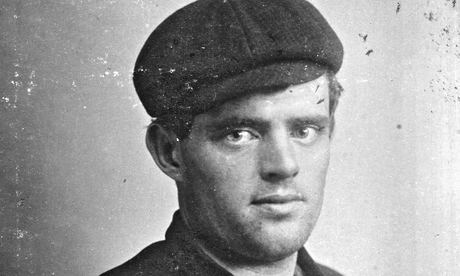
jack londonOnce I made the decision to become a writer, I went after it with everything I had. There would be no going back, no surrender. In this I found myself feeling like one of my writing heroes, Jack London.

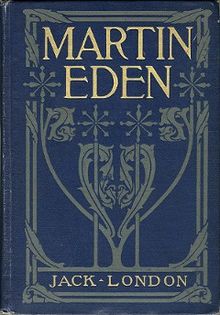
London was a self-taught writer who achieved success through an iron will and disciplined production. He also wrote one of the best novels about a writer, the largely autobiographical Martin Eden. There are long sections that get inside the writer’s mind and heart, and also chronicle London’s own efforts as a young man struggling to teach himself to write fiction. I thought I’d share a few of those with you today.

Study, Don’t Just Read, Successful Authors

[Martin] went farther in the matter. Reading the works of men who had arrived, he noted every result achieved by them, and worked out the tricks by which they had been achieved—the tricks of narrative, of exposition, of style, the points of view, the contrasts, the epigrams; and of all these he made lists for study. He did not ape. He sought principles. MartinEdenHe drew up lists of effective and fetching mannerisms, till out of many such, culled from many writers, he was able to induce the general principle of mannerism, and, thus equipped, to cast about for new and original ones of his own, and to weigh and measure and appraise them properly. 

When I started my writing journey I went to a local used bookstore and picked up an armload of thrillers by King, Koontz, Grisham and others. As I read these books I marked them up, wrote in the margins, talked to myself about what I was discovering, made notes about the techniques—sometimes on napkins or other scraps of paper. I still have all these, by the way.

Collect Examples of Style

In similar manner he collected lists of strong phrases, the phrases of living language, phrases that bit like acid and scorched like flame, or that glowed and were mellow and luscious in the midst of the arid desert of common speech. He sought always for the principle that lay behind and beneath. He wanted to know how the thing was done; after that he could do it for himself. He was not content with the fair face of beauty. He dissected beauty in his crowded little bedroom laboratory, where cooking smells alternated with the outer bedlam of the Silva tribe; and, having dissected and learned the anatomy of beauty, he was nearer being able to create beauty itself.

I have a notebook full of examples of great flights of style. I’ve copied, by hand, passages I’ve admired. The object was to get the sound of sentences in my head and expand my stylistic range.

You ought to do the same. Re-read and even speak out loud examples of what John D. MacDonald called “unobtrusive poetry” in the narrative.

You Can’t Learn to Write Just By Writing

He was so made that he could work only with understanding. He could not work blindly, in the dark, ignorant of what he was producing and trusting to chance and the star of his genius that the effect produced should be right and fine. He had no patience with chance effects.

This resonates with me, because I’ve often heard the advice that you should shun craft study and just write. Like you should shun medical school and just perform surgery. I did a whole post on this, and refer you there.

Beware the Perils of Pure Pantsing

He wanted to know why and how. His was deliberate creative genius, and, before he began a story or poem, the thing itself was already alive in his brain, with the end in sight and the means of realizing that end in his conscious possession. Otherwise the effort was doomed to failure.

Jack London knew what he wanted before he started to write. He had plot before beginning and developed the tools to pull it off. Now, I love all you pantsers out there. I want you to succeed. Just beware the perils and trust that your left brain is actually part of your head, too. Give it a listen every once in awhile.

But Don’t Choke Off Inspired Moments

On the other hand, he appreciated the chance effects in words and phrases that came lightly and easily into his brain, and that later stood all tests of beauty and power and developed tremendous and incommunicable connotations. Before such he bowed down and marveled, knowing that they were beyond the deliberate creation of any man. And no matter how much he dissected beauty in search of the principles that underlie beauty and make beauty possible, he was aware, always, of the innermost mystery of beauty to which he did not penetrate and to which no man had ever penetrated.

There are time that something may “work” even if you don’t know why. So go with it, try it, let that character or section of prose fly off your fingertips. Just be ready to “kill the darling” if enough people tell you it ain’t working. I’ve reached for many a metaphor that my lovely wife has told me is more confusing than enlightening. She is almost always right about this.

Embrace the Wonder

He knew full well … that the mystery of beauty was no less than that of life—nay, more that the fibres of beauty and life were intertwisted, and that he himself was but a bit of the same nonunderstandable fabric, twisted of sunshine and star-dust and wonder.

The story of Martin Eden proceeds from this point to a tragic ending. I think it’s because Martin failed to follow his sense of beauty to a Source, and instead succumbed to a meaningless Nietzschean void. That matter is best discussed in a classroom.

For our purposes, keep the magic alive in your writing. Don’t you love being a writer? Doesn’t it feel sometimes that you are made up of sunshine, star-dust and wonder? Yes, there are also times you feel like the tar on the bottom of a dockworker’s boot, but you accept that as the price for feeling the other, don’t you?

How are you teaching yourself to write?

How are you embracing the wonder?

[Note, I’m traveling home from ThrillerFest today, so may not be able to comment much. Talk amongst yourselves!]

Shutting Down and Opening Up

By Elaine Viets


Open-MouthBy Elaine Viets 

Recently, I’ve seen a rash of news stories with headlines like these:

Retired Air Force four-star general opens up about Wright-Patt, DDC.”

“Marine general opens up about battle with prostate cancer.”

“Wells Fargo CEO opens up about his childhood in poverty.”

Opens up? No, they didn’t.

“Opens up” implies that a person hesitates to talk about a subject, then relaxes and spills the information they didn’t intend to. “Opens up” paints a cozy word picture: We see the reluctant subject settling in over a beer or a cup of coffee, looking a bit nervous. After skillful questioning, the interviewer pries that pearl of information out of the oyster. The subject opens up and reveals a deep secret.

pearl-oyster-sea-farming-101

Wrong.

Retired generals and CEOs don’t open up. They didn’t get to the top by opening up anything, especially their mouths. Every word they say in public is carefully calculated.

Even clown prince Donald Trump knows what he’s doing when he shoots off his mouth. His outrageous remarks get him the attention he needs to rack up the poll numbers – he wants to be one of the top ten in the Republican presidential debate.

And while we’re talking about opening up, why doesn’t Trump’s barber open up and say the Donald’s hair looks lousy?

air force

Anyway, about that so-called opening up: The retired four-star general didn’t open up about the air force base.

He told a newspaper he didn’t like “the focus on a potential Base Realignment and Closure process — because he sees bigger dangers to Wright-Patterson Air Force Base — and warns of complacency because the base has fared well in recent years.”

That isn’t “opening up.” The general is sounding off, possibly to preserve a local pork barrel. He’s been put up to “open up,” and the headline writers fell for it.

Marine-Corps-Logo

And the Marine General who “opened up” about his prostate cancer?

More careful calculation. The story says, “In the midst of planning a complicated drawdown in forces, the Marine Corps’ three-star manpower chief received startling news: He had cancer.”

But he soldiered on, did his military duty and survived his battle with cancer.

That was one brave general. But the article stresses that many men, important men, get prostate cancer, get treated and survive.

I salute the general for discussing a sensitive issue. But he didn’t “open up” – as an ex-reporter I smell a carefully calculated public relations opportunity. He discussed prostate cancer and urged other men to get the exam they fear.

STAGECOACH3%20002

Then there’s that Wells Fargo CEO. Did he really “open up” about his poverty-stricken childhood? Absolutely. Right after he handed out free money to the first one thousand customers.

Hell, no. That “opening up” was another PR ploy. Wells Fargo has had a wagon load of bad publicity about its foreclosures. But here’s this CEO, “one of 11 children growing up on a farm in small-town Minnesota,” who “knows how much trouble we were in financially by the time I was 6 years old . . . We bounced between bankruptcy and foreclosure until I was 15 or 16, when we got a chicken farm, where we had 15,000 laying hens. All of a sudden we had regular income.”

Oh, and by the way, Well Fargo “will continue serving real customers in the real economy.”

Sniff! Sniff! What’s that smell? Is it coming from that team of Wells Fargo horses?

Watch where you step, writers. And be careful about “opening up.”

You can fall into a dangerous word trap.

                           *********************************

Win Elaine’s latest hardcover mystery, “Checked Out.”  Click on Contests at www.elaineviets.com


The Writer’s It Factor

Today I welcome my friend and fellow ITW member Brad Parks as our guest blogger. Brad takes on one of the most elusive yet essential elements in successful storytelling. Read on to find the answer.

—————————–

BY BRAD PARKS
@Brad_Parks

Once upon a writer’s conference, a friend of mine—who might or might not be Chantelle Aimee Osman, depending on how she feels about being described as my friend—was going around, asking folks a great question:

In Hollywood, people talk about certain actors or actresses having an “It Factor,” that special something that just draws in the eye and won’t let it go. Is there an It Factor with writing; and, if so, what is It?

I answered with one word: Voice.

Voice, I will posit, is the writing equivalent of a killer body, great hair and a mysteriously alluring smile.

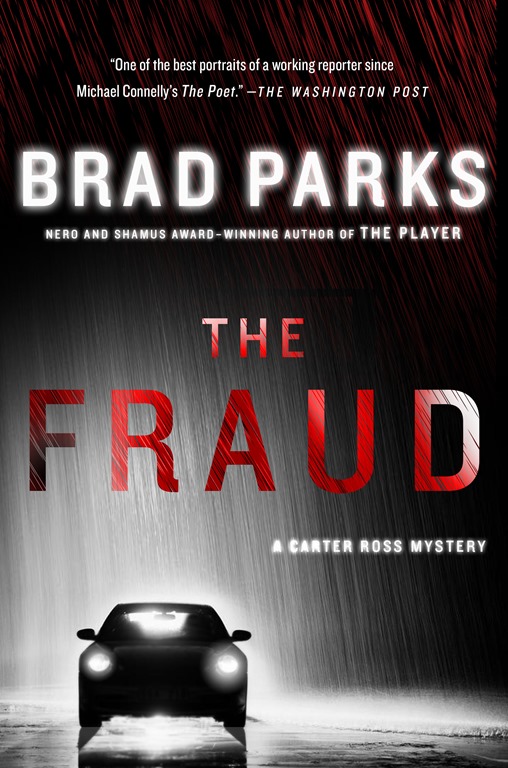
And while I volunteered to take this guest blog spot from Joe because I have a new book to 2024657flog—it’s called THE FRAUD, and when I’m flattering myself I think it’s a fine example of a healthy narrative voice—I want to take a few minutes of your blog time to unpack this subject, because it strikes me as one that folks in the writeosphere don’t spend enough time discussing.

Which is strange. Ask any editor or agent what they’re looking for in a manuscript, and a strong, fresh, unique voice is inevitably at or near the top of that list. The same is true for readers, even if they might not be able to articulate it as such.

The proof can be found at the top of the bestseller list. I’m willing to bet I could kidnap you, drag you into the desert, beat you with sage brush and leave you to die in the brutal sun; but, if before I departed, I also left you with a stripped paperback that began…

I was arrest in Eno’s Diner. At twelve o’clock. I was eating eggs and drinking coffee. A late breakfast, not lunch. I was wet and tired after a long walk in heavy rain. All the way from the highway to the edge of town.

… you’d be like, “Oh, cool. Reacher.” (Or at least you would if you were a Lee Child fan, as I am).

Many of the writers whose book sales are counted in the millions have voices that are so distinct, you could wipe their names and all other identifying characteristics from their work, and yet most of us would still be able to identify their prose within a few paragraphs.

Think of Harlan Coben (where suburban suspense meets Borsht Belt shtick); or Sue Grafton (who couldn’t pick Kinsey’s chatter out of a crowd?); or James Lee Burke (you can hear Louisiana in everything that falls out of Robicheaux’s mouth); or Elmore Leonard, or Laura Lippman, or… or…

It starts with voice. And, yes, of course the writers I’ve listed do many other things well, whether it’s Coben’s great twists or Lippman’s great characters or what have you. But I would argue that voice also covers the things they don’t necessarily do well. Because when a writer has a strong voice? The reader is already buckled in, happy to be along for the ride.

This is great news for all of us who attempt to prod words into compliance. Because unlike Hollywood, where the It Factor is at least partially based on things you have to be born with—some marriage of facial symmetry, bone structure, and that certain crinkle around the eyes—voice is something that can be developed.

Let’s start from 30,000 feet up, with a simple definition of what it is we keyboard-ticklers do each day. Writing is nothing more than (and nothing less than) the task of transferring thoughts from your brain to paper.

It sounds simple enough, except when you start out, there’s this thick filter between your head and the page. And, depending on how tortured your formal education might have been—and how many misguided English teachers forced you to write keyhole-style essays or said you couldn’t end sentences in a preposition—the filter can stay thick for many years.

But if you keep working the writing muscle, the filter starts to thin out. The thoughts get to the page more readily than they did before. You start to notice little things that are dragging on your prose and you eliminate them. You read great writers and incorporate the things they do so well. You read your stuff out loud and develop an ear for what sounds clunky and what sounds cool.

Eventually, the filter disappears. Then it’s just you, in all your idiosyncratic genius. And if you accept that no two people’s thoughts are the same—yes, you really are that special snowflake—no two writers’ voices will be the same, either. Ergo, you will be that strong, fresh, unique voice that someone out there is looking for.

And, no, none of this happens particularly quickly. If you thought I was going to offer the equivalent of a miracle diet for writers—Lose 30 Pounds And Gain Your Voice In Two Easy Weeks, Guaranteed!—I’m sorry to report no such thing exists.

Personally? I started writing for my hometown newspaper when I was 14 years old and I didn’t start to develop a whimper of a voice until I was at least 19. Even then, it was probably just a subconscious imitation of the writers I admired. I didn’t start to have a voice of my own until I was probably 24. Well, okay, maybe 26.

Admittedly, I’m not the quickest study. I’m sure a brighter light could find their voice faster than I did. But, perhaps, only by a little. Writing is a journey without shortcuts, because the destination only becomes clear to you after you’ve arrived.

But at the end of this particular road, the voice—that It Factor—is waiting for you. Fact is, it’s been inside you all along, screaming to get out.

Brad Parks jacket picBrad Parks is the only author to have won the Shamus, Nero and Lefty Awards. His sixth thriller featuring investigative reporter Carter Ross released yesterday. For more, visit www.BradParksBooks.com.

Indie Book Store Confidential

books

Editor’s note: Kris is up in the wilds of Northern Michigan helping her sister Kelly move into a new condo. She is busy painting the kitchen so Kelly is stepping in today. All these stories are true but the customers’ names have been withheld for obvious reasons.

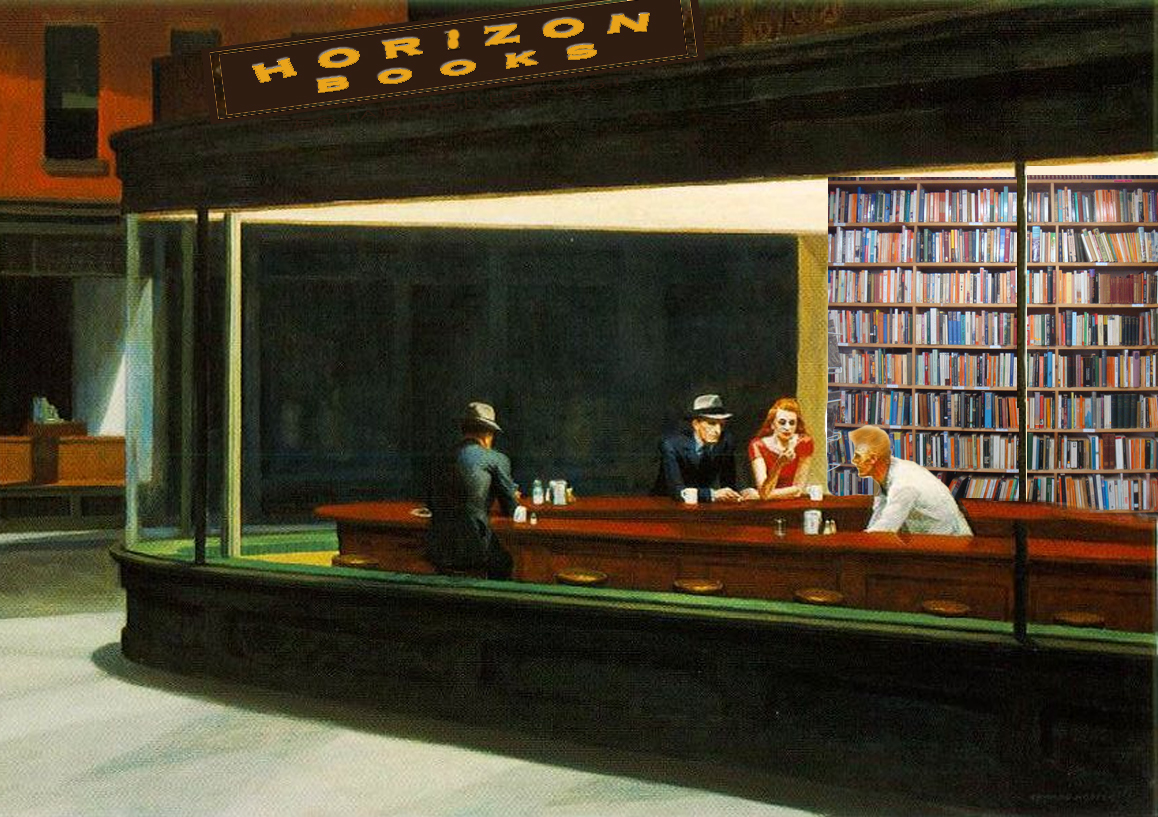
It was a dark and snowy night. I was working the late shift all alone at Horizon Books in Traverse City. The cavernous store was as empty and quiet as Al Capone’s vault. The windows dripped with sweaty heat. Across the street, the red neon sign of the Milk and Honey Ice Cream shop beat blood-red, like a broken heart.

I was leaning on the counter, reading a copy of Hilary Mantel’s Wolf Hall. I only cracked it open because it was my job to know what’s hot and I always did my job. But I was only twenty pages in and I was already tired of characters named Thomas.

Suddenly, the air turned cold, sashaying over me like a discarded mink stole. I saw a dame standing near the door. Red heels, silk stockings, red skirt and a high-collared leopard fur coat with a matching hat, cocked with sass. She wasn’t young but I could tell she had paid a lot of money to have folks think otherwise.

Her baby blues jumped left and right and her red lips pursed slightly as she approached the counter. I knew what she was going to ask for. I knew because not only is it my job to know what’s hot, I got a knack for knowing exactly what people want.

She was an easy read. Before she ever reached the counter, I discreetly reached into what we at the store called “The Case.” The Case is where we keep the VHS Porn Movie Guide, Cannabis Culture magazines, Naked Art Books, the Karma Sutra, and a handful of other titles low-lifes have a tendency to sticky-finger out the door.

I wrapped my hand around the slick spine of a trade pulp and laid it silently on the counter. The dame blushed and reached her for dough. It cost her sixteen Washingtons, all shades of green, but I had a feeling that she would’ve paid fifty, one dollar for each shade of Grey.
Then she was gone into the white confetti of the Michigan night, just one of a hundred happy Horizon readers, eager to experience literary new worlds.

I was just being introduced to yet another Thomas in Wolf Hall when the door opened again. This time, it wasn’t milk and honey but milk and cookies. Shirley Temple with red hair and Sock Monkey mittens. She could barely see over the counter.

“Do you have Mable Makes a Move by Anne Mazer?”

I love little kids who read. There are so few nowadays. I punched at a keyboard that was so old it looked brushed with fingerprint dust, and scrolled through our 1990s WordStock system for the title. Yeah, the computer’s as old as the Clinton-Lewinsky scandal, but hey, it works. And indie bookstores don’t have much cash flow. Nothing came up. Section 904 -– younger young adult — is not my area of expertise. I’m a hard-boiled kind of clerk.

“Is that part of a series?” I asked.

She gave me the How-dumb-are-you? eye roll. “It’s the Sister Magic series. Book Six. Anne Mazer. M-a-z-e-r.”

Feeling a hundred years old, I strolled to the 904 aisle to get the book for Miss Sassy Pants. But I found myself standing there in a maze of pink and purple books, all with glittery spines and little blonde girls and unicorns on the covers.

“There it is,” the girl said as she snatched the book from the shelf. She was back at the counter with the exact change before I could bag her up.

“You’ll enjoy that book,” I say to make conversation as she counted her pennies.

“It’s not for me,” she said. “It’s for my younger sister. I’m reading The Chronicles of Narnia by C.S. Lewis. It’s very old but holds up well. Thank you.”

I sighed in satisfaction as I watched her go, amazed and hopeful for the next generation. Finding the right book for the right reader is the best part of my job. But that’s only part of what goes on in an independent bookstore.

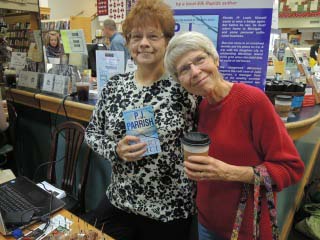
Kelly posing with our book HEART OF ICE and a very nice Horizon Books customer

Kelly posing with our book HEART OF ICE and a very nice Horizon Books customer

We all wear many fedoras here. We shelve new arrivals and ship out the flash-in-the pan hardcovers when they fall off the NYT list. We find impossible-to-find out of print titles for discerning readers. We babysit authors for signings, from the local geezer who wrote a fly-fishing guide to the likes of Steve Hamilton and Mardi Link. We tote books to business luncheons, library fund raisers and school carnivals. And yeah, we make coffee, too. Some of us even know latte art.

You learn a lot working behind the scenes. Some things you might not want to know, like what’s really in a Jimmy Dean sausage. But if you want the dope on how you, as an author, can get the “bulge” (advantage) when working with an indie store, well, maybe this hardboiled old bookseller can give you some hints:

1. Don’t piss off the Author Events Manager.
2. Do not bring in consignment books without being asked.
3. When you first approach the Events Manager, please arrive with sufficient materials in hand so the manager knows what the book is about. A copy of the book might be good.
4. Do not call every Sunday and ask how many books you sold this week.
5. Do not show up late for your event. Maybe, just maybe, people might be waiting.
6. Don’t be a stump. Most events will not require you speak to a group. Your first store events will be done at a table, behind a pile of books. STAND UP. Talk to people, and smile. Have postcards or flyers with a synopsis and let the customer walk away and read your stuff. Pretty good chance they will come back and buy. Flyers can be printed at home!
7. If your book is non-returnable, do not expect your bookstore to carry it on any basis but consignment. You bring it in and get paid only if you sell one.
8. If your book is consignment, do not be surprised if your local store refuses to carry it or do an event. It’s just the way it is. However, even if your book is from Createspace, if it has local interest, many stores are very likely to not only carry it, but actively promote it.
9. If you visit your bookstore as a reader, do not ask a salesperson to look up a book and when you find out the store does not have it but can order it for you, do not tell them you are going to go home and order it from Amazon, where you can get it cheaper. You might find yourself with a boot up your butt as you go out the door.
10. Remember that the folks who work in indie bookstores usually are there because they really love books. And writers. But remember that they are human and just might be having a bad day at the latte machine or just had to deal with a really dicey customer.

Which brings me back to that dark and snowy night. It was near closing and I had already done most my duties: run out the stragglers, reshelved the books people sat and read for eight hours, cleaned the coffee bar, took out the trash, and rolled the pennies for the day shift.

I was this close to a clean getaway when another cold blast of air made me look to the front door.

The kid was standing there wet and bedraggled. As he slurped over toward me, I saw the piercing in his nose and the desperation in his eyes.

“I need a book,” he whispered.

I had already locked up The Case and wasn’t about to open it for another would-be weed farmer.

“We got books,” I said.

“I need it for school,” the kid said. “It’s called One Flew Over the Cuckoo’s Nest.

The kid looked like he didn’t have the strength to go get it himself, so I hopped over, came back and slid the slender paperback across the counter. He stared at it like it was a dead walleye.

“Is this hard stuff?” he asked.

“Not too bad.” I paused, feeling a moment of pity for this pathetic creature. “You seen the movie?” I asked.

His eyes brightened. “There’s a movie?”

“Yeah, it’s a little dated but it’s good and has a powerful message on the mental health system in America.”

The light left his eyes.

“Hey, you can’t go wrong with Jack Nicholson,” I said.

“Who’s he?”

I shook my head and picked up the wad of crumbled bills the kid had set on the counter. I bagged up his book and sent him back out into the night, locking the door behind him. I watched him until he disappeared into the swirling snow.

Life wore a man out, wore a man thin. Tomorrow would be a better day.

I pulled the string on the light and the neon – BOOKS! OPEN! – sign went silent.

Subjectivity of Art

So we all know how subjective an assessment of any novel can be – we see it  all the time in conflicting book reviews, Amazon and Goodreads ratings, or, as demonstrated in every book group I’ve ever attend, the amazing array of reader reactions possible to the exact same book… Instinctively, I think we all know that our work cannot please everyone all the time. How then does a new writer know if the work he or she is producing is going to be of a standard that will attract an agent or editor’s interest? How (at the most basic level) do you know if you’ve written something that’s actually ‘good enough’ for publication?

Most writers I know suffer from a fair measure of self-doubt as well as ambition, and many, by their own account, are never totally sure when they complete a new draft whether others are actually  going to like it. That’s where beta readers, critique groups and manuscript/first page critique sessions come in –  these all provide writers with some initial feedback on their work. This is also where the thorn in every writer’s side comes in – subjectivity. We’ve all heard stories of agents and editors who didn’t like the next book a writer they previously loved  produced, or books rejected dozens of times only to be picked up by that one elusive editor and nurtured to success. Remember how many times the first Harry Potter book was rejected only to then go on to be  bestseller…well, many writers cling to that hope – but how to know when that hope is possibly true or, sadly, unfounded? Art by its very nature is subjective…so how is a new writer to gauge the success of their current WIP without being driven crazy by the spectre of ‘subjectivity’ ?

I admit I am just as plagued by self-doubt as the next writer and even when I think something I’ve written is pretty good I’m never sure anyone else is going to think the same…so when working with my own beta readers/critique partners I adopt the following approach in order to keep my sanity:

  • I ask for both an overall assessment as well as specific feedback on elements in the story that are critical ( e.g. POV, narrative flow and character) or areas where I know I am weakest (hello, plot and structure!). This enables my readers to pinpoint some elements that may not work as well as others (and hopefully avoid the vague “I’m not sure why I didn’t like that bit…” kind of response).
  • I look for consistency of the same feedback. If everyone feels like the POV isn’t as strong as could be, then there’s probably merit in considering reworking it. If only one person doesn’t like a particular element, I may be less sure…and I may need to probe their response a little deeper.
  • I accept the likes and dislikes of my beta readers. All of mine love historical fiction but some have a preference for lighter or darker mysteries, while others aren’t really into speculative or fantasy elements…and so I tailor my feedback requests to take this into account.
  • I reach out to new beta readers/critique partners that represent the readers I am targeting in my current WIP. If it’s a children’s book for example, I think children should give their feedback, not just adults.
  • I realize the limitations of any feedback and try to critically reappraise my own work as well. Just after I’ve finished a draft I’m usually too close to the material to take a step back and process its overall merits. I need to give myself time and space so I can re-evaluate my work – because often your own gut feel is just as important.
  • I try to accept that failure is the only means to achieving ultimate success. No matter the blow to one’s ego, sometimes we have to admit it that something doesn’t work and move on. I strongly believe that each ‘failure’ is an important learning step on the path to success (even if it does suck sometimes!)

What about you? How do you deal with the thorny ‘subjectivity’ issue when it comes to feedback for your own work? What process do you use to gain the confidence that your work really is ready…in terms of being ‘good’,  ‘marketable’ or ‘publication ready’?


From Failure to Success in Writing

how-i-raised-myself-from-failure-to-success-400x400-imadpwd2t88rkgy8The rah-rah headline for today’s post is borrowed from a book I read as a young man, How I Raised Myself From Failure to Success in Selling by Frank Bettger. It’s considered a classic of sales-training lit. But lots of folks have given the book props for helping them get ahead in other professions, too.

The headline is also apt because I definitely thought myself a failure as a writer when I was in my twenties. The stuff I wrote didn’t work the way I wanted it to, and I was told that’s because you have be born a writer. You can’t learn how to do it.

For ten years or so I accepted that I would never make it in this business.

So I did some other things. I moved to New York to pursue an acting career. Started doing Off-Broadway, Shakespeare, avant-garde. But after awhile I wondered why I wasn’t being offered a starring role in a movie like Raiders of the Lost Ark (they gave it to some guy named Ford).

During a visit back to L.A. I met this gorgeous actress at a party. Knowing I’d be returning to New York soon, I only waited two-and-a-half weeks to ask her to marry me.

Shockingly, she said yes.

After we were married I decided it might be a good idea for us to have one steady paycheck. Since Cindy was the more talented of the two of us, she continued with her stage work while I applied to law school.

In my third year at USC Law I interviewed with a big firm with offices in Beverly Hills.

Shockingly, they hired me.

Later on I opened my own office. And found out I had to be a businessman, too. I had to learn entrepreneurial principles. So I started to read books on business, and one of these was Bettger’s.

A few years went by and the desire to write, with me since I was a kid reading Tarzan of the Apes, came back to me. Bettger’s principles helped me along that path, too.

Frank_Bettger_(1888-1981)Frank Bettger was a former big-league ballplayer who went into the insurance game. After initial failures he started wondering if he really had what it took to be a good salesman. He decided to find out what others did. He began to apply a set of practices that helped get him to the top.

The first of these practices was enthusiasm. To sell successfully, you have to be enthusiastic about your product, your prospects, life itself. You need to exude joy, because the alternative is gloom, and gloom don’t sell.

Bettger noticed that if he didn’t feel enthusiastic, he could still act enthusiastic, and soon enough the feeling came tagging right along.

When I discovered you really can learn the craft, I got as excited as a man in the ocean who finds a plank to hang on to and then spots a lush island in the distance. It was enough to infuse joy and hope into my writing, and those two things alone started to improve it.

Another practice Bettger mentions is a system of organization. Make plans, record your results. When I got my first book contract I hadn’t thought through what I’d do for a follow-up. So I got organized. I began planning my career five years ahead, kept track of who I met with and pitched to, who I wanted to meet, and scheduled projects accordingly.

I’d already established the discipline of writing to a quota, but now I started keeping track of my output on a spreadsheet. Starting with the year 2000 I can tell you how many words I wrote on any given day, on what projects, and my weekly, monthly, and yearly totals.

Next, Bettger summarized the most important secret in sales: Find out what the other fellow wants, then help him find the best way to get it.

This got me thinking about pleasing readers. In college I was heavily influenced by the Beats (Kerouac, Ginsberg, et al.) Their writing was idiosyncratic and experimental. But I figured out early that what was idiosyncratic did not necessarily, or usually, connect with a large audience.

I knew I could write solely for myself, ignore genre, be hip (though a lot of the time it was artificial hip). But I wanted to make a living at this, so I backed up and looked for points where my own writing pleasure met with readers’ desire for a good story.

Still, I needed confidence this could be done. Bettger wrote that the best way to increase confidence is to keep learning about your business. Never stop.

The same holds true for writing, both the craft side and the business side.

If you are set on traditional publishing you need to know: What are publishing contracts like? What terms are you willing to accept … or, more importantly, walk away from? What are the characteristics of a good agent? What can you realistically expect in terms of editorial and marketing?

If you are going to self-publish, do you have a plan? Do you know what you need to know? Are you putting in a systematic effort to find out? Are you a risk taker?

In my business life I dedicated at least half an hour a day reading about business principles, thinking, and planning. I do the same thing in my writing life. I read every issue of Writer’s Digest. I enjoy books and blogs on the craft. My philosophy has always been that if I pick up one new technique, or see something familiar from another point of view, it’s worth the effort.

There’s a lot more packed into Bettger’s book, but I’ll close with the part that helped me most, both as a businessman and as an author. It’s his chapter on Ben Franklin’s plan for self-improvement.

In Franklin’s autobiography, he writes about his desire, as a young man, to acquire the habits of successful living. Franklin chose thirteen virtues, such as temperance, resolution, frugality, justice and so on. He made a chart and concentrated on one virtue for a week, ingraining the habit. That way, he could go through his list four times a year.

Bettger followed this plan by choosing thirteen practices that would help him as a salesman, such as sincerity, remembering names and faces, service and prospecting, and so on.

I did something similar with my writing. I formulated what I call the Seven Critical Success Factors of Fiction: plot, structure, character, scenes, dialogue, theme, and voice. By concentrating on these serially, I hoped to raise my overall game.

Bettger’s book helped me at two crucial points in my life––when I had to run a business, and when I made the decision to pursue the writing dream. In both pursuits there are challenges aplenty. Sources of inspiration are critical. I’m glad that ex-ballplayer was around to fire me up.

So what gets you enthusiastic about your writing? When you need an infusion of confidence, where do you turn?

Missing

question mark

Designed by Why Not Associates. All rights reserved.

One of the questions frequently asked of a writer is where ideas are obtained. If you are writing, and find yourself lacking for ideas, I have a suggestion: google “missing persons” and then your local city, county, or even neighborhood.  You will find enough tragedy, heartbreak, and yes, mystery to write volume after volume.

I am haunted by a particular incident that took place less than two blocks from my home. I am blessed to live in Westerville, just outside of Columbus, near a lovely area known as Hoover Reservoir. It’s a body of water that stretches for a few miles and has hiking and jogging trails, fishing opportunities, and a decent sized waterfall. It is also the situs of a disappearance that has baffled our local law enforcement for almost twenty years. A gentleman named Robert Mohney left his home — and a half-eaten steak dinner — on the evening of July 28, 1996 and was never seen again. His automobile — a cherry red Pontiac Firebird — was found in a parking lot at Hoover Reservoir. One reflexively thinks suicide, but no note was found. No, there is the impression of a meal interrupted and a sudden…disruption, perhaps?  Mohney had been going through a divorce but it reportedly was not an unfriendly proceeding; this wasn’t someone, according to those who knew him, who was intent on leaving for the other side. Inquiries were made and the reservoir searched but the man, a good looking guy in his late 20s, was and is gone. Police acting on a tip in 2010 dug up a field in an area north of the city hoping to locate a body and perhaps bring some closure —whatever that is — to Mohney’s family. They came up empty, unfortunately. Mohney is now the subject of high school legend, one in which his spirit can be seen late at night, wandering the banks of the reservoir, seeking peace. What happened to him? How does someone disappear from a popular picnic and recreational area without anyone noticing something? There’s your novel; have at it.

If that doesn’t interest you, here’s another.  Over nine years ago  a second year medical student at The Ohio State University named Brian Shaffer disappeared one night from a very popular campus-area bar and restaurant after becoming separated from friends. Security cameras show him going into the establishment with those friends but never coming out. Law enforcement has spent hours reviewing video and accounting for everyone who entered and left the place. Everyone but one.  Cadaver dogs were subsequently led through the premises but came up empty. There have been rumors a-plenty as to what occurred — everything from sighting in Atlanta to a tie-in with what have become known as the “Smiley Face Murders” — and if you want to feel as if you’re about to slip loose of your moorings, google that term — but nothing concrete has been determined. Shaffer is…gone.

There are more. A number of young women living on the fringes of polite society in a rural area south of central Ohio have disappeared during the past year. I stopped believing in coincidence some time ago; something bad and evil is acting, with impunity, in that area. Further afield, a number of ladies employed in some of the more popular adult entertainment establishments on Bourbon Street in New Orleans go missing under strange circumstances each year. Check out the statistics for the number of people who go missing in your city, your state, your country. There are all sorts or stories, real or imagined, waiting to be told. Be warned: after reading a few of those accounts you will want to take every person you love and keep them close and safe in a locked room. But if you need a story idea, you’re just a few keystrokes away from one, or two, or several.

That’s all I have. Tell me…what’s been happening near you? Are they heavily publicized, or were you surprised by what you found?