Writing and Publishing Links Roundup for Week of 11/3

Shutterstock photo purchased by TKZHere’s a links roundup for some recent, interesting articles about writing and the publishing biz. (Link texts follow the hyperlinks). Enjoy reading!

(PW) The Best Books of 2015:
http://best-books.publishersweekly.com/pw/best-books/2015

(PBS) Three Lessons on Writing from J.K. Rowling
http://www.pbs.org/newshour/rundown/j-k-rowlings-lessons-writing/#.Vjh9ku-_TQk.twitter

(Writers in the Storm blog via WD) Query Letters Pet Peeves (by Agents)
https://writersinthestorm.wordpress.com/2014/01/03/query-letter-pet-peeves-agents-speak/

(PW) How to build an author’s platform through email lists
http://www.publishersweekly.com/pw/by-topic/authors/pw-select/article/68469-how-to-build-an-author-platform-through-email-lists.html?utm_content=buffera6df3&utm_medium=social&utm_source=twitter.com&utm_campaign=buffer

(NYT) Russia: Librarian accused of allowing access to banned books
http://nyti.ms/1Pi1UpF

(PW) How to get Self-published books into stores and libraries
http://www.publishersweekly.com/pw/by-topic/authors/pw-select/article/68467-how-to-get-self-published-books-into-stores-and-libraries.html

(PW) Want to Succeed in Self-publishing? Tips from an Indie Author (Tony Rich)
http://tinyurl.com/q48o5rr

How about you? In the Comments, please let us know about any interesting articles to add to our list. Thanks!

The Evolution of Your Hero

Evolution

Two weeks ago James Scott Bell wrote a terrific post on hero passivity, and how to handle it (carefully) in a novel. Which in a nutshell is this: in general you should avoid it, because it’s absolutely a radioactive story killer if handled wrong.

The mistake, and the temptation that leads to it, is to get too caught up in the intention to write a character-driven story (a noble goal, but like trying to run a marathon, you need to understand the role of pace), and a facet of that character is passivity in the form of lack of motivation, lack of courage, lack of direction or simply lack of interest.

Sooner or later, you need to give your hero something to do.

This issue is an example of how story structure touches and drives everything. 

This includes character arc, the beginning of which can indeed be a viable context for your protagonist’s passivity (which may be the very thing that gets them into trouble).  Nay-sayers on structure handle this differently, and yet end up – at least when the story finally works – aligning with where structure seeks to take a story in the first place.

Which is why mastery of story structure is perhaps the most critical phase of an author’s development. Because everything in the story connects to and is informed by structure.

When someone tries to tell you that’s not true… run.

Showing your hero in a passive context can actually be a good thing…

… provided you understand when and where to allow passivity to show itself.

Some stories begin with the hero simply not yet having fully collided with a forthcoming problem or situation (which absolutely needs to happen, and at a specific place in the story sequence), while others show the hero actually contributing to that problem by virtue of being passive (like, for example, someone in a relationship being cold toward their partner, resulting in… well, you know, all kinds of issues).

But be careful with this.  Because passivity can get you – the author – in a real pickle, too.  Stories are nothing if not a vicarious experience of a central hero-centric problem/situation (plot) for the reader.  Just don’t suck on that pickle for too long… because it’s toxic if you do.

And that’s where structure will guide you.

In her book “The Hero Within: Six Archetypes We Live By”, Carol S. Pearson is credited with bringing us life’s hero archetypes, four of which align exactly with the sequential/structural “parts” of a story.  (For those who live by the 3-Act model, know that the 2nd Act is by definition contextually divided into two equal parts at the midpoint, with separate hero contexts for each quartile on either side of that midpoint, thus creating what is actually a fourpart story model; this perspective is nothing other than a more specific – and thus, more useful – model than the 3-Act format from which it emerges.)

Those four parts align exactly with these four character contexts:

Orphan (Pearson’s term)/innocent – as the story opens your hero is living life in a way that is not yet connected to (or in anticipation of) the core story, at least in terms of what goes wrong. 

And something absolutely has to go wrong, and at a specific spot in the narrative.

The author’s mission in this first story part/quartile, prior to that happening, is twofold: make us care about the character, while setting up the mechanics of the dramatic arc (as well as the character arc) to come.  There are many ways to play this – which is why this isn’t in any way formulaic – since within these opening chapters the hero, passive or not, can actually sense or even contribute to the forthcoming storm, or it can drop on their head like a crashing chandelier.  Either way, something happens (at a specific place in the narrative sequence) that demands a response from your hero.

Now your hero has something to do, something that wasn’t fully in play prior to that moment (called The First Plot Point, which divides the Part 1 quartile from the Part 2 quartile).  In this context, and if your chandelier falls at the proper place (in classic story structure that First Plot Point can arrive anywhere from the 20th to 25th percentile; variances on either end of that range puts the story at risk for very specific reasons), you can now think of your hero as a…

Wanderer – the hero’s initial reactions to the First Plot Point (chandelier impact), which comprise the first half of Act 2 (or the second of the four “parts” of a story).  The First Plot Point is the moment the story clicks in for real (everything prior to it was essentially part of a set-up for it), because the source of the story’s conflict, until now foreshadowed or only partially in play, has now summoned the hero to react.  That reaction can be described as “wandering” through options along a new path, such as running, hiding, striking back, seeking information, surrendering, writing their congressman, encountering a fuller awareness of what they’re up against, or just plain getting into deeper water from a position of cluelessness and/or some level of helplessness.

But sooner or later, if nothing else than to escalate the pace of the story (because your hero can’t remain either passive or in victim-mode for too long), your hero must evolve from a Wanderer into a…

Warrior – using information and awareness and a learning curve (i.e, when the next chandelier drops, duck), as delivered via the Midpoint turn of the story.  The Midpoint (that’s a literal term, by the way) changes the context of the story for both the reader and the hero (from wanderer into warrior-mode), because here is where a curtain has been drawn back to give us new/more specific information – machinations, reveals, explanations, true identities, deeper motives, etc. – that alter the nature of the hero’s decisions and actions from that point forward, turning them from passive or clueless toward becoming more empowered, resulting in a more proactive attack on whatever blocks their path or threatens.  Which is often, but not always, a villain.

But be careful here.  While your hero is getting deeper into the fight here in Part 3, take care to not show much success at this point (the villain is ramping things up, as well, in response to your hero’s new boldness).  The escalated action and tension and confrontation of the Part 3 quartile (where, indeed, the tension is thicker than ever before) is there to create new story dynamics that will set up a final showdown just around the corner.

That’s where, in the fourth and final quartile, the protagonist becomes, in essence, a…

Martyr (Pearson’s term)/hero – launching a final quest or heading down a path that will ultimately lead to the climactic resolution of the story.  This should be a product of the hero’s catalytic decisions and actions (in other words, heroes shouldn’t be saved, rather, they should be the primary architect of the resolution), usually necessitating machinations and new dynamics (remember Minny’s “chocolate” pie in The Help?), which ramp up to facilitate that climactic moment.

This is where character arc becomes a money shot.  Because by now everything you’ve put the hero through has contributed to a deep well of empathy and emotion on the reader’s part.  This is where the crowd cheers or hearts break or history is altered, where villains are vanquished and a new day dawns.

Instinct, Intention or Accident?

Too many writers aren’t in command of the difference.  You can be, and you should be.

In this context these three options don’t refer to your hero, they refer to you, the author of the story.  All three modes may play a role in how a story comes together, but the good news is that you don’t have to rely on any single one of them.  Armed with a deeper knowledge of craft, you get to choose which to harness, and when.

Truly, successful storytelling exceeds the sum of these three states, so listen to all the voices in your head that contribute to the way you build the arc of your character: yours, those of your characters (that’s a metaphor, by the way, because when a character “speaks to you” that’s just your story sensibility weighing in), and the sum of the learning you have accumulated from venues like this one, and the books the authors here have written to show it to you.

(image by Esther Dyson)

Embrace Your Weirdness

NaNoLogoIt’s day one of National Novel Writing Month (NaNoWriMo) 2015, and all over the world writers are clacking away in an initial rush of writing joy. The journey has begun. The climb up the mountain is on. Yes, there will need to be some oxygen intake along the way, but right now everybody’s yodeling.

To me, that’s the great benefit of NaNo. For one month there’s a community of writers engaged in the same pursuit—completing a 50,000 word novel in 30 days.

Of course, it’s not all sweetness and light. Life sometimes intrudes (it tends to do that). But those who keep on producing the words will feel an exhilaration that proves at least one thing: they are not chairs. They are writers full of passion and ideas and fervors and dreams. Some people never get to feel that way about anything.

That’s why you, writer, need to appreciate the gift you’ve been given, the gift of being slightly weird.

Yes, writers are weird. We’re weird because we do things like this: A friend has been in a terrible accident. We rush to the hospital. We enter the room. The friend is hooked up and bandaged. We go to him and take his hand. “I’m here for you,” we say.

At the same time, half our brain is thinking, This would make a pretty good scene. I wonder what they call that machine over there? Maybe I can ask a doctor some research questions before I leave. Maybe—

“What’s that? Oh, yes, yes, I’m here for you!”

And we wouldn’t have it any other way! I mean, who wants to walk through life in the tight shoes of the ordinary? We lie for fun and profit! Remember that great line from A Knight’s Tale, uttered by Chaucer: “Yes, I lied. I’m a writer. I give the truth scope!”

There’s nothing more joyful than giving the truth scope.

Let’s see it in your pages! In my recent book, VOICE: The Secret Power of Great Writing, I include a clip from John Fante’s 1939 novel, Ask the Dust. Here it is, and can’t you just feel what it’s like to want to be a writer?

Los Angeles, give me some of you! Los Angeles come to me the way I came to you, my feet over your streets, you pretty town I loved you so much, you sad flower in the sand, you pretty town. A day and another day and the day before, and the library with the big boys in the shelves, old Dreiser, old Mencken, all the boys down there, and I went to see them, Hya Dreiser, Hya Mencken, Hya hya: there’s a place for me, too, and it begins with B, in the B shelf. Arturo Bandini, make way for Arturo Bandini, his slot for his book, and I sat at the table and just looked at the place where my book would be, right there close to Arnold Bennett, not much that Arnold Bennett, but I’d be there to sort of bolster up the B’s, old Arturo Bandini, one of the boys, until some girl came along, some scent of perfume through the fiction room, some click of high heels to break up the monotony of my fame. Gala day, gala dream!

“Zest. Gusto. How rarely one hears these words used. How rarely do we see people living, or for that matter, creating by them. Yet if I were asked to name the most important items in a writer’s make-up, the things that shape his material and rush him along the road to where he wants to go, I could only warn him to look to his zest, see to his gusto.” (Ray Bradbury, Zen and the Art of Writing)

So whether you’re NaNoing or not (this year I have to transfer my gusto for NaNo to a project with an end-of-November deadline) make this month one where you surrender yourself to the joy of being that strange bird, a writer. You get to create fabulous worlds, unforgettable characters, blistering dialogue, scenes full of tension and conflict. You can write about zombies or lawyers (though some people think there is little difference between them). You can write about great loves and losses, go to Mars or New York.

And if perchance you are in one of those places in your mind, with a glassy stare on your face as your characters begin improvising––or maybe your lips are moving as you make up the dialogue––and someone happens to mention that you’re acting a little weird, simply say, “Thank you!”

Carpe Typem everyone. Have a wild and wonderful November.


First-Page Critique: The Art of Stage Setting

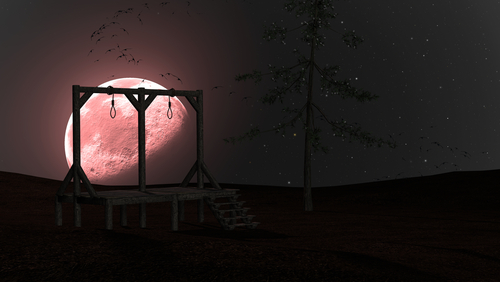
1gallows_shutterstock_239830486

Today we’ll be critiquing the first page of a story called THE GHOST AT BEAVERHEAD ROCK. I’ll add my comments at the end. Please add your notes and suggestions in the Comments.

THE GHOST AT BEAVERHEAD ROCK

Darkness still hid the night’s work when Daniel Stark and Timothy McDowell stepped out of the restaurant. It would not be hidden for long, Dan said to himself. A faint glow separated the outline of the easterly mountain ranges from the star-filled sky. The boy must not see it. They must be gone before anyone saw it.

The coach from Bannack to Virginia City stood in front of the Overland stage office. Restless, wanting to move and get warm, the horses stamped their feet, rocked the coach forward, then back. Their breath steamed in the lamplight spilling from the windows.

“It’s ready to leave. Hurry.” Dan slung his rifle across his back.

“Sun ain’t up yet.” Timothy yawned. “Sure is a nice morning. Crisp.”

The boy’s deep voice still could startle Dan, who thought of him as the boy he had left in the spring. “Let’s get our bags.” He set a fast pace toward the rooming house.

Boy-like, Timothy scuffed his toe at clods of frozen horse manure. “We’ll be in that dratted box all day. I want to enjoy the air.”

“You can enjoy the air in Virginia City.”

“Not if the smoke settles there. Gets so bad sometimes you can hardly breathe.” He took a deep breath, let it out. ”Nothing like mountain air.”

Dan looked over his shoulder. Timothy grinned at him, teasing, but took longer steps. Dan cuffed the boy’s shoulder, not much below his own. “That’s better.”

As he spoke, the stars lost brilliance, and the mountains around Bannack stood out from the sky.

The stage driver came out of the office, holding a coiled blacksnake whip in one hand. He arched his back, circled his arms, rolled his shoulders. Two passengers, a man and a stout woman walked out of the stage office.

Timothy lagged behind again. Dan called over his shoulder, “Hurry. They’re loading.”

“What in hell—?” Breaking into a run, Timothy veered off the boardwalk, broke into a run uphill.

Damn! He had seen it. Pivoting, Dan sprinted after him. He leaped the sluice ditch, dashed between the one-man cabins on Bachelor’s Row. His boots crushed frozen bunch grass. His breath rasped in his throat. The rifle bounced against his back.

He caught Timothy amid the sagebrush several yards from the gallows and tackled him around the waist. They tumbled together onto the ground. “No, Tim, don’t look – ” What he meant to say was lost as the corpse turned on its rope; its frozen eyeballs stared into his soul.

My comments: I think this first page shows that the writer has a nice ear for dialogue. The conversation between the man and boy flowed easily. There are some other craft-related issues that need to addressed, in order to make this scene stronger.

Get important information across early

I sense that this writer has a strong vision of the story’s characters and setting, but the first paragraph needs to provide more information to convey that vision to the reader. In the absence of clues, readers start making their own assumptions. It’s easy for them to wander off track. For example, I didn’t realize until the second paragraph that the story is set in the western past. By then, I had already formed a vision of a much more modern setting. It’s jarring to the reader to have to backtrack after making a wrong assumption.

Don’t over-withhold information in an effort to build suspense

The first paragraph in this story makes a reference to “the night’s work,” followed up by several more deliberately vague references to “it”. We don’t learn what “it” is until the very end of the page, however. Too much information is withheld for too long, potentially frustrating the reader or causing him to lose interest. The first paragraph might be stronger if it contained a hint or reference to the gallows. For example, instead of repeating the use of a vague pronoun in the following sentence:

It would not be hidden for long…”

It might be more dramatic if Dan spotted the silhouette of the dark, swinging mass (the corpse) emerging against the night sky. Just a hint, enough to give the reader some sense of the terrible sight that he’s trying to keep the boy from seeing.

Avoid confusing transitions between dialogue and action

By the time I encountered the following paragraph:

“What in hell—?” Breaking into a run, Timothy veered off the boardwalk, broke into a run uphill.

I still didn’t know what it was that Timothy had seen and was reacting to. By the time I got to the payoff at the very end of the scene–the sight of the gallows and hanging corpse–I was feeling confused and somewhat frustrated as a reader. This confusion can be avoided by providing the reader with enough information earlier in the scene, to keep him oriented and engaged in the story.

Your thoughts?

Please add your notes and suggestions in the Comments. And thanks to our brave writer for submitting this first page!

#1 Rule of First Drafts

My friend and fellow ITW member Tosca Lee returns to TKZ to share her #1 Rule of First Drafts. Enjoy!
Joe Moore
___________________

I’m a second or third draft writer. That’s the point in the process when I get to see what kind of clay I’ve really got on the wheel, when I can crimp the edges and pull out my high points, and make the dire ones worse. When I’ll stay up twenty hours straight and, after imagejust enough sleep to make me more tired, go at it again. Because by then I have something to work with. But that first, initial draft? Pull my fingernails out from the beds with pliers, why don’t you.

I have friends who turn on their playlists and lay down first drafts in a state of euphoric bliss—the weird literary equivalent of women who experience pleasure in childbirth. I have never written like that. I have moments of stream-of-conscious ecstasy that churn out sentences as coherent as word salad. But most of the time I sit in silence, stare out the window, pick at my lower lip and wonder if my last book, which may have won some award, was the last good thing I had in me.

Eight novels in (ten, if you count the unpublishable ones), I have an instinct about the basic material I need to get down, more or less in order. More importantly, I have trust in the writing and editing process and faith that I can patch up the leaks—later.

For now, in the early stages, I’m only interested in one thing: getting the clay on the wheel. I trust that there are seeds in there—of things real, from me, that will resonate in another soul in months and years to come. I don’t know what they are yet and it’s not my business to force them into shape.

I have a few rules for this process but the first is the one I go back to every time, and it is this:

Write like no one will ever read it.

“But what about the audience? You have to think about them!” Forget them. Everything you do from your edits on will be about them. But for now, write with the candor you would in a secret journal. This isn’t about pantsing or plotting. It’s about capturing the grit you need without worrying that it’s pretty or eloquent or clean enough. Don’t be pretty. Be raw.

If you are an aspiring writer whose end goal is to be published, let me tell you something: you will never be as bold and daring as you are in those first years before your work gets published. Before critics post public reviews of your work and readers rank it alongside blenders on Amazon. Before even accolades usher their own kind of doubt into the next endeavor. This undiscovered period in your life is an advantage you won’t have twice. Use it.

These days, I have to trick myself into following this rule. I know my agent, editor, and a movie producer are waiting for my first draft. I want them to like it. Oh, who am I kidding—I want them to tell me it’s the best thing they’ve ever read, that they wept, told their therapist, and pre-ordered 100 copies for friends and distant acquaintances.

But the only way I will touch one cell of their soul is if I banish their faces from my mind. No one will read this. It is my mantra. This is me, writing secret stuff, dealing some audacious literary badassery in private. Time to edit, censor, and make coherent later. The good stuff happens now.

TL1Tosca Lee is the award-winning, New York Times bestselling author of ISCARIOT; THE LEGEND OF SHEBA; DEMON: A MEMOIR; HAVAH: THE STORY OF EVE; and the Books of Mortals series with New York Times bestseller Ted Dekker (FORBIDDEN, MORTAL and SOVEREIGN).

Tosca received her B.A. in English and International Relations from Smith College in Northampton, Massachusetts with studies at Oxford University. She is a lifelong world adventure traveler and makes her home in the Midwest. To learn more about Tosca, visit www.toscalee.com.

When a Picture Is Worth
At Least 80,000 Words

chci-dog-thechicadvisor

The great advantage of being a writer is that you can spy on people. You’re there, listening to every word, but part of you is observing. Everything is useful to a writer, you see – every scrap, even the longest and most boring of luncheon parties.– Graham Greene

By PJ Parrish

Friday, I tried to push the boulder back up the hill again.

You all know the one. James even had a picture of it here last week when he asked us what was the hardest part of writing. It’s that stone on which is engraved CHAPTER ONE. It’s that rock that feels so heavy and looms so large that you are sure it will roll back and crush you dead before you even get traction.

Especially if you haven’t got a good picture of how your story is going to open.

We talk a lot here at TKZ about crafting a good opening for your book. That it has to be compelling, that it has to grab the reader by the throat, that you can’t do this or that. But I think the single most important decision we all need to make boils down to one question:
What is the optimum moment to enter the story door? What is the best angle of approach?

I struggle with this question every time I start a new book because I’ve learned that for me least, finding this prime entry angle affects the whole trajectory of my story. I keep going back to my metaphor of the astronauts in the movie Apollo 13. The three guys are up in the capsule about to make their harrowing re-entry into the earth’s atmosphere. The guys down in mission control are sweating about finding the right angle of descent. If they come in too fast and deep, they will burn up. If they come in too slow and shallow they will bounce off into the atmosphere.

It’s the same with a book opening, I think. If you come in too hard and fast, you burn up in a blaze of clichéd action and grab-me gimmicks. But if you come in too late and lazy, you lose the reader in backstory and throat-clearing.

So how do you find that right moment?

For me, it always starts with an image. I have to see something in my mind’s eye –- a person who can’t be ignored, a place that has the power to haunt the imagination, a visual that is so compelling that I have to spend 100,000 words explaining it. You often hear writers talk about “seeing” their stories unfold like films. Joyce Carol Oates has said she can’t write the first line until she knows the last. I can’t write one single word until I see the opening of my mind-movie.FINAL COVER
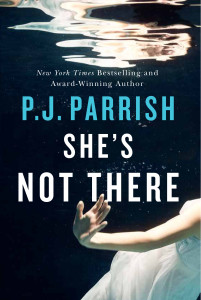
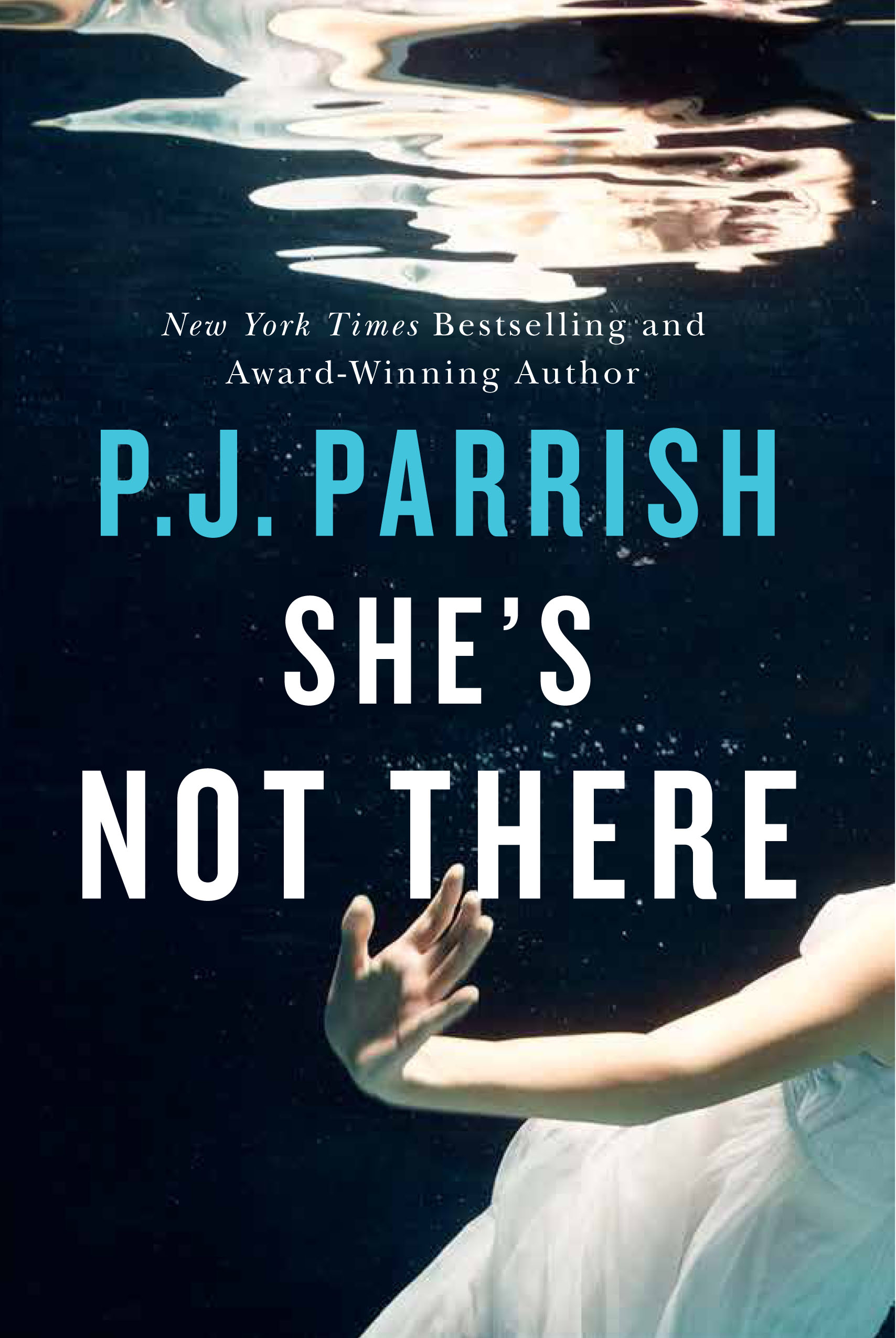
I can trace this process to almost every book my sister and I have written. (I usually get the opening chapter duties after we have talked things over). For our newest book, She’s Not There, the seminal image came from a vivid childhood memory of when I almost drowned at a Michigan lake one summer. I walked out into a lake, the sand gave way under my feet and I felt myself sinking slowly downward in the water until someone yanked me out by the hair. Here is the opening of our book:


She was floating inside a blue-green bubble. It felt cool and peaceful and she could taste salt on her lips and feel the sting of it in her eyes. Then, suddenly, there was a hard tug on her hair and she was yanked out of the bubble, gasping and crying.

This is our heroine, Amelia, who is coming out of a coma in a hospital, a literal image. But I knew in my bones that once I had that opening paragraph, I had the whole book, because it is a metaphor for the story’s theme about getting a second chance to live after you’ve lost your way.

Kelly and I take a lot of photographs for our locations and return to them for inspiration as the stories unfold. Other images that inspired our books:
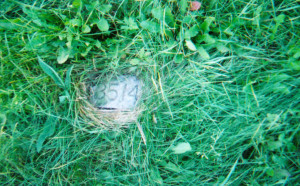
getPart (1)

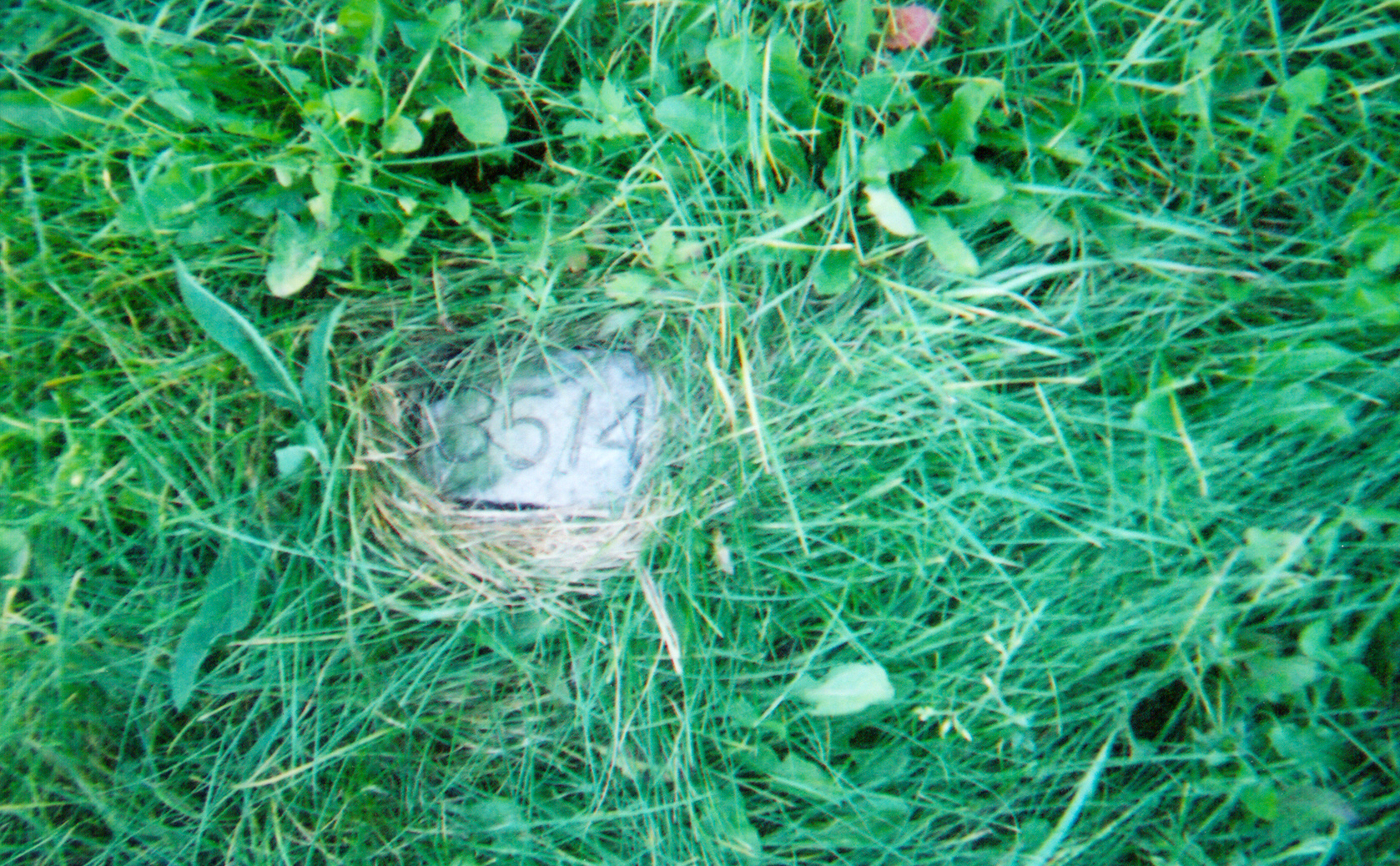
A potter’s field cemetery in an abandoned asylum outside Detroit, where we found that the old stone markers of the dead inmates (above) had only numbers and had been lost in the weeds. This became An Unquiet Grave.
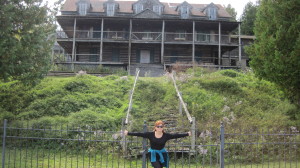
Ice 4

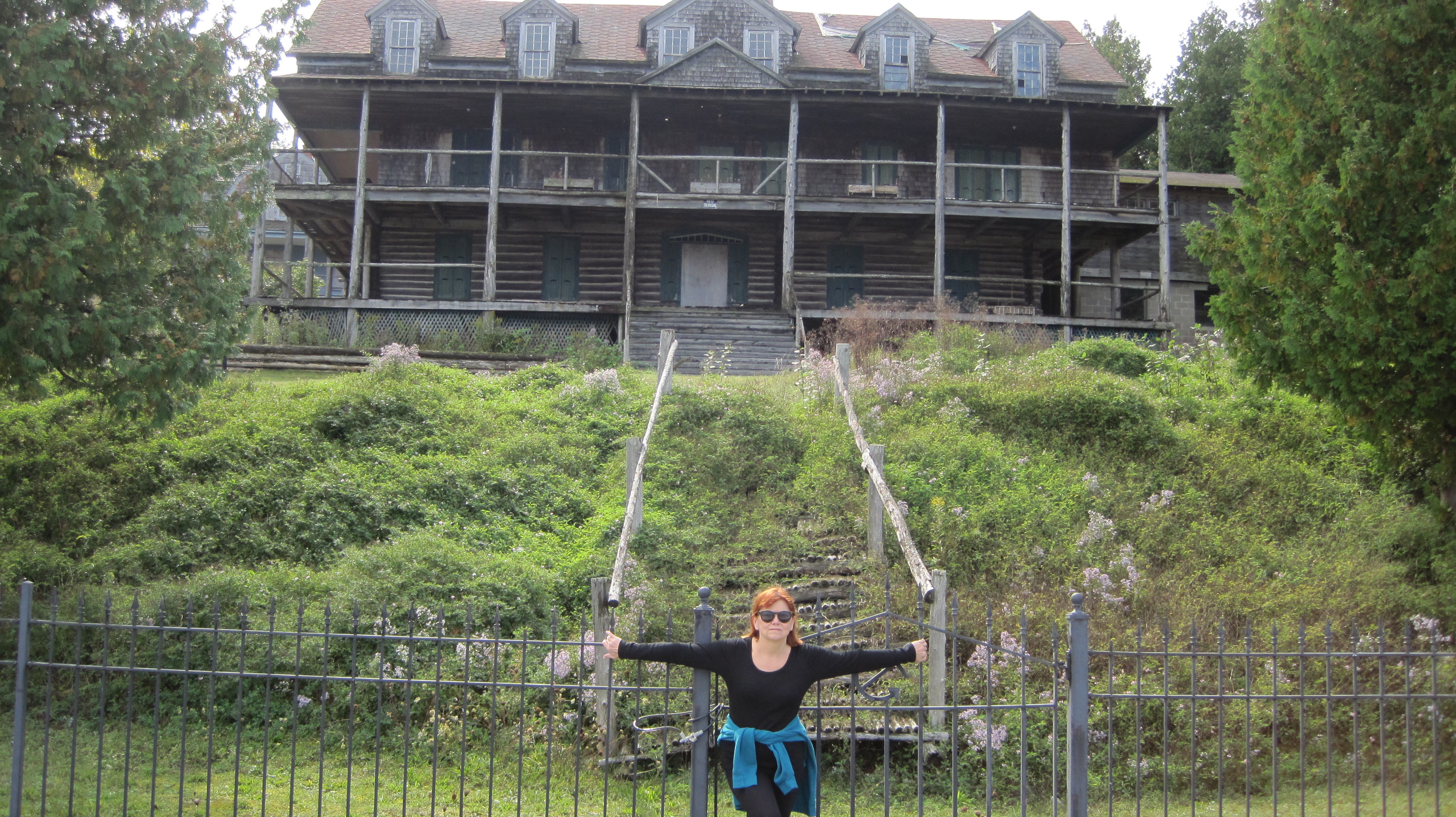
This abandoned hunting lodge (left) on Mackinac Island in Michigan. Once Kelly and I saw it, the whole plot of Heart of Ice began to reveal itself.

The odd juxtaposition of a swampy stand of dead trees glimpsed from the road outside Philadelphia, Mississippi, and a nearby old white pillared mansion. This inspired Dark of the Moon.

Sitting in Paris’s Sainte-Chapelle in December, listening to Vivaldi’s “Four Seasons,” feeling so cold that my teeth chattered like bones, watching a cellist who looked so bored that he wanted to kill someone. Which he did in The Killing Song’s first chapter.
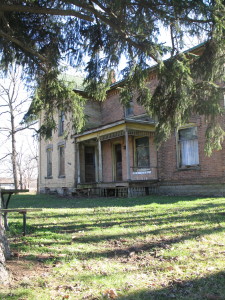
farmhouse 60

This creepy old farmhouse near Lansing MI inspired this opening for South of Hell:

It was just south of Hell, but if you missed the road going in you ended up down in Bliss. And then there was nothing to do but go back to Hell and start over again. That’s what the kid pumping gas at the Texaco had told her, at least. Since she had not been here for a very long time, she had to trust him, because she had no memory of her old home anymore.

I feel so strongly about the power of a picture in your imagination that I use this in our writing workshops. Kelly and I have found that one of the biggest hangups for beginning writers is getting over the paralysis of finding the perfect opening. Maybe it’s because it’s been drilled into their heads that they have to come out of the gate at full gallop or no agent or editor will ever buy their books. Or maybe they get intimidated by the “rules” that preach suspense is all about adrenaline. Whatever the reason, they get all constipated and can’t make a decision about when is the right moment to start their narrative journeys.

So we give them pictures and five minutes to write the opening of a story using it. The purpose of the exercise is to get them un-stuck but it is also to force them to tap into their powers of observation. Forced to focus on one photograph, they turn up the volume on their receivers, extend their sensory antennae. They become, in the words of Graham Greene, better spies on the human experience.

The results are always amazing. Freed from the tyranny of their WIPs and under deadline to write something, they lock on an aspect of the image that moves them. And they always come up with really good stuff.  Afterwards, when we read them aloud, I see something change in their expressions, like they realize they do, indeed, have that spark inside them.

In college, I was an art major and I always struggled because I was hung up on making everything look…perfect. Even my attempts to be “modern” were perfect and thus lifeless. Then one of my teachers had us do blind contour drawing. We had to keep our eyes on the subject, never look at the sketch pad, and draw slowly and continuously without lifting the pencil. I was shocked at how good my drawing was. Psychologists call this right brain thinking. Picasso nailed it in one quote:

It takes a very long time to become young.

The idea being, of course, kids know instinctively how to create. We adults…well, the spark fades and most of us live in our left lobes, never finding the synapse that lights the way back across.

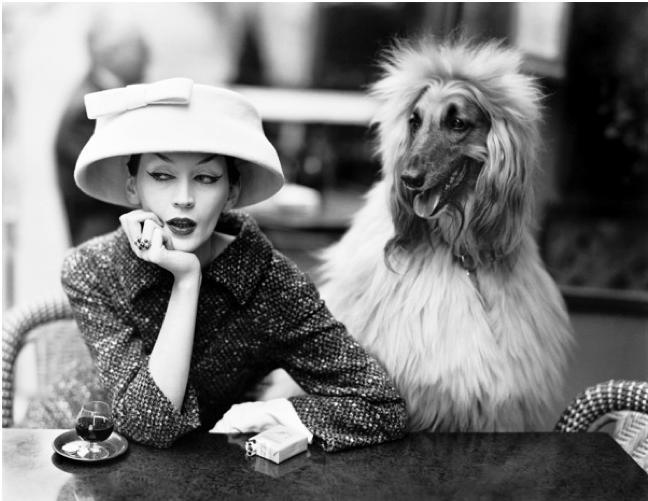
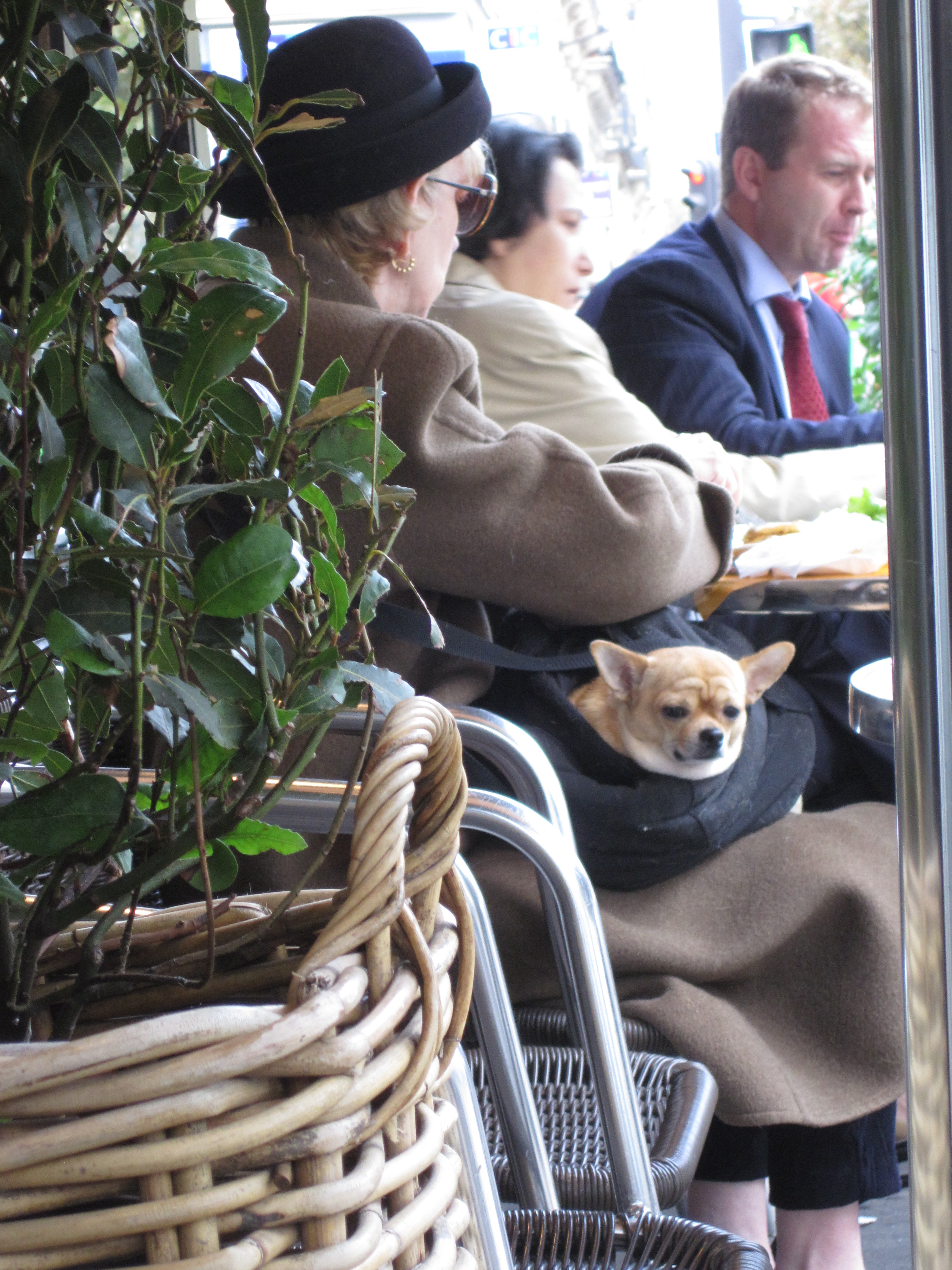
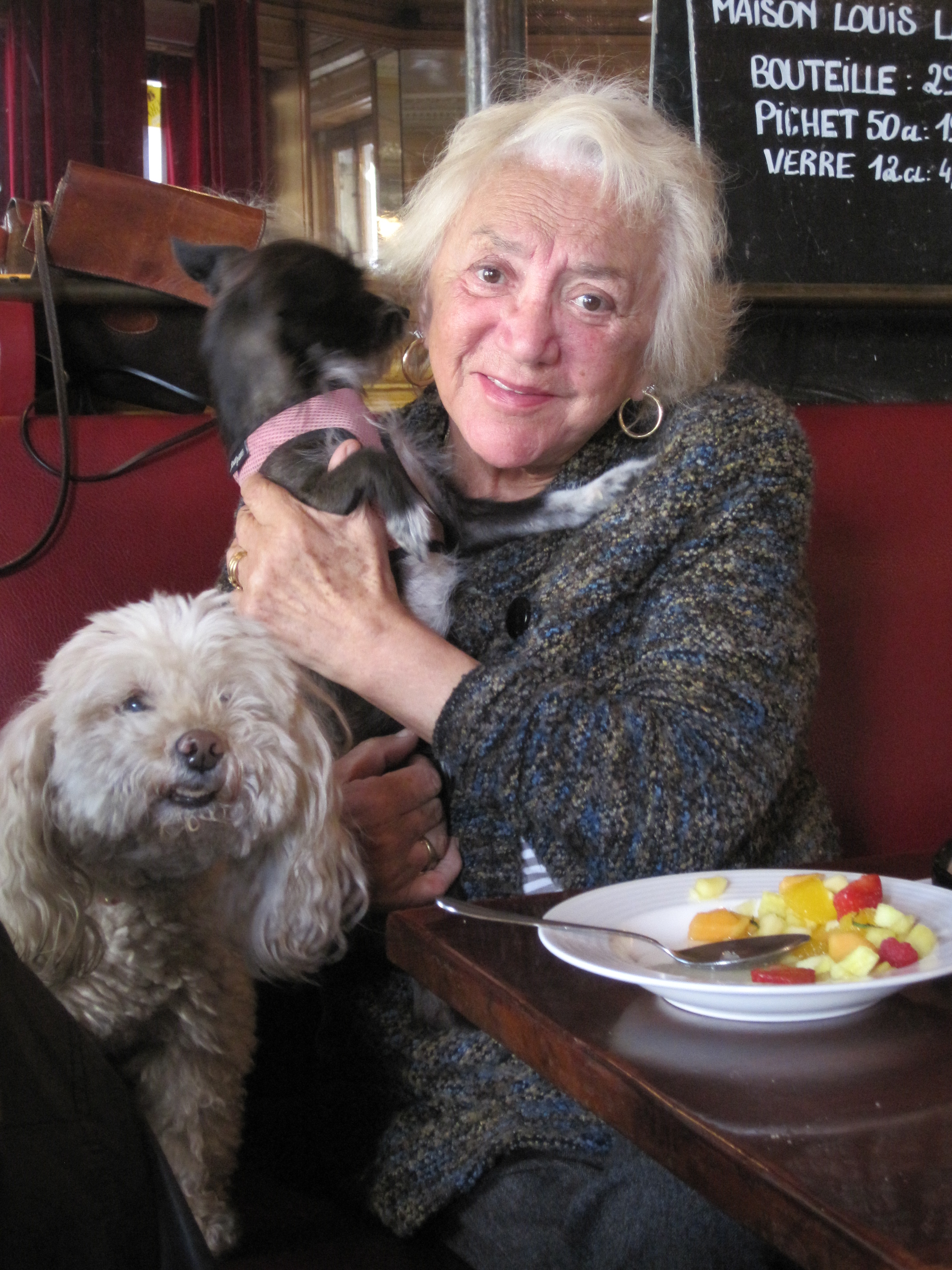
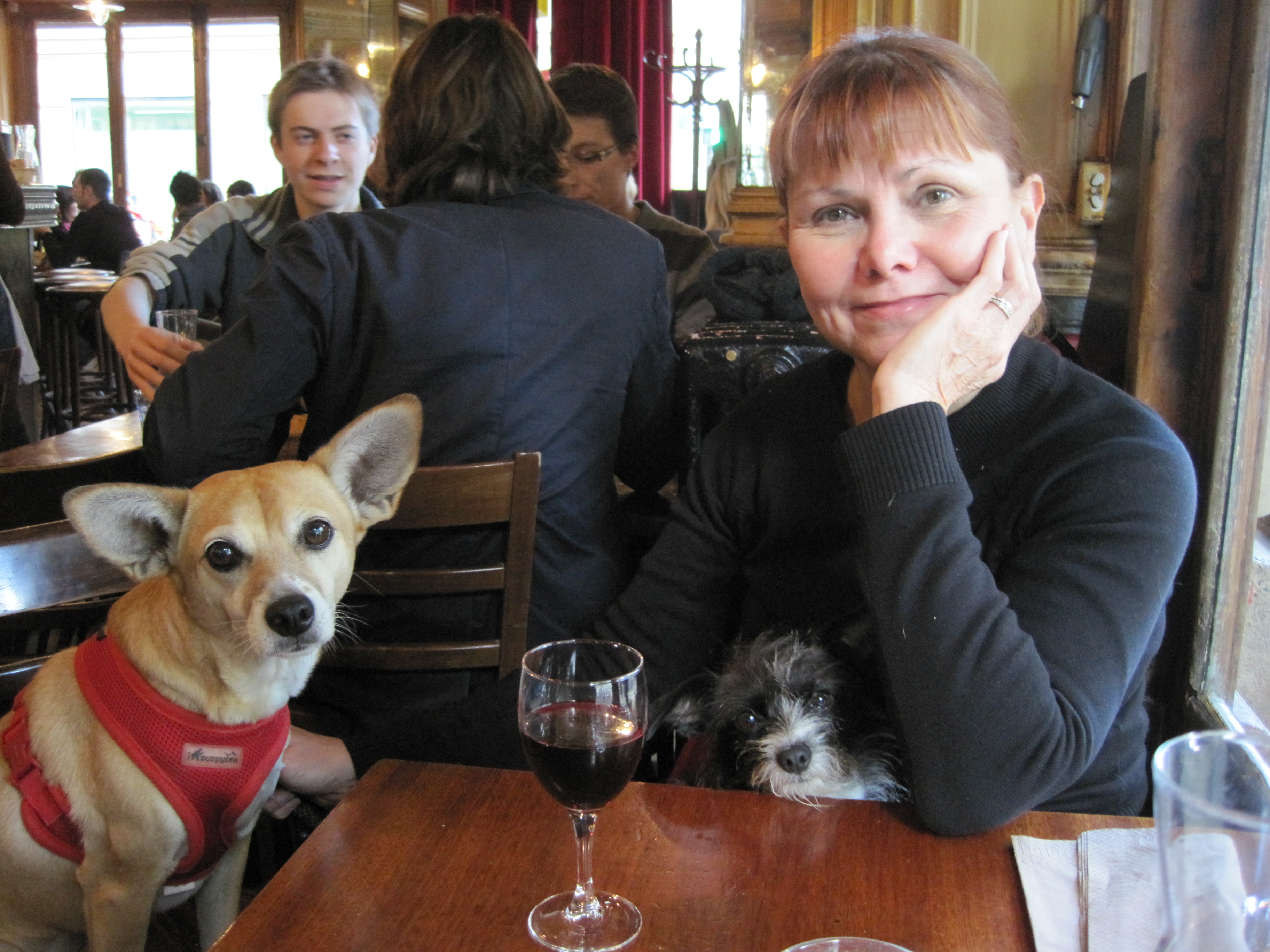
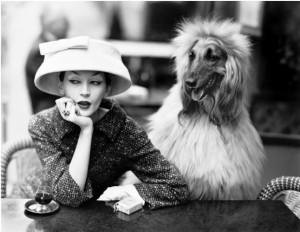
I just got back from a month in France. I didn’t write a word. I had been trying hard to begin this new book and I was bone dry and defeated. So I rested and read good books by other writers. And I took photographs. I have a thing about taking photos of people in cafes, especially old ladies with dogs, which is a human sub-species in France.  When I got home, while I was going through my pictures, I happened upon one and sat down and wrote an opening about it. It was pretty darn good. It won’t make it into the new book (maybe it’s a short story?) but it got my right brain buzzing again. I started thinking about the new book again, not with dread but with anticipation. I even got this picture in my head…

But that’s another story.

EXERCISE TIME!

Just for fun, while writing this post, I sent two of my old French lady photographs to some writer friends and asked them to choose a photograph and write an opening. Thanks guys! Here are the results:IMG_0469
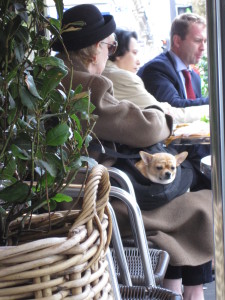
The old woman watched the young man cross the plaza towards her. He looked very French — cream colored neck scarf, black blazer, black coiled hair, black jeans, his jaw brushed with just enough of a beard to give the impression he’d spent the last three days in bed with a woman. If she had known how beautiful he would grow up to be, how much he would one day resemble his father, she would not have given him away thirty years ago. — my sister and co-author Kelly
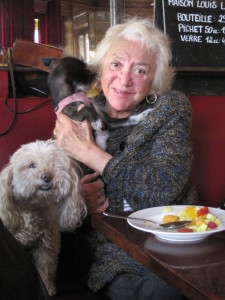
IMG_0609


They’re all I have now that Jacques is gone. I think they miss him as much as I do, but we persevere. At least I know why it happened. Dogs, they do not understand. — SJ Rozan.


IMG_0469


The old woman came to the cafe every morning promptly at nine. She always had the morning newspaper in her right hand, and a blue bag with her small dog in it over her left shoulder. She walked in, spread the paper out on the table, and placed the bag containing the dog on the chair next to her– always the one on the right. The dog never barked, never growled, and never bothered anyone. Her order rarely varied: always a cup of black coffee, sometimes orange juice as well, with a toasted muffin with strawberry jelly, please, and a pat of butter — but she never failed to order a side of bacon for the dog, whose name was Pierre. She would feed him the bacon, cooing his name and gently scratching him behind the ears. Once the bacon was gone, Pierre would curl up inside his carrier and go to sleep while she enjoyed her newspaper and sipped her coffee, tearing the muffin to small pieces. She smelled of lilacs, always left a five dollar tip, and was always gone by ten.— Greg Herren


IMG_0469

What an ugly fucking dog, I thought, and even more unhappy than ugly. I wondered how it felt to be shoved into the old lady’s purse like that, like a spare Euro or used tissues as she shoved foie gras down her pie hole. I don’t know, maybe I was reading into it. I probably was. Wouldn’t be the first time. I was the unhappy one. Maybe the dog was Zen about it all, the foie gras eating and the bag. Like I said, I don’t know. But I couldn’t help hoping the dog would leave a present in the old lady’s purse. – Reed Farrel Coleman


What I found revealing about this exercise is that in each example you can hear the unique voice of each writer. Kelly loves to focus on lost relationships. SJ Rozan’s is just like her books, as lean but emotion-laden as a haiku. Greg’s reflects the same gentleness and attention to detail as his books. And Reed’s — well, if you have read his Moe Prager series, or his new bestselling Robert B. Parker Jesse Stone books, you’ve hear the same gritty authority at work.

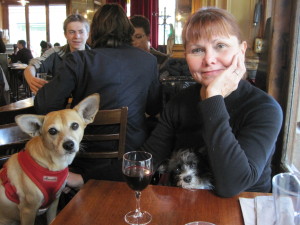
Just for fun, go ahead and take your turn. Pick one of the lady pictures and write an opening. Don’t over-think it. Don’t take too long. You might surprise yourself. And if you’ll let me, here is one more picture of an old lady and her dogs in a cafe. (My husband took this one…)  A bientôt, mes amis.
IMG_0608

Diversity, Micro-Aggression and Cultural Appropriation

One of the main themes of the recent SCBWI conference I attended was diversity in children’s literature (or rather its lack thereof!). Even though all the sessions I attended were directed towards children and YA authors, the key issues and concerns are  applicable across genres and age groups – namely how to incorporate diversity in the books we write, and how to do so in an appropriate way (that is, in ways that avoid cultural appropriation as well as what the editors termed ‘micro-aggressions’ in the books we write).

I hadn’t heard the term ‘micro-agression’ before when it came to books but the term is really about the cliches, characterizations or expressions writers can fall into (often without thinking) that perpetuate cultural stereotypes. In one of the first-page sessions the editors pointed out some of these ‘micro-aggressions’ in phrases such as sitting ‘Indian style’ and ‘Indian giver’. I’m sure in both these instances the author used these unwittingly rather than maliciously but the editors were quick to point out that, in an industry increasingly concerned about the lack of diversity in the books they publish, authors need to be especially mindful of how they incorporate diversity in their books and avoid using terms, phrases or characters that perpetuate stereotypes or inflict ‘micro aggression’ against particular cultures.

In another session I attended there was a great discussion about the issues writers face when writing about cultures or characters different to their own. The key take home message? If you write cross-culturally you MUST do your research! This includes having beta-readers from that culture to ensure that the kinds of ‘micro-agressions’ or cultural appropriations that the editors identified, did not occur.  I wholeheartedly support an increase in diversity, particularly in children’s literature, and acknowledge that writers, when tackling cross-cultural issues, must do their research to ensure that they approach the issue in an appropriate and sensitive way. I must confess, however, that after this session, given the sensitivity and complexity of the discussion, I felt more rather than less reluctant when it came to writing cross-culturally. That isn’t to say I don’t feel strongly that I should have the freedom to write whatever I chose to write about without any gender, racial or cultural constraints but, after the discussion, I did feel like the issue was more fraught than I had realized (or rather, I clearly hadn’t thought through the issues enough).

So TKZers what do you think? How do you approach the issue of diversity? Do you endeavor to write cross-culturally and if so, how do you navigate the issues raised when doing so? Do you see  ‘micro-agressions’ or cultural appropriations in the books you read?

The One Thing Every Protagonist Must Have

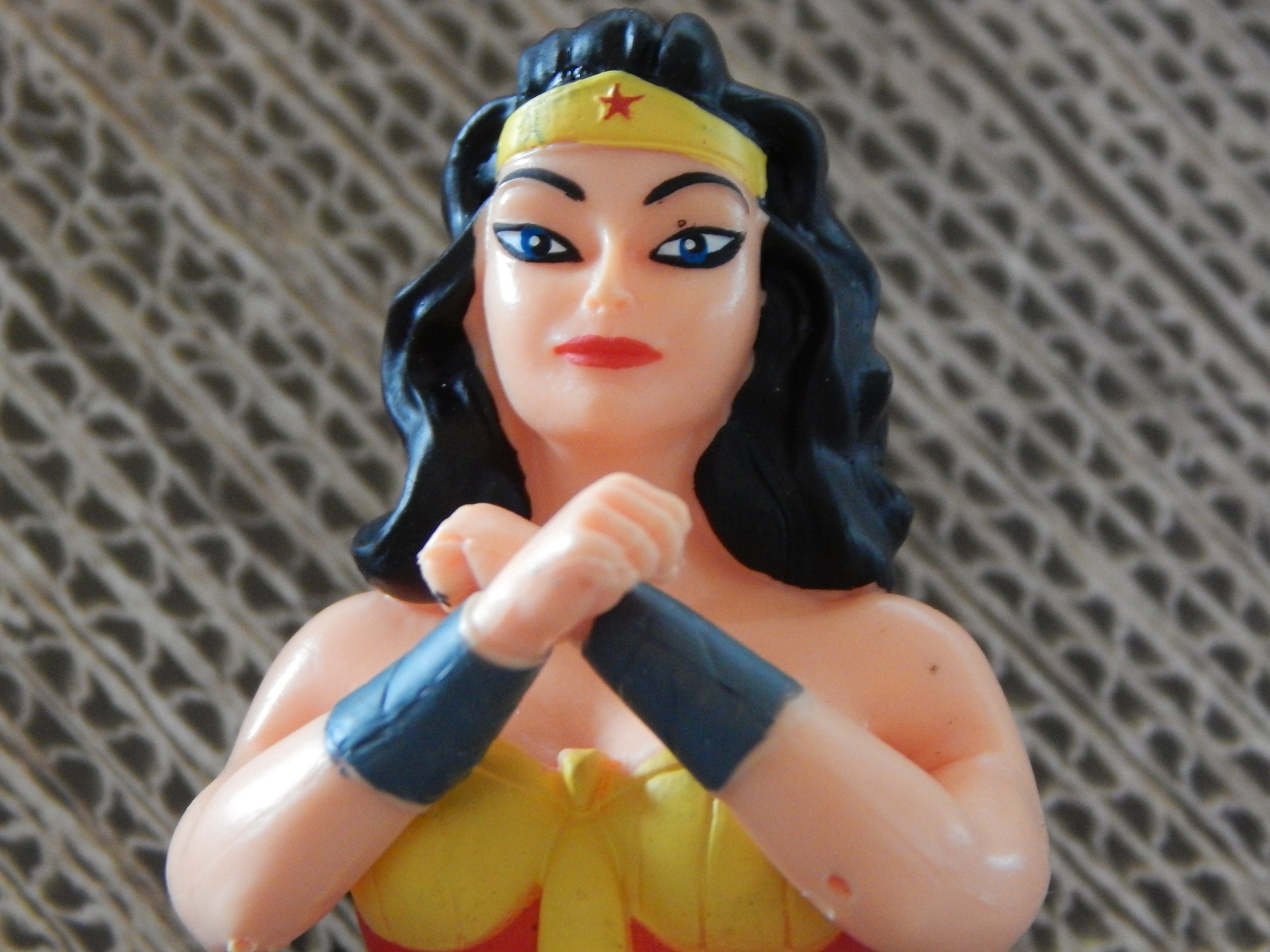
wonder-woman-533667_1920What is it that every protagonist in a novel must have? I’ll tell you on the other side of this email I recently received:

Dear Mr. Bell

One of the main pieces of advice that you give in your Plot and Structure book, for a commercial novel, is that the character should always be doing something. Have an active Lead.

In my manuscript, I have a Lead who is at first more passive. Things happen to him more than he takes action. he reacts more than he acts. When he does take action, he fails. My hope was to built sympathy for the underdog.

Then, about the halfway mark, he digs deep and starts taking action and being less passive. I really am hoping to show the reader that this kid has some special spark deep down. It is something you see glimpses of in the first half, but he is never successful. And then after about halfway through, he decides to take the reins.

I know that this is a very short sketch and it may be impossible to advise me based on such little info. Having said that, am I working against your advise TOO much here? Is there evidence to suggest that novels with initially passive main characters rarely sell well?

I wrote back, telling the writer that passivity is a killer. A character may start out passive, but very quickly you must show that he has something, or at least the capacity to develop this something.

And that something is: Strength of will.

There is no novel, no drama, no conflict, no story without a Lead character fighting a battle through the exercise of his will.

As Lajos Egri states in his classic, The Art of Dramatic Writing:

A weak character cannot carry the burden of protracted conflict in a play. He cannot support a play. We are forced, then, to discard such a character as a protagonist … the dramatist needs not only characters who are willing to put up a fight for their convictions. He needs characters who have the strength, the stamina, to carry this fight to its logical conclusion.

Let’s think about Scarlett O’Hara for a moment. Do we want 200 pages of her sitting on her porch flirting with the local boys? Do we want to listen to her selfish prattle or watch her flit around in big-hoop dresses?

I’m not sure we want anything to do with her at all after seven pages or so, but then! She learns that Ashley Wilkes, her ideal, her dream husband-to-be, is going to marry that mousy Melanie!

She immediately lays plans to get him alone at the big barbecue. She’ll tell him of her love and he’ll dump Melanie. Through strength of will she draws him into a room where they can be alone.

Only her plan does not work out as intended. Which is good! For strength of will must be met with further obstacles and challenges and setbacks. The protagonist has to keep fighting, or the book is over.

That’s why, after the setback with Ashley, Scarlett faces a further complication—a little thing I like to call the Civil War.

For the rest of the book Scarlett will have to show strength of will to save the family home and fight for the man she loves (NOTE: strength of will does not always mean strength of insight. Scarlett does not realize until it’s too late who she really loves. Of course, we could have told her. It’s the guy who looks like Clark Gable!)

Now, a character can start passive. But she cannot stay there for long. In Stephen King’s Rose Madder, the opening chapter depicts a wife who is horribly abused by her psycho husband. The chapter ends with the chilling line: Rose McClendon Daniels slept within her husband’s madness for nine more years. 

Wise storyteller that he is, King does not give us more pages of abuse. No, he quickly gets us to a blood stain. It’s what Rose sees on a sheet as she makes the bed one morning, a reminder of her most recent beating. Nothing she hasn’t seen before, only this time it triggers something inside her:

She looked at the spot of blood, feeling unaccustomed resentment throbbing in her head, feeling something else, a pins-and-needles tingle, not knowing this was the way you felt when you finally woke up.

Then comes Rose’s strength of will. She finally does what her husband has strictly forbidden—leave the house. Do that, he warns, and I’ll track you down and kill you.

For us, walking out a door is a small thing, but for Rose Daniels it is the biggest risk of her life. But she does it.

And that’s why we want to watch her for the rest of the book. She will have to exercise her will many times in order to survive.

I told my correspondent, give us something, anything, early in the book, to show that your Lead has strength of will. It can be small at first, but at least it will show us he has the capacity to fight his way through an entire novel.

Look at your own manuscript. Have you given us an opening disturbance for your Lead character to deal with? Show us his determination to do something about it, and you will have accomplished the first task of the storyteller—getting the reader hooked on a character and wanting to turn pages to find out what happens next!

What Scares YOU?!

spider

Photo (c) Copyright 2015, New Media Investment Group.

It is almost Halloween. The Just Born Candy Company (the fine folks who bring us Marshmellow Peeps!) have Ghost, Tombstone, and Pumpkin Peeps (as well as some pricey limited edition flavors) out right now. They don’t have Spider Peeps. I consider that to be a good thing, for the reason set forth below.

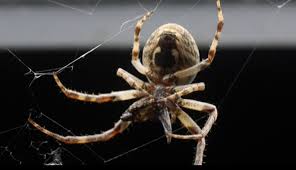
Long time TKZ visitors will recall that I have blogged on the topic of fear and what scares you and me. Given that we are approaching Halloween, I thought that we might visit it once again, giving our more recent visitors a chance to weigh in as well. Fear is a great inspiration for writing. Take what you fear most and write about it, spinning the topic out to its worst case scenario. I have three major fears: 1) spiders, 2) spiders, and 3) spiders. I apparently have some notoriety in this regard as, when one does a image google of me, a couple of pictures of spiders appear within the montage of America’s Most Wanted posters. How nice. I also don’t care much for heights or closed-in places. Put me in a spider-filled coffin suspended fifty feet in the air and you might as well kill me. In fact, if I’m ever in that position, please do. I spray the interior and exterior of my house twice a year with an insecticide called Suspend (and a tip of the fedora to Carl Causey, husband of author Toni McGee Causey, for that suggestion!) but, as this article in the Friday morning news demonstrates, the spiders in my house and their homeslices have merely withdrawn and are regrouping on a bridge in Columbus, five to ten thousand strong, planning a flank attack even as I type. I’m waiting for you, demon spawns, with a sprayer full of Suspend and cleated boots and a twelve-gauge shotgun. I don’t care what the guy in the video in the article says, about how interesting they are, or how their fangs aren’t sharp enough to pierce the skin of a human being. Is he nucking futs? He’s gonna let one of those things get close enough to you to determine whether or not its fangs will break your skin? Not me.

There was a time during the past year when I was driving over that bridge twice a night, every night. No more. The current occupants are probably busily weaving the largest web you’ve ever seen, even as they chitter, “{{{wherrrzzz Joezzzz?}}},” ready to drop it on me as I drive by. It won’t happen. Obviously, I won’t be traversing that route until the temperature is somewhere south of zero and they are all curled up in a glare of ice. And those folks who are walking on the bridge to get a peek at what five thousand spiders — at least — look like? Unbelievable!

So what scares the living daylights out of you? Have you written about the topic of your (ir)rational fear? Do you plan to?