I have a good friend who dreamed the entire plot of her first novel, which became the debut installment in an enormously successful thriller series. Why can’t I have dreams like that?
My dreams alternate between blanket-clutching, dry-mouth terror and the most deadly-dull, anxiety-ridden school scenes, in which I’m either trying to remember the locker combination I had in 1974, or attempting to teach Algebra to a room full of kids who suspect I don’t know what the heck I’m doing (and they would be right).
There are so many theories on what dreams are. Just a few:
Subconscious problem solving.
Wishfulfillment
Random neuron firing
Emotional cleanup using dream symbols
Messages from the future or past
I don’t know about you, but my dreams tend to be a mix of the above, with the exception of messages from the future or past. As an adult, I’ve had some very comforting dreams about my grandparents, but I put those in the emotional cleanup category.
Dreams are as entertaining to me as a good book, and sometimes even more so because I’m participating. I go to sleep hoping the dreams are good. The only time I fear them is when I’m home alone overnight and have paralyzing night terrors about strangers in my bedroom. But most of my dreams contain vibrant colors, vivid situations and storylines, and people I don’t often see. I couldn’t enjoy them more if I made them up myself. Which, in a way, I suppose I do. It’s my subconscious at work—that part of the brain from which I suspect my best writing material comes.
But how to access that material in the waking world? As writers, we are essentially creating dreams for our readers. Stories that are like reality, but just that much better. Just that much less predictable, like any good dream.
Some ways to access the dreaming part of your brain:
Lucid dreaming: Lucid dreaming is dreaming when you know you’re dreaming. You won’t necessarily control your dreams, but you’re likely to remember them. Here’s a comprehensive list of ways to make it happen.
Dream journals: This is one of my favorites. As soon as I wake, I jot down the details of all the dreams I can remember. The exercise of writing it out makes me feel like I have a jump on my creative day.
Music: Do you listen to music as you write? It can quickly put you in the writing zone, but music with lyrics can be distracting. When I wrote Charlotte’s Story, I had this adagio on a loop for weeks. Repeated music is a great self-hypnosis tool.
Rituals: Same Bat Place. Same Bat Time. If you’re in the habit of doing deep work in the same place every time, your brain will begin to relax once it’s in sight.
Silence: I used to brag a lot about how I could write just as easily in a noisy cafe as I could in a silent room. While it’s still true, silence settles me much more quickly. You can almost hear the doors in my head opening.
Do you have trouble recalling your dreams? It’s common.The reason it’s sometimes difficult is because the brain may shut down its memory-recording functions while we’re in REM sleep.
Here’s what I find so fascinating about recalling dreams—or even having them. What if they really are simply random discharges of neurons firing up images in our brains while we sleep? That doesn’t make them any less interesting or less vital. It’s what we do with the connections between those images that makes a dream a dream. Even while we are sleeping, we are constructing narratives. How cool is that? Storytelling is so elemental to our being that we may be compelled to do it unintentionally, while we’re asleep.
That means that we are all storytellers. But to be writers, we have to externalize those narratives.
I love to wake up and share my dreams. If a dream is particularly vivid, I’ll definitely record it in my journal. It surprises me how long the narratives are. Recently I’ve tried to make sure I’m recording only what I remember about the dream. Of course, my inclination is to embellish it, to make it more of a story. Did I tell you about the one where I was babysitting a little white dog, and it ran out of the plush apartment where it lived? I searched all around the courtyard, but found it chained underwater in a big white swimming pool, paddling its heart out to keep its head above water. I felt like such a hero rescuing it. Somehow, though, I don’t think the tale would make compelling fiction.
Maybe next dream.
If you write consistently, you know exactly how it feels to slip into The Dream Zone. What helps you get there?
Have you ever dreamed an entire story or novel, and then written it?




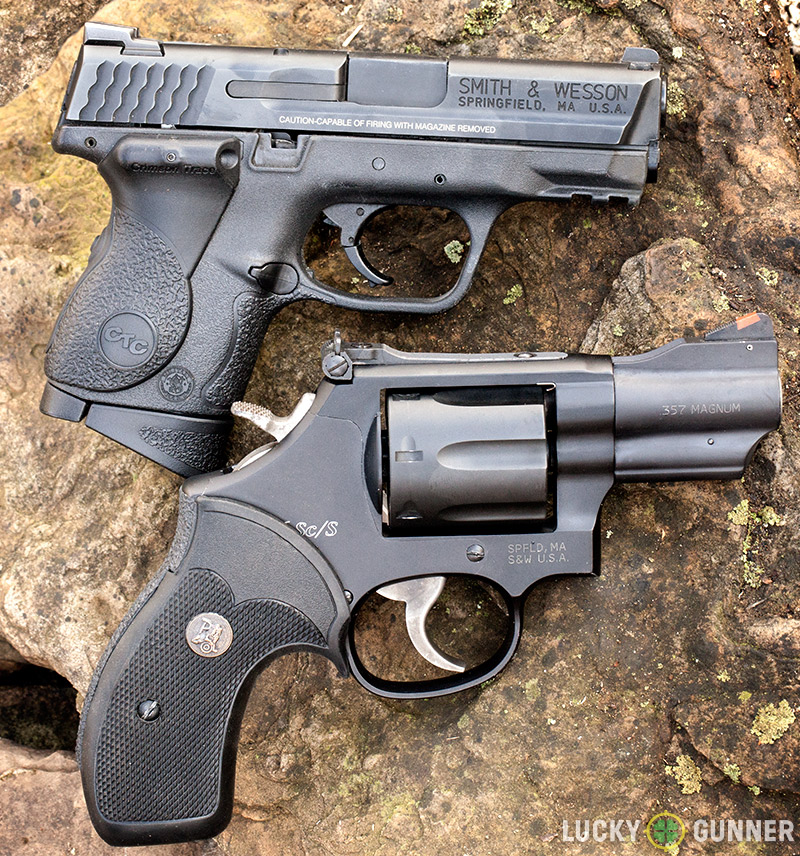 e mutually exclusive. Both are handguns, but they operate under entirely different principles. A revolver, otherwise known as a “wheel gun”, holds its cartridges in a cylinder that rotates as the hammer comes back and prepares for each shot. The revolver in the picture features an external hammer, and can be fired double action (DA) or single action (SA), which makes it a DA/SA revolver. (Double action means that with the hammer down, a single pull of the trigger with bring the hammer back, rotate the cylinder, and then drop the hammer again, firing the gun. Single action would describe the condition where the hammer is manually cocked and remains back–“condition zero”. From this condition, the trigger is more sensitive by a large margin.) Generally, there are no external safeties on a revolver. The fact of the long DA trigger pull functions as a safety. Only a fool would carry a revolver in condition zero.
 Recent years have seen a growth in the popularity of the DAO (double action only) revolver. With no external hammer to cock, every pull of the trigger is double action. The upside of a hammerless revolver is the ease of the draw from concealment (hammers have a way of snagging on clothing).
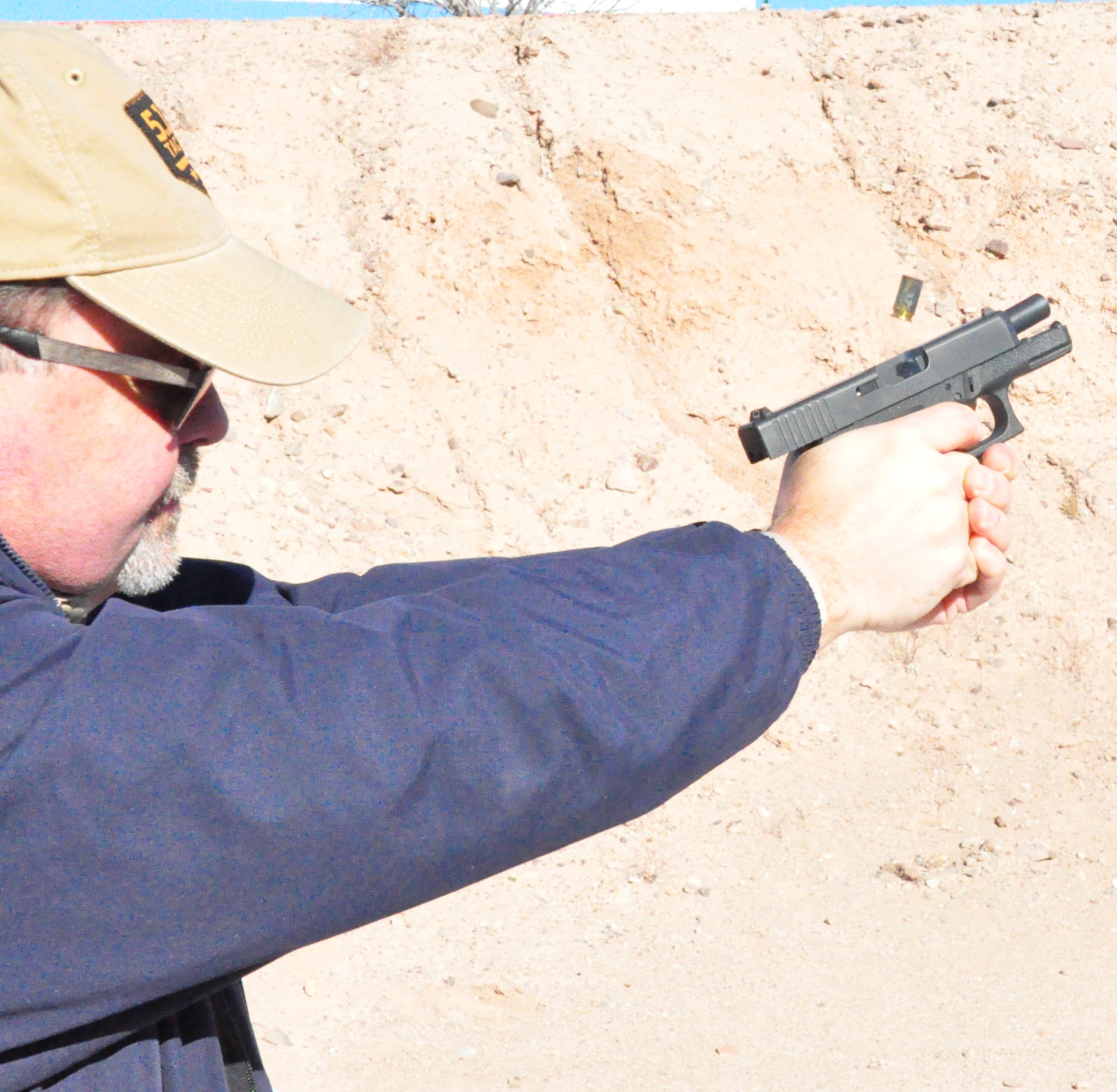
 A pistol, on the other hand, carries its load in a magazine that is inserted in the grip. As the weapon fires, the slide cycles, ejecting the spent shell casing and pushing the next round into battery. The picture at the top of this post of me at the range shows this cycling action of a Glock 36 at 1/4000 of a second–thanks to my son, Chris, for getting the picture.
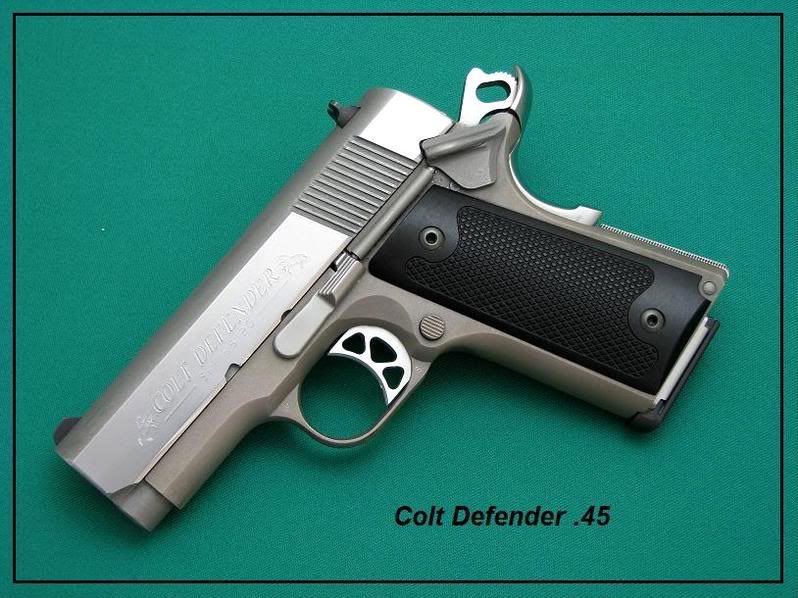
  The pistol in the picture with the revolver has no hammer, but is rather “striker fired”–a distinction that is best left to a future post. Striker fired pistols may or may not have external safeties. Some pistols have external hammers, such as the Colt Defender in the picture. As shown, the Colt is in condition one, which means cartridge in the chamber, hammer back and safety on–otherwise known as “cocked and locked.” In yet another iteration, many manufacturers make DA/SA pistols. The Bersa Thunder in the photo offers a very long, hard DA trigger pull for the first shot, which leaves the hammer back for a SA follow-up shot. For most DA/SA pistols, the “safety” is not a safety at all, but rather a de-cocker, which safely returns the hammer to its DA position.
 If your character is an on-duty cop or active duty military, where sidearms are worn in some kind of duty rig, the sky’s the limit for what they want to carry. You can buy holsters for all kinds of hand cannons. The choices become more limited when it’s important for your character to conceal his or her weapon. As a general rule, the larger the firearm, the harder it is to conceal. The obvious corollary is that bigger people can conceal bigger guns.
 When it comes to carrying a gun on one’s belt, the critical first choice is inside-the-waistband (IWB) vs. outside-the-waistband (OWB), and both mean exactly what the words say. Generally, OWB carry is more detectable,
 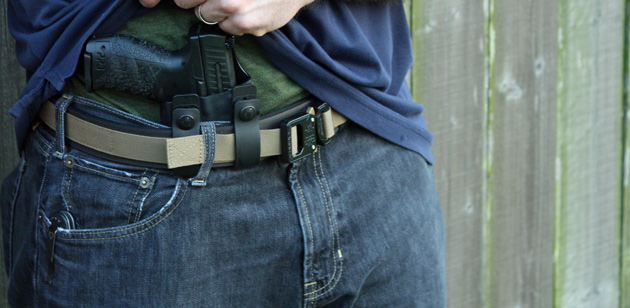 but with the right holster and an effective cover garment, it can be very effective. By contrast, IWB carry allows for concealment by means as simple as an untucked T-shirt. On the downside, the gun takes up waistband real estate that would otherwise be used by the waist.
  If your character wears skinny jeans, IWB could be a problem. IWB carry positions are referred to as positions on a clock face, where one’s navel would be 12 o’clock and the right hip would be 3 o’clock. The IWB position in the picture is referred to as “appendix carry”, and for the life of me, I don’t know how he would be able to sit down. Shoulder rigs are popular in movies and television shows, but I
 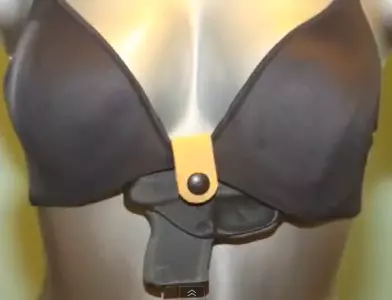 have never met a real person who wore one and didn’t hate it over time. They’re hard on the shoulders, and you can never let your arms hang normally. But the deal breaker for me would be that during the draw stroke, you pretty much have to point the gun at the person behind you, and then subsequently at yourself. That violates the basic tenets of firearm safety–as do many of the specialty retention devices such as the bra holster. ‘Nuff said, can we agree?
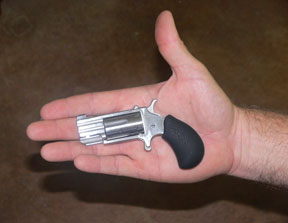 the only concealment option is a vest pocket, or perhaps a boot? Search the Web for specialty guns that are actually well-made and very effective for what they are. North American Arms makes a mini-revolver that easily fits in your fist, and can be chambered in .22 magnum, a round that shows very similar terminal ballistics to a .38 special, un
 der ideal circumstances. The tiny, nearly non-existent barrel is a problem for a shot longer than, say, 10 yards, but as a belly gun, it’s kind of impressive, and since it’s a revolver, your character gets five tries to bring justice to another character.