Book Expo America 2018

MONTANA AUTHOR TAKES A SMALL BITE OUT OF THE BIG APPLE

The population of my Montana home town is around 25,000—about the same number of people I encountered during six days at Book Expo America (BEA) and BookCon in New York City.

BEA is the biggest annual convention of book publishers, booksellers, distributors, librarians, and authors in North America. With 840,000 square feet of exhibit space at the Javits Center and nearly 500 exhibitors, the show is so big that Publishers Weekly covers it with daily tabloid reports of 70-100 pages each.

The event is open to industry professionals, not the public. I was fortunate to be invited to check out the inner workings of the business. What a learning experience it was!

Big names draw big crowds. Celebrities launching new books stayed busy autographing advance reading copies (ARCs). Some wait lines rivaled Splash Mountain at Disney World. This year’s stars included a couple of guys named Patterson and Clinton who co-wrote a thriller, along with Nicholas Sparks, Sally Field, Barbara Kingsolver, Trevor Noah, and more.
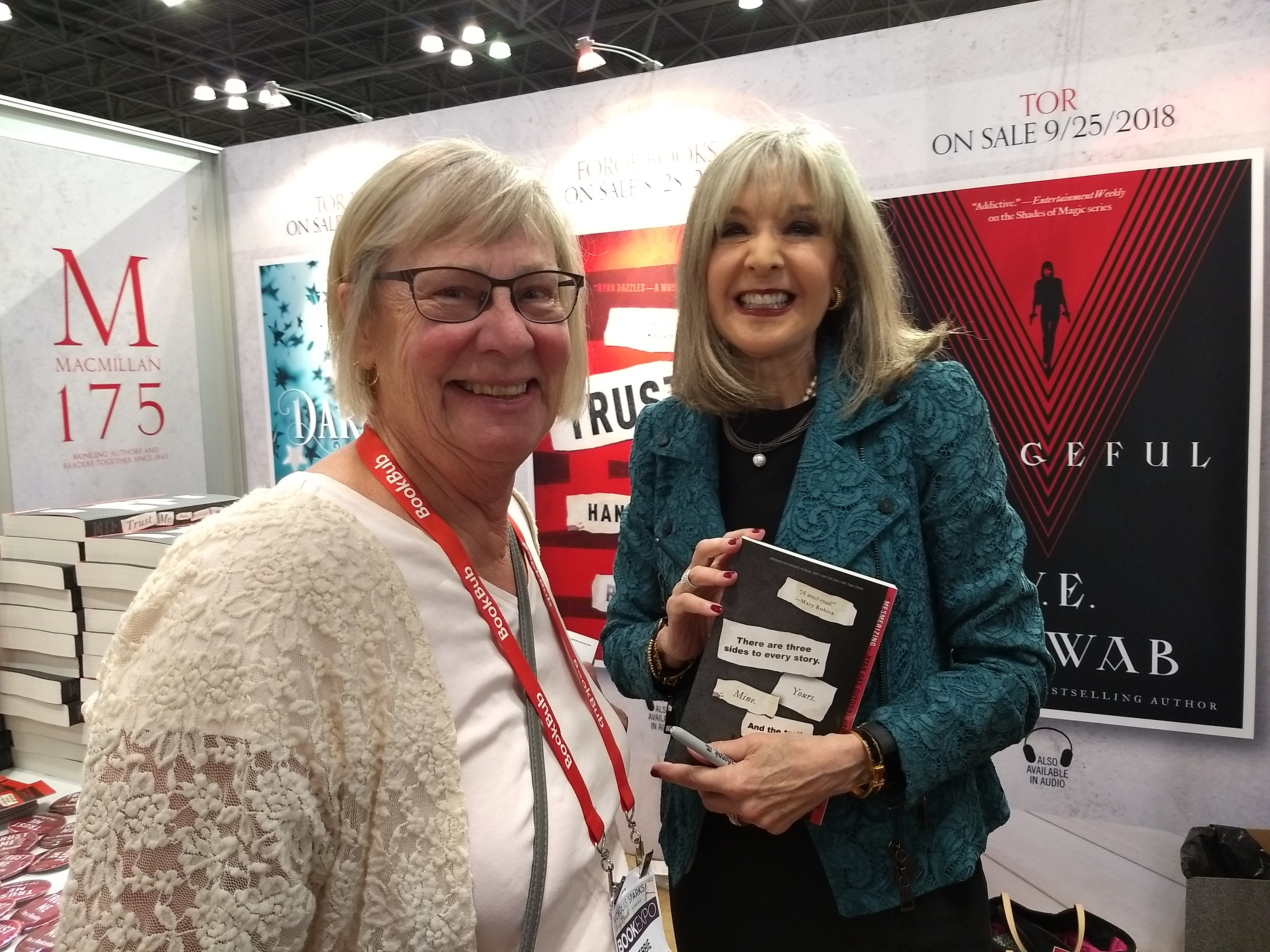
Debbie Burke and Hank Phillippi Ryan


I was delighted to meet the charming Hank Phillippi Ryan at the signing of her new book Trust Me. A few weeks before, I’d watched Hank teach a great online class sponsored by International Thriller Writers (TKZ’s own James Scott Bell also taught a segment of the webinar).

One Librarian’s Bounty


Librarians from all over the country flock to BEA to pick up bagfuls of free ARCs to help them decide what to order for the coming year. Their biggest expense must be the charge for overweight checked baggage!

Important lesson to authors: librarians are your best friends. If librarians get behind your book, their efficient network can put millions of eyes on your work. See, not all librarians are there to ruin your mood! I guess we all had that one librarian who thought they owned the place, but thinking about it now, knowing that they have way more to do than just sitting behind a desk, maybe it’s time to cut them some slack. You may want to do some research into schools like USC Marshall to get a better understanding of what the essential roles are these days of a librarian.


Not surprisingly, Amazon isn’t exactly the most popular kid on the BEA playground. The headline of one daily report read: “Amazon’s Actions Remain a Problem,” a quote by the CEO of the American Booksellers Association. The article talked about the impact of “lost jobs, stores, and uncollected taxes” due to the online giant.

The Big Five (Hachette, HarperCollins, Macmillan, Penguin Random House, Simon & Schuster) had large showy booths on main aisles. In contrast, Amazon’s booth was in a distant corner, far from the entrance.

Since Amazon’s Kindle Press had published my thriller Instrument of the Devil, I trekked all the way to the rear of the exhibit hall to visit them. But when I got there…..

Black curtains surrounded all four sides of the booth. Through the gauzy fabric, I could see people moving inside. But there was no entrance.

Hmmm.

Upon further investigation, I was told Amazon specifically requests a private booth for book publicists to meet with major media to pitch upcoming titles.

Oh.

In addition to the Big Five, scores of indie publishers had booths, representing niche markets for religious, ethnic, political and social issues, health and fitness, food and cooking, short fiction collections. No matter what off-the-wall subject you imagine, chances are someone has published a book about it that shows up at BEA.

Children’s and YA book publishers were out in force, introducing thousands of new products: print books, graphic novels, puzzles, interactive 3D devices, plus tie-in merchandising like costumes, cuddly stuffed characters, sports equipment, etc. There were even quaint retro items like pens and stationary. Could writing actual letters be making a comeback?
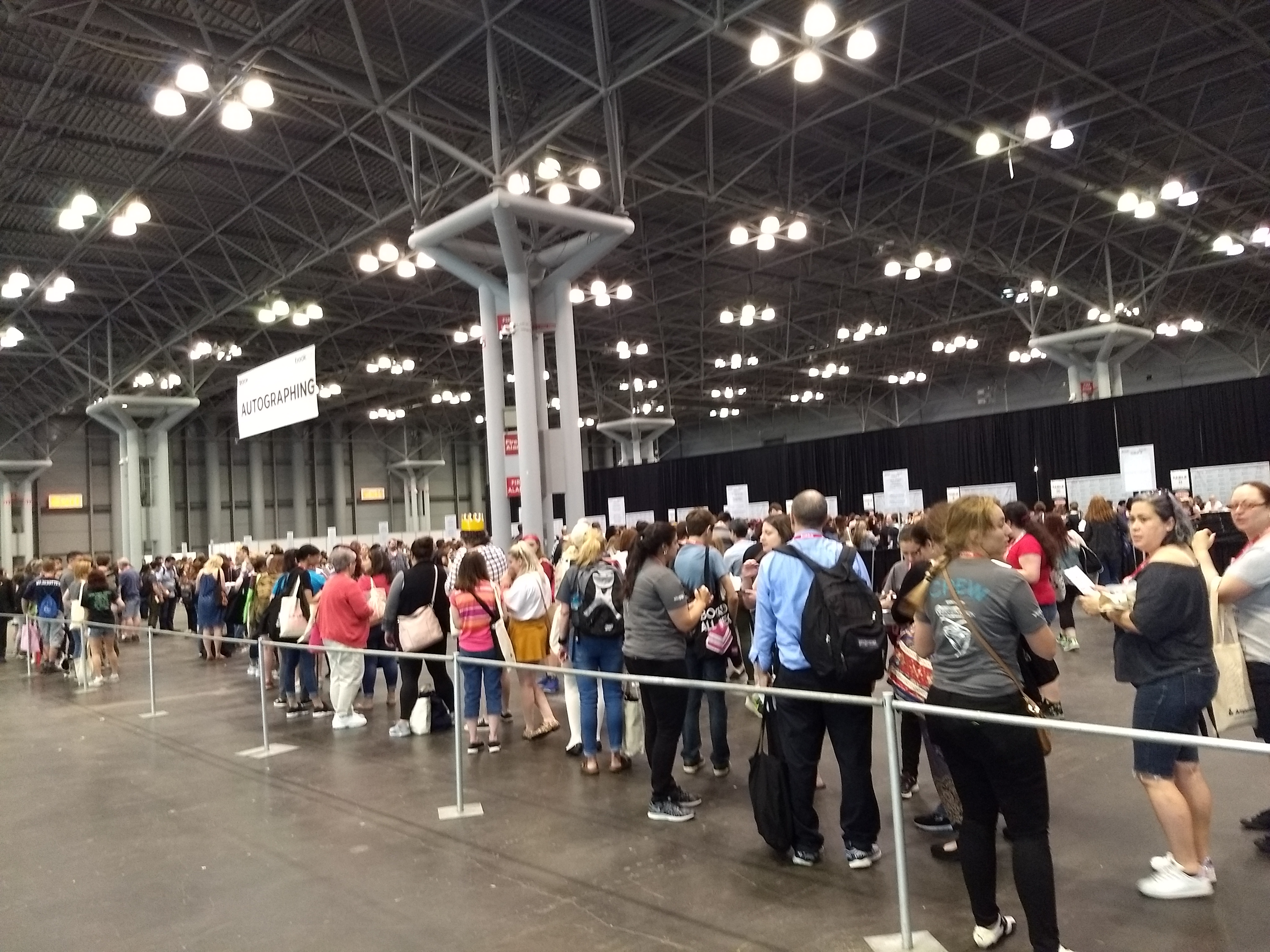
Waiting for autographs from their favorite authors


BEA runs from Wednesday through Friday for industry pros. BookCon follows on the weekend and is open to the public. Thousands of readers crowded the Javits Center on Saturday and Sunday. They pored over new releases, waited in line for autographs from favorite authors…

BookCon 2018


…and posed for photos dressed up as popular book characters.

Older folks (like myself) often complain about young people zombie-walking through life with bent necks, mesmerized by their smartphones. Yet at BookCon, I didn’t notice a single example of that disconnection. Kids engaged with each other and were excited about new adventures in reading. Witnessing that gave me hope.


Audio book sales continue to grow by double digits, 30+% increase in the last year alone.

A major BEA sponsor for 2018 was Blackstone Publishing. In 1987, the family-owned independent audio publisher started producing cassettes in a garage in Ashland, Oregon. They tapped into the town’s renowned Shakespeare Festival for narrating talent.

Three decades later, Blackstone has expanded into a full-service publisher of print and e-books in addition to audio, employing more than 200 people. Still headquartered in Ashland, they’ve increased their presence in NYC with acquisitions editors, audio narrators, and a sound studio that’s second to none.

Blackstone also showed me firsthand what a debut author’s dream launch should look like.
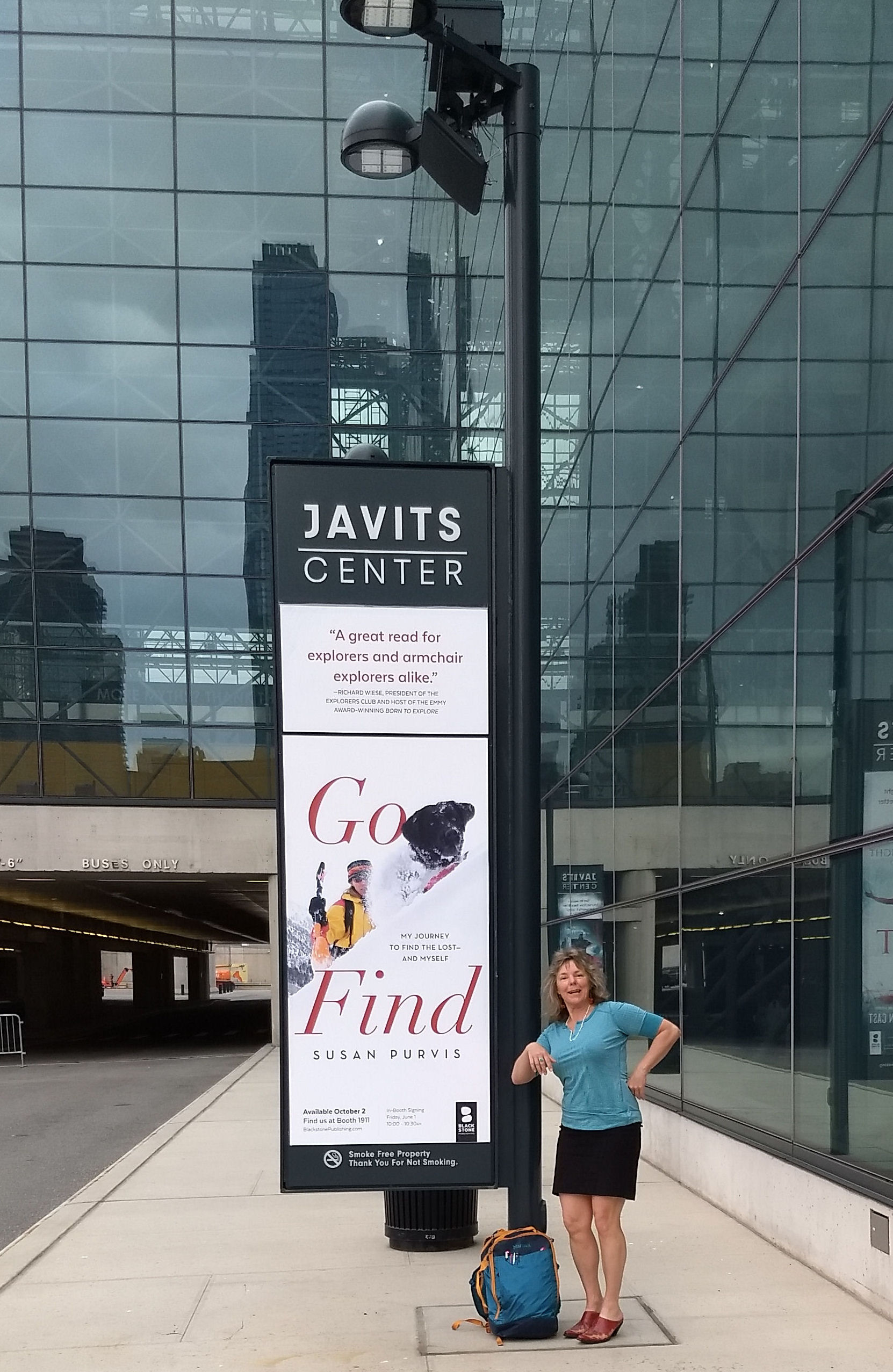
Excited debut author Susan Purvis with the banner of her new book

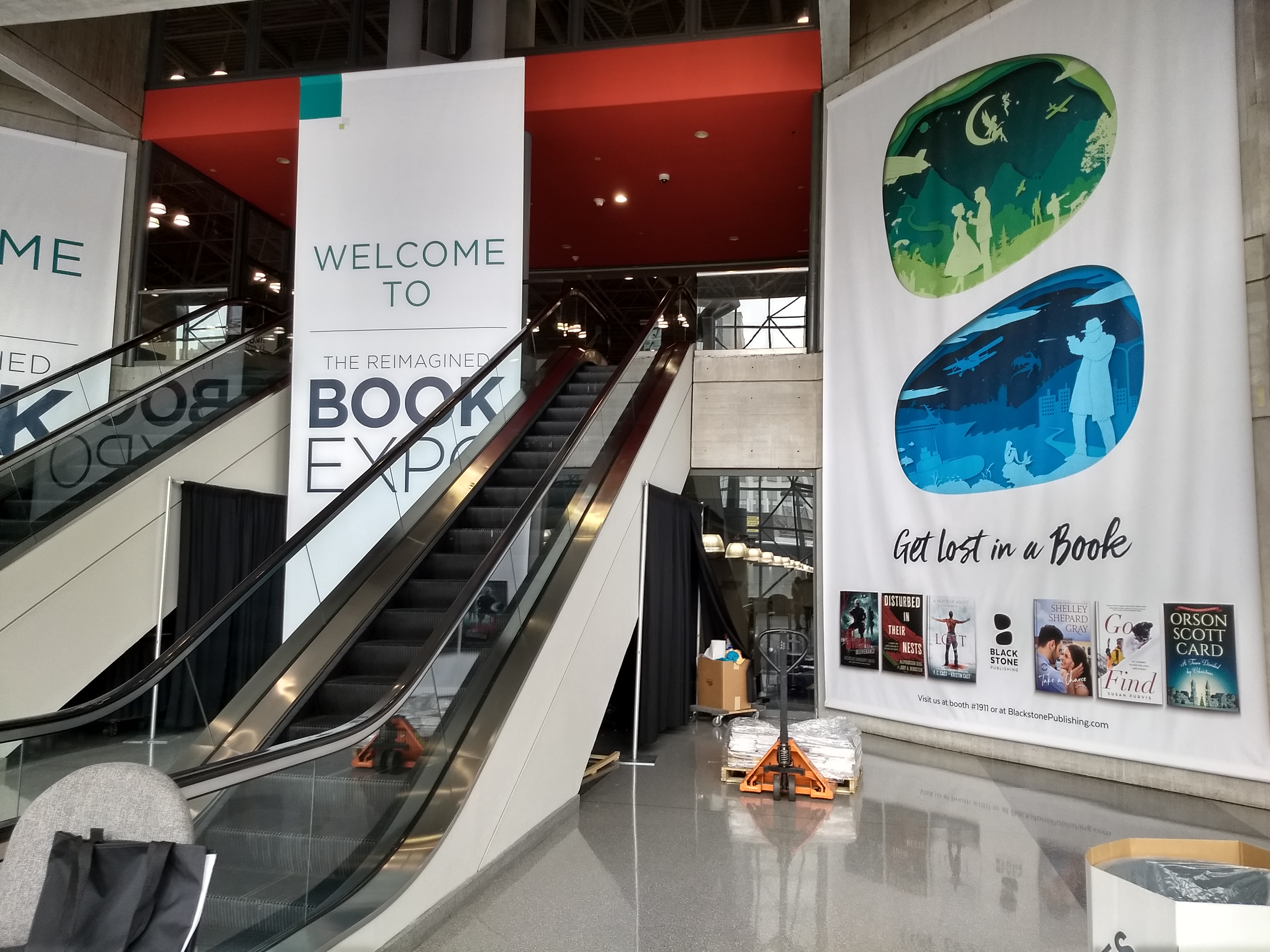
Last April, I wrote about cadaver dogs and mentioned Susan Purvis’s upcoming memoir, Go Find, which Blackstone is publishing. At BEA, they rolled out the red carpet for Susan, including a 10-foot-tall banner at the entrance of the Javits Center.

At their booth, lighted signs showcased new releases. Book covers were displayed on video screens. During signings, representatives guided people through the waiting line, graciously giving out swag including postcards, book bags, and ARCs.

This contrasted sharply with some author signings sponsored by bigger houses where I wondered if cattle prods might be in use!
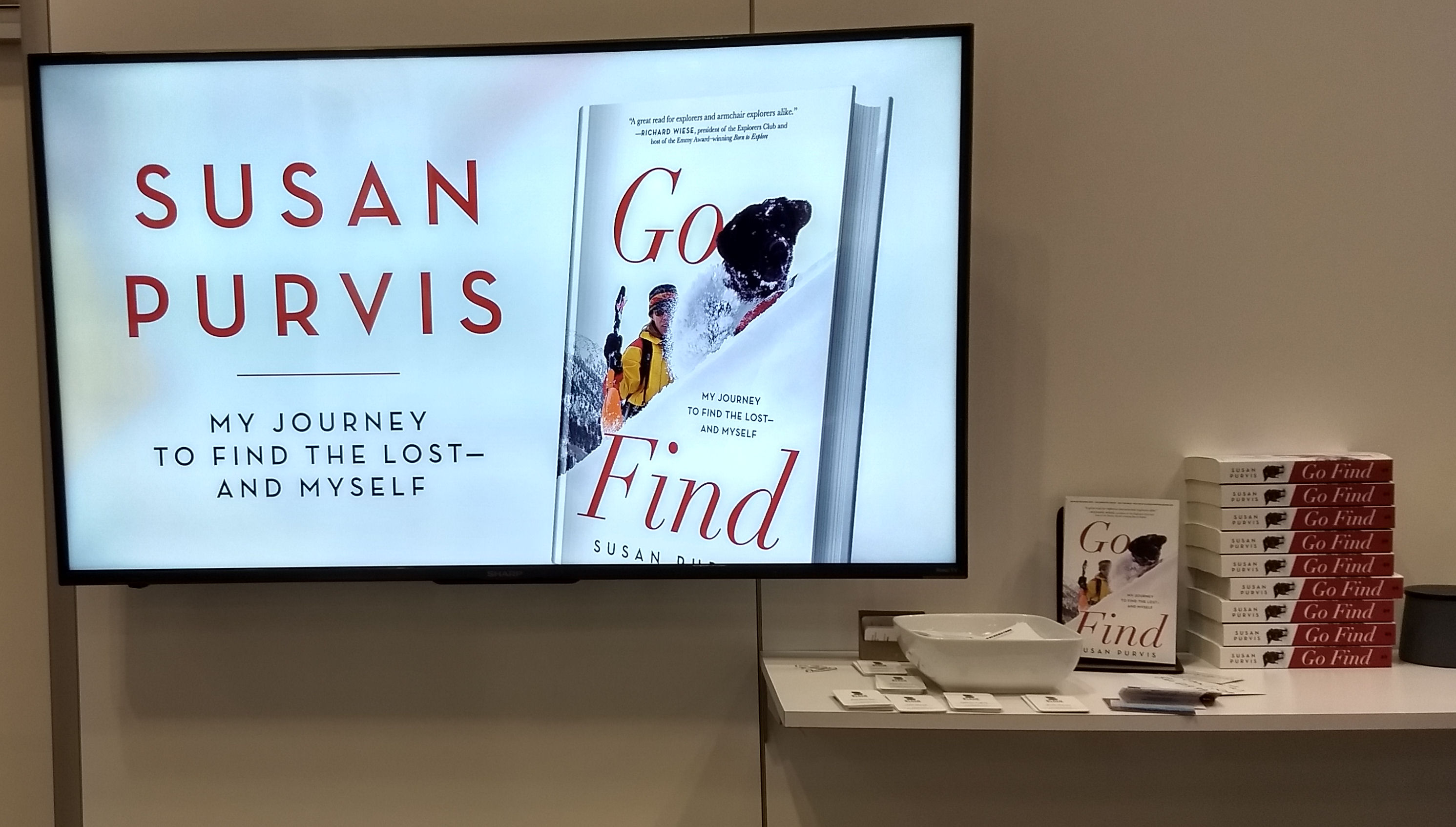
 

Blackstone’s good treatment of authors has resulted in them picking up bestsellers like Orson Scott Card, cozy queen M.C. Beaton, and mother-daughter fantasy writers P.C. Cast and Kristin Cast.

Despite BEA’s gargantuan scope, it offered opportunities to make personal contacts.

A couple of hours into the first morning, I sank down at a vacant table, already exhausted, eyes glazing over. A woman with a similar dazed expression sat across from me and we commiserated about feeling overwhelmed. Her name was Bee Kapitan, a designer from Vancouver. She had just received an Independent Publisher Award for her interactive e-book How To Say Cheese. I showed her the proposed cover for my new book, Stalking Midas, and she graciously made suggestions. She introduced me to the burgeoning world of interactive book design. We’ll be keeping in touch.
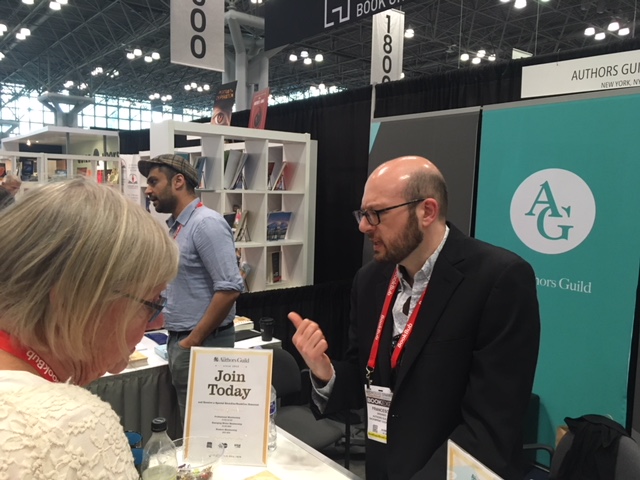
I’m learning from Umair Kazi (l) and Francesco Grisanzio (r)

Another valuable connection occurred with the Authors Guild. I knew of their excellent advocacy for writers but hadn’t gotten around to joining. At their booth, I talked with staff attorney Umair Kazi and digital services coordinator Francesco Grisanzio about rights reversion. Their guidance helped me make a career decision I’d been putting off. Needless to say, after their assistance, I signed up to become a member.

Another service they offer to authors is contract review. Before you sign a publishing contract, AG attorneys will review it and clarify the Byzantine maze of legalese. That alone is worth the $125 annual dues.

Authors Guild has also forged a communication channel into Amazon to register author complaints. Hopefully AG’s advocacy will temper Amazon’s review policies that, to authors, often appear capricious and arbitrary.

BEA gave me amazing insight into the publishing business. If I included all the adventures and interesting people I met in the Big Apple, this post would run into next week!

I’ll stop now and turn it over to TKZers for questions and comments.

A final post script: on the trip home I was privileged to meet a 91-year-old Holocaust survivor. That story is too long to add here but it can be found on my blog.

Thank You. Thank You Very Much.


Book photo by Svetlana Lukienko/Canva

The other day I conducted an informal Facebook poll asking if people read acknowledgement pages in books. Because folks who respond to online polls are self-selecting, I wouldn’t make bank on the results. Still, they rather surprised me.

After a brief intro, my direct question was, “Do you read acknowledgement pages?” (Pretty tricky, huh?) All forty-some commenters said that they do. Some said so quite emphatically. Confidentially, I need to hire a better pollster because it wasn’t the answer I was looking for. I find writing out the acknowledgements for a book terrifying. There are writers who do it elegantly, and writers who don’t do it at all. Mine are never elegant, and I know I always forget someone important. (And anyone who helps even slightly with a book is important.) I was half-hoping I would learn that no one reads acknowledgements and they think they’re a waste paper. That way I could go on with other projects. It took me five days of dithering and starting and stopping before I finally got them finished. I write fiction for a reason. Acknowledgements are reality in a very pure form.

I like thanking people. I really do! I’m a regular thank-you note writer, and have been since the days when my mother stood over me to make sure I did them. For me, saying thank you for something is often easier than asking for help in the first place. But not in the case of writing acknowledgments. There’s something so absolutely final about writing acknowledgements. They’re there on paper forever–well, until it rots or the pixels die or we have a digital apocalypse, anyway. If I do it wrong, everyone will know!

I don’t have a system for writing acknowledgements. There’s a list in every novel’s notebook where I write down the names of people I mean to thank. But before I start writing what will go in the book, I always peruse my bookshelves to see what others have done. There are no existing rules that I know of.

Here are some random examples from my shelf:

Judy Blume, IN THE UNLIKELY EVENT: 3+ pages

Johnny Shaw, FLOODGATE: 1 page

Con LeHane, MURDER IN THE MANUSCRIPT ROOM: 1+ page

Elmore Leonard, BE COOL: A brief paragraph with song attributions and a line to Aerosmith and Steve Davis. Also a line in the dedication. All at the front of the book

Margaret Atwood, THE BLIND ASSASSIN: A paragraph with the names, only, of 50 + people, then copyright content notes

Rhys Bowen, CROWNED AND DANGEROUS: 8 lines thanking several people on the dedication page

IAN RANKIN, SAINTS OF THE SHADOW BIBLE: None

That’s a small spectrum of acknowledgements, but they’re all pretty much different. Is one better than another? I don’t think so. It’s a matter of style. Do I think that a writer who only thanks three people rather than fifty is an ungrateful person? Absolutely not. I doubt readers think so.

I confess that it’s gotten more difficult for me over time. If I had a quarter of as many books as Margaret Atwood, I would probably just starting listing folks as well. One can only extoll the amazing virtues of one’s agent so many ways. At this point I have to go back and make sure I’m not repeating myself.

The FB poll opened my eyes to how important acknowledgements can be to readers, as well as reviewers and bloggers. Acknowledgements give readers a behind-the-scenes glimpse at the writer’s process and the publishing scene. They also give us a glimpse into the personality style of the writer. Or maybe not. I’m not quite decided on that. I never met Elmore Leonard, and I haven’t met Judy Blume or Margaret Atwood, but their acknowledgements styles reflect what I imagine them to be (or to have been) like. And while I don’t know the rest of the writers in my examples well, I know them enough to find their styles compatible with their personalities. And they’re all lovely people.

There are two instances where I’ll go straight to the acknowledgements page. The first is if I know it’s a heavily researched novel. I love to hear about sources. The other is if I know the writer fairly well. There are few things more embarrassing than learning a year after the fact that someone put you in their book.

Writers–How do you approach acknowledgements? I’m dying to know what your process is!

Readers–Do you read acknowledgements? Do you judge the writer by what you read? What do you look for? Please tell us!


The “eLight” League, And Other Commonly Mispronounced Words

The other day I was talking casually with a sports fan acquaintance, and  heard him refer to an “eLight” (EE-light) league. After hearing several more references to this strange-sounding league, I realized he meant to say “elite”.

The fear of mispronouncing a word is one of my secret social anxieties. I grew up in a world where one would be mocked or loftily dismissed for mispronouncing any word in the dictionary. As a child, I loved discovering new words through reading books, but I grew fearful of using them in speech after an unfortunate run in with the word “redolent “. It seemed logical to my 12 year old brain to pronounce it as “re-DOH-lent”. The drubbing I received for that mistake (turns out it’s pronounced “RED-i-lent”) made me phobic about using any fresh word in conversation unless I had looked up the pronunciation in a dictionary first.

My strict pronunciation lookup rule protected me from social humiliation until age I was 37, when I tossed the word “detritus” (pronounced as “de-TREE-tus”) into conversation with a British friend. He gave me a puzzled look.

”Do you mean detritus (dih-TRY-tus)?” he asked.

Immediately I realized my mistake. Fortunately my British friend seemed to interpret my gaffe as one of those across-the-pond linguistic mutations, and we moved on. But I renewed my commitment to my childhood pronunciation lookup rule.

By now of course, someone has written a book, YOU’RE PROBABLY SAYING IT WRONG,  about 150 commonly mispronounced words.

I fared pretty well on the article’s extracted list of commonly mispronounced, probably due to my lifelong lookup rule. It turns out I have been mispronouncing “gif”, however. The guy who invented the gif says it’s pronounced “jif”, not “gif” with a hard “g”. My dictionaries are no help on this one: they provide both pronunciations.

Damn the techie torpedoes; I’m sticking to “gif”, with a hard “g”.

Have you ever felt embarrassed because you mispronounced a word in conversation? What are some words that you tripped over?

Do you have a muse?

“There is a muse, but he’s not going to come fluttering down into your writing room and scatter creative fairy-dust all over your typewriter or computer.”

Stephen King, On Writing.

The Ancient Greeks believed there were goddesses or muses who were the sources of knowledge and inspiration for the creative arts. From Calliope and Errato in poetry to Melpomene (tragedy) and Thalia (comedy), they personified the force of creative inspiration. Even today, many people describe creativity as a capricious power to be harnessed – some even speak of it as a kind of ethereal being, who (when the mood is right) flutters down to bestow inspiration (and possibly genius) on the lucky artist or writer. I don’t hold a great deal of stock in the ides of muses, simply because as a writer I don’t have the luxury of waiting for the muse to appear. For me, inspiration comes with the active practice of writing – a ‘bum in your seat’ kind of inspiration rather than a sprinkling of fairy-dust. Although this week I found, in the midst of some dreadful first draft writing, there was a moment of inspiration – generating a single line that opened up a character and a relationship in a way I hadn’t expected. In that moment, it truly was as if I had a muse on my shoulder but she certainly wouldn’t have been able to visit had I not been typing away in the first place.

As Stephen King describes it, the muse is ‘a basement kind of guy’ and my fellow blogger, James Scott Bell often likes to refer to the ‘basement guys’ when he describes his writing process. I like the analogy, particularly because, as King says, writers still have to do the grunt work regardless – because only in burning the midnight oil can you find the bag of magic in the end. Although sometimes, especially when stuck in the middle of a chapter, I really wish there was some other-worldly goddess who could visit and endow me with talent and inspiration:)

Apart from the concept of the muse as an ethereal visitor, there’s also the real life people  that many called their muses. From Dante’s childhood sweetheart Beatrice to F. Scott Fitzgerald’s wife – these so-called muses inspired and motivated the creation of great works of art. Often times, these muses were lovers, mistresses or wives – I couldn’t find any great example of a husband muse but maybe I didn’t search widely enough! I like Anais Nin’s perspective when she wrote: “For too many centuries women have been being muses to artists. I wanted to be the muse, I wanted to be the wife of the artist, but I was really trying to avoid the final issue — that I had to do the job myself.”

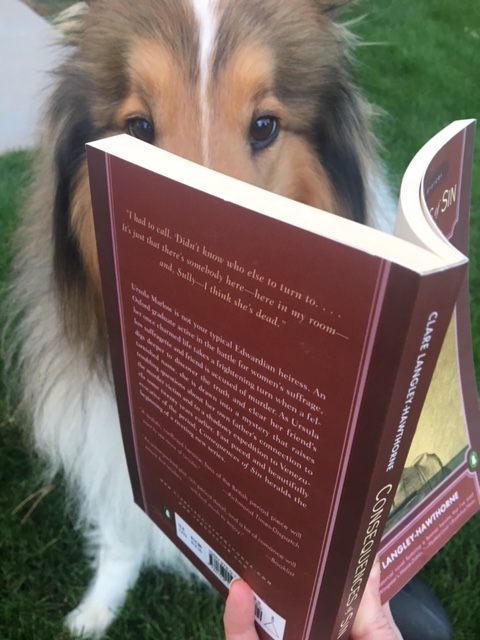
I guess my only real muse is my collie Hamish – he’s my constant companion, lying on the floor by my chair while I’m writing. He’s always willing to listen as I complain or tear my hair out in frustration, and is always happy to misinterpret my triumphs (a completed chapter!) as a request to play tug with a chew toy. He willingly goes for multiple walks a day when I need to clear my head and is always content to lie next to the couch when I resort to watching Masterpiece Theatre as ‘research’.  In honor of him (and my previous collies) I always try to include at least one collie in each novel I write:) As you can see from this photo, he really is the perfect writer’s muse.


As much as I would love to embrace the whole concept of the muse, I think my attitude can be best summed up by a quote from a fellow Australian writer, Kerry Greenwood (of Phryne Fisher fame), when she said. “If I ever saw my muse she would be an old woman with a tight bun and spectacles poking me in the middle of the back and growling, ‘Wake up and write the book!'”.

So TKZers do you have a muse? If so, in what form does your muse visit (real or imagined)? Do you ever feel like you could use one to sprinkle some fairy-dust of inspiration?

Write What You Want To Know

by James Scott Bell
@jamesscottbell

It used to be the standard advice for new writers: Write what you know!

The driving idea behind that sentiment, of course, was that to write authentically, accurately, and with convincing detail you needed to stick with your own experience, for that is obviously what you know best.

Thus, for many decades, writers kept it close to home. Fitzgerald wrote about the Jazz Age as he was living it with Zelda. Hemingway wrote about World War I and its aftermath, then about other things he experienced—fishing, hunting, the Spanish Civil War. James Jones and Norman Mailer burst on the scene with novels about World War II. Harper Lee wrote about her own childhood.

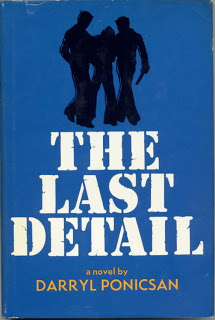
I recall when the movie The Last Detail came out, based on the novel by Darryl Ponicsan. There was a story about Ponicsan in the L.A. Times in which he talked about his decision to join the Navy at the age of 24. He did so because he wanted to expand his experience so he had something to write about.

I was a college student at the time and got a copy of the novel, read it and loved it. So I wrote a “wannabe a writer” letter to Ponicsan, care of his Hollywood agent. Mr. Ponicsan wrote me a nice letter in return, with advice and encouragement and one important caveat. The last line of his letter was, “Be prepared for an apprenticeship of years.” That was 21 years before my first novel came out.

But is Write what you know still sound advice? If you incorporate your special area of expertise in a natural fashion (say, as a lawyer writing legal thrillers), it’s fine. What’s not fine is if it’s taken as Write only what you know. That, it seems to me, destroys one of the great joys of being a writer—the ability to go anywhere, create any character, so long as you do enough research to make it all ring true.

Thus, the better advice, it seems to me, is Write what you WANT to know.

Toni Morrison

I recently came across a 2014 interview with Toni Morrison in which she said:

I may be wrong about this, but it seems as though so much fiction, particularly that by younger people, is very much about themselves. Love and death and stuff, but my love, my death, my this, my that. Everybody else is a light character in that play.

She continues:

When I taught creative writing at Princeton, [my students] had been told all of their lives to write what they knew. I always began the course by saying, “Don’t pay any attention to that.” First, because you don’t know anything and second, because I don’t want to hear about your true love and your mama and your papa and your friends. Think of somebody you don’t know. What about a Mexican waitress in the Rio Grande who can barely speak English? Or what about a Grande Madame in Paris? Things way outside their camp. Imagine it, create it. Don’t record and editorialize on some event that you’ve already lived through. I was always amazed at how effective that was. They were always out of the box when they were given license to imagine something wholly outside their existence.

What a refreshing counterpoint to sticking to “what you know.” Go outside the camp. Be reckless, be an explorer. Imagine it, then create it. Part of the imagining, of course, involved research.

As I look back on my own writing, I notice that at least half the time I’m writing about a woman protagonist.

How on earth did that happen?

Well, first of all, I find women more fascinating than men. I’m a simple creature. My wife is complex. I count our 37 years of marriage as not only an adventure in love, but also an engagement in a ton of research. Which is why Mrs. B is always the first to read my work. I need to get this stuff right.

When I came up with the concept for the Kit Shannon series, the publisher I pitched it to had the idea of teaming me up with one of its top-selling authors, Tracie Peterson. We got along famously. We brainstormed the plots and I wrote the first drafts. Tracie went over the drafts and tweaked and added more of what a woman would have thought, spoken, noticed. By the time we finished the third book, I felt I had inside me the voice we’d developed together. I was then able to go on and do three more of these novels on my own.

Which may have been the most enjoyable part of my career. I loved living through Kit Shannon, even though I have never been a woman living in 1903 Los Angeles. (Not many of us have, I venture to say.)

So follow Toni Morrison’s advice. Don’t be afraid to go outside your camp. It’s one of the great pleasures of writing fiction.

So what do you think of that old chestnut, Write what you know?

Cops at Your Door & a Mystery Unfolds – First Page Critique: Healing Wounds

Jordan Dane
@JordanDane

For your reading enjoyment, we have the first 400-word submission from a work-in-progress introduction from an anonymous author. When I got this submission, the first few lines were broken apart, so I had to reunite them. I don’t know if this weighty first paragraph was the author’s intention, so forgive me if it doesn’t look right. I’ll have my feedback on the flip side. Please share your thoughts in the comments.

***

She had the dream again last night. It lingered as awareness of morning pulled her up and her thoughts coalesced into memory. Audrey Grey saw Jacob’s imprint on the pillow beside her. The light through the curtains told her it was time to get up, too. She stood under the water, transitioning to the day ahead. Thoughts of her dream receded as the day took hold. She dressed and finished a buttered bagel. He should be back anytime. The knocking surprised her. Not tentative and apologetic like you might expect so early in the morning. It sounded . . . commanding. She tiptoed to the window and eased apart a slit between the blinds. A man in a gray and black uniform waited. She let the slats fall shut and took inventory of her appearance. Wet hair, worn skinny jeans, baggy knit top. He knocked again.

You don’t just ignore the police at your door. It’s dishonest and she couldn’t lie to a cop about not being home. Her clumsy fingers fumbled with the lock and slid the chain off. The door always stuck a little, but with an extra tug it gave way. She leaned into the door frame, face to face with the visitor. She could see the gold shield, the belt fully rigged with gear and the black gun at his side.

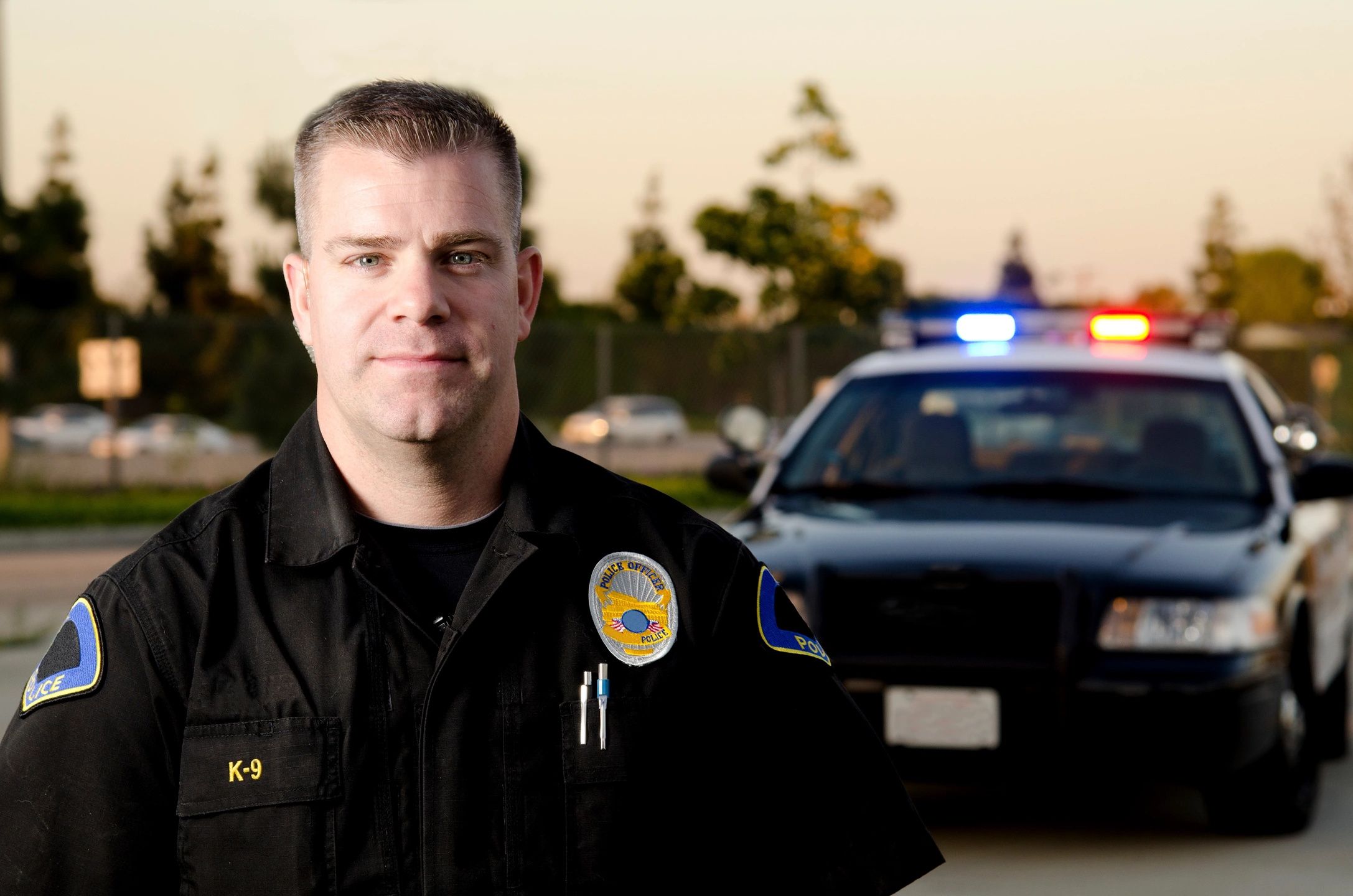
“Good morning, Ma’am. My name is Officer Mike Welden, Wake County Sheriff’s Department.” He consulted a black notebook flipped open in his hand. His questioning eyes moved from the page to her wary ones.

“There’s been an accident and the identification on the injured party gave this address. Do you know Jacob R.

Grey?” She caught her breath. “Yes, he’s my husband.”

“May I come in?”

She stepped back allowing him to enter. His trained eyes scanned beyond the entry and he spoke her line.

“Would you like to sit down?” Obediently, she took a seat on the edge of the sofa, swiping at shower damp tendrils of hair falling onto her face. “You saw my husband? Is he okay?”

“I found him, yes, ma’am. It appears he was hit while on his bicycle this morning. He’s been taken to Duke Hospital.”

No. He would be here soon. They had to buy a grill for the cookout. “I’m sorry, what do you mean, ‘appears’?”

“We have no witnesses, so it’s not clear exactly what happened.

FEEDBACK

OVERVIEW – This intro is a classic opener with police knocking on the door of a wife to share bad news about the husband or a family member. Here at TKZ, we preach to start with a disturbance and cops at your door would qualify, but I would’ve liked to see the dialogue with more tension and intrigue. With this being a bicycle accident, the lines are bland. If you isolate only the dialogue and take everything else away, nothing much happens.

Would it have been better to open with the bicycle accident?

We also have an opener with someone in their own head and thinking about a dream, but with the dream not explained any more than a vague 2-line notion, it’s not interesting either. I’ve opened with internal thoughts of a character, but the writing has to intrigue and create elements of mystery to keep the reader (or an editor and agent) turning pages.

It’s my opinion that the author might try to find a better place or a better way to start. Let’s drill down into the details.

OPENING LINE: ‘had the dream again last night.’
The dream is only brought up twice in this weighty opening paragraph. With the first line and this one in the middle of the first paragraph – ‘Thoughts of her dream receded as the day took hold.’ There is so little known about the dream, it’s almost not worth bringing up. It’s a cheap tease that doesn’t work for me.

To intrigue a reader, there needs to be elements of mystery that would force them to want to know more about the dream. In these two lines, even the author dismisses the importance by saying ‘her dream receded as the day took hold.’ If this dream is significant, more of it needs to be layered in and it must reflect or foreshadow what is about to happen–or create the start of a mystery to be solved–otherwise it’s not worth the focus.

If this is a dream where Audrey symbolically loses her husband Grey or can’t find him, that might provide an answer as if she is telepathic or deeply connected to him. If the dream is of something else that will carry through the story, like a distinct thread that evolves, then more needs to be hinted from the start.

Maybe the dream is something buried in Audrey’s subconscious that has put Grey in danger. The author must show patience at dangling this kind of story element into the story, but there needs to be more in order for it to gain traction.

To play with this opener, the author could have the cops get Audrey out of bed from a dead sleep. I liked the imagery of her waking to see Jacob’s imprint on his pillow. She could be more traumatized and her mind muddled if they wake her from an exhausting night of bad dreams, only to wake into her own nightmare.

But I’m more of a fan of action in the opening. Hard to say what I might’ve done in these 400 words, but the bicycle accident would appeal to me more. The reader could be drawn into Grey’s world of normalcy as he rides his bicycle, only to be suddenly struck down by a mystery assailant who races from the scene. BOOM! Opener. Then build on the foreboding dream of Audrey’s that comes to fruition with a knock on her door with police standing there. Solid start.

DISTRACTING LINE – ‘You don’t just ignore the police at your door. It’s dishonest and she couldn’t lie to a cop about not being home.’

This line should be deleted. It’s a strange thought for her to even think about not opening the door to police. A lie about not being home is odd. Most people would be intrigued as hell about why cops were at the door. Why isn’t she? It makes her sound flaky and doesn’t read as solid motivation. In the following line, there’s a focus on action where ‘her clumsy fingers fumbled with the lock.’ That shows her mental state, as if she’s nervous (and rightly so) which is contrary to her strange thought about not opening her door as a dishonest gesture.

VISUAL IMAGERY – In the second paragraph, Audrey comes face to face with the policeman. This struck me as odd, given the next imagery of her staring at his duty belt and gun. I would imagine a cop would be taller than Audrey, unless she’s tall. If she’s shorter, her eyesight might see his duty belt better. I can see her distraction with it. Many people aren’t familiar with guns and she might be intimidated by it, but the police are there for a reason and she doesn’t seem curious enough about why they are there. If this image is important, then clean it up and make the cop more intimidating, if that’s the intention, but in the whole intro, Audrey doesn’t act like a normal wife getting bad news about her husband. I’ll explain below in the section on CHARACTER MOTIVATION.

HOUSEKEEPING – There’s plenty to clean up, line by line. I’m sure other TKZers will help with that, but something that stood out was the cop’s mention of Jacob R, about halfway down. Who is Jacob R? Didn’t the police have his last name? Why would the cop only call him by his first name and an initial? When Audrey says, “Grey?” I had to reread to get the leap she made. (Maybe she jumps in to add it and interrupts him, but there’s punctuation of em dash that would help make that clearer. The author should explain why the police only referred to Jacob R or use his full name. Presumably they would have it since Jacob is at the hospital and survived the accident. He would have ID on him.

In the sentence that starts with ‘His trained eyes scanned beyond the entry and he spoke her line.’ If this is in Audrey’s POV, the author leaps into the head of the cop when referring to ‘his trained eye.’ The author should delete the word ‘trained.’ I also had to reread the last part of that line – ‘he spoke her line.’ This is out of order from real action. How would Audrey know he was about to speak her line -‘Would you like to sit down?’ In that one short paragraph, two characters are speaking and it’s confusing. Separate the lines with space to make things more clear and I would write the cop’s line more distinctly to show he’s speaking.

“It’s best we sit down. After you.” The big man took charge and Audrey lead him into the parlor.

“You saw my husband. Is he okay?”

CHARACTER MOTIVATION – Officer Welden tells her that he found her husband, saying ‘it appears he was hit…’ Instead of Audrey focusing on what a real wife might want to know – “If he’s okay, why isn’t he home?” “Was he injured? Where is he?”

Instead, Audrey focuses on the word ‘appears’ and acts like a sleuth, at the expense of the well being of her poor husband. If she comes across as jarred by the news, physically and mentally, she would be more sympathetic and the tension and emotion would be escalated. But with this cold reaction, it only adds to the bland nature of this opener. The reader will care more if they can relate to the character and Audrey’s understandable emotion.

After Audrey asks if her husband is okay, Officer Welden only says, ‘I found him, yes, ma’am’ before he jumps to more of what happened. This is a police notification to a family. They would be more concerned with sharing news about the husband’s condition and where he’s been taken. Audrey can push for details on the case and who caused the accident once she knows her husband is okay and sees for herself, but there is no sense of urgency on Audrey’s part and the cop should explain more about Jacob’s condition.

“Your husband sustained a broken arm and a few cracked ribs. Doctors at Duke Hospital are examining him now.”

Audrey mentions an internal thought of ‘No, He would be here soon. They had to buy a grill for the cookout,’ (a line that I would italicize to show an internal thought for the reader). The emotion or her confusion isn’t in sync with her cold reaction and focus on the word ‘appears.’ Put more emotion into this section and have her react like a more normal wife and the reader will care more too.

DISCUSSION:
1.) What is your feedback, TKZers?

It takes guts to submit your work for critique. Any comments are solely for the purposes of providing help to a fellow author. We’ve all been here. Thanks for your submission, brave author. The beginning of every story is my greatest challenge, always. Tweak this and perhaps re-imagine a different beginning for Audrey and Jacob and you’ll have a solid start.

My Cure for Writer’s Block

By John Gilstrap

Perhaps the title of this post is a bit misleading.  Truth be told, I don’t believe in writer’s block.  There are days when the creativity feels like it won’t flow at all, and there are certainly days when I would prefer to do something other than tying my backside to the chair and hammering out words, but that’s what everybody feels about any job on some days.

“Writer’s block” is, I believe, too often an excuse to be wielded on those days when a writer would prefer to play hookie.  There’s nothing wrong with playing hookie, but whilst playing, it’s disingenuous to complain about not getting stuff done on your manuscript.  There truly is no substitute to a writer writing, even when the words don’t flow easily.

I think of creativity as a flow, and the writer as the pump.  When the pipes are filled and the pressure is even, creativity pours out of us, sometimes in such volume that we can’t handle it all.  Then stuff happens in our lives or in our surroundings that causes intellectual cavitation, and our pump loses prime.  All that flow reduces to a pool, and it’s hard work to get it going again.

Everybody has a proprietary secret sauce to re-prime their own pipes, but one that always works for me is to return to the basics: pen and paper.  I posted a video on the topic on my YouTube channel.  I don’t know why it works, but somehow, the tactile connection between my brain and the page, flowing through an old-fashioned fountain pen, never fails to set me straight.  For every book I write, I’d guess 20% of the prose starts as being written longhand.  Once the story is flowing again, I type up the handwritten pages and I’m off and running.

What about you?  Any tricks you want to share for getting past the story parts that don’t seem to want to work?

Reading For Survival

The man who won’t read good books has no advantage over the man who can’t read them. — Mark Twain

By PJ Parrish

Saw a depressing video on Facebook the other day. People on the street were being polled about what was the last book they read.

The guy then asks folks to name an author. Any author. Crickets. Sigh.

I know we here at TKZ are preaching to the choir. But I also think maybe we need to be more worried about this.  I’m not going to talk politics here, rest assured, but I am going to say that our ability to absorb information seems to be questionable, at best, these days. And we need to be smart right now. About a lot of things.

We need to read.

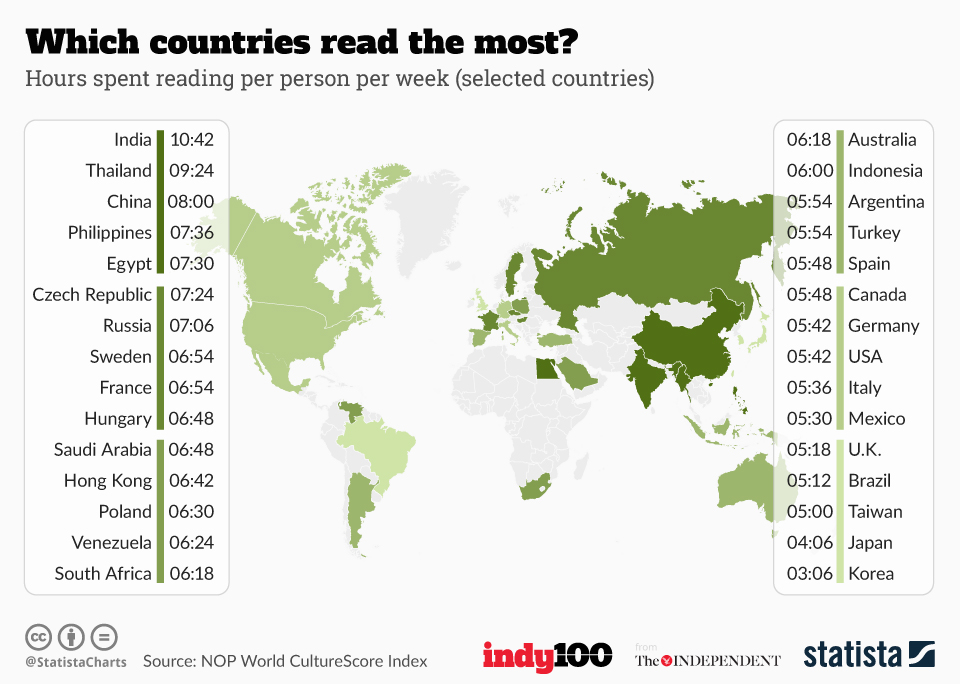
The latest Pew poll I could find on this subject says that  28% of adults ages 50 and older have not read a book in the past year, compared with 20% of adults under 50. . And as a country, we’re at the bottom of the reading pack.

This subject slid to the front of my brain only because I was cleaning out my file drawer in my office. I found a slender little booklet that I had thought I had lost years ago. It’s a copy of an essay that John D. MacDonald wrote for the American Library Association and the National Endowment for the Arts.

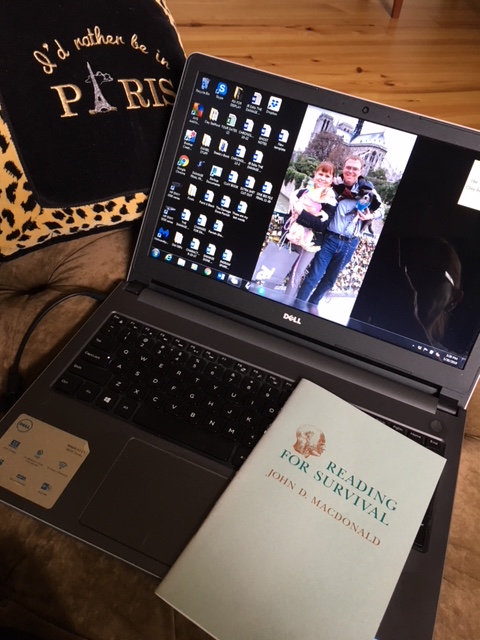
It’s called Reading For Survival.

Now, if you think it’s some dust-dry diatribe, some shrill screed about how we’re raising a generation of morons, well, then you must not have read John D before. It reads like, well, one of his novels. (By the way, I didn’t know James and I would be writing about JDM in the same week. Click here to go back and read his post on what JDM taught him.)

A little background:  Years ago, a friend of mine, Jean Trebbi, had a local TV show in South Florida called Library Edition. Jean was a force in the literary community. She was the head of the Broward County Center for the Book, a tireless supporter of all authors and most any book. In 1985, she interviewed MacDonald on her program, and when the camera stopped rolling, he kept going, but wanting to talk about non-readers instead of his own books.

Jean suggested he should write something on the subject for NEA and the Library Association. MacDonald didn’t want to do it, fearing he would be just preaching to the converted, but he finally agreed — with the caveat that he could use “colorful enough language to it will be quoted, sooner or later, to a great many non-readers.”

Things didn’t go well. “I could not make the essay work and I could not imagine why,” he recalls in the booklet’s forward. “I must have done two hundred pages of junk.”

Does hearing that make you feel any better about your own writing problems?

Jean Trebbi, finally wrote him asking what he hold-up was and MacDonald told her he had written a hot mess. Jean suggested using the device of a conversation between Travis McGee and and his friend Meyer. And that is what he did.

MacDonald called it “a small, mangy, bad-tempered mouse of 7200 words.”  But as I re-read it the other day, I realized its message is as vital today than it must have been thirty-one years ago. MacDonald said the theme of his essay was “the terrible isolation of the non-reader, his life without meaning because he cannot comprehend the world in which he lives.”

If that doesn’t set off in a bell in your head, you haven’t been paying attention to what’s going on in our country these days.

The essay opens like a vintage MacDonald novel.  Thunderclouds are gathering over the slips at Bahia Mar and McGee and Meyer are sitting on the deck of the Busted Flush. And next time someone tells you never open with weather, read them this:

The big thunder-engine of early summer was moving into sync along Florida’s east coast, sloshing millions of tons of water onto the baked land and running off too quickly as it always does.

An impressive line of anvil clouds marched ashore on that Friday afternoon in June, electrocuting golfers, setting off burglar alarms, knocking out phone and power lines, scaring the whey out of the newcomers.

The power goes out and Meyer puts down his book, and McGee says that it’s too dark to read anyway. (weather as metaphor!)

“I wasn’t reading, Travis,” Meyer said. “I was thinking about something. A passage in the book started me thinking about something.”

Over the next twenty-two pages, Meyer — whose mind is like a maze — spools out his argument — that man’s brain evolved the way it did, creating a genetic storehouse of memories, out of the pure need to understand his environment and thus survive.

Meyer concocts a prehistoric man named Mog and his modern counterpart Smith. Mog happens upon some fruit but he’s wary of eating it. Using all his memory skills, he decides to not chance it, that it’s a trap. His modern counterpart, Smith, gets a job offer at twice his salary. But using his memory skills, he deduces the employer is in a high risk banking arena with bad management turnover rates. So he says no.

“Back in prehistory,” McGee offers, “man learned and remembered everything he had to know about survival in his world. Then he invented so many tricks and tools, he had to invent writing. More stuff got written down than any man could possibly remember. Or use. Books are artificial memory. And it’s there when you want it. But for just surviving, you don’t need the books. Not any more.”

Books are artificial memory. Don’t you love that? But then Meyer lays it on him:

“So why are we doing such a poor job of surviving as a species, Travis?”

MacDonald goes on to say that the world of prehistoric man was small, limited to what the man could see, hear, taste, eat, kill, carry and use. But to modern man, who can read and remember, the world is huge and monstrously complicated.

“The man who can read and ponder big realities is a man keyed to survival of the species. He doesn’t have to read everything. That’s an asinine concept. He should have access to everything, but have enough education to differentiate between slanted tracts and balanced studies, between hysterical preachings and carefully researched data.”

Makes you wonder what MacDonald would have thought of today’s fake news debate, Facebook’s propaganda problems and the isolated little echo chambers we’ve crawled into. MacDonald and McGee go on:

“To be aware of the world you live in you must be aware of the constant change wrought by science, and the price we pay for every advance. These are our realities, and, like our ancestors of fifty thousand years ago, if we — as a species rather than an individual — are uniformed, or careless, or indifferent to the facts, then survival as a species is in serious doubt.”

So what’s the answer? Meyer thinks he knows:

How do we relate to reality? How do we begin to comprehend it? By using that same marvelous brain our ancestor used. By the exercise of memory. How do we take stock of these memories? By reading, Travis. Reading! Complex ideas and complex relationships are not transmitted by body language, by brainstorming sessions, by the boob tube or the boom box. You cannot turn back the pages of a television show and review part you did not quite understand. You cannot carry conversations around in your coat pocket.

Ha! What would MacDonald have to say about Tivo and iPhones?

Meyer is worried, he tells Travis, that non-readers are disenfranchised, cut off from any knowledge of history, literature and science. And worse, they become negative role models for their children, who will in turn, “become a new generation of illiterates, of victims.”

“The non-reader, Travis, wants to believe. He is the one born every minute. The world is so vastly confusing and baffling to him that he feels there has to be some simple answer to everything that troubles him. And so, out of pure emptiness, he will embrace spiritualism, a banana diet, or some callous frippery like Dianetics.”

Or worse. Name your modern opiate.

MacDonald died Dec. 28, 1986, a few months after finishing the essay. I really wonder what he might think of where we are today, of what he might think watching those blank-eye folks on the beach, trying to think of one author’s name.  What would he make of the fact we are barraged with information twenty-four hours a day, yet we seem to be growing not smarter but more lost and disconnected?

The essay ends with Meyer saying that he has no cure to offer, but that just identifying the disease is a good first step. But then he adds:

“Bleak, my boy. Bleak indeed. And so let us trudge back toward home, and stop at the bar at the Seaview for something tall and cold, with rum in it.”

“Beautifully said,” I told him.

On the way back, I told him that he had made me feel guilty about my frivolous reading fare of late, and what might I read that would patch up my comprehension and my conscience at the same time.

Meyer thought about it until we had our drinks. He took a sip, sighed, and said, “I’ll lend you my copy of Barbara Tuchman’s A Distant Mirror.”

I am halfway through it. And the world has a different look, a slightly altered reality. That fourteenth century was the pits!

I ordered the Tuchman book from Amazon. (My local bookstore can’t get it, I tried). Now I am going to go mix a stiff gin and tonic, crack it open and try to get some badly needed sense of perspective.

Happy reading, folks.  By the way, I am on the road today, probably somewhere near the Michigan-Indiana border as you read this. So if I can’t reply quickly, please chat among yourselves.  Will check in when I get home to Traverse City, MI.


Recognizing Writing Tics – First Page Critique

By Sue Coletta

We have another brave writer who submitted their first page for critique. I took the liberty of breaking up the paragraphs for easier reading. Anon, white space is our friend. My comments will follow. Enjoy!

Untitled

The smell of burning wood and flesh began to be drowned out by the sound of screams…the screams of a woman. Deafening and chilling screams, echoed through the steel door.  Andromeda found herself in a small room, with cold metal walls, a plain steel table, metal bed with a thin mattress and blanket, and an uncomfortable looking metal chair. She was a tall, beautiful young woman, whose long black hair fell down to her shoulders, and slightly covered her almond shaped face.

An eerie chill pierced the air in the room, and Andromeda wasn’t sure if the goosebumps that followed were because of the woman screaming, or the total lack of insulation in the room – likely a combination of both.

Andromeda looked around the room, her heart pounding through her chest. Her attempts to remember how she got here was futile; the only thing she remembered was cleaning up after her best friend and roommate Sofia, who was recuperating from the flu.

After disposing of soiled tissue paper and disinfecting their dorm room, Andromeda turned on some classical music and tucked herself in bed. After that, there was a black spot in her memory. She sat up in the bed that she woke up in, and began to stretch and look around the room.

Dressed in a white t-shirt, gray fleece shorts, and white socks, she began to walk around the stark and unoccupied room, looking for anything that may give her a clue as to where she was. She wrapped her arms around her body, bracing herself for the shudder and chills that followed.

The room had the look and feel of a military interrogation chamber: there were no windows, no traces that anyone even knew she was there. But someone knew she was here, the same someone who put her in this place. Suddenly, Andromeda was reminded of the screams as they began again, growing increasingly louder, followed by a loud “BOOM!” Andromeda ran to the door, preparing her mind to bang on the door with all of her might, to hell with alerting whomever put her in this room; the only thing on her mind was escaping. However, before she could even touch the door, it receded into the floor.  Andromeda fell face first onto the cold, hard, metal floor of the hallway. The palms of her hands were burning, and so were her legs.

***

After reading this piece several times, I still can’t figure out if it’s a dream sequence or if it’s the opener for a fantasy novel. The last line indicates the events happened in the real world—how else would her hands and legs be burning?— so my guess is we’re in a fantasy world. If this is a dream, however, we need to be careful not to trick the reader. Opening with a dream is risky. Does that mean we can never do it? No. But we do need to learn the rules of storytelling before we break them.

Let’s set aside the last two sentences for a moment.

Our hero is actively searching for a means of escape while at the same time, wrestling with how she landed in an unfamiliar room. Anon didn’t give away too much too soon, either. Which is great. An opening page should raise story questions and pique the reader’s interest. Our goal is to make it impossible not to flip the page. Anon, I really hope this isn’t a dream, or it’ll undo all the conflict and tension you’ve worked so hard to create.

Writing Tics

Believe me, we all have our fair share of words we favor, extra words (overwriting), and unnecessary words that get in the way. The trick is learning how our writing tics weaken our writing.

This first page is littered with began. It may seem nitpicky to mention it, but it popped right out at me. Our goal is for individual word choices to deliver the right balance of cadence, emotion, transparency, and rhythm, so the reader enjoys the story with no hiccups. Words like began and started detract from the action.  Allow me to show you what I mean.

First line of the excerpt …

The smell of burning wood and flesh began to be drowned out by the sound of screams…the screams of a woman.

If we only remove “began to be” …

The smell of burning wood and flesh drowned out the sound of screams … the screams of a woman.

See how more immediate that reads? Next, let’s shuffle a few words around so the reader can share in the experience.

Screams drowned out the smell of burning wood and flesh … the screams of a woman. 

Better, but it still needs a few tweaks. By being specific and intentional we paint a more vivid picture …

High-pitched screams collided with the stench of burning flesh … screams of a woman.

Next line: remember to introduce the hero right away so the reader knows who’s telling the story. While we’re at it, let’s deepen the point of view by removing all telling words i.e. smell, sound, remember, knew, thought, felt, etc.

Inside the cramped room with metal-lined walls, Andromeda [last name] jolted upright in an unfamiliar bed, the bare mattress yellowed, torn.

Adding Inner dialogue allows the reader to empathize with our hero. Let’s add that here …

Where was she?

We still need sensory details and conflict …

Rotted meat blended with the warmth of a campfire. Plumes of smoke billowed through the barred-window in the steel door—her only source of air. And light. No windows, no other doors, no means for escape. A steel hydraulic table sat in the corner, a trickle of blood snaked down one leg, the remaining surface polished to a glossy shine.

Hero’s reaction …

Andromeda’s heart thrashed, rattling her ribcage. Was her captor incinerating live victims?

Put it all together …

High-pitched screams collided with the stench of burning flesh … the screams of a woman. Inside the cramped room with metal-lined walls, Andromeda [last name] jolted upright in an unfamiliar bed, the bare mattress yellowed, torn.

Where was she? 

Rotted meat blended with the warmth of a campfire. Smoke billowed through the barred-window in the steel door—her only source of air. And light. No windows, no other doors, no means for escape. A steel hydraulic table sat in the corner, a trickle of blood snaked down one leg, the remaining surface polished to a glossy shine. 

Andromeda’s heart thrashed, rattling her ribcage. Was her captor incinerating live victims?

See how these tweaks pull the reader deeper into the story?

Because it feels like this brave writer is early on in their journey, I added a few quick tips rather than bleed red ink all over the excerpt. I’d hate to be responsible for shattering the magic that keeps us thirsting for knowledge, keeps us creating. The beginning of our journey is an important time in every writer’s career. The muse is running wild and possibilities are endless.

Quick tips

  • Watch your adverbs; words like suddenly don’t add tension;
  • Be specific; rather than “some classical music,” name the composer;
  • All caps are reserved for acronyms, not for words like “Boom”;
  • Use active voice, not passive; this post may help;
  • Followed by, for the most part, is similar to began and started in that we need to reword to make the action more immediate;
  • Anytime you write “herself” you lessen the point of view i.e. tucked herself in bed. Instead, try something like: she slipped under the covers. Or, she swung her legs under the blanket.

I hope these tips help with your next draft, Anon. If this first page isn’t a dream, you have the makings of an intriguing story. Wishing you the best of luck!

Over to you, TKZ family. What tips would you give this brave writer?