When Fiction Meets Reality – The Challenges of my Current WIP

Jordan Dane
@JordanDane

Falkue at German Wikipedia

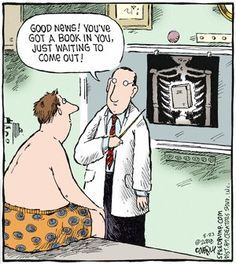
I’m 75% finished with my latest novel and I can’t stop dreaming about it. It’s keeping me up. I hope that’s a good thing. I’ve never had this happen before. Have any of you?

My novel is something very far from my comfort zone. For a large section of the story, my characters time travel (in an odd way) to Victorian London where they hunt Jack the Ripper. They have their reasons and the clock is ticking.

Whenever I add paranormal elements to any of my stories, I want the premise to almost seem plausible. You know how most people get scared when sitting around a campfire, telling ghost stories? That’s the visceral feeling I hope readers will get when they come along for a ride to the streets of White Chapel 1888.

I not only had to research the many resources on the Jack the Ripper case and take a view on what I think might’ve happened for the sake of my plot, I also had to research the time period to recreate a setting that will come alive on the page. In 1888, London was not the progressive modern city it is today. This was before proper sanitation, plumbing, and before police investigative methods were improved.

Tenement slum houses held large families of immigrants contained in small rooms rented by the day. Disease ran rampant with poor options for drinking water. Within close proximity to these slums lived wealthier Londoners who attended the opera and dined in fine restaurants. A newspaper called The Star had started in 1888, the year Jack had been born to evil. It had originally provided a voice for the common folk on injustice, but anything on the White Chapel murders turned a profit for the newspaper and became the driving story of the day.

A challenge has been to add enough details for history buffs yet recreate this world for readers who might be more interested in the peril of the characters. There’s always a balance and a consideration for good pacing.

My story is seen through the eyes of a young woman in present day who is desperate to find justice for a murdered friend in New Orleans. She’s obsessed with the Ripper case because she thinks it is related to the death of her friend. She steals a vintage necklace off a body and brings it to a mysterious yet reclusive psychic, only to find that she is correct that the jewelry is linked to her friend’s investigation. When held in his hand, the necklace catapults the psychic to two horrific murders. The vintage piece is the key to locating Jack the Ripper on the night he kills his 5th victim, Mary Kelly. I can’t give too much away, but I hope you’ll see the many moving parts of this story.

In order to recreate time travel, the hunters (led by the psychic) must be willing to suspend their bodies in a near death coma. Similar to how dreams work, a willing mind can share the common existence of a shared dream. My twin sisters often shared the same dreams. For most that would be scary, but it was normal for them. It’s been said that if you dream of your own death, you die in the dream. How many of you believe that is possible? Does it make you think twice before imagining it?

While my characters hunt the Ripper in spirit form, they are invisible to everyone except their one spirit guide (someone from 1888 that they must find in order to remain tethered to their world). As you can imagine, there are challenges to not having a physical body, yet they must be presentable in period clothing to the one guide (their citizen of heaven) who is capable of seeing the traveler.

Another challenge was to create believable dialogue during the time travel segment. What my modern woman hears from the people she meets must sound authentic. That involved a lot of historical research as well. It helped that my narrator was a modern young woman. For most of the historical part of the plot, her voice dominated, but I made sure she overheard the locals to make sure the color would be there.

But things are not what they seem in the netherworld between life and death. Evil and Fate combine to change history in ways my team of hunters will never foresee. Their worst fears are exposed and they must face their worst nightmares. As a writer, it’s my job to make my characters pay for the daring things they do to become a star in their story.

Thinking through all the ramifications of affecting history or interfering with fate–while doing it in a way to create mysterious twists in the plot–has been another fun challenge. Every time I think I know where the story is going, it changes course again, in a good way. I’ve surprised myself in ways I couldn’t have foreseen. The plot had to develop and the characters’ dilemmas had to rise to the top in order for me to see different outcomes and motivations. I’ve added layers to my story that I never would’ve seen coming. That’s a good feeling.

This is the first book in a new Trinity LeDoux series for me. The working title is – The Curse She Wore. Trinity is a 24-year-old wannabe bounty hunter, trying to get her license in New Orleans. At the start of the story she is homeless, but everything changes after my hermit psychic sees something brave yet vulnerable in her.

The first time I visited New Orleans, I sensed the layers of richness to the setting and understood why so many writers find the location completely captivating. I’ve waited to write a story set in New Orleans. This is it. I’m bringing in a Cuban influence, the Santeria faith (used for the concept of an ancestral spirit guide or citizen of heaven), a discreet Voo Doo shop for true believers, and a reclusive psychic from an old wealthy family who lives on an historic plantation. He’s got secrets of his own.

My tag line for this story is – “They had Death in Common.”

For Discussion:
1.) Tell me about the challenges of your current WIP. Anything interesting to research?

2.) Have you ever worked in the details of a real murder into your work of fiction? How did that work for you?

If you’re on Instagram, please find and follow me at this LINK.
Chappaquiddick, The Story


About a month ago, I began to see advertisements for the film Chappaquiddick. Being familiar with the subject–Ted Kennedy’s involvement in the death of a young woman named Mary Jo Kopechne–there was no question in my mind about whether I would go to the film or not.

My parents were Catholic sweethearts still in their twenties when Bobby Kennedy was assassinated in June, 1968. One of my early memories is of my mother watching his funeral on our small black and white television. Just a little over a year later, two weeks after I turned seven, Mary Jo Kopechne died, suffocated in a car submerged in the dark water just off the Dike bridge near Chappaquiddick, Massachusetts. Senator Ted Kennedy, who was positioned to run for president in 1972, was driving the car when it went into the water. He didn’t report the accident until ten hours later. He pleaded guilty to leaving the scene of an accident and was given a two-month, suspended jail sentence.

I’m not sure when I truly became aware of this terrifying story. While the adults around me spoke pretty freely at the time, I’m certain no one mentioned the details of the accident right after it happened. Given my visceral reaction every time I think about it, I must have first heard about it when I was a young teenager. What imaginative child doesn’t spend at least some time thinking about drowning? Worse, I had a fear of both water and bridges. We often traveled across the Ohio River, and my sisters and I tried to hold our breath as long as the car was on the bridge. It was a great distraction.

This blog really isn’t about the Chappaquiddick film. No, I won’t be going to see it. I know the story, and have read all sorts of accounts and theories about it. I won’t offer my opinion on it here. But it would be interesting to know what viewers unfamiliar with the event think after seeing the film.

This blog is about a book.

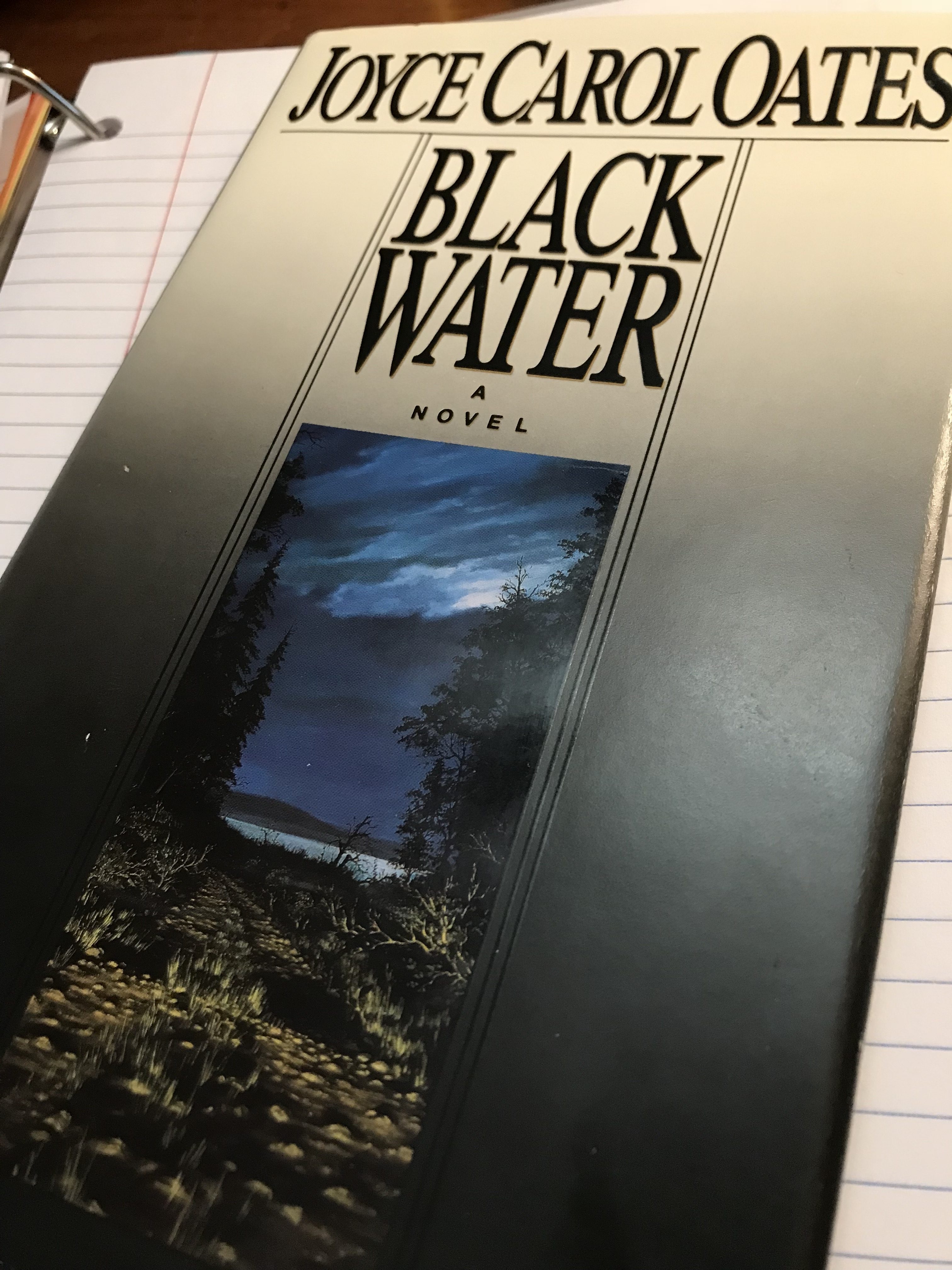
In 1993, I read Joyce Carol Oates’ novella, Black Water. Oates has boldly fictionalized real-life situations and characters in several novels: Blonde, about Marilyn Monroe; Sacrifice, about the Tawana Brawley case; and My Sister, My Love, about JonBenet Ramsey’s death. There are many, many true crime books, and novelized historical fiction is very hot right now. Oates’ writing is always intensel, and delves deeply into the psychology of her characters. So I guess it’s no surprise that I found myself profoundly affected by Black Water. It nails two of my darkest fears, and throws in the always-timely subject of young people (often young women) betrayed by powerful figures (often older men).

This 1992 Washington Post article reports that Oates says, “The Senator in “Black Water” shouldn’t be mistaken for Ted Kennedy, Kelly Kelleher isn’t a pseudonym for Mary Jo Kopechne, and this brief tale isn’t about Chappaquiddick at all.” (Reporter’s quote, not Oates’ actual words.) But it is a story about a party, a senator, a girl, a car accident, a death in the water, and a betrayal. It’s all there.

Black Water is written in Oates’ unique close third voice–a voice which also hints at the existence of a rather arch and wise narrator. Kelly Kelleher is her own memoirist, judge, jury, cheerleader, critic, and inner child. As she waits for the senator to come back to save her, she fights desperately to live. She’s flooded (no pun intended) with memories, and  tells herself stories about what’s happening in the outside world. She clings to her optimism.

I’m told by someone who spoke casually with Oates about the novella that she means for it to be read in one sitting of two hours–the same amount of time the authorities believe Kopechne lived after the car went into the water. That notion leaves me breathless. This will sound ridiculously theatrical, but I almost wish that this fact were written on the page facing the ending of the novella.

The true horror of this story lies in those two hours. Forget the party. Forget Kelly’s romantic thoughts. Forget the way the senator kicks at her as he propels himself away from the sunken car. Forget the alcohol and rumors of infidelity. All you need to know about is those two endless, infinite hours. At the end of those two hours, she is dead, but the reader has visited her entire life just as Kelly relived it–In bright and dark patches of emotion, wonder, and terror.

Why would I want to see the film? After reading extensively about the Chappaquiddick incident, I’ve come to my own conclusions. I’m not particularly interested in hearing more theories. The story has always been about those two hours for me.

This is the power of the book. Don’t get me wrong. I watch at least a couple films a week. But film viewing is mostly passive, even when the film is well done. I’m not saying that films don’t inspire or teach, horrify or amaze. It’s only that prose fiction engages imagination and emotion in a unique way. I want more of that. Always.

Okay, TKZers. How do you feel about the novelization of history? Are there any books you believe truly capture the spirit and heart of a real-life story?


Facebook, She Just CAN Quit You

Note: This post erroneously made a brief, premature appearance before its scheduled due date. Re-upping it for today.

By Kathryn Lilley

Photo purchased from Shutterstock by KL

Recently the dynamics on commercial social media have become…a tad weird. So about a fortnight ago, after one too many hacking episodes, privacy scares, and nasty encounters with online trolls, I took the plunge and deactivated my Facebook account. I’ll miss the ease of staying in touch with certain folks (and of course I’ll miss “Yoga with Baby Goats” and other video gems), but it was long past time to cut my ties with advertising-supported social media.

I started feeling conflicted about commercial social media as far back as 2013, when I wrote Is Social Media Developing a Personality Disorder?  

Five years later, the answer (for me, anyway) is an emphatic “Yes.”

Here at TKZ we made a firm decision at the outset not to go down the commercial advertising route. It’s wonderful that out little corner of the cyber sphere continues to serve as a little oasis of calm amidst the winds of the social media Furies.

I’ll miss seeing my friends and family on Facebook, of course. (And I’ll really miss my daily dose of baby goats.)

How about you? Is anyone else rethinking their relationship to social media these days?

Postscript: it’s been two weeks since I cut the cord with Facebook; I’ve been surprised by how much I haven’t missed it. I think what Facebook actually provided was simply that endorphin rush one feels as one frequently checks for Likes, posts, and messages. It does feel a bit like kicking a habit, but not nearly as difficult as I’d imagined.

The Wagon Wheel of Suspense

By Sue Coletta

We have another gutsy writer who submitted their first page. Please pay special attention to the notes at the end of this post, and you’ll understand my title (I hope).

Gym Body

With my hand on the gym door handle, I could feel the thud of the bass beat in the upstairs studio. I stopped, the pulse of the gym in my hand, or perhaps, it occurred to me, it was my own heartbeat in my palm. Deep breath. Step in. The cop cars outside reminded me of something that had happened long ago.

Another instructor pounded down the stairs and brushed by me, wiping tears from her eyes.

The background sound was now a disordered group clap in time to the Zumba cool down.

Breathing in the whirlpool chlorine, the familiar clink of weights being set in place at the top of the stairs, I fished through my wallet for my membership card.

“Suzi – don’t worry about it,” said Trixie, the front desk attendant, waving her hand in the air and making her eyes look even more bored than usual. “You teach here. I have no idea why you’re supposed to show your card.”

I raised my voice over the soothing buzz of the smoothie bar blender to thank her.

Trixie’s dirty blond hair fell to her waist, and her eyes, smudged with thick gray eyeliner, held a bored expression that she could deepen into greater and more cynical levels of boredom depending on how cool she thought you were. Right now she was pushing 11 on a bored-look scale of 10. I must be pretty cool. “Just go on in.”

“Excuse me!” said a gravelly voice to my left. “I need a ticket for the 9am Push class!”

Trixie lightened her bored look to appear almost polite – not welcoming, but at least not as bored. It was amazing how fast she could wind down to a 6. “I’m so sorry, but Suzi’s class is full this morning.”

I turned to see who was getting the bad news. It was Georgia, one of my regulars. She had the pale papery skin and short gray hair of a woman in her golden years, but emerging under her Lululemon spandex tank top were the bicep and deltoid muscles of a woman who pumped iron like a 20-year-old in a bikini contest.

* * *

NITTY-GRITTY

With my hand on the gym door handle, I could feel the thud of the bass beat in the upstairs studio. I stopped, the pulse of the gym in my hand, or perhaps, it occurred to me, it was my own heartbeat in my palm. If her hand is on the door handle, how could she feel her heartbeat in her palm? If you’d like to deepen the POV, reword like this: With my hand on the gym door handle, the thud of the bass beat in the upstairs studio pulsed through my hand.  Deep breath. Staccato sentence, which varies sentence structure and adds rhythm. Good job! Step in. This one may be overdoing it, but it’s a stylistic choice. The cop cars outside [the building] reminded me of something that had happened long ago. I’d love a hint to what happened. Don’t explain in detail, though. Rather, hint at it, teasing us to keep us interested. As written, it’s not enough.

Another instructor pounded down the stairs and brushed by me, wiping tears from her eyes. Good. It makes me wonder why she’s so upset. I hope it’s because someone got their head bashed in with a weight and not due to a minor disagreement. Meaning, if you’re going to show us a woman racing down the stairs in tears in the opening paragraph, you ought to have a compelling reason why, a reason the reader will soon discover. This is precious real estate. Don’t waste it on meaningless conflict that has no bearing on the forthcoming quest. 

The background sound was now a disordered group clap in time to the Zumba cool down. Meh. I’d delete this sentence. It detracts from the next sentence, which I like. Breathing in Inhaling the whirlpool chlorine, the familiar clink of weights being set in place at the top of the stairs, I fished through my wallet for my membership card. Bravo on using sound and smell to enhance the mental image. Too often writers forget to use these senses, and often they’re the most powerful.

“Suzi – don’t worry about it,” said Trixie, the front desk attendant, waving her hand in the air and making her eyes look even more bored than usual. “You teach here. I have no idea why you’re supposed to show your card.” You managed to sneak in the main character’s name, which is great. However, this dialogue is too on-the-nose. What if Trixie gossiped about why the woman ran out in tears? Again, give us a compelling reason. 

I raised my voice over the soothing buzz of the smoothie bar blender to thank her.

Trixie’s dirty blond hair fell to her waist “Fell” indicates she had her hair up prior to this., and her eyes, smudged with thick gray eyeliner, held a bored expression that she could deepened into greater and more cynical levels of boredom, depending on how cool she thought you were. Right now, she was pushing 11 eleven on a bored-look scale of 10 ten. I must be pretty cool. “Just go on in.” Love the snark. This paragraph shows us Suzi’s fun personality. Very good.

“Excuse me!” said a gravelly voice to my left. Unless the character is shouting, lose the exclamation point. “I need a ticket for the 9am Push class!” <– Here too. Rather than pick away at this, I’m stopping here. Please jump to the notes below. Trixie lightened her bored look to appear almost polite – not welcoming, but at least not as bored. It was amazing how fast she could wind down to a 6. “I’m so sorry, but Suzi’s class is full this morning.”

I turned to see who was getting the bad news. It was Georgia, one of my regulars.  She had the pale papery skin and short gray hair of a woman in her golden years, but emerging under her Lululemon spandex tank top were the bicep and deltoid muscles of a woman who pumped iron like a 20-year-old in a bikini contest.

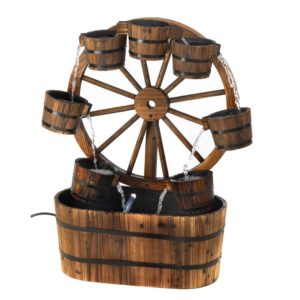
Old Fashioned Wagon Wheel Garden Fountain

NOTES

Even if we tightened the writing, these last two paragraphs still aren’t interesting enough for the opening page. I’d rather see you use this space to hint at what Suzi will find inside her classroom. Dead body? Blood? An escaped zoo gorilla? Hordes of tarantulas from the exotic pet store next door? Prison escapee? Suzi’s ex-husband who just dumped the crying woman? My point is, the details must connect. Or show us why she fears the past might be repeating itself. Hint at the disturbance you mentioned in the first paragraph. As it stands now, the cop cars disappeared from Suzi’s mind. By including too many details about the surroundings you’ve undone the tension you started to build in the opening paragraph.

The title, I assume, is a play on words. Gym body = dead body in the gym? As a crime writer, my mind jumps to a scenario that involves murder. If this isn’t the case, then you need a new title. Preferably one that hints at the genre.

THE WAGON WHEEL OF SUSPENSE

Envision an old fashioned wagon wheel fountain (pictured above). The water rides up in the buckets, over the top of the wheel, and spills down into the same basin. The water itself never changes, even though it cycles through several buckets. In writing, especially in our opening chapter, we need to narrow our focus to one main conflict (i.e. a killer on the loose), one compelling question that the reader needs to answer (why do folks die at this specific gym?). This is how we force them to turn the page. We can and should include several disturbances along the way (in this analogy, I’m referring to the buckets), but they all should relate to that main conflict (the water) in some way.

In the opening chapter it’s crucial to stop the wheel partway. Don’t let that water escape till later, thereby raising the main dramatic story question. We still need to transfer the water from bucket to bucket on the way up the wheel (remember, conflict drives story). That’s how we build suspense, little by little, almost painfully teasing the reader till we’re ready to let the water flow.

In this opening chapter, the main conflict could be what’s inside Suzi’s classroom that’s so horrible a woman pounded down the stairs in tears after witnessing it, but you’d need to drop more clues to make us want to find out. Use the patrol cars outside the building as one disturbance. How does the past relate to present day? What sort of reaction do the lights and sirens have on Suzi? Has this gym been the scene of other murders? Hint at how these things connect to pique the reader’s interest.

Anon, please remember, if I thought you were just beginning your writing journey, you wouldn’t see this much red ink. Your grasp of POV tells me you’ve got the skills to do better. I already like Suzi enough to go for the ride. That’s a huge plus. All you need to do is give us a compelling reason to turn the page. With some tweaking, I know you can do it.

Over to you, TKZers! What advice would you give to improve this first page?

Pack More Punch in Your Prose

by James Scott Bell
@jamesscottbell

We talk a lot about the big stuff here at TKZ—plot, structure, characters, scenes, and so on.

Today, I want to discuss the small stuff: words and sentences. But though they are small in stature, they are monumental in effect. It’s our sentences that create the pictures which deliver the stories to our readers.

If they’re flabby (the sentences, not the readers) the book won’t have nearly the effect it should.

So let’s get serious about sentences. The jumping-off point for our discussion is another of our first-page critiques. See you on the other side:

Lies on the Seine

Chapter One

There were three people in line in front of her. Danny Sullivan didn’t recognize the man behind the cart. Having to deal with a stranger wasn’t unheard of, but ever since the woman in Berlin it always made her throat dry and she had to force herself not to swallow. She was on high alert whenever it happened.

Danny surveyed the area around her for anyone who looked suspicious. A woman sitting on a wooden bench had a stroller and a book, but she didn’t seem to be reading or paying any attention to her child. A man in a fully buttoned suit was leaning on a tree talking on his phone. He wouldn’t stand out if he loosened his tie, she’d keep him in her sight. She noticed a group of teenagers over her left shoulder, the one in the baseball cap and sunglasses seemed to be looking directly at her, she couldn’t be sure. She wasn’t paranoid, suspicious people could be extremely dangerous.

There were two people in line in front of her. Danny turned her attention to the sandbox. Jacob and Jason were playing their favorite game, burying their cars then needing help to find them. Being that it was rare for their father to get a few minutes off in the middle of the day to meet his family at the park, Mark was unaware that the four-year-olds were conning him. She watched as he desperately looked for cars where the twins pointed even though they each knew he was excavating in the wrong location. To him, ruining his suit was a small price to pay if it meant he could play with his sons. Her family was a distraction.

There was one person in line in front of her. Her hand shook as she reached into her bag preparing for the worst. Meetings like this always put her on edge. At least she was out in the open, unlike the time inside the rubbled hospital remains in Iran when the only thing she accomplished was getting out alive. Danny had been with the CIA for almost fifteen years, danger came with the job. Now, as an operative assigned to bring down a black market arms dealer, she expected to find herself in situations that put her life at risk. However, being in such close proximity to her family was a whole different kind of scared.

***

JSB: Author, you’ve got the makings of a good scene here. CIA, something big about to go down, kids and husband close by. So let’s see if we can’t render this with more vigorous prose, more action, and less telling.

There were three people in line in front of her.

I want you to be on the lookout for sentences that begin with the There were… construction. It’s not ungrammatical, and I use it myself sometimes. But there are (!) other ways to deliver the same information. I mention it because you use this construction in three of the four paragraphs. I get that you’re showing the line getting shorter, but variety in the language would make this more inviting.

Also, while it’s often done, beware of beginning a story with a pronoun (her) instead of a name. Yes, a writer could have a valid reason for doing so, but be darn sure about that reason.

Why not this for the opening line:

Danny Sullivan didn’t recognize the man behind the cart.

Now we have a name, which gets us closer to the character from the jump. We have action—she’s looking and not recognizing. And we have a specific image—the man behind the cart. This opening line put us right into an actual scene. In medias res, as they say.

I like the mystery that’s dropped in about the woman in Berlin. I think we can also make this crisper, not only by cutting flab (there’s that word again) but by making this two or three sentences:

OLD: Having to deal with a stranger wasn’t unheard of, but ever since the woman in Berlin it always made her throat dry and she had to force herself not to swallow.

NEW: Dealing with a stranger wasn’t unheard of, but ever since the woman in Berlin it made her throat dry. She had to force herself not to swallow.

OR: Dealing with a stranger wasn’t unheard of. But ever since the woman in Berlin it made her throat dry. She had to force herself not to swallow.

In general, compact sentences increase tension.

The second paragraph gives us Danny’s observations. We can do some more cutting:

OLD: A man in a fully buttoned suit was leaning on a tree…

NEW: A man in a fully buttoned suit leaned on a tree… 

Grammatically, there’s nothing wrong with the first version. But when you can cut words and still convey the same information, try it. Especially if you’re writing a thriller.

He wouldn’t stand out if he loosened his tie, she’d keep him in her sight. She noticed a group of teenagers over her left shoulder, the one in the baseball cap and sunglasses seemed to be looking directly at her, she couldn’t be sure.

Odd use of commas. Change each comma to a period and I think you’ll see it reads better.

Third paragraph: As I’ve already mentioned, There were… should go. Also, we can cut some more flab. Try it this way: Two people to go. Danny looked at the sandbox.

I’d also cut the last line: Her family was a distraction. I’m not sure what it means. What kind of distraction—one that gives her pleasure, or makes her nervous? If you want this information in the scene, show us how Danny’s feeling by way of something physical—a smile, a twitch, inner warmth, inner trembling, a deep breath—or perhaps a thought beat (e.g., Mark, why’d you pick today?) 

In fact, you should cut the last line of each paragraph. There’s a little guideline called RUE (Resist the Urge to Explain). Each of your last lines is an author explanation of what we’ve just read. Let the action speak for itself.

The fourth paragraph begins: Her hand shook as she reached into her bag preparing for the worst. Meetings like this always put her on edge. At least she was out in the open, unlike the time inside the rubbled hospital remains in Iran when the only thing she accomplished was getting out alive.

I like this because it’s active and has a bit of backstory is woven in naturally. Notice how the effect can be enhanced by leaving some things out:

Her hand shook as she reached into her bag. At least she was out in the open, unlike the time inside the rubbled hospital remains in Iran.

Now we have micro-mysteries. What is she reaching for? Why was she in Iran? Micro-mysteries are great in opening pages. They compel the reader to read on.

So cut the rest of the paragraph, which is plain exposition—CIA, fifteen years, black market. Instead, let us see by Danny’s subsequent actions what her skills are.

Act first, explain later.

I recall an action movie, The Long Kiss Goodnight starring Geena Davis. She’s this nice, prim wife in a small town. But when she’s viciously attacked in her home, she suddenly has this amazing skill with a knife, and dispatches her attacker with lethal force.

WHU?

We have to wait a long time to find out the backstory. That’s okay. We’re hooked. (Oddly, I can’t remember the rest of the movie. But the opening remains vivid.)

Author, you’ve got the stuff here for a tense opening page. Rework it. Cut and shape those words so they punch us in the heart.

Oh, and one more thing—don’t ever start a sentence with However. That’s for academic papers and stuffy speeches to the Rotary Club, not fiction! [UPDATE: Unless it’s in the mouth of a prim character who would begin a sentence with However!]

All right, kids. Your turn.

First Page Critique: Endless Tomorrow

By John Gilstrap

We all know the drill by now.  A brave author has taken a big risk that we all respect.  First, the submission, and I’ll join you on the flip side:

Endless Tomorrow (TITLE)

The message from the Consul arrived before breakfast. Agnes had just wiped the last of the shaving lather from his face when Congressman John Paul opened the embossed and sealed envelope. He stared for far longer than it took to read the few words on the short scrap of paper.

“Well, what is it now?” asked Agnes.

Not the reserve a housekeeper should show to an employer but his momentary flash of irritation was soon forgotten. His fingers slid numbly over still tingling cheeks. “They know how to make guns.”

“Guns?” Her disbelief was evident. “Who’s got guns?”

John might as well have told her he could do magic. Guns were a relic of the past and long since gone from the world. “Strangers from behind the Eastern Mountains. We got word of them yesterday at the Ministers’ Meeting but there was no talk of guns.” He stared absently ahead. “A messenger must have come in the night.”

She laughed dismissively. “No one has guns anymore. Not for hundreds of years.” Agnes gently slapped powder on his cheeks and untied the barber cloth.

“Don’t be so sure, Agnes. I learned about them once in school. They are not complicated—at least in theory.”

“Oh, goodness. What else does the Consul’s note say about these people? They have rocket planes too?”

John had the feeling that rockets and planes were two different devices but his memory was fuzzy on the subject of the Moderns’ technology. He read the Consul’s note aloud. That was what Agnes wanted anyway. She was never satisfied until she knew everything.

Dozens of strangers from east now camped in field by Beaker’s Farm. Requesting our presence. Tech and crops unclear. Claim to have guns!? Ministers meeting at eleven. Then we ride. Richard.

Her voice was scolding. “Guns! Don’t believe those people—telling whatever lies they think might impress us. They’ll be wanting to settle here in the valley, just like every wanderer coming from the east. We both know it!” Her fingers moved adeptly over the contents of his shaving kit, brushing the blades clean, packing everything.

He folded the note away and regarded the woman beside him as she busily tidied his dressing room. Short in stature with a curvy figure slowly going plump, long dark hair done up in a bun, sharp gray eyes that never hesitated to meet his own. Clever she was, a bit of a schemer, a good source of town gossip—useful in every way but she had spent her whole life in the quiet town of Newhaven. Can she imagine the violence and slave-taking that reign outside our valley? Maybe none of us can. 

John shook his head and wished suddenly that he had heard fewer stories from terrified refugees who had fled from over the mountains. The era of the great seed traders was over. Only the wretched came now.

It’s Gilstrap again.

First the full disclosure: This piece is not from any genre that I care to read.  I don’t even know what genre it is.  And Author, that was not an insult, merely a confession.  That said, storytelling is storytelling, and from that perspective, this piece is troubled.  First, some general observations, and then I’ll dig a little deeper.

Adverbs.  Goodness gracious, there are a lot of them, and none are necessary. At a glance, I got numbly, absently, dismissively, gently, adeptly, busily, slowly, and suddenly. It’s a mistake to believe that -ly adverbs clarify meaning, because they never do. Either the modified verb will do the job on its own, or the writer has chosen the wrong verb in the first place.  There are exceptions, but I can’t think of one as I write this.  And yes, we’re all guilty of it.

Point of view.  The piece doesn’t have one.  I don’t know whose story we’re telling here.  The head-hopping detracts from the narrative pull of the story.

Setting.  Clearly, we are hundreds of years into the future, but the technology clock has for some reason spun the other way.  I don’t buy it.  This could very well be my unfamiliarity with the genre.

You started your story in the wrong place.  Getting a shave and receiving a note are not barn-burners of crises.  As it’s currently written, the opening is mainly a framework on which to hang backstory that we don’t yet need.  Assuming that guns are a big part of the McGuffin, I suggest starting with a holy-crap reaction that those new strangers have them.

Now, let’s get picky . . .

Endless Tomorrow (TITLE) JG: Years ago, I was told by an editor never to make a title an easy target for a snarky reviewer.  Casting no aspersions on this piece, Endless Tomorrow invites something like, “Endless Story” in the review. Just a thought.

The message from the Consul [Why capitalized?] arrived before breakfast. Agnes had just wiped the last of the shaving lather from his face [gramatically, the “his” here refers to Agnes] when Congressman John Paul opened the embossed and sealed envelope. [What did it look like? Thick, thin? How did it arrive?] He stared for far longer than it took to read the few words on the short scrap of paper. [So? what does Agnes think about that?]

“Well, what is it now?” asked Agnes.

Not the reserve a housekeeper should show to an employer [according to whom? Whose POV are we in?] but his momentary flash of irritation was soon forgotten [by whom?]. His fingers slid numbly [Why are his fingers numb?] over still tingling cheeks. “They know how to make guns.”

“Guns?” Her disbelief was evident [How? In what way?]. “Who’s got guns?”

John might as well have told her he could do magic. [POV?] Guns were a relic of the past and long since gone from the world. “Strangers from behind the Eastern Mountains. We got word of them yesterday at the Ministers’ Meeting but there was no talk of guns.” He stared absently ahead. “A messenger must have come in the night.”

[She laughed dismissively. “No one has guns anymore. Not for hundreds of years.” Agnes gently slapped powder on his cheeks and untied the barber cloth.

“Don’t be so sure, Agnes. I learned about them once in school. They are not complicated—at least in theory.”

“Oh, goodness. What else does the Consul’s note say about these people? They have rocket planes too?”

John had the feeling that rockets and planes were two different devices but his memory was fuzzy on the subject of the Moderns’ technology. He read the Consul’s note aloud. That was what Agnes wanted anyway. She was never satisfied until she knew everything.] The bracketed and underlined section is unnecessary backstory, and mostly redundant.  Recommend deleting it.

Dozens of strangers from east now camped in field by Beaker’s Farm. Requesting our presence. Tech and crops unclear. Claim to have guns!? Ministers meeting at eleven. Then we ride. Richard.

Her voice was scolding [What is a scolding voice? Tone, maybe?]. “Guns! Don’t believe those people—telling whatever lies they think might impress us. They’ll be wanting to settle here in the valley, just like every wanderer coming from the east. We both know it!” Her fingers moved adeptly over the contents of his shaving kit, brushing the blades clean, packing everything.

He folded the note away [What does “folded away” mean? Where did he put it?] and regarded the woman beside him as she busily tidied his dressing room. Short in stature with a curvy figure slowly going plump, long dark hair done up in a bun, sharp gray eyes that never hesitated to meet his own. Clever she was,[this structure sounds like Yoda] a bit of a schemer, a good source of town gossip—useful in every way but she had spent her whole life in the quiet town of Newhaven. Can [Could?–keep it in past tense] she imagine the violence and slave-taking that reign outside our valley? Maybe none of us can [Could?]. 

John shook his head and wished suddenly that he had heard fewer stories from terrified refugees who had fled from over the mountains. The era of the great seed traders was over. Only the wretched came now.

Overall, this piece feels like a very early draft to me.  Okay, TKZers, what say you?


Writing About What You Know
–Even When It Hurts

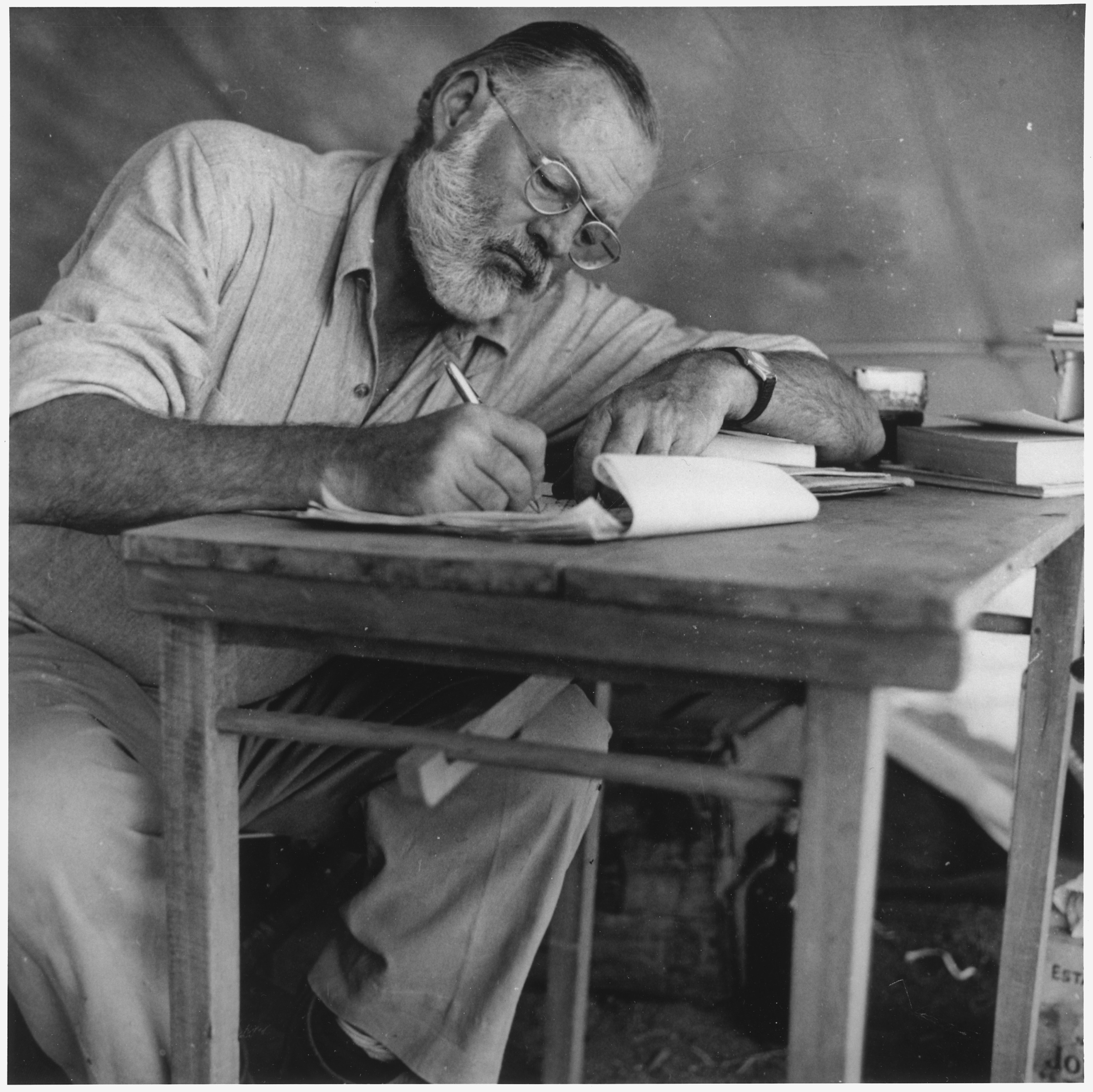
Write hard and clear about what hurts. – Ernest Hemingway

By PJ Parrish

Years back, I had the pleasure to hear David Morrell speak as luncheon guest of honor at a writer’s conference. Now, if you’ve ever been lucky enough to hear David or better yet, talk to him, you know he’s a fount of fabulous advice for a writer, no matter where you are on the food chain.

That day I heard him speak, I was well into my own career, so I was munching away on my carrot cake, listening but also mind-wandering. Then he said something that made the hairs stand up on my neck.

“Write about what you fear most.”

I sat there stunned. Tears threatened. Because David had poked a wound in me as a writer. I had been struggling with a short story. It felt artificial and too cool. And I realized, sitting in that ballroom fork in mid-air why. I had been unwilling – or unable – to confront my demons.

I knew the demons were there. That was why I had chosen the story I did. (Or did it chose me?) But I was holding the demons at arm’s length. Or maybe hiding from them. The next day, I went back and started over. It was a hard story to write. But I finished it. I didn’t publish it, but I finished it. And it taught me a great hard lesson.

You have to be willing to open a vein.

David Morrell talks often about a book called The Gift of Fear. The author Gavin de Becker says we should all learn to trust our gut instincts to protect us from life’s traumas and, ultimately violence. But David suggests the book has lessons for writers:

As de Becker says, we have all these signals coming at us all the time, and some people choose to ignore them, and get mugged, or have their car stolen, or terrible stuff, because they say, “I kind of knew there was something wrong there, but I thought, oh heck, it doesn’t matter.” Well, when you feel that, it, it does matter, and basically that’s what my books are about: the gift of fear.

David speaks from experience, and is not shy about sharing this. After his father died in WWII, his mother was forced to put him in an orphanage for a time. When she remarried, his step-father was a brute who hated kids and there was constant fighting in the house. From an interview:

I was in fear for much of my early years. And in my fear, I told myself stories. I was at the time, four years, five years, six years old, and I told myself stories in which I was the hero, and rescuing people or whatever—in effect, rescuing myself.

He carried this into his career as a bestselling thriller writer. If you’ve lived under a rock, you might not know that he is the father of Rambo. He has produced a long, stellar, bestselling list of other novels that range from spy novels to Victorian mysteries. But his theme is always human fear, and his characters’ struggle to suppress it or else give in to it.

He’s not afraid of fear.

In 1987, his teenage son died from complications from a rare bone cancer. David took his panic attacks, despair, grief and deepest fears and turned them into a memoir, Fire Flies. Stephen King wrote of it: “I found myself almost speechless…It left me feeling shaken, uplifted, and terribly moved.”

Many other writers have found their voices in what they fear. John Green, author of The Fault Is In Our Stars, was stricken with severe anxiety and obsessive compulsive disorder, unable to escape “the spiral of my own thoughts,” as he put it. With therapy and medication, he recovered and wrote Turtles All the Way Down, a wrenching novel about what it is like to live in constant fear of your own mind.

“Coming out of that, it was difficult to write about anything else,” he told an interviewer. “The topic demanded itself.”

One of my favorite early reads, The Bell Jar, is irrevocably associated with Sylvia Plath’s experience with depression, with the character Esther Greenwood’s mental breakdown mirroring Plath’s own. On the Road is based on Jack Kerouac’s real life drugged out road trip with his friend Neal Cassady. Amy Tan’s brilliant novel Joy Luck Club is based on her immigrant childhood in San Francisco. In an interview, Tan talked about how writing the novel moved her to connect with her difficult mother:

When I was writing, it was so much for my mother and myself…I wanted her to know what I thought about China and what I thought about growing up in this country. And I wanted those words to almost fall off the page, so that she could just see the story, that the language would be simple enough, almost like a little curtain would fall away.”

The story I like most on this subject involves Fitzgerald and Hemingway. Of course.

Fitzgerald, flush from his success with The Great Gatsby, started working on his next novel. It was about a glamorous couple living in the South of France. By this point, his wife Zelda was hospitalized with schizophrenia and Fitzgerald was broke, borrowing money from his editor, and drowning in alcohol. The novel, Tender is the Night, told the sad tale of the self-destructive Dick and Nicole Diver.

A month after it came out, Fitzgerald wrote to Hemingway to ask his friend’s honest opinion of the book. Hemingway wrote back: “Forget your personal tragedy. We are all bitched from the start and you especially have to hurt like hell before you can write seriously. But when you get the damned hurt use it—don’t cheat with it. Be as faithful to it as a scientist—but don’t think anything is of any importance because it happens to you or anyone belonging to you.”

There’s a lesson in that for us mortal writers. Yes, write what you fear most. Plumb your life experiences. Use your pain. Write what you know.  But there’s a trick.

I have a writer friend named Jessica Lourey. Jess writes two terrific mystery series, kids books, women’s fiction and fantasy. But her non-fiction book Rewrite Your Life, is what I’d like you to take a look at for our purposes today. Jess writes about how writing fiction can help you heal the wounds in your life. She gives TED talks to non-writers about the power of memoir writing. But her book is full of good advice for novelists:

When writers base fiction too closely on their own experiences, they can sometimes lose the ability to truly play with the story. I think this is because they are not consciously making as many decisions as a writer of “pure” fiction. They can be tempted to simply record what happened in real life (and to skip inventing material to fill in the gaps of their own knowledge about other people’s motivations or bits of the experience that they didn’t notice), instead of pondering how to best tell a good story. I’ve known writers whose story details should have been changed or expanded to better support their theme or create atmosphere, but who resisted the suggestion that they do so because “this is how it really happened.”

Most of us have encountered folks who say, “Boy, do I have a story to tell.” Or “my life would make a great novel.”  Instinctively, all fiction writers know the problem with this. Yes, every human walking the earth has a unique story to tell. But few have the ability to tell it in a way that emotionally touches others.

That’s the trick.

The trick is to face your fear and turn it inside out and upside down. Your own true experiences – be it the horror of war, the loneliness of childhood or the terror of domestic violence – is only fodder. If you spill it out too raw on the page, it can feel strangely trite and, in the case of my short story, artificial. The trick is to take your specific and deeply personal emotions and experiences and make them feel universal. Your pain has to become something bigger.

Your story begins inside you. But in the end, it belongs to your reader.

How to Handle Critiques

After undertaking quite a few first page critiques here at TKZ, it occurred to me that it might be timely to (re)consider the role of critiques and, perhaps more importantly, how a writer should handle the feedback received.

Receiving criticism, even when constructive (but especially when it isn’t!)  is never a pleasant experience (and trust me, I’ve been there many, many times) but it’s a vital part of any writer’s review process. The tricky part comes when the feedback provided isn’t consistent – which quite often it isn’t (Hint: when the feedback is consistent, it’s usually worth considering!). As we’ve seen here at TKZ, reviewing someone’s writing is a very subjective experience. So how should a writer handle multiple points of view, advice and feedback?

Here are some of my thoughts – based on my experience with beta readers, reviewers, writing groups, agents and editors….

Trust the opinion of those you admire and who genuinely want you to succeed in your writing.

I would say everyone who provides feedback here at TKZ is supportive of the brave souls who submit their work for a first-page critique – so this comment is more directed to other reviewers or writing groups, where sometimes the quality of the feedback provided may be colored by differing degrees of experience as well as intention (just saying!) so make sure the advice you’re getting is from people whose honest opinion you admire and trust. This also means not seeking opinions solely from friends or family members who may hold back on giving you an honest appraisal out of fear of hurting your feelings.

Look for consistent themes in the feedback provided.

If everyone has difficulty say with the voice or POV you’re using in your work, even if their advice differs on how to fix that, I’d genuinely consider the issue. If a consistent ‘flaw’ is identified by multiple reviewers, then it’s always worth take a close look at the problem even if, as the writer, you disagree with the solutions offered.

Avoid comments that are vague and focus on the specifics.

There’s not much a writer can do with ‘I just didn’t like the character’ feedback so it’s much better to focus on specifics rather than vague generalities. That being said, if everyone gives you the same (albeit vague) feedback, then fundamentally something isn’t resonating with readers so, as a writer, I’d take that feedback on board and see what I could do to fix it.

Discuss comments and feedback with those your admire and trust

Sometimes, when my agent has identified an issue I haven’t even thought of, and none of my beta readers have identified, I’ll go back to them with her comments – and 9 times out of 10 they will agree…so it’s always worth bouncing ideas and feedback with your reviewers. This often leads to greater clarity and consistency in terms of what may not be working in a story.

When multiple, conflicting, but specific feedback is given, go with what feels right for you… 

This is the trickiest aspect of dealing with inconsistent feedback and, as writer’s gain more experience, it does get easier to identify what rings true and what doesn’t. In one of my writing groups, I’d sometimes get random feedback that I quickly realized was completely wrong for the genre of book I was writing, or which led me down a path that wasn’t going to work for me. It’s extremely hard, though, to sift through all the comments given in a writing or critique group and know what feels right. In that situation, I’d go back to my initial comment about relying on the feedback of those you trust and admire and who really want you to succeed in your writing.

But also take a big step back to see what the heart of the issue might really be…

One of our TKZ alumni, Larry Brooks, identified it best in his book ‘Story Fix’ – where he noted that what brings a story down is often less about the writing and more about the inherent appeal and strength of the story itself. So when digesting the plethora of feedback  you’ve received, I’d initially classify the advice into two buckets (1) feedback on the actually mechanics of your writing (weak grammar, clumsy sentence structure etc.) and (2) feedback that goes to the heart of the story you are trying to tell (POV, appeal of characters, dramatic tension etc.). It’s much easier to fix issues that reviewers identify in bucket number (1). Feedback the falls into bucket (2), may require you to take a long hard look at the concept and premise of your story. That doesn’t mean despairing, it just means going back to identifying the core of story you are hoping to tell and seeing whether it holds up under scrutiny. That could be the first step in identifying what is going wrong and the best way of rectifying it.

So TKZers, what advice would you give, particularly to our brave first page submitters, on handling multiple, sometimes inconsistent, feedback when it comes to your writing?

What Should I Expect From My First Novel?

by James Scott Bell
@jamesscottbell

I got an email the other day from a young writer seeking advice about his foray into self-publishing. Here’s a clip:

As for my career this is going to be my debut work and as an author I currently have no following. My goal with the book is to establish myself professionally and get a small following going as well as bring in a good amount of money for a first book. My question is what are some steps I can take to build publicity about the book and myself without having any real following or platform?

Here is my answer.

  1. A small following does not bring in “a good amount of money”

Of course, what qualifies as a “good amount” varies, but I’m assuming this writer means more than Starbucks money. To get there, you’ll need a large following and more than one book. When it comes to anything in the creative industry, if you are only focused on money, then you’re passion won’t shine through as much as you’d like to think. A lot of people can get caught up in this, especially just starting out. I know a few elderly people who were writers and did it becuase they loved it. After a while, they started publishing their stories and made a lot of money from it. A number of years after, they decided to retire. But because they had been writing for so long, they didn’t know where to begin on the retirement journey. So, they were advised to look into specialist companies like KeyAdvice for financial advice. I still speak to them sometimes and they tell me about all their stories about the holidays they have been on and how they are still writing. Not for profit, but just because they love it that much. Being an author can be rewarding. Everything will eventually fall into place for us creative individuals. We all need money to get by, but this shouldn’t just be your main focus.

So here’s what you should do to start off as an author…

  1. Attract a following with really good books

And what qualifies as a good book? Any book that follows all the advice on Kill Zone.

Ahem.

Only halfway kidding. It’s a book that is crafted in a way to connect with readers. It’s a book by an author serious about that craft. Which means …

  1. Get serious about your craft

Because this is what you want to do. But there’s a big difference between wanting to do something and actually doing it well. Get feedback from a critique group or beta readers or professional editors. And…

  1. Plan ahead

Even as you’re finishing your novel, be developing two or three or four more, because …

  1. Your first novel will probably not be ready for prime time

They say everybody has a novel inside them, and that’s usually the best place to keep it. Really. First novels are almost always best seen as a learning experience. Rarely does an author hit it out of the park on the first pitch. In the “old days” of traditional publishing (roughly 1450 – 2007) the vast majority of authors went through many rounds of rejection, and it was that third or fourth or fifth novel that finally sold.

There were some notable exceptions, like Brother Gilstrap’s debut effort, Nathan’s Run. An exception which, you guessed it, proves the rule.

Today, of course, you can easily self-publish, but that ease is a lure, because …

  1. Self-publishing is not a get-rich-quick scheme

The explosion of content out there now demands not only that books be of good quality, but that the author understand and implement some basic fundamentals about running a small business.

Self-publishing can be a profitable enterprise if you …

  1. Produce and market at a steady clip

The only real formula for making bank as an indie is quality production over time, sprinkled with a modicum of marketing knowledge. Keep in mind that the single greatest factor in selling books is word-of-mouth. Hands down. Glitzy marketing efforts only get you so far. Your books have to do the heavy lifting, so don’t fall into the trap of thinking the only thing that matters is how vigorously and breathlessly you check all the marketing boxes.

Keep writing and learning on parallel tracks, and …

  1. Don’t go shopping for a yacht

At least not until you can pay cash for it, and have enough in the bank for docking fees, upkeep and a crew. Which reminds me …

  1. Learn to handle money like a Scottish shopkeeper

That’s good advice for anybody, no matter what they do. But what you do is write, so follow the above advice and…

  1. Repeat over and over the rest of your life

A real writer writes and does not stop, even if it means managing only 250 words a day between family or work obligations. Even if it means you’ve got a broken leg and you’re in a cast that’s hanging on a chain from a rack over your hospital bed. You can still talk 250 words into Google Docs through your phone.

That is what you can expect from your first novel.

So, Zoners, what did you all learn by finishing your first novel? Where is it now?