The Value of Libraries

“A library outranks any other one thing a community can do to benefit its people. It is a never failing spring in the desert” – Andrew Carnegie

My local library is a hive of activity with a bustling cafe attached, a used book sale area, and a busy downstairs where almost every table is occupied by 10am with people working on laptops, reading newspapers, or logging on to the free wifi on the row of public computers available. Upstairs, there is wonderful children’s section with story time and other parent-children activities, and meeting rooms that hold an array of community events and speakers. I remain thankful that my local community and government values a library such as ours because in many other places, the very existence of community libraries is under threat. In the UK for example, nearly 500 libraries have closed since 2010 and many libraries are now being run by volunteers due to budgetary costs and restrictions. The results of this are heartbreaking, especially since, by many accounts library use is actually on the increase (see The Guardian’s report on library closures here).

After seeing posts on Twitter about the rise in volunteer-run libraries in England, I began to think more carefully about what libraries mean to me and my community. They are more than just a place to borrow books or DVDs or CDs – for some it’s a safe, warm, place to read or study, for others it may be a way to find social connection in their lives, and for some people it might be their only way of accessing the internet (which could be crucial in terms of a job search or education). The more I thought about libraries, the more I realized how lucky I was to have such a fantastic one in my community.

Growing up in Australia, our local library was really my only source of research (yes, this was in the dark ages before the internet) and it was a family outing to go there to borrow books or to get material needed for dreaded homework assignments. Now, although I can access much of my book research online, I still find myself drawn to my local library – and I’m frequently seen laden down with books as I struggle back to my car. Our library recently updated their online ebook lending system (the app is called Libby) which makes it easy to borrow ebooks and download them to my Kindle. So for me the library has immediate, work related value, in that it enables me to undertake research without completely draining my bank account:) For my twin boys, the library is still their ‘go to’ place for books and they have discovered many new series and authors simply by making a decision to try something new (no risk as no money was expended!).  For many others, the library provides intangible benefits too – offering a means of attaining social mobility, self-improvement and providing opportunities to reach beyond the limitations of social or economic class.

Still, I wonder in this day and age whether people still value libraries the way I do – so I was heartened to read the American Library Association’s annual report (which you can view here) that indicates that American libraries are still receiving the funding and attention they deserve (though that’s not to say there aren’t still challenges or threats to that!).

So TKZers, I’d love to know what libraries mean to you. Do you still visit your local community library on a regular basis? What do you think is the value of a library today?

 

What I Wish I’d Known When I Started Writing

by James Scott Bell
@jamesscottbell

Next year will be my 24th as a professional writer.

When my first book hit the shelves nobody used a cell phone (Seinfeld had that big brick handset with the antenna, remember?) O.J. Simpson had been found not guilty and Bill Cosby was still America’s most beloved dad. Microsoft released Windows 95. And a guy named Bezos launched a website that was purportedly going to sell books to consumers right over the internet! Everybody thought he was nuts.

For the seven years previous I’d been studying the craft of screenwriting and fiction, and writing every day. I devoured books on writing and gobbled up each monthly issue of Writer’s Digest. I have several shelves of my beloved writing books (and binders full of WDs), all highlighted and sticky-noted in some form or fashion. Every so often I like to pull one off the shelf to see what I highlighted, and relive some of the excitement of discovering something that worked for me.

The other day took down The Complete Guide to Writing Fiction by Barnaby Conrad, published by Writer’s Digest Books. It’s a collection of articles and interviews from the famous Santa Barbara Writers Conference, which Conrad directed for many years.

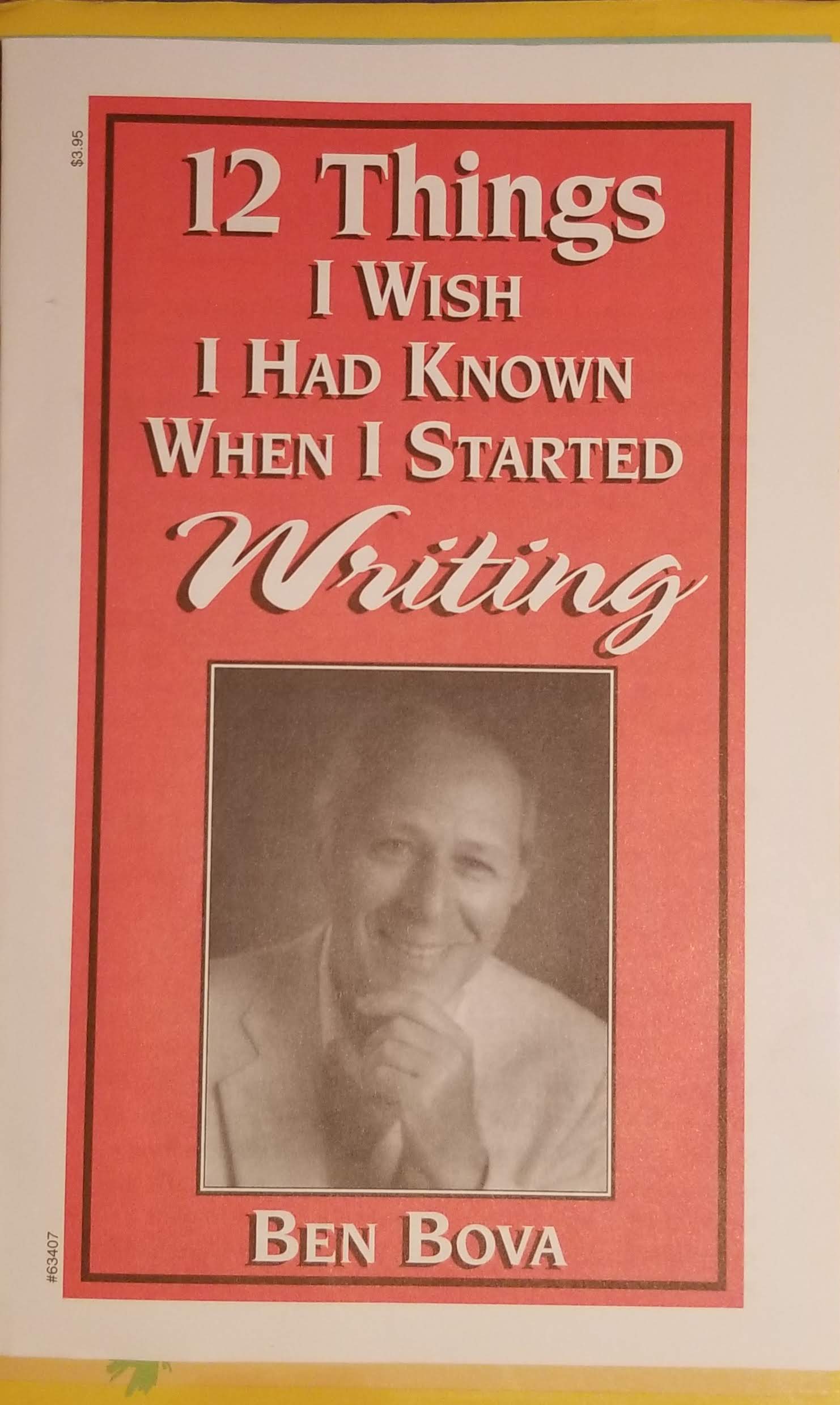
There was something tucked inside the book. It was a pamphlet titled 12 Things I Wish I Had Known When I Started Writing by Ben Bova, the science-fiction writer and editor. I think this came as a freebie with a book ordered from the Writer’s Digest Book Club, of which I was an enthusiastic member. So I had another look at Bova’s lessons and thought I’d reflect on them with you today. The first two are unsurprising:

  1. Write every day.
  2. Read widely.

All serious writing students know this, though I would edit the first one thus: write to a weekly quota. Figure out how many words you can comfortably write in a week, then up that by 10% for your goal.

  1. Write about WHO you know.

Bova stresses the importance of well-rounded characters. Basic, of course, but coming from the sci-fi genre Bova knows it’s a temptation to overemphasize world-building.

  1. Character + Problem = Story.

I would change Problem to Plot, where plot is defined as a life-or-death battle which the character meets by strength of will.

  1. No villains.

This is Bova’s most important tip. The “villain” does not see himself that way. “Every tyrant in history was convinced that he had to do the things he did, for is own good or for the good of the people around him,” Bova writes.

I always counsel writers to know the bad guy’s “closing argument.” If he were on trial, what would he say to defend himself? And mean it?

  1. Start in the middle.

My heart sang. Had Bova anticipated Write Your Novel From the Middle? Ahem. No. He was talking about the opening pages, and he echoes one of my constant refrains: act first, explain later. Bova explains:

[Start] your story in the midst of brisk, exciting action. Start in the middle! Don’t waste time telling us how your protagonist got into the pickle he’s in. Show him struggling to get free. You can always fill in the background details later.

Particularly in a novel, it’s tempting to set the scene, explain the protagonist’s background, describe how she got to where she is. Cut all that out. Or, at least, save it for later. Start in the midst of action. Hook that reader right away or you won’t hook him at all.

  1. The chain of promises.

Don’t present a problem on page one and then solve it. Pile them up. “Each problem you present to the protagonist is a promise to the reader that there will be suspense, excitement, adventure in solving that problem.”

  1. Use all five senses.

Bova rightly notes that writers tend to favor sight and sound. Add touch, taste, and smell.

  1. Point of view.

Bova makes a case for close 3d Person, so you can be intimate with a character in one scene, then cut away to another character, and so on. He does not favor First Person because he finds it too limiting. Hmm. Tell that to Raymond Chandler.

The last three tips come from another world, when hard-copy manuscripts were submitted to agents and editors. Imagine that!

  1. Make your manuscript readable.

“Typed, whether on a typewriter or a computer printer.”

Remember when that was an actual choice?

  1. Study the markets.

“Publishers think in categories. You must too.”

  1. Cover letters.

“And always remember to include the SASE.”

(For you kids out there, SASE stands for “Self-Addressed Stamped Envelope.” Ask your parents what that means.)

All this got me thinking: what is something I wish I’d known when I started out? I’ll give you a twofer:

  1. Scene Structure.

I wrote four or five screenplays that didn’t generate any interest. What finally broke me through was an epiphany while reading Jack Bickham’s Writing Novels That Sell. Specifically, his chapter on scene and sequel. More specifically, understanding the scene beats of Goal, Conflict, Disaster. No more weak or meandering scenes after that. The next script I wrote got me an agent.

  1. The Mind is as Important as the Keyboard

The initial thrill of being published eventually ran into a new set of challenges familiar to all writers who make it inside the gates of the Forbidden City. Stuff like comparison, envy, self-doubt, bad reviews. All of which interfere with the joy of writing. Faith and family were in place for me, but I also studied specific topics like gratitude, contentment, focus, and discipline. So important are these that I wrote a book to help writers prepare for and deal with the mental game of writing.

So, TKZers, if you’ve been around the block, what is something you wish you had known when you were starting out?

And if you are just starting out, what is something you want to know? Ask away, and one of our crack team of bloggers will take a flyer at an answer—for I am in travel mode today and my check-in may be sketchy.


Series, -Ogy, or Stand-Alone?

By John Gilstrap

I am often asked about the business and creative considerations of writing a thriller series as opposed to writing stand-alone thrillers.  The truthful answer is a shrug and a heartfelt “I don’t know.” But having written both over the course of my career, I guess I have some thoughts to share.

An -ogy is not a series.

A trilogy or a quintilogy is not a series.  It is a single story broken up into parts.  As I understand it, Tolkien’s Lord of the Rings trilogy was originally a single manuscript.  There being no market for a 900,000-word book, however, he broke the one story into multiple parts.  I don’t know if that story is true, but I like it because it proves my point.  In an -ogy, there’s no anticipation from the reader for a completed story at the end of any volume but the last one.

The Harry Potter saga is another example–one with which I’m more familiar because I actually read the books.  Not to be confused with Hobbitty stories, which I have not.  Book One of the septilogy (is that a word?) is dedicated mostly to establishing the wizarding world, along with establishing relationships between the kids.  The whole business of the Sorcerer’s Stone is more of a MacGuffin.  At the end of that volume, while there is a sense of continuing peril, Harry’s immediate world is stable.  Looking back on those books, I believe that Rowling wrote Sorcerer’s Stone in a way that it could have lived on as a stand-alone if the market had not embraced Harry and Hogwarts.

Beginning with Book Two, and continuing all the way through to the end, the Potter story was a continuous one.  Even though Harry resolved the immediate crisis of each book, the last pages always revealed more impending doom.  There was no real resolution.

A series is more episodic.

My Jonathan Grave thriller series is not a continuing story, but is rather a collection of stand-alone stories that involve recurring main characters.  Jonathan Grave’s character arc over the course of eleven books now is very long and slow, while the arcs of the characters he interacts with are completely developed within each book.  There are Easter eggs for readers who have read all the books in order, but I am careful to make each episode as fulfilling for a reader who picks up  Book Ten as their first exposure to the series as it is for a reader who’s been with me from the beginning.

Writers like the always-fabulous Donna Andrews write series that are driven as much by place as by characters.  The people in her fictional town of Caerphilly, Virginia, are a hoot, even though an extraordinary number of people are murdered there.

Jeffery Deaver’s Lincoln Rhyme solves a new crime by the end of every book.  While Rhyme’s medical progress as a quadriplegic is continually evolving from book to book, as is his relationship with Amelia, a new reader is well-grounded in any story, without benefit of having read the previous ones.

A stand-alone, well, stands alone.

When I finished Nathan’s Run, the story was over.  There was no place I could feasibly have taken Nathan or the other characters to tell a new story.  That was the case with each of the following three novels and, of course, with my nonfiction book.  I think the primary characteristic of a stand-alone is that “The End” means the end.  The character and story arcs have all been driven to ground.

A series takes planning.

When I was writing No Mercy, the first book in the Grave series, I knew in my heart that I had finally landed on a character who could support a series.  What I didn’t know was whether or not a publisher would buy it, and if they did, whether they’d support the idea of developing the one story into many.  Still, I made a conscious effort to plant as much fodder as I could for potential use in future stories.  For example:

  1. Jonathan is a former Delta Force operator, leaving the potential for stories dealing with his days in the Unit.
  2. His hostage rescue activities are a covert part of a legitimate private investigation firm that does work for some of the largest corporate names in the world.  This sets up potential stories set in the world of more common private investigators.
  3. Jonathan is the primary benefactor for Resurrection House, a school for the children of incarcerated parents.  When every student has parents with lots of enemies, there’s lots of potential for future stories.
  4. His home, Fisherman’s Cove, Virginia, is the town where he grew up.  This puts him in the midst of people who already know the darkest secrets of his childhood and accept him for who he is.  Or they don’t.  This sets up the potential for small  town conflicts.

There are many more such seeds, but there’s no need to highlight them all.  The point is that unlike a stand-alone, a series needs to be engineered not just for the current book, but for future books as well.

What do y’all think?  Do these resonate with you?  What have I forgotten?

And finally, tomorrow is Thanksgiving here in the United States.  For those who celebrate, I wish you a wonderful time with whatever your holiday traditions may be.  For those of you who read this from somewhere other than America, I wish you a great day with lots of high-calorie food and televised sports!

When Should A Story End?

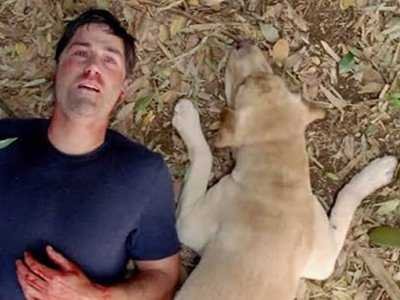
Vincent the Lost dog with dead friend

I suppose sequels are inevitable for a writer of a certain age. — John Updike

By PJ Parrish

We’re binge-watching Breaking Bad in my house lately. I know, I know…I am the last one to the party, but now I am hooked. Great characters (and a lesson in how writers can make even the most reprehensible people sympathetic). Great plotting (and a lesson on how writers should strive to make each plot point arise organically from character).  And each episode ends with a cliff-hanger.

We’re almost to the end. So the husband and I looked at each other last night and said, “how in the heck are they going to tie this up?” And the first thing I thought was:

Please, don’t let it be another Lost.

Do you remember Lost? The survivors of Oceanic Flight 815 were 1,000 miles off course when they crashed on a lush mysterious island. Each person had a shocking secret, but so did the island — an underground group of violent survivalists that made The Time Machine’s Morlocks look like teletubbies.  I loved that show, grooving on its nerdy sci-fi cum mythology thing. But somewhere around season three, things started to get…dumb. I was mentally exhausted trying to make sense of it all (what’s with the polar bear? Who cares how Jack got his tattoos?) and finally, I gave up. Plus I was too worried that Vincent the Labrador Retriever would get killed. One by one, all his owners did.

I think what happened with Lost was that it was so hot that ABC got cynical and said, “Find any way to keep it going!” It felt like the writers were just winging it, with no real thoughtful end ever in sight. (This happened with season two of the original Twin Peaks, you remember). Apparently, I should have toughed it out with Lost. Rabid fans tell me the writers found their focus again and that I missed a great payoff. Today, the series is being reassessed as break-through serial television, giving TV bean-counters the guts to take chances on great stuff like Game of Thrones and yes, Breaking Bad.

All this was on my mind the other day because I read an intriguing article in the New York Times by Amanda Hess called “The Curse of the Never-Ending Story.” Click here to read it. Hess bemoans the trend of turning stories into franchises that trudge across Hulu and populate Amazon like zombies, always alive when they should be dead.

Today, the tradition of the novel has been supplanted by that of the comic book: Stories that extend indefinitely, their plot holes patched through superpower, magic and dreams. Or maybe every story is a soap opera now: Nobody is dead forever, not Dan Conner of Roseanne and definitely not the superhero genocide victims of Infinity War. To Hollywood’s bean-counters, sequels are mere brand extensions of intellectual property. The logic of the  internet is colonizing everything.

So far this decade, 17 of the top 20 top grossing movies were sequels. Television is eating itself alive with reboots (Lost in Space, Will & Grace, and egad, Murphy Brown wearing a “Nasty Woman” t-shirt). And apparently, there are second acts in American life: Harry Potter made it to Broadway.

I am not sure what this means for us novelists. For those of us who write series crime fiction, it can be a struggle to keep our plots fresh without straining credibility. How many times can our hero get shot or beat up? How many bodies can turn up in Cabot Cove, the apparent murder capital of the world? How deep do we dig into the brains of our hero without looking like that creepy family in Get Out?

But maybe this is really in my thoughts right now for a different reason. One that I don’t want to deal with.

Back in 2015, our stand alone SHE’S NOT THERE was published by Thomas & Mercer.  I loved writing this story about Amelia Brody, an amnesiac who is convinced her husband tried to kill her so she goes on the run. It is, at its thematic heart, about what happens to your soul when you try to live an inauthentic life. It is about a woman whose past is erased, so she must painfully reconstruct it before she can have a chance at a future. When I typed THE END, I was convinced I had nothing more to say.

The problem I don’t want to deal with? I think I might be wrong.

In SHE’S NOT THERE, there was a skip tracer named Clay Buchanan who was hired by Amelia’s husband to track her down and kill her. Buchanan was one of those characters who emerge from the ether of the imagination unbidden; he was supposed to be a cameo, but he became a second protagonist. Amelia is desperate to remember her past. Buchanan is desperate to forget his. His wife and infant son disappeared ten years ago and he was accused of murdering them. He was cleared but his life was broken, especially because he lost custody of his daughter. Like Amelia, he can’t move forward until he fully confronts his past. Throughout the book, I use a devise where his dead wife speaks to him — or, in his grief, he believe she does. In one scene, he is looking at a photograph of his wife:

Buchanan stared at the photo then he looked up, into the shadows of his bedroom.

“Are you here, Rayna?”

He heard nothing.

“I need to know something,” he said. “I need to know if it’s too late.”

Still, silence.

For the first time, she is gone. But in this “man in the mirror” moment, Buchanan makes the decision that he will find out the truth about what happened to her. Until he knows for certain, he can’t move forward. This happens on page 362, the second to last chapter. When we wrote this scene, we had no intention of revisiting Clay Buchanan. I believed just having him decide to take action was enough. But then readers weighed in — often and loudly.  They wanted to know what was going to happen. They want to hear Buchanan again. They weren’t content with silence.

I have mixed feelings about this because I’ve always believed that all stories have a logical end, that you shouldn’t over-explain. I’ve always believed in the power of ambiguity, even in unhappily ever after. (I blogged HERE about it a couple years back). I believe in leaving some space at the end of a story for readers to fill in the missing pieces themselves, to imagine what a character’s life is like after they close the book. I like the idea that readers can “write” their own epilogues.

But I think I might be wrong this time. I think I might have to write a sequel.

I’m having trouble getting moving on this book. Partly is it because I don’t want this to feel forced or derivative. I don’t want this to be a soap opera. Maybe I have seen too many bad movie sequels that felt cannibalized or read too many series thrillers that felt phoned in. Maybe I am just worried because, so far, Clay Buchanan isn’t talking to me. Or maybe it’s just that I’m not listening hard enough.

My sister Kelly keeps telling me, as she always does when I am blocked, to just have faith, that we will figure it out before we’ve been there before. But with this one, we haven’t. I don’t know how this is going to turn out. As they say in the serials, stay tuned…

Let’s Talk About the Skeleton in the Room

By SUE COLETTA

I’ve seen way too many medical professionals in the last six months (living with rheumatoid and psoriatic arthritis isn’t always easy). As Joe pointed out Saturday—beautifully, I might add—life as we know it can change in an instant. In short, remember to have fun. Laughter really is the best medicine.

One way I’ve amused myself while waiting in the exam room is by analyzing the skeleton suspended by a metal pole. You know the one … the staff usually names it Fred, or something equally common, as though the name will somehow lessen the impact of bad news.

What I find fascinating is the fact that the vast majority of doctors and nurses don’t know the sex of their skeleton, evident by the female skeletons tagged with a male name.

Determining the Sex of a Skeleton

Many differences exist between the two sexes, and the variations run as deep as our bones. This becomes especially important for corpses found in an advanced stage of decomposition. All that might remain is the skeleton, perhaps teeth, and possibly some hair. Even if the pathologist has teeth and hair to work with, that doesn’t mean enough DNA material remains to identify the victim.

This is where the skeleton offers more information. The only exception would be that of a pre-adolescent, where sexual dimorphism is slight, making the task much more difficult. Need to buy time in your story? Murder an adolescent. (Oh, no, she didn’t just say that.) Or have the killer shatter the key areas of the skeleton.

The most common way to determine a skeleton’s sex is by bone size. Not the most accurate, but it’s a starting point. Male bones are generally larger than female bones because of the additional muscle that increases on the male through adolescence and into adulthood.

Another good inclination of sex is the pelvic area.

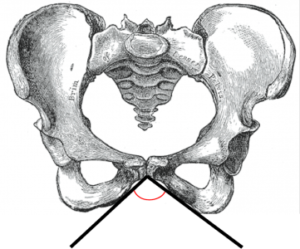
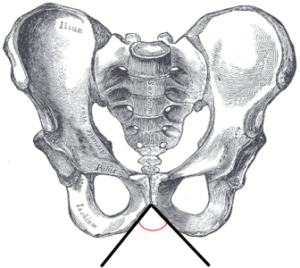
The sub-pubic angle (or pubic angle) is the angle formed at pubic arch by the convergence of the inferior rami of the ischium (loop bone at the base) and pubis (top of loop) on either side. Generally, the sub-pubic angle of 50-60 degrees indicates a male. Whereas an angle of 70-90 degrees indicates a female. Women have wider hips to allow for childbirth.

Female

Male

There are also distinctive differences between the pubic arches in males and females. A woman’s pubic arch is wider than a male’s as is the pelvic inlet to allow a baby’s head to pass through.

The pubic arch is also referred to as the ischiopubic arch. Incidentally, this difference is noticed in all species, not just humans.


The area around the pelvic inlet (middle of the pelvic bone) is larger in females than in males. A female skeleton who has given birth naturally will be identifiable because this space widens during childbirth. Even though it contracts afterward, it never fully returns to its original size. In the picture above notice the heart-shaped space.


If you don’t want the pathologist to easily ID the victim, perhaps the neighborhood bear takes off with the pelvis bone. You could also have him return for the rest of the body as the coroner is examining the corpse. Talk about adding conflict to the scene! Just remember, most black bears don’t eat human flesh (in my area, anyway). So, do your homework. Grizzly bear, anyone? How about a Kodiak brown bear?

Other Body Clues

The acetabulum—the socket where the femur (thigh bone) meets the pelvis—is larger in males. Also, the head and skull have several characteristics that help the pathologist (or crime writer) determine male from female.

  • In males, the chin is squarer. Females tend to have a slightly more pointed chin.
  • The forehead of males slant backward, where females have a slightly more rounded forehead.
  • Males tend to have brow ridges; females do not.

These differences and more tell the pathologist the sex of the deceased.

So, the next time you’re sitting in an exam room, get friendly with the skeleton in the room. Who knows? You may even sell a book or two when you educate the staff. Do it nicely, though. Some medical professionals don’t like to be schooled by a crime writer, as weird as that sounds. 🙂

Wishing you all a joyous Thanksgiving!


Why We Write

by James Scott Bell
@jamesscottbell

Those of us who teach as well as write are always glad to hear that something we suggested helped a fellow scribe. I got an email the other day that I have to share. With the kind permission of the sender, here it is:

Dear Mr. Bell

I want to thank you. You helped me find something that I had no idea I had in me.

A few minutes ago, while reading your book “Plot & Structure”, I completed Exercise 1. As per your instruction, I wrote from the gut. [JSB: This is a free-form, just let-er-rip exercise, no judging or stopping, asking yourself what kind of writer you wan to be.]

The result surprised me deeply. I never knew that I could write something like that 15 minutes ago, and I never realized the kind of author I want to be.

As a thank you, I am including in this email the text I wrote. It is exactly the way I first wrote it, and I haven’t even read it myself yet:

“When readers read my novels, I want them to feel that they have just been on a journey to a new world, a different universe. I want them to feel amazed, I want them to feel like they have never read anything like that before in their lives, I want them to feel that if they want to experience this kind of suspense again, they have to read my stories. I want them to think about what they read the next day, the next year, I want the story they read to mean so much to them that they will be planning to show it to their unborn children one day. And most important of all, I want them to keep wanting more at the end.

That’s because, to me, novels are a way for me to share my soul. Novels are the sum of all that is important in life, the sum of all of the things that make us smile, laugh, cry, scream, terrified, look over our shoulders on a dark alley, everything that we hope one day happens to us. They are our hopes, our fears, our dreams and nightmares, what elevates us to heaven one day and crushes us back to the earth with the might of a thousand heavens the next. A good story is a communion, it is something that a billion people who have never met each other share, it is a way for everyone to look up to the sky, or deep inside themselves, and recognize the same truth as any person might one day realize, no matter how far apart in space or time those people might live. It is a timeless truth, it is the very fabric of our souls, it is how we recognize each other and how we recognize ourselves in others. It is what makes us, us.”

It might be terrible in the end, but it meant a lot to me.

***

JSB: That is anything but terrible. It can’t be, for there is no wrong answer so long as it has come from your deepest self. Indeed, this young man got precisely the best result because it surprised him. Self-discovery is a crucial step toward writing unforgettable fiction.

This writer has taken that step.

And so I ask you, TKZers: Why do you write?

Giving Thanks

(c) Copyright Uncooked Media UK. All rights reserved.

I am going to meander a bit today. Please bear with me. I’ll get to the point somewhere in here and probably veer off again, but I’m sure you’ll understand.

I received a bit of sinus-clearing news early Thursday morning a couple of weeks ago. Let me give it to you in the manner in which my older son gave it to me, via cell phone:

“Samantha (his daughter, my granddaughter) is fine. She got hit by a car on her way to school.”

Samantha and my son live three doors and a crosswalk away from her middle school. She was crossing said street — in the crosswalk, with the light, in a school zone  — when a woman turning left struck her from the side and rear. Samantha went up on the hood of the car, rolled off, and fell to the ground. She, fortunately, landed on her side (as opposed to on a joint or, God forbid, her head). I won’t go into detail with regard to the legalities of what happened afterward as that is still unwinding (I incidentally while questioning Samantha about what happened used some of the techniques which Sue Colletta noted in her wonderful TKZ post of November 5). What is important is that Samantha is okay so far (and yes, we are keeping an eye on her) but she picked herself up, submitted to medical examinations, and went to school the next day, where she basked (probably the wrong word) in the vague celebrity that shines on someone of her age (she’ll be 12 next week) who experiences a near catastrophe and comes out of it (relatively) unscathed.

Am I grateful or thankful that she was apparently uninjured? I’m not sure. “Thankful” and “grateful are appropriate but don’t quite cover it. I don’t think I have the words. I am considering, somewhat seriously, leaving all of my worldly goods behind and joining a monastery where I can devote every waking moment to prayer and good works as a small step toward balancing the scales that tipped so that Samantha could emerge intact. There is at any given moment only a hair’s breadth between a sigh of relief and the scream of anguish that herald’s the worst day of someone’s life. The birthday party we will be having on Thanksgiving might have been spent in a hospital waiting room. Or worse.

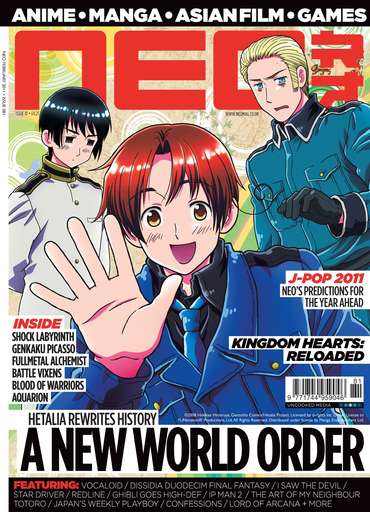
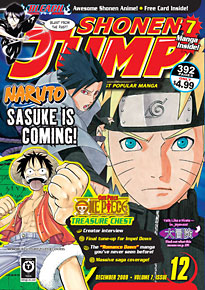
So. Flash forward to this past Tuesday. I had been trying to think of something, some minor gesture, to uplift Samantha a bit and tilt her world away from what happened and into the right direction. I happened to be in one of the local Half-Price Books stores and passed by the magazine section. There was a space jammed with a magazine called Weekly Shonen Jump which I quickly recognized as a manga magazine. For those of you over the age of forty — and what follows is a bit of an oversimplification — manga is the general name for a Japanese comic book. It is distinguished from anime, which is what we might characterize as a Japanese animated movie. The styles of both media are the same and very distinctive. I am not a fan — it gives me a headache to read/watch it — but Samantha is a huge follower. Weekly Shonen Jump runs upward to five hundred pages an issue and reprints previously published stories. Its nickname in both its American and Japanese incarnations is “phone book,” because of its thickness. The English language version (which is what I had found) goes for a cover price of five dollars an issue which isn’t a bad price at all. The bookstore was selling the issues for fifty cents each, which is, um, even better. An extremely helpful clerk who saw me looking at the magazines directed me to another stack of a publication titled Neo, a slick-paged magazine which concerns itself with manga, anime, and Japanese video games. I bought the entire kit and kaboodle of both, dropping around ten bucks for seventeen magazines that ultimately took up most of the room in the box I needed to transport them to my car.

Samantha’s school was just letting out by then so I drove over to my son’s place and showed up at the front door with the box in hand. When Samantha got home from school, I handed the box over with the words, “For you.” She opened the box and started going through it, making exclamatory noises which were followed by the awe-struck statement, “This is the most beautiful thing that I have ever seen in my life.”

(c) VIZ Media. All rights reserved.

Thankful? Grateful? Yes. My granddaughter is alive, well, and loves to read. Like I said earlier, however, I don’t quite have the words to express how I feel. I’m thankful for other things. I wake up in my own bed every morning and can put my own feet — I still have both of them. Many people don’t — on my own floor and can put on my own clothes without assistance. And I have clothes. I also have windows and doors that I can open and close at will in a house that I own free and clear in a neighborhood that is (for the most part) quiet and peaceful. If my reach occasionally (okay, frequently) exceeds my grasp, I have both arms, both hands, and ten digits with which to fail gloriously and otherwise. I also have an ungrateful and unappreciative cat who somehow still elicits the best out of me several times a day, every day. There’s food in the refrigerator and the water, heat and air conditioning works on demand. I can still work at my job and if I get tired of it I can go do something else. I have four wonderful children, who are each successful in their own way. And. I get to do this — communicate with you — which is what I am doing right now. I am thankful for you. But to have a granddaughter who loves to read and appreciates a small gift that elicits a response like the one she gave o me…as I keep saying, I don’t have the words.

Happy Thanksgiving. Please keep reading, and for those of you who fight the good writing fight, please continue to do so in order that Samantha and every child who loves to read will have great stories to enjoy for the rest of their lives. May they and you be safe for all of the remainder of their days and yours. Thank you.

Reader Friday: What’s Your Favorite Emotion to Portray?

By SUE COLETTA

On TKZ, we’ve been known to beat the show-don’t-tell drum, because it makes the scene come alive. When a writer nails an emotion so perfectly, it’s easy to visualize the moment.

What’s your favorite emotion to portray?

What’s your crutch body cue that you edit out?

Care to share a favorite line or two from your WIP, published book, or from a story you’ve read that shows a vivid emotion?

Please also share the circumstances surrounding the character, so we can appreciate the emotion in the right setting.