Parking areas around open air shopping malls these days in our part of Northeast Texas are carefully constructed mazes with cul-de-sacs, small dead pockets with only two or three slots stuck into a grassy area, and long winding loops leading back to the main entrance and exits.
I firmly believe they are designed by intent to raise my blood pressure.
Adding to the fun of trying to find a space and wishing the slots were angled instead of perpendicular to the lanes are those pesky little speed bumps that aren’t much for my pickup, but can drag the oil pan off of low-slung vehicles.
Personally, I feel it would be easier to drive into a lot reminiscent of amusement park waiting lanes. I’m sure you’re all familiar with them. Walk up to the entrance, turn left and walk alllll the way to the end, reach the post, and slog alllll the way back and reverse direction ad nauseum until it’s your turn to get on and ride of 90 seconds.
It would be preferable to creeping up and down a parking lot until you find a slot and then having someone whip in ahead of you, resulting in red faces and manic fury.
Why am I talking about parking lots and queues on a writing blog? Well, pour another cup of coffee brothers and sisters, and let me explain how my mind works.
These traffic swirls, eddies, and seldom clot-free lots are reminiscent of the plots in my books. They start with a good, simple idea that should be straightforward from Point A to Point B.
Should be.
Those who follow these blogs know I don’t outline, so the story’s progression is always an adventure for everyone concerned. I begin with a general idea, and hope the plot advances properly until the supporting characters appear at the right time take their places and guide the story. The first act usually comes together as everyone behaves themselves and sets a hopefully simple course.
It never does.
For some reason, my subplots grow like dandelions and as in the case of the project I’m working on at this writing, and I find myself turning left and right to keep up. Right now, I have a protagonist in a traditional western chased by three different bands of antagonists I didn’t anticipate.
Act II is usually difficult for me. Now at 30,000+ words into the manuscript, the loose ends that have been waving around for the bulk of that work in progress are starting to come together, and by Act III and 60,000 words, it should a fun downhill slide to the end.
But this time everything slowed at 75,000 words.
That’s unusual for me. This part usually writes itself as fast as polished steel, so I wondered why.
My characters are doing what’s necessary. For some authors, a stall in the plot is indicative of problems with character motivation. Some writers learning the trade place their protagonists in a place they shouldn’t be, forcing their creations to do something against their personalities or characteristics.
If you’re stalled because of those issues, the best thing to do is simply highlight those pages and hit Delete.
Good lord, Rev! We worked hard on those pages, sometimes sitting for days in front of the computer and staring out the window for eight hours at a time, and you want to send them into an electronic abyss!!!???
Fine then, maybe you can’t put ‘em into a shallow grave yet. Highlight, cut, and paste them in a fresh new separate document for later review, or when you’ve had a couple of cocktails and find the courage to finally hit the Big D key.
But I’m not stalled for that reason.
So I stopped, re-read all 300+ pages and realized I’d drifted away from my protagonist’s main strength. He doesn’t run. When cornered, or angered, he attacks. I’d drifted away from the one thing that makes Cap Whitlatch who he is.
We pause here for a brief recollection that directly ties into my solution and came to light while I was talking to my brother about an event that occurred back in 1976.
Feel free to pour another cup of coffee as I tell you about that night when…
…driving home from a friend’s house at two in the morning, a muscle car full of angry young men took offense at something I still don’t understand. They pulled up beside me at a light and the two on my side opened their doors and charged me. One had a tire iron, and the other carried a hammer.
Greatly outnumbered and shocked by the unprovoked attack, I hit the gas on my old ’69 Galaxie 500. The big 390-cubic-inch engine roared and I ran the light in a cloud of white tire smoke. They followed and tried to run me off the road several times for the next five miles. With no weapons of my own (and that was the last time that happened) I had few choices. There was no police station nearby and though I’d just left the house of a friend who was an officer, it as well before the days of cell phones.
I couldn’t run to my apartment, because it would still be me against four. I had no friends who lived nearby to offer assistance, but I had one ace in the hole. My old man, a veteran of the Japanese theater in WWII, lived close and slept with his windows open, with a double-barrel twelve-gauge always by the bed.
Using evasive driving skills taught to me by the aforementioned police officer friend, and relying on sharp 22-year-old reflexes, I stomped the gas as if trying to make a run for it. Just as I expected, the driver responded and soon we were running parallel at 80-miles-an-hour.
Nerves jangling, I hit the brakes at the last minute and whipped a hard right into Dad’s neighborhood.
They overshot.
Fast acceleration on my part, another quick left and a power slide to the curb in front of the Old Man’s little frame house. Tires squalling, I was out of the car in a flash. “Dad!”
A light sleeper, his voice came through the dark screen. “What’s wrong, son?”
“I need help.”
The muscle car rounded the corner and slid to a stop behind my Ford. The driver popped open his door and emerged with a makeshift weapon in his hand I couldn’t identify in the dark. The other three were out and coming for me as well.
Scared, furious, and finally cornered, I saw red and charged. “The driver’s mine!”
At that time I weighed in at maybe 135 pounds, but it was mad talking, even though that old boy was half again my size and looked as if he lifted baby elephants for fun.
From the corner of my eye I saw the Old Man step onto the porch in his drawers, but the twin bores of that big shotgun pointing at the other three was enough to make ‘em all stop. Fists doubled, I was heading for the driver when he turned and shouted.
“Gun!”
They jumped into the car, reversed, and spun out of there.
Lowering the shotgun, the Old Man watched the taillights disappear. “What was that all about?”
I was suddenly weak. “I have no idea.”
We went inside, drank a pot of Mom’s coffee at the kitchen table and wondered why those guys wanted to harm me. I still don’t know to this day, but the story doesn’t end there.
My paternal grandfather was a rural constable upon whom I based Ned Parker in my Red River mysteries. The Old Man told him what had transpired before I saw Grandpa again, and when I did, the old lawman gave me a wry grin and some great country wisdom.
“It don’t do to run a dog up on his own porch, does it?”
Remembering what happened that night gave me the conclusion to this stalled work in progress. Cal Whitlatch is on the porch (read here a rough western town) and he’s no longer running. He’s turned to fight.
Now those three subplot threads are coming together and I once again have control of what’s happening. Instead of wandering through that maze, looking for…something…the story is now clear. With that, I’m on the downhill slide to a whiz bang ending.
So here are a couple of final points.
Don’t force your characters into a situation or place they shouldn’t be. They’ll either dig in their heels, or wander around lost and confused as you put ineffective and listless words on the page.
Don’t lose your initial thread. It’s okay for the plot to veer (in that parking lot), if you come back to the final trail at the end.
It’s all right to stop, reverse, and find your way again through that maze.
It’s okay to either move stalled works to a new page for later review, or to delete them and start over. It might hurt, but you’ll get over it.
Writing something outside of that stuttering project, like this post, can jumpstart your subconscious to find the plot trail again, too.
I hope I’ve led you out of that confusing and frustrating parking lot in this ridiculously long post.




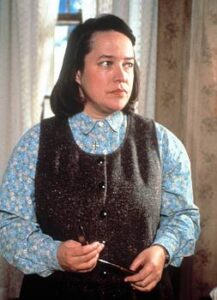





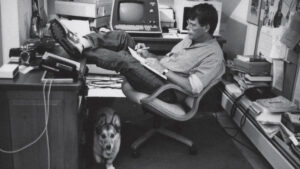 When I was growing up, immersed in dreams of one day becoming a writer, I romanticized what the process must be like. Where would one go to imagine new worlds and create new adventures? Movies romanticized the whole process, and I bought into it. Then I saw this now famous picture of a then less-famous Stephen King in his writing space. It seemed so . . . ordinary. Yet at the same time it seemed very special. The dog under his feet is a nice touch. This is a guy with a job. And his creative space is . . . an office. Just an office. But of course, it’s more than that. It’s Stephen King’s office. (As you’ll see below, it turns out that I was not the only budding young writer who was impressed by the photo.)
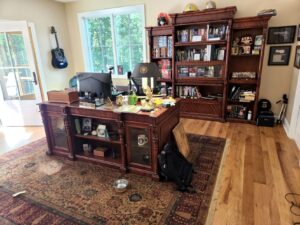 Our move to West Virginia presented a unique opportunity to design an office as an office–as opposed to a purloined bedroom. Now that I think about it, I suppose there’s not a lot of difference between the two. I wanted lots of light and direct access to the outdoors. That door leads to a deck that overlooks the woods. The orange helmet on the left end of the bookcase belonged to my father. A closer look will show that it’s quite banged up from the helicopter crash he survived on the deck of the USS Forrestal in 1959. The two yellow helmets are mine from the two jurisdictions where I ran fire and rescue. (I had to turn my white lieutenant’s helmet back in when I left.) Since the house is now run by a 12-pound ball of fur named Kimber, chew toys and water bowls litter the floor of every room.
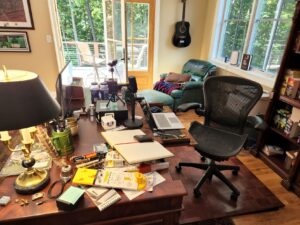 Here it is from a different angle. This is messier than it normally is, but a pinky swear is a pinky swear. Note the studio grade microphone and the webcam–a new bit of ubiquity in office photos, I’ve found. All of those Gilstrap books stacked on the far end of the bookcase are the background for Zooming and YouTube videos (when I start shooting them again). The opened journal you see on the desk is one of many that I have stacked around the place (each novel gets a new journal). That’s where I scratch my way through difficult parts of the story that are somehow resistant to being typed. That green chair in the corner used to belong to me. Now it’s Kimber’s day bed and she gets very annoyed if I move the blanket from where she left it.
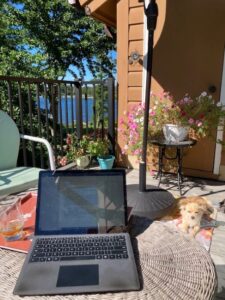 When we moved out of Fort Lauderdale five years ago, it meant big downsizing. As some wag said (might have been George Carlin): You spend the first half of your life accumulating stuff and the second half getting rid of it. We now live half the year in Tallahassee and half in Traverse City, Michigan. We don’t have the luxury of an extra “office” space anymore, so I store everything on line and cart my laptop around wherever the spirit moves me. Often it’s the sofa, but more likely my local coffee shop or after 4, the Traverse City Whiskey Co. where they make a mean whiskey sour. On spectacular days like today, the balcony will do.
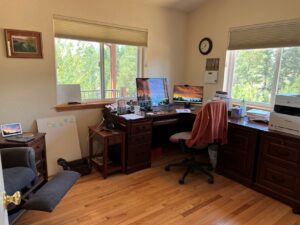 I’m fortunate to have a bedroom dedicated to me. This is my workspace, which doesn’t show my cluttered closet space or bookshelves. The desk is also a little less cluttered than usual, since the request for the photo came on Friday, and I clear my desk on Thursday for the housekeeper. The stacks of paper next to the printer and behind the monitor represent my method of ‘housekeeping.’ The stacks will eventually topple over, and I’ll attempt to separate the wheat from the chaff.
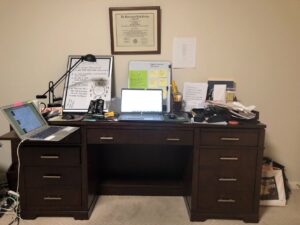
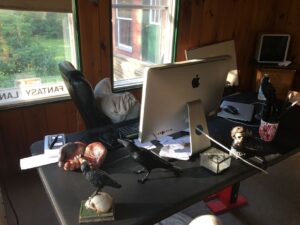 Attached are two photos of my office from different angles. The Holy Hands on my desk were made and blessed by a Cherokee chief. They hold tiny replicas of my Mayhem Series. Both gifts from a couple (readers) who said I touched their lives.
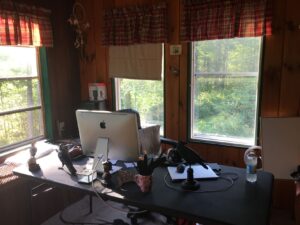 Most of the crows, as well as the crow dreamcatcher hanging above, were also gifts from readers. All mean a lot to me. Constant reminders of why I write.
 Here’s my office. I’m most comfortable surrounded by books, and many of these mysteries are signed by friends. The box with the white rug is for my cat, Vanessa. She “helps” while I work.
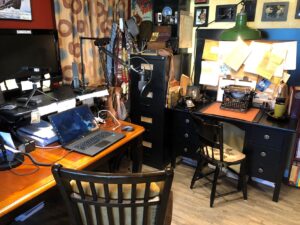 Here’s a shot of my mind lab. Brief description: “My creative place is a combination of old and new. Side-by-side, I have a Windows 11 laptop with audio/visual recording devices next to a retro 1920s private detective office with stuff like a pristine vintage typewriter and a cool rotary phone that’s tweaked to work in the digital age. Fun place. BTW, that filing cabinet is stuffed full of books.”
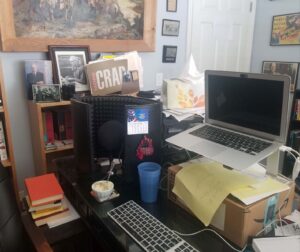 My desk, with microphone and sound foam. To the left, pics of Stephen King (with legs on desk), Ed McBain, and John D. MacDonald, all telling me to stop whining and write. My coffee mug with WRITER on it, which I bought a few days after I decided I had to try to become a writer. And a file folder for my first drafts.