What to Wear To A Gunfight

By John Gilstrap

It’s been a while since I’ve written any gun porn.  This is the day the drought ends.

Here’s the scenario: Your character, Detective Dan, knows that he is marching into harm’s way to confront at least two bad guys who he knows are armed.  For our purposes here, Detective Dan is part of a small force, maybe just a partner or two.  The smart move is to wait for backup, but they can’t do that because a family of four is being held hostage and things have gone very bad very quickly.

It’s almost certain that shots will be fired.  The good news is they have a pretty good arsenal to choose from. Just to make it interesting, they have to walk a long way to get in an out, and climb a lot of stairs.  And let’s put them in regular street clothes–nothing tactical.  Think business suits.

Choose Your Weapons

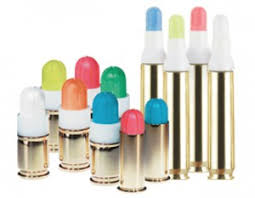
Simunitions are essentially medium-velocity paint pellets that can be loaded into real weapons. Yes, they sting when they hit.

There’s an adage among the tacti-cool crowd that the only reason to carry a pistol is to fight your way back to your rifle.  Having never been in a real gunfight I can’t speak to the veracity of the adage in the real world, but my experience having been a  bad guy in Simunitions training with law enforcement agencies, I can attest to feeling woefully outgunned when I brought my 15-round Glock into play against their 30-round M4s.

M4 carbine

If I’m writing Detective Dan, he’s going to want to have a rifle with him.  If his police agency is like most that I know, he’s got an M4 stashed in the trunk of his car, right next to his ballistic vest. An M4 is the rifle you see in most pictures of soldiers and SWAT team operators.

Right about now, when he’s kitting up for the fight, Detective Dan is going to second-guess his decision not to wait.  That vest he’s putting on will stop most pistol rounds, but it’ll be useless against a rifle bullet.  In an hour, he could have the State Police there with ballistic shields, dogs and a helicopter.  Best of all, he’d have a team that’s specifically trained to do the kind of entry that he’s about to attempt.

But hey, he wouldn’t be the main character in a book if he didn’t put his life on the line from time to time.

Now, Detective Dan has some thinking to do.  Of the weaponry available to him, what should he take?

Everything is heavy.

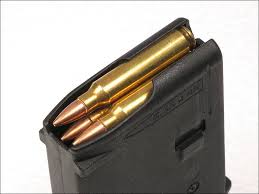
Loaded Glock 19 magazine

A Glock 19 (common pistol for police agencies around the world) loaded with a standard 15-round magazine weighs about two pounds.  Extra mags weigh a half pound apiece.  Detective Dan normally carries two extra mags, so that’s three pounds on his belt.  It’s no wonder so many detectives wear suspenders.

Loaded 30-round M4 magazine

His loaded M4 weighs 8.5 pounds and each extra 30-round magazine weighs about one pound.  Detective Dan decides to carry four extra mags to feed his M4. The good news here is that his vest–which itself weighs 5 to 8 pounds (or more)–has pouches specifically designed to hold extra mags with that weight distributed across his shoulders.

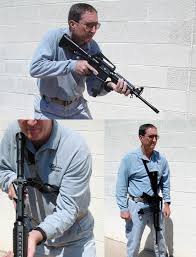
Single-point rifle sling. I think the rifle itself is an AR15.

Detective Dan will use a single-point sling for his M4 to help distribute that weight, as well.  Then there’s the radio, handcuffs and whatever other hardware Detective Dan carries.  All of it bounces around and rattles when he moves.

Tough choices.

Does Detective Dan really need 45 rounds for his pistol and 150 rounds for his rifle?  This mission would be a lot lighter if he cut back on ammo.  And he’d sweat a lot less without the body armor.  Suppose the fight degenerates to hand-to-hand?  He’s going to have a heck of a time maneuvering with all that stuff on him.

As the author, you have to balance what is reasonable for the character.  If you’ve established Detective Dan as a reformed alcoholic 50-something with a beer gut, the choices are much different than if you’ve established him as a 30-something ex-Special Forces operator who works out two hours a day.

The last thing Detective Dan wants is a fair fight.

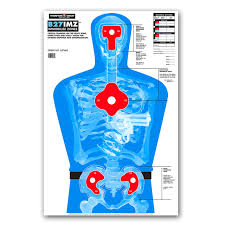
This target highlights the most lethal impact points on the human body.

If Detective Dan had had the gift of time, he could have waited for darkness to fall and brought night vision into play as a force multiplier.  In any confrontation, when your team is the only one that can see anything, the odds of winning tilt decidedly in your favor. In the real world, there are no verbal warnings, and no warning shots.  When a bad guy points a firearm at a good guy, there’s going to be a gunfight.  More times than not, the shooter with the most training wins, and the loser is dead.  In that engagement, the trained shooter will aim exclusively at the bad guy’s head, torso or pelvis, because that’s where the major organs and blood vessels are.  If someone is hit in the leg or the hand, that’s because the trained shooter whiffed that shot.

Shots fired.

I don’t want to write a whole scenario here, but let’s talk about some practical considerations.  We’ve kitted out Detective Dan with lots of cool options, so when the shooting starts, he and his team can have the best possible chance of seeing dinnertime.

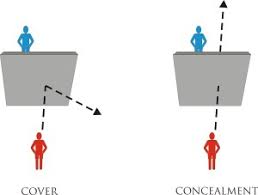
Once the SHTF (come on, you can figure that one out), Detective Dan does not have the luxury of panicking.  He needs to be keenly aware of the differences between cover (which prevents being hit by bullets) and concealment (which merely makes him invisible).  He needs to remember that he is responsible for every bullet he sends downrange, and that the four innocents are as susceptible to his gunfire as the unknown number of bad guys.

Every shot needs to be aimed at a known target.  And because Detective Dan is a dedicated professional, he won’t take even the perfect shot if one of the hostages is in the background and likely to get hit.  More on that later.

The bad guys, by contrast, don’t care who they kill, so they can feel free to shoot blindly.

Rifle or pistol?

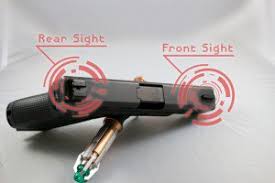
The distance between the front sight and the rear sight is called the sight radius. The longer the radius, the more accurate the shooter.

There are many reasons why most people (everyone I know) shoots more accurately with a rifle than with a handgun, but mostly it boils down to the stability of the platform and the sight radius (the distance between the front and rear sights).  Holding a firearm against your shoulder is inherently more stable than holding one out at arm’s length.  That’s true of holding anything, right?

Past 15 yards for most shooters, and 25 yards for all but the most elite competitive shooters, a pistol shot is at least equal parts hope and marksmanship.  For that M4 Detective Dan is carrying, accuracy at 100 yards isn’t even a challenge if he’s had even a little bit of training.

Here’s the problem: Those rifle bullets love to fly.  That head, torso or pelvis it hit is just the beginning of its journey.  The bullet might break up, it’s trajectory will probably will destabilize and it might start tumbling, but it will still be going very fast.  The next few milliseconds could get troubling for others in the room.  Perhaps that’s not a concern if everybody in the room is a bad guy, but that’s not our scenario.  Again, those pesky hostages are the wildcard.

Given the weaponry he carries, Detective Dan must always weigh accuracy against collateral damage.  I imagine it will be stressful for him.

I cheated a little to make a point.

I gave Detective Dan weaponry he most certainly would have access to, but not necessarily his smartest choices.

The M4 I gave Detective Dan is the weapon that every cop seems to be carrying on the news during active shooter incidents.  I saw a DC subway cop carrying one on a train not too long ago.  It’s tacti-cool as all get out–makes for a badass photo op–but I think it’s the wrong gun.

A tactical 12-gauge shotgun.

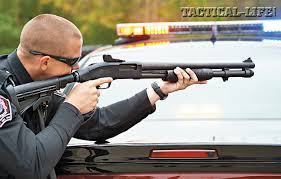
If I were Detective Dan, I think I’d have taken a 12 gauge shotgun as my long gun. I’ve rarely seen a police vehicle that doesn’t have one, and it is a very effective weapon in close quarters, with less chance of over-penetration.

Uzi

A lot of police agencies employ a hybrid weapon called a pistol caliber carbine.  The Uzi and Heckler and Koch MP5 are probably the most famous of these.  Certainly, they are heralded by Hollywood.  Also called personal defense weapons (PDWs), pistol caliber carbines provide the stability of a longer frame with the ballistics of a pistol.

H&K MP5. It’s hard to see, but the stock is folded forward.

Critics (and every tactical operator I know) argue that pistol caliber carbines are overrated.  Why carry two pistols?  If the bad guy has body armor, the good guys’ advantage is reduced.  A load of 00 buckshot probably would not penetrate body armor either, but getting hit with all 9 of those .32 caliber pellets would probably take their breath away long enough for a second shot.

Okay, it’s late and I’m tired.  We’ll talk about tactical reloads and deeper tactical considerations later.  Questions and comments are all welcome.


First Page Critique: Is It Good
To Open With A Bad Guy?

By PJ Parrish

We’re off to sunny Arizona today for our First Pager, and into the shady heart of a bad girl. Thank you, writer, for letting us read your submission today and, as always, learn along with you. And this has left me with a yen for a blue margarita. Cheers!


Cartel Queen Veronica Valdez 

CHAPTER 1
The Four Seasons Resort Scottsdale
Onyx Bar

Monday, October 20, 2019

“Hurl! Loser!”

Eight twenty-something male golfers sat on the patio crushing beers and trading insults.
Veronica Valdez glared at the window. I didn’t come here for party-till-you-puke feral males. She sat at a high-top table and ordered a blue margarita.

An ASU freshman, Veronica’s fake driver’s license identified her as twenty-two year old Shirley Smith. Designer clothes and accessories gave the impression of a sophisticated professional.

With a smile as fake as a TV game-show host, a man appeared. “I’m Tommy Thompson. May I join you?”

“Of course, I’m Shirley Smith. What’s your first name?”

“Orville,” he whispered.

“Orville, this will be our secret.”

Swaggered over here. Has a room. Luxury watch.

Veronica nudged her scarlet Valentino tote bag off the table, and Thompson retrieved it. “Thanks, the least I can do is buy you a blue margarita.”

“Okay, but they’re on me.”

On you? You’ll forget your name when we’re finished.

Their drinks arrive minutes later.

“The Blue Curacao liqueur gives the margarita its color.” I won’t tell him it hides the Roofie’s blue tint.

They played where-are-you-from and what-do-you-do, and during an awkward lull Veronica’s left hand pulled Thompson’s head close, and the snogging began. She circled her tongue inside his mouth, dropped her left hand, and slid it under his crotch. Still kissing, she squeezed his crotch and when he whimpered, her right hand dropped a tasteless pale-green and blue-speckled, fast-dissolving roofie tablet into his blue margarita.

“Bet you can’t drain yours, Tommy.” If he’s trying to get into my pants, he’ll over-compensate. That’s what men do. Thompson finished his blue margarita in three gulps.
The bartender’s generous pour combined with an anesthetic dose of Rohypnol affected Thompson. “Thizz marga uh uh is thong. Not too thong for me. Hah!” Now you’re on your ass. Right where I want you, Orville.

Veronica paid the check and walked a babbling, unsteady Thompson to his room where she undressed him, and tucked him in bed. After checking his pulse and respiration, she left with his $30,000 White Gold Rolex GMT Master II along with his wallet, iPhone, and $789. She’d keep the cash and sell the watch, credit cards, iPhone, and driver’s license on the dark web.

Behind the wheel of her truck, Veronica rubbed herself with the watch until she moaned and shivered.

_____________________________

I’m back. Well, looks like we’re dealing with a femme fatale here. Which gives us a chance to talk about opening your story with the antagonist. Is it a good idea or just a cliche? Should you give that first spotlight to the villain or introduce your hero first? And, to make it more complicated, what if your protagonist is also an antagonist? Books and movies are rife with successful examples of this hybrid: Darkly Dreaming Dexter, American Psycho, A Clockwork Orange, Interview With the Vampire, and one of my favorite books-cum-movies The Talented Mr. Ripley.

So who do you shove out onto the stage first?

In movies, this is called the Establishing Character Moment. Often it’s given to the protag, but sometimes, the villain goes first. I was watching Dirty Harry the other night, and of course, I was analyzing the heck out of it. It’s about a serial killer called Scorpio. The opening is terrific. (A lot of credit needs to go to cinematographer Bruce Surtees, whose seminal chiaroscuro style was artful-creepy). The scene opens with the sound of church bells. Then we get a shot of a pretty girl, sighted through a rifle scope, swimming in a rooftop pool. The shot pulls out to show the shooter taking aim…

https://www.youtube.com/watch?v=nDXdhA-Z3-o

Indulge me a moment more while we talk about how Darkly Dreaming Dexter opens. First, we get a brief orgasmic ode to the moon then comes this graph:

I had been waiting and watching the priest for five weeks now. The need had been prickling and teasing prodding at me to find one, the next one, find this priest. Three weeks I had known he was it, the next one, we belonged to the Dark Passenger, he and I together. And that three weeks I had been fighting the pressure, the growing Need rising in me like a great wave that roars up and over the beach and does not recede, only swells with every tick of the bright night’s clock.

The bad guy as protag! One of my favorite books from high school was John Fowles’s The Collector, much of it written from the abductor’s POV. Here’s the opening graph:

When she was home from her boarding-school I used to see her almost every day sometimes, because their house was right opposite the Town Hall Annex. She and her younger sister used to go in and out a lot, often with young men, which of course I didn’t like. When I had a free moment from the files and ledgers I stood by the window and used to look down over the road over the frosting and sometimes I’d see her. In the evening I marked it in my observations diary, at first with X, and then when I knew her name with M.I saw her several times outside too. I stood right behind her once in a queue at the public library down Crossfield Street. She didn’t look once at me, but I watched the back of her head and her hair in a long pigtail. It was very pale, silky, like Burnet cocoons. All in one pigtail coming down almost to her waist, sometimes in front, sometimes at the back. Sometimes she wore it up. Only once, before she came to be my guest here, did I have the privilege to see her with it loose, and it took my breath away it was so beautiful, like a mermaid.

I am pretty sure this paragraph was swimming around in my subconsciousness when I wrote my stand-alone serial killer The Killing Song, which opens with the murderer admiring his next victim as she sits in a concert in Paris’s Sainte Chapelle.  So…if you’re going to open with the bad guy, you better be able to get into your killer’s skin, no matter how warty it is.

Which brings us, at last, to our submission today. (Thanks for your patience, writer, but I really needed to make a point about opening with bad guys first).

Now, in such a short sample, we can’t be sure Veronica is our villain. She could be the protagonist dressed up in anti-heroine Prada. Given the title, that’s my guess. Maybe the writer can weigh in with some insight? But we can still comment on the effectiveness of this opening in catching our attention and maybe what can be done to improve things. Some general observations first:

There’s some potential here. But I really think this writer needs to slow things down. Here is what happens, just in the plot-events: We’re in a bar where we meet the main character Veronica. She is clearly there to prey on someone, complete with fake ID and fancy togs. She hones in on a victim and they have drinks, small talk, and she sort of seduces him.  She slips him a roofie, and he gets woozy and can barely talk. Somehow, they get upstairs to his room where she undresses him and tucks him into bed. She steals his watch, wallet, phone and cash. She goes downstairs and out to the parking lot to her truck. She masturbates with his Rolex.

All this in…385 words. Way too fast.

What doesn’t happen is: establishment of location. (other than a superfluous tagline); any description of surroundings (and we’re in a beautiful desert luxury hotel!); what anyone looks like or sounds like (other a fakey-smile and roofie-drunk slurring); why Veronica is there, outside of ripping off men; basic choreography of moving the characters around in space. How do they get up to his room when he’s half-passed out? How does she get to her truck?  And there is not even a hint of character motivation or insight.

That last one is a biggie. Because if you are dealing with an antagonist/protagonist or an anti-heroine, you darn well better be prepared to plumb the depths of her deepest needs, wants, fears and yes, loves. And that begins at the beginning.

If the antagonist is important enough to get her own point of view, she ought to have goals and motives driving her — same as any other character, and we need to see the beginnings of this layering in the first chapter in which she appears. One trick to writing a solid bad guy is to make him the hero of his own story. (I think this is a James credo). Few people actually consider themselves evil or bad, so even if Veronica has an iota of conscience, she will at least rationalize it.

Right now, Veronica is a cipher. The fact she’s female doesn’t make her any less a cliche in today’s crime fiction. When you find a way to make her feel like a real woman with real problems, readers will want to follow her — even if she’s a bad girl.  I suggest the writer read T. Jefferson Parker’s L.A. Outlaws. I It’s about a rookie cop who gets caught up in an affair with a Robin-Hoodish bad girl. Here’s the opening of Chapter 1, written from the female antagonist’s POV:

Here’s the deal: I am a direct descendent of the outlaw Joaquin Murrieta. He was a kickass horseman, gambler, and marksman. He stole the best horses, robbed rich anglos at gunpoint. He loved women and seduced more than a few during his twenty-three years. Some of his money went to the poor, but to be truthful most of it he spent on whiskey, guns, expensive tailored clothes, and on the women and children he left behind.

I got Joaquin Murrieta’s good looks. I got his courage and sense of justice for the poor. I got his contempt for the rich and powerful. I got his love of seduction. Like Joaquin used to, I love a good, clean armed robbery. I steal beautiful cars instead of beautiful horses.

Right now I’m about to stick up a west-side dude for twenty-four thousand dollars in cash. He won’t be happy, but he’ll turn it over.

And I’ll be richer and more famous than I already am.

My name is Allison Murrieta.

So my main advice, dear writer, is to slow down. All the action you cover in 385 words would make a good entire first chapter. And that’s not even accounting for adding better character development. Even poor Orville merits a physical description. Beyond this, you have some problems with simple confusion. Let’s do a line edit and clear up some of that up.

The Four Seasons Resort Scottsdale
Onyx Bar

Monday, October 20, 2019

Generally, you should use this device for big complex plots that ricochet around in time and place. All this info could be — should be — woven into the narrative. (ie: The Onyx Bar was almost deserted, except for a quartet of young guys just coming in from the 18th green. Their cleats clacked on the wood floor and their drunken laughter echoed off the adobe walls. Veronica watched them for a moment then swiveled on her bar stool to look out  huge windows. The sun was just dipping below Pinnacle Peak. God, she loved The Four Seasons. The best resort in Scottsdale. Best views, best food, and best place for hunting men who weren’t too smart.

That’s bad but you get the idea. SHOW us where we are with choice details. Don’t TELL us in a wooden tagline.

“Hurl! Loser!” Do you really want to use up your precious first line on a nameless frat-boy who has no bearing on anything? Put the spotlight on Veronica. She is there for one thing — to find a male mark. Make her ACTIVE rather than reactive to the barf boys. 

Eight twenty-something male golfers sat on the patio crushing beers and trading insults.
Veronica Valdez glared at the window. I didn’t come here for party-till-you-puke feral males. She sat Was she standing and just now sat down or already sitting? at a high-top table and ordered a blue margarita.

An ASU freshman, Veronica’s fake driver’s license identified her as twenty-two year old Shirley Smith. Another example of TELLING instead of showing. Turn it into action, something like this:

When the waitress came over, Veronica said, “I’ll have a blue margarita.” 

The waitress’s eyes narrowed. “Can I see some ID?” 

Veronica pulled out her wallet and flipped it open to her license. She stayed cool, knowing the stupid girl couldn’t tell it was fake. Behind the license was her Arizona State student ID. That was real. As real as her Valentino Hobo Bag, Chanel boucel jacket and her Louboutin booties.

Designer clothes and accessories gave the impression of a sophisticated professional. See above blue comment. SHOW us with telling details that she presents a sophisticated front. You also might be able to slip in hints of her physical appearance. The blonde hair wasn’t real, but the breasts were. You can do something with this real vs fake thing. Which might end up standing for something larger symbolically about this woman. Plumb her depths. 

With a smile as fake as a TV game-show host, a man appeared. From where? Also, she is a predator so wouldn’t she notice him first? She’s trolling for a mark, so make her ACTIVE. What does he look like? A Chiclet smile isn’t enough. SHOW us through her eyes. “I’m Tommy Thompson. May I join you?” Do you realize all your names are alliterative? I’d change that.

“Of course, I’m Shirley Smith. What’s your first name?” I don’t understand. He just told her his name was Tommy. 

“Orville,” he whispered.

“Orville, this will be our secret.” Again, confusing. What is the secret? 

Swaggered over here. Has a room. Luxury watch. Tell us here what kind, not later. And how does she know he has a room? Maybe she sees him slip a key into his jacket before he comes over? She’s the predator here, so make her smarter. Has she done this before? Here’s a good opportunity to slip in a hint of backstory. She needs it. And be careful that she’s not a regular here or management would note. Which can also be a good backstory note, something like:

She knew all the best hotel bars, from San Francisco to Savannah. The Onyx had always been her favorite, though she was careful not to show up too often. Bartenders noticed women who drank alone. They remembered. And she couldn’t risk that.  

Veronica nudged her scarlet Valentino tote bag off the table, and Thompson retrieved it. Confusing. Did he catch her bag as it fell off the table? “Thanks, the least I can do is buy you a blue margarita.” She already ordered one. Perhaps it’s more interesting to have him ask what’s that blue thing she’s drinking? Also, your dialogue here is a little anemic. Make it work harder. Make it SAY something about Veronica. Maybe he makes some lame pick-up remark like, “What? You ordered that because it matches your eyes?” Which gets you a way of slipping in what she looks like. Or maybe she wears blue contacts? I suggest you go back and read James’s post on how Telling Details can enliven your story.

“Okay, but they’re on me.”

On you? You’ll forget your name when we’re finished.

Their drinks arrive minutes later.  Whoa. You need to slow down here. You just had these two meet, so you really can’t jump ahead with an empty time-bridge like this. What do they do? What did they say? You’re missing chances to flesh out your set-up and your main character. 

“The Blue Curacao liqueur gives the margarita its color.” I won’t tell him it hides the Roofie’s blue tint.  A non sequitur — of course she wouldn’t tell him she’s drugging his drink. The italics tells us we are in her head, and because the sentences are joined in one graph, we assume she said the thing about the Curacao?  But it’s unclear.

They played where-are-you-from and what-do-you-do, and during an awkward lull Veronica’s left hand pulled Thompson’s head close, Because this “seduction” is so rushed, I’m not buying this action. You need to set it up better to make it believable. Also, they are sitting at a high-top table in full view of a classy bar, so this is borderline unbelievable. and the snogging  Why use British slang for making out? began. She circled her tongue inside his mouth, dropped her left hand, and slid it under his crotch. Under? Still kissing, she squeezed his crotch and when he whimpered, her right hand dropped a tasteless pale-green and blue-speckled, fast-dissolving roofie tablet into his blue margarita drink..  Here is an example of wrong details. Just describe the salient action. She dropped the roofie into his glass. It dissolved before he had time to open his eyes.

“Bet you can’t drain yours, Tommy.” If he’s trying to get into my pants, he’ll over-compensate. That’s what men do. You need a new graph here: Thompson finished his blue margarita drink in three gulps. The bartender’s generous pour combined with anesthetic dose of  the Rohypnol affected Thompson. Again, why tell us when you can show us? New graph needed for dialogue “Thizz marga uh uh is thong. Not too thong for me. Hah!” New graph needed because you change to her thoughts. Now you’re on your ass. Did he fall off the chair? Right where I want you, Orville.

Re: Roofies. I did a lot of research on this drug for one of my own books, and you need to be careful in your description here. They are a depressant. Depending on the dose, it takes a good 20 to 60 minutes for them to take affect, maybe more for a man. Also, because of date rape abuse, they are no longer legally available in U.S. Maybe she got it in Mexico? Again, this could be a telling detail about your character. 

Veronica paid the check and walked a babbling, unsteady Thompson to his room where she undressed him, and tucked him in bed. You really need to slow your action down here. The roofie would make him almost unable to walk. Is he large? Is she small? Was he hard to maneuver? No one noticed this in the bar? How did she get his key card? They don’t have room numbers on them so how does she know where the room is? Sorry if this sounds niggling, but you can’t just gloss over details like this. After checking his pulse and respiration, she left with his $30,000 White Gold Rolex GMT Master II along with his wallet, iPhone, and $789. She’d keep the cash and sell the watch, credit cards, iPhone, and driver’s license on the dark web.

I have a question about iPhones that is above my pay grade. I know they are big targets of thieves who resell them, but there are also ways to guard against that and they can be traced. This makes me wonder — what kind of criminal is Veronica? The scenario here describes a petty theft because she’s not going to make a fortune reselling this stuff. Is she up to bigger things — like she’s part of phishing scheme? Then keeping the iPhone makes sense. This goes to my point about the need to start layering in some backstory here. Because a college girl drugging older guys in bars just to steal their watches and wallets isn’t very interesting. The stakes need to be bigger, I think. 

Then…out to the parking lot we go. Slow down!  One sec we’re in a hotel room, next in a car. Whiplash!

Behind the wheel of her truck, rusty Ford flatbed? Platinum Silverado? Vintage Jeep? Veronica rubbed herself with the watch until she moaned and shivered. Well, that’s quite an image, but again, slow down! Nobody likes to be rushed in a seduction, even if it’s a solo act. She gets in the truck. Give her a thought or two. Have her watch the sun go down. Maybe she thinks about poor Orville “roached-out” (that’s slang for being high on roofies) up in his fancy room (which you never described). Maybe she takes out his wallet and sees a photo of the kids.  Give us something! Humanize these characters! And then, she leans back in the seat and gazes out at the beautiful Scottsdale sunset.  It’s been good day at the “office.” She reaches into the Hobo bag and pulls out the watch. She admires it. She admires herself. She thinks something, anything! Okay, maybe we can go with the sex thing then, but it would be better with some kind of human context.  Even if her heart is black, you have to show it to us because as I said in the general comments, a villain has to be believable and multi-dimensional. She’s as blank as a blow-up doll right now. 

A final thought. Roofies are called “the forget-me-pill.”  Boy, I’d sure do something with that given your scenario. Every chapter needs a good kicker.  Poor Orville will forget, given the lasting effects of roofies.  But who’s really trying to “forget-me” here? Maybe your bad girl herself? Look for depths to plumb in your characters, especially your villains. 

That’s about it.  If this sounds harsh, please know, dear writer, I am not doing this to discourage you. I think you’re onto something here, and the spareness of your writing shows some talent. (though I still think it’s too spare). You’ve got something potent going here but I’m not sure you know what’s truly inside Veronica. I want to know more about her.  Strangely enough, I even want to like her because there’s nothing like a dame gone wrong who maybe, just maybe, finds a way to right herself.  I really encourage you to check out T. Jeff’s L.A. Outlaws. Reading good writers helps us find our way. And don’t give up. I’m hard on you because this has potential. 

Thanks for submitting!

The Churn of the Screw

Photo by Steve Johnson courtesy of unsplash.com

Last week I received one of those letters from the “Department of the Treasury.” It was not, alas, an invitation to apply for employment with the Secret Service. It was instead a letter from the Internal Revenue Service advising me that I owed additional money with regard to my 2018 federal tax return, and giving me three weeks to pay it.

Some of you may have had the pleasure of dealing with such a notice personally. If you are an author or derive at least some of your income from self-employment, your return almost automatically gets a bit of extra attention which may ultimately generate such a notice to you. Others among you may have friends or relatives who have for one or more reasons been on the receiving end of a letter. This particular letter wasn’t my first rodeo. I have worked for fifty-one years and filed an equal number of federal returns. I have in that time received five letters of this type which isn’t too bad a track record, I guess, but I’ve learned a little about what and what not to do as a result.

I am today accordingly going to provide some very basic advice about how you can deal with such a situation, and possibly save yourself some money in the process. I offer this to those of you who prepare and file your own tax returns, as opposed to having a local or national tax service do that for you. Some of those will represent you before the IRS. If so, contact your preparer immediately upon your receipt of the letter.

To begin: eat the frog first. If you don’t want to read the rest of this post, fine, because you’ve just read my most important piece of advice. Open the letter and read it immediately upon your receipt of it. Do not ignore it, set it aside, or assume that it is a mistake. Doing so will simply cause the generation of more notices to you. Interest will accumulate. Matters will escalate. Open the letter, read it, and see what the IRS wants.

Next. When you receive such a notice it is probably because the IRS wants money. The amount is usually stated up front. Forget that for a moment. You want to know the basis for the determination that you are deficient. That is usually buried deep in the notice but it’s there.

Find it. Then get out your Federal tax return for the appropriate year and review it, particularly with regard to the area which the IRS says is causing the deficiency. If you see that the IRS is correct, waiting or ignoring action will not cause the matter to go away. You will continue to receive letters. Your file will eventually be assigned to an agent and the letters will become more personal. The matter will become more difficult to settle. Instead, pay the amount owed if you are able. If not, there is a telephone number that will be listed on the notice which you can call to work out a payment plan. Interest will still accrue, but if you work out a plan and stick to it the letters will (or at least should) stop.  

What happened in my case is that the IRS said that I made a computational error resulting in a deficit. I got out my return and the IRS was wrong. I had actually made TWO computational errors. Whoever or whatever reviewed my return found one. I found a second error which substantially mitigated the first error. I accordingly set all of the paperwork aside and streamed the fifth season of Black Mirror, knowing that the IRS would eventually locate the second error and send a second letter with a recalculated deficiency.

Not really.

I got to work. The notice listed a number I could call if I disagreed with the agency’s determination. I got my ducks lined up in front of me in writing and called. I was on hold for forty-five minutes before I was told that due to a “network error” my call could not be handled and that I should try to call again later. “Network error,” I discovered, is agency-speak for “lunch.” Don’t call at or near the hours of 11:00A – 1:00P central time. Everyone is at lunch.

I called back at 2:30P EDT and after approximately a quarter-hour I spoke with a very businesslike but civil call center person.  I politely explained my position and stated that I was of course (of course) willing to immediately pay the resulting (lesser) deficiency plus interest. I also asked for the best way to proceed in order to prevent correspondence from crossing. I was told to put my position in writing and (snail!)mail it to the address from which I received the original notice. Done and done.

Next. If you receive a decision in your favor, all to the good. If not, you do have appeal rights. If the dispute has its basis in an issue of tax law that you are going to run into frequently going forward — a business deduction, for example — you may want to obtain representation. If it is a smaller amount arising over a one-time mistake (or two) or a misunderstanding, you may wish to attempt to resolve it yourself. If so, keep in mind that if you run into an IRS representative who won’t budge off of the one-note, thank them for their time and politely ask to speak to their supervisor. Primary level agents are firmly ensconced within the sinecure of the agency’s position. Supervisory level agents are more conciliatory toward the taxpayer. They are not giving anything away, by any means, but are more often more receptive to a taxpayer with regard to a contested issue. Just remember your polite words.

Oh. One more thing. You call the IRS. It does not call you. If you get a call from somebody purporting to be from the IRS (or, as I have in the past, the FBI, or the U.S. Attorney’s office) telling you to go to Wal Mart and buy Visa gift cards or whatever to pay off your account, don’t. It’s a scam.

Hopefully, you will never need any of this information and have never needed it. That said, does anyone have any tax stories they want to share? If so, please do. Whether you do or not, Happy Father’s Day to all of you dads!


Confessions of a Book Reviewer

By Elaine Viets

A reviewer for a major print magazine complained to me about a novel he was reading, when it dawned on me – this was news writers could use. If we know what’s wrong, we can fix it before the reviewer writes about it, for all the (mystery) world to read.
This reviewer is not some crank who looks for excuses to rip writers. If he has to give a book a bad review, he agonizes over that decision.
But here are some writing wrongs that upset this reviewer.

(1) Padded Middles. This is my reviewer’s number one problem – novels that slow down in the middle. “The padding doesn’t advance the narrative,” the reviewer said. “It’s pages and pages of the thoughts and feelings of people who aren’t very interesting. They offer no valuable insights. Sometimes, I wonder if editors make writers add this unnecessary information because big books are so popular. Most books I’ve read recently are 20 to 30 pages too long. Often, there’s a good book buried in that excess fat.”

(2) Switching names. “The character is introduced as Joseph Smith. Then the author proceeds to call him Joe, Joey, Joseph, and sometimes just Smith. It’s hard to figure out who the writer is talking about.”

(3) Who’s talking? “A character is introduced in the first 50 pages, and then shows up 200 pages later with no ID.” Take tax accountant Mary Rogers. She has a brief scene in chapter 2 and then in chapter 25 we see this line: “I think the suspect embezzled half a million dollars,” said Mary Rogers.
Huh?
“I’m frantically pawing through the book, trying to figure out who Mary Rogers is and why she’s saying that. If the author said, ‘I think the suspect embezzled half a million dollars,’ said tax accountant Mary Rogers’ that would make it easier for readers.”

(4) Writers who fixate on a certain word. “Like ass. I read an author who used ‘ass’ constantly. His character fell on his ass, showed his ass, got his ass kicked and had his ass handed to him. He dealt with asshats, ass clowns and of course, assholes.” Cuss words are necessary for realism, but don’t overdo it.

(5) Dumb and proud of it. “Writers who want to assert their real-people identities trot out lowbrow snobbery. Their favorite phrase is ‘I don’t know anything about . . .’ Then you can choose one or more of these – opera, classical music, gourmet food, Shakespeare.” Assume your readers are intelligent – after all, they bought your book.

(6) The hero with the drinking problem. He – or sometimes she – “is haunted by the awful things they did when they were on the sauce. Yes, people drink. And some authors handle this well. But most of these characters are tiresome cliches.” Reading these novels is like getting your ear bent by the garrulous drunk at the end of the bar.

(7) Writers who don’t do their research. If you really want to frost this reviewer, have your hero open a Heineken with a twist-off cap – there’s no such animal. And Jack Daniel’s whiskey always has an apostrophe. If you’re writing a thriller set in Nazi Germany, you’ll score extra points with this reviewer if you don’t say “Hitler was elected president in a democratic election.” You’ll find plenty of people who’ll write that, but the Website Mythfact.com says it’s complicated.
“In America we hear ‘Hitler was elected President in a Democracy’ a lot,” the Website says, “but the sentence is so semantically wrong . . . In summary, the whole thing is almost too complex to apply the ol’ ‘Hitler was elected democratically’ quip to, but since it is important, perhaps it is best phrased as, ‘Hitler and the NAZI party seized power in a democratic system.'”
Got that? Good.

(8) Basic copyediting errors. “These are turning up in books by major authors,” our reviewer said. “I’ve seen ‘grizzly murders,’ when I’m quite sure the local bears are innocent. Clothes are tossed down a ‘laundry shoot,’ and people ‘tow the line.'” If you really want to see steam come out of this reviewer’s ears, mix up “it’s” with “its” and “your” with “you’re.” Granted, we all make mistakes, especially when we’re writing quickly. But somebody should catch those errors before the book is printed.

(9) TMI in the first chapter. Nearly every one of us at TKZ has written about this problem. Overcrowded first chapters slow the pace of your novel. Our reviewer said, “It stops a good book dead when the first chapter has an overlarge cast of characters and I can’t keep them straight.”

That’s all for now. Readers, what stops you when you’re reading a novel?

Sabbatical

–GoDaddy Stock Photo

When my kids were ten and three years old, I ran away from home for a week. Given all the pre-trip planning, list-making, grandparent arrivals, and pantry-stocking, it might have looked like I was about to take a solo vacation, but appearances can be deceiving. Inside, I was holding my breath, telling myself I could get it all done, hold out until the day I would pack up the ridiculously large, white, American sedan I’d rented, and cruise onto the highway, the “Girls Singing for Your Trip” mixtape cd my bff had made me cranked up on the stereo. The first song was Vacation by The Go-Go’s [sic]. The second was Walk Like an Egyptian by The Bangles. By the time I was actually in the car, blowing bye-bye kisses to the kids, I felt like a teenage bandit who’d stolen Grandma’s Buick and could only count on a few hours of freedom before the cops pulled me over and ushered me home.

Did I feel guilty? Yes, I did. But I also knew that if I didn’t get away—my stated reason was that I wanted time to myself to write—I would either collapse into a useless puddle of mommy-shaped goo, or have to take refuge in a small closet and refuse to ever come out again.

Roanoke, Virginia to Ocracoke Island, North Carolina, is a long drive—though I confess I thought it wouldn’t be. They looked so close together on the map. It was a good thing I liked driving alone. The ferry ride that ended my journey was a kind of revelation, a reminder that I was, indeed, far from home. Ocracoke is overwhelmingly beautiful, with pristine, protected beaches, and (at least back then) a small-town vibe that made me feel comfortable and safe. I felt Very Far Away from my life.

Now, I had a pretty darned good life back home. I loved my husband and children intensely. It wasn’t like I couldn’t take time to write. I had part-time childcare, and a lovely house set up on a hillside, among trees. And I liked my kids. It didn’t matter that they occasionally vomited on me, or threw the occasional floor-pounding tantrum in the post office, or didn’t pick up their room. They were still mine, and I loved them. But every mother has her limits, and as much as I loved my family, I knew I had to go away for a little while so I could remain in love with them.

Have you ever felt that way? Perhaps not about children, but about your work, or your partner, or circle of friends?

A couple of months ago, I stopped writing. Oh, I didn’t stop completely. I showed up here, and also wrote a couple of blurbs. I journaled just a bit. But for the most part, my computer screen was fallow. At first, the stoppage wasn’t intentional. I’d had a professional disappointment that left me deeply frustrated. But like so many things that look grim on the outside, it was hiding something useful on the inside. It led me to take a good hard look at my work and career, and what they meant to me. And that’s when I decided that my writing sabbatical needed to continue for a while.

I love writing. I really do. It’s the only thing I ever set my heart on. I’m terrible at goal-setting because I’m easily distracted. There’s a story I heard once about a distinguished scientist who told himself he was going to count the steps he took walking to work every day. He did it successfully the first day. On the fourth day he remembered that he’d made that plan earlier in the week, but had only counted his steps that very first day. His is the story of my life. The good news is that I mostly get distracted in good ways, by new projects. But writing is the thing I’ve never been distracted from for very long. When I was in my mid-twenties, I decided I wanted to write fiction, and I’ve been trying to learn to be a better writer ever since. [Note: If you’ve stopped learning, go back to where you left off, and begin again.] It is the only vocation I have ever truly wanted to pursue because it’s the most challenging, maddening, rewarding work I’ve ever done.

Sometimes writing (and often publishing) will vomit on you. It will wring you out of every emotion, and leave you panting for inspiration. It will break your heart, and flip you the bird on the way out the door. It will whisper or shout your shortcomings. But then it will snuggle you like a puppy or a two-year-old wanting comfort. It will bring you bright and shiny presents—a brilliant detail, or the perfect sentence. Most of all, it will make much of itself. And I don’t know about you, but sometimes it can be too much of a muchness.

I’m not fond of crises. I panicked when I realized I wasn’t writing. For a while, I thought I might never write again. (Did I type that out loud?!) Fortunately, that panic didn’t last forever. But I did let myself feel the panic while it was happening. Yes, that old touch-feely feelings stuff. I let myself see that there could be a life beyond writing. I don’t have to write! Ever! In fact, there are already plenty of writers. I could clean houses, dig ditches, paint portraits, design video games, become a professional birdwatcher or baker or phlebotomist. In fact, if I stop writing and get a 9 to 5 job—or even take a permanent copywriting gig—it would be a financial boon to the family coffers.

I could have run away from my family. I could have stayed on that island beach until my money ran out, then gotten a job somewhere in the mid-Atlantic area. But I loved my family. Deeply. I just needed to be by myself for a little while so I could build up the energy to give them more, love them more. I hope I came back a slightly better parent.

During my writing sabbatical (a gentle word), I read some, watched television, bought furniture, decluttered the house quite a bit. I still have some power washing to do. And more reading to do. After two years of lightening the tone of my reading, and, to some extent, my writing, I’ve delved back into much darker stuff (the astonishing Mo Hayder has changed my life, I think). It’s got me thinking, and doing some unexpected planning. I’m still in love, but perhaps a bit wiser. That’s never a bad thing.

Have you ever had to get away just so you could stay?


Voices Lost and Found plus Two New Writing Tricks

by

Debbie Burke

Recently, a wonderful, unexpected opportunity came my way.

My pal, Susan Purvis, was invited to be the keynote speaker at the St. Eugene Writers Conference near Cranbrook, British Columbia. She invited me to tag along and share the hotel room the organizers had graciously provided for her.

Writing workshop, free room, and a favorable exchange rate—what’s not to like?

To Honor “The Children” at St. Eugene Mission School


Surrounded by snow-tipped mountains with the St. Mary River flowing past, the St. Eugene Hotel had a once-dark history and was supposedly haunted.

Built in 1910, on a road to hell paved with good intentions, the Canadian government and the Catholic Church operated St. Eugene as an Indian boarding school. First Nations’ children were separated from their families, not allowed to speak their native tongue, nor practice cultural traditions and customs.

The boarding school system broke down traditional family structure, resulting in generations of poverty with staggering rates of alcoholism and chronic unemployment. The school was closed in 1970.

For the next few decades, the building languished in decay—deserted, vandalized, and flooded. But the spirit of the Ktunaxa people prevailed.

In 1984 Elder Mary Paul said, “Since it was within the St. Eugene Mission School that the culture of the Kootenay Indian was taken away, it should be within that building that it is returned.”

Mary Paul’s vision of rebirth was carried forth by Chief Sophie Pierre, who had herself been a student at the school. The chief spearheaded years of rehabilitation of the old building.

St. Eugene is now a world-class resort hotel, beautifully refurbished with conference rooms, restaurants, and a casino. A championship golf course and KOA campground occupy former pasture lands.

Teepees at the St. Eugene Resort campground

Today, the resort employs more than 250 people; many are descendants of former students of the boarding school.

Sophie’s son, Joe Pierre, is the current elected chief and delivered a moving blessing at the keynote dinner in both the Ktunaxa language and English.

Photos from the past decorate the hallways, including one that appears to capture a ghostly figure among the solemn faces of school children. A presence has been sensed in various rooms of the hotel.

In a location so steeped in history, how could a writer not be inspired?

~~~

Now to what I learned:

Renowned playwright/novelist Anosh Irani divides his time between Vancouver, where he teaches, and his native India. Anosh introduced two new writing terms I hadn’t heard before.

The first concept Anosh talked about was The Wound.

The wound can be literal, like a physical problem, a disease, an injury, a chronic condition that restricts and constrains the character’s ability to function. The wound can also be mental, emotional, or psychological. Unseen wounds often affect the character more deeply than physical ones.

Questions to ask while you’re writing:

Is the story driven by a deep-seated wound in the main character?

Is the story about healing that wound?

Is the character free if s/he cures the wound/achieves the goal?

The second term Anosh talked about was The Crucible, which immediately brought to mind the Arthur Miller play about the Salem witch trials.

Photo credit: skeeze at pixabay


However, crucible also means: “a ceramic or metal container in which metals or other substances may be melted or subjected to very high temperatures.”

In playwriting, the author places the main character inside a container (the stage) under extreme pressure and temperature. The character is trapped. Unless s/he wins, there is no way out of that cage.

Before this workshop, I had not been mindful of a major difference between novels and plays:

In novels, characters may roam all over the globe in search of adventure or a solution to their problems.

But in plays, actors are literally trapped within the confines of the stage and cannot escape. The setting may change but the stage remains a limited space—a crucible.

That concept resonated with me. As novelists, we can borrow that crucible technique and put it to work in our stories. The more trapped your character, the more heat and pressure they are under, the greater the story tension.

~~~

For a marketing perspective, YA novelist/editor Jeff Giles entertained us with his funny essay about how not to promote a book. “See More About Me” describes a debut novelist who wrote 326 Amazon reviews for books by other authors but, in each review, shamelessly promoted his own novel.

Also during the weekend, Anna-Marie Sewell, Poet Laureate of Edmonton (2011-2013), and Danielle Gibson, a teacher and YA author, workshopped with half a dozen talented high school students. At the group open reading, the kids performed their work with the confidence and charisma of veteran public speakers. We in the audience listened in awe and muttered to each other, “I could never have done that at that age!”

St. Eugene was once a place where children lost their voices. There’s a sweet irony that new generations now find their voices there.

Conference organizer Keith Liggett, a ski journalist and award-winning cookbook author, sets up several writing events each year at St. Eugene. Top-name speakers draw participants from across Canada and the U.S. The next gathering will be in February, 2020.

St. Mary River flows past St. Eugene Resort

St. Eugene nearly descended into ruin as a relic haunted by dark memories. In the new century, it has experienced a renaissance, emerging as a major employer in the region and a thriving recreation destination and cultural center.


Elder Mary Paul would be pleased.


TKZers – Have you attended a writers gathering in an inspirational setting? What did you take away from the experience? 

Adventures in India

I’ve long been interested in India and its history and, as an early ‘big’ birthday present this year, my husband organized an amazing trip to India for the whole family. We knew that given the boys’ school commitments, the only real time we could all go was in the summer, which meant facing the scorching heat, outrunning the monsoon, but also (luckily) avoiding the tourist crowds. We also discovered that, although this time of year most Indians think you’re crazy to be visiting, it’s the best time to go if you want to glimpse tigers in the wild (which has long been a dream of mine).

We tried to expose our twin boys to as many of the cultural contrasts and contradictions of India as we could – from walking through the Dharavi slums of Mumbai, visiting the historical sites via public transport in Delhi, to seeing the Taj Mahal at daybreak, going on safari in Ranthambore national park in search of tigers, and walking through Amber Fort outside Jaipur in 116 degree heat. All in all, I think we managed to pack a lot in on our two weeks away!

I can’t wait to someday incorporate what we experienced in a book (or two)…though at the moment I feel I’m still in absorption mode. But rather than rant on about all of our amazing experiences, I thought I’d share just some of the photos of our time away.

Sunset over Mumbai:

A nearly deserted Taj Mahal at dawn:

Overtaking a camel on the road to Ranthambore:

Close encounter with tiger on safari (he was about ten feet from our jeep):

‘Basking’ in the scorching heat at Amber Fort:

They say travel broadens the mind but I think this trip, more than any other we’ve taken as a family, opened our eyes to another country and culture. So fellow TKZers, has any adventure done the same for you?


If You Want Pace & Tension – Stick with the Action – First Page Critique of ESCALATION

JordanDane

@JordanDane


A brave anonymous author has submitted their first 400 word beginning to their novel for feedback. My thoughts will follow the author’s submission. Please add your constructive criticism in your comments. Enjoy!

***

ESCALATION

Chapter 1

Conversation was almost impossible over the sound of the siren and the roar of the ambulance’s diesel engine. Zach felt with his right hand for the siren tone switch without taking his eyes off the road. He flipped the switch to change the siren from the long monotonous wail to the rapid repetitive yelp that would alert the motorists in the busy intersection they were quickly approaching. Ana also intermittently hit the air horn to add another dimension to the sound.

Threading the needle of these busy intersections had become second nature to Zach. He had worked for the Sova County ambulance service for the past three years and had seen the increase in traffic with the county’s growth. His calm expression never changed as he muttered, “You stupid ass!” when a pale yellow late model Toyota Camry plowed through the light. The driver, bobbing his head in time with some unheard beat, was oblivious to the ambulance’s flashing lights and blaring siren. Zach came to a stop and made eye contact with the other drivers before proceeding through the intersection. A red Bronco came barreling around the curve and almost collided with a dark blue Honda pulled to the curb to allow the ambulance to pass. Zach steered through the maze of skewed vehicles with practiced precision. Once they were clear of the traffic, he gunned the engine. Fortunately, the day was bright and clear. It was better not to have the weather as a hazard; the traffic was definitely enough.

“Are you familiar with the area we’re going to?” Ana asked while shading her eyes from the gleam of sunlight reflecting off the side mirror of the truck. Her face felt just short of sunburned from the early morning sun beating down on her side of the ambulance.

Analyn Michaels, a pretty, petite girl with wavy light brown hair that fell just below her shoulders, had been partnered with Zach for the past eleven months. She tugged at the seatbelt cutting into the side of her neck and glanced over at him.

***

FEEDBACK

OVERVIEW – There is a sense of urgency as the ambulance races through the streets in the first paragraph. The heavy wordiness of that paragraph and the longer sentences contradict the urgency and I will rewrite that intro to show what I mean. (See the feedback below in – FIRST PARAGRAPH REWRITE.)

With the start of paragraph 2, the story action slows to a crawl with a backstory dump and the county history on traffic patterns. There is plenty of time to explain the guy’s resume and add to the setting of the story, but if the author dares to write a suspenseful opener, I always recommend – STICK WITH THE ACTION and explain later.

That long heavy paragraph shows Zach fighting traffic, but the sense of urgency is gone. He can be calm by nature of his character, but it’s the author’s job to convey the adrenaline rush to the reader. We can all imagine how tense Zach must be and how hard it must be to deal with bad drivers at busy intersections. Make the reader feel the tension and that a life is on the line.

By the time we get to Ana, the pace is gone as she shades her eyes from the sun and thinks about her sunburn. The description of her is another form of backstory that can wait, if the author’s intention is action and a medical urgency that has the ambulance weaving through traffic with sirens blaring. Ana also reflects on how long she’s been partnered with Zach as the seat belt cuts her neck because of their high speed race.

This introduction is conflicted between the stifled action and bad writing habits that slow the pace, but there is good news. We have ALL made these errors and sought improvement.

These are only my thoughts based on my assumptions on where this story might be going. Take any of my advice for what it is worth, dear author. FREE! I tend to imagine your intention and try to work with what is written. I offer advice based upon what I would edit in my own work. You may not like what I have to say and that’s okay.

TITLE – ESCALATION is not a bad title. I can visualize an action-packed cover and the sense of a thrilling medical drama, but I wanted this introduction to match the adrenaline surge of an EMT/Ambulance driver racing through traffic with the life of a patient on the line. Not all medical fiction books will have a title to match the intro, but this one makes sense since it appears to focus on the EMTs.

POV – I can’t see a particular point of view in this short intro. No telling if Zach is the lead/main character or Ana. Since we get Ana’s full name, it could be that SHE is the one to tell this story, but the focus is on Zach. I would recommend picking a main POV character per scene. Zach may not be the HERO of this story, but I would advise the author to clearly pick ONE POV and stick with it.

At present, this intro is not in Zach’s POV, not when Ana flips the air horn switch in the first paragraph, without being seen from Zach’s eyes. Also, Zach can’t know that the seat belt is cutting Ana’s neck at the end. This intro reads like “head hopping.” Even though we don’t know who the main character is, we still need ONE POV to see this action through.

I tend to pick the character with the most to lose or who has the best emotional vantage point. In this intro, that could be Ana, who has to watch as Zach barrels through traffic like a mad man. Or it could be Zach as he battles the traffic while watching Ana cringe, but pick a point of view and work the emotion.

NAMES – I’m not sure why Ana has a full name AND a nickname, but Zach has only a first name. I would suggest giving characters their full names as soon as you can, even if these characters aren’t the hero or heroine. By giving each character a name, it gives context to the reader and an author can write a fuller characterization with more voice if the character has a name.

On the second book I sold, I had a anonymous bad guy get killed in the intro. It wasn’t until I christened him with a full name, that I could tap into his inner voice and give him an arrogance where he deserved to die. It became more interesting.

FIRST PARAGRAPH REWRITE – I tried picturing a white knuckle ride through a busy intersection as I thought of how to rewrite this. With an action scene, the sentences should be shorter, punchy and filled with action imagery. Fragments are fine. You are conveying a sense of urgency to the reader and pulling adrenaline from them as they read, to get a visceral response. I also added DEEP POV, which are Ana’s thoughts in italics, that inner voice we all have. Mine are usually curses.

REWRITE EXAMPLE 1

Analyn Michaels gripped an armrest and held her breath. Oh, God! Streetlights had changed. Cars ignored the blaring siren. In seconds their ambulance would hit the busy intersection. Watch it! She winced. Ana wanted to trust Zach behind the wheel, but it wasn’t easy.

“Hold on. This’ll be tight.” He glanced at her sideways with a smirk. Smart ass!

An SUV lurched in front of a butt ugly Camry to make a turn. Damn it! The driver of the SUV never saw their flashing emergency lights. Ana reached for the air horn and flipped the switch. At the sound, the SUV screeched in front of them. Ana braced her body as Zach swerved to miss the bastard.

The roar of the ambulance engine rumbled in her gut. Ana fought the adrenaline surging through her veins. When they cleared the worst intersection, Zach gunned the diesel engine. Precious seconds ticked by.

Ana hoped they’d make it on time.

This is a quick rewrite. I would normally play with this more and go back to add layers of emotion, but I hope this conveys urgency and action and puts the reader in the front seat. There are smells to add of burned rubber or diesel fumes or beverages spilling on a tight turn. I made the assumption they were heading TO an emergency and not hauling someone to the hospital, since both of them are in the front. But imagine that you have an emergency of someone having a heart attack. Every second could make a difference.

WHITE SPACE ON THE PAGE – In an action scene, it is especially important to have white space on the page. Readers tend to skim the heavily worded paragraphs. Make paragraphs shorter, sentences shorter, and don’t embed dialogue. In my rewrite, it changes from one heavier paragraph to 5 bursts of action.

Over the years, I have cut back on the length of my chapters and my scenes. I give the reader more white space on the page and use deep POV to break up the prose. Call it “shorter reader attention span,” but that’s what I’ve noticed and changed my style accordingly. My paragraphs tend to be shorter too, but it’s the same idea. Long heavy narratives can appear daunting to a reader these days. Don’t give them a reason to skin.

VOICE – I like the character voice where we get a sense of dark humor in Zach. EMTs have seen it all. They can be adrenaline junkies. I like Zach cursing as he drives, not giving an inch, yet staying calm.

PACE WRECKING LINES – There are a number of lines that cut the pace and stop the action in this short intro.

He flipped the switch to change the siren from the long monotonous wail to the rapid repetitive yelp that would alert the motorists in the busy intersection they were quickly approaching. Ana also intermittently hit the air horn to add another dimension to the sound.

The two lines above are too focused on the details of sound and they lose any momentum for the action. It’s not as important to get the nitty gritty detail of what is physically happening. It’s mainly important to write a smattering of action (see an example of ‘smattering’ in my rewrite of paragraph 1) to give the reader a sense of it. Keep it punchy and focus on the bare essence of the action.

Fortunately, the day was bright and clear. It was better not to have the weather as a hazard; the traffic was definitely enough.

In an action scene, if you have to stop to write about the weather, you’ve lost the pace. In this case, the weather is “bright and clear,” not even a factor, so why bring it up? Since an author is in control of the weather, why NOT make the roads slick with rain and with lightning?

“Are you familiar with the area we’re going to?” Ana asked while shading her eyes from the gleam of sunlight reflecting off the side mirror of the truck.

I would imagine that ambulances have GPS to direct them into areas of the city they aren’t familiar with. Ana’s line doesn’t seem authentic. Also, this is an example of too much unnecessary detail that doesn’t add to the action. We authors are tempted to write details to put the reader in the scene with us, but the details should not be a distraction, as these sentences are.

To make this side mirror glint of light work, I can see Ana searching for cross streets as Zach barrels through an intersection.

REWRITE EXAMPLE 2

As the ambulance lurched, the sun blinded Ana. She kept one eye on the GPS screen and raised a hand to block the glare. Can’t see, damn it.

“Are we close?” he asked.

“I don’t know. I missed it.” Ana craned her neck to spot another sign. “Don’t stop. I’ll catch the next one.”

I’m sure you can do better, dear author, but I wanted you to see the difference in how to pick action that works and doesn’t detract from the action.

Her face felt just short of sunburned from the early morning sun beating down on her side of the ambulance.

“Just short of sunburned” means NOT SUNBURNED. We’ve all been on long drives where our skin gets burned from the sun. Yes, but does Ana’s condition add to this scene? Not so much. Stick with the action to keep the pace and the attention of the reader. You can always bring in a sunburned trucker’s tan later.

ENCOURAGEMENT – We have all been here, dear author. You have a good sense of description. The details can come in handy, but be judicious about where you put them. With action, you should stick with the flow and keep the pace. Be patient with back story and descriptions. You WILL get a chance to strut your stuff.

I like your EMTs. Zach has a hint of personality & humor that I want to know more about. Ana can be fleshed out more, but I get a good sense of how you might write her. Being an EMT is heroic stuff. You have good instincts to start with action. Hang in there and keep writing. With every page, you will get better. Writing is the gift that keeps giving. I’m happy to read your work.

DISCUSSION:

1.) What do you think, TKZers? Do you have feedback for this author?

2.) Anyone with experience as being an EMT? I had a technical adviser who had all sorts of great life experiences. He was an EMT and a volunteer firefighter. The stories he told about how these emergency calls had ice flowing through his veins, until one of the 911 calls turned out to be about his wife and he had to respond–the most harrowing ride of his life. Or the time he was doing CPR on a guy and took the time to notice the man had really bad dandruff. EMTs are a HOOT!

Let’s Argue!

By John Gilstrap

I thought I’d pull y’all in on a running argument I’ve been having with my writer-buddies.  Spoiler: I’m finding precious few to take my side.

Here’s the hypothetical: Let’s say successful thriller writer George Schwartz decides to write a historical romance novel through traditional publishing outlets.  To keep the marketing department happy, and to avoid confusing his existing audience, George decides to write under the pseudonym, Amanda Thomas.  (Apologies if there is a real Amanda Thomas in the romance space.  I couldn’t find her in my 30-second Amazon search.)

Just to get it out of the way, I believe that honesty is king.  Lying to anyone about anything is wrong.  Hard stop.

Here’s my argument:

Since George is writing FICTION under a PSEUDONYM, I don’t see anything wrong with him creating a fabulous, seductive, relevant bio for Amanda Thomas’.  She led a hardscrabble life in the Midwest, raising her three younger siblings because Mom and Dad disappeared in a twister.  As she worked her way toward a management position in some unnamed factory, she never took her eye off her real goal of becoming a writer.  This FIRST NOVEL is the culmination of her life’s dream.  She’s only thirty now, with nothing but future ahead of her.

Her cover photo would be gorgeous, that of a model who has signed a scary non-disclosure agreement.  Amanda flat-out does not do interviews.

Okay, you get where I am going with this.

One of my best friends in the writing world, a very successful author, was horrified at this possibility.  What if the readers found out?  They would feel betrayed, and no one would ever buy another Amanda Thomas novel.  And when they found out that George Schwartz was the purveyor of the betrayal, they’d never buy another of his books either.

But where’s the betrayal?  Where’s the lie?

Amanda Thomas is NOT REAL, and her book is FICTION.  There’s no analogy James Frey and A Million Little Pieces because his reprehensible action was to misrepresent a made-up story as nonfiction.  Amanda’s book is a novel–no one expects a word of it to be true.

If there’s a lie, it’s in the fact of the pseudonym.

To me, to object to a fictional bio for a pseudonym is to object to a pseudonym itself.  The only honest pseudonym in this case would be “Amanda Thomas, who is really George Schwartz.”  We don’t expect that, so why, if it’s okay to misrepresent the fact of authorship, is it not okay to give the fake author a fake background?

What say you, TKZ family?  Is it wrong to misrepresent a pseudonymous writer as a real person?  Should readers know that the name on the cover is not the writer’s real name?  Where are the lines that shouldn’t be crossed?