About PJ Parrish

PJ Parrish is the New York Times and USAToday bestseller author of the Louis Kincaid thrillers. Her books have won the Shamus, Anthony, International Thriller Award and been nominated for the Edgar. Visit her at PJParrish.com

Everything I Ever Learned
I Learned From Potboilers

My signed first edition of Arthur Hailey's The Moneychangers.

My signed first edition of Arthur Hailey’s The Moneychangers.

“A great book should leave you with many experiences, and slightly exhausted at the end. You live several lives while reading.” — William Styron

By PJ Parrish
We moved around a lot when I was a kid, and like a plant with shallow roots, I was always sending out feelers toward solid ground. I found it in libraries. I couldn’t always count on having the same address every year, the same classroom or even the same friends for very long. But I always could count on finding old faces and familiar places in the local library.

Paradoxically, it was in libraries where my love of exotic places and travel was born. No matter what was going on in my little life, I could escape to somewhere else by opening a book. My library card was my first passport.

Novels took me around the world, but they also taught me things — about history, religion, politics, philosophy, human psychology, medicine, outer space – filling in the gaps left by my spotty education. Even after I went to college, made my own money and settled down, novels remained my autodidact keys.

I learned about the American Revolution through John Jake’s Kent Family Chronicles. I studied medieval Japan through James Clavell’s Shogun. I was able to wrap my brain around the complex politics of Israel and Ireland after reading Leon Uris. James Michener taught me about Hawaii and Edna Ferber took me to Texas. Susan Howatch’s Starbridge series sorted out the Church of England for me. Ayn Rand made me want to be an architect for a while, or maybe a lady reporter who wore good suits. (I skimmed over the political stuff.)

And Arthur Hailey taught me to never buy a car that was made on a Monday.

I got to thinking about Hailey and all the others this week for two reasons: First, was an article I read in the New York Times about the Common Core teaching controversy (more on that later). The second reason was that while pruning my bookshelves, I found an old copy of The Moneychangers. This was one of Hailey’s last books, written after he had become famous for Hotel, Wheels, and that quintessential airport book Airport. I interviewed Hailey in 1975 when he was touring for The Moneychangers. I remember him as sweet and patient with a cub reporter and he signed my book “To Kristy Montee, Memento of a Pleasant Meeting.”

I had read all his other books, especially devouring Wheels, which was set in the auto industry of my Detroit hometown. Hailey, like Michener, Clavell, Uris et al, wrote long, research-dense novels that moved huge, often multi-generation casts of characters across sprawling stages of exotic locales (Yes, Texas qualifies). Hawaii, which spans hundreds of years, starts with this primordial belch:

Millions upon millions of years ago, when the continents were already formed and the principle features of the earth had been decided, there existed, then as now, one aspect of the world that dwarfed all others.

How could you not read on after that? But the main reason I loved these books was for their bright promise of cracking open the door on something secret. Here’s some cover copy from Hailey’s The Moneychangers:

Money. People. Banking. This fast-paced, exciting novel is the “inside” story of all three. As timely as today’s headlines, as revealing as a full-scale investigation.

Shoot, that could be copy written for Joseph Finder now.

Many of these books were sniffed off as potboilers in their day. (Though Michener and Ferber both won Pulitzer Prizes). But the writers were, to a one, known for their meticulous research techniques. Hailey spent a full year researching his subject (he read 27 books about the hotel industry), then six months reviewing his notes and, finally, about 18 months writing the book. Michener lived in each of his locales, read and interviewed voraciously, and collected documents, music, photographs, maps, recipes, and notebooks filled with facts. He would paste pages from the small notebooks, along with clippings, photos and other things he had collected into larger notebooks. Sort of an early version of Scrivener.

51dyqvF1YqL._SY344_BO1,204,203,200_

For my money, these books were a potent blend of entertainment and information, and they endure today as solid examples for novelists on how to marry research with storytelling. In his fascinating non-fiction book Hit Lit: Cracking the Code of the Twentieth Century’s Biggest Bestsellers, James W. Hall analyzes what commonalities can be found in mega-selling books. One of the criteria is large doses of information that make readers believe they are getting the inside scoop, especially of a “secret” society. The Firm peeks into the boardrooms of Harvard lawyers. The Da Vinci Code draws back the curtain on the Catholic Church. Those and all the books I cited delivered one thing in spades — the feeling we are learning something while being entertained.

Which brings me to Common Core.

This is an educational initiative, sponsored by the National Governors Association and the Council of Chief State School Officers that details what K–12 students should know in English language arts and mathematics at the end of each grade. I read this week that as part of the Common Core mandate, English teachers must balance each novel they teach with “fact” material –news articles, textbooks, documentaries, maps and such.

So ninth graders reading The Odyssey must also read the G.I. Bill of Rights. Eight graders reading Tom Sawyer also get an op-ed article on teen unemployment. The standards stipulate that in elementary and middle school, at least half of what English students read must be supplemental non-fiction, and by 12th grade, that goes up to 70 percent.

Now, I’m not going to dig into the politics of this. (You can read the Times article here.) And I applaud anything that gets kids reading at all. What concerns me is that in an effort to stuff as much information and facts into kids’ heads, we might not be leaving room for the imagination to roam free. As one mom (whose fifth-grade son came home in tears after having to read the Universal Declaration of Human Rights), put it, “If you look at the standards and what they say, nowhere in there does it say, ‘kill the love of reading.’”

One more thing, I then I’ll shut up:

There was a study done at Emory University last year that looked at what happens to the brain when you read a novel. At night, volunteers read 30-page segments of Robert Harris’s novel Pompeii then the next morning got MRIs. After 19 days of finishing the novel and morning MRIs, the results revealed that reading the novel heightened connectivity in the left temporal cortex, the area of the brain associated with receptivity for language. Reading the novel also heightened connectivity in “embodied semantics,” which means the readers thought about the action they were reading about. For example, thinking about swimming can trigger the some of the same neural connections as physical swimming.

“The neural changes that we found…suggest that reading a novel can transport you into the body of the protagonist,” said Gregory Berns, the lead author of the study. “We already knew that good stories can put you in someone else’s shoes in a figurative sense. Now we’re seeing that something may also be happening biologically.”

Maybe those poor eighth graders just need to crack open some Jean Auel, SE Hinton or Cassandra Clare.

Blurring the Lines
Between Heroes and Villains

good_evil

“Each film is only as good as its villain. Since the heroes and the gimmicks tend to repeat from film to film, only a great villain can transform a good try into a triumph.” — Roger Ebert

By P.J. Parrish

You think it’s hard to find a good man? Try finding a really bad one.

I’ve been looking for bad men for more than fourteen years now. I’d say my sister Kelly and I are somewhat of experts on the subject of men with, ah…issues. Over the course of our thirteen-novel career, we’ve encountered every kind of twisted, tortured, miserable example of the male species you can imagine.

But they’re our villains and we…well, I won’t say we love them but we do lavish a lot of attention on them. And we need to confess something right now –- it is getting harder and harder to make bad guys good.  Or bad women, for that matter.

Great antagonists loom large in literature. Imagine Othello without his Iago, A Clockwork Orange without the deranged Alex Delarge or Joseph Conrad’s Heart of Darkness without Kurtz. Where would Harry Potter be without Voldemort, or Dr. Jekyll without Mr. Hyde? And Milton didn’t lose Paradise without a big push from Satan.

Within the thriller genre, the villain is almost as important as the hero. And creating a truly original villain is one of our prime challenges, mainly because readers are savvy. They’ve read all the good books, seen all the forensic shows, and can smell a Hannibal Lector rip-off a mile away. We’ve always worked hard to make our villains full-bodied characters, especially when we delve into the serial killer sub-genre, which can be cliché quicksand. In reality, most criminals are as dumb as stumps. But the fiction writer’s task is to create a villain who is a worthy adversary for the hero, and in the best of our genre the villain is as complex and textured as the protagonist.

As Roger Ebert recognized, heroes and villains tend to repeat from film to film. It’s the same with mysteries and thrillers. Our fields have been tilled by so many great (and not-so-great) writers, that it’s gotten harder to create truly unique protagonists and antagonists. Just this week I started a new book by a well-known thriller writer but somewhere south of page 100, I was beset with déjà vu. No, I hadn’t read this specific book before (Yeah, I have been stupid enough to do that!) But I had read it a hundred times before by other writers.  It was the same old cop chasing the same old bad guy for the same old reasons. It gave me sympathy for agents and editors and how they must feel when they read the hundreds of queries and manuscripts they get every day. Been there, read that, bought the t-shirt. (But not the book).

img-thingI got to thinking about good villains the other night during a bout of sleeplessness, and while channel surfing happened caught The Talented Mr. Ripley. It’s a nifty screen adaption (directed by Anthony Minghella) of Patricia Highsmith’s great book. I like both versions for different reasons but mostly for the portrait of the title character. In a way, Ripley is both protagonist and antagonist, in that the story centers around his arc but he also lies and murders in cold blood to get what he wants.

Ripley is smart and a quick study, but he is hollow of heart and soul. In the book, Highsmith sketches out his painful childhood as an orphan, berated by a mean aunt. But the author is more concerned with Ripley the sociopathic chameleon who will assume any shape to get what he wants. There is some of this in the movie, but Matt Damon’s character is more pathetic than lethal, desperate to fit into the world of the rich. You almost get the feeling the Matt Damon Ripley could change — if only he could find someone to love him despite his black heart. (Which he does…but even that doesn’t work out too well.) Highsmith’s Ripley is a serial killer who over the course of four more books continues his amoral ways and keeps one step ahead of the law.  (I’ve just downloaded the second Ripley novel, Ripley Under Ground where in Tom has resurfaced in France. I’m headed there soon I like to read books set where I am on vacation.)

Partly, I am going back to Ripley because I have an idea for a new book that will depend very heavily on the villain. I want to read Highsmith to see how she did it — sustain a compelling story centered not around a sympathetic traditional protagonist but his polar opposite.

The Killing SongI think we were moving toward this kind of book with our stand alone thriller THE KILLING SONG. We gave equal weight to our protagonist and our antagonist. They each had their own character arc and themes, as well. Theme and character go hand and hand for me. Whenever we start a new book, Kelly and I immediately begin searching for our themes because we believe they are the underground railroads upon which a plot runs — and they illuminate character. In THE KILLING SONG, the theme for our hero Matt Owens is: What happens when you only look away for a moment? His beloved sister disappears from a Miami nightclub when he looks away but the theme has a deeper meaning as Matt pursues her killer.

But we also had a theme for our villain, which emerged from the juxtaposition of beauty and degeneration. We decided our villain would be a classical musician, a man of grace and refined taste living in Paris, one of the most beautiful cities in the world. We wanted to contrast the beauty of his “upper” world with the horrors of his “lower” world of serial murder. Laurent Demarais was a violinist in our first draft but became a cellist when we realized the cello’s deeper tone just seemed to fit his personality.

Like Tom Ripley, some of his demons were born in childhood. Laurent’s father was an acclaimed conductor who pushed his son so mercilessly to become a prodigy that the beauty of music became twisted, and then a second childhood trauma planted the seed for his evil that took two decades to mature.  Part of the plot for Matt is uncovering the clues from Laurent’s childhood so he can better understand the monster he is now hunting.

But beyond childhood, we had to ask the hard question we ask of every character we create: What does Laurent want? I think this is the most important thing a writer asks herself as she goes along. If you don’t know what your characters want you can’t really articulate on the page what their motivations are. I think of this “want” as coming in layers that move from the most superficial: the hero wants to find the bad guy; to the most complex: He wants to find his own true identity. I wrote about this in length a while back. You can find the post HERE. 

On the superficial level, Laurent wants to kill. But trying to figure out what he wanted in the deepest parts of his soul — yes, even villains have them, though black and withered they may be — helped us plumb his psychological depths and make him less a cardboard monster. Laurent Demarais wears a mask of sanity. I wish I could say that is my phrase but it is the title of a great book about psychopaths written in 1941 by a doctor named Hervey Cleckley. He concluded that killers can seem sincere, intelligent, even charming. But beneath that lies a heart incapable of human emotion.

Even today, seventy years later, that mask of sanity is a great description for the classic villain whether in reality (Ted Bundy) or art. (Annie Wilkes in Stephen King’s Misery, Glenn Close in Fatal Attraction or even Hal the computer in 2001 Space Odyssey. I’m sure you can think of many other examples.)

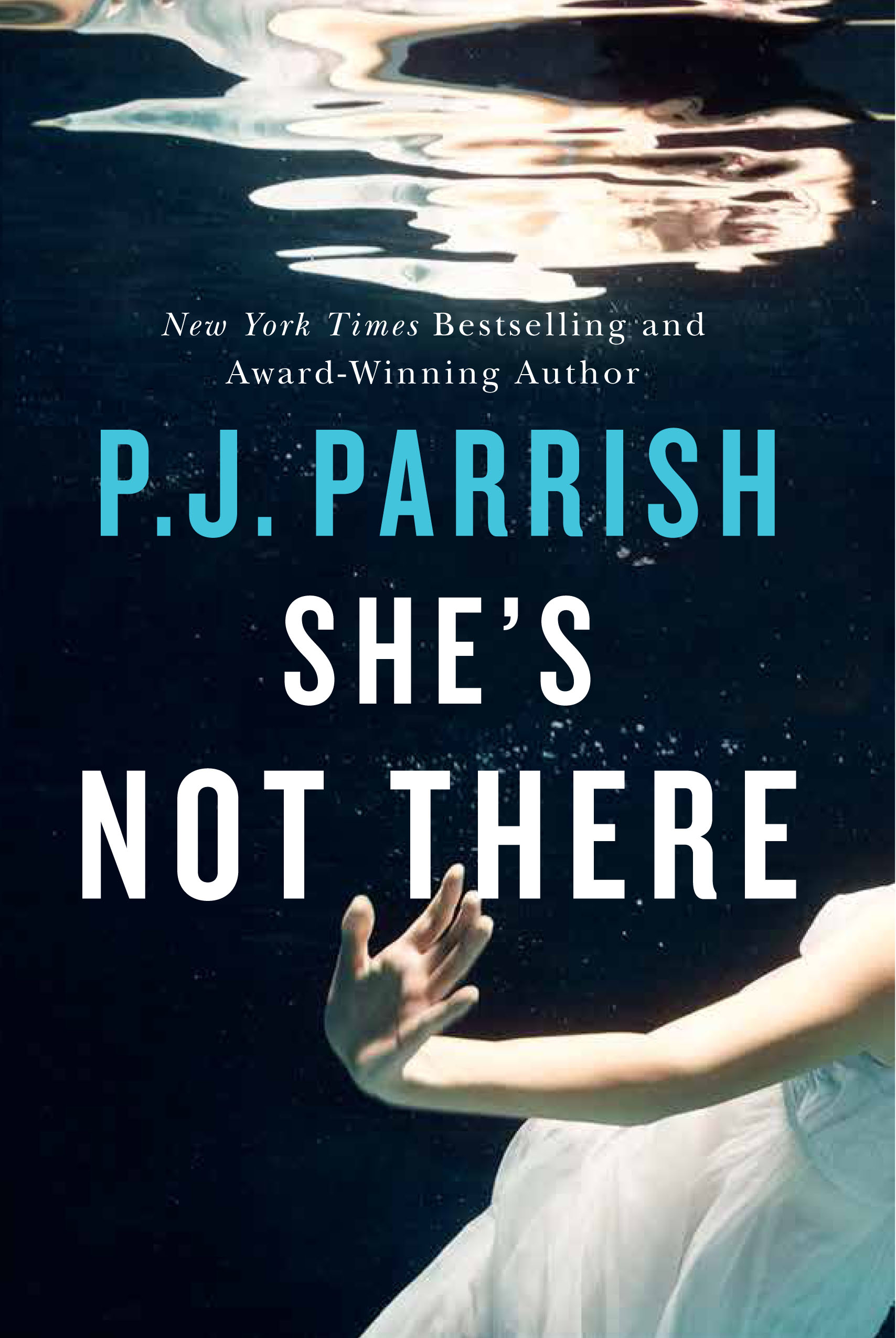
FINAL COVERIn our new book SHE’S NOT THERE, (comes out Sept. 6 but is now available for pre-orders), we don’t have a traditional villain. There is no obvious struggle between good and evil, no ticking clock, no creep stalking a family at their cabin, no Dr. Evil trying to rule the world. It’s psychological suspense, which meant for us that all “action” had to emerge completely from character motivation. James N. Frey (author of How to Write a Damn Good Novel) calls psychological thrillers a style, rather than a subgenre. He says that good thrillers focus on the psychology of their antagonists and build suspense slowly through ambiguity. If you’re a regular here, you know how much I like ambiguity. (Link HERE).

She’s Not There was very hard to write. Not only does it have an unreliable narrator (Yeah, I loved Shutter Island, too.) It was hard to write because we couldn’t rely on the old tropes of serial killers, pebbled glass PI heroes, or power gone wild to build tension.  When the tension sagged, we couldn’t just fling another corpse onto the page. The story’s theme is: What happens to you when you drift downward into living an inauthentic life? Almost all my characters are struggling with this, pulled down by dark secrets and disappointments, and they are all fighting to break back to the surface and breathe again. Yes, people die. Yes, there are creepy moments, high tension, even a cross-country chase.

But my villain?  He’s not there. At least in the conventional sense. You won’t be able to spot him by his black hat. You won’t see him lurking in the shadows or toting an Uzi.  He’s hiding in plain sight, deep inside each of my characters, even the good ones. And for a long time, you don’t know if the good guy is really the bad guy. Or vice versa. Or both.


Like a Virgin, Published
For the Very First Time

“No passion in the world is equal to the passion to alter someone else’s draft.” — H.G. Wells

By PJ Parrish

After twelve books, writing hasn’t gotten any easier for me. And after twelve books, having a new one come out hasn’t lost its thrill.

I just sent in the final copy edits for the latest one. Okay, it’s number thirteen, but I’m not superstitious. I’m excited as hell. Maybe it’s because we took almost a year off for a rest before we started it. Maybe it’s because it’s not a Louis Kincaid series book or even our usual thriller/police procedural. It’s psychological suspense, dual protagonists, unreliable narrator, and a theme that’s haunted my subconscious for a long time – the damage done by living an inauthentic life.

FINAL COVER

Anyway, as my Brit friend Crazy Tim would say, I’m dead chuffed to announce that She’s Not There will be published September 8 (and, if you’ll excuse a bit of blatant self-pro-mo, is now available for pre-order). Our new publisher is Thomas & Mercer, and I’ve waited to talk about this because I wanted to finish the pre-pub process before I went public about our experience. To be honest, I wasn’t sure what to expect when we signed with the West Coast team. We’ve been only with Manhattan-centric houses before and though I have friends who raved about their T&M experiences, I wasn’t sure what to expect. Would the process be different? Would my book get noticed? And finally, would the editing be as good as I was used to?

The answers so far: Yes. Yes. Yes.  Well, let’s change that last one to “no” and I’ll explain later.

Yes, the process is different when you are published by one of giant Amazon’s imprints. (Which are separate from its self-publishing unit). I was treated really well by my former New York publishers and had some great success. But my experience with T&M has been surprising in its inclusiveness. Once they bought our book, there were long intensive conversations where they explained in detail their editing, promotion and publishing process. They have sought our advice via rather lengthy questionnaires and emails on how we thought our book should be marketed — who is our target audience, what our tone is, what themes and motifs are important, what colors and typefaces we thought conveyed our book’s mood, even what kind of voices we thought were suitable for audible books. They wanted to see images we had for cover ideas, and the final cover above is a refined and more dramatic take off on a jpeg we sent.  It was designed by David Drummond and we think it’s really brill, as Crazy Tim would say. (Click here to see David’s other work).

Yes, our book will get noticed. Although Amazon stresses eBook publishing, its print books are beautiful, and contrary to what I had heard, stores are not reluctant to carry T&M books. I’ve had three requests this week for launch party signings from independent stores. As for respect, well, in two years, T&M has had three Edgar nominees and six ITW nominations (one win). And you know, I figured any house that could snag Ed McBain’s back list has something going for it.

Now to that last one. No, the editing is not as good as I am used to. It’s better. Which is not to say the editors are necessarily better. I’ve been blessed to have some terrific editors, including John Scognamilio at Kensington and Mitch Ivers at Simon and Schuster. But at T&M the process is a bit different. We have two separate editors: the first is our acquisition editor, who bought our book and now oversees its journey through the house and out into the world; the second is our development editor, who oversaw the big-picture issues of the book (story, character development, theme) and did the first round of editing. We are really lucky to have landed with Alison Dasho, who was one of the powers behind Bleak House Books in Madison. Alison fulfills what I think is the number one criterion of a great editor: She gets us.

But then came the small army of copy editors. Four of them. All eagle-eyed and talented, but each with his or her own unique contribution. Faith pruned out our word repetitions and cliches, and suggested some character tweaking. Scott caught our writer tics, mistakes in our San Francisco references, and lazy word useage. Sharon snagged typos, flagged inconsistencies, and Nicole, as an ex-dancer herself, rightly questioned every reference we made to ballet. With each pass, the book emerged tighter, cleaner, sharper.

In the heat of creation, we writers make a lot of mistakes. Dumb stuff like changing a hero’s hair color in mid-book. Knee-jerk writer tic stuff like having more staring eyes than a Walter Keane painting. Show-off stuff like having someone order an expensive whiskey when in reality it’s so rare no bar stocks it. Lazy stuff like not bothering to do a Google Street View to find out that Gloucester Street in Brunswick, Ga., does not cross Mansfield. (My bads, all).

But today, as I sit here typing this, my mind is at rest. Because a bunch of talented folks have my back. Copy editors who respected my style when I fought to use “like” because I wrote in a deeply intimate POV and my characters would never use the uppity but correct “as if.”  Copy editors who actually asked me where I stand on serial commas. (They’re like gnats…okay until you can start feeling them bite). Copy editors who take the time to applaud in Track Changes when you do something cool.

Last week, I opened the Word file and found an error. My blood turned cold because it was an error about a clue, deadline was past and the book had started into the production pipeline. When I worked up the guts to tell Alison, she said, “Oh, don’t worry. We’ll fix it. We can go back and fix anything all year long.”

Once, everything was written in stone. Now, nothing is. In some ways, that’s progress, I’d say.

COPY EDITING TEST TIME!

Okay, now let’s see if you can match wits with my editors. Below are passages from She’s Not There. Each has an error or problem, which thanks to my editors won’t see print. Answers at end.

  1. “Look, Owen, I can’t talk now. I have to –-”
    “Is she okay?”
    “No, she’s not okay. She doesn’t even…” He was on the verge of crying. He couldn’t let Owen hear him balling like a girl. “Owen, I’ll call you when I know more.”
  2. There was an ornate gold broach in the shape of a peacock, the tail set with colored gemstones. And a second pin, a big gaudy red and green parrot. He picked them both up. They were not the kind of things a teenage girl would wear. They were old-lady pins.
  3. More memories moved in, unclear but powerful. Her mother’s light brown hair and sad hazel eyes. The sharp jut of her shoulder blades beneath a thin yellow dress as she hung white sheets on a clothesline. A single word came to Amelia as she thought of her mother . . . enduring. Enduring the starkness of a house where quarters were hoarded in Mason jars and small comforts were found in the shelves of the town library and the pews of the Methodist Church.
  4. “My grandson loves his Fig Newtons,” the old man said.
    The sudden sadness in the man’s voice made her turn back toward him.
    “It was all there was in the kitchen—Fig Newtons,” he said. “My granddaughter, she didn’t know how to take care of him right. He was alone and living on cookies and water when I got there.”
  5. The corner booth at the Seal Rock Restaurant offered him a clear view. He had checked out the neighborhood and the building’s exterior already. It overlooked a park that sloped down to the ocean and two popular tourist places, the Sutro Baths and the Cliff House.
  6. He turned onto Eddy Street. The Oasis Inn was a puke-yellow relic from the Sixties.
  7. Buchanan tore open the mailer. Inside was a red leather Day Planner and the Kindle. He opened the Day Planner to the week that Amelia disappeared.
  8. Her eyes locked on the younger woman, and she stiffened, a memory coming into focus. An argument somewhere, this woman yelling at her, something about Alex. Then the memory disappeared, and Amelia found herself staring at the young woman’s face, filled with an unexplainable contempt.
  9. A manic episode, Amelia thought sadly. Isn’t that what they called it? Wasn’t that what happened to bipolar people when their mood pendulumed too wide? That day on the roof and the screaming fit over the burnt cookies—they were the negatives to all the positives.
  10. Tobias nodded slowly and then his eyes slid toward the bar, looking for the server again. When he looked back, Buchanan got his first good look into the man’s eyes. They were the color of the Cumberland River on a cloudy day—a muddy blue-green but shot through with tiny red veins. The guy had been drinking.
  11. She took a step back from the counter at the sound of the voice. The big bald man was coming out from the back room, holding up the ring between two meaty fingers. A woman came out after him, a tiny leather-skinned thing with fizzed red hair, wearing jeans and a pink halter-top.
  12. The dog hadn’t been sick, she remembered. She had taken him in for a teeth cleaning and grooming and they had to keep him overnight. But where? What was the name of the place? She shut her eyes, trying to summon a name, but all she could see in her mind were elephants dancing in tutus. Like that old Walt Disney movie . . .Fantasia.

ANSWERS

  1. Balling like a girl. Maybe “bawling” might not raise eyebrows, you think?
  2. Old ladies wear brooches, not broaches. Unless she gets defensive about it and is afraid to bring up the subject. Or it she wears it sideways, which makes it a broached breach-brooch.
  3. This is a trick question but I included anyway to make a point. It’s nice that mom went to the Methodist Church, but ten chapters ago she was a Baptist.
  4. My grandson loves his Fig Newtons. the old guy says. But then he says the boy’s mother, his granddaughter, was unfit. Which makes the boy his great-grandson.
  5. I have sat in this same booth at the Seal Rock Restaurant in San Francisco more times than I can count. Too bad I didn’t look at the sign outside because it’s the Seal Rock Inn Restaurant.
  6. The Oasis Inn in San Francisco really exists. I haven’t stayed there, but I Street-Viewed it. Trouble is, I called it puke-yellow (and worse later). Lesson: The truth is no defense. If you talk smack about a place, change the name or prepare to get a lawyer.
  7. Day Planner? It’s actually called a Day Runner. And I even use one. Geez.
  8. “Amelia found herself staring at the young woman’s face, filled with an unexplainable contempt.”  Whose face is filled? You tell me, I’m just the writer…
  9. “Pendulumed”?  Get over yourself.  What’s the matter with “swung”?
  10. Let’s see, just for fun, how many times we can shoehorn “look” or “looking” into two sentences!
  11. Fizzed red head. Great image…but for the life of me, I don’t know of what. I meant to write frizzed.
  12. “She shut her eyes, trying to summon a name, but all she could see in her mind were elephants dancing in tutus. Like that old Walt Disney movie . . .Fantasia.”  One of my favorite childhood movies, Fantasia.  Problem is, those dancing animals were hippos. But like I told my editor, the book is about the unreliable nature of memory.  Maybe I was trying to make a subtle point? {{{{Long pause}}}} Nope. I just plain blew it.

I have a memory like…a dancing elephant. Thank God for editors with good eyes, kind souls and suspicious hearts. No serial comma, please.


Want to Be a Writer?
First Be a Mensch

By PJ Parrish

After almost two decades as a crime novelist, working in a business that has seen head-spinning turmoil, I’ve found there is one thing that never seems to change — the menschness of my fellow writers.

I’m pretty sure that menschness is not a word. But maybe it should be. Because what I am trying to describe goes beyond friendliness, kindness and even camaraderie. Sure, you can find all those traits in our community. But the thing that always strikes me when I mingle at conferences, sit on panels or hoist a pinot at the hotel bar is the down-to-earth nice-guy attitudes of my fellow crime dogs.

Okay, I just went and looked up mensch so you don’t have to:

Mensch (מענטש) a Yiddish word that means “a person of integrity.” A mensch is someone who is responsible, has a sense of right and wrong and is the sort of person other people look up to. First known use 1856. In English the word has come to mean “a good guy.”

I have met lots of mensches in the mystery world. Folks who were kind to me in the beginning and gave me advice or a blurb. Big-time writers who, as Lee Child once put it, once they climb high don’t forget to reach down and pull others up a rung. Fellow mid-list authors who shared my pain and talked me off ledges. Beginning writers who sent me thank you notes for something I did or said.  With the exception of one super-successful bestselling toad-guy (who shall remain nameless here) most the people I’ve met along the way have been generous of spirit.

photo (1)

MWA’s head mensch Margery Flax unpacking the Edgars before the banquet.

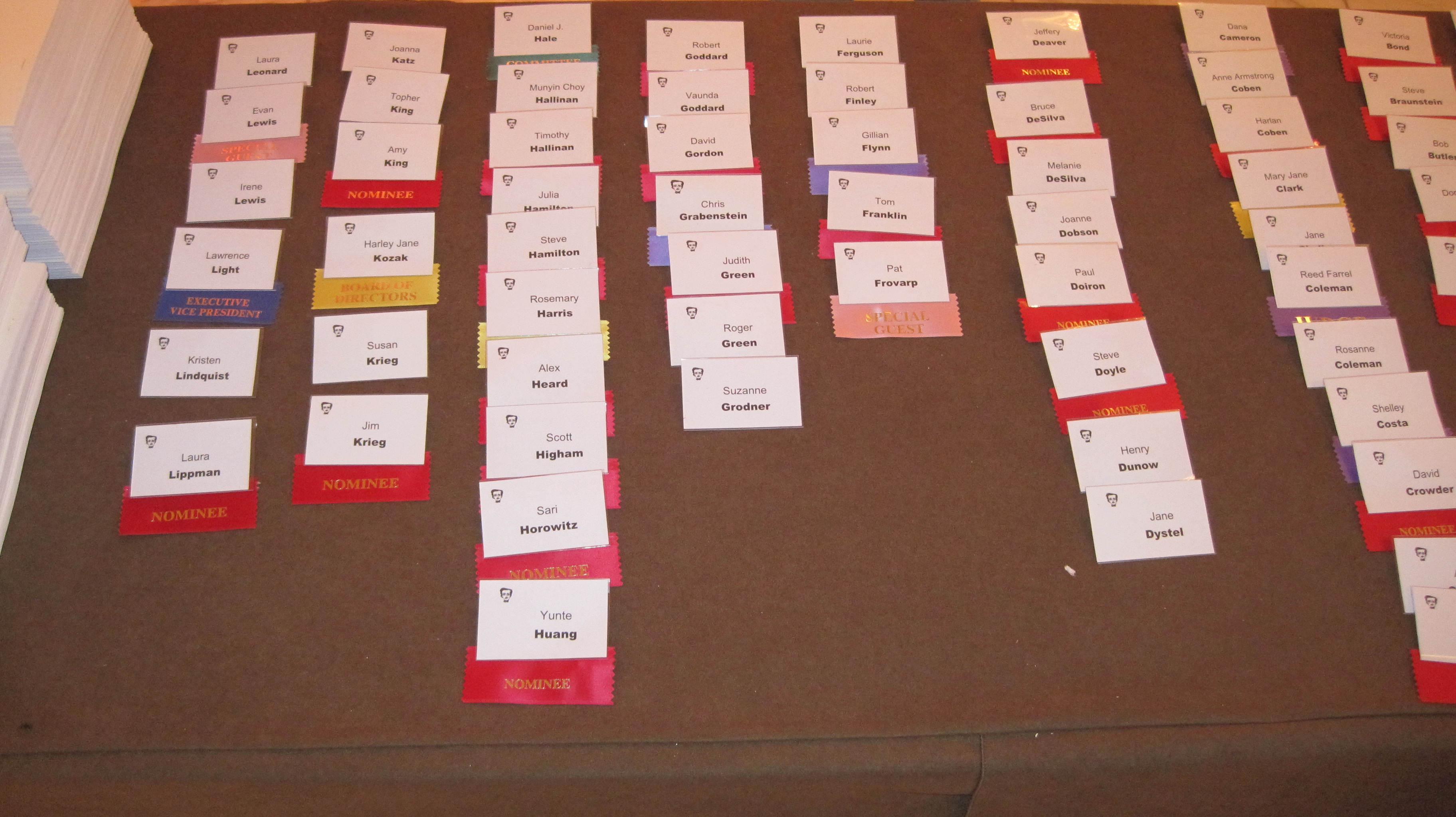
This point was driven home to me this past week when I went up to New York for the Edgar awards given out by Mystery Writers of America.  I’ve been chairing the banquet since 2007 and it has put me in touch with some of the biggest luminaries of our genre. (One reason I volunteer for the job!) Bear with me if I go alittle fan-girl here on you, but I want to talk about them, because sometimes us guys on the lower rungs tend to think those stars above us aren’t human.

Lee Child I met at the Las Vegas Bouchercon. During a cocktail party, I screwed up my courage and went over to introduce myself. He looked down at me (everyone does…I’m five-three and shrinking fast) and said, “You stole the title of my book, you know.” I’m standing there thinking WTF? Then Lee told me that his book One Shot had come out the same day as the MWA anthology, in which I had my first short story, “One Shot.”

“I forgive you,” Lee said. And he bought me a beer.

IMG_0735

Kelly and me flanking Mary Higgins Clark at our first Edgars.

Mary Higgins Clark I met at my first Edgar banquet when she came up to me when it was over and said that she had been attending the banquet for decades and this was the best one. She didn’t have to do that. But she’s a mensch.  This year, when I went to get my drink at the cocktail party, the bartender asked me in a whisper, “Is that Mary Higgins Clark over there? I’m her biggest fan.”  Wiping away visions of Misery, I took her over to meet her and Queen Mary was utterly charming.

IMG_0780

With Lisa Scottoline. then MWA prez.

Speaking of royalty, Lisa Scottoline is another good guy. The night she was emceeing the Edgars Prince William was getting married to Catherine Middleton. At the podium, Lisa wore a tiara in their honor. We’re both royalists and bonded over brain-lint on the Saxe-Coburg Gotha family line. Another mensch queen.

Which leads us to kings. Yeah, I got to meet him. It was my first Edgar job back in 2007 and Stephen King was named Grand Master. One of my duties was to greet him, make sure he got to interviews, a book signing and cocktail parties, and wasn’t mobbed in the Grand Hyatt lobby. I was nervous and tongue-tied. He took my hand and told me to relax. Last week, we met again because he was a Best Novel nominee. (He won for Mr. Mercedes). Not only did he remember my name, he asked what I was working on.

image1

I got to escort Stephen and his wife Tabitha to the nominee party, and when I walked in, you’d think I had the pope in tow. That pic is of me  (looking oddly dyspeptic) with Sara Paretsky and Brad Meltzer. As I watched King work the room (or rather the room work him), I was in awe of how unflaggingly gracious he was to everyone, no matter what their rank.

I wasn’t alone. Best nominee Ian Rankin tweeted: “Well, on the minus side I didn’t win the Edgar award – some young ruffian called Stephen King did. On the plus side I got to meet Mr King.”  From Best nominee (and one of my fave writers) Stuart Neville came this tweet: “I didn’t win the Edgar, but I got to meet Stephen King, who was very gracious in tolerating my fawning.”

Another true mensch is Brad Meltzer. I got to meet him when he was the GOH at SleuthFest and later when he was MWA president and emceed the banquet. He is funny, down-to-earth, and always has time to talk to you, no matter your status.

These are just a few of the good folks I’ve been lucky to meet. So many others have been kind to me on my way to this point in my career — Jerry Healy, Elaine Viets, James Hall, SJ Rozan, Steve Hamilton, William Kent Kreuger, Reed Farrel Coleman, Linda Fairstein, Mike Connelly, Stuart Kaminsky, Eleanor Taylor Bland, and John Gilstrap, who gave me my first blurb.

I wish I could remember who said this, but it was about what “class” was: The ability to make any other person comfortable, regardless of their status and your own. All the folks I’ve mentioned have it in spades. And after a sorta rough year, it was good to go back to New York and be reminded that no matter what winds buffet the book world, our community provides shelter and support.

But ours is a small family with long memories. So no matter where you are on the food chain, play well with others. This post was inspired by a blog I read the other day wherein the author Guy Kawasaki provides five tips on how to be a mensch. After the Edgars, I realized there are lessons in here for writers:

1. When someone has wronged you, continue to treat them with civility. For writers, don’t curl up and die at the easy slight. This happened to me years ago when a fellow writer said something not-so-nice to me in a conference bar. I stewed about it for a long time and finally decided to confront her. She apologized and said she was drunk and had been too embarrassed to bring it up. We’re friends now.

2. Give way more than you take. Volunteer to work at a conference. If you’re published, give someone a critique. Don’t just sit back and bitch; get involved. And if you are a blog lurker, don’t be shy about posting. No one wants to be that creepy guy at the party who sits silent in the corner and just watches. A good blog (like ours here at TKZ) is a conversation. It’s at its best when we all give something back. Winston Churchill said, “We make a living by what we get. We make a life by what we give.”

3. Genuinely acknowledge others. If someone gets published, congratulate them, for God’s sake. If you owe someone a debt, put them in your acknowledgements. If you’re in a critique group, find something to praise. We all need praise. It is high octane fuel for the soul.

4. Embrace diversity.  If you read only light books with happy neat endings, read something dark and difficult. Or better yet, try to write it.  If you’ve never tried to write short stories, now’s the time. If nothing else you will find, as I did, that it’s not as easy as it looks. And lastly, don’t be a genre snob. If you write hardboiled noir, don’t look down your nose at cozies. (Chances are their royalty checks are bigger anyway). When I finally got around to going to Malice Domestic a few years ago, it was like being in a different world, sure, but I came to appreciate more deeply the writing of our less gritty brothers and sisters.

5. Default to kindness. In his blog, Kawasaki says the biggest deficit is not monetary—it is the lack of kindness in our interactions with others. You see this dynamic in action at any writer’s conference. We tend toward cliques. We gather with people of similar status. It’s like high school all over again. But you don’t have to give in to it. If you see someone sitting alone, gather them into your circle. If you are on a panel and someone is struggling, help them out. If you’re sharing an event or signing with someone, talk up their stuff along with your own. And if you ever find yourself in the same room as Stephen King, introduce yourself. He may keep a small boy’s heart in a jar on his desk, but he won’t bite your head off.

Be a mensch. And thank you for putting up with my fan girl pix.

A Plea for…Unhappily Ever After

nv-3

I see the novel ending with an open door. — Michael Ondaatje

By PJ Parrish

I just finished reading a terrific book. And I was going to blog this week about how much I liked it and why I thought it works on all levels – complex characters, a delicious plot with well executed twists, and a setting so well rendered that I felt I had been parachuted in.

But then last night, I got to the ending. It was so…tidy. After three hundred pages of gloriously messy narrative, the author chose to tie up all the plot threads into a pretty pink bow. It just didn’t work for me. Why? Because it deprived me of thinking for myself. It slammed the door on the possibilities I was creating in my head for her characters. It didn’t leave my imagination anywhere to go. And thus, it lost its power.

If you haven’t yet guessed, I love ambiguous endings. I love that Rhett tells Scarlett off and walks away into the fog. I loved that we don’t really know what happens to Offred in Margaret Atwood’s The Handmaiden’s Tale, when she says, “Whether this is my end or a new beginning I have no way of knowing: I have given myself over into the hands of strangers, because it can’t be helped.” And yeah, I even sorta kinda maybe liked the ending to Gone Girl.

Four of my favorite movies are Now Voyager, The Graduate, Lost in Translation and Cinema Paradiso. Will Jerry continue to light two cigarettes for himself and Charlotte? Do Ben and Elaine stay together? What did Bob whisper to Charlotte at the end and did they go back to their awful relationships? Will the adult Toto ever believe in love again?

sopranos2

And about that last scene in The Sopranos? You know, where the family’s sitting in a diner as Journey’s “Don’t Stop Believin'” plays, the tension builds and then suddenly the screen goes dark and silent? Loved it! The series creator David Chase was later quoted as saying, “I have no interest in explaining, defending, reinterpreting, or adding to what is there. People get the impression that you’re trying to (mess) with them, and it’s not true. You’re trying to entertain them. Anybody who wants to watch it, it’s all there.”

Chase might well have added, “it’s all there…in your head.” Because for me, that is where the power of great storytelling lies. For me, even the best constructed novels can fail because almost always I can sense the author moving toward that inevitable ending, starting to close the circle and make sense of it all for me instead of letting me do it.

Now we crime dogs don’t have a lot of latitude when it comes to ambiguity. The conventions of our genre dictate that there is a crime to be solved and that usually implies something to be resolved. Readers are drawn to mysteries and thrillers because the stories usually attempt to impose order on chaos, to make sense out of the nonsensical, to have a hero triumph and make the world right again. I think readers of most kinds of fiction –- yes, even literary – want their novels to make sense. And while they might be willing to let things slide for a while, they usually crave a gratifying conclusion. The reason is easy to understand: Our real lives are messy, confusing, full of dead ends and false starts, horny toads instead of Christian Grey princes, and let’s face it, we all don’t live happily ever after. So when we turn to crime fiction and romance, we are looking for a satisfying conclusion.

But what is “satisfying?” Isn’t there room in there for shadows and crooked lines? Can’t we have some ambiguity?

Some crime writers try to allow for this, but readers sometimes get testy about it. I have two books in my series that have open-ended conclusions. One (A Thousand Bones) involves the case itself and I got emails from readers taking me to task for not “solving” the case in a conventional manner. But the crime was so awful and so personal for my protag, for her to do anything else would have been too…tidy. The other time I left an ending open was in our latest Louis Kincaid book, Heart of Ice, and it involves our hero’s personal life. My editor at the time wanted us to tell readers what exactly was going to happen, but we fought for the open ending. I trust the readers to figure it out.

Tana French, in her Edgar winning debut In the Woods, had similar reaction to her ending. The plot involves two separate cases, decades apart, that are playing on the psyche of the detective. He solves the newer one but the older one, that truly eats at his soul, remains unsolved. French actually cautions us this is going to be outcome in the book’s opening lines:

“What I warn you to remember is that I am a detective. Our relationship with the truth is fundamental, but cracked, refracting confusingly like fragmented glass. It is the core of our careers, the endgame of every move we make, and we pursue it with strategies painstakingly constructed of lies … and every variation on deception. The truth is the most desirable woman in the world and we are the most jealous lovers, reflexively denying anyone else the slightest glimpse of her. We betray her routinely … This is my job … What I am telling you, before you begin my story, is this–two things: I crave truth. And I lie.”

I was watching The French Lieutenant’s Woman on TMC the other night. I’m not crazy about the movie, but it got me thinking about the book, which I had to read eons ago as a literature major. I remember being baffled by it, because right in the middle of Sarah and Charles’s doomed love affair, a narrator appears out of nowhere and tells us we now will have three endings and even flips a coin to decide what order we will get them.

Now John Fowles loved bending narrative rules and was famous for his ambiguous endings. (Maybe because he studied the Existentialists at Oxford?) The Magus ends with the hero’s future an open puzzle that readers are challenged to solve for themselves.

Fowles once told an interviewer how he had received a sweet letter from a reader who wanted to believe that Nicholas, the protag of The Magus, was reunited with his girlfriend at the end of the book — a point Fowles had deliberately left ambiguous.

“Yes, of course they were,” Mr. Fowles told the woman.

Fowles got a second letter the same day from an irate reader taking issue with the ending and demanded, “Why can’t you say what you mean, and for God’s sake, what happened in the end?”

Fowles wrote back, “They never saw each other again.”

Now we mere mortals probably have to be a bit more careful when we use ambiguity. It doesn’t always work. At best, it conveys pretension and at worst, it just confuses the reader and pisses him off. Which brings me all the way back to that book I finished the other night. It was such a letdown to be spoon-fed that ending after such brilliance. Why was the writer compelled to tie the ends up so neatly?

E.M. Forster, in his splendid Aspect of the Novel asks the same question: “Why is this necessary? Why is there not a convention which allows a novelist to stop as soon as he feels muddled or bored? Alas, he has to round things off, and usually the characters go dead while he is at work.”

Okay, one last quote before I go, but it’s a beaut. And it comes from a fictional person, Stephen Maturin. He is a character in a series of novels by Patrick O’Brien, who shows up as the ship’s doctor in the fabulous move, Master and Commander.

“The conventional ending, with virtue rewarded and loose ends tied up, is often sadly chilling; and its platitude and falsity tend to infect what has gone before, however excellent. Many books would be far better without their last chapter: or at least with no more than a brief, cool, unemotional statement of the outcome.”

Oh yes.

Give me a book that makes sense and is satisfying. But don’t wind things up so tightly that you squeeze the life out of it. Let me think, when the story ends, that the characters are like Bette Davis and Paul Henreid, on a big ship, setting sail on some grand voyage, going…somewhere. And that I am going with them.

What does your character want?

download

By PJ Parrish

Many moons ago, when I was just starting out in this crime writing business, I wandered into a workshop at SleuthFest. That day, all I was looking for was a reason to not lurk alone in the lobby of the Deerfield Beach Hilton. Besides, I had two books under my belt that got some nice blurbs and some good reviews. So I thought that I had all the answers.

Man, was I wrong. And thank God I went into that workshop because it forever changed the way I wrote.

LesStandifordHeadShot

The workshop was conducted by Les Standiford and he was talking about creating memorable characters. Now, every writing conference has panels on this. Yada yada yada…don’t rely on stereotypes…blah blah blah…give them interesting backstories and dossiers…humanize your villain…make your hero fallible but likeable…same old same old.  And despite the fact Les Standiford had his own successful mystery series and was a celebrated fiction teacher, I didn’t think I was going to get anything new from his session. But then, as I sat in the back of room, half-dozing off the effects of last night’s cocktail party, Les said something that made the hairs on my neck stand up:

“Ask yourself one question of every character you create: What does he want?”

He had hit a nerve in my writer’s subconsciousness. Because although I had been writing about my cop hero Louis Kincaid for a while, I had never really thought hard about what Les was talking about. So as I sat there in that hot crowded room, I asked myself:

What did Louis want?

Well, he wanted to solve the case! He wanted to find the men in the small Mississippi town who, thirty years ago, had lynched a black man and left his bones in a shallow grave in a swamp.

{{{{Loud sound of buzzer going off}}}}}

Okay then, Louis was a rookie who really needed a job and wanted to impress his new boss, the sheriff.

{{{{Buzzer}}}}

Well, dammit, Louis felt compelled to find the identity of the lynching victim and bring him peace.

{{{Close but no cigar}}}}

Okay, okay. Let me think hard about this. Wait…Louis is biracial. He was born in Mississippi but was fostered out to a white family in Michigan. He walks, uneasily, in two worlds. Could this be about him finding his “black” past, forgiving his mother for abandoning him and coming to terms with the white father who deserted him?

{{{You’re the writer. What do you think?}}}

I think that what Louis wants is to find himself. Twelve books later, both he and I are still looking. But way back when, I thought I had all the answers. That day I walked into Les Standiford’s class, I didn’t even have the right questions.

What does your character want?

It sounds like an easy question. But if you’re doing this novel writing this right, the answer isn’t so easy. Kurt  Vonnegut famously said, “Every­one wants some­thing on every page, even if it’s only a glass of water.“  That is true even of minor characters, but when you’re talking about your lead role players, I think you have get to the very bottom of that water glass.

Dead Poets

Are we talking about character motivation here? Well, yes, I suppose so. Les Standiford, Vonnegut and all great writers and teachers tells us we must plumb the depths of our character’s hearts and heads to find out what makes them tick. But it’s more than that. I think why Les’s question made an impact on me was because it forced me to come at the old question from a different angle. It’s sort of like when Robin William’s character John Keating in Dead Poets Society climbs atop his desk and tells his students, “I stand upon my desk to remind myself that we must constantly look at things in a different way.”

The first step of character development is figuring out what passions, fears, regrets, or desires consume your character. Then, all you have to do is show him interacting with his setting and other characters in a manner consistent with those possible “motives.”

What Les was asking us to do was to go beyond the surface, to dig deep and deeper to find out what was the one essential consuming need of each character. Think of character motivation as having levels. Yes, you can get published by going no deeper than defcon 1 or 2 in character development. But what happens if you push yourself to take just a couple more steps down into the darkness?

Speaking of going into creepy basements, let’s go to a simple example: Silence of the Lambs. If you’ve read Thomas Harris’s book, you know how effective the author was at descending into the lowest rungs of every character’s motivations. But even the movie did a pretty good job at this. Let’s dissect our heroine:

What does Clarise Starling want?

Level 1: She wants to solve the case. She wants to find Buffalo Bill. (basic thriller plot)

Level 2: She wants to prove she can hang with the big boys of the FBI. (basic thriller with feminist theme)

Level 3: She wants to escape her suffocating southern small-town roots and the FBI was a ticket out of hicksville. Remember how impressed one of the victim’s girlfriends was with Clarise’s job? (Basic thriller with feminist theme and rich backstory.)

Level 4: She wants to impress her boss-mentor Jack Crawford. (basic thriller with feminist theme, good backstory and father-figure character interplay.)

Level 5: She wants to validate herself as being worthy of her father’s legacy because he was a cop killed in action. She gets approval by proxy via Crawford, who tells her at the end that her father would have been proud of her.  (Now this is getting interesting!)

Level 6: She wants to make the lambs stop screaming. Cool…But what does this mean psychologically? Clarise is haunted by a childhood memory of hearing lambs being slaughtered. I have always read this as her attempt to exorcise her demons of abandonment, her human need to deal with existential loneliness, her way of pushing back against the black void. “I thought if I could only save just one,” she tells Lector. She’s talking about saving Buffalo Bill’s victims, but isn’t she really talking about herself?

(While we are at it, has anyone else noticed how eerily similar Silence of the Lambs and Jodie Foster’s other movie Contact are in character themes? Both are smart, emotionally fragile women raised by fathers then orphaned, both manipulated by brilliant outcast men. And both women are staring into the vast blackness and hoping they are not alone.)

Let’s go to another example. What does Captain Ahab want in Moby-Dick?

Level 1: He wants to catch the whale that maimed him. (Simple story of revenge).

Level 2: He wants to prove to his crew and himself that even though he’s got one leg, he is still a man. (He even smuggles his own crew onboard just in case.)

Level 2: He wants to strike out against the pacificism of his Quaker religion. Not so simple theme that’s right here in this passage:

The White Whale swam before him as the monomaniac incarnation of all those malicious agencies which some deep men feel eating in them, till they are left living on with half a heart and half a lung. That intangible malignity which has been from the beginning; to whose dominion even the modern Christians ascribe one-half of the worlds; which the ancient Ophites of the east reverenced in their statue devil;—Ahab did not fall down and worship it like them; but deliriously transferring its idea to the abhorred white whale, he pitted himself, all mutilated, against it. All that most maddens and torments; all that stirs up the lees of things; all truth with malice in it; all that cracks the sinews and cakes the brain; all the subtle demonisms of life and thought; all evil, to crazy Ahab, were visibly personified, and made practically assailable in Moby Dick.

Level 3: He wants to vanquish evil, what he calls “the inscrutable thing.” And he’s not sure God is on his side or even exists. He’s like Hamlet, looking for some metaphysical truth in all the madness. And I am sure Peter Benchley had Ahab in mind when he created Quint the shark hunter in Jaws.  Both men are nuts but sort of magnificent. Which is why they had to die.

So here’s what I’d like to leave you with. The next time you think about your characters’s motivations, go deeper. Think hard and long, applying great gobs of elbow-grease of the mind. Don’t be content with staying on the top levels. Don’t skim the surfaces.

MSDSIOF EC076

Don’t be afraid to descend to the very bottom rung and enter that dank dark basement of the human soul. That’s where you find the good stuff.


Better Brainstorming…
Even If You Write Alone

creative-brainstorming

It is easier to tone down a wild idea than to think up a new one.” — Alex Osborn

By PJ Parrish

I don’t know how you guys do it. Those of you who write alone, I mean.

I am blessed in that I work with a co-author, my sister Kelly. Our collaboration began more than 20 years ago and has lasted through 20-some books (counting the ones that didn’t get published). And while we have had our disagreements over the years, we have always understood the power behind the notion that two brains are better than one.

I want to talk today about brainstorming.

This came about because I was cleaning out my computer folders the other day. I have one folder I labeled BRAIN LINT. This is just a depository for all the stuff I can’t find a good place for but am too gutless to throw out. In this folder are still-born story ideas, pictures cadged from iStock that were meant to inspire, old newspaper articles about bizarre crimes and weirdos, and one completed manuscript that is so bad I keep it just to remind myself of how far I have come and how far I could fall.

When I was cleaning out the lint, I found one gem. It is a transcript of a story conference in 1978 between Steven Spielberg, George Lucas and Lawrence Kasdan. They were brainstorming about a possible movie. It didn’t have a title then, but it would eventually be made under the title Raiders of the Lost Ark. You might have heard of it.

Here’s just one exchange:

george-lucas-steven-spielberg-looking-radLucas: We want to make a very believable character. We want him to be extremely good at what he does, as is the Clint Eastwood character or the James Bond character. James Bond and the man with no name were very good at what they did. They were very fast with a gun, they were very slick, they were very professional. They were Supermen.
Kasdan: How do you see this guy?
Lucas: Someone like Harrison Ford, Paul LeMatt. A young Steve McQueen. It would be ideal if we could find some stunt man who could act.
Spielberg: Burt Reynolds. Baryshnikov.
Kasdan: Do you have a name for this person?
Lucas: I do for our leader.
Spielberg: I hate this, but go ahead.
Lucas: Indiana Smith. It has to be unique. It’s a character. Very Americana square. He was born in Indiana.
Kasdan: What does she call him, Indy?

I still can’t get the image of Baryshnikov in a fedora out of a mind. But that was how Indiana Jones was born, out of a brainstorming session between three creative guys. What a strange word – brainstorming. Ever wonder where it came from?

AFOsbornWell, in 1919, Alex Osborn, an ex-newspaper man from Buffalo, joined with Bruce Fairchild Barton and Roy Sarles Durstine to form the hugely successful BDO advertising agency. Osborn went on to write many books on creativity but he’s the one who coined the term “brainstorming.”

Nowadays, “brainstorming” is a catch-all for any type of creative group grope. But I thought it might be interesting to go back and see what Osborn had to say about it back in 1953 and find out if it could help writers today. Well, guess what? It’s still good advice, whether you are collaborating, working in a critique group — or even flying solo.

Here’s my main take-aways from Osborn’s ideas on brainstorming.

1. Think up as many ideas as possible regardless of how ridiculous they may seem.  It’s unlikely you’ll get the perfect solution right off the bat, so he recommends getting every idea out of your head and then go back to examine them afterwards. An idea that may sound crazy may actually turn out to work with a little modification.

Doesn’t this make sense when you’re plotting? I know when Kelly and I talk, we throw everything on the wall. You need to take the same approach with yourself. Write down every idea and let them bake for a while. Sometimes, the most outrageous thing leads to something useful.

2. Don’t be judgmental. All ideas are considered legitimate and often the most far-fetched are the most fertile. Ideas can be evaluated after the brainstorming session but judgments during the process should be withheld.

Are you sometimes too hard on yourself? Do you think, “Oh, that’s so stupid, no editor will ever buy it.” Or maybe you are a self-doubter, telling yourself, “I don’t have the chops to try this technique.” Or: “This is a great idea but it’s so complex so I won’t even try.”

3. Go for quantity not quality. Don’t get hung up (like I often do) on coming up with the most clever solution to your writing problem. Let your brain waves flow so the bad stuff bobs up to the surface along with the good. Osborn said: “Creativity is so delicate a flower that praise tends to make it bloom while discouragement often nips it in the bud. Forget quality; aim to get a quantity of answers. When you’re through, your sheet of paper may be so full of ridiculous nonsense that you’ll be disgusted. Never mind. You’re loosening up your unfettered imagination—making your mind deliver.”

Osborn’s books were geared more toward corporate types trying to get their teams to think more creatively on things like how to get traffic flowing better in big cities. But take a look at his suggestions for improving creativity and see if there’s not something here for us mere writers:

1. Break up the problem into smaller pieces. For writers, this can mean tackling each plot or character problem as manageable bites, not getting overwhelmed by the idea that you’ve got 400 pages to fill. Get that first draft written then go back and fix your plot holes or layer your characters better.

2. Search for alternatives. If you’ve painted yourself into a plot corner, look for a different way out than the old ways.

3. What can be borrowed or adapted? Read other writers and learn from them.

4. Modify with new twists. There aren’t many new plots in crime fiction but there is always a way to put your own fresh imprint on them.

5. Is there something that can be magnified or minified? Maybe the stakes in your thriller aren’t high enough. Maybe you need to play down a secondary character who is overshadowing your hero. Are you larding in too much research?

6. What can be substituted? Maybe if you changed your location the story would suddenly come alive. Would your mystery work better in a small town where you could exploit the English village dynamic? Is your setting banal and underwritten? Are you hitting all the wrong clichés if your book is set in Paris or some other iconic place?

7. What can be re-arranged? Maybe you’re writing in the wrong point of view? Try switching from first to third. Or maybe the guy you think is your hero is really the bad guy?

8. Consider the vice versa. I love this one. Do just the opposite of what you are now doing. Is your protag male? Switch gender! Are you relying on tired character tropes (lonely alchoholic PI, sweet antique store owner who solves crime). Make your brain do a 180 and examine what is on the flip side. I did this with my latest book. The woman I thought was my protag turned out to be one of two in a dual-protag parallel theme story.

Okay, enough lessons. Let’s end by going back and eavesdropping some more on the Indiana Jones brainstorm session. CLICK HERE to read the whole thing.

97147d290117720Lucas and Spielberg started with the idea that they wanted to make a movie that was like old Republic serials of the Thirties (Zorro, Dick Tracy, Red Ryder). Something had to always kept happening, every ten minutes or so another cliff-hanger situation. From there, the guys dreamed up Indiana Smith and other elements. In the beginning, even the ark was just a MacGuffin.

Lucas: The thing is, if there is an object of antiquity, that a museum knows about that may be missing, or they know it’s somewhere. He can go like an archeologist, but it’s like rather than doing research, he goes in to get the gold.
Spielberg: His main adversaries will be the Germans?
Lucas: Yeah, I think they should be. I’ve been trying to move him around the world a little bit to see if we can’t get a little Oriental influence into it just for the fun of it. I may have fit it in. The fun thing is, he’s a soldier of fortune, so we can move him into any sort of exotic thirties environment we want to.
Spielberg: Keep him out of the States. We don’t want to do one shot in this country.
Lucas: The film starts in the jungle. South America, someplace. We get one of these great scenes with the pack animals going up the mist-covered hills. Very exotic mist-filled jungles and mountains.
Spielberg: Where he goes into the cave?
Lucas: This is where he goes into the cave. We had it where there’s a couple native bearers, whatever, and sort of a couple of Mexican, well not Mexican…
Spielberg: They’re like Mayan.
imagesLucas: They’re the third world local sleazes…[LATER] He goes into this very sleazy Casablanca type club and makes contact with this agent. The agent is a girl. She’s sort of a Marlene Dietrich tavern singer spy. A German lady singer. She’s really a double agent.
Spielberg: I like the idea that she’s a heavy drinker and our hero doesn’t drink at all. She gets drunk a lot. She’s beautiful and she gets really sexy when she’s drunk, and silly. And he doesn’t touch the stuff.
Lucas: I don’t want to soften her. I like the fact that it’s greed. I like all the hard stuff, but you’re going to love her.
Raiders-of-the-Lost-Ark-indiana-jones-23708996-500-300Spielberg: There should be a real slimy German character. He’s the only gestapo involved there. Every time you see him, you know it’s going to be the worst pain, death by torture. This guy looks like a ferret. He’s got that slick black hair. His name is Himmler or something like that. He’s a stocky short guy, a master torturer.
Lucas: What can he chase them with? What if he jumps on a camel?
Spielberg: I love it. It’s a great idea. There’s never been a camel chase before.
Lucas: Is this camel going to chase a car?
Spielberg: You know how fast a camel can run? Not only that, he can jump over vegetable carts and things. We still have the big fight in the moving truck to do. And now we have a camel chase.
Lucas: We’ve added another million dollars.
Spielberg: Not really. How much trouble can a camel be?

And then they talk about the big scene toward the end where Indy and Marion are tossed into that deep tomb and the bad guys cover it up with a rock. They’re trying to figure out what is in the tomb that’s dangerous and how Indy gets out. They decide there is a huge artesian well that opens up and he and Marion are in danger of drowning. Then somebody suggests there are also wild animals in the tomb, like tigers.

Spielberg: It would have to be a neighborhood tiger.
Lucas: There aren’t any tigers out there.
Spielberg: I’m not in love with the idea.
Lucas: You could have bats and stuff, make it slightly spooky.
Spielberg: What about snakes? All these snakes come out.
Lucas: People hate snakes. Asps? They’re too small.
Spielberg: It’s like hundreds of thousands of snakes.
Lucas: When he first jumps down in the hole, it’s a giant snake pit. Then when he says they’re afraid of light, they throw down torches. You have a whole bunch of torches that keep the snakes back. So he only has one more torch, and the snakes start coming in. He sits there with one torch, knowing that when the torch goes out… It’s the idea of being in a room, in a black room with a lot of snakes. That will really be scary.
Spielberg: The snakes are waiting, looking at him. Thousands. And the torches are burning down. He’s trying to keep it going. The torch goes out. The whole screen goes black. The sound of the snakes gets more intense. You hear him backing up. The camera pans and suddenly you see, it’s black, but there’s light coming from several cracks. It’s not completely black. That leads him to an opening. To a rock that isn’t so flush against the other rocks. He knows there’s access. He keeps pushing on it, he gets a little more room.
Lucas: We shouldn’t have any snakes in the opening sequence, just tarantulas. Save the snakes for now.
Spielberg: It would be funny if, somewhere early in the movie he somehow implied that he was not afraid of snakes. Later you realize that that is one of his big fears.
Lucas: It should be slightly amusing that he hates snakes, and then he opens this up, “I can’t go down in there. Why did there have to be snakes? Anything but snakes.”

raiders-of-the-lost-ark

Now, aren’t you glad they didn’t go with the tigers?

Seven Decisions That Can Make Or Break Your Book

red hearrings

It is like reconstructing the whole of Paris from Lego bricks. It’s about three-quarters-of-a-million small decisions. It’s not about who will live and who will die and who will go to bed with whom. Those are the easy ones. It’s about choosing adjectives and adverbs and punctuation. These are molecular decisions that you have to take and nobody will appreciate, for the same reason that nobody ever pays attention to a single note in a symphony in a concert hall, except when the note is false. So you have to work every hard in order for your readers not to note a single false note. That is the business of three-quarters-of-a-million decisions.”

By PJ Parrish

See that quote above? (I know that I start a lot of posts with quotes and you skip over them. But please go back and take a second to read this one. We’ll wait til you get back…)

Okay, that quote is by the writer Amos Oz, and I have kept it around because whenever I get in the weeds with my writing, it’s helpful to read it and be reminded that creating a book is really nothing but a a very long series of decisions. (Click here to read the whole interview with Oz. It’s worth a detour later.)

Decisions, decisions…

We make thousands of them every day, and they run the gamut from the semi-conscious to the life-altering. Get up or hit the snooze button? Walk the dog now or hope he makes it until I get home? Buy or rent? Change jobs or roll the dice and go back to school? Call up the ex-wife and tell her the truth? Send my son to rehab? Confront mom about giving up her car keys?

Since this process is part of our everyday life, you’d think making decisions would be rote when it comes to our writing. But it’s not. Just ask any poor slob who has painted himself into the plot corner and said, “Oh crap, now what?”

Like Amos Oz, I think a good novel is made by careful and calculated decision-making. Not that there isn’t room for serendipity, flights of fancy, and raw passion. Yes, characters take on a life of their own, but we still hold their reins. Yes, we can’t anticipate every detour, but we can keep the car under fifty as we career down the road less written about. When it comes to writing, I really believe in the virtue of control. (Hey, whatcha want? I’m a Scorpio with Virgo rising). So I’d like to talk today about how to make our decision-making more acute.

I just finished critiquing a partial manuscript of an unpublished author (I do this for charity). And while there was good stuff going on, I sensed that the writer wasn’t in control of his decisions. He was like a guy thrown into a swift-moving river and had relinquished his fate to the rapids and rocks instead of making an effort to steer toward a goal. He was letting his plot and characters propel him forward rather than using his craft oars to guide him toward where he really wanted to go.

Years ago, I went on a white-water rafting trip on the Nantahala River (where part of Deliverance was filmed. That’s me middle right in the picture above). It was white-knuckle stuff, but I always had faith that our guide could get us through. He knew where the rocks and whirlpools were, when we needed to pull right, or when we needed to ford a bad stretch. He made decisions.

Okay, enough with the metaphors. Give me a rock I can grab onto, I hear you saying. So let’s try to break down the big decisions you need to make that can make or break your book.

1. Where do I start?

We crime dogs get drilled into us that a fast break from the gate is vital to mystery and thrillers, and while I believe you can risk a slow opening if it is well done, I think your POINT OF ENTRY is the single most important decision you make. Yes, the opening must be compelling and hint at what’s to come. But enter too early and you risk throat-clearing. (Detective awakened by phone call in night summoning him to crime scene. Ho-hum). Too late and you risk confusion. (What the heck is going on here? Who are these people? Where am I in time and place?).

Let’s take a look at one opening. It’s a little long but worth dissecting:

Dawn broke over Peachtree Street. The sun razored open the downtown corridor, slicing past the construction cranes waiting to dip into the earth and pull up skyscrapers, hotels, convention centers. Frost spiderwebbed across the parks. Fog drifted through the streets. Trees slowly straightened their spines. The wet, ripe meat of the city lurched toward the November light.


The only sound was footsteps. Heavy slaps echoed between the buildings as Jimmy Lawson’s police-issue boots pounded the pavement. Sweat poured from his skin. His left knee wanted to give. His body was a symphony of pain. Every muscle was a plucked piano wire. His teeth gritted like a sand block. His heart was a snare drum. The black granite Equitable Building cast a square shadow as he crossed Pryor Street. How many blocks had Jimmy gone? How many more did he have to go?


Don Wesley was thrown over his shoulder like a sack of flour. Fire-man’s carry. Harder than it looked. Jimmy’s shoulder was ablaze. His spine drilled into his tailbone. His arm trembled from the effort of keeping Don’s legs clamped to his chest. The man could already be dead. He wasn’t moving. His head tapped into the small of Jimmy’s back as he barreled down Edgewood faster than he’d ever carried the ball down the field. He didn’t know if it was Don’s blood or his own sweat that was rolling down the back of his legs, pooling into his boots.


He wouldn’t survive this. There was no way a man could survive this.


This is from Karin Slaughter’s lastest, Cop Town. Why do I like this opening? Because even though she uses a lot of description, the effect is visceral and immediate. She could have started with the shooting incident itself, but haven’t we all read that a million times? No, she dives into the bleeding heart of the scene by showing a cop carrying his dying partner. What is left UNSAID is compelling and makes us want to read on: What happened? Why didn’t he just get in his squad car and drive? Where is he going? Are both men shot? Turns out, Jimmy carries his partner to the hospital but does he survive? You have to read on…you just have to. Cop Town is up for the Best Novel Edgar this year, by the way.

2. Whose story is this?

Every story needs a protagonist. That much we all know. But sometimes, in the hurly-burly of writing, we can lose sight of who owns the story. The result can be that seductive secondary characters take over, or the villain (whom we all love to lavish our attention on) becomes hyper-vivid. The protag-hero is, to my mind, the hardest character to create because you must invest so much of the story’s logic and impact in him that he can mutate from calm center to sidelined cipher.

Sometimes, you might start out telling the story from one character’s POV, believing he is your hero, but then a second character elbows into the spotlight. This happened to me with my current book. I opened with a woman waking up in a hospital with concussion-induced amnesia and she has a gut-punch fear that her husband tried to kill her. So she bolts from the hospital and goes on the run. She’s my unreliable narrator protag, I thought. Until her husband hires a skip tracer to bring her home. It took fifty-some pages before I realized I had a full-scale dual-protag story on my hands.

Now this is not to say you can’t have a teeming cast in your story. I’m still slogging through Ken Follett’s The Pillars of the Earth. Early on, I was captivated by the protag Tom Builder, but whenever Follett moved away from Tom, I got impatient. Later in this massive book, the protag spotlight shifts to his step-son Jack. I missed Tom badly.

Don’t confuse point of view shift with protagonist. A book can have numerous POV’s, but the STORY’S ARC is usually best tethered to one character’s journey. The Lord of the Rings is a sprawling saga with at least three major heroic types. But isn’t Frodo the true protag? (Not sure…throwing it out for discussion).

And be careful about setting up a false or “decoy” protag. This is a character that dominates so much of a book in its early going, that the reader begins to identify with her and invest in her journey. But then this character is marginalized (usually killed). Think of Marion Crane in Psycho, who dominated the movie for 47 minutes until Norman Bates stepped out of the shadows to become the putative protag. It could be argued that Stieg Larsson’s Mikael Blomkvist is a decoy protag, because while most the plot’s machinery is built around him, Lizabeth Salander is the true action hero and embodiment of the story’s themes. At the very least, I’d consider them dual protags.

A word about unreliable narrators and dual protags: Neither is easy to pull off. Believe me, I know — now. Being in the POV of an unreliable narrator is exhausting for the writer and can, consequently, tire the reader as well. As for dual protags, you the writer will tend to bond more strongly with one over the other. So will your readers. Unless you are confident of bringing two equal beings to life, stay with one protag. You don’t want your reader saying, “Gee, I wish Tom the Builder would come back.”

Don’t juggle with chain saws until you’ve mastered machetes.

3. What am I trying to say?

We’ve had great posts here on the subject of theme. I’m going out on limb here and say all good books have themes.  Yes, your goal might be modest — you just want to entertain readers. (Don’t we all?) But beneath the grinding gears of plot, even light books can have something to say about the human condition. A romance might be “about” how love is doomed without trust. A courtroom drama might be “about” the morality of the death penalty. Good fiction, Stephen King says, “always begins with story and progresses to theme.” And often, you don’t even grasp the theme until later in the book or even during rewrites.

Last week, our new publisher sent us a long questionnaire. They wanted our ideas on cover design, colors, typography, who we thought our audience was, and whose books are similar to ours. They also asked us to write our own back copy. Not because they wanted us to do their job; they wanted us to be able to articulate the essence of our story. And I tell you, if you can’t write your own back copy (about two paragraphs), you might not have a grip on your story and what it is about.

They also asked us some other pointed questions: What are your major and minor conflicts? What is the book’s theme(s)?  What are the recurring visual motifs or symbols? What is the book’s tone and mood? Which leads me to…

4. What mood am I in?

My publisher’s questionnaire listed some “mood” words to help us: haunting, witty, intense, sweet, hopeful, psychological, somber, epic, tragic, foreboding, romantic. They were asking us this because they want the design and promotion to enhance our chances for success in a cacophonous book market. You, too, have to think about this as you write your book, whether you self-pub or go traditional. What kind of world are you asking your reader to enter? How do you want them to feel? Once you can answer this question, you then must use all your powers and craft to create what Edgar Allan Poe called “Unity of Effect.”  Every word and image, Poe believed, had to be carefully chosen to illicit an emotion. In his short stories, it was fear, of course. In his poems, you could argue, he was going for melancholy. What are you aiming for?

5. Where am I?

Don’t neglect your setting. I know…that’s stating the obvious. But I’m often surprised at how paltry setting is rendered in crime fiction. We need to know where we are very early in the story, preferably inserted gracefully into the narrative flow via sharp description. Yeah, you can slap one of those tags at the beginning of chapter one — Somewhere in the Gobi Desert, Sept, 1904.  I concede that you need signposts at times; I’ve used them myself. But they can be a crutch. As a reader, I prefer to be parachuted into a place and use my senses rather than have the writer stick a sign in my face. Here’s a nice free-fall:

Exmoor dripped with dirty bracken, rough, colorless grass, prickly gorse, and last year’s heather, so black it looked as if wet fire had swept across the landscape, taking the trees with it and leaving the moor cold and exposed to face the winter unprotected.

That’s Belinda Bauer opening her thriller Black Lands. Now I don’t have the foggiest where “Exmoor” is, but I have a pretty good notion it’s a dark place somewhere up by England where bad stuff happens.

6. Am I doing this for me or for the story?

The story always has to come first. You can’t kill someone off just because you’ve stalled in the middle and you’re desperate. You can’t let a character hog the story just because you’ve fallen in love with her or she’s easier to write than your protag. You can’t add a twist just because you think it will make you look clever. All twists must be organic, emerging from the plot, not from your “hey-watch-this!” writer ego.  Go back to question 2: Whose story it is? Well, it’s not yours; it’s your characters’s. It’s not about you using fancy words or filigreed metaphors. It’s not about you trying to transcend the genre, win some award, or anything else. It’s about the people in your book.

As Elmore Leonard once said, “Always write from a character’s point of view. Write in their language to keep the sense that it’s their story. They’re the most important thing.”

This one is dear to me because my collaborator-sister Kelly and I sometimes have two distinct ideas of where a story might be going or what a character is like. We’re often asked if we argue. No, we don’t. Because we know that our egos don’t matter; only the story does.

7.  Does this make sense?

As I typed that headline above, I started hearing Olivia Newton John: “Let’s get logical, logical! I wanna get logical! Let me hear you characters talk! Let me see your story walk!”  So my last question here is a plea for simple clarity in three things: your writing style, plot structure, and character motivation. Let’s break them down:

Writing style: Don’t confuse your readers. Chose the simplest but most evocative words you can find. As Stephen King says, “One of the really bad things you can do to your writing is dressing up the vocabulary, looking for long words because maybe you’re a little ashamed of your short ones.” In other words, most the time a lawn is just a lawn, not a verdant sward.

Be clear in your directions when you move your characters through time and space. If someone enters a room, tell us. If you jump ahead three days in time, tell us.  This is the “busy work” of fiction writing but it’s no less important. If your reader can’t follow the simple physical movements in your story, they will give up on you and your book.

Plot structure: Your story must have a durable thread of logic that runs from beginning to end. Events on your plot arc must emerge organically and not from coincidence. (no deus ex machina or long-lost Uncle Dickie from Australia showing up in chapter 40 to announce he is the killer) Your details of police, legal and medical procedure must ring true. Your twists and turns must be well-planned and hard-earned. Does the plot, as a whole, make sense? And if you write sci-fi, dystopian fiction or horror, does the artificial world you create obey the rules of its own logic and does it FEEL believable?

Character motivation: Man, is this one important. I can’t believe I left it for last. Characters are your lifeblood and if you want the reader to believe in them, to care about them, to root against them or cheer for them, they must be multi-dimensional and “real.”  They must conform to their own internal logic. They must be true to their personalities. We’ve all read books where we say, “Shoot, that guy would have never done that!” The writer has not done her job in this case, has not asked herself: “Does this make sense for this person to do this?” This post is running long, so I’m going to advise you to go back and read Jodie’s excellent post yesterday on consistency in characters. As she says, “Don’t impose your preconceived ideas on the character – you risk making him do things he just wouldn’t do. Know your characters really well and the rest will naturally follow.” CLICK HERE TO GO BACK.

Decisions, decisions…

As Amos Oz said in his quote above, nobody ever pays attention to a single note in a symphony in a concert hall, except when the note is false.

Yo! Muse!

muse (1)

O Muses, O high genius, aid me now!
O memory that engraved the things I saw,
Here shall your worth be manifest to all!
— Dante, The Divine Comedy

By PJ Parrish

If you are like me, you take your inspiration wherever — and whenever — you can get it. Writing is not easy. (Warning: tortured metaphor ahead).

Writing is like sailing a Hobie Cat in the ocean in the middle of a squall. I know because I used to sail Hobies during my first marriage, which is probably why it didn’t last. The marriage, not the Hobie. The day is always sunny when you launch your Hobie from the beach and you’re all aglow with hardy-har-har-endorphins. So it is when you sit down and type CHAPTER ONE.

Then the storm hits and there you are, hanging onto a 16-foot piece of fiberglas and vinyl, hoping lightening doesn’t hit the mast and fry your ass. You are out there alone in the storm, out of sight of land, riding the waves and the troughs, hoping you can make it home. You might even throw up. This is usually around CHAPTER TWENTY for me.

End of metaphor.

I often wonder what keeps writers writing. Tyranny of the contract deadline? Blind faith? The idea that if you don’t you might have to do real physical labor for a living, like paint houses? All of those work for me. But sometimes, the only thing that keeps me going is a visit from my muse.

Now, let’s get one thing clear here. I don’t believe in WAITING for a muse to show up. I get really impatient with writers who claim they can’t write until they feel inspired because frankly, 90 percent of this gig is writing DESPITE the fact your brain is as dry as Waffle House toast. (or as soggy, depending on which Waffle House you frequent. The last one I was in was off the Valdosta Ga. I-95 exit in 1976 and the toast was so dry it stands today as my singular metaphor for stagnant creativity).

But I do believe that sometimes — usually when your brain is preoccupied with other stuff — something creeps into the cortex and quietly hands you a gift. And these little gifts are what get you through.

There are nine muses in mythology, who were supposed to be the origin of all artistic inspiration. They were Calliope, Clio, Erato, Euterpe, Melpomene, Polymnia, Terpsichore, Urania and Thalia. (I always thought it was cool that Dobie Gillis’s unobtainable ideal woman was named Thalia — the muse of comedy). The muses ruled over such things as dance, music, history, even astronomy. No muses for crime writers, unless you count Calliope for epic poetry but I think James Lee Burke has her on permanent retainer.

I don’t have just one muse. I’ve figured out I have a couple who specialize in particular parts of my writing. And they never come around when I am at the computer. Never get a whiff of them when I am actually in writing mode itself. They are like cats. They only come around on their own terms.

SweetSmell_081Pyxurz

First, there’s my dialogue muse. I call him J.J. because he sounds like Burt Lancaster’s gossip columnist J.J. Hunsecker in “The Sweet Smell of Success.” Always chewing at my ear saying oily things like, “I’d hate to take a bite out of you, you’re a cookie full of arsenic.” J.J. comes to visit me only when I am jogging. Never on the threadmill, mind you, only outdoors. J.J. makes my skin crawl, but man, can this guy write dialogue.

Tvpinup

Then there’s my narrative muse. I call him Cat Man because he slips in on silent paws, sings in a fey whisper and only visits me just as morning has broken. He looks like Cat Stevens, but the old hot young version not the later one. Cat Man comes around about dawn, just as I am waking up as if from death itself. See, my husband’s insomnia means we sleep with blackout drapes, a white-noise machine and the A/C turned so cold the bedroom is like a crypt. So when I wake up, it is with a gauzy gray aureole rimming the drapes, icy air swirling around my nose and a soft swoooshing in my ears. And there is Cat Man, spinning a long segment of sensual exposition that salvages my stagnant plot. I have learned to lay there, very still, until he is done with his song, because if I get up and try to write it down, he vanishes. Praise for the singing, praise for the morning, praise of the springing, fresh from the word.

alice flo 2

And then there is my third muse. She’s my favorite. Her name is Flo because her voice sounds like that waitress who worked in Mel’s Diner on the old “Alice” sitcom. You know, like the door of a rusted Gremlin. Flo is my muse of getting real. Her Greek name is Nike (the goddess of victory) and her slogan is “Just Do It.” Because whenever those other two guys fail me, whenever they don’t show up, Flo is there. She is the muse who knows that the only way I am going to get the book finished is through plain old hard work. Like Nike, Flo has wings. They symbolize the fleeting nature of victory. Or, as Flo often tell me, “Honey, if you don’t get off your ass and just write the damn thing, you’re going to lose your contract and you’ll have to paint houses for a living.”

I’d be lost without her. Who — or what? — keeps you going?