About Debbie Burke

Debbie writes the Tawny Lindholm series, Montana thrillers infused with psychological suspense. Her books have won the Kindle Scout contest, the Zebulon Award, and were finalists for the Eric Hoffer Book Award and BestThrillers.com. Her articles received journalism awards in international publications. She is a founding member of Authors of the Flathead and helps to plan the annual Flathead River Writers Conference in Kalispell, Montana. Her greatest joy is mentoring young writers. http://www.debbieburkewriter.com

Tribute to a Mentor

by Debbie Burke

@burke_writer

In the early 1990s, a successful screenwriter, producer, and military consultant named Dennis Foley left Hollywood to move to the small ski village of Whitefish, Montana. He’d been a popular writing instructor at UCLA and was now on the forefront of a brand new wave in education: online classes. He could live wherever he wanted, while students sent him assignments and manuscripts via email.

At the time, our local group, Authors of the Flathead, was a small rag-tag gang of hobby writers who fiddled around with words and supported one another in our fledgling attempts at publication. I’d sold my first story to a literary magazine that paid me a $5 check that bounced. A couple of other members wrote unpaid columns for weekly newspapers. Definitely not the big leagues.

We were the ignorant leading the inexperienced.

In a small town, it didn’t take long for word to get around about the new guy from Hollywood who had worked on hit TV shows like MacGyver, Cagney and Lacey, China Beach as well as motion pictures. The club president and I summoned our courage to invite this Hollywood big shot to speak at a meeting.

Dennis graciously said yes and he turned out to be anything but a Hollywood big shot. He not only spoke at that meeting, he came to the next, and the next. Pretty soon, he adopted Authors of the Flathead and was teaching our rag-tag gang the same material he was teaching at UCLA.

For free.

WOW.

He showed us how to become professionals. We learned plotting and organization. He taught us John Gardner’s terms like profluence, the sense of a story always moving forward; and fictive dream, the near-trance state when writers delve deeply into imagination to create a fictional world more vivid than reality. He urged us to take the reader into that world and gave us tips how to preserve the trance.

He explained schadenfreude (delight in the misery of others) and urged us to chase our characters up a tree and throw rocks at them. Conflict was the key to riveting fiction. If life went well for the character, it was bad for the reader; if life went badly for a character, it was good for the reader.

He recommended scenes in novels needed to accomplish four tasks:

  1. Reveal character;
  2. Increase conflict and tension; 
  3. Move the story forward;
  4. Foreshadow.

A really effective scene accomplishes all four tasks but at minimum a scene should include two or three.

He taught us that consistent daily production would carry us farther than occasional brilliant flashes of talent. He counseled us to lower our writing goals to a level we could meet, even if it meant only writing a paragraph or page a day. At a page a day, he often reminded us, in a year, you have a book-length manuscript.

Consistently meeting smaller goals was a better habit to develop than setting goals too high and becoming frustrated when you fail.  

For show and tell, he would bring us Oscar-nominated scripts to study, like Earl Wallace’s Witness.

Dennis had also published four military novels about Vietnam and a memoir about long range patrols. But he rarely talked about his own work; instead he concentrated on our work and how to improve it.

In addition to teaching, Dennis continued to polish his own craft, earning an MFA from Vermont College. He brought back fresh techniques and shared them with us.

Dennis’s one inviolable rule: Don’t bore the reader.

When we needed speakers for our group’s annual conference, he contacted Hollywood colleagues as presenters, contributing to its well-respected reputation. When the pros from New York and Hollywood attended, they invariably commented about how rare it was to find such camaraderie and helpfulness in a writing community. Dennis had set that tone and example that has remained our trademark.

After weekly meetings, we often adjourned to a restaurant for coffee and camaraderie. At one of those early gatherings, we asked Dennis why he shared his knowledge and experience so generously with us.

For the first time, I heard what became my favorite Dennis story.

Before his retirement as an Army officer, Dennis worked in Hollywood as a military adviser for films and television. Once, when a writer didn’t meet his deadline, Dennis was tasked to rustle up an emergency script overnight. He delivered and more assignments followed, even though he had no formal training as a writer. In fact, he’d nearly flunked English in high school. He freely admits he didn’t have any idea what he was doing.

Stirling Silliphant, the Academy Award-winning screenwriter of In the Heat of the Night, took then-newbie Dennis under his wing and coached him. When Dennis wrote himself into a corner, he would call Stirling, who always guided him to a solution.

One day, Dennis said to Stirling, “You have helped me so much, how can I ever repay you?”

To which Stirling replied, “Pass it on. If you don’t, you’re an asshole.”

Dennis took that admonishment to heart.

For nearly three decades, the Authors of the Flathead have been the fortunate recipients of his generosity and knowledge.

He taught us week after week, year after year, never accepting anything in return.

After our last meeting, Dennis and I were talking in the parking lot. His special forces years in Vietnam have taken their toll and long-term effects of Agent Orange are worsening. He expressed concern he soon may not be able to carry on the teaching he loves.

With tears welling, I hugged him and said, “We’ve had a good run.”

“A helluva good run,” he replied.

~~~~

Even though this post will embarrass the hell out of him, I had to write it because Dennis has shied away from recognition these many years.

The sum total is his mentoring has improved the writing of thousands of students and launched many of us to publication success.

But the most important contribution Dennis has given us is his generous spirit of sharing knowledge. He followed Stirling Silliphant’s admonishment to pass it on and far exceeded it.

THANK YOU, DENNIS. 


TKZers: Have you had a mentor who changed your life? What did s/he do to help you? 

Your homework assignment is to track down that special mentor (if they’re still alive) and tell them thank you. 

First Page Critique – Broken Thrones

Photo credit: Pixabay

by

Debbie Burke

@burke_writer

Please welcome another Brave Anonymous Author offering a submission entitled Broken Thrones.

1

Joanie Brown opened one eye. The darkness had lifted. Light filtered from a slit in the ragged curtains covering the one window in the room, dust drifting down in the narrow beam. She breathed deeply and gagged. The stench of human filth and the sweet smell of pot overpowered her senses. Her head pounded, keeping time with her racing heart as she struggled to make sense of her surroundings.

Where am I? Why can’t I remember?

She lay on her back on a concrete floor. Under her fingers splayed out at her sides, she felt a gritty moisture. She hastily wiped her hands on her pant legs. She reached out and brushed a cold, rough wall with her left hand. Deep snores sounded from somewhere in the room, so she knew she wasn’t alone. Out of her one eye—the other one wouldn’t open and it hurt—she saw a closed door and four dingy gray walls. The floor was littered with bits of paper, discarded needles, condoms, and a filthy jacket tossed in the corner nearest her. She saw no furniture of any kind, except a soiled striped mattress across the room. She squinted at it, seeing a dark shape curled up on it. The source of the snoring, no doubt. The only other sound was the clack-clack of some insect as its feet raced across the hard floor. She scooted closer to the wall at her left and hoped it wouldn’t come her way. Joanie hated bugs.

She reached up and brushed thick hair out of her face, running her fingers over her other eye, wondering why she couldn’t see anything out of it. Now she knew—it was swollen shut. Wincing, she tried to pry it open. Her fingers came away with a smell of blood. She knew that smell. Her brain kicked into high gear now.

Memory now returned in chunks. Kyle. Where was he? The thought of him made her chest heave.

The last time she’d seen him, he was getting the crap beat out of him in a potholed alley littered with garbage and weeks-old refuse—by two thugs who’d dragged him there from the LA street corner where she’d finally found him. She’d hunkered down and watched from behind a dumpster reeking of rotting vegetables and month-old French fries.

Before that, she had spent hours searching for him.

~~~

Brave Author, your excellent title makes a promise of dire conflict. Broken Thrones implies destruction and violent overthrow of power. It’s short, punchy, and memorable, especially effective since Game of Thrones is currently a popular topic of conversation. Well done!

Your writing is crisp, competent, and vivid. You immerse the reader in the scene by making good use of the senses—sights, sounds, touch, and especially smells. We’ve all caught a nasty whiff from a stinky dumpster and know exactly what you’re describing.

The sense of foreboding is strong. Something bad already happened and worse is yet to come—like bugs crawling over Joanie.

That said, I see two problems with this first page.

First, this opening has been done before. Editors and agents always ask for something “fresh.” They’ve likely read many submissions with opening pages about an injured character waking up in a strange place without any memory of how she got there. This may be an easy fix and we’ll get to that in a minute.

The second problem: lack of action. Almost the entire page is spent setting the scene—a filthy shooting gallery basement littered with drug paraphernalia, an unknown man snoring, Joanie’s swollen eye, and her confusion. She’s taking stock in a scary situation but she’s in the passive role of watching and waiting, rather than driving the action.

The last two paragraphs are a flashback: Joanie watches someone named Kyle, whom she’s been looking for, while he gets beat up. And she hides.

Now that’s action!

Let’s consider if the story would work more effectively if you start there.

A character getting the snot pounded out of him immediately piques the reader’s curiosity, even if it’s not yet clear who that poor soul is or why he’s being beaten. Is Kyle a mugging victim? A druggie who owes his dealer? Or did Kyle sell bad junk to the daughter of the guys who are stomping him?

What is the relationship between Joanie and Kyle? Is he her boyfriend? An ex-husband she’s been chasing for child support? Or perhaps her dealer?

Those answers lead to the next questions: Why has Joanie spent hours searching for Kyle? Did he run away? Does she desperately need a fix?

The most provocative question of all: Why is Joanie hiding? If she fears for her life, why not yell for help or use her cell to call 911?

Does she feel guilty for watching the attack without doing anything to help?

Or does she feel he deserves what he gets?

See what happens if you start with action? The reader is immediately engaged, wondering and guessing, rather than passively watching the scenery, even though the scenery is skillfully and vividly described.

Additionally, that avoids the need for a flashback, which always risks reader whiplash. Just as they’re settling into the story, you yank them to a different place and time. Why flash back when you don’t need to?

If, while Joanie’s crouched by the dumpster, you reveal her character in a way that makes the reader care about her and her quest, we’ll willingly follow her into the next scene in the basement.

When she wakes up, you can still use the vivid description of the disgusting drug den with discarded needles and used condoms. The only difference: it’s probably now page 2 instead of 1. And the reader is more invested in the story and characters.

Then introduce a new series of questions to intrigue the reader. Did Joanie try to stop the thugs and they turned on her? Did their accomplice sneak up behind her and knock her out?

While she’s lying on the floor, reveal her character more deeply through her thought process and actions. Does she crawl to the mattress to see if the snoring man is Kyle? Does she look for a way to escape? Does she grab a syringe and hide it as a weapon for when the bad guys come back?

Keep raising questions while building characters who make the reader care what the answers are.

One tiny nit: since dumpsters are usually emptied at least weekly, “month-old French fries” didn’t quite hit the mark. Otherwise your scents are spot on. Made me gag, but I mean that in a good way!

Brave Author, you have a promising beginning for a dark thriller/suspense novel. Thanks for sharing your work.


Over to you, TKZers. What suggestions do you have for today’s Brave Author?


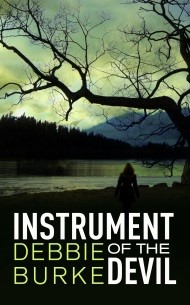
Today is the last day to download Debbie Burke’s thriller Instrument of the Devil for only 99 cents. Here’s the link.


True Crime Thursday – Employment Scam

by Debbie Burke

@burke_writer


Photo purchased from Shutterstock by Debbie Burke

You thought you’d found a home-based job to earn extra income. Instead, you became the unwitting participant in money laundering.

Today’s True Crime is a sneaky scam that the Better Business Bureau reports is sweeping the country.  It recently hit a man in my small home town of Kalispell, Montana. Here’s his story.


Debbie Burke regularly launders money when she throws jeans in the washer w/o checking pockets. Her thriller Instrument of the Devil is on sale during April for only 99 cents. Here’s the link.

Nancy Drew – Immortal Female Detective

by

Debbie Burke

@burke_writer


Credit: www.nancydrewsleuth.com

Nancy Drew was the original Super Girl—independent, confident, smart. She was competent to handle any challenge, fearless in the face of danger, and resourceful at solving problems decades before MacGyver came along. She drove motorboats, rode horses, and played tennis better than her boyfriend, Ned Nickerson. The girl sleuth never backed down from threats and brought villains to justice.

She is credited as an early influence on many girls who grew up to be accomplished, notable women, including Sandra Day O’Connor, Oprah Winfrey, Ruth Bader Ginsberg, Sonia Sotomayor, Hillary Rodham Clinton, and Laura Bush.

Credit: www.nancydrewsleuth.com


Nancy’s heroic adventures kept my friends and me up long past bedtime, reading with flashlights under the covers. I remember saving for weeks to buy the latest release when it hit the neighborhood toy store that carried her books. If I recall correctly, the hardbacks in the late 1950s cost around a dollar, a serious investment for a kid earning a dime a week allowance.

Credit: www.nancydrewsleuth.com


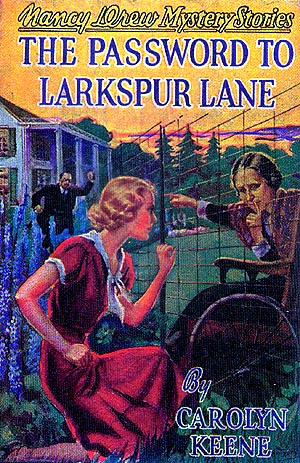
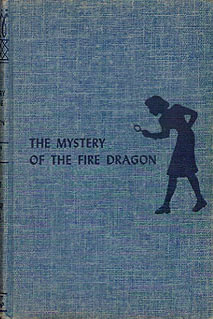
Additionally, I devoured the local library’s collection of Nancy’s earlier books published in the 1930s and ’40s, with dark blue boards and cool pen-and-ink illustrations.

The dust jackets on older editions had long since disappeared and, after thousands of check-outs, bindings were often held together by heavy tape.


I didn’t really know what a “roadster” was but I sure wanted a blue roadster convertible just like Nancy’s.

Credit: www.nancydrewsleuth.com


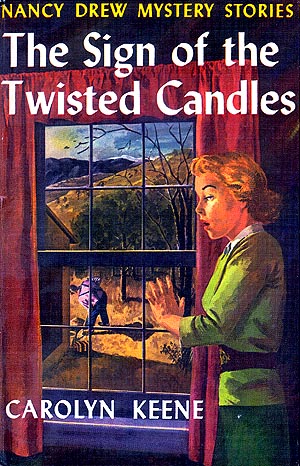
In the 1950s, the books featured lighter blue, tweed-pattern boards with dust jackets.


Credit: www.nancydrewsleuth.com

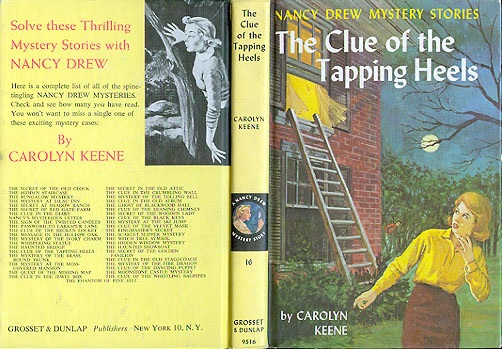
By the 1960s, the dust jackets disappeared and the spine became bright yellow with illustrations incorporated into the front hardcover.

The last one I remember reading was The Secret of the Golden Pavilion (1959) which took place in the then-exotic locale of Hawaii around the time it became the 50th state.

Throughout the 30 or so books I read, Nancy remained eternally 18-years-old (16 in earlier versions) but never attended school or college. Her successful attorney father, Carson Drew, encouraged her to pursue all kinds of dangerous adventures but no one ever got murdered.

Nancy’s only job was solving mysteries and she didn’t get paid for her efforts.

Realistic? Not very.

Fun and exciting? Yes!

Nancy solved her first mystery in 1930 (The Secret of the Old Clock) and kept unraveling puzzles in 56 classic hardcovers originally published by Grosset & Dunlap. Simon & Schuster added eight additional books in paperback. A complete set of 64 classics in hardcover sells for over $400. The classic series ended in 2003 with 175 books. Spinoffs continue to the present day, totaling more than 600 books, TV series, video games, and films.

Here’s a trailer for The Hidden Staircase, the Nancy Drew movie released in this past March.

Nancy Drew was the brainchild of publishing magnate Edward Stratemeyer. His syndicate had launched popular series with male heroes like Tom Swift and the Hardy Boys and he decided to try a strong female heroine to appeal to girl readers.

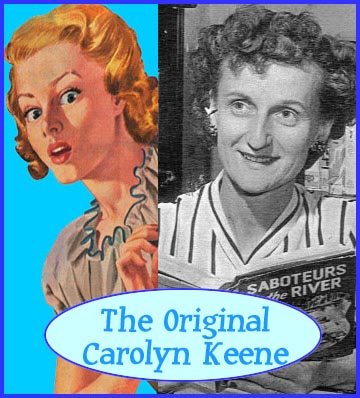
Carolyn Keene was the pseudonym for numerous ghostwriters who were paid flat fees to write books based on outlines Stratemeyer generated. The ghosts gave up all rights, received no royalties, and were sworn to secrecy. Reportedly, the flat fee had started at $125 but was lowered to $75 because of the Depression.

Credit: www.nancydrewsleuth.com

The first ghostwriter was Mildred Augustine Wirt Benson, who brought the smart, feisty, courageous Nancy to life. The series was an immediate success. For Christmas, 1933, Macy’s ordered 6,000 books that sold out in days, even in the midst of the Great Depression.

Mildred wrote 23 Nancy books, in addition to other series like the Dana Girls and Penny Parker.

As a teenager, Mildred had been determined to become a great writer. Her stories won contests and were published in high-end children’s magazines alongside authors like Louisa May Alcott. Mildred earned the first-ever master’s degree in journalism from the University of Iowa.

After her Nancy stint, Mildred wrote many more books under other pen names as well as her own. For more than a half century, she covered the crime and court beat in Toledo, Ohio and later wrote popular newspaper columns. The day she died at age 96, she was at work on an article.

Ironically, despite Nancy Drew’s profound influence on many generations of young women, Mildred wasn’t publicly acknowledged as Carolyn Keene until 1993, nine years before her death. Her archives are kept at the University of Iowa.

Nancy Drew fan conventions kicked off in 2001 and are scheduled as far ahead as 2030, Nancy’s 100th anniversary. For 2019, events will be in Toronto and Savannah.

Nancy Drew expert Jennifer Fisher has compiled vast amounts of history into a fun website that’s sure to bring back memories: http://www.nancydrewsleuth.com/   Thank you, Jenn, for your gracious assistance with this post.

Plenty of authors, including TKZ’s Kathryn Lilley, P.J. Parrish, and myself, credit Nancy with igniting their interest in writing mystery fiction. Kathryn was an ardent fan as a child and later wrote four Nancy books under the enduring Carolyn Keene pseudonym. In 2015, Kris wrote a great post on sidekicks, citing the example of Nancy’s friend, George.

Early editions, especially dust jackets, are collectors’ items. The asking price for a first edition of The Secret of the Old Clock is $2,000. Click on the bottom listing from bookbid2  to browse photos of the vintage cover and interior.

Can children’s books shape lives and careers?

Nancy Drew seduced me into a life of crime [writing]. How about you?

Credit: www.nancydrewsleuth.com


TKZers, please share your favorite memories of childhood books. What books influenced your reading preferences as an adult? Did Nancy, or another character, inspire you to become a writer?


Debbie Burke’s thriller Instrument of the Devil is on sale for only 99 cents during April at this link.


How To Build Conflict Using Myers-Briggs Personality Types

by Debbie Burke

@burke_writer

In recent TKZ posts, Myers-Briggs has been mentioned by John Gilstrap and TKZ regular Eric Beversluis. Kathryn Lilley also talked about Myers-Briggs in this post from 2015.

Which brings me to today’s discussion about how authors can use this personality test to build characters and foment conflict.

Image purchased from Shutterstock by Debbie Burke

Have you ever met someone and instantly disliked them for no apparent reason?

Conversely, have you ever “clicked” with a stranger and didn’t know why?

Have you ever been fired from a job or had to leave because of “personality conflicts”?

Have you ended a relationship or been dumped because of different values?

Do you have a hard time figuring out the needs, desires, and priorities (or lack thereof) of some people?

Do people sometimes act in ways you can’t understand or justify?

How about your characters? Do they struggle with the above issues?

If so, that’s great because conflict is the mainstay of fiction.

Myers-Briggs (MB) is a tool that can help writers answer these questions.

What is Myers-Briggs?

Katharine Briggs and Isabel Myers-Briggs
Wikimedia Commons

In 1923, the mother/daughter team of Katharine Cook Briggs (1875-1968) and Isabel Briggs Myers (1897-1980) became interested in the study of personality types based on research by Swiss psychiatrist Carl Jung (1875-1961). The two women developed the Myers-Briggs Type Indicator test that classifies the different ways people function in life.

Their purpose was to help people make career and personal choices that best suited their individual personalities. The test has been widely used by psychologists and industry to put people in the right jobs based on their particular traits, as well as to improve communication between vastly different personalities.

In other words, to solve problems.

However, in fiction, writers want to create problems for their characters.

If you understand why certain MB personality types clash with other types, you can use that knowledge to increase tension among your characters.

With the MB test, let’s dig a little deeper into reasons why you instantly dislike a person or can’t understand why they act the way they do. Then we’ll extrapolate those reasons into opportunities to create conflict among characters.

What are the MB components?

Introvert/Extravert (I or E)

Are you shy among strangers? Do you prefer to be alone in an interior world of thoughts and ideas? If so, you may be an introvert (I).

Are you outgoing and like large groups of people? Are you interested in what’s happening in the big, wide world around you? If so, you’re likely an extravert (E).

What happens if you take “I,” a shy character who avoids conflict at all costs, and force him/her to interact with “E,” a bold, boisterous character who loves to scrap?

Intuitive/Sensing (N or S)

Do you draw conclusions based on hunches? Do you look below the surface to determine what is going on? If so, you’re probably intuitive (N).

Do you use your five senses (sight, hearing, smell, taste, and touch) to observe the world around you? Do you like facts and figures? You might be sensing (S).

Take “S,” a detective with the attitude if-I-can’t-see-it-it-doesn’t-exist. Add “N,” an intuitive who plays hunches and follows his/her gut instinct. Partner those two up and watch the fireworks.

Thinking/Feeling (T or F)

Are you logical and fact-oriented? You’re probably thinking (T).

Are you in touch with emotions and driven by them? You’re probably feeling (F).

Arrange a date between “T,” a logical, analytical woman, and “F,” a warm-fuzzy metrosexual. Lots of problems for that romance.

Judging/Perceiving (J or P)

Are you decisive and want things settled, organized, and clearly defined? Probably judging (J).

Do you prefer to take things as they come, remaining open to new opportunities? Probably perceiving (P).

The Odd Couple is the classic example of conflict between “J” and “P”. Felix demands neatness and precision while Oscar thrives on disorder and chaos. Remember this scene: “It’s not spaghetti, it’s linguine.”

Sixteen Variations:

The combinations of the above characteristics yield sixteen variations of personality types. If you’re not already familiar with MB types, here is a link that describes each one: https://www.myersbriggs.org/my-mbti-personality-type/mbti-basics/the-16-mbti-types.htm

Pitting Opposites Against Each Other:

If you instantly dislike someone when you first meet them, their four dominant traits may be the opposite of your four dominant traits. This doesn’t mean they’re right or wrong; they’re simply different ways in which you perceive the world around you.

Here are a few examples to build personality differences into fictional conflict.

An extravert “E” can’t understand why the introvert “I” wants to stay home rather than go out partying. “I” is sick and tired of being pressured to mingle with other people when s/he would much rather read a book.

A sensing “S” doesn’t see why an intuitive “N” doesn’t act on facts that are as plain as the nose on your face. “N” trusts flashes of insight from the subconscious and thinks “S” is hopelessly unimaginative and dull.

A thinking “T” has no patience for a feeling “F” who always gets upset over the stupidest things. “F” is constantly frustrated by “T” who never understands his/her feelings.

A judging “J” is fed up with that loosey-goosey perceiver “P” who never plans ahead and flops haphazardly from one activity to another. “P” is annoyed that “J” is so rigid, inflexible, and set in his/her habits.

Characters who are too much alike can also mean trouble:

If characters share the same traits, they may lack balance and believe that is the only way to be.

For instance, judgmental J extremists convince their followers to condemn anyone who doesn’t share their beliefs. This manifestation brought Hitler to power.

Feeling F characters can go overboard emotionally. Because of intense feelings, poor Romeo and Juliet both end up dead.

Wikimedia Commons

Characters can also be defined by their lack of a trait. A classic example is Star Trek’s Mr. Spock, an extreme “T” for whom logic is the supreme law. Whenever he was confronted by another character’s emotional “F” reaction, his response was: “That’s illogical.” 

Personality traits run along a continuum. Some traits are well-developed and dominant; others are more subtle. Our job as writers is to combine dominant and subtle variations into unique characters who are not stereotypes.

The opposite qualities may be fairly equally developed in the same personality. For instance, when I took the MB as a teenager, the result was INTP but T and F scores were almost equal, meaning I possessed an analytical, logical mindset (my husband would dispute that!) but was also highly emotional (that, he agrees with!).

My Intuition N was well developed while my Sensing S scored low. That explains why I rarely notice someone’s eye color, clothes, or shoes, yet I know the depths of their fears and secrets.

Underdeveloped S makes me a lousy eyewitness. What was the bank robber wearing? Huh? What did the getaway car look like? I dunno.


Dominant traits can change with time and experience, giving your characters an opportunity to transform themselves.

As a child, I was extremely introverted and shy. Due to career requirements, my extraverted side developed because I had to deal with people. Now, I’m no longer paralyzed with dread at a party. In fact, I thoroughly enjoy meeting new people at writers’ gatherings and book festivals.

Not surprisingly, many writers fall into INFJ or INFP, a pattern Tom Kuegler explores in this article on medium.com.


Try guessing the traits of your mate and your children; that obnoxious neighbor you don’t get along with; your annoying boss.

You might gain insight into why they act the way they do.

Then put your characters through the MB personality type test and use their traits to increase conflict among them. 

~~~

Now it’s your turn, TKZers.

Using MB traits, which category does your favorite fictional character fall into?

Who is the most memorable (not necessarily likable) character you can think of? Can you guess their category?

How do their traits cause conflict with other characters?

~~~


In Debbie Burke’s thriller, Instrument of the Devil, find out how the attraction between two INFP characters means trouble, while an ENTJ causes further complications.

Instrument of the Devil is on sale for $.99 during April. Here’s the link.


True Crime Thursday – Property Seizure

Shutterstock image purchased by Debbie Burke

Can police take your property even if you haven’t been arrested or convicted of a crime? The disturbing answer is yes, according to this story from South Carolina:

https://www.greenvilleonline.com/in-depth/news/taken/2019/01/27/civil-forfeiture-south-carolina-police-property-seizures-taken-exclusive-investigation/2457838002/

First Page Critique – Freets

by Debbie Burke

@burke_writer

Today, please welcome a brave Anonymous Author with a story entitled Freets.

FREETS

By –

ONE

The coffin was nearly ready. Andy Turbett knuckled sweat off his brow and stepped back to get a good look at the lid. It was as fine a piece of wood as he’d ever had on his bench and the work was going well. Hmm, maybe a tiny shave off the side. He reached for a spokeshave just as Ruth came into the barn, toting some colourful paper stuff under her arm. Bright sunshine framed her.

“Andy,” she said, nodding, with her bunchy smile.

“Hello, lass. Come to check up on me, have tha?”

She looked at the side panels and base of the coffin leaning in a corner, waiting to join up with the lid. “Oh, you are getting on fast. I did come to say maybe we won’t need it so soon after all. Not if Dan has it his way.”

Andy blew at the curls of wood that he’d planed off. They joined the rest of the wood debris on the long dirt floor.  “Ah, well. Can’t say I disagree with him there.”

“Grandad needs to die,” Ruth said.

Andy made a non-committal sound. Her husband would never let her do it, and what he said went. Not one to let the wife put her foot out the door first after the wedding, wasn’t Dan. “What’s that paper?” he said, to change the subject.

“Oh, I made a banner to hang in the tea-shop. Tha won’t miss this afternoon, will tha?”

“Nay. Got to wash and change first, I’m sweating like a beast.” He took a pull from the pint-glass of water on the floor. Warm and dusty, but it’d do. “This weather. Got to be a record.”

“That’s what they’re saying.” She watched him. “There’s some houseleek growing by the rocks in the woods, I’m going tomorrow if tha wants me to get -”

“Nay,” he said. “Nay.” God, this little apple-cheek lass scared him sometimes. He took up the spokeshave again.

“Oh, Andy. I do wish tha knew it’s all right if tha treats it with respect.”

“Nay, best to leave ’em alone. I know tha thinks different, being so young and -” There. He should have kept his mouth shut after all; she wasn’t one to take offence, but you never knew, what with her thinking herself as much a daughter of the village as Fiona, his own wife.

~~~~

With TKZ first page critiques, the focus is usually on what’s not working and how to best fix it. Once in a while, a submission comes in that is so good, it’s more useful as an example of how to do things right.

Freets is such a submission.

However, I have to say that title put me off. How many readers know what a freet is? I didn’t. How many will take the time to look it up?

According to Wiktionary.org, freet is:

  1. A superstitious notion or belief with respect to any action or event as a good or a bad omen; a superstition. quotations ▼
    • 1824, John Mactaggart, The Scottish Gallovidian Encyclopedia, page 263:

If the old “freet” be true “ that those who fall when at the handspake aneath the corpse, will soon be the corpse themsell,” there would soon be a good few corspes; for at these “druken” concerns, the bearers are falling some of them every now and then.

  1. A superstitious rite, observance, wont, or practise. quotations ▼
    • 1903, Samual Ferguson, The Fairy Well of Lagnanay:

Oh, sister Ellen, sister sweet, Come with me to the hill I pray, And I will prove that blessed freet!

  1. A charm.

Okay, once we understand the meaning, Freets has the components of a great title—identifies a story problem, hints at the conflict, and evokes a wonderfully sinister tone.

However, the obscure meaning is a big negative. Perhaps the author can add a subtitle. A vivid, compelling cover is a must; otherwise, browsing online shoppers may pass it by because of the unfamiliar word. Also, define freets in the book description or jacket copy.

That’s the biggest nit I have with this submission.

At TKZ, we talk a lot about starting with action rather than static weather descriptions, backstory, or a character contemplating her navel. Jim Bell recommends opening a story with a “disturbance,” which doesn’t have to be violent or loud.

This submission avoids those common pitfalls. Each sentence is deliberately crafted and performs multiple functions, drawing the reader deeper into the story. I’m going to examine individual sentences and explore why they work.

Sentence 1 – The coffin was nearly ready.

This quiet, simple, declarative sentence caught my attention immediately. Death is a monumental disturbance yet the matter-of-fact tone sets an understated mood. The implication is that death has already occurred or is imminent. I’m guessing the genre is mystery, suspense, or horror so death is likely to mean murder.

Consider making this first sentence its own paragraph for more dramatic impact. See Kris’s excellent post on paragraphing.

Sentences 2, 3, 4 – Andy Turbett knuckled sweat off his brow and stepped back to get a good look at the lid. It was as fine a piece of wood as he’d ever had on his bench and the work was going well. Hmm, maybe a tiny shave off the side.

Andy’s character is introduced without superficial details about age and appearance but instead drills straight into his values, beliefs, and skills. He is a diligent woodworker who appreciates quality materials, is a perfectionist, and takes pride in his craft. “Knuckled” is a great active, visual verb.

Building a coffin by hand suggests the time period is historical rather than contemporary.

Sentence 5, 6 – He reached for a spokeshave just as Ruth came into the barn, toting some colourful paper stuff under her arm. Bright sunshine framed her.

Spokeshave is clearly a tool of his trade, even though the term was unfamiliar until I looked it up (see illustration). It also confirms a historical period, because he doesn’t reach for, say, a power sander.
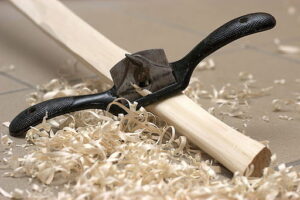
Spokeshave – Wikimedia Commons

The spelling of colourful indicates the locale may be the British Isles.

The second character, Ruth, is introduced. Setting details (a barn) and weather (bright sunshine) are also established in an active way rather than as static description. The sun isn’t just shining—it frames Ruth, doing double duty as a weather report and an active verb.

Sentence 7 – “Andy,” she said, nodding, with her bunchy smile.

Bunchy is another unfamiliar word yet it evokes a great visual of a big mouth with lots of teeth. Turns out it’s an adjective, dating back to about 1400 AD, that means protuberant or bulging.

Sentence 8, 9 – “Hello, lass. Come to check up on me, have tha?”

Lass and tha are additional indicators the setting is Great Britain. Tha easily translates to you without stopping the reader. When I looked it up, I found it is Yorkshire dialect.

Sentences 10-13 – She looked at the side panels and base of the coffin leaning in a corner, waiting to join up with the lid. “Oh, you are getting on fast. I did come to say maybe we won’t need it so soon after all. Not if Dan has it his way.”

When Ruth says they might not need the coffin yet if Dan has his way, I’m totally hooked. Who is dying? More important, who is controlling how and when the person dies? Obviously there is more going on than an ordinary death due to natural causes.

Sentences 14-17 – Andy blew at the curls of wood that he’d planed off. They joined the rest of the wood debris on the long dirt floor.  “Ah, well. Can’t say I disagree with him there.”

Again, the author incorporates description into action. Curls of wood is a vivid visual. Long dirt floor reinforces the historical time period.

Andy’s response suggests conflict lurking under the surface of apparent calm.

Sentence 18 – “Grandad needs to die.”

Wham! The author immediately gets to the core of Ruth’s character. She wants her grandfather dead and appears ready to help him along if he doesn’t go willingly, even though her husband disagrees.

Sentence 19 – Andy made a non-committal sound.

Sometimes what’s not said is more revealing than what is said. Andy’s non-response shows that not only does he want to avoid a confrontation with Ruth, but he may be intimidated by this outspoken woman who might be capable of murder.

Sentences 20, 21, 22 – Her husband would never let her do it, and what he said went. Not one to let the wife put her foot out the door first after the wedding, wasn’t Dan. “What’s that paper?” he said, to change the subject.

This statement of opinion reveals more insight into Andy’s beliefs, as well as delivering a glimpse into the relationship between Ruth and her husband, Dan. Not one to let the wife put her foot out the door first after the wedding, wasn’t Dan is an incredibly awkward sentence, yet it sounds authentic to the historical time period. It expresses Andy’s analysis of the marriage in a quaint, archaic way that’s still understandable to contemporary readers.

Sentences 23, 24 – “Oh, I made a banner to hang in the tea-shop. Tha won’t miss this afternoon, will tha?”

Apparently a public meeting is planned about an unspecified topic. Grandad? Or something else? The author is dropping questions like breadcrumbs. The reader will follow the trail to find answers and keep turning the pages.

Ruth adds another slightly veiled threat to Andy that he better show up.

Sentences 25-31 – “Nay. Got to wash and change first, I’m sweating like a beast.” He took a pull from the pint-glass of water on the floor. Warm and dusty, but it’d do. “This weather. Got to be a record.”

“That’s what they’re saying.”

This gives another revelation of Andy’s character as well as amplifying the weather and setting. He works hard and appreciates the small reward of a warm, dusty glass of water.

At the same time, these innocuous sentences show him trying to change the subject to avoid the unease of talking with Ruth. The author makes the setting description do double duty to point out conflict and tension.

Sentences 32, 33 – She watched him. “There’s some houseleek growing by the rocks in the woods, I’m going tomorrow if tha wants me to get -”

Already the reader has the sense that being watched by Ruth makes Andy uncomfortable. I didn’t know what houseleek was but, right away, I suspected poison.

Houseleek – Wikimedia Commons


Turns out it’s a succulent plant, also called hens-and-chicks, that was used medicinally to treat diarrhea, burns, and mouth ulcers. Even so, Ruth’s sinister aura makes the reader wonder how else she plans to use houseleek.


Sentences 34-37 – “Nay,” he said. “Nay.” God, this little apple-cheek lass scared him sometimes. He took up the spokeshave again.

Andy interrupts Ruth and repeats Nay twice for emphasis. Short, punchy sentences mirror his fear. He’s worried enough to pick up a possible weapon. Additionally, the reader learns more about Ruth’s physical appearance.

Sentence 38 – “Oh, Andy. I do wish tha knew it’s all right if tha treats it with respect.”

Ruth chides him while reinforcing the hint that houseleek is potentially toxic if not treated with respect. She’s also trying to reassure him. I can almost hear her next statement: “One little taste won’t hurt tha a bit. Here, try some.”

Sentences 39-42 – “Nay, best to leave ’em alone. I know tha thinks different, being so young and -” There. He should have kept his mouth shut after all; she wasn’t one to take offence, but you never knew, what with her thinking herself as much a daughter of the village as Fiona, his own wife.

Andy challenges Ruth and immediately regrets his statement. Uh-oh, you never knew if Ruth might take offence. The unspoken threat is clear—she may be capable of evil acts. He also appears to think she’s presumptuous, considering herself a daughter of the village as much as his own wife. That indicates Ruth is an outsider, who has brought youthful, possibly dangerous beliefs and omens–freets–to the village.

By now, I’m eager to turn the page…except the submission is over. Drat!

Today’s brave author provided a case study of how to effectively open a novel. Each sentence does double or triple duty—showing description incorporated into action, and revealing character and conflict. There is no pointless meandering.

While we don’t yet know the specifics of time period or locale, carefully chosen details give enough hints without bogging down in exposition. Each sentence builds on the previous one, inexorably marching forward, carrying the reader into a story full of intrigue and promise.

In one page, the author establishes s/he is as skilled in the craft of writing as Andy is in woodworking.

Thank you, Brave Author, for submitting this excellent page. Keep us posted when it’s published.


Just because I was taken by this piece doesn’t mean all readers will be. TKZers, do you have differing opinions or points? How might you handle the story?


Mystery Publishing News – Recent Shakeups

Adrian Midgley captures “Pekoe” defying gravity to catch that $&#% dot.


An author in search of a publisher often feels like a cat trying to catch a laser pointer. The target moves up the wall, down the stairs, sideways, backwards, and spins you around in circles. Even when you’re lucky enough to catch one (either a laser dot or a publisher), it can vanish without warning.

What’s a cat—or an author—supposed to do to keep up to speed?

In a constantly changing market, below are several recent developments affecting mystery presses:

Midnight Ink – The October, 2018 announcement that Midnight Ink would shut down came as a big shock to authors and employees alike. The respected crime fiction imprint was established in 2005. According to a Publisher’s Weekly article in November, 2018, the Minnesota-based publisher Llewellyn withdrew from the fiction market to concentrate on nonfiction, leaving MI out in the cold.

Spokesperson Kat Sanborn said:

“We had good reviews, but the sales just weren’t there for [Midnight Ink],” Sanborn said, noting that the 250 backlist titles will remain in print, and that frontlist will be marketed and promoted as usual. “We’re just not accepting new manuscripts,” she said.

Twenty titles that were already in progress will be rolled out during spring/summer 2019.

Three MI editors were laid off, including Terri Bischoff, who didn’t stay unemployed for long, landing on her feet with a new gig at Crooked Lane Books. She is now Senior Editor at CLB, a crime fiction publisher founded in 2014.

Several orphaned MI authors have found new homes at Crooked Lane, Severn River Publishing, and Seventh Street Books.

~~~~~

Seventh Street Books – SSB is undergoing changes as well with a new owner. Formerly owned by Prometheus Books, in November, 2018 SSB was bought by Start Publishing. Dan Mayer remains as Editorial Director.

Publisher’s Weekly reported:

“Prometheus Books sold its two genre imprints to Start Publishing. Publisher Jonathan Kurtz explained the sale by saying he wanted to return the publisher to its nonfiction roots. Prometheus expanded into fiction in 2005 with the launch of Pyr, which focuses on science fiction and fantasy novels. In 2011, it added the crime fiction imprint Seventh Street Books. Pyr has a backlist of 170 titles, and Seventh Street’s backlist stands at about 90.”

~~~~

Poisoned Pen Press – In December, 2018, Publisher’s Weekly announced the acquisition of PP by Sourcebooks:

“Sourcebooks has announced that it has acquired most of the assets of Poisoned Pen Press and that the award-winning crime and mystery publisher will become Sourcebooks’ mystery imprint.”

The staff, including PP’s founder Robert Rosenwald and Editor-in-Chief Barbara Peters, will reportedly stay on and become Sourcebook employees. The offices remain in Scottsdale, AZ.

~~~~

Kindle Press – The Amazon imprint stopped accepting new submissions in spring of 2018, leaving me and a hundred or so other authors orphaned.

~~~~

I’ve been looking for a new house since then and have received offers from several well-known publishers like Fly-By-Night Press and No-Advances-R-Us, LLC.

Which raises the question: how does an author find a reputable house that’s likely to be in business for longer than it takes the ink to dry on the contract?

The answer is research. Vetting publishers sounds daunting but here are three shortcuts:

#1  Mystery Writers of America – MWA regularly updates their list of approved publishers. To be included on that list, a press must adhere to “professional standards of good business practice and fair treatment of authors.”

Here’s a partial list of qualifications:

  • Must be in business for at least two years;
  • Must have paid a minimum of $1000 within the past two years to at least five authors who are not owners of the company;
  • Must have published at least two works of crime-related fiction or nonfiction in the past two years;
  • Must meet other standards outlined in MWA’s Approved Publishers Guidelines.

#2  Writer Beware – a great watchdog website that alerts writers to scams, cons, questionable business practices, and outright fraud. Although affiliated with Science Fiction and Fantasy Writers of America (SFWA), their investigations and warnings cover all genres. Writer Beware is the first place I research a publisher.

#3  Ask other authors – Gone are the days when an author stayed with the same house for his/her entire career. In the past couple of years, Big Five houses decided to focus on blockbusters, pretty much to the exclusion of mid-list authors. As a result, many popular authors were dropped even though they had successful series.

Fellow writers/orphans are often willing to share their war stories about publishers.

Some authors have gone on to work with smaller presses. I know a few who now have contracts with several different houses at the same time.

Others decided to indie-publish or go hybrid.

The Authors Guild features a Back-in-Print program for previously published books where the author has gotten the rights back. For a fee, AG will assist in converting to new formatting for re-release as ebooks and/or print on demand (POD) hard copies. They also help with distribution.

When a publisher makes you an offer, the legal department of the Authors Guild will review and analyze the publishing contract. That single service makes their $125 membership fee worthwhile. Fly-By-Night and No-Advances-R-Us offered me contracts which I sent to AG’s attorneys. They helped me make the informed decision to say, “Thanks but no thanks.”

And now, if you’ll excuse me, I have to go chase that little red dot that just flickered across the ceiling . . . . . . . .


TKZers, do you have a favorite news source that keeps you up to date on the publishing industry?


Even though Debbie Burke is an orphan, her thriller Instrument of the Devil is still available here.

Introducing TRUE CRIME THURSDAY

by Debbie Burke

@burke_writer

Welcome to True Crime Thursday, a new feature on TKZ. The fourth Thursday of each month will showcase:

  • Interesting, unusual, or bizarre crimes;
  • Legal developments;
  • Colorful criminals whose antics boggle the mind.

Photo courtesy of Pixabay

A real-life incident just might inspire the plot for your next novel.

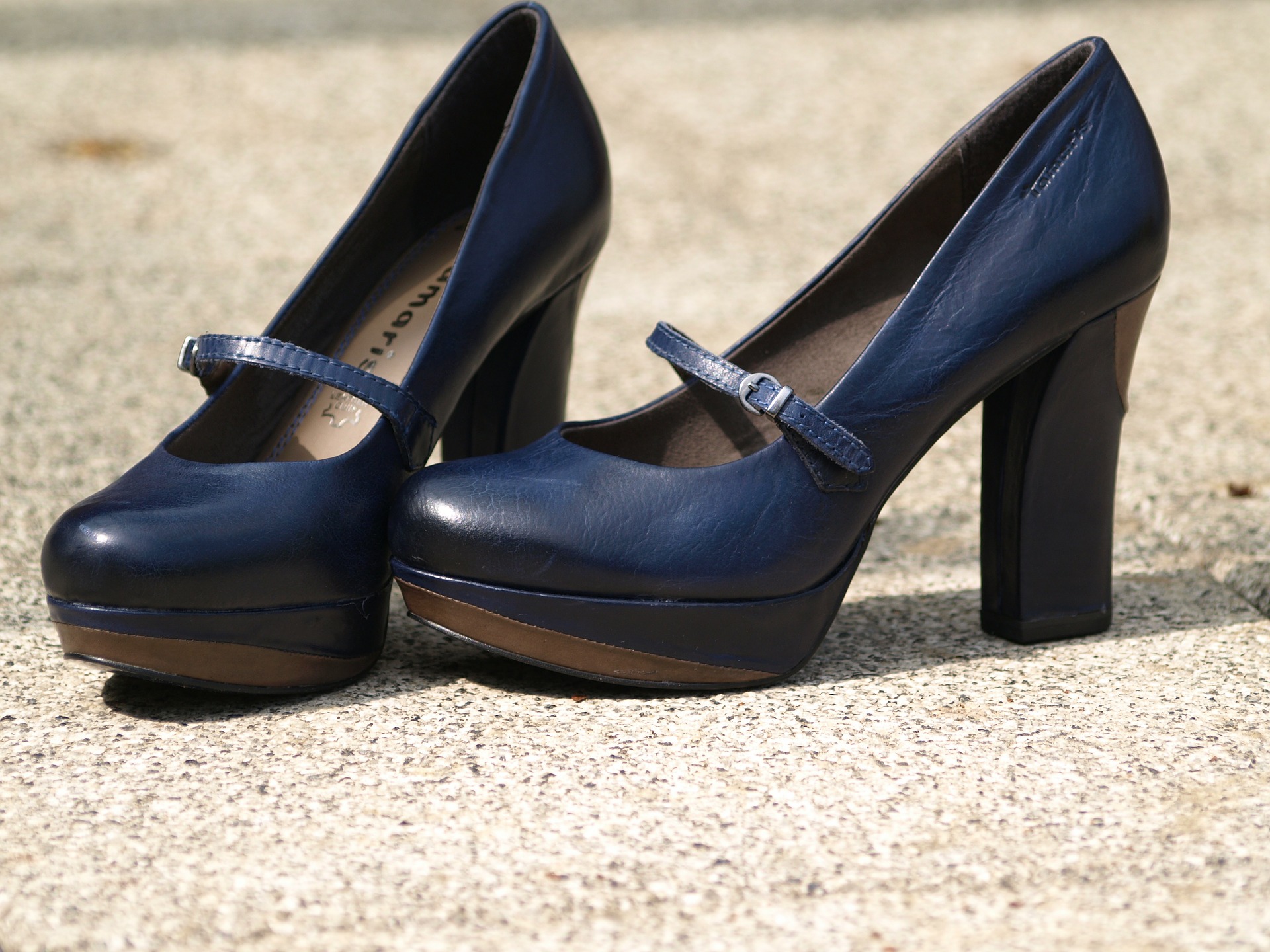
To kick off True Crime Thursday, check out the lady who thought her high heels were a good hiding place for cocaine. 


First Page Critique – Samuel’s Mine

by Debbie Burke

@burke_writer

Wikimedia Commons

Please welcome today’s Brave Anonymous Author with a submission entitled Samuel’s Mine.

CHAPTER ONE

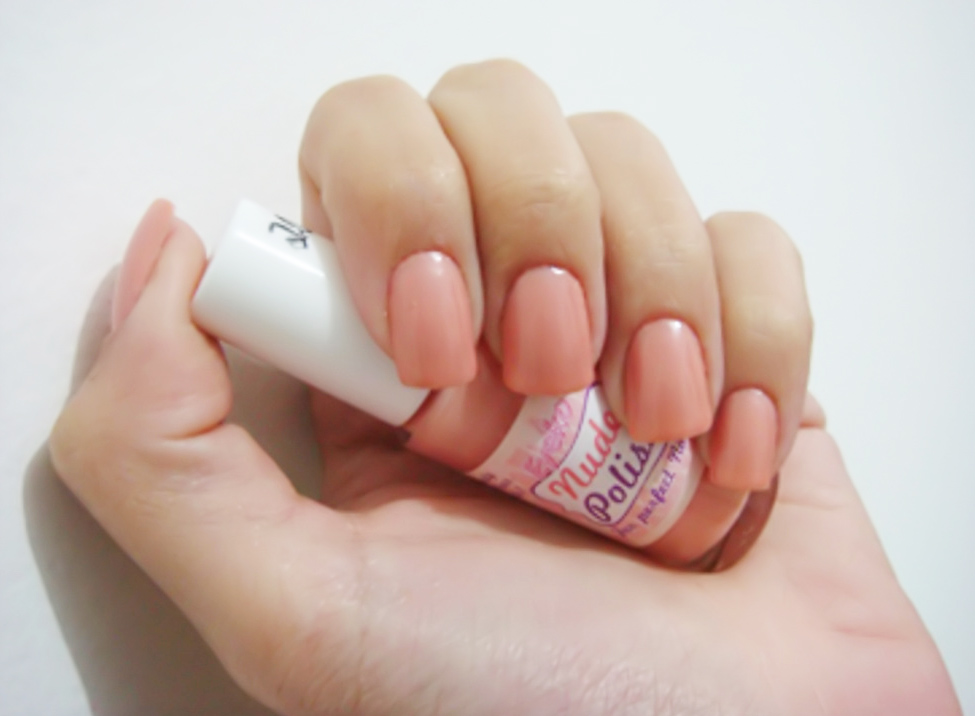
Oddly enough her fingernails were left unbroken. Each nail remained intact, as sharp and fresh as they had been right before Julia went to sleep. The bright pink polish now served as a beacon of hope in this otherwise despondent room. She looked around, unbelieving, and still trying to figure out the situation. How did she get here? Where is here? She remembered talking to Jacob on the phone. She remembered painting her nails  sitting on the edge of her bed. All else was a fog, like unrecognizable shadows in the poorly lit recesses of her brain. Something was there but yet nothing.

She turned her head. Her neck seized instantly with stiff pain. Oh dear Christ!  A thick perspiration began its slow descent down her forehead. She lay across the floor with a dull but growing pounding building inside her head. She rarely got headaches. I fell, she thought. The fog in her head was drifting away as her surroundings grew clearer. I fell..how could I fall? Sharp jabs of pain filled her upper body. No, No, I couldn’t have. This isn’t right. She winced while moving her head to the left. The room was dark and she could smell mildew. The perspiration slid a smooth path down her face although a chill ran through her. The fog finally lifted from her head leaving the remnants of ache and confusion. How did I get on the floor?

Her body shuttered, skin prickled, as a chilling draft surfaced. She could hear the faint shuffle of footsteps above her. Julia’s legs; however, were cramped and stiff pressed on the cold floor. In fact, the floor she was on was not a floor, but rather stones. She can see them now – large cobblestones like the ones that used to line the streets in the City. They were now biting against her body and left prickles on her skin. Goosebumps. This is not right. She scanned the room fighting the ache, unknowing where she was. Stone block walls now came into her ever-strengthening sight. And that smell was more than mildew, but what?

The thick moisture moving down from her brow found her parched lips and with a fine swoop of her tongue, Julia tasted it. At first the sheer moisture was soothing to her mouth, but shortly the taste surfaced. It was not sweat. This tasted coppery. She had her fair share of fights and busted her lip a few times playing hockey. Julia was tough and knew this taste well. It was the taste of blood.

***

Okay, let’s get to work.

At first glance, the title Samuel’s Mine doesn’t give any hints to the genre, story, or characters. Until the reader knows who Samuel is, it’s hard to determine if this is an effective title. It strikes me as vague and not that interesting. And it certainly seems on the tame side for the creepy scenario painted on the first page, which signals dark suspense or horror.

Julia, of unknown age, evidently had a bad fall she doesn’t quite remember and wakes up in an unfamiliar chilly basement that smells of mildew. She’s lying on a cobblestone floor, apparently can’t move, and is bleeding from a head wound. She hears footsteps above.

What sets Julia apart from many other stories that start with a similar setup?

Pink polish on unbroken fingernails.

Brave Author, your instincts are good to include vivid, specific details in your first paragraph. The reader easily sees Julia sitting on the edge of her bed, painting her nails and talking on the phone with Jacob. Then Julia evidently loses consciousness. She wakes up disoriented and is amazed that her nails aren’t broken.

The second and third paragraphs offer descriptions of her pain, confusion, and cold. A fair amount of overwriting and repetition could be cut and condensed.

More important, creepy descriptions will only hold the reader’s attention for a limited time. Compelling action is necessary to move the story forward. More about this in a moment.

A number of odd, awkward, or incorrect word choices jarred me. I sense the author is trying too hard.

Otherwise despondent room – Despondent describes an emotion that Julia feels but the room doesn’t. Maybe “desolate” instead?

Her neck seized with stiff pain – Is the pain stiff or is it her neck?

Thick perspiration – “thick” distracted me, although you later explain it’s not sweat but blood.

Shuttered – should be “shuddered.”

Lay across the floor – sounds awkward.

Growing pounding building – watch out for three words in a row ending in “ing”

Prickled, prickles, and goosebumps –  repetitive.

Julia’s legs; however, were cramped and stiff pressed on the cold floor. In fact, the floor she was on was not a floor – repetitive. Replace the semicolon with a comma.

…but rather stones. She can see them now [tense change] – large cobblestones like the ones that used to line the streets in the City. – Repetitive. Also, suggest you use this opportunity to specify which “City” so you convey more about her background as well as her possible location.

The thick moisture moving down from her brow found her parched lips and with a fine swoop of her tongue, Julia tasted it. At first the sheer moisture was soothing to her mouth, but shortly the taste surfaced. – Odd phrasing. How does a tongue make a fine swoop? How does a taste surface?

She had her fair share of fights and busted her lip a few times playing hockey. – Another excellent specific detail that characterizes Julia.

The first 400 words basically set the scene and don’t give much insight into Julia’s character nor the conflict. So far, it’s a helpless-female-in-jeopardy trope. Her reactions are generic fear.

However, the details about her pink fingernails and familiarity with hockey and fighting make Julia real and relatable. I suggest you include more specific details like that.

The biggest problem: Where is the action?

The author actually submitted about 1400 words that revealed additional clues about the story’s direction that were not found on the first page. I suggest you cut repetitious descriptions of Julia’s cold, confusion, and pain, and instead move to the action sooner.

I took the liberty of rewriting (in red below) to incorporate developments that didn’t show up on this first page but did occur later in the submission.

Oddly, Julia’s fingernails weren’t broken—bright pink, as sharp and fresh as when she’d painted them, sitting on the bed before she went to sleep. Yet now she lay on a cold floor, cramped with pain, in a dim room, hemmed in by stone block walls. She smelled mildew and a faint odor of something else.

When she tried to look around, spasms seized her neck. A draft chilled her bare legs, her nightshirt pulled up to her panties. Her pink-tipped fingers traced the rough contour of the floor—cobblestones, like old streets in London.

I fell…how could I fall? Unrecognizable shadows clouded the poorly lit recesses of her memory. She remembered talking to Jacob on the phone but after that, nothing.

Wet warmth flowed down her face. When it reached her parched mouth, she licked it. Not perspiration. Blood. She recognized the taste from split lips she’d endured while playing hockey. And from fights. She touched a raw, pulpy spot on her skull. The wound was bleeding badly.

Footsteps creaked on the wood planks above. “Daddy?” she pleaded, her whisper harsh and scratchy.

Through foggy vision, she made out a dark corner where a propane cylinder sat on a table with other tools she didn’t recognize.

Above, a door opened and footsteps clomped down the stairs. She tried to see who was coming but pain froze her. She squeezed her eyes shut, fighting tears.

A new smell, earthy and ripe, familiar yet not. Coal River Farm. The petting goats. Julia and her parents feeding the animals.

When she opened her eyes, a tall, lean man in dirty jeans and boots was walking to the table. Not her father.

“Where am I?” she croaked. “What do you want?”

“Shut up, sow.” He picked up the propane cylinder and a long thin rod.

Terror prickled her senses. She had to fight, run, escape. But when she struggled to stand, her legs felt too weak, too heavy. “Let me go, please. I won’t tell anyone.”

He stood over her, staring down with piercing brown eyes. “How old are you? Nineteen, twenty?”

“Twenty-two.” Tears rolled down her cheeks. “Why do you care?”

“Ah, twenty-two. You’re ready.”

“For what?” She shivered in the chill of her own blood that now soaked her nightshirt.

He pulled a lighter from his shirt and lit the propane torch. A long blue flame shot out. “The culling.”

***

Print out these early pages and read them aloud.  When you’ve repeated the same description several times—for example, how cold Julia is—choose the strongest way to say it and cut the others.

When you stumble over a sentence as you read aloud, that signals a place that needs smoothing out.

Take several different color highlighters. Assign one color to each element of the scene. For instance, orange for setting, blue for characterization, green for description, red for action. Once you’ve identified and marked up the scene in a tangible visual way, it’s easy to see where there’s too much emphasis on one aspect and too little of another. You can then work to play up the most important parts–action and character–to engage the reader.

Brave Author, there is a lot of scary promise in this story. Thanks for sharing your work.


TKZers, any helpful ideas for today’s Brave Author?