First Page Critique: Attitude, Voice, Conflict

Our first page today comes from a novel called Things Unseen. My comments on the other side:

joshua-tree-national-park-74399_1280

At the southeastern edge of California, there’s a slice of land the color of desolation. The air is staler than a week-old bread crust and drier than a burnt piece of toast. It’s a place like a daydream, suspended between consciousness and slumber. Like dawn, or sunset—a place of transitions. For over fifty years, one man had called this place home. I was on my way to meet him.

“Oriana,” I addressed myself aloud, “you’ve run out of gas.” I sat back from the wheel of my dad’s ‘95 Toyota Camry and imagined my existence fading across the desert landscape. I could see the Camry’s sand-colored exterior melting into an unpaved expanse. “Twenty miles from her destination, young woman collapses in the heat of the Mojave summer.” That would make great fodder for one of my novels. I lifted my gallon water bottle from the passenger’s seat and took a long drink. You needed water in the desert, but extra gas would have been nice, too. I stepped outside and surveyed the low mountain range ahead. The last station was fifty miles back. I should have known to stock up on gasoline. My family used to come out here every summer, after all.

I jumped at the sound of my cell beeping from my pants pocket. Low battery, huh? Even if I could get service out here, who would I call? 911? That rundown gas station? The National Park Service? No one would ever pass by here, except for that man, maybe. No one would—

Something glinted ahead, like the flash of metal beneath the sun. A mirage? It was heading in my direction. It moved quickly across the flat land at the foot of the mountains, morphing from a distorted ripple to a human form—on a bicycle?

A boy, about eleven or twelve, pedaled up to the front of the car. A veil of t-shirts shaded his face and neck. He got down from his bike, walked over to the open window by the driver’s seat, reached in with his right hand, and switched on the ignition. I just stood there, watching. I’ve been saved. He turned off the ignition and towards me. “Out of gas?” he said, lifting his headgear.

***

  1. Opening with a description

There’s a meme going around that you shouldn’t open your novel with a physical description. I don’t see anything wrong with it, so long as you make it clear it’s coming from a character’s perspective and there is some sort of disturbance involved.

Here we have a woman who has run out of gas in the desert, only we don’t know that until the next paragraph. The first paragraph ends with For over fifty years, one man had called this place home. I was on my way to meet him. 

The problem I have with that is it isn’t disturbing. It doesn’t portend trouble or change or challenge. She could be going to see this man for tea.

If you were to keep the opening paragraph, and describe the desert and desolation, why not end the graph with: And I was out of gas.Then you’ve got an immediate sense of trouble.

But I would advise the author to reformulate the opening paragraph into action showing us the car running out of gas. Get that in early, give us the character, then bring in the setting.

  1. 1 + 1 = 1/2

This formula comes from Sol Stein, the noted writing teacher and editor. What it means is that two descriptions of the same thing don’t strengthen the effect, but dilute it.

In the first paragraph we have this: The air is staler than a week-old bread crust and drier than a burnt piece of toast. 

That’s two similar descriptions. But they make the reader hold both simultaneously, and that takes away from the power of either.

So a simple rule is: don’t describe the same thing in two different ways in the same sentence. Choose one, the best one. Personally, I’d go with burnt piece of toast because burning goes with the desert effect you’re trying to establish.

But the first paragraph also gives us other desert descriptions: color of desolation, daydream, dawn, sunset. This comes close to fiction writing blunder #21 (as explained in my book 27 Fiction Writing Blunders – And How Not To Make Them!)––being too in love with lyrical. Readers don’t often connect with a lyrical opening or passage, unless it is so dang good it cannot be resisted (like the opening of Ken Kesey’s saga, Sometimes a Great Notion).

So major in action and disturbance in the opening.

  1. Attitude adjustment

When using First Person POV, it’s crucial to establish a discernable attitude from the get-go. Readers love a character who has some ‘tude, who has blood coursing through her veins. They want to hear a distinct voice. Like Stephanie Plum’s in Janet Evanovich’s High Five:

When I was a little girl I used to dress Barbie up without underpants. On the outside, she’d look like the perfect lady. Tasteful plastic heels, tailored suit. But underneath, she was naked. I’m a bail enforcement agent now—also know as a fugitive apprehension agent, also knows as a bounty hunter. I bring ‘em back dead or alive. At least I try. And being a bail enforcement agent is a little like being bare-bottom Barbie. It’s about having a secret. And it’s about wearing a lot of bravado on the outside when you’re really operating without underpants.

My advice to the author would be to spend some time really getting to know your character’s voice. Delve deep into her background and wounds and strengths and fears and yearnings and drive. Give her a real attitude about running out of gas. Get her angry about it. Show us more emotion. Re-write this opening page until it is soaked with voice and attitude.

  1. White space

A purely practical matter: most readers these days don’t respond well to long blocks of text. Your first two paragraphs should be four or five. It’s not hard to do, and it makes things easier on the reader.

  1. The boy on the bike

Here is where you can inject more attitude. Why does Oriana just stand there while a boy walks over and reaches into her car? This is a perfect time for an argument.


“Get away from my car!”
“You wanna die, lady?”
“Now!”
“You gonna shoot me or something?”

 In other words, conflict. It’s basic, but so often writers leave it out in the opening pages. They set things up, describe landscapes and situations, and it’s only later that another character comes into the proceedings, and even then it might be a friend or ally and it’s Happy People in Happy Land (writing blunder #10).

I’m going to leave off here and let others weigh in, but I want to give this author a bit of good news. Your ability to write coherent sentences in a logical flow is sound. That’s not something easily developed or taught if it isn’t there in the first place.

So now it’s a matter of craft, which can be taught. I’ve given you my view of your first page, and now it’s time for others to do the same.

But I will say that a woman out of gas in the desert is a great opening disturbance. Work this page until is vibrates with attitude and emotion and conflict. Cut all flab. Do that, and I’ll want to go on to page 2.

But first . . .

By Joe Moore
@JoeMoore_writer

Yesterday, my friend, Kris Montee (PJ Parrish), wrote an excellent post called Finding the Right Door to Enter Your Story. If you haven’t read it, do so the moment you finish this. Kris covers the good, bad and ugly of opening lines and chapters.

We’ve often discussed the power (or lack of) that first lines have on the reader. It can’t be emphasized enough how much a first line plays into the scope of the book. For just like first impressions, there is only one shot at a first line. It can set the voice, tone, mood, and overall feel of what’s to come. It can turn you on or put you off—grab you by the throat or shove you away. It’s the fuse that lights the stick of dynamite.

Some first lines are short and to the point—built to create the most impact from a quick jab. Others seem to go on ad infinitum. And only when we arrive at the period at the end do we see how expertly crafted it was for maximum effect. Or not.

So in the spirit of sharing what I consider examples of pure genius, true literary craftsmanship, and genuine artistic excellence, I’d like to share what I think are some of the best first lines in literary history. Let’s start with two of the most famous:

It was a dark and stormy night; the rain fell in torrents, except at occasional intervals, when it was checked by a violent gust of wind which swept up the streets (for it is in London that our scene lies), rattling along the house-tops, and fiercely agitating the scanty flame of the lamps that struggled against the darkness. —Edward George Bulwer-Lytton, Paul Clifford (1830)

It was the best of times, it was the worst of times, it was the age of wisdom, it was the age of foolishness, it was the epoch of belief, it was the epoch of incredulity, it was the season of Light, it was the season of Darkness, it was the spring of hope, it was the winter of despair. —Charles Dickens, A Tale of Two Cities (1859)

Lolita, light of my life, fire of my loins. —Vladimir Nabokov, Lolita (1955)

I am an invisible man. —Ralph Ellison, Invisible Man (1952)

The sun shone, having no alternative, on the nothing new. —Samuel Beckett, Murphy (1938)

This is the saddest story I have ever heard. —Ford Madox Ford, The Good Soldier (1915)

It was a wrong number that started it, the telephone ringing three times in the dead of night, and the voice on the other end asking for someone he was not. —Paul Auster, City of Glass (1985)

The sky above the port was the color of television, tuned to a dead channel. —William Gibson, Neuromancer (1984)

All this happened, more or less. —Kurt Vonnegut, Slaughterhouse-Five (1969)

If you really want to hear about it, the first thing you’ll probably want to know is where I was born, and what my lousy childhood was like, and how my parents were occupied and all before they had me, and all that David Copperfield kind of crap, but I don’t feel like going into it, if you want to know the truth. —J. D. Salinger, The Catcher in the Rye (1951)

Through the fence, between the curling flower spaces, I could see them hitting. —William Faulkner, The Sound and the Fury (1929)

Ships at a distance have every man’s wish on board. —Zora Neale Hurston, Their Eyes Were Watching God (1937)

He was an old man who fished alone in a skiff in the Gulf Stream and he had gone eighty-four days now without taking a fish. —Ernest Hemingway, The Old Man and the Sea (1952)

It was the day my grandmother exploded. —Iain M. Banks, The Crow Road (1992)

It was a pleasure to burn. —Ray Bradbury, Fahrenheit 451 (1953)

It was love at first sight. —Joseph Heller, Catch-22 (1961)

Once upon a time, there was a woman who discovered she had turned into the wrong person. —Anne Tyler, Back When We Were Grownups (2001)

We started dying before the snow, and like the snow, we continued to fall. —Louise Erdrich, Tracks (1988)

Every summer Lin Kong returned to Goose Village to divorce his wife, Shuyu. —Ha Jin, Waiting (1999)

In my younger and more vulnerable years my father gave me some advice that I’ve been turning over in my mind ever since. —F. Scott Fitzgerald, The Great Gatsby (1925)

“To be born again,” sang Gibreel Farishta tumbling from the heavens, “first you have to die.” —Salman Rushdie, The Satanic Verses (1988)

The seller of lightning rods arrived just ahead of the storm. —Ray Bradbury, Something Wicked This Way Comes (1962)

Granted: I am an inmate of a mental hospital; my keeper is watching me, he never lets me out of his sight; there’s a peephole in the door, and my keeper’s eye is the shade of brown that can never see through a blue-eyed type like me. —GŸnter Grass, The Tin Drum (1959; trans. Ralph Manheim)

In the late summer of that year we lived in a house in a village that looked across the river and the plain to the mountains. —Ernest Hemingway, A Farewell to Arms (1929)

He was an inch, perhaps two, under six feet, powerfully built, and he advanced straight at you with a slight stoop of the shoulders, head forward, and a fixed from-under stare which made you think of a charging bull.  —Joseph Conrad, Lord Jim (1900)

The past is a foreign country; they do things differently there.  —L. P. Hartley, The Go-Between (1953)

I write this sitting in the kitchen sink. —Dodie Smith, I Capture the Castle (1948)

Of all the things that drive men to sea, the most common disaster, I’ve come to learn, is women. —Charles Johnson, Middle Passage (1990)

In the town, there were two mutes and they were always together. —Carson McCullers, The Heart is a Lonely Hunter (1940)

High, high above the North Pole, on the first day of 1969, two professors of English Literature approached each other at a combined velocity of 1200 miles per hour. —David Lodge, Changing Places (1975)

The cold passed reluctantly from the earth, and the retiring fogs revealed an army stretched out on the hills, resting. —Stephen Crane, The Red Badge of Courage (1895)

Let’s finish with my personal all-time favorite:

It was a bright cold day in April, and the clocks were striking thirteen. —George Orwell, 1984 (1949)

So which ones have I missed? If it’s not on this list, what’s your favorite first line?

_______________

tomb-cover-small_thumbMax is back! THE BLADE, book #3 in the Maxine Decker thriller Series is now available in print and e-book.

Finding the Right Door
to Enter Your Story

Disney2

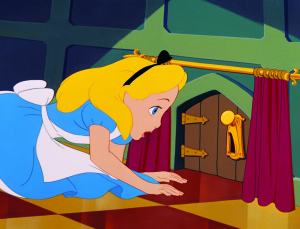
“Begin at the beginning,” the King said gravely, “and go on till you come to the end: then stop.”

By PJ Parrish

I had a whole ‘nother blog in the works today but Clare’s post yesterday on common amateur mistakes made me want to switch gears. That, and the fact that I was hearing voices in my head the other day and this is a good way to exorcise them.

A while back, I gave a talk to a beginning writers group about what makes for a great opening in a novel. We had a good time analyzing which of their openings had promise or why they had veered off track. It’s a popular topic, as we at TKZ here so well know, but I think it’s one that we all need to revisit constantly. Me included.

See, the other day, as I was pounding around the jogging oval at the park, I heard a strange voice whispering in my head. I had never heard her before, but she was insistent: “Tell my story! Tell my story!” I tried to ignore her, because as Kelly and I await the Sept. 9 launch of our new book SHE’S NOT THERE, we are 16 chapters into a new Louis Kincaid. And one of the commandments of novel writing is Thou Shall Finish One Book Before Starting a New One. But this woman wouldn’t shut up, so I went home and banged out 2,000 words. Wow! I never get out of the gate that fast! I was chuffed.

Well, I re-read it yesterday. Wee-doggies, it stinks. I open with a woman sitting alone in a fishing boat in the Everglades. She is thinking about her life and what brought her to this point. She is sad. She is regretful. She is boring as hell. I also larded in pages of description of the saw grass, the weather, the clouds, the water, even the type of fishing lure she was using. Finally, toward the 2,000-word mark, I reveal she is a Miami homicide detective who turned in her badge when her husband and child were killed in a drug deal gone bad that she was involved in.

This morning, I deleted the chapter. Lesson number 1: Just because you have an idea doesn’t mean you should act on it. Lesson number 2: Even experienced writers have trouble with openings.

Even Stephen King. You think you sweat bullets over openings? He says he spends months and even years before he finds his footing. I read this recently in an interview King gave to The Atlantic magazine. He talks at length about what makes for a great opening, and how hard it is for him to find the right one.

When I’m starting a book, I compose in bed before I go to sleep. I will lie there in the dark and think. I’ll try to write a paragraph. An opening paragraph. And over a period of weeks and months and even years, I’ll word and reword it until I’m happy with what I’ve got. If I can get that first paragraph right, I’ll know I can do the book.

And he makes a great point, that the right opening line is as important to the writer as it is to the reader:

You can’t forget that the opening line is important to the writer, too. To the person who’s actually boots-on-the-ground. Because it’s not just the reader’s way in, it’s the writer’s way in also, and you’ve got to find a doorway that fits us both. I think that’s why my books tend to begin as first sentences — I’ll write that opening sentence first, and when I get it right I’ll start to think I really have something.

Which is why I deep-sixed my woman in the fishing boat. Maybe her story does need to be told, but I entered via the wrong door. I’m going to set her aside for a while. In the meantime, I am going back to school. Want to come along?

HOOKS

Enthuse or lose! What was the prime crime of my bad chapter? NOTHING HAPPENED! The first chapter is where your reader makes decision to enter your world. Your hook needn’t be too fast or fancy. It can even be quiet — like someone going on a fishing or hunting trip (see example below!).  But it must be suspenseful enough to makes us care about your character. Fancy hooks can be disappointing if what follows doesn’t measure up. If you begin at the most dramatic or tense moment in your story, you have nowhere to go but downhill. Also, if your hook is extremely strange or misleading, you might just make the reader mad.

What about opening with action scenes? I’ve seen it work well; I’ve seen it look silly. I think intense action scenes work only if they have context and reason for happening. Car chase, bullets fly, things explode, dead bodies! But unless you give reader reason to care about someone, it feels cheap and pushy, like a Roger Moore James Bond movie. If you can make us CARE about the person during intense opening action scene, yes. If not, it’s boring and trite.

OPENING LINES

A good one gives you intellectual line of credit from the reader: “Wow, that line was so damn good, I’m in for the next 50 pages.” A good opening line is lean and mean and assertive. One of my fave’s is from Hemingway’s story, “The Short Happy Life of Francis Macomber:  “It was lunch now and they were all sitting under the double green fly of the dining tent pretending that nothing had happened.”

A good opening line is a promise, or a question, or an unproven idea. But if it feels contrived or overly cute, you will lose the reader. Especially if what follows does not measure up.  Stephen King has two favorite opening lines. One is from James M. Cain’s great novel The Postman Always Rings Twice:  “They threw me off the hay truck about noon.”  Here’s King on why he loves it:

Suddenly, you’re right inside the story — the speaker takes a lift on a hay truck and gets found out. But Cain pulls off so much more than a loaded setting — and the best writers do. This sentence tells you more than you think it tells you. Nobody’s riding on the hay truck because they bought a ticket. He’s a basically a drifter, someone on the outskirts, someone who’s going to steal and filch to get by. So you know a lot about him from the beginning, more than maybe registers in your conscious mind, and you start to get curious. This opening accomplishes something else: It’s a quick introduction to the writer’s style, another thing good first sentences tend to do.”

GET INTO STORY AS LATE AS POSSIBLE

This is one of my pet peeves about bad writing…throat clearing. Begin your story just moments before the interesting stuff is about to happen. You want to create tension as early as possible in your story and escalate from there. Don’t give the reader too much time to think about whether they want to go along on your ride. Get them buckled in and get them moving. Preferably not in bass boat.

INTRODUCE THE PROTAGONIST

Another pet peeve of mine. Don’t wait too late in the story to introduce your hero. Don’t give the early spotlight to a minor character because whoever is at the helm in chapter one is who the reader will automatically want to follow. I call these folks “spear carriers” after the guys who stand in the background holding the spears in “Aida.”  They aren’t allowed to steal the spotlight when Radamès is belting out Celeste Aida. So don’t let your secondary characters get undue attention or the reader will feel betrayed and annoyed when you shift the spotlight.

IDENTIFY THE CONFLICT OR QUEST

Begin the book with conflict. Big, small, physical, emotional, whatever. Conflict disrupts the status quo. Conflict is drama. Conflict is interesting. Your first chapter is not a straight horizontal line. It’s a jagged driveway leading up a dark mountainside. Don’t put a woman in a fishing boat in the Everglades thinking about how crappy her life is and expect the reader to care.

WHAT IS AT STAKE HERE?

What is at play in the story? What are the costs? What can be gained, what can be lost? Love? Money? One’s soul? Will someone die? Can someone be saved? The first chapter doesn’t demand that you spell out the stakes of the entire book in neon but we do need a hint. And we don’t care that her fishing lure is a 1-ounce jig with a bulky trailer.

CREATE A DRAMATIC ARC

Your whole book has an arc, but every chapter should have a mini-arc. Ask yourself “What is the purpose of this chapter?” and then build your chapter around that. This does not mean each chapter needs a conclusion but it needs to feel complete unto itself even as it compels the reader onto the next chapter. The opening chapter should have its own rise and fall. It is not JUST A LAUNCHING PAD!

GET YOUR CHARACTERS TALKING

Dialogue is the lifeblood of your story and you need it early. Too much exposition or description is like driving a car with the emergency brake on. Likewise, don’t bog down your opening with characters doing menial things. Like fishing. Or thinking about boring stuff. Like fishing lures. Here’s some good advice from agent Peter Miller that I read once on Chuck Sambuchino’s Writer’s Digest blog: “My biggest pet peeve with an opening chapter is when an author features too much exposition, when they go beyond what is necessary for simply ‘setting the scene.’ I want to feel as if I’m in the hands of a master storyteller, and starting a story with long, flowery, overly-descriptive sentences makes the writer seem amateurish and the story contrived. Of course, an equally jarring beginning can be nearly as off-putting, and I hesitate to read on if I’m feeling disoriented by the fifth page. I enjoy when writers can find a good balance between exposition and mystery. Too much accounting always ruins the mystery of a novel, and the unknown is what propels us to read further.”

SO DOES THAT MEAN  I SHOULD OPEN WITH DIALOGUE?

This goes to personal taste. I’m not a fan of it, but I have seen it pulled off. But be careful because opening with dialogue tosses the reader into the deep end of the fictional pool with no tethering in time and place. This is like waking up from a coma. Where am I? Who are these people talking? I could be wrong because I haven’t read them all, but even Dialogue Demon Elmore Leonard gives you a quick couple lines or graphs first. (Okay, I’m wrong: LaBrava opens with “He’s been taking pictures three years, look at the work,” Maurice said.) But if your dialogue only leads to confusion, that isn’t good. Which relates to…

ESTABLISH YOUR SETTING AND TIME FRAME

The first chapter must establish the where and the when of the story, just so the reader isn’t flailing around. Yes, you can use time and place taglines, especially if your story is wide in geographic scope or bouncing around in time. But if your story is fairly linear and compact (taking place, say, all within six months time in Memphis), sticking a time tag on each chapter only makes you look like you don’t know how to gracefully slip this info into your narrative.

ESTABLISH YOUR TONE AND MOOD

First impressions matter. From the get-go, your reader should be able to tell what kind of book he is reading – hardboiled, romantic suspense, humorous, neo-noir? Yes, the cover and copy conveys this, but you need to convey it in your opening. Everything in your book should support your tone, but the first chapter is vital to inducing an emotional effect in your reader. I’ve mentioned Edgar Allan Poe’s Unity of Effect often here but it’s worth repeating: Every element of a story should help create a single emotional impact. But remember that a little mood goes a long way – think of a few swift and colorful brush strokes rather than gobs of thick paint.  Did you know that in the Everglades, intense daytime heating of the ground causes the warm moist tropical air to rise, creating the afternoon thundershowers? And that most of the storms happen at 2 p.m.? I should have just wrote “It rained in the afternoon.”

MAKE YOUR VOICE LOUD AND CLEAR

This is where you are introducing your story but also yourself as a writer. Your language must be crisp, you must be in complete control of your craft, you must be original! Shorter is usually better. No florid language or indulgent description, no bloated passages, no slack in the rope. The reader must feel he is being led by a calm, confident storyteller. See quote about by Stephen King about James M. Cain.

BACKSTORY AND EXPOSITION

The first chapter is not the place to tell us everything. Don’t be like a child overturning his bucket of toys — then it’s just a colorful clamor, an overindulgence of information. Exposition kills drama. Backstory is boring. Give us a reason to care about that stuff before you start droning on and on about it. Incorporating backstory is hard work, but you must weave it artfully into the story not give us an info-dump chapter 1.
Shoot-1

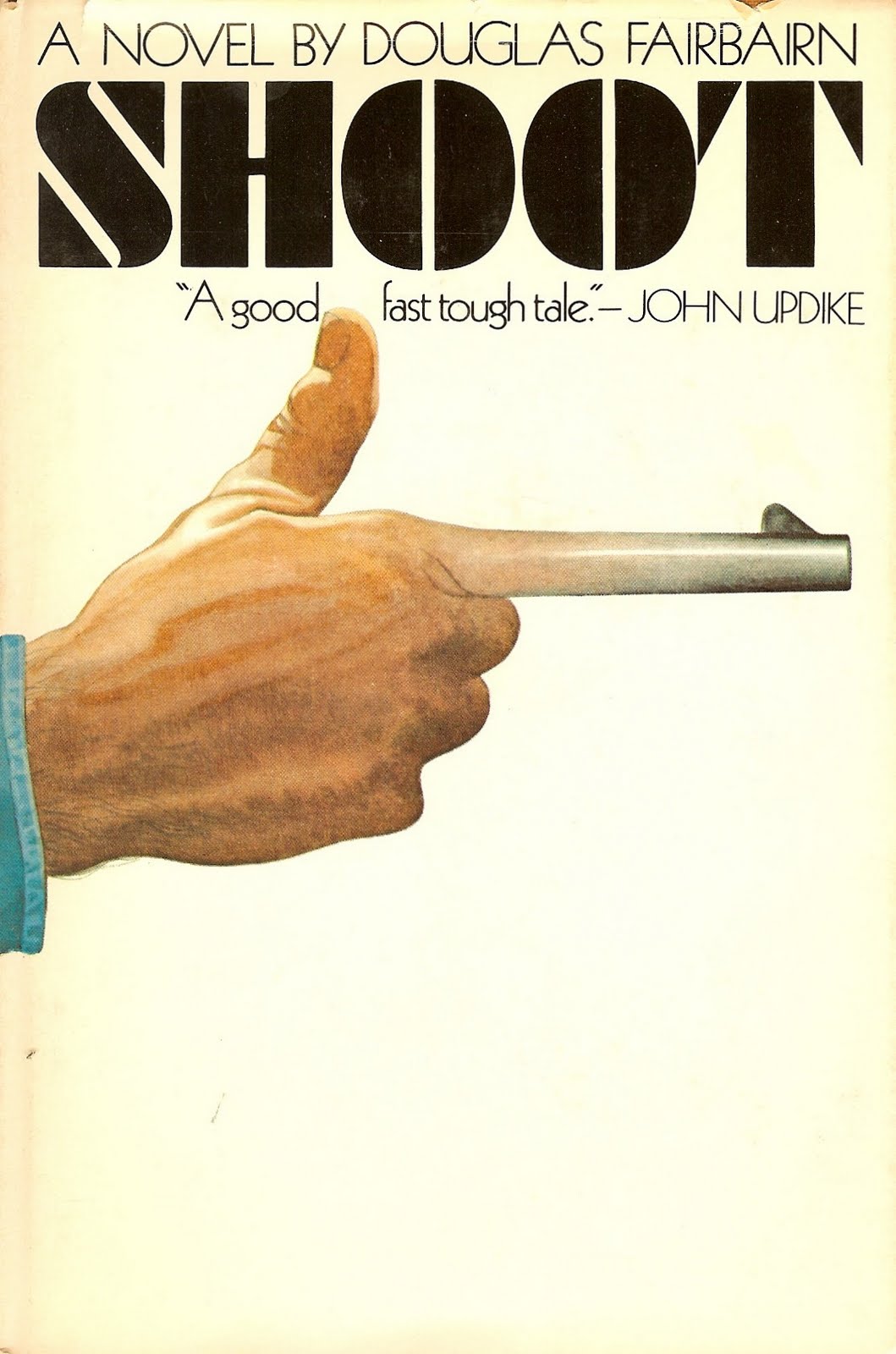
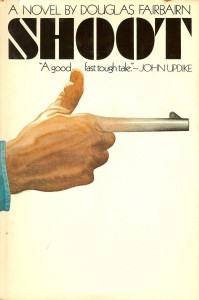
To end, let’s go back to Stephen King. So we know he admires James M. Cain. But what is his all-time favorite opening line? It is from Douglas Fairbairn’s novel Shoot. Here’s the set-up: A group of middle-aged guys, all war vets, are on a hunting trip. As they come to a riverbank, they spot another group of guys, much like themselves, on the other side. Without any provocation, one of the hunters on the opposite bank raises his rifle and fires at the first group, wounding one man. Reflexively, one of the first group returns fire, blowing the shooter’s head apart. The opening line: “This is what happened.”

And here is King on why he loves it:

“This has always been the quintessential opening line. It’s flat and clean as an affidavit. It establishes just what kind of speaker we’re dealing with: someone willing to say, I will tell you the truth. I’ll tell you the facts. I’ll cut through the bullshit and show you exactly what happened. It suggests that there’s an important story here, too, in a way that says to the reader: and you want to know. A line like “This is what happened,” doesn’t actually say anything–there’s zero action or context — but it doesn’t matter. It’s a voice, and an invitation, that’s very difficult for me to refuse. It’s like finding a good friend who has valuable information to share. Here’s somebody, it says, who can provide entertainment, an escape, and maybe even a way of looking at the world that will open your eyes. In fiction, that’s irresistible. It’s why we read.

King loves it so much, he echoed it in the opening of of his own novel Needful Things: “You’ve been here before.”  And guess what? It’s his own favorite opening. Which is a good place to end, I think.


Don’t be an Amateur!

I was going through some old files the other day and came across a folder from my old Oakland days and discovered I had kept a great article entitled:  Pat Holt’s Top Ten Mistakes Writers’ Don’t See (But Can Easily Fix When They Do). This morning I thought I’d look up her blog site, Holt Uncensored, and was delighted to see that her list was still up on the web and so, with a shout out to her, I’ve included this as the starting off point for putting together  our own Kill Zone top 15 (or maybe 20) mistakes that single you out as an amateur writer.

Holt’s top 10 are:

  1. Repeats – where a writer unconsciously has a ‘crutch’ word that is repeated (sometimes ad infinitem) in a manuscript. This may be a common word (see my recent blog post on writing tics) or an unusual word that stands out if repeated, or it could be a phrase that needs to be ‘lopped off’. So repeat after me…No Repeats!
  2. Flat writing – where your writing goes and die on the page…
  3. Empty adverbs – when used unnecessarily ’empty’ adverbs don’t add anything – in fact they can suck the meaning from a phrase or  appear infantile and clunky.
  4. Phony Dialogue – be careful not to use dialogue to advance the plot (people don’t normally recite plot facts to one another) or you can lose credibility with your reader.  Also be wary of using ‘fashionable’ dialogue or slang that can make your dialogue sound dated.
  5. No-good suffixes – don’t take a good word and muck with it by adding ‘ness’, ‘ize’, ‘ly’ or ‘ingly’ to the end of it….otherwise you get ‘meaninglessness’
  6. ‘To be’ words – nix these and use words like ‘is’, ‘am’, were’, ‘being’, ‘been’ or ‘there was’ or ‘there is’ sparingly as they can flatten your prose.
  7. Lists – don’t provide a long list of items as if they were on a checklist. Whether it be nouns (e.g. every flower in the garden) or verbs (e.g. everything your protagonist did that morning) this will only cause a reader’s eyes to glaze over.
  8. Show, don’t tell. ‘Nuff said!
  9. Awkward phrasing – cull any weird or awkward phrases that stop a reader in the midst of reading or which makes you sound like you’re trying way to hard to show you’re a ‘writer’.
  10. Commas – make sure you know your grammar and punctuation so you can demonstrate to an agent or editor you know what you’re doing.

To this great list I would add:

  1. Data downloads – don’t suddenly force feed your reader lengthy exposition that halts the story in its tracks
  2. Spell Check! – nothing says ‘amateur’ than sloppy typos.
  3. Know your core story and stick with it (for this I have to give kudos to Larry Brooks, my Monday blog-mate, as his book Story Fix clearly demonstrates,  this is where many writers (both novice and professional)  come adrift)
  4. Purple prose – If a simple, clear, precise description will suffice don’t overburden it with flowery, purple prose.
  5. Faking it – readers know if you’re not being authentic so don’t try and mimic another writer’s ‘voice’ – find your own and go with it…Also if you are writing say a romance just because you think you can make money, but you don’t actually like or read the genre, guess what? Readers, agents, and editors will know. There’s no point faking it…

So what about you TKZers, what would you add to make your ‘Top List of Mistakes That Make You Look Like An Amateur’?


How to Stay True to Your Writer Voice Across Genres

Jordan Dane
@JordanDane

Dana FB pic of Stone Angels 205250_10150186214376802_699051801_8472241_16017_n

(Surprise! I made a switch of a post date with James Scott Bell. He took my Thursday, July 16, and I swapped him for his usual Sunday. Who can say “No” to Jim, seriously?)

I made the change from crime fiction thrillers to young adult (and back) because I had a niece who wanted to be a writer and I included her in on my process while I wrote my first YA – IN THE ARMS OF STONE ANGELS (Harlequin Teen). We had fun together. I flew her from Texas and we spent a long weekend visiting the locals sights I wanted to use for the story, taking photos. I also worked with her to come up with character images and names and we plotted the first 8 chapters.

The sixteen year old character (Brenna Nash) had been born in my head while I wrote the Prologue. It should have felt like a drastic change in voice (from adult to teen), yet I made the leap with only one real foundation in crime fiction to connect my stories. I had deliberately chosen to make my first YA a cold case mystery so I could tie into my reader base. I didn’t analyze this change in genre, but I’ve been thinking of VOICE lately and wanted to break it down.

If you are a new author trying to find your way, or a more experienced writer who would like to venture into a new genre, I hope this post gets you thinking.

Keys Ways to Establish Your Own Voice Yet Stay Flexible Across Genres

1.) Ask Yourself: What is my natural voice? Answer this question on your own, but then ask those closest to you how they see you. Are you naturally cynical? Are you great with the one liners? Or are you quieter with good timing for well-timed jabs?

Exercise: Describe Yourself in Three Adjectives (Snarky, Fun, Flirty) Then ask: Is this how I talk?

2.) What books have you enjoyed in the genre you are interested in writing? I’m not just talking about reading a book and liking it. I’m suggesting you analyze exactly why you liked it. I’m talking notes in the margins and highlighted lines of dialogue or imagery you liked. Understanding your taste will help you define what comes naturally to you. You are drawn to author voices you like and hope to write yourself.

Exercise: Picture your ideal reader. If you can describe him or her, then write to your reader as if you were one on one. Does this make your voice easier to develop?

3.) Can you hear the central character in your head? Can you resist censoring him or her? I call this “free association.” It’s as if the character is telling you his story and you’re the scribe. Throw everything onto the page without filter and you might stumble onto your next book.

Exercise: Take a pen and paper and free write without censorship. Go bonkers. When you’re done, ask yourself – Do I write like this? Is this more natural than what I’m writing now? I’m convinced you must enjoy what you’re doing, otherwise it’s too much like work.

4.) Can you trust your instincts to get it right? When I’m working out a character, I resist getting feedback from anyone else. I want to feel sure about the character before I open myself up to criticism or get input from a committee of beta readers. Trust your gut. It’s your story.

Exercise: Answer these questions: Is my writing something I would read? What’s on my shelves? Am I forcing my voice?

5.) Don’t push your instincts into an area of voice that does not feel completely comfortable to you. I like writing when I’m slightly off balance and unsure, but I know my boundaries. I couldn’t write Chicklit for example. Not a whole novel, for sure. Plus my sense of humor runs more subtle so I’m not likely to try slapstick weirdness for a whole book either. Even if you’re a risk taker, I feel strongly that there are limits and we must determine what those are to make any adjustment to voice that has any hope of being successful.

Exercise: Am I enjoying what I’m writing? Does it feel like work or fun? Unless I’m writing something that comes naturally, it can seem like drudgery. Remember this is your passion and it should be fun.

Even when I ventured into YA, I still wrote about loners, the quietly brave hero, the cynical character, the well timed one liners, and the brooding male. I created my teen characters to be unique to the story line, yet my world building and character voices were consistent with my comfort zone. I read many many YA books before I wrote the genre. I wanted to write about smart and unique characters who knew how to tread through life alone if they had to, the kid who could be shadows that most people don’t notice until these kids rise up to become heroes. Those are the kinds of books I like to read and write.

So what about you? How did you develop your author voice? Any new tips to add?

To Age, or Not at All

angel headstone

(Photo by Alexy Sergeev, who retains all rights therein)

My friend and fellow TKZ contributor Joe Moore offered up an excellent post three weeks ago concerning the pros and cons of writing a series versus writing a standalone novel. You can find it here if you wish to refresh your recollection of it. My little offering today is focused upon an issue which arises in a literary series when— oh joy! — it becomes extremely popular and continues for books and books and years and years.  Lurking in that blessing is a problem: do you let your primary characters age gracefully, or not at all?

I have been fascinated with this problem since I was nine years old. I was reading a daily comic strip at the time titled “Dondi.” It was created by Gus Edson and Irwin Hasen and was about a World War II war orphan who was brought back to the United States and adopted by a G.I. The strip had been going for five years by the time I discovered it in 1960; my mother, seeing me reading it, wryly observed that Dondi was the only five-year old kid in 1960 who could still remember World War II. Dondi stayed five until the strip shut down in 1986. This got me thinking about the problem of aging in fiction, one that is confronting a number of authors right now.  No one really expects characters like Spenser or Lucas Davenport or Harry Bosch or Jack Reacher, to age in real time. What occurs in a novel of genre fiction typically takes place over a few days or weeks, with a new novel being published every year or two. I have heard it said that a year in real time translates into a month or two in the world of the fictitious character, less than that if the succeeding book picks up where the previous book left off. The problem, however, is that when you have series that have survived for three decades and beyond that, events in the real world overtake a long-running series. It’s the Dondi problem, if you will: how is it that a veteran of the Vietnam War is tracking a GPS location on their android phone in 2012, all the while climbing fences and taking down the bad-uns like the thirty-something year old they were when the series started in 1982? Even the most youthful characters should be manifesting signs of becoming long in the tooth at that point. Yes, some authors are addressing this to varying degrees. Ace Atkins, who picked up the Spenser reins from the late Robert B. Parker, is slowing him down just a bit, letting age and damage manifest themselves incrementally but irrevocably. Michael Connelly and John Sandford seem to be moving Bosch and Davenport, respectively, into new situations where they might not be quite as physically active as they were twenty or more years ago. James Lee Burke addressed the problem of age brilliantly in LIGHT OF THE WORLD, wherein he appears (and I stress “appears”) to write finis to the darkly poetic accounts of the life of Dave Robicheaux. Age and death may be inevitable; it is tough, however, to contemplate saying goodbye to these folks, to watch them walk upright, if a bit stiffly, into the sunset.  Do they necessarily have to age? Or can they be like Dennis the Menace or Bart Simpson, stuck in the amber of grade school forever?

For those of you honoring me with your presence today…what say you? If you are writing a series, do you plan to age your characters at some point? Do you have an end game planned? Or will they be forever young? And readers of series…what do you think? Do you want your favorite characters to age, or do you prefer them to be forever young? Do you have a preference?


The Whole Truth About Atticus Finch

NOTE: Because of the timely nature of this item, Jordan and I are switching slots this week. Her post will come on Sunday. 

It’s been a rough week for fans of the book and film To Kill A Mockingbird.  

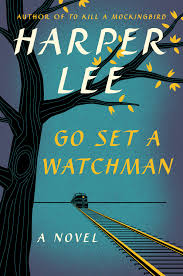
HarperCollins delivered the “new” Harper Lee novel, Go Set A Watchman. Many people urlstill harbor strong suspicions that the aging and infirm Ms. Lee was manipulated after fifty years of steadfastly refusing to publish anything else.

Be that as it may, it’s here. Strangely unedited (it renders a different version of the Tom Robinson trial, for example), the novel is primarily about one thing––a daughter’s coming to terms with her less-than-perfect father.

That’s the big shocker everyone is talking about: In Watchman, Atticus Finch is revealed to be a segregationist. He does not want the government or the courts telling him or his community how to live. He thinks the Supreme Court is using the Fourteenth Amendment to erase the Tenth Amendment. And he believes the black population is not ready for the responsibilities of citizenship.

In Watchman, Atticus is a member of the Citizens’ Council of Maycomb County, a group of white men strategizing on how to deal with Brown v. Board of Education, and the incursion of the NAACP and northern progressives into the South.

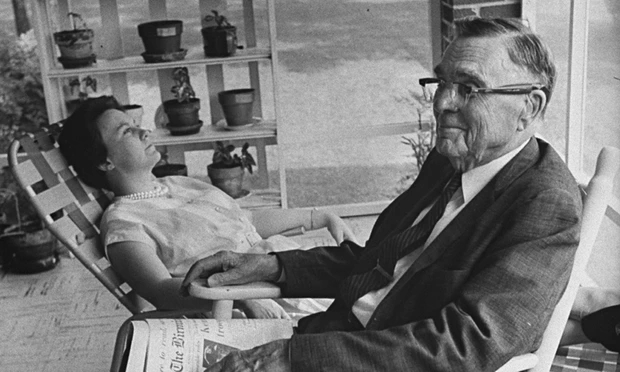
Harper Lee w:her father
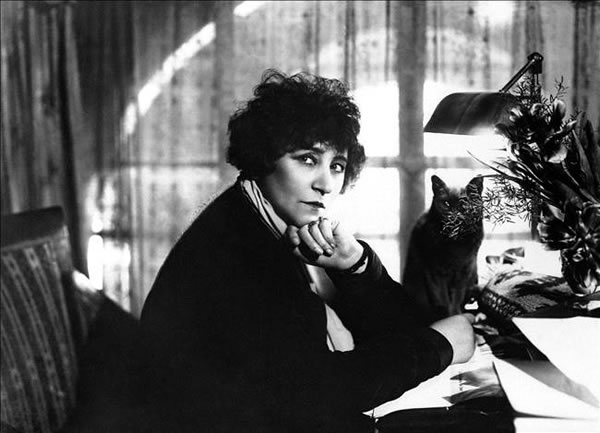
Harper Lee with her father, Amasa Coleman Lee

The grown-up Jean Louise Finch (Scout from Mockingbird) discovers this about the father she idolized as a child. It all leads to the climactic scene––a knockdown argument between Jean Louise and Atticus over the “negroes” (the term the book uses).

“Let’s look at it this way,” Atticus says. “You realize that our Negro population is backward, don’t you? You will concede that? You realize the full implications of the word ‘backward’, don’t you?”

Jean Louise is horrified and responds: “You are a coward as well as a snob and a tyrant, Atticus.” She goes on to compare him to Hitler (!) and admittedly tries to grind him into the ground.

As a historical document, written in the mid-1950s, Watchman is reflective of so many similar confrontations that took place back then––college-educated white children coming home to challenge their parents’ views on race, especially in the South.

I will not reveal what happens in the last chapter. Suffice to say I was simultaneously moved and unsatisfied by it. Which may be the very point Harper Lee, the author, intended to make.

We live in an imperfect world, loving imperfect people.

Which brings us back to Atticus Finch. He was always seen as a virtual saint, especially as played by Gregory Peck in the movie.

But what everyone seems to miss is that Atticus held the same segregationist views in Mockingbird.

I’ve taught Mockingbird in seminars, most notably the Story Masters sessions I do with Donald Maass and Christopher Vogler. We go through the book chapter by chapter, talking about technique and style.

There is a single, enigmatic passage in the book that’s always troubled me. I never knew quite what to do with it. Until now, with the publication of Watchman.

It comes early in Chapter 15, the very chapter where Atticus sets himself in front of the lynch mob at the jail. The narrator, Scout, reflects on how Atticus would sometimes ask, “Do you really think so?” as a way to get people to think more deeply.

That was Atticus’s dangerous question. “Do you really think you want to move there, Scout?” Bam, bam, bam and the checkerboard was swept clean of my men. “Do you really think that, son? Then read this.” Jem would struggle the rest of an evening through the speeches of Henry W. Grady.

So what was Jem’s opinion? Who was Henry W. Grady? Why would Atticus give his boy a book of Grady’s speeches?

In light of what I’m about to reveal, I think Jem (who is the more sensitive of the children) probably said something along these lines: “Atticus, it’s just not fair that colored kids don’t get to go to school with white kids.”

Atticus gives him the Grady speeches, which are available online.

Henry W. Grady (1850-1889) was a post-Civil War advocate of what he called the “New South.”

The old South rested everything on slavery and agriculture, unconscious that these could neither give nor maintain healthy growth. The new South presents a perfect democracy, the oligarchs leading in the popular movement; a social system compact and closely knitted, less splendid on the surface, but stronger at the core; a hundred farms for every plantation, fifty homes for every palace; and a diversified industry that meets the complex needs of this complex age.

The new South is enamored of her new work. Her soul is stirred with the breath of a new life.

But what about the population of emancipated slaves? What of their future? Grady said things like this:

What is this negro vote? In every Southern State it is considerable, and I fear it is increasing. It is alien, being separated by radical differences that are deep and permanent. It is ignorant — easily deluded or betrayed. It is impulsive — lashed by a word into violence. It is purchasable, having the incentive of poverty and cupidity, and the restraint of neither pride nor conviction. It can never be merged through logical or orderly currents into either of two parties, if two should present themselves. We cannot be rid of it. There it is, a vast mass of impulsive, ignorant, and purchasable votes. With no factions between which to swing it has no play or dislocation; but thrown from one faction to another it is the loosed cannon on the storm-tossed ship.

These, then, were the views Atticus was passing along to Jem in Mockingbird, and holding onto in Watchman.

In other words, Atticus Finch was never a perfect saint.

But let me ask you this: who among us is? I’ve not known very many in my lifetime.

Which means this complex Atticus Finch is a more realistic character than the “perfect” one. He is still the man who defended Tom Robinson to the best of his ability. But he also holds odious, segregationist views. Jean Louise (and Harper Lee) make clear how wrong that is.

So what do we do with such a man, or woman, or family member? What are the limits of love? What is the cost of growing up? Are we compelled to hate those who hold views we cannot abide?

That’s what Harper Lee is asking in Go Set A Watchman.

The novel does not destroy the Atticus Finch of Mockingbird. Rather, it renders him flawed and therefore human.

You know, like the rest of us.

Jesus taught people to hate the sin, but love the sinner. In a world of so much hate, this message is exactly what we need to hear. Harper Lee’s novel, so long locked up in a safety deposit box, may therefore be more important than we think.

When the Story Writes Itself

Nancy J. Cohen

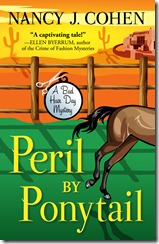
Have you noticed how you plod through some books you’re writing and others seem to write themselves? Why is that, do you think? Peril by Ponytail, my upcoming mystery release, was a breeze compared to some of my other stories. I had a wealth of research material from my trip to Arizona. Not only did I stay on a dude ranch similar to the one where Marla and Dalton honeymoon in the story, but I explored a copper mine, hunted spirits at a haunted hotel, toured a cave, visited ghost towns, and more. With such an abundance of historical and sensory details, I had too much material for one book. The story sprang from the setting and the characters I’d placed there. Photos brought me back to the locale along with my detailed notes. I didn’t lack for words to fill in the pages.

PerilbyPonytail

My next story, Facials Can Be Fatal, is a different story…figuratively as well as literally. Based back in my hairdresser sleuth’s hometown, it involves a client who dies in the middle of getting a facial. The method of death tripped me up, and it took me weeks to decide Howdunit. Then I created my ring of suspects, but it wasn’t enough. The spark was missing. When I hit upon a historical angle and the idea of a deserted theme park, those two elements hit the ball into the field. Now I was off and running. I’d needed that ember to ignite the flame of creative passion.

Now I’m writing the sequel, since #14 in my series directly follows book #13. Normally, I write a detailed synopsis before the writing process begins. In this case, I wrote four pages of plotting notes that essentially go from Point A to Point B without much in between. A mystery doesn’t work without twists and turns. My normal synopsis runs 12-15 pages. But just by winging it, I’m already up to page 40 in the story. I’m not sure where I am going. I have hazy images of the suspects and their motives in my head. And I haven’t yet hit upon the angle that’ll make my pulse race.

Do I need it? Maybe not.

I sit down every morning with the blank page in front of me and my five pages a day goal, and those words somehow get filled in. I expect at any time to get stuck due to insufficient plotting, but it hasn’t happened yet. This is a different kind of mystery for me. It’s not a “dead body up front” kind of story. There’s been an accident, and we aren’t sure yet if it was intentional or not. Meanwhile, I’m going with the flow to see where it takes me.

Does this happen to you? Are some stories easier to write than others? What do you think makes the difference?

TKZ Spotlight: Author Terri Lynn Coop

Today I’m delighted to welcome author Terri Lynn Coop for a Q and A.

TVavatarTerri is a lawyer by day, writer by night, and an unapologetic geek the rest of the time. Her work appears in the “Battlespace” military fiction anthology and the spooky “No Rest for the Wicked” collection. She is a long-time member of the TKZ community.

Please describe your journey as a writer, including any challenges and obstacles you’ve had to overcome.

I didn’t write anything except exams in pursuit of my engineering degree, back then it was all about the math. By the time I hit law school, I was taking every writing class I could to avoid exams. One class, Law and Literature, stuck with me. The professor stressed how the body of American law develops like an epic novel, new chapters constantly building on the old. I developed an appreciation for some of the great legal writers and even forgave the professor for making me read Kafka. 

And it was a good thing. My nascent writing career was short-circuited in 2005 when the family antique business became embroiled in an intellectual property lawsuit. Over the next five years I probably wrote 500,000 words in briefs and motions in four courts across three states. Despite the myth that lawyers are wordy, I had to learn, and learn fast, how to persuasively tell my story, complete with all the backstory, research, and reasoning in 25-page chunks. I had a very specialized audience of one, the judge. I won the case, but it was brutal. 

During this time I also wrote the two “trunkers,” novels of such horrifying proportion that I will do everyone a favor and leave them in the darkest recesses of my hard drive. 

Everything changed in 2009 when my husband was seriously and critically injured in an accident. I was thrown into the role of full-time caregiver and primary wage-earner for two years. Even though he eventually had professional health care aides, I still worked three jobs to keep the household running. Writing was my escape then, and out of that cauldron came the first novel I would let anyone read: “Devil’s Deal”. It went on to win the 2013 Claymore Award at Killer Nashville for best unpublished novel.

Where do you live, and how does that setting inform your writing?

I live on the Kansas prairie in Fort Scott, about 100 miles south of Kansas City, but I’ve lived coast to coast and traveled widely. My settings come from my road trips. For example, in my novel, I’ve camped at that trailer park in south Texas, had breakfast in that truck stop diner, and I spent six months working in downtown Dallas. 

Here in Fort Scott, I love to sit in the local diner and listen to the locals talk. 

How does your background influence your writing?

After my Claymore win, I was interviewed by The Library Police. They asked me why so many lawyers end up as writers. I told them that as a group we are bright, literate, and bored. The practice of law is interesting and can be fulfilling, but if done correctly, is extremely routine and administrative. As a public defender, I practiced what I called “law by the pound.” It was about volume and number of cases resolved. A lot of interesting tidbits came my way, but most of it was very mundane. However, it was so immersive that it couldn’t help but influence my writing in both content and style. 

How old were you when you first felt the urge to write, and what inspired you to get serious about honing the craft?

Ignoring my high school emoting, real inspiration hit in 2003 when I joined an online writing group. I got serious about learning the craft when I wandered into venues that were considerably less impressed with me than I was. 

What are some main themes you return to when writing?

The series that kicked off with Devil’s Deal will have an underlying current of trust, betrayal, loss, and loyalty. In the first book Juliana can’t abandon her father to his fate, even though he may well deserve it. Law enforcement knew exactly how to manipulate her into risking everything to save him. She called it a “familial bomb vest strapped around her heart.” 

Which authors have most influenced your writing?

I have a spare style, terse to the point of being brusque. Most edit notes I get are to “put more in,” rather than “cut more out.” In books, I like plots that move fast and sure with well-defined reluctant heroes like Lee Child’s Jack Reacher, Steve Ulfelder’s Conway Sax, and John Gilstrap’s Jonathan Graves. But, I’m also intrigued by rich characters and settings like Larry’s McMurtry’s Texasville saga. So, I try to keep it moving, but also have character quirks and a lot of repartee in dialogue. 

For POV, a short work called “Lawyers, Guns, and Money,” by J.D. Rhoades completely sold me on the effectiveness of using first person for tight fast plots where the action swirls around the main character. I liked keeping the villains slightly off-stage. The bad guys drove Juliana and Ethan like puppet-masters. 

Do you have a “day job”? Tell us about that. Does it inform your writing in any way?

I’m semi-retired from practicing law. I’ll never give up my license, but I really burned out on courtroom work after some tragic cases. So these days I run the antique business I inherited from my late husband, hustle freelance writing work (including a gig writing catalog descriptions for Halloween costumes,) and hack away at my novels. I’m always on the lookout and absorbing settings, overheard snips of conversation, legal news, and other writers to incorporate into my writing. 

What are you working on now?

I am working on the second installment of the Juliana Martin series, titled “Ride the Lightning.” After the debacle in Texas that ended the first book, Juliana is burned out, salving her wounds as the cynical manager of a Biloxi roadhouse and dance club. Everything is going fine until Ethan Price shows up on undercover with an outlaw motorcycle club. 

When did you first connect with the TKZ community, and have the discussions here had any impact on you as a writer?

 I came to TKZ in about 2007. I was going to a writers conference where John Gilstrap was a presenter and would be critiquing my writing sample. I researched him and landed here. Best decisions I ever made. First the critique, including the now famous “this sucks,” and becoming part of this community have all contributed to my writer’s life. The lessons, discussions, fellowship, and critiques have all left positive impressions on me and my work. Even when I go quiet on the comments because of some kerfuffle in real life, I’m always around. 

Many thanks to Kathryn Lilley for this chance to ramble. I’ll see you all around TKZ. I’ve also been known to blog at Readin’, Ritin’, and Rhetoric. [http://readinrittinrhetoric.blogspot.com/]

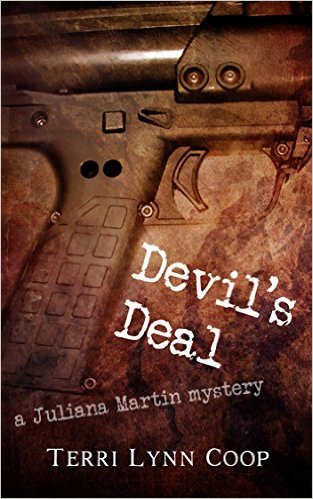
1devil51ZAGcl6jpL._SX311_BO1,204,203,200_

Devil’s Deal is available through Amazon. [http://www.amazon.com/Devils-Deal-Juliana-Martin-Mystery-ebook/dp/B00N9OL3FK/ref=sr_1_1?ie=UTF8&qid=1415893921&sr=8-1&keywords=terri+coop] Ride the Lightning will be out by late summer.