Is Writer’s Block Real?

As you read this, I am on the road to Left Coast Crime. I’m tagging along with my buddy Brett Battles and am not officially attending, so you’ll find me wandering around the hotel bar or lobby, probably looking a bit lost. If you’re attending and you see me, please either hand me a dollar or buy me a donut. I may even have time to chat.

So, with that said, I won’t be around to respond to today’s post, but I invite you to fill the comments with some lively conversation in my absence.

Today’s topic is writer’s block, which I’m sure has been discussed many times here at the Kill Zone. But a couple weeks ago, I offered my take on the subject on everybody’s favorite time-suck, Facebook, and this is what I said:

If you haven’t noticed, I’m extremely opinionated. Some might call it a fault. I think it simply means I have convictions. But I’m perfectly willing to change my opinion if someone can present me with compelling evidence to the contrary.

So sometimes my opinions piss people off. Today I expressed this opinion and it ruffled some feathers:

There’s no such thing as writer’s block. It’s an invention. It’s not a reason, it’s an excuse.

When challenged, I responded thusly:

“So do we have lawyer’s block or doctor’s block or mechanic’s block or accountant’s block? People in all of these professions experience bad days, they all get burned out, they all get stuck at times, but do they take the unprofessional route and stop what they’re doing? No. Unless they’ve had a complete breakdown (which is something else entirely), they keep doing their jobs.

There’s nothing special about being a writer. It’s a job. One I, and many of my friends, have been doing for more than a couple dozen years. None of us can AFFORD to get “blocked.” We write every day, seven days a week, no matter what.

Writer’s block is not a mental condition.

Stress, anxiety, etc.—real conditions that cause real problems—are good reasons for a writer, or any of the above professions, to stop working. But that’s not writer’s block, so let’s not pretend it is.

Nor is getting stuck.

Getting stuck is a natural part of the process, not a “block.” We get stuck simply because we haven’t thought our story—or our characters—through. Once we do, we get unstuck. It happens with nearly every story.

Sorry if I’m unsympathetic. But to my mind, you either do the job or you quit.

As for inspiration, if you need to wait for it in order to work, you might as well give it up.”

Now, you can imagine the response I got. Some positive, but one from a writer friend, who also happens to be a doctor, said I didn’t know what I was talking about. That writer’s block is a very real condition.

I respect this man’s opinion and value him as a friend, so I didn’t want to get too far into it with him. But my response to him was that there are certainly conditions that people suffer from—depression, anxiety, etc.—that can lead to writer’s block, but the block itself is merely a symptom of underlying problems. Unless you’re suffering from a mentally or physically debilitating disease, if you’re a writer, you should be writing. No excuses. So maybe the problem is defining what “writer’s block” is. How ever you define your writer’s block, if you truly do suffer from a lack of creative ideas and your “normal flow” seems to be ebbing you could have a look into consuming CBD products from sites such as cbdoilsuk.com as CBD in some users has been reported to increase their creativity and could help you get that “flow” back.

Since I don’t believe in it, however, I have a hard time defining it, but I can tell you what it isn’t.

If you are having problems with a story, if you’re stalled, if you’re staring at a blank page and nothing is coming that day, that’s not being blocked. That’s merely a setback. We all have them. We hit walls, we write ourselves into corners, we figure out solutions, and if we’re professionals, we press on.

And that’s true of anyone in any profession. If you want to get paid, you get to work.

Hell, I’m working right now and I’m NOT getting paid for it. And I had absolutely no idea what I’d be writing about today, but I sat down and did it anyway. As I’ve said, I can’t afford to be “blocked.”

Anyway, those are my rather inelegant and somewhat gruff—and yes, insensitive—views on the subject. Now, please, discuss amongst yourselves.

It’s quite possible it’s true what they say about me and I am crazy.

Now, does anyone have a donut?

5 Mistakes That Will Kill Your Query Letter

RejectionBy Kathryn Lilley, TKZ

Before there is an Agent and a Publishing Deal, there is every writer’s dreaded obstacle and Final Wall: the Query Letter. Here is  a list of the top five reasons a query letter is rejected by an agent.

1. Perilous Protocol

Manners and professionalism count. Your query letter will be met with an instant “No” if it doesn’t meet the minimum requirements of query letter protocol.

What is “protocol”?

It almost goes without saying, protocol requires you to pay close attention to an agent’s posted Submission Guidelines. Here are some links to excellent discussions about some other how-to basics of crafting a query letter.

The Complete Guide to Query Letters That  Get Manuscript Requests, by agent Jane Friedman.

How to Write a Query Letter by agent Rachelle Gardner.

Query Shark (a site where where you can post your query letter for review, discussion, and critique)

2. Misses and Misdirection

This point sounds obvious, but you must send your query letter to an agent who represents your manuscript’s genre. Do your homework. Research which agents are actively seeking new manuscripts in your chosen genre. (Genre-blending works are frequently problematic here–if you can’t pinpoint which genre your story belongs in, it makes it that much harder to attract an agent).image

3. “Good”, But Not Good Enough

The Truth: Agents aren’t looking for good writing. They’re looking for great writing. They’re looking for compelling, fresh writing that sizzles. “Good” (AKA amateur) writing simply won’t cut it in the current marketplace. So before you submit your query letter, make sure your writing meets that mark. You have to be brutally honest when judging the merits of your own writing. Compare your first chapter to some best sellers in your genre, and then ask yourself: am I there yet?

4 First Line Fails

No matter how well crafted your query letter is, you can lose an agent’s interest with a clunker first line in your story sample. For great discussions about crafting an effective first line, see the following links:

Finding The Right Door To Enter Your Story by PJ (Kris) Parrish

But First…. By Joe Moore

5 Spelling, Grammar, and Punctuation, Oh My!

It hurts me to say this, but many query letters fail due to the sender’s lack of paying attention to the basics of spelling, grammar, punctuation, and paragraph formatting.

image

How about you? Can you share your do’s and dont’s about writing an effective query letter?

A Kinder, Gentler Perspective on Story Structure

by Larry Brooks

When teachers teach, even within the realm of art, the essence of the learning is based on some form of undeniable, unassailable truth. Otherwise, it’s just some guy’s notion of how things are done.

Even finger-painting requires fingers, which are limited in what they can and can’t do. Which creates context for the processes and products of finger-painting.

We teach skydiving and dancing using techniques and proven principles. And even if it’s never mentioned, it is the undeniable and unassailable force of gravity that creates context for the entire proposition.

We teach cooking using techniques and principles and proven recipes. And even if it’s never mentioned, it is an undeniable and unassailable truth – that people don’t like to eat their meat raw unless the words sushi or tartare are within visual range – that creates context for the entire proposition.

I could go on.  If you’ve read my writing books you know I’m fond of analogies (and of going on), often to the extent I receive nasty personal notes from readers who, well, don’t appreciate them, or worse, aren’t capable of understanding what they mean.

Not everyone is cut out for being a writer.

With all the prevailing kumbaya in the online writing and workshop conversations, it is easy to lose sight of this single and simple truth: writing a good novel is hard. Freaking hard. A command of the principles of the craft – including how a good story is structured – is an essential arrow in the writer’s quiver.

Don’t be the writer who squares off with this beast unarmed. Or kids themselves that, within the wide breadth of what the writer gets to make up for themselves, structure is one of those things.

Here’s where things go south in the writing conversation:

When a teacher begins to talk about limits and lanes and proportions and optimal placement of certain essential elements within a story, some writers shut down. This is supposed to be fun, it’s supposed to be art, not architecture and certainly not math.

Others twist what they think they hear into what they fear they are hearing.

And thus the meaning is lost. And with it, the writer’s realistic hope of getting there.

Know this: any conversation about story structure is NOT a conversation about process

The presence of, the nature of, and the benefits of story structure are exactly equal and unequivocally unbiased when it comes to any writing process, whether it that of the most passionate free-form organic pantser or the most anal outlining mega-consumer of 3-by-5 cards in the history of office supplies.

The goals of both, and the criteria for the success of both, are without compromise or exception identical.

Here are a few of the outcomes of this disconnect between teachers who talk about story structure and writers who don’t like what they hear:

Writer says: there’s no such thing as story structure, I’ll write my story any damn way I please.  (And when she does, there will eventually be her very own version of story structure in place, thus disproving that initial assertion. Bad story structure is still structure, and it will probably tank your story… so it’s best to understand the difference between good and bad.)

Writer says: I don’t want to create my story within the confines of someone else’s story structure, I want it to flow organically from my head into my fingers and onto my pages.  (And when he does that, it may or may not work. When it does work, it will in no small part be because it landed on the page with some close proximity to the existing and universally-accepted – among professionals – principles of story structure, and if it doesn’t work, feedback will move the story in precisely that direction. Or, in the absence of a revision, it’ll simply fade away, unread.)

Writer says: Sounds like a pile of “rules” to me, and I hate rules. There are no rules in writing.  (Right. No rules. Check. Just like there are no rules in music, athletics, love, relationships, health, medicine, the legal system and generally staying alive. When such a belief system prevails, the writer is saying she depends on her own personal set of story sensibilities (just like those guys in Oregon holed up in a National Wildlife office are relying on their own legal sensibilities to… well, nobody is quite sure, other than they’re woefully out of touch and destined to fail, thus making this a killer analogy for today’s message) to determine what happens and when it happens within her story… and again, if it works, it will be in no small part because the structure resembles principles she did not invent, but rather, she simply aligned with.)

Writer says: There are infinite ways to structure a story. Another writer says: I’ve heard about 3-act models, 4-part models, 6-part paradigms… they all can’t be valid.  (Actually, they can all be right, because you could argue that a novel with 71 chapters has 71 facets of structure to it… which is like a political argument that spins something to serve one’s one beliefs. Doesn’t change the fact that, when the story works, even with 71 chapters, it likely has the functioning acts, which can also be described in 4-parts overlaying those 3-acts, and/or as many other takes on the model as you care to attempt to break down and defend.

None of that matters.

What does matter is the author getting the flow of the story right.

What you call it when it happens doesn’t matter. The bestseller lists are crowded with authors who have never heard of a First Plot Point (yet they execute one elegantly in every novel they write), and believe that the flow of their story is one of their own invention, when in fact, they are simply writing what has proven to work for the collective whole of fiction, thus validating their story sensibility, if not their ability to describe it.

In other words, what a writer says they believe about story structure doesn’t matter relative to the truth about story structure. Because story structure is very much like gravity in this regard… it simply IS.  It exists. It doesn’t care what you call it, or how many ways you slice and dice it… it simply IS.

And it’ll hurt you or kill you if you proceed without an awareness of it.

In today’s commercial, genre-defined fiction market, that universal (yet liberatingly flexible) structure ends up being very much the same in pretty much every novel and movie that works. Because if it doesn’t align, it probably doesn’t work, and thus it won’t find a publisher or readers beyond the family holiday card list.

It is flexible in the same way that an athlete is free to improvise and respond spontaneously, provided they don’t break the rules of their game or step outside of the lines within which they play. When they do that, a penalty ensues.

Of course, writers don’t want to hear this about their game.

And yet, they remain free and without restraint within those same contextual expectations (limits, boundaries, and a proven relationship between decisions and consequences; i.e, a story that violates the tenets of structure simply don’t work as well as those that honor them) for what, win or lose, they are attempting to accomplish.

Already some writers reading this will notice the hair on the back of their neck standing straight, because damn it, there can’t possibly be a single structural paradigm out there telling me how I need to organize my story. And/or, it shouldn’t be this complicated.

It’s an unwinnable argument, either way. Until you have the courage and wherewithal to actually break down a story that works (not yours, but one that is out there) and see the glowing infrastructure of it for yourself. If you are a reader as well as a writer – and you sure as hell better be – and you still deny this after seeing it… I recommend a career in politics instead.

Of course, in doing this you need to know what you’re looking for before you can see it. And there, to quote our friend Bill S., is the rub. To many writer’s don’t.

So let’s simplify that universal structural model…

… the one you’ll find in pretty much every piece of successful fiction, once you do know what you’re looking for. Let’s clear the air and end the debate.

Because there is a kinder, gentler way to introduce, define and embrace the core principles of story structure without resorting to percentages and math and specific target milestones (which remain available for those who want to master this essential storytelling skill), and it defies challenge from any writer high enough up the learning curve to be reading this with the expectation of actually writing publishable, readable fiction.

Consider this: you absolutely cannot argue that every story – that isn’t a short story – does not have a beginning, a middle and an end.

Guess what… that’s 3-act story for you, in a nutshell.  It simply IS.

When you look closer at those three acts, though, you’ll find there are actually four contextual essences (parts) to a story within them (to be more accurate, across them), that flow smoothly over that core 3-act model, thus becoming a more precise and usable 4-part model that is orders of magnitude more useful to writers than its 3-act better known twin brother.

Because it gives you a mission for all the scenes, contextually, within each of those four parts. It’s like having a map, telling you where the land ends and the sea begins, and where the mountains are. Carve your own path through the wilderness as you will, but this information will keep you alive.

So if you are a non-believer where structure is concerned, or a resister, a late adopter or a literary Luddite – or simply someone who hasn’t yet been exposed to these essential truths – let’s look at story structure in a completely new way, with a completely different and non-restrictive or polarizing vocabulary. One as accessible and uncontroversial as the beginning-middle-end model that you are hard pressed to deny.

By the way, beginning-middle-end is way too simplistic to be useful to a professional author. It’s like describing college as freshman, sophomore, junior and senior, when your goal is to get into med school.  You better understand what needs to happen, and when, far beyond that simplistic breakdown.

You need to know what happens, and when.

Think of your novel as a flow.

Now we’re talkin’. Because you know – you don’t resist – that your story is not, it is never, about one moment in time, that is doesn’t take a snapshot of something and describe it to death, that your story needs to move forward (and even backward if you like) in time, it needs to change, to evolve, that new information needs to come in to play, stuff happens, stuff changes… and eventually, things get resolved.

You don’t resist that.

When you realize you don’t resist that, you are also signing up to implementing some form of story structure.

Think of structure as the flow of your story… and understand that the flow of your story follows a natural, organic contextual essence, one that has arisen from any and all other possible flows because this is how human beings experience life (which also has a beginning, middle and end) and stories themselves.

This is how readers engage with our stories. We are writing, first and foremost, for them. If that’s not true for you, you have another issue besides structure that you will eventually need to confront.

Now think of that flow having four definable sub-sequences, each with its own unique narrative purpose. Just like life has infancy, youth, middle age and old age (a list you can expand as you wish, but these four always remain in place)… the context of those experiences is by definition different – everything about them is different – when we live through it.

So it is with your story.

A functioning story has four segments to it that are unique relative to each other, and to how the reader experiences your story. Here they are:

Setup… you need to introduce your hero, present a story world (time, place, culture, natural law), inject stakes and set up the mechanics of an impending launch of – or twist to – your core dramatic arc (the plot), which is what your hero will spend the rest of the story investigating and pursuing and wrestling, all in context to the pursuit of a goal that leads to resolution).

Response… after things have been setup, the story needs to settle into a lane that shows your hero responding to a new path – the core story path, also known as your plot – with stakes in play and some form of obstacle (antagonism) causing the hero to react to something they may not understand (pursue more knowledge) or, if they do, a need to deal with it in a way that keeps their ultimate goal on their horizon.

Attack… because if the hero is too heroic too soon there isn’t much drama for the reader to engage with (there needs to be), so we wait until this quartile to show your hero evolving from a seeker/wanderer/responder to become a more proactive attacker of their problem or goal, both relative to the goal itself and the presence of an equally-evolving obstacle (a villain or a storm or a disease or an approaching deadly meteor, whatever is the source of tension and drama in the story)… moving closer to a showdown and some form of…

Resolution… wherein all the moving parts of your story converge to put your hero face to face with their goal and whatever blocks their path toward getting what they need to get.

This is, by the way, the nature and essence of the most common form of story model, the 3-act structure embraced by screenwriters and a huge percentage of professional novelists… this is the very same flow, because those two middle segments comprise “Act 2” of that model, thus creating a 3-act whole.

The degree to which you depart from this accepted – and expected – story flow is the degree to which you are putting your story at risk. Either by not knowing this, or worse, by defying it.

Because the context of the scenes and chapters with each of these four eras of flow differ, each with its own contextual mission for the scenes and chapters within it, you are then empowered to create a different contextual experience for your hero from part to part.

For example, your hero’s true story-arc-challenge doesn’t fully launch in the first-part (roughly a quartile) setup, and once it does, everything else in the hero’s life is trumped by whatever it is you have placed before your hero as a problem or a need or a goal, with stakes and opposition in play.

There will be those who resist, even to this kinder, gentler flow of a story. There will be those who say, “but wait, my story does kick off on page two, not on page 62,” which is a statement of fact or intention rather than a valid defense. This is why stories get rejected, and why the author may not ever be clear about why it happened.

If that’s you, then I urge to you see a movie tonight, and notice how it flows over these four contextual essences.

Read a bestseller, notice how it sets up the core story before fully launching it, (even when something highly dramatic opens the story, trust me, things will change for the hero, and soon, all within the setup quartile).

Notice how the story shifts (at what is called The First Plot Point) to thrust the hero down a new or altered path, causing her/him to react, to respond, all in the face of stakes (motivation) and the presence an emerging threat (both of which were, in a properly structured story, introduced and/or foreshadowed in the Part 1 setup quartile) of an antagonist (a person or force or situation) that seeks to prevent the hero from reaching their goal (in a romance, for example that would be whatever – person or thing or situation – that keeps the two lovers apart)…

… and then, how the story again shifts in the middle and points your hero toward a more proactive attack on their problem…

… and then, after another twist at roughly the three-quarter mark (new information), where all paths and motives and strategies begin to converge, resulting in a confrontation or a catalytic series of decisions and actions by your hero (who cannot passively sit on the sidelines while someone else steps up to solve the problem), creating some form of resolution.

If you want to see seven or eight parts in that, you can. They may indeed be present, but almost always as subsets and supporting dynamics within these four parts of the flow.

Here’s something that’s true, even if you are the most ardent resister to anything that smacks of story structure: your novel is not a snapshot. Not a dissection of a singular moment in time. A story needs to move forward. Things need to change.

Your hero needs something to do.

Every time.  In every story that works.

If you think of that change over the arc of your story, then you are embracing the context of flow.

Don’t call it structure if that offends or frightens you. But that’s precisely what it is, and that’s all it intends to do: make your story flow.

Call it what you will, but once you get this and begin to either pants or plan your story with this in mind – because it is like gravity itself, if you deny or ignore it, it can kill you – you’ll find the story not only works better, but your experience in creating it will be orders of magnitude more blissful.

Sort of like soaring on the wind.

You always need some form of wings to stay aloft, and alive.

The flow, fueled by your character’s journey, becomes your story’s wings. You are the pilot in command, trained and skilled at what works and what will result in a fiery crash, fully mindful of how far you will fall if you don’t honor the physics of story, forces that will either elevate you or send you spiraling to the ground.

We all get to choose. For professional authors of stories that work – no matter what their writing process – there really is no choice at all.

They go with the flow, every time.

When the Research Comes to You

by James Scott Bell
@jamesscottbell

So the other day I was sitting in my living room, taking a short break from the keyboard. I think I was putting on some shoes. I don’t wear shoes if I can avoid it. For me, flip flops are a form of dressing up.

And then boom. 

I mean, a literal boom, contemporaneous with a slight shaking of the house.

Having grown up in L.A., and been shaken and stirred many times, my immediate thought was that we were having a small earthquake. But what was that boom? It sounded like an over-caffeinated UPS guy trying to get me to the front door.

I sat and listened and waited. No more shakes. No more booms. A quick look out the window. No UPS guy.

Back to work. Half an hour later my wife comes home and says that the major street near us is completely blocked off, with cop cars and fire trucks all over the place. She asked me if I knew what happened.

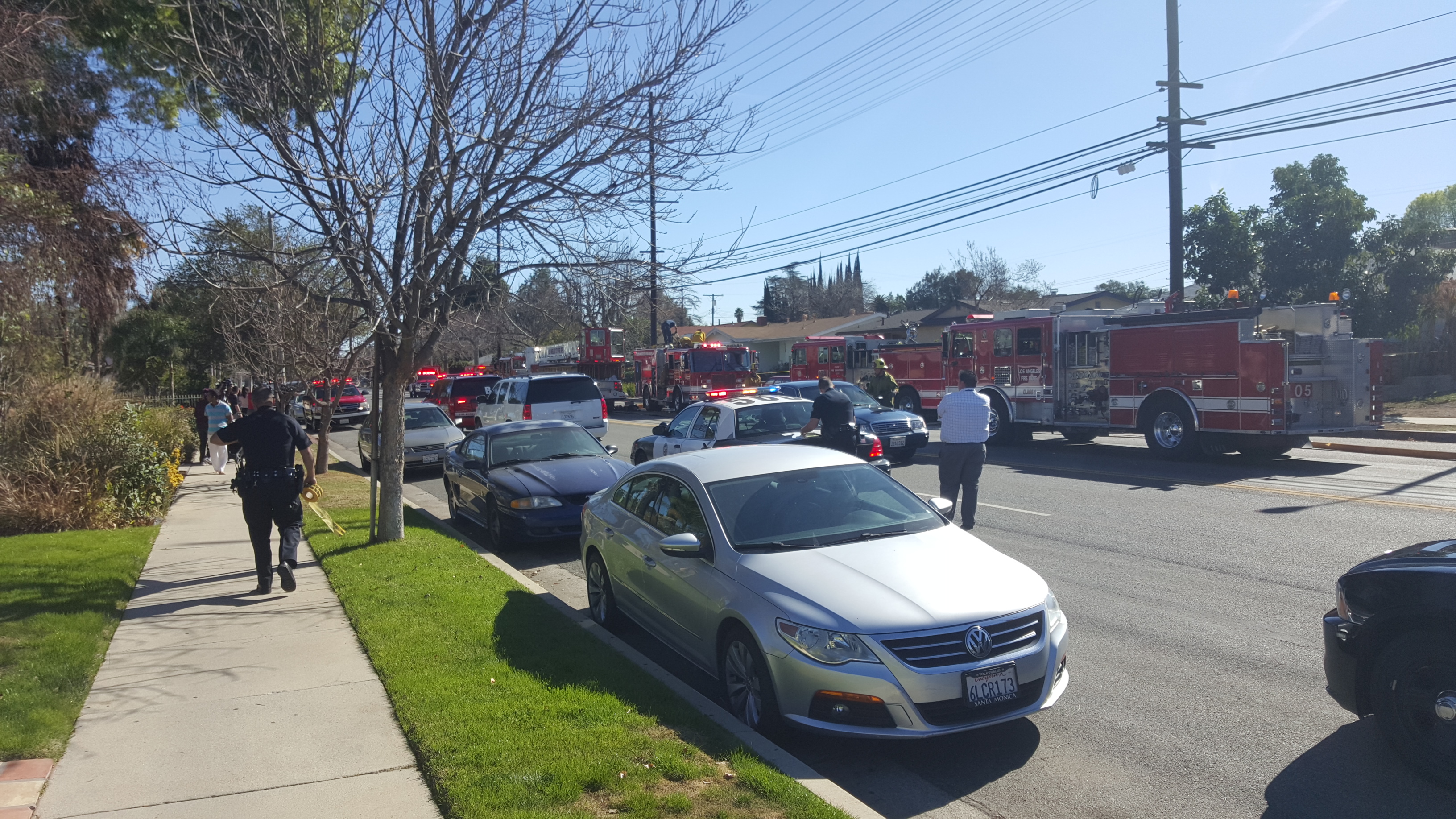
Vanowen fire trucks

I reported the boom and said, “Let’s go see.”

We walked around the corner and found yellow police tape across the intersection and a traffic cop diverting cars. We walked to the opposite side of the street and down to where all the action was. Somebody said a house had caught on fire.

I went up to an LAPD officer and told him about the boom. He took my statement. Then a news van pulled up at the corner and a reporter with her camera guy comes striding toward me.

“Do you know what’s going on?” she says.

I told her about the boom and the shake.

“Can I put you on camera?” she asked.

Twist my arm. It took her camera guy about fifteen seconds to set up. And then it was a go. She asked, “Tell me what you heard.”

I said, “Well, I was sitting at home working on my latest James Scott Bell bestselling thriller, when …”

Uh, no. I let that opportunity slip away. I merely reported the facts.

What had happened was that a detached garage blew up and caught on fire. They pulled out two charred bodies. Which had me thinking meth lab or some other illicit activity gone bad. But there were no immediate answers.

That evening I was on the news. You can catch my five seconds of fame here:

Two days later Cindy and I decided to walk past the scene from the alley, where the garage door faced. There we encountered a man in boots and heavy gloves, raking the debris. We introduced ourselves to Tom Pierce, an independent fire investigator with about forty years experience. He was most friendly, and when I subtly mentioned I was a thriller writer, he gave us a little seminar on his investigatory techniques.

With Fire Investigator Tom Pierce

Turns out the victims were a mother and son, Guatemalan. She was in her seventies, he in his thirties. The arson team didn’t find enough butane or propane for a drug lab, but there was a heavy smell of gasoline. One theory is that the guy was cleaning something with gasoline and the fumes built up and someone struck a match. Whatever it was, there was instant conflagration, and the two residents didn’t have a chance.

This sad scenario is obviously fodder for the thriller mind. So were the details that Mr. Pierce shared with me—burn patterns, how he breaks up the scene into quadrants, the possible sources of ignition. All now safely packed away in my mental filing cabinet.

Because, for a writer, all of life is material. And it doesn’t have to be something as big as an explosion in your own neighborhood. It could be as small as a bit of snagged conversation, or the curious way one person is looking at another.

So remember:

  1. Waste nothing

Everything you encounter can lead to ideas, plots, characters, scenes, bits, beginnings, endings. Keeping your mind in an open and unlocked position is easy once you get into the habit.

  1. Add What if to anything that sparks

When you see something that lights a little fire in your imagination, add some wood to it (I can’t seem to get away from fire metaphors). The wood is What if? Let it burn.

  1. Have no fear

When you’re in this creative state, let yourself go. Turn off your “inner editor.” Even more, push yourself off a cliff and grow wings on your way down (a favorite recipe of the late, great Ray Bradbury). Some of your best stuff will be found on that marvelous trajectory.

Finally, remember this bit of advice from Ann Lamott: “You own everything that happened to you. Tell your stories. If people wanted you to write warmly about them, they should have behaved better.”

So what about you? How often does “real life” play into your fiction? Your creativity?

Reader Friday: Best Political Thrillers?

It’s a Presidential Election Year–aka “Silly Season”–again. What are some of your favorite political thriller books or films?

Update: We’re truly sad to learn of the passing of Harper Lee, who wrote perhaps the best “political” story (as told through the highly personal story of a child) in American history, TO KILL A MOCKINGBIRD.


First Page Critique – Renegades

Jordan Dane

@JordanDane

My first critique for 2016. For your reading pleasure, we have RENEGADES, submitted anonymously for feedback. My comments will be on the flip side. Please provide your constructive criticism in your comments. Our brave author appreciates the help.

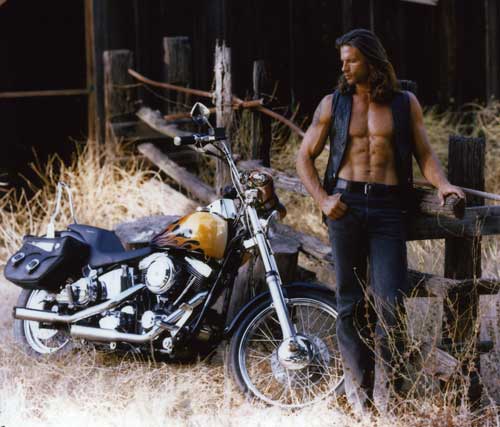
I'm dating myself with this pic of Lorenzo Lamas as RENEGADE

I’m dating myself with this pic of Lorenzo Lamas as RENEGADE

RENEGADES

Silvana
Miami, Florida
Friday, March 30, 2012
3:25 PM

Silvana Machado’s cell phone went off while she was pistol-whipping a street punk. He’d gotten up in her face when she and Vargas confronted him after they spotted two hookers slipping cash into his palm. He wasn’t particularly well turned out, wearing fairly ordinary clothing, utterly lacking the gaudy flash popular in pimpdom. She made him as a newbie, just getting his enterprise off the ground. He’d gotten out of a black Dodge Charger, not a bad car, but a far cry from your typical pimp’s tricked-out ride. She eyed the caller ID on the bleating phone. Headquarters.

She holstered her weapon and opened the call. “Machado.” Bobby Vargas held on to the the punk.

“Sergeant Machado, Lieutenant Santos here. What’s your location?”

Silvana stepped away from her partner and the punk, just out of earshot. “Northwest 26th Avenue, just off 50th Street, sir.”

“What are you doing?”

“Questioning a suspect, sir. Possible involvement in last week’s drug murder in this neighborhood.”

“Forget it. Get over to 75th and Biscayne, the Sea & Sand Motel. On the double. The manager found a body in one of the rooms.”

“Yes, sir.” She swiped the call off and turned back to the punk, now sniveling. His lip was slashed open. A mouse was forming over his swollen left eye. She pushed a heavy lock of mousey-brown hair back from her face and held out her palm. “Give.” Two snaps of her thick fingers.

“Gi-give what?” the punk said.

Vargas landed a hard knee into his skinny back. He buckled.

“The money, dipshit,” Silvana said. He resisted no more. She reached into his pockets and pulled out a wad of cash, maybe twelve or thirteen hundred. “Now, I understand they call you G-Man.” His head went up and down fast a couple of times. “Okay, G-Man, get this straight.” She held up the cash, close to his bleeding face. “This is your initiation fee.
From now on, it’ll cost you one grand a week to run your whores in this neighborhood. You understand?”

He said, “A grand? Man, that’s a ”

Another whack of her semiauto across his face. Blood flew from his mouth, nearly hitting Vargas’s sleeve. She was well-muscled and that one had to hurt.

“One thousand. Every Friday. Four PM, right here at this corner. You miss a payment or if we don’t find you on Friday, we’ll find you on Saturday and you won’t see Sunday. You hearing me?”

He nodded.

“Say it!” she said.

“One th-thousand. Every Friday. Four  four o’clock. I-I hear you.”

FEEDBACK

OVERVIEW – I think I met this woman at my last high school reunion. Interesting voice for this character. I’m not sure if she is an anti-hero or a baddee, but I’m willing to find out. I love a well-drawn anti-hero. I’d keep reading. Below are some suggestions:

STICK WITH THE ACTION – In the first paragraph, the first sentence sets up the action that is taking place, but then the author immediately takes us out of the action by setting up what led to the pistol-whipping and what the pimp is wearing and what he drives. I’d suggest taking care of some of this set up (ie like why the hookers were slipping him cash) with dialogue but stick with the action to keep the reader in the moment and totally buying into the danger of the scene. I can see her making taunting fun of him to her “look the other way” partner. The longer explanation diffuses the moment. But I laughed out loud when I heard her say, “Questioning a suspect” to her LT. Slam dunk on timing of a great line. I almost don’t want to read the next line – “Possible involvement in last week’s drug murder in this neighborhood.” Author might consider dropping it to sharpen the dark humor to this scene.

GUN USE – I have a thing about a cop using his/her weapon to beat someone with. She then puts the bloody weapon into her holster to spread the DNA. I know this is done a lot in TV and movies, but does anyone else take issue with this? My police officer friend gave me his input and I can’t post what he said here. This is a family blog.

TAG LINE/DATE USE – In the tag line at the top, the author uses the year 2012, which dates this story. I can see if a particular date is important for a period piece, but if the intention is simply to set the stage for something that occurred 3 years ago, then it might be better to use something like: March – Three years ago. I can see this set up to flash forward to present time when we encounter Silvana again.

EMBEDDED DIALOGUE – In the paragraph that begins, “The money, dipshit,” Silvana said, this weightier paragraph has a number of dialogue exchanges in it. Personally I like pulling out as much dialogue, for readers to follow easily. In a wordy paragraph that looks like a narrative, a reader might skim over or lose some lines. I prefer seeing dialogue more clearly and with more white space on the page as a respite for the eye.

SPELL CHECK – Words like “mousey” and “dipshit” show as misspelled and “”semiauto” should be hyphenated. Also, the time “Four PM” does not have to have the caps.

For Discussion: Any other comments of feedback for this courageous author, TKZers? Would you keep reading?

HotTarget (3)

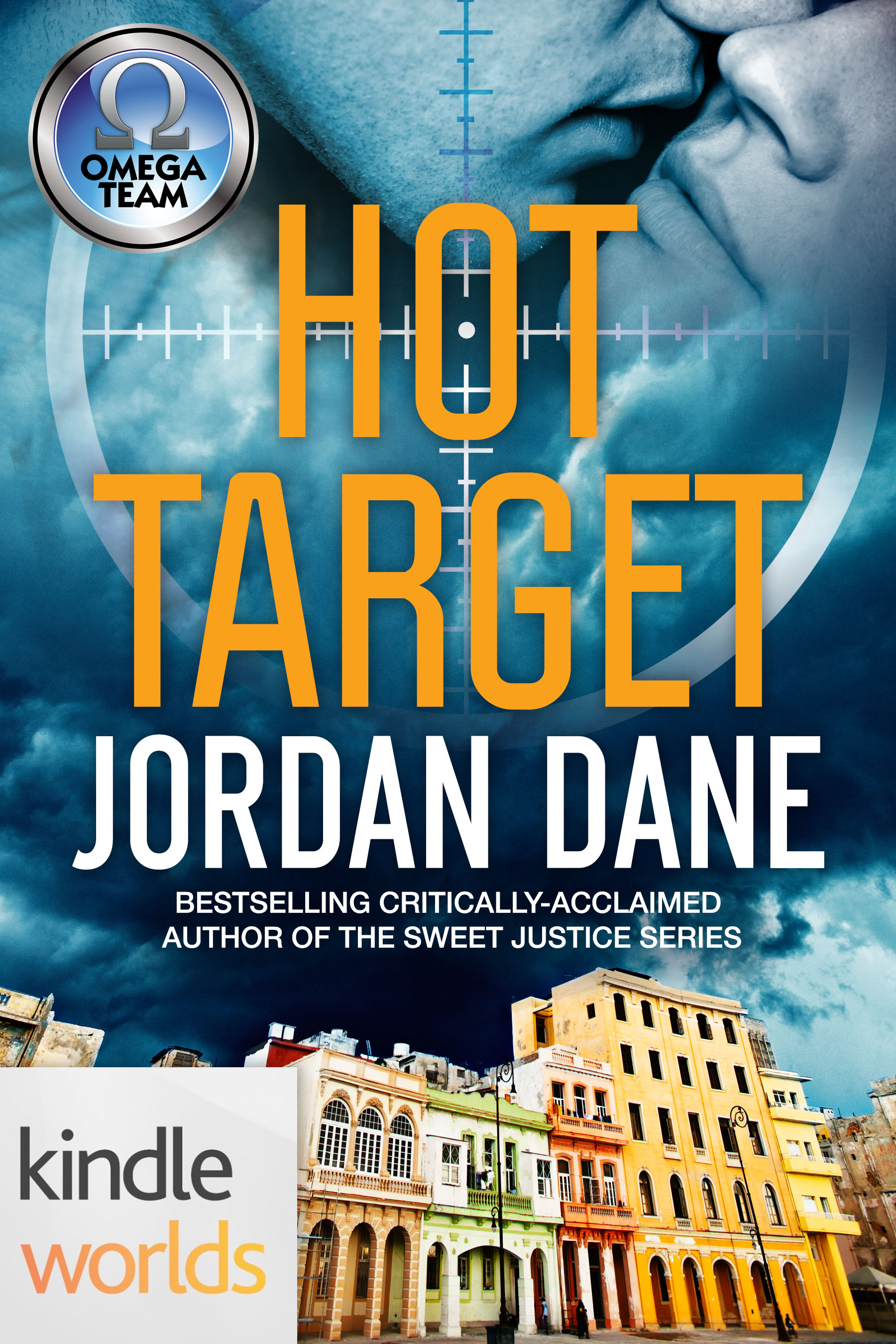
HOT TARGET – $1.99 ebook (Coming Feb 18)

Rafael Madero stands in the crosshairs of a vicious drug cartel—powerless to stop his fate—and his secret could put Athena and the Omega Team in the middle of a drug war. 

The Omega Team series will launch Feb 18 with Amazon Kindle Worlds. Come join the facebook launch party at this LINK on Feb 18 for giveaways and chats with the authors in this romantic action adventure series.

It Was Just A Dream

I’d like to welcome back to TKZ my friend and fellow ITW member, Meg Gardiner. If you’ve ever considered using a dream or dream sequence in your manuscript, Meg points out the perils of doing so. Read on and take note. – Joe Moore

———————–

unnamedWhen I teach writing workshops, I always warn students about what not to do. In particular, I strongly urge them not to open their stories in these ways:

  • With the protagonist staring out the window, thinking about his past.
  • With the detective squinting into the sunrise, hung over.
  • With the protagonist waking up.
  • With a dream sequence.

Why? Because these are clichés — they’ve been done ten thousand times. They’re tired. And because, if your story opens in one of these ways, nothing is happening.

In the case of dream sequences, there’s an additional reason. When readers reach the end of the scene and read, “And then she woke up,” they feel cheated.

As readers, we immerse ourselves in a story by suspending disbelief. That is, while we read, we willingly suspend our knowledge that a story is fiction and accept it as true.  (Thank Samuel Taylor Coleridge for the concept.) But readers generally give an author only one shot at this. If a story opens with an amazingly dramatic, action-packed, emotionally resonant scene that turns out to be a dream, readers are likely to feel that the author has pulled a bait and switch.

Oh. The hero didn’t REALLY save his wife from a mob shootout. He just fell asleep on the sofa.

Huh. The heroine didn’t REALLY leap into the ocean from the deck of a burning ship. She just ate too much pizza and had a nightmare.

Readers invest themselves in the story. When it turns out that the drama is all in a character’s sleeping mind, they’re likely to bail.

Inevitably, when I urge students to avoid dream sequences, one or two will tell me that’s how their novel opens. When I ask why, they say they want the story to open with a punch — but that nothing dramatic happens until chapter five, so the dream is the only way to get some action on the page. Or they tell me they want to show the characters’ fears, longings, or memories, and “there’s no other way.”

There’s always another way. And ninety-nine times out of a hundred, it will be better than opening with a character’s unconscious fantasies. If you want readers to come along for the entire ride, you need your characters to be awake and in action in the physical world from the word go.

How do you deal with dreams in your manuscript? Or do you avoid them altogether?

Meg Gardiner is the bestselling author of twelve thrillers. Her novels include the Edgar Award-winning CHINA LAKE and PHANTOM INSTINCT, which was chosen one of O, the Oprah magazine’s “Best Books of Summer.” She lives in Austin, Texas.

Dumb Mistakes That
Will Doom Your Book

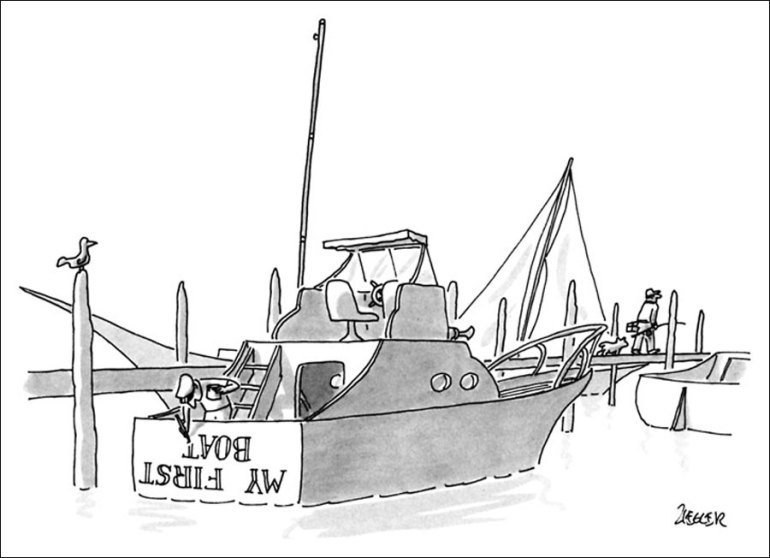
my-first-boat1

Don’t get whistled out of the game on fouls before you have a chance to show off your best moves. – Miss Snark

By PJ Parrish

So I’m watching Hassan Whiteside play in the Heat game the other night and it got me thinking about writing books. Or maybe it was Marco Rubio in his last debate. I dunno. Not sure who inspired me more. But what I want to talk about today is dumb moves.

Shooting yourself in the foot. Stepping in it. Dropping the ball. Screwing the pooch. Whatever you want to call it, this is not something you want to do in your career. Ask Whiteside. He threw an elbow into the face of his Spurs opponent and got ejected (his third this season). Or ask Rubio. He became Chris Christie’s chew toy after he robo-repeated a talking point three times in thirty seconds. (and paid for it by dropping to fifth in the New Hampshire primary.)

Hey, we’re all human. We all make mistakes. Believe me, I have. Some that adversely affected my writing career. So let’s take a look today at some of the wrong moves that can, as the great agent Miss Snark said, get you knocked out of the game before you’ve even had a chance. Your contributions to our guide to dumbness are welcome!

When writing the book…

extinct

Don’t chase the trend: We can go way back to Jaws for examples here. In the wake of Benchley’s novel, we quickly got such memorable chum as Megalodon (oil rig explosion unleashes giant shark), Carcharodan (prehistoric shark freed when iceberg melts), Extinct (killer shark preys on boys in Mississippi River) and Meg (really big pregnant shark bubbles up from Marianas Trench and eats dumb tourists.) After Anne Rice, Charlaine Harris and Stephanie Meyers dug up Bram Stoker, we got a full decade of un-deads. And après Dan Brown came le deluge of conspiracies (Templars! Cathars! Christian Inquisitors! Oh my!) Here’s my point: By the time you decide you want to follow a trend in publishing, it has begun to wane (and surely will be over in the 18 months it will take you to write it and get it to market). T.S. Eliot might have said, “Mediocre writers borrow, great writers steal.” But if you’re trying to break into the bestseller bank, chances are the money’s already gone. So think twice before you use that unreliable narrator or try to wedge “girl” in your title.  You are a snowflake. You are unique. Let your book reflect that.

Don’t be content with dull titles: Your title is your book’s billboard, meant to be glimpsed and grasped as a reader speeds by in the bookstore or on Amazon. It is ADVERTISING and it must convey in just a few words the essence, heart, and all the wonderful promise of your story. Work hard on this. Yes, slap anything on the file name as you work, but always, as you work through the writing, search for that pithy phrase that capsulizes what you are trying to say. Try Shakespeare (The Fault Is in Our Stars, Infinite Jest) or poetry (No Country For All Men — Yeats).  Go for weird juxtapositions (Zen and the Art of Motorcycle Maintenance) or intrigue (Midnight in the Garden of Good and Evil  or Then There Were None) or humor (Hello, Vodka, It’s Me, Chelsea!). Twist an old phrase (Dr. Suess’s You’re Only Old Once.). So many times, I read manuscripts (or published books) where the title feels like an after-thought, almost as if the writer used up all his juice just getting 300 pages down, breathed out whew! and then went back to page 1 and typed The Templar Conspiracy Book I. Click here for some good tips on titles.  Click here if you want to read the worst titles of maybe all time — and see some butt-ugly covers. Which leads me to…

Don’t use ugly covers: Now, if you’re traditionally published you have little control over this. (although some enlightened publishers are getting better about seeking author input.) But if you are self-pubbing, don’t let your nephew who flunked out of Pittsburgh AI design your cover. Don’t go find free lousy images and try to do this yourself. Nothing screams amateur louder than an ugly cover.  It tells potential readers that you think so poorly of your story that you’re willing to send it out in the world in dirty sweatpants and a Led Zeppelin World Tour 1971 T-shirt. Pay someone to do this. It’s worth every schekel. If you cheap out, don’t be surprised to see your ugly cover end up HERE.

After the Book is Done…

Don’t forget to copy edit it:  This is tedious. This is awful. This is grunt work that comes after even the hell of rewrites. Well, tough. After you finish your filet mignon, you have to floss. You might be really tired of looking at the thing and all you want to do is get it out there in the world, wait for someone to love it, and throw shekels your way.  Resist the urge to do this. Instead, PRINT IT OUT and read it for typos, misspellings, stupid mistakes, grammar lapses, brain farts. After you’re done, go back and do it again — maybe with a ruler held under each line so you go reeeeeal slow. I know authors who copy edit their stuff backwards so the mistakes jump out better.  You won’t get all the bad stuff. But the goal is to make it as clean and professional as you humanly can.  If you don’t know the difference between lay and lie, find someone who does. Agents and editors all say if they see dumb errors in manuscripts, they won’t read on. No one will take your words seriously until you do.

Write a great query letter:  This isn’t easy but it’s really important.  Agents want to fall in love with new talent and every affair begins with a magic moment.  A great query is simple, direct but has a terrific hook. Which is not the same as a plot summary. In Hollywood-speak, it is a “log line” that capsulizes the essence of your plot with a strong emotional pull. (ie from Aliens: “In space, no one can hear you scream.”)  This is hard writing. Even if you self-publish, learning how to write a great tease for your book will serve you well when you go to write that Amazon copy. Click here to see a simple and very serviceable query template.

Have some cajones: There is nothing worse than a falsely humble author. If you are doing a book signing, would you tell someone who walks up to your table, “Oh, I know you’re busy…you don’t really want to know about my book.” So, in your query letter, don’t spend precious words apologizing for “wasting” an agent’s time by sending them your letter. If you don’t have faith in your book, how do you expect anyone else to?  Even if you aren’t a pro yet, act like one.  Be like that wide receiver who doesn’t spike the football in the end zone — act like you belong there. (I got this one from a great blog by agent Jenny Bent.  Click here to read the rest of her advice on submitting.)


Follow the rules when submitting your novel:  Reputable agents are good people; they truly want to find the next best thing because they love good books. So be a pro and follow their rules. Research what types of novels they are looking for. Find out their names and how to spell them. (DEAR AGENT is sorta off-putting, you know?) Format your manuscript in the way they want it — ie, double-spaced, courier or roman, etc.) And finally: Don’t forget to number your pages. Don’t use colored paper or add weird stuff like glitter. And for God’s sake, don’t call your book “a fiction novel.”  You laugh? I saw the actual query letter that had that gem.

I don’t think that guy ever made it off the bench.


Print, Audio and Ebook Experience

I thought this blog post would never eventuate after our aborted President’s Day weekend in Telluride that coincided with a huge boulder falling on a transmission line resulting in zero power to the whole town. We actually ended up driving back to Denver early after a night of picnicking in the semi darkness of our (rather chilly) hotel room. My husband and I called it our family Valentine’s Day adventure but after 12 hours of driving in 2 days it was more of an exhausting Valentine’s Day than anything…although, at least now I have no excuses and the blog post could be completed:)

On the way to Telluride and back we listened to two audio books in the car – one (which shall remain nameless) highlighted the very worst aspects of the audio book experience (wooden narration revealing a badly written novel in all its horror…) and we gave that one up after three discs; the second (thankfully) displayed all the wonderful elements associated with listening to a great book on CD. This (and I’m more than happy to identify it as The Graveyard Book by Neil Gaiman) was narrated by the wonderful Derek Jacobi (and a cast of other great British actors) and so was perhaps an unfair comparison – but, at least for part of our trip, the audio book experience was pleasantly memorable.

Both my twin boys love listening to books narrated well and still enjoy having me read aloud to them each night (which I still managed to do in our Telluride hotel room by flashlight!). What is interesting to me is that, although they love a great audio book, they are still ambivalent to ebooks – far preferring to read the print version. I often end up buying or getting from the library the print version of ebooks I own for them, as both boys want to read the hard copy rather than the electronic version. Since they both love spending on their computers and iPads, I have to wonder why neither of them have embraced ebooks. Is it because, like a bad audio book experience, it feels awkward and unenjoyable? Or is there something magical about turning the pages of a printed book that cannot be captured in an ebook (something that, as children, they feel strongly about perhaps?).

With recent reports of Amazon potentially opening physical bookstores, I also wonder whether we are finding an increasing resistance to ebooks (?). Now, I’m equally comfortable reading on my Kindle as I am reading the print version of a book – and yet my boys, who have grown up in the age of the iPad and Kindle, are not. They turn their noses up at any offer I may have to purchase the ebook version of a book they want. They’d much rather hold a book in their hands.

What about you? As a reader, do you have a preference for print, audio or ebooks? As a writer are you more wary of ebook only publication sites or publishers? Have you had a great book ruined by the audio version? What do you think – are we perhaps seeing generational differences that might result in a resurgence of print (if my boys are any indication)?

A Trick That Will Tame Your Crazy Writing Stress

by James Scott Bell
@jamesscottbell

Some time ago the astute Kristine Kathryn Rusch posted about what she calls The Popcorn Kitten Problem. It’s based on the video below. Take a look at a bit of it:

Now that is what an indie writer’s mind can often feel like. So much freedom! So many things to write! And yet so many marketing hats to put on, and a ton of petty tasks that seem to repeat, over and over again.

Lest ye think this is just an indie conundrum, it’s also increasingly a picture of a tradpub author’s brain, because so much of the marketing onus now falls upon the writer. Publishers are insisting upon “platform” before they offer contracts. When a book is released the harried in-house publicity person (if there is one) has little time for any single author. So you better be out there doing a hundred different things…every day!

If you don’t watch out the resulting stress might grab your good endorphins like an amped-up Conor McGregor and slam them to mat.

conor-mcgregor

Enough of that and you could end up tired or with a chronic case of the blues.

Here’s how a typical popcorn kitten scenario might play out:

You’re writing your WIP, an essential scene where your protagonist has to apply for a new job. In your pre-planning you decided that job would be as a hairdresser. Or, since you are a notorious pantser, you came up with that on the spot.

You don’t know all that much about the hairdressing business. If you are a wise writer, you put a mark in your manuscript that will tell you to do the research later. Then you’ll write as much of the scene as you can, based on what you know about human nature and job interviews—and if you don’t know about either of these, you should quit writing and join the Navy. Then get out and write a novel about the Navy.

Instead, you decide to leave your WIP and jump on the internet for some “quick” research. As you look at search results, you see a book called What Every Writer Needs To Know About Writing Hairdresser Interview Scenes, and you click over to Amazon to check it out. Seems reasonable at $2.99, but just to make sure you don’t spend your discretionary Starbucks money like a fool, you download the free sample.

But while you are on Amazon you see a recommendation for a mystery series about hairdressers. You know the author. She’s someone you met at Bouchercon. You hop over to the book page and see 125 five-star reviews and a rank of 1,286 in the paid Kindle store. At a price of $4.99. What? Your self-published stand-alone mystery is only $2.99 and it’s ranked 423,679.

You wonder what this other author has that you don’t. So you look at her Amazon author page and check out her covers. Wow. Great! Your cover was done by your cousin Axel, a budding commercial artist who lives with his poet girlfriend, Moonglow. Well, you admit, you got what you paid for.

You do a little more research and find out who did this author’s covers. You check out the artist’s portfolio online and what he charges. Whoa! That’s a healthy chunk!

So you do a little research on how to judge the worth of a book cover. There are many blog posts on this, and you read a few of them. Something else catches your eye on the last one. It’s about the importance of book description copy in selling a book. You recall that when you did yours you had a nagging suspicion it was rather plain vanilla, but you were anxious to get the book out because everyone in your critique group was making money self-publishing and you didn’t want to be the chump standing on the dock as the ship took off for the Bahamas with all your friends.

You go back to Amazon and find a book called Book Description Copy for Former Chumps Like Yourself, and you download that sample. You read that sample, and from the Table of Contents figure out some of what your own description was missing, so you open up a new doc and start writing afresh.

Ten minutes into that a thought pops into your head. You don’t want to have your protagonist apply for a hairdresser job. No! She should be an insurance investigator!

So you hop back on Google looking for “How to become an insurance investigator.” Lo and behold, there’s a book called Insurance Investigation for Former Chumps Like Yourself. The author has a website. You go to the website and see he has a blog. Gold!

Which reminds you, you were going to try to do some guest posts for various blogs when your book came out. That’s publicity! Where was that list again? You search for it … you need to send out some emails!

You look at the clock. Uh-oh, it’s almost time to pick up Lydia from school, and what have you done on your WIP? Fifty-seven words! The last word you typed was hairdresser

I’m sure you can relate. Just as a Molinist theologian can contemplate an infinite number of contingent realities, so you, the writer, have an infinite number of ways you can get distracted, going off in different directions based upon a single pop of a cerebral synapse, one little soft-pawed frolic of a popcorn kitten.

So what’s the cure?

Here is a simple trick that can change your life. All it requires is some paper and a little mental discipline.

I call it Nab, Stab and Tab.

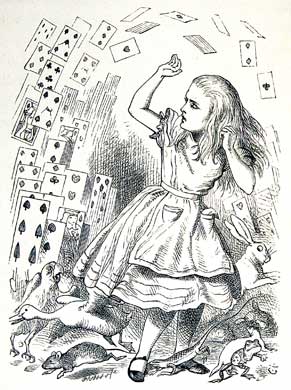
First step is to nab that thought. Recognize it for what it is—a siren’s song to leave whatTenniel-Cards you’re focused on and slide into Alice’s rabbit hole. You might even say it out loud. “My crazy mind wants me to go on Google right now!”

Next step, stab. You want to nail the thought to your desk so it doesn’t hop around in your head. You do this by writing it down. That’s all. I have scratch paper nearby for just this purpose. So in the scenario above, if I suddenly remembered I want to explore guest blogging, I’d write guest blogging on the paper.

Then I immediately forget about it and get back on task! This is the key moment, the forgetting. Get back to work on your WIP!

Finally, when I come up for air and have some time, I’ll give each thought a tab—I assign it a level of importance, using the A, B, C method (which I detail in my monograph, How to Manage the Time of Your Life).

A is for highly important, must-do.

B is for what I’d like to do.

C is for items that can wait.

If there is more than one A item, I prioritize these with A1, A2. Same with any Bs and Cs.

Next, I estimate how much time each task will take. I use quarter hour increments. So a task might take me .25 hour or .5 or a full 1 or 2. Whatever.

Finally, I put the A tasks into my weekly schedule in priority order. If there’s enough time, I’ll put in the Bs. The Cs I usually put off.

This may sound complicated, but it takes only a few seconds to nab and stab. And only a few minutes to tab and schedule.

Yet the benefits are profound. Less stress, more focus on you primary work.

The kittens will start to purr, and then they’ll go to sleep.

And you’ll sleep better, too.

So can you relate to kittens bouncing around in your mind? How do you usually handle it?