Don’t Ever Mail It In

by James Scott Bell
@jamesscottbell

Jessica Strawser, editorial director of Writer’s Digest magazine, and soon-to-be debut novelist, tweeted this from the recent WD conference in New York.

I agree. The dread mistake is called “mailing it in.” It’s when you think you’ve reached a certain point in your writing where you don’t have to improve. You’ve had some success, so why sweat and strain?

That’s not how a real writer thinks. How do I define a real writer? It’s someone who honors the craft and never settles. The real writer always sets the bar a bit higher than the last jump.

Mailing it in sometimes afflicts even the A list. A series that catches on in a big way can afford the author the opportunity to spend more time on a yacht than behind a keyboard. I’ve seen that happen a couple of times, and it’s not pretty.

On the other hand, you have a writer like Dennis Lehane. There he was with a popular PI series that he could have sat on. But then he proceeds to write one of the great stand-alone crime novels of our time, Mystic River. Not content with that, a few years later he writes an epic historical called The Given Day. I’m not sure he meant this to be a series, but I suspect the popularity of the novel gave rise to the idea. Now that series character, Joe Coughlin, is going to get the Ben Affleck treatment in a major motion picture.

I like what the Amazon “best books of the month” reviewer said about the second Coughlin book, Lived by Night: “Incredibly, Lehane … becomes more masterful with each book…”

That’s the kind of accolade for which a real writer strives. Because, you see, there is a joy and a satisfaction in the striving itself. The mail-it-inners don’t have that anymore. It’s a loss to the soul.
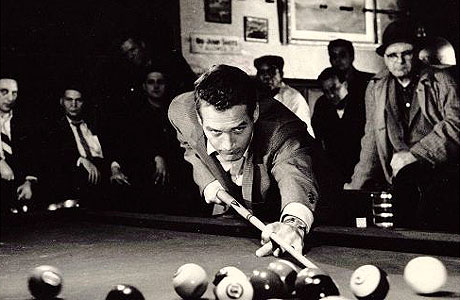
paulnewman460I’ve referred several times to that speech Paul Newman makes in The Hustler, one of my top ten favorite movies. He is “Fast Eddie” Felson, low-level pool hustler whose been told he’s a “born loser” by the satanic gambler played by George C. Scott. One day he describes to his girl, Sarah, what the game of pool feels like when “he’s really going.” It’s…

…like a jockey must feel. He’s sittin’ on his horse, he’s got all that speed and that power underneath him… he’s comin’ into the stretch, the pressure’s on ‘im, and he knows… just feels … when to let it go and how much. Cause he’s got everything workin’ for ‘im, timing, touch… it’s a great feeling, boy, it’s a real great feeling when you’re right and you know you’re right. It’s like all of a sudden I got oil in my arm. The pool cue’s part of me. You know, it’s a pool cue, it’s got nerves in it. It’s a piece of wood, it’s got nerves in it. You feel the roll of those balls, you don’t have to look, you just know. You make shots nobody’s ever made before. I can play that game the way nobody’s ever played it before.

Sarah looks at him and says, “You’re not a loser, Eddie. You’re a winner.”

Eddie looks at her quizzically. And she says, “Some men never get to feel that way about anything.”

Get it? Don’t ever settle for mailing it in.

Now how do you get to that “Fast Eddie feeling”? These things work for me:

  1. Read widely, not just in your preferred genre. I love reading great writing, fiction or non-fiction. Right now I’m reading three books at the same time (do you do this?) I’m reading L.A. Noir by John Buntin (about Chief of Police William Parker and mobster Mickey Cohen, and the battle for Los Angeles); a collection of short stories by John O’Hara; and a two-volume biography of Andrew Jackson published in 1938 (elegant prose here of the kind we rarely see anymore).
  1. Be intentional about studying the craft. What I mean is look for books and articles and blog posts on specific subjects that are chosen to address your own writing needs. I break down the craft into what I call “seven critical success factors” –– plot, structure, characters, scenes, dialogue, voice, and meaning (or theme). I advise you try to locate your weakest area and design a self-study program that lasts a minimum of six weeks. Read books and articles on the subject, and do practice writing. Get feedback on your exercises. What if you took the next year and set out to raise your game in each area? What if you designed seven 6-week courses for yourself? (If you would like a ready-made course of study, I do have one available). Your growth will be tremendous. You’ll feel it. Just like Fast Eddie.
  1. Be a risk taker. Go to new places in your writing. You don’t have to jump genres if you’re trying to build a brand. But do something more, different, deeper in your next book.

Early in his career Dean Koontz was rolling along writing bestselling paperback thrillers under several pen names. But he wasn’t satisfied. So he set out to deepen his characterizations. He studied up on psychology and used what he learned to write Whispers. Would his wide audience for fast-paced thrills like it? It was a risk … and it became Koontz’s first New York Times bestseller.

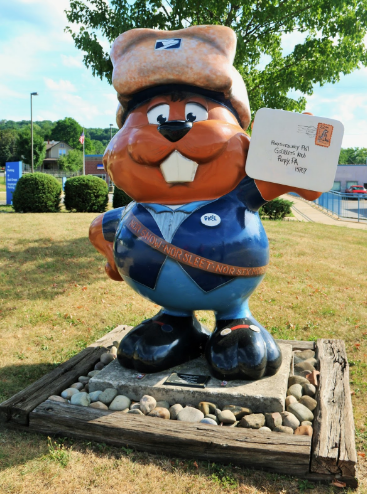
So keep the edge. Make the writing itself (not just the results) the object of your affection. That way you’ll leave behind no regrets when your personal mail is delivered by the groundhog.screen-shot-2016-09-16-at-1-08-22-pm
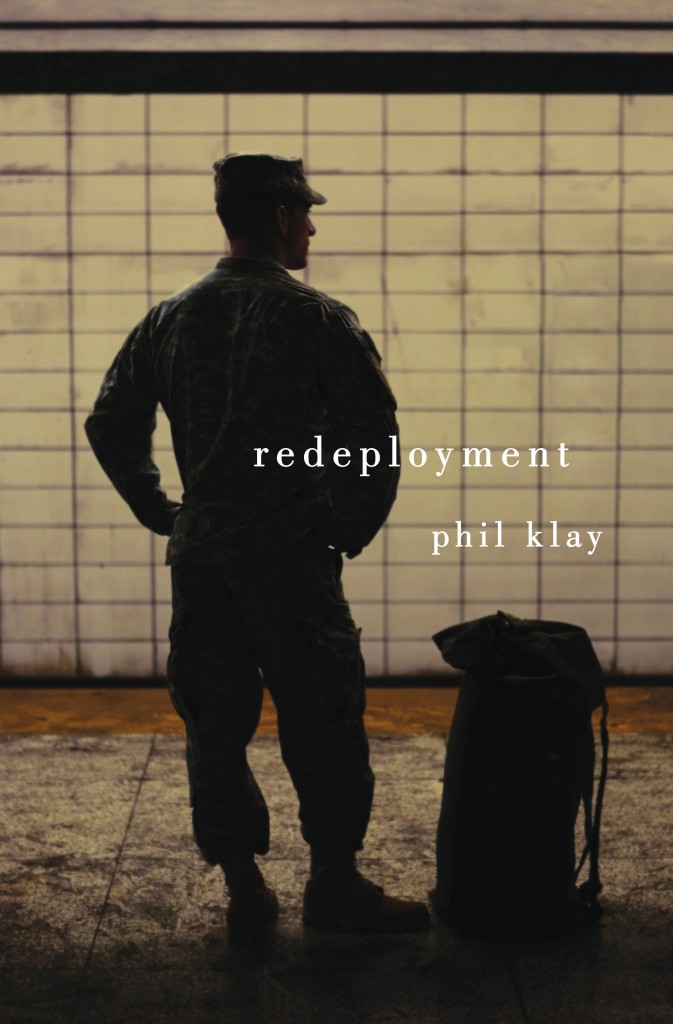
Memorable Military Research Book – Redeployment by Phil Klay

Jordan Dane

@JordanDane

redeployment-673x1024

I heard Phil Klay on MSNBC talking about his fiction book entitled – Redeployment – and I was intrigued. The first thing that grabbed me was the fact that the book is fiction, a group of short stories. Klay is former military (see more about him below) and from what I’ve seen, many war books written by young men of his experience/background, they tend to write non-fiction, so he had me hooked. I also noticed his book was a 2014 National Book Award Winner. Very impressive.

I wanted to read Klay’s book for research. I’m currently writing a few Amazon Kindle World series books involving the military. Reading pure romance books on the subject of military lifestyle wasn’t satisfying my need for authenticity, especially when I’m in the head of my male characters.

I’ve been watching online videos on snipers and reading books written by Navy SEALS. Klay’s anthology is my latest attempt to get a feel for an authentic voice for the character I will be writing shortly. Since my market is generally women readers, I have to temper any research with how I would write a story for women, but I do love discovering male voices that connect with my own life experiences, similar to the guys I worked with in the oil fields. (Yeah, I have stories.)

I feel I must warn readers interested in this amazing book. It’s taken me awhile to read through it. The first person voices in these stories are intimate, poignant, and gripping. They are presented without judgment. It’s a stark reality without any solutions or answers, but I found an honesty to it. These stories have gotten me down and I find I have to pace myself in reading them. I read at night and there are some days I can’t pick up this book, but I love the rich distinctive style of the voices in this anthology. I highly recommend this book. No question. This book would make an interesting read for anyone looking for a good character study.

5 TIPS ON RESEARCH:

1.) GET IT RIGHT – Research is important for authenticity, to insure your book doesn’t get thrown against a wall. There are women readers serving in the military, so I would have to “get it right” for them, yet still appeal to a woman’s desire for romance.

2.) NEVER OVERDO – Too much jargon or acronyms can bore a reader. In my crime fiction books, I will use police procedural language in dialogue, but find a quick way to explain what things mean after I first mention it. It can be tricky, but reviewers have liked the subtle way I do this, without overkill that can slow the pace. It’s all about balance.

Example:

“You have TOD, doc?”

Chambers knew the medical examiner would be challenged to estimate time of death, given the conditions of the body.

3.) CAPTURE THE ESSENCE – Read research related books or watch videos to get a general feel for an attitude, lifestyle, or the types of characters and their backstories you want to portray, but NEVER copy another author’s work. To prevent the temptation, when I read books like Klay’s, I jot down notes of ideas for my own book, then set the research book down for days/weeks before I start on my story and I never read books like this WHILE I am writing. In fact, I don’t read books in the genre I’m writing while I am in the midst of a project. Your mind can put words onto the page subconsciously. Your story MUST be your own, to retain your own voice.

4.) NEED VISUALS – For action scenes or locations, search online for your own visuals. Practice describing what you see, to get your own interpretation as seen through the eyes of your character. If you have video, use your ears too. What sounds do you hear on location? What other senses can you pry from your own experiences? Using all the senses can be a rush, especially if they spring from your own life.

5.) FILL IN THE GAPS – Once you get your character’s voice in your head, add other things that fill in around him. How does he or she dress? How do they live? Who are his/her friends? Who does he/she trust? What baggage does he or she carry? What’s the last thing he or she would do, then make them do it in your story – to face their demons. This gets into character – another topic – but my natural next step after I get a distinctive voice in my head, is to fill in a visual of my character’s life. Then I’m ready to write.

DISCUSSION

1.) What research books have stayed with you long after you’re written the book?

2,) Do you have any recommended reading for me on authentic military action, jargon, and dialogue?

ABOUT THE BOOK

Phil Klay’s Redeployment takes readers to the front lines of the wars in Iraq and Afghanistan, asking us to understand what happened there and what happened to the soldiers who returned. Interwoven with themes of brutality and faith, guilt and fear, helplessness and survival, the characters in these stories struggle to make meaning out of chaos.

ABOUT THE AUTHOR

Phil Klay - Author

Phil Klay – Author

Phil Klay – Author Phil Klay is a veteran of the U.S. Marine Corps and served in Iraq’s Anbar Province from January 2007 to February 2008 as a Public Affairs Officer. His writing has appeared in Granta, The New York Times,Newsweek, The Daily Beast, New York Daily News, Tin House, and The Best American Nonrequired Reading 2012. Klay is a 2014 National Book Foundation’s 5 Under 35 Honoree.

“In Klay’s hands, Iraq comes across not merely as a theater of war but as a laboratory of the human condition in extremis. Redeployment is hilarious, biting, whipsawing and sad. It’s the best thing written so far on what the war did to people’s souls.”
–Dexter Filkins, The New York Times Book Review

Is It Time to Quit the Day Job?

By John Gilstrap

Well, well. It’s been awhile since I wandered into the Killzone. I love what you’ve done with the place. I figure it’s been about six years since I took my hiatus from these halls. I see lots of familiar faces, and a happy number of new ones as well. Now, if you’ll excuse me for just a second, let me go to the fireplace and turn my coffee cup around so it’s facing front again.

When I departed the Killzone after its first three years, I did it in part because the pressures of my day job—which required an insane amount of overnight travel—combined with my annual book contracts left me with too little time to do justice to everything. Something had to go, so the voluntary commitment bit the dust.

Effective January of last year, I departed that day job after 10½ years, and while I’m still busy as hell, there’s room again in the schedule for blogging. When I reached out to my buddy Jim Bell to see if there might be room for a returning emeritus, I learned that Joe Moore was planning his departure, and here we are.

I thought it appropriate for my first foray back into blogdom to talk about making the decision to quit the day job. Most artists have dreamed of turning their back on the workaday world and throwing their entire being into writing or singing or painting or . . . well, you get it. How do you know when it’s time (or if it’s okay) to pull the trigger on a job—or, in my case, on a 35-year career? (I am/was a safety engineer by training and degree, with a special emphasis on explosives, hazardous materials, firefighting and various metals processing operations.)

As a rule, I discourage people from making the jump to full-time writing unless they have a financial backstop—a working spouse, perhaps, with a dependable income stream and employer-paid insurance. I for sure discourage people who have never published a book, or who perhaps have published only one or two okay-performers from making the leap.

Full disclosure: I’m a planner and a risk avoider. I don’t roll the dice on important stuff.

In my world view, you always take care of family first. The baby’s got to have food and diapers, the teenagers have to have as good a shot at a great launch as you can give them. My own experience shows that writing success can be achieved just as well as a part-time endeavor as it can be from a full-time commitment. For me, it played out like this:

Books 1 & 2: Written part time, while working 60 to 80 hours a week.
Books 3, 4 & 5: Written full-time, but supplemented by income from screenplays and insurance paid for by the Writers Guild of America.
Books 6 thru 14: Written part time while working a day job that required nearly 200 nights of travel per year.
Books 15 & 16: Written full-time.

If you’ve got a passion for writing, you’ll find a way to make it work, one way or another. In the vast pantheon of people who tell stories on the page, relatively few of them do so full time. And of those who do, my experience shows that they have a working spouse, or have retired and have an additional source of income. In my own case, I spent 20 years investing and saving for this moment, to the point that if the book market crashes, we’ll still make ends meet.

So, how do you know if you’re ready for the switch to full-time writing? Well, obviously mileage will vary, but here are a few questions to ask yourself.

Can you afford it?

Only you know what your lifestyle needs are, and how much cash flow you require to support it. Only you know how much risk you’re willing to take, and what sacrifices you’re willing to make. Still, here are some realities to consider (We’ll assume that you’re married without dependent children, you’re a 50-year-old sole bread-winner making $100,000 per year from writing alone, and that you live in Fairfax, Virginia):

1. 15% comes off the top for agent commission, leaving you with $85K in taxable income.
2. The $85K puts you in the 25% tax bracket, so $21,250 goes to Uncle Sam.
3. Of the remaining $63,750, you’ll owe another $4,400 to Virginia.
4. That brings us to $59,350.
5. Now remember that since you’re self-employed, you need to cover both the employer and employee share of FICA, so that’s another 15% of taxable income, or $12,750, leaving you with $46,600 to pay bills.
6. Don’t forget health insurance, which is far too moving a target to guess at a number, but plan on about $1,000 per month, provided you stay healthy.
7. Of your $100,000, then, you’ve only got about $34,600 left in truly discretionary income.

The killers here are the 7.5% employer’s share of FICA and the health insurance. For my wife and I, who are both healthy yet take some medications, our insured healthcare costs will approach $30,000 per year until we reach the age of 65.

If you’re on the edge of making the move to full-time artist, invest in both a good lawyer and a good accountant to discuss the advantages and disadvantages of incorporation, and on the structure of the corporation you form.

Can you handle the loneliness?

The first time I left a day job to write full-time, loneliness proved to be my Achilles heel. It’s not that I’m not content keeping my own company, but rather that as a Type A extrovert, I missed the water cooler action. Spending the day playing with your imaginary friends can get to be pretty isolating if you let it.

Are you ready to turn your passion into a real job?

It’s a big deal to entrust your financial future to an industry as capricious as the entertainment business, where your reputation and paycheck are literally tied to your latest effort. Readers’ tastes change, publishers go out of business, editors and agents retire. Any one of those events—or any one of a bajillion others, for that matter—can turn current success on its ear. And you’ll have to adapt. It’s no different than any other business, but in my experience, creative people start a writing business with far less preparation and due diligence than the average entrepreneur. Don’t make that mistake.

Whether you’re traditionally published or you choose the far more challenging self-publishing route, this job is as much about marketing and business management as it is about creativity. While your expenses are tax deductible, they are not free. Those expense reports you used to turn in to the accounting office for reimbursement are now paid out of your own funds. That short story that you used to squeeze out free of charge for a charity anthology now represents real opportunity costs that are measured in real dollars.

Will you be happy with your decision five years from now?

Back when Joy and I were first married, my mother counseled that if we waited to have children or buy a house until we thought we could afford them, we’d never have children and we’d be renting forever. Sometimes, making the decision casts the future. Failure is not an option.

There’s no such thing as security in any job market these days. We all know people who have been laid off without ceremony after having dedicated decades of their lives to the company they loved. Business is business, after all, and there’s rarely room for mercy from the corner offices.

It could be argued that shifting from what I used to call a Big Boy Job to a creative job is no more or less risky than leaving Google to go to work for Apple. They’re all big steps.

They’re all big decisions.


It’s Fourth and Goal: Can You
Push Your Story In For the Win?

Don’t give up at half time. Concentrate on winning the second half. — Bear Bryant

chihuahua

By PJ Parrish

Are you ready for some football?

Wait, wait! Come back! Give me second chance. I promise this will be about writing. But it is the first week of the season and I really love football. This is how much:

I have a collector’s Plexiglas box of Wheaties with Dan Marino on the front.

I used to have Dolphin season tickets and on December 16, 2007, when Cleo Lemon threw a 64-yard touchdown pass to Greg Camarillo to end a 16-game losing streak, I cried like Wayne Huizinga.

I was for years the proud coach of the Killer Chihuahuas, (see logo above) my fantasy football team that made the playoffs four straight years and would have won in year four if Brett Favre hadn’t gone south on me in the last three games.

Okay, okay…I promised to talk about writing. If you hang here at TKZ, you know I love a good metaphor, so I am going to offer up some football strategy that might help you get your Work In Progress down the field, into the red zone and over the goal line. I feel compelled to do this because I myself need a good locker room talk right now. I am up in Michigan staying at my sister Kelly’s place, working on our book. We are on page 244 and we are struggling badly. It feels like we’re deep into the fourth quarter, we’ve been trudging up and down the field in the mud forever, we’re tired and sore, and haven’t scored a point.
Team Parrish can’t SEE the end zone, let alone get into it.

This past Sunday, while we worked, we had the Lions-Colts game on mute in the background. Toward half-time, dispirited and disgusted, I closed the lap-top and told Kelly, “I need a break.”

I popped a Faygo Rock and Rye, turned up the sound and watched the game.
Then came half time. But I wasn’t hearing Kenny Albert and Moose Johnston. I was hearing our own James Scott Bell in his post a while back about how every writer should take a break around the halfway mark and assess how far they had come and where they needed to go.

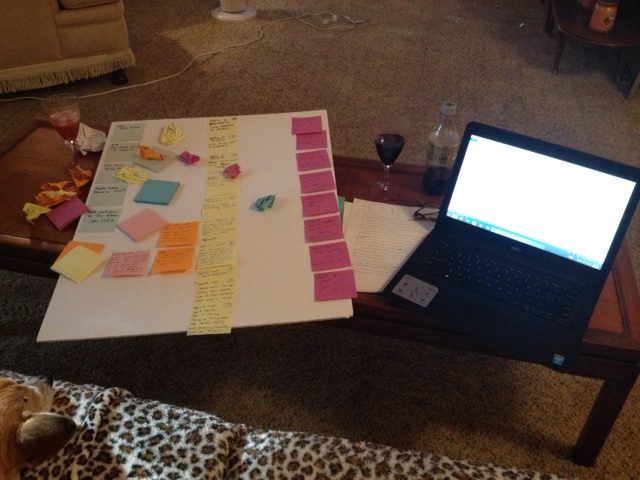
So I told Kelly that we needed to go back and see what had gone wrong (and right) in the first half and make adjustments. She went to Walgreens and came home with a poster board and some Post-Its. We spent the next two hours laboriously mapping out, chapter-by-chapter, day by day, where our story had gone. It looked like this:
IMG_0552You’ll see that we seemed to make a lot of mistakes and needed a bunch of different colored Post-Its. (More on that to come). And that toward 6 p.m., we were compelled to strengthen our beverage of choice from Faygo to wine.  But by laying out this PHYSICAL map of our book, we were able to see things that we couldn’t see on the computer screen or even on the printed manuscript. Things like:

We had a good juicy set-up, we laid out the hero’s problem, and we sent him off on his quest.  But…

We had four chapters in a row of slow build-up and scene setting that could easily be winnowed down to two chapters. Foul: lazy writing.

We had one day (in book time) that ran three chapters and it defied the laws of physics for Louis to go where he did and accomplish what we needed him to do without him stopping for eat and sleep. Foul: stuffing 10 pounds of plot into a 1-pound calendar day.

We forgot to introduce a character early on who magically shows up later. Foul: brain-farting.

We had a subplot going on off camera that, in calendar-time, did not match up with the on-camera plot. We needed the sub-plot character to drive from Michigan’s upper peninsula to mid-state in time to do a nefarious deed. Problem was, it takes a minimum of 8.5 hours for this drive to happen and this guy would’ve needed wings to get down-state. Foul: Not doing homework via a simple Google Maps check.

Some of you TKZ regulars might recognize our Post-It Method of Plotting. I’ve written about it here before. But for some reason, Kelly and I neglected to do it for this WIP, and here we are, well into the third quarter, and we need to make Bill Belichick-worthy game adjustments if we are going to pull this one out of the dumpster.  Here is a close-up of the finished map:

IMG_0553

What’s with the colors? The chapter-by-chapter plot map is done in pale yellow.  The gold Post-It is sub-plot that is going on at the same day(s) of what yellow note it is next to. This is how we found out our bad guy couldn’t make that long drive in time. The pale pink note is the time-line of the central murder that happened in the near-past. The blue notes are back-story dates of everything that happened BEFORE the story begins. The purples are just inserts and correx that we will make later.  This book is third-person single point of view (Louis, who always gets pale yellow). In past books, we have used multiple POVs and switch to other colors for each POV so we can make sure at a glance that no one character, especially a secondary one, is getting too much on-camera time and stealing the spotlight from Louis.

So how does Team Parrish feel coming out of this half-time locker room break and strategy session? Full of cautious confidence. We started out this book full of hope and ambition. But as the game wore on, we just sort of flailed and fumbled around out on the field, hoping we could make progress by blind luck and maybe a last-minute field goal.  This is how the Jets play every single year. Or the Browns, whose fans show up at games carrying banners saying “We Still Have LeBron.”  You want to be Seattle. Or the Pats, who find a way to win even with Brady on the bench for four games.

What am I trying to say here? Well, it’s a variation on what all the good folks here at TKZ preach. Have a good work ethic. (you don’t want to be giving up in mid-season just because you’re a little gassed).  Have a good strategy going in. (a great idea or at least a fresh take on an old one). Devise a game plan and keep to it. (that means for some of you out there outlining). Stop at each quarter or at least half-time and see what has gone right and what had failed. Be flexible enough to make adjustments. Don’t quit, because as the great sports sage Yogi Berra said,  it ain’t over til it’s over.

And with that, I leave you with a few classic football cliches that are actually good advice for us writers:

You gotta work with what’s working. This is a variation on the more erudite “You go with what brought you to the dance.” If you’re a hard-boiled type at heart, maybe you shouldn’t try YA romantic zombie fiction just because it’s hot. Yes, stretch yourself, but don’t be crass. Readers smell insincerity a mile away.

It’s important to give the ball right back to the guy who lost it. Yes, you can make mistakes. In fact, they help you grow. If you’ve had a setback, be it a rejection letter, a bad review or just loss of confidence, don’t let it defeat you.  Favre is the leading career fumbler of all time. You think that when he put the rock on the ground, he thought about quitting? Heck no. The guy took risks. (Though the Killer Chihuahuas never forgave him for that last season…)

He heard footsteps. This is the wide receiver who feels a defender gaining on him so he takes his eye off the ball. For you, this means, don’t let distractions cripple you.  This can mean anything from the little — social media, chores, research — to major distractions — envy over other’s success, people who tell you that you’ll never get published.

He ran east and west instead of north and south. Or as Dan Dierdorf put it: “You gotta keep the axis of your body perpendicular to the goal line.”  For writers, this means always moving forward and maintaining momentum. This is my biggest problem because I become stalled in an insane quest for perfection when I should be grinding out that first draft.  I spent too much time running east and west instead of heading toward the goal line. Don’t be like me.  Be a downhill runner.

It’s a game of inches. Success in publishing almost always comes hard and gradually. You pound away at that keyboard, bang your head up against big forces that feel like they are bent on keeping you back. You spend months, years, on your WIP and only manage to move a few yards forward.  But this is how it’s done. Slow and steady. And you never, ever, come prepared to play only one game because you must…

Take it one game at a time. Finish that book, get it out there somehow and then start the next one. And as you do this you will…

Leave it all on the field. You gave it everything you had because, of course…

There’s no tomorrow.

Here’s to a good, healthy season. And hey, the Lions won. That is enough to give anyone hope.


Revisiting the Middle

Thanks to my fellow TKZ blog mate, Larry Brooks, who provided me with his ebook ‘Stuck in the Middle: Mid-Draft Saves for your Story‘, I thought we should revisit the saggy middle and look specifically at some great questions to ask before addressing the dreaded mid-draft slump.

Larry outlines some key issues that I think all authors should consider when they are mid-way through their draft novel. He poses these as a series of questions that highlight some of the critical issues that can plague a book and which can lead to a slump in the middle. I encourage TKZers to check out the ebook which goes into greater depth that my blog summary, but in the meantime, here are some of the key questions Larry raises (hopefully I’m not misquoting Larry here with my summary version!)

  1. First off, authors should take a step back and ask themselves whether the premise of the book itself is sufficiently strong to sustain a reader’s interest for an entire book – often times the premise is simply too weak dramatically, either because there isn’t enough of a dramatic arc to the book, or because the key characters don’t have enough to achieve/do for a reader to root for them.
  2. Second, an author should also check that their core story is sufficiently well defined. Is there a compelling dramatic question being asked and answered in the book? Often the middle sags simply because it doesn’t enhance or advance the overall dramatic arc of the story.
  3. Do you have sufficient plot points that keep the story moving along, providing sufficient tension to engage the reader throughout the book? Sometimes the middle drifts because the plot points to the story haven’t been spaced or placed appropriately.

As Larry points our the middle chapters of a book should continue to ‘elevate, escalate and surprise’. They should also provide a critical transition between plot points as the key characters move through the overall story arc.

Hopefully, I haven’t misquoted Larry’s key questions to much, but I encourage all writers to step back and consider these kind of issues when diagnosing what isn’t working in their own work. All too often we focus on the mechanics rather that the overarching questions of premise, core story and plot that need to be addressed to ‘fix’ the problem.

Saying Goodbye to a Legend

by James Scott Bell
@jamesscottbell

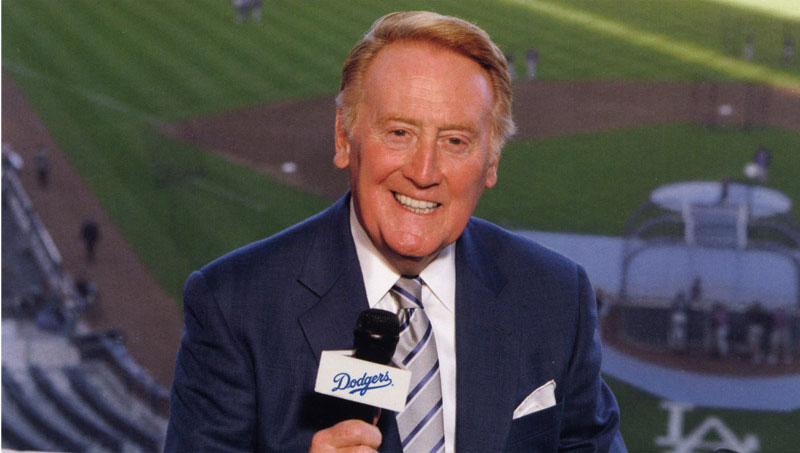
home-vin-scullyI’ve never known a breath of life without Vin Scully in it.

Growing up in Los Angeles, and being a die-hard Dodgers fan, I spent my youthful summers listening to Vinnie (we all called him that, he was our favorite uncle or best friend) call the games via my transistor radio. Many a night I’d fall asleep to that honey-toned voice and my mom would have to tiptoe in and turn the radio off.

And now he’s about to retire. After 67 years behind the mike for the Brooklyn and Los Angeles Dodgers.

It’s like summer itself will no longer be there.

Everyone acknowledges Vin Scully as one of the greatest (JSB would say the greatest) sports announcers of all time.

The question for us today (and for writers) is, Why? I’d say three things:

His precision.

His poetry.

His passion.

Precision: Vinnie is always so prepared, able to talk about each and every player who comes up to bat. On both the Dodgers and the opposing team. He knows their stats, their backgrounds, and the particular stories that turn them into individuals and not just numbers.

He also knows when and how much of that information to give. One of the greatest Vin Scully traits is not over-talking, as so many announcers do. He often just lets the crowd chatter or cheer. It’s like he’s letting you be part of the game. Thus, you never get tired of hearing Vinnie’s voice (one of the most naturally gorgeous in all sports … or any other verbal art form known to man).

Poetry: Vinnie has always been able to weave lovely and often unforgettable phrases into his announcing. He often cites great literature and even popular songs. I remember one game he was calling over forty years ago where he referenced a Jim Croce song, saying, “Tonight, they are playing like a junkyard dog.” I’ve never forgotten that. That’s what Vinnie can do.

Passion: One thing for sure, Vin Scully loves baseball. More than that, he honors it. He knows the rich history of the game, the great players, the important moments. When you listen to Vinnie call a game you are getting more than an account of the innings; you’re getting a history lesson, too.

I just had to write about Vin Scully today, as a bittersweetness overtakes me for the end of an epic era. Maybe I always thought Vin Scully would be there …

And in a way, he will be. For he called my favorite sports moment of all time. And it is now preserved on YouTube. If you want to appreciate the genius, the greatness that is Vin Scully, watch that entire clip of the Kirk Gibson home run in Game 1 of the 1988 World Series.

You cannot overstate the drama. The Oakland A’s take a 4-3 lead into the bottom of the ninth inning. On the mound is the most feared closer in baseball, future Hall of Famer Dennis Eckersley.

Gibson, the Dodgers’ most valuable player (along with pitcher Orel Hershiser), couldn’t play. He’d injured both legs during the NLCS, and could barely walk, let alone run. But as the ninth inning rolled on, Gibson (in the clubhouse at the time) told manager Tommy Lasorda he could pinch hit if need be.

Which is when Tommy Lasorda faked out Eckersley and the A’s. With two outs, and Mike Davis at the plate, Lasorda put Dave Anderson in the on-deck circle. Eckersley decided he’d rather pitch to Anderson, and pitched around Davis, who drew the walk and trotted down to first base.

Then … suddenly … stunningly … out comes Kirk Gibson.

Watch the clip to see what happened.

gibsonup101513Vinnie, calling the game with Joe Garagiola for NBC, was as precise and colorful as always. At one point he describes Gibson “shaking his left leg, making it quiver, like a horse trying to get rid of a troublesome fly.” Perfect!

But what is so endearing about Vinnie and the home run is that his love of the game and its iconic moments couldn’t be held back. When Gibson’s ball cleared the right field fence, Vinnie for that instant became a fan himself. Not of the Dodgers, but of the game of baseball. He knew this was a moment on par with Bobby Thompson’s dramatic home run back in the 1956 pennant race, or Bill Mazeroski’s game 7 World Series winner in 1960.

So when Vinnie says, “She is GONE!” there’s a little extra oomph in the word gone that reveals the great one’s heart.

As Gibson rounds the bases, with the crowd going nuts, Vinnie lets the TV audience share the experience by saying not one word. He waits over one full minute, as Gibson’s teammates mob him, and then delivers one of the great lines in broadcasting history: “In a year that has been so improbable, the IMPOSSIBLE has happened!”

Writers, learn from the great Vin Scully.

Be precise. Yes, you can—indeed must—let your imagination out to play. But if you want to be a selling writer, at some point you must use the tools of the craft to shape readable fiction. Vin Scully is still one of the hardest working broadcasters in the game.

Be poetic. John D. MacDonald wanted “unobtrusive poetry” in his style. Not so much that it stuck out, shouting Look at this great writing! But more than plain vanilla. The latter can work, but why not reach for more? Vin Scully elevated every game with his prose.

Be passionate. Love telling stories. Joy is one of the big secrets of popular fiction. You can hear the love and joy in Vin Scully’s calls. Here is a man who had his dream job for nearly seven full decades. We always knew it.

Ah, Vinnie. I will miss you so much. You made my summers unforgettable. You transported me to the stadium when I couldn’t be there. And even when I was, I had my transistor with me so I could hear you call the game. So, I might add, did about half of Dodger Stadium.

And someday, when I write the best book of my life, and know it, and hit the key that publishes it, I want to hear your voice in my head:

“She is GONE!”

God bless you, Vin Scully.

So who were the voices of your childhood?

The Streetcar I Desire

new orleans streetcar

Barring something unforeseen, I will be turning 65 tomorrow. I will spend most of  the day driving to New Orleans where I’ll be doing some business next week and occasionally popping into the Bouchercon host hotel (as well as assisting Jim Born with his excellent Weaponry panel at 9:00A on Saturday September 17, for both of the attendees who do not drink even when they’re in The Crescent City). The major milestone for me, however, will be riding New Orleans’ iconic streetcar line…for 40 cents a ride. Senior citizens in New Orleans get to do that.

An elderly friend told me that getting older is actually like aging in reverse. When you’re just a few years old people are constantly taking things away from you or putting them out of reach, a practice which we now call “childproofing,” You get trusted incrementally with objects, privileges and responsibilities until one day you wake up and you’ve got a whole collection of those, which include but are not limited to driving and automobiles, jobs, voting, drinking, military service, intimacy, and child rearing. You think you’re overdue for most of them by the time you get them, but the truth is that you’re probably not ready. Experience is the best teacher, however, and we all muddle through a continuum that runs between success and disaster and all points in between.

After several decades, though, things begin to change. People start taking things and choices away from you again. The guy at the hardware superstore asks if you need help carrying any purchase that weighs more than a pack of light bulbs. Your children think that you have early dementia if you are unable to keep their schedule and yours straight without a calendar. The question “How is work?” is replaced with “When are you retiring?”. Your first birthday congratulations at 65 is from the federal government: it’s a red, white and blue Medicare card. And that driver’s license that was so important to obtain five decades ago is possibly only an accident or three from being retired. As for me…everything still works. I can carry an old-fashioned microwave up two flights of stairs without sustaining a heart attack (though it was a very near thing). I can drive nine hundred miles in one day (though I’m split it up out of caution). Things aren’t being taken away from me yet, even though I am more  Mickey Donovan than Harry Coombes at this point. I wouldn’t have it any other way. And I am going to ride those streetcars next week —on every line I can — for 40 cents a trip like they are a pack of 3-dollar government mules.

So let’s open it up. What was your favorite birthday celebration? Do you have a tradition? What would you like to do, but haven’t had the fortitude or the ability to do, at least at this point in your life?


Yes, He Really Said That


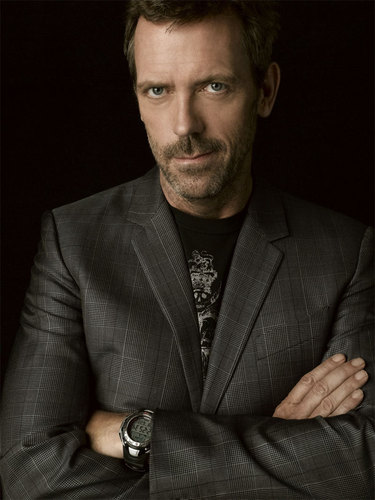
HOUSE -- Pictured: Hugh Laurie as Dr. Gregory House -- NBC Photo: Timothy White

HOUSE — Pictured: Hugh Laurie as Dr. Gregory House — NBC Photo: Timothy White

By Elaine Viets

Dr. Gregory House is a creature of fiction. Real doctors aren’t that insensitive, are they?
Oh, yes they are. I had a brain surgeon who made Greg House look like Marcus Welby.
Dr. Jeb Travis Tritt is the brain surgeon who saved my life after I had six strokes, including a hemorrhagic stroke, in April 2007. That’s not his real name, and he doesn’t look or act like the brain surgeon in my new mystery Brain Storm. But Dr. Tritt, as I baptized him, was a real character. I couldn’t make up what he said – I’m not that creative.

brain surgery1In fiction and reality, Dr. Tritt is a brilliant surgeon with a lousy bedside manner. He saws open skulls for a living, so I expected him to be a little strange. But hey, so am I.

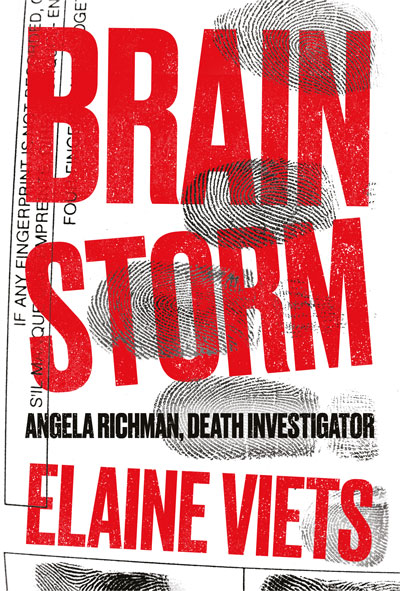
VIETS-BRAINSTORM-smallBrain Storm, the first Angela Richman, Death Investigator novel, is set in mythical, ultrawealthy Chouteau Forest, Missouri. Angela and I had blinding headaches and other classic stroke symptoms that sent us to the ER. There we were misdiagnosed by the neurologist on call, who said we were “too young and fit to have a stroke.” This comment is staggeringly stupid, though I didn’t know it at the time. Babies can have strokes. Dr. I. M. Incompetent told Angela and me to come back in four days for a PET scan.

brain ERWe never got that scan. Instead, we had a series of strokes, brain surgery, and a coma, and encountered Dr. Jeb Travis Tritt. After brain surgery, Angela and I were in a coma for a week and spent three months in the hospital.

brain surgery3

That’s where Angela and I parted company. When she came out of the coma, she learned that the doctor who nearly killed her had been murdered. The chief suspect was Dr. Tritt. Angela, still drugged and hallucinating, was determined to save the doctor who saved her. I can’t kill the doctor who misdiagnosed me. Except in fiction.

brain doctorBut I did experience Dr. Tritt’s midnight monologues, and put them in Brain Storm.
When Dr. Tritt got off work at midnight, he’d stop by my room. First he’d check my healing wound – a hideous cobblestone of a bump. Then he’d settle in for a monologue, talking nonstop for two or three hours. I was a captive audience – I couldn’t walk yet. He’d make jaw-dropping comments. I was heavily drugged and still talking to imaginary friends. But I knew I had a real find. Dr. Tritt’s visits were a gift. It took me nine years to use it.
One night Dr. Tritt said, “Do you remember anyone talking to you while you were in a coma?”
“No,” I said. “No tunnel of light, no relatives waiting on the other side. I didn’t see or hear anything.”
“Thank God,” he said. “I used to stop by every night and say, ‘Elaine! This is God! Wake up!’ But the nurses made me quit.”

brain godWhy did a surgeon spend hours talking to me instead of going home? He answered that question in another monologue.
“My wife is divorcing me,” he said. “She likes to shop and I don’t make enough money. She thought brain surgeons would be rich, but I don’t get that much. I only got three thousand dollars for your surgery. She wasn’t that good in bed, anyway. She just laid there, like you did, except you were in a coma.”
Huh? It didn’t occur to the doctor that perhaps his performance might have something to do with his wife’s lack of enthusiasm. The doc wasn’t coming onto me. My face was swollen, my skin was bright red thanks to an allergy to some medication, and half my hair was shaved off.
I’d always been proud of my long hair. I was shocked when I saw it had been partly shaved off for the surgery. Late one night, Dr. Tritt said, “I’m sorry about your hair.”
“In the grand scheme of things, it’s not the end of the world,” I said.
“I burned your hair because I knew you were going to make it,” he said. “If my patients are going to die, I save their hair because they like to look good in their coffins.”

brain coffinI was speechless. But then I thought: What would he say if I was going to die? Would he come by one midnight, hand me my hair and said, “Elaine, you’re screwed. But here’s your hair. You’ll look great in your coffin.”
Good old Jeb Travis Tritt. This real life character saved my life. Now I hope he can help me pay off those hospital bills.

++++++++++++++++++++++++++++++++++++++++++++++++++++++++++

VIETS-BRAINSTORM-smallBrain Storm is on sale as a trade paperback, audio and e-book amzn.to/2awPsIe

Win an autographed hardcover of Elaine’s seventh Dead-End Job mystery, Clubbed to Death. http://elaineviets.com/index.php?id=contests