
 Who was one of your first encouragers on your writing journey?
It’s Time To Share, TKZers! What Are You Working On?
 A while back, a TKZer made an excellent suggestion: to give an opportunity for readers to share something about their writing and latest projects.
So, this is the day we want to hear about YOU, your WIP, and recent accomplishments! Don’t forget to include a link so that folks can find out more about your work.
C’mon, it’s time to toot your horn!
A Different Twist on Storytelling

The Greenbrier
Autumn is conference season. Bouchercon morphed into C3 (Creatures, Crimes & Creativity con), which then morphed into Magna Cum Murder. As a former road warrior, traveling by air all the time, I decided this year to skip the airport this year and drive from Northern Virginia to Indianapolis for Magna. On the way out, we broke the trip into two, four-and-a-half-hour drives, stopping for a night in Wheeling, West Virginia. For the trip home, we decided to take the southern route, which took us through White Sulfur Springs, West Virginia, the home of the stately and wonderful Greenbrier Resort (and yes, that’s spelled properly).
From 1962 till 1992 The Greenbrier kept an important secret. Then a reporter from the Washington Post decided on his own that the world needed to know something that the government had classified Top Secret. The Greenbrier had been designated as the relocation spot for members of the US Senate and House of Representatives in the event of a nuclear attack. (I’m told that said reporter now teaches journalistic ethics at the collegiate level. Just sayin’.) A 112,000-square-foot, 153-room bunker facility lies buried 720 feet under the Allegheny Mountains, and is constructed of 50,000 tons of reinforced concrete. One of the four blast doors that provides access to the bunker weighs 25 tons, and swings on hinges that are four feet long, 14 inches wide and eight inches thick.
The bunker was built in total secret. How, you might ask? That’s where storytellers became important. Beginning in 1955, the C&O Railroad, owner of the resort at the time, started a press campaign celebrating an expansion of the hotel which would add the West Virginia Wing, featuring new guest rooms and massive exhibition space for business meetings and trade shows.
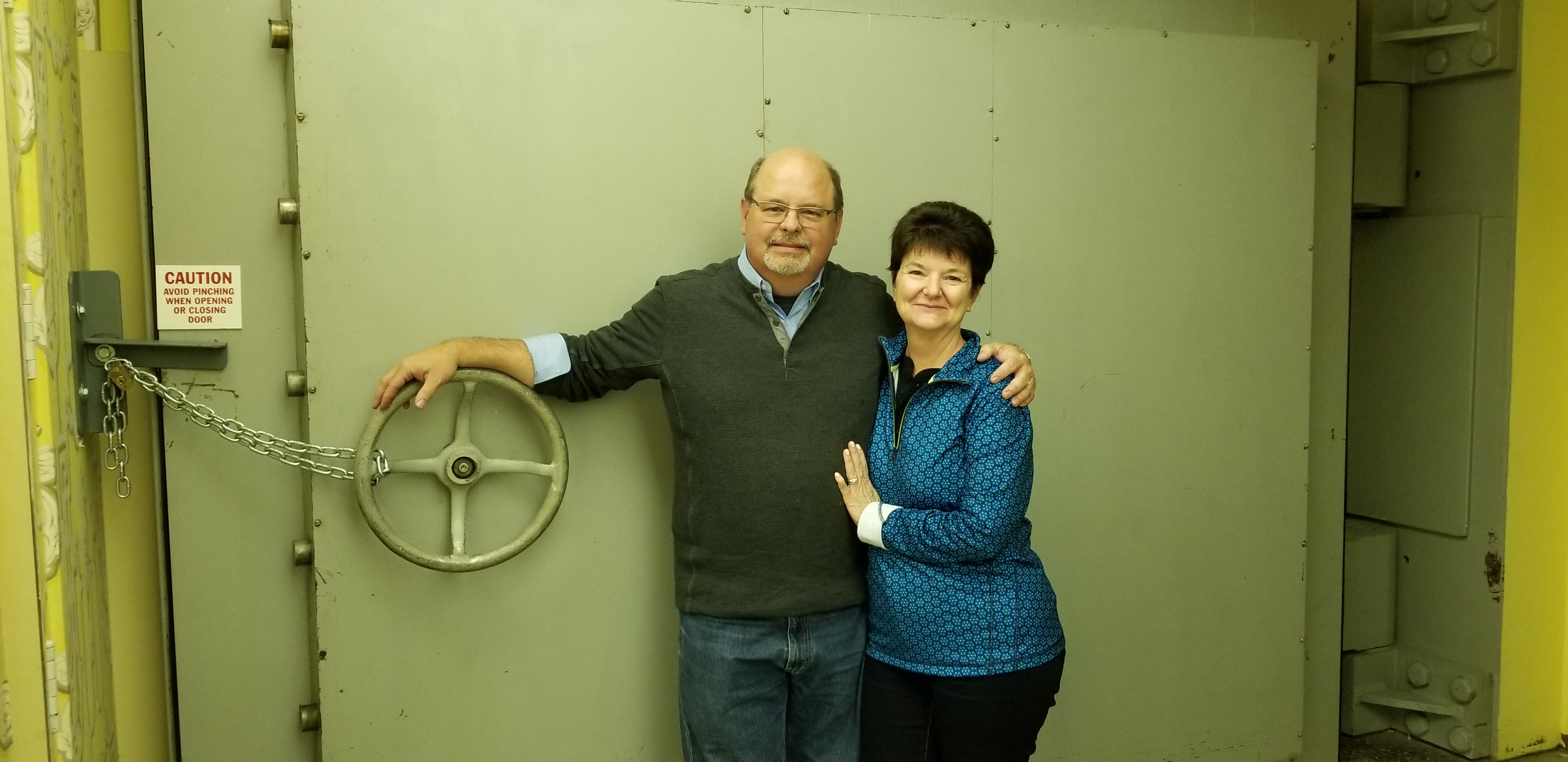
Joy and me standing in front of one of the smaller blast doors.
And here’s the thing: When the bunker was finished in 1962, the massive spaces were all used for business meetings and trade shows. One of the nation’s most important secrets was kept in plain sight! The enormous blast doors were disguised as walls, and the House and Senate chambers were rented out for classes and business meetings. Who would think to ask if the walls were five feet thick?
For thirty years, the bunker was maintained by a crew of thirteen very special workers who doubled as the television and electronics maintenance team for the hotel and its visitors. Their cover worked because they actually were the television and maintenance team for The Greenbrier.
If the balloon ever went up, the U.S. Government Relocation Facility–the official name for the bunker–would have become home to roughly 1,100 members of congress and their staffs. Sleeping in bunks and sharing bathrooms and showers, conditions would have been Spartan at best. Even in the early sixties, the folks who ran the bunker understood that cramming passionate politicians from all persuasions into tight quarters could lead to flashes of temper. They understood that after weeks of living underground, somebody might go a little nuts and try to open the blast doors to expose everyone to fallout. Thus, there was a safe, accessible only to security personnel, where riot gear was stored. Because these people needed to be fed in shifts and it was therefore necessary to move people along, the architects intentionally included design features that made the cafeteria an unpleasant place to sit and talk.
One of the planning details that impressed me the most was the White House backdrop on the wall of the media room. The president and the executive branch would never have come near The Greenbrier, so it made sense that the Capitol Building backdrop would be part of any broadcast, but why the White House backdrop? Well, if the president and vice president were killed, the speaker of the House of Representatives would become the president, and they were prepared for that eventuality.
And then there was the incinerator room. Yes, it burned documents and clothing that were brought in, but the designers had also taken into consideration that members of congress were of a certain age, and that there would be lots of stress, and, well, you know. Burial really wasn’t possible.
As I took this tour, my mind whirled at about a million rpm. Think classic locked-room mystery. Think psychological thriller. Think political thriller. Is there any place one couldn’t go with that kind of setup?
Is Anything Really Taboo
In Today’s Crime Fiction?
 I am on book tour in Michigan today, so excuse me if I don’t answer quickly to comments. In meantime, I wrote this recently for the great online mag Criminal Element. (Which coincided with a terrific review for our new Louis Kincaid thriller The Damage Done.) Thanks to my editor at CE, Adam!)
By PJ Parrish
Taboo. Off limits. That’s a no-no. Don’t go there. Oh man, you can’t do that.
That’s what mystery and thriller writers often hear. Be it from editors, reviewers or readers — especially readers — there are things we aren’t supposed to write about. Things that no one who’s looking for escapist fiction, wants to read about, things that are too sensitive, too controversial, too just plain ick-factor to deal with. After twenty-odd years in publishing and with thirteen thrillers under my belt and a new one just published, this one question never fails to intrigue me.
What is too much? How far can you push the envelope? Where is the line when readers will turn on you? And, maybe most important, as a writer, should you care?
We often hear there are some things you should never do in mysteries and thrillers. Maybe it’s because some folks believe the old boundaries of genre fiction still bind us. Maybe it’s because we’re all hyper-aware of the problems of finding audiences in a world of shrinking shelf space and the blat-blare-honk! of indie-publishing. Maybe it’s just vestigial adherence to the sad old rule that genre fiction should know its limits. Here’s just a few of the no-no’s I know:
- Don’t deal with abused children because readers can’t take it.
- Don’t write about religion because it’s too personal.
- Don’t write about politics because it’s too divisive and partisan.
- Steer clear of graphic violence and sex.
- And never, ever, kill an animal.
I’ve been thinking about this topic since the release of our new book THE DAMAGE DONE. This book heavily stresses the series-long character arc of our protagonist, a biracial PI ex-cop who is desperate to get back to wearing a badge again. Louis Kincaid is mysteriously recruited for a cold-case squad of the Michigan State Police run by an old nemesis who ten years before caused Louis to lose his badge. The “why” behind Louis’s new job is seminal to the plot and tests Louis’s faith in law enforcement.
Faith…
That is the underground railroad that propels the plot of THE DAMAGE DONE. And that means dealing with religion. It is in the foreground when Louis is called upon to solve the murder of a mega-church minister. But in the background, the slow percolation of a second cold case — the remains of two boys are found in an abandoned copper mine — boils up memories of Louis’s childhood slide through the foster system and tests his complex notion of faith. Faith in what? Or in whom?
Religion isn’t easy to write about because like anything of import, you can get, well, preachy. But, while many of our characters are people of deep faith, it was important with this story that we didn’t dictate what the reader concludes. And that, I think is how mystery and thrillers can illuminate the social questions of our weird times — deal with hard issues but never be didactic. I’ve been working my way through the John D. MacDonald books for the last year. In Condominium, MacDonald took on shady real estate developments and crooked politicians. In One More Sunday, he tackles televangelists and moral ambiguity — but never loses sight of telling a ripping good yarn. Luckily for me, I finished my own novel about faith before I started this one.
I read a crime novel recently by an Edgar-winning writer. The writing was elegant, the plot set-up tantalyzing. I really liked the protag. But about halfway through, I found myself getting irritated. Why? Because the writer started shouting about the devastation of the environment and it was drowning out the story. I don’t like folks banging on my door trying to teach me about Jesus. I don’t like crime writers hitting me over head with a thematic two-by-four about baby seals.
Likewise, I get annoyed by bad women-in-peril books. Now sexual predators are a fixture of crime fiction, and some authors handle the subject graphically. (Karin Slaughter’s Kisscut comes to mind.). But if you can’t bring anything new to the subject, if your female characters are cliched victims, then don’t go there, especially in the red-hot passions of the #metoo movement. Reality is far more potent than most anything you can put on the page today.
Yes, we should write about politics, sexual violence, and yes, we even need to kill animals if the story needs it. (Although I had to put down a book by Minette Walters, one of my favorite writers, because she wrote about torturing cats and I had ten cats at the time.). But you have to deal with a touchy subject always with the idea that it must organically support the story.
With our book A Thousand Bones, we dealt with the devastating rape of the protagonist. Our editor asked us if we really wanted to “go there.” After much agonizing we decided the heroine’s character arc wouldn’t be believable without including the violent act. In the same book, the heroine, a rookie cop, commits an act of vengeance against her rapist. We thought long and hard about the ethics of a law enforcement officer pushing the limits but decided to leave the incident in. We got some emails on this from readers claiming a “a good cop” would never do this. I was at a signing and a man came up holding the book. He said, “I’m a retired Detroit police captain and I need to talk to you about how you ended this story.” I braced myself. Then he said, “I would have done the same thing she did.”
Not every decision about “taboos” is as difficult. We got a thoughtful email from a regular reader about our book An Unquiet Grave telling us she found the profanity off-putting. We write a hard-boiled police procedurals and thrillers, so we have to reflect the reality of the street and the station house. But we came realize we had become too reliant on profanity to convey intensity of character. It can be a crutch, a poor stand-in for powerful dialogue. Yes, our books still have profanity, but we think about each word we use. Which is sort of what you should do with non-profanity, no?
In the end, after thirteen books and twenty years of crime writing, I’ve decided there is only one real taboo — that the message never overwhelm the plot and characters. The story must always win out.
How To Use False Eyewitness Testimony in #Thrillers
By SUE COLETTA
Forensic Psychology is a fascinating field, especially as it relates to eyewitness testimony. Can we always trust our memory? Let’s test your observation skills. In this short video, count the number of times the ball is tossed from one white-shirt player to another. Sounds easy enough, right? Give it a try.
Well, how’d you do?
This phenomenon is called inattentional blindness. Your mind perceives what’s happening, but you do not attend to it. In other words, there’s nothing wrong with your eyes. But for some reason this information is more subconscious than conscious. The best known demonstration of inattentional blindness is a study performed by Simons and Chabris (1999) known as Gorilla in the Midst. It’s highly copyrighted so I couldn’t embed it here, but if you’d like to check it out, click the title.
Imagine the implications inattentional blindness has on eyewitness testimony? Often times victims of violent crime are so focused on the gun they see little else.
Change blindness is another phenomenon that effects key elements of our surroundings, including the identity of the person right in front of us, even if that person has changed places with someone else. If you’d like to use change blindness in your WIP, check out The Door Study.
The implications of change blindness on eyewitness testimony could delay solving the crime. Always a good thing in thrillers. A detective could be led down numerous dead-ends, and so could the reader.
In a violent crime, “weapon focus” muddies the waters. Participants in another study watched a film of a kidnapping attempt. Would it surprise you to learn that actions were better remembered than details?
Action Details
When we witness a crime, we absorb the information by the actions that happened during the commission of the crime. For example, a man pointed a gun at a woman, pushed her into his van, and sped away. The central information — what an eyewitness focuses on — and the peripheral information — what’s happening around said eyewitness — often becomes skewed with the surge of adrenaline.
Such findings suggest that when we witness a traumatic event, our attention is drawn to the central action at the expense of descriptive details. Yet, in other circumstances, such as non-violent events, our attention may be spread more evenly between the two.
Which brings us back to inattentional blindness. This phenomenon occurs when attention is drawn toward only one aspect of an eyewitness’ surroundings, resulting in lack of information. Which writers can use to our advantage.
Weapon Focus
The use of weapons complicate matters even more. When a gunman brandishes his firearm, an eyewitness tends to focus on the pistol rather than other details, such as the suspect’s hair and eye color, build and dress. Researchers have tested this theory, as well.
In the study, they showed participants videos of robberies — robbery involves a weapon and a victim; burglary does not— where one group witnessed the robber with a concealed pistol and other group witnessed the robber with the gun in plain sight. When researchers asked the concealed weapon group to identify the robber in a line-up, only 46% of participants could identify the suspect. From those who watched the video where the robber brandished the weapon, only 26% could identify him.
Schemas
In order for an eyewitness to be able to answer a question, they must be willing to respond. And it’s this willingness that can impair their memory of the events. Not everything we “see” or “experience” is stored in our minds. Our brains don’t work like computers where each bit is encoded. Rather, we make connections to other things in order to process information. If you’re interested in learning more, I’ve written about Subliminal Messages on my blog.
Episodic memories — memories involving an event — are organized in our minds as “event schemas.” This allows us to store knowledge, events, and activities by connecting to what we classify as “normal.” In other words, rather than remembering every time we dined at our favorite seafood joint, we tend to build a general impression of seafood restaurants … the smell, the atmosphere, and so on.
However, the use of schemas can distort memories. The perfect example of this is when someone asks me about my childhood, then asks my brother. From our answers one might think we grew up in different households. Many factors contribute to how we remember times and events. Such as, influence. When gaps exist in our memory we tend to incorporate new information in an attempt to fill in the blanks. Although useful in everyday life, this poses real problems for investigators, because this new information is often constructed after the crime took place, and leads to false testimony.
I hope you’ve enjoyed this peek into Forensic Psychology. We’ve barely scratched the surface. Next time, I’ll share how an investigator should pose questions to an eyewitness. Perhaps you could use the techniques in your WIP. Would that interest you?
So, TKZers, how many of you saw the gorilla? Are you tempted to use false eyewitness testimony in your WIP?
The Mystery of Jack Waer
by James Scott Bell
@jamesscottbell
 It’s no secret that I love the paperback era of the 1950s. Most of it is eminently entertaining, and almost always well written. Why? Because the writers in those days had been through the classic American schooling that drummed the structure of the English sentence into their heads. Then they paid their dues writing for newspapers, where grizzled editors would scream at them to write more clearly.
The result was sharp and grammatical prose, unlike so much of what’s produced today, even in once respected newspapers. I recently saw the word anyways in an actual news column trying to make an actual point.
But I digress.
I recently purchased The Noir Novel Megapack—four 1950s novels for only 55¢! A few days ago I started reading one of them: Murder in Las Vegas by Jack Waer.
It’s terrific. A solid noir set up: After a night of drinking and getting into a fight, a guy wakes up in his apartment, not knowing how he got there. He finds his .38 on the floor and picks it up. Then he spots a dead body on his bed just as his cleaning lady comes in and, seeing the gun in his hand and the body on the bed, screams and runs out. It isn’t long before he’s on the lam and hiding out in L.A.
Excellent hardboiled prose, as in:
His fist came up into my face and it was like having a stick of dynamite exploding inside my head. That was the end of the line. After that there was nothing but the black velvet road that led me through insane dreams.
***
Slowly, I crossed around the bed. I went just so far, then stopped, although the thing inside my gut sprang forward, clawing and spitting. I wanted to yell, to scream out all the filthy things I’d ever learned in all those years on the way up. I wanted to yell until the noise drove away the sight in front of me.
Somebody had been at her throat with a knife.
***
I grabbed the threadbare huck towel off the rack and splashed some water on my face. After I’d dried off I took a look at myself in the mirror and decided never to do it again.
***
The Vanguard was the address where the high tone and six-figure sports kept their private doxies in the manner to which their wives had never been accustomed.
***
The place reminded me of my happy childhood. It was like Old Home Week to enter the dark interior and smell the sweetish odor of stale beer, dampness and despair.
So I found myself wondering, who was Jack Waer? But my initial searches hit a cul-de-sac.
On Amazon, there are only three titles listed for him, as used paperbacks. Murder in Las Vegas, Sweet and Low-Down and 17 and Black.
Who was this guy? I didn’t find any biography of him on the usual noir sites. He was not listed in my go-to reference on this era, Paperback Confidential: Crime Writers of the Paperback Era. I even emailed an MWA Grand Master who is an expert in the pulps. He’d never heard of the guy.
I began to formulate a theory. Because the writing in Murder in Las Vegas is so sharp and spot-on, I thought “Jack Waer” might be a pseudonym for a mainstream novelist. In those days, literary writers often went “slumming” in paperback originals in order to make some dough on the side, all while protecting their “good name.” Evan Hunter did that under the pseudonym Ed McBain. It was McBain who became rich and famous. I don’t know if Hunter ever forgave his alter ego for that.
So that was my theory. Only three books. (It turns out it’s only two, for Sweet and Low-Down is a reissue of 17 and Black with a new title.)
Did he die? Or did the literary author simply move on?
It turns out I could not have been further off.
I did another search on Google and saw an old black and white photo:
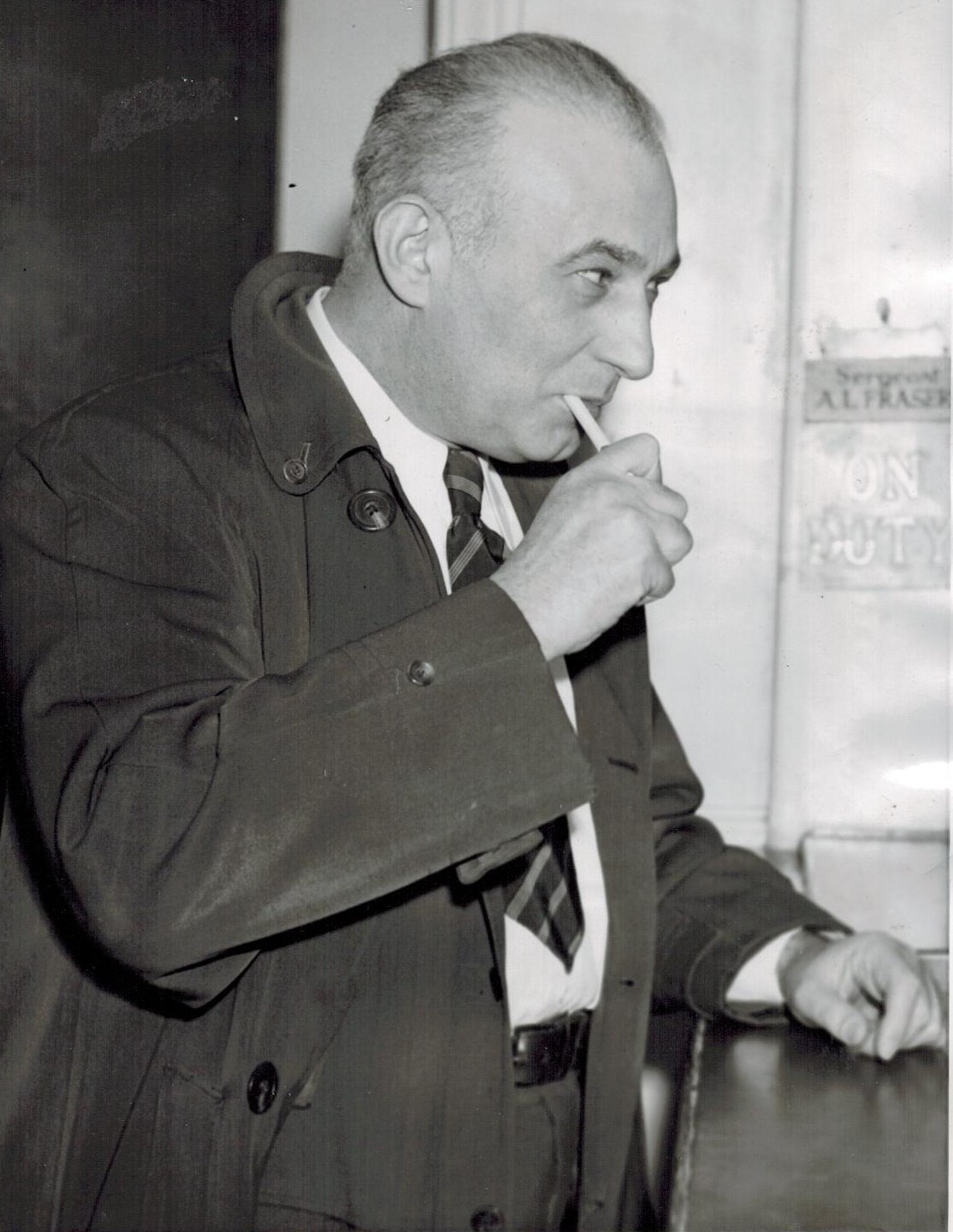
So I went to the page, which turned out to be the blog of L.A. mystery writer J. H. Graham. Ms. Graham is, like me, third-generation Angeleno, and we both love the crime lore of the 50s. I am indebted to her for solving the Jack Waer mystery.
Turns out Waer was a gambler running in the same circles as Mickey Cohen, the underworld king of Los Angeles. Says Graham:
Waer, who is also used the name Alexander John Warchiwker according to his naturalization forms, was born in Warsaw Poland in February 1896. He came to Los Angeles sometime after 1930, having previously lived in Detroit. In 1942 he listed Eddie Nealis as his employer on his WWII draft registration card; his job description was not specified. However, he was arrested on gambling charges in July 1943, when D.A. investigators raided an office in the Lissner Building at 524 S. Spring St. and found Waer running a dice game.
The [Los Angeles] Times had called Waer a writer after the NYE 1945 hold-up. He may well have been one; In any case, he became a writer for sure by 1954 with publication of his novel 17 and Black (later issued in paperback as Sweet and Lowdown).
So there you have it. A habitué of the illegal gambling dens of 1950s Los Angeles wrote a couple of books on the side, one of which is pretty doggone good!
Even if your beat is the underbelly of society, it helps if you can write.
Waer, according to Graham. died in Las Vegas in 1966.
And if you are interested in crime fiction that takes place in Los Angeles back in those days, check out J. H. Graham’s mysteries.
What obscure writers have you come across who should be better remembered?
From Cool to Heat

Photo courtesy Eddie Howell on unsplash.com
The weather has turned cool since last we met. Each area of the United States has its identifiable seasons, from the Deep South (where New Orleans has two, those being “summer” and “February”) to the West (where, as Mark Twain is reputed to have said, “The coldest winter I’ve ever spent was a summer in San Francisco”). Ohio has a more severe line of demarcation. The heat of summer at this time of year sinks into the chill of fall. Leaves drop. One can’t um, leave them go without raking or mulching for too long, as snow will almost inevitably fall by November. One sets the thermostat from “cool” to “warm” and calls for the furnace check-up, even as it seems as if but a few weeks ago it was the air conditioning system that was being checked out. The circle, it seems, moves faster and faster.
I’ve of late been feeling the rapidity of the turning of my own seasons. I came across a passage in a new book entitled THE DARKNESS by Ragnar Jonasson. The protagonist is a police inspector who is being involuntarily retired as she approaches the age of sixty-five, muses that she feels little different than she did in her forties, other than for perhaps some minor fatigue. Just so. I’m waking up at 3 AM much too frequently but I’m doing it in my bed in my house and know where I am. There are no real complaints there. Still, I am increasingly aware that the miles in the rear view mirror are substantially greater than those between me and the final destination, and I increasingly doubt whether I’m going to get there before the warranty expires. Most of my close friends are a few years older than I — in their early to mid-seventies — and seem to be hitting a wall. One of them, who I have known for well over fifty years, advised me yesterday that he was not up to making the two-hour drive to visit me this weekend due to vision problems. He reminded me that when we lived on the west coast he would call me and say, “Tahoe!” and off we would go, making the six-hour round trip to Nevada and back on the same day as if we had not a care in the world. We didn’t. Not then. It was high noon. We are well past that. The sun hasn’t kissed the horizon, but the lengthening shadows hint that, from our landlubber perspective, it is well-nigh approaching the yardarm. Sunset occurred for another friend last week. His body mercifully slipped loose of its moorings last week and followed his essence, which had been stolen by Alzheimer’s Disease, piece by piece, over the past two years. It’s not the way I want to go — I would prefer to pass either while writing at my desk or at the hands of an irate husband — but we don’t always get a choice. Shakespeare’s untimely frost follows no calendar.
Photo courtesy Eddie Howell on unsplash.com
What more to do? I have four wonderful children, each accomplished in their individual ways, and a terrific granddaughter. There might be time for one more dog. I think I’ve made more people smile than otherwise which is something that not everyone can truthfully claim. It’s been a good ride and there are many more miles and adventures to come. I hope. The lesson I’ve learned, and which I am making so bold as to impart to you —particularly those of you here who are younger — is don’t waste a day, or even an hour. Decide what you want to do and work toward it, whether it is writing the Great American Novel — someone will do it, so why not you? — adopting a stretch of highway, or visiting every Sonic, Tim Horton’s, and Cracker Barrel in the country. Regardless of what you want to do, there are only a finite number of times that you get to switch from cool to heat and back again. Cherish each one, and enjoy them.
Photo courtesy Pathecho Grid on unsplash.com
Reader Friday: Cartoons

Valet de Poulet – Some Thoughts on Self-Care (Guest: Bill Cameron)
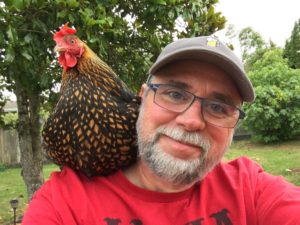
A man and his chicken
It’s my pleasure to have my friend, Bill Cameron, join us today. I’m a big fan of his writing ever since I read his debut book LOST DOG. Bill was in my debut authors group for the International Thriller Writers (ITW) in 2008. That book featured an unlikely kleptomaniac anti-hero smart ass, Peter McKrall, with his unique voice that has always stuck with me. It launched Bill’s detective series that features Detective Skin Kardash.
I also follow/harass Bill on Instagram (@bcmystery) where he posts pics of his urban chickens. His daily videos and pics of his chicken drama are tons of fun and addictive, like his writing. Thanks for being our guest, Bill. Shake a tail feather and take it away.
***
Much of my day was spent chasing chickens around my yard—an act of pure slapstick if there ever was one. Usually the ladies will come right up to me (probably because I often have treats), but today they sensed I had something else in mind. So they fled, making comical “bock-bock-bock” sounds as they went. I was no doubt equally comical, trying to both run and scoop up indignant chickens simultaneously. The result was a kind of bow-legged lurch with my hands flapping around near ground level. I may have fallen, but if you don’t have video you can’t prove anything.
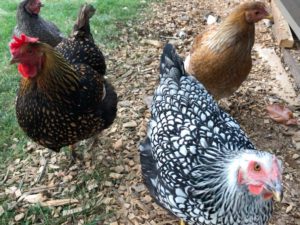
My problem, or rather the chickens’ problem, was a possible infestation of scale mites. These awful little bugs burrow under the skin of a chicken’s legs, drink blood, and can wreak havoc on the well-being of a flock. (Do not image search for “chicken scale mites” unless you want to see true horror.)
Now, I say possible infestation because until the the situation gets really bad, the vermin are difficult to see. Some discoloration on the legs of our oldest hen, Hinie, was the only indication something might be amiss. That discoloration could also mean nothing at all, but since we don’t want the mites to get a leg-hold, I decided to address the problem proactively.
The treatment is basically Chicken Spa Day, which probably sounds nice to you and me. And in fact some chickens enjoy a soak in a warm bath and maybe a massage. (Do image search for “chicken taking a bath” for some entertaining pics.) Not so much our ladies. But I was not deterred.
In advance, I’d prepared a warm Epsom salts bath with a little mild soap. As I caught them, the girls each got a soak and a mild scrub to clean off any mite eggs or mites that hadn’t yet burrowed. Then, after they were dried off, I coated each hen’s legs with Bag Balm to suffocate the pestilent buggers who remained.
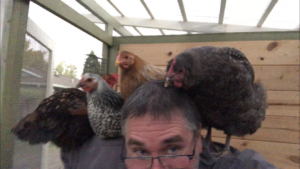
The good news is all went relatively as planned, though it took me more than an hour to get all four into the tub. (Farm Fact: chickens are fast.) The girls had a lot to say about it, probably in the form of chicken swearing. But the endeavor was a success—though I got wetter than the girls did.
So what does this shenanigan have to do with self-care?
Well, for me, taking care of chickens is a lot like writing. It can be rewarding, fun, challenging—and also a source of heartbreak. Right now we have four girls: the aforementioned Hinie, plus Cheeks, Tuchus, and Buns. (Do you detect a theme? Guess what!) Earlier this summer, one of our first hens, Fanny, died unexpectedly. And last year, two others (Moon and Patootie) turned out to be roosters, which are verboten within city limits. That’s the heartbreak side of things. But the rest of the time there’s the slapstick comedy and the reward of eggs and affection from smart, engaged birds who each have their own personality.
When I’m away from the keyboard, I find chicken care is a good way for me to get my “I’m not an incompetent buffoon” fix—something that can be rare in my writing life. On days when things seem especially dire (“wait, did you say there’s no market for that manuscript I spent five years on?”), time with the chickens can give me a sense of worth. They need me—for food and water and spa days, and for a lap or shoulder to cluck on. And I’m up to the task.
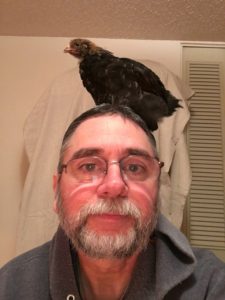
The day Hinie pooped on Bill’s head
But as with writing, there’s no guarantee of success. They might get scale mites, and while I’m confident I have that problem in hand, the next problem might cost me a beloved pet. In the morning, I might get a manuscript rejection, but in the afternoon I might get a fresh egg and a nuzzle from a bird named after a butt.
Chicken Tending (think about it) isn’t the only thing I do for self-care. But the ways it’s like writing helps me deal with the tribulations of my writing life. Sometimes we just need a little success. For me, chasing birds around the yard goes a long way toward keeping me grounded and believing I can make a difference—on the page as much as in the coop.
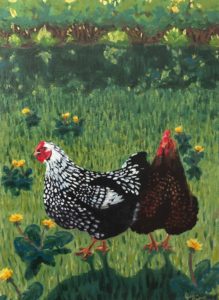
Fanny (RIP) & Hinie by Bill’s daughter, Jessica
FOR DISCUSSION:
What do you do to take care of yourself?

Bill Cameron is the critically-acclaimed author of gritty, adult mysteries featuring Skin Kadash. His short stories have appeared in Alfred Hitchcock’s Mystery Magazine, Killer Year, Portland Noir, First Thrills, Deadly Treats, and West Coast Crime Wave. In 2012, his novel County Line received the Spotted Owl for Best Northwest Mystery. His latest book, the young adult mystery Property of the State, was named one of Kirkus Reviews Best Books of 2016: Teen.
Bill is currently at work on a mystery set in the Oregon High Desert.
25 Ways To Avoid Writer’s Butt*

Credit: Go Daddy Stock Photo
A handy list for your writing day:
- Don’t write.
- If you choose to write, don’t eat while you’re writing.
- Chain yourself to your desk to keep from going to the kitchen.
- If your desk is in the kitchen, you need to move your desk.
- Don’t write about food unless you’ve just eaten. It will make you hungry.
- A candy treat is a fine reward for a potty-training toddler, not grown-up writers who’ve squeaked out 100 words in three hours.
- A single glass (not bottle!) of wine, spirits or beer is a fine reward for finishing your work for the day.
- Take your dog or cat for a walk. Bonus points if you’re not staring at your phone.
- Exercise before you write. Let writing be your reward. (Hey! Stop laughing!)
- When you get stuck while writing and find yourself headed for the kitchen, scream DON’T DO IT at the top of your lungs and do 10 push-ups. Knee push-ups count.
- If you’re on the phone kvetching with another writer about the sad state of publishing, your life, your advance, or your Writer’s Butt, wear a headset and walk around and around your office, living room, front yard. Bonus points for each 1K steps you take.
- Keep your fridge and cabinets stocked with food you hate, or food that takes preparation.
- Get a standing desk and a good mat on which to stand.
- Nap, at your desk, or napping place of your choice.
- Take your dog or cat for another walk.
- When you temporarily forget how to write, listen to an audiobook by a writer who inspires you as you walk, jog, etc.
- Don’t write when you’re exhausted. Exhausted writers are hungry writers.
- When you’re not writing, make your diet as carb-loaded and awful as possible. Then you’ll have acid-reflux the whole time and won’t be tempted to eat.
- Take a dance break.
- Write stomach-churning prose.
- Wear pants that are already uncomfortably tight instead of yoga pants.
- Use the Pomodoro method. This one is online, but you can get yourself an actual timer for your desk.
- Write at the library and leave your money in the car so you can’t use the vending machines. Bonus points for parking far away.
- When you’re reading, walk around the house. You know you did it as a kid. Watch out for the dog.
- During your writing time, turn off the Internet, have a tall glass of water on hand, and write like a demon. You’ll feel so good and accomplished when you look at those pages that you’ll either not care if you have Writer’s Butt (always an option!), or you’ll feel so virtuous that you’ll make yourself a healthy dinner, have a glass of wine (or not), take the dog for a walk, get a good night’s sleep, and do it again tomorrow.
*Disclaimer: I have used all 25 methods at various times, and my Writer’s Butt comes and goes. As to number 3, I have gotten so tangled up in the huge number of power cords around my desk that I may as well have been chained because it was a real pain to try to get away from my chair and go to the kitchen.
Okay TKZ-ers! Please share your Avoiding-Writer’s-Butt strategies. We’re listening…