By PJ Parrish
So I’m trying to start a new short story the other day. I am determined to open with the weather. Well, the story takes place in the aftermath of a hurricane, so Elmore Leonard be damned.
But nothing is coming, man. I am as dry as…
…the Sahara Desert.
…as a half-gnawed Milk Bone discarded by a toothless chihuahua.
…as a lasagna that’s been sitting in the back of the fridge for a month and the foil has come off and now it has a brown miasmic crust as dry as…
{{{Argh!}}}}
I gave up and turned on the tube. I swear I am not making this up, but guess what movie was just coming on? Throw Mama From the Train. Where Billy Crystal has a bad case of writer’s block trying to open his novel with weather. “The night was…”
You’ve been there. I know you have. You stare at the screen, your brain turning to sludge. And you get stuck with one bad opening line that, like a terrible earwig, won’t let go. The night was…humid. The night was hot and sticky. No, that’s humid!
I love this movie because it has so much to teach us about how not to write. There are dozens of great movies like this. And each, in its own way, communicates the agony and yeah, the ecstasy of this crazy little thing called fiction. Let’s review. Roll that beautiful bean footage!
Wonder Boys. This is my favorite writer’s movie. Michael Douglas is a one-hit wonder writer/creative writer professor who’s mired in his 2,500-page second novel. He copes by toking up and bedding his students. But then one of his ladies reads his manuscript and tells him: “Grady, you know how you tell us in class that writers make choices? And even though your book is beautiful, at times it’s very…detailed. With the genealogy of everyone’s horses and the dental records and so on. It sort of reads like you didn’t make any choices.”
The Lesson: Good fiction comes from making a very long series of good decisions. About your plot, your characters’ motivations, what tone you’re going for, what your theme might be. Every sentence is a choice; every verb is a choice. One of the hardest decisions, as Grady discovers, is what to leave out. I often, in our First Page Critiques here, ask writers for more description or mood. But sometimes, you have to trust the reader and leave stuff out. Like leave out adjectives that over-amplify mood and let it emerge through action and dialogue (Show don’t tell).
Finding Forrester. Not my favorite writer flick but it has one good scene. Sean Connery is mentoring a prodigy who can’t get started for fear of failure. The young man sits staring at his computer until Connery hands him one of his own stories and says “Start typing this. Sometimes the simple rhythm of typing gets us from page one to page two. And when you begin to feel your own words, start typing them.”
The Lesson: Don’t just sit there paralyzed. Write something. Write anything. Just get started. Perfection is your enemy. A complete first draft is your goal. It won’t be great. But it will be the raw material out of which you will find your way toward the true story. To paraphrase Woody Allen, a writer is like a shark. If it doesn’t keep moving, it dies.
The Swimming Pool. Charlotte Rampling is memorable as a burned-out sexually repressed mystery novelist who retreats to a house in France and…psycho-sexual mischief ensues. And she finishes her book.
The Lesson: Sarah tells her editor she is “fed up with murders and investigations.” Her editor says, “Well, why don’t you confront your critics and write something completely different?” The idea of turning to something new helped get me out of my doldrums years ago when I felt the juice going out of my series. I wrote my first stand-alone, set in Europe, The Killing Song. It re-energized my need to tell stories again. If you are in a similar dark spot, switch gears. Try a short story. Change genres.
Misery. James Caan, sick and tired of churning out his series, gets trapped in fan-girl hell by Kathy Bates and is forced to resurrect the character he killed off. “You…you dirty bird. How could you? She can’t be dead. Misery Chastain cannot be dead!”
The Lesson: Changing genres can be good. Or it can get your legs broken. Also, be careful who you decide to kill off in your books, especially if the character is sympathetic. Yeah, sometimes you have to kill your darlings but don’t be rash.
The Royal Tennenbaums. About a depressed family of former child geniuses with a great parody of writer-ego-writ-large by Owen Wilson as Eli Cash, who poses for photos holding snakes, wears a cowboy hat and turns out dreck like: “The crickets and the rust-beetles scuttled among the nettles of the sage thicket. ‘Vámonos, amigos,” he whispered, and threw the busted leather flintcraw over the loose weave of the saddlecock. And they rode on in the friscalating dusklight.”
The Lesson: If you do find success, don’t take yourself seriously. Your work, yeah. But when you show up at Bouchercon, leave the cowboy hat at home, Bucky.
Sunset Boulevard. William Holden’s portrait of down and soon dead screenwriter Joe Gillis is one for the ages. Courtesy of Billy Wilder’s whip-snap dialogue like “Sometimes it’s interesting to see just how bad bad writing can be.”
The Lesson: Be wary of collaborations. And if another writer asks you to read their stuff, be kind. Or you might find yourself face down in a swimming pool, and not a nice sexy one in Provence.
Honorable Mentions:
Kill Your Darlings. Only because it stars Harry Potter as Allen Ginsberg.
Julia. Only because Jane Fonda, playing Lillian Hellman, gets so mad while writing she throws her typewriter out the window. Have so wanted to do that.
Adaptation. Only because Nicolas Cage gives me the creeps with his pitch-perfect personification of the neurotic writer.
Postscript: After you all offered your faves, I have gone back in and added one more. I can’t believe I forgot this one. Talk about neurotic sad writers….how can we forget Miles from Sideways? He calls his agent to find out what’s up with his novel and well, the publisher has decided to “take a pass.” Miles doesn’t do rejection well.
Okay, time for you all to weigh in. What movies about writers have moved you? And fora fun, here’s a very clever mash-up video about our favorite writing tool — the good old typewriter!



 And I think you learn a lot on both ends—mentor and mentoree (master/protégé). I’ve been commercially writing for a while now and when I put together a “mentorship” program for the
 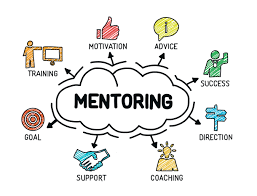 Dr. Phillips-Jones says that effective mentoring requires more than common sense. Her research indicates that mentors and mentorees who develop and manage successful mentoring partnerships demonstrate specific and identifiable skills that enable learning and positive change to take place. She notes that unless a fairly structured process and specific skills are applied, mediocre relationships occur.
 My Google trip took me to a place called Masterclass. You might have heard of it. I found a short but sweet post called
 Garry Rodgers is a retired homicide detective with a second career as a coroner. Now, Garry’s a crime writer and indie publisher of sixteen books including an international bestselling based-on-true-crime series.