Through the Glass, Darkly

aa book


I am not given to spending a lot of time looking into my rear view mirror as I drive down the road of existence. I was inspired a couple of weeks ago, however, to pause and write down every major mistake I have made in my life to date. I limited the itemization to “domino” mistakes, those being the initial errors that led to others with adverse life-changing consequences. My list had thirteen items when I finished. I’m not going to share all of them with you, but I will reveal the one at the top of the list: I started drinking heavily.

I mention this because we are approaching April 1, which, God willing, will mark the completion of my twenty-fourth year of sobriety. Speaking only for myself, sobriety works. Alcoholism doesn’t. I was what one calls a “functioning” alcoholic, which means that I could fool some of the people, including myself, all of the time. That of course did not stop me from doing stupid and terrible things, some of which I have regretted every single subsequent day of my life right up to this moment.  On the other hand, every good thing that is presently in my life has occurred as the result of sobriety. It’s second nature to me now, which doesn’t mean that it’s always easy; it just means that 1) many days are much, much easier than some, and 2) every day of sobriety is much, much easier than having that first drink and going back to what I was.

I am aware that many people drink modestly, even on a daily basis, without adverse consequence (other than for, perhaps, a regrettable Facebook posting).  I am much given to self-deceit and numbered myself among those for over a decade. My initial epiphany took place when I met a gentleman, now deceased, in 1989 who became my best friend. He told me that he was an alcoholic, and that he had been sober for nine years. I thought, “Nine years?! Without a drink?! Wow! I can’t even go nine days without a drink! It’s a good thing I don’t have a problem!” I confess that I found absolutely nothing ironic about that thought until I had been sober for three weeks near the end of April 1991 and the scales began falling from my eyes.

I mention this because alcohol and writing and publishing and the like all seem to go together. Many of the great authors of the past drank, and famously so, to varying degrees, from Hemingway to Faulkner to Mailer. Many of the authors of the present, famous and otherwise — and even some reading these words — do as well. Sometimes it can be a problem, one that keeps you from getting where you want to be and becoming who you want to be.  My problem was nothing more or less than that punch list of things to do that was so critical at the beginning of the day became much less so when Captain Morgan showed up, sometimes around lunch.” Must do” can quickly become “so what.” You can’t get published that way, or maintain relationships, or handle finances. You can’t really live.

That you might enjoy a drink or two on a regular basis doesn’t mean you have a problem. If, however, you think you might have a problem, or you have people in your life who are telling you that you might or do, there is a very insightful twenty question quiz  developed by the fine folks at The John Hopkins Hospital and used by The Betty Ford Clinic, among many others, that will give you an idea of where you stand. Answer the questions honestly; what you do with the knowledge is up to you (just so you know, I scored fifteen “yes” answers out of twenty and it still took me two years to get a handle on things). If your honest answers indicate that you have a problem and you want to do something about it without the world knowing about it, talk with your doctor. If you’re not ready for that, the Alcoholics Anonymous website will link you to information about meetings in your area. You might be surprised as to the frequency and number of locations within a few miles of you. Each meeting has its own personality; a meeting held in a downtown church on a Sunday night will be much different from one held in a suburb on a Wednesday morning. If you attend a meeting and you don’t seem to fit, keep trying.  And if you want to talk, email me. We’ll set it up. If one person with a drinking problem reads these words and begins to turn their life around, then my job is done. And whether I hear about it or not, you’ve made my day. Thank you.

What does your character want?

download

By PJ Parrish

Many moons ago, when I was just starting out in this crime writing business, I wandered into a workshop at SleuthFest. That day, all I was looking for was a reason to not lurk alone in the lobby of the Deerfield Beach Hilton. Besides, I had two books under my belt that got some nice blurbs and some good reviews. So I thought that I had all the answers.

Man, was I wrong. And thank God I went into that workshop because it forever changed the way I wrote.

LesStandifordHeadShot

The workshop was conducted by Les Standiford and he was talking about creating memorable characters. Now, every writing conference has panels on this. Yada yada yada…don’t rely on stereotypes…blah blah blah…give them interesting backstories and dossiers…humanize your villain…make your hero fallible but likeable…same old same old.  And despite the fact Les Standiford had his own successful mystery series and was a celebrated fiction teacher, I didn’t think I was going to get anything new from his session. But then, as I sat in the back of room, half-dozing off the effects of last night’s cocktail party, Les said something that made the hairs on my neck stand up:

“Ask yourself one question of every character you create: What does he want?”

He had hit a nerve in my writer’s subconsciousness. Because although I had been writing about my cop hero Louis Kincaid for a while, I had never really thought hard about what Les was talking about. So as I sat there in that hot crowded room, I asked myself:

What did Louis want?

Well, he wanted to solve the case! He wanted to find the men in the small Mississippi town who, thirty years ago, had lynched a black man and left his bones in a shallow grave in a swamp.

{{{{Loud sound of buzzer going off}}}}}

Okay then, Louis was a rookie who really needed a job and wanted to impress his new boss, the sheriff.

{{{{Buzzer}}}}

Well, dammit, Louis felt compelled to find the identity of the lynching victim and bring him peace.

{{{Close but no cigar}}}}

Okay, okay. Let me think hard about this. Wait…Louis is biracial. He was born in Mississippi but was fostered out to a white family in Michigan. He walks, uneasily, in two worlds. Could this be about him finding his “black” past, forgiving his mother for abandoning him and coming to terms with the white father who deserted him?

{{{You’re the writer. What do you think?}}}

I think that what Louis wants is to find himself. Twelve books later, both he and I are still looking. But way back when, I thought I had all the answers. That day I walked into Les Standiford’s class, I didn’t even have the right questions.

What does your character want?

It sounds like an easy question. But if you’re doing this novel writing this right, the answer isn’t so easy. Kurt  Vonnegut famously said, “Every­one wants some­thing on every page, even if it’s only a glass of water.“  That is true even of minor characters, but when you’re talking about your lead role players, I think you have get to the very bottom of that water glass.

Dead Poets

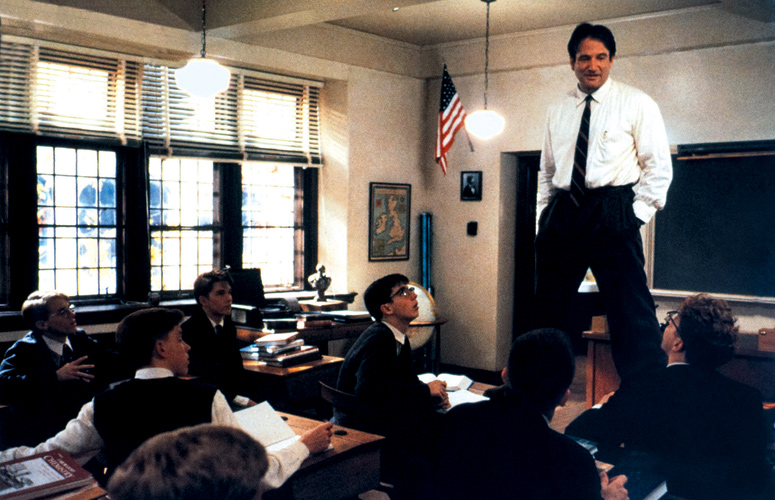
Are we talking about character motivation here? Well, yes, I suppose so. Les Standiford, Vonnegut and all great writers and teachers tells us we must plumb the depths of our character’s hearts and heads to find out what makes them tick. But it’s more than that. I think why Les’s question made an impact on me was because it forced me to come at the old question from a different angle. It’s sort of like when Robin William’s character John Keating in Dead Poets Society climbs atop his desk and tells his students, “I stand upon my desk to remind myself that we must constantly look at things in a different way.”

The first step of character development is figuring out what passions, fears, regrets, or desires consume your character. Then, all you have to do is show him interacting with his setting and other characters in a manner consistent with those possible “motives.”

What Les was asking us to do was to go beyond the surface, to dig deep and deeper to find out what was the one essential consuming need of each character. Think of character motivation as having levels. Yes, you can get published by going no deeper than defcon 1 or 2 in character development. But what happens if you push yourself to take just a couple more steps down into the darkness?

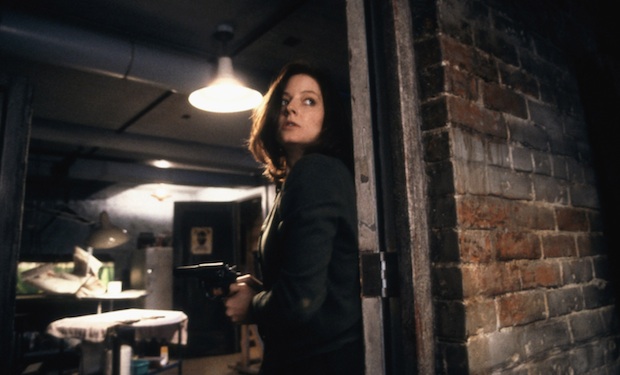
Speaking of going into creepy basements, let’s go to a simple example: Silence of the Lambs. If you’ve read Thomas Harris’s book, you know how effective the author was at descending into the lowest rungs of every character’s motivations. But even the movie did a pretty good job at this. Let’s dissect our heroine:

What does Clarise Starling want?

Level 1: She wants to solve the case. She wants to find Buffalo Bill. (basic thriller plot)

Level 2: She wants to prove she can hang with the big boys of the FBI. (basic thriller with feminist theme)

Level 3: She wants to escape her suffocating southern small-town roots and the FBI was a ticket out of hicksville. Remember how impressed one of the victim’s girlfriends was with Clarise’s job? (Basic thriller with feminist theme and rich backstory.)

Level 4: She wants to impress her boss-mentor Jack Crawford. (basic thriller with feminist theme, good backstory and father-figure character interplay.)

Level 5: She wants to validate herself as being worthy of her father’s legacy because he was a cop killed in action. She gets approval by proxy via Crawford, who tells her at the end that her father would have been proud of her.  (Now this is getting interesting!)

Level 6: She wants to make the lambs stop screaming. Cool…But what does this mean psychologically? Clarise is haunted by a childhood memory of hearing lambs being slaughtered. I have always read this as her attempt to exorcise her demons of abandonment, her human need to deal with existential loneliness, her way of pushing back against the black void. “I thought if I could only save just one,” she tells Lector. She’s talking about saving Buffalo Bill’s victims, but isn’t she really talking about herself?

(While we are at it, has anyone else noticed how eerily similar Silence of the Lambs and Jodie Foster’s other movie Contact are in character themes? Both are smart, emotionally fragile women raised by fathers then orphaned, both manipulated by brilliant outcast men. And both women are staring into the vast blackness and hoping they are not alone.)

Let’s go to another example. What does Captain Ahab want in Moby-Dick?

Level 1: He wants to catch the whale that maimed him. (Simple story of revenge).

Level 2: He wants to prove to his crew and himself that even though he’s got one leg, he is still a man. (He even smuggles his own crew onboard just in case.)

Level 2: He wants to strike out against the pacificism of his Quaker religion. Not so simple theme that’s right here in this passage:

The White Whale swam before him as the monomaniac incarnation of all those malicious agencies which some deep men feel eating in them, till they are left living on with half a heart and half a lung. That intangible malignity which has been from the beginning; to whose dominion even the modern Christians ascribe one-half of the worlds; which the ancient Ophites of the east reverenced in their statue devil;—Ahab did not fall down and worship it like them; but deliriously transferring its idea to the abhorred white whale, he pitted himself, all mutilated, against it. All that most maddens and torments; all that stirs up the lees of things; all truth with malice in it; all that cracks the sinews and cakes the brain; all the subtle demonisms of life and thought; all evil, to crazy Ahab, were visibly personified, and made practically assailable in Moby Dick.

Level 3: He wants to vanquish evil, what he calls “the inscrutable thing.” And he’s not sure God is on his side or even exists. He’s like Hamlet, looking for some metaphysical truth in all the madness. And I am sure Peter Benchley had Ahab in mind when he created Quint the shark hunter in Jaws.  Both men are nuts but sort of magnificent. Which is why they had to die.

So here’s what I’d like to leave you with. The next time you think about your characters’s motivations, go deeper. Think hard and long, applying great gobs of elbow-grease of the mind. Don’t be content with staying on the top levels. Don’t skim the surfaces.

MSDSIOF EC076

Don’t be afraid to descend to the very bottom rung and enter that dank dark basement of the human soul. That’s where you find the good stuff.


How to Write Act II

american-act-ii-microwave-popcorn-tub-9866-pA couple of months ago I released Super Structure: The Key to Unleashing the Power of Story. I’ve received many nice emails and comments about it, but recently two people asked me the same question. And it’s a good one, so I thought it worthy of a full post. Here’s a clip from an email (used by permission):

I’ve often noticed that writing books get a bit too abstract at times about theme, as if it’s something impossible to hold onto or grasp. But you are so clear by making it come across so smoothly in the super structure points. There is something very smooth about your approach. I felt very grounded as I read.

This is a small point that I’ve wanted to ask a teacher for some time because I’ve noticed this situation in other structure layouts: Why is it that Act II, which constitutes at least half of the entire story (actually > 55% if Act I is 20% and Act II is 25%), have relatively fewer super structure points (i.e., Kick in the Shins, The Mirror Moment, Pet the Dog, Doorway of No Return #2). There are 4 in Act II to guide the writer for 55% of the story but 10 to guide the writer for the other 45% (Act I and III combined). And yet we’re often told that the hardest part of writing a novel or screenplay IS Act II. Is it the hardest partly because it’s harder to teach in terms of structure, etc.?

That’s an excellent and insightful question. It does seem counter-intuitive to suggest in a book about structural signposts that the least number of them occur in longest section of the novel.

But, in point of fact, this is exactly how it must be.

First of all, what is Act II all about? It’s about the Lead’s confrontation with Death. Death can come in three guises: physical, professional, or psychological. That’s what makes the stakes high enough for the reader to care about what’s going on.

Act I prepares us for this death struggle. To get readers to care about what happens, we have to bond them with a Lead character, show something of the ordinary world, have hints of trouble to come … and then we have to find a way to force the Lead through that Doorway of No Return. Why force? Because no one wants to confront Death unless they have to! (Or unless their name is Evel Knievel.)

That’s why there are several important structural beats in Act I.

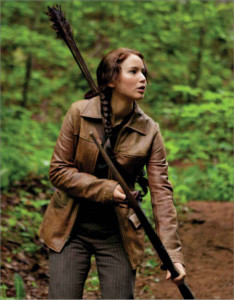
Okay, now the Lead is in the dark forest. To survive and get back to the castle, she’ll havekinopoisk.ru to defeat the forces arrayed against her. If you want a perfect illustration of this, think of The Hunger Games. Katniss Everdeen is taken from her ordinary world and thrust into a contest to the death, in an arena filled with obstacles and opponents.


Now, keep these two points in mind:

1. There are innumerable actions the Lead can take to gain her objective, to survive, and to ultimately defeat the opponent.

Standing at the edge of that dark forest, the Lead might: go left, go right, go straight ahead, follow a sound, run from a sound, climb a tree, make a weapon, start a fire, form an alliance, fight off a monster—whatever it is, you, the author, get to choose.

2. Each subsequent action will, in some way, be a reaction to what’s just happened.

If the Lead breaks her leg, she won’t be running in the next scene. If her love interest decides to walk out on her, she won’t be singing a happy tune.

You may also find that a character refuses to do what you want. In one novel I tried to get a wife to go away to her sister’s house, but she would not do it. I’d planned for her to go, I tried to push her out the door, but no soap. So I had to readjust, and in this case the character was right!

In short, a more “open” Act II enables us to respond to the story as it takes shape.

This is true, by the way, whether you like to outline or whether you prefer to wing it.

Further, you don’t need as many signposts because your scenes should have an organic logic to them. Act II is largely made up of the Lead’s battle plans. We know what the objective is: defeat death! In The Hunger Games it’s physical death; in The Catcher in the Rye, it’s psychological death; in The Verdict, it’s professional death.

So the Lead, in Act II, takes an action to gain a foothold in this battle. And suffers a setback.  Now what?

She forms a new plan, takes a new step, reacting to and learning from the last one.

In this way you have a natural, logical, clear and compelling “plot generator.” You don’t need as many signposts to do that.

If you ever feel “lost” in Act II, just go back and check a few things:

• Are the stakes death?

• Is the Opponent stronger than the Lead?

• Is your Lead using strength of will to push forward?

• Is there an easier way for your Lead to solve the problem? (If so, figure out how to eliminate that possibility)

Then brainstorm a few questions:

• How can things get worse for the Lead?

• What’s the worst thing that could happen to the Lead?

• Can a new character come in to complicate matters even more?

• What are the enemies of the Lead doing “off screen”? That is, what actions are they taking while the reader is reading the current scene? (This is a great way to come up with plot complications.)

Soon enough, you’ll be back on track with plenty of ideas for organic scenes, rising and falling action, throughout Act II.

Then, at some point, you have to get the Lead through another doorway, into Act III, where the final battle takes place. There are more signposts in Act III to guide you through this section. That’s because you can’t dilly dally. You’ve got the Lead going over a waterfall. You’ve got to get him to safety, fast.  The Act III signposts have a shorter space between them, which is exactly what you need.

Make sense?

I think it was Isaac Asimov who said that he knows the beginning and the ending of his novels, but then has the “fun” of finding out how to get from the one to the other.

So go go have some fun.

And tell us how you approach Act II in your own novel writing. What challenges do you find? How do you address them?

Reimagining the Past

photo 4I returned from an amazing trip to India all the more excited about possible future projects not just because my ‘on the ground’ research was more fruitful than I expected, but because I’d been able to experience that critical connection to history that will (I hope) provide the window I need to reimagine the past. I’d felt this connection once before, in Venezuela, and it provided me the impetus for writing my first Ursula Marlow mystery, Consequences of Sin.

For a historical mystery writer, I need to feel a connection to the history I’m writing about. I want to convey the sensory experience of what it would have been like to live in another era and for that I need some means of accessing the past on a personal level to enable the true ‘reimagining’ process to begin. This is easy for me in a place like England where  family ties already establish that connection, but much harder when I consider other places and eras to which I have little in the way of understanding or connection.

I wasn’t sure what I’d find on my trip to India (apart from obviously some very beautiful places – see the photo of the Taj Mahal above – which is awe-inspiring – and the sharp contrast between poverty and luxury – also evident in Agra just streets away from the Taj Mahal). I certainly wasn’t sure what my reaction would be to the place or its history.

As it turned out, I was surprised how easily I felt an affinity to those Europeans who arrived in India during the late 18th and early 19th centuries (the period that I had, not surprisingly, been researching with a future novel in mind). Although many historical places were difficult to isolate against the noise, traffic and bustle of modern life in India, I had no trouble reimagining what it must have once  been like. I also found that I was beginning to inhabit the mind and imagination of some of the characters I had begun to sketch out in my head before my trip, and so much of what I saw, smelled, and heard could be accessed through the prism of their thoughts and background, not just my own.

photo5One of the most surprisingly things to come out of my research was that the place I had originally believed would be the initial setting for my story (Hyderabad) was totally displaced by my experiences in another city (Udaipur – photo to the right) and I saw quite clearly my characters inhabiting this landscape and not the one I had previously envisaged (only downside, a whole new set of history books to read!).


One of the best things about travel is that it rarely provides the experience you expect – and it’s in the unexpected that I find the greatest inspiration.

So now I’m back, I just need to get down to the business of actually writing. In the meantime, I’d love to hear some TKZers’ unexpected travel and research experiences – how have they inspired your writing?

Top Ten Things You Need to Know About Characters

Scarlett210. Characters are how  readers connect to story

I’ve read books about the history of eras, and while interesting, they are nothing compared to a good biography (I’m currently reading H. W. Brands’ biography of Andrew Jackson). Why? Because we are more fascinated with people than epochs. (I once heard history described as “biography on a timeline.”)

We all love twisty turny plots, chases, love, hate, fights, freefalls––all of that. But unless readers connect to character first, none of that matters.

9. On the other hand, character without plot is a blob of glup

Contrary to what some believe, a novel is not “all about character.” To prove the point, let’s think about Scarlett O’Hara. Do you want 400 pages of Scarlett sitting on her front porch, flirting? Going to parties and throwing hissy fits? I didn’t think so. What is it that makes us keep watching Scarlett? A little thing called the Civil War.

A novel is not a story until a character is forced to show strength of will against the complications of plot. Plot brings out true character, rips off the mask, and that’s what readers really want to see.

“Blob of glup,” by the way, is a term I remember from my mom reading me The Thirteen Clocks by James Thurber. I always thought it quite descriptive.

8. Lead characters don’t have to be morally good, just good at something

Two of the most popular books in our language are about negative characters. I define a negative character as one who is doing things that the community (theirs, and ours) do not approve of, that harm other people. A Christmas Carol has Scrooge, and Gone With the Wind has Scarlett. Why would a reader want to follow them?

Two reasons: They want to see them redeemed, or they want to see them get their “just desserts.”

The trick to rendering a negative Lead is to show, early, a capacity for change. When Scrooge is taken back to his boyhood, we see in him, for the first time, some compassionate emotion. Maybe he’s not a lost cause after all!

Or show that the negative character has strength, which could be an asset if put to good use. Scarlett has grit and determination (fueled by her selfishness) and just dang well gets things done. We admire that, and hope by the end of the book she’ll turn it to something that actually helps those in her world. She does, but by then it’s too late. Rhett just doesn’t give a damn.

7. Characters need backstory before readers do

Yes, you have to know your character’s biography, at least the high points. One question I like to ask is what happened to the character at sixteen? That’s a pivotal, shaping year (unless your character actually is sixteen, in which case I’d go to age eight).

But you don’t have to reveal all the key information to readers up front. In fact, it’s good to withhold it, especially a secret or a wound. Show the character behaving in a way that hints at something from the past, currents below the surface. Why does Rick in Casablanca stick his neck out for nobody? Why does he play chess alone? Why doesn’t he protect Ugarte? Why doesn’t he love Paris? We see him act in accord with these mysteries, and don’t get answers until well into the film.

6. But readers want to know a little something about the character they’re following

Against the advice that you should have absolutely zero backstory in the first fifty pages, I say do what Stephen King, Dean Koontz, Michael Connelly and most every bestselling novelist does: sprinkle in bits of backstory in the opening pages. But only what is necessary to help readers bond to character.

A rule of thumb I give in my workshops is this: In the first ten pages, you can have three sentences of backstory, used all together or spread out. In the next ten pages, you can have three paragraphs of backstory, used all together or spaced out. This will force you to examine closely what you include, saving the rest for later, and letting the story get cracking.

5. Memorable characters create cross-currents of emotion in the reader

We all know about inner conflict. A character is unsure about what he’s about to do, and there’s an argument in his heart and soul, giving him reasons both for and against the action. That’s good stuff, and one way to get there is to identify the fear a character feels in each scene.

But to create even greater cross-currents of emotion in the reader, consider having the character do something the absolute reverse of what the reader expects. Brainstorm ideas for this, and you’ll often find a great one down the list, beyond your predictability meter. Put that action in. Write it. Have other characters react to it.   

Only then find a way to justify the behavior, and work that into your material.

It was E. M. Forster, in Aspects of the Novel, who defined “round” (as opposed to “flat”) characters as those who are “capable of surprising us in a convincing way.”

4. Great villains are justified, at least to themselves

The antagonist (or as I like to put it, the Opponent) is someone who is dedicated to stopping the Lead. It does not have to be a villain, or “bad guy.” It just has to be someone on the other side of one definition of plot: two dogs and one bone.

When you do have a bad guy opponent, don’t fall into the trap of painting him with only one color. The pure-evil villain is boring and manipulative, and readers won’t fall for it. You’re also robbing them of a deeper reading experience (for which they’ll thank you by looking for your next book).

One exercise I give in workshops is the opponent’s closing argument. Pretend they have to address a jury and justify their actions. They are not going to argue, “Because I’m just a bad guy. I’m a psycho. I was born this way!” No bad guy thinks he’s bad. He thinks he’s right.

Make that argument. Weave the results into your book.

3. Don’t waste your minor characters

One of the biggest mistakes I see new writers make is putting stock characters into minor roles: The burly bartender, wiping glasses behind the bar; the boot-wearing, cowboy-hat-sporting, redneck truck driver; the saucy, wise-cracking waitress.

Instead, give each minor character something to set him or her apart from the stereotype. Think of:

• Going against type (a female truck driver, for example)

• An odd tick or quirk

• A distinct speaking style

Use minor characters as allies or irritants. Even those who have only one scene. A doorman, for example. Instead of his opening the door for your Lead, have him give the Lead a hard time. Or have your Lead in a hurry but the cab driver is lethargic and chatty.

A little time spent on spicing up minor characters will add mounds of reading pleasure to your readers.

2. Great characters delight us

When I ask people to name their favorite books or movies, and then ask why, it’s invariably because of one great character. As good as Harrison Ford is in The Fugitive, people always mention Tommy Lee Jones, and even his famous line, “I don’t care!”

The Silence of the Lambs? Two great characters. The absolutely unforgettable Hannibal Lecter, and the insecure but dogged trainee, Clarice Starling. Lecter delights us (because we are all a little twisted) with his wit, deviousness, and dietary habits. Clarice delights us because she’s the classic underdog who fights both professional and personal demons.

1. Great characters elevate us

Truly enduring characters end up teaching us something about humanity and, therefore, about ourselves. They elevate us. And that is true even if the character is tragic. As Aristotle pointed out long ago, the tragic character creates catharsis, a purging of the tragic flaw, thus making us better by subtraction.

On the positive side, I think of Harry Bosch and Atticus Finch, both on a seemingly impossible quest for justice. I’m the better for reading about them, and those are the kinds of books I always read more than once.

On the negative side, I think of the aforementioned Scarlett O’Hara. We are pulling for her to do the right thing, to get with it, to join the community of the good. Then she goes off an marries some other guy she doesn’t love and uses him mercilessly. When she finally suffers the consequences of her actions we, too, are duly warned.

So, TKZers, when you think of an unforgettable character, who comes to mind? What is it about this character that moves you? Elevates you? Makes you want more of the same?

Book Sores


By Elaine Viets
stack-of-books

Some bookstores are mad as hell at writers, and for good reason.
We writers still need bookstores. Even self-published writers like to see their work displayed on store shelves – at least the ones I know.
And bookstores need to fill those shelves with our pretty books.
books1

So why is it so hard to make this work?
I used to be a bookseller, and a couple of members of the tribe told me why writers’ books may not make it onto their shelves. I’m not using their names because they spoke bluntly about the issues.
Here’s what booksellers want you to do:
(1) Give me a real new release.
An independent bookstore owner said, “I’m not interested in mysteries that authors have been trying to sell on their own for six weeks, but are still calling new releases. When your book is first out, bring it to me.”
(2) Give me time to display your new release.
Make sure your books are at the store in plenty of time. Either hound your publisher or personally deliver the books to the store. “For an April 1 release, I’ll need to have a copy of the book in my store by March 25,” an indie bookseller said.
(3) It costs money to stock your books.
“Many traditional publishers are charging restocking fees now,” the indie bookseller said. “So if your books don’t sell, my store loses money. Self-published books require paperwork and have storage, pickup and delivery problems. I don’t have to the space to keep them.”
(4) A fact of book selling life: Some local authors don’t sell in my store.
The authors are charming. Their covers are good-looking. “But their books don’t sell. I’ve had some authors’ books for a year and no one bought them,” he said. The big box stores would have returned those books months ago.
“I can display your books as a new release for two or three weeks, but if they don’t sell, I can’t afford to give those books shelf space.” If this bookstore isn’t the right fit for your work, look for one that can sell your books.
(5) A bookstore is a place to buy books – not a showroom.
“I’ve had people buy the books on Amazon – Amazon!” he said. “Then these same people come to hear the author at my store, eat my snacks and drink my bottled water and soda. Can they do that on Amazon? No!
“I’ve watched people in the audience take out their e-readers or their iPhones during the talk and order from Amazon. That’s why booksellers are starting to charge for signings.
“Authors, if you have a signing at my store, please ask your friends and fans to buy the book here.”
  (6) Avoid the A-word.
That’s Amazon. A Barnes & Noble community relations manager told me this story:
“A customer wanted a local author to speak and sign books for her group. I gave her the names of several people I thought would be a good fit for her organization. We spent half an hour discussing various authors, and then I gave her their contact information.
“ ‘Now,’ I said, ‘when you get the author, how many copies would you like to order for your event?’
“ ‘Oh, I’ll get the books from Amazon,’ she said. ‘They’re cheaper.’ ”
mrdunl

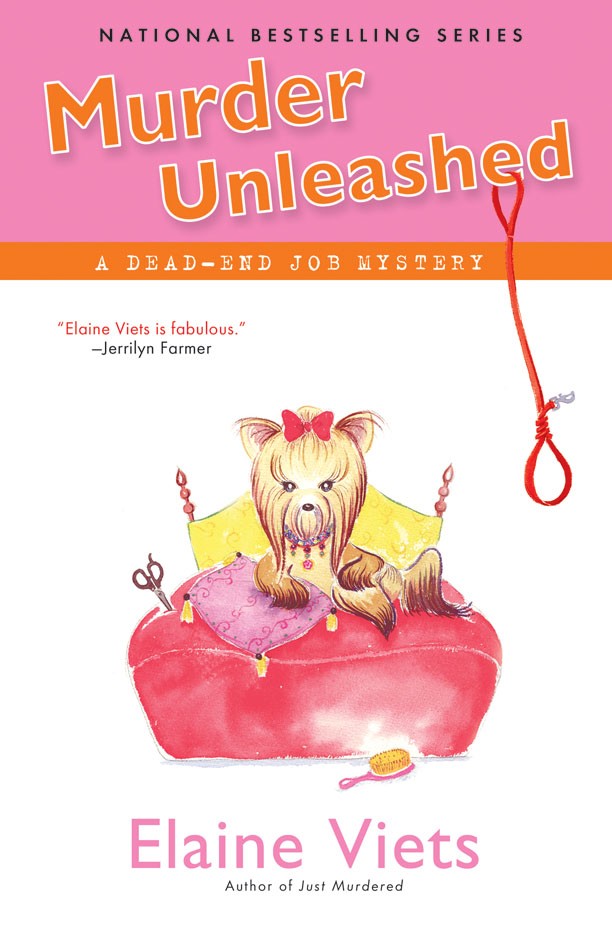
Win a free hardcover. I’m giving away my first Dead-End Job Mystery that was in hardcover, “Murder Unleashed.” Enter to win by clicking Contests at www.elaineviets.com

Better Brainstorming…
Even If You Write Alone

creative-brainstorming

“It is easier to tone down a wild idea than to think up a new one.” — Alex Osborn

By PJ Parrish

I don’t know how you guys do it. Those of you who write alone, I mean.

I am blessed in that I work with a co-author, my sister Kelly. Our collaboration began more than 20 years ago and has lasted through 20-some books (counting the ones that didn’t get published). And while we have had our disagreements over the years, we have always understood the power behind the notion that two brains are better than one.

I want to talk today about brainstorming.

This came about because I was cleaning out my computer folders the other day. I have one folder I labeled BRAIN LINT. This is just a depository for all the stuff I can’t find a good place for but am too gutless to throw out. In this folder are still-born story ideas, pictures cadged from iStock that were meant to inspire, old newspaper articles about bizarre crimes and weirdos, and one completed manuscript that is so bad I keep it just to remind myself of how far I have come and how far I could fall.

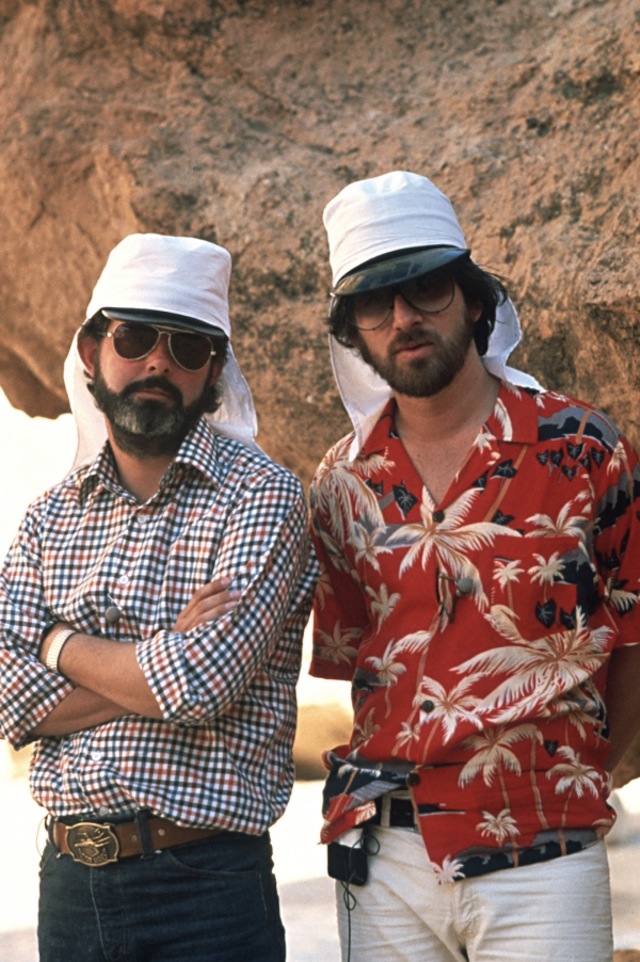
When I was cleaning out the lint, I found one gem. It is a transcript of a story conference in 1978 between Steven Spielberg, George Lucas and Lawrence Kasdan. They were brainstorming about a possible movie. It didn’t have a title then, but it would eventually be made under the title Raiders of the Lost Ark. You might have heard of it.

Here’s just one exchange:

george-lucas-steven-spielberg-looking-radLucas: We want to make a very believable character. We want him to be extremely good at what he does, as is the Clint Eastwood character or the James Bond character. James Bond and the man with no name were very good at what they did. They were very fast with a gun, they were very slick, they were very professional. They were Supermen.
Kasdan: How do you see this guy?
Lucas: Someone like Harrison Ford, Paul LeMatt. A young Steve McQueen. It would be ideal if we could find some stunt man who could act.
Spielberg: Burt Reynolds. Baryshnikov.
Kasdan: Do you have a name for this person?
Lucas: I do for our leader.
Spielberg: I hate this, but go ahead.
Lucas: Indiana Smith. It has to be unique. It’s a character. Very Americana square. He was born in Indiana.
Kasdan: What does she call him, Indy?

I still can’t get the image of Baryshnikov in a fedora out of a mind. But that was how Indiana Jones was born, out of a brainstorming session between three creative guys. What a strange word – brainstorming. Ever wonder where it came from?

AFOsbornWell, in 1919, Alex Osborn, an ex-newspaper man from Buffalo, joined with Bruce Fairchild Barton and Roy Sarles Durstine to form the hugely successful BDO advertising agency. Osborn went on to write many books on creativity but he’s the one who coined the term “brainstorming.”

Nowadays, “brainstorming” is a catch-all for any type of creative group grope. But I thought it might be interesting to go back and see what Osborn had to say about it back in 1953 and find out if it could help writers today. Well, guess what? It’s still good advice, whether you are collaborating, working in a critique group — or even flying solo.

Here’s my main take-aways from Osborn’s ideas on brainstorming.

1. Think up as many ideas as possible regardless of how ridiculous they may seem.  It’s unlikely you’ll get the perfect solution right off the bat, so he recommends getting every idea out of your head and then go back to examine them afterwards. An idea that may sound crazy may actually turn out to work with a little modification.

Doesn’t this make sense when you’re plotting? I know when Kelly and I talk, we throw everything on the wall. You need to take the same approach with yourself. Write down every idea and let them bake for a while. Sometimes, the most outrageous thing leads to something useful.

2. Don’t be judgmental. All ideas are considered legitimate and often the most far-fetched are the most fertile. Ideas can be evaluated after the brainstorming session but judgments during the process should be withheld.

Are you sometimes too hard on yourself? Do you think, “Oh, that’s so stupid, no editor will ever buy it.” Or maybe you are a self-doubter, telling yourself, “I don’t have the chops to try this technique.” Or: “This is a great idea but it’s so complex so I won’t even try.”

3. Go for quantity not quality. Don’t get hung up (like I often do) on coming up with the most clever solution to your writing problem. Let your brain waves flow so the bad stuff bobs up to the surface along with the good. Osborn said: “Creativity is so delicate a flower that praise tends to make it bloom while discouragement often nips it in the bud. Forget quality; aim to get a quantity of answers. When you’re through, your sheet of paper may be so full of ridiculous nonsense that you’ll be disgusted. Never mind. You’re loosening up your unfettered imagination—making your mind deliver.”

Osborn’s books were geared more toward corporate types trying to get their teams to think more creatively on things like how to get traffic flowing better in big cities. But take a look at his suggestions for improving creativity and see if there’s not something here for us mere writers:

1. Break up the problem into smaller pieces. For writers, this can mean tackling each plot or character problem as manageable bites, not getting overwhelmed by the idea that you’ve got 400 pages to fill. Get that first draft written then go back and fix your plot holes or layer your characters better.

2. Search for alternatives. If you’ve painted yourself into a plot corner, look for a different way out than the old ways.

3. What can be borrowed or adapted? Read other writers and learn from them.

4. Modify with new twists. There aren’t many new plots in crime fiction but there is always a way to put your own fresh imprint on them.

5. Is there something that can be magnified or minified? Maybe the stakes in your thriller aren’t high enough. Maybe you need to play down a secondary character who is overshadowing your hero. Are you larding in too much research?

6. What can be substituted? Maybe if you changed your location the story would suddenly come alive. Would your mystery work better in a small town where you could exploit the English village dynamic? Is your setting banal and underwritten? Are you hitting all the wrong clichés if your book is set in Paris or some other iconic place?

7. What can be re-arranged? Maybe you’re writing in the wrong point of view? Try switching from first to third. Or maybe the guy you think is your hero is really the bad guy?

8. Consider the vice versa. I love this one. Do just the opposite of what you are now doing. Is your protag male? Switch gender! Are you relying on tired character tropes (lonely alchoholic PI, sweet antique store owner who solves crime). Make your brain do a 180 and examine what is on the flip side. I did this with my latest book. The woman I thought was my protag turned out to be one of two in a dual-protag parallel theme story.

Okay, enough lessons. Let’s end by going back and eavesdropping some more on the Indiana Jones brainstorm session. CLICK HERE to read the whole thing.

97147d290117720Lucas and Spielberg started with the idea that they wanted to make a movie that was like old Republic serials of the Thirties (Zorro, Dick Tracy, Red Ryder). Something had to always kept happening, every ten minutes or so another cliff-hanger situation. From there, the guys dreamed up Indiana Smith and other elements. In the beginning, even the ark was just a MacGuffin.

Lucas: The thing is, if there is an object of antiquity, that a museum knows about that may be missing, or they know it’s somewhere. He can go like an archeologist, but it’s like rather than doing research, he goes in to get the gold.
Spielberg: His main adversaries will be the Germans?
Lucas: Yeah, I think they should be. I’ve been trying to move him around the world a little bit to see if we can’t get a little Oriental influence into it just for the fun of it. I may have fit it in. The fun thing is, he’s a soldier of fortune, so we can move him into any sort of exotic thirties environment we want to.
Spielberg: Keep him out of the States. We don’t want to do one shot in this country.
Lucas: The film starts in the jungle. South America, someplace. We get one of these great scenes with the pack animals going up the mist-covered hills. Very exotic mist-filled jungles and mountains.
Spielberg: Where he goes into the cave?
Lucas: This is where he goes into the cave. We had it where there’s a couple native bearers, whatever, and sort of a couple of Mexican, well not Mexican…
Spielberg: They’re like Mayan.
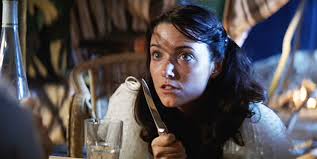
imagesLucas: They’re the third world local sleazes…[LATER] He goes into this very sleazy Casablanca type club and makes contact with this agent. The agent is a girl. She’s sort of a Marlene Dietrich tavern singer spy. A German lady singer. She’s really a double agent.
Spielberg: I like the idea that she’s a heavy drinker and our hero doesn’t drink at all. She gets drunk a lot. She’s beautiful and she gets really sexy when she’s drunk, and silly. And he doesn’t touch the stuff.
Lucas: I don’t want to soften her. I like the fact that it’s greed. I like all the hard stuff, but you’re going to love her.
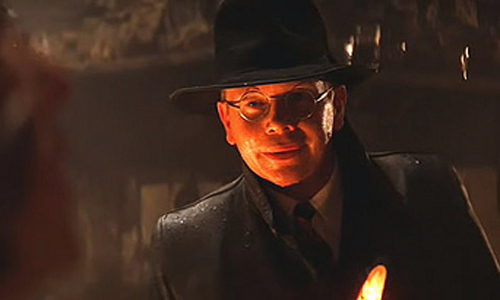
Raiders-of-the-Lost-Ark-indiana-jones-23708996-500-300Spielberg: There should be a real slimy German character. He’s the only gestapo involved there. Every time you see him, you know it’s going to be the worst pain, death by torture. This guy looks like a ferret. He’s got that slick black hair. His name is Himmler or something like that. He’s a stocky short guy, a master torturer.
Lucas: What can he chase them with? What if he jumps on a camel?
Spielberg: I love it. It’s a great idea. There’s never been a camel chase before.
Lucas: Is this camel going to chase a car?
Spielberg: You know how fast a camel can run? Not only that, he can jump over vegetable carts and things. We still have the big fight in the moving truck to do. And now we have a camel chase.
Lucas: We’ve added another million dollars.
Spielberg: Not really. How much trouble can a camel be?

And then they talk about the big scene toward the end where Indy and Marion are tossed into that deep tomb and the bad guys cover it up with a rock. They’re trying to figure out what is in the tomb that’s dangerous and how Indy gets out. They decide there is a huge artesian well that opens up and he and Marion are in danger of drowning. Then somebody suggests there are also wild animals in the tomb, like tigers.

Spielberg: It would have to be a neighborhood tiger.
Lucas: There aren’t any tigers out there.
Spielberg: I’m not in love with the idea.
Lucas: You could have bats and stuff, make it slightly spooky.
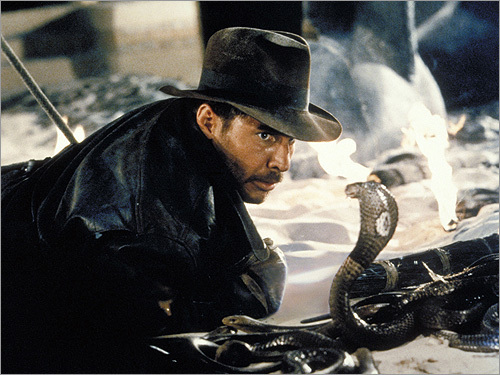
Spielberg: What about snakes? All these snakes come out.
Lucas: People hate snakes. Asps? They’re too small.
Spielberg: It’s like hundreds of thousands of snakes.
Lucas: When he first jumps down in the hole, it’s a giant snake pit. Then when he says they’re afraid of light, they throw down torches. You have a whole bunch of torches that keep the snakes back. So he only has one more torch, and the snakes start coming in. He sits there with one torch, knowing that when the torch goes out… It’s the idea of being in a room, in a black room with a lot of snakes. That will really be scary.
Spielberg: The snakes are waiting, looking at him. Thousands. And the torches are burning down. He’s trying to keep it going. The torch goes out. The whole screen goes black. The sound of the snakes gets more intense. You hear him backing up. The camera pans and suddenly you see, it’s black, but there’s light coming from several cracks. It’s not completely black. That leads him to an opening. To a rock that isn’t so flush against the other rocks. He knows there’s access. He keeps pushing on it, he gets a little more room.
Lucas: We shouldn’t have any snakes in the opening sequence, just tarantulas. Save the snakes for now.
Spielberg: It would be funny if, somewhere early in the movie he somehow implied that he was not afraid of snakes. Later you realize that that is one of his big fears.
Lucas: It should be slightly amusing that he hates snakes, and then he opens this up, “I can’t go down in there. Why did there have to be snakes? Anything but snakes.”

raiders-of-the-lost-ark

Now, aren’t you glad they didn’t go with the tigers?