by
Debbie Burke
@burke_writer
What makes readers care about your story?
STAKES.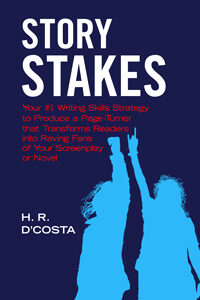
What are stakes? Quite simply, they are the consequences if the protagonist fails. What will s/he lose?
The world could end; the lovers may not get together; the serial killer might claim more victims, etc.
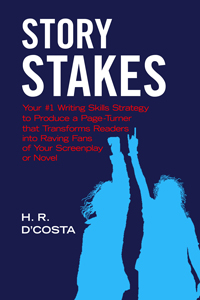
I recently read H.R. D’Costa’s craft book Story Stakes. My copy is now full of yellow highlighter markings because she makes her points clearly and concisely. Her style is straightforward, logical, and easy to follow.
Using specific examples, D’Costa lists 11 types of stakes to “increase tension and reader engagement.” Screenwriters are experts at creating high stakes, therefore many of her examples are from films. But the same principles apply to books.
With her permission, here is her list:
Stake #1: General Protection – from the fate of an entire galaxy (Star Wars) to the safety of passengers on a booby-trapped bus (Speed), general protection focuses on the lives of others who will suffer if the hero fails.
Stake #2: Demise – physical death is the consequence to the hero or someone precious to him/her.
Stake #3: Livelihood – failure by the hero means loss of a job, profession, ability to support family, etc.
Stake #4: Freedom – the hero or someone close to him/her will go to prison or otherwise lose their freedom and autonomy.
Stake #5: Reputation – if the hero’s good name is besmirched, his/her legacy is disgraced. That can lead to other stakes coming into play, like the loss of respect/love of family and friends, or loss of livelihood.
Stake #6: Sanity – the hero could lose his/her mind. Gaslight (Ingrid Bergman, Charles Boyer) and Hitchcock movies like Vertigo and Rebecca explored this stake.
Stake #7: Access – the hero could lose connection with loved ones, lose his/her home, or be shunned by his/her community.
Stake #8: Regret – The hero may have a dream but doesn’t achieve it because s/he didn’t grab an opportunity. Another variation on regret is the hero failed in the past and has been plagued by guilt ever since, such as In the Line of Fire, where a Secret Service agent (Clint Eastwood) didn’t save President Kennedy. The plot offers the agent a second chance to save another president. Failure will doom him to a life of regret but success gives him redemption and peace of mind.
Stake #9: Suffering and Sacrifice – the hero suffers and sacrifices health, wealth, love, or endures other hardships in order to achieve a goal. If s/he fails, all suffering and sacrifice are in vain.
Stake #10: Justice – If the hero fails, the villain gets away with a heinous crime and never faces punishment for evil deeds.
Stake #11: Hero Happiness – The hero pins all hopes and effort on a prize. If s/he fails, the prize is lost.
Stakes are the emotional link between the story and the reader. Through the characters, the reader vicariously faces terrible problems and must make difficult choices with dire consequences.
Stakes make the reader ask questions:
“What would I do in this situation?”
“How would I react if my family was in jeopardy?”
“What would I give up to achieve this goal?”
D’Costa makes clear that a single stake is not enough to forge a strong emotional bond between the hero and the reader. Step by step, she analyzes emotional factors that drive characters’ decisions and how readers relate to those stakes.
She goes on to illustrate how to layer stakes, one on top of another, blending them into a compelling tangle from which the hero—and the reader—cannot escape. The hero must keep pushing forward, despite increasing danger, and the reader must keep turning pages to find out what happens.
She also shows how stakes can change during the course of the plot, starting out with one set of problems that morph into different stakes. Each complication becomes more complex and perilous, leading to ever-worsening consequences.
D’Costa (aka HRD) graciously agreed to share further insight into her book and writing process in the following Q&A:
DB: What specifically prompted you to write Story Stakes?
HRD: First, let me say thanks so much for featuring Story Stakes on The Kill Zone today, Debbie! I really appreciate it.
Your question is an interesting one because I didn’t intend to write a craft guide about stakes—not initially, at least. I was actually working on a craft guide about creating the kind of dazzling climax that would turn a novelist into an “auto-buy” for readers.
In conducting research for that book, stakes came up again and again. They really define the overall quality of your story climax. Anyway, when editing the climax book, it quickly became apparent that the stakes warranted a book of their own.
So I stopped working on the climax book, and began conducting research again—this time focusing exclusively on the stakes, and how to use them to deepen readers’ emotional involvement in a story.
DB: How did you develop your 11-point stakes list?
HRD: Most of my research consisted of watching movies in a variety of genres and asking myself two main questions:
- What initially motivated the protagonist to pursue his goal?
- What techniques did the filmmakers use to make audiences even more invested in the outcome of the climax?
Looking for patterns led to the creation of a master list of 11 types of story stakes as well as a list of modulating factors (these help you elicit even more emotion from the same set of stakes) and strategies to raise the stakes.
By the way, if TKZ readers would like a printable PDF list with the 11 types of story stakes, they can find one here.
I found it really interesting that some types of story stakes can’t stand on their own (they need to be paired with another set of stakes). Even though these non-standalone stakes don’t drive the plot, they’re valuable because of how they heighten reader emotion.
For instance, throughout the middle of a story, the protagonist experiences several ordeals. If the protagonist fails to achieve his goal, he will have suffered in vain—and these stakes of suffering inject a story with extra emotional intensity.
However, ordeals emerge from conflict. In other words, if your characters are, to quote TKZ’s own James Scott Bell, “Happy People in Happy Land,” your plot won’t just be boring. Because stakes of suffering are virtually nonexistent, your plot will also lack emotional juice. It’s a good example of how one storytelling choice impacts another.
DB: Who are your favorite influences vis a vis writing craft?
HRD: Many years ago, thanks to my dad, I was able to attend Robert McKee’s famous Story seminar. McKee said that we’d learn a lot by comparing a produced version of a film to its original screenplay. I started to do that—and discovered McKee was right. It got me hooked on that style of learning, so I continued along that path. Most of what I’ve learned has come from self-study—analyzing films, screenplays, and novels to understand what works and what doesn’t. That’s why I’d consider them my greatest teachers.
That said, some wonderful craft books gave me a solid foundation to build on. One of my favorites is Blake Snyder’s Save the Cat. It provides a good overview of story structure. More important, it makes screenwriting feel accessible. After you read it, you think, Yes, I can do this. Although it was written with aspiring screenwriters in mind, many novelists have found it useful, too. (Actually, now there’s an edition just for novelists, but I haven’t read that yet.)
Another gem: Write Away by Elizabeth George. This one really impressed upon me the importance of connecting all your plot events together through cause and effect. Although writers of all genres can benefit from this craft book, it might be especially valuable to TKZ readers since George uses her mystery novels to explain her points. In addition, she shares excerpts from her writing journals. These can be quite comforting to read when you hit a rough patch because you know George went through the same thing.
Relatively recently, I discovered Al Zuckerman’s Writing the Blockbuster Novel. In one chapter, he walks you through four outlines for Ken Follett’s The Man from St. Petersburg. Experiencing how the story evolved is both fascinating and instructive. One of my favorite tips from Zuckerman’s book relates to stakes, so it’s a good one to end on. *smile* Here it is: when deciding your point-of-view character for a scene, choose “the one who has the greatest emotional involvement, the largest stake in what’s happening.”
~~~~
D’Costa’s 11 variations are not a formula. Writers can mix and match stakes that work best. Learning how to blend stakes increases the emotional impact of your story.
And that leads to satisfied readers.
Story Stakes is a reference tool I’ll be referring to often. Thanks for writing it, H.R. D’Costa!
~~~~
 About H. R. D’Costa
A graduate of Brown University, H. R. D’Costa (a.k.a. HRD) is an author and writing coach who specializes in story structure and story stakes. Known for her “deep dive” instruction style, she is the author of 8 writing guides including Sizzling Story Outlines, Story Stakes, and the 4-volume Story Structure Essentials series. For practical, actionable writing tips designed to help you keep readers glued to your pages, visit her website scribemeetsworld.com, which is also home to the Ultimate Story Structure Worksheet (downloaded over 37,000 times by writers from around the world).
~~~~
TKZers – WIN A PAPERBACK COPY OF STORY STAKES
To win a paperback copy of Story Stakes, answer this question in the comments: What are some of your favorite examples of stakes in films or novels?
Debbie will randomly select a winner from the comments and announce the lucky recipient on July 25, True Crime Thursday.
Note: This giveaway is only open to residents of North America, South America, and Europe.
Good luck and happy writing!