
Last week we asked about your favorite movie of all time. What’s your favorite novel? Or let’s put it this way: What’s the one you’d take to that fabled desert island? (If you must, you can have a couple).
But also why? What is it about this particular novel that speaks to you? What can other writers learn from it?
My Writing Nemesis & AMAZON UPDATE
Now, I bet you think I’m going to write something cute about how some of my own personal writing habits are my own worst enemy, right? Nope. The truth is, I have actual writing nemeses out there–all authors so. It’s the dirty little secret that few of us ever confess to. Because here’s the thing; when your book hits the shelves, it’s directly competing against all the other releases that week (in addition to the books that go on sale in the weeks leading up to publication, and the ones for a month or so afterward). There’s a reason that we compulsively check Amazon rankings during those critical first few weeks; many publishers keep close tabs on early sales to determine if a) they’ll continue to publish your work, and b) if you merit an extra marketing push, or if the book will be left to languish.
There is quite literally not enough shelf space for all the new releases (even less now that so many stores have shuttered); and some will get prime placement, while others are crowded together in the stacks, with only the spine showing. It takes a truly dedicated reader to turn from those table overflowing with mountains of books to a perusal of the spines. And either way, your book will only be physically present in a store for anywhere from a few weeks to, at most, a few months after publication.
Which brings me back to my nemesis. Because not only is my book competing with every other book released in the same time frame, it’s also been directly competing for marketing dollars and attention with the other books being released by my publishing imprint.
And one of those authors, unbenownst to her, is my current nemesis.
Our books were released on the same day, so keeping tabs on her sales gives me a sense of how we’re performing with regard to each other. Because there’s an excellent chance that our next books will share a release date, too. And if one of our books takes off, and the other doesn’t, when the sales and marketing team is trying to decide which novel to push in August 2013, guess which one they’ll go with?
I know authors who went ballistic when a competing major author switched to “their” release week, claiming it stole their chance to make a bestseller’s list. I’ve never gone so far as that, but I’ve certainly experienced frustration when another author with the same publisher received a marketing benefit that my book was denied.
I had a different nemesis with my debut novel, a lovely man whose own debut received the bulk of co-op placement and marketing dollars from our publisher. Oh, how I loathed him at the time. It’s really not so different from an office environment. When a good friend gets a promotion, merited or not, it’s difficult not to struggle with the green-eyed monster; especially if you felt it was a promotion you were owed. Well, it’s no different for writers. Although our water coolers are virtual, and every day is casual Friday.
And that’s our dirty little secret.
ADDENDUM: AMAZON UPDATE
I was checking my book’s pages last night, and inexplicably, DON’T TURN AROUND is suddenly listed as a paperback, not a hardcover; the Kindle version can no longer be ordered at all, and none of the books are linked on each others’ pages anymore. Maybe I’m paranoid, but this feels a lot like retaliation for my blog post about Amazon deleting legitimate reviews…
Cultural Differences
By Nancy J. Cohen
Genres matter when you attend a conference. I started out in romance, attending National RWA and Romantic Times conventions. At RWA, we dressed in business attire and wore sequins to the Awards dinner. We taught workshops or we spoke on panels where the emphasis was teaching other writers the craft and business of writing. The same was true for smaller chapter conferences held around the state and throughout the country. Editor/Agent appointments were a staple for this type of working writers conference.

Romantic Times, in contrast, was a fan convention. Here we’d meet readers, booksellers, and reviewers in a fun, party-type setting. I still dressed in business casual during the day. At night, people wore costumes to themed balls and parties. As RT attracted more writers, they added writing tracks to educate aspiring authors. Now they’ve expanded to include other genres just as RT has changed its name to RT Book Reviews. It’s still a great conference to meet industry personnel and readers.
Then I switched to writing mysteries and attended Malice, Bouchercon, and SleuthFest. What a difference! People wore jeans! There were men in the crowd! Panelists were expected to be entertaining and witty and mostly talked about their books. Bouchercon and Malice are fan conventions while SleuthFest is a writers’ conference. SF has a forensics track and workshops for different levels of writing, along with editor/agent appointments.
The one thing these events have in common? Writers hang out at the bar, the hospitality lounge, or the dealers’ room and network like crazy. Costly swag gets picked up along with candy and pens. Bookmarks and other papers lay around the promo tables like unloved orphans.
And then I attended Necronomicon, my first SciFi/Fantasy/Horror convention. Lo and Behold! Another culture shock! In many ways, this convention was similar to the mystery cons. The panels were professional and moderated by a host. Aspiring authors attended in abundance. Instead of a forensics track like at a mystery writers conference, this convention had a science track led by scientist guests. However, here’s the biggest difference: Gamers. One darkened breakout room held 3 rows of computers where people sat playing Halo. Other guys sat at round tables absorbed in role playing games.
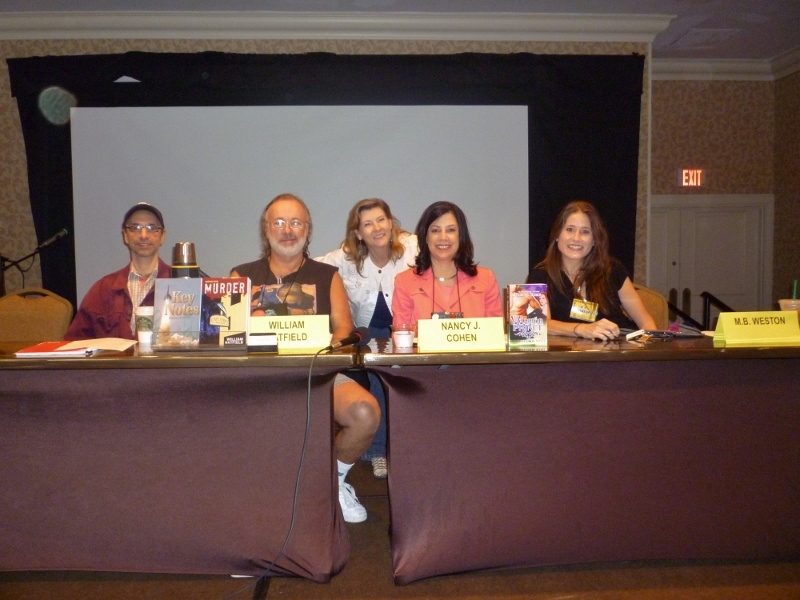
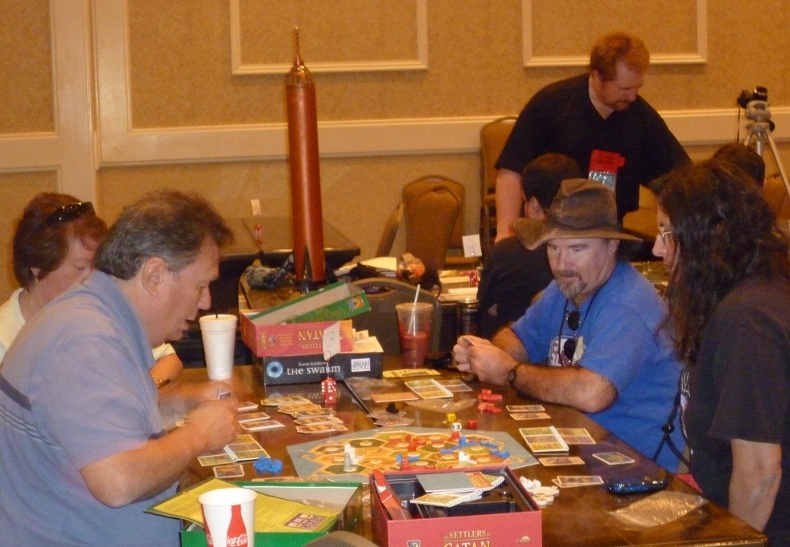
Workshops went on into the wee hours of the night. I was scheduled to speak on three panels and had to request the organizer not to book me after dinner. Authors who paid for a spot in Author’s Alley sat at tables in a hallway and sold their own books. The Dealers’ Room was similar to the ones at mystery cons, where authors hope one of the vendors has their books for sale or else we make a consignment deal. I noted only one bookseller at this convention. Most of the vendors sold jewelry, games, and other knickknacks.
All in all, this conference was a valuable introduction to an entirely new audience. The panels were interesting as well as stimulating, and parties ranged into the night if you were so inclined. Check out my personal blog for more photos and reports on the panels I attended. Keep in mind that this was not like the big SciFi cons where TV and movie stars attend and people roam around in costumes. There was a costume contest, but it was one night only. This felt more like a writers conference aimed at SciFi/Fantasy authors.

Would I attend again? The jury is still out on that one. While the conference was comped for me since I was a speaker, I still paid over $500 for a hotel room. I sold two books. Granted, this audience is more likely to order the ebook version, but would I spend that money again instead of attending a conference that targets mystery or romance fans? We’ll see. The exposure to a new crowd is always good, and I had a great time meeting new people. I guess as in any choices we have, it depends on the budget.
If you have crossed genres, were you surprised by the differences at the conferences you attended?
Thinking about scenes while on the wing

When this topic posts I’ll be flying somewhere over the Pacific, winging my way to Hong Kong, and later China. This flight has full-reclining seats, so I might even be snoozing, especially if I sample enough of the bubbly that gets passed around by the Cathay Pacific flight attendants. (Who, by the way, are the most gorgeous, smiling people I’ve ever seen on an airplane.)
I’ll be offline, so I’d like to post a Reader-Friday style question to you all. Describe the scene that you’re working on right now, and tell us what challenges it presents to you as a writer. How are you working to make it the best it can be?
Here’s mine: I’m working on a scene in my upcoming book, PLUS-SIZE HOMICIDE, in which Kate, the MC, receives an unexpected (and most unwelcome) visit from her overprotective father. While showing the tension between Kate and her father, I need to set the stage for an issue from Kate’s past that she’ll have to confront in this book: the murder of her mother. I’m concentrating on showing not telling, resisting the impulse to add too much back story.
What about you? What scene are you working on, and what is your main challenge in writing it?
Unreliable Narrators
In the midst of the end-of-year-moving-to-Denver chaos, I’m finishing Gillian Flynn’s excellent thriller, Gone Girl. Not only is it a great read, it also presents one of those hard to pull off characters – the unreliable narrator – which also got me thinking about the elements that go into developing this successfully – something I have never tried to do (out of fear, I suspect…)
So how does an author present a voice that is compelling as well as unnerving, sympathetic and yet suspicious? How does an author walk the fine line between belief and disbelief so that a reader is both intrigued as well as unsure whether to believe the narrator or not?
I think the key elements are:
- A strong unique voice from the outset – any form of narrator needs this for a first-person novel to succeed – but with an unreliable narrator I think this is even more important. A reader needs to be intrigued and disquieted but not totally put off (which is why I think there has to be a degree of sympathy, even when the character in question maybe pretty unlikeable.)
- The clues to the truth must be sown carefully, cleverly and slowly throughout the novel so that when the reader eventually comes to the necessary realization or revelation all the pieces fall into place… which leads to the next element and that is…
- Don’t cheat the reader – a reader needs to feel satisfied at the end of the book that they could have guessed the truth or read the signs as to what was really going on. Nobody wants to feel cheated or miffed that key clues had been deliberately excluded or misrepresented in such a way that the reader couldn’t have possibly guessed the truth.
- Make sure the inconsistencies or ‘grey areas’ are mapped out so they eventually help round out the narrator’s character in a way that feels authentic as well as compelling. An unreliable narrator is a tricky character to develop so you need to make sure it is a fully-formed, well-rounded character that ultimately feels real to the reader.
So what about you, fellow TKZers, have you ever attempted to write a first-person thriller with an ‘unreliable narrator’ at its heart? What do you think are the necessary elements to successfully pulling this off?
The Perils of Internet Information
We all know that Bogart never said, “Play it again, Sam.” That mangled quote, which Woody Allen famously used in his stage play (and later movie) came from Casablanca,where Bogart’s character actually has this exchange with Dooley Wilson (as Sam):
Rick: You know what I want to hear.
Sam: No, I don’t.
Rick: You played it for her, you can play it for me!
Sam: Well, I don’t think I can remember––
Rick: If she can stand it, I can! Play it!
Recently, I’ve seen another bastardized quotation zapping around the internet. It’s a quote attributed to Ernest Hemingway. As a Hemingway-phile, I was quite interested. The quote goes like this: “There is nothing to writing. All you do is sit down at a typewriter and bleed.”
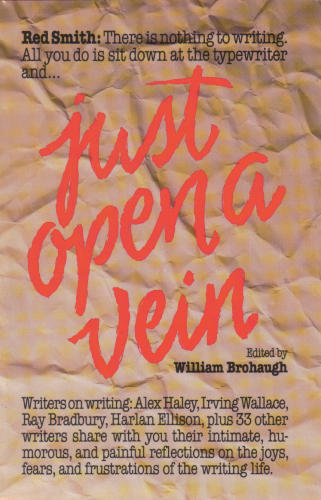
I was immediately suspicious. Something was rotten in the state of Bartlett, for it was the great sports writer Red Smith who said, “There’s nothing to writing. All you do is sit down at a typewriter and just open a vein.” (There are some variations on this, but the source is clear. You can read more here.)
This quote, in fact, became the basis of a book on writing, Just Open a Vein by William Brohaugh (Writer’s Digest Books, 1987). The Red Smith quote, with attribution, was printed right on the cover.
So how did these words get into Ernest Hemingway’s mouth, and thence to the wide world of the internet?
A TV writer did it, that’s how! As I investigated this further I came across an EW article from May 28, 2012, by Ken Tucker. It was a review of an HBO movie about Hemingway and his third wife, Martha Gellhorn. Tucker writes:
There’s a lot of dialogue that sounds as studied as Hemingway must have intended it to sound as he declaimed it (“Let me tell you about writers — the best ones are all liars”) and stuff that’s almost certainly cobbled together from various sources. (I was particularly amused when a negative review of the movie today in The New York Times made a point of ridiculing one Hemingway line — “There’s nothing to writing, Gellhorn — all you do is sit down to your typewriter and bleed” — but failed to realize it most likely derived from a New York Times sportswriter Red Smith’s wry dictum, “Writing it easy; all you have to do is open a vein and bleed.”)
So there you have it. It seemed like a good line to give to Hemingway in a biopic. But there’s another problem with having him say this (besides the fact that he never said it). The problem is he never would have said it!
Because Hemingway drafted in longhand, and he drafted standing up! He stood because of injuries sustained during his service in World War I. It was easier on him to be on his feet.
He usually only got to a max of 500 words in a single day, because he was famously trying to write “one true sentence” followed by another, and so on. (NOTE: There’s a famous author photo of Hemingway at a typewriter for the back cover of For Whom the Bell Tolls. But this was a staged photo to emphasize the Hemingway field reporter mythos).
So let’s be clear, when doing the hard work (the “bleeding”) of a first draft, Hemingway:
Did not sit.
Did not use a typewriter.
As his grandson, Sean Hemingway, once explained: “Hemingway wrote his first drafts in longhand, and you do not have to be a handwriting analyst from the FBI to appreciate his bold, fluid penmanship. Despite the author’s own comments in the book about the difficulty of the writing process and the need for revisions, many of his first drafts are remarkably clean, poignant testaments to his continued abilities as a writer later in life.”
And by the way, Hemingway never employed a secretary named Sam. Thus, he never, ever said, “Type it again, Sam.”
So here’s one instance where a reliance on what’s floating around the internet becomes a virus of error.
The irony, of course, is that I used the internet to do the research to get to the bottom of this. But this is the age we live in!
So what erroneous information have you come across in your internet surfing? What checks and balances do you use in your own research?
‘Twas Two Weeks ‘fore Thanksgiving…
Thanksgiving is less than two weeks away, but potential Christmas gifts are appearing on the shelves already. The one that most immediately comes to mind is a library-bound, digest-sized book entitled JACK REACHER’S RULES, which provides handy suggestions should you decide so far off the grid that you have to have sunlight shipped in, or want to set a building on fire; it’s great stuff, and just in time for the holidays for that Lee Child fan on your list who thinks they have everything. I have made a good dent in my shopping already; of course, I want nothing for myself. I believe that I have commented elsewhere that at my somewhat advanced age I am no longer interested in acquiring more possessions; rather, I seek new experiences. Alas, those that I have suggested to my spouse have been, shall we say, shot down. I will leave it to your imagination what they might be, and why they won’t happen.
So, I am asking you, since Christmas is coming…what, as far as books are concerned, are going to be looking to find under the tree in about five or six weeks or so? What do you want Santamazon to leave for you? It can be anything from the grandiose — an entire library in the basement — to the simple — a new writing journal — to something that is somewhere in between, like that slip-cased copy of MY PRETTY PONY by Stephen King that you could have picked up in a bookstore twenty-three years ago for a song and dance. What about a new tablet, the better to read DC e-comics on? Or what if Santa finishes that new novel you’ve been working on, the one that seems to be missing a hundred pages or so in the middle? What would you like?
Reader Friday: Best Movie Ever?
Writing Dialogue – Tips
I’ve always loved writing dialogue. It’s the backbone to a scene for me. When I had my day job and had to sneak off to write during my lunch hour, I first fashioned the scene with dialogue, using it as a framework for the other layers. I wrote the lines like a screenplay. I usually only had time to draft a scene or two that I would work on once I got home.
The next layer would be the body language and how the scene would move between the lines, to add the nuance of the people being together to add more context. I’d also layer in setting. And the last thing I would add was internal narrative to give color to my characters. I called this method, BUILDING AN ONION FROM THE INSIDE OUT and it’s part of my FOR WRITERS resources page – the post on START WITH A BANG, IT’S ALL ABOUT PACE. I developed a sparse style that had a beginning, middle and close to each scene that usually ended with a foreshadowing or memorable image between the characters to add an element of pace. But the backbone to all of this was DIALOGUE.
Regardless whether dialogue comes easily to you or is a challenge to write, it is an essential element to a scene and a book. Internal dialogue adds color and voice to your work. And the dialogue between the characters can make each one distinctive and add rich context to the world you are building. An excellent example of memorable world building and dialogue that adds depth is Elmore Leonard.
If you have recommendations on other authors who have stood out in your mind for memorable dialogue, I would love to hear your thoughts. But here are a few four tips to start with:
DIALOGUE TIPS
1.) Make it Short & Sweet – Long, rambling dialogue can lose the reader. It’s my belief that the human eye needs the relief of the white page, otherwise you run the risk of losing the punch and pace. If you have one character with a long diatribe, I would suggest finding ways to break it up with discussion from other characters or action to give it pace and flow.
2.) Make it Real – Listen to real chatter between two people. They may use slang, contractions, or fragmented sentences. Too much slang can date the book or alienate a certain audience, so be careful not to pepper too much into your book, but learn what makes dialogue sound real by listening to others. Certain phrases, pauses, body language interludes can add depth here. Another way to listen to dialogue is focusing on the radio, the banter between DJs for example.
3.) Be Willing to Break Grammar Rules – Sticking strictly to proper grammar and the King’s English can make dialogue sound stilted and formal. Some characters demand real rule breaking, yet you may have one that is educated and proper. Seeing the contrast from that kind of character to a street kid, for example, can make the dialogue interesting, but the name of the game is to make each voice distinctive and interesting. It’s funny that I usually write dialogue without contractions, but have to go back and add them later. Not sure why that is, but it’s one of my edit reviews, to make sure the dialogue flows and sounds real.
4.) Read it aloud – I can’t stress how important I think this is. Read your dialogue aloud. If you stumble on certain words, change them. Make them roll off the tongue. You won’t regret taking the time and it will help with finding those pesky typos too.
DIALOGUE FORMATTING
1.) Start a new line when a new character comes on the scene. I also like to drop down lines to give more white space for the reader’s eye. So try not to embed dialogue within a paragraph of narrative.
2.) Keep tags simple but clear. With too many lines strung together, the reader can lose track of who said what. But if there is only one man and one woman, there’s no need to use their first names over and over. The generic ‘he’ or ‘she’ said will suffice. And overuse of adverbs and too many repeats of body language/movements can stick out to irritate an alert reader. For example, instead of a simple ‘he said,’ an author might make the mistake of using ‘Joe chortled mockingly.’ (Oy, the overwriting and too much repetition can wear on a reader. The basic use of ‘he said’ becomes part of the background white noise and not a distraction that could pull the reader from the story.)
3.) Pepper in a name once in a while, to remind the reader who is talking. After pages of ‘he said,’ they could forget who was speaking, especially if it’s two people of the same gender. Then, using first names becomes more important. Or use a generic description of the character to break up the pattern of first names, something like ‘the detective said.’
If you have any tips on writing dialogue and what works for you, or authors who write noteworthy dialogue, please share your thoughts with your fellow TKZers.
Kick starting your story
By Joe Moore
Have you noticed that everyone is writing a book? Whenever I disclose to someone that I’m an author, the response is pretty much the same: “I’ve always wanted to write a book.” Or “I’ve got a great idea for a novel.” Despite all the would-be authors out there, not every potential novelist actually gets to the writing stage. And even fewer produce a finished product. But for the ones who not only have an idea but are burning up with a desire to put pen to paper, I’ve put together a basic outlining technique that might help get things started—a simple list of questions to kick start a book. Answering them can give writers direction and focus, and help keep them going when the wheels sometimes come off the cart along the way. Here goes:
- What distinguishes your protagonist from everyone else?
- Does she have an essential strength or ability?
- How could her strength cause her to get into trouble?
- Most stories start with the protagonist about to do something? What is that “something” in your story, and what does it mean to her?
- Is that “something” interrupted? By what?
- Is there an external event or force that she must deal with throughout the length of the story?
- How is it different from the original event?
- How will the two events contrast and create tension?
- Does she have a goal that she is trying to achieve during the course of the story?
- Is it tied into the external event?
- Why does she want or need to obtain the goal?
- What obstacle does the external event place in her path?
- What must she do to overcome the obstacle?
- Does she have external AND internal obstacles and conflicts to overcome?
- How will she grow by overcoming the obstacles?
- What do you want to happen at the end of your story?
- What actions or events must take place to make the ending occur the way you envision?
This outline technique has less to do with plot and more to do with character development. Building strong characters around a unique plot idea is the secret to a great book. Once you’ve answered the questions about your protagonist, use the same technique on your antagonist and other central characters. It works for everyone in the story.
These are general questions that could apply to any genre from an action-adventure thriller to a romance to a tale of horror. Answering them up front can help to get you started and keep you on track. Armed with just the basic knowledge supplied by the answers, you will never be at a loss for words because you will always know what your protagonist (and others) must do next.
Can you think of any other questions that should be asked before taking that great idea and turning it into a novel?