Beating Free

monk

February 1973 was a month of uncertainty for me. I was ready to graduate from college in a few months and had absolutely no idea what I wanted to do when I “grew up” (a state of mind which continues, verily, to this very day!). I somehow found myself being interviewed by the head of an insurance firm, a very nice guy who sensed almost immediately, as I had, that putting me in his office would be inserting a round stick of dynamite into a square…well, office. We had a cordial conversation anyway, and at the conclusion of it he showed me a blocky machine that was hooked up to a television. “This,” he said, “is the future.” He picked up a rectangular object that looked like an audio cassette on steroids, inserted it into the machine, and turned on the television so we could watch a gentleman nervously give a lecture about actuarial tables and premiums and whole life insurance and the like. What I was being shown was something called a VCR in U-Matic format, the forerunner to Betamax and VHS and the grandparent to DVDs and yes, streaming. I was assured that within a few years there would be one of these machines, or something like it, in every home in the country. My new friend probably had no idea how that machine, and its descendents, would change things. I didn’t either, but I felt that ground move. This thing was a game changer.

I had the same feeling, and not in a good way, when I was wading through my emails yesterday and found a news release about a company named CzurTek (pronounced “SEE-zer Tek”) which has developed a relatively high-speed book scanner called “Czur” (just like Julius) which it appears to intend to sell for around $169.00 and which it is attempting to bring to market by crowd-sourcing.

czur scanner

The video of it is impressive, for sure; Czur does involve some human interaction, but nothing that a semi-sober fraternity brother couldn’t handle. There is a lot of talk about algorithms and the like that I didn’t understand but the legal part of me got went on high alert: the bad kind. I remember what happened, and is still happening, to the music industry, when CD players and copiers started appearing as basic equipment on home computers. “RIP AND BURN!” became the catchphrase of the day. It used to be that if you wanted to have a bestselling album you had to sell a million copies or more in a week. A lot of people did that, too. Now, not so much. You can hit the top of the charts on some weeks by bringing home unit sales of five figures. People don’t buy a lot of music anymore; they go to peer-to-peer sites or they stream it but they don’t buy a lot of it. It’s tough to beat free. It didn’t happen overnight, but it happened fast enough that no one knew what was happening. I think that we are about to see the same thing happen, and with books this time. And it comes at a time when the industry, including the publishers and authors, can’t take the hit.

The folks at CzurTek know exactly what they are doing. The video I have linked you to above seems benevolent enough — there’s talk of copying rare and delicate manuscripts to preserve them, for but one example — but when you go to their Facebook page the 800-pound bear in the room is too much to ignore. Witness this, taken from the August 30, 2015 post off of CzurTek’s site, which infers that the idea for Czur sprung from the high cost of textbooks:

Normally one textbook is more than 100 dollars, and sometimes a professor will ask us to buy 6 or 7 of them.

In order to solve this problem, some of my schoolmates would buy second-hand books, or photocopy them. I once borrowed my roommate’s camera to take pictures of an entire book. It was really tiring, and hard to get high-quality pictures when the pages are curved.

Two years later….

in Shenzhen, we decided to have a go at solving this problem. After several attempts, we found that digitizing the books seemed to be the best approach. However, a book scanner costs tens of thousands of dollars, which is beyond the reach of ordinary people. So we decided to create one ourselves! Over the past 3 years, in the course of visiting numerous factories and testing our algorithm hundreds of times, we have turned ourselves into specialists in this area.

Now….

In other words, if a book is too expensive, just copy it. If it’s due back at the library and you’re not done with it, copy it. If the books are too darn heavy, copy them. Edit the text and put it in your essay! The CzurTek website even talks about building your own library for free, of course.

I’m not without sympathy, up to a point. College textbooks are extremely expensive. There are reasons for this, particularly with respect for those dealing with higher mathematics, biology, and physics, but that’s a topic for another time. But does the cost — or that they’re too heavy, or due back at the library — make it okay to steal them? Just copy them.

This isn’t the future. It’s already here. There are a bunch of book scanners on the market right now that don’t quite do the job well, but have the basics down. If Czur isn’t the gamechanger it appears to be, someone else will make one that is, and make it soon. The issue then becomes whether you want to spend a year of your life creating something that gets copied and probably illegitimately disseminated as soon as it is published, with no compensation to you. To go back to the music business: musical artists have found other revenue streams, such as licensing their music to film projects, tee-shirts, bumper stickers, tours, and the like. Their music? The newbies give it away, in the hope that someone will come to their concerts and buy merchandise. What are authors going to do? Tours? Please. Do you really think that someone is going to buy a ticket to listen to (fill in the blank) read or give a talk. Tee-shirts? C’mon.

I’ve prattled on a bit too long on this, and I apologize for that. I see this, however, as a significant problem. Am I Chicken Little? Or am I Dr. Miles Bennell? If I’m right, what are we — you, me, and the publishing industry — going to do about it? You tell me. And as for you folks at CzurTek…how would you feel about someone reverse engineering Czur, and giving it away for free? Sound good?


 

First Page Critique – “Bird Without a Song”


“Bird Without a Song”

Prologue

       Somewhere near the end of my tour of duty in Vietnam, soon after I held the baby in my arms and felt him die, I began to imagine them. At first they were only quick movements in the corners of my tent but soon I began to see them in front of me. Some faces were clear, Corporal Terwilliger, Major Ayres, Corpsman Cooper, but there were strangers, too, ones I didn’t remember but who were familiar all the same. Some were faces from stretchers on fatigue-shattered nights when flares and panic were stabbing at us. I knew they were dead, too, even without names. There were hundreds of them. Thousands. They stood and waived to me from shadows when no one was around. They were small, and full of life.

      “I wonder if this is what heaven is like. You see all your friends again but they’re tiny. I’ll have to ask the little people,” I said to my crew chief one day while sweeping blood out of our chopper. I recognized the stare of concern he gave me. Shrugging, I laughed and pretended to be joking. I never mentioned them again. But they were real to me and, in time they began to talk. Major Ayres was the first to speak. “Tell my girlfriend I loved her,” he said.

      “Did they send my Air Medal to my mom?” Corporal Terwilliger asked.

      “You didn’t know me, but thanks for bringing my body back from the jungle,” one I didn’t remember said. I told them I would do everything I could to tell everyone they were safe and still alive. 

        When it was my time to leave, I tried to say good bye. 

      “We’re coming with you,” they told me in chorus.

      “I can’t take you back to the States. Someone would notice.”

      “They don’t see us,” Major Ayres argued. He was good at arguing. At his request, I was writing to his girlfriend’s fourth-grade classroom in Virginia to tell her students what Vietnam was like. “We will all fit quite nicely in your sea bag,” the major added.

        “Of course. That’s right, Sir. Others don’t see you. But why do you want to come with me?”

      “We want to be there when you tell our families we died with honor. When you tell them we’re still here and still love them. You must help keep us alive.”

      “But you’re dead, Sir, you all are.”

      “Not if you write about us,” a nameless ones said.

My comments and critique

It’s easy to assume that, because of the title of this Kill Zone feature – “First Page Critique,” that criticism is inevitable. That the submitted page is by definition flawed and in need of counsel.

But I’m happy to say that, in my humble opinion, this first page is on fire. It’s a fantastic launch for a novel, and while we can’t quite tell where it’s headed (not a requirement of a first page), we already know that we, like those dead guys that are attaching themselves to our hero, would like to come along for the ride.

What’s worthy of mentioning here, though, with a view of making this stellar page even better, falls more into the category of editing than it does story critique.

The second paragraph benefits from a tweak to the initial dialogue, moving the attribution to an earlier position, and then pushing the closing line (from Major Ayres) to a new paragraph. It’s a mistake to stuff lines of dialogue from different speakers into a single paragraph (not a hard and fast rule, but this one qualifies). And then, there’s another natural paragraph break in the middle, all of these edits contributing to a cleaner read.  I’ve rewritten it here:

      “I wonder if this is what heaven is like,” I said to my crew chief one day while sweeping blood out of our chopper. “You see all your friends again but they’re tiny. I’ll have to ask the little people.”

      I recognized the stare of concern he gave me. Shrugging, I laughed and pretended to be joking. I never mentioned them again. But they were real to me and, in time they began to talk. Major Ayres was the first to speak.

       “Tell my girlfriend I loved her,” he said.

The paragraphing was perfect from that point forward, as was the writing and the chill it shoots up the reader’s spine, with echoes of buried themes of war and personal loss emerging from between the lines.

I say.. bravo to this author. Keep going, this is a great start to what we can already tell will be a powerfully dark and personal story, perhaps the stuff of a bestseller someday.

What say you, KZ readers?

First Page Critique -The Lunar Lifestyle

THE LUNAR LIFESTYLE

We booked the cheapest seats on the rocket, which meant that neither of us faced a window. If I craned my neck, I could see the other couples sitting in the expensive seats, ogling at space and Earth through their window views. I didn’t let it bother me. Once we got to the moon, everything would be free.

I turned to Matt and pointed out a leftover drop of puke drying on his chin. He wiped it away with his sleeve. He didn’t do so well with g-forces.

“Any regrets?” I asked him.

Matt shook his head. “We can always video chat my parents. Or your aunt. And we’ll make new friends up here.”

“I guess you’re right.”

“Besides, Clara, it’s a fresh start. Think of it that way. A start for our family, you know?”
Matt yawned and thumbed through the Rocket Passenger Safety Handbook as we waited to disembark. It occurred to me that there was no point in reading the Rocket Passenger Safety Handbook at the conclusion of a one-way trip. But he’d had a rough flight, so I didn’t say anything.

Matt and I had lived in Lake Placid, New York. Matt taught sixth grade math, and I’d taught seventh grade geography. Eventually, they had to close the school because parents were getting concerned with the levels of radiation in the lake, so we signed up to go to the moon.

Matt and I hadn’t met at school, actually. He tells everyone that he fell in love with me at first sight. I’d stood out to him, apparently, in my bright green sundress on a warm winter’s morning at the dentist’s office. I’ve never had the heart or the courage to tell him that I’d only worn it because I’d been too lazy to do my laundry, and it was the only thing I had left. I certainly hadn’t fallen for him as I waited to be de-plaqued. Matt had grown his bushy red hair out into a bushy red mustache back then. I considered it something of a public service when I made him shave.

Our rocket docked directly inside the lunar base. There were six or seven other bases scattered around the moon-China had one, as did Russia and a few other European countries-but Matt and I would be part of the first group to settle the new American base.

My Critique by Nancy J. Cohen

Being a science fiction fan, I loved the opening. I surmise Matt and Clara are married and are about to embark on a new life on the moon. The point of view is clear, and I’m interested in these characters and their new adventure.

But then the story segues into a flashback that stops the forward motion cold. Starting with this paragraph— “Matt and I had lived in Lake Placid…” and ending at the next paragraph, “…when I made him shave”—it’s all background info that could have been woven into the story later or brought in via dialogue.

Then suddenly the rocket is docking. I would have liked to stay in the moment during their voyage to experience it with them. Their reactions would help the reader learn more about these characters via conversation and their gut responses to the trip. The voyage went too fast.

Also, you’re telling rather than showing. Instead of “Our rocket docked directly inside the lunar base,” let us share this trip through their sensory impressions as the rocket turns, descends, decelerates and docks. Does their pulse race? Their stomachs churn with anxiety as the ship tilts? Their hearts lurch as the vehicle thumps to a landing? I want to smell the rocket fuel. In other words, show—don’t tell. This could be an exciting trip told through the viewpoint of these newlyweds. But you lost me at “Matt and I…”

Putting Backstory in its Place: First Page Critique

Shutterstock image via TKZ

Shutterstock image via TKZ

Today we are critiquing the first page of a reader-submitted story, titled THE BANK BAR. I’ll add my comments at the end, and then please add yours in the Comments.

THE BANK BAR

The young man had been stalking Sadie for over a month. He sat in his car and watched as Sadie walked home from the store. She didn’t know him. He wanted to make contact with her, but it was too soon. He just wasn’t ready. The only connection he had to Sadie was that he had gone to high school with her older brother. But, they weren’t friends, they didn’t really know each other. He had seen Sadie in a store one day, and knew she was special. Well, special to him. He had no problem attracting girls. He was good looking, smart, in good shape, and was charming. He didn’t have a role model growing up, although if his friends had known his father they would probably disagree.
Sadie was 20 years old, and he was surprised that Sadie was still single. It was 1938, and it wasn’t uncommon for girls younger than Sadie to quit school, marry, and get pregnant; or the other way around. The depression had forced a lot of students to leave school to look for work to help their family. Nor was it unusual for girls to marry someone older. His father was six years older than his mother when they married, and she was 16. But his father was gone now. Good riddance. The bastard had mistreated his mother, and often beat him in a drunken rage. For a long time, there wasn’t much he could do. Things change. A boy grows up. A boy gets bigger, stronger. Eventually, a boy becomes a man. That day came when he finally was able to face his father, and it was no contest. His father would never abuse his mother or beat him again. The neighbors heard that his father left to look for work, and would return for his family. A lot of men had gone off to try to find work. Lord knows there wasn’t much work in Greenville, Alabama. Only he and his mother knew the truth. It was something they could live with, and in fact, preferred to the violence they lived with before his father disappeared. He would not be returning. Ever.

My comments

I like the way this first page sets up a level of tension and expectation in the reader. At first, I wondered why the narrator describes “stalking” Sadie. Once it was revealed that the boy had previously killed his father, I immediately thought, “Uh oh, poor Sadie is next. We have an attractive, charming, serial killer on our hands.” If that’s where this story is headed, I’m interested!

Avoid getting bogged down in backstory and tell-itis 

Unfortunately, this scene suffers from a malady I call “the backstory blues.” The very first line of the story, “The young man had been stalking Sadie for over a month” sets the reader’s focus in the past. And there we stay–mired  in backstory details–for the rest of the page. This problem can be fixed by refocusing the scene to show what’s happening now. Let us see through the young man’s eyes as he’s watching Sadie. Is she a farm girl? Pretty? Vulnerable looking?

Use specific language and details

The language, “Walked home from the store”, is too brief and nonspecific to convey dramatic tension. Is Sadie walking a dusty back road or village sidewalk? Perspiring as she struggles with a heavy bag? Is she walking with a friend, and is her stalker waiting until she’s alone to make his approach? The more specific and “in the moment” this stalking scene can be written, the stronger and creepier it will be. Weave in the backstory elements without losing focus on the here and now.

Avoid weak words

Certain words are inherently weak, in conversation as well as writing. “He ‘just’ wasn’t ready.” “They didn’t ‘really’ know each other.” Edit those out.

Title note

I was a bit confused by the title. Having read the first page, I still have no idea what THE BANK BAR refers to. (A spot for dumping bodies, perhaps?) In this title, both words–bank and bar–can have multiple meanings. This title can be interpreted in different ways, and therefore, it lacks clarity. The title is a writer’s first opportunity to grab the reader’s interest. Make it as strong and compelling as possible. At the very least, the title should give a hint about the type of story that is to come.

Your thoughts?

How did you like THE BANK BAR, TKZ’ers? Please add your notes and suggestions in the Comments. And thank you to our brave reader for submitting this first page!


On Fishing For A Story

Hemingway Fishing

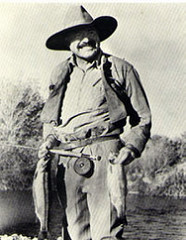
Ernest Hemingway working on his hook.

Analogies about writing, especially about how to write, abound. In my first writing book I beat them to death (because I love analogies), and have since been beaten senseless by some reviewers who don’t care (or know) that analogies are a proven and strategically effective way to teach.

So I was delighted to see Jim Bell’s analogy about playing basketball a couple of weeks ago (and another in the first paragraph yesterday), if nothing else than it allows me to point to him if someone reading TKZ isn’t appreciative of the analogy I am about to offer in today’s post.

Thanks, Jim, for opening that can of worms (itself an analogy, for the record).

All of the analogies I have employed – flying an airplane, playing golf, cooking, building a bridge, a few others – become a thematic chorus when considered en masse. The message is clear, and twofold: professionals can wing it and play loose with the core principles (just like when Michael Jordan shot and made a free throw in an NBA game… with his eyes closed), in a way that less experienced cannot and should not.

At the core of each of these avocations there are unimpeachable truths…

… essential physics that are not to be messed with. When a proven professional does so – and we all do it from time to time… because we can – even a little, they do so in context to an evolved storytelling sensibility and learning curve that a newbie does not yet possess.

In effect, they can do it with their eyes closed, in a way that would make the rest of us look silly.

You don’t tee off with a putter in the name of your art, you don’t under-cook the chicken in the name of table appeal, you don’t build a bridge on sand for obvious reasons, and so on.

The second thing is this: the same is true, every bit as true, for authors who are navigating, cooking up, teeing up, or building a novel. Mess with the core physics of the craft and your story will crash and burn. And when you are rejected, it will most likely be because of an ignorance (as in, to ignore) or a lack of regard (as in, to over-estimate your skills) of the core physics of storytelling.

And so we come to today’s analogy: fishing.

When I was a kid my father took me fishing several times each summer. He selected the tackle, baited the hook, threaded the line, made my casts and, when something nibbled, put his hands on mine as we played the line before setting the hook and reeling in. Then he gave me credit for landing “a big one.” The result was a few fabulous rainbow trout breakfasts and more than a few thrown-back bottom fish, not to mention some of my most precious childhood memories.

There came a point when I was a teenager too cool to fish with my father, so off I went with friends to fish on our own and talk about girls we could not catch from the bank of a river containing fish we could not catch. That period of my fishing life lasted about ten years, when that teen independence gave way to young adult cluelessness.

Over that decade, I caught exactly zero fish.  Not one.

Because I was imitating what I had seen my father do for me, and had been too proud or busy or stupid to learn those basics on my own. He smiled when he realized the life lesson to be learned from this failure, a lesson that took years to sink in for me.

I haven’t been fishing since, perhaps disqualifying me from using this analogy at all.

Except… it works.

I can’t help but think about how those fundamentals and processes of fishing are parallel in every way to the experience of learning how to write a novel. How the selection of the story, the way we set it up, the way we play the line and set the hook, are not only essential, but complex and nuanced, not remotely something that can be done without instruction or via imitation.

New writers must be excused from what they don’t yet know, because there is something noble about attempting to learn by doing. At least for a while. But when that takes place in a vacuum, without a parallel experience of learning and apprenticeship, the nobility of it fades away like a fish fleeing from a poorly tied fly.

Most writers come to the intention of writing a novel based upon their reading experience…

… usually joyous, but often riddled with a wildly uninformed belief that they can do what those authors they read can do, or worse, do anything they want – as a reader of novels. Some writers believe this is all you need, that writing is purely intuitive, a misperception reinforced because so many of the authors they’ve read made it look easy.

Logical and functional is not synonymous with easy. Just ask Michael Jordan as he lined up to shoot that free throw with his eyes shut.

Writing stories from this limited base of knowledge is no different that believing you can fly the plane after years of sitting in coach… that you can whip up a killer chicken piccata because you’ve been ordering it for years at the Cheesecake Factory (their best dish, by the way)… that you can hit a nine iron off the tee of a 205 yard par three because that’s what Tiger does… or that you can design and build a functional bridge because you’ve been driving across one for years on your way to work.

Or – I forgot perhaps my favorite analogy, so here goes: You believe that you can take out your own appendix because it took your doctor only fifteen minutes to get that job done. (I smiled when I just saw that Jim used nearly this exact analogy yesterday in the first paragraph of his terrific post; analogies are universal and eternal, and they often speak things more clearly than the direct route can achieve.)

My wife, who is an excellent cook, has for years been trying to nail a chicken piccata that holds a candle to the Cheesecake Factory’s (the recipe for which is not for public consumption), and she’s finally resigned to simply going there to enjoy this dish. Just like we can try to write like Stephen King, using his process (as described in his book, On Writing*), but until you know what he knows, that may not – probably won’t – serve you.

By implication, King is saying that all you need to do is just write. Imagine a surgeon being told, in her first year of med school, that all she needs to do is just cut.

Of course those are silly and obvious comparisons. 

And yet, so many writers attempt to write a novel from an equally consumer-focused and over-simplified learning curve (and dare I say, naive), and as a result they inevitably crash, burn, throw up and, like me, fail to catch a single fish for decades or more.

But that’s not you, you’re saying. You attend writing conferences and read all the writing books, maybe even mine and Jim Bell’s.

Which is great, keep going. But ask yourself this: are you truly and deeply internalizing the principles you read there, and are you practicing and applying them in a way that trumps the in-the-moment bliss of storytelling, which is what some writing gurus tell you is the only thing you need to pay attention to?

Do you know the difference between a concept and a premise?

Do you understand the nature of classic story structure, or even believe in it in the first place? Do you know the role of theme in a story? Do you understand what creates drama and suspense, and how to pace it over the arc of the narrative?

Do you believe you can simply make up the forms and standards and processes by which these things are made manifest in your story?

Professional writers know these things, and they just don’t do it any other way than the prescribed and proven way, no matter how they choose to describe their process.

Something to think about the next time it’s just you and a pole on a peaceful afternoon at the river, waiting for the next story to descend upon you from heaven.

*****

*In his book On Writing, King advises writers to take their initial story idea and just sit down and start writing from it, allowing an inner sense of story to help navigate the road leading to the best possible story. He omits, however, to add that this works for him, which by definition could mean that unless and until you know what he knows, the results you achieve may not compare to his, and thus, rendering this among the worst writing advice ever rendered… this being my opinion, of course. I’m no Stephen King, either, but at least I know what a writer must understand before that or any other method of writing a story will bear fruit, or not take you a decade to write, which is why I’m here.

*****

Larry’s new writing book, Story Fix: Transforming Your Novel from Broken to Brilliant” is available now in digital formats on Amazon.com and BN.com, and will be out in trade paperback within the next few weeks. Analogies kept to a minimum, he swears.  Visit Larry’s website at http://storyfix.com/.

Flickr photo from Don…The UpNorth Memories Guy… Harrison.

Little Writing Speed Bumps

traffic-sign-24338_1280There are two reasons to study the craft of fiction writing. The first is to learn tools and techniques that actually work, that have been tested over time. Some of these might be so valuable as to rise to the level of “rules.” A rule, of course, can be broken, but only if you have a very good reason to do so and know exactly what that reason is. Otherwise you’re flirting with danger, like a brain surgeon who decides on a whim to use a butter knife instead of a scalpel.

The other reason for study is to learn what doesn’t work, what trips up a story. You learn not to do certain things.

Some of these errors are relatively small. But commit too many of them and they will have a cumulative, and negative, effect on the reader. I call these errors “speed bumps.”

It’s like this. You’re enjoying a pleasant drive through a scenic part of the country. You’re relaxed, the vistas are inspiring. You forget for a moment that you’re driving and you just take pleasure in the sights.

Then you hit a speed bump. You come out of your reverie for just a moment. But if it’s the only bump you hit, you quickly get back into the nice-drive mode.

But what happens if you keep running over speed bumps? Pretty soon your nice drive is completely ruined and you vow you’ll never take this road again.

That’s the way it is with speed bumps in writing. Most readers don’t consciously analyze these. They don’t sit there and think, Wow, he should not have used an adverb there! But there is a little jolt inside that reader’s mind, back there in the subconscious zone. I contend that enough of these small bumps can ruin the reading pleasure of a book. In some cases it may mean the difference between a reader seeking out another of your titles, or deciding not to give you further consideration.

You don’t want that, do you? So un-bump your writing! That’s one sure way to elevate your craft.

I am now going to offer you an exhibit. This is from a well-regarded and bestselling writer, one whose books I have enjoyed in the past. I want you to read it over and see if you can spot the speed bump. The scene is a restaurant:

“So she didn’t talk specifically about her mother?”

“Just about the murder. The murder is very big in her life.”

The waitress brought us menus.

“My God,” he said. “Actual food.”

“No reduction of kiwi,” I said.

“No skate wings,” Paul said. “No pâté of Alsatian bluebird. No caramelized parsnip puree with fresh figs.”

The waitress took our order.

“Why do you suppose she didn’t want me to talk with her aunt?”

“Daryl’s hard to understand,” Paul said.

“She ever talk about her father?” I said.

“No. I always sort of assumed he was dead.”

“Siblings?” I said.

“She never mentioned any.”

“How long have you known her?”

“Two years,” Paul said. “We worked together in the first play I did in Chicago. When she’s up, she’s a hell of a lot of fun.”

The waitress brought smothered pork chops for Paul, spaghetti and meatballs for me.

“Why are you asking about her?”

“Because I don’t know about her.”

Paul was nodding as I spoke.

Ask yourself if there is any small thing in that scene that might cause a casual reader to feel a subconscious bump, and a more alert reader to actually stop and say, Hold on there a minute. Something’s not right!

Cue Jeopardy music:

Dum dada dum dada dum dum dah, dum dum dum dum DOT dee dada dada….

Time’s up!

Here’s my take: These two men are in a restaurant discussing a murder that took place years ago. The waitress appears and gives them menus…and then stands there while they joke around. In the real world, a waitress would leave the menus and give them time to read them. Or ask for a drink order. I waited tables, my friends!

But maybe we can let that one slide.

They continue their conversation. What they say to each other takes about 23 seconds. I timed it. And then the waitress returns with their full meals! There is no time lapse, either, because as soon as the plates are put down the conversation continues in exactly the same spot!

So either this waitress is the love child of Supergirl and The Flash, or reality has been blithely tossed out the window.

It’s a pet peeve of mine: restaurant scenes where the food timing is all off. I do see it often. In film it’s usually a bar scene where they order martinis and the bartender goes out of the scene for fifteen seconds, then comes back with two perfect martinis that could be neither shaken nor stirred. It always takes me out of the scene. And it’s so unnecessary.

Care enough about your readers to study the craft so you can root out speed bumps. Some will slip by. You just don’t want to fill the road with them. I’m here to help.

There. Off my chest. Now it’s your turn. What speed bumps to you notice in books? Pet peeves that take you out of the story? What do you have to watch for in your own writing?

READER FRIDAY: Tell Us About Your Writing Rituals

Flickr: IMG_4240.jpg By Sebastian Wallroth per Wikipedia

Flickr: IMG_4240.jpg By Sebastian Wallroth per Wikipedia

Hemingway wrote standing up. Capote called himself a “horizontal author” preferring his bed or couch to write. Victor Hugo (Les Miserables and The Hunchback of Notre Dame) wrote in the nude. He had servants hide his clothes to insure he wouldn’t leave his residence.

What about you? Do you have any MUST DO rituals when you start your writing day or when you start or end a book?

CAUTION: If you are a Victor Hugo admirer, DO NOT post photos.)

Want a book review? Try these tips

Jordan Dane
@JordanDane

The Oklahoman newspaper

The Oklahoman newspaper

It’s my pleasure to introduce someone I’ve known for a long time, an Okie friend. I first knew Ken Raymond of The Oklahoman newspaper as a crime beat and features reporter. He is a talented author as well. After he graced me with a glimpse of his work, I’ve been trying to coerce him to write a novel ever since and hope he does one day. Very talented guy. Now he’s the book review editor at the paper, a man of many hats. Please chat Ken up, TKZers.

P S – I will be traveling and in remote spots this week. I may not have access to the internet, but I will try to check in on post day.

Ken Raymond’s Post:

Last year I interviewed David Sedaris, the humorist renowned for essays such as “Santaland Diaries,” a hilarious chronicle of his days working as an elf at Macy’s one holiday season.

We didn’t have much in common, aside from our mutual appreciation of his work, but we both love books … and we share a similar problem.

Whenever Sedaris makes a public appearance, would-be authors thrust their manuscripts at him. He’s not sure why, but he thinks they hope he will read all the books, pass them on to his editors and launch the writers’ book careers.That never happens. Sometimes he says no to the manuscripts; other times he takes them out of a sense of politeness and civility.

Even if he wanted, he could never find time to read them all.

I’m not famous. I don’t make many public appearances, and when I do, they’re usually at writing conferences or classrooms. But I do get buried in books, most of them unsolicited. Dozens pile up outside my front door each week, and more still find their way to what used to be my office.

Who am I? I’m just the book editor for The Oklahoman newspaper in Oklahoma City. Book editor sounds important, but really I’m just one guy who reads and reviews books and tries to convince other people to do the same. My staff, such as it is, consists of volunteer newsroom staffers and a handful of stringers, whose only recompense is a byline and a free book. I interview authors, write about industry trends and work hard to deliver the best possible product, but I’m also a columnist and senior feature writer. There are only so many hours in the day.

Don’t get me wrong: I love my job. I’m among the fortunate few in this world who are paid to read books. The problem is that there are just so many of them, good and bad, in all genres and styles.

Given all that competition, how can you make your book stand out — to me and to the countless other reviewers out there?

There’s no guarantee of success, but these tips may help:

Be honest.

For some reason, no one wants to come across as a beginner in the writing business. I guess everyone assumes that if they’re not all polished and shiny, they won’t stand out.

Me, I’m sick of flashy. I get hundreds of emails a week from authors or publicists, and sometimes from authors pretending to be publicists. The messages are so flashy they look like old Geocities websites, with weasel words thrown in to make it seem as if the books they’re pitching are the biggest thing to hit literature since the Gutenberg Bible. Read them closely, though, and they’re largely unappealing campaigns of self-aggrandizement.

I prefer a simpler approach: the truth. Don’t try to impress me; your book should do that. Your emails should tell me who you are, what you’ve written and why you think it stands out. Talk to me like we’re eating lunch together, and I’ll listen.

I’ll also tell you what I tell everyone these days. I can never promise coverage, but I’ll give you the same chance at a review that every other author gets, including the famous ones. I’ll look at your book, and if it’s not for me, then I’ll offer it up to my review team. If anyone picks it and thinks it’s pretty good, I’ll run a review. If they don’t like it, I probably won’t run a review.

Follow up.

If you apply for a job, odds are you won’t sit by the phone for two weeks, hoping it’ll ring. Instead, you’ll follow up a few days after the interview, letting the company know you’re interested and making sure you’re remembered. You may follow up again a week later.

The same goes for book promotion. Often someone will pitch a book to me, and I’ll ask for a review copy. By the time the book arrives in the mail, I may not remember it at all; I’ve dealt with a bunch of other books in the interval.

A simple follow-up email reminds me that we communicated about the book. It tells me that I was interested enough to request it. It’ll make me take a closer look.

Don’t take it personally.

Nothing turns me against a book more than an argumentative author. Earlier this year, a guy blitzed me with phone calls and emails, demanding that I review his minor book about his favorite subject: himself.

Somehow he had browbeaten other news organizations into writing reviews, none of which were particularly flattering. When his berserk behavior persisted, I told him I wasn’t interested in interviewing him or reading his book. He promptly called my boss eight times in a two-hour period and drowned him in email.

He seemed shocked, absolutely shocked, that he couldn’t force his way into the paper.

I don’t want to be a puppet. Most people don’t seek out needless confrontation. If we all act professionally, we should get along fine, even if I can’t get to your book or publish a review. I bear you no ill will; without you, I couldn’t do my job.

Play the odds.

Major publishers release fewer books during the cold weather months. The spring, summer and fall are all pretty hectic, so those winter months are your best opportunity to contact me. You simply won’t have as much competition.

At the same time, I scramble for content around that time of year. I suspect others in my position do, too. I start pushing gift books on Black Friday and continue every week until Christmas. Even if your book came out much earlier in the year, I may use it in one of my gift guides. I generally offer a range of books in different genres.

But winter isn’t your only window. Whenever possible, people like me prefer to publish reviews proximate in time to book release dates. If I could, I would limit most of my reviews to books that are about to come out in a couple days.

In order for that to happen, I need your book about a month in advance. Some critics prefer digital copies; I like physical books, even if they’re uncorrected page proofs.

Because I am in Oklahoma, I take special interest in books with some sort of Oklahoma ties. If you live here, went to college here, set your book here, whatever, that’ll up your odds of getting reviewed. The same applies to other regional newspapers. If you’re in Alaska, pitch your book hard to Alaskan publications.

Set up book signings, too. You probably won’t get rich at a book signing, since stores take part of the haul, but I always mention local book signings in print. Many other papers do the same. It may not be as good as a full review, but at least it gets your name out there.

Best of luck, and please contact me about your upcoming books. The best way to reach me is via email at kraymond@oklahoman.com. Follow me on Twitter at @kosar1969.

Discussion: Any questions for a book review editor, TKZers? You ever wonder what a crime beat reporter sees on the job? Or maybe you want to know what was the strangest features article Ken ever wrote? Ask away!

Ken Raymond - Book Editor & writer for The Oklahoman newspaper

Ken Raymond – Book Editor & writer for The Oklahoman newspaper

Bio:
Ken Raymond is the book editor and a senior writer at The Oklahoman. He publishes a monthly column called “Purely Subjective.” A Fulbright scholar and Pennsylvania native, he covered crime for much of his career, bringing dramatic stories to life through literary nonfiction. He has won numerous national, regional and state awards. Three times he has been named Oklahoma’s best writer by the Society of Professional Journalists. He lives in Edmond with his wife, three Italian greyhounds and a Chihuahua.

Hidden Rooms in the Basement

By Joe Moore
@JoeMoore_writer

Last Sunday, James Scott Bell gave us a great look back at his High School basketball conquests, described how it felt to be in “the zone”, related his successes to writing, and gave some excellent tips on how to develop mental muscle memory to make it easier to enter the zone on a constant basis.

Today, I wanted to expand on the zone concept. A beginning writer once asked me: “I’ve heard authors talk of being ‘in the zone’ regarding their writing, which I take to mean being in an altered state of extreme creativity. But how, without drugs or other stimulus, do you get into that state?”

In fact, as Jim mentioned, we hear the term in the zone used often, not only with writers, but athletes, artists, and just about any activity that requires skill, creativity and concentration.

So what is “the zone” and how do we enter it? Why is it so hard to remain there for extended periods of time?

Being in the zone can last for a few minutes, a couple of hours or a whole day. For those that never seem to enter the zone, it might be because they try too hard to do so. Sort of like when we stop trying to solve a problem, the solution suddenly comes to us through our subconscious, again as Jim calls “the boys in the basement”.

Let’s try to define what being in the zone means, especially when it relates to writing. For me, it’s a mental state where time seems to disappear and my productivity greatly exceeds normal output. It might start after I’ve finished lunch and sat down at my PC to work on a new chapter. Without any feeling of the passage of time, I suddenly realize a couple of hours have gone by and I’ve produced 1000 words or more. I don’t remember the passage of time or anything that deals with my surroundings. I only remember “living” or becoming immersed in the story’s moment, having the words flow from a deeper source, and “awakening” from the writing zone as if only a few moments have passed.

I’ve never been hypnotized, but I can assume that being in the zone is somewhat like self-hypnosis. My body remains in the here-and-now, but my creative senses somehow find a hidden room inside my mind, a place normally under lock and key. And I’m able to enter it for a short time to let what’s there emerge into the light of day.

It can also feel like driving down the Interstate on a long trip deep in thought or chatting on a hands-free cell phone and suddenly realize I can’t remember the past 10 miles.

I’ve also never been athletic, but judging from Jim’s story, I bet it’s a similar scenario: a golfer is able to tune out the surrounding crowd of tournament spectators, the dozens of network cameras, the worldwide audience, the cheers from the distant gallery as his opponents make a great putt, and he’s able to enter a place where only his game stretches out before him. The rest slips by in a blur. Personal mind control.

So, in addition to Jim’s tips, what are some additional methods for getting into the zone? Some writers use the “running start” technique by reading the previous day’s work or chapter. It gets them back into the story and hopefully the new words start to flow.

Others listen to music. This is something I often do. Nothing with lyrics, though. I listen to movie scores or piano and guitar solos. I find that it can help set a mood or become background “white noise” that blocks out other audible distractions. That’s because, for me, the biggest obstacle is distractions. It’s important to reduce interruptions and distractions by creating an environment where they are minimized. This means shutting my office door, closing the drapes on the windows, unplugging the phone, disconnecting Internet access, and most of all, choosing a time to write when those things can be fully managed. Doing away with distractions is no guarantee that I will enter the zone at will, but it does give me a fighting chance to at least knock on the door to one of those dark, hidden rooms in the basement and let my story flow.

OK, Zoner’s. What does it feel like for you to be in “the zone”? Any tips on how you make it happen?

———————————

thor-bunker-cover-RSApril, 1945. The Germans have the bomb. Download THOR BUNKER, A Short Story prequel to THE TOMB for only 99¢.