Does Your Cover Need
a New Year’s Makeover?

“A book cover is a distillation. It is a haiku of the story.” — Chip Kidd, Random House cover designer

By PJ Parrish

Welcome back, crime dogs. It’s the new year! Out with the old, in with the new!

So today, as you think about how you might want to improve yourself this year — botox? go blond? organize the sock drawer? — maybe you should take a moment to re-look your book branding.

Oh dear…Just hours into 2019 and I’ve lost some of you already. Branding…ugh. I can barely think about what’s going on in chapter 12 let alone worry about how I am going to make splash (or even a ripple) in the ocean of books that will be published this year.  Let’s get the bad news out of the way first:

That chart shows the number of self-published books from 2008 through just 2017. I know, I know. Discouraging. So how do you increase your chances of getting noticed and maybe even making a few shekels? Let’s restate the obvious:

  1. Be a bestselling writer already
  2. Get a James Patterson co-author gig
  3. Get lucky.
  4. Write a really good book
  5. Do everything in your power to give it a good launch.

The only two you have any control over are 4 and 5. So let’s start there. Let’s also not go into promotion and marketing right now because that hydra-headed monster is too much for me to handle here. And besides, it depresses the hell out of me, and my only new year’s resolution this year is to try to focus on positive stuff because the negative stuff will find me at every turn.

Let’s talk, instead, about one of my favorite subjects — great covers. This is foremost in my writer brain in this new year because my sister Kelly and I are hard at work getting our back list titles ready to post. Our oldest came out 18 years ago (geez…) so, it’s time for a make-over. Besides, when you get your rights back and want to reissue your books, you legally can’t use the same covers your old publisher did. Which, as many of you poor souls know, can turn out to be a good thing.  More on that later…

How important are  covers? Industry folks believe a cover is the single most important thing in determining a book’s initial chance for success. A great cover makes a book stand out and thus easier to sell. For you the author, it is your only chance at a first impression. It’s like your own face, capable of conveying emotion, inner feelings, mood — what’s inside!

So, how do you make a great first impression?

If you are traditionally published, you have little or no control over this. Publishers have teams of marketing folks and artistic types that agonize over this (or in some sad cases, don’t). I’ve worked with Big Six publishers, small presses, Amazon’s mystery imprint Thomas & Mercer, plus many international imprints. In 30-plus years publishing romance, mysteries and thrillers, I’ve had some terrific covers and some howling dogs.
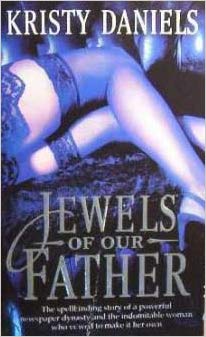
(See image at left…arf! arf!) My involvement in the cover process has ranged from no input, cover consultation written in my contract, and being asked to fill out an extensive questionaire about what I thought my cover should convey (by Thomas & Mercer, who also asked us to send photos we liked and allowed us to chose between two final covers).

But what about those of you who are self-publishing? That’s why I am writing this today, because, as I said, I am now a publisher myself and Kelly and I have been agonizing over this.

Here are some qualities of good covers, suggested by the site Trending/Packaging, with a few comments from me in red italics.

  • It needs a good title/ subtitle. Which is why I rail so often in my First Page critiques about innocuous or trite titles.
  • It must draw the potential reader’s attention towards the book. Like a great billboard does as you sped by in your car.
  • It should communicate with the reader on an emotional level. So important! Generic doesn’t cut it.
  • It must be unique. All books are different from each other, similarly, every book cover should also be unique to make it different from other covers. Easier said than done.
  • It should look professional. Well, duh. But just go look at some of the free offerings on Amazon to see how many fail at this. Or this site, subtitled Just Because You CAN Design Your Own Cover Doesn’t Mean You Should. 
  • It should clearly give an idea of the category of the book whether it is a horror story or a love story etc. What is your tone? Dark, lighthearted, noir, romantic?
  • It should communicate the message about the quality of the book. There is a huge difference between the covers of different qualities of books. Again, click here for what not to do. 
  • It should tell the reader what your genre or sub-genre is — fiction, non-fiction, biography, romance, thriller, etc. Readers want to know what kind of story they are getting and don’t like to be confused.

To be sure, publishers tend to be lemming-like when it comes to cover design. Hey, if basic black worked for Gone Girl, why not all its sisters? Liane Moriarity’s Little Big Lies unleashed an explosion of lollipop covers. And this trend seems evergreen — the imperiled girl/woman in the red coat:
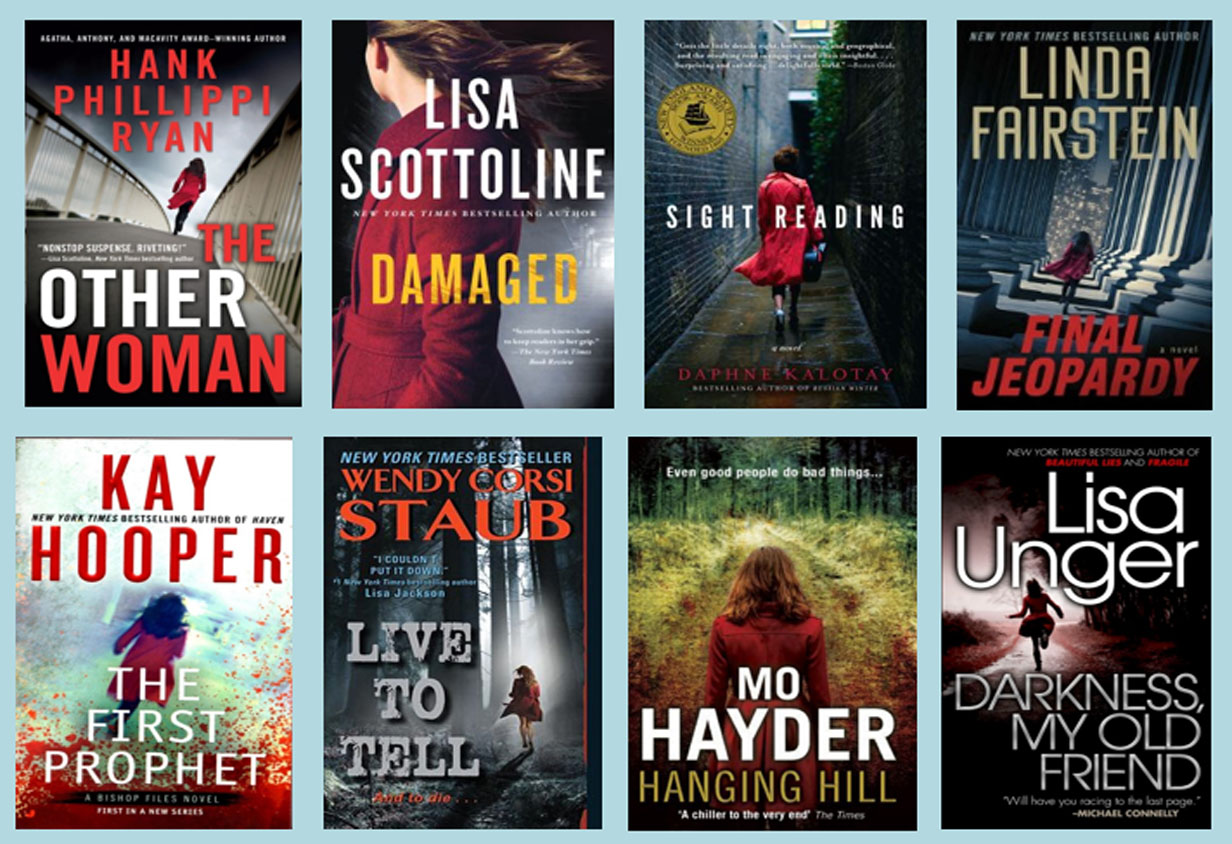
As this is a favorite theme among man books — the shadowy guy with the gun.
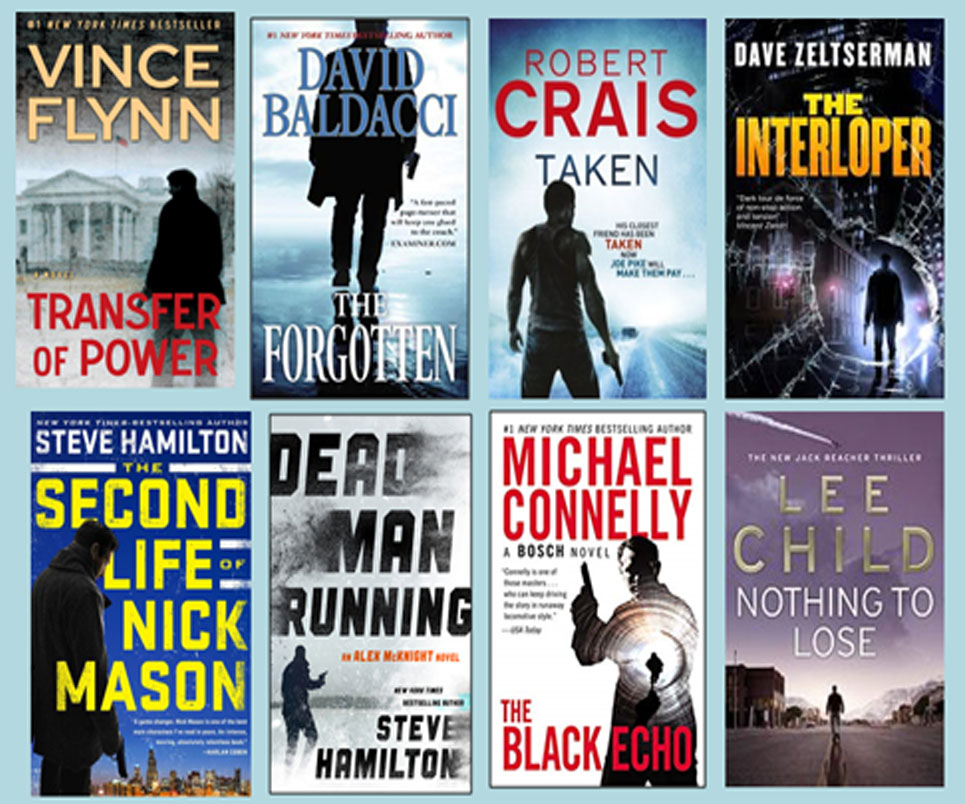
Please note I show these not as any reflection of the quality of the books. I know many of these folks and they are talented all. I have read many of these books. I’d guess few of these writers get heavily involved in their cover design. Just showing that publishers themselves tend to run in packs. (Oh…I will send a free book to the first person who can tell me why the Lee Child book is somewhat out of place here).

Speaking of trends, a while back, I wrote a post about what was hot in cover design in 2018. Click here to see examples but to sum up:

  • Bold typography
  • Minimalist covers
  • Hand-drawn covers
  • Seventies and eighties designs
  • Millennial Pink
  • Collages
  • Authentic photography
  • Upscale finishes

I think we can all breath a sigh of relief that “millennial pink” is probably passe by now. The others, I believe, still stand. I see them holding true every time I pass through a bookstore or browse Amazon. But I don’t think we crime dogs should get too hung up on this.  What I think we should pay attention to is:

  • Professionalism
  • Consistency of brand
  • Messaging

Professsionalism means you can’t get away with a lousy, cheap-looking cover. Because it yells in neon to a potential reader “I am an amateur!” This applies especially if you are just starting out. Like they used to tell us in “women’s magazines” — dress for the job you want, not the one you have. Don’t design your own cover unless you have solid graphic background and even then — GET INPUT! Would you edit your own story? No…you get beta-readers, you hire copy editors. (If you do edit your own books, you’re a fool). You might have to hire a pro to do this. There are lots of good ones out there. Please don’t skimp on this. Please.

Consistency of Brand means your books have to look alike. I don’t mean literally, but they have to all be of a kind so potential readers can immediately sense a unified brand.  All good authors do this. And periodically, they go back in and re-design their older books en masse to give them face lifts. Time for an object lesson….

My friend Neil Plakcy (a member of my old critique group) has been publishing his Golden Retriever mystery series for about ten years now. His books are a lot of fun (the dog helps solve the crime), light in tone, but also deal with some serious issues. (his hero did prison time for computer crimes.) Recently, Neil decided he needed a make-over.  The first line is before, the second line is after. Click to see enlarged.
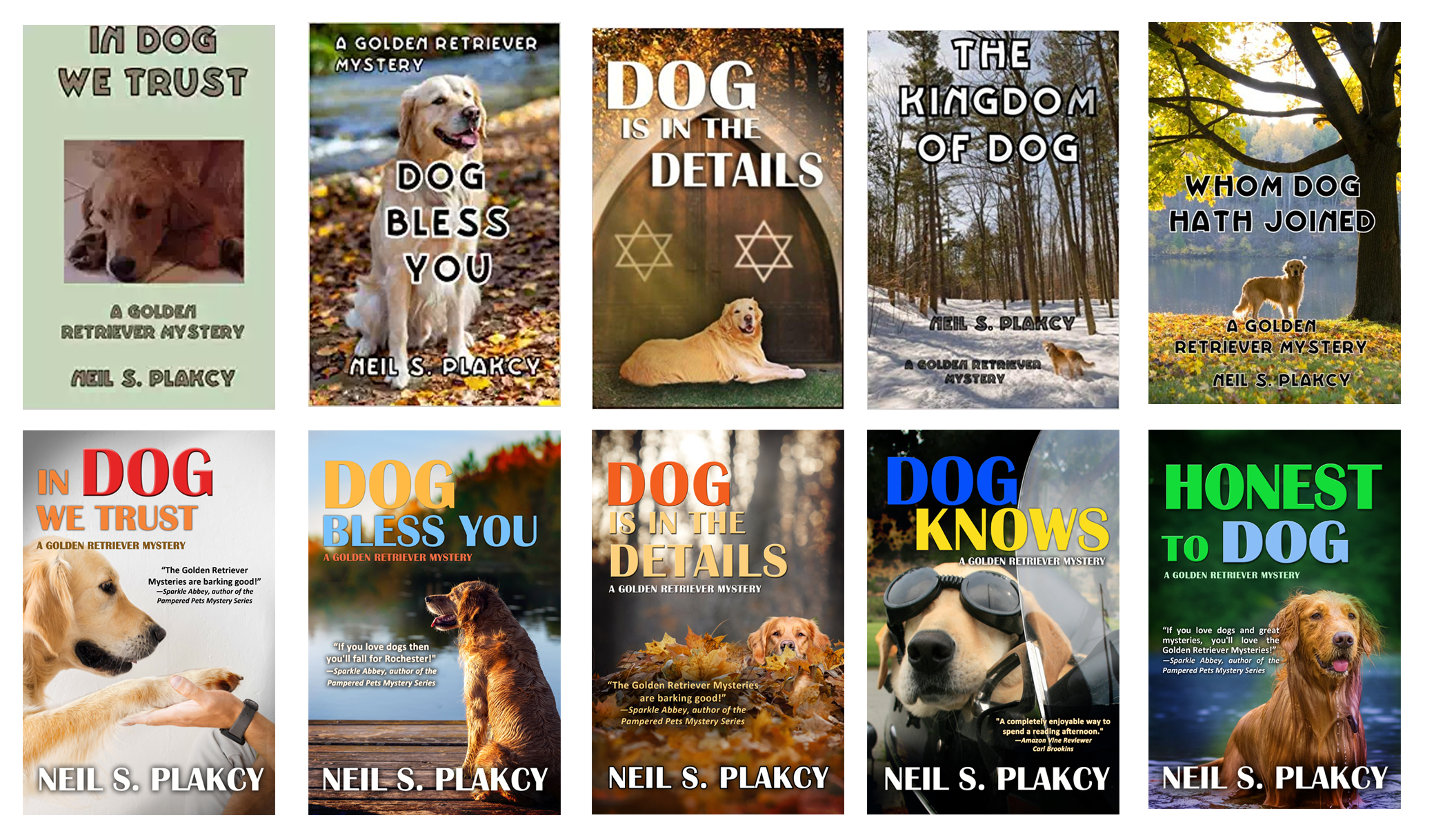
What was wrong with the first ones? Inconsistency in type-faces. Type too small. The main important image (the dog!) was usually too small and static (the dog is just sitting or standing around mainly). No one compelling image for the eye to focus on. The pictures didn’t capture the books’ playful tone. Dull colors. And hard to find Neil’s name!

What is right with the second ones? The type is consistent and DOG is set bigger and in contrasting color to drive home the content in a glance. The subtitle “A Golden Retriever Mystery” is always the same size and in the same place. Neil’s name is consistent and authoritative. There is negative space for blurbs. And the dogs are so cute they make you want to adopt them. These covers look designed, not slapped together.

Disclaimer time: My sister Kelly designed the new covers. She does this as a side business and this is not an infomercial to get her work because I don’t want her attention on anything else but our stuff for now. But she and I also are redesigning our own back list covers.  And, I gotta tell you, it’s not been easy. 
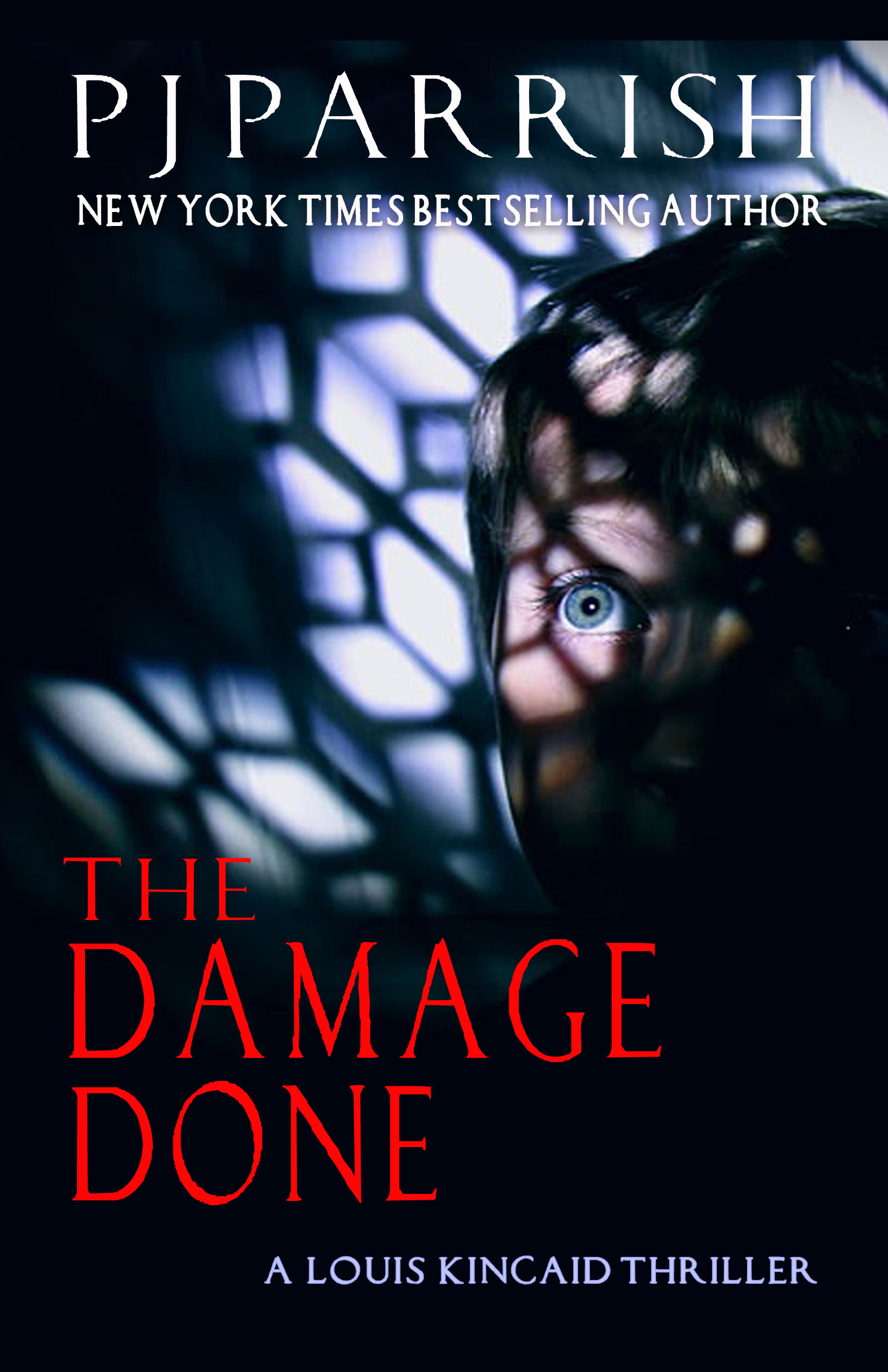
Our departure point was our newest book, THE DAMAGE DONE. It has a very distinctive cover. And we decided we wanted all our previous books — which had been published by three different companies —  to be “branded” with the same look.

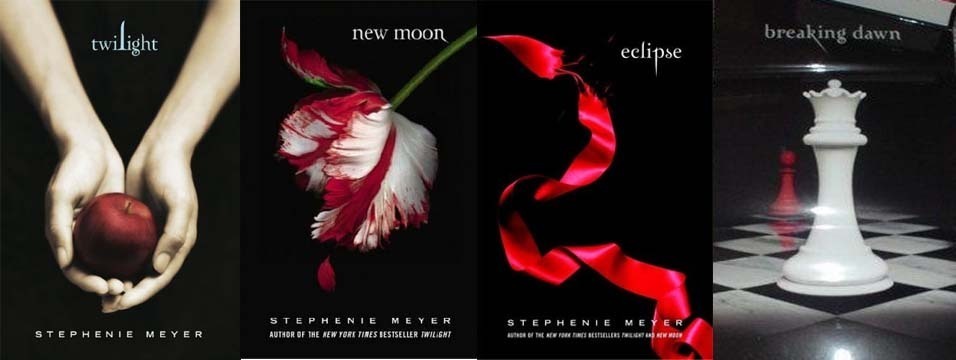
I was always impressed with the covers of Stephanie Meyers Twilight series. Stark black backgrounds each with one strong image and interesting type. They were beautiful, simple, revolutionary at the time and still copied to this day.  I suspect they were in my back-brain when we started redesigning our old books. These books were about vampires yet the covers had a dark elegance. The tone was spot-on.
Our first decision was tone. Our Louis Kincaid books are PI/police procedurals, rather dark in tone. We didn’t want to look too “thriller” with screaming type. We wanted each book to have a person on it because we think readers relate to books with human beings rather than say, a static photo of the Capital building or a rundown farmhouse. This is just our taste. Yours is different, so you must figure out what TYPE OF GRAPHIC IMAGE best conveys your story. We decided to go with black backgrounds and red title type. I studied advertising design in college and red and yellow on dark background is the most eye-grabbing combo. Red conveys power and immediacy. (Blue conveys trust; orange is hip and fun; purple signals prestige and elegance). Black is a powerful neutral but adds drama when paired with the right contrasting color. I think this is why Katherine Hepburn liked to wear red scarves and Nancy Reagan wore red. (She was barely 5-foot-4 and claimed it made her feel more powerful. I get that…)

Second, we had to find the right images. I can’t count the hours Kelly and I paged through the stock photo sites looking — praying — to find that one great photograph. And we paid for them — ranging from a splurge of $375 for a Getty Image photo to $35-$70 from such sites as iStock, Stutterstock, Deposit Photo, Dreamstime. All these latter are very reasonable with clear licensing guidelines. You get what you pay for. Invest wisely.

Big caveat: You have to look beyond the original photo sometimes. Sometimes, a creative cropping can make it more powerful. Or you play around with it, lightening, darkening etc. This is why you need design help because a successful cover is often made in tweaking the details.  Here’s an example: We are also putting out a collection of our short stories. Here is the photo we bought for the cover. Pretty cool looking dame, huh? Just as is, it could have worked. But…

But we wanted an off-kilter, more mysterious feel and needed some negative space for type. And sometimes, a glimpse of stocking (or a woman’s face) can be much more shocking. So here is what we did with it:
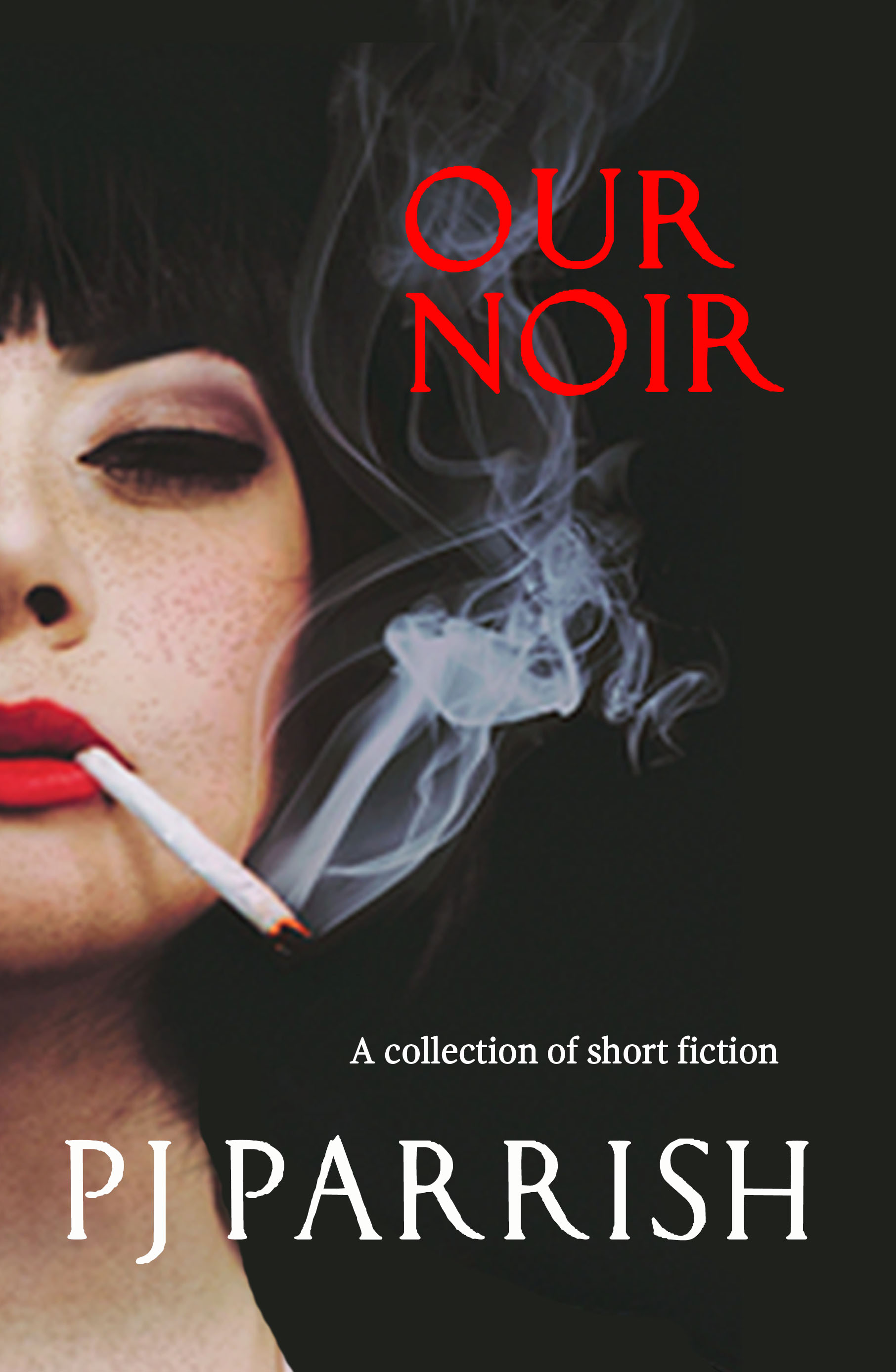
 

We continued our lady’s face around the spine and onto the back for effect. Here’s the final full cover, spine and back art.
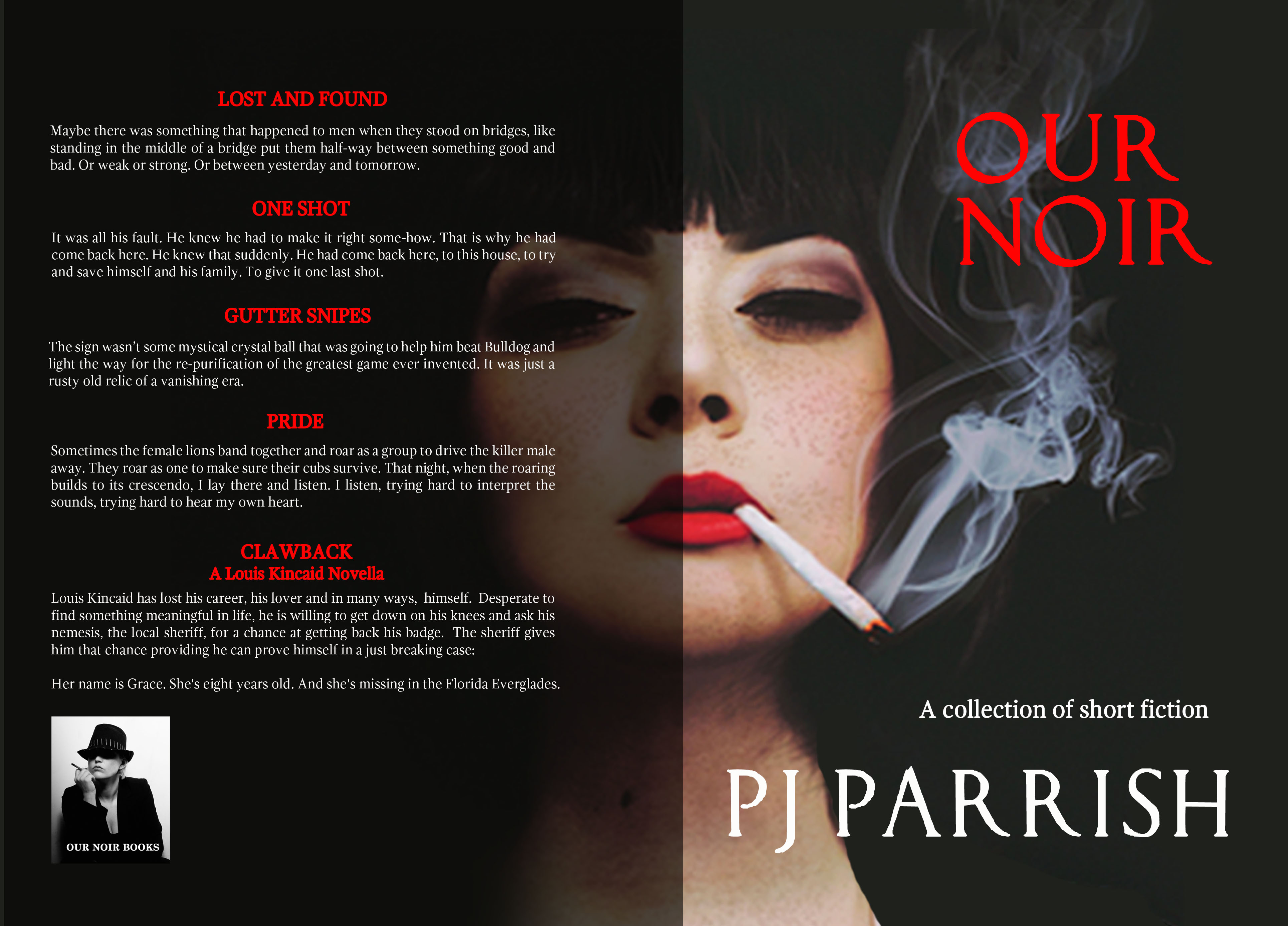
If you work with a good designer, you and she can tweak things until you get what you want.

Third, we were very particular about the type we wanted. Like colors, typefaces have their own psychological effect. Look at the different moods you can create just from basic Word software:
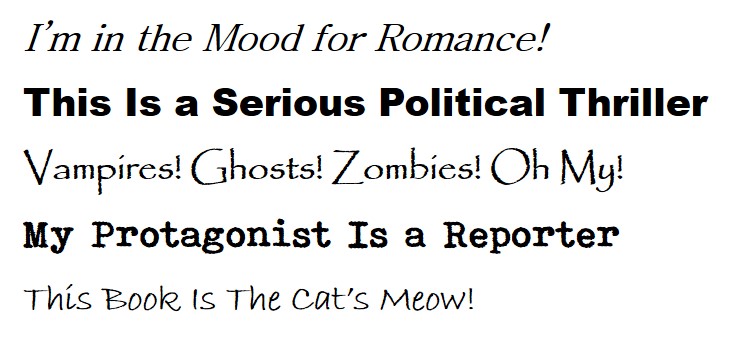
I love typefaces. But I fell really hard for Luca Pacioli Rough.  It was used in the credits for House of Cards. It’s elegant but edgy. (which is what we were going for overall). Kelly found it and downloaded it free. (Some fonts are restricted, however).

Okay, time for another object lesson.  On the top row are some of our books as they were put out by the original publishers years ago. The bottom row are our new designs, all made to meet our three criteria of professionalism, consistency of brand and messaging. Click to enlarge.
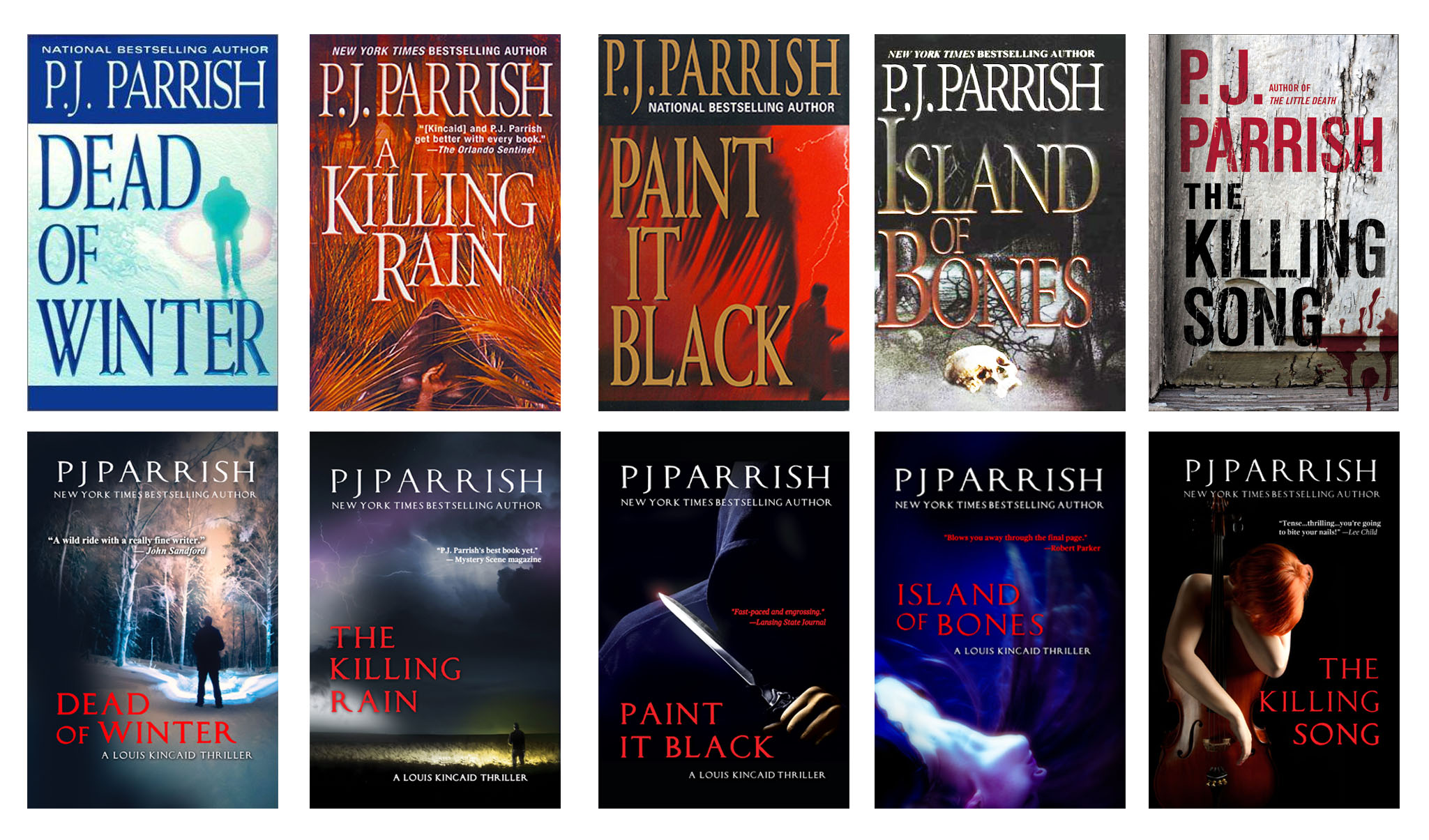
All the new covers are consistent in tone. They all use one strong graphic element and same fonts. Notice, in particular, THE KILLING SONG. This is one of our stand alones and we always thought the original cover was weak. Yes, the letters are bold and there’s some dripping blood on what looks like a weathered farm house or something. But the story takes place mainly in Paris and is about a sophisticated cellist who just happened to have a habit of killing woman and leaving bizarre musical clues. The original cover missed the mark on tone and on conveying anything about setting or story. Music was the main point. Somebody at our publishing house had a tin ear.

If you’ll bear with me, let me give you one more example from our own collection. Call it the Evolution of a Cover.  Our tenth Louis Kincaid book was called The Little Death.
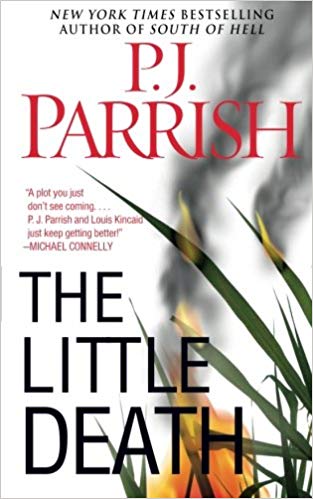
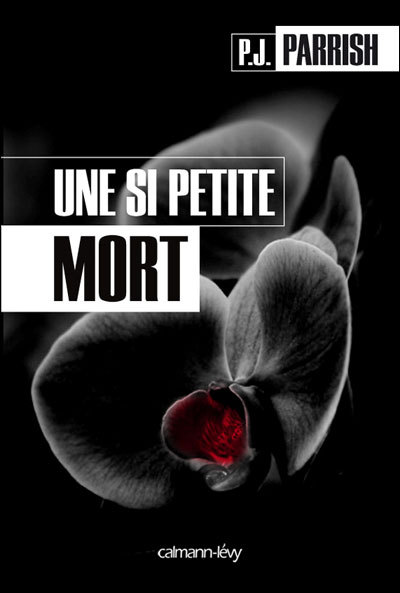
At left is the original cover: I defy you to tell me what it is about or where it takes place. It appears that some kind of plant is burning, but what does that mean? What the heck is this book about? Well, the story takes place in Palm Beach society. It is about a clique of rich women who take young male lovers then things go wrong and they must “dispose” of them. The title is a French idiom, “La Petite Mort,” for orgasm.  Our French publisher came a lot closer to getting the point. All his covers for our books were well-branded, featuring the same typefaces, and one strong graphic image against black backgrounds. In this case, it was an orchid — which is a major clue in the book and the means by which Louis finally cracks the case. It also looks sort of sexy. 
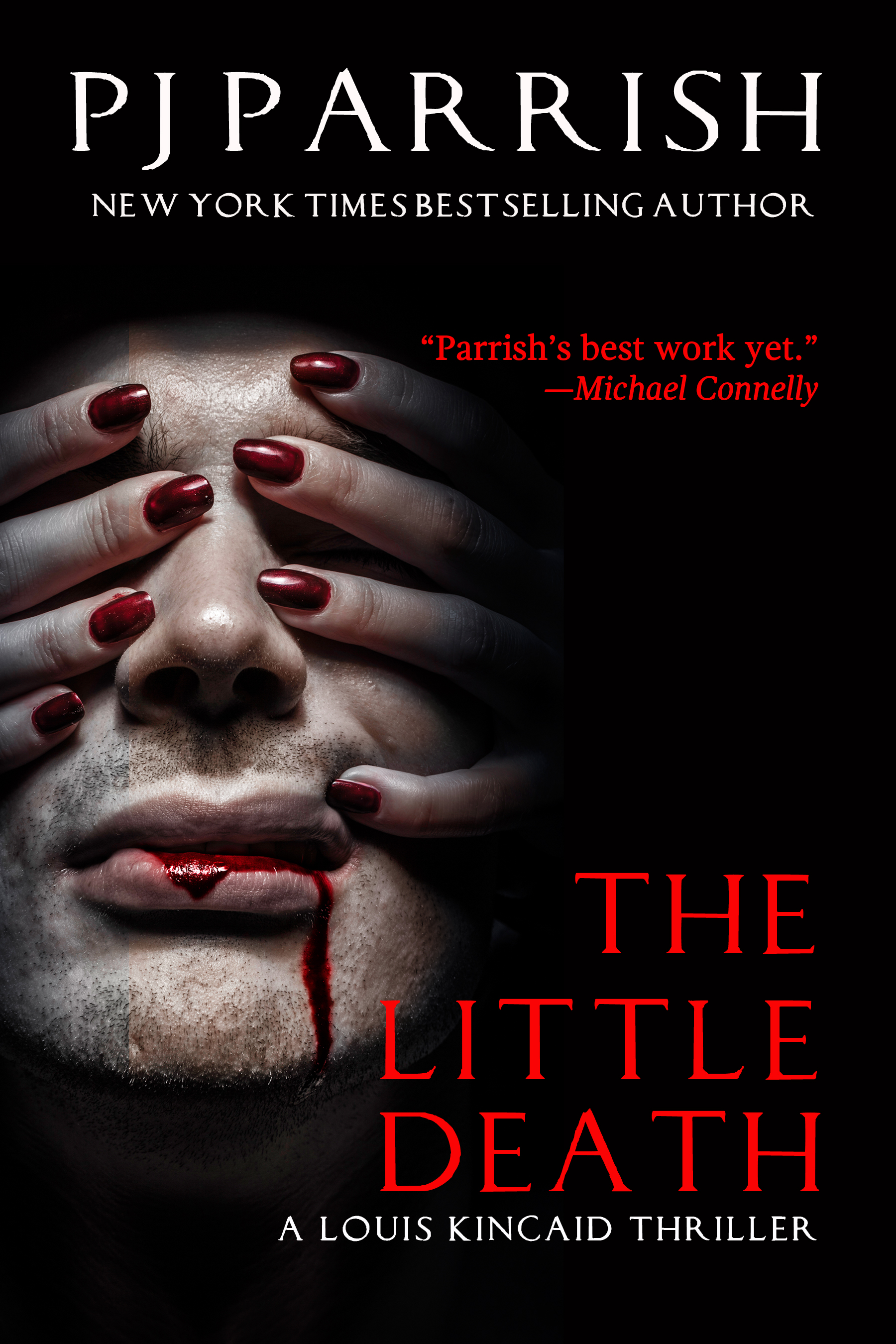
At left, is what we have come up with so far. We are still working on this cover — it was really hard to find the right image — but here is what we started with. We are tweaking this image, however, because we think it is a little too, forgive the pun, in your face. We might take out the dripping blood. We might go with something else entirely. But at least it won’t be a burning bush…

Whew…boy, did I run at the mouth today. Must have been holding all this in during the holiday hiatus. Anywho, that’s it for Cover Art 101 today. I could rail on this subject for hours. But I’d rather hear what you all think — as readers and writers.  What turns you on, what turns you off? Can you truly judge a book by its cover?

 

Crime Writer’s Version of ‘Twas the Night Before Christmas

‘Twas the night before Christmas, when all through the house,

Not a corpse was breathing, not even their spouse;

Nylon stockings were hung by the chimney with care,

In hopes that the cops would not find them there;

The live victims were all nestled, snug in their restraints;

While visions of mayhem snuffed out their complaints;

My ol’ man in his bandana, and I in my cap

Had just settled in for a quick nightly nap.

When out on the lawn there arose such a clatter,

I sprang from my bed to see what was the matter.

Away to the window I flew with a dash,

Tore open the curtains and hid the drug stash.

The moon on the breast of the new-fallen snow,

Gave a luster of midday to a figure below.

When what to my wondering eyes did appear,

But a swirling lit cruiser pulling eight plastic reindeer,

With a rickety old driver so slow and not quick,

I knew in a moment he’d never catch Nick.

He slogged through the snow, toward our doorway he came,

And he whistled and shouted and called us strange names:

“Now, Dasher! now, Dancer! now Prancer and Vixen!

On, Comet! on, Cupid! on, Donder and Blixen!

To the top of the porch! to the top of the wall!

Now dash away! dash away! dash away all!”

As leaves that blew before the storm hit,

When he met with an obstacle, our pit bull named Kit;

So up to the housetop the cop climbed the lattice,

With no warrant or recourse, as if he had gratis,

And then, in a twinkling, I heard on the roof

The prancing and pawing like he was dancing in hoofs.

As I drew in my head, and was turning around,

Down the chimney the cop came with a thundering bound.

He was dressed all in blue, from his head to his foot,

And his clothes were all singed with ashes and soot;

A bundle of pot brownies he had flung on his back,

And he looked like a junkie just opening his sack.

His eyes–how they twinkled! his dimples, how merry!

His cheeks were like roses, his nose like a berry!

His droll little mouth snarled up with a grin,

And the squint to one eye like he’d drank all our gin;

The stump of a cigar he held tight in buck teeth,

And the smoke, it encircled his head like a wreath.

He had a broad face and not much of a belly

That barely moved when he laughed, like a jar with no jelly.

He was cheerful with glee, a right jolly old cop,

And I laughed when I saw him; he looked like Nick’s pop;

A wink of his eye and a twist of his head

Soon gave me to know I had nothing to dread.

He spoke not a word, but went straight to his work,

And stole all the nylons, then turned with a jerk,

And laying his finger aside of his nose,

And giving a nod, into the fire he dove.

I sprang forward to save him, then stopped, reconsidered,

How much would they pay for a cop’s body, delivered?

But I heard Nick exclaim, ere he drove out the lot,

“You’ll get us both busted and rightfully caught.”

“Quiet,” I told him, but one moment too late.

For he’d vanished; so much for that date.

Back in bed I climbed, the mattress now ample,

And sprinkled the pillows with the remaining drug sample.

When I drew my last breath before my eyelids did flutter,

I mumbled, “Merry Christmas to all. May your nights make you shudder.”


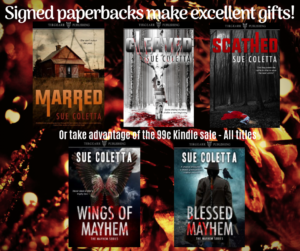
Searching for a special gift for the hard-to-please person on your list?

Send them on a thrilling adventure!


To order signed paperbacks, email me at sue@suecoletta.com or message me on Facebook.

Blowout 99c Kindle sale (all titles — ends tomorrow)

MARRED, Book 1, Grafton County Series
CLEAVED, Book 2
SCATHED, Book 3

WINGS OF MAYHEM, Book 1, Mayhem Series
BLESSED MAYHEM, Book 2
SILENT MAYHEM releases early 2019!

*All books can stand alone.


Wishing you and yours a joyous holiday season! May all your writing dreams come true in 2019.


Turn Browsers Into Buyers

by James Scott Bell

Christmas is coming, the goose is getting fat.
Please put a penny in the old man’s hat.
And if you are promoting, I’m sure it’s no offense
If you sell the man some Kindle books for 99¢.

Yes, ’tis the season for self-indulgent poetry, and a couple of announcements.

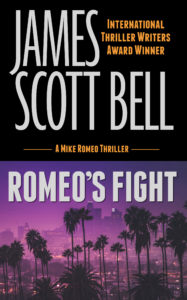
The first is that my fourth Mike Romeo thriller, Romeo’s Fight, is set to release on January 7th. It’s available for preorder for the special launch price of $2.99. In February it will go up to $3.99. Naturally I would appreciate it if you would hop over to Amazon and reserve your copy. On launch day you’ll get it automatically delivered to your Kindle.

Click here to preorder.

(You international readers can find it in your Amazon store by pasting this ASIN number into the search box: B07L9DLGVF)

Welcome back!

Romeo’s Fight, like all the Romeo thrillers, can be read on its own. But if you’re one of those who likes to read a series in order, I’ve got some good news: for the next two weeks the first three Romeos are all priced at 99¢. Now’s the time to hop on this International Thriller Writers Award winning train. The order is:

1. Romeo’s Rules
2. Romeo’s Way
3. Romeo’s Hammer

Romeo’s Fight opens this way:

“So you’re Mike Romeo,” the guy said. “You don’t look so tough.”

I was sitting poolside at the home of Mr. Zane Donahue, drinking a Corona, and wearing a Hawaiian shirt, shorts, flip-flops and sunglasses. I was the perfect embodiment of L.A. mellow, trying to enjoy a pleasant afternoon. Now this shirtless, tatted-up billboard was planted in front of me, clenching and unclenching his fists.

“I’m really quite personable once you get to know me,” I said.

“I don’t think you’re tough,” he said.

“I can recite Emily Dickinson,” I said. “Can you?”

He squinted. Or maybe that’s how his eyes were naturally. His reddish hair was frizzy. With a little care and coloring, it would have made a nice clown ’do. He had a flat nose, one that had been beaten on pretty good somewhere. In a boxing ring, the cage, or prison.

“Who?” he said.

“You don’t know Emily Dickinson?”

Blank stare.

“Then you’re not so tough yourself,” I said.

I took a sip of my brew and focused on the devil tat above his left nipple. Underneath were the words DIE SCUM.

So let’s talk a bit about marketing, specifically two items: the browsing sequence and the building of buzz.

We start with the old-school bookstore browser. She walks into Barnes & Noble, perhaps with a title in mind, but takes a moment to look at the New Release table. What is the first thing that attracts her attention? The cover. If the cover has the name of an author she’s read before, and likes, that book gets picked up first. Otherwise, she might check out a book by someone she doesn’t know simply because of the cover design.

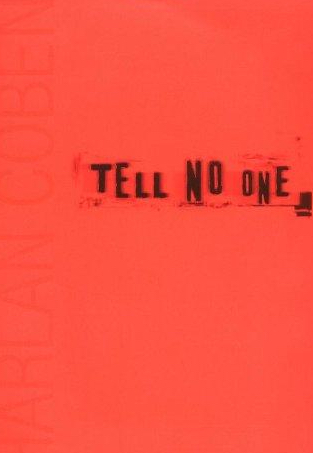
(This is exactly how I discovered Harlan Coben. I vividly remember going into Crown Books and looking at the New Release table, and one cover just jumped out and grabbed my shirt and said, “Open me!” It was the cover of Tell No One, and it was stunning, not just because of the color and title font, but also because Harlan’s name could not be seen. This counter-intuitive distinction set it apart from every other cover on that table.)

So what next? She will look at the dust jacket copy. Does that copy sizzle? Make the plot irresistible? If so, the next place she’ll turn is to the opening page. And of course we know what that has to do. Just check out our First Page Critique archives.

If she likes what she reads, our browser will look at the price. $28? Yikes! Ah, but B&N is offering it at a 30% new release discount. That might just be enough to close the sale.

It’s roughly the same with online browsing. Cover, book description, the “Look Inside” feature to sample the first pages, and the price. Understand that sequence as you plan your marketing.

So what about the second consideration, building buzz? The two primary venues for this are social media and the email list. The one overarching consideration is: Don’t annoy.

You annoy by only talking about your book and how great it is going to be. If all we see on social media is variations on “buy my book!” it’s not buzz, but “buzz off” we’re going to create.

My rule of thumb on social media is 90/10. Ninety percent of the time be, gasp, social, providing good content so people are glad to have you around. Then when a book comes out or you have other such news, you have the trust and toleration of your followers.

Everyone knows and touts the essentiality of the fan email list. It takes years to build a substantial list, which you do by a) writing great books; b) having a systematic way for readers to sign up; and c) making the actual content of your communication a pleasure to read.

So what do you do if you are just starting out and have no fan base? If you’re traditionally published, work in concert with your publisher and come up with a plan. While there are still physical bookstores around, introduce yourself locally and set up a book signing. Your publisher might be able to arrange a regional tour (travel expenses on you). Are book signings worth it? All pro authors can tell you stories about book signings gone awry (see this post from TKZ emeritus Joe Moore), but when you’re a newbie, you pay your dues.

For both traditional and self-publishing writers: send personalized emails to everyone you know, politely requesting they take a shot on your book and, if so moved, a) leave a review on Amazon; b) tell their friends about it; and c) sign up for your email list which, you assure them, won’t be spammy or too frequent. (My rule of thumb here is once-a-month, give or take.)

We all know how hard it is to get a message through amidst the din and dither of the madding crowd. Just remember to keep the main thing the main thing: write excellent books. That’s the only ironclad, long-tail secret to a career. Buzz and marketing help get you an introduction. They can turn browsers into buyers. But it’s your books that turn buyers into fans.

This is my last post of 2018. To my blogmates and all our marvelous TKZ readers: Merry Christmas and a Carpe Typem New Year!

The Organ Recital

Photo courtesy of Sydney Rae, unsplash.com

Where did the year(s) go? Is there a way to slow things down, before one reaches the age of the organ recital? What is that, you ask?

A friend of mine who is a bit ahead of me agewise has a weekly meeting with an ever-dwindling group of his friends from high school. My pal recently referred to one of these gatherings as “the organ recital.” I asked him what he meant, and he said, “Y’know, this guy talks about his liver problems. That one is talking about starting renal dialysis in two weeks. We’re going to have to change our meeting day. I’ve had two heart attacks, and my pancreas won’t survive another Christmas of Reese’s Trees and Giant Eagle Egg Nog ice cream. The bags of all-season cheese curls probably don’t help either. We all try to one-up each other about how sick we are, whose organ will go first and which one it will be.”

I’ve noticed this practice among my own circle of friends of a certain age. Their daily routines seem to be intervals between trips to this specialist or that specialist. I don’t engage in this because I don’t go to the doctor. It’s not an act of denial. I know what’s coming.  I just don’t care to know which of my bodily parts might be planning a suicidal onslaught against me or if they’re going to collaborate on some sort of kamikaze run at an inopportune time, like when I’m attempting to navigate the silly-string pattern of I-65 through downtown Nashville, when they’ll say, “Let’s cut the strings on this puppet right NOW!”  Oh, sure, I wake up at 3 AM and wonder momentarily if that sudden, tear-inducing pain in my side is a tumor the size of Milwaukee, boldly shouldering aside everything in its ever-increasing path, or if that twinge of chest pain is a signal to the conductor that, thanks to regular patronage of Arby’s and Sonic, that left anterior descending artery is blocked up and the remaining available tracks can’t handle the freight. They all go away, however, and everything still seems to work okay, so I forget about them until the next minor complaint arises. Wash, rinse, and repeat.

Young folks don’t think about this, but they normally don’t have friends who have died suddenly in their sleep, or after a series of hospital stays, or while unable to recognize loved ones or even themselves as they spend their final days in an institution which has come to be known, ironically enough, as a memory facility. When you are in your thirties, such things seem miles away, over the river and through the woods, something that happens to others, to old people. They don’t realize how fast time passes. That distant toll of the bell all too soon becomes up close and personal.

2018 wasn’t been one of my better years, but there have been worse, much worse. The worst of them were the worst of them due by and large to self-inflicted damage and will hopefully never be repeated, thanks to acquired wisdom and accumulated guile. 2018 was sadly memorable for watching a number of folks I have loved to varying degrees lay down their swords and shields and pass ahead to the next stage. I am fortunate at the moment, however, to be more Harry than Tonto, more weekend than Bernie. There is still much for which to look forward. My children continue to surprise me in good and great ways, and my granddaughter promises much and delivers more. On the cultural side, there is a new James Lee Burke novel — The New Iberia Blues — and a new season of Luther coming. The new year also has the promise of some new horizons to see before any final sunset, if good fortune prevails. Hoping for the best while preparing for the worst seems to cover all of the bases. Until that moment when it doesn’t, of course.

While I have the chance let me tell you that I am so thankful for each and every one of you that I can’t adequately express it.  Thanks for stopping by, reading, commenting, and being a friend to everyone at TKZ. You are the reason why we show up. And please: keep writing, writing, and writing until the tip of that spear you call your story is as sharp as you can get it. That friend I mentioned at the beginning of this piece is fond of saying (in another context) that a used key stays shiny. Keep using your talents and shining them up until they are so bright that they cannot be ignored.

Thank you. Have a Merry Christmas and a Happy New Year. See you in 2019.

First Page Critique: Quandor

Thank you, Brave Author, for sending TKZ your first page. I’ve critiqued it below, and then our readers will weigh in. (NOTE: The punctuation below is the author’s.) — Elaine Viets

Quandor
Quandary, age 13 and the only child of Frando and Zelmar Surdona, quasiborg rulers of exactly one half the planet Xenia, anxiously awaits his next birthday. Little does he know a space exploration science kit will radically change his future and that of the entire planet. Nor does he know the powerful pull of adolescent attraction will gain him an unexpected ally when he needs it most, but at a price.
“Mom, dad didn’t take me with him again to the council meeting.” He whined. “How am I going to take his place as supreme monarch if he won’t teach me anything?”
“All in due time Quannie.” She said.” Right now they are working on the delicate issue of where to find replacements for the dwindling supply of Beryllium and Gallium.”
“Yeah I know. Not enough to go around for the next generation. Hard choices for who gets the quality interfaces and who doesn’t.” He said.
“That’s right dear. Very important for our quasiborg family and worker cyborgs.”
“Well, at least you guys got me that special operation before I was born making me a Superborg. I’ll never have to worry about an interface. And I have lots of advantages over quasiborgs and worker cyborgs when I take over.”
“You aren’t taking over dear. Just learning to help rule. Please don’t talk to anyone about the operation. It’s a private matter.” She said. “Yes you have 70% human and 30% cyborg charactics while the other 1816 family quasiborgs are only 40% human and 60% cyborg.
“Ha. Not so private. An open secret if you ask me. And don’t call me Quannie. Sounds so childish.”
“Ok master Surdona. Is that better? We must get to the store through the thermal cloud tube before it gets crowded.” She said.
“Or we could use dad’s business pass and use the express lane.” He quipped.
“Like father like son.” She muttered as they readied the cloud rider.


Elaine Viets’ take:
Brave Author, this reads like a gentle YA sci-fi story, a coming of age novel. If you’re using it to open your story, it needs more tension to capture your reader. Here are some suggestions:
(1) Give us more world building. Is Xenia a hostile or hospitable planet? Does it have an Earthlike atmosphere, or is it hot and harsh like Mars? Let us know in a few words.
What does a quasiborg, Superborg, or cyborg look like? Do these beings resemble humans, or some other type of alien? What are their skin colors and facial features?

(2) Little does he know. That phrase in your first paragraph is borrowed from the sci-fi classic, Star Wars. It’s like another Star Wars favorite phrase: “A long time ago, in a Galaxy far, far away.” They give stories a fairytale feel. The crawl for Star Wars VI says “Little does Luke know that the GALACTIC EMPIRE has secretly begun construction on a new, armored space station . . .”
That works for the movie, but not for this novel. I’d move that section to the end of this first page to ratchet up the tension. Consider starting your novel this way:
“Mom, Dad didn’t take me with him again to the council meeting,” thirteen-year-old Quandary said. The only child of Frando and Zelmar Surdona, quasiborg rulers of exactly one half the planet Xenia, was in a whiny mood. His mother hated when his voice had that high-pitched demand and he swaggered around their dwelling, making demands. “How am I going to take his place as supreme monarch if he won’t teach me anything?”
“All in due time, Quannie,” Zelmar said. “Right now they are working on the delicate issue of where to find replacements for the dwindling supply of Beryllium and Gallium.”
Right here, Brave Author, you could put in a brief description of the planet, and what these beings look like, then have the rest of that conversation, and mention that Quandary was eagerly awaiting his next birthday. Then your omniscient narrator could add at the very end:
“Little does Quandary know a space exploration science kit will radically change his future and that of the entire planet. Nor does he know the powerful pull of adolescent attraction will gain him an unexpected ally when he needs it most, but at a price.”
Having this prediction here also comes with a price, Brave Author. It will put distance between you and your readers. But it may deliver a better story.
(3) Give us a snappier title. Make us want to read this novel. Maybe use the boy’s name, “Quandary.”
(4) Last, and most important, learn punctuation.
Here’s how those second and third paragraphs should be punctuated:

“Mom, Dad didn’t take me with him again to the council meeting,” Quandary whined. “How am I going to take his place as supreme monarch if he won’t teach me anything?”
“All in due time, Quannie,” she said. “Right now they are working on the delicate issue of where to find replacements for the dwindling supply of Beryllium and Gallium.”

These basic mistakes would drive an editor nuts. Consider a basic English course at a community college or the local library. You could also read Strunk and White’s The Elements of Style. Many major publishers either follow White’s style, or the Associated Press Stylebook. No editor will buy a book with unprofessional punctuation, no matter how well-written it is.
Writing a novel without understanding proper punctuation is like building a house without understanding how to use carpenters’ tools.
Go forth and create, Brave Author.

A Book In My Ear: Audiobooks, the Writer’s Take

My nineteen-year-old son always has his face in his phone. Drives me nuts, and I confess that when he’s around I nag him about it.

“Focus on what you’re doing,” I say.

“But I’m just rinsing off this dish to put it in the dishwasher,” says he. (Okay, at least he’s following House Rule #1–Zero dirty dishes on the counter or in the sink.)

“The phone is rewiring your brain. You need to pay attention to what you’re doing. I think you’re addicted.”

“It’s just a plate, and I’m putting it in the dishwasher! You know,” he says, after taking care of the plate. “You kind of nag me sometimes.” He puts one arm around my neck–coincidentally it’s the arm with the phone on the end of it. “What’s up with that?”

Yes, I do nag him. But I’m also a hypocrite of enormous proportions. We’re a lot alike, he and I. We both have attention issues–as in, we are both very easily distracted and desire almost constant mental stimulation. I say “desire” because I’ve spent many years working to get a handle on my distraction habit–a habit that can be both devastating and helpful to a writer.

My name is Laura, and my phone is near me at all times. Not necessarily because I want my family to be able to reach me 24/7, though that’s important, but because my AirPods might lose the audio signal of the book I’m listening to. I listen to 5-6 audiobooks a week, with a few podcasts in between.

In fact, I listened to the entire 6+ hours of the excellent true crime podcast, Bear Brook, on Monday, after talking about it with my editor around 2:00 p.m. And Monday was a pretty busy day for me.

Sometimes, when I’m cooking and have a book in my ear, my husband will come in and talk to me as he has a snack or peruses his own phone. I’ll turn a part of my attention to him and let the narrator’s voice drop into the background. Husband doesn’t necessarily know if I have a book or podcast going on, or if the pod is just there for phone convenience. If he appears to want to have a conversation, I’ll take the pod out of my ear and slip it in my pocket.  I’ve started to feel a bit icky about this scenario. I would almost always prefer to talk to him.

Last November–and I can’t believe it was so long ago–I posted about my attraction to audiobooks as a reader. The comments on that post are amazing and truly informative. I love reading about other folks’ reading habits. A rereading of that post also woke me up to the fact that I’ve since almost doubled my audio consumption. I knew it was getting out of hand, but seriously…

Audiobook overconsumption is, I’m afraid, messing with my writing. There. I’ve said it. (Took me about 500 words, but I’m fond of big intros outside of my fiction. Sorry.)

As with watching television, audiobook listening is primarily a passive experience that can happen while the listener does other things. Yet, surely there are people who listen to books and do absolutely nothing else while they’re doing it, giving the book one hundred percent of their attention. Twyla Tharp, in her book The Creative Habit: Learn It and Use It for Life, writes about listening to music that way. She’s a huge proponent of doing one thing at a time. She protests that she would be very offended if someone came to one of her dance performances and read a book, so she wouldn’t read a book while listening to Beethoven. Which leads me to wonder if I would be offended if someone vacuumed or changed tires or gardened while listening to one of my books. Or if they read a paper copy or ebook while keeping an eye on a televised football game as my dad often does. My answer is an emphatic no, of course not.

For the two and a half decades before I started writing, books were entertainment and solace for me. I paid attention when I read because I was interested in the stories. When I started writing, I learned to actively read like a writer. Writers read for language, grammar, story shape, character development, story arcs, plot elements, point-of-view. We read to learn how to do it–it’s as simple as that. Some of us try modeling our work on more skilled writers (a marvelous exercise to step into another writer’s shoes). After a while, the reading-like-a-writer habit can get frustrating for writers at every level. Sometimes you just don’t want to know about the puppeteer behind the curtain, you just want to know what happens next.

I find it difficult to track the writer’s journey in an audiobook. There are occasionally those moments when I think, “I see what she did there.” While I tend to recall plot details and my mental images of the characters in books I listen to, I retain little else besides the conclusion that I liked them or didn’t.

I have a similar problem with ebooks, oddly enough. As with audiobooks, I have a very hard time returning to a word or a scene I want to go over again. I can’t tell you the number of bookmarks I put into ebooks, and the audiobook screenshots I have in my phone so I can bookmark scenes that way. With a paper book, I usually remember where something I want to find appeared on its page, left or right, top or bottom, or middle. Also I can usually narrow it down to a half dozen pages with less than a minute of searching.

There’s something so concrete about watching a story unfold on the page and also following it in one’s mind. I feel like I can almost reach out and hold it. I remember very early on that my husband said of my short stories that they looked like short stories, but that they had little story in them. Yes, I’d read a ton of books, but I hadn’t yet read much as a writer. Still, shape is important, especially when you’re starting out.

Over the past year, most of the ebooks I’ve read have been friends’ or students’ manuscripts, or books to blurb. I’ve read some hardcovers and a couple of regretful paperback freebies I picked up at a conference. But I can say with confidence that the novels and books I’ve listened to outnumber the print/ebooks at least ten to one. That number feels pretty shocking.

I feel rather like a student who has been watching YouTube videos while sitting in a classroom as the teacher lectures. Ouch. That’s no way to learn. Content is important.

That said, I love all versions of books. Sometimes I think it’s not quite fair to the book I’m listening to if I’ve glossed over bits of it. I’ve missed something, and I hate missing out, especially on a story.

Today I ran across this interesting piece, 8 Science-Backed Reasons to Read (a Real) Book. It’s an eclectic list, focusing mainly on books themselves in place of other forms of entertainment.  But a lot of it make sense. I’m not surprised that turning pages helps one’s recall, and reading is like a workout for the brain. I’m much more likely to immediately look up a word when I’m reading, rather than when listening to a book.

Right now I have three books going: I’ve listened to the Twyla Tharp book, and have read the first fifty pages of the softcover version. The second is a ginormous hardcover, Robert Galbraith’s Lethal White. The third is, yes, an audiobook. Heinlein’s Stranger In A Strange Land. Perhaps I should be reading the Heinlein on paper, and listening to Lethal White. Heinlein’s characters are wonderful, but Galbraith’s are deeper, especially given that they are series characters. But I’m sixty-five on the waitlist for Lethal White at Overdrive. And it costs a small fortune to buy on audio.

It feels good to sit down at the computer with some hands-on, eyes-on reading backing me up again.

What about you? Do you experience a difference in your writing if your reading habits change?

Interview with cozy author Leslie Budewitz

by Debbie Burke

@burke_writer

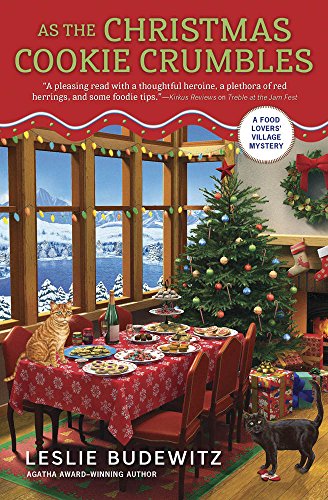
Tis the season and I have great fondness for Christmas cookies. Today’s guest Leslie Budewitz is an expert in those buttery, sugary treats. She is also an Agatha-winning author for fiction and nonfiction as well as an attorney. Her latest book As the Christmas Cookie Crumbles is a tasty mystery with recipes.

Leslie is the author of two cozy series and a reference guide for writers: Books, Crooks and Counselors: How to Write Accurately about Criminal Law and Courtroom Procedures. She’s a past president of Sisters in Crime and, after a two-year stint on the board of the Rocky Mountain Chapter of Mystery Writers of America, will be joining the national board of MWA in January.

Welcome, Leslie!

Leslie Budewitz

Question: Although you write cozy mysteries, you also tackle serious themes. How do you balance the lighthearted tone of a cozy with grim issues like homelessness and family dysfunction?

Leslie: Any mystery—any novel—depends on conflict, some internal, some external. Those conflicts often arise from the world around us, whether it’s family tension or a dispute over whose turn it is to beg on a particular street corner. Other cozy authors have tackled social justice issues as well—Cleo Coyle, Elaine Viets, and Diane Mott Davidson among them. The trick in a cozy, I think, is to explore the emotions and motivations that the issues raise and make sure that the external actions flow from those internal tensions, because a cozy is ultimately about the personal impact of a crime and the community response to it.

I tend to use an ABC plot structure, with the murder the A or primary plot, the protagonist’s relationships the B or main subplot, and life in the shop or community the C or secondary subplot. That keeps the balance, I hope, and allows me to sneak in some humor and lighter moments while giving the murder the respect it deserves.

Question: The Spice Shop series is set in Seattle; the Food Lovers’ Village series takes place in a tiny Montana town. Can you talk about the differences in handling urban vs. rural settings? Do the personalities of your big city characters differ from those in a small town?

Leslie: To me, the heart of a cozy is community, and the role of the amateur sleuth is to probe and protect it. That makes a small town a natural setting. An urban cozy works when it is set in a community within a community—the Pike Place Market and Seattle’s restaurant community, or Coyle’s Greenwich Village coffee house and the coffee business in NYC.

On the flip side, small-town series are prone to Cabot Cove Syndrome—after a while, there’s no one left to kill! You can root the conflict in the town, bring it in from outside, or create a clash between locals and visitors. An urban setting makes a high crime rate more credible, and allows you to move around the various neighborhoods of a city, although you have to simplify geography and keep the protagonist’s home or shop at the center.

As for differences in personalities, that’s a great question and not one I’d considered. Both my main characters grew up where they now live and identify deeply with their communities. Erin Murphy in the Village series left for 15 years before returning; that’s a common story, especially in Montana; it’s my story, and I’m enjoying exploring it through her eyes

Question: You’ve worked with a Big Five publisher as well as smaller presses. Share with us the contrasts.

Leslie: They’re not as different as you might think. In both, the author’s primary relationship is with the editor. At my nonfiction house, Quill Driver, my editor was also the publisher. At my fiction houses, Berkley, Midnight Ink, and Seventh Street—large, medium, and small—the editorial relationship is still key, even when the structure differs. Larger houses tend to have more robust systems for accounting, routine publicity, and sales and distribution, although smaller houses often contract with big companies for the latter.

Both the decision of the post-merger Penguin Random House to drastically cut mass market paperback originals and the recent decision of Llewellyn to stop publishing new Midnight Ink titles after the Spring/Summer 2019 catalog, as well as the still-fresh sale of Seventh Street Books, demonstrate that business decisions beyond your control can come out of nowhere and dramatically change your career. The only thing you can control is the work itself. Fortunately, that’s the most satisfying aspect, but being able to predict your cash flow ranks pretty high, too.

Question: You’re an attorney yet none of your fiction features a main character in that profession. Is there a reason you’ve chosen other fields for your characters? Is there a legal mystery in your future?

Leslie: A cozy depends on an amateur sleuth; lawyers and journalists are semi-pros, so if one were to star in a cozy series, she’d probably need to be retired and running a bakery! Pepper Reece in the Spice Shop series managed staff HR for a large law firm that collapsed in scandal, and she uses her knowledge of people rather than a knowledge of the law to solve crimes. But she also reaches out to lawyers and paralegals she’s worked with now and then. Erin Murphy consults her step-father, a lawyer turned herbalist and acupuncturist, when she needs to understand a legal detail or two.

I don’t see myself turning to legal mysteries or thrillers, but I can say that injustice will always be at the heart of what I write.

Question: Anything else you’d like to talk about?

Leslie: While writing is a solitary activity, one of the most important elements in a writer’s career is her community. You and I met ages ago, long before we’d published any fiction. We shared a magical writers’ group for a couple of years, and have met for countless lunches and cups of coffee since then, brainstorming and bolstering. I encourage Kill Zone readers at all stages of their writing careers to form and maintain those communities, on line and in person. Cozies are sometimes criticized as unrealistic—as if Jack Reacher were more realistic than Jessica Fletcher—but one thing they get absolutely right is the fundamental importance of community.

Thanks, Leslie, for sharing your thoughts with The Kill Zone.

****************************************************************************************************

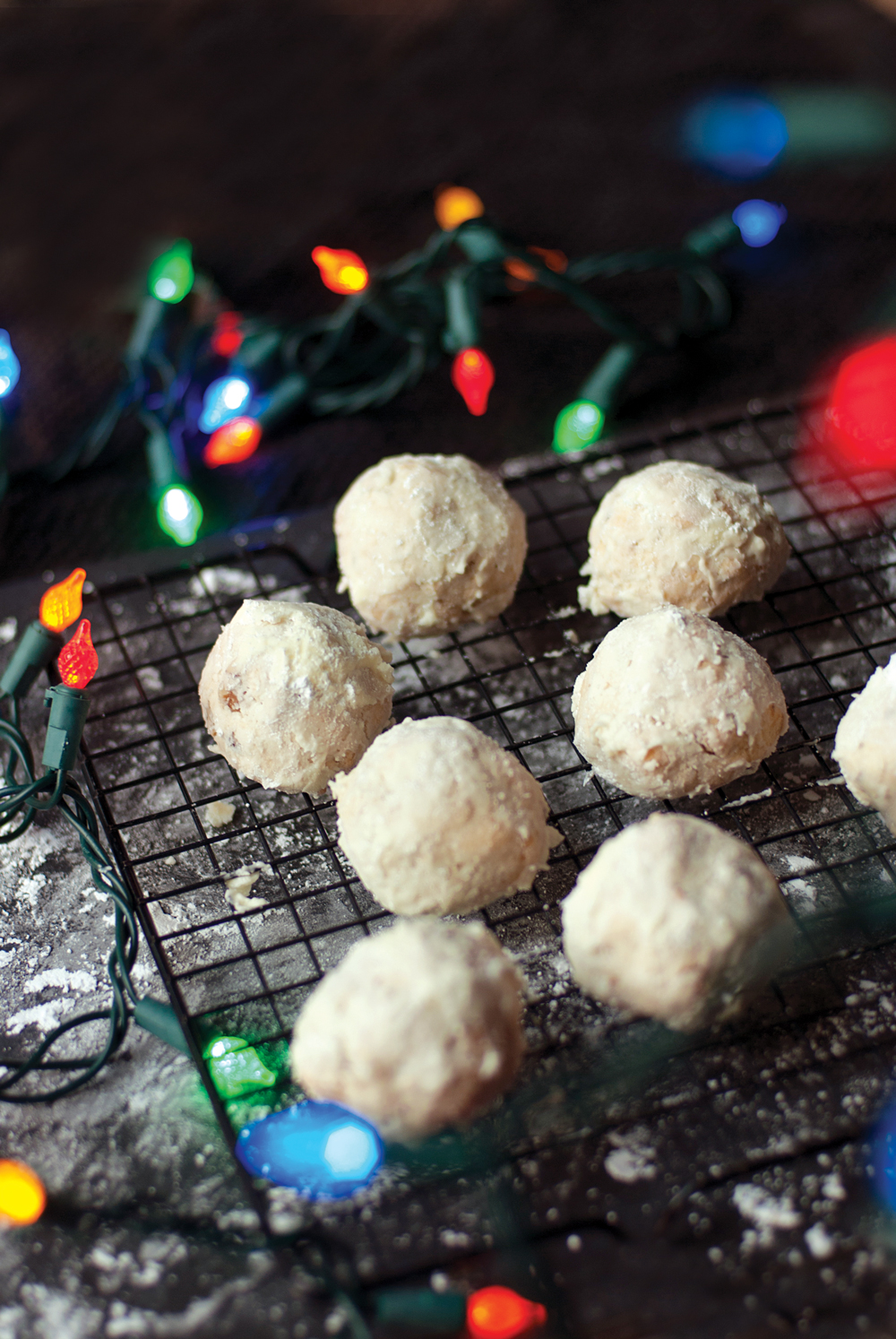
At TKZ, even cookies have aliases. Below is Leslie’s recipe for Russian Teacakes AKA Snowballs AKA Mexican Wedding Cakes:

Merrily’s Russian Teacakes

by Leslie Budewitz

The classic shape is a ball rolled in powdered sugar. But they can also be made as slice-and-bake cookies dipped in chocolate. A reader suggested the Dirty Snowball—add a little cocoa powder to the powdered sugar when you roll the cookie. A delicious idea, especially since a snowball plays a crucial role in the climactic scene.

Whatever you call these scrumptious little treats, I know they’ll be popular with everyone you see this holiday season—even the Grinch and Mr. Scrooge.

1 cup butter (2 sticks), softened

1/2 cup powdered or confectioners’ sugar

1 teaspoon vanilla extract

2-1/4 cups all-purpose flour

1/4 teaspoon salt

3/4 cup finely chopped pecans

1/3 cup additional powdered sugar, for rolling

optional:

2-3 ounces semi-sweet or bittersweet chocolate, for dipping

1 tablespoon cocoa powder, for Dirty Snowballs

Preheat oven to 350 degrees.

In a mixing bowl, cream the butter, ½ cup powdered sugar, and vanilla. Combine the flour and salt and stir into the creamed mixture. Stir in pecans. Chill up to an hour.

Roll dough into 1-inch balls and bake on an ungreased cookie sheet for 10-12 minutes. Pour the additional powdered sugar into a flat bowl or on a plate; for the dirty snowball, add the cocoa powder. When cool enough to touch but still warm, roll cookies in the powdered sugar. Cool, then roll in the sugar again if you’d like.

For slice-and-bake cookies, shape the dough into two logs, about 2 inches wide, and wrap in waxed paper, plastic wrap, or parchment paper. Chill about 20 minutes. Slice and bake 18-20 minutes. Cool cookies on a wire rack.

Melt the chocolate and dip one end of each cookie in the chocolate, or drizzle a bit on the end with a spoon. Return to rack to allow chocolate to harden.

Makes about 4 dozen.

Wishing you all a joyous holiday season!


Are You a Rereader?

Today’s post is inspired by last week’s NYT ‘By the Book’ column in which Michelle Obama was asked “are you a rereader? What books do you return to again and again?” – two questions which prompted me to think long and hard about my own habits when it comes to rereading. Growing up my father reread his faded paperback copy of ‘The Lord of the Rings’ every year – it was almost a rite of passage and when we saw the book appear once more on the coffee table it signaled something both familiar and comforting. Growing up, I was also a great rereader – all my Enid Blyton books are well-worn and dog-eared from countless reads and rereading my Chalet School collection (an obsession of mine well into my twenties as I sought to find all sixty books in the series) was an annual event (which reminds me, I need to reread them all again – it’s been too many years!).

As an adult, however, I find (like Michelle Obama) that with limited time I prefer to read new books – though there are a few books which I’ve read more than once (or even twice). My Jane Austen collection certainly gets reread (especially after visits to Austenish places like Bath) and I have to admit Charlotte Bronte’s Jane Eyre and Emily Bronte’s Wuthering Heights have had a few goes over. I also have (perhaps a bit embarrassingly) reread my Georgette Heyer collection more times than I care to remember. Going back to these books is like settling into a comfy chair with a box of chocolates – a relaxing indulgence (maybe…) but perhaps also a version of hygge:)

Rereading provides a host of different pleasures to the initial read – there’s familiarity as well as enjoyment, there’s a different kind of anticipation as the book progresses, and a different level of satisfaction when the book is finished. When I think about the books I reread, however, I notice that they really only represent a small part of my overall reading taste. If I’m honest they probably represent the more romanticized and escapist portion:)

So TKZers, are you rereaders? If so, what books do you turn to again and again? What do you think distinguishes a book that you want to reread from one which, while you certainly enjoyed it, you feel no need to pick up and read again?