One Writer’s Strange Encounter with a Reader

By SUE COLETTA

Joe’s Saturday post inspired me to share a strange encounter I had with a reader last week. I loaded up the SUV for my annual trip north to appear at a 5-star library in New Hampshire (rated by Library Journal). I’ve all but given up on libraries for book signings, but this library has the coolest librarian/director I’ve ever met. She’s a walking contradiction! Inside the library, she’s quiet, polite, and super helpful. When she locks the library doors, however, she really lets her hair down, hops into her supped-up Mustang convertible and races down the streets—a quick streak of blue and white whizzing by. I adore this woman! Every signing, successful or not, ends with a hug. Which keeps me coming back year after year.

Sometimes my timing is perfect. Other times, not so much.

Last week, the local priest decided to hold his retirement party across the street from the library on the same night as my book event. Needless to say, it wasn’t my most successful signing ever. Didn’t matter. Whether we’re speaking to a packed room or only three or four readers trickle in, we still need to put on the same show. Sometimes a more intimate setting is really nice, as it gives us the opportunity to chitchat with the folks who read our books.

Unless you get an angry-looking woman in the front row who does nothing but glare at you.

All she wanted was for me to keep reading excerpts, one after another. It was strangest thing. Every time I stopped she’d point to another book and ask me to read the opening chapter. No one else objected, so I gave her what she wanted. After I read about four, I was beginning to feel like a puppet on a string. So, I asked her why she’d rather hear me read than chat with me.

Her response? “I don’t even think about the writer when I read. I don’t care about the research. I don’t care about the story behind the story. All I want is the next book.”

“Wow,” was all I managed before the librarian jolted to her feet.

“I care,” she said, “I care very deeply for writers.”

The others in the room agreed.

Still, I couldn’t help thinking, how sad. Here this woman sat surrounded by books lining every wall, every partition. Decades, if not centuries, of writers who’d worked endless hours, alone, pecking the keyboard or typewriter or writing longhand by candlelight, their joys, their sorrows, their laughter and pain spilled across the pages, and this poor woman was incapable of seeing any of it. Didn’t care to, either, apparently. But even if she continued to disrespect writers, I wasn’t about to stoop to her level and spout an equally snarky comeback. I’m a big believer in karma. So, I gave her a free signed paperback and thanked her for coming to the event.

If you haven’t done book signings yet, let me put your mind at ease. For every one clueless reader, there are thousands of others who cherish every word. Readers who sit our books on a shelf of honor because they loved it so much. Our characters become their best friends, sometimes their only friends. When these devoted readers finally get the chance to meet the writer who brought their beloved characters to life, they shower us with love. Some might even mistake the writer for one of their characters. You know what? That’s okay, too… unless she’s a Delores Claiborne type. 😉 It means our words, our stories, touched their lives in some way.

Isn’t that why we write?

Please excuse me while I share my love for those who read my books. I’ve been blessed with an amazing, generous, thoughtful, kind, funny, loving, and downright nutty audience. It’s no secret that I adore crows, right? I’m so enamored with these birds that I’ve set out to change the public perception that crows are pests. Nothing could be farther from the truth. Spotting one in the yard does NOT equate to a bad omen. These amazing creatures—the smartest of the bird world, by the way, along with their cousin, the raven—do NOT bring death and destruction. They’ve been saddled with an unjustified bad reputation for no apparent reason. It’s time to stop judging birds by the color of their plumage.

Ahem. Excuse me. I get a little carried away when it comes to breed profiling. 🙂

Anyway, since I share my love for Poe (my crow who lives free, yet comes when called) along with Edgar, Allan, Thoreau, Shakespeare, and the rest of my black beauties (some of which I’ve turned into characters for my Mayhem Series) readers are now decorating my office with crows. Here are a few I received this summer…
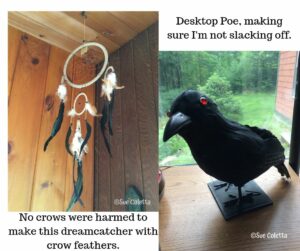
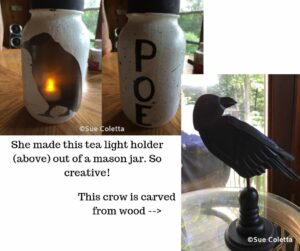


Over to you, TKZ family. Have you ever heard a similar remark as the woman in the library? If so, how’d you handle it? Tell us about your strangest — or best! — encounter with a reader?

*I’m on the road today, researching, so I may be late responding to comments.

Get More Done By Giving Yourself Less Time

by James Scott Bell
@jamesscottbell

You’ve probably heard Parkinson’s Law articulated, even if you didn’t know its name. It was formulated by C. Northcote Parkinson, one of those appellations whose authoritative grandeur makes you stand at attention. He was actually an English naval historian and novelist, and quite prolific. So it must have been with some consternation that his most famous work turned out to be the little book Parkinson’s Law, which arose out of a satirical article about government bureaucracy.

In short form, Parkinson’s Law holds that work expands so as to fill the time available for its completion. As explained in this article, the adage…

…signifies that the more time we dedicate to a certain task, the longer it will take to complete it, even if we could have gotten the task done just as well in a shorter period of time.

For example, according to Parkinson’s law, if we’re given a week to perform a task that it can normally take us a day to complete, then we will end up unnecessarily stretching our performance of that task, until it takes us a week to complete it.

This is why publishing houses give writers deadlines. And why writers almost always find themselves massively stressed in the weeks before a manuscript is due. They could have been early with the book, but they aren’t because they’ve expanded the work all the way to the deadline. It’s almost magically perverse.

This is why it’s important for indie writers to establish SIDs—self-imposed deadlines. Otherwise, it’s just too dang easy to loaf about you manuscript, especially if it’s giving you some trouble.

The article suggests the following:

To account for Parkinson’s law in your work, you need to start each task by identifying its scope, and trying to determine how much time it will realistically take to complete it.

That is, don’t ask yourself how much time you have to complete a task. Instead, ask yourself how much time it should realistically take you to complete that task, and do your best to complete your work within that timeframe.

In other words, set your own deadline based on what you could realistically accomplish if you parked your keister in the chair each day and did your work!

Further, you can put time constraints on a micro level as well. Let’s say you have four months to write 70k words, and you know your writing schedule and daily quota can easily get you there. Don’t get cocky.

Instead, figure out what you can optimally produce per week, up that number by 10%, and make that your goal.

You can even go smaller. Every now and then I give myself five minutes to write 250 words. I’ll often use Dr. Wicked’s Write or Die for this task. Nothing jump starts the writer’s mind like forced, fast writing (with the possible exception of a double espresso).

Final bit of advice. Parkinson had another law, the Law of Triviality, which holds that members of an organization give disproportionate weight to trivial issues.

Might I suggest that this applies to individuals, too.

For writers this might mean that when you sit down to write you first check your social media or email, or rearrange your desk, or finish that Sudoku you’ve been working on.

Indeed, there even seems to be a new corollary at work today: the amount of available triviality on the internet exponentially expands our desire to experience it.

Which leads to another law: Every “peep of steam through [your social media] whistle — Listen to me! Listen to me! — [reduces] the boiler pressure … needed to write another novel.”

Solution: Practice digital minimalism, set your own strict time limits when you work, and write!

Does Parkinson’s Law resonate with you? Do you find yourself filling up all the time you have for completing things?

Incident at the Library

Photo by Chuttersnap courtesy of unsplash.com

I still go to the library regularly. Books appear like magic on my front porch practically every day but there is something — a few things actually — about a library that you can’t beat. My favorite is a metropolitan branch office located in a shopping center a few miles from my home. It’s the type of library — location-wise, anyway — that I patronized as a wee lad and it will no doubt be the kind that I will be walking into when the engine known as “Joe H.’s circulatory system” decides to call a wildcat strike. Yes, the interiors of libraries and the services they provide, moving far beyond books, have changed from sixty years ago and will continue to change. Joltin’ Joe Moore wrote a blog about those modifications almost seven years ago (which you can find here) and it is still on point. There is something, however, that speaks to me about this library, whose exterior is so similar to the one I visited two or three times a week as a child.

I was in that library this past Sunday and was reminded in an up-close and personal way of the reason that we still need libraries. I usually go there just to pick up books I’ve reserved, and this visit was initially no exception to that rule. I got a few graphic novels, consisting of some collections of Ed Brubaker’s and Sean Phillips’ Criminal anthology series and the first two volumes of Brian Azzarello’s and Eduardo Risso’s 100 Bullets. I  also knew that the branch had a copy of Hillbilly Elegy by J.D. Vance (which has been on my “must-read” list for three years) so I picked that up as well. It took me a second to find the non-fiction section amidst the CDs, DVDs, reserves, audiobooks, and magazines, but find it I did. Seeing the books with the Dewey Decimal System numbers on the spine was like greeting an old friend. I in due course found Hillbilly Elegy right where it belonged (“305.562 VAN”). I was about to go to the self-serve checkout kiosk when I noticed a book displayed on the shelf where I found Hillbilly Elegy. The book — Outliers: The Story of Success by Malcolm Gladwell (“302 GLA”)— looked interesting, so I checked that out as well, thanks to a librarian who liked the book enough to put it on display so that would stand out. 

Digital editions of books are becoming more popular, This has caused a bit of a dispute between publishers and libraries which you can read about here).  The market for physical books may be decreasing but it hasn’t collapsed. I like physical books — there is something about the tactile experience with a book that can’t be beat — but I have come to prefer eBooks for two reasons. One is that I can adjust the font and its size. The other is the “search” feature. If a novel has more than a couple of characters I often forget by page 135 who was doing what on page 40. One can obtain either format, regardless of preference, of many titles at or through the library. Take the aforementioned Hillbilly Elegy. There was a waiting list — a long one — for digital copies (author Vance is an occasional resident of the Columbus area) but a physical copy was readily available. And yes, many of you like audiobooks, which are available at and through the library as well. I am amazed at the width, breadth, and depth of audiobooks which are available digitally and physically through and at the library.

One last story. While I was browsing an announcement was made that the library was closing soon and that anyone who needed a ride home should contact the front desk. After I checked the books out at the kiosk I walked to the front counter, and asked the three women sitting behind it, “Who do I see about that ride home?” They all laughed, and one said, “Wellll…Uber, Lyft, Yellow Cab…” Everyone laughed again, and then the quick-witted librarian happened to look at the books which had been checked out by the half-witted patron. “Oh! I’m glad you got that,” she said, pointing to the copy of Outliers I had checked out. “I put that up weeks ago!” So there you go. You don’t get that type of human interaction on Amazon.


That brings us to you. Joe M., at the conclusion of his long-ago post, asked when your last visit to the library was. What I want to ask is when was the last time you recommended the library to someone. I did it two weeks ago. And when was the last time you visited the library and came away with something that you didn’t go looking for? Bedbugs don’t count.  But you do. Thanks for being here today.                


Reader Friday: Favorite Villain

Imagine yourself in a prison visiting room, with a petition of plexiglass between you and a fictional villain.

Who’s sitting across from you? Why did you choose to interview this villain?

What’s the first question you’d ask?


If your favorite villain is still loose on the street, where are you conducting the interview? Do you feel safe? Why/why not?

The Nose Knows

By Elaine Viets

Does your writing stink? Do your scenes feel flat and your characters cardboard?
Maybe you’re neglecting the sense of smell. Sights and sounds are essential. But smell can add another dimension.
Smell is tied to emotion. Real estate agents tell prospective sellers to bake cookies or a loaf of bread just before a buyer tours their house. They’re hoping those smells will trigger happy memories of home cooking and the lookie-loo will buy the house.
Years ago, when I was growing up, I would wake up and smell the coffee – and the fried eggs and bacon. Those were good memories.

Smell can be a quick, easy introduction to a flashback in your novel.
The smell of climber roses and cut grass take me back to my Midwestern summers. The scent of honeysuckle reminds me of Sundays at my grandmother’s house, when I read near a honeysuckle vine.
The smell of hothouse flowers make me think of funerals.
Beer, gin, wine and other alcoholic odors can bring back good times and bad ones.
These smells can trigger a happy – or sad – memory and give you an easy way to reveal your character’s back story.

Smell can herald a person. I can smell smokers before I see them: I pick up the stale nicotine scent of their cigarettes or cigars. The smell lingers on their skin and in their hair.
So do perfumes. In a mystery I just read, the protagonist knew the man she was talking to had just seen his girlfriend – his car still smelled of Chanel No. 5. I know when a certain security guard is on duty at our condo because he wears a strong, pleasant aftershave that I can smell throughout the lobby.

Smell can announce your protagonist or cue your characters that the killer is in the room.
In “Postmortem,” Patricia Cornwell has a killer who

(spoiler alert!)

has a rare metabolic disorder, maple syrup urine disease, which provides a crucial clue. He smells of stale maple syrup.
You can have your victims smell their assailant’s sweat, cigarette smoke, perfume or aftershave. They can be close enough to have garlic or curry or mints on their breath.
In “The Poet,” Michael Connelly says a room “smelled like stale smoke and Italian salad dressing.”
Smells change at different times of day. I visit an office building two or three times a week. Early in the morning, about 7:30, it smells like cleaning products with top notes of bleach. After 9 a.m., when many of the workers are at their computers, the building smells like hot coffee. By noon it smells of microwave dinners. And at 4 p.m., it smells tired. What’s that smell like? Burnt coffee with undercurrents of sweat and stale microwave meals.
In the morning, people may smell freshly showered and their shirts smell of starch. By nighttime, after a stressful day, they could smell of sweat.

Smells can give your story a sense of reality. Your writing can paint an idyllic picture of a farm: the green fields, the sturdy farmhouse, the horses grazing in the pasture. But what’s the first thing you smell?
Be honest now.
Manure.
That smell gives your pretty word picture a whiff of reality.

****************************************************************************
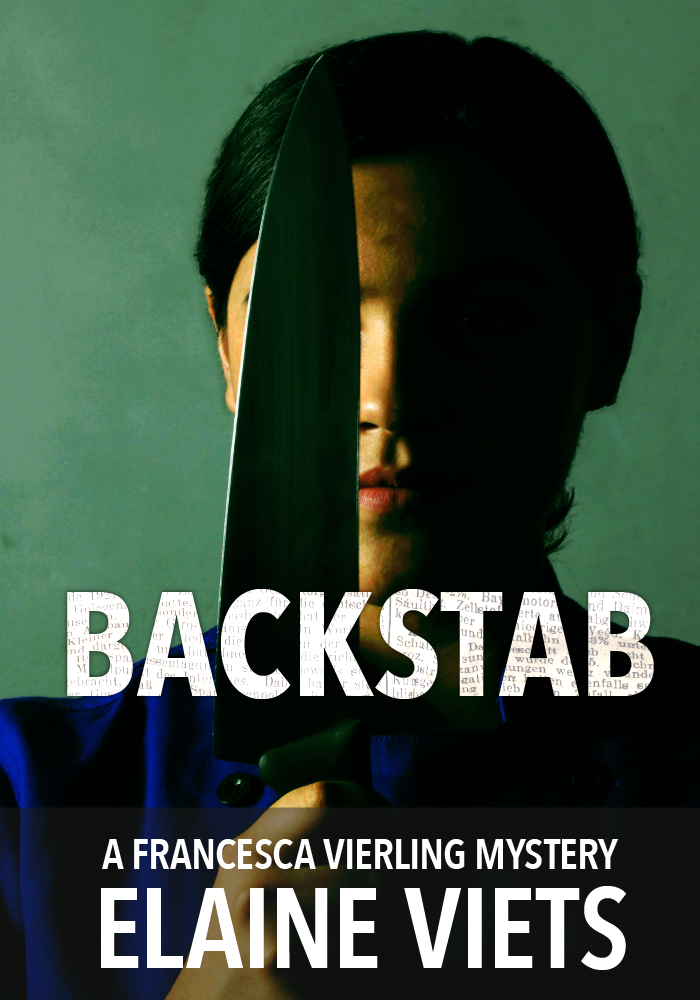
Win “Backstab,” Elaine’s first newspaper mystery, reissued as an ebook. Click Contests at www.elaineviets.com

First Page Critique: The Purple Door


(Purchased photo via iStock)


Greetings, readers and writers all! It’s First Page Critique time. Please take a few moments to read the submission, and my critique–then share your thoughts and advice in the comments.

THE PURPLE DOOR

CHAPTER ONE

Christina

Thursday, October 1

For the first time since Christina buried the yellow bag, it was time to check in. She was in no shape for it. She hadn’t slept in two days, maybe longer, and the Storm was here.

She stood at one of the windows, the old boarding house creaking in the wind. The Storm poured out of her unwell mind, blurred the pane of glass, blended with the actual, physical storm outside. The leaves on the treetops shook with tethered fury, and lightning splashed over the street. She looked down over the neighborhood, her ceaseless thoughts flowing out into the raindrops watering the ground.

So much had happened in a month, most of it bad. But she’d found something unexpected at the Purple Door. This attic room had become home.

She’d made herself a nest.  Up in this high-raftered roost, working on the mural and listening to her records as loud as she wanted, talking to Adam until the sun came up, this place was her whole world. Everything and everyone she needed was here… and all the little things she didn’t need, she’d buried.

She was going to stay right here. So she had to pass this phone call.

Christina dropped the curtain on her faint reflection in the glass, a flash of long blond hair. She had to be ready. She began to pace, staring into the fathomless black face of her phone until it lit up in her hand:

“DAD”

The name leapt off the screen in all caps, a visual shock. It was a trick she used in order to focus, now that the crazy thoughts her meds used to kill were back in bloom.

She’d buried her pills, and several other problematic artifacts, in little holes around the boarding house. In the back yard, a gauzy yellow bag that used to shimmer in the light was now stuffed with tablets of lithium, lamictal, and clozapine, and sealed underground with three feet of dirt. She was up here without a net.

________

Let’s start this party with a quote from William Howard Taft, 27th President of the United States, and 10thChief Justice of the United States:

Don’t write so that you can be understood, write so that you can’t be misunderstood.

This is a big deal when it comes to writing (or speaking), and it’s uniquely critical when a writer is creating a fictional world for the reader. If the reader feels unbalanced by the prose, or more confused than fascinated, the writer may lose them. Below I’ll discuss how this is relevant.

There’s so very much to like about this submission, The Purple Door.

–Christina is a vibrant protagonist. She’s a person of strong will and motivation.

–Dreamlike imagery

–Precise language

-Compelling portrait of a young woman with brain differences


“For the first time since Christina buried the yellow bag, it was time to check in. She was in no shape for it. She hadn’t slept in two days, maybe longer, and the Storm was here.

She stood at one of the windows, the old boarding house creaking in the wind. The Storm poured out of her unwell mind, blurred the pane of glass, blended with the actual, physical storm outside. The leaves on the treetops shook with tethered fury, and lightning splashed over the street. She looked down over the neighborhood, her ceaseless thoughts flowing out into the raindrops watering the ground.”


The first thing I imagined when I read this opening was that Christina was either a witch or a superhero who was maybe checking in with her handler. I had no clear idea what kind of this story was. Call me overly literal, but I cannot lie.

The second paragraph, about the Storm, definitely has a supernatural feel. Now, I understand that the drug combination at the end of the piece implies that our protagonist has psychiatric issues that present her with some spectacularly trippy, mind-blowing experiences. And there’s room for them in the story. Maybe just not right off the bat. Don’t give the reader dessert before the meal. UNLESS you’re going to start out with a hugely damaging or significant psychotic episode as the novel’s opening gambit. But that’s not happening here.

I’d like to see the piece start out with the bold facts, and resist being coy. Always resist coy.

Suggestion:

Exactly one week ago, Christina had used a rusted hand spade to bury her pills, and other problematic artifacts, in deep holes around the backyard of the boarding house. A gauzy yellow drawstring bag that used to shimmer in the light now lay hidden three feet underground, stuffed with what was left of her lithium, lamictal, and clozapine tablets. They were down there, which meant she was up here, living without a net.

We immediately know who Christina is, and the battle she’s fighting in her brain. It’s a fierce beast. Sure, she has to get by DAD, but he is a secondary foe. No doubt he’s one of many she’ll encounter over the course of the book. The real beast—that brings her both burdens and strange gifts—will be with her all her life.

With that in mind, it’s okay to go on and show us Christina’s current sleepless, exhausted, nervous state. If you’re going to go with a visual of the Storm she experiences as she looks out the window, be straight about it. She knows it’s not real, but she’s also experiencing it. Let the reader know, too.

Now she stood in the darkness, looking out the window, phone in hand, waiting for her father to call. It was time to check in. Time to convince him that she was doing just fine on her own. Except, she felt the Storm in her head coming on. It blurred the pane of glass, blended with the real rainstorm lashing the outside of the old house. The topmost leaves of the trees shook with tethered fury… [continue as written]

I very much like the imagery in this section. The splashing lightning made me hesitate, but I think it works.

As far as I’m concerned, the rest of the page works fine—as long as the burying of the pills moves to the beginning. Two minor points:

–Remove the ellipses in the fourth paragraph and replace with a comma, or begin a new sentence.

–Does she really think of her thoughts as “crazy thoughts?” [penultimate paragraph] One of the implications of not being on the drugs appears to be that she feels like herself. It brings into question the concept of normalcy—something that is certainly debatable.

One more significant suggestion. After the first paragraph, try switching to the present tense. Not everyone is a fan, but just try it. It offers an immediacy that I think is appropriate to the subject.

Now she stands in the darkness, looking out the window, phone in hand, waiting for her father to call. It’s time to check in.

Sally forth, Brave Author. This is a terrific story!


Interview with Larry Brooks

 by

Debbie Burke

@burke_writer


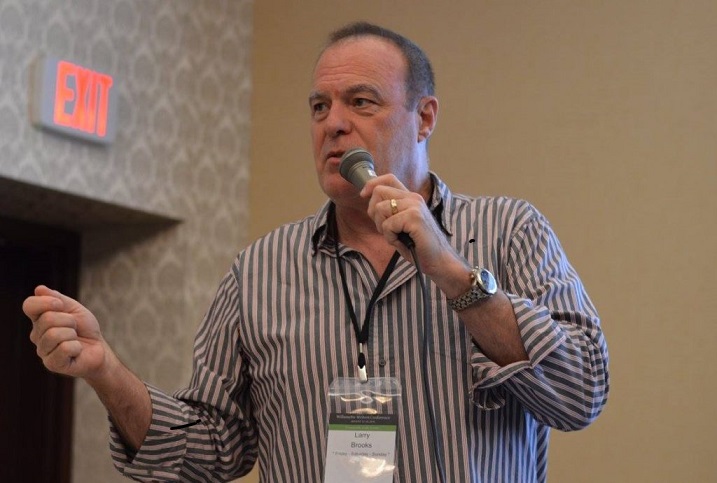
Today, I’m delighted to talk with former TKZ contributor, Larry Brooks, about his new craft book, GREAT STORIES DON’T WRITE THEMSELVES, with a foreward by mega-bestseller Robert Dugoni. Larry’s book launches on October 8, 2019, published by Writer’s Digest Books. 

Welcome back to the Zone, Larry! 

DB: You’ve written three successful books on fiction craft–Story Engineering, Story Physics, and Story Fixeach with a strong emphasis on the architecture of story structure. What new ground are you digging into for this latest book?

 LB: Each of my writing books sought to bring clarity and order to what one might call the conventional wisdom of writing a novel, which is anything but clear. Within that so-called conventional wisdom there is legitimate imprecision, alongside unfortunate confusion born of contrary interpretations and polarizing preferences. Because of this, there remains a high degree of risk and a frighteningly high frequency of failure. Over 96 percent of novels submitted by agents are rejected at least once. That’s not exactly irrefutable statistical proof that the conventional wisdom serves everyone well.

That said, those who claim “there are no rules” are only adding to the noise and confusion. Frustration resides in the grey area between rules and principles, and between the separate contexts of process versus product. So much of what we hear and read about “how to write a novel” connects to process (how your favorite author does the work may or may not be a process that works for you). This leaves the realm of product – what a novel consists of, the criteria for efficacy, and how to know if you’ve come anywhere near close enough to meeting those criteria as largely untended ground. It’s as if the unspoken common courtesy suggests that you can write anything you want, any way you want, and you’ll be fine… if you “just write.”

That 96-percent failure statistic proves this to be false. My new book – “Great Stories Don’t Write Themselves: Criteria-Driven Strategies for More Effective Fiction” is process-neutral, yet it culls out and assigns specific criteria for each and every element and essence of a novel across the entire structural, dramatic and character arcs involved. No matter how you get there.

Too often writers don’t know what they don’t know, while believing they do know enough, or what they think they know is unimpeachable. My new book seeks to shrink the gap between those extremes.

DB: Sounds like an ambitious goal. Can you give us an example?

 LB: Sure. When was the last time you heard anyone at a writing conference – a speaker, teacher, agent or even another writer in an elevator, tell someone that their story idea isn’t strong enough? Never happens. And yet, as much as half of all rejection connects to story ideas that are derivative, vanilla and flat, that are lacking the raw grist of what makes a story work. Ask any agent or editor how many of the story ideas that cross their desk excite them, how often this happens, and this truth will be verified.

But it’s not just the story idea that matters. Whether it’s the core premise, the opening scene or sequence, the first plot point or the midpoint or the way the character and her/his core quest is framed… all of it becomes more accessible and effective when developed and evaluated in context to criteria that are universally applicable to that specific element.

 DB: Where did the germ of the idea for Great Stories come from?

 LB: I pondered that 96-to-4 failure rate, and decided there had to be a better way forward. After writing three books on storytelling that began exploring this sad truth, the subsequent question of “now what?” wouldn’t let me alone. How and why are those 4-percent of submissions that succeed better than the 96-percent that aren’t working as well? What are the common denominators of that?

My favorite writing tip is this: scenes work best once we understand the narrative expositional mission of the scene, in context to what came before and what comes next. This is why we rewrite and revise, to get closer and closer to that optimal form. From that epiphany, I came to realize this is true for all of the structural, thematic and aesthetic elements of a great story, at all levels. We are either searching for our best story, or we are polishing (optimizing) scenes toward that standard. That said, too many writers aren’t writing toward a standard at all, they are simply writing down what seems to be available in the moment of creation. They are just writing.

The more we understand the available criteria that will apply to a story that reaches the high bar of optimal efficacy, the sooner and more blissfully we will arrive there. That objective became the mission of my new writing book.

 DB: What’s the most important concept or lesson you hope to teach writers with your new book?

 LB: You don’t have to guess, nor do you have only your instincts to inform your choices. Your story choices can be informed by the criteria that will apply, one way or another, to the determination of what works and what doesn’t. These criteria apply within any and all writing processes, readers don’t give two hoots how the writer got it done. What does matter is the degree to which our choices align with what readers want, expect and have learned to recognize as emotionally resonant, thrilling and rewarding. That’s what talent really means: the consistent ability to land on the best possible ideas, and then make them shine on the page. When either of those outcomes happen—they are different core competencies, by the way, meaning we need to develop our craft on two levels, as storytellers and as scene writers—they are always framed by criteria that explains why they work. The book defines, explores and verifies over 70 separate criteria that apply within 18 specific facets or locations within the entirety of a novel’s narrative arc.

 DB: What’s next on Larry Brooks’ “To Do” list? Is there a new thriller simmering on the back burner?

LB: I promised my wife I’d write her a love story, and in my mind the best love story is a thriller, because so much is at stake… stakes being a key criteria in any genre. Setting it in France won’t hurt, either.

Thanks for having me back here on The Kill Zone. I can be reached through my website, www.storyfix.com, where you can learn more about this book and any of my other work, including my fiction.

Larry Brooks

~~~~~

Thanks for sharing the inside scoop with us, Larry.

I, for one, will be looking forward to your love story thriller!

Great Stories Don’t Write Themselves is available for pre-order at:

Amazon

Barnes & Noble

~~~~~

TKZers: Do you have questions for Larry about his new book and/or story structure?

First Page Critique: No Tomorrows

Happy Monday (and for me, the final week of summer before my twins start high school – so no stress at all this week…)!! Today I’m critiquing the first page of a project entitled (ominously…) ‘No Tomorrows’. As always, my comments follow and I look forward to your input!

No Tomorrows

Sally Lee’s sandals squished on the wet pavement. She should’ve changed to sneakers, but hadn’t wanted to take the time. She had to escape the house.

Escape? A curious word. Where’d that come from?

The fog had closed in after the evening’s pounding rain. It swirled around her, shrouding her in cold white anonymity as she walked away from the peaceful cul-de-sac where they’d lived for twenty years. It felt good to be walking somewhere, anywhere. Her jacket whipped around her. She zipped it up and tucked her blond curls under the hood.

Wrapped in the mist, she could think, find her reason again after the strange events of the evening. It had started with the conversation at the dinner table.

After the blessing, Sally asked, as she always did, “How was your day, kids? Anything interesting happen?” She started the mashed potatoes around the table, then reached for the platter of pork chops. Dinner as usual. Sally thrived on as usual. Dinner was family talk time.

Four scrubbed faces turned her way. Mayra answered first, tossing her long blond hair over her shoulder. At fifteen, she acted as if it was her right to be first in any circumstance. Sally often had to remind her to allow the youngest to go first sometimes.

“Remember I told you we have to write an essay?” she asked. “Today Miss Harris told us we had to choose one of three questions to answer in our essays.”

Five pairs of eyes looked at her.

“Well?” Roger asked, “What question did you choose?”

“What would I do today if I knew I’d die tomorrow?” Mayra answered her father, reaching for the platter of dinner rolls.

Sally dropped her fork. It hit her plate with a clang, then bounced to the floor, skittering under the table. Five pairs of eyes watched as she scooted her chair back and dived under the table. She picked it up, along with a piece of broccoli.  Her hand trembled as she pushed her hair back from her damp forehead. The fork clattered to the floor again.

“What are you doing under there, Sal?” Roger peered down at her.

“Getting my fork—you writing a book? Leave that chapter out, okay?”

The children giggled.

Crawling out, she wiped her fork on her napkin and popped the broccoli into her mouth.

“Five second rule?” chirped five-year-old Kimmie.

Overall Comments

I loved how this first page juxtaposed an ordinary dinner scene with Sally’s rather desperate ‘escape’ in the first paragraph. The reader knows something is off kilter, yet there’s nothing obvious to explain Sally’s disquiet…yet…and this provides the reader with a great reason to keep turning the page. The writing is also succinct and clear, with just enough detail to evoke the rain and fog, as well as the dinner table conversation and the family dynamics. Sally’s reaction to her daughter’s essay topic certainly left me wanting to read more and, as with any good first page, it left me with lots of questions I wanted answered.

I particularly liked the first paragraph and the chilling use the phrase Escape? A curious word. Where’d that come from? This definitely made me want to know more about Sally’s past and why she felt such panic and anxiety that she needed to flee her house. The author did a great job of introducing some short snippets of information that made us empathize and also be intrigued by Sally (I loved the line: Sally thrived on as usual. It reveals so much about her character in just a few words.)

Some Suggestions

Still, I do think there were a few ways in which this first page could be strengthened – although most of my recommendations are really only minor nitpicks:)

First, I did feel like the dinner scene could have had a couple of more lines describing the whole family as we only really hear Mayra, Roger, and Kimmie (if my math is right there are two other kids at the table). I found it hard to picture them all – and the use of “Four scrubbed faces turned her way” followed by “Five pairs of eyes looked at her” was a bit generic. Likewise, having both the protagonist and her daughter described by their blond hair didn’t seem very distinctive or interesting.

Second, I didn’t really believe the essay topic that Mayra had been given at school. At fifteen, “What would I do today if I knew I’d die tomorrow?” seems a rather odd topic (though maybe this is just me??). I think I would have been more willing to go along with it had Roger reacted in some way or said something like “Wow, that’s pretty dark…” or “Miss Harris is a strange one.”  – something to show his character a bit more. This would also provide a nice contrast to Sally’s reaction.

Finally, I think I would have liked just a little bit more tension, maybe even menace, when it came to Sally’s reaction to her daughter’s essay topic. Just one line that could intrigue the reader a bit more perhaps? I didn’t quite understand why Sally said: “Getting my fork—you writing a book? Leave that chapter out, okay?” but that might just me! I think I wanted her to snap at him or be more defensive – something – to add to the disquiet beneath the cozy domesticity of the dinner table scene.

Overall though, I thought this was an effective first page. It managed to combine the ordinary with an uneasiness that made me want to find out more about what was really going on in Sally’s life – so bravo to our brave submitter!

So TKZers what comments, feedback, or advice would you provide?


When Writers Hit The Wall

by James Scott Bell
@jamesscottbell

Early in my writing career I noticed something happening when I got to around the 30k word mark in a manuscript. It was like I hit a wall. It’s not that I didn’t have ideas or know the direction of my plot. It was just a strange feeling like I wasn’t sure what to write next. I’d look ahead at the 60k or more words I had to write, and got the heebie-jeebies. What the heck was going on?

Luckily, I found out I wasn’t alone. Lawrence Block reported the same thing in his book Writing the Novel:

One thing I’ve come to recognize is that I tend to run into a wall at a certain point in all of my books…. I find myself losing confidence in the book—or, more precisely, in my ability to make it work. The plot seems to be either too simple and straightforward to hold the reader’s interest or too complicated to be neatly resolved. I find myself worrying that there’s not enough action, that the lead’s situation is not sufficiently desperate, that the book has been struck boring while my attention was directed elsewhere.

I got to thinking about “the wall” again while reading Kris’s post on settings and Game of Thrones. It put me in mind of the current plight of author George R. R. Martin. Now, I’m not an epic fantasy reader. I’ve never made it past the halfway point of The Fellowship of the Ring (stop with the singing already!) But I am definitely an admirer of those writers who excel at the genre. Especially Martin, whose page count and popularity I look at with awe. He is, at the moment, in the midst of a long patch of writer’s delay involving the next book in his series. Last year, he talked about it:

I know there are a lot of people out there who are very angry with me that Winds of Winter isn’t finished. And I’m mad about that myself. I wished I finished it four years ago. I wished it was finished now. But it’s not. And I’ve had dark nights of the soul where I’ve pounded my head against the keyboard and said, “God, will I ever finish this? The show is going further and further forward and I’m falling further and further behind. What the hell is happening here?”

This sounds like the wall and is completely understandable in light of the complexity of the books, not to mention the TV series running ahead of him!

Patrick Rothfuss, another popular fantasy writer, has also been in the midst of a very public delay for the third novel in his Kingkiller Chronicle (the second book was published back in 2011). Fans have expressed their displeasure—some going way over the line.

In an interview Rothfuss said something interesting:

“But I am moving forward. More importantly, I’m finally getting my life sorted out so that I can go back and approach my writing and my craft with the joy that I used to feel back in the day, when I was just an idiot kid playing D&D or working on my unpublishable fantasy novel.”

I think most of us can relate to that. When we first sat down to write a novel, we felt the joy of creation, the pure fun of making stuff up (see Jordan’s post on the “fun mojo” of writing). We shouted Huzzah! when we typed The End (or something that sounded like Huzzah. Maybe it was just Whew.)

But then we got the stunning news that what we had written didn’t work. We had to figure out why. We had to learn the craft. We had to work.

Then some of us got contracts and had to finish books with the cold, merciless wind of deadlines blowing across the backs of our necks. That chill was even more ominous if we found ourselves at a wall in our manuscript. So I developed some strategies to prepare for that dreaded moment.

1. The 20k Word Step Back

At 20k the foundation of my novel had better be strong. There’s a whole lot of words to write, characters to flesh out, plot twists to justify. So I stop around 20k to assess my plot:

A. Is my Lead compelling enough? Will readers care about his plight? Is he likable? Does he have qualities with which readers can empathize?

B. Are the stakes death (physical, professional, or psychological)? What can I do to ramp up the stakes?

C. Has my Lead been truly forced through the Doorway of No Return (when the book plunges into Act 2)? [Note: if your Lead isn’t forced into Act 2 by the 20% mark of your novel, the readers will feel it dragging.]

D. Do I have enough of an orchestrated cast? Do my secondary and minor characters have enough uniqueness about them? Are they sufficiently in conflict with other characters?

2. The Joy Factor

I’ve quoted this before, but it bears repeating. This is from a 1919 text on fiction writing by a man named Clayton Meeker Hamilton:

In the great story-tellers, there is a sort of self-enjoyment in the exercise of the sense of narrative; and this, by sheer contagion, communicates enjoyment to the reader. Perhaps it may be called (by analogy with the familiar phrase, “the joy of living”) the joy of telling tales. The joy of telling tales which shines through Treasure Island is perhaps the main reason for the continued popularity of the story. The author is having such a good time in telling his tale that he gives us necessarily a good time in reading it. (A Manual of the Art of Fiction)

“For the first thing a writer should be is––excited,” writes Ray Bradbury in Zen in the Art of Writing. “He should be a thing of fevers and enthusiasms. Without such vigor, he might as well be out picking peaches or digging ditches; God knows it’d be better for his health.”

Finding—and keeping—the joy in your book is thus absolutely essential, not just to break through the wall, but to elevate the entire thing. For me that means:

A. Going deeper into characters. This is a source of originality and interest. Giving even a little bit of backstory to minor characters creates all sorts of possibilities. You’re more likely to feel joyful when your novel teems with the possible coming out of characters.

B. Make things even harder for the Lead! Stop being so nice. Keep asking: what could make things worse? Oh, yeah? How about worse than that?

C. Keep a novel journal. This not only keeps you in the story; you can look back at early entries to recapture what got you hooked in the first place.

3. The Skip Ahead

If you’re still feeling hampered or unsure at the wall, get a long pole, back up fifty yards, then run like mad and vault right over the thing. Land a few scenes ahead. Pick the future scene you’re most excited about writing. Then write it!

Now, turn around and look backward. You should be able to plot a way to get from the wall to the scene you just wrote.

So what about you? Do you ever hit a wall in your writing? How do you deal with it?