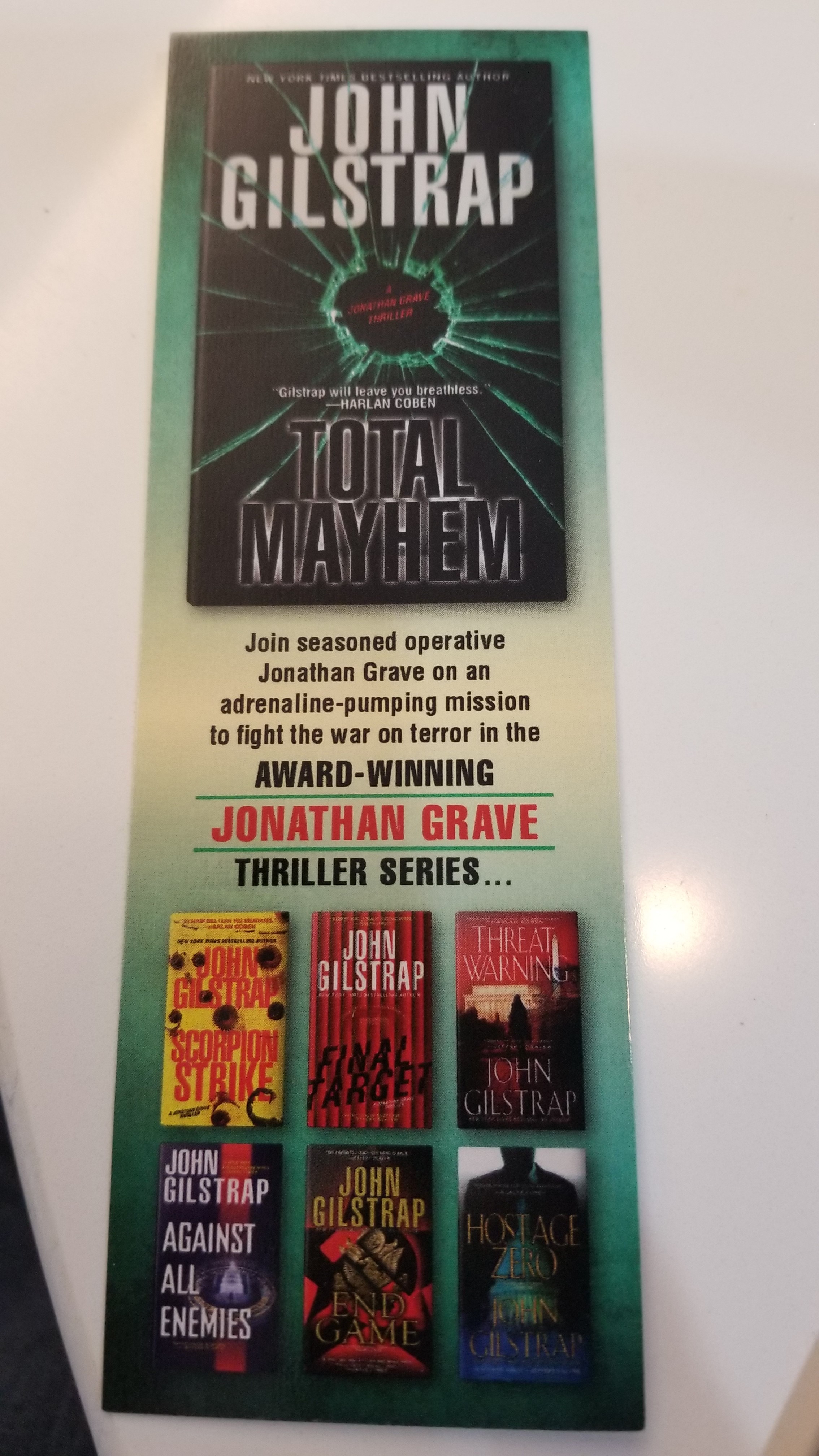
 Up until about a year ago, I thought that bookmark swag was a waste of money and time. I have since changed my mind. I may have posted here before that on those awful occasions when a book signing is really just that–a table in the entryway where I wait for people to inquire why I’m there–I no longer just sit passively and wait. I get up and wander the store, introducing myself as the visiting author, and inviting them to stop by and say hi–or buy a book–as they pass me yet again on their way out of the store.
More times than not, they’ll ask a few questions, and that’s when I hand them my bookmark. As you can see, the bookmark (designed by publisher–Thank you Kensington!) not only has contact information, but the titles of the most recent books and a bit about awards won and such. Never once have I handed out one of these things without seeing the recipient going on to Google me.
When I was on tour for Total Mayhem back in July, I became truly shameless. Because I dined alone, and spent a lot of time writing my next book long-hand, I knew that I was raising curiosity, so I made sure to put a bookmark in the check folder after I had signed the credit card voucher. When you dine in the hotel where you’re staying, that can create an interesting buzz.
Business Cards
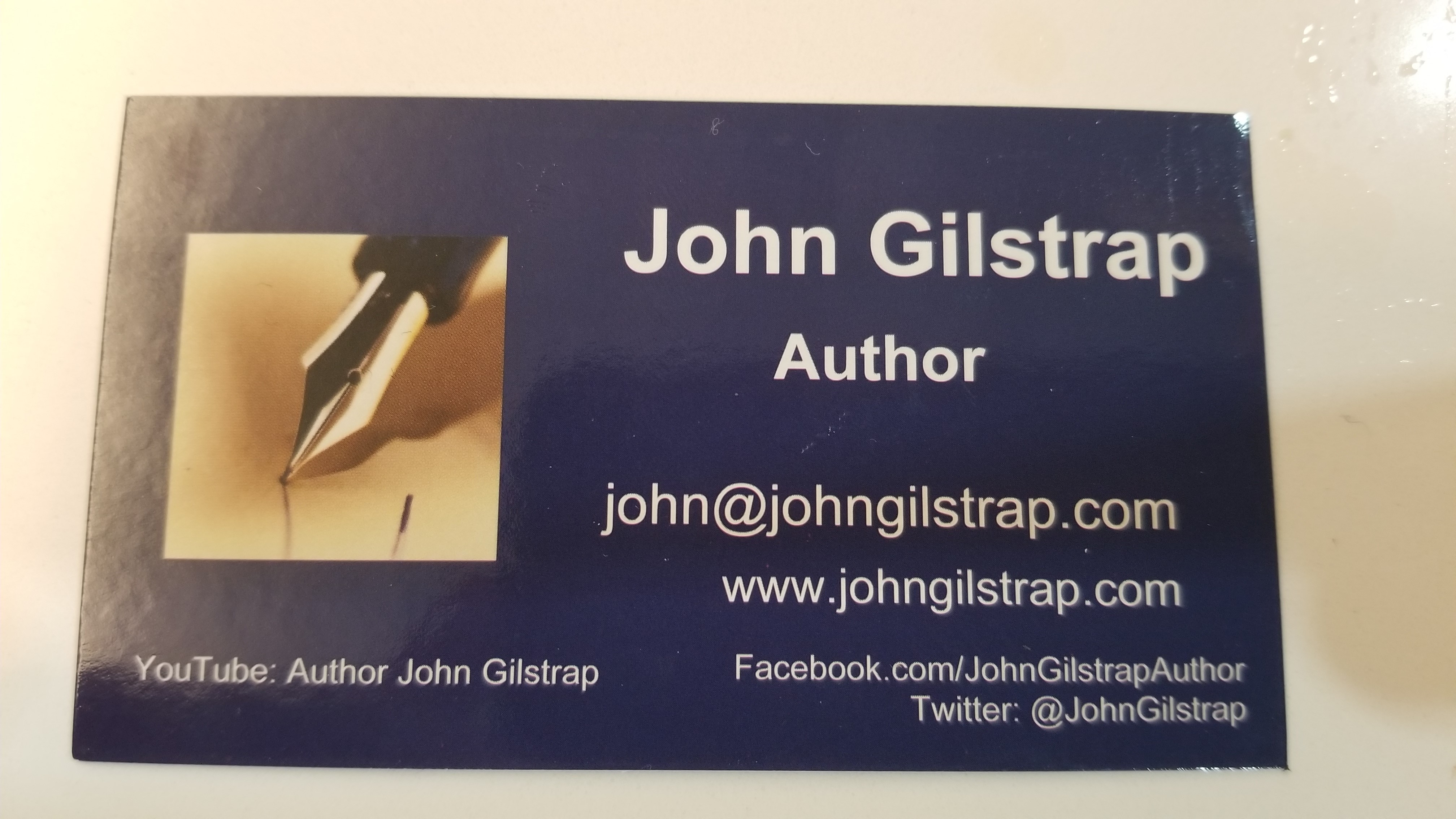 For the first time in the history of forever, I actually killed my entire supply of business cards. As I approached the bottom of the box, I started paying closer attention to other writers’ business cards to see how they were handling what to include and what not to. Because I pass these things out to pretty much everybody from the maitre d’ to the car mechanic to somebody I meet at a party, the information on the card needs to carry a lot of weight.
 Things I considered included:
- Email address but no phone number or street address. (Stephen King’s Misery continues to lurk in my head.)
- Standard design and style. This is one of my peccadilloes. I get annoyed when business cards don’t fit easily into my wallet.
- All social media included for quick reference. I chose not to include the Killzone Blog, however, because my every-other-week posting status would have required narrative.
- My entire bibliography.
- Had to have a clean look.
- Had to have space for people to write notes to themselves on the card.
I’ll let others judge the final product, but I’m happy with it. I’m also happy with Vistaprint, which is the company I used to create and print the cards.
Special Gifts.
 Most swag is intended as a kind of fan service or shameless self-promotion. Or, merely business communication. Sometimes, though, people can be so helpful to my research, or in their hospitality, that I offer them special gifts that I designed for just occasions.
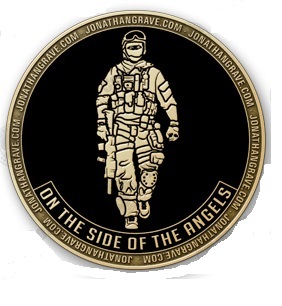 Within military and other public service circles, challenge coins are very important. They are a way of showing pride in one’s unit or department. I figured that if Jonathan Grave were a real person, he’d most certainly have a challenge coin struck for his company, Security Solutions, so I did it for him.
In addition to offering them up as thank-yous, I also offer them in trade for those who offer similar coins for my own collection. Over the years, I’ve picked up some pretty cool ones from some pretty spooky places.
So, TKZ family, what’s your swag bag look like? What works for you as writers or fans or booksellers, and what doesn’t?

 Last Friday I was editing what I wrote the day before in my WIP when a word stopped me cold: casket. Should that be coffin?
 The word coffin comes from the Old French word cofin and the Latin word cophinus, which translates to basket. First used in the English language in 1380, a coffin is a box or chest for the display and/or burial of a corpse. When used to transport the deceased, a coffin may also be referred to as a pall.
 Interestingly enough, the word casket was originally used to describe a jewelry box, similar to the one George modeled in the above photo. 😀