First Page Critique – Broken Thrones

Photo credit: Pixabay

by

Debbie Burke

@burke_writer

Please welcome another Brave Anonymous Author offering a submission entitled Broken Thrones.

1

Joanie Brown opened one eye. The darkness had lifted. Light filtered from a slit in the ragged curtains covering the one window in the room, dust drifting down in the narrow beam. She breathed deeply and gagged. The stench of human filth and the sweet smell of pot overpowered her senses. Her head pounded, keeping time with her racing heart as she struggled to make sense of her surroundings.

Where am I? Why can’t I remember?

She lay on her back on a concrete floor. Under her fingers splayed out at her sides, she felt a gritty moisture. She hastily wiped her hands on her pant legs. She reached out and brushed a cold, rough wall with her left hand. Deep snores sounded from somewhere in the room, so she knew she wasn’t alone. Out of her one eye—the other one wouldn’t open and it hurt—she saw a closed door and four dingy gray walls. The floor was littered with bits of paper, discarded needles, condoms, and a filthy jacket tossed in the corner nearest her. She saw no furniture of any kind, except a soiled striped mattress across the room. She squinted at it, seeing a dark shape curled up on it. The source of the snoring, no doubt. The only other sound was the clack-clack of some insect as its feet raced across the hard floor. She scooted closer to the wall at her left and hoped it wouldn’t come her way. Joanie hated bugs.

She reached up and brushed thick hair out of her face, running her fingers over her other eye, wondering why she couldn’t see anything out of it. Now she knew—it was swollen shut. Wincing, she tried to pry it open. Her fingers came away with a smell of blood. She knew that smell. Her brain kicked into high gear now.

Memory now returned in chunks. Kyle. Where was he? The thought of him made her chest heave.

The last time she’d seen him, he was getting the crap beat out of him in a potholed alley littered with garbage and weeks-old refuse—by two thugs who’d dragged him there from the LA street corner where she’d finally found him. She’d hunkered down and watched from behind a dumpster reeking of rotting vegetables and month-old French fries.

Before that, she had spent hours searching for him.

~~~

Brave Author, your excellent title makes a promise of dire conflict. Broken Thrones implies destruction and violent overthrow of power. It’s short, punchy, and memorable, especially effective since Game of Thrones is currently a popular topic of conversation. Well done!

Your writing is crisp, competent, and vivid. You immerse the reader in the scene by making good use of the senses—sights, sounds, touch, and especially smells. We’ve all caught a nasty whiff from a stinky dumpster and know exactly what you’re describing.

The sense of foreboding is strong. Something bad already happened and worse is yet to come—like bugs crawling over Joanie.

That said, I see two problems with this first page.

First, this opening has been done before. Editors and agents always ask for something “fresh.” They’ve likely read many submissions with opening pages about an injured character waking up in a strange place without any memory of how she got there. This may be an easy fix and we’ll get to that in a minute.

The second problem: lack of action. Almost the entire page is spent setting the scene—a filthy shooting gallery basement littered with drug paraphernalia, an unknown man snoring, Joanie’s swollen eye, and her confusion. She’s taking stock in a scary situation but she’s in the passive role of watching and waiting, rather than driving the action.

The last two paragraphs are a flashback: Joanie watches someone named Kyle, whom she’s been looking for, while he gets beat up. And she hides.

Now that’s action!

Let’s consider if the story would work more effectively if you start there.

A character getting the snot pounded out of him immediately piques the reader’s curiosity, even if it’s not yet clear who that poor soul is or why he’s being beaten. Is Kyle a mugging victim? A druggie who owes his dealer? Or did Kyle sell bad junk to the daughter of the guys who are stomping him?

What is the relationship between Joanie and Kyle? Is he her boyfriend? An ex-husband she’s been chasing for child support? Or perhaps her dealer?

Those answers lead to the next questions: Why has Joanie spent hours searching for Kyle? Did he run away? Does she desperately need a fix?

The most provocative question of all: Why is Joanie hiding? If she fears for her life, why not yell for help or use her cell to call 911?

Does she feel guilty for watching the attack without doing anything to help?

Or does she feel he deserves what he gets?

See what happens if you start with action? The reader is immediately engaged, wondering and guessing, rather than passively watching the scenery, even though the scenery is skillfully and vividly described.

Additionally, that avoids the need for a flashback, which always risks reader whiplash. Just as they’re settling into the story, you yank them to a different place and time. Why flash back when you don’t need to?

If, while Joanie’s crouched by the dumpster, you reveal her character in a way that makes the reader care about her and her quest, we’ll willingly follow her into the next scene in the basement.

When she wakes up, you can still use the vivid description of the disgusting drug den with discarded needles and used condoms. The only difference: it’s probably now page 2 instead of 1. And the reader is more invested in the story and characters.

Then introduce a new series of questions to intrigue the reader. Did Joanie try to stop the thugs and they turned on her? Did their accomplice sneak up behind her and knock her out?

While she’s lying on the floor, reveal her character more deeply through her thought process and actions. Does she crawl to the mattress to see if the snoring man is Kyle? Does she look for a way to escape? Does she grab a syringe and hide it as a weapon for when the bad guys come back?

Keep raising questions while building characters who make the reader care what the answers are.

One tiny nit: since dumpsters are usually emptied at least weekly, “month-old French fries” didn’t quite hit the mark. Otherwise your scents are spot on. Made me gag, but I mean that in a good way!

Brave Author, you have a promising beginning for a dark thriller/suspense novel. Thanks for sharing your work.


Over to you, TKZers. What suggestions do you have for today’s Brave Author?


Today is the last day to download Debbie Burke’s thriller Instrument of the Devil for only 99 cents. Here’s the link.


First Page Critique: Ghost Wind

Happy Monday! Today I’m critiquing the first page of a historical novel entitled Ghost Wind. My comments follow and I look forward to getting some great feedback from you, TKZers!

The Ghost Wind

This was the door the Mexican boy had pointed out to her. She stepped up onto the boardwalk, side-stepping a hole in the rotten wood, the wind pelting her with dirt and dead leaves and causing the oil lamp overhead to swing precariously back and forth. The door was solid and locked tight. Standing on her toes and reaching above her head her fingers found the iron key above the lintel, just as he’d said. The glass panes in one of the windows were shattered, their jagged edges reflecting the moonlight. She struggled with the lock, the key finally turning with a hollow click. The force of the wind slammed the door inward and knocked the few remaining shards of window glass from their panes.  She entered cautiously and looked around the room.  Just enough moonlight penetrated the darkness to reveal several pieces of furniture shrouded in dusty canvas. Lifting the coverings, she found a long leather-covered central table, a cot, a few cabinets still in serviceable condition.  The building seemed solid, but the wind still whined around the warped window sills sending leaves and twigs skittering over the floor and causing the ghostly canvas to billow and fall. She shivered and tried to rub some warmth back into her arms. Whatever made her think it was always hot here?

She continued making a slow circuit of the room, trying not to bang her shins against unseen obstacles. It was near midnight, but the night was still alive with sound. Guitar music drifted from a cantina across the street accompanied by bursts of laughter from a nearby saloon. A door banged somewhere farther down the street. Slow footsteps marched up the narrow boardwalk and then stopped, grinding the broken glass below the window. For a moment it seemed whoever was passing had moved on until a familiar sound stopped her cold. The four, slow, distinct clicks of a gun hammer being drawn back. She knew that sound.

She drew a sharp breath, inhaling the room’s lingering odors of dust, mildew, sour liquor, and stale sweat. The dry branches of a leafless tree scratched against a window making demon shadows dance on the far wall.  The lamp outside, creaking on its rusty hinges, thrashed in the gusty wind. Her hands, already cold inside her gloves, grew clammy.

“Don’t. Move.”

§

It had been a long journey across some of the ugliest, most barren wasteland imaginable. First by train to Waco, then by stage to some godforsaken place called Ben Ficklin, and finally by horseback to… here. San Angela, Texas. A hundred miles from nowhere and on the road to who the hell cares where. But here she was. Nearly fifteen hundred miles. And she felt like she had walked every one of those miles. She was dirty, cold, tired, hungry, and in no mood for an argument.

My comments

The real strength of the first page is the atmosphere it evokes and the attention to detail that allows the reader to get a strong sense of place as well as the past. That being said, these could also be considered weaknesses given the lack of action and dialogue – illustrating the delicate balancing act any author has to achieve on this all important first page!

Because I really enjoyed this first page, I’m wary of making too many recommendations (reader tastes are always subjective after all) but I do think tightening up the initial descriptive paragraphs would help pick up the pace so the reader can reach the critical moment where the gun is being drawn back a little quicker. I wouldn’t take out much, but some of the description is redundant and could be removed without impacting the atmosphere or dramatic tension in this first scene. I would also consider changing the one line of dialogue “Don’t. Move.” to something less conventional or cliched. Something unexpected here would definitely intrigue the reader especially since the next paragraph provides further background (I have to say I love the way the line ‘she was dirty, cold, tired, hungry, and in no mood for an argument’ could feed back into that one line of dialogue).

By way of suggestion only, I’ve re-pasted the first few sections, striking through some of the lines of description I feel are redundant.  See if you agree, TKZers. I think visually if the first page could end with the line of dialogue it would also seem less wordy and more appealing to readers. Otherwise, I thought this was a terrific first page. Bravo to our brave submitter!

The Ghost Wind

This was the door the Mexican boy had pointed out to her. She stepped up onto the boardwalk, side-stepping a hole in the rotten wood, the wind pelting her with dirt and dead leaves and causing the oil lamp overhead to swing precariously back and forth. The door was solid and locked tight. Standing on her toes and reaching above her headher fingers found the iron key above the lintel, just as he’d said. The glass panes in one of the windows were shattered, their jagged edges reflecting the moonlight. She struggled with the lock, the key finally turning with a hollow click. The force of the wind slammed the door inward and knocked the few remaining shards of window glass from their panes.  She entered cautiously and looked around the room. Just enough moonlight penetrated the darkness to reveal several pieces of furniture shrouded in dusty canvas. Lifting the coverings, she found a long leather-covered central table, a cot, a few cabinets still in serviceable condition.  The building seemed solid, but the wind still whined around the warped window sills sending leaves and twigs skittering over the floor and causing the ghostly canvas to billow and fall. She shivered and tried to rub some warmth back into her arms. Whatever made her think it was always hot here?

She continued making a slow circuit of the room, trying not to bang her shins against unseen obstacles.It was near midnight, but the night was still alive with sound. Guitar music drifted from a cantina across the street accompanied by bursts of laughter from a nearby saloon. A door banged somewhere farther down the street. Slow footsteps marched up the narrow boardwalk and then stopped, grinding the broken glass below the window. For a moment it seemed whoever was passing had moved on until a familiar sound stopped her cold. The four, slow, distinct clicks of a gun hammer being drawn back. She knew that sound.

She drew a sharp breath, inhaling the room’s lingering odors of dust, mildew, sour liquor, and stale sweat. The dry branches of a leafless tree scratched against a window making demon shadows dance on the far wall. The lamp outside, creaking on its rusty hinges, thrashed in the gusty wind. Her hands, already cold inside her gloves, grew clammy.

Resorting to Manual Methods

By John Gilstrap

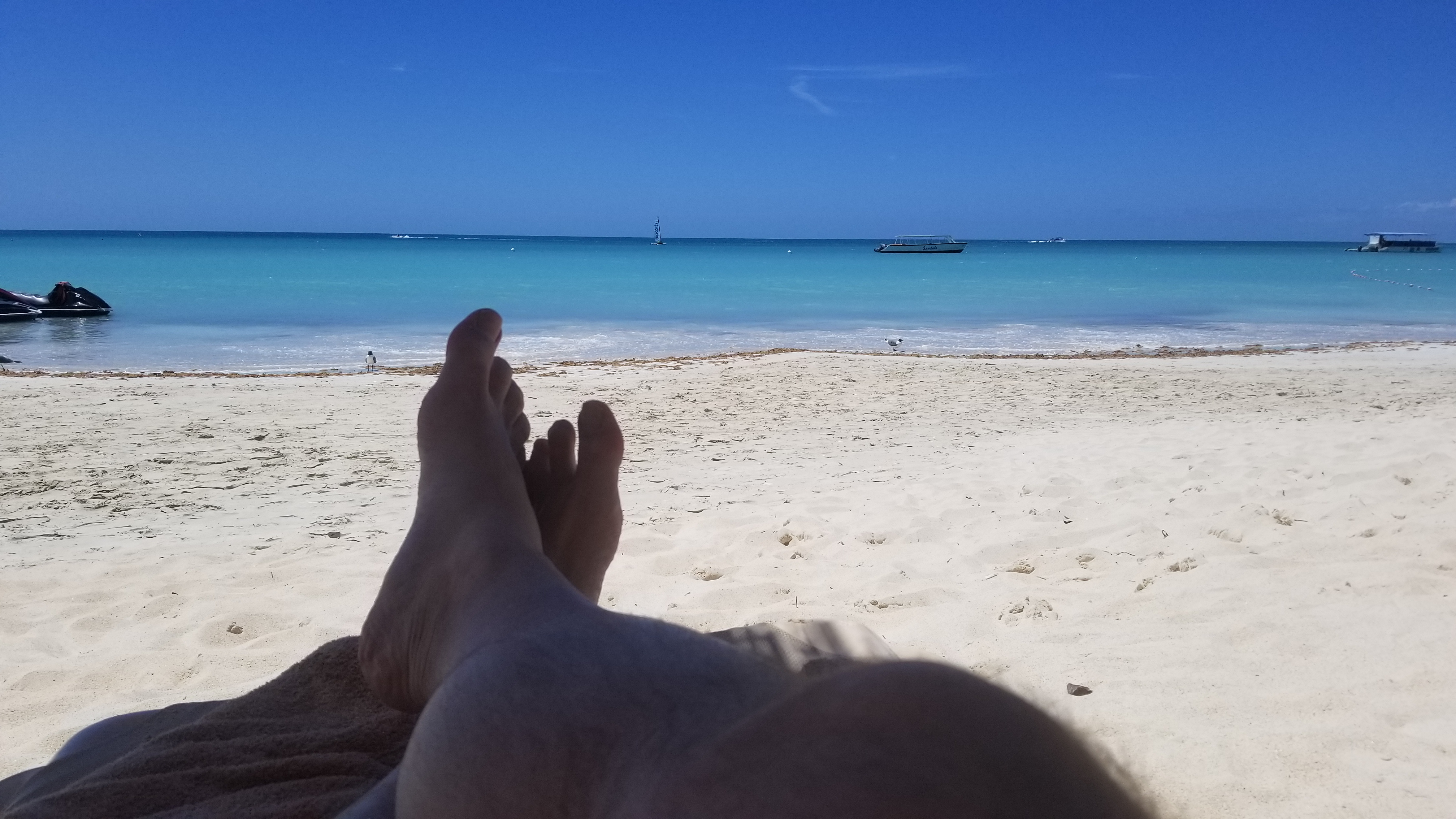
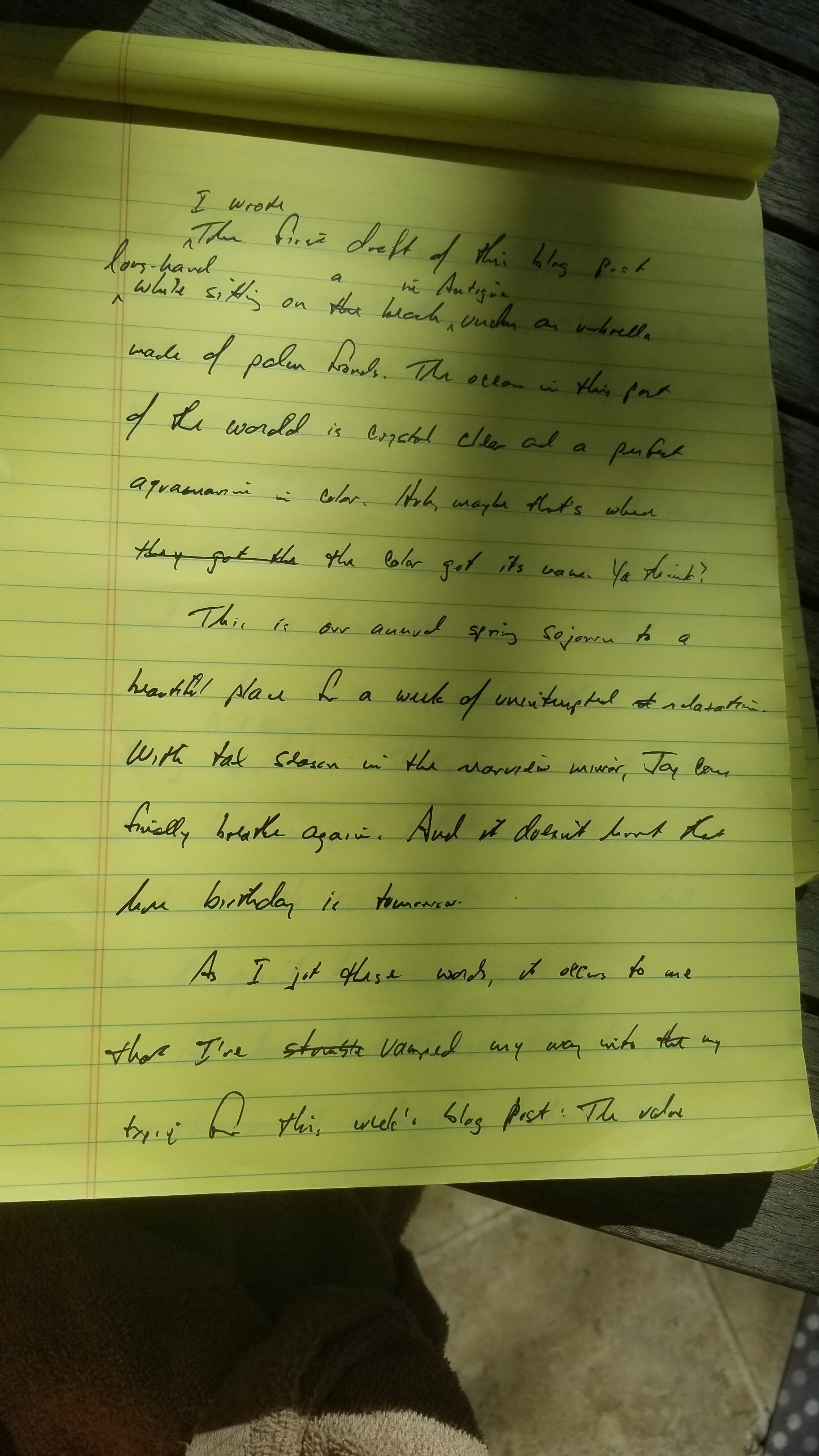
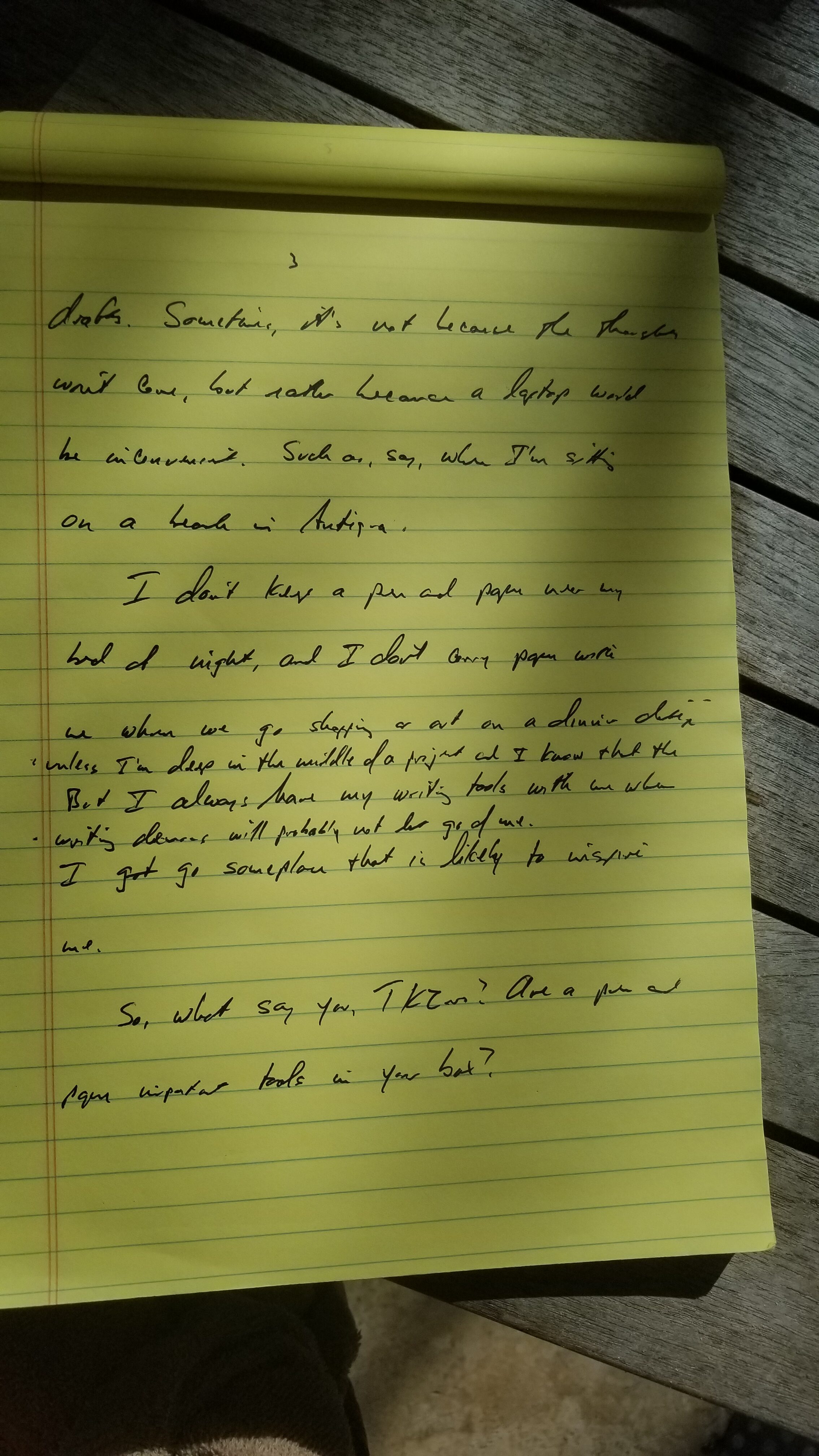
I wrote the first draft of this blog post longhand while sitting on a beach in Antigua, under an umbrella made of palm fronds.  The ocean in this part of the world is crystal clear and a perfect aquamarine in color.  Huh, maybe that’s where the color got its name.  Huh.

This is our annual spring sojourn to a beautiful place for a week of uninterrupted relaxation.  With tax season in the rear view mirror, Joy can finally breathe again.  And it doesn’t hurt that her birthday is tomorrow.  As I jot these words, it occurs to me that I’ve vamped my way in to my topic for this week’s blog post: The value of putting pen to paper–literally.

I had no idea what this week’s post would be until I started stringing words together. Then it came to me. That’s the power of picking up a pen!

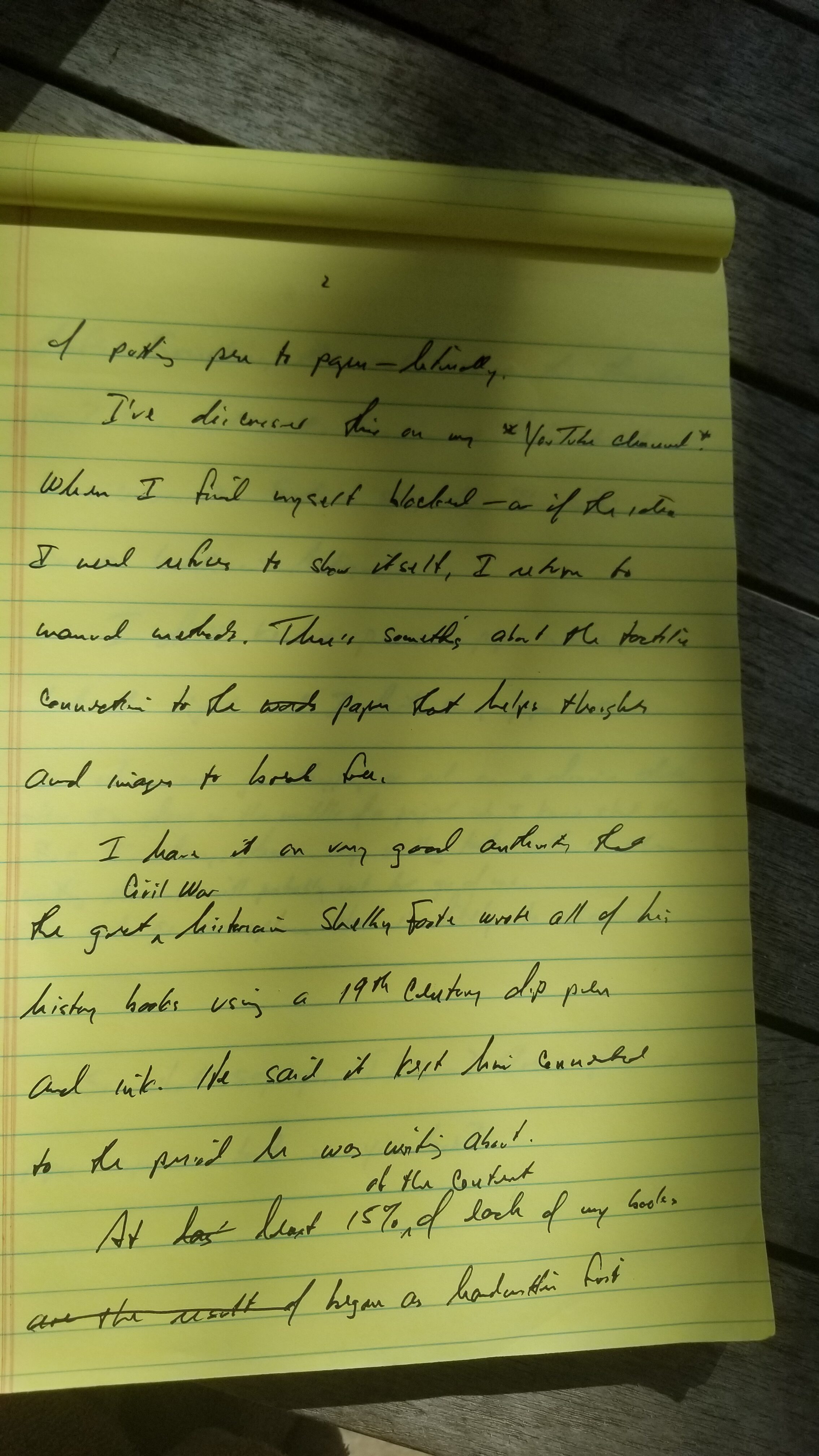
I’ve discussed this on my YouTube channel.  When I find myself blocked–or if the idea I need refuses to show itself, I return to manual methods.  There’s something about the tactile connection with the paper that helps words and images to break free.

I have it on very good authority that the great Civil War historian Shelby Foote wrote all of his history books using a 19th century dip pen and ink.  He said it kept him connected to the period he was writing about.

I always double-space handwritten drafts because it leaves room for editing as I go along.

At least 15% of the content of each of my books begin as handwritten first drafts.  Sometimes, it’s not because the thoughts won’t come, but rather because a laptop is inconvenient.  Say, for example, when I’m sitting on a beach in Antigua.

I don’t keep a pen and paper near my bed at night, and I don’t carry paper with me on routine outings such as shopping, or going out on a dinner date–unless I’m deep in the middle of a project and I know that the

It’s not uncommon for edits to run for over a page in the spaces between the lines of the original text. It can get confusing during rewrites.

writing demons will probably not let go of me.  But I always have my writing tools with me when I go someplace that is likely to inspire me.

Just as an aside, if I had been drafting a section of a book by hand, I would have included a slug line at the top that would show the date and my location at the time I was drafting it.  That has no practical rationale in real time, but now that I’ve been doing this for a couple of decades, it’s nice to remember where I was, back in the day.

So, what say you, TKZers?  Are a pen and paper important tools in your box?


First Page Critiques:
A Look At The Edgar Nominees

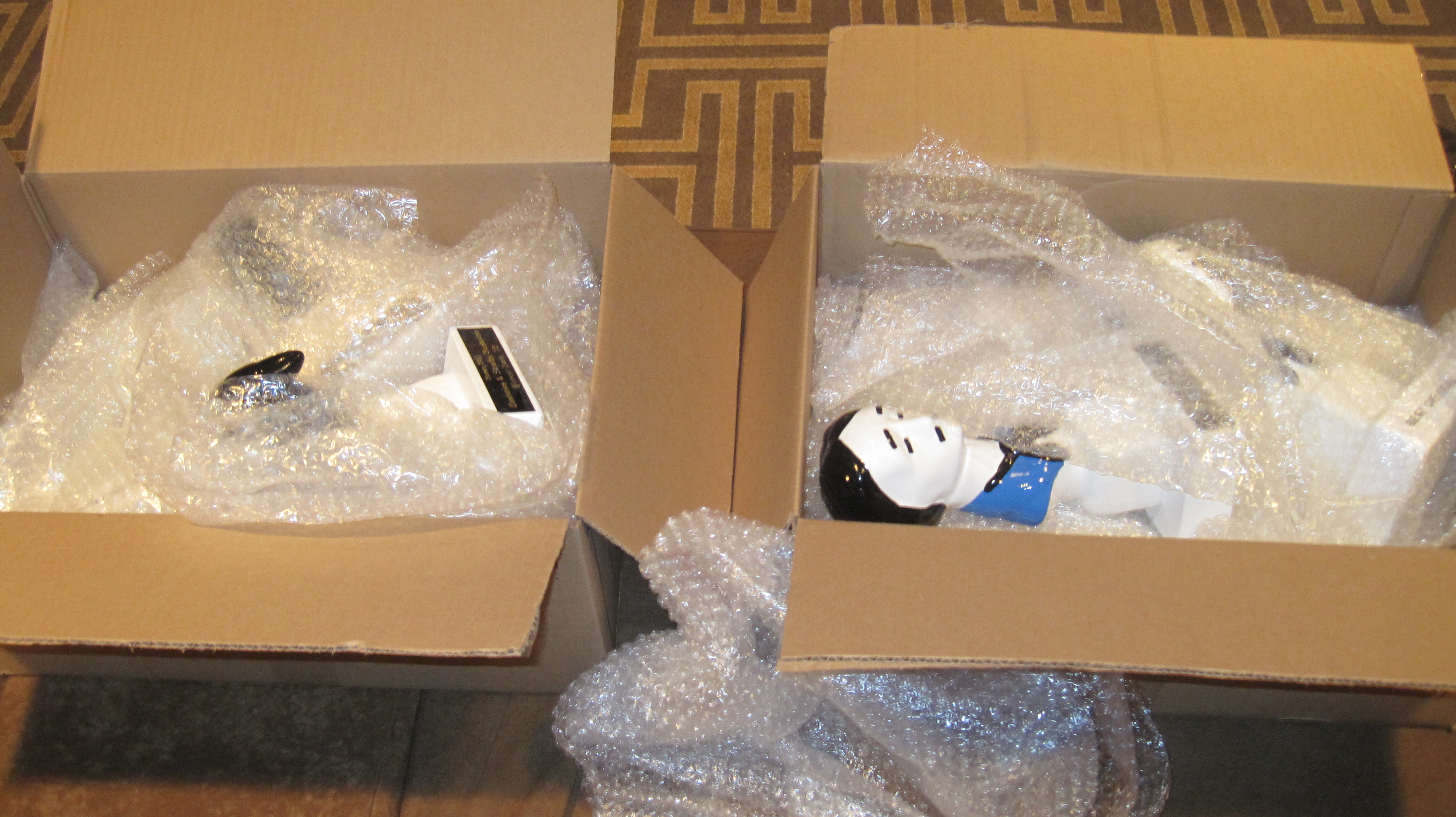
Edgar Awards waiting to come out of hiding last year.

By PJ Parrish

I’ll be on a plane to New York when you read this. (Or maybe sitting in Charlotte…it’s not easy getting out of Tallahassee to the rest of the world). I’m off to my annual Edgar Awards duties.  I am the chair of the banquet, which is the easy fun part.  The hard part of Edgar duties is being a judge.

I’ve never been one but I did judge best first novel for the ITW Thriller Awards one year. Hundreds of books…they just kept coming.  In the beginning, it was a trickle but by June it was a deluge. Three-hundred-plus of them by Christmas. I grew to dread the sound of the FedEx truck.  And yeah, I read every one of them.  Not always to the end, I will admit. But I always gave each book at least 100 pages to find its legs before I assigned it to the “yes” or “maybe” or “not as good as maybe” pile in my office (actually, I had to end up also using the top of my baby grand).  Then I had to winnow the “yes” pile (I think it was about thirty books) down to five nominees.

One thing I remember was that all the “yes” books had a good opening. And you know, the principles I applied then to moving a book to the “yes” pile are the same ones I use when I critique one of our First Page submissions.  Sure, the published thriller writers had more craft over the course of the entire book than some of our submissions here, but the basic principles behind a good opening were the same.

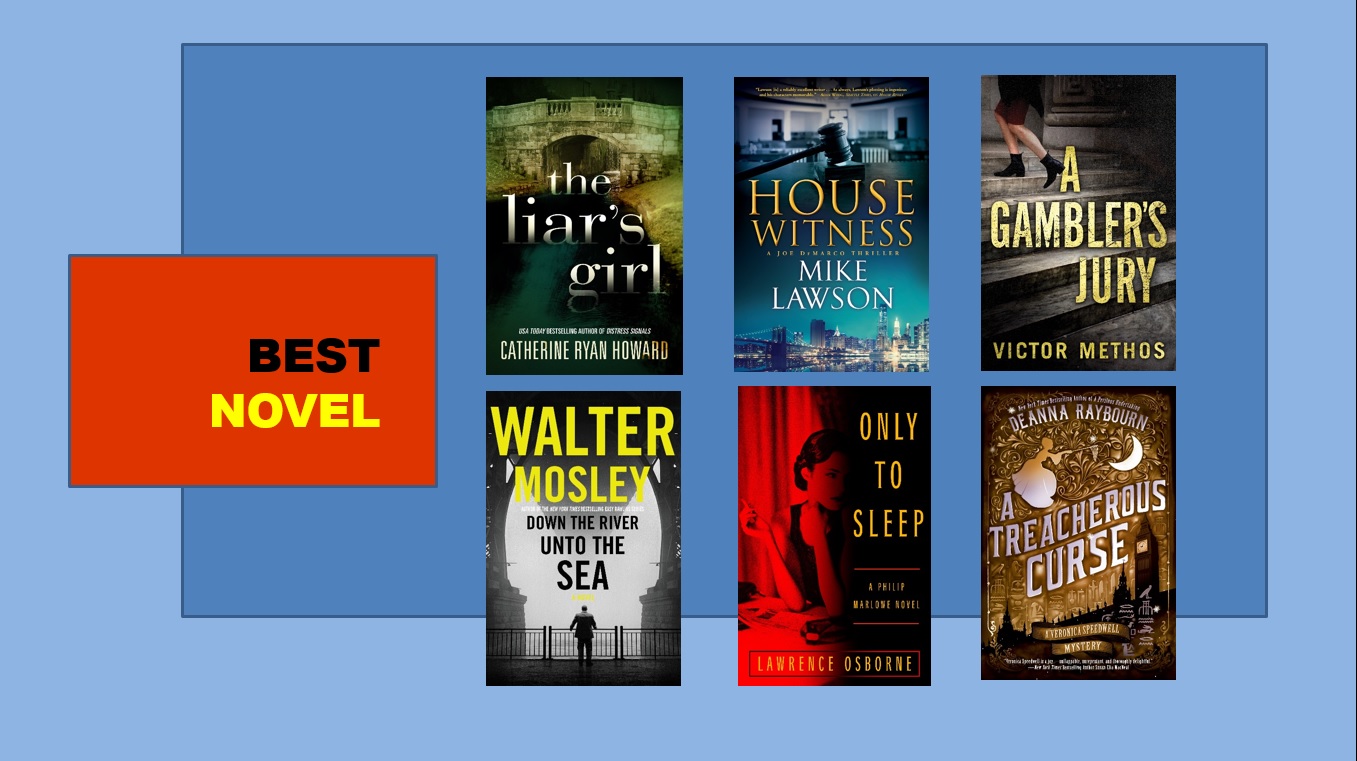
Yesterday, I was putting together the PowerPoint for the Edgars. As usual, my attention was mainly on the visuals of the covers, which we flash up on a giant screen in the Grand Hyatt ballroom as the nominees as announced.  Here is what the Best Novels look like this year:

Nice covers, right? (You can see all the covers in every category on MWA’s Edgar website here). But then I got to wondering, what are they like inside? How do these writers handle the openings of their stories? Just for fun, I thought we could take a peek here today.

The stories include a legal thriller with a tortured heroine who’s fighting the government and her own demons; an Irish thriller about a girl who falls for a convicted serial killer only to find out ten years later he’s not what he seemed; a fixer whose client is a big-time politician with secrets someone will murder to protect;  a cop-cum-PI who’s trying to find the man who framed him and cost him his badge; a resurrection of the iconic Philip Marlowe, now 72 and retired in LA; and a Victorian adventuress trying to unravel of web of intrigue at an Egyptian dig.

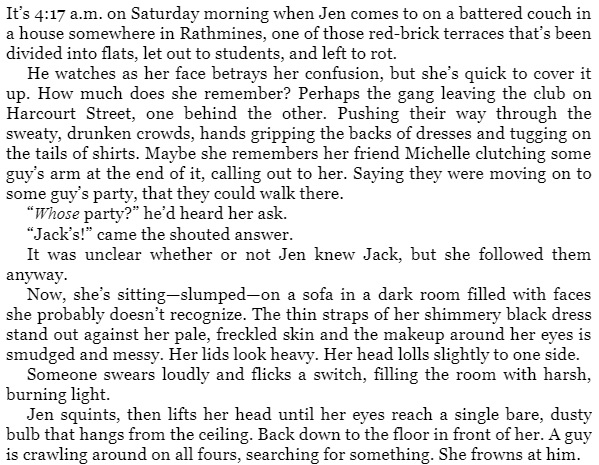
Here’s the first page (not titled chapter 1, by the way), of Catherine Ryan Howard’s The Liar’s Girl.

This is a tricky opening in that the writer is playing loose with point of view. In the first graph, it feels like we are in Jen’s POV, but by the second graph we realize we are seeing Jen coming to from the POV of the man watching her. This goes on for the whole chapter until she finally staggers out of the party room and he follows her. You just know he’s going to kill her. Or is he? There is a double-spaced scene break and then the title “will, now.” We are in the POV of a man named Will and very slowly we learn he is a patient listening to a radio broadcast about a girl who has been found dead in a canal. And he is concerned that this is related to something that happened to him ten years ago. Other chapters are titled “Alison, now” etc., which recalls the Rashomonesque structure of Gone Girl. You can read the full sample here.

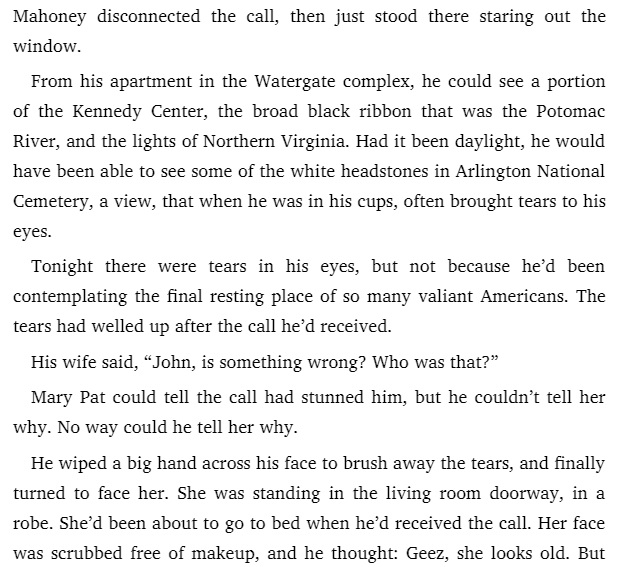
Here is the opening, labeled Prologue, of House Witness by Mike Lawson: 

We get about a page more where he says he need to take a walk and his wife tells him it’s too cold and he’s had too much to drink but he insists on going anyway. Then comes this line to end the scene:

John Mahoney had just been told that his son had been killed — and his wife didn’t know he had a son. 

Good kicker! The rest of the prologue is Mahoney on his walk, wherein we learn he is the disposed speaker of the House who had an affair years before with an aide Connie. After some extensive backstory, we learn the call was from Connie who tells him their son was shot in a Manhattan bar and berates Mahoney into making sure the dead son’s in-custody killer is convicted. Mahoney thinks about all the mistakes he has made and calls his “fixer” Joe DeMarco.  DeMarco calls back the next day and assures Mahoney the killer’s prosecution is a “slam dunk.” The last line of the prologue is “DeMarco was dead wrong.”  The chapter 1 goes back to the night the son was murder from the killer’s point of view. This is the 12th book in the Joe Demarco series. But because the Amazon sample is short, I don’t know when the protagonist DeMarco makes his entrance. Read the sample here. 

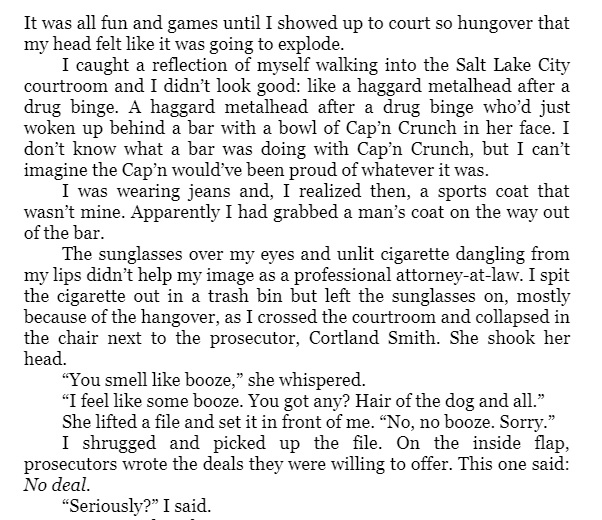
Next up is Chapter 1 of A Gambler’s Jury by Victor Methos.

This scene is a classic introduce-the-protag opening. After this, she goes to see another potential client whose future is so dim, she advises him he should just pack up and high-tail it to Mexico. A brief Chapter 2 takes us to her office, until she decides instead to detour to a bar, where we meet her friend Michelle, the owner. In Chapter 3, it’s the next morning at her apartment where we meet another friend who is concerned about Dani’s lifestyle before Dani goes to another court proceeding.  You can read the sample here.

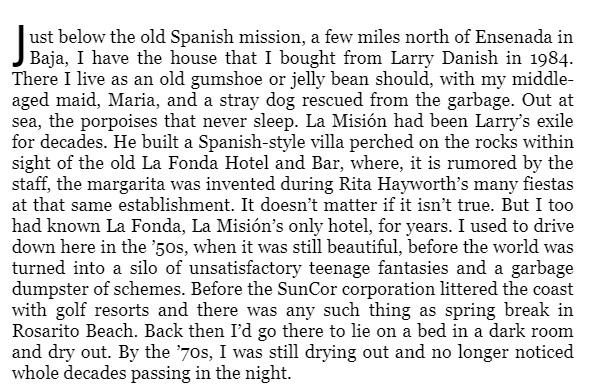
Now take a look at Walter Mosley’s latest, Down The River Unto the Sea.

This first-person point of view narrative is from the protagonist Joe Oliver. He talks about how he’s too influenced by his sex drive and that leads us, after a double-space break to this sentence “Her name was Nathali Malcolm.”  (Nice bridge!) So with this type of opening we are firmly in intimate POV in what I suspect might be a cherchez la femme character-driven noir as only a master like Mosley can tell it.  Read the sample here. 

Speaking of noir, guess who’s back? Philip Marlowe himself in Lawrence Osborne’s resurrection Only To Sleep. Marlowe is 72, retired, and swilling margaritas on his patio when two men walk in with a case that has the Marlowe name written all over it. Osborne’s opening, once it gets going, is redolent of night-blooming jasmine, gin, and that signature rude Chandler wit:

It’s a bit disconcerting to find Marlowe still taking cases from men who “smile with the small contempt of company men” in Reagan-era LA. But it’s fun and the voice is assured. Take a look here. 

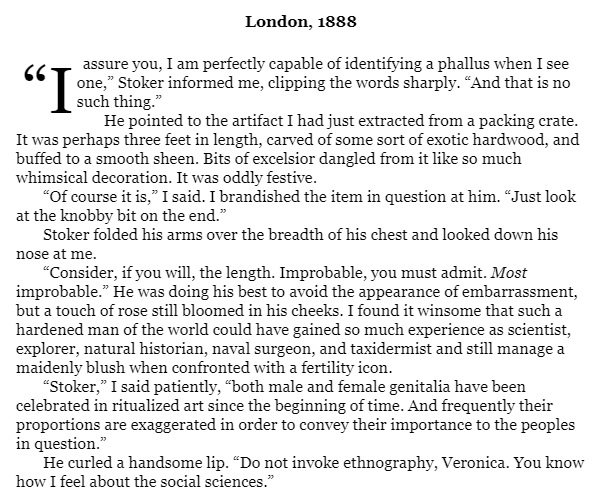
From Los Angeles in 1988 on to London in 1888. Here’s the opening of our final Edgar Best Novel nominee A Treacherous Curse by Deanna Raybourn:“

Now, if you’ve read my critiques before, you know I don’t like chapters that open with dialogue. This one is, ah, rather interesting. Not just for the sexual word play but because, I think, we get a quick bead on the personalities of our protagonist Miss Veronica Speedwell and her partner-foil Stoker. The chapter continues, after some repartee, with backstory about their partnership and how they’ve come to take on their latest case. The chapter is longish and leisurely in pace. Yet I was pulled in.  And I am not a regular fan of historical crime fiction.  You can read the sample here.

As I said, I don’t envy the task of judges. There were 595 entries in the Best Novel category this year. That’s a lot of reading and thinking.

So what do you think? Any openings here that would lure you in? I haven’t the foggiest idea who will win Best Novel this year. I never do. But around 10:30 Thursday night, one of these writers is going to be very very happy, holding court in the bar of the Grand Hyatt, clutching an ugly little porcelain statue.  Congrats to all the nominees. Well done. Here’s the full list.

ELVIS PRESLEY — WHAT REALLY KILLED THE KING OF ROCK ‘N ROLL

By SUE COLETTA

I invited my dear friend Garry Rodgers — retired homicide detective with a second career as a forensic coroner — to share a fascinating post about the real cause of Elvis Presley’s death. Prepare to be wowed. Welcome to TKZ, Garry!
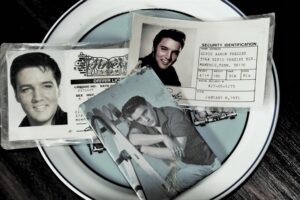
Elvis Presley suddenly dropped in the bathroom of his Graceland mansion on the afternoon of August 16, 1977. Elvis was rushed to Baptist Memorial Hospital in Memphis, Tennessee, where he was pronounced dead, then shipped to the morgue and autopsied the same afternoon. Three days later, the Memphis County coroner issued Elvis Presley’s death certificate stating the cause as hypertensive cardiovascular disease with atherosclerotic heart disease — a heart attack subsequent to high blood pressure and blocked coronary arteries.

It was a rush to judgment. Toxicology results soon identified ten pharmaceutical drugs in Elvis’s system. Codeine was at ten times the therapeutic level and the combination of other prescription drugs suggested a poly-pharmacy overdose. This revelation started immediate accusations of a cover-up and conspiracy theories quickly hinted at sinister criminal acts.

Four decades later, modern medicine and forensic science looked at the Presley case facts. The review indicated something entirely different from a heart attack or drug overdose really killed the King of Rock ‘n Roll. It said Elvis Presley accidentally died after long-term complications from earlier traumatic brain injuries (TBIs). TBIs are known as silent, stalking, and patient killers.

Looking back, it’s likely old accidental head injuries triggered events leading to Elvis Presley’s death.

From my experience investigating unexpected and unexplained sudden deaths, the accidental conclusion makes sense when you consider the totality of evidence in Elvis’ death. Setting aside media reports of gross negligence, arm-chair speculation of cover-up and fan accusations the King was murdered, there’s a simple and straightforward conclusion based on facts. But before examining the facts and knowing hindsight is 20/20, let’s first look at how coroners conduct sudden and unexplained death investigations.

Coroners are the judges of death. Their responsibilities include establishing five main facts surrounding a death. Coroners do not assign blame or fault. In the Presley case, the five facts determined at the immediate time were:

  1. Identity of Deceased — Elvis Aaron Presley
  2. Time of Death — Approximately 2:00 p.m. on Tuesday, August 16, 1977
  3. Place of Death — 3754 Elvis Presley Boulevard, Memphis, Tennessee
  4. Cause of Death — Heart attack
  5. Means of Death — Chronic heart disease

There’s a distinct difference between Cause of Death and Means of Death. Cause is the actual event. Means is the method in which death happened. Example: cause being a ruptured aorta with means being a motor vehicle crash, or cause being massive cerebral interruption with means being a gunshot wound to the head.

Once the facts are known, it’s the coroner’s duty to classify the Manner of Death. There are five universal manner of death classifications:

  1. Natural
  2. Homicide
  3. Suicide
  4. Accidental
  5. Undetermined

Elvis Presley’s death was ruled a natural event, thought at the time being an acute cardiac event from existing cardiovascular disease. If the coroner determined Elvis died from a drug overdose, the ruling would have been accidental. No one ever claimed it was suicide or homicide.

One principle of death investigation is to look for antecedent evidence—preexisting conditions which contributed to the death mechanism or was responsible for causing or continuing a chain of events that led to the death.

Another principle of death investigation is examining the cornerstone triangle of Scene—Body—History. This compiles the totality of evidence or case facts. Given that, let’s look at the evidence and case facts in Elvis Presley’s death.

Scene

Elvis was found on his bathroom floor, face down in front of the toilet. It was apparent he’d instantly collapsed from a sitting position and there was no sign of a distress struggle or attempt to summon help. When the paramedics arrived, Elvis was cold, blue, and had no vital signs. Rigor mortis had not set in, so he’d probably expired within the hour. He was transported by ambulance to Baptist Memorial Hospital where a vain attempt at resuscitation occurred because “he was Elvis”.

ER doctors declared Elvis dead at 3:16 p.m. He was then moved to the morgue where an autopsy was promptly performed. There was no suggestion of suicide or foul play, so there wasn’t a police investigation. The scene wasn’t photographed, nor preserved, and there was no accounting for what medications or other drugs might have been present at Graceland. There’s no official record of the coroner attending the scene as this was considered an in-hospital death and a routine occurrence.

Body

Elvis was in terrible health. His weight estimated at 350 pounds—gaining 50 lbs. in the last few months of his life. He was virtually non-functional at the end, being mostly bed-ridden and requiring permanent nursing care. Elvis suffered from an enlarged heart which was twice the size of normal and showed advanced evidence of cardiovascular disease in his coronary vessels, aorta, and cerebral arteries—certainly more advanced than a normal 42-year-old would be. His lungs showed signs of emphysema, although he’d never smoked, and his bowel was twice the length of normal, with a partially-impacted stool estimated to be four months old.

Elvis also suffered from hypogammaglobinemia, which is an immune disorder, as well as showed evidence of an autoimmune inflammatory disorder.

Toxicology tested positive for ten separate prescription medications but showed negative for illicit drugs and alcohol. The only alarming pharmaceutical indicator, on its own, was codeine at ten times the prescribed manner but still not in lethal range.

This is a quote from Elvis’s toxicology report:

“Diazepam, methaqualone, phenobarbital, ethchlorvynol, and ethinamate are below or within their respective ranges. Codeine was present at a level approximately 10 times those concentrations found therapeutically. In view of the polypharmacy aspects, this case must be looked at in terms of the cumulative pharmacological effect of the drugs identified by the report.”

History

Elvis was born on January 8, 1935 in Tupelo, Mississippi and had a twin brother who died at birth. As a youth, Elvis was active and healthy which continued during his time in the U.S. military and all through his early performing stage when he was a bundle of energy. He began experimenting with amphetamines, probably to enhance his performances, but shied away from alcohol as it gave him violent tendencies.

In 1967, Elvis came under the primary care of Dr. George Nichopoulos who was well-known to celebrities. Then, Elvis was 32 years old and weighed 163 pounds. His only known medical ailment was slight high blood pressure, presumably due to his high-fat diet.

Also in 1967, Elvis’s health took a sudden turn with progressive pain, insomnia, hypertension, lethargy, irrational behavior and immense weigh gain. Over his remaining years, Elvis was seen by a number of different doctors and was hospitalized a number of times, all the while resorting to self-medication with a wide assortment of drugs from dozens of sources.

Doctor Nick, as Nichopoulos was called, stayed as Elvis’s personal physician till the end. He was present at the death scene as well as during the autopsy. Doctor Nick concurred with the coroner’s immediate conclusion that the cause of death was a natural cardiac event resulting from an arrhythmia, or sudden interruption of heartbeat, and agreed that Elvis’s death was not due to a drug overdose.

When the toxicology report was released, it came with a qualifier:

“The position of Elvis Presley’s body was such that he was about to sit down on the commode when the seizure occurred. He pitched forward onto the carpet, his rear in the air, and was dead by the time he hit the floor. If it had been a drug overdose, [Elvis Presley] would have slipped into an increasing state of slumber. He would have pulled up his pajama bottoms and crawled to the door to seek help. It takes hours to die from drugs.”

Because the tox report appeared to contradict the autopsy report’s stated cardiac cause of death, a prominent toxicologist was asked to review the findings. His opinion was:

“Coupled with this toxicological data are the pathological findings and the reported history that the deceased had been mobile and functional within 8 hours prior to death. Together, all this information points to a conclusion that, whatever tolerance the deceased may have acquired to the many drugs found in his system, the strong probability is that these drugs were the major contribution to his demise.”

The Tennessee Board of Health then investigated Elvis’s death, which resulted in proceedings against Doctor Nick.

Evidence showed that during the seven and a half months preceding Elvis’s death—from January 1, 1977, to August 16, 1977—Doctor Nick wrote prescriptions for Elvis for at least 8,805 pills, tablets, vials, and injectables. Going back to January 1975, the count was 19,012.

These numbers might defy belief, but they came from an experienced team of investigators who visited 153 pharmacies and spent 1,090 hours going through 6,570,175 prescriptions and then, with the aid of two secretaries, spent another 1,120 hours organizing the evidence.

The drugs included uppers, downers, and powerful painkillers such as Dilaudid, Quaalude, Percodan, Demerol and Cocaine Hydrochloride in quantities more appropriate for those terminally ill with cancer.

Doctor Nick admitted to this. His defense was because Elvis was so wired on pain killers, he prescribed these medications to keep Elvis away from dangerous street drugs, thereby controlling Elvis’s addiction—addiction being a disease.

One of the defense witnesses, Dr. Forest Torrent, a prominent California physician and a pioneer in the use of opiates in pain treatment, explained how the effects of this level of codeine would have contributed to Elvis’s death.

Central to misconduct allegations was the issue of high codeine levels in Elvis at the time of death—codeine being the prime toxicological suspect as the pharmaceutical contributor. It was established that Elvis obtained codeine pills from a dentist the day before his death and Doctor Nick had no knowledge of it.

The jury bought it and absolved Doctor Nick of negligence in directly causing Elvis Presley’s fatal event.

Continuing Investigation

Dr. Torrent was convinced there were other contributing factors leading to Elvis’s death. In preparation for Doctor Nick’s trial, Dr. Torrent had access to all of Elvis Presley’s medical records, including the autopsy and toxicology reports. Incidentally, these two reports are now the property of the Presley estate and are sealed from public view until 2027, fifty years after Elvis’s death.

Dr. Torrent was intrigued by the sudden physiological and psychological changes in Elvis starting in 1967. He discovered that while in Los Angeles filming the movie Clambake, Elvis tripped over an electrical cord, fell, and cracked his head on the edge of a porcelain bathtub. Elvis was knocked unconscious and had to be hospitalized. Dr. Torrent found three other incidents where Elvis suffered head blows, and he suspected Elvis suffered from what’s now known as Traumatic Brain Injury—TBI—and that’s what caused progressive ailments leading to his death.

Dr. Torrent released a paper entitled Elvis Presley: Head Trauma, Autoimmunity, Pain, and Early Death. It’s a fascinating read—recently published in the credible medical journal Practical Pain Management.

Dr. Torrent builds a theory that Elvis’s bathtub head injury was so severe it jarred brain tissue loose, which leaked into his overall blood circulation. Later additional head injuries exacerbated the problem. This is now known to be a leading cause of autoimmune disorder, which causes a breakdown of other organs. This progression was unknown in 1967 and Elvis went untreated. Side effects of TBIs include chronic pain, irrational behavior, and severe bodily changes such as obesity and enlarged organs like hearts and bowels.

Today, TBI is a recognized health issue in professional contact sports as well as incidental to motor vehicle accidents and workplace falls or other head injury events.

Dr. Torrent’s hypothesis holds that with a change in mental state and suffering chronic pain, Elvis Presley entered a ten year spiral towards death. He became hopelessly addicted to pain killers, practiced a terribly unhealthy diet and lethargic lifestyle, and resorted to the typical addict’s habit of sneaking a fix wherever he could. This led to early coronary vascular disease and, combined with his escalating weight and pill consumption, Elvis was a heart attack ready to burst.

Note that I used the term “antecedent,” like all coroners do when assessing a cause of death. Given Dr. Torrent’s observations—and all the facts compiled from forty years—if I were the coroner completing Elvis Presley’s death certificate today, I’d write it like this:

  1. Identity of Deceased — Elvis Aaron Presley.
  2. Time of Death — Approximately 2:00 p.m. on Tuesday, August 16th, 1977.
  3. Place of Death — 3754 Elvis Presley Boulevard, Memphis, Tennessee.
  4. Cause of Death — Cardiac arrhythmia, antecedent to hypertensive cardiovascular disease with atherosclerotic heart disease, antecedent to poly-pharmacy, antecedent to autoimmune inflammatory disorder, antecedent to traumatic brain injury/injuries.
  5. Means of Death — Cumulative head trauma.

Therefore, I’d have to classify Elvis’s death as an accident.

There’s no one to blame—certainly not Elvis. He was a severely injured and sick man. There’s no specific negligence on anyone’s part and definitely no cover-up or conspiracy of a criminal act.

If Dr. Forrest Torrent is right, there simply wasn’t a proper understanding back then to clearly determine what really killed the King of Rock ‘n Roll.

*   *   *

 

Garry Rodgers now works as an investigative crime writer with a number of publications to his credit.


In The Attic is based on a true double homicide he investigated involving a psychopathic ax-murderer. Garry also hosts a popular blog at DyingWords.net.
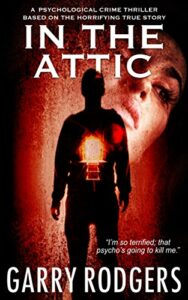
 

Note from Sue: I read IN THE ATTIC in August of 2016, and I doubt the story will ever leave me. It’s just one of those books that I’ll never forget. Visceral, raw, emotional, and true!

First Books on the Moon

April has been quite a month for scientific events. Mark Alpert last Saturday discussed the recent presentation of an image of a black hole at the center of Galaxy M87 and gave us some insight, otherwise absent from most accounts, into the importance of what was revealed. Another attempted milestone which occurred this month was not as successful as the image presentation but was not entirely a failure, either. It is also extremely relevant to what we do.

I am referring to the crash landing on Earth’s moon of the SpaceIL Beresheet Lander. Lost in the disappointment of the Lander’s failure to achieve a soft lunar arrival was that 1) the Lander carried something named “The Arch Lunar Library” which 2) may well have survived the impact.  This particular payload is the first in a planned series of lunar archives prepared and maintained by the Arch Mission Foundation, a non-profit organization that tasks itself with maintaining a billion-year history of Planet Earth (this is done, I would guess, by people who, unlike myself, do not spend their time streaming Turkish crime series on Netflix). The Arch Lunar Library was preserved on something called “Nanofiche,” which is a disc-shaped medium as opposed to those flimsy cards of a similar name that spill all over the place when you try to get them into a reader at your local library without adult supervision.  Nanofiche will apparently last for thousands of years. The medium is so indestructible that it can probably be used to crush the last cockroach. Nothing damages it except for saltwater. It can outlast everything else, however, including, apparently, a crash lunar landing at otherwise destructive speed.

So what does the payload contain? Many, many things, including millions of images of pages of books: all sorts of books, fiction, non-fiction, how-to, what have you, books. It’s an ongoing project, so maybe a book that you are writing right now will be included in the future. I don’t mean to make you choke or anything, but there you go. Keep writing. Before you resume writing again, however, I strongly urge you to read the overview of the Lunar Library which will answer many of the questions I had, such as why someone was doing this. The article is a bit long, but it’s a quick read. It’s hair-raising in spots, but in a good way.

My question: if you were to pick a book to include in a project like this, which would it be? I’m not talking about your favorite book, necessarily. I’m talking about the book that you feel would be most appropriate, most deserving, for a project like this. My choice is an easy one: From the Earth to the Moon, by Jules Verne. What say you?

Happy Easter and Chag Pesach Sameach to all of my friends As Leonard Cohen said in a very different context, it would be a real drag without you.


Tips on Writing Believable Conspiracies for Thriller Fiction

Jordan Dane
@JordanDane


www.cgpgrey.com

“Just because you’re paranoid, doesn’t mean they aren’t after you.”
– Joseph Heller, Catch-22

Conspiracy theories have captured our imaginations for many decades. With the advent of the Internet, such theories have proliferated from the comfort and anonymity of your cell phone with your fake handles. Rightly or wrongly, the anonymity of the Internet has spurred conspiracies and brought them into our homes, linked to our smart phones and other devices.

Some popular, long standing conspiracies involve:
• A secret world order that controls the globe – Illuminati/Knight Templar
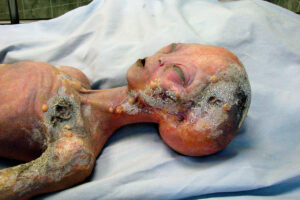
• The government secrets from Area 51/Roswell/Alien Autopsy
• Reptilian aliens walk on two legs among us
• The JFK assassination – Oswald wasn’t alone
• The moon landing was fake
• The FDA is withholding the cure for cancer

“WHAT IF” questions can generate plot ideas. Many conspiracy theories revolve around big institutions like the church, educational institutions, big oil, rogue agents operating within the CIA, a secret government agency,Wall Street, big pharma or similar organizations that touch people’s lives and make them vulnerable. Your notion of conspiracy can be domestic or foreign, localized or global, political, religious, military or big corporations.

Here are some popular movies that were based on conspiracy theories:
• Wag the Dog – White House officials and a Hollywood producer create a fake war to distract the public from a sex scandal involving the US President.(1997)
• All the President’s Men – Based on Watergate and secret factions operating in our government.
• Manchurian Candidate – An evil corporation brainwashes US soldiers into fighting in Iraq in order to create a perfect assassin capable of eliminating undesirable political rivals. (2004)
• Syriana – An energy analyst, a CIA agent, a middle-eastern prince, and a corrupt lawyer become embroiled in a high-level assassination involving Big Oil. (2005)
• Network – Upon learning of his dismissal, failing news anchor Howard Beale goes on hugely popular rants quickly angering the Powers That Be. (1976)
• JFK – Oliver Stone’s masterpiece documenting District Attorney Jim Garrison’s struggle to prove the involvement of a conspiracy behind the assassination of US President John F. Kennedy. (1991)
• The Insider – A research chemist turns whistle blower (Jeffrey Wigand) and threatens to reveal to the world Big Tobacco’s cover up of the negative health effect of cigarette smoking. (1999)
• They Live – A drifter accidentally discovers a pair of sunglasses which enables him to see Aliens among us, the true rulers of the world. (1988) (I can’t believe I actually saw this one.)

If you want to add a twist to your plot, consider combining multiple conspiracy theories that might not be related on the surface. I once combined a secret global human trafficking ring making illicit use of the dark web and combined it with a news story set in India where people were getting robbed on the street for their kidneys and other organs. I envisioned a contemptible shadowy organization that traded human flesh online and used my energy trading experience to visualize how such a group would conduct business across a network that resembled the control panels at large oil refineries (places I had seen many times).

Medical Conspiracies

Like telling a good ghost story, tap into fears people would believe. Not too far-fetched. Medical conspiracies are a great combination of personal vulnerability with a high stakes thriller plot. Think of the many ways we all accept certain medical procedures as normal. What if a covert group interferes with a “normal” procedure and hunts innocent victims without reason or a connection to the crimes? A great example of a medical thriller based on a believable fear is Michael Palmer – The 5th Vial.

Seemingly unrelated victims across the globe are targeted by a top secret cabal of medical specialists dealing in illegal organ donation. Standard blood work—and the 5th vial—put a target on their backs and seal their fate.

Robin Cook’s Coma is another classic medical thriller where certain victims are targeted and their bodies are harvested for illegal organ donation after the victims are suspended in a coma state. Innocent patients go in for standard and routine operations, only to become the latest addition to a body farm in a secret facility operated by wealthy patrons through the Jefferson Institute.

8 Key Ways to Writing Believable Conspiracies

1) Take advantage of paranoia. Mistrust and suspicion are keys to pulling off a believable conspiracy plot. Even if readers haven’t considered darker subversive motives at play during relatively routine activities, trigger their paranoia with your plot and a different way to look at it.

2) Write what you fear. If you fear it, chances are that readers will too. Convince them. Exploit common fears and highlight deeper ways that get readers thinking. In fiction, it works to grip readers in a personal way. The fears we all share—the things that wake us up in the middle of the night—can tap into a great plot.

3) Villainous motivation must feel real. You can be over the top but give your diabolical conspiracy a strong and plausible motivation. Don’t be vague. Drill down into your conspirators and justify their motives and existence from the foot soldiers on up the line.

4) Give your bad guys believable resources. Make it seem insurmountable to stop them. Think of the infrastructure it would take to plausibly pull off your thriller plot. Have them use believable technology, science and manpower to give them the appearance of Goliath when it comes to your hero/heroine fighting their diabolical acts.

5) Know organizations and your governmental jurisdictions to give your plot teeth. How do they operate in secret? Give them a plausible connection to organizations the reader may know about. Draw from organizations or systems readers will understand. If you’re too vague, readers will dismiss your plot as unlikely and a shadowy plot with no substance.

6) Make the risks personal for your hero and heroine. High stakes are important, but force your main character(s) to dig deep to fight through their fears and insurmountable odds. This is what will keep readers rooting for your characters. Make them worthy of their star role. A global phenomenon can put readers on edge, but bring the impact down to the personal stakes of real human beings for maximum impact.

7) Ripped from the headlines stories can add layers of credibility. The best fictional thrillers come from events or news that readers are familiar with.

a.) Re-imagine a well known historical event. Add your best twist to a conspiracy makes your work more interesting and forces readers to think.

b.) Or dig into a headline story for facts that are not readily known. Often that story will be deeper than most readers are aware of, especially if there are personal human stories within the big headline. I used the Mumbai terrorist attack to add bones to some of my stories. I’ve also used the National Geographic’s TV show Locked Up Abroad in my book The Echo of Violence and wrote my own version of those amazing events when a married couple (Christian missionaries) were abducted and held for ransom for a year by a small terrorist cell. It saddened me to realize that only one of the missionaries came back. They had gone to the Philippines for a second honeymoon to celebrate their wedding anniversary. I didn’t exploit their horrific story, but I re-imagined a “what if” scenario involving a nun.

FOR DISCUSSION:

1.) What conspiracies can you imagine from today’s headlines? Get crazy. Add humor or scare the hell out of us.

2.) Do you have helpful resource links for writers interested in conspiracies?

3.) What book sticks in your mind that scared you with a plausible and frightening conspiracy?

First Page Critique: Coyotes

Gentle Readers, We’re in dusty New Mexico today, at a delightfully grisly scene. Let’s go!

(Coyotes)

Three days is a long time to be dead, especially out under the intense New Mexico sun. The bodies were stacked like cord wood; if they were wood, I’d wager there was a good half a cord there. New Englanders know these things.

The smell was overwhelming; the chorus of a few thousand flies filled my ears and the half-cord sized pile shimmered with writhing maggots. I gagged but forced myself to look, to see the coyotes’ empty yellow eyes.

There were at least fifteen of them, maybe more, it was hard to be sure. Blocks of wood with a date scrawled in black marker—October 20th, three days ago—had been placed into the animals’ mouths, to what end I couldn’t imagine. Temporary markers for temporary remains, I guessed. Somehow, though, it didn’t feel like those small sections of two-by-four pressure treated wood had been placed there with any measure of respect.

The coyotes’ once sumptuous red-gray coats were matted, their fur dulled by the ever-present dust that blows across the desert, by the lack of lifeblood for nourishment. Their bodies had already begun to shrink. To flatten, sinking back into the plains where they had made their homes, where they had hunted their prey. Where they’d eaten berries and birthed their young and filled the night with their songs. No one would come to dispose of their bodies; the BLM land would simply reclaim them.

I looked away then. I didn’t understand it but, when I’d risen this morning, I couldn’t get it out of my head. I’d needed to see for myself. “Fucking hell,” I whispered and wished I had a cigarette, but they were a quarter of a mile away, in my unit—dubbed the Eunuch by my friend Ben, since my unmarked Charger “has no balls and protects divine royalty.”

Ben has a little bit of a crush on me.

“They think of it as a sport,” he’d sputtered the night before, his youthful cheeks red with righteous indignation, his prominent nose red from the beers. Ben’s half Jewish and has the shnoz to prove it. He’s also very tall and thin and his tagline, when meeting new people is, “Ben Short. All my life.”

______

Dang, there’s so much to love about this passage. I’m wild for it. We’re BANG, right into the scene of the crime, with a smart narrator showing us around. The slaughtered animals tell us this isn’t going to be a gentle story, and the grisly detail is carefully observed. Such an opening won’t be for the faint of heart, but this will find plenty of fans. And there’s humor here to leaven it. I don’t have much more than praise to offer, so I’m going to give it a line edit.

______

“Three days is a long time to be dead, especially out under the intense New Mexico sun. The bodies were stacked like cord wood; if they were wood, I’d wager there was a good half a cord there. New Englanders know these things.”

Terrific opening line. Don’t change a thing. Except maybe get rid of “out.”

Not identifying the bodies as belonging to coyotes is misleading. I assumed they were human, and felt a little confused and dopey when I learned they weren’t. Whole different story. 

__Three days is a long time to be dead, especially out under the intense New Mexico sun. The coyotes’ stiffened bodies were stacked as high as a half cord of firewood so that they appeared to be one hideous creature with way too many heads. Against my better judgement, I moved a few steps closer.__

(Okay. The “so that they appeared to be one hideous creature with way too many heads” may sound like too much, but you need something to carry forth some rhythm into the middle of the paragraph.)

Lose “New Englanders know these things.” Keep us in New Mexico for now. You’re in it for the long haul, and the confident voice needs no justification pertaining to knowledge of cords of wood.

“The smell was overwhelming; the chorus of a few thousand flies filled my ears and the half-cord sized pile shimmered with writhing maggots. I gagged but forced myself to look, to see the coyotes’ empty yellow eyes.”

I want to know more than that the smell was “overwhelming.” What does that mean? That it’s so strong that the narrator staggers and might faint? That it smells like rotting hamburger wrapped in the socks of a million sweaty feet? Be specific. Give us a sentence.

Same deal with the flies and their sound.

 __A thousand hovering flies, their electric hum vibrating in my ears, swept and dove at the pile, which already shimmered with patches of wriggling maggots. Gagging, I forced myself to look into the coyotes’ empty yellow eyes.__

“There were at least fifteen of them, maybe more, it was hard to be sure. Blocks of wood with a date scrawled in black marker—October 20th, three days ago—had been placed into the animals’ mouths, to what end I couldn’t imagine. Temporary markers for temporary remains, I guessed. Somehow, though, it didn’t feel like those small sections of two-by-four pressure treated wood had been placed there with any measure of respect.”

You’ve got an amazing visual and powerful commentary by the narrator here. Remember to keep the voice active and confident.

__I counted fifteen heads, but there may have been more that I couldn’t see. A block of wood scrawled with a date of 10/20–three days earlier–jutted from each animal’s mouth. Temporary markers for temporary remains, I guessed. Somehow, though, it didn’t feel like those small sections of two-by-four pressure treated wood had been placed there with any measure of respect.__

“The coyotes’ once sumptuous red-gray coats were matted, their fur dulled by the ever-present dust that blows across the desert, by the lack of lifeblood for nourishment. Their bodies had already begun to shrink. To flatten, sinking back into the plains where they had made their homes, where they had hunted their prey. Where they’d eaten berries and birthed their young and filled the night with their songs. No one would come to dispose of their bodies; the BLM land would simply reclaim them.”

“Matted.” Were they bloody? Were the coyotes shocked to death, or shot? Attacked by vampires/vampire bats?! The “lack of lifeblood” implies they’ve lost blood.

Call me an idiot, but I wondered at the (BLM) Black Lives Matter land reference. Further investigation suggests that it refers to Bureau of Land Management land. Adding the BLM reference dulls the poignancy of the last line. Slip it in a tad later.

__The coyotes’ once sumptuous red-gray coats were matted, their fur dulled by the ever-present dust that blows across the desert, by the lack of lifeblood for nourishment. Their bodies had already begun to shrink and flatten, sinking back into the plains where they had made their homes, where they had hunted their prey. Where they’d eaten berries and birthed their young, and filled the night with their songs. No one would come to dispose of their bodies. The land would simply reclaim them.__

“I looked away then. I didn’t understand it but, when I’d risen this morning, I couldn’t get it out of my head. I’d needed to see for myself. “Fucking hell,” I whispered and wished I had a cigarette, but they were a quarter of a mile away, in my unit—dubbed the Eunuch by my friend Ben, since my unmarked Charger ‘has no balls and protects divine royalty.'”

“I didn’t understand it but, when I’d risen this morning, I couldn’t get it out of my head. I’d needed to see for myself.”

I don’t get this at all. Are we not on the immediate scene? Had the narrator been told about the coyotes sometime earlier, and that’s why they’re now at the scene? Very confusing. If that’s the case, make that super clear and don’t drop it randomly in here–tell us at the end of the scene when they’re driving away or something. “The captain was going to be pissed as hell that I’d gone by the scene, but I’d been up all night thinking about it after Ben told me. I had to see it for myself.”

__I looked away then. “Fucking hell,” I whispered, and wished I had a cigarette. But they were a quarter of a mile away, in my unit—dubbed the Eunuch by my friend Ben, since my unmarked Charger “has no balls and protects divine royalty.”__

“Ben has a little bit of a crush on me.”

I must ask. Does our narrator identify as a man, woman, as transgender, or something else? Please make this clear, and sooner. It will matter to many readers because they’ll want to get the picture in their head.

“Ben is a bit of a comedian. He also has a crush on me.”

“They think of it as a sport,” he’d sputtered the night before, his youthful cheeks red with righteous indignation, his prominent nose red from the beers. Ben’s half Jewish and has the shnoz to prove it. He’s also very tall and thin and his tagline, when meeting new people is, “Ben Short. All my life.”

Okay. Now I see that Ben is the one who told her about the coyotes the night before. Still, the implied timeline is confusing. There’s no need to go back and forth–just tell us straight out what the narrator is doing there and at whose behest. Earlier.

Who is “they?” Maybe he can refer to them as son-of-a-bitches or bastards, etc. If he doesn’t curse, he could say “Jerks.”

The line about Ben joking about his name is cute. But given the intense scene, I think it’s one joke too many on top of the grisly coyote situation.

“Ben’s half Jewish and has the shnoz to prove it.” Really? This sounds like a line from a 1940s noir. It’s a stereotype that some people might find offensive. Use at your peril.

__“Bastards think of it as a sport,” he’d sputtered the night before, all six feet of him towering unsteadily over me. His youthful cheeks were red with righteous indignation, his prominent nose red from the beers.__

____

Again, I think this is a terrific beginning, and can be near-perfect with a small amount of thoughtfulness and editing.

What do you all think? Tell us your advice for our Brave Author!


Nancy Drew – Immortal Female Detective

by

Debbie Burke

@burke_writer


Credit: www.nancydrewsleuth.com

Nancy Drew was the original Super Girl—independent, confident, smart. She was competent to handle any challenge, fearless in the face of danger, and resourceful at solving problems decades before MacGyver came along. She drove motorboats, rode horses, and played tennis better than her boyfriend, Ned Nickerson. The girl sleuth never backed down from threats and brought villains to justice.

She is credited as an early influence on many girls who grew up to be accomplished, notable women, including Sandra Day O’Connor, Oprah Winfrey, Ruth Bader Ginsberg, Sonia Sotomayor, Hillary Rodham Clinton, and Laura Bush.

Credit: www.nancydrewsleuth.com


Nancy’s heroic adventures kept my friends and me up long past bedtime, reading with flashlights under the covers. I remember saving for weeks to buy the latest release when it hit the neighborhood toy store that carried her books. If I recall correctly, the hardbacks in the late 1950s cost around a dollar, a serious investment for a kid earning a dime a week allowance.

Credit: www.nancydrewsleuth.com


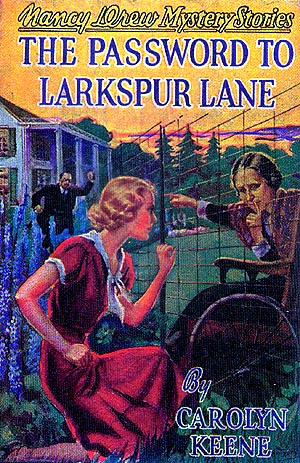
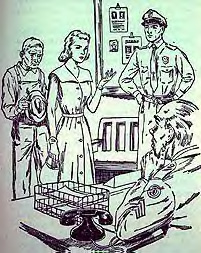
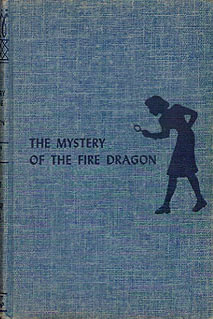
Additionally, I devoured the local library’s collection of Nancy’s earlier books published in the 1930s and ’40s, with dark blue boards and cool pen-and-ink illustrations.

The dust jackets on older editions had long since disappeared and, after thousands of check-outs, bindings were often held together by heavy tape.


I didn’t really know what a “roadster” was but I sure wanted a blue roadster convertible just like Nancy’s.

Credit: www.nancydrewsleuth.com


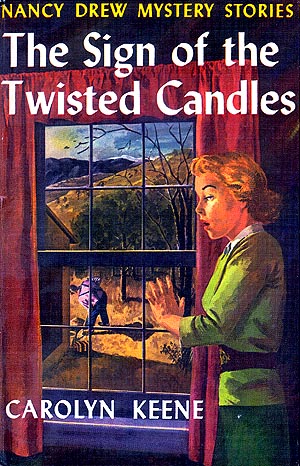
In the 1950s, the books featured lighter blue, tweed-pattern boards with dust jackets.


Credit: www.nancydrewsleuth.com

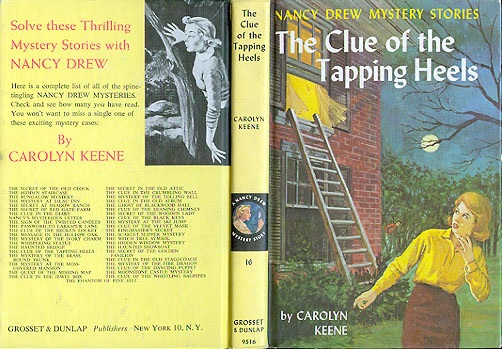
By the 1960s, the dust jackets disappeared and the spine became bright yellow with illustrations incorporated into the front hardcover.

The last one I remember reading was The Secret of the Golden Pavilion (1959) which took place in the then-exotic locale of Hawaii around the time it became the 50th state.

Throughout the 30 or so books I read, Nancy remained eternally 18-years-old (16 in earlier versions) but never attended school or college. Her successful attorney father, Carson Drew, encouraged her to pursue all kinds of dangerous adventures but no one ever got murdered.

Nancy’s only job was solving mysteries and she didn’t get paid for her efforts.

Realistic? Not very.

Fun and exciting? Yes!

Nancy solved her first mystery in 1930 (The Secret of the Old Clock) and kept unraveling puzzles in 56 classic hardcovers originally published by Grosset & Dunlap. Simon & Schuster added eight additional books in paperback. A complete set of 64 classics in hardcover sells for over $400. The classic series ended in 2003 with 175 books. Spinoffs continue to the present day, totaling more than 600 books, TV series, video games, and films.

Here’s a trailer for The Hidden Staircase, the Nancy Drew movie released in this past March.

Nancy Drew was the brainchild of publishing magnate Edward Stratemeyer. His syndicate had launched popular series with male heroes like Tom Swift and the Hardy Boys and he decided to try a strong female heroine to appeal to girl readers.

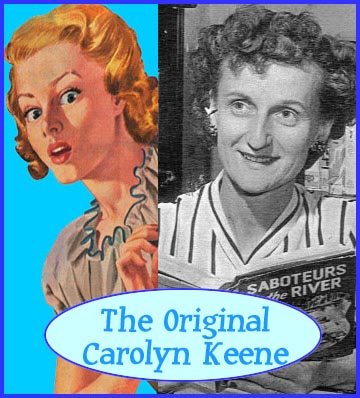
Carolyn Keene was the pseudonym for numerous ghostwriters who were paid flat fees to write books based on outlines Stratemeyer generated. The ghosts gave up all rights, received no royalties, and were sworn to secrecy. Reportedly, the flat fee had started at $125 but was lowered to $75 because of the Depression.

Credit: www.nancydrewsleuth.com

The first ghostwriter was Mildred Augustine Wirt Benson, who brought the smart, feisty, courageous Nancy to life. The series was an immediate success. For Christmas, 1933, Macy’s ordered 6,000 books that sold out in days, even in the midst of the Great Depression.

Mildred wrote 23 Nancy books, in addition to other series like the Dana Girls and Penny Parker.

As a teenager, Mildred had been determined to become a great writer. Her stories won contests and were published in high-end children’s magazines alongside authors like Louisa May Alcott. Mildred earned the first-ever master’s degree in journalism from the University of Iowa.

After her Nancy stint, Mildred wrote many more books under other pen names as well as her own. For more than a half century, she covered the crime and court beat in Toledo, Ohio and later wrote popular newspaper columns. The day she died at age 96, she was at work on an article.

Ironically, despite Nancy Drew’s profound influence on many generations of young women, Mildred wasn’t publicly acknowledged as Carolyn Keene until 1993, nine years before her death. Her archives are kept at the University of Iowa.

Nancy Drew fan conventions kicked off in 2001 and are scheduled as far ahead as 2030, Nancy’s 100th anniversary. For 2019, events will be in Toronto and Savannah.

Nancy Drew expert Jennifer Fisher has compiled vast amounts of history into a fun website that’s sure to bring back memories: http://www.nancydrewsleuth.com/   Thank you, Jenn, for your gracious assistance with this post.

Plenty of authors, including TKZ’s Kathryn Lilley, P.J. Parrish, and myself, credit Nancy with igniting their interest in writing mystery fiction. Kathryn was an ardent fan as a child and later wrote four Nancy books under the enduring Carolyn Keene pseudonym. In 2015, Kris wrote a great post on sidekicks, citing the example of Nancy’s friend, George.

Early editions, especially dust jackets, are collectors’ items. The asking price for a first edition of The Secret of the Old Clock is $2,000. Click on the bottom listing from bookbid2  to browse photos of the vintage cover and interior.

Can children’s books shape lives and careers?

Nancy Drew seduced me into a life of crime [writing]. How about you?

Credit: www.nancydrewsleuth.com


TKZers, please share your favorite memories of childhood books. What books influenced your reading preferences as an adult? Did Nancy, or another character, inspire you to become a writer?


Debbie Burke’s thriller Instrument of the Devil is on sale for only 99 cents during April at this link.