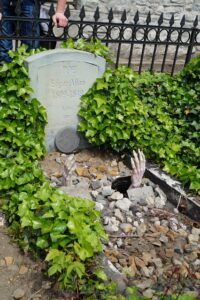
Tribute to a Mentor

by Debbie Burke

@burke_writer

In the early 1990s, a successful screenwriter, producer, and military consultant named Dennis Foley left Hollywood to move to the small ski village of Whitefish, Montana. He’d been a popular writing instructor at UCLA and was now on the forefront of a brand new wave in education: online classes. He could live wherever he wanted, while students sent him assignments and manuscripts via email.

At the time, our local group, Authors of the Flathead, was a small rag-tag gang of hobby writers who fiddled around with words and supported one another in our fledgling attempts at publication. I’d sold my first story to a literary magazine that paid me a $5 check that bounced. A couple of other members wrote unpaid columns for weekly newspapers. Definitely not the big leagues.

We were the ignorant leading the inexperienced.

In a small town, it didn’t take long for word to get around about the new guy from Hollywood who had worked on hit TV shows like MacGyver, Cagney and Lacey, China Beach as well as motion pictures. The club president and I summoned our courage to invite this Hollywood big shot to speak at a meeting.

Dennis graciously said yes and he turned out to be anything but a Hollywood big shot. He not only spoke at that meeting, he came to the next, and the next. Pretty soon, he adopted Authors of the Flathead and was teaching our rag-tag gang the same material he was teaching at UCLA.

For free.

WOW.

He showed us how to become professionals. We learned plotting and organization. He taught us John Gardner’s terms like profluence, the sense of a story always moving forward; and fictive dream, the near-trance state when writers delve deeply into imagination to create a fictional world more vivid than reality. He urged us to take the reader into that world and gave us tips how to preserve the trance.

He explained schadenfreude (delight in the misery of others) and urged us to chase our characters up a tree and throw rocks at them. Conflict was the key to riveting fiction. If life went well for the character, it was bad for the reader; if life went badly for a character, it was good for the reader.

He recommended scenes in novels needed to accomplish four tasks:

  1. Reveal character;
  2. Increase conflict and tension; 
  3. Move the story forward;
  4. Foreshadow.

A really effective scene accomplishes all four tasks but at minimum a scene should include two or three.

He taught us that consistent daily production would carry us farther than occasional brilliant flashes of talent. He counseled us to lower our writing goals to a level we could meet, even if it meant only writing a paragraph or page a day. At a page a day, he often reminded us, in a year, you have a book-length manuscript.

Consistently meeting smaller goals was a better habit to develop than setting goals too high and becoming frustrated when you fail.  

For show and tell, he would bring us Oscar-nominated scripts to study, like Earl Wallace’s Witness.

Dennis had also published four military novels about Vietnam and a memoir about long range patrols. But he rarely talked about his own work; instead he concentrated on our work and how to improve it.

In addition to teaching, Dennis continued to polish his own craft, earning an MFA from Vermont College. He brought back fresh techniques and shared them with us.

Dennis’s one inviolable rule: Don’t bore the reader.

When we needed speakers for our group’s annual conference, he contacted Hollywood colleagues as presenters, contributing to its well-respected reputation. When the pros from New York and Hollywood attended, they invariably commented about how rare it was to find such camaraderie and helpfulness in a writing community. Dennis had set that tone and example that has remained our trademark.

After weekly meetings, we often adjourned to a restaurant for coffee and camaraderie. At one of those early gatherings, we asked Dennis why he shared his knowledge and experience so generously with us.

For the first time, I heard what became my favorite Dennis story.

Before his retirement as an Army officer, Dennis worked in Hollywood as a military adviser for films and television. Once, when a writer didn’t meet his deadline, Dennis was tasked to rustle up an emergency script overnight. He delivered and more assignments followed, even though he had no formal training as a writer. In fact, he’d nearly flunked English in high school. He freely admits he didn’t have any idea what he was doing.

Stirling Silliphant, the Academy Award-winning screenwriter of In the Heat of the Night, took then-newbie Dennis under his wing and coached him. When Dennis wrote himself into a corner, he would call Stirling, who always guided him to a solution.

One day, Dennis said to Stirling, “You have helped me so much, how can I ever repay you?”

To which Stirling replied, “Pass it on. If you don’t, you’re an asshole.”

Dennis took that admonishment to heart.

For nearly three decades, the Authors of the Flathead have been the fortunate recipients of his generosity and knowledge.

He taught us week after week, year after year, never accepting anything in return.

After our last meeting, Dennis and I were talking in the parking lot. His special forces years in Vietnam have taken their toll and long-term effects of Agent Orange are worsening. He expressed concern he soon may not be able to carry on the teaching he loves.

With tears welling, I hugged him and said, “We’ve had a good run.”

“A helluva good run,” he replied.

~~~~

Even though this post will embarrass the hell out of him, I had to write it because Dennis has shied away from recognition these many years.

The sum total is his mentoring has improved the writing of thousands of students and launched many of us to publication success.

But the most important contribution Dennis has given us is his generous spirit of sharing knowledge. He followed Stirling Silliphant’s admonishment to pass it on and far exceeded it.

THANK YOU, DENNIS. 


TKZers: Have you had a mentor who changed your life? What did s/he do to help you? 

Your homework assignment is to track down that special mentor (if they’re still alive) and tell them thank you. 

My 911 Sit Along

A couple of weeks ago I did a 911 ‘sit along’ as part of my citizen’s police academy. This came just a few days after after I’d heard presentations from our local SWAT and negotiation teams and, sadly, just a week or so before Colorado experienced yet another school shooting. Taken all together, not only do I have a renewed appreciation for the work of our local law enforcement but also a deeper understanding of the team effort that kicks into high gear when emergencies occur.

It was a relatively uneventful day when I did the 911 sit along, which meant I got the opportunity to have a more in-depth discussion with one of the operators about what it was really like to be a 911 dispatcher. First off, it is not for the faint of heart (obviously) or for those who can’t multi-task. Given the level of technology these days, dispatchers have to be able to cope with monitoring and entering data in at least three open computer screens (and that’s not including CCTV footage or maps that transmit police unit locations in real time) all while listening to to the multiple radio frequencies constantly transmitting in their ears, as well as actually fielding and dealing with the 911 calls coming in. The dispatcher I was assigned to was a veteran of the Aurora shooting (when 911 calls flooded all the local centers) as well as the many youth suicides that our community has, unfortunately, had to deal with in recent months.

Our local 911 center also fields all non-urgent calls to our local police department so I got to witness calls that ranged from the life-threatening (a driver passed out in his car in the middle of traffic) to the mundane (rabbit trapped in window well). Even on the day I was there, I saw multiple incidents being referred to our local school resource officers as well as the emails coming in to the 911 center via the local, anonymous tip line, Safe2Tell, about potential threats to local schools. It became increasingly clear that mental health calls are a huge part of our local 911 dispatcher’s lives and I got to witness the delicate balancing act local law enforcement plays in trying to mitigate against the overwhelming number of tips and calls they receive about schools and students. As the mother of two 8th graders, it was sobering indeed.

One of my key questions to the dispatcher I was assigned to, was how she dealt with the stresses of her job. Being married to a police officer, helped, she said, as he understood what she had to face and they could talk and decompress together. It was also clear that our local police department provides a supportive environment that ensures everyone receives the counseling they need, particularly after distressing events like the recent spate of teen suicides.

It’s hard not to reflect on the events of this past week, and not appreciate the role of both 911 dispatchers and law enforcement. I’m sure our local dispatchers fielded calls as local schools went on lockdown or, as my sons’ school did, secure perimeter, in response to the STEM school shooting. No doubt our local police officers rushed to the scene to provided backup before our victim advocates arrived on scene to help provide parents and teachers with the support they needed.

The police citizen’s academy has given me tremendous insight into how our local police department operates and made me realize how little I understood the complexity and role of our local 911 dispatchers. After spending just a few hours in the 911 center, my writer’s brain was whirring with possible characters and plots for a novel, but now, given the events of the past week, it feels like it’s all hitting a little too close to home…so I’m going to  put the book ideas aside and hug my teenage boys a little tighter instead.

Reader Friday: Writing Goals

Predetermined writing goals can help keep our butts in the chair, fingers on the keyboard.

How often do you set a goal?

Do you preplan your writing schedule for the entire year? If so, what are your goals for 2019?

If you prefer not to look beyond the WIP you’re working on, have you set a deadline to finish the manuscript?

Road Work

By Elaine Viets

I was reading a fast-paced thriller when suddenly, the action stalled. The sheriff was chasing the killers, pursuing them on the back roads – and I was stumbling through sentences like this one: “Where State Road 41 turned north to Wyandotte, I went south on US 64, and west on Highway 27 until it intersected with Route 441, and then . . . ”

And then I lost interest. My thriller had turned into Mapquest.

Never mind who wrote this novel, or the real names of the roads and town – all writers lose their way sometimes.

Even big name authors will give you turn-by-turn directions to the Santa Monica Freeway or the Holland Tunnel.

Donald Westlake parodied this habit in his funny Dortmunder novels. Stan, the driver for this band of feckless crooks, always discussed his routes through New York City. Here’s a Stan sample:

“Anyway, the Van Wych’s no good because they’re putting in the monorail. I figured the old streets are still okay, I’ll take a straight run up Flatbush Avenue, come to Manhattan that way.”

Mentioning lots of streets may seem to give your novel gritty authenticity, but those streets should help illustrate your story. If your hero is chasing drug smugglers through the back country, describe those roads so they are more than jumbled numbers. Is the highway deserted at night? Is that rutted road hard to see in the rain? Are there isolated farmhouses nearby – or is this road so far off the grid your hero will have no help in an emergency?

Use those roads to give us a feeling of what’s going on. This information can rachet up the tension in your novel.

Paddy Hirsch, in his historical mystery, “The Devil’s Half Mile,” about Wall Street in 1799, mentions a spaghetti tangle of Manhattan streets. But look how he does it:

“Bedlow Street and Timber Street had the high ground and the views, while Cherry Street had the seafront promenade, but the maze of lanes and alleys that tumbled down the hill and connect them was something else entirely. Most of the land there was marsh, and the work to drain the soil and fill in the incline had not gone well. The lanes were sunken, and the buildings on them flooded in the fall, froze in the winter and attracted mosquitos in the summertime. The mysterious fevers and sicknesses that plagued the city seemed to center on those sinkholes, so that only the poorest and most wretched lived there. But the rents were cheap, and as a result they were overflowing with newcomers seeking a fresh start in the growing city.”

Hirsch outlined an entire neighborhood in one paragraph, and named the major streets.
One of the best examples of stellar road work is in T. Jefferson Parker’s “California Girl.” It’s 1960 and teenage Andy is driving his girlfriend home in his car, nicknamed the Submarine.

“Andy steered the Submarine up Red Hill Avenue, into Lemon Heights. Meredith sat close beside him, her hand on his knee. Through his jeans, he could feel the exact shape of her palm and thumb and each finger. He tried to open his leg a little, invite her hand to go farther up, but he had an accelerator to work and she’d never moved much north of his knee anyway. Wasn’t going to in the middle of day, heading home from school. That was for sure.”

They talk about their plans and then:

“Andy downshifted and made the left onto Skyline. Meredith had removed her hand from his leg but he could still feel it there, warm and soft and a little damp. . . .

“Lemon Heights was where the rich people lived. The heights were rolling foothills with eucalyptus and avocado and sycamores, even a few lemon trees from the old days. The houses were big and each one was different, not like the tracts expanding below, where two or three floor plans repeated themselves up one street and down the next.”

Using streets can give your story real direction.

ACDF: My New, Most Important Alphabet

By John Gilstrap

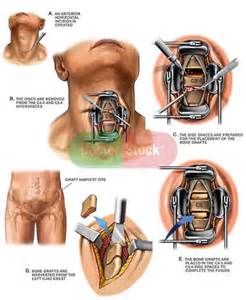
Note: My bone grafts will come from the bone bank, not from my hip. Thank goodness.

If you’re looking for any solid writing advice on this Wednesday, perhaps you should move along.  This week’s post is personal.  Perhaps even indulgent.

My writing schedule has been knocked completely off course by life issues.  Yes, I realize that this contradicts a point made a few weeks ago in a post on this very blog, but I’m not trolling for sympathy, and I don’t consider this space to be “social media”.  I’ve been a regular here for long enough for all y’all to feel like family.  And I don’t look at any of this as bad news.

Tomorrow, I will undergo roughly four hours of surgery to remove three discs from my cervical spine, replace them with bone grafts, and then fuse them all together with a titanium plate.  The surgeon will go in from the front of my throat, retract my trachea and esophagus off to the side.  The procedure is called anterior cervical discectomy and fusion (ACDF), and the success rate is phenomenal.

This is not my neck, but this is what my x-ray will look like when they’re done.

For about a year now, I’ve endured pain and numbness down my left arm and shoulder, radiating down into my left shoulder blade.  Sometimes, my thumb feels as if it’s been hit with a hammer.  As I type this, I can’t feel my thumb at all.  It’s called cervical radiculopathy. I’ve tried physical therapy, and I’ve had two epidural injections, one of which helped a great deal, and one that seemed to do nothing at all.  The surgeon explained that I now have two choices:

Choice One.  I can suck it up and keep going.  There’s no danger of catastrophic degeneration from my condition, so the surgery is, by definition, elective (though insurance will cover it).  He said if I do nothing, things will never be better than they are now, and if they get worse, I always have the option for surgery down the road.

Choice Two.  Have the surgery now and make the pain go away.  This is the choice I made, and here’s why: I will never be younger than I am now, and few conditions age a person faster than chronic pain.

So, the decision is made.  I’ve decided that the risks inherent in any major surgery are worth the results.  I’ve signed on for 4-6 weeks of recovery and the inability to lift anything heavier than 5 pounds for eight weeks.  This puts a big burden on my lovely bride, and she’s signed on as well.

And I’m terrified.

It’s my cervical spine, for heaven’s sake!  The fusion will happen at three levels, C4-5, 5-6, and 6-7.  In the weeks ramping up to tomorrow, I’ve realized how counter-productive it is to be the control freak that I am.  I am literally passing my future into the hands of a man I’ve met only twice.

Since mid-March of this year, the time when this surgical rock started rolling down the hill, I have spent countless hours–hundreds, probably–researching every aspect of ACDF surgery.  I’ve watched an entire procedure, from incision to final sutures (thanks, YouTube!).  I know what the likely complications will be (difficulty swallowing and speaking for the first week or two), but I also know that the vast majority of patients who undergo ACDF surgery enjoy complete elimination of their radiculopathy as soon as they open their eyes.

Knowing these details helps me settle my fears.  This is going to happen, so why not embrace it and try not to be scared?

The real casualty of this looming episode in my life is my writing–and that’s my hook around to the topic of this blog.  Thanks to my obsessive research into my surgery, I have fallen woefully behind the power curve for my next book.  It’s a quirk of my personality that I have difficulty concentrating on the imagery necessary to write a story while my mind is consumed with unanswered questions.  No excuses, just an observation.  I’m hoping that during those days (weeks, perhaps) when I am pretty much unable to do anything but rest and take walks, I’ll be able to re-focus on what I really should be doing.

So, here we go, on into the unknown . . .

It’s A Gas! Things We Can Learn
From Good Openings In Movies

By PJ Parrish

Just back from the Edgars. As banquet chair, one of my duties is to run the PowerPoint, so I stay as sober as a nun until it’s all over. Then, like everyone else, I head to the bar to see old friends and talk about the business.

I met one of the winners, Donald Joh, who won best TV episode for The Romanoffs. His writing partner was Matthew Weiner. You might have heard of him – he created Mad Men, and has won a van-load of Emmys and Golden Globes.

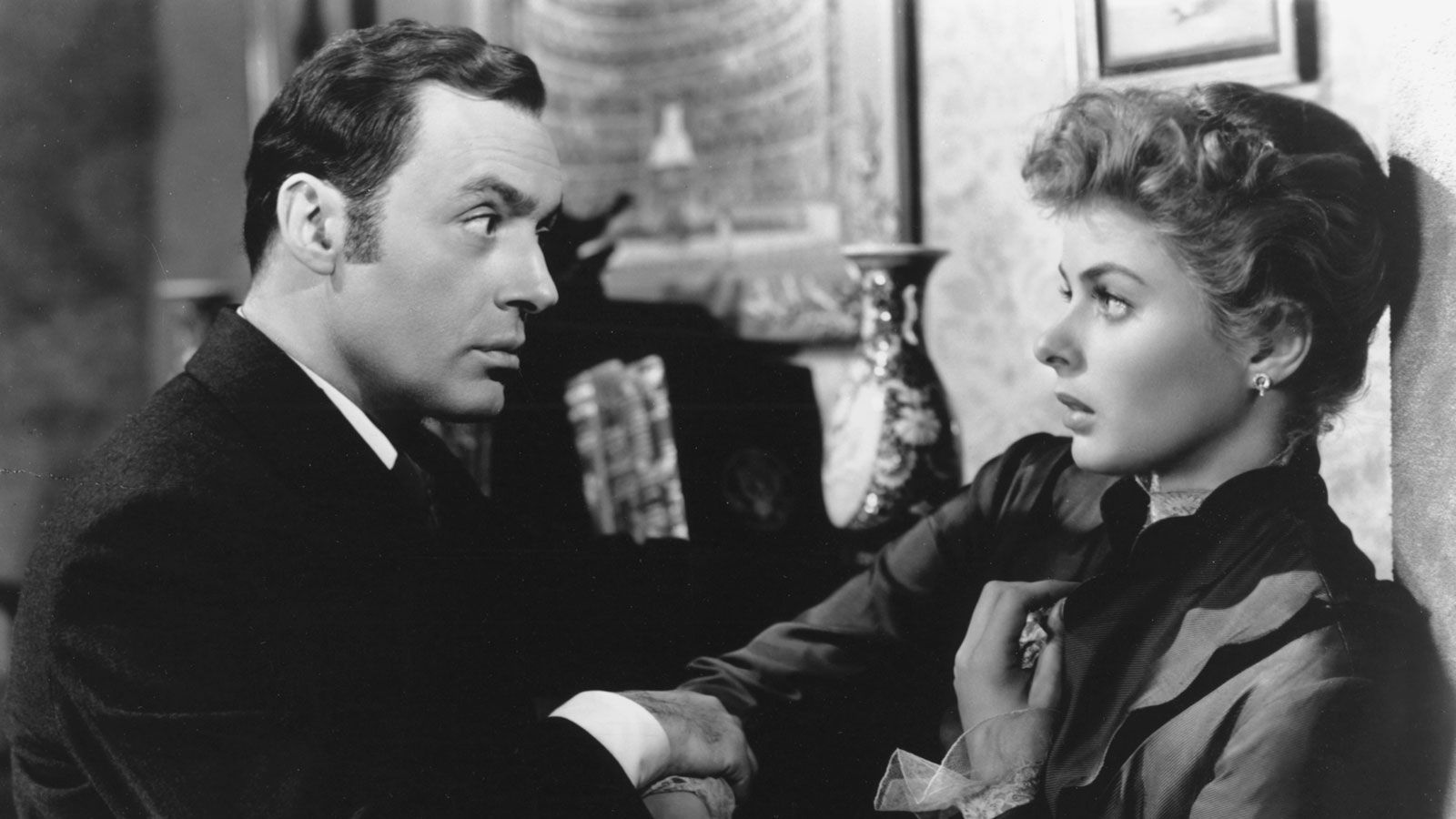
Donald and I got to gabbing about the differences between screenwriting and novel writing. One thing we agreed on was that both need to have a great set-up. I told him I had recently watched Gaslight, the great study in paranoia with Charles Boyer trying to drive his wife Ingrid Bergman crazy. Gaslight falls under what I call the Bad Husband genre. Others include Dial M For Murder (Bad Husband Ray Milland trying to off Grace Kelly), Suspicion (Bad Husband Cary Grant gets miffed when he finds out his heiress wife Joan Fontaine is really poor), and Bad Fiancé Robert Wagner who’s just plain mean and tosses his pregnant girlfriend Joanne Woodward off a roof).

The golden era of the Bad Husband genre seemed to end in the Fifties. We’ve got a few bad seeds now, like Nick Dunne in Gone Girl, but they pale in comparison to guys like Cary. I guess you could include Jack Torrance in The Shining but he was possessed by evil spirits, so that doesn’t count in my book. But I can make a good case for throwing in Guy Woodhouse from Rosemary’s Baby and greedy little Jerry Lundegaard in Fargo, dontcha know?

But back to Gaslight. I told Donald Joh I have trouble watching movies for pleasure because I analyze the good ones for what they can teach me about how to set up a story, how to convey plot only through action and dialogue, and how to establish important things like place, atmosphere, and begin layering in character motivation. So if you’ll indulge me, let me give you a quick breakdown of how Gaslight does this.

The opening image is a foggy London street and a lamplighter making his rounds. Atmosphere and main motif of gaslight planted. Next we see a sign — 9 Thornton Square and look over the shoulder of a man reading a newspaper THORNTON SQUARE MURDER UNSOLVED. Place identified and first good hook is thrown out just via an image. The door of No. 9 opens and a girl comes out. She looks shell-shocked as the gawkers whisper. Her elderly guardian turns down the remaining gaslight and they leave in a carriage. He tells her not to look back and delivers the movie’s first lines:

“You’ve got to forget everything that happened here. You’re going to Italy to see Verbaldi. He was the best friend your aunt had. He will make you a great singer just like your aunt was.”

Another hook is thrown out, a dribble of backstory, and we’re off and running.

That opening scene could be a prologue. Because we next jump ahead ten years and to a new location. But you could also just call it “Chapter 1”. So, we cut to the next “chapter.” A sign in the window says “Verbaldi Music Lessons.” Neat location seque. Inside, the now-adult girl (Ingrid Bergman) is finishing up her lesson. Her teacher tells her she has worked so hard all these years but seems distracted.

Teacher: “You look like her.”
Paula: “But I don’t sing like her, I know. I haven’t a voice, have I?”
Teacher: “Your heart is not in your singing anymore.”

Efficient character development and time/locale bridge. Paula, we understand, feels inferior to her famous aunt and very alone in the world. “I haven’t a voice” is a pitiful recognition of her own insubstantial character. The movie is, in fact, partly about Paula finding her “voice” even as her husband tries to break her down. Paula confesses she is in love. The teacher tells her she needs a vacation. Paula leaves and outside, she embraces the man who had been accompanying her on piano — Gregory Anton. Dialogue:

Paula: “But I don’t know you. I don’t know anything about you.”
Gregory: “Are you afraid?”
Paula: “Yes, of happiness.”

Again, character development layered in. Paula is being portrayed as a weakling. Which enforces her powerful character arc by the time we get to the movie’s climax. You have to give your heroine a point to begin so she can fight her obstacles and grow. Both plot and character need arcs from A to Z. She tells him she needs to go away for a week to know what she is doing. He tells her that he has waited for her so long and he can wait a little longer.

In the next chapter-scene, we are on the train to Lake Como. In her compartment, Paula chats with an old woman who is reading a murder mystery about a man who marries a girl and has six wives buried in the cellar. reinforces the plot. The old woman reveals she lives in London, in Thornton Square. Aha!

“Do you know it? You know we had a real live murder there.”

“Yes, I’d heard of it.” 

The old lady then recounts the event: Ten years ago a famous singer named Alice Alcast was murdered. So now we know what was going on in that opening scene! It’s a good lesson for novelists on how to use ACTION to tell the backstory. In a novel, we would probably have our heroine THINKING/REMEMBERING what happened 10 years ago. Much more effective to find a way to convey this info in action/dialogue if you can

The train is pulling into Lake Como. Paula is agitated and the old woman tells her that traveling alone is dangerous and to be careful. foreshadowing. When Paula gets off the train, we see a hand clasp her sleeve. Creepy! The camera pulls back to reveal it is her lover Gregory. He tells her he has followed her to Lake Como.

Gregory: “You’re not angry with me, are you?”
Paula: “Angry? If you hadn’t come I’d have sent for you.”

They kiss as the train moves out. The final shot is of the old woman in the train’s window looking concerned. More foreshadowing.

New scene: In the villa, Gregory confesses he has always dreamed of living in a quiet house in London.

Paula: “I have a house like that, at 9 Thornton Square. That house comes into my dream, a house of horror. Strange, I haven’t dreamed of it since I’ve known you. I haven’t been afraid since I’ve known you. For years I’ve been afraid of something nameless. But I’ve found peace since I found you. I could even face that house with you. You shall have your dream, Gregory. You shall have your house in the square.”

The main characters have been well introduced. We sense that Gregory is a Bad Husband, but we are intrigued to know what he is up to. Poor Paula has to face the demons of her past by re-entering the murder house. It’s like we’re screaming at the screen of a slasher movie: DON’T GO IN THE BASEMENT! The stage is set.

New chapter: We are at 9 Thornton Square. Gregory pushes open the creaky door and Paula enters her dark house of horrors for the first time in 10 years, and says:

“Will you light the gas, please?”

Oh, indeed he will. The gas light works as a theme throughout the movie on many levels and images. Paula watches as the shadows move across the parlor of the gloomy room and says:

“It is all dead in here. The whole place seems to smell of death.”

She pulls off a dusty sheet from a grand portrait of her opera singer aunt as Gregory watches from the shadows. She whispers:

“It was there I found her, there in front of the fire, in front of her own portrait. I came running downstairs. She had been strangled.”

She gets distraught and says she can’t stay here. Gregory comforts her and says they will shut all the old furnishings away so nothing can remind her of the past. Make the house full of parties and life again.

And the set up is complete. The newlyweds begin to create a life together at 9 Thornton Square and though the aunt’s portrait is locked away in the attic, you know the ghost has not been banished. 

Now, I’ve heard folks dismiss Gaslight as corny. But for my farthings, it’s an effective thriller and character study. The director George Cukor was labeled “a woman’s director” but he directed a couple sturdy noirs along the way including A Double Life with Ronald Colman as an actor who gets way too into his role as Othello and offs his ex-wife who’s playing Desdemona. But that’s for a Bad Husband for another day…


10-4


One of my biggest problems when writing is that I tend to get in my own way. This has occurred with some frequency during my latest project, currently titled The Lake Effect, which I discussed here a few weeks ago. You may or may not recall that I dreamt the beginning, middle, and ending of what is a love story. All that I have had to do is write the thing. This I am doing,  and am having fun doing it. Occasionally, however, I can’t leave well enough alone. I know that I should simply tell the story. I’m doing that, but occasionally I seem to consider myself to be duty bound to insert into the narrative examples of how clever and knowledgeable I consider myself to be.  As one might expect, I am usually wrong. The result is that my narrative bogs down. I’m not getting tripped up in detail. Sometimes one should stop and smell the roses, so long as the scent is pertinent in some way to the story. My mistake has been that I will be moving from Point A to Point B but will insist on stopping and describing Points A1, A2, and A3 along the way as well. I don’t consider my reader, who (hopefully) will want to get to Point B with all due and deliberate speed. I do this and  wonder why it isn’t working, then realize that I am boring myself. If I am putting myself to sleep, then what am I doing to my poor reader, who will probably leave the building, never to return?

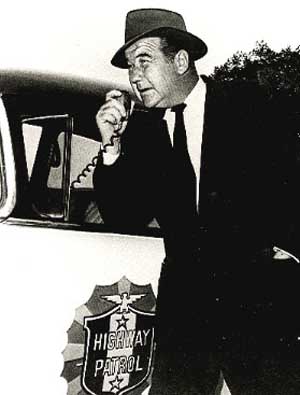
I have found that as a sort of enjoyable and tutorial penance for such a writing error I am best served by watching a few episodes of Highway Patrol.  It was one of my favorite television series in the 1950s and remains so today. Each episode was about twenty-five minutes long. They would shoot the episodes in two to three days, twice per week, and broadcast close to forty episodes a season. This was done on a very limited budget. There were no fiery car crashes or extended shootouts through shopping malls.  There were other constraints. Broderick Crawford was the lead actor. He played Dan Mathews, the taciturn, grizzled head of the unnamed Highway Patrol unit featured in the series. Crawford’s parts in each episode had to be shot in the morning because he was usually well-toasted by lunch. It somehow worked. Crawford delivered his dialog staccato-style (“Youshouldbesorryforwakin’meathishourwhaizzit?”) (“CorneraBrownanChocorantwoaclock”) (“21-50taheadquarters10-4”) when ordering his officers about. The cadence of Crawford’s diction, or lack thereof, was perfect for an episodic series where time was of the essence.  There was also a formula applied to the shows which becomes obvious after a few different viewings. It was simple. A crime would be committed, Matthews and his team would chase their tales, and some evidence would be discovered, all within the first half of the episode. The last half of the episode (all twelve minutes or so) would show Mathews and his associates bringing the evildoers to justice. Voice-over narration by a gentleman named Art Gilmore gave each episode a quasi-documentary feel (“Burglary is the alley cat of crime, wandering the night in search of prey”). At the conclusion of each episode, Mathews, as he was getting into his car, would stop, look at the camera, and break the fourth wall by directly addressing the television audience with a pithy safe driving platitude, such as “It isn’t the car that kills…it’s the driver!” Just so.  

Each episode of Highway Patrol was suspenseful and exciting even with such a cut and dry formula. Nothing ever really felt left out. Each minute — each second — was important. Highway Patrol was the first television series to utilize fast cutting — a few different action shots of just a couple of seconds’ duration (usually consisting of a police car racing to a crime, or chasing a suspect) — to move the action along.  They also didn’t spend a lot of time getting the viewer from Point A to B. Mathews would get a lead, jump up from his chair and say, “Let’s go!” The next scene might show him driving quickly down a street for about two seconds (stock footage was often used, as Crawford at one point during the series run had his real-world driver’s license suspended for driving under the influence) followed by Mathews getting out of the car at his destination and shooting it out with the criminals. Bing bang boom.

If while writing you find yourself stuck in a thicket of your own design and wondering what to weed and what to water watch a few episodes of Highway Patrol. It is possible that you will absorb its lessons about narrative and storytelling by osmosis. All four glorious seasons (Crawford said the series stopped because they ran out of crimes) can be found on DVD,  YouTube and a couple of cable channels. It works for me. If you already have a method of bringing your writing errors and ommissions on track, please share. And thank you. 1075 to 21-50. 10-4.


Reader Friday: Ask One Question to Any Author (Alive or Dead)

If you could ask any author (alive or dead) one question, what would it be and who would you ask?
I’d love to chat with Edgar Allan Poe. A palpable sadness bleeds through his writing. It’s no secret tragedy followed him throughout his life, but his story still seems incomplete.

Asking him only one question might be near-impossible for me. 😉


Fiction Research Links

Jordan Dane
@JordanDane

I came across some great resource links over the years and thought I would share some with my TKZ family. I’ll group them in no particular order.

MEDICAL:

This first link is to a site in Australia, but when I couldn’t find a similar one for the U.S., this serves the purpose. It gives writers a good visual as a reminder of what an Intensive Care Unit in a hospital looks like and the terminology: What’s in an ICU?

The Encyclopedia of Death and Dying – Wonder what’s in there? Plenty of weird topics alphabetized.

BioMed Search – Medical Resources – This has tons of medical resources on all sorts of illnesses, procedures, case reports, treatments for illnesses, surgical procedures, etc.

EMedicine: Medscape – Want to see what blunt force trauma does to the head and skull? This site is not for the squeamish. Various medical specialties are listed with slide show pictures. There’s also extensive resources on surgical procedures, pediatrics and general disease conditions.

FORENSICS:

This link has many resources, especially when you look under Forensic Resources Tab: American Academy of Forensic Sciences AAFS

Computer Forensics at SANS – Digital Forensics

Top 50 Forensic Science Blogs

CRIME SCENE:

This link has resources for writers to research crime scene cases and chat in forums to ask questions and get advice from detectives. Writers can research old cases and they even have an online store for fun purchases. Crime Scene

Crime Scene Investigator Network – This link gives writers plenty of resources on crime scene procedures and evidence gathering, with photos, forum to ask questions, videos, and case files.

Crimes & Clues: The Art & Science of Criminal Investigation – Ever wonder what a CSI job demands and the pay? This site has that and more. Profiling articles from top FBI agents, interrogation techniques and cases, courtroom testimony, various studies on forensic science, death investigation with pathology and entomology.

MISCELLANEOUS:

Police One – A solid resources for all things police: uniforms, gear, police cars, radios, body armor, body cams, police procedure, etc.

Botanical: Modern Herbal – A solid research source for herbs and poisons

Poison Plant Database

Firearms Tutorial – This is a resource for firearms with basic terminology, Lab procedures, examination of gun shot residue (GSR), and a study of ballistics, among other things. But since we have a resident expert in John Gilstrap, I would encourage anyone to start with John’s posts on guns here at TKZ – links below:

The Truth About Silencers

Cla-Shack

Choose Your Weapon

GENERAL WRITERS RESOURCES:

Internet Resources for Writers – Tons of resources on all topics for writers from networking resources, craft, research and business links.

The Internet Writing Journal: Research Resources for Mystery and Crime Writers – Lots of links on crime research, police procedure, forensics, government sites, and types of crimes.

CHARACTERS:

Building Fictional Characters – Lots of helpful links to resources on the topic of crafting characters with recommended instructional books. But I would be remiss if I didn’t also include our own TKZ resources on author craft through James Scott Bell (his list of books on writing are HERE) and Larry Brooks. Larry’s craft resources are listed HERE.

I hope you’ll find these links new and interesting.

FOR DISCUSSION:

What writers’ resource links have you found useful? Any topic from business/promotion to craft and research.


First Page Critique: They’re Gone


Greetings, writers.

Today, join us for a peek into the life of the cutest family ever! Take it away, Brave Author:

CHAPTER 1

We all have secrets. Josh prefers to keep his hidden, especially from his wife. Josh Benson is a 35 year old family man, devoted father, and loving husband. He has no idea his life will shatter in the next 24 hours.

Josh is scrolling through cell phone photos. He stops at one in particular. It’s from his first date with Lauren. He looks fit and his blue eyes are staring into Lauren’s without a hint of deception. Things change. This photo was taken nine years ago.

He hears little footsteps scurrying across the hardwood floor. Sean and Cooper come running into the living room and jump on the couch like it’s a trampoline.

“Mommy, Daddy, can we watch tv?” It’s a Saturday morning so this excitement is expected.

Lauren says, “Yes, but you need to quit breaking the couch. I’ve told you a hundred times.”

“Fine Mommy, we’ll stop.” The things kids say just to watch television.

Josh clicks a button on the remote control and asks the boys what show they want to watch.

They both respond at the exact same time as if they’re the Backstreet Boys. “Sesame Street!”

Josh looks at his two greatest accomplishments and just smiles. He loves them more than life itself.

After the kids find out the number of the day, they consume some snacks like Joey Chestnut in a hot dog eating competition.

Josh says, “Okay boys, guess what today is?”

“Family day!” Everyone cheers. Josh and Lauren are taking the boys to the Philadelphia Zoo for the first time.

“Who’s ready for the zoo? Who wants to see a lion?”

Cooper starts roaring as loudly as he can. He’s 3 years old so this is appropriate behavior.

The boys are adorable, as in they’re so perfectly good looking, you would think Brad Pitt and Jennifer Aniston had kids in their prime and out came Sean and Cooper.

Sean, their 5 year old, is full of life and never stops. He’s like the Energizer bunny. He says, “I’ll be right back, Daddy!”

He plays a quick game of frogger to avoid the never-ending amount of toys scattered across the living room floor. Once he finds the right bin, he puts on his favorite costume. He dresses up in a black mask, puffed out chest, gold utility belt, and a long black cape. He hustles to the kitchen table and taps Josh’s shoulder.


__________________

Before rushing into the meat of this submission, let’s address the piece’s first word: We. “We” is a huge word, and its implications are several.

  1. “We” implies a rare, first-person, plural narrator.
  2. Who is included in this we? Does it include all humans? Is it a Greek-style chorus of Josh’s friends and family? Perhaps an alien tribunal?
  3. Hearing this particular “we,” I’m immediately put in mind of Rod Serling’s opening and closing monologues on the original Twilight Zone television series. Serling’s monologues had an intimate, confidential, we’re all in this together, feel. He seemed to be addressing each listener across a table set with crystal ashtrays and chilled cocktails.
  4. A story with a first-person, plural narrator is definitely akin to second-person narration, which uses “you” handily. As in, “You may be reading this thinking, ‘Oh! The author is going to kill off that darling little puppy!’ But you would be wrong. We all know I’m way smarter than that.”

“We,” as intimate as it sounds, here leads us into a scene over which we hover as though we’re watching images sent back to us via drone. An opening scene sets the tone of the entire novel–and while there are plenty of clues that we’re dealing with a happy family and proud father, there is no other tension except Josh’s slight frustration with Elmo repeating himself.( My sympathies, I’ve been an Elmo prisoner.)

All this is to say, please give us some small, physical signs of John’s frustrations. Is he always the perfect, fun dad? Or is he occasionally grouchy and overly-protective.

Josh pulling out an old photo of him and his bride is a bit cliché.

Given the title, and the tale’s dire, first paragraph prediction, I’m going to assume that it’s the two adorable children who are the “They” who are soon gone? With those assumptions, the story will clearly be a thriller. Except…there’s a whole lot of cuteness to navigate that serves to make me wonder if that’s really going to be true.

Thinking about dialogue:

““Mommy, Daddy, can we watch tv?” It’s a Saturday morning so this excitement is expected.” –Who is talking here? Both of them? It would be weird and truly scary to have them say this simultaneously.

““Fine Mommy, we’ll stop.” The things kids say just to watch television.” –“Fine, Mommy, we’ll stop.” sounds a bit Stepford-child-ish. And, again, is it both children saying this?

“The things kids say just to watch television.” Is this Josh’s thought? Again, it feels like an intrusive narrator’s words, rather than those of a character.

All that said, I love the children’s presence, and the intense family feeling here.

Please keep in mind that an opening scene needn’t be saccharine to imply general happiness. If this is, indeed, a thriller, put in more tension, less Elmo.

Set to, dear readers! I’ve left plenty of open territory for other criticismsl