Your Magnificent “What If” Muscle

by James Scott Bell
@jamesscottbell

I’ve often thought of the imagination as a muscle. With proper care and exercise, it gets stronger. Leave it alone, and it atrophies.
For fiction writers, the imagination is our stock-in-trade. The healthier it is, the more likely the production of fresh, original writing.

One of the best exercises for the imagination is the “What if” game. Through daily practice you train yourself to ask “What if X?” in response to the stimuli—usually visual—that come your way in an ordinary day.

You’re driving and come to a stoplight. What appears to be an elderly woman pushing a shopping cart stuffed with belongings enters the crosswalk. Are things just as they appear? Probably. But not to your creative mind! So you ask:

What if there’s a bomb in that shopping cart?

What if the lady is the heiress of a large fortune, but went insane? Or was driven insane?

What if it is really a man in disguise and he’s on the down low because a contract has been put out on him?

The light turns green and off you go, letting the ideas simmer in your brain.

You pass a billboard of a happy family—smiling dad and mom, two laughing kids—at a theme park. Happy to most people, maybe. But:

What if Dad is a hit man on the side?

What if Mom is the assassin-for-hire?

What if one of the kids is an alien?

Two minutes have gone by and you already have six or seven ideas.

If you’re diligent about this exercise, your imagination muscle will churn all the time, often without conscious thought. Then the issue won’t be, Where do I find my next idea? but, How do I choose from all the great ideas my imagination has already provided?

As I look back at my own books, I think I can safely say that most of the ideas sprang from a What if conjecture. Sometimes that was the product of just sitting down and telling myself to come up with something. Several times it was me riffing off some odd news item.

Like an L.A. story that haunted me for a few years. A man shot his wife, drove to a freeway overpass, got out of his car and shot himself. He fell 100 feet onto the freeway below. His body smashed into a car, killing the driver, a woman.

I clipped the story from the newspaper and put it in my “idea box,” where I kept all sorts of clippings. Every now and then I’d look through the box to see what still interested me. This incident always did. Finally one day I asked myself, What if the woman in the car was my protagonist’s fiancé? I sat down and wrote an opening, in First Person POV, that ended with this:

This would have been simply another dark and strange coincidence, the sort of thing that shows up for a two-minute report on the local news—with live remote from the scene—and maybe gets a follow-up the next day. Eventually the story would go away, fading from the city’s collective memory.

But the story did not go away. Not for me. Because Jacqueline Dwyer was the woman I was going to marry.

Try Dying took off from there.

Here’s another one.

Years ago I got an email out of the blue from a fellow I knew in high school. It had been nearly thirty years since we’d communicated, and even back then he wasn’t a close friend. He said he’d found my website and saw I was a writer and thought it would be good to get together, and could he buy me coffee?

Unfair as it may have been, my immediate thoughts were: a) he has always “dreamed of” being a writer, and thinks I can help him; b) he has written a novel and can I help him find an agent?; or c) he’d like to tell me about Herbalife. My What if muscle was flexing, and went to: What if this guy wanted to do something to me? Or to my family? And why?

We spent a perfectly harmonious hour together, and that was that. Or so I thought.

It just so happened that about this time I re-read one of my favorite John D. MacDonald novels, The Executioners (basis for the Cape Fear movies, the original with Gregory Peck and Robert Mitchum being the best). Talk about a spiral of suspense!

That’s when I knew I had my next novel. I wanted that spiral! My novel would be about a guy from the past who contacted my family-man protagonist for a friendly get together, but then…

The book was published by Zondervan and hit the CBA bestseller list. Now it’s back in indie iteration as Can’t Stop Me. What if it launches today at a special deal price? We shall see!

So are you intentional about asking What if? What do you do to work out your imagination muscle? How to you decide what book you want to write next?

Writing Strategies

Writing Strategies: Breaking through writer’s block, keeping your butt in the writing chair, and rewiring your brain

The Kill Zone is a goldmine of advice and insight on all aspects of writing and publishing, from how to write and ways to publish, to creating characters, embracing story structure, and much more.

Getting to the keyboard to write, and once there, continuing to write is a challenge for many of us, especially with the internet ready to provide endless distractions. Today’s Words of Wisdom shares three excerpts from the KZB archives that provide ideas and strategies to help get past writer’s block and keeping motivated. You can read the full post for each excerpt via the date links. It’s also an entirely unintentional, serendipitous follow-on to James Scott Bell’s Reader Friday post yesterday entitled “Setting Yourself on Fire.”

So, the table has been set for today’s discussion. Feel free to comment and engage with other readers on any, or all, of these topics.

I was feeling uninspired in my writing (which probably explains why I was surfing the Internet and reading about placebo studies). So I wondered: If a placebo can cure cranky bowels, could it help me break through a minor case of writer’s block?

I decided to run my own unscientific study. I didn’t have any sugar pills on hand, so I reached for the next best thing: my daughter’s jelly beans.  I figured that labeling and ritual had to be part of the reason why placebos work, so I poured the jb’s into an empty prescription  container. (And I have to report that jelly beans look extremely potent when they’re staring up at you from a bottle of blood thinner medication.) Then I put a nice label on it marked “Creativity.”

As part of my morning ritual I started taking two “creativity pills” with my coffee. As I solemnly popped the beans, I paused to meditate for a few moments about my writing goals for the day.

And by God, it worked. I blasted right through that writer’s block. I wrote four pages that day, and haven’t looked back since.

The only thing is, now I’m afraid to stop taking the beans. I think I’m hooked. For my next batch I’m thinking of getting those special-order M&Ms–the ones you can order with little messages written on them. I’ll get them labeled with something like, “Writing is rewriting,” or whatever fits.

What about you? Do you have any silly rituals that help you get your creativity engine going?

–Joe Moore, January 11, 2011

I like to reexamine what tips I would give to aspiring authors, or even experienced authors, when I get a chance to speak to a group. Invariably the question comes up on advice and I’ve noticed that what helps me now is different than what I might have found useful when I started. Below are 8 tips I still find useful. Hope you do too, but please share your ideas. I’d love to hear from you.

1.) Plunge In & Give Yourself Permission to Write Badly  – Too many aspiring authors are daunted by the “I have to write perfectly” syndrome. If they do venture words onto a blank page, they don’t want to show anyone, for fear of being criticized. They are also afraid of letting anyone know they want to write. I joined writers organizations, took workshops, and read “how to” articles on different facets of the craft, but I also started in on a story.

2.) Write What You Are Passionate About – When I first started to write, I researched what was selling and found that to be romance. Romance still is a dominant force in the industry, but when I truly found my voice and my confidence came when I wrote what I loved to read, which was crime fiction and suspense. Look at what is on your reading shelves and start there.

3.) Finish What You Start –  Too many people give up halfway through and run out of gas and plot. Finish what you start. You will learn more from your mistakes and may even learn what it takes to get out of a dead end.

4.) Develop a Routine & Establish Discipline – Set up a routine for when you can write and set reasonable goals for your daily word count. I track my word counts on a spreadsheet. It helps me realize that I’m making progress on my overall project completion. Motivational speaker, Zig Ziglar, said that he wrote his non-fiction books doing it a page a day. Any progress is progress. It could also help you to stay offline and focused on your writing until you get your word count in. Don’t let emails and other distractions get you off track.

–Jordan Dane, August 7, 2014

Rewiring the brain

In an article published in WD in 2012, Mike Bechtle argued that mere willpower is not the most effective solution for breaking through writer’s block. He suggests that we rewire our brains to get back into the “flow”.

Here were my major takeaways from Bechtle’s article:

  • Write first thing in the morning, when alertness and energy levels are typically at their highest. (My note: If you can’t write first thing in the morning, try to write at the same time of day every day. Your brain will “learn” to kick into gear at its regular writing time)
  • Fuel your brain with a nourishing breakfast (Think eggs and fruit, not an apple fritter)
  • Limit distractions (Don’t check email or messages before writing, and don’t read a newspaper, turn on the TV, or listen to radio, either)
  • Keep writing sessions short (The brain can focus intensely for only short periods of time, according to Bechtle)
  • Apply glue to butt (Stay seated while writing, that is!)
  • Don’t set your expectations too high

Other strategies

In my first foray as a fiction writer back in the 90’s, I was a contract writer for the Nancy Drew series. The schedule for those books gave me little leeway for writer’s block. As soon as the chapter outline was approved, writers were given six weeks to complete the novel. Six weeks! I had to write those stories so fast, I felt as if I was hurling words at the word processor. Every project was a race to the finish line. “Writer’s block” was a foreign concept.

Then my editor left, and the publishing landscape changed. I stopped writing NDs and began to vaguely contemplate writing something on my own. Inertia quickly set in. Months became years, and I hadn’t written anything new.

15 minutes a day, that’s all we ask

I happened to read an article by Kate White, who is an author and former editor of Cosmopolitan Magazine. Her advice to getting started? Write 15 minutes per day, first thing in the morning. No. Matter. What.

To act on Kate’s suggestion, I had to set my alarm for five a.m. instead of six. That extra hour gave me enough time to down a cup of coffee and generate 15 minutes of quality writing time, before I headed off to my day job.

White’s advice worked for me. Fifteen minutes of writing daily eventually became an hour. Soon I was producing a minimum quota of a page a day.  (Yes, I know: a single page a day isn’t impressive as a quota. See the last bullet point of the previous list about lowering expectations.) A few months later, I had completed the first draft of my new novel.

Kathryn Lilley, June 16, 2015

***

Now it is your turn.

  1. Do you have tips for breaking through a minor writer’s block?
  2. How do you keep yourself writing?
  3. Do you have a routine you use, or a ritual?
  4. Any advice on keeping your keister in the writing chair?

What Would A Famous Writer Tell You?

by James Scott Bell
@jamesscottbell

Here’s a fun little exercise I’ve used from time to time to jumpstart the ol’ creative battery. It only takes about 90 seconds. 
Begin by finding a quiet spot where you will not be interrupted. Sit in a comfortable chair, feet on the floor. Relax. Close your eyes and take a few slow, deep breaths. 

Now imagine that you are walking through a beautiful meadow. Take time to smell the flowers. (Note: there are no cows in this meadow.) 

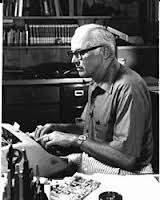
Up ahead you see a cabin with a bit of smoke curling out of the chimney. Vividly imagine this cabin. Notice the materials and the colors. Smell the smoke. 

You walk up to the door and find it slightly open. You step into the cabin and see a famous writer—or one of your personal favorites—tapping away at a keyboard. (Note: The writer can be deceased, but try not to pre-choose who it is. Let your right brain hop in and provide the answer.)

The writer looks at you, slightly annoyed at being interrupted, and you tell said writer that you have come for one piece of writing advice that you desperately need. The writer, who is somehow familiar with your work, thinks for a moment, and says, “_______.”

Here’s what happened when I did this a few days ago. The writer was John D. MacDonald. He was writing on an electric typewriter with his ever-present pipe in his mouth. 

He finished typing a sentence and looked at me.

I said, “Sorry to interrupt, but I really need a piece of advice for my writing. Would you mind?”

MacDonald took a couple of thoughtful puffs, then said, “Work harder on your sentences.”

I wanted to pull up a chair and ask him to elaborate. But he waved me off. “I have to get back to work,” he said and started typing again. 

I walked back through the meadow, pondering his advice. I remembered something he once said about his own style. He wanted it to have “a bit of unobtrusive poetry.”

The key word is unobtrusive. He didn’t want readers noticing the poetry, just feeling it as it served the story. 

I had to admit I wasn’t taking enough time lately to think about my sentences. I determined to do more light editing after I’ve written a scene to see if I can add just a touch of unobtrusive poetry. I started to think about how. I can:

  • search for more active verbs.
  • freshen an adjective.
  • come up with a metaphor.
  • put the strongest part of the sentence at the end. For example, instead of He was holding a gun when he came through the door I can arrange it this way: He came through the door holding a gun.

You can do this exercise whenever you need some inspiration. In the past I’ve received advice from Hemingway, Mark Twain, and Raymond Chandler.

Then I let them get back to work. 

Care to try it? Don’t make something up on the spot. You want your subconscious to participate. Follow the steps for at least a minute and a half. 

Who did you find in the cabin, and what did that writer tell you? What will you do with the advice?

Naps, Breaks, Vacations, and Drifting

Counter-intuitive Routes to Creativity and Productivity

 By Steve Hooley

Christmas is coming and Hanukkah has passed

One week until Christmas. Twelve days after Hanukkah. Family gatherings, parties, and travel, all will cause interruptions in our writing schedules. Are these interruptions good or bad? Do they help or hurt our creativity? Do they increase or decrease our productivity?

As I contemplated a topic for this post, I remembered hearing of references to the benefit of breaks from writing to increase creativity and productivity. I had always been somewhat skeptical, being more of a puritanical believer in “put butt in chair” and write. I thought this might be a good time to take a look at some of that research on breaks.

Before I start on the topic today, I should mention that JSB wrote on a parallel topic this past Sunday, 12/12/21 – “Ways to Write When You’re Not Writing.”

Back to today’s post:

I found an article in Scientific American that summarized some of the recent research. And an article in Writer’s Digest, (Writer’s Digest, May/June 2021, pgs. 40-44, “The Curiously Effective Way to Beat Procrastination,” Michael La Ronn), had caught my eye with a discussion of “drifting.” These two articles are the basis for today’s post.

Summary of research over last ten years

In the article from Scientific American, titled “Why Your Brain Needs More Downtime,” author, Ferris Jabr, begins with a brief intro: “Research on naps, meditation, nature walks, and the habits of exceptional artists and athletes reveals how mental breaks increase productivity, replenish attention, solidify memories, and encourage creativity.”

He describes what happens when we don’t take those breaks, and defines “cerebral congestion” as that “sense of so much coming at you at once, so much to process, that you can’t deal with it all.” He then shifts to the benefit of long periods of time (vacation) away from the cause of the stress.

Apparently, people in the U.S., Canada, Japan, and Hong Kong take the fewest days off work each year (10 days), versus European Union (20 days) or the Netherlands (26 days).

Along with the intuitive belief that such continuous busyness is not healthy, there is now much empirical evidence from studies that “the benefits of vacation, meditation, and time spent in parks, gardens, and other peaceful outdoor spaces, along with napping and unwinding while awake, can sharpen the mind.” It is argued that downtime restores the brain’s attention, motivation, productivity, and creativity.

Unfortunately, the benefits of vacation may fade within two to four weeks.

Boys in the Basement and the Default Mode Network

The really interesting research has revealed how much the brain goes on working when we are not concentrating, working, or focusing. A “mysterious and complex circuit stirs to life when people are daydreaming.” This is called the Default Mode Network (DMN).

Immordino-Yang, a research scientist at USC, in a review of research on the DMN, argues that “when we are resting, the brain is anything but idle and that, far from being purposeless or unproductive, downtime is in fact essential to mental processes…”

Other research suggests the Default Mode Network is more active in highly creative people.

Power Naps

So, if we need to turn our DMN loose to do creative things for our brain, we should take more naps. Right? Many studies have established that naps “sharpen concentration and improve the performance of both sleep-deprived and the fully rested…”

Here, the interesting data is in the length if naps. One study looked at 5, 10, 20, and 30-minute naps. The five-minute naps barely improved alertness. Ten minutes and higher increased performance, but the 20 and 30-minute naps were associated with half an hour or more of “sleep inertia” (post-nap grogginess). The study concluded that 7-10-minute naps were best.

 Restorative Breaks and Mindfulness Training

Here’s my favorite. Breaks taken in a natural outdoor setting (vs. in a setting full of city noise and chaos) led to a 3-times greater improvement in memory. I wonder how the sound of my chain saw (requiring ear protection) affects the benefit of the “natural outdoor setting.”

And, finally, “mindfulness training” (sustained focus on one’s thoughts, emotions, and sensations in the present moment) is believed to “improve mental health, hone one’s ability to concentrate, and strengthen memory.”

 The Bonus, “Drifting”

This if from the article in Writer’s Digest. When I read this article several months ago, I shook my head. I didn’t know what to think. I grabbed a pen and wrote in the margins: “What!?” “A disease becomes a cure.” “Really?” And “Procrastinate, just not too long.”

But, after reading the other article on brain research and the benefits of taking breaks, I’m trying to be more open-minded about this approach.

If you haven’t read this article, I urge you to do so. Basically, the author is arguing for an approach to writer’s block where you “give your mind permission to do whatever it wants to fuel your creativity. Simply put, you let it be curious.” (Drifting). In the author’s case, drifting took the form of three days off just to let his curiosity explore.

Near the end of the article, he lists 5 ways to “Drift Like a Pro:”

  • Read a Book About Something New
  • Consume Other Content
  • Meet New People
  • New Experiences
  • Travel

And in a final section, he writes, “Teach yourself to drift, and enjoy the journey.”

It sounds too good to be true. I don’t know if I could trust myself to drift purposefully or return from the journey. I worry that it could be addictive, or the easy way out.


Okay, time for your thoughts:

  1. What kind of “restorative” breaks have you taken or will you take over the Hanukkah – Christmas holiday?
  2. What type of naps, breaks, vacation, meditation, or drifting do you regularly practice to maintain your creativity and productivity during the rest of the year?
  3. BONUS POINTS – What do you think about “drifting?”


This is my last post before the Christmas – New Year’s break. Have a Merry Christmas and a Happy Productive/Creative New Year! See you in 2022.


How to Write When You’re Not Writing

by James Scott Bell
@jamesscottbell

The Boys in the Basement

We’re writers. We know what that means. We’re always on the job. Our minds, often apart from our intentions, keep the story wheels churning.

Like when we go to comfort a loved one in a time of need. We take their hand and issue words of consolation, while our writer mind is thinking, This would make a great scene. I wonder how I can work it into a book?

Nothing to apologize for. It’s how we roll. We write even when we’re not at the keyboard. So why not be intentional about it? Here are some of the methods I use to incentivize the Boys in the Basement:

Mind Mapping

We all know about brainstorming. That’s where we let the mind run free, without judgment, generating as many ideas as possible. The best way to get good ideas is to get lots and lots of them and only later cast aside the least promising ones.

I have found that a great aid to brainstorming is the mind map. Mapping is a way to visually link the random thoughts you jot down into some level of coherence. (A good book on this process is Writing the Natural Way by Gabriele Lusser Rico.)

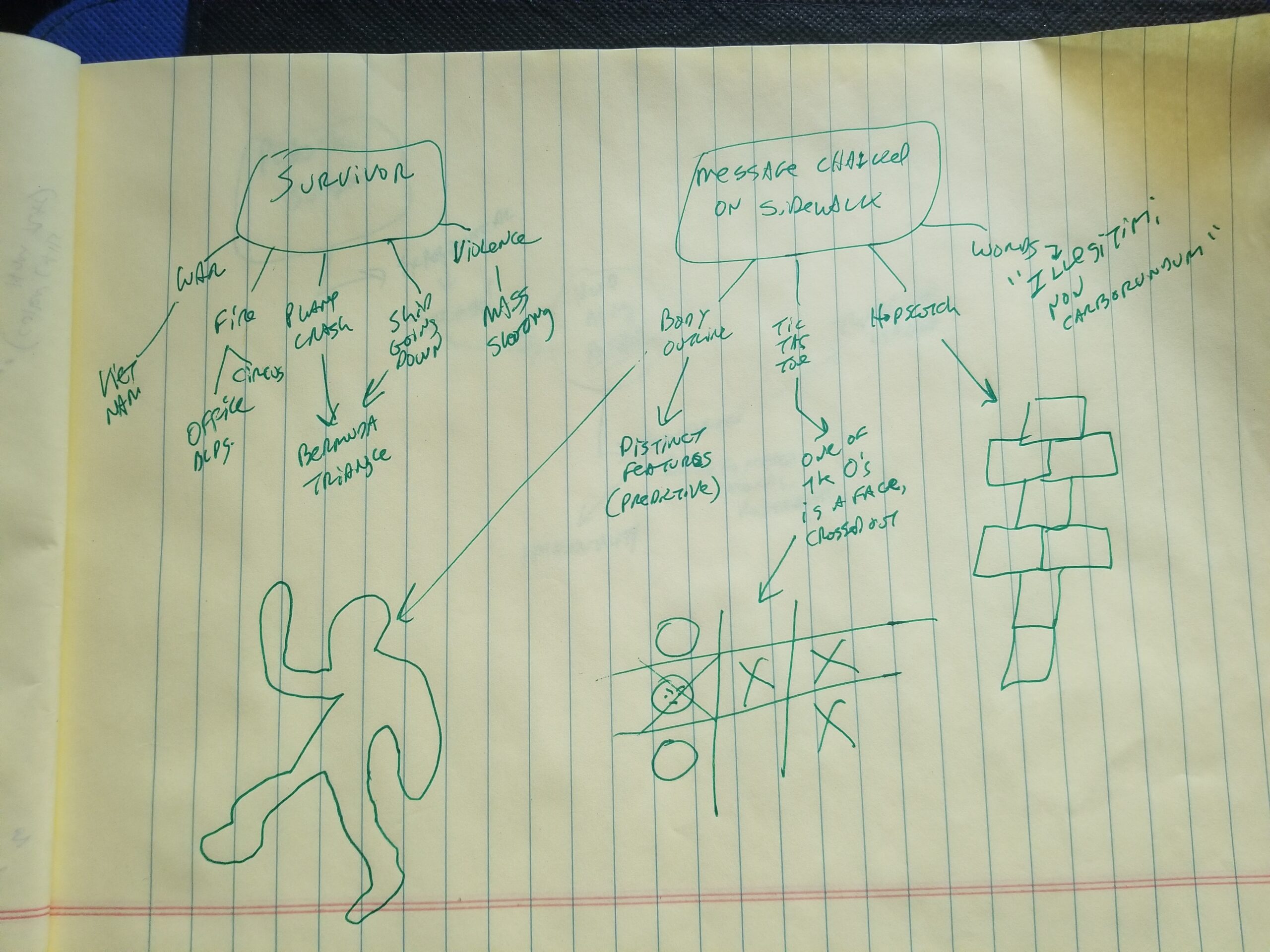
I use mind maps in two ways. First is to get ideas for flash fiction and short stories for my Patreon community. I often use a nifty set of cards called The Storymatic. Their ad line is “Six trillion stories in one little box. Which one will you tell?” It’s a set of 500 cards of two types. One type is a setting or situation, the other is a kind of character. I’ll draw one of each at random and put them together to see what comes up.

The other day I drew the cards “Survivor” and “Message in chalk on sidewalk.” I wrote those down on opposite sides of a page and circled them. Then I began the map. Here’s what it looked like (click to enlarge):

As I went along I kept coming back to the doodle of the chalk drawing. The Boys were trying to tell me something. I listened, and an idea for a short story popped up. As I pondered a little more I dropped the Survivor part altogether (you’re not wedded to anything when you mind map) and in a few minutes had the complete concept.

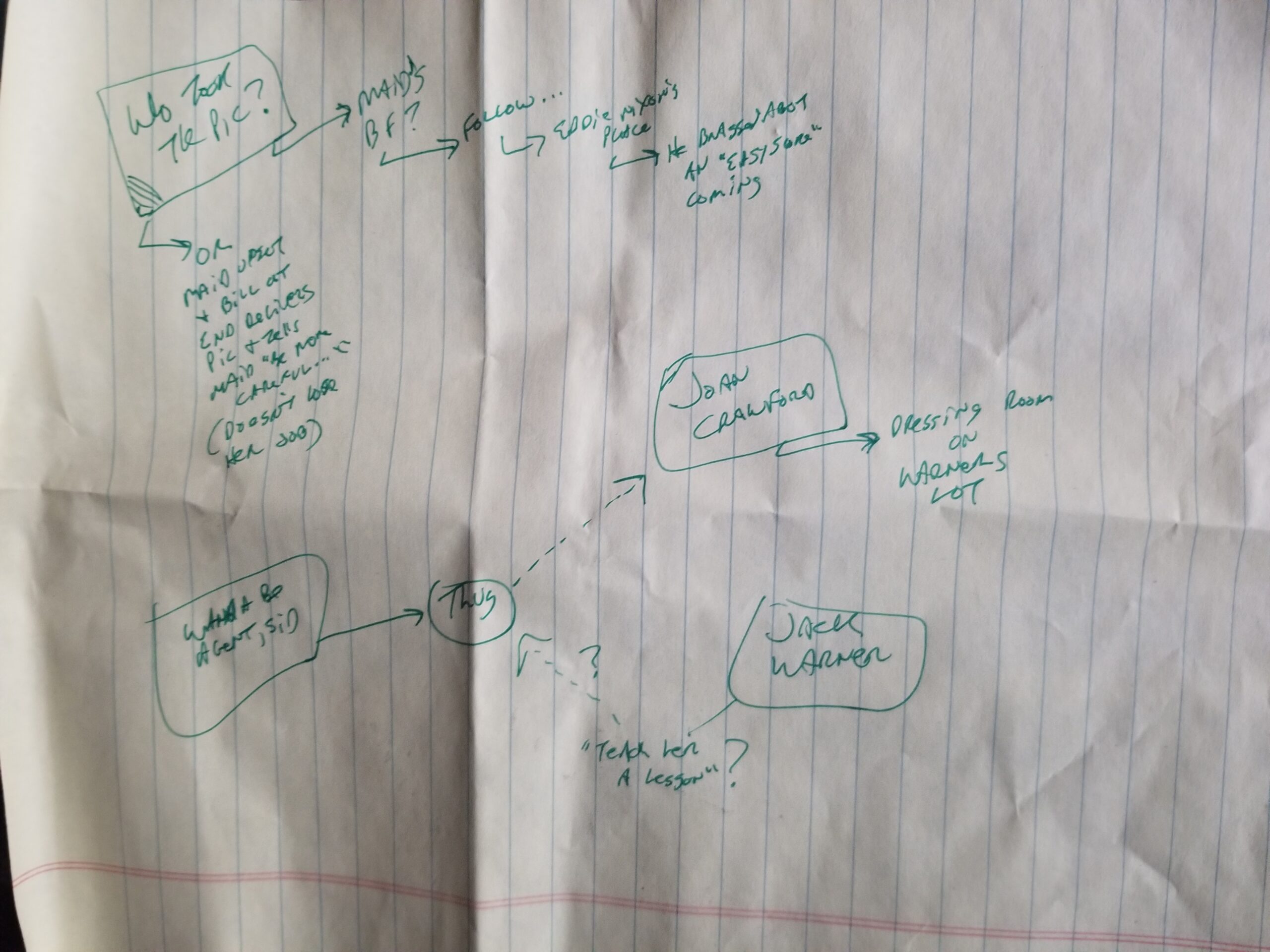
The other way I map is when I have a particular plot problem to work out. I’m finishing up a novelette in my Bill Armbrewster series about a Hollywood studio troubleshooter in the 1940s. As I closed in on the ending I realized there was a key element earlier in the story that needed clearing up. It involved the filching of a photo from a movie star’s dressing room (Bette Davis’s, to be exact.) So on paper I wrote “Who stole the pic?” and started mapping. In a few minutes I had my answer.

Sound and Music

I know some writers who want silence as they type. But for creativity there is research that suggests a little ambient noise helps. When I’m in my office I usually put on Coffitivity or New York street sound.

Often I’ll do my mind mapping while listening to music. If I’m thinking of suspense—which is most of the time—I’ll put on a playlist of suspense movie soundtracks (my favorite being the Hitchcock scores of Bernard Herrmann). I have other lists of soundtracks that stir up other emotions.

I don’t usually use music with lyrics for this, but I understand a certain Mr. King used to crank up the rock for his work. So I’ll make occasional use of the greatest rock era of all time—the 1970s (go ahead, try to prove me wrong).

Bedtime Prompt

Nice thing about the Boys is that they don’t take time off. So give them direction at night.

If you’re working on a novel, spend five concentrated minutes just before shut eye thinking about the plot, characters, or a scene.

Sometimes I’ll write a problem down on a pad on my bedside table. What is Romeo going to do about the bomb?

In the morning, as soon as possible, write down whatever is bubbling in your head, even if it doesn’t make sense at first. Somewhere in there is a message to you, though it may be in code!

Quiet Mind

I wonder if you’ve noticed a slight increase in stress levels these days.

Ahem.

We’ve all been there. We’ve all had days when we make the coffee nervous. As I pointed out in a previous post, all the mental effort that goes into navigating the mandate marshlands takes a toll on our creativity and writing energy.

Add to that the constant stream of vitriol spewing out of every communicative orifice in our civilized nation, and you’ve got a recipe for potential creative shutdown.

So what can you do? You can quiet your mind a couple of times a day. A popular practice for this is mindfulness.

Mindfulness isn’t some mystic practice that requires a robe and the lotus position. You won’t end up in a Tibetan monastery (unless you really want to). It’s just a way to practice calming down. In old movies the usual step was some guy saying, “I need a drink.” Many follow that path even now. Better is 10-15 minutes of mindfulness. Plus, instead of a hangover, you’ll get a burst of creativity afterward. Four ways I’ve done it:

Sitting: Sit in a comfortable spot, with your back straight (not leaning against the backrest). Feet flat on the floor, hands resting on your legs. Breathe easily in through your nose and out through your mouth. Listen to your breathing. Note the way your abdomen and chest move. Find an object in the room to concentrate on. Look at it, noting everything about it. Don’t analyze it, just look at it. It’ll be hard to do this at first. Your thoughts will easily distract you (“I have to remember to go to the store…Where did I leave my reading glasses?…Did The Rock really make another movie?”). When that happens, recognize you’ve had the thoughts and gently return to breathing and concentrating.

Walking: Don’t mistake this for taking a walk for exercise. Instead, you only need a small space outside. I walk around my pool. Do it slowly, nose-mouth breathing, noticing whatever is around you.

Driving: (Especially helpful in L.A. traffic.) Instead of grumbling about being late, breathe easy and focus on the taillights in front of you. Notice their design and texture. Make sure you’ve turned off talk radio and the news. Ignore bumper stickers.

Waiting in Line: Instead of grousing how long your line is—or how all the other lines seem to move faster—be grateful for the opportunity to have some quiet time. Don’t pick up a People magazine to see if Kim and Kanye are getting back together. Just breathe easily and note all the colors you see in the objects around you.

These are some of the ways I write when I’m not writing. What have you noticed about your own time away from the keyboard? When do ideas tend to pop up from the basement? Do you do anything to incentivize the Boys?

Your Guide to a Weekly Creativity Time

by James Scott Bell
@jamesscottbell

If I may riff off Brother Gilstrap’s recent post, I think there are generally two types of writers. There are “natural” storytellers. John is one of them. I think he’s shared this here on TKZ, but I remember him telling me about getting virtually the entire story for Nathan’s Run while on a long drive. How’s that for nice?

Other writers have to dig in hard ground to find, stimulate, and coax ideas. Then take the good ones to the workshop and figure out the best way to develop them into stories. That would be me. When I started out on this writing journey I dove into study of the craft. I devoured writing books and subscribed to Writer’s Digest. I read popular fiction analytically to unpack how successful writers did things. I studied movies with an eye toward learning structure.

And when it came to finding ideas worth turning into full-length fiction, I found I couldn’t sit there waiting for one to show up. I had to follow Jack London’s advice: “Don’t loaf and invite inspiration; light out after it with a club.”

Early on I read How to Write Best Selling Fiction by Dean Koontz. He has a section in there on finding story ideas. Among his suggestions:

Read widely. Newspaper stories can present the germ of an idea. Nonfiction on various subjects, too.

Write narrative hooks. Just sit at the keyboard and type hooks (first lines) until “you find one that is so intriguing that you simply must find out what happens next.” One day Koontz wrote:

“You ever killed anything?” Roy asked.

He had no idea who Roy was or what he meant. But he sat there looking at it and it came to him (“out of my subconscious mind”) that Roy should be a boy of fourteen. From there his imagination started chugging and he wrote two pages of a conversation between Roy and a boy he named Colin. When he was finished he knew the book was going to be about the duality of human nature (good and evil), that Roy was the villain, and that the book would be fast-paced and suspenseful. Indeed it was, and became an early bestseller called The Voice of the Night.

Titles. Write out titles by the bunch until one of them tickles your fancy.

Characters. Start writing about an intriguing character and pile on backstory details. When one starts to take on life, ask:

  • What does the character fear more than anything else in the world?
  • What would be the very worst thing that could happen to him?
  • What event would throw his life into complete turmoil?

So I scheduled a weekly creativity time. A half hour to an hour sitting in a local coffee joint doing these exercises, just letting the ideas flow. After a few weeks I noticed that my creativity muscle was growing stronger. Indeed, it began working “on its own.” I’d be driving down the street and see a billboard and suddenly I’d be asking What if? What if that happy couple clinking champagne glasses is about to be blown up by a bomb?

I kept all my ideas in a file. When one of them cried out for further attention I put into “development.”

My first step in the development process is what I call a “white hot document.” This idea comes from Dwight Swain’s classic Techniques of the Selling Writer. You start a document that is an exercise in “focused free association.” You just start writing what comes to mind, go off on tangents, explore rabbit trails. Ideas for scenes, themes, characters, plot developments—write them all down without any intrusion from your inner editor.

You put this aside and come back the next day to edit and annotate. You take what’s most emotional and exciting for you and develop it further with more free association. Do this for several days and you’ll have a solid foundation for a plot. Swain wrote: “The important thing, always, is not to sit idly waiting for the feathers to grow. Don’t just hope for ideas. Hunt them down! Find a springboard! Develop a plan of action!”

So unless you are a natural storyteller, make it a point to exercise your imagination on a regular basis. Play games. Go wild. You’ll find good ideas soon enough and your creativity synapses will grow stronger.

Then all you have to do is write the novel. And the one after that. And the one…

What kind of storyteller are you—natural or a digger in hard ground? Where do your ideas come from? Do you wait for them to show up or do you light out after them with a club?

The Alchemy and the Craft

by James Scott Bell
@jamesscottbell

The Alchemist at Work, Pieter Bruegel, 1558

Alchemy was the medieval “science” of transmuting base metals into gold and silver, though its origins can be traced back to the Alexandrian Greeks of the early Christian era. The practice was based on the idea that all substances are composed of one primitive matter—the prima materia. By removing imperfect qualities from a base metal and adding other ingredients, the alchemists hoped to transform the material from rough to precious.

Legend has it that the source of this “knowledge” goes back to the Egyptian god Thoth, whom the ancient Greeks associated with Hermes. That’s why medieval alchemists called their work the “hermetic art.” They would put the “seal of Hermes” on their vessels, which is where we get our phrase “hermetically sealed.”

Of course it never worked, but that didn’t stop fraudulent alchemists from making a pretty ducat from unsuspecting patrons. One ruse involved a forged spike made of half gold and half iron. The alchemist would paint the gold half so it appeared to be iron. Then, in front of his patrons, he would dip the gold half in his brew (paint remover) and take it out, revealing gold! If the patron insisted on having the spike tested by a refiner, it would indeed be proven that there was actual iron and actual gold. How long the alchemist could get away with this before skipping town is a matter of conjecture.

But get this: alchemy lives on! For writers! (Though in a different form.) Let me explain by way of an email I recently received (quoted with permission):

I’m one of your fans. Purchased many of your books. Reading “How to write short stories and use them to further your writing career.” Thank you for writing this.

So, I read and agree that every short story worth reading and worth writing has a “shattering moment.” I know that you can place it in the beginning, middle or the end. I understand that it is a life changing event that happens to the character/s.

What I do not know is how to find out what that event is. I have stories that are more anecdotes because I can not find that shattering moment. Or I have a shattering moment, but do not know how to build a story around it.

Do you have any suggestions on how I can learn more in order to deal with the above problems in my writing?

What this email alludes to is the difference between craft and what I’m calling alchemy. Craft is the nuts and bolts of what works to make fiction better. These are tools and techniques that can be learned and applied. It’s what we spend most of our time here at TKZ talking about.

But then there is the “certain something” that each individual writer brings to the keyboard. Some might call this talent, which cannot be taught. True enough, but what I suggest is that we consider talent our base metal. By removing impurities and adding ingredients, we can actually transform it into fiction gold.

  1. Removing impurities

The main impurity is your “inner editor.” That is the judgmental voice that assesses every creative move the moment you try to make it. It loves to reject things. It tells you what not to write. It makes snap decisions at the surface level.

The problem is that there is gold underneath the surface. You’ll never find it if you give the IE sway as you write. (The IE is only welcome in the editing phase.)

The way you turn off that voice is by writing through it. One exercise is the page-long sentence. You write 250 words without stopping and without using a period. If even for a second you start to feel nervous or fearful or embarrassed by what you’re writing, you write the next word and keep going. You only assess things after you’ve written, not before.

Doing this exercise frequently will weaken the inner editor until finally it shuts the heck up whenever you’re creating. (I might cleverly add that IE silence is golden.)

  1. Adding elements

Now, what can we add? The short answer is: you. Your talent, your knowledge, your memories, your feelings…but not at the surface level. We must dig deeper, coaxing the hidden material to the surface.

The way I like to do it is to make brainstorming lists. As is true for most of us, the first thing that usually comes to mind is something familiar, even clichéd. That truck driver you need for the scene, is he wearing jeans, boots and a baseball cap? Go deeper! Make a list of other modes of dress. And a list of ethnicities. And does he even have to be a he? Aha, a whole new direction for brainstorming!

My rule of thumb is a minimum of five items on a list. Why? Because it’s when you get down to 4 and 5 that surprising, original material is sent up from the boys in the basement. Going on to 6 and 7 is a further adventure.

And remember, your inner editor has no business in your brainstorming.

So, to bring this back to the specific question from my emailer about short story writing: If you can’t identify a shattering moment from an anecdote, try this: write a page-long sentence in the voice of a character. Listen to her describe her emotions about the anecdote. Let her tell you how it is shattering. If she doesn’t know, ask her what she’s trying to hide. Keep after her! She’ll eventually confess.

Try the same thing with another character. Even another. You’ll eventually find the right narrator and thus the right story.

If you have a shattering moment but don’t know how to build a story around it, start making lists.

  • What sort of character would be most affected by this moment?
  • Where might this moment take place?
  • What kind of people are in that place?
  • Why are they there?

(Remember, make your lists at least five items long.)

We often hear about the “art and craft” of something. That’s what this post has been about. Craft is necessary to shape a story into the best form. Art is the alchemy, the thing that cannot be taught. But it can be coaxed!

So start coaxing.

Over to you. How do you describe the talent part of our craft? How do you like to coax your creativity?

Hobbies, Activities, and Creative Pursuits

How do you recharge your battery?

The TKZ textbook on creativity

For today’s post, I wanted to explore activities that writers use to ramp up creativity, refill the well of creativity, or “recharge our batteries.” I wanted to look specifically at the use of creative pursuits, hobbies, or interests, outside of writing, to accomplish that goal.

I had my rough draft done before I searched for previous posts on creativity done here at TKZ. I was amazed at how much had already been written.

If you click on the two links below, you will find a treasure trove of articles on creativity, a TKZ textbook on the subject.

https://killzoneblog.com/category/creativity

https://killzoneblog.com/tag/creativity

And here are the chapters:

  1. The Creative Energy of Crowds, JSB
  2. Evolution of a Book Title and Cover, Debbie Burke
  3. Don’t be Afraid to Go There in Your Writing, JSB
  4. The Importance of Creativity Time (mental calisthenics), JSB
  5. Use NaNoWriMo to Repo Your Mojo, JSB
  6. Less Focus for Better Writing (positive constructive daydreaming), JSB
  7. Chasing a New Idea, JSB
  8. Permission to Make a Mess, Laura Benedict
  9. It Came From…, Joe Hartlaub
  10. When Your Brainstorming Hits a Drought, JSB
  11. Inspiring Quotes from Inspiring Crime Thriller Writers, Garry Rodgers
  12. The World Needs Creatives More Than Ever, Sue Coletta
  13. When a Writing Break Turns into a New Novel, J.T. Ellison
  14. Are Only Humans Creative? 6 Ways Creativity Improves Health, Sue Coletta
  15. Writers and Dreaming, Sue Coletta
  16. Can Creativity Pass Through Generations via DNA, Sue Coletta
  17. Our Brain and Creativity, Sue Coletta
  18. Write that Caption! New Yorker Cartoon Contest, Kathryn Lilley
  19. The Power of the Shadow Story, JSB

I enjoyed reviewing the posts. I learned a lot. I considered changing my post to another topic, but I think we can sneak in a discussion on the topic under the guise of “activities, hobbies, and creative pursuits outside the realm of writing that increase our creativity for writing.”

Writing fiction is inherently an intense and consuming activity that requires a never-ending flow of creativity. It is the rare writer who can work for long periods of time without stopping to rekindle the fire, or refill the well from which that creativity flows.

In the posts listed above, there are many ways listed to improve creativity. A few of them include creative activities outside of writing. I know from reading responses to previous posts that many of you have such outside interests. We want to hear about them.

It is my opinion, that having and pursuing other creative interests is healthy, can give our brains a chance to shift gears, and can even inspire ideas for our writing.


So, Dear Writer, what do you think?


  • Do you believe that other creative activities can benefit your writing?
  • Do you need creative pursuits beyond writing to recharge your battery?
  • What hobbies, activities, or creative pursuits do you use and enjoy?
  • In what way does this hobby or activity improve your writing?
  • How passionate (crazy) are you about this hobby? Give us a little taste of your passion.

The Creative Energy of Crowds

by James Scott Bell
@jamesscottbell

I miss crowds.

I miss a packed Dodger Stadium in the bottom of the ninth, the fans on their feet, stomping and screaming and willing a hit.

Or the Hollywood Bowl on a summer evening, be it jazz or Beethoven, as long as I’m there with my wife, a bottle of wine, and lots of people.

How about a Broadway theater? Nothing like being front row, center, for a hit like Chicago with the legendary Gwen Verdon (as I was one night long ago.)

Heck, give me Langer’s Deli at lunchtime as I munch their famous #19 pastrami on rye, with the chatter of random conversation all around me.

I miss the bustle of the streets in downtown L.A. and midtown Manhattan. Now those places look like something out of I Am Legend.

Will crowds ever come back? Will people ever rub shoulders again without masks or hypochondria?

Will big cities recover their beating hearts?

There’s a split of opinion on this. In a post that went viral, investor James Altucher says the New York he loved is dead, and will not rise from the grave:

Now [NYC] is completely dead. “But NYC always, always bounces back.” No. Not this time. “But NYC is the center of the financial universe. Opportunities will flourish here again.” Not this time.

“NYC has experienced worse”. No it hasn’t.

A Facebook group formed a few weeks ago that was for people who were planning a move and wanted others to talk to and ask advice from. Within two or three days it had about 10,000 members.

Every day I see more and more posts, “I’ve been in NYC forever but I guess this time I have to say goodbye.” Every single day I see those posts. I’ve been screenshotting them for my scrapbook.

This sentiment rubbed one Jerry Seinfeld the wrong way:

There’s some other stupid thing in the article about “bandwidth” and how New York is over because everybody will “remote everything.” Guess what: Everyone hates to do this. Everyone. Hates.

You know why? There’s no energy.

Energy, attitude and personality cannot be “remoted” through even the best fiber optic lines. That’s the whole reason many of us moved to New York in the first place.

You ever wonder why Silicon Valley even exists? I have always wondered, why do these people all live and work in that location? They have all this insane technology; why don’t they all just spread out wherever they want to be and connect with their devices? Because it doesn’t work, that’s why.

Real, live, inspiring human energy exists when we coagulate together in crazy places like New York City. Feeling sorry for yourself because you can’t go to the theater for a while is not the essential element of character that made New York the brilliant diamond of activity it will one day be again.

I get the part about energy. As a writer who spends quite enough time alone at the keyboard, I love the electric current of crowds. Sometimes I want people around me—people I don’t even know, people who are just there at the coffee house, the park, the restaurant, the beach. There’s scientific proof (“The science!”) that such activity is an aid to creativity.

Yeah, I can fake it a bit with Coffitivity. But that’s no substitute for the vibe of a crowded ITW bar (especially when Gilstrap is present). I want to be able to sit in NY’s Bryant Park at twilight, and people watch. I want to nosh chop suey in L.A.’s Central Market at noon as the life of the city churns around me.

It would be nice to someday see faces again, too.

Alas, even when large halls and stadiums finally open up, they’re sure to be tightly regulated. (The power to tightly regulate is a drug not easily kicked.) In anticipation of this, I’ve composed a new song to sing at Dodger Stadium during the seventh inning stretch:

Take me out to the ball game,
Take me out with the few.
Buy me some peanuts and Handi Wipes,
Keep me away from the talkative types
As I root, root, root in my face mask.
To sneeze or cough is a shame.
So stay six, eight, ten feet away
As I watch the game!

Do you miss crowds? Think they’ll ever come back?