What’s Up?

What’s Up?

by Terry Odell

What's Up

Image by Andrew Martin from Pixabay

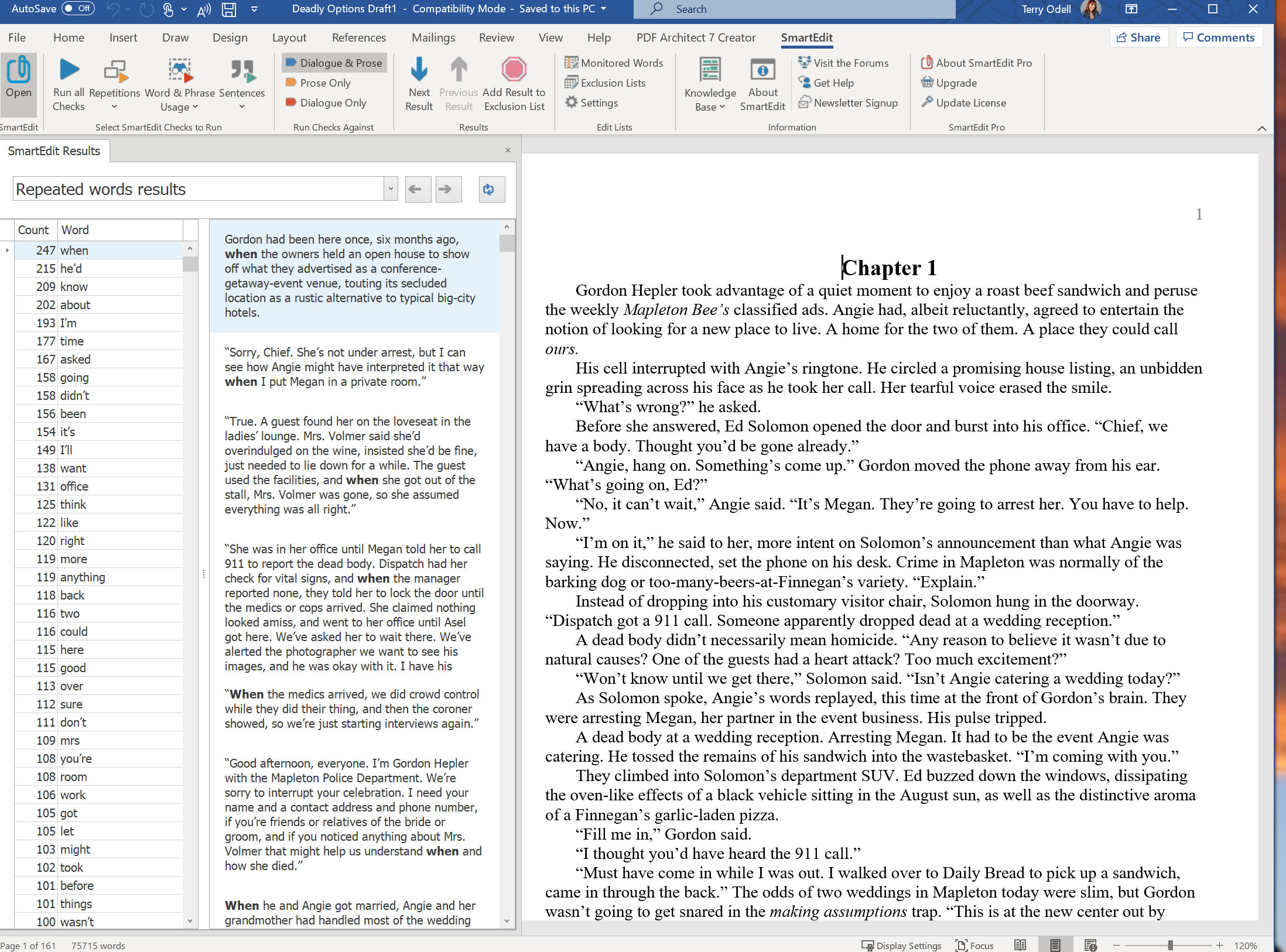
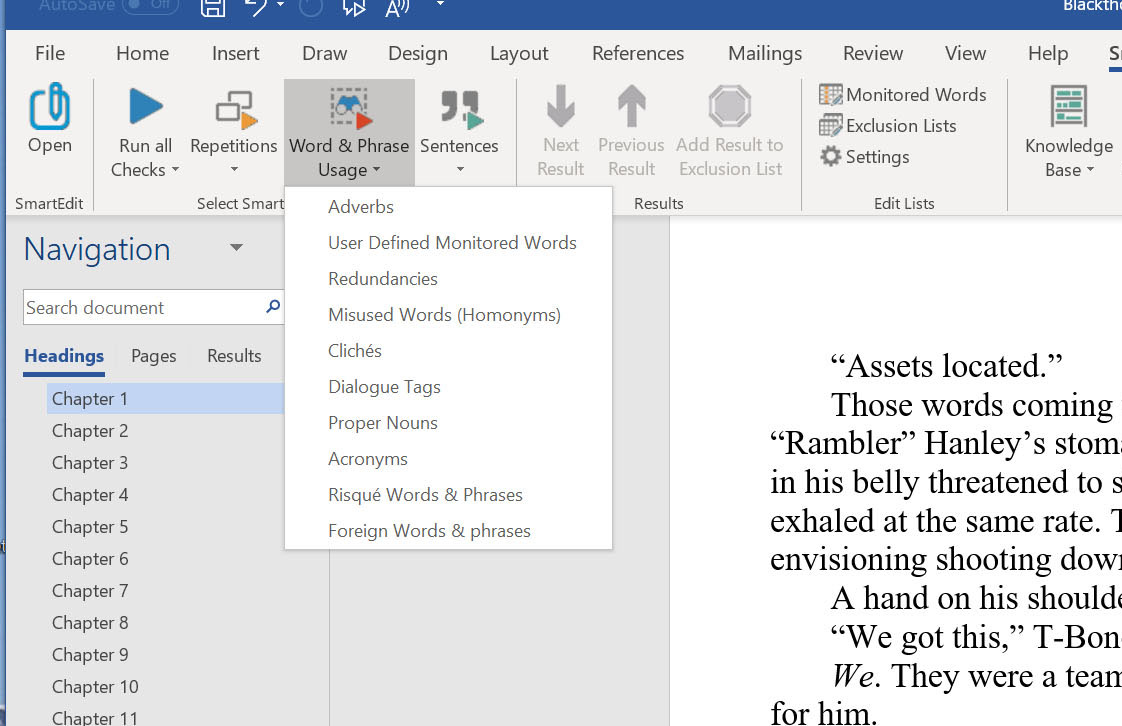
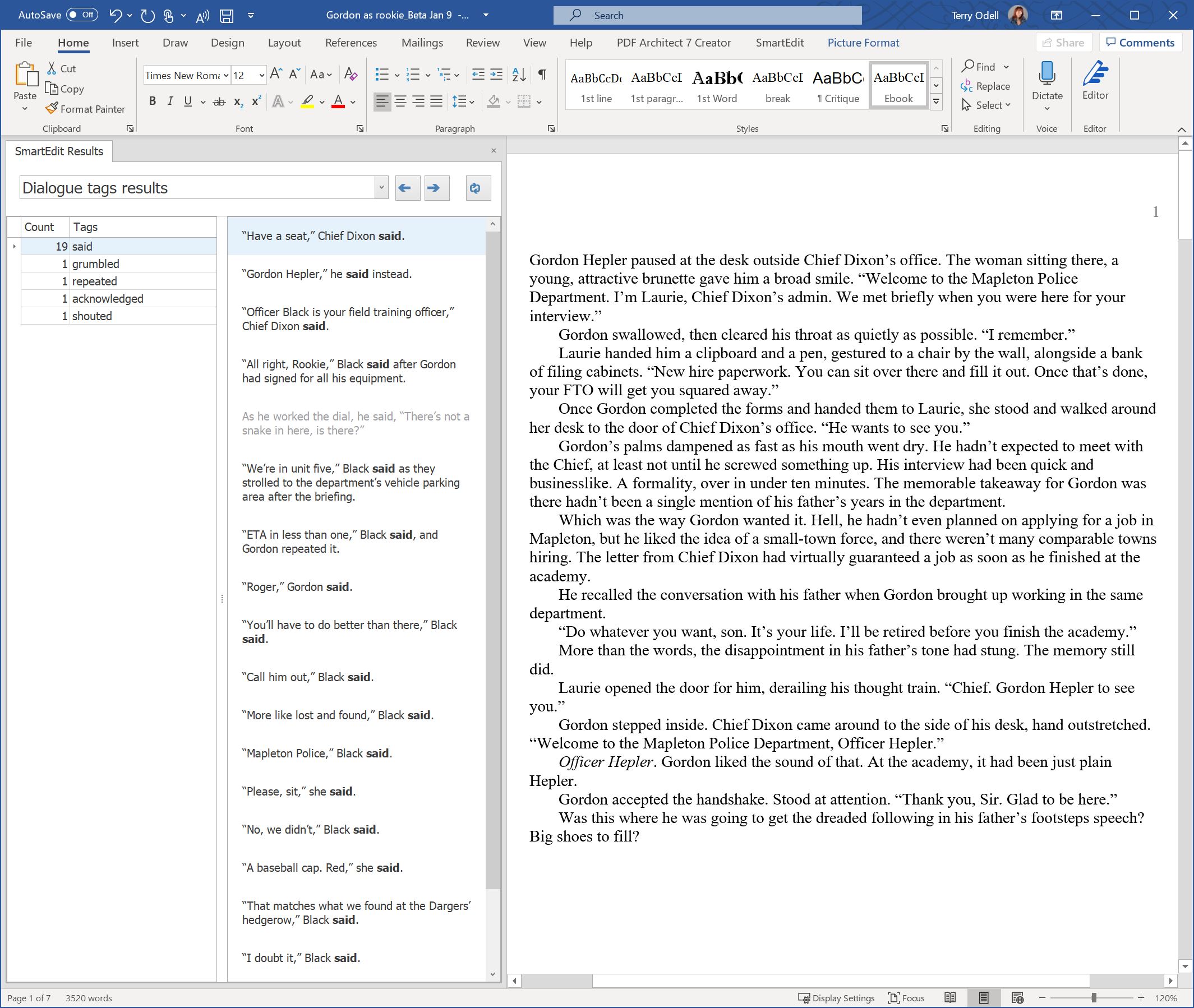
I’ve been going through my manuscript, getting it ready to send to my editor. I’ve run checks on overused words and phrases using a program called SmartEdit—which, as always, finds a new one every time. This time it was “about.” But there’s another word I check for.

My high school Latin teacher used to share his opinions on unnecessary words and redundancies. Saying “From its earliest beginnings to it final completion” pushed his buttons. He complained that the word “up” was overused, and often unnecessary. Why say ‘face up to a situation’? To which class clown Leon replied, “So what’s the guy robbing a bank supposed to do? Walk up to the teller and say “This is a stick?”

Leon’s wit notwithstanding, up is a word I run checks on, because it seems to slip off the fingertips without conscious thought—over 300 times in this manuscript—and often can be dispensed with.  Here’s an essay we used to use when we were training tutors for the Adult Literacy League in Orlando. I thought I’d share it today.

What’s Up With Up?

“We’ve got a two-letter word we use constantly that may have more meanings than any other. The word is up.

“It is easy to understand up, meaning toward the sky or toward the top of a list. But when we waken, why do we wake up? At a meeting, why does a topic come up? And why are participants said to speak up? Why are officers up for election? And why is it up to the secretary to write up a report?

“The little word is really not needed, but we use it anyway. We brighten up a room, light up a cigar, polish up the silver, lock up the house and fix up the old car.

“At other times, it has special meanings. People stir up trouble, line up for tickets, work up an appetite, think up excuses and get tied up in traffic.

“To be dressed is one thing, but to be dressed up is special. It may be confusing, but a drain must be opened up because it is stopped up.

“We open up a store in the morning, and close it up in the evening. We seem to be all mixed up about up.

“In order to be up on the proper use of up, look up the word in the dictionary. In one desk-sized dictionary, up takes up half a column; and the listed definitions add up to about 40.

“If you are up to it, you might try building up a list of the many ways in which up is used. It may take up a lot of your time, but if you don’t give up, you may wind up with a thousand.”

Frank S. Endicott

Do you have any crutch words that appear on the page all too frequently?

Reader Friday: Characters

Reader Friday: Characters

CharactersJD Robb has just published her 50th “In Death” book. The cast of characters has grown over time, but her two main characters, Eve and Roarke, have anchored every book. Other authors write multiple series featuring different characters, often those who have played secondary roles in previous books.

If you’re writing a series, do you get tired of the characters, or are they old friends? For recurring characters, how do you keep them fresh?

Transitions

Transisitions
by Terry Odell

On last Friday’s question, one person commented on transitions being hardest for her to write, so I thought I’d address my approach to the subject here.

TransitionsWhen we moved to Colorado, we did a lot of remodeling. We have a small tile area in front of the fireplace. We installed ¾ inch hardwood for the rest of the floor. One of the challenges the contractors faced was making sure the transition between tile and wood was smooth, because the new hardwood was thicker than the pre-existing laminate flooring.

In your manuscript, you have to decide how you’re going to get from one time or place to the next. You don’t want people tripping when they move from tile to wood. That’s why paying attention to transitions is important.

There are ‘big’ transitions: Switching POV characters, chapter breaks, and scene breaks. There are the ‘little ones: Making sure every sentence, every paragraph follows logically from the one preceding it. As you can see, it’s a broad topic, but I’ll try to hit some of the high points.

When I started writing, I felt obligated to be with my characters 24/7. It was a major writing breakthrough to be able to write, “By Friday” when the previous scene was on a Wednesday. Skip two days? Gasp! Things had to be happening. And they were, but they weren’t anything that moved the story. There are other ways to show passage of time. Some authors like to date/time stamp scenes and chapters. There are scene breaks. Or, just some extra white space.

Formatting note: if you’re indie publishing, some of the conversion software (for ebooks) assumes extra returns are mistakes, and removes them. Print is another matter. For ebooks, I take the cautious approach and use a marker. If it’s a break within a scene, and my normal scene breaks are ~~~, then I’ll use a single ~ to show I’m with the same POV character, same scene, but time or place has changed.

For new chapters and scenes, I want to make sure I’m grounding the reader in the who, where, and when. For my romantic suspense books, each chapter usually has 2 main scenes, one from each character’s POV. That requires a bit of leapfrog mentality from the reader.

The last sentence of a scene often won’t lead into the first of the next. There has to be a way to remind the reader of: first, whose scene this will be, and second, where the previous scene ended. And, if time has passed, there has to be a way to indicate that as well. When you shift scenes or chapters, look at your opening paragraph. Is it description? Yes, you want to show the reader they’re somewhere else, but it can be more important to show the reader who they’re with first. Keep them involved with the character; don’t slow the read to describe the sunrise.

An example: Protag Graham has a POV scene in Chapter One. We’ve learned he’s a patrol cop with a goal of a transfer into a detective position. He’s in competition with another cop, Clarke. That scene ends with the following, which was clearly in Graham’s POV. He’s been thinking of the woman he just met in his investigation.

Laughter erupted from the room. The sound of his name, coupled with Clarke’s guffaws, eradicated Colleen’s image like wind-blown storm clouds. Dammit. It had been five years. He was a damn good cop, and he was going to beat Clarke into CID no matter how many times the arrogant bastard tried to dredge up his past.

He appears again in Chapter Two, but not as a POV character. His next turn center stage is in Chapter Four. Here’s the opening:

Graham finished filing his reports, surprised to see it was four-thirty. Instead of going home, he drove to Central Ops. Roger Schaeffer in CID might let him poke around a little. The lieutenant seemed to be one of the few who thought Graham had a shot at the CID spot. His recommendation could make the difference.

For this scene, I opened by using Graham’s name (who), and also a time reference (when). The where, Central Ops is mentioned. Also, by showing something only Graham can be aware of (his surprise at the time), we’ve established it’s his POV scene. If there was any doubt, the rest of the paragraph is internal monologue, thoughts only Graham would know.

Another good reason for clear transitions between chapters and scenes is because those tend to be the logical stopping places for readers. If they’re not picking up the book until the next night—or later, but we hate to think they could possibly wait that long to continue reading—it helps if they don’t feel that they have to back up to get a running start.

You also have to consider the ‘mini-transitions.’

Whether you’re writing narrative or dialogue, there has to be a clear and steady flow from one sentence to the next, from one paragraph to the next. Just as you need transitions between scenes, you need transitions between individual paragraphs. And sentences. Consider dialogue. Normally, in conversation, if someone asks a question, we’ll answer it. Whatever the person who asked the question happens to be doing or thinking is going on simultaneously with our hearing the question and giving our response.

But in writing, if you stick all those internal thoughts and gestures in, it’s likely your reader will have forgotten the question. Look out for tacking on sentences after a character has asked a question. That’s not the best place to include it.

How do you handle transitions? Tips or problems you’re looking for help with? I’m sure there are a lot of folks here willing to chime in.


Terry Odell is an award-winning author of Mystery and Romantic Suspense, although she prefers to think of them all as “Mysteries with Relationships.” Follow her on Facebook and Twitter.

Ask Yourself Why

Ask Yourself Why

Terry Odell

Ask yourself why

Image by Anand Kumar from Pixabay

Everyone, I’m sure, has heard of using the “What if?” question to start a story, and to help move things along throughout. But for me, there’s an even more helpful question for me while I’m writing. WHY?

Disclaimer. I’m not a Plotter. Not a true Pantser. More of a Planster.

In one of his workshops, James Scott Bell has an exercise designed to help you understand your characters. There, he sets up a scene of a gorgeous room with a huge picture window overlooking a pastoral view and your character picks up a chair and throws it, breaking the window. He asks Why he or she would do that.

While that can be helpful when it comes to characterization, my question relates to the story. Even though we write fiction, it has to come across as reality. One technique I use to make sure things seem “real” is to ask myself Why a character would do or say something.

If the answer is “Because I need it for tension/conflict/humor/plot advancement,” it’s probably wrong. When I was writing Danger in Deer Ridge, the first major ‘error’ I spotted in my opening draft was having the hero appear while the heroine was looking in her car’s trunk for her tool kit.

  • Why didn’t she hear him drive up?
  • Why did he park the truck there?
  • Why did he come down without a toolkit of his own?

All these Why questions require answers. Answering them drives the story forward for me. My thought processes might not end up on the page, (and this is most prevalent in the early chapters, while things are taking shape) but the results do.

So, where it ended up: She didn’t hear him drive up because he parked at the top of the drive. Why?

He parked the car there because his son is asleep in the truck. It’s a quiet rural area, one he knows well, and he’s not concerned that someone will come by and Do a Bad Thing.

That’s still weak, so I added a dog who would take the head off of anyone who tried anything. (Note to self: don’t forget you’ve now saddled yourself with yet another ‘character’ to keep track of.)

More Why questions.

Why not go all the way down the drive? It’s steep, curves, and riddled with potholes, and he doesn’t want to wake the kid.

Weak. What if he’s not an experienced father? Why not? Because his wife left him, took the kid and remarried, and he hasn’t seen the kid since he was an infant.

Why does he have the kid now? Because the ex-wife and the boy’s stepfather were killed in a Tragic Accident? Works for now. (Note to self: revisit this before Grinch has to tell anyone about it.) Also, having him a new and inexperienced father allows for more conflict between hero and the Very Caring Mother who is our heroine.

More notes: Why doesn’t the hero work for Blackthorne, Inc. when the book opens, since the other books in the series open with a scene of a Blackthorne op. Why does he live conveniently near the heroine’s new digs?

By the time I’d written the scene, answers to my Why questions gave me more insight into my characters. I realized that the hero’s friendly demeanor and magnetic grin weren’t consistent with a man who’s worried about leaving a young child asleep in his truck. I ended up tweaking that scene, which added to the tension, because the heroine sees someone who’s in a rush, who keeps looking over his shoulder. She extrapolates from her own secret-keeping life, and it seems logical for her to worry that this guy might be out to get her.

If you don’t want your story to seem contrived, try asking yourself “Why?”

What other questions help you move forward in your writing?


Terry Odell is an award-winning author of Mystery and Romantic Suspense, although she prefers to think of them all as “Mysteries with Relationships.” Follow her on Facebook and Twitter.

Banished Words 2020

Banished Words 2020

Terry Odell

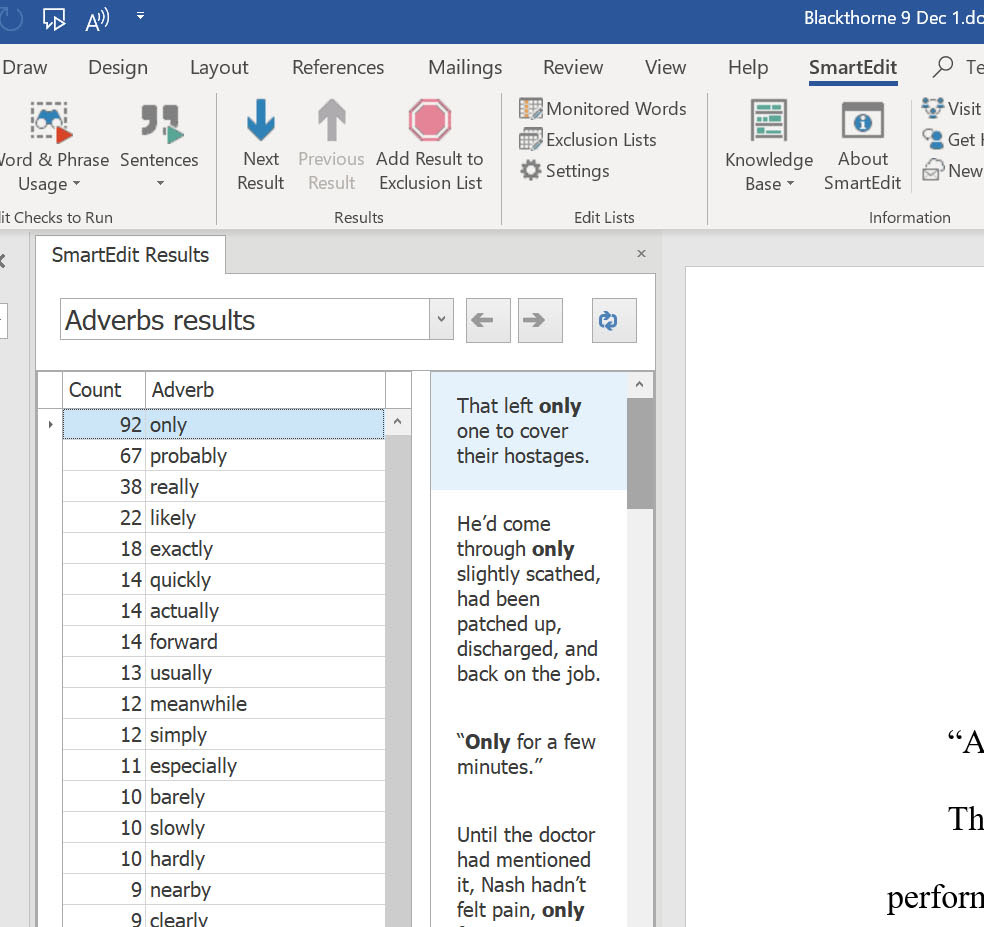
Banished WordsOne of my final editing tasks is removing overused words. I have my list of offenders, and I run the manuscript through SmartEdit, which will find more I was unaware of.

But “overused” can’t be decided based solely on number of uses. It depends on the word.

We all have words and phrases we like to use, often to the point of overuse. Maybe we’re not even aware we’re using them. When we’re writ­ing, they seem to sneak into our man­u­scripts via our fin­gers, as if the brain isn’t involved at all.

Lit­tle words, like “just” and “really” and “well” are com­monly listed among words that don’t add any­thing to the man­u­script other than giv­ing our brains time to catch up with what we’re try­ing to write. They’re the equiv­a­lent of the “um” in speak­ing.

Big “fancy” words, or “unusual” words are in another cat­e­gory. Miasma? Efful­gent? Par­si­mony? They’re going to jump out at a reader, and should be used spar­ingly, per­haps only once or twice in an entire man­u­script. I recall an author using halcyon repeatedly, and it made me stop after the second time.

Recently, one of my critique partners asked about my use of libation, bringing up an important point. How many characters used the term? Often, it’s good to have specific vocabulary words used by specific characters.

While I’m looking at my repeated words, I will check for con­text. Is it dia­logue? Does it enhance the char­ac­ter­i­za­tion? Then, I look to see how long it’s been since the last time I used the word. (There’s that “you’re on page XXX” thing at the bot­tom of Word.)

If it’s a com­mon word, my goal is at least 10 pages between uses. “Medium” words, maybe 30–50 pages. And those big fancy ones? If they’re truly the char­ac­ter speak­ing, and not autho­r­ial intru­sion, once is enough. Not a rule, just something I consider.

And, of course, the caveat that any “fancy” words are appro­pri­ate to the char­ac­ter, the genre, and the time­frame of the book. If you’re read­ing a Regency romance, the lan­guage is going to be totally dif­fer­ent from a contemporary.

There are other words one might want to avoid. Every year, Lake Superior State University publishes its “Banished Words List” of words based on misuse, overuse, and general uselessness. Their list for 2020 contains the following.

Most nominated

  • quid pro quo

Words that attempt to make something more than it is

  • Artisanal
  • Curated
  • Influencer

Words banished for pretentiousness or imprecision

  • Literally
  • I mean
  • Living my best life
  • Mouthfeel

Those darn millennials!

  • Chirp
  • Jelly (Abbreviation of jealous)
  • Totes (Abbreviation of totally)
  • Vibe/vibe check

To see why these were selected, go here.

What about you? Any words that jump out at you when you’re reading, either mundane or unusual?


Terry Odell is an award-winning author of Mystery and Romantic Suspense, although she prefers to think of them all as “Mysteries with Relationships.” Follow her on Facebook and Twitter.

Focusing on the Writing

Focusing on the Writing
by Terry Odell

Focus on the Writing

Image by Pexels from Pixabay

I was supposed to be on a photo tour in Croatia today, but that’s been put on hold, so let’s talk about dealing with writing routines in times of distraction.

I’ve talked to a lot of people about how they’re having trouble focusing on their writing. Distractions abound, and the writing gets set aside. Guilt sets in.

It’s okay to be distracted, to flounder about. Writing less is acceptable. For me, I find the following techniques helpful. I’ve used them when coming back from vacations, when it takes a while to find my writing groove, and they work as well for me in these crazy times.

Get rid of chores that will nag.
If you are going to worry about cleaning house, paying bills, going through email, take the time to get the critical things dealt with. Otherwise you’re not going to be focused on your writing. If you’re a ‘write first’ person, don’t open anything other than your word processing program.

Do critiques for my crit group.
This might seem counterproductive, but freeing your brain from your own plot issues and looking at someone else’s writing can help get your brain into thinking about the craft itself.

Work on other ‘writing’ chores.
For me, it can be blog posts, or forum participation. Just take it easy on social media time.

Deal with critique group feedback.
Normally, I’m many chapters ahead of my subs to my crit group. If I start with their feedback on earlier chapters, I get back into the story, but more critically than if I simply read the chapters. And they might point out plot holes that need to be dealt with. Fixing these issues helps bring me up to speed on where I’ve been. It also gets me back into the heads of my characters.

Read the last chapter/scene you wrote.
Do basic edits, looking for overused words, typos, continuity errors. This is another way to start thinking “writerly” and it’s giving you that running start for picking up where you left off.

Consult any plot notes.
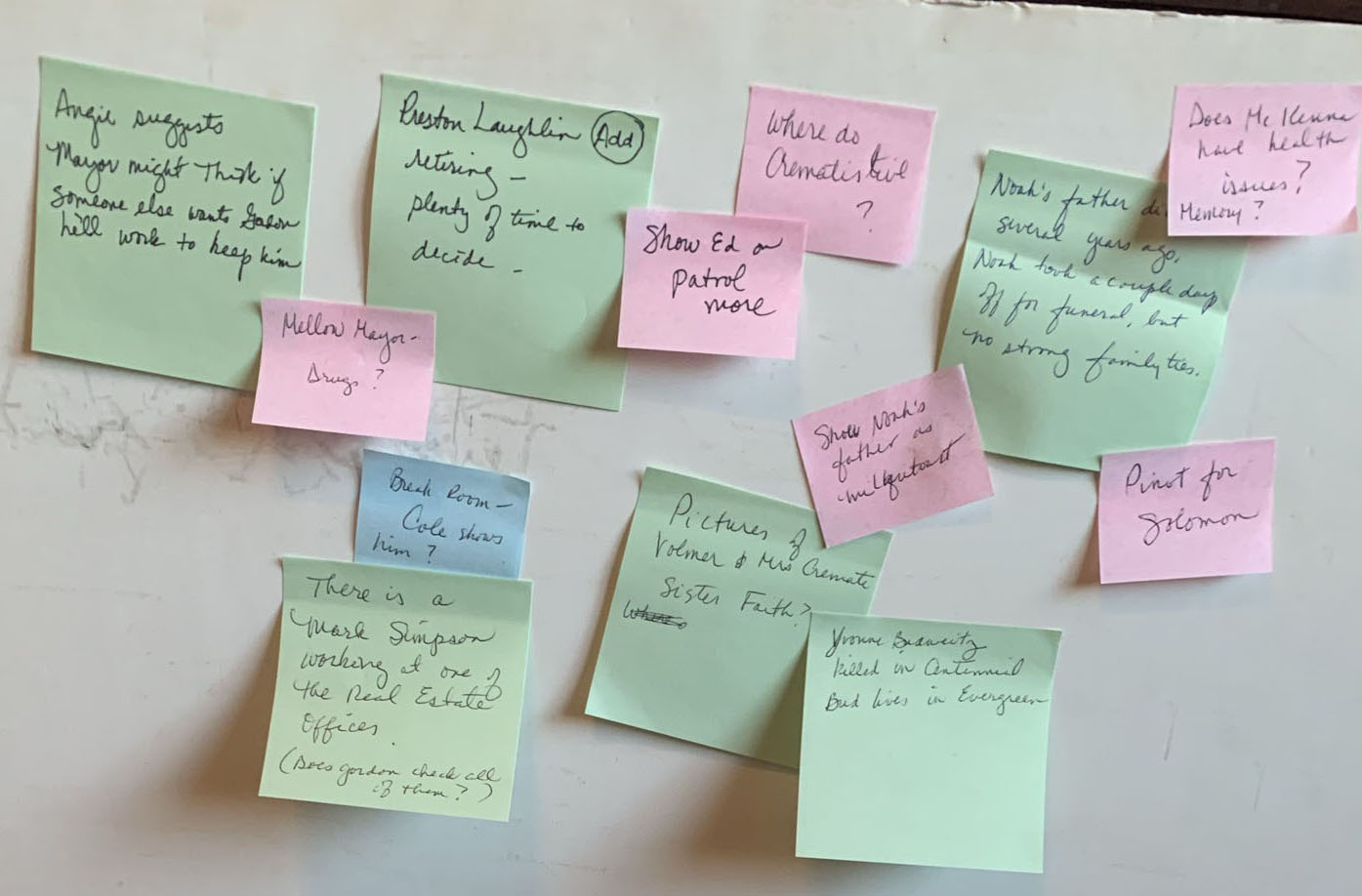
For me, it’s my idea board, since I don’t outline. I jot things down on sticky notes and slap them onto a foam core board. Filling in details in earlier chapters also helps immerse you in the book.

Figure out the plot points for the next scene.
Once you know what has to happen, based on the previous step, you have a starting point.

Write.
And don’t worry if things don’t flow immediately. Get something on the page. Fix it later.

What about you? Any tips and tricks you’ve found when outside world distractions keep you from focusing?

And one more thing. On Friday, May 1st, you have a chance to Ask Me Anything. I’ll be on a Draft2Digital Spotlight podcast talking with Mark Leslie Lefevbre. It’ll be broadcast on YouTube and Facebook. You can bookmark the links and you might be able to set up a reminder.
Time: 10 Pacific, 11 Mountain, 12 Central, Noon Eastern. It’ll be my first video appearance. Yikes!  The program is 45 minutes long, with the last 15 minutes for Q&A. I hope to meet you there.


Terry Odell is an award-winning author of Mystery and Romantic Suspense, although she prefers to think of them all as “Mysteries with Relationships.” Follow her on Facebook and Twitter.

The Ears Have It

The Ears Have It
By Terry Odell

Deer EarAs authors, we want to provide the best possible experience for our readers. That means providing a well-edited book, and the more reliable eyes on the manuscript, the better. But I’ve learned you need ears on the manuscript as well.

Skipping the ‘read it out loud’ editing pass means you’re going to miss things. Heck, even when you do read it out loud, you still miss things, because you’re too familiar with what you’ve written. Your eye sees what’s supposed to be on the page. That’s what you’ll read; that’s what you’ll hear.

Since I can’t afford a narrator to read the book aloud twice, and I don’t know anyone who’d be crazy enough spend the time to read the book to me, I investigated having my computer do the job. I’d tried it a long time ago, and the robotic voice was impossible to listen to. However, there have been improvements in the system, so I decided to give things another shot. Here’s what I discovered.

Disclaimer. I use Microsoft Word.

Word has two ways to have the computer read your manuscript to you, and since they’re part of Word, you don’t need to install (or pay for) another program. One is the Speak Selected Text option which I blogged about here.

The other option is Read Aloud, and here’s a peek at how it works. Note: “Read Aloud” offers a choice of narrators, which is nice to break things up. I chose the female voice for this section.

You can find more here.

Depending on your version of Word, you may be able to use one or both.

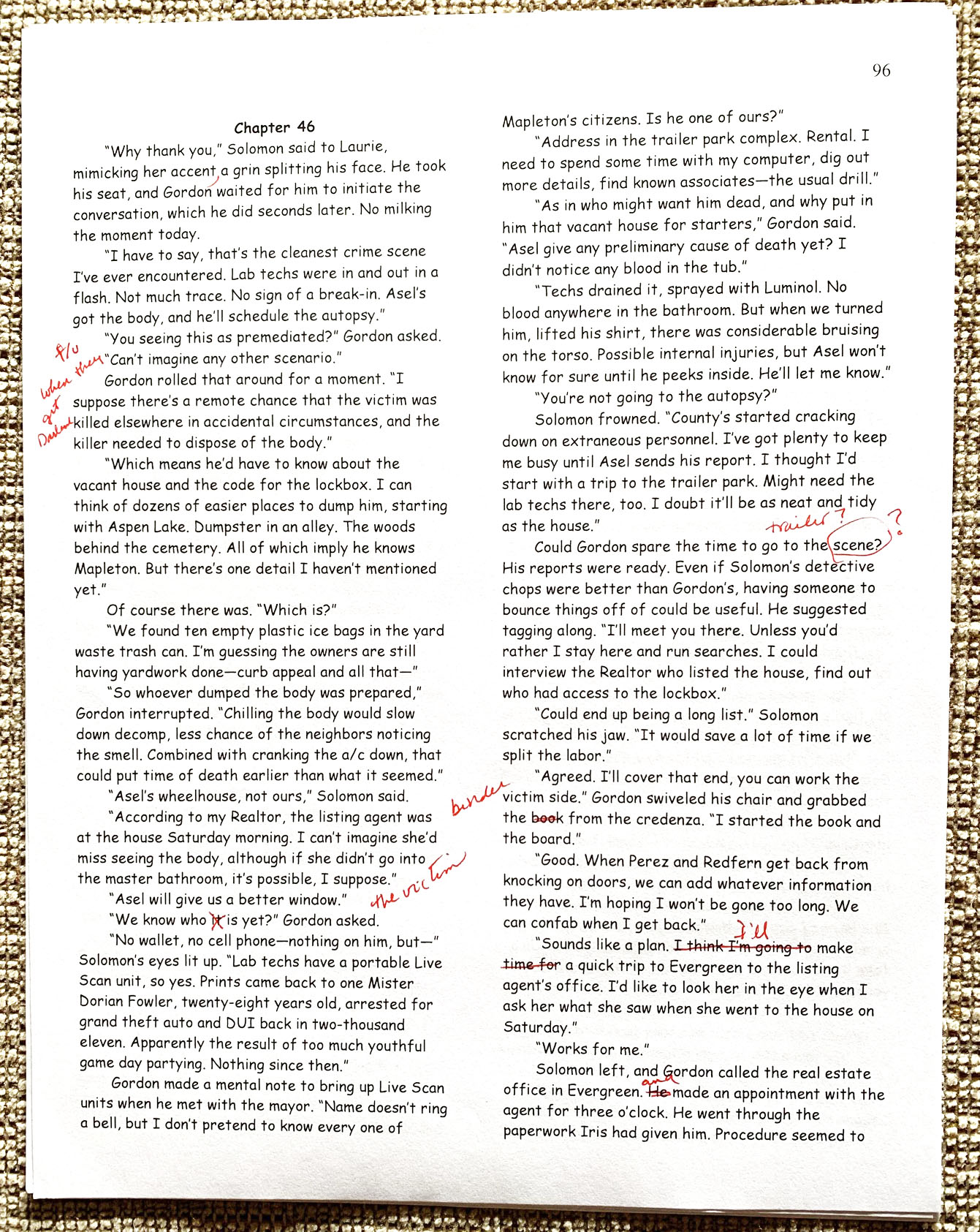
Whereas my audiobook narrators are performers, the Word guy who’s reading my text to me (I call him Fred) simply recites the words on the page. Unlike the audiobook narrators who sometimes leave out words, or substitute others, “Fred” is going to read exactly what’s on the page. For example, I’d read this paragraph countless times, as had my editor and crit partners.

She drove the up the dirt lane. A beam of sunlight shone through a break in the gray winter sky, reflecting off a sprawling white two-story house, as if to say, This is your light in the darkness.

No one saw the typo on any of their passes. Did you notice it? On the first read? Or were you paying close attention because I told you there was a typo? When “Fred” read it, the extra “the” jumped right out.

Listening forces you to go slowly. Depending on which option you use, you might be able to speed the read a bit, but you can’t ‘skim-listen.’ While “Fred” reads, I have the manuscript open. I look for wrong punctuation, improper spacing, and the like. If I catch repeated words that evaded my eyes but not my ears, I’ll fix those as well.

If Fred doesn’t know a word, he’ll spell it. Usually, these are acronyms, but sometimes it’s a word he’s not programmed for. Other time, his programming doesn’t work exactly right. In one instance, he read, “The paramedic inserted an four.” Can you figure out what I’d written? Answer at the end of the post.

There will be pronunciation errors. “Fred” doesn’t read in context. He doesn’t emphasize words in italics. He speeds up for dashes and hyphens. Our language is filled with heteronyms—words that are spelled the same but have different meanings. The computer doesn’t read context, so you’ll get the occasional jolt for words like live, read, wind, dove, close, bow, complex, and presents, but that’s good, because it makes you pay attention.

Other “fun” jolts come from Fred’s programming regarding abbreviations, as in “Joe came into the room and sat.” Fred read this as “Joe came into the room and Saturday.” Or, when the character said, “Wait a sec,” Fred read “Wait a section.”

No matter which method you choose, hearing a computer read exactly what you’ve written is a critical—and ear-opening—step in the editing process. By the time “Fred” and I are through the manuscript, I’m hoping to have a better product for my readers.

Is it worth it? I’d say yes, especially when you get a review like this one: “After reading so many books with poor editing, I was very happy to finally read a book without the distracting errors and I was able to enjoy the story.”

As for what I’d written: “The paramedic inserted an IV.”


Terry Odell is an award-winning author of Mystery and Romantic Suspense, although she prefers to think of them all as “Mysteries with Relationships.” Follow her on Facebook and Twitter.

April Fools’ Day Literary Hoaxes

Happy April Fools’ Day.

April FoolWhen my brother was about 3 or 4, he loved April Fools’ Day. I think he regarded it as a chance to tell little lies, like “You have dirt on your face,” or “Your shoes are untied,” and then shouting “April Fool.”

Some people go to great lengths to fool the public, like the great spaghetti harvest or the Sydney iceberg.

But when did this tradition of pranks originate?

Some historians speculate that April Fools’ Day dates back to 1582, when France switched from the Julian calendar to the Gregorian calendar. People who were slow to get the news or failed to recognize that the start of the new year had moved to January 1 and continued to celebrate it during the last week of March through April 1 became the butt of jokes and hoaxes.

There’s also speculation that April Fools’ Day was tied to the vernal equinox, or first day of spring in the Northern Hemisphere, when Mother Nature fooled people with changing, unpredictable weather, something we Coloradans know all too well.

Since this is a writing blog, I hit the Google Machine for some literary “pranks.”

Here are a few.

Naked Came the Stranger, by Penelope Ashe
The Hoax: America goes nuts for a salacious novel of sex and drugs.
The Truth: A group of journalists purposefully wrote a terrible book to prove American culture is vulgar, which everyone kind of assumed anyway.

A Million Little Pieces, by James Frey
The Hoax: Wrote a harrowing memoir about his struggle with addiction.
The Truth: It was more novel than memoir; he got caught; made an enemy of Oprah.

Coffee, Tea or Me?, by Donald Bain
The Hoax: Memoir reveals the wild and crazy lives of airline stewardesses (which is what we used to call female flight attendants).
The Truth: A ghostwriter is hired to pen memoir of wild and crazy stewardesses, discovers they’re actually kind of boring, makes up a bunch of stuff, and makes millions.

The Painted Bird, by Jerzy N. Kosinski
The Hoax: Polish American author writes a harrowing memoir of his experiences during World War II…
The Truth: …but it’s a cobbled-together skein of plagiarism and lies.

Go Ask Alice, by Anonymous
The Hoax: The diary of a troubled, drug-addicted teen is published in order to scare kids straight.
The Truth: Well, yes, except the diary was a forgery, penned by a therapist.

Atlanta Nights, by Travis Tea
The Hoax: “Travis Tea” submits a salacious novel to a seedy publisher.
The Truth: “Travis Tea” is actually a group of sci-fi and fantasy authors seeking to expose an unscrupulous publisher.

Any April Fools’ Day memories to share? Best pranks? Given the “outside” world, a few laughs are welcome.

Image by Annalise Batista from Pixabay


Terry Odell is an award-winning author of Mystery and Romantic Suspense, although she prefers to think of them all as “Mysteries with Relationships.” Follow her on Facebook and Twitter.