My first page critique is a YA fantasy submission titled THE DRAGON’S PEARL. (Love the title!) My thoughts will be on the flipside. Enjoy!
Once upon a time, there was a girl named Misha who was neither kind nor beautiful, but very smart, and according to her mother, intelligence was all that mattered. For once, Misha had to agree because at this very moment, her immediate survival depended on her being very, very smart.
The gun dug against the small of her back. “Move faster,” the man holding the gun said. He wore a creepy-looking white mask—all three of her kidnappers did—and he had a real-looking black gun. He was smaller than the big man and stouter than the skinny one, with hairless arms smoother than her own. But since he held the one flashlight, Misha decided he must be the leader.
“Faster,” he said again.
She scooted down the tunnel, first in line. In case she sprung a trap, presumably. Designating a fourteen-year-old girl as a meatshield to catch all the arrows, it was the kind of thing she would consider.
“We’re almost there.” The kidnapper pushed past her, giddy like a sugar-overdosed child, darting his flashlight from wall to ceiling. “I can feel it.”
Where is there? Misha slowed her pace. She lifted both hands—handcuffed—to scratch her freckled nose. She had no idea where they were, what their purpose was. After removing her blindfold, they’d marched her down this abandoned subway tunnel for the past hour, twisting, turning, pausing, then picking a path less traveled.
The steel tracks were hard to see and easy to trip over. Her aunt had already tripped twice, with the big man there to catch her every time.
Her aunt Saria was the unfortunate tagalong to this kidnapping. She hummed tunelessly to herself, but Misha knew this was her aunt’s way of coping. Saria was afraid of everything, from plastic bags on the street that looked like dead cats to melodramatic fistfights on the movie screen. Violence terrified her.
“I’m sorry,” Misha said quietly. “If you hadn’t come to my tournament, you wouldn’t even be here.”
Saria sighed. “I wouldn’t have had to close my pawnshop for the day and lose all that profit.”
“Yes, that too.”
Saria barely winced when she smiled, her wrists raw from the nervous twisting of the plastic zip-ties. “There’s nowhere else I want to be, but by your side.”
My thoughts:
The “once upon a time” opener sounds cliché, but when it’s coupled with the twist of lulling the reader into the story as if it were a fable, only to spring into a kidnapping, the story keeps my interest. But the softer beginning diminishes the threat of the kidnappers. I’m not sure of the author’s intent. I don’t feel like Misha is in danger, especially once the aunt and the dialogue begin.
In the second paragraph, I got a little bogged down with the vague descriptions of the three men. There are not many lines there, but I don’t feel that it is important to detail the heights and weights of nameless men—especially since they are behind her. It’s like she has eyes behind her head and can see everything (while she is blindfolded, we later learn). When describing adversaries like these, it might be best to lump them together as threatening masked men and have their distinctive voices be the way she tells them apart, if that even matters so early in the story. If she’s blindfolded, she can only sense their presence by sound or smell. I would imagine that the smaller guy will play a definitive part in the story after he’s unmasked, but at this point, I don’t know that for sure. Only the author will know how important any of them will be.
I would like to see a dark world building setting play a part in this set up. That’s what makes fantasy great. This reads like an internal chapter scene and not the start of a book, perhaps because it doesn’t feel like Misha is in danger and the dialogue with the aunt. If she is to be the meat shield, I would like to feel that she appreciates the danger she is in and setting might help. She needs to be more wary and worried about what will happen to her and her aunt.
When Misha scratches her “freckled nose,” that took me out of the story. In her POV, she wouldn’t think of her nose as freckled. It would simply be her nose. That action trivializes the danger too. It’s a way for the author to get a character description in, but it also has the impact of diluting any threat.
Half way through the opener, we find out she has been blindfolded. That was not reflected in the first paragraphs. This reads as out of order to me. With her being bound and blindfolded, that would make it very awkward to walk, especially with her scooting down a tunnel. If she is blindfolded, the reader needs to see and feel this early on. She wouldn’t be leading the pack either. How would she know where to go?
I also didn’t know her aunt was even with her until well into the opener. Misha seems more worried for herself and not for her aunt, who would be in danger too. Plus their conversation does not translate the threat. It’s a bit chatty. And if violence terrified Saria, her humming a tune doesn’t seem appropriate, even if it’s a nervous tune. Plus when she’s more concerned about her profits for the day, that also diminishes the scary aspects of the scene.
The last couple of lines bounce into Saria’s POV. Misha can see her aunt wince and smile (if she is not blindfolded), but she can’t know how raw her wrists are, which tells me this is Saria’s POV. A head hopping thing.
The last thing I want to mention is the use of adverbs. Anything with an LY on the end is usually redundant and unnecessary if the rest of the action in the scene are well described. For example, “Misha said quietly” could be changed to “Misha whispered,” which would suggest she’s afraid of being overheard, but since the dialogue is a bit chatty, there is nothing she should be afraid of. If I were being kidnapped and had my aunt with me, I would be asking questions or trying to figure out where they were or how to get away.
When I first read through this, I thought it was okay. (I didn’t expect to be so picky.) I might keep reading to see where it goes, but unless you grip an editor or agent from this opener with something fresh, they will be looking for a reason to not turn the page. Focus on the danger more, make it eerie, and give a better glimpse into Misha’s personality and why she was chosen. Add elements of a mystery. That might make this opener better.
What do you think, TKZers?

Author Archives: Joe Moore
What novelists can learn from song writers
Last Friday, a giant in country music passed away. George Jones was not only considered by many to be the greatest country singer of all time, but also one of the most self-destructive. His string of hits was fueled by a private life of booze that was nothing short of
devastating. Once when his wife hid the car keys so he couldn’t go buy alcohol, he hopped on a riding lawn mower and rode it into town to the liquor store. He later parodied the story in a music video.
But despite the long chain of events that few mortals could survive, George Jones climbed to the top of the mountain and made a place for himself that will forever be the gold standard in country music.
His life was a soap opera that was mirrored in the songs he sang. His struggles with the demons of alcoholism are reflected in some of his album titles: “The Battle”, “Bartender’s Blues”, and the defiant “I Am What I Am”. But out of this self-inflicted carnage of a tragic life, one song emerged as arguably the greatest country song ever written: “He Stopped Loving Her Today”.
The song is performed with the singer telling the story of his "friend" who has never given up on his love. He keeps old letters and photos, and hangs on to hope that she would "come back again." The song reaches its peak with the chorus, telling us that he indeed stopped loving her – when he finally died.
It’s poignant, sad, and paints a heart-wrenching portrait of absolute love and devotion, as well as never-ending hope. Not only does it drill to the core of emotion, but it delivers the story with the few words.
So what does this have to do with writing books? Everything.
It’s called the economy of words—telling the most story with the least amount of text. It is an art form that songwriters must master, and novelists must study. There is no better example of the economy of words than in a song like ‘He Stopped Loving Her Today’. Not one word is wasted. No filler. No fluff. Remove or change a word from the song and the mental picture starts to deflate. The story is told in the most simplistic manner and the result is a masterpiece. Every word is chosen for its optimal emotional impact. Nothing is there that shouldn’t be. It is a grand study in how to write anything.
I’m not suggesting that your 100K-word novel be written with the intensity of George Jones’ song. In fact, if it were, it would probably be too overwhelming to comprehend. But my point is that no matter who you are—New York Times bestseller or wannabe author, your book contains too many unnecessary words. If you can say it in 5 instead of 10, do it. Get rid of the filler and fluff. Respect the economy of words. Less is more.
For those that love George Jones, enjoy this video. For those that have not heard “He Stopped Loving Her Today”, click the link, listen and learn.
He Stopped Loving Her Today by George Jones
What Is Your Spark?
Where does it come from?
I’m talking about that original impulse, that first bud of creativity that eventually grows into a book. Can you remember? What was it that tickled your brain and set the synapses glowing? What the very first moment when you knew you were onto something?
I’m not talking about inspiration or muses or the “need” to write. I’m trying to focus way way down to that little thing that got you going on whatever it is you are now working so hard to bring to life. What was the spark?
Normally I don’t think much about stuff from the ether like this. Especially since we here at The Kill Zone tend to focus on practical stuff like building credible characters and sturdy plot structures. But sometimes it’s fun — and maybe even a little instructive — to turn the microscope to its finest setting and examine the beginnings of life.
Every writer starts a novel from a different impulse. Some start with a situation, many by asking “what if?” Many writers are character-led. Often you can trace it back to something as small as an overheard conversation. Or an old man standing a corner glimpsed as you pass by in your car. It can be a line from a half-forgotten poem or the smell of dime store lipstick.
Sometimes that first impulse is too weak to sustain a novel. Sometimes that clot of embryonic cells never quite grows into a character. But sometimes, when you dip a bucket into the subconscious you draw up something special.
I got to thinking about this today because I was trolling the internet boning up on the history of the detective novel. I am going to be on a panel at the Edgar Symposium tomorrow that focuses on the future of the detective novel. And because I didn’t want my fellow panelists to wipe the floor with me I was, I admit, doing a little brushing up on my genre history.
That’s why I happened upon a lecture P.D. James gave in 1997 called Murder and Mystery: The Craft of the Detective Story. (Click here to read it). I’m a huge James fan; she and Georges Simenon were my guiding lights when I was trying to learn how to write detective novels. Jules Maigret and Adam Dalgliesh…those are the guys I’d want on the case when there’s a body on the slab.
So you can imagine how cool it was to read this paper of hers. It’s a great survey of the detective genre. But what I found really fascinating was the part where she talked about how she got her ideas. For James, it always starts with the setting.
I was gobsmacked when I read that. Because that’s what always gets me going. I can’t see a story until I can see the setting. Our books move between Michigan and Florida. Our settings have been, variously, an isolated island in the gulf, an abandoned insane asylum, an old family farm, a cattle pen overgrown with weeds, and an Everglades swamp way down south where the bottom of the state spreads out into the straits like a tattered flag.
Sometimes I almost feel like one of those weird psychics who claim they can see the place of death. When we are starting a new book, I can’t always tell you exactly where we are. But I can sort of feel it. And eventually the place materializes on the page, sort of like an old Polaroid.
Like right now, we working on a new Louis book that takes him back to Michigan. That’s all we knew when we started, that he had to go home. But where? Kelly insisted it had to be the Upper Peninsula (she went to college up there) and we eventually decided to take Louis as far north as we could — way up to the Keweenaw Peninsula, that strange spit of land that extends out into Lake Superior like a crooked finger pointing the way toward the Canadian wilderness. End of earth sort of idea.
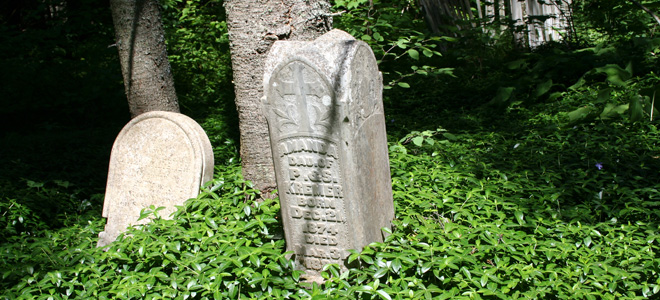
But still, things weren’t gelling. There was a spark but it wasn’t catching. Then I saw a photograph someone had taken of a small abandoned cemetery. Its crumbling headstones are obscured by dense carpets of clover. It’s in the middle of nowhere. But it once the middle of somewhere — a lively town where the copper miners lived and worked in the 1800s.
P.D. James said that once she found her setting all she then had to do was begin talking to its inhabitants. Thus came her characters. So it has happened with us. We’re only ten chapters into this new book so we’re still meeting the natives, still learning their histories, still trying to develop an ear for their odd Yooper accents. (it’s somewhere between the nasal tones of Detroit and the lilt of Canada with some Finnish thrown in).
In a bit of synchronicity, I am the editor of the Edgar annual this year and months ago we decided on our theme — the sense of place in the crime novel. The essays are great — Lawrence Block on New York City, Peter Lovesey on Bath England, William Kent Kreuger on northern Minnesota, Cara Black on Paris — each writer talking about how place colors their stories.
Even as I read them it didn’t really occur to me how important setting was to me as a writer. But it is the thing from which everything else comes. If I don’t know where I am I can’t begin to tell you where my story is going. I need to know my place. It is my first spark.
What is yours?
p.s. Forgive me if I don’t respond right away but I am en route to NYC today. Will catch up when I get into Newark Airport. There’s wifi on the bus!
Rituals and Superstititions
I remember hearing a talk given by a historical writer who went into great detail about how she got herself prepared to write each day. Her rituals included mood lightning, music, incense, and a few historically appropriate artifacts to get her into the mood, and I remember thinking “what?! I don’t have the luxury of time for all of that, I just have to sit down and write!”. But in many ways that’s not strictly speaking true. I was thinking about it this morning and realized that, like many writers, I do have my own set of rituals and superstitions that form part of the creative process that leads to sitting down, facing the empty page, and writing.
First of all, I have to mentally prepare myself – that means from the moment I get up the words are already forming. In the shower I’m formulating sentences and by the time I’m in the car on the way back from school I feel the ghosts of my characters coming to take their seats. I’m mentally rehearsing for when I finally sit down and write…and when I do I have a separate notebook for each new novel. I have a scrapbook too – in which I jot down historical notes and cut and paste maps or photographs. When I write in long hand, which I sometimes do rather than type, it has to always be done in a rolling-ball or fountain pen as I hate ballpoint pens (I used to only write in ink using a fountain pen until my dog Hamish chewed it to bits…) I always write at home, never in cafes, and always in total silence.
Okay, so I admit it’s a pretty lame ritual. I’m not up at the crack of dawn like some writers who get their best work done at 4am, and if I had my choice I wouldn’t be up at 2am either (although I often end up writing this late out of necessity). I don’t write in a shed like Roald Dahl or use ballpoint pen on A4 paper with only two punch holes (not four) like Philip Pullman. I don’t have an antique hour glass like Dan Brown that I use to mark the time (nor do I do a session of push ups or sit ups either!). I also usually write fully clothed (unlike John Cheever who apparently wrote in his underwear). So I guess I fall on the rather dull end of the writing ritual scale.
But how about you? Do you have any specific writing rituals? Are you superstitious (or OCD…) and insist on anything specific when you write?
Should You Quit Your Day Job to Write?
Left Behind
Reader Friday: What kind of writer are you?
First-page critiques at TKZ
We’re delighted to announce the launch of first-page critiques as a regular feature here at TKZ! You can send us the first page of your manuscript, and we’ll critique it.
Here’s how it works: Send us the first page (400 words max) of your manuscript in an email or as a Word attachment, along with the title, to the email address killzoneblog at gmail dot com. We’ll take the first 30 submissions we receive, then announce when we’re accepting submissions again. The pages will be divvied up among the Zoners for review. We’ll post the pages on recurrent Thursdays, along with a critique. Readers will be able to comment as well. Note: Critiques are done anonymously–writers‘ names will not be posted, and reviewers will not know who authored their assigned pages.
In years past we’ve had great fun doing this exercise! We’re looking forward to reading some of your pages!
Multiple Book Releases
What happens when you have more than one book to promote at the same time? Do you annoy readers with announcements about the new releases, blog tours, and contests? Which book do you choose to emphasize in your online blasts?
In this digital age, we can publish as fast as we can write. But at what point are we diluting our own sales? And how will our digital releases affect our print books with their higher price point?
I’ve reached this quandary in April through no planning of my own. Wild Rose Press gave me April 26 as the official release date for Warrior Rogue, #2 in my paranormal Drift Lords series. But then they decided to enter it into the Kindle Select program, meaning the ebook came out in December and my five free days were in February. I did a big push over Valentine’s Day weekend with announcements and contests.
I’d planned another promotional campaign for April 26 to celebrate the print release and the book’s availability for Nook and other formats. I set my newsletter to go out on that date, a Rafflecopter contest to start then, and a blog tour shortly thereafter. (If you want to sign up for my newsletter, visit http://nancyjcohen.com and fill in the form on the left sidebar).
But the best laid plans go awry. Two things happened to impact my campaign. Warrior Rogue showed up in print about two weeks early. And Shear Murder, Bad Hair Day Mystery #10, came out in ebook for $3.19!
I’d been panting with anticipation for the digital release of Shear Murder, but Five Star wouldn’t give me a specific date. This title had only been available as an expensive hardcover for over a year. And finally it shows up in the same month as my promoted new release. What to do?
Since I’d already set up my contest and newsletter and blog tour for Warrior Rogue, I’m going ahead with those plans for April 26. That date seems like a moot point now, since the title is already available in various formats. The irony is that Warrior Rogue, initially $2.99, price jumped to $5.99. So now that ebook costs more than Shear Murder at $3.19.
I don’t want to bombard my fans with notices and confuse them with my two different genres, but I really want to get word out about Shear Murder. It’s easier to keep new releases apart when they aren’t the same month!
And hereafter, I won’t treat release dates as absolute. There’s no point in planning a big hoopla around a certain date when the book shows up weeks earlier. Is this a result of the digital age?
Those of you who are hybrid authors, both traditionally and indie published, can at least space out your own uploads so as not to compete with your publisher’s plans. But if you’re writing two or more books per year for different publishers, how do you alternate your online promotions? And as a reader, how much news from an author is too much?
When writers don’t play nice in real life, do readers care?
conference back in 2006 as a newbie without a publishing contract, I was expecting to be dismissed by the “real” authors there. Instead, I found myself surrounded by the most welcoming, supportive professional community I’d ever met.