It’s Fourth and Goal: Can You
Push Your Story In For the Win?

Don’t give up at half time. Concentrate on winning the second half. — Bear Bryant

chihuahua

By PJ Parrish

Are you ready for some football?

Wait, wait! Come back! Give me second chance. I promise this will be about writing. But it is the first week of the season and I really love football. This is how much:

I have a collector’s Plexiglas box of Wheaties with Dan Marino on the front.

I used to have Dolphin season tickets and on December 16, 2007, when Cleo Lemon threw a 64-yard touchdown pass to Greg Camarillo to end a 16-game losing streak, I cried like Wayne Huizinga.

I was for years the proud coach of the Killer Chihuahuas, (see logo above) my fantasy football team that made the playoffs four straight years and would have won in year four if Brett Favre hadn’t gone south on me in the last three games.

Okay, okay…I promised to talk about writing. If you hang here at TKZ, you know I love a good metaphor, so I am going to offer up some football strategy that might help you get your Work In Progress down the field, into the red zone and over the goal line. I feel compelled to do this because I myself need a good locker room talk right now. I am up in Michigan staying at my sister Kelly’s place, working on our book. We are on page 244 and we are struggling badly. It feels like we’re deep into the fourth quarter, we’ve been trudging up and down the field in the mud forever, we’re tired and sore, and haven’t scored a point.
Team Parrish can’t SEE the end zone, let alone get into it.

This past Sunday, while we worked, we had the Lions-Colts game on mute in the background. Toward half-time, dispirited and disgusted, I closed the lap-top and told Kelly, “I need a break.”

I popped a Faygo Rock and Rye, turned up the sound and watched the game.
Then came half time. But I wasn’t hearing Kenny Albert and Moose Johnston. I was hearing our own James Scott Bell in his post a while back about how every writer should take a break around the halfway mark and assess how far they had come and where they needed to go.

So I told Kelly that we needed to go back and see what had gone wrong (and right) in the first half and make adjustments. She went to Walgreens and came home with a poster board and some Post-Its. We spent the next two hours laboriously mapping out, chapter-by-chapter, day by day, where our story had gone. It looked like this:
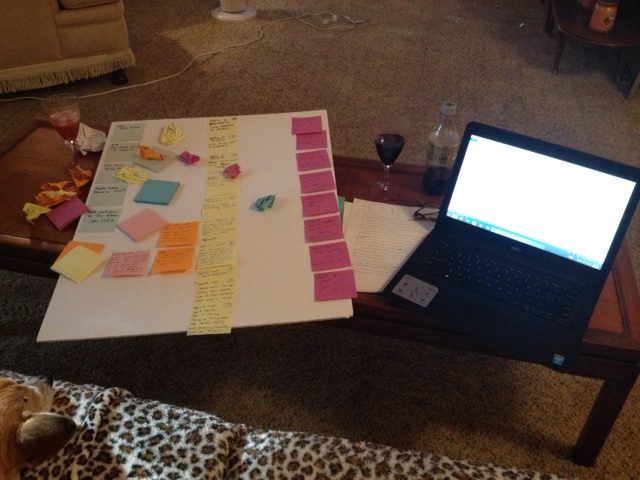
IMG_0552You’ll see that we seemed to make a lot of mistakes and needed a bunch of different colored Post-Its. (More on that to come). And that toward 6 p.m., we were compelled to strengthen our beverage of choice from Faygo to wine.  But by laying out this PHYSICAL map of our book, we were able to see things that we couldn’t see on the computer screen or even on the printed manuscript. Things like:

We had a good juicy set-up, we laid out the hero’s problem, and we sent him off on his quest.  But…

We had four chapters in a row of slow build-up and scene setting that could easily be winnowed down to two chapters. Foul: lazy writing.

We had one day (in book time) that ran three chapters and it defied the laws of physics for Louis to go where he did and accomplish what we needed him to do without him stopping for eat and sleep. Foul: stuffing 10 pounds of plot into a 1-pound calendar day.

We forgot to introduce a character early on who magically shows up later. Foul: brain-farting.

We had a subplot going on off camera that, in calendar-time, did not match up with the on-camera plot. We needed the sub-plot character to drive from Michigan’s upper peninsula to mid-state in time to do a nefarious deed. Problem was, it takes a minimum of 8.5 hours for this drive to happen and this guy would’ve needed wings to get down-state. Foul: Not doing homework via a simple Google Maps check.

Some of you TKZ regulars might recognize our Post-It Method of Plotting. I’ve written about it here before. But for some reason, Kelly and I neglected to do it for this WIP, and here we are, well into the third quarter, and we need to make Bill Belichick-worthy game adjustments if we are going to pull this one out of the dumpster.  Here is a close-up of the finished map:

IMG_0553

What’s with the colors? The chapter-by-chapter plot map is done in pale yellow.  The gold Post-It is sub-plot that is going on at the same day(s) of what yellow note it is next to. This is how we found out our bad guy couldn’t make that long drive in time. The pale pink note is the time-line of the central murder that happened in the near-past. The blue notes are back-story dates of everything that happened BEFORE the story begins. The purples are just inserts and correx that we will make later.  This book is third-person single point of view (Louis, who always gets pale yellow). In past books, we have used multiple POVs and switch to other colors for each POV so we can make sure at a glance that no one character, especially a secondary one, is getting too much on-camera time and stealing the spotlight from Louis.

So how does Team Parrish feel coming out of this half-time locker room break and strategy session? Full of cautious confidence. We started out this book full of hope and ambition. But as the game wore on, we just sort of flailed and fumbled around out on the field, hoping we could make progress by blind luck and maybe a last-minute field goal.  This is how the Jets play every single year. Or the Browns, whose fans show up at games carrying banners saying “We Still Have LeBron.”  You want to be Seattle. Or the Pats, who find a way to win even with Brady on the bench for four games.

What am I trying to say here? Well, it’s a variation on what all the good folks here at TKZ preach. Have a good work ethic. (you don’t want to be giving up in mid-season just because you’re a little gassed).  Have a good strategy going in. (a great idea or at least a fresh take on an old one). Devise a game plan and keep to it. (that means for some of you out there outlining). Stop at each quarter or at least half-time and see what has gone right and what had failed. Be flexible enough to make adjustments. Don’t quit, because as the great sports sage Yogi Berra said,  it ain’t over til it’s over.

And with that, I leave you with a few classic football cliches that are actually good advice for us writers:

You gotta work with what’s working. This is a variation on the more erudite “You go with what brought you to the dance.” If you’re a hard-boiled type at heart, maybe you shouldn’t try YA romantic zombie fiction just because it’s hot. Yes, stretch yourself, but don’t be crass. Readers smell insincerity a mile away.

It’s important to give the ball right back to the guy who lost it. Yes, you can make mistakes. In fact, they help you grow. If you’ve had a setback, be it a rejection letter, a bad review or just loss of confidence, don’t let it defeat you.  Favre is the leading career fumbler of all time. You think that when he put the rock on the ground, he thought about quitting? Heck no. The guy took risks. (Though the Killer Chihuahuas never forgave him for that last season…)

He heard footsteps. This is the wide receiver who feels a defender gaining on him so he takes his eye off the ball. For you, this means, don’t let distractions cripple you.  This can mean anything from the little — social media, chores, research — to major distractions — envy over other’s success, people who tell you that you’ll never get published.

He ran east and west instead of north and south. Or as Dan Dierdorf put it: “You gotta keep the axis of your body perpendicular to the goal line.”  For writers, this means always moving forward and maintaining momentum. This is my biggest problem because I become stalled in an insane quest for perfection when I should be grinding out that first draft.  I spent too much time running east and west instead of heading toward the goal line. Don’t be like me.  Be a downhill runner.

It’s a game of inches. Success in publishing almost always comes hard and gradually. You pound away at that keyboard, bang your head up against big forces that feel like they are bent on keeping you back. You spend months, years, on your WIP and only manage to move a few yards forward.  But this is how it’s done. Slow and steady. And you never, ever, come prepared to play only one game because you must…

Take it one game at a time. Finish that book, get it out there somehow and then start the next one. And as you do this you will…

Leave it all on the field. You gave it everything you had because, of course…

There’s no tomorrow.

Here’s to a good, healthy season. And hey, the Lions won. That is enough to give anyone hope.
 

Revisiting the Middle

Thanks to my fellow TKZ blog mate, Larry Brooks, who provided me with his ebook ‘Stuck in the Middle: Mid-Draft Saves for your Story‘, I thought we should revisit the saggy middle and look specifically at some great questions to ask before addressing the dreaded mid-draft slump.

Larry outlines some key issues that I think all authors should consider when they are mid-way through their draft novel. He poses these as a series of questions that highlight some of the critical issues that can plague a book and which can lead to a slump in the middle. I encourage TKZers to check out the ebook which goes into greater depth that my blog summary, but in the meantime, here are some of the key questions Larry raises (hopefully I’m not misquoting Larry here with my summary version!)

  1. First off, authors should take a step back and ask themselves whether the premise of the book itself is sufficiently strong to sustain a reader’s interest for an entire book – often times the premise is simply too weak dramatically, either because there isn’t enough of a dramatic arc to the book, or because the key characters don’t have enough to achieve/do for a reader to root for them.
  2. Second, an author should also check that their core story is sufficiently well defined. Is there a compelling dramatic question being asked and answered in the book? Often the middle sags simply because it doesn’t enhance or advance the overall dramatic arc of the story.
  3. Do you have sufficient plot points that keep the story moving along, providing sufficient tension to engage the reader throughout the book? Sometimes the middle drifts because the plot points to the story haven’t been spaced or placed appropriately.

As Larry points our the middle chapters of a book should continue to ‘elevate, escalate and surprise’. They should also provide a critical transition between plot points as the key characters move through the overall story arc.

Hopefully, I haven’t misquoted Larry’s key questions to much, but I encourage all writers to step back and consider these kind of issues when diagnosing what isn’t working in their own work. All too often we focus on the mechanics rather that the overarching questions of premise, core story and plot that need to be addressed to ‘fix’ the problem.

Saying Goodbye to a Legend

by James Scott Bell
@jamesscottbell

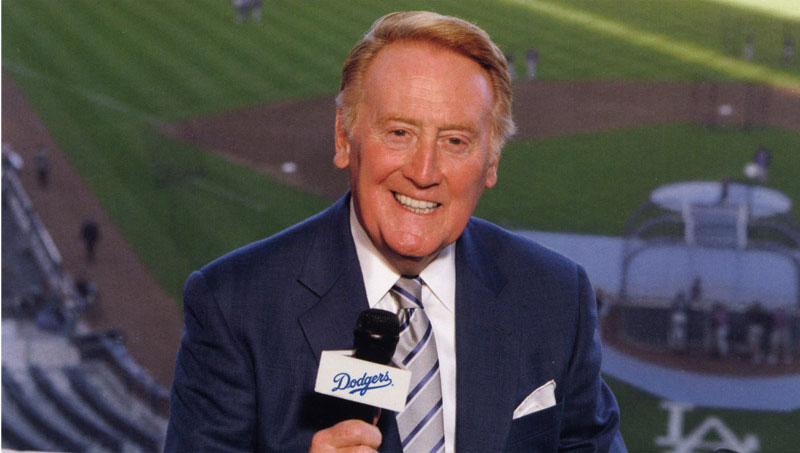
home-vin-scullyI’ve never known a breath of life without Vin Scully in it.

Growing up in Los Angeles, and being a die-hard Dodgers fan, I spent my youthful summers listening to Vinnie (we all called him that, he was our favorite uncle or best friend) call the games via my transistor radio. Many a night I’d fall asleep to that honey-toned voice and my mom would have to tiptoe in and turn the radio off.

And now he’s about to retire. After 67 years behind the mike for the Brooklyn and Los Angeles Dodgers.

It’s like summer itself will no longer be there.

Everyone acknowledges Vin Scully as one of the greatest (JSB would say the greatest) sports announcers of all time.

The question for us today (and for writers) is, Why? I’d say three things:

His precision.

His poetry.

His passion.

Precision: Vinnie is always so prepared, able to talk about each and every player who comes up to bat. On both the Dodgers and the opposing team. He knows their stats, their backgrounds, and the particular stories that turn them into individuals and not just numbers.

He also knows when and how much of that information to give. One of the greatest Vin Scully traits is not over-talking, as so many announcers do. He often just lets the crowd chatter or cheer. It’s like he’s letting you be part of the game. Thus, you never get tired of hearing Vinnie’s voice (one of the most naturally gorgeous in all sports … or any other verbal art form known to man).

Poetry: Vinnie has always been able to weave lovely and often unforgettable phrases into his announcing. He often cites great literature and even popular songs. I remember one game he was calling over forty years ago where he referenced a Jim Croce song, saying, “Tonight, they are playing like a junkyard dog.” I’ve never forgotten that. That’s what Vinnie can do.

Passion: One thing for sure, Vin Scully loves baseball. More than that, he honors it. He knows the rich history of the game, the great players, the important moments. When you listen to Vinnie call a game you are getting more than an account of the innings; you’re getting a history lesson, too.

I just had to write about Vin Scully today, as a bittersweetness overtakes me for the end of an epic era. Maybe I always thought Vin Scully would be there …

And in a way, he will be. For he called my favorite sports moment of all time. And it is now preserved on YouTube. If you want to appreciate the genius, the greatness that is Vin Scully, watch that entire clip of the Kirk Gibson home run in Game 1 of the 1988 World Series.

You cannot overstate the drama. The Oakland A’s take a 4-3 lead into the bottom of the ninth inning. On the mound is the most feared closer in baseball, future Hall of Famer Dennis Eckersley.

Gibson, the Dodgers’ most valuable player (along with pitcher Orel Hershiser), couldn’t play. He’d injured both legs during the NLCS, and could barely walk, let alone run. But as the ninth inning rolled on, Gibson (in the clubhouse at the time) told manager Tommy Lasorda he could pinch hit if need be.

Which is when Tommy Lasorda faked out Eckersley and the A’s. With two outs, and Mike Davis at the plate, Lasorda put Dave Anderson in the on-deck circle. Eckersley decided he’d rather pitch to Anderson, and pitched around Davis, who drew the walk and trotted down to first base.

Then … suddenly … stunningly … out comes Kirk Gibson.

Watch the clip to see what happened.

gibsonup101513Vinnie, calling the game with Joe Garagiola for NBC, was as precise and colorful as always. At one point he describes Gibson “shaking his left leg, making it quiver, like a horse trying to get rid of a troublesome fly.” Perfect!

But what is so endearing about Vinnie and the home run is that his love of the game and its iconic moments couldn’t be held back. When Gibson’s ball cleared the right field fence, Vinnie for that instant became a fan himself. Not of the Dodgers, but of the game of baseball. He knew this was a moment on par with Bobby Thompson’s dramatic home run back in the 1956 pennant race, or Bill Mazeroski’s game 7 World Series winner in 1960.

So when Vinnie says, “She is GONE!” there’s a little extra oomph in the word gone that reveals the great one’s heart.

As Gibson rounds the bases, with the crowd going nuts, Vinnie lets the TV audience share the experience by saying not one word. He waits over one full minute, as Gibson’s teammates mob him, and then delivers one of the great lines in broadcasting history: “In a year that has been so improbable, the IMPOSSIBLE has happened!”

Writers, learn from the great Vin Scully.

Be precise. Yes, you can—indeed must—let your imagination out to play. But if you want to be a selling writer, at some point you must use the tools of the craft to shape readable fiction. Vin Scully is still one of the hardest working broadcasters in the game.

Be poetic. John D. MacDonald wanted “unobtrusive poetry” in his style. Not so much that it stuck out, shouting Look at this great writing! But more than plain vanilla. The latter can work, but why not reach for more? Vin Scully elevated every game with his prose.

Be passionate. Love telling stories. Joy is one of the big secrets of popular fiction. You can hear the love and joy in Vin Scully’s calls. Here is a man who had his dream job for nearly seven full decades. We always knew it.

Ah, Vinnie. I will miss you so much. You made my summers unforgettable. You transported me to the stadium when I couldn’t be there. And even when I was, I had my transistor with me so I could hear you call the game. So, I might add, did about half of Dodger Stadium.

And someday, when I write the best book of my life, and know it, and hit the key that publishes it, I want to hear your voice in my head:

“She is GONE!”

God bless you, Vin Scully.

So who were the voices of your childhood?

The Streetcar I Desire

new orleans streetcar

Barring something unforeseen, I will be turning 65 tomorrow. I will spend most of  the day driving to New Orleans where I’ll be doing some business next week and occasionally popping into the Bouchercon host hotel (as well as assisting Jim Born with his excellent Weaponry panel at 9:00A on Saturday September 17, for both of the attendees who do not drink even when they’re in The Crescent City). The major milestone for me, however, will be riding New Orleans’ iconic streetcar line…for 40 cents a ride. Senior citizens in New Orleans get to do that.

An elderly friend told me that getting older is actually like aging in reverse. When you’re just a few years old people are constantly taking things away from you or putting them out of reach, a practice which we now call “childproofing,” You get trusted incrementally with objects, privileges and responsibilities until one day you wake up and you’ve got a whole collection of those, which include but are not limited to driving and automobiles, jobs, voting, drinking, military service, intimacy, and child rearing. You think you’re overdue for most of them by the time you get them, but the truth is that you’re probably not ready. Experience is the best teacher, however, and we all muddle through a continuum that runs between success and disaster and all points in between.

After several decades, though, things begin to change. People start taking things and choices away from you again. The guy at the hardware superstore asks if you need help carrying any purchase that weighs more than a pack of light bulbs. Your children think that you have early dementia if you are unable to keep their schedule and yours straight without a calendar. The question “How is work?” is replaced with “When are you retiring?”. Your first birthday congratulations at 65 is from the federal government: it’s a red, white and blue Medicare card. And that driver’s license that was so important to obtain five decades ago is possibly only an accident or three from being retired. As for me…everything still works. I can carry an old-fashioned microwave up two flights of stairs without sustaining a heart attack (though it was a very near thing). I can drive nine hundred miles in one day (though I’m split it up out of caution). Things aren’t being taken away from me yet, even though I am more  Mickey Donovan than Harry Coombes at this point. I wouldn’t have it any other way. And I am going to ride those streetcars next week —on every line I can — for 40 cents a trip like they are a pack of 3-dollar government mules.

So let’s open it up. What was your favorite birthday celebration? Do you have a tradition? What would you like to do, but haven’t had the fortitude or the ability to do, at least at this point in your life?


Yes, He Really Said That


HOUSE -- Pictured: Hugh Laurie as Dr. Gregory House -- NBC Photo: Timothy White

HOUSE — Pictured: Hugh Laurie as Dr. Gregory House — NBC Photo: Timothy White

By Elaine Viets

Dr. Gregory House is a creature of fiction. Real doctors aren’t that insensitive, are they?
Oh, yes they are. I had a brain surgeon who made Greg House look like Marcus Welby.
Dr. Jeb Travis Tritt is the brain surgeon who saved my life after I had six strokes, including a hemorrhagic stroke, in April 2007. That’s not his real name, and he doesn’t look or act like the brain surgeon in my new mystery Brain Storm. But Dr. Tritt, as I baptized him, was a real character. I couldn’t make up what he said – I’m not that creative.

brain surgery1In fiction and reality, Dr. Tritt is a brilliant surgeon with a lousy bedside manner. He saws open skulls for a living, so I expected him to be a little strange. But hey, so am I.

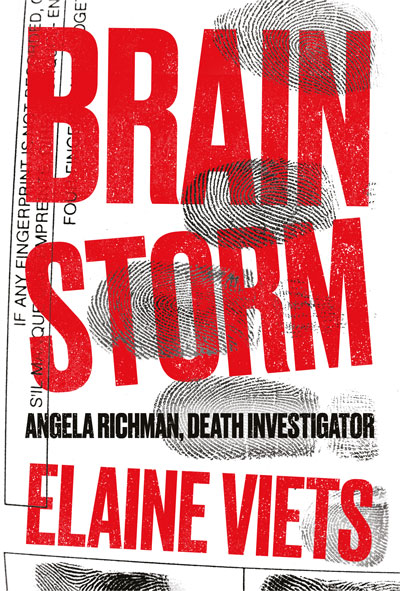
VIETS-BRAINSTORM-smallBrain Storm, the first Angela Richman, Death Investigator novel, is set in mythical, ultrawealthy Chouteau Forest, Missouri. Angela and I had blinding headaches and other classic stroke symptoms that sent us to the ER. There we were misdiagnosed by the neurologist on call, who said we were “too young and fit to have a stroke.” This comment is staggeringly stupid, though I didn’t know it at the time. Babies can have strokes. Dr. I. M. Incompetent told Angela and me to come back in four days for a PET scan.

brain ERWe never got that scan. Instead, we had a series of strokes, brain surgery, and a coma, and encountered Dr. Jeb Travis Tritt. After brain surgery, Angela and I were in a coma for a week and spent three months in the hospital.

brain surgery3

That’s where Angela and I parted company. When she came out of the coma, she learned that the doctor who nearly killed her had been murdered. The chief suspect was Dr. Tritt. Angela, still drugged and hallucinating, was determined to save the doctor who saved her. I can’t kill the doctor who misdiagnosed me. Except in fiction.

brain doctorBut I did experience Dr. Tritt’s midnight monologues, and put them in Brain Storm.
When Dr. Tritt got off work at midnight, he’d stop by my room. First he’d check my healing wound – a hideous cobblestone of a bump. Then he’d settle in for a monologue, talking nonstop for two or three hours. I was a captive audience – I couldn’t walk yet. He’d make jaw-dropping comments. I was heavily drugged and still talking to imaginary friends. But I knew I had a real find. Dr. Tritt’s visits were a gift. It took me nine years to use it.
One night Dr. Tritt said, “Do you remember anyone talking to you while you were in a coma?”
“No,” I said. “No tunnel of light, no relatives waiting on the other side. I didn’t see or hear anything.”
“Thank God,” he said. “I used to stop by every night and say, ‘Elaine! This is God! Wake up!’ But the nurses made me quit.”

brain godWhy did a surgeon spend hours talking to me instead of going home? He answered that question in another monologue.
“My wife is divorcing me,” he said. “She likes to shop and I don’t make enough money. She thought brain surgeons would be rich, but I don’t get that much. I only got three thousand dollars for your surgery. She wasn’t that good in bed, anyway. She just laid there, like you did, except you were in a coma.”
Huh? It didn’t occur to the doctor that perhaps his performance might have something to do with his wife’s lack of enthusiasm. The doc wasn’t coming onto me. My face was swollen, my skin was bright red thanks to an allergy to some medication, and half my hair was shaved off.
I’d always been proud of my long hair. I was shocked when I saw it had been partly shaved off for the surgery. Late one night, Dr. Tritt said, “I’m sorry about your hair.”
“In the grand scheme of things, it’s not the end of the world,” I said.
“I burned your hair because I knew you were going to make it,” he said. “If my patients are going to die, I save their hair because they like to look good in their coffins.”

brain coffinI was speechless. But then I thought: What would he say if I was going to die? Would he come by one midnight, hand me my hair and said, “Elaine, you’re screwed. But here’s your hair. You’ll look great in your coffin.”
Good old Jeb Travis Tritt. This real life character saved my life. Now I hope he can help me pay off those hospital bills.

++++++++++++++++++++++++++++++++++++++++++++++++++++++++++

VIETS-BRAINSTORM-smallBrain Storm is on sale as a trade paperback, audio and e-book amzn.to/2awPsIe

Win an autographed hardcover of Elaine’s seventh Dead-End Job mystery, Clubbed to Death. http://elaineviets.com/index.php?id=contests

How to Write 10,000 Words in a Day, and Why You Should Give It a Shot (at least once)

The most words I’ve ever written on a fiction manuscript in a fourteen hour period is 11,214. I was on a solo writing retreat in a secret location (okay, it was at an AirBnB apartment in St. Louis), laboring over the final push for The Abandoned Heart. My deadline loomed, and I was finding myself way too distracted at home to get the book drafted in time. All told, over the three and a half days of my retreat, I wrote over 26,000 words—certainly more words than I’d ever written before on a first draft in any similar time period.

Part of why I was successful was that I knew I was paying for the time away from home, and I didn’t want to disappoint myself or anyone else. It cost me about $400 for the apartment rental, plus another $125 for gas (St. Louis is two hours away), groceries, and a couple of restaurant meals. My family paid, too, in that they had to pick up the slack at home. The circumstances were definitely extraordinary. But it wasn’t my first time at the Big Daily Word Count Rodeo.

I was lured into my first 10K day a few years back by my thriller writer friend, J.T. Ellison. She was looking for a partner in crime—someone to check in with, someone to be accountable to—and she knows I’m game for all sorts of shenanigans. We’ve climbed the 10K summit many times now, and we even have tee shirts to celebrate our achievement.

If you peruse the Internet, you will find several examples of people talking about tackling the big 10K. But the methods all boil down to a few key elements.

Let’s talk about the whys first.

1. Resistance. If you only have a dozen hours in a day to write 10,000 words, you’re going to have to write fast. Really fast. You won’t have time to worry about what your parent/child/rabbi/auntfanny/spouse/eleventhgradeteacher/coworker will think about your work. You won’t have time to be afraid. You won’t have time to fiddle with word choice and as-you-write edits. The beauty of this goal is that you must put your internal editor on notice: She has to work fast, or get the hell out of the way. Resistance has no claws or hooks in this scenario.

2. Get those words out of your head and down on paper. Your story isn’t doing anything for anyone by sitting there, overcooking in your brain. I’ve never tried to do this below the 30K mark in a story, but there’s no reason why you can’t. It’s a story exploder, in a good way. Even if you’re not quite sure where a story is headed, the story knows. That fabulous subplot that woke you briefly at two in the morning, and you forgot on waking? It’s still in there, and your agile, in-overdrive mind will pop it out just when you need it.

3. Get a big jump in your word count. If you’re going for a 100K manuscript, 10K is ten percent of your total. That’s huge for one day, and the satisfaction you’ll enjoy from that accomplishment will stick with you for the duration.

4. First drafts aren’t final drafts. Perfection is not (ever) required. This is the place to let your storytelling mind play. Write now (and it will sometimes feel like you’re just typing and that’s totally okay), edit later. Don’t imagine that this will be finished work, but do be prepared to be pleasantly surprised at how readable it is.

5. You write just as well quickly as you do when you write more slowly. I’m not kidding when I say you’ll be surprised at the quality of the writing you produce. With breaks, you’ll be writing between 1000 and 1200 words an hour (my fastest is about 1400), which isn’t unusual. The unusual part is doing it hour after hour.

6. Why not? Test yourself. Push yourself. Life is too short to dawdle. This isn’t something you have to do once a week, once a month, or even once a year. There are lots of things we devote entire days to that we despise. Why not set aside a day to do something that you love?

Resistance will come up with a lot of excuses for why you can’t do this: It’s a gimmick; You don’t have time; Nobody can write decently at that pace; Your family won’t give you time/space to do it; The world can’t possibly do without you for a dozen hours; It’s dumb and unprofessional; You will fail.

There have been a few times when I’ve completed all the arrangements for a 10K day (always at home), and someone forgot their homework, lunch, or got sick. Or the furnace broke or the phone rang ten times and it was my mother. I only got in 8K or 6K or 5K on those days. But I had at least 5K more than I did the day before. The important thing was that I committed to the time, to the work, and that I got a good chunk of words written.

Let’s talk about the hows of a 10K day:

  1. Commit. Decide you’re going to do it, and take it seriously. Sure, things will crop up and demand your attention, but if you’re committed, you won’t be derailed. Stay off of social media for the day.
  2. Enlist. Enlist your family in the project. Announce your intention to disappear into your writing for the day, and make (enjoyable) plans for them or yourself to be away. If they’re already used to your professional attitude toward your own writing, this won’t be unusual for them. If this is new for you (and them), you might want to take yourself off to a hotel, a friend’s house, or a comfortable library with food facilities nearby. Show them what 10K words look like. They will be impressed that you want to produce so much material. (And if they’re not, too bad for them because they should be.)
  3. Choose your ground. Find somewhere comfortable to work where you won’t be tempted to nap frequently, or get on the Internet. For the random 10K day, I prefer to work at home because I can be as relaxed as I like. Declutter your workspace so you can concentrate on the work and not be distracted by bills, school or work communications, etc. Dress comfortably and make sure your chair is comfortable, too.
  4. Plan your breaks, plan your food. The Pomodoro timer method works well. You can get up and stretch your legs for five minutes after each twenty-five minute work block, and take a longer break every couple of hours. Or you can set up any system that you know works for you. The idea is to be consistent. Don’t work through your breaks. It may sound silly to plan your food, but it’s a critical detail. If you only have a fifteen minute or five minute break, every minute counts. When you emerge from your writing cocoon to find a sandwich in the fridge, or an ounce of nuts, or some fruit and chocolate waiting on the kitchen counter, it will seem magical.
  5. Plan your writing.  Make sure you’re very familiar with the manuscript, have a solid idea about what you want to write, and where the story is going. Your list should be completed the day or night before your 10K day. My chapters are about 2K words long, so that’s a goal of five chapters for an all-day session. Remember to write in scenes, and to keep the story moving forward.
  6. Keep track. Make a note of your growing word count. Every time you stop for a break, write down how many words you’ve written. They will add up quickly! Be sure to time your breaks, just like you do your writing sessions. Save your work frequently.
  7. Bring a friend. Bring along a friend (not necessarily in person) to participate so you can encourage one another. Plus, you get to celebrate together at the end.

I know it’s a lot to digest all at once, but I promise that the rewards are huge. I strongly encourage you to give it a shot.

How many words did you write on your very best word count day? Do you have any stories you want to share?

Goodreads is giving away copies of all three novels in my Bliss House dark suspense trilogy, including The Abandoned Heart, which will be released on October 11th. Enter here for a chance to win.


The 3 (Or 7, or 36) Basic Plot Lines In Fiction

By Kathryn LIlley

According to some writing gurus, there are somewhere between seven to 36 basic plot lines in fiction (depending on which expert you believe) that structure most works of fiction. Here is a list of some of the  plot lines that are often described as basic elements comprising all works of fiction:

Happy Ending/Comedy

Tragic Ending

“Literary” Ending (Plot revolves around a question or sense of fate, rather than actions or decision)

Other sources break down the Big Three plot lines into more specific categories:

Overcoming the Monster

image


Quest

Rags to Riches (Or Riches To Rags And Back To Riches)

image


Voyage And Return

Mystery

Crime Pursued By Vengeance/Prevention of Bigger Crime  (a plot line that would define most thrillers)

I have to admit, I started looking into the notion of basic plots because I once took a Hollywood screenwriting seminar delivered by one of the better known screenwriting teachers in LA. He first introduced me to the idea that there were only a limited set of original plot lines in fiction, most of which harked back to classic Greek drama.

Check out this link to a summary of some of the prevailing notions of a limited set of fundamental, archetypal plot lines in fiction, and let me know–are people getting carried away with the idea? I think a story’s plot itself is less Important than the way that story is told–the plot, however basic and fundamental, must be told in a way that is fresh, original, and compelling. And making a stale plot seem fresh and new (aka rags to riches==>Cinderella==>Pretty woman): that is the hardest part of writing.

But I suspect I my story structure and story coach colleagues (and everyone else) might have some thoughts about this topic. Please share yours?

From The List of Elite Writing Tips

by Larry Brooks

It’s amazing that nobody has compiled such a list, at least that I know of. Sometimes a little morsel of writing wisdom is so rich, so illuminating and powerful, it doesn’t require a lecture or a blog post or a book.

I’ll try to hold to that here, after I lay one on you.

I bet you, too, can think of a handful of powerful writing tips just from this prompting.

Often I kick off my writing workshops by asking folks to jot down their all-time favorite writing tip, and then open things up for a lively discussion.

Almost all of the tips offered are powerful–except the one that says there are no rules or principles, just make up  your story as you go along… that one can be downright lethal–so the discussion focuses on the context of why these tips work, and what brought the writer to that particular career-changing realization.

Not all writing tips are golden, though,

Some require a deeper discussion to be fully understood. Not because they are overwhelmingly complex, but because at a glance they can be misleading. (Too many writers operate from that at a glance context.) I can think of at least one popular writing book with a title like that, suggesting “truth” that is, in fact, context-dependant and nothing other than a risky opinion (“hey kids, do it like I do it!”). The book itself is actually fine (in fact, it contradicts the title; it ends up being more about process than what makes a story work), adding to the confusion even with the best of intentions.

There is another tip, though, that transcends opinion to become holy writ. I’ve seen it work wonders for writers who have struggled to move forward without ever really wrapping their head around it. With a more open mind, though (and yes, it’s a shame that we sometimes need an open mind to see that which is simply, obviously and always true, in writing and in life), it can change your writing journey the moment you see it, provided it parts the curtain of your understanding.

This one is especially true for genre fiction, so us Zoners should paste it onto our monitors, because it will never fail us. It is this:

It isn’t a story until something goes wrong.

This connects to so many principles of storytelling.

And yet, newer writers in particular get stuck writing about something–a character, a place, a time, an issue, all without plot-driven conflict or antagonism other than the hero’s inner issues–rather than writing about something happening in the context of something gone wrong for your protagonist, launching the hero on a dramatic quest that unfolds under escalating pressure from antagonistic opposition, threat, urgency and emotionally-resonant stakes.

You can start with something going wrong, and add character, setting, theme and structure from there.  Of you can start with character and/or there and look to add conflict–something has gone wrong–to it.

But no matter how you start, you can’t finish until something really does go wrong.

What is your favorite writing tip? id you hear it because you needed to (one of those when the student is ready the teacher shall appear moments), or is it a baseline truth from which you have always written?

Did you hear it because you needed to (one of those when the student is ready the teacher shall appear moments)? Or is it a baseline truth from which you have always written?

******

On another note… I’ve launched a new website in support of my new relationship-salvage book, Chasing Bliss. You can check it out HERE (including an in-depth author interview).

Why Plot is Essential to Character

by James Scott Bell
@jamesscottbell

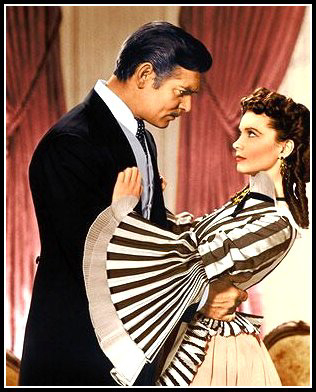
Rhett-Butler-Scarlett-O-Hara-scarlett-ohara-and-rhett-butler-6948455-316-392If you ever find yourself among a group of writers, writing teachers, agents or editors; and said group is waxing verbose on the craft of fiction; and the subject of what fiction is or should be rumbles into the discussion, you are likely to hear things like:

All fiction is character-driven.

It’s characters that make the book.

Readers care about characters, not plot. 

Don’t talk to me about plot. I want to hear about the characters!

Such comments are usually followed by nods, murmured That’s rights or I so agrees, but almost never a healthy and hearty harrumph.

So, here is my contribution to the discussion: Harrumph!

Now that I have your attention, let me be clear about a couple of items before I continue.

First, we all agree that the best books, the most memorable novels, are a combination of terrific characters and intriguing plot developments.

Second, we all know there are different approaches to writing the novel. There are those who begin with a character and just start writing. Ray Bradbury was perhaps the most famous proponent of this method. He said he liked to let a character go running off as he followed the “footprints in the snow.” He would eventually look back and try to find the pattern in the prints.

Other writers like to begin with a strong What if, a plot idea, then people it with memorable characters. I would put Stephen King in this category. His character work is tremendous. Perhaps that is his greatest strength. But no one would say King ignores plot. He does avoid outlining the plot. But that’s more about method.

I’m not talking about method.

What I am proposing is that no successful novel is ever “just” about characters. In fact, no dynamic character can even exist without plot.

Why not? Because true character is only revealed in crisis.

Without crisis, a character can wear a mask. Plot rips off the mask and forces the character to transform––or resist transforming.

Now, what is meant by a so-called character-driven novel is that it’s more concerned with the inner life and emotions and growth of a character. Whereas a plot-driven novel is more about action and twists and turns (though the best of these weave in great character work, too). There is some sort of indefinable demarcation point where one can start to talk about a novel being one or the other. Somewhere between Annie Proulx and James Patterson is that line. Look for it if you dare.

We can also talk about the challenge to a character being rather “quiet.” Take a Jan Karon book. Father Tim is not running from armed assassins. But he does face the task of restoring a nativity scene in time for Christmas. If he didn’t have that challenge (with the pressure of time, pastoral duties, and lack of artistic skills) we would have a picture of a nice Episcopal priest who would overstay his welcome after thirty or forty pages. Instead, we have Shepherds Abiding.

If you still feel that voice within you protesting that it’s “all about character,” let me offer you this thought experiment. Let’s imagine we are reading a novel about an antebellum girl who has mesmerizing green eyes and likes to flirt with the local boys.

Let’s call her, oh, Scarlett.

We meet her on the front porch of her large Southern home chatting with the Tarleton twins. “I just can’t decide which of you is the more handsome,” she says. “And remember, I want to eat barbecue with you!”

Ten pages later we are at an estate called Twelve Oaks. Big barbecue going on. Scarlett goes around flirting with the men. She also asks one of her friends who that man is who is giving her the eye.

“Which one?” her friend says.

“That one,” says Scarlett. “The one who looks like Clark Gable.”

“Oh, that’s Rhett Butler from Charleston. Stay away from him.”

“I certainly will,” says Scarlett. (The character of Rhett Butler never appears again.)

Scarlett then finds Ashley Wilkes and coaxes him into the library.

“I love you,” she says.

“I love you too,” Ashley says. “Let’s get married.”

So they do.

One hundred pages later, Scarlett says, “I really do love you, Ashley.”

Ashley says, “I love you, Scarlett. Isn’t it grand how wonderful our life is?”

At which point a reader who has been very patient tosses the book across the room and says, “Frankly my dear, I don’t give a damn.”

What’s missing? Challenge. Threat. Plot! In the first few pages Scarlett should find out Ashley is engaged to another woman! And then she should confront him, and slap him, and then break a vase over the head of that scalawag who looks like Clark Gable! Oh yes, and then a little something called the Civil War needs to break out.

These developments rip off Scarlett’s genteel mask and begin to show us what she’s really made of.

That is what makes a novel.

Yes, yes, you must create a character the readers bond with and care about. But guess what’s the best way to do that? No, it’s not backstory. Or a quirky way of talking. It’s by disturbing their ordinary world.

Which is a function of plot.

So don’t tell me that character is more important than plot. It’s actually the other way around. Thus:

  1. If you like to conceive of a character first, don’t do it in a vacuum. Imagine that character reacting to crisis. Play within the movie theater of your mind, creating various scenes of great tension, even if you never use them in the novel. Why? Because this exercise will begin to reveal who your character really is.
  1. Disturb your character on the opening page. It can be anything that is out of the ordinary, doesn’t quite fit, portends trouble. Even in literary fiction. A woman wakes up and her husband isn’t in their bed (Blue Shoe by Ann Lamott). Readers bond with characters experiencing immediate disquiet, confusion, confrontation, trouble.
  1. Act first, explain later. The temptation for the character-leaning writer is to spend too many early pages giving us backstory and exposition. Pare that down so the story can get moving. I like to advise three sentences of backstory in the first ten pages, used all at once or spread around. Then three paragraphs of backstory in the next ten pages. Try this as an experiment and see how your openings flow.
  1. If you’re writing along and start to get lost, and wonder what the heck your plot actually is, brainstorm what may be the most important plot beat of all, the mirror moment. Once you know that, you can ratchet up everything else in the novel to reflect it.

Do these things and guess what? You’ll be a plotter! Don’t hide your face in shame! Wear that badge proudly!

Super Plotter