Inspiratus Interruptus

I have a home office. I love it. There’s no commute. I can get a couple of hours of work in while most people are still asleep. I have a secretary named “Joe,” a gofer named “Joe,” and a personal manservant named “Joe” who makes me coffee and breakfast and lunch. What a team we are. We all get along just fine. I don’t have anyone hassling me about “Rrrrr, rrrr, rrrr, your billable hours are down, rrrr rrrr rrr, what about rrrr, rrrr, and why are you on the internet again, rrrr?” Yep, it’s a sweet deal. I can do my big boy job, write a bit, do my big boy job, lather, rinse, repeat.

The only problem I have (for purposes of this discussion) is having to deal with non-work, non-personal interruptions. I have my office line and my home line in the same room. I have been getting a lot of calls on my home line because I will be turning 65 in a few short months. Yes, I know, I know, you wouldn’t expect someone of my countenance, libido, and good cheer to be that old but it is so. Here is a warning: when you are about to turn 65, everyone starts calling you to 1) tell you what’s what about Medicare and 2) sell you the exact policy that you need. I began acquiring all sorts of new imaginary friends, such as “Medigo,” “WhatsMedicare,” “Medsuppins,” “Marketplace,” and the alluring, mysterious “Name Not Found.” Ignoring them didn’t help because the phone would ring four times before sending the call to voicemail. That’s a distraction, even when you are screening your calls. And we haven’t even talked about the fine folks from the help desk at Windows Security who have detected a ‘wiwus” on my computer, or the guy who is willing to give me a free vacation if I’ll just watch a short demonstration video, or the woman who keeps calling me to ask if I’m interested in my cable company’s latest product. Uh huh. The “do not call” list?” It’s pretty much a joke. Muting the ring isn’t an option for me, either, as I have a daughter in college and a granddaughter in grade school, both of whom need me at unexpected times.

My life was changed for the better, however, when I came across an article in a newsletter from the Community Senior Center which my wife belongs to (and, no, I’m not a member. That stuff is for old people). The article touted a gentleman by the name of Aaron Foss, the designer of a called “NoMoRoBo.” Foss is GIVING this thing away. No strings, no deposits, no nothing. It’s a true public service. What it does is block robo calls — those things that dial five thousand numbers at a time — and telemarketers. You go to the “nomorobo” website, watch the very short video, click on “get started now” button, fill in the blanks, and within a day or so you’ll see results. Your phone rings once, gives a little purr, and “pfttt”…the annoying caller doesn’t even have a chance to leave a voicemail. They are gone. “Nomorobo” doesn’t work with every landline phone service, or every cell phone service provider, but it works with mine, and they’re adding more and more constantly. Oh. Oh. And. It supposedly will not block or divert political fundraisers or surveys, but I’ve had several blocked already (“Poll_Quest,” to name but one). “Nomorobo” constantly learns new numbers to block and you don’t have to do a thing, other than write your next bestseller without interruption (other than for that initial ring). And every time the phone rings once and disconnects during dinner, my wife and I look at each other, and smile.

Authors, readers, doctors (Hi Steve!) and all who fight the good fight on all fronts each day: try this out. I have absolutely no interest in this, financial or otherwise. It is free and it does work and no one puts your name or number on a mailing list, either. And Aaron Foss? I’d stand in front of a tank for him.

Having shared this marvelous invention with you, I want something in return (Aaron Foss, I am not). Please tell us: what devices do you use to give yourself privacy, and to keep yourself from being interrupted? And what is your favorite personal story that concerns dealing with telemarketers, solicitors, and the like?

Amazon Marketing Services Coming May 1 – Thoughts?

Jordan Dane
@JordanDane

amazon-logo-15

Amazon Marketing Services (AMS) will launch May 1, 2016. What does this mean to you, authors? As an Advantage or CreateSpace publisher, you can sign up for AMS for an annual fee of $99.00. Word of caution, from what I’ve seen of the sign-up instructions, this is for Kindle Select books only. The annual fee is charged against your account as a deduction from your sales. No Paypal or credit card charge up front. Once you become a “member” of AMS, you gain access to marketing programs reserved for Amazon’s biggest vendors. Feel empowered yet?

Below are the programs available to members:

Advertising on Keywords/Tags – Pay Per Click

The right keywords and tags can help you with discoverability on your titles at Amazon while setting your own budget allowance for promotion. Popular keywords, phrases, and tags on a book can generate momentum on search pages to get a title noticed. You’d only pay when a reader clicks on your book ad. According to Amazon, a click budget can be as low at $100.00, capping off your cost at your option.

Enhanced “A+” Detail Pages

Sometimes bling is the thing to showcase a book. Amazon offers enticing content for an author’s book page for $600, such as videos, sample page shots, photos and other creative promotion ideas. The deluxe page content also features advanced formatting and rich media content to tease the readers to buy.

Price Discounts

This is a really great idea. Amazon now offers vendor-provided coupon links (offered on the product detail page) to give readers/customers immediate discounts off the Amazon sales price. This will allow you to offer true sales campaigns and promotions during a peak period, in a more nimble way than ever before. You can drive sales during a virtual tour event or for a given weekend or launch period with ease.

Dashboard Sales Analytics

Want to evaluate your promotion effectiveness with REAL sales data? Now you can with AMS. If you’d like to evaluate one campaign service provider or a blog tour or advertising on Facebook for example, now you can if you isolate the event and analyze the effectiveness through analytics offered on the AMS dashboard. You’ll be able to analyze your return on investment down to the title and event to fine tune your marketing strategies with real sales data.

Vine Reviews

Chasing reviews can be a challenge if you want exposure and honest reviews. The cost for promotion service providers to solicit readers for an honest review can take time to scrutinize the potential reader and the cost for such a service can vary. Amazon had its established Vine Reviewers program of pre-approved reviewers. This is a costly service, priced at $1500.00, but it allows you to access the entire Vine Reviewer list without taking the time to approach them one at a time. If you invest in this service, AMS handles the details.

How to sign up for AMS?
If you’re curious about this new Amazon program, here is the link for AMS – https://ams.amazon.com/  I have to admit that I thought this would be for ANY KDP author. That’s how it is presented under the instructions as you set up, but when you drill down into the instructions on page 2, it appears these services are only for Kindle Select books.

Or you can do what I tried to do, which is set up my corporation (or my publishing company name) under the Amazon Advantage program at this LINK. (I thought I could set up as a vendor.) But alas, I could not set up under the Advantage program as a vendor under my company name OR my brand name (author name). On the surface it would appear Amazon is forcing authors into their KDP SELECT program to become a member of AMS. If anyone knows any differently, or had another approach and was successful, please let me know.

I’ve read that if your book has an ISBN and you’re signed up through Createspace, this might get you into AMS, but after I explored Createspace, I did not find a way into AMS this way either.

Here’s link to an Amazon brochure on “Drive Sales with Amazon Marketing Services.”

Here is a FAQ link.

For Discussion:

1.) What do you think of the tools AMS makes available to all authors? Which service are you most interested in?

2.) Is anyone a member already? Have you encountered any problems?

3.) What do you think of the exclusivity of having this program only available to Kindle Select, meaning your book will only be sold on Amazon for a time under those rules?

HOW TO WRITE A BESTSELLING NOVEL!

I’ll say this right up front:

The title of this post is complete nonsense

I could have used similar words on the cover of my book on craft to attract those who believe there’s some secret ingredient to bestselling fiction, but I didn’t.

Why?

Because, first, I like to think I have a little integrity. And second, the truth is, nobody can tell you how to write a bestseller.

Nobody.

I don’t care if they’ve sold a gazillion books themselves, there is no person on this planet who can tell you how to write something that will rocket to the bestseller lists.

Not even the big New York publishers know how to get their books on the bestseller lists. If they did, every book they published would be there.

I decided to write this post because I was searching the Internet one day and stumbled across a writer’s website that had an article with a title very similar to the one above. So I took a look at the post and, yes, the author had included some good advice, but none of it really had anything to do with writing a bestseller. He had simply used that word to get your eyes on the page.

So I used the same trick here to make a point.

And I’ll bet your adrenalin rose just a little when you saw it, right?

But here’s the thing…

EVERYONE WANTS TO WRITE A BESTSELLER,
BUT MOST AUTHORS NEVER WILL

Because it’s completely out of your control.

If you sit down to write a “bestseller,” you are taking a wrong-headed approach to writing. Writing great fiction has nothing to do with writing bestsellers. Bestsellers are, by and large, flukes. Right place, right time. And not all bestsellers are created equal.

I can name a dozen of my friends who do everything right and should be on the bestseller lists, and authors who are and don’t belong there.

When I wrote Trial Junkies, I just wanted to write a great book. I had no idea it would go on to be an indie bestseller. Sure, it was something I hoped for, but I certainly wasn’t rubbing my hands together in anticipation of mega-sales. I just wrote the book I wanted to read and decided to let fate take care of the rest.

So don’t put all your energy into trying to write a bestseller. You should simply write the best book you can possibly write. A book you’re so excited about that you don’t care if you ever make a dime off of it.

I spent many years writing stuff that I knew would never sell. In fact, I didn’t even try to sell it, because I knew it wasn’t good enough. But I kept at it for several years. I wrote story fragments and screenplays and teleplays and partial novels and while I knew what I was producing was not quite there yet, I also knew, with great certainty, that it would be one day.

Sure, I had dreams of being Stephen King or Dean Koontz. We all do. But the reality is that most writers never make it to the lists, yet they still manage to have wonderful careers.
Should you forget about your dreams?

No. Sometimes they’re all you have.

But any thoughts of bestsellerdom should be relegated to the back part of the brain. You have a story to write. And that’s all you should be thinking about.

If you publish it and it manages to reach one of the bestseller lists, that’s just gravy.

So there is no How to write a bestseller.

And don’t ever be fooled by anyone who claims to know the secret. That particular brand of fairy dust just doesn’t exist.

Beyond The “Word Gap”: A Bridge Too Far?


imageBy Kathryn Lilley

When my daughter was in the first grade, her teacher pulled me aside one day.

“I’m learning so much by listening to the way you speak to your daughter,” she said. “It’s amazing. You talk to her like she’s an adult.”

At the time, I recall being surprised by that comment. (And to be honest, I didn’t know there was another way to talk to children.) Then I started paying attention to the way some of the other parents in the school communicated with their kids. I was struck by the simplified language they used. They used fewer, simpler words than I did. (I remember wondering briefly if I was doing something wrong in the way I communicated as a parent. If so, it was too late to switch gears, I decided. By the time my daughter was six, she already had an adult-level vocabulary).

I felt reassured by a study that came out the next year, which  indicated that children with big vocabularies tend to do better in school than children with small vocabularies. (That there was a correlation between vocabulary size and academic performance seemed intuitively obvious to me at the time. But still, it was a relief to have my personal communication style officially sanctioned by a study.)

After that study came out in the mid-nineties, early education experts and advocates jumped on board the notion of a “word gap”. They stressed the need to close that gap as a major strategy for improving the education system. But some critics are now pushing back on some of the notions fueling the word gap campaign. According to some scholars cited in a recent article in The Atlantic Monthly, merely using more words is not enough to prepare a child for school. Some linguists dismissed the campaign to close the word gap as simplistic, inadequately researched, and ineffective.

http://www.theatlantic.com/education/archive/2016/04/beyond-the-word-gap/479448/

Personally, I would like to see some research done on the opposite side of the word gap equation: I wonder whether there is a potential downside in having a big vocabulary in early childhood. Judging from my own highly unscientific, peer group study sample, younger children who have big vocabularies tend to sail through their grammar school years.  The early years are so effortless for these children, they often fail to develop the study habits they’ll need to carry them successfully through high school and college.

But he’s so bright! Another friend complains to me over the phone about her eighth grade son, who is suddenly struggling in school. Why won’t he just do his friggin’ homework?

Because he never had to work before now, I reply. Her son-of-a-professional’s precocious vocabulary let him coast along in school while some of the less “bright” kids were developing a few basic study habits.

So here’s my take on the word gap movement: it’s a little off base as an education strategy. Yes, having a decent vocabulary helps you shine in the first grade. But eventually, you’re going to have to sit down and do your friggin’ homework.

Here at TKZ, we’re all writers and avid readers, so this is an interesting group to ask: are you familiar with the “word gap” campaign? What do you think about it as an early childhood education strategy?

Concept vs. Premise: The Inherent Opportunity in Understanding the Difference

Concept and Premise are two of the most common terms used to describe a story, often within a pitch or a review, less often within the lexicon of story development.

That’s a shame, too.  Because understanding the difference between them, and harnessing that difference to raise the conceptual essence of a premise, is a powerful storytelling tool.  One that differentiates a story within its genre, whatever the genre might be.

And perhaps even more exciting, this single thing can be the difference between a mid-shelf book and a bestseller.  Or between published and unpublished.  Because agents and writers are looking for home runs, and there is no quicker way around the bases than a high concept story, a story with a premise that is fueled by concept.

Here’s a quick example, with more right around the corner:

Two people fall in love in Florida.  This is premise that is as flat and almost completely void of concept.  The only thing about it is if you find the notion of a story set in Florida compelling.  If you don’t, and you’re an agent or an editor, you are already bored.

Two people fall in love in Florida, after they find out they are brother and sister torn apart in their infancy.  Ouch.  A button has already been pushed from this alone.  Because this is highly conceptual, it lends a more specific thematic arena to the story… even before we hear about the story itself.

Pay attention to that last line, because that is one of the criteria for a compelling premise: it doesn’t require a hero and a plot to be compelling.  It stands alone as a good idea.

Too many writers begin with the vagueness of the former, too often never landing on something compelling at all, telling just another love story that doesn’t stand out.

Thrillers are inherently conceptual.  

It is the unique story proposition that attracts us, unless we are talking about an established series hero (Jack Reacher, Alex Cross, James Bond, etc.), which becomes the drawing card first and foremost.  Most of us don’t have that kind of brand equity, leaving a conceptual story proposition as our most powerful story enrichment too.

And yet, “conceptual” is always a matter of degree and personal taste.  That’s where writing in a genre serves us, we already know the general direction of the tastes of prospective readers.  With thrillers, the more conceptual the better.

Relative to story development, concept, as it relates to premise, is the contextual framework for a story.  A notion that infuses the premise with compelling energy.  A proposition.  Any of which becomes the aforementioned contextual framework for the unfolding of a premise.

Too often editors and agents don’t really grasp or acknowledge the difference between concept and premise, with little lost to that truth.  And yet, concept and premise are the first things agents and editors look for in a story, over and above characterizations and writing voice.

Which means that when we, as writers, don’t grasp that difference, we are stepping over a potential gold mine, even if a premise alone can still get the attention you seek.  Better to have both story levels working for you, even if the agent never knows what hit her/him.

Not every story needs to be high concept.  Unless, once again, you are writing a thriller.  In our genre, the higher the better.  There’s not really such a thing as a cozy thriller. 

More examples of concepts… that are not yet a premise.

These coming from the real world of published novels and produced movies.

Before succinctly defining concept and premise, let’s look at some real-world examples, all taken from stories you might recognize.  Notice how, in each of these, there is no hero yet, no plot… nothing other than the conceptual framework itself.

 “Snakes on a plane.” (bad movie, but a great example of a concept… in this case, a proposition.  Nonetheless, a deal was made for the script on this 4-word pitch alone, solely on the compelling nature of the concept)

“The world will end in three days.” (a situation)

“Two morticians fall in love.” (an arena)

“What if you could go back in time and reinvent your life?” (a proposition)

“What if the world’s largest spiritual belief system is based upon a lie, one that its church has been protecting for 2000 years?” (a speculative proposition)

“What if a child is sent to earth from another planet, is raised by human parents and grows up with extraordinary super powers?” (a proposition)

“What if a jealous lover returned from the dead to prevent his surviving lover from moving on with her life?” (a situation)

“What if a paranormally gifted child is sent to a secret school for children just like him?” (a paranormal proposition)

“A story set in Germany as the wall falls.” (a historical landscape)

“A story set in the deep South in the sixties focusing on racial tensions and norms.”  (a cultural arena)

As we move into definitions and criteria, remember: concept is not premise.  Rather, it is the reason why your premise will compel readers.  Because it is compelling.  Fascinating.  Intellectually engaging.  Emotionally rich.  Imbued with dramatic potential.  It infuses the premise with something contextually rich, even before you add characters and a plot.

The Definition of Concept

Go back and apply these facets of definition to the examples provided, this will help solidify your understanding of the difference between concept and premise.

Concept is the presence of something conceptual at the heart of the story’s essence.

A concept is a central idea or notion that creates context for a story – often for a number of stories, not just your story – built from it.  Take Superman, for example.  Ten films, four television series, hundreds of graphic novels.  All inspired by one concept.  Each film, each episode and each edition all delivering different and unique premises.

A concept becomes a contextual framework for a story, without defining the story itself.  The notion of Superman, for example, becomes the framework within which each of those unique premises is built.  Same for any series story, each installment is driven by the same concept.  Ask Harry Potter where he came from… it is always the same origin framework.

It is an arena, a landscape, a stage upon which a story will unfold.  Every medical and legal thriller comes an example of this, the concept is the arena, a place dripping with inherent drama and theme.

It can be a proposition, a notion, a situation or a condition.  The Davinci Code is the poster child of a proposition… one that sold 82 million hardcovers and counting.

It can be a time or place, or a culture or a speculative imagining.  Historical fiction, anyone?  Science fiction?  Time travel?  Ghosts, vampires, spies, serial killers… all of these are speculations within a conceptual framework.

And none of them have stories yet.  Which means the premise is not yet on the page.

The Criteria for Concept

It is inherently, before character or plot, interesting, fascinating, provocative, challenging, engaging, even terrifying.

High concepts depart from the norm, they exist at the extreme edge of imagination and possibility.

Concepts promise a vicarious ride for the reader.  Taking them somewhere, or placing them into situations, that are not possible, realistic or even something they would choose in real life.

A concept can define the story world itself, create its rules and boundaries and physics, thus becoming a story landscape. (Example: a story set on the moon… that’s conceptual in it’s own right.)

In short, a concept is simply the compelling contextual heart of the story built from it.  It imbues the story atmosphere with a given presence.

It does not include a hero… unless the hero is, by definition, a conceptual creation (like  Superman; Clark Kent is not a concept, he is a character).  A story is built around the conceptual nature of its hero is leveraging the the compelling energy of that conceptual proposition.

When we read that agents and editors are looking for something fresh and new, concept is what they mean.  When a concept is familiar and proven – which is the case in romance and mystery genres especially – then fresh and new becomes the job of premise and character, as well as voice and narrative strategy.

Concept is often genre-driven. 

Literary fiction and some romance and mysteries aren’t necessarily driven by concept, yet they are totally dependent on a premise that gives their hero’s something to do.  Which can and should be conceptual in nature.

However, the sub-genres of romance – paranormal, historical, time travel, erotica, etc. – are totally concept-dependent.  Other genres, such as fantasy and science fiction and historical, are almost totally driven by and dependent upon concept.

If your concept is weak or too familiar within these genres, you have substantially handicapped your story already.

The Definition of Premise

Premise is NOT concept.  But it can be fueled by whatever is conceptual about the story (stated separately within a pitch as the story’s concept).  Premise is the summarized description of a story.  And when that story is considered fresh and powerful, premise  emerges from a conceptual landscape.

Concept is to premise as size, strength, speed and agility are to an athlete.  Without it, the story remains undistinguished, relying almost solely on its narrative to win or lose the day.

Premise is:

A protagonist/hero whose life is interrupted, disrupted or leads toward… a specific problem, need or opportunity… launching a quest with a mission and a desired outcome, beginning with a response to the need or problem… for reasons (stakes) that compel the character to respond, then resolve the issue… in the face of opposition from an antagonistic force or person(s) with opposing goals and their own motivations… calling for higher and stronger responses and course of action… leading toward brilliant and courageous resolution resulting from the Hero’s decisions and actions… leading toward a specific outcome, returning the hero to a life that is contextually different than where the story began.

A great story almost always has both concept and premise going for it.  Armed with this higher understanding, our emerging ideas and story visions are empowered to reach for a higher bar.

Ask any agent or editor, or reader, for that matter.  Outside of literary fiction and cozy mysteries, the more conceptual our stories, which arise from our premises, the better.


Why I Teach Writing

by James Scott Bell
@jamesscottbell

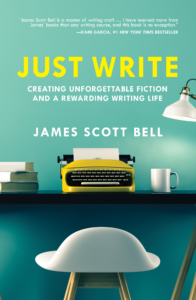
Something new from Writer’s Digest Books.

Just Write cover

I got together with the great team at WD and collected some of my previous articles and posts on writing, added new material and organized everything under two parts. The first part is about kicking up your fiction writing not just one notch, but several; the second is about enjoying your writing life, making it all it can be. The book is available at your local bookstore and online:

AMAZON I BARNES & NOBLE I KOBO I iBOOKS I GOOGLE BOOKS

Sometimes I’m asked why I teach writing. Here’s my answer.

I teach because I know what it feels like to be an unpublished writer wondering if he has the stuff. For about ten years after college I was of the belief that writing fiction could not be taught. I’d been told that writers are born, not made. I was warned not to waste money on craft books.

But when I went to see Moonstruck one afternoon with my wife, the urge to MV5BMjIwMDY0NzYyMF5BMl5BanBnXkFtZTcwOTE5NDk0NA@@._V1_SX640_SY720_write hit me again with full force. That film bowled me over with its originality, characters, dialogue, and heart. I wanted so much to be able to write something that would make people feel the way I was feeling. I was a practicing lawyer then, so mostly I was making people feel irritated. But I said to myself, “Self, you learned the law by studying. Let’s just see if you can learn to write the same way, despite what those naysayers told you. At least give it a shot!”

I began with screenwriting. The seminal book was Syd Field’s Screenplay. He broke down the three-act structure, and I spent a year watching movies, timing them, figuring out what happens at various points, and why. Field, however, had a notion about the first “plot point” that was not entirely clear to me. He said it “spins the action” into a different direction. I felt there had to be something more to it than that.

So I intensified my study on that structural point. And one day it hit me. What has to happen here is some event that forces the Lead into the confrontation of Act II, and is vitally connected to the main conflict of the story. It is also a place from which the Lead cannot retreat. It was like going through a doorway of no return. I tested this against classic movies, and lo and behold, there it was.

I got so excited about this I began to share the Doorway of No Return theory with other writers. They’d stroke their chins and think about it and then say, “Yeah. I see that.” And when they saw, it made me all the more jazzed.

So I kept studying, trying things, creating techniques for myself. When something worked, I journaled about it. I was like Dr. Jekyll keeping track of all the experiments on himself. Only instead of turning into Mr. Hyde I was becoming a writer of saleable prose.

After landing a five-book contract I began to teach at conferences, and started writing articles for Writer’s Digest. Later, I was the WD fiction columnist. And all the time I had this in mind: I wanted people to know it CAN be done. You CAN learn the craft. You CAN get better. The naysayers are touting a Big Lie! Don’t believe it!

And I’d hear from folks that they were learning and growing and getting agents and contracts and hitting bestseller lists. The Big Lie was dead!

In fact, the day I wrote the above paragraph (Friday), I got this tweet:

So keep writing, friends. Keep learning. Those are parallel tracks. I keep on both of them myself and have ever since that day I walked into the sunlight after seeing Moonstruck. I still get pumped about trying things and figuring out what works, what makes my own fiction better. And I still love to share what I learn with fellow writers, as do all my blogmates here at TKZ.

That’s why I teach writing.

First Page Critique: REBORN

By Joe Moore
@JoeMoore_writer

Today’s First Page Critique is called REBORN. My comments follow. Enjoy.

Back arched, pointed ears swept backwards, Archenon knelt before the High Queen in the Great Hall of Êvina. 

“Please—I beg you. Let me go.” An intricate braid of ebony hair lay heavy along his spine. The piece of parchment crunched between his hands, folded and read so many times that it had begun to crumble.

The High Queen of Aradria, his mentor Rhonja, looked down on him. “You know I can not.” She smoothed out a fold on her silky dress, which was fitted to perfection. It hugged her slender form, mirroring the blinding hall in its purity. Her hair, shining like starlight, wafted about her shoulders.

His imploring emerald eyes met hers from the bottom of the crescent staircase leading up to the white throne. A vast mosaic of Her Majesty’s Royal Crest lay fixed in the wall behind her—four petals aligned to the cardinal points held each other under the protection of a circle representing Spirit, the High Queen’s element. 

Archenon swallowed hard. “I have given you my life, and now the last tie to my heritage is to be torn away. Is there nothing I can say to make you change your mind? I want to see my mother one final time.”

Rhonja had never reciprocated Archenon’s feelings, but he thought she cared for him enough to allow this one request. She was the epitome of hope for her subjects, yet she would crush his. 

“You do care for me, don’t you?” he asked.

“Of course. I treasure you,” she replied, her brilliant gaze a calm ocean at twilight. But her words were scant comfort. 

Shafts of light pierced between the half-drawn purple drapes hanging over the arched windows. Elegant pillars of creatures, cunningly carved, held up the vaulted ceiling. Gryphons, mermians, dragons, elves and other beings stared at him with marble eyes. It was as if they fought to keep the very building from crashing down on him. More than ever, the immensity of the white hall felt intrusive and distinctly foreign. 

Archenon was afraid he would never belong anywhere. Not here, in this land where the trees were few and the ocean lapped around every edge of the border. Not even in his first home, deep in the woods of Elfen Harrows, in the realm of fire. Not an easy thing for an elf to admit, and he shivered with a sudden fear.

—————————-

I have great admiration for anyone who writes science fiction and fantasy. The author of these genres takes on an additional burden that the rest of us rarely do—world building. While the rest of us write about a world that we all know, sci-fi and fantasy worlds usually have a whole new set of rules.

Not only does the author have to lay out the rules and landscape, but it must be done right up front—at least within the first chapter or so. AND the author must identify the protagonist, possible antagonist, conflict, fear, story question, and the hero’s “need” at the same time.

Overall, this first-page submission accomplishes those tasks. I’m not saying it’s ready for prime time, only that all the ingredients are there. Even though it reads like a first draft, it kept my interest, and I would certainly read on.

There is a fine line between underwriting and overwriting. Underwriting drops the reader into a scene and advances forward with little or no delay (Jim Bell’s “Act first, explain later”). Overwriting drops readers into a scene and bounces them around like a pinball. In the case of this submission, I feel the scene was overwritten. The writer is trying to cover as much world building as possible in a page or two. But this is the burden I mentioned before. And the skill to do so must be acquired. Bottom line: it’s hard. What this sample needs is just a good, clean rewrite to smooth things out. That should not be a problem. Here are the ingredients that I found in the first page, and why I think this is a good effort.

Protagonist: Archenon
Possible antagonist: Rhonja
Conflict: Rhonja will not let Archenon “go”.
Fear: Archenon is afraid he would never belong anywhere.
Story question: Will he be able to see his mother again.
Need: Escape.

That’s my take on REBORN having only read one page. Tell us what you think. Would you read on? Thanks to this brave writer for submitting to our Thursday First Page Critique.

Give your manuscript a running start

By Joe Moore
@JoeMoore_writer

Whenever I disclose to someone that I’m an author, the response is pretty much the same: “I’ve always wanted to write a book.” Or “I’ve got a great idea for a novel.” Despite all the would-be authors out there, not every potential novelist actually gets to the writing stage. And even fewer produce a finished product. But for the ones who not only have an idea but are burning up with a desire to put pen to paper, I’ve put together a basic outlining technique that might help get things started—a simple list of questions to kick start a book. Answering them can give writers direction and focus, and help keep them going when the wheels sometimes come off the cart along the way. To continue my Writing 101 series, here goes:

  • What distinguishes your protagonist from everyone else?
  • Does she have an essential strength or ability?
  • How could her strength cause her to get into trouble?
  • Most stories start with the protagonist about to do something? What is that “something” in your story, and what does it mean to her?
  • Is that “something” interrupted? By what?
  • Is there an external event or force that she must deal with throughout the length of the story?
  • How is it different from the original event?
  • How will the two events contrast and create tension?
  • Does she have a goal that she is trying to achieve during the course of the story?
  • Is it tied into the external event?
  • Why does she want or need to obtain the goal?
  • What obstacle does the external event place in her path?
  • What must she do to overcome the obstacle?
  • Does she have external AND internal obstacles and conflicts to overcome?
  • How will she grow by overcoming the obstacles?
  • What do you want to happen at the end of your story?
  • How do you want the reader to feel at the end?
  • What actions or events must take place to make the ending occur the way you envision?

This outline technique has less to do with plot and more to do with character development. Building strong characters around a unique plot idea is the secret to a great book. Once you’ve answered the questions about your protagonist, use the same technique on your antagonist and other central characters. It works for everyone in the story.

These are general questions that could apply to any genre from an action-adventure thriller to a romance to a tale of horror. Answering them up front can help to get you started and keep you on track. Armed with just the basic knowledge supplied by the answers, you will never be at a loss for words because you will always know what your protagonist (and others) must do next.

Can you think of any other questions that should be asked before taking that great idea and turning it into a novel?