The So-What

by John Gilstrap

If you’re around this writing biz long enough, and attend enough seminars or classes, sooner or later you’re going to hear about the three-act structure.  I’m of the belief that there are no hard and fast rules in the world of fiction-writing—that if it works, it works—but it’s pretty hard to tell any story without a beginning, a middle and an end.

Now, the Syd Fieldses of the world embrace a form of the three-act structure that is far more draconian and, frankly, intimidating than mine.  Truth be told, looking back on 17 published novels, I would be hard pressed to identify precise act-to-act transitions in any of them.  I think more in terms of setup, development and climax.  Or, as I wrote above, a beginning, a middle and an end.

A few weeks ago, as I was teaching a two-hour writing seminar in Alexandria, Virginia, I was smitten with the notion that, structurally, there’s another critical element of successful storytelling: the so-what.  It’s a little hard to define, but it goes to the heart of what makes an otherwise well-told story fall flat, and what makes some mundane storytelling very successful.  In my view, it’s the missing element that renders a lot of so-called literary fiction to be under-performers at the cash register.

A successful so-what leaves readers satisfied that the time they invested in the reading was well-spent.  After investing a few hours (or a lot of hours) into reading a story, I need to feel that the characters I’ve bonded with have changed somehow, and that their journey has left their slice of the world somehow changed.  Brilliantly-painted word pictures and navel-gazing angst all have their places, but the absence of a good so-what leaves me, as a reader, a little angry at the author.  Would it have killed the writer to include an identifiable story along with the beautiful words?

Every year at ThrillerFest in New York City, International Thriller Writers Association sponsors an event called Pitch Fest, where attendees can carve out face time with NY literary agents to pitch their book ideas.  Last year, I agreed to participate in Practice Pitch Fest, in which I would sit where an agent would later sit and help writers hone their pitches.  It was a real eye-opener for me, not least because, never having had to pitch, I don’t know that I could do it.

After sitting across from fifteen, maybe eighteen authors, the most common weakness among the pitches I heard was the lack of a solid so-what.  Consider:

My book is based on my mother’s brave effort to conquer cancer. The so-what questions here are, how was your mother’s fight more brave or essentially different than every other mother’s fight to conquer cancer?  Why are you and you alone the right person to write this book?  What will the reader take away that is different from other books about parents’ brave struggles with illness?  Actually, this is the problem with most memoirs.

An emotionally scarred New Orleans detective stalks a serial killer who preys on tourists in the Big Easy.  Emotionally scarred detectives have been done to death.  The New Orleans beat is covered by countless gumshoes already, and serial killers are ubiquitous in crime fiction.  The so-what in a story like this could be the evolution of the detective over the course of the book from good to bad, or bad to good.  Or that the serial killer is of a nature that we’ve never seen before.  But without the so-what, the idea is just another serial killer book.  Been there.  Ho-hum.

Sometimes, the so-what has little to do with plot and everything to do with character.  For some mysteries—but no thrillers I can think of—the so-what is as simple as letting readers spend a fun few hours with characters they have come to love over the years.  But that’s a tough hill to climb for Book One.

So, does this make sense or am I all wet here?  Can you think of a book you disliked yet you thought you were going to love?  No need to name names, but when a book leaves you flat, what is the most likely missing element?

Fair warning: When this post appears, I will be in Las Vegas at the SHOT Show, researching what new toys Jonathan Grave needs to add to his arsenal.  I will accordingly be slow to respond to comments.

The Dénouement: Tying Up
the Yarn Strands of Your Story

It is the loose ends with which men hang themselves. — Zelda Fitzgerald.

By PJ Parrish

Another sleepless night. But – hazzah! – another idea for a Kill Zone post. Two nights ago, unable to stop the hamster wheel in my head, I took my pillow out to the sofa, hit the remote, and trolled for a good movie. Nothing except…

The last half hour of Spike Lee’s Do the Right Thing. Now I hadn’t seen the movie since it came out in 1989 and while I didn’t remember all the characters and plot points, I did remember that climax. And that is where I came in the other night, right when the tensions and heat in the Brooklyn neighborhood boiled over, leading Mookie to throw a trash can through the window of Sal’s pizza joint. All hell then breaks loose.

Spike Lee choreographs this climax with chilling precision. But what interested me was what came after. The next day, Mookie and Sal, standing in front of the smoldering ruins of the pizza joint, argue then reach a tepid reprochement. But Lee adds a coda of the local DJ (Samuel Jackson) greeting his listeners with the admonishment “Wake up! Up you wake, up you wake, up you wake! It’s gonna be another hot day.” Then before the credits roll, Lee gives us two quotes — from Martin Luther King Jr. on peaceful protest and Malcolm X on violence as self-defense.

That’s when I got up and jotted some notes for this blog. Because I think the ending of Do the Right Thing is a great departure point for a talk here about the dénouement.

De-noue-what?

You’ve probably heard this term bouncing about in craft books or maybe on conference panels. But I’m not sure we really know what it is or how we should use it in our books.
First, let’s learn how to say the sucker: It’s day-new-moh.

http://www.youtube.com/watch?v=dXbsK7eHirk

It comes from the Old French word desnouer, “to untie” and the Latin word nodus for “knot”. It’s the part of the story that comes after you’ve built up your conflicts in a rising arc of tension and blown up your plot in a giant fireball of gun fights, car chases, lovers’ quarrels, dying zombies or melting Nazis (I also watched Raiders of the Lost Ark this week). The dénouement is what comes after the climax, wherein you the writer have to tie up those loose plot ends, slap on some salve, leach out the suspense and resolve things into a nice satisfying conclusion.

Or maybe not. But we’ll get back to Spike Lee in a second. For now, let’s stick with conventional dénouements.

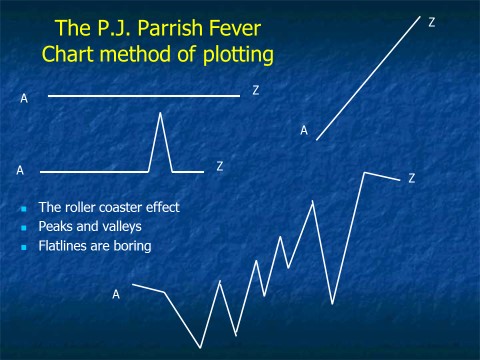
Above is a slide from one of our workshops. We’re making the point here that a good plot is never a flat line or even a comet-shot straight upward. It is like that fever chart at the bottom — a series of triumphs and setbacks for your hero but its main thrust is always upward toward the climax. And that little downward line out to Z is just the denouement.

Think of the dénouement as a coda to the big movements that precede it. It is a tail on the plot beast, but still important because it is where things are explained (if necessary) and secrets revealed (sometimes). Shakespeare was big on dénouements: In Romeo and Juliet, after the lovers are dead, the Montagues and Capulets gather and Escalus lays a big guilt trip on them all telling them their feud is to blame. At the end of Hamlet, with the stage strewn with bodies, Horatio shows up to remind us that the voices of angels will carry Hamlet to his heavenly rest, meaning his story – and thus he – will live forever.

To use a metaphor: Your climax is well, like a climax. The dénouement is smoking the cigarettes afterward.

Maybe it’s useful to stop here and think about the THREE-ACT STRUCTURE. James and others here at TKZ talk about this a lot, so if you aren’t familiar with it, pick up James’s books on plot structure or go troll through our archives. Here’s the skinny over-simplified: The first act is your set-up wherein you introduce characters and their world, set up your plot, and define the main conflict that is the hero’s call to action. The second act is “rising action,” a series of events and setbacks that build up to the climax. The third act is the turning point and climax that requires the hero to draw on strengths, confront the antagonist and solve the problem at hand. Then we move into “resolution” where conflicts may be fixed, normalcy restored, and anxiety (for the reader) released.

The dénouement is a big deal in traditional detective stories. You will often get at the end of the story Holmes or Poiret laying out the clues and explaining how they figured things out.
One of my favorite detective dénouements is from Psycho. The climax has Norman, dressed up as Mother, trying to stab Lila in the creepy cellar. But what comes next is the scene in the courthouse where the psychiatrist explains what happened to Norman.

https://www.youtube.com/watch?v=abAsTTC9puk

It’s hokey, yeah, but we need to understand how Norman got so twisted. Likewise, you might need such a useful scene to help untangle the yarns of your plot at the end.

My sister Kelly and I are struggling with this notion right now with our WIP.  We’re at the climax wherein our hero confronts the bad guy and triumphs, of course. The bad guy has to die. But we realized that while we knew why our antagonist had rotted from within (and you need to know this!) we had no one in our cast of characters to explain it to the reader.  Yes, the hero can surmise things about the bad guy, and you need to sow the clues of personality throughout the story. But sometimes, in the end, someone — like the shrink in Psycho — has to give it context and history.  So we went back and inserted a new character early in the book — hidden in plain sight — who will, in a denouement, give testimony.

There’s a great example of dénouement in Arthur Miller’s Death of a Salesman. After the climatic fight between Biff and Willy and Willy’s suicide (to get insurance money) there is a final scene called “Requiem” where the family gathers at Willy’s funeral. Sadly, no one has come to pay their respects. Biff laments that Willy had “the wrong dreams.”  And Willy’s wife, who has been able to cry, breaks down, sobbing that the house is now paid for, repeating “We’re free…we’re free.”

Both Terminator movies have nice dénouements. In the first one, Sara Conner in her Jeep, guns and dog in tow, pulls into a last-stop desert gas station where a young boy points to the darkening sky and says “a storm is coming.” Sara’s last line before she heads off toward the apocalypse — “I know. I know.”  In the sequel, the dénouement is the “good” Terminator lowering himself into the fire pit to destroy his microchip and thus save the world.

Another of my favorites is from The Shawshank Redemption. After Andy Dufresne escapes from prison and disappears, the story is essential over and all is resolved. But no…we are treated to his friend Morgan Freeman’s touching narration about going free: “I hope the Pacific Ocean is as blue as it is in my dreams.”

We can debate this, but I think a denouement is different than an epilogue.  An epilogue is an animal unto its own world, a specific literary device that has a special purpose, often yoked with a prologue.  The denouement usually takes places immediately following the climax and resolution; an epilogue is usually separated by time — week, months or years later. Sometimes it hints at a sequel to come, or it serves as a commentary of sorts on what has happened. It might sum up what happened much later to the characters. Think of way George Lucas used this device in American Graffiti — as the credits rolled, he shows graduation pictures of each character and listed what happened to each i.e. “Curt Henderson is a writer living in Canada.”

A good denouement is subtle. What you don’t want to do is end up with an extended “Now I have to explain why I have to kill you” speech. This is not a true denouement; this is just a bad climax.  The skeins that you weave as you move through your story should come together in a logical and satisfying pattern.  And if you have some little loose threads that might poke out after that — well, that’s what the denouement is for.

But then there’s the big question: Do you have to untie every knot? Do you have to snip off every loose thread? No, of course not. I love ambiguity in endings. I don’t like anal books that clean up everything. And truth be told, I don’t really enjoy those classics mysteries where the detective gathers everyone in the dining car and lays it out there.  I want to figure some things out for myself. And I crave some messiness in my fiction.  Not all stories are neat; not all storytellers color within the lines.

Which brings me back to Spike Lee and his denouement for Do the Right Thing. It doesn’t tie up anything in a pretty bow.  In fact, Lee rejects the whole idea of traditional closure. Mookie and Sal are left in a wary face-off that personifies the unease of race relations in general in this country.  The mayor (Ossie Davis) tells Mookie to “do the right thing” but no one in this story really knows what that is, which is the only thing that is clear at the end.  So what can Spike Lee leave us with except the denouement he offers — two powerful and deeply conflicting quotes from King and Malcolm X.  And a final picture of them shaking hands?

Some knots just defy untying.


The Fear Factor

“Do one thing every day that scares you” – Eleanor Roosevelt

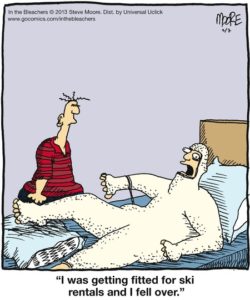
I’m writing this blog post on Thursday in anticipation of a long weekend in which I am (finally!) going to learn how to ski (cue drum roll…) I’m sincerely hoping that come Monday when this blog post will be posted, I will have survived the experience in one piece (no broken bones, smushed body parts, or too many bruises at least). The hardest thing for me will not be the physical aspect (although, to be fair, I am immensely uncoordinated) but the mental ‘fear factor’. I’ve been cross country skiing before and loved it – basically you get to hike with skis on and you don’t have any shrieking speed issues unless you take a wrong turn. Actual downhill skiing, however,  is quite another thing –  something that involves overcoming my fear of speed (or, more precisely, careening out of control).

My husband snowboards and my boys have been taking skiing lessons since we moved to Denver so I’m the last hold out (if you don’t count our collie Hamish, who, to be sure, would love it if he could have skis on his paws).  It seems strange to me that I think nothing of moving continents or taking risks with my writing, but skiing (like bicycle riding) remains a definite ‘fear factor’ to overcome. I managed to combat my fear when it came to bicycle riding (although I’m still a slow poke!) so I’m sure I’ll survive skiing – the question is whether I can overcome fear to actually enjoy it!

I’ll keep you all posted, but, hopefully, by the time this posts on Monday and I can respond to comments, I will have mastered the basics of downhill skiing!

So TKZers, what is your ‘fear factor’ and are you planning on overcoming it in 2017?…If so, how?


Epic Intimacy and Point of View

by James Scott Bell
@jamesscottbell

We have a first-page critique today, from which I want to draw a lesson about intimacy in Point of View, especially in epic fantasy novels. Here’s the clip:

REBORN

Chapter 1

Back arched, pointed ears swept backwards, Archenon knelt before the High Queen in the Great Hall of Êvina.

“Please—I beg you. Let me go.” An intricate braid of ebony hair lay heavy along his spine. The piece of parchment crunched between his hands, folded and read so many times that it had begun to crumble.

The High Queen of Aradria, his mentor Rhonja, looked down on him. “You know I can not.” She smoothed out a fold on her silky dress, which was fitted to perfection. It hugged her slender form, mirroring the blinding hall in its purity. Her hair, shining like starlight, wafted about her shoulders.

His imploring emerald eyes met hers from the bottom of the crescent staircase leading up to the white throne. A vast mosaic of Her Majesty’s Royal Crest lay fixed in the wall behind her—four petals aligned to the cardinal points held each other under the protection of a circle representing Spirit, the High Queen’s element.

Archenon swallowed hard. “I have given you my life, and now the last tie to my heritage is to be torn away. Is there nothing I can say to make you change your mind? I want to see my mother one final time.”

Rhonja had never reciprocated Archenon’s feelings, but he thought she cared for him enough to allow this one request. She was the epitome of hope for her subjects, yet she would crush his.

“You do care for me, don’t you?” he asked.

“Of course. I treasure you,” she replied, her brilliant gaze a calm ocean at twilight. But her words were scant comfort.

Shafts of light pierced between the half-drawn purple drapes hanging over the arched windows. Elegant pillars of creatures, cunningly carved, held up the vaulted ceiling. Gryphons, mermians, dragons, elves and other beings stared at him with marble eyes. It was as if they fought to keep the very building from crashing down on him. More than ever, the immensity of the white hall felt intrusive and distinctly foreign.

Archenon was afraid he would never belong anywhere. Not here, in this land where the trees were few and the ocean lapped around every edge of the border. Not even in his first home, deep in the woods of Elfen Harrows, in the realm of fire. Not an easy thing for an elf to admit, and he shivered with a sudden fear.

***

The genre here appears to be epic fantasy, so I’ll be making my remarks based on that assumption. The excerpt has a rich style (which we’ll discuss in a moment) and what I like about it is that everything is woven into an immediate scene, with great tension–a disturbance, which is the best way to hook a reader from the start. I’ve seen too many manuscripts of this type that begin with some meandering journey down a mountain, through a valley, or on a horse. Nothing much happens as the world is built. I like this author’s approach much better.

So let’s talk about how to render this approach as effective as possible.

POV

The first four paragraphs are Omniscient POV. You can tell because the author describes things that the main character, Archenon, cannot see. He cannot see his own ears, his ebony hair, or his imploring emerald eyes. It’s only when he swallows hard, and we get a glimpse of his thoughts, that we move into the more intimate Third Person.

My main suggestion is that the author render the entire section in Third Person POV. That will create more empathy, more connection, between reader and character. No matter the genre, we want to do everything in our writerly power to deepen the reader-character bond. I don’t see a reason to keep distant via Omniscience.

Let me quickly add that in epics I do think Omniscient POV can be well utilized, but it’s usually when the author describes setting (world building) or recounts a history. I also recognize that epic fantasy fans are tolerant of long passages of Omniscient-style narrative. But for those of you contemplating that style, my suggestion remains: set us first inside a character, and then do the building. This is what James Clavell does in the opening pages of Shogun. He gives us some history and description and context but only does so after this gripping opening line: The gale tore at him and he felt its bite deep within and he knew that if they did not make landfall in three days they would all be dead.

Now we’re set. We’re inside a character. And when Clavell recounts historical detail, we get the impression it is coming from the protagonist’s own knowledge.

So, author, can you get us into Archenon with more immediate, sensory, deeply-felt detail? I think you can!

Let’s take a look at this paragraph:

Shafts of light pierced between the half-drawn purple drapes hanging over the arched windows. Elegant pillars of creatures, cunningly carved, held up the vaulted ceiling. Gryphons, mermians, dragons, elves and other beings stared at him with marble eyes. It was as if they fought to keep the very building from crashing down on him.

Notice that we don’t get the POV clue until the middle, with stared at him. See how that keeps us at a bit of a distance? These little things add up. Instead, do something like this:

Archenon winced at the shafts of light piercing the half-drawn purple drapes having over the arched windows. He averted his gaze to the elegant pillars …

Let me suggest you go through your entire manuscript looking to make the POV more intimate. Watch for paragraphs the open without a POV clue in it.

STYLE

I do think the author has an innate handle on fantasy style. It’s rich and evocative. I liked a lot of it.

One suggestion I do have is to look over every description and make the tone consistent with the feeling you want in the scene. For example, these lines: Gryphons, mermians, dragons, elves and other beings stared at him with marble eyes. It was as if they fought to keep the very building from crashing down on him. More than ever, the immensity of the white hall felt intrusive and distinctly foreign.

Look how the sentence in the middle works against the other two. Rather than fighting to keep the building up, try: It was as if they were waiting for the right moment to bring the building crashing down upon him.

That way the sentence adds to the menace of the scene, rather than relieving it.

Also––and I only mention this because it’s the very first sentence––I was thrown off by the pointed ears swept backwards. It’s a jarring image. If they are sweeping backwards, that’s one big set of ears! I know it turns out Archenon is an elf, but we can wait for that information. (You could insert a bit about Archenon feeling the heat in the points of his ears…)

These are the sorts of things you pick up when you revise. I’ll say again, this is a good foundation––an actual scene and a rich style. Make it more intimate and I’ll want to keep reading.

Your turn, TKZers. What did you think? 

The Legos Theory of Storytelling as Applied to Turkish Television. Seriously.

Happy 2017! I spent the holidays reading almost nothing, writing a lot, and engaging for better or worse in self-reflection.  I concluded that the best thing I could do for myself and for my work was to go back to basics.

What follows is aimed more at those folks in our audience who are struggling with getting that first novel done. It is easy enough to explain in the context of childhood: rather than struggling to build a motorized crane using an Eitech Erector Set, I need to grab a box of Legos and start building little cars and and people and such, working my way forward by starting with the small and simple and building gradually, but steadily.

I came to this conclusion after watching two television series. You’ve almost certainly heard of one, and probably have never heard of the other. Our own Kathryn Lilley discussed Westworld on this blog a few weeks back. It was beautifully filmed, intricately plotted, startling, and full of surprises. The major rub against it was that it was difficult to understand what was going on from episode to episode. I still have a little callus on my thumb from rewinding it to pick up certain plot nuances that I missed. There were several — maybe a dozen — plot lines that spun off in different directions, some of which were relevant to the story, others which seemed to have been included simply to create a mood. All of them were interesting, but only a few minutes were devoted to each at any one time. Characters? More characters had been introduced by Episode Three than I could keep track of. I found it to be worth working through it — it raises some stunning and yes, frightening issues concerning reality, mortality, and other areas — but the general consensus seems to be that it arguably is a series that more people heard about than actually watched.

The anti-Westworld, if you will, is a series available on Netflix called Kacak (“The Fugitive”). If Westworld  is the result of the Eitech erector set I referenced at the beginning of this post, Kacak comes from the basic box of Legos, and it is wonderful. Kacak is a genre-blurring television series produced in Turkey, throwing together elements of thriller, suspense, romance, drama, and yes, a bit of comedy to create a slow-boil story that sucks you in and doesn’t let you go. It is subtitled, but the story is simple enough, and the acting is good enough, that one could glean the context without it. It begins in a remote Turkish village where a man named Serhat operates a tea shop. He is loved by everyone around him, and one gets the sense of “why” from his interaction with his clientele and another shopkeeper. For his own part, Serhat is devoted to his wife and their young son, who somehow in a few moments becomes the cutest little guy to ever walk the face of the earth. All of this communicated with a few minutes of interaction here and there over the course of a day or so. Just when you think you’ve stumbled into an episode of Lassie, however, Serhat interjects himself quite forcefully into a dangerous situation. He is immediately hailed as a hero throughout his village; when news of Serhat’s heroism spreads to Istanbul, however, a danger from his past — a past of which even his beloved wife knows nothing — quickly intrudes and irrevocably blows up Serhat’s perfect life. Does this sound familiar? Sure. The movie A History of Violence explores a similar theme, as does Charles Dickens’ A Tale of Two Cities. Kacak goes further, however. Serhat vows revenge. As Serhat carries out his plan — and attempts to put what is left of life back together — the audience learns about his past, in dribs and drabs, not in meal courses but in tapas or dim sum, small portions which are easily digestible and brought out over the course of the very long meal, where the surprises keep coming. To put it another way: just when you think you’ve reached the smallest Russian nesting doll, there’s another one within.

Kacak does all of this without a big budget, or, interestingly enough, without nudity, graphic sex, or (much) gratuitous violence. Some of the acting is a bit stilted, and there are momentary but noticeable lapses of continuity, to the extent that on occasion the series is unintentionally funny. That is part of the charm of it, however. It isn’t subtle or nuanced for the most part. What it does, however, and does very well, is tell a story.

I will be the first to acknowledge that I am not much of a teacher. If I have a strength in the area of education it’s the ability to point people to something that will illustrate, quickly, how something is done. If you are having trouble getting your story off of the ground, or that you are getting bogged down under the weight of your own plot, or are having trouble keeping your characters straight, hijack the family Netflix account from your teenager and watch at least the first few episodes of Kacak. I have watched the first ten — Netflix lists fifty — but you can learn a lot just by watching and studying the first three or four. I think, however, that you will want to eventually watch the whole series, which takes that little box of Legos and slowly builds from it, using just a few parts at a time.

My question for you: is there a television series you use to jumpstart your writing, to clear the cobwebs, whatever? My own answer: in addition to Kacak…True Detective: Season One, which I have practically committed to memory (time, indeed, is a flat circle). You?


First Page Critique: “A Stranger”


Critiqued by Elaine Viets

The writers at TKZ regularly volunteer to critique the first page of a novel. We have a big backlog. Congratulations to the brave writer who submitted this first page critique. My comments follow the work.

A STRANGER

This is a story about Timothy Frame, a man who saw the world in decimals and dollar signs. A man who, unable to prescribe himself with any wondrous adventures of his own, was often fond of basking in the adventures he could find inside of his television set, or his relatively new cellphone, which shined just as much now as it did when he first bought it.
This is a story of a man who wore his tie in a single-Windsor knot and could tie it with his eyes closed. A man who could never bring himself to care enough to fork over the seventy-five cents for a local newspaper, but was often bored enough to gaze upon their front pages during his time spent in the queue at his local Starbucks.
This is a story of a man who was proud of the urban-themed wall hangings and area rugs that he had decided, after a long and arduous debate within himself, would define his personality far better than any of the other eclectic, mass-produced items found in that particular section of the Pier One store, located down the street from his one-bedroom apartment.
This is the story of Timothy Frame, who had planned his entire existence, down to the last retirement dollar, and even down to the very slab of stone that would inevitably bear his name and a couple of dates, separated by a single hyphen. Timothy Frame, who had proportioned his life evenly and would measure those proportions accordingly on a day-to-day basis. Timothy Frame, whose teeth had always bled when flossed.
He threw the bloody clump of thread into the wastebasket and carefully placed the box of floss into the wooden drawer beneath his enamel-coated sink. Spitting one final time into the pricey-looking bowl, he thought to himself.
“$99. Money well spent.”
It wasn’t marble, though that didn’t bother him. It looked enough like it to satisfy him. If anyone else were to ever come over, they might fall for the lie at a quick glance.
“This guy owns a marble sink,” they would think. “He’s going places.”

ELAINE’S COMMENTS: You have an interesting essay here. You’ve given us a character sketch. I like your observations, and the careful details. It’s an entertaining exercise, but it’s not the beginning of a novel. I’m assume that’s what you’re writing.
Help us out, please. Your readers haven’t a clue what kind of novel you’re writing: Is it a crime novel? If so, what kind: a thriller? A cozy? A novel of psychological suspense? A hard-boiled mystery? Give us a hint.
Who is Timothy Frame? Is he a victim? A killer? A detective? How old is he?
Nothing happens, except Timothy flosses his teeth. A novel needs action, but there’s nothing to propel this description forward and let the story unfold.
Please let your readers know that something will happen. You can build on that last line:
” ‘This guy owns a marble sink,’ they would think. ‘He’s going places.’ Too bad the only place Timothy was going was prison. For murder.”
Or, “There was one thing Timothy could not plan: that his carefully measured life would be destroyed by . . . .”
Your readers are lost in time and space: Where are we? In a city? A small town? What is the time of day? What time of year?
We’re not even sure enough about Timothy to know his social status. We get hints he’s working his way up. That’s why he’ s so proud of his faux-marble sink. It looks real. But we need to believe he’s real, too.
There is fine writing here, but we writers often fall in love with our own descriptions. Take a hard look at this description and figure out where you want to go. I’d love to see these questions answered and have you turn this into a real novel.

********************************************************************************************

Time for a Caribbean cruise! Win an autographed hardcover, Final Sail, my 11th Dead-End Job mystery. Enjoy Helen Hawthorne’s adventures on a luxury yacht as she tries to catch a jewel smuggler. Click Contests at www.elaineviets.com

How Not to Treat a Writer (and a Bonus Guide on Building Good Anthologies)

Let me tell you a story.

On December 19th, I received an email through my website contact link suggesting that I might submit a story to an upcoming anthology of “dark and speculative fiction.” Okay, I thought. Sounds like me. Reprints were okay (if the work was requested, and it appeared that mine had been), and there was actually money involved. The stated theme of the anthology was vague and used the phrase “we may be looking for…” But I’m always game for submitting work, and women’s sexuality was one of the mentioned subjects. Okay, I thought. That sounds like me, too. Knowing that the publisher was a legit literary fiction house, I clicked through to the open call for submissions page.

I don’t want to embarrass anyone in this story, so I’m not going to get specific about all of the submission details. The story I had in mind was one I had published in Patricia Abbott’s Discount Noir, and I had long thought of expanding it. I was pretty sure it fit the women’s sexuality/female protagonist bill. Except: The deadline was to be December 30th. Yes, twelve days after I received the email, and only eighteen days after the date on the submission page.

Twelve days! It’s madness to think anyone but a few very motivated writers could put out a finished 2-5K word story in that brief amount of time. Still, I had the story on hand and was thinking of adding only a thousand words or so. As I said, I’m game. Christmas got busy, and I put it on the back burner. After a very relaxing holiday, I worked on it on the 29th and 30th. I’ll confess that I submitted it after midnight on the 30th, but it was still the 30th in Alaska, so I figured I was good. And, if not, no big deal. It was a fun exercise to work on the story.

I received the acknowledgement immediately. All was well. Then, later that same day, the 31st, I received a polite form rejection email.

There’s nothing like receiving a rejection for a story on New Year’s Eve. It was disappointing, as all rejections are. I had a lot of confidence in the story, so it was a little surprising. I went through six stages of story rejection grief, and enjoyed the seventh (an extra glass of wine), and decided the story would be a good addition to the ebook short story collection I want to do later this year.

But, wait! Less than an hour later, I received an email that I had been sent the wrong form email. They actually meant to send the one telling me they were considering the story and would get back to me in a month. They were sorry for the confusion, they said.

Ha! Ha! said I. And forgot about it the very next day.

This past Monday, nine days later, I received my response. They “love” the story, but “have since decided on a theme” that this story doesn’t quite fit. Oh, by the way, maybe I have another one that would suit their newly chosen theme? They only need it by January 16th.

*sigh*

There are so many possible responses. But the one that immediately comes to mind is a less lovely version of WTH? (That’s not the one I sent.)

My work has been in quite a few anthologies the past few decades, and I’ve edited five and published two of those myself. Yet I have never been involved in such an unprofessional exchange.

Publishing isn’t, “Hey, kids! Let’s put out a book!” Well, it can be, but the process needs to stay professional. And it would seem to me that a primary tenet of professionalism would be: Try not to alienate prospective writers.

Here’s a handy list for creating an anthology:

  • Define your theme. Make it broad, or make it narrow. Be flexible enough to push the boundaries a bit if you need to. The narrower your focus, the smaller your natural audience will be.
  • Put together a budget. Will you pay the writers in cash or copies or both?
  • Get a few writers on board that you know well so that if you will be going to a publisher, you have committed work from writers they recognize.
  • Write a proposal whether you will be shopping it to publishers or not. It will give you good guidelines against which you can measure submissions.
  • Find a publisher or, if you’re game and have some knowledge of publishing, put it out there yourself. How will it be distributed? Through regular distributors? Online vendors?
  • Decide if you want all original work or reprints or both.
  • Plot out a schedule backwards from your desired pub date. Give yourself three-four months before the actual pub date to assemble, edit, copyedit, and format the stories. Writers often miss deadlines. Build in an extra month for dawdlers or disaster. Allow writers three to six months for writing. It might as well be three because 90% of them will write the story in the last available month.
  • Scheduling six to nine months to put the whole thing together is reasonable. This is variable of course. Using all reprints may be faster—but often the writer will need to get permissions from another, larger publisher. And the larger they are, the slower they are. (It took seven weeks to get permission from one publisher for a Surreal South anthology, and we almost had to drop the story.)
  • Establish who will be the contact for all authors. Who will do the mailings and keep track of the files?
  • NOW open submissions for your slush pile, and give folks a few months to come up with stories and write them. If you have a solid core of committed writers, you have a head start. If you give everyone three months to write and submit, you’ll have plenty of time to read and choose.
  • Acknowledge submissions.
  • Get someone working on the cover art.
  • Draw up a contract. Do you want exclusive, or non-exclusive rights?
  • Choose the stories. Have a couple runners-up in case some submissions get pulled.
  • In the name of all that’s holy, send the appropriate rejection and acceptance emails to all of the writers.
  • Assemble the manuscript. Make sure all the rights are covered.
  • Plan advertising (or work with marketing dept.)
  • Write cover copy.
  • Have someone write an introduction that teases the theme and mentions all the accepted stories by name.
  • Make any necessary edits and okay them with the writers.
  • Copyedit the stories, send the manuscripts back to the writers for approval. Give them a deadline for getting back to you.
  • Get a blurb or two if you can. Put galleys up on NetGalley, etc. to encourage reviews.
  • Format, print, distribute.

NOTE: This is not a hard and fast schedule for every anthology. Big ones will take longer. Working with inexperienced writers will take longer. If you’re doing an ebook anthology of reprints or one that is very small, you may be able to do all this stuff in a few weeks.

Lisa Morton, Carolyn Haines, and I all wrote our stories for Haunted Holidays: Three Short Tales of Terror and had the book out in paper and ebook on multiple platforms in three months.


The point is, take your time. Think it through at the beginning of the project. Be friendly but professional in your communications with your writers. Admit it if you screw up, but don’t set yourself up for failure by setting unrealistic expectations for yourself and everyone else involved.

As a writer, what’s the worst submission experience you’ve ever had?

Have you ever put together and anthology? How did it go?


Laura Benedict is the author of the Bliss House trilogy of novels. She blogs daily at her website. Visit her on Twitter, too.

Writers Dish On The Topic Of Being “Almost Famous”


A few years ago, I took an LA-to-Tokyo flight. Upon deplaning, I was met by something totally unexpected: a group of smiling Japanese ladies. They surrounded me and shook my hand, while handing me pieces of paper and pens. They kept smiling, while repeating something which sounded like “Ba-ba.” So of course I smiled and nodded back at them, which made the ladies beam twice as enthusiastically.

It eventually became clear that the Japanese women thought I was an American celebrity–some blondish middle-aged celebrity, I guess, whose name sounds like “Ba-ba”. Later my friends and I tried to figure out the name of my mystery-celeb doppelgänger.

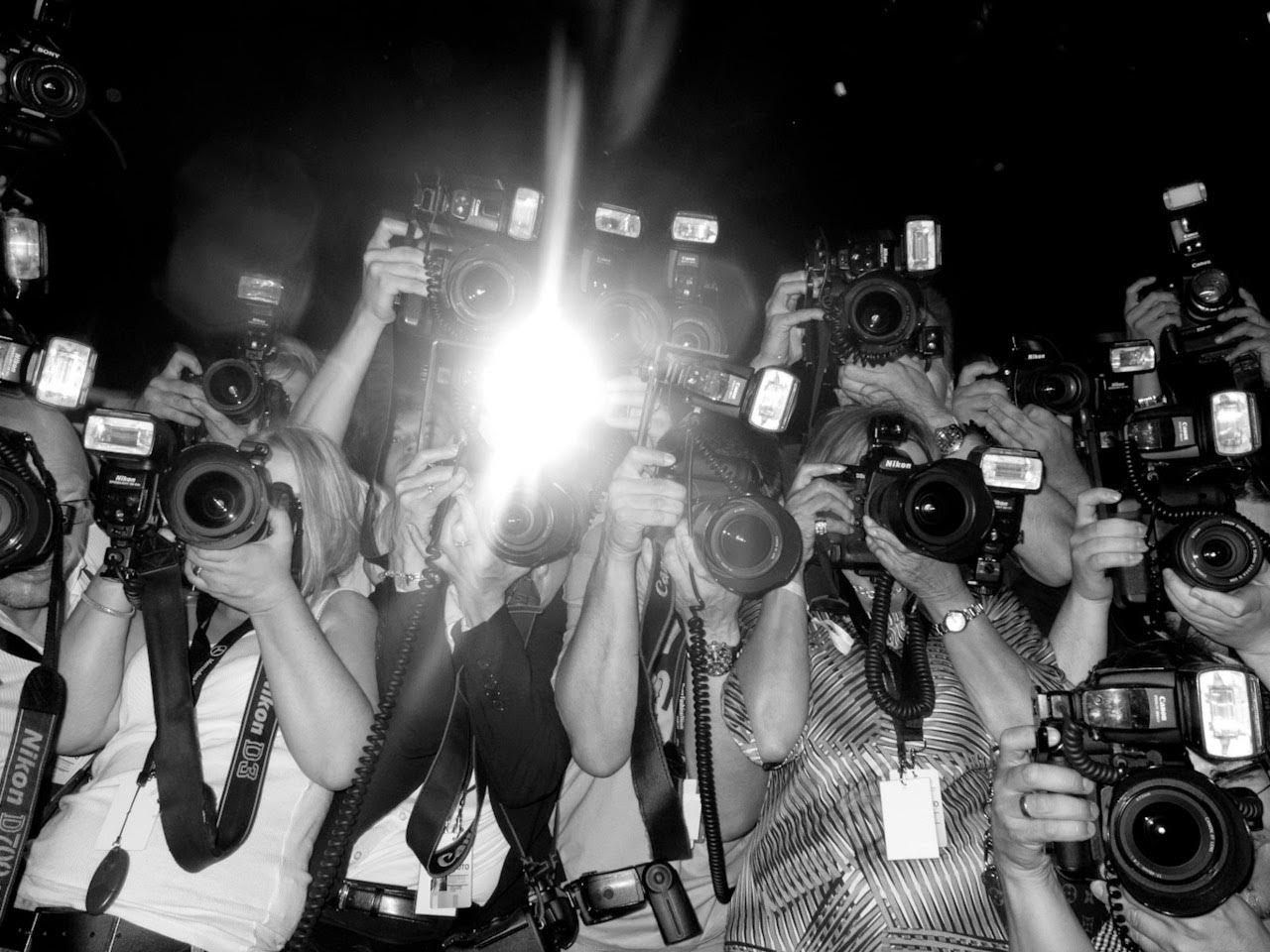
I was reminded of that experience yesterday after reading an article about the subject of being “almost famous.” Because let’s face it–we writers seldom become famous, not in that celebrity-level, red carpet read, paparazzi-magnet kind of way. I think Ernest Hemingway might have been the last fiction writer who could legitimately claim celebrity pop culture status.

Imagine yourself as an A-list celebrity. What would that experience be like, do you think? Share with us!

What Happens When You “Just Write” Without Truly Understanding How a Story Should Be Written

By Larry Brooks

There is an article in the latest edition of Writers Digest Magazine about story structure (written by a story coach), built upon this assumption: human beings innately understand storytelling, because we’ve experienced stories all our lives. It’s in our DNA. This is why stories work, why they touch us and teach us and entertain us.

But it doesn’t remotely empower us to write one. That article, however, would have us believe otherwise. To be fair, the article is otherwise valuable and useful, especially the seven questions put forth about a story, the answers to which will pave the to a structure that will work. Trouble is… the article seems to suggest that it is that natural instinct that will empower the reader to know what to do with the answers.

And that’s where it falls apart. Knowing what your character wants and what blocks the path is different than understanding the key principles of story structural that are already there – you don’t have to, nor should you, try to reinvent them every time you write a story – that propell those answers into the story with dramatic effectiveness.

The article and this assumption imply that anyone can, in fact, sit down and write a novel, presumably by tapping into this natural gift, which, like riding a bicycle, is available only to human beings. Never mind that with other natural gifts, some of us end up being better athletes or musicians or professors… with storytelling, it seems, we’re all in the same creative boat.

To which I say… what is more true is that we all have equal access to learning the principles that could result in you writing a crack story worthy of publication and readership. My hypothesis here, my counter argument, is that unless you engage in a dance with those principles—which are deep and wide and clearly evident in the books you read—you are nowhere near knowing what you need to know to make your story work, at least without spending years trying to get there.

And you can get there, draft after draft, feedback upon feedback, year after year. But even then, your ability to comprehend and implement the feedback that will facilitate how your story needs to change—or simply realize what needs to change on your own, which certainly can and does happen—depends on your understanding of those very same principles.

This is no different than your family doctor of forty years knowing more about medicine than your nephew who just entered med school. Natural DNA gifts aren’t part of the equation.

If you’ve tried this “just write” DNA approach to writing a novel, you may already have formed an opinion about the natural state of the ability of human beings to write publishable stories, versus the accepted principles of storytelling that professionals end up abiding by, almost every time. Perhaps, upon realizing how challenging this is, that you didn’t win the DNA lottery after all. It’s why so many of us have a novel we started and couldn’t finish, or a drawer full of manuscripts that nobody wanted, and perhaps we now understand why.

Or not.

Look Ma, no hands! I’m a natural!

The WD article contends that, using our innately informed sense of story, we are all equipped to sit down and write a story that is within revision-distance—which is a little like shouting distance, only further, like yelling a message from Miami to Houston—from being able to take what you’ve assembled from the first pass and actually suddenly, tapping into that secret DNA, know enough to credibly fix it.

Analogy: you open a jigsaw puzzle without studying the image on the cover, you pour it out on the floor… and then you fix it. But you have to look at the picture to do that within a reasonable lifetime.

Another analogy for those who don’t do jigsaw puzzles, or don’t agree than a novel is at that level of complexity: Imagine you are on an airplane. Suddenly an announcement comes over the PA asking if anyone knows how to fly, because the pilots are inexplicably unconscious. So, because you’ve flown so many times—equivalent to having read a lot of novels in this analogy—and you are the hero of this story, you volunteer to head up to the cockpit, pausing only to throw up in the unoccupied mile-high bathroom next to the cockpit door.

What the heck, you rationalize… if it doesn’t work, I’ll just fix it later.

I’ll just fly.

There is no shortage of writers who adopt this approach toward the writing of a novel. They’ve read hundreds if not thousands of them, so they believe they possess the natural sense of story required to get it right. They regard craft with a grain of alcohol, betting that they can get there from the seat of their pants.

Meanwhile, the clock keeps ticking away.

There are actually three assumptions at work here. 

First, that there actually are expectations and standards and forms and functions within the craft of storytelling, principles that published novels abide by. Principles that all such books demonstrate, once you know what to look for. A published author can explain, for example, why The Girl On The Train works (discussing setup and foreshadowing and subtext and structure and emotional resonance and narrative arc and thematic weight… all the stuff that article contends we innately already grasp), and do so in writerly technical terms.

Readers, however, explain it in a way that only skims that surface: It held my interest. I felt for the girl. I wanted to see how it turned out. I couldn’t’ get it out of my head.

The reader experiences… but the writer knows.

There actually are things we need to know and understand… a deep well of knowledge, in fact, before we can reasonably expect to drive the literary bus. The good news is that it is learnable and accessible, and when you do finally wrap your head around it, you’ll see it bursting from between the covers of every novel you read and film you watch.

Second, that we do indeed—all of us, endowed equally—possess such an innate understand.

Pigs are flying everywhere in the light of this assumption.

Let’s agree that our high school freshman offspring is not yet able to do this, so we can therefore assume that somewhere between the appearance of pubic hair and finishing one’s first pass at Lord of the Rings, the ability to naturally craft stories manifests in our brain cells.

And third… other is that the same sense that results in the brain-drain draft that is part of the initial assumption, is equipped to then fix it through revision. As if this supposedly natural gift, the one that we all possess, can think “oh, that’s what I should have done the first time,” and move toward publishability from there.

Tick tock.

The article then goes on to suggest…

… that anything beyond a learned modeling of story (from the same reading experience that fed the story DNA, I suppose) is reduced to mere formula. Which is assumptively regarded—disregarded, actually—as a bad thing indeed.

Tell that to the halls full of successful romance and mystery authors who are on their twentieth title. Tell them that what they do is formula—because nobody will argue, the linear contextual unfolding of genres in those and other stories is nearly identical in every book—and that it is a bad thing.

It’s not formula. It’s form. Narrative flow. Context. Story arc. Dramatic theory.

We are pressured to abide by the truism that there are no rules in storytelling.

All the Big Names tell us this.

But, ask around. Ask those halls full of successful authors. Ask the crew here at Killzone. “Rules” is just a word. What is present within the storytelling proposition is the looming, story-saving imposition of principles, including those that relate to story structure, that are the very thing that become the benchmarks, criteria and targets for which we strive—and must reach—as professional storytellers working genre fiction.

All successful writers use them, even if they don’t have names or labels for them, even if they claim to have summoned the story forth from the depth of their gifted genius.

On top of the basic principles, there are specific principles that create expectations within the various genres. The author doesn’t tell us that we are born with those, too… that Nora Roberts was a born romance author, but not so much when it comes to… wait, she is a killer mystery writers, too, and I bet she could know a time travel story out the part, too.

Because of what she knows.

Literary fiction… there are principles there, too. A bunch of them, in fact, just like us. It actually gets more airtime out there, which becomes a sort of toxin in the learning experience of new authors, who buy into the notion that it is all about the hero, and the other characters. But that’s a loaded statement… not wrong, per se, but in genre not yet right enough. In genre fiction, it’s all about the dramatic arc, fueled by something conceptual, that becomes a window through which we manifest and observe characters and their story arc.

Where in the DNA mind-map does that little subtlety show up?

No, that is something we must learn.

Without a plot fueling our genres (thrillers, mysteries, romances, fantasy, science fiction, and all the mashups you can think of) that is infused with a hero’s problem/quest/journey, in the face of something antagonistic that seeks to block their path (or kill them), and with significant, emotionally-resonant stakes motivating everyone on both sides… without all that, we are left with the biography and episodic adventures of a fictional character, with little to root for.

Without rooting, all that’s left is observing. And outside of literary fiction, that doesn’t work.

We must learn that, as well.

It’s like the difference between staring at and analyzing a still photo, versus being swept away by a motion picture driven by those same story elements and essences.

So no… we’re not born with that sensibility. I’ve worked with hundreds of new writers, really smart people with big brains and big ideas, who didn’t have a clue. Who write 200 pages of setup in in 380-page manuscript. That write “the adventures of” their own life, or a span of it, that amount to nothing more than a diary, without the slightest connection to a dramatic spine or the posing of a dramatic question.

Did you know, when you started, deep in your gut, in your DNA, the same storytelling DNA that the WD article claims will take you the promised land… that a story unfolds in a series of differing contexts which are non-negotiable (labeled as parts or acts), one bleeding into the next, and that there are optimal places for the insertion of escalation and twists? That these things aren’t random, but rather, the very thing that one cleans up—moves toward—when the story isn’t working, when it was poured from the box of your brain onto the floor of your manuscript to become a pile of disconnected notions and intentions?

You didn’t know that upon finishing your first read of Lord of the Rings. You had to learn it. If not through craft, then through assimilated experience that never saw a shred of that magic DNA.

You must learn this stuff.

Sometimes over years of experience and feedback. Sometimes—often both—with the eventual embrace of story modeling that impart all this craft into the same brain cells, in the right way and right order, that this article author claims you possess naturally?

What we’re talking about here is story sense.  That author claims you have it already, that you only have to ask yourself the right questions (seven of them, included in the article) to tap into it and empower your ability to navigate the narrative path that will ultimately make the story work.

But consider this: all of the craft out there that awaits you, on this site and others, in books like my three writing titles and training videos, and those of Jim Bell and Robert McKee and Michael Hague and Art Holcomb and a bus full of other so-called writing gurus… all of it has one purpose, and one purpose only: to ignite and empower your sense of story.

To render you capable of the just write approach.

Once fully ablaze with a full awareness of the principles of craft, then you actually can take your story idea to your keyboard and just write. Because with those principles grinding and vetting and molding the narrative before it reaches your fingertips, the story will appear in your first and early draft in a vastly elevated form… something you actually can fix using those same awarenesses.

Some clarification is in order here. 

Our friend and my colleague here on Kill Zone, Jim Bell, has a new book out entitled Just Write. It’s terrific, robust and empowering. But don’t be fooled by the title (just as you should not be fooled by the title of another book by another guru, “Story Trumps Structure,” which it absolutely does not), Jim is not remotely suggesting that as your first line of attack on a story you should just write, nor is he saying you’ll be fine because of that secret storytelling gene that will unlock the story upon command.

Rather, he’s saying pretty much what I’ve said here. Jim and I occupy the same space on the writing shelf at your local Barnes & Noble. We are craft guys. We preach it, teach it, model it, deliver it as best we can. What I believe Jim is saying in his book is this: armed with some awareness of the principles of storytelling, and fueled by a vibrant idea that this awareness allows you to vet, then one of your options in the continuing process of discovering and developing your story is, in fact, to just write.

Another option—because it leverages the same body of awareness—is to just outline. Just line your walls with yellow sticky notes. Just compose as much of the narrative shape of a story in your head before you sit down to a draft.

All of these processes are viable. Because they are all equally dependent upon an understanding of story. To “just write” without that awareness is to step into the forest without a map, an umbrella, or a stun gun, or even without shoes. Many writers use drafts as their vehicle of story discovery, years and years of them—this being another, very different context of “just write”—versus a separate track of more principle-based training, or at least a concurrent focus (which gives you two avenues of evolution as a writer, versus either one alone).

It’s all story discovery and development.

It’s all process.

And while the principles will put you in a specific lane defined by specific story criteria—this is a certainty; if you deny it or fight it off, ask yourself if you can find a published commercial genre story that doesn’t abide by the principles of craft… you actually can’t, any more than you can find a bird or an airplane without wings—you will actually be more empowered to trust your gut as you… because now your gut is in a different league of capability.

Versus, say, the writer who doesn’t know a setup quartile inciting incident from a midpoint context shift.

The physics of stories is no more flexible or forgiven than, well, the physics of gravity. We can harness gravity, we can manage it to fly and dance and play, we can optimize it for specific purposes, but without wings that harness that power, we end up on the floor, right next to that pile of story that you tried before you knew.

It’s time you learned how to play this game, regardless of the state of your natural literary genius.

Tick tock.

*****

Are you interested in learning more about craft, framed in a fresh and empowering way?

Over the break I’ve launched a series of hardcore craft training videos for writers, called The Storyfix Virtual Classroom. At this writing there are FIVE topic focuses (one of them on structure), from 61 to 118 minutes in length. These include a classroom-style lecture, with “live” talking head and PowerPoint data points, all instructionally-designed and optimized.

Go to www.vimeo.com/ondemand/storyfix to check them out. Or to read more, go to my new training website at www.storyfix-training.com.

Here’s a 25% discount for Killzone readers: use this code – Killzone25off –during checkout to receive this deal.